1980s Cartoons: The Shows That Owned After School and Saturday Morning
The race home, the cereal bowl, the transforming robots, and the little worlds that still open at the sound of a theme song.
Weekday adventures. Saturday company. A whole decade of strange places that felt remarkably familiar.
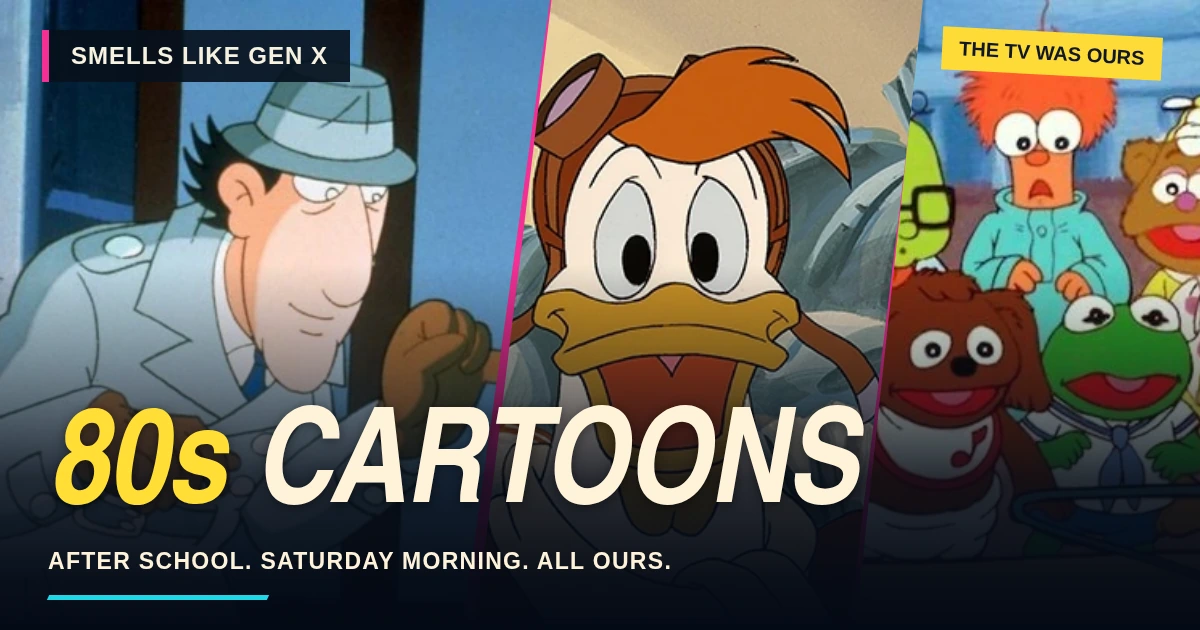
The school day ended in stages. First the bell, then the trip home, then the urgent business of getting a television switched on before the opening finished. A backpack landed somewhere that was technically indoors. A snack appeared. A villain with a better wardrobe than most adults announced another plan to conquer the world. Homework had excellent intentions. The cartoon had already started.
Saturday offered a different arrangement: pajamas, breakfast, and a stretch of television that seemed to have been put there specifically for children. The weekday shows had to fit around school. On Saturday, school had thoughtfully removed itself from the discussion. Both experiences belong to the story of 1980s cartoons, even though the programs reached the living room through different stations, schedules, and business deals.
This was a decade with room for a sword held above a secret identity, robots arguing about energy, a detective whose niece did the actual detecting, and a village of blue people having an exceptionally complicated relationship with one wizard. It could also make a nursery bigger than outer space. The range mattered. Children didn’t all want the same fantasy, and a household with several children was perfectly capable of discovering that at considerable volume.
The cartoons became part of the furniture of 1980s television: familiar voices, short appointments, recurring arguments, and characters who stayed the same age while their viewers moved through school. The route into that world depended on where you lived and what your station chose. Here is how that busy, brightly colored world worked—and why so much of it still lives somewhere just behind the first few notes of a theme song.
Inside This Article
- Getting Home Before the Opening
- Saturday Had a Different Temperature
- Networks, Syndication, and the Channel That Carried It
- He-Man and ThunderCats: Fantasy With a Place to Stand
- G.I. Joe and a Team for Almost Every Kind of Kid
- Transformers, M.A.S.K. and the Big Reveal
- The Smurfs and the Appeal of Small Worlds
- Inspector Gadget: The Detective Who Needed Supervision
- Muppet Babies: The Nursery With No Outer Limit
- Gummi Bears, Wuzzles and DuckTales
- Rescue Rangers and the Cartoons Crossing Into the 90s
- Yes, the Commercials Were Part of It
- Someone Had to Make All Those Worlds
- Reruns Were How You Learned the Place
- The Story Had to Work Before Dinner
- The Household Was the Other Cast
- Why the First Few Notes Still Work
- Watching Again Without Rebuilding the Whole Saturday
- Questions From the Living-Room Floor
Getting Home Before the Opening
An after-school cartoon began with a practical question: could you get there in time? The answer depended on a bus route, a walk, an errand, or the adult who needed the television for something else. The broadcaster didn’t know that your class had been dismissed late. It simply carried on with its opening, its first scene, and whatever extremely avoidable disaster the bad guys had arranged.
That gave small decisions an unreasonable amount of importance. Change clothes first or turn on the set? Make the snack or wait until the commercial? Go outside now or after the episode? These were not major events in a childhood biography. They were repeated decisions, and repetition gave them weight. An afternoon became recognizable through the things that happened in roughly the same order.
The show also changed the feel of the room. School had rules about sitting, speaking, and finishing assignments. The cartoon invited a different kind of attention: knowing which robot was which, identifying a villain from a voice, noticing that a character had made precisely the same mistake last time. Adults didn’t necessarily recognize this as expertise. Children were nevertheless accumulating it, one mildly alarming fortress at a time.
There was a social clock as well. A friend who watched the same program became someone with whom you could resume a conversation rather than start one. You didn’t have to explain the premise before discussing a scene. You went straight to the important issue, such as whether a particular machine had any sensible reason to turn into that particular vehicle.
Local television shaped that routine. The same title often occupied different slots in different places, and stations moved programs. A remembered time is often perfectly accurate for one living room without being a national fact. What children shared was the appointment: a recognizable place in the afternoon when the day’s obligations briefly gave way to a more interesting set of problems.
The wider experience of watching TV in the eighties helps explain the attachment. Viewers often joined the program already in progress, missed an episode, or encountered a repeat without choosing it. The cartoon had to welcome them anyway. Its opening, character designs, and reliable conflict acted like a front door that was easy to find.
Saturday Had a Different Temperature
Saturday cartoons arrived with a longer breath. There was no school bus to catch at the end of the first commercial break. The room might still be quiet, the rest of the household might still be asleep, and the person holding the cereal bowl could briefly feel like the only fully functioning member of the family. This was an impressive achievement for someone wearing pajamas decorated with spaceships.
Network Saturday programming provided one kind of continuity. A show ended and the next one arrived, surrounded by promos, station identification, and advertising. Children developed loyalties to a whole stretch of television, not just one title. A disliked program became the thing you sat through—or the moment to investigate another channel—before the favorite came back into view.
That did not mean every American child watched an identical morning. Affiliates, local decisions, time zones, reception, and the year all mattered. A lineup remembered from the beginning of the decade often looked quite different from one remembered near its end. Memory is very good at putting all the favorites together in one glorious block. Actual television had contracts, preemptions, and the occasional deeply unwelcome schedule change.
The distinction between a weekly morning ritual and a weekday habit also affected how a program felt. A Saturday episode could carry the pleasure of something saved for the weekend. An afternoon program became a regular visitor, familiar enough that its world seemed to continue behind the screen when it wasn’t on. Neither experience required a child to know how the program had been sold.
The dedicated history of Saturday morning cartoons of the eighties follows those network blocks and changing choices more closely. Here, Saturday is one part of the larger picture. An era that contained both a leisurely morning in the Smurf village and a hurried afternoon encounter with transforming robots can’t be squeezed into a single cereal commercial.
Networks, Syndication, and the Channel That Carried It
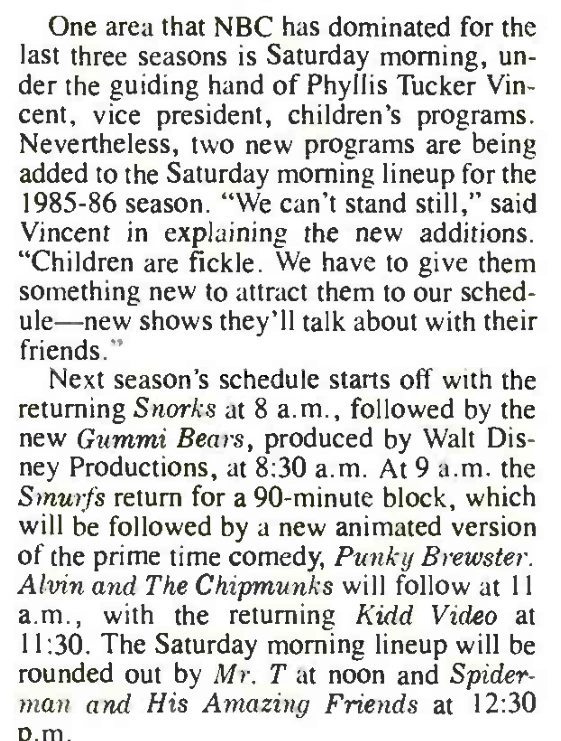
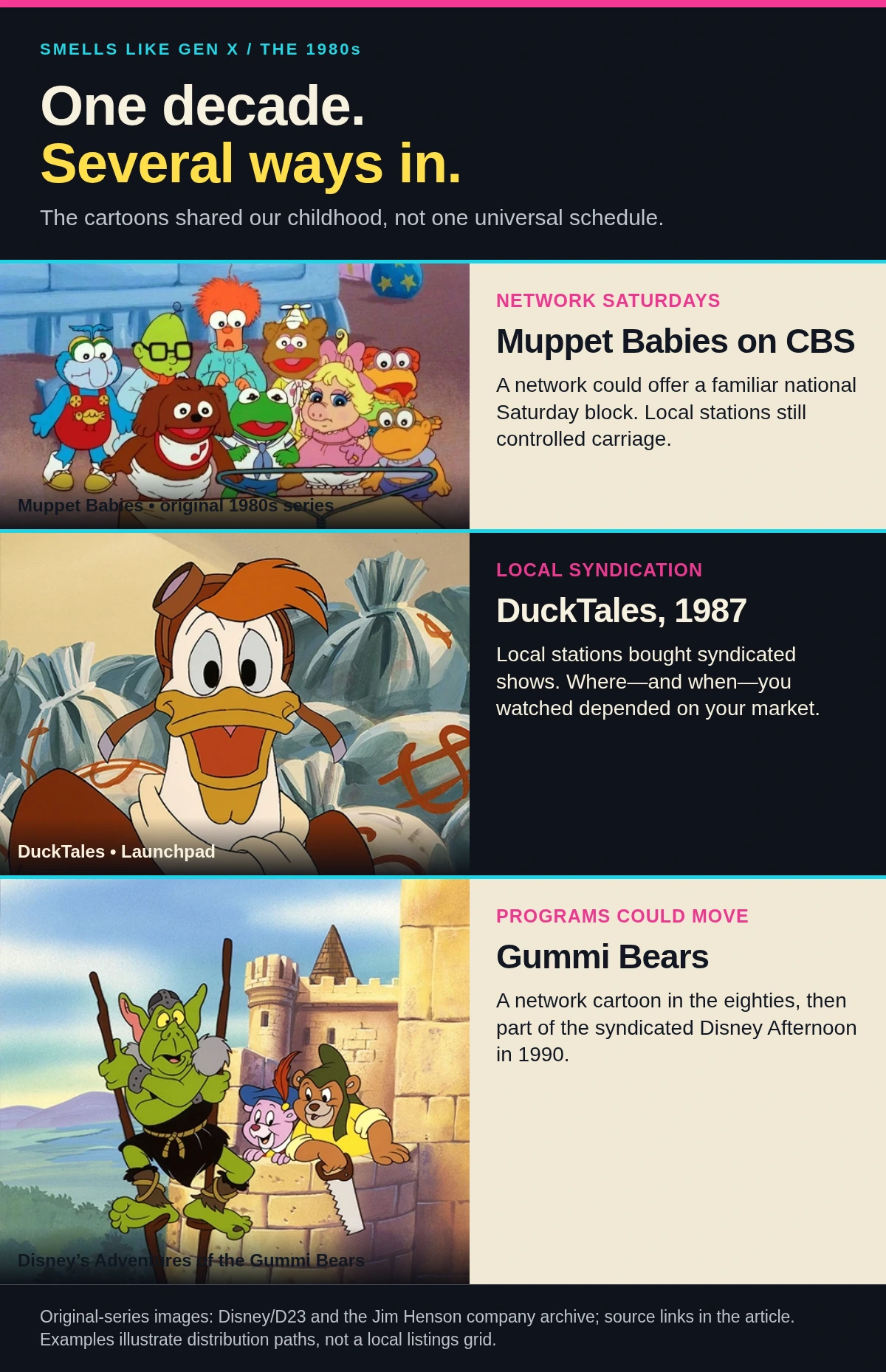
The television business had a vocabulary for getting a cartoon to a station. Children generally had a shorter vocabulary: the channel number. A network program reached participating stations through a network’s schedule. A syndicated program was licensed to individual stations or station groups. The difference could be invisible from the couch, but it helped determine which shows appeared together and when a viewer could find them.
Syndication was especially useful for creating weekday familiarity. A local station could build a children’s block around programs it had acquired. The station’s own announcer and promos might become part of the experience, giving the whole stretch a local identity even when the cartoon had been made far away. It was easy to associate a global franchise with the same channel that ran the local weather.
Network carriage and syndication were not permanent labels stamped on a character’s forehead. A series could travel between outlets over its life. Disney’s Adventures of the Gummi Bears, for instance, belongs in the story of network Saturday television before its later place in a syndicated Disney block. Remembering one version of its schedule doesn’t erase the other. The bears were busy; distribution departments were busier.
The period industry report shown here makes those decisions tangible. In May 1985, NBC was telling affiliates about a coming Saturday season that would introduce Gummi Bears and an animated Punky Brewster alongside returning programs. The two additions offered quite different kinds of familiarity: a new fantasy community and an animated version of a live-action sitcom. Choosing cartoons meant balancing recognition with something viewers hadn’t already seen.
NBC children’s-program executive Phyllis Tucker Vincent discussed the need for new shows that children would talk about with friends. That ambition is more recognizable from the couch than a sales chart. A program had to give its audience something to mention later: a character, a joke, an adventure, a world worth another visit. The business conversation and the schoolyard conversation were connected long before either participant met the other.
Nor did being an animated program identify a particular audience measurement. A syndicated children’s show, a Saturday network cartoon, and a prime-time sitcom occupied different competitive settings. A claim about one station’s children watching at a certain time is not automatically a claim about all television households watching in the evening. How Nielsen ratings worked explains the numbers and their denominators without turning a cartoon memory into an invented prime-time ranking.
For a viewer, the result of all those arrangements was a menu with local quirks. One friend had a show you didn’t see. Another remembered it under a different station’s branding. A move to a new town could rearrange the entire afternoon. The cartoons felt national because their characters traveled so widely, but the route from school to the screen remained personal and local.
He-Man and ThunderCats: Fantasy With a Place to Stand
Fantasy cartoons offered children something more useful than a complicated map: a place they could recognize immediately. A castle silhouette, an unusual sky, a vehicle, or a particular musical flourish announced where they were. Before anyone had explained a plan, the world had already established its invitation. You knew what kind of adventure you had walked into.

He-Man and the Masters of the Universe made strength theatrical. Prince Adam’s transformation turned an ordinary change of role into a ceremony, complete with a sword and a voice that didn’t sound remotely concerned about disturbing the neighbors. The appeal wasn’t confined to who could lift the largest object. It was the promise that a familiar person could become equal to a frightening situation.
The contrast between heroic grandeur and comic company made that world easier to enter. Cringer and Orko helped keep the palace from becoming a very serious meeting about destiny. Skeletor’s furious self-importance gave the opposition a personality beyond a collection of weapons. You enjoyed the danger and still laughed at the villain, which is an excellent arrangement when the villain lives in a place called Snake Mountain.
ThunderCats offered a different fantasy texture: travelers from a lost world establishing themselves on Third Earth. The names, landscapes, and creatures made the setting feel larger than the immediate mission. Lion-O’s imposing appearance could coexist with inexperience. That combination gave the adventure a useful question: what happens when someone has the equipment of a leader before he has acquired all the judgment?
These programs gave children portable pieces of a world. You carried a transformation gesture onto a playground without reproducing an entire episode. A branch became a sword; a corner of the yard became a fortress. The television supplied a shared vocabulary, while the children supplied plots that would have caused a professional continuity editor to sit down quietly.
The full He-Man story and the original ThunderCats television world deserve their own close looks. Across the decade, their larger contribution was the same kind of invitation: enter a place with rules, discover people worth recognizing, and imagine yourself doing something slightly more consequential than finding a clean gym shirt.
G.I. Joe and a Team for Almost Every Kind of Kid
A team gave the room something to argue about besides the channel. Somebody wanted the leader. Somebody preferred the quiet one with the interesting equipment. Somebody chose the character with the best vehicle and considered the matter settled. That variety helped make shows such as G.I. Joe stick: you could watch the same adventure as your friends without all trying to be the same person afterward.
G.I. Joe turned that variety into a recurring clash with Cobra. Uniforms and equipment distinguished characters quickly, while opposing personalities made the two sides more than colored shapes moving through an action scene. The appeal of a specialist is easy to understand at school age. Being the person who knows how to solve one particular problem can sound much more attainable than being the strongest person in the universe.
Team stories also invited arguments about usefulness. Who actually accomplished something? Who needed rescuing? Why did a character with an apparently perfect skill fail to use it at the obvious moment? The questions made watching an active business. You admired the adventure and served as its unpaid tactical consultant, a position with very little authority and extremely strong opinions.
Cobra’s machinery and theatrical villainy supplied a strange, comfortable distance from actual danger. This was a stylized screen conflict with spectacular inventions, outlandish plans, and personalities large enough to compete with the hardware. Its pleasures shouldn’t be mistaken for a documentary account of military life. The cartoon’s job was to generate another mission, not to prepare anyone for a procurement hearing.
Other series organized their groups differently. The tiny Rescue Rangers needed ingenuity because the ordinary world was so large around them. The ThunderCats needed a community as well as a fighter. The Transformers made allegiance part of a whole civilization of machines. Changing the scale or setting changed the action, but the team remained a way to distribute attention and loyalty.
The specific television rhythm of G.I. Joe’s after-school adventures includes its familiar public-service messages and its own chronology. In the wider cartoon landscape, it represents the attraction of belonging to a group where everyone has a role. Some children chose the role. Others chose the character with the best hat. Both approaches produced committed viewers.
Transformers, M.A.S.K. and the Big Reveal
Transformation was practically a form of punctuation. A character changed shape, a vehicle revealed a second purpose, or several pieces assembled into an answer to a very large problem. The sequence announced that the story had reached a new level. Even when a viewer knew exactly what would happen, watching it happen remained part of the pleasure.
The Transformers made that premise the fabric of its world. Cars, trucks, and aircraft were not simply equipment used by characters; they were forms the characters could take. A familiar object acquired a concealed personality. It was an unusually effective idea for children who already looked at an ordinary vehicle and imagined what it could do if the adults would stop using it for groceries.
The Autobots and Decepticons also gave transformation a social setting. The robots had allegiances, temperaments, and arguments. Changing form could be a practical move in an action scene, but a robot’s appeal depended on more than a mechanism. The voice and attitude made the difference between a clever concept and a character a viewer wanted to see again.
The franchise’s toy line and animated series both launched in 1984, a connection that was hardly hidden from its audience. Yet the screen experience had its own logic: sound, speed, timing, scale, and personalities in conflict. A toy could hold a pose. Animation could let a machine stride into a scene, speak with absolute confidence, and immediately become involved in a disagreement with another machine who had also brought a vehicle mode.
Transformation stories offered an especially satisfying combination of surprise and reassurance. The change looked dramatic, but it followed a recognizable pattern. Children could anticipate it, imitate its noises, and object when a pretend version failed to respect rules they had apparently memorized. The living room could briefly resemble a repair shop staffed by very small, very demanding engineers.
The original Transformers series has enough shifts in cast and story to warrant a separate feature. What it contributed to the wider era was an easy-to-grasp imaginative possibility: the world around you might have another shape, and the ordinary thing in the driveway might be far more interesting than it had admitted.
The Smurfs and the Appeal of Small Worlds
Not every cartoon needed a towering hero. Some of the decade’s most inviting worlds worked in the opposite direction, making their inhabitants small and their surroundings enormous. A mushroom house or a passage under the earth could establish scale more efficiently than a speech. The viewer understood immediately that everyday spaces might conceal whole communities.
The Smurfs offered a village rather than a single star. Their familiar names and traits helped children recognize a social arrangement: the capable one, the overconfident one, the clumsy one, the authority figure trying to keep everything functioning. The forest could become dangerous, but the village remained a place to return to. Adventure had a home address, even if the postal service would have found it inconvenient.
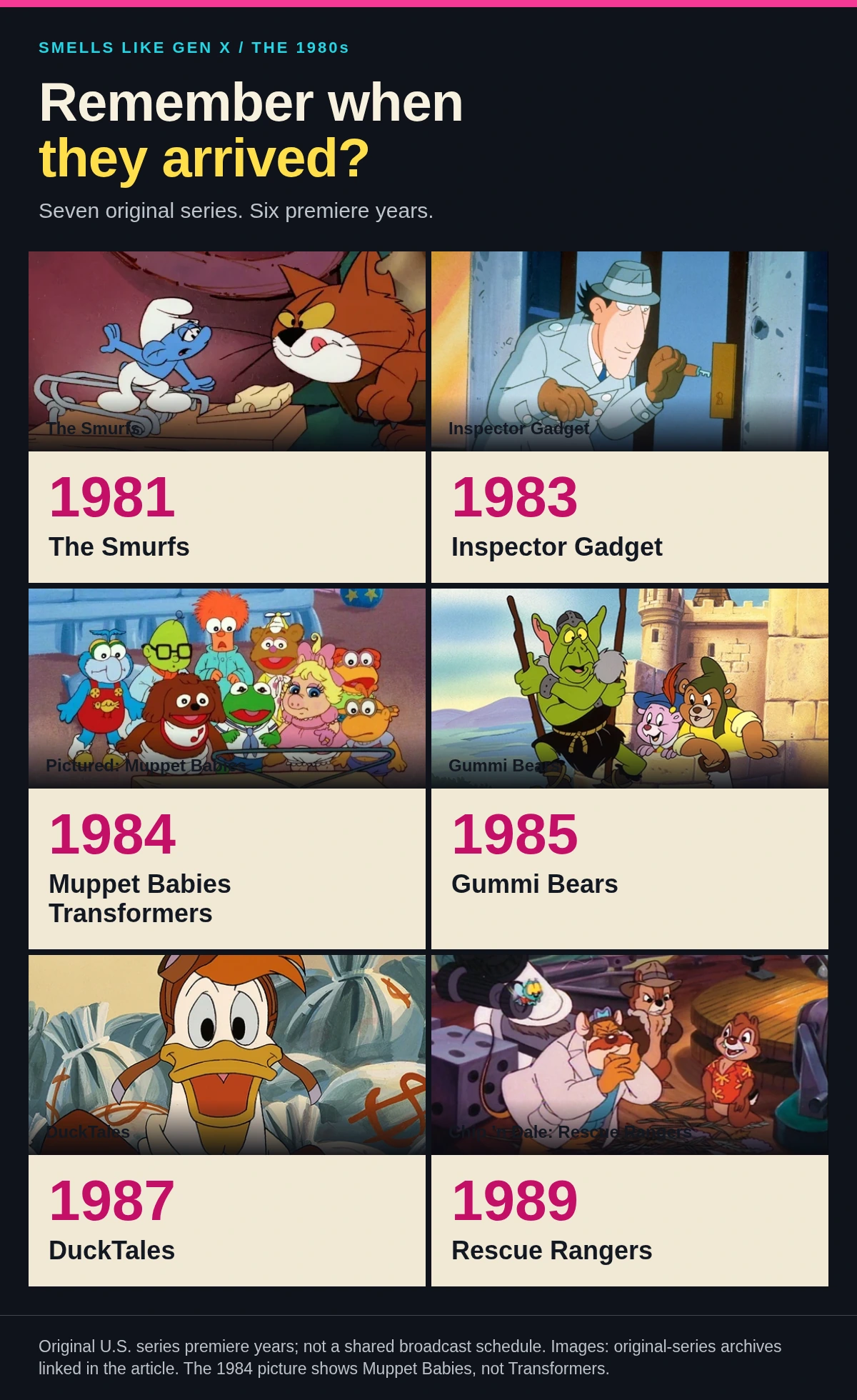
Gargamel’s hostility gave those domestic rhythms an outside threat. His own exasperation also supplied comedy. The contrast between a very angry wizard and the little community he couldn’t leave alone made the premise readable without elaborate preparation. You understood the sides and settled in. The show’s Hanna-Barbera television incarnation began in 1981, bringing Peyo’s characters into a long American Saturday-morning life on NBC.
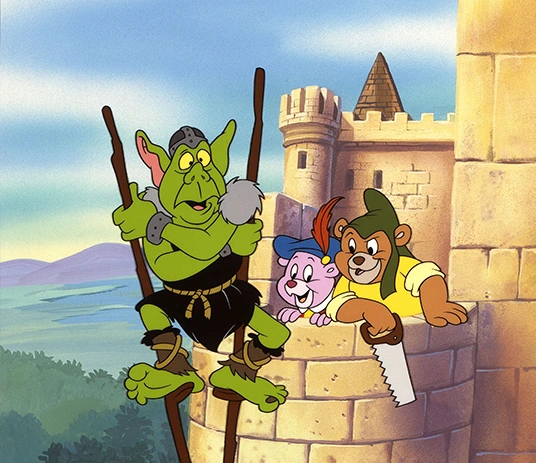
The Gummi Bears developed another hidden community, with forest spaces and underground routes that made the landscape feel usable. An adventure world becomes more convincing when its inhabitants seem to have ways of getting around it. The Quick Tunnels were the sort of detail that could make a child study an illustration rather than simply glance at it. Somewhere behind the next wall, perhaps, was an excellent transport system.
Small-scale fantasy also made danger imaginative rather than merely bigger. A familiar animal, an adult-sized room, or a stretch of machinery became an obstacle course. Chip ‘n Dale Rescue Rangers found opportunities in that mismatch. The world was full of things made for someone else, so the characters needed resourcefulness. Size became a source of storytelling possibilities, not a limitation on how much story could happen.
Inspector Gadget: The Detective Who Needed Supervision
Inspector Gadget possessed an extraordinary collection of mechanical solutions and a fairly unreliable understanding of the problem in front of him. That imbalance was the joke. His body could produce an astonishing device, but the person wearing the trench coat still needed help. Technology could extend his reach without improving his judgment, a distinction that has aged remarkably well.
Penny and Brain made the premise work. They gave a child watching at home people—or, in Brain’s case, a dog—to follow behind the official action. The audience saw competence that Gadget failed to notice. Knowing more than the adult hero was not an incidental pleasure. It placed the viewer in a privileged position, watching the gap between authority and actual problem-solving widen with every malfunction.
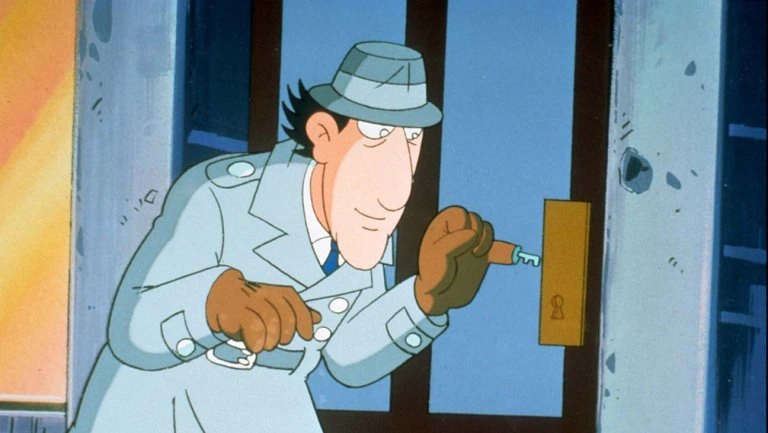
That structure is different from a straightforward action fantasy. The detective might look confident, but confidence wasn’t evidence. A gadget might be impressive and still be entirely wrong for the occasion. The joke depended on cause and effect, misplaced credit, and the little thrill of recognizing who had really done the work. A child didn’t need to call any of that irony to enjoy it.
Heathcliff offered a more terrestrial sort of disruption. An orange cat could make a neighborhood feel like his personal territory, with food, dogs, people, and trouble all available nearby. The animated title had a DiC series in 1984, alongside the Catillac Cats world. Its appeal didn’t require an alien invasion. Ordinary places already contained plenty of things for a determined cat to interfere with.
The contrast matters in an overview of the decade. Remembering only warriors, robots, and elaborate weapons leaves out the cartoons built around appetite, vanity, stubbornness, and comic misunderstandings. These were familiar motives in an eighties household. A child didn’t have to understand an interstellar energy crisis to understand wanting something that another person had inconveniently put out of reach.
Muppet Babies: The Nursery With No Outer Limit
Muppet Babies made a surprisingly persuasive argument for staying indoors. Its nursery contained the material for adventures far larger than the room itself. A game, a worry, or an object sent the characters somewhere else. A small child’s imaginative life became the program’s engine rather than something waiting to be replaced by a more serious plot.
The original animated series premiered on CBS on September 15, 1984. Its familiar Muppet personalities survived the change of age and medium, so the premise offered recognition and novelty at once. Piggy’s force of personality didn’t need an adult body to make itself felt. Kermit could remain an organizing presence while the group invented new trouble around him.
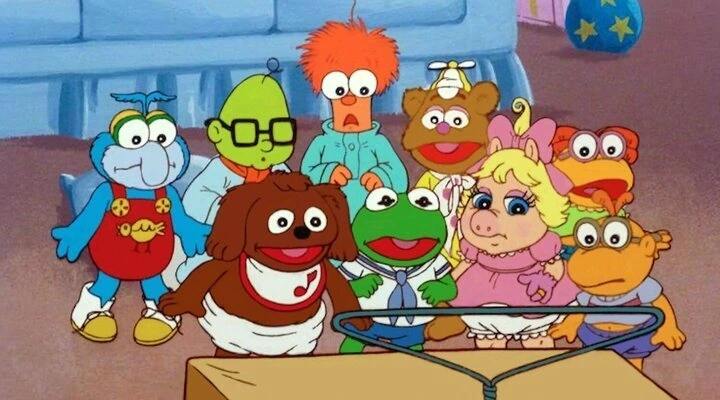
The show also understood that children borrow freely when they play. An image, a movie idea, a story, and the thing lying on the floor can coexist without anyone filing a formal objection. The original series mixed animation with other visual material, giving its fantasy a collage-like freedom. The nursery was a starting point; the imagination didn’t have to respect its walls.
That is a useful corrective to the idea that eighties animation always demanded another object to own. Muppet Babies certainly existed within a commercial culture, but its central activity was making something out of an idea. You could imitate that activity without acquiring a castle or a vehicle. A cardboard box had already submitted an excellent application for several starring roles.
There was comfort in the return, too. However extravagant the fantasy became, the nursery remained a group with familiar wants and frictions. The show made ordinary childhood uncertainty feel worth an adventure. A room didn’t have to be dull because it was safe, and a fantasy didn’t have to end with the biggest available explosion.
Gummi Bears, Wuzzles and DuckTales
Disney brought two new animated series to network Saturdays in 1985: The Wuzzles on CBS and Adventures of the Gummi Bears on NBC. They offered different invitations. The Wuzzles combined animals into cheerful, deliberately peculiar characters. Gummi Bears built a continuing fantasy setting. Neither was simply a package of theatrical shorts inserted between station announcements.
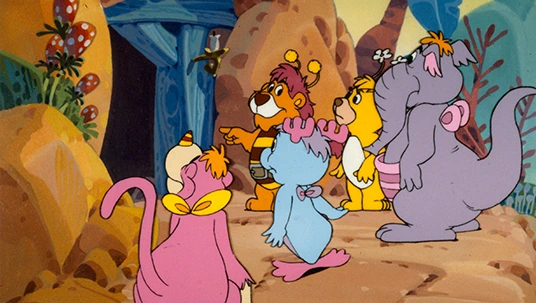
A Wuzzle could look like somebody had mixed up the animal instructions. Gummi Glen, meanwhile, felt like a place you might discover if you knew which tree, tunnel or secret passage to try. Both arrived in 1985, yet they asked for different kinds of attention. One sold you on an immediately funny creature; the other invited you to learn your way around a whole hidden world.
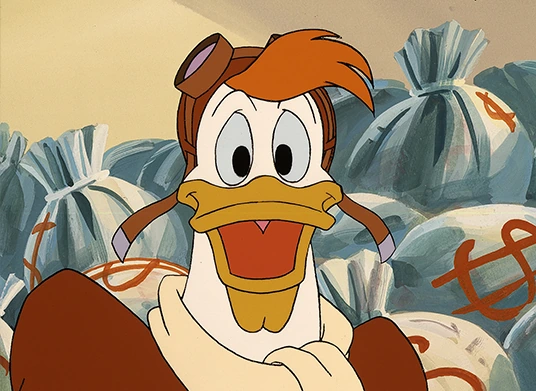
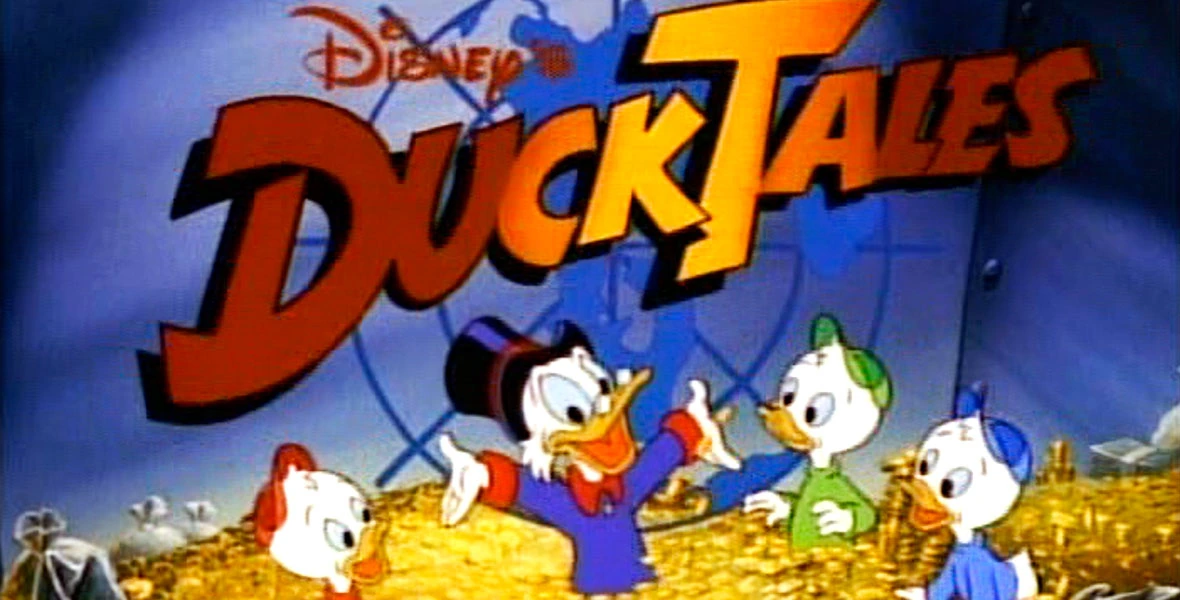
DuckTales arrived in syndication in September 1987. Its adventure premise put Scrooge McDuck and his family into a world where money could be an obsession, an obstacle, a temptation, or the beginning of a journey. A fortune gave Scrooge reasons to travel, protect, argue, and occasionally discover that his priorities required adjustment.
The show made room for comedy without making the adventure feel disposable. Launchpad could be funny and still belong in the journey. The nephews could participate rather than simply watch an adult solve everything. Entering Duckburg, you didn’t have to choose between jokes and a story with forward motion. The program could offer both within the same afternoon.
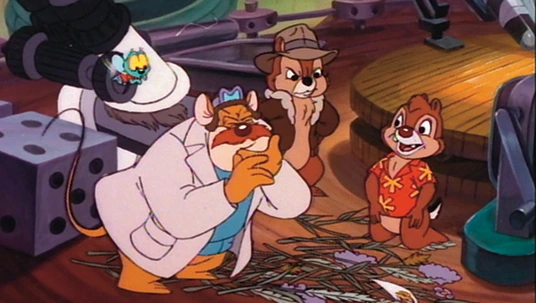
Rescue Rangers added another late-decade version of the team adventure, changing the scale and tools rather than merely changing the costumes. Its small protagonists had to make the surrounding world work for them. Gadget Hackwrench’s ingenuity made a strong complement to the group’s more impulsive instincts. A useful invention mattered as much as a bold entrance.
These programs are often gathered under memories of The Disney Afternoon. The named block began in 1990, after the eighties had ended. Its earlier shows belong here; moving the later block backward would flatten the actual sequence. Children experienced a growing set of favorites before the familiar umbrella name gathered several of them together.
Rescue Rangers and the Cartoons Crossing Into the 90s
An era doesn’t change its cartoons at midnight on New Year’s Eve. Shows introduced near the end of the eighties continued to shape the nineties, while older programs remained in circulation. Discovering a series late didn’t mean caring how long it had existed. The first time you saw something and the first time it aired were two different dates, both meaningful in different ways.
Teenage Mutant Ninja Turtles belongs to that overlap. The original animated series began in 1987, before the enormous later wave of Turtle visibility could make it feel like a purely nineties arrival. Its premise combined an action team with comic friction, recognizable personalities, and the absurdity already present in the title. The show didn’t ask anyone to pretend its central idea was ordinary.
That mixture suited an audience able to enjoy a battle and a joke in the same breath. The characters had distinctive attitudes and still belonged to a group. Their world was strange enough to invite questions and familiar enough to sustain playground arguments. Once again, children acquired a shared cast of people to discuss—although these particular people required a somewhat more complicated biological explanation.
DuckTales and Rescue Rangers also carried their eighties beginnings forward. Their continued life helps explain why personal decade boundaries can feel untidy. A television memory often includes the place where you first watched a show, the year you became most attached to it, and a later repeat you watched with someone younger. The mind files by experience, not by a broadcaster’s premiere ledger.
Keeping the chronology straight makes the memories more interesting. It reveals a period of overlap and experiment rather than a sealed box of perfectly matched products. The late eighties were full of programs building audiences whose strongest memories would develop later. The future was already in the room, usually asking whether anyone else wanted the last slice of pizza.
Yes, the Commercials Were Part of It
The cartoon gave the toy a voice before the toy reached your bedroom. Now you knew whom it disliked, what its vehicle was supposed to do, and the general amount of shouting required to begin an adventure. The commercial break was standing by to help with the next step. Once the figures were on the floor, though, the official writers lost control. A missing accessory could change the whole plot.
Watching a cartoon didn’t mean owning its toys. Some children had many, some had a few, and some knew the characters mainly through television or friends. Price, availability, family rules, gifts, and simple preference shaped the collection. A broad cultural memory should have room for the child who wanted the expensive thing and never received it, as well as the child whose birthday party apparently had a licensing department.
Toys could influence what a viewer noticed. A newly introduced character looked like a potential addition to a team at home. A vehicle suggested a whole afternoon’s play. Yet the screen could also make a character appealing through a voice, a joke, or an act of courage that a molded figure couldn’t perform. Commercial origins don’t explain away every emotional response to a story.
The advertising breaks widened the conversation beyond the program. Other toys, games, foods, and products entered the same stretch of viewing. Children compared what they saw with what they had and what friends discussed. Adults sometimes encountered the entire television experience through the requests it generated, which was an effective way for a cartoon to acquire a reputation as a very talkative shopping list.
You can follow the plastic side of the story through our eighties toy guide. On television, the extra ingredients were movement and personality. The same figure could look impressive in a package and become somebody you rooted for once a voice, a bad decision and a ridiculous escape were attached. The sales connection was obvious. So was the fun of watching the characters get into trouble.
Someone Had to Make All Those Worlds
It is easy to remember cartoons as if they arrived fully formed with a theme tune attached. Actual animation required people making decisions about writing, design, voices, backgrounds, movement, editing, and sound. A scene that passed in seconds contained several kinds of work. The speed of children’s television consumption didn’t make that work automatic.
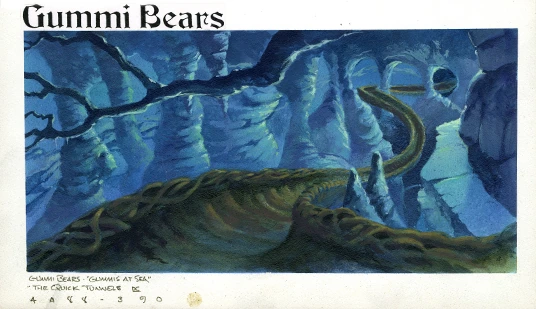
Backgrounds deserve particular credit. They established where a character lived, what a journey felt like, and whether a place seemed threatening or welcoming. The Gummi Bears’ tunnel artwork reproduced here is worth looking at beyond its role as a piece of nostalgia. Curves, dark passages, and connected spaces turn a practical route into somewhere a viewer wants to explore.
Character design had to work quickly, too. A silhouette, a face, a color, or an accessory helped a child distinguish someone in a group. That clarity served action and comedy alike. Viewers recognized favorites before the characters spoke, which made a crowded scene more readable and a brief appearance more satisfying. The best designs didn’t need an introduction every afternoon.
Repeated visual material was part of the experience. An opening, a transformation, or a familiar movement could become something children anticipated. Sometimes repetition exposed the mechanics of production; sometimes it became a ritual with its own pleasure. You noticed the reuse and still wanted the moment. Knowing the chorus doesn’t prevent anyone from waiting for it.
Quality also varied within and between programs. A spectacular opening established an expectation that an ordinary dialogue scene didn’t match. A memorable background outlived the plot it supported. Revisiting the cartoons allows room for both admiration and criticism: the ingenuity that survives, the shortcuts that show, and the work that made a small television picture feel like a whole place.
Reruns Were How You Learned the Place
Repeats could be irritating when you wanted something new, but they were also a way of becoming fluent in a program. The first viewing supplied a story. Later viewings revealed a character’s habits, a favorite joke, an approaching scene, or a background detail you had missed. Familiarity made the show easier to enter while doing something else, such as eating a snack with unjustified confidence over the carpet.
Broadcast order and personal order didn’t always agree. You met a character halfway through the run, missed an explanation, and pieced the situation together later. Programs with clear premises and dependable relationships accommodated that kind of viewing. You didn’t always need a perfect sequence to understand why Skeletor was angry or why Penny was quietly doing something useful.
The repeat also changed the social experience. Two friends knew different episodes and exchanged explanations. Someone spoiled a plot without realizing another person hadn’t seen it. Recognizing a rerun early conferred the temporary authority of a guide, even if the audience consisted of one younger sibling who had not requested the service.
Recording could alter that relationship, when a household had the equipment and permission. VHS recording gave some viewers a way to preserve a favorite or watch at a different time. It also introduced practical matters: the right tape, enough space, correct settings, and the possibility that someone had recorded over something important. Ownership of a machine did not guarantee a flawless personal archive.
For many viewers, the strongest familiarity still came from whatever the station chose to run. The programs belonged to a shared broadcast routine before they belonged to a personal collection. You couldn’t necessarily summon the exact episode you wanted, but you could return to a world often enough to feel you knew the way around it.
The Story Had to Work Before Dinner
A television cartoon had a modest amount of time to establish a problem, complicate it, and bring the viewer to some kind of landing. That constraint encouraged clear beginnings. A visitor arrived, a machine failed, someone wanted something, or a familiar antagonist decided that this afternoon was finally the afternoon. The audience could recognize the invitation without being asked to study first.
The middle of the story was where personalities earned their space. A complication mattered more when it exposed a character’s habits: pride, impatience, greed, kindness, or the conviction that an obviously questionable plan would work perfectly. The equipment could change from one program to another, but those motives were legible to children. Almost everyone had encountered somebody who refused to admit a mistake, even without access to a secret laboratory.
Comedy used the same clarity differently. Gadget’s confident misunderstanding could send the plot in the wrong direction while Penny worked on the right one. Heathcliff could turn an ordinary desire into an escalating nuisance. The joke grew out of the distance between what a character wanted and what happened next. A large mechanical weapon was optional; sometimes a stubborn cat was quite enough.
Adventure needed a sense of possibility as well as threat. A visible tool, a possible route, or a character’s useful ability invited viewers to imagine a solution. That made the eventual escape or rescue satisfying when it connected to something already established. A world with recognizable rules gave children a way to participate mentally, even if their proposed solution involved considerably less patience than the script required.
The ending could offer relief rather than a permanent change. The village remained, the team survived, and the central relationships were available for another episode. Adults sometimes describe that stability as a weakness, particularly when revisiting a run in rapid succession. Within a broadcast routine, it also helped the program remain welcoming. Missing Tuesday didn’t necessarily make Wednesday incomprehensible.
That doesn’t mean children never wanted consequences or continuity. A larger story, an introduction, or a change in the familiar group could feel significant precisely because the normal arrangement was so well known. The surprise had something to disturb. A program built attachment through dependable habits and then spent some of that attachment on a moment that didn’t behave as expected.
There were limits. A reset could become irritating if it made the characters seem incapable of learning. A villain’s recurring failure could drain the danger. A moral delivered after an adventure could feel connected to what had happened or pasted onto the end like an extra instruction sheet. Children were not uniformly uncritical viewers; they could identify a dull episode without knowing the production circumstances behind it.
The strongest memories often come from a successful balance: enough familiarity to settle in, enough variation to make the visit worthwhile. An enjoyable episode didn’t have to invent an entirely new kind of television. It needed to give its particular characters something worth doing and let their particular qualities matter. That is a smaller claim than changing a generation, but it describes a substantial amount of good entertainment.
The Household Was the Other Cast
A cartoon’s audience wasn’t simply a child and a screen. It could include a sibling who wanted another channel, a parent hearing the theme from another room, a friend visiting after school, or someone announcing that the set needed to be turned off. These people didn’t appear in the credits, but they could exercise a remarkable amount of control over the viewing experience.
Shared television made compromise concrete. You might watch a show you hadn’t chosen because someone else had won the argument, then discover a character you liked. You might trade one program for another or surrender the room when an adult’s appointment began. The arrangement could feel wildly unfair, particularly when a villain had selected exactly that moment to reveal the next stage of a plan.
Differences between households mattered as much as differences between networks. Some children watched with limits, some with company, some with a broad range of channels, and some with the stations they could receive clearly. Cable expanded possibilities for some families without instantly making every home the same. The story of getting cable in the eighties is part of that uneven landscape.
The cartoon also became background to a relationship. A joke repeated between siblings survived after the episode itself disappeared from memory. A character’s voice became a family imitation. The important detail wasn’t always the official plot. It was who laughed, who complained, or who remembered to call someone into the room when a favorite program started.
That is why a list of titles never quite captures the experience. The same episode could mean quiet time alone to one viewer and a noisy weekly gathering to another. Television provided the common material; households supplied the setting in which it became memorable. Even a program built to travel across the country arrived in a particular room.
Why the First Few Notes Still Work
A theme song was useful television equipment. It identified the program, established energy, and gave a returning viewer a quick route back into the world. Children heard those openings repeatedly, often at the same points in their week. An adult can forget the plot of an episode and still recognize the sound that once meant the afternoon had properly begun.
The pictures could do it too: a sword in the air, a robot changing shape, mushroom houses, that ridiculous detective’s hat. Sometimes one image brings back the whole afternoon before you can remember the title. It may also bring back the rug, the snack, or the sibling who insisted on talking over the opening. Television memories rarely bother to file the program separately from the room.
Some cartoons survive in memory through almost nothing at all: a vehicle, a color, half a premise, a character whose name refuses to come back. The less-remembered eighties cartoons are especially good at producing that experience. Recognition can arrive before recollection, followed by the slightly offended realization that a show has been occupying space in your head without paying rent.
The attraction needn’t depend on declaring everything better then. Some jokes are thin, some stories repeat themselves, and some remembered masterpieces look less impressive when watched without the protective fog of being nine. Other moments are better than expected: a background, a voice performance, a comic pause, or a character relationship that had more care behind it than you noticed.
What remains valuable is the specificity. These weren’t interchangeable symbols labeled childhood. They had different rhythms, designs, assumptions, and kinds of fun. An era with both Gadget’s magnificent incompetence and the nursery’s imaginative freedom offered children more than one way to enjoy being an audience.
Watching Again Without Rebuilding the Whole Saturday
Returning to an old cartoon works best as curiosity rather than an examination the program has to pass for your childhood to remain valid. Try an actual episode instead of a montage of openings. Watch how the characters behave between the famous moments. Notice what the story assumes you already know and what it takes time to explain.
It helps to identify the version first. A familiar title can lead to a later revival, a film, or a new interpretation rather than the original series. He-Man, ThunderCats, Transformers, Muppet Babies, and DuckTales all have screen histories beyond the eighties incarnations discussed here. A new design isn’t evidence that your memory is broken; sometimes you have simply opened the wrong door.
Don’t demand that one episode reproduce an entire period of life. The original experience included the room, the schedule, the people, and your own age. A restored picture can improve the visibility of a background, but it cannot restore the fact that you once had very few responsibilities after the final bell. That particular feature was never included on the tape.
The reward is smaller and more interesting: recognizing what the artists built, hearing a voice you haven’t thought about in years, or discovering why a particular premise made so much sense to a child. You may keep the affection and lose the need to defend every frame. The cartoon can be a piece of work as well as a piece of your past.
And the next time a theme appears from another room, you may still know the entrance. A school day, a Saturday, a snack, a whole little world waiting behind the picture: the details return in their own order. Some appointments turn out to last much longer than the station ever scheduled.
Questions From the Living-Room Floor
Were all 1980s cartoons Saturday morning shows?
No. The decade included network Saturday cartoons, weekday syndicated programs, and animation encountered through other outlets and repeats. The distinction matters because a local afternoon schedule wasn’t a universal national lineup. A favorite could occupy different times in different markets or move during its broadcast life.
Why were so many cartoons connected with toys?
Characters and imaginary worlds could support both television stories and physical play. Programs gave a toy a voice, personality, and setting; toys offered children a way to invent further adventures. That commercial relationship was important, but it didn’t describe every cartoon or mean every viewer owned the merchandise.
Did the Disney Afternoon begin in the 1980s?
The named syndicated block began in 1990. Several of its familiar programs had eighties beginnings, including Gummi Bears, DuckTales, and Rescue Rangers. Remembering those earlier shows is accurate; describing their entire original eighties run as part of the later block confuses the shows’ beginnings with the package that subsequently brought them together.
Can prime-time Nielsen Top Ten lists tell us the most popular cartoons?
Not by themselves. Network prime-time season standings describe a different viewing setting from Saturday mornings or syndicated children’s slots. Cartoon audience claims need evidence for the relevant program, audience, time period, and market. A show’s premiere year is not proof that it appeared in that year’s prime-time Top Ten.
Sources & Further Reading
- Jim Henson Company Archives: Muppet Babies’ September 15, 1984 CBS premiere
- Jim Henson Company Archives: the original nursery concept and animated-series development
- Disney D23: original television animation, production artwork and the later Disney Afternoon chronology
- Disney A to Z: the original DuckTales series and syndicated debut
- Official Smurfs television catalog: the 1981–1989 Hanna-Barbera incarnation
- Official Heathcliff history: the DiC animated series in 1984
- WildBrain/DHX: the original Inspector Gadget’s thirtieth anniversary
- Hasbro: the 1984 Transformers toy and animated-series launch
- Paramount: original 1987 Teenage Mutant Ninja Turtles program and episode catalog
- Warner Bros. original ThunderCats program and episode descriptions distributed through Apple TV
- Broadcasting, May 20, 1985, p. 87: a contemporary announced Saturday network plan