ALF in the 80s: The Alien Who Took Over Prime Time
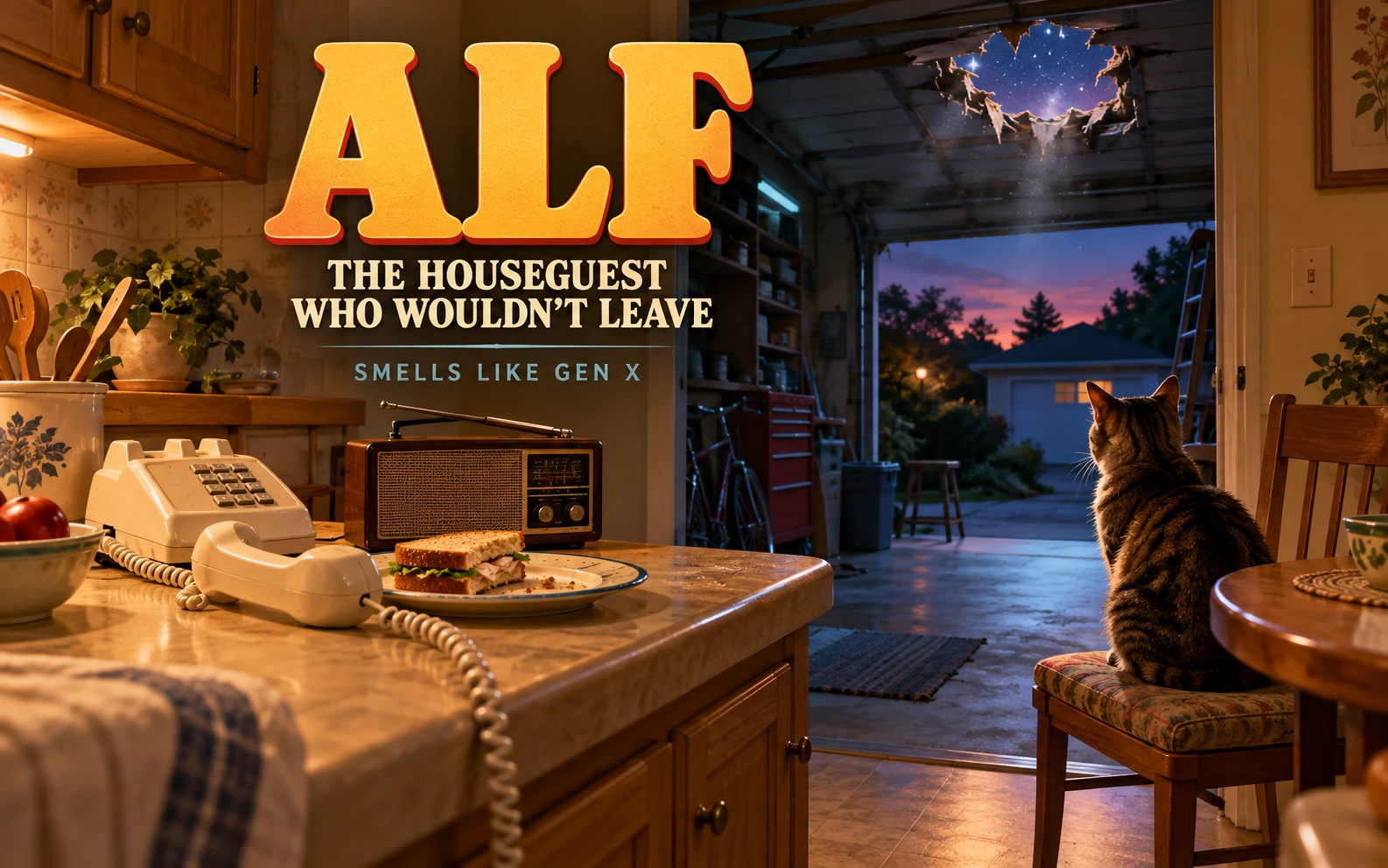
A cat with cause for concern, a father running out of patience, and the furry visitor who made himself far too comfortable in American prime time.
By Gizmo
ONE SECRET.
NO PEACE.
Inside This Article
- The garage roof was only the beginning of the damage
- September 1986: the Tanners make an unreasonable decision
- The opening makes the visitor part of the home movie
- Paul Fusco gives the creature a person inside the joke
- Willie Tanner, a decent man at the end of another sentence
- Kate Tanner understands what everybody’s kindness is costing
- Lynn and Brian have different reasons to open the door
- Lucky the cat, and the running joke with an obvious suspect
- The Ochmoneks are the neighborhood’s worst privacy settings
- Pennsylvania 6-5000: Willie did not authorize this foreign policy
- Strangers in the Night turns babysitting into concealment
- La Cucaracha lets something else invade the house
- A Christmas special that refuses the easy joke
- I’m Your Puppet gives ALF an unsettling little assistant
- NBC gets a top-ten houseguest
- Under the floor, the easy conversation took work
- A face made for the toy aisle, with a voice less easily packaged
- Saturday mornings send Gordon Shumway back to Melmac
- Melmac is funny until the missing part matters
- Having My Baby makes room for someone smaller
- The human family was more than camouflage
- The premise had a ceiling, even after the roof came off
- Why the visitor is still so easy to recognize
- Questions Readers Ask
The garage roof was only the beginning of the damage
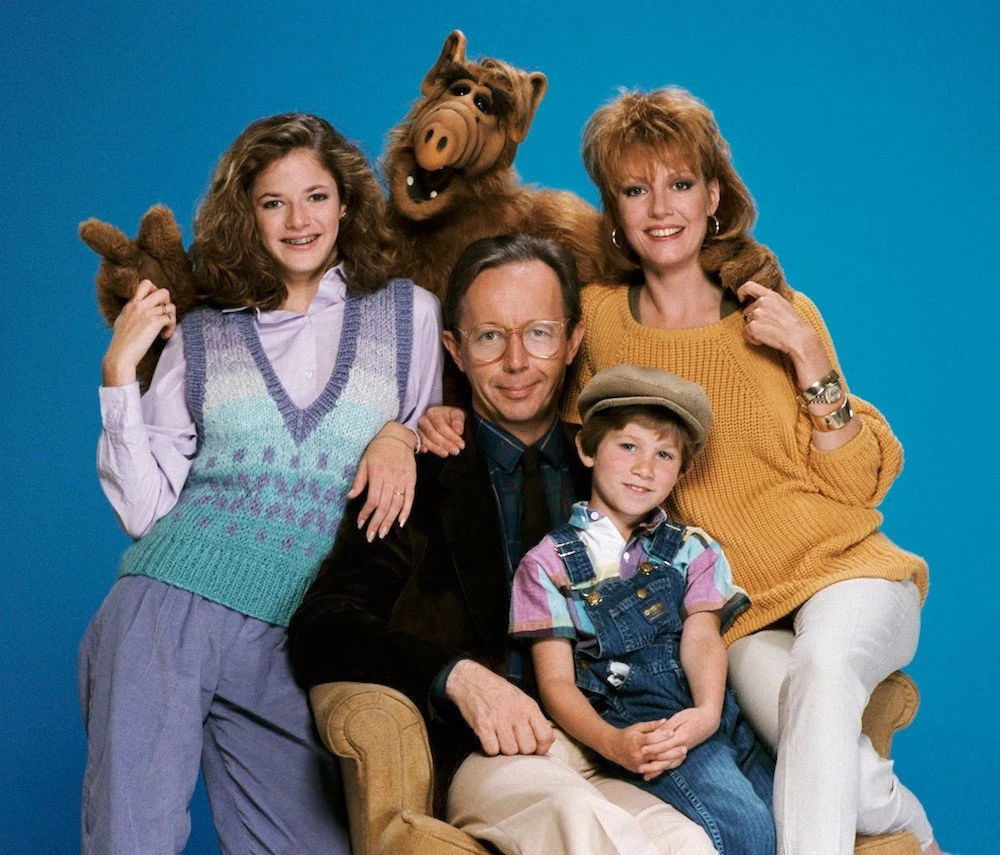
Willie Tanner had a home, a job, a family, and the reasonable expectation that anything arriving through the roof would at least have the decency to remain inanimate. Then ALF moved in. Before long, the household was hiding an extraterrestrial, defending its cat’s position in the food chain, and discovering that a creature from another planet had already mastered the most irritating habits of a difficult houseguest.
ALF ate, complained, watched television, and offered opinions with the confidence of someone who had never once been asked to pay the mortgage. His gratitude was real but inconsistently expressed. His appetite was more dependable. He had survived the destruction of Melmac, which gave him a genuinely sad story beneath the jokes, and apparently decided Earth owed him a sandwich.
That mixture made the series work. The central character wasn’t simply cute, and the family wasn’t merely a collection of people waiting to admire a remarkable visitor. ALF was funny because he imposed. The Tanners were funny because they kept trying to make the impossible arrangement behave like a household.
Beginning on NBC in September 1986, ALF became one of the most recognizable oddities in 1980s television. A furry puppet with an enormous snout shared a network with polished family comedies and became a top-ten series. Sometimes the decade really did look as though somebody had approved the pitch before the coffee arrived.
The good episodes still offer more than a familiar face from a toy shelf. Paul Fusco’s performance has comic timing, Max Wright makes exasperation almost musical, and Anne Schedeen supplies the indispensable sense that someone in the house understands the cost of all this nonsense.
The show also has limits: repetitive trouble, uneven sentiment, and a family whose patience occasionally exceeds any known terrestrial measurement. But revisiting its 80s run reveals why the visitor lasted beyond the first joke. He was an outsider with a mouth, a dependent with an ego, and a lonely survivor who could be very difficult to live with. The Tanners didn’t adopt a mascot. They acquired a problem with excellent comic delivery.
September 1986: the Tanners make an unreasonable decision
The premiere aired on September 22, 1986, at eight on NBC. Tom Patchett and Paul Fusco’s series introduced Max Wright as Willie, Anne Schedeen as Kate, Andrea Elson as Lynn, and Benji Gregory as Brian Tanner, an ordinary-looking family facing a decidedly unusual new responsibility.
The setup is wonderfully direct. An alien crash-lands in the family’s garage. The authorities pose a danger to him. The family decides to conceal him. There is no lengthy training period in extraterrestrial ethics before the first practical question arrives: where, exactly, do you put him?
The nickname is similarly efficient. ALF means Alien Life Form, an explanation that sounds sensible right up until the life form begins using the telephone. His own name is Gordon Shumway. The distinction is part of the joke: a being with a history and an identity becomes known on Earth by what amounts to a hastily improvised label.
His loss supplies the emotional reason the family can’t simply send him away. Melmac is gone. Whatever else he may be, he isn’t a visitor with a return ticket and a considerate estimate of how long he’ll stay. The Tanners are offering refuge, even when the sitcom keeps the implications lightly dressed.
That decision places them in a familiar television tradition. 80s family sitcoms often begin by altering the household: a new adult, a changed job, a different arrangement of care. ALF follows the same instinct and gives the new dependent a much less conventional appearance.
The family doesn’t have to find him easy to love every minute. In fact, the show benefits from allowing annoyance to remain visible. Kindness without inconvenience would make a very thin premise. The Tanners’ choice matters because the inconvenience keeps arriving, often hungry and already holding the remote.
The central fantasy isn’t only that an alien might live in a suburban house. It’s that an ordinary family might keep making room for him after discovering how little room he intends to leave for anybody else.
The opening makes the visitor part of the home movie
The familiar opening-credit approach lets ALF point a camera at the family, turning the Tanners into the subjects of his home movie. It’s a clever reversal of the premise. We have arrived to look at the alien, and the alien is busy looking at the humans.
The device makes the household feel established before the week’s disruption begins. Willie, Kate, Lynn, and Brian are people the visitor lives with, not merely a line of names waiting beneath his title. The camera gives him an affectionate role in recording their world, even if his usual participation involves making it more difficult to manage.
The instrumental theme adds the right burst of comic energy. The premiere credits name both Alf Clausen and Tom Kramer for theme music, a useful reminder that a television sound can be familiar long before its makers are. No spoken explanation is required to tell us that the evening will be light, busy, and a little unruly.
That promise also makes the darker episodes more surprising. The opening has prepared a recognizable household pleasure, so an excursion into grief or danger changes the temperature of a room we already understand. The routine isn’t wasted time before the story. It is part of the relationship between the audience and the show.
On a revisit, those few moments can do more to restore the series’ atmosphere than a page of merchandise ever will. The music starts, the family becomes familiar again, and the visitor has somehow appointed himself the person responsible for preserving domestic life on film. Given his record with the rest of the household equipment, Kate might reasonably request a deposit.
Paul Fusco gives the creature a person inside the joke
ALF’s design gets the first look. Fusco’s performance earns the second. The snout, fur, and compact body make the character immediately recognizable, but a funny shape doesn’t automatically sustain a conversation. The voice has to suggest someone making choices, enjoying a reaction, and preparing the next inconvenient remark.
Fusco gives him a confidence far larger than his circumstances justify. ALF depends on the Tanners for nearly everything and still behaves as though he is the senior guest at a badly managed resort. The discrepancy is the engine. A helpless creature who knew he was helpless might invite sympathy. This one invites an argument, followed eventually by sympathy when he has stopped talking long enough to need it.
The pauses matter as much as the rasp in the voice. A small turn of the head can make a response look considered. The jaw, eyes, and body position work together so that a line feels attached to a thought rather than delivered through a novelty object.
Paul Fusco wasn’t merely the voice coming out of ALF. He was the performer making that snout, those ears, and those impatient little pauses seem alive. That combination helps explain the consistency. The character’s humor isn’t added after the physical performance. It lives inside the way the creature moves, looks, and waits for a reaction.
ALF can be selfish without being entirely cold. Fusco sometimes lets an exposed feeling arrive through the same voice that has just made an unbearable joke. The shift is most effective when it isn’t announced as a lesson. A person who misses home doesn’t necessarily stop being annoying while he misses it.
There are moments when the delivery leans too heavily on the expectation that ALF saying something is automatically funnier than somebody else saying it. That’s the risk of a breakout character. Recognition becomes a laugh track of its own, and the script may begin spending goodwill instead of earning the next response.
But the essential performance is remarkably durable. Put him at a kitchen table opposite a worried adult, and he has a point of view. You don’t need to believe in extraterrestrial biology. You need to recognize the person who has eaten your food and now has suggestions about how you should live.
Willie Tanner, a decent man at the end of another sentence
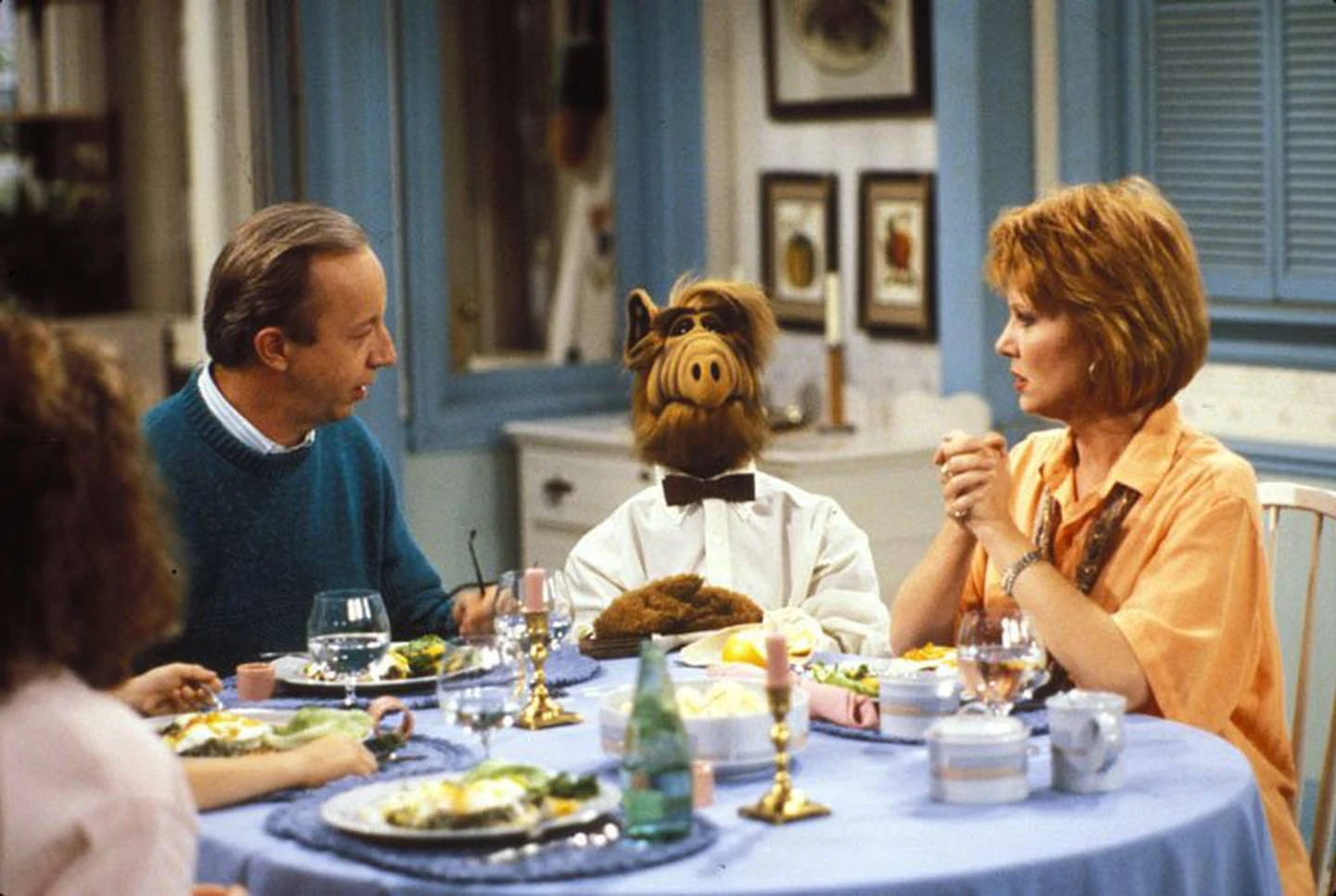
Max Wright’s Willie has the air of a man who began explaining something reasonable several hours ago and has been interrupted ever since. His voice catches, his patience stretches, and the effort to remain civil becomes its own comic performance.
The character is not built for the confident paternal speeches of a more conventional sitcom. Willie worries, hesitates, and tries to reconcile competing obligations. He wants to protect ALF. He also wants his house to survive. These are related ambitions, but they are not always compatible on a practical afternoon.
Wright makes the strain specific. A pause before ALF’s name can contain a whole argument. A look at the latest disaster suggests that the previous disaster has barely been cleared. His exasperation isn’t simply noise. It’s a repeated attempt to impose sense on a situation that has developed a highly effective immunity.
The contrast with Cliff Huxtable’s playful household authority is useful. Willie doesn’t usually seem to be arranging a comic demonstration for the benefit of his children. He seems to be responding to a genuine emergency in which the least responsible person has already volunteered an explanation.
Yet the decency remains visible. Willie knows what might happen if ALF is exposed, and his concern makes the concealment more than a gag. The audience needs to believe that a man can be this frustrated and still refuse to betray the person frustrating him.
That is a substantial acting assignment opposite a puppet, especially when so much of the joke depends on treating the creature as an actual source of pressure. Wright doesn’t play an actor waiting for an effect to finish. He plays a father trying to finish a thought.
Some episodes let the character become too helpless, reducing him to a target for one more interruption. The better ones retain his judgment and affection beneath the nerves. He isn’t a fool for caring. He’s a decent man discovering that decency has acquired a particularly expensive appetite.
Kate Tanner understands what everybody’s kindness is costing
Kate often appears to be the person who has looked at the whole situation and noticed the work. Refuge is admirable. So are groceries, sleep, privacy, and the possibility of owning something ALF hasn’t investigated with his mouth.
Anne Schedeen gives the character a firm comic center. Kate doesn’t need to match Willie’s rising alarm. A dry response or a direct look can make the same point with considerably less expenditure of breath. When ALF tries to charm his way around a rule, she has usually heard the approach coming.
That resistance is essential. If everybody simply adored the visitor, the show would have little to play beyond his next outrageous remark. Kate supplies a credible limit, even when the plot later asks the household to move the limit again.
Her warmth works because it isn’t the only thing she is permitted to express. She can care about ALF and resent the disruption. She can understand his loneliness without wanting him in the middle of every family decision. Those feelings aren’t contradictions. They’re what living with someone actually difficult might involve.
The show doesn’t always give her enough beyond the reaction. Like many sitcom mothers, Kate can be left managing consequences while other people receive the more flamboyant material. Schedeen’s timing makes those scenes enjoyable, but it doesn’t erase the imbalance.
When the writing lets her answer ALF on equal comic terms, the household becomes sharper. He isn’t simply performing to an audience of patient relatives. He has encountered someone who can puncture the performance. A guest may be from another planet and still be told that his reasoning is ridiculous.
That dynamic connects ALF to the stronger family comedies around it. Growing Pains finds comedy in parents negotiating their own roles as well as their children’s behavior. The Tanners’ extra complication is furry, but the practical question is familiar: who gets to make a decision, and who gets left cleaning up after it?
Kate’s answer is rarely decorative. It gives the series a needed spine. Somebody has to remember that a loving household is still a household, not an unlimited room-service arrangement.
Lynn and Brian have different reasons to open the door
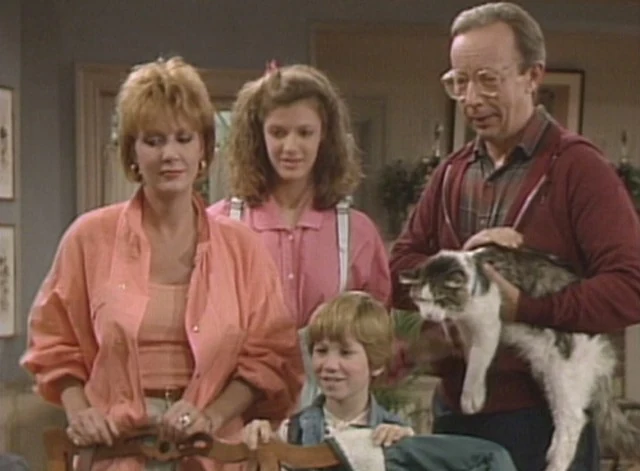
For Brian, an alien in the house offers an extraordinary kind of companionship. Adults see exposure, bills, and a creature with poor impulse control. A child sees somebody unlike any other friend in the neighborhood. Benji Gregory gives Brian an openness that makes the arrangement feel exciting before it feels administratively impossible.
That difference in perspective is useful. The series can let Brian accept ALF without requiring a detailed argument about interplanetary responsibility. He responds to a person in front of him. The adults have to think further ahead, which is their job and a considerable inconvenience to the visitor.
Lynn occupies a less uncomplicated position. Andrea Elson plays a teenager whose ordinary life keeps encountering a secret too large to explain. Friends, dating, privacy, and embarrassment don’t vanish because the family has acquired a cosmic emergency. If anything, the emergency makes those ordinary concerns harder to manage.
ALF’s confidence around Lynn can produce an odd blend of teasing and affection. He wants attention and treats the family’s younger members as potential allies against the people attempting to enforce rules. That’s a familiar household maneuver, even if most houseguests don’t arrive with a destroyed planet as supporting evidence.
The children also help keep the family’s choice emotionally credible. Protecting ALF isn’t merely Willie’s private moral project. The attachment spreads. Each person finds a different reason to care, and the creature becomes part of several relationships rather than an object the parents have agreed to store.
The writing is uneven about giving those relationships independent life. Sometimes Lynn and Brian receive stories that expose different sides of ALF. Sometimes they’re simply present to make the room look like a family. The show is stronger when the children want things of their own, not only whatever gives ALF his next entrance.
A revisit makes that distinction more visible. The extraordinary visitor is the attraction, but a household needs people with ordinary needs around him. Otherwise the premise shrinks into a one-creature revue with a very elaborate set.
The best family scenes let the children enjoy ALF and be inconvenienced by him at once. Affection doesn’t remove sibling-like irritation. Living with the most remarkable person you know can still mean wishing he would stop touching your stuff.
Lucky the cat, and the running joke with an obvious suspect
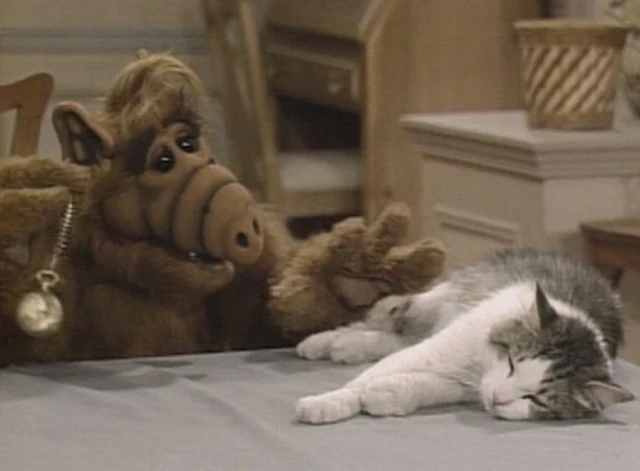
ALF considers cats food. The Tanners consider Lucky family. That disagreement gives the show a running joke clear enough to explain without a second sentence, and just dark enough to distinguish ALF from a polite children’s mascot.
“Looking for Lucky,” broadcast on October 6, 1986, turns the joke into a story. The cat disappears, and the household naturally looks toward the resident who has already expressed a culinary interest. ALF insists he’s innocent. His previous behavior has not prepared an especially supportive defense.
Everybody assumes ALF did it. Considering his record around the Tanner house, you can understand the rush to judgment. A person can be innocent of this particular offense and still understand why nobody believes the first explanation.
The opening hypnosis attempt is especially silly: ALF tries to persuade Lucky that he’s something other than a cat. The logic belongs entirely to the alien, which is to say it has a clear objective and very little respect for the other participant’s point of view.
The episode eventually uses mistaken feline identity to complicate ALF’s effort to repair the situation. That is a better payoff than simply repeating the menu joke. He has to act, discover that his understanding is incomplete, and care about the effect on the people who have taken him in.
The cat material can become tiresome when the series relies on recognition alone. We know what ALF wants. The next reference needs an angle, a reaction, or a consequence. Otherwise it is merely a familiar premise being announced again.
But the joke has a function beyond provocation. It establishes that ALF brings different assumptions into the household, and that living there requires limits. His appetite doesn’t overrule the family’s attachment. Belonging means learning that another person’s love matters even when your own habits say otherwise.
That’s a surprisingly practical lesson beneath a very impractical situation. The Tanners don’t have to endorse every Melmacian custom to protect a Melmacian. They are allowed to draw a line, and Lucky has an especially strong interest in the line remaining exactly where it is.
The Ochmoneks are the neighborhood’s worst privacy settings
Raquel and Trevor Ochmonek don’t need to know an alien exists to make concealing one difficult. Liz Sheridan and John LaMotta give the neighbors the kind of curiosity and persistence that turn a simple knock at the door into a household operation.
In another sitcom, their arrival might mean an unwanted conversation. Here it means hiding the central character, explaining the noise, and hoping nobody has left anything unmistakably extraterrestrial in view. The stakes transform familiar neighbor comedy without requiring the visitors to become villains.
Raquel’s attention is particularly useful to the premise. A household with an extraordinary secret needs somebody nearby who notices things, draws conclusions, and doesn’t reliably wait to be invited. Sheridan makes the curiosity active. The Tanners can’t assume a polite social boundary will do the work for them.
Trevor supplies a different pressure, less finely tuned and no less capable of making an inconvenient entrance. LaMotta’s presence gives the neighborhood a lived-in comic texture: these aren’t anonymous passersby who vanish after the week’s misunderstanding. They’re people the family may have to see again tomorrow.
The later addition of their nephew Jake, played by Josh Blake, opens another route between the households. The secret isn’t sealed inside an adult conversation. Younger people have their own reasons to visit, ask questions, and make the Tanners’ careful arrangements less careful.
The comedy works best when the neighbors remain people rather than alarms with surnames. Their habits and assumptions are funny in their own right. ALF simply makes those habits more dangerous to the family’s peace.
There is a darker possibility under the farce. Discovery could expose ALF to an authority he fears. The series usually keeps the tone light, but the threat gives the hiding scenes a reason to exist beyond another hurried trip behind the furniture.
It’s an old sitcom mechanism, updated with fur. The extraordinary family secret meets the person least likely to mind their own business. Nobody needs a spaceship chase when the neighbor has already started walking toward the kitchen.
Pennsylvania 6-5000: Willie did not authorize this foreign policy
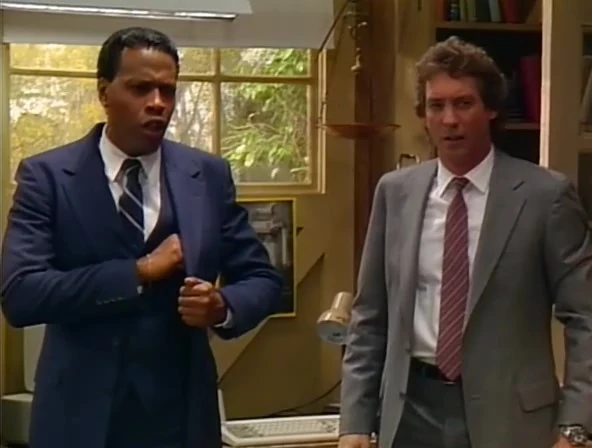
ALF has opinions about nuclear weapons. Unfortunately for Willie, he also has access to a shortwave radio and no dependable sense of how official attention might affect the household. In “Pennsylvania 6-5000,” a question that might have remained an argument at the kitchen table becomes a matter involving the president.
The October 13, 1986 broadcast turns Willie’s communications hobby into a route for trouble. ALF makes contact, and Willie receives the consequences. It is an excellent early demonstration of the household’s division of labor.
The joke works because ALF’s concern isn’t entirely ridiculous. The practical behavior is. He sees a serious problem and assumes the obvious response is to contact the person supposedly in charge, without considering protocols, suspicion, or the fact that he is meant to remain a secret.
Willie’s predicament exposes the difference between a clever observation and responsible action. A creature can see something foolish in human affairs and still make a complete mess of trying to address it. Outsider status doesn’t grant wisdom in every department.
Wright’s performance keeps the bureaucratic danger comic. The more complicated the explanation becomes, the less plausible it sounds to anyone outside the family. A reasonable man is placed in a situation where telling the truth may be the least reasonable available option.
The agents also help expand the world beyond the living room. Their businesslike presence makes the family’s secret feel vulnerable to ordinary systems: questions, suspicion, and a person who expects an answer. The threat isn’t an elaborate interplanetary enemy. It’s somebody with the authority to ask why this happened.
As an early episode, it makes a strong case for the premise’s usefulness. The alien’s curiosity can reach into topical territory while the consequences remain personal. Nobody needs to explain Melmac’s constitution or design a new spacecraft. Willie just needs the day to stop getting worse.
It also establishes a reliable source of affection and irritation. ALF wants to participate in the world. The family understands why that wish is dangerous. Both positions make sense, which is precisely why the argument can continue well after the immediate problem is resolved.
Strangers in the Night turns babysitting into concealment
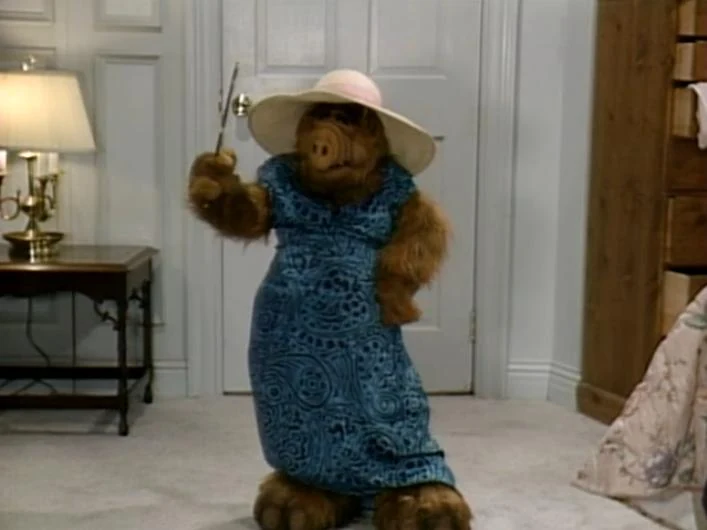
The second episode, “Strangers in the Night,” gives ALF an ordinary household responsibility with an extraordinary complication. While the parents are away, Brian needs care, a neighbor may appear, and the person in the house least suited to remaining inconspicuous becomes part of the arrangement.
The September 29, 1986 story uses a familiar sitcom setup without needing to reinvent babysitting. The novelty lies in what the family is hiding and how much confidence the hidden person has in his own ability to manage things.
ALF’s disguise supplies one of the series’ immediately recognizable visual jokes. A large hat and a dress do not make a furry extraterrestrial an unremarkable visitor. The gap between his confidence and the available evidence is so wide that the audience doesn’t need an elaborate explanation.
That is a useful example of the show’s comic scale. Some jokes depend on Fusco delivering a sharp line. Others depend on letting the whole character stand there and propose, through appearance alone, an argument nobody should accept.
The concealment also changes the children’s relationship to ordinary rules. They aren’t simply deciding whether to obey a parent or indulge a visitor. They are protecting a secret that has become part of the family’s shared life. The premise makes them collaborators in something much bigger than staying up past bedtime.
There is danger in repeating that pattern too often. A knock, a scramble, a disguise, an explanation: the mechanism can become predictable. The early episode benefits from the freshness of seeing how this particular creature will attempt the familiar routine.
It helps that the joke doesn’t require the audience to think the disguise is convincing. We are invited to enjoy the audacity of trying it. ALF’s confidence is his most renewable resource, and it works considerably better on himself than on the people expected to believe him.
For anyone who remembers the character chiefly as a face leaning over the sofa, the full visual absurdity is a useful reminder. The show wasn’t only a delivery system for wisecracks. It also understood the comedy of placing something thoroughly impossible in a perfectly ordinary hallway.
La Cucaracha lets something else invade the house
By May 1987, the Tanners had ample experience with one unwanted arrival. “La Cucaracha” asks whether the household is prepared for another. A cockroach from ALF’s world reaches Earth, and the situation grows considerably less manageable than a routine complaint about an insect in the kitchen.
The story arrived on May 4, 1987, with a new reason for the Tanners to worry about what ALF had brought into the house. That places it late in the first season, when the series already had a clear domestic identity and could enjoy briefly pushing against it.
The episode works as a comic reversal. ALF is usually the extraordinary thing the family is trying to contain. Now he has information about something even less welcome, and his presence becomes part of the potential solution as well as the reason for the problem.
The creature story also lets the program borrow from monster movies without permanently becoming one. A household space becomes threatening, the familiar scale is disrupted, and the family has to respond to something the ordinary routines cannot handle.
That is a larger fantasy leap than many episodes attempt. Most weeks, the show asks us to accept ALF and then plays recognizable human situations around him. Here it adds another conspicuous piece of alien biology. The risk is that the premise begins expanding so freely that nothing in the domestic world provides resistance.
The episode gets much of its appeal from being an exception. The Tanners don’t routinely spend their evenings battling a new extraterrestrial creature. Because the house usually contains smaller, more social disasters, a monster-sized disruption has somewhere to land.
It is also the kind of story younger viewers may remember through an image or a feeling more than a complete plot. The supposedly safe sitcom home suddenly contains something grotesque. Comedy and mild alarm share a room, and the room is no longer quite as reassuring as it was at the start.
The series eventually returns to ordinary arguments, which is the sensible choice. One spectacular pest problem is an adventure. A weekly one would require a completely different show, along with an exterminator whose invoice included hazard pay and a nondisclosure agreement.
A Christmas special that refuses the easy joke
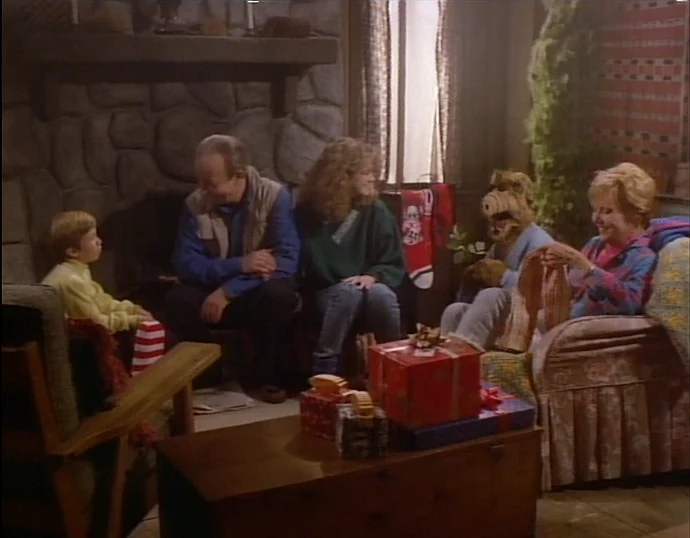
“ALF’s Special Christmas” begins with a family holiday and takes a surprisingly difficult route. The December 14, 1987 special brings ALF into a hospital, where he meets Tiffany, a seriously ill child, and Mr. Foley, a man carrying grief of his own.
Keri Houlihan plays Tiffany and Cleavon Little plays George Foley, two people whose troubles cannot be cleared away by the next convenient joke. Their performances ask the series to sustain a feeling it usually touches only briefly before the next interruption.
The shift can be startling. A viewer expecting a holiday edition of the familiar household comedy encounters illness, loneliness, and despair. The show doesn’t simply put a Santa hat on the title character and assume the seasonal work is done.
ALF’s outsider position becomes emotionally useful. He doesn’t arrive with all the practiced evasions adults may use around suffering. His directness can be awkward, but it also allows an encounter to remain personal. A child isn’t merely a lesson for the visiting celebrity creature. She is someone who wants company and deserves to be heard.
Foley’s grief gives the story a different kind of loneliness. Little brings gravity to a role that might otherwise have become a blunt device for manufacturing tears. The special asks ALF to recognize pain he can’t wisecrack out of existence.
That’s the crucial difference from the ordinary messes at the Tanner house. A broken object can be replaced. A misunderstanding can be explained. Here the visitor faces experiences that don’t yield to the show’s usual reset. The next joke cannot honestly make everything all right.
There is sentimentality, certainly, and some of the turns are calculated with a firm hand. A viewer is allowed to feel pushed. Holiday television often reaches for a larger emotional response than its ordinary stories have prepared, and a familiar character can become a shortcut to feeling.
But the attempt isn’t empty. ALF’s need to belong and his capacity to care have been part of the premise from the beginning. The special lets those qualities occupy the foreground without pretending his personality has become entirely gentle.
It is one of the clearest answers to the question of whether the character could be more than a wisecracking novelty. Not every moment works equally well, but the performance can hold a vulnerable exchange. The creature who usually demands attention discovers an occasion to give it.
A revisit may land differently depending on what life has added since the first viewing. The child and the grieving adult are not peripheral obstacles on the way to a cheerful ending. They are the story. The series briefly understands that companionship may matter even when it cannot provide a cure.
I’m Your Puppet gives ALF an unsettling little assistant
In “I’m Your Puppet,” ALF gets a ventriloquist’s dummy, and a show built around an animated-looking object begins making jokes about another animated-looking object. The March 21, 1988 episode has an obvious self-referential attraction, but the best part is how comfortably it makes the familiar household strange again.
Al Jean and Mike Reiss wrote the episode. Now ALF has a puppet of his own to hide behind. For a creature who already spends most of his day dodging responsibility, this is a dangerous new development.
A dummy is already a slightly unsettling household addition, even before the family has agreed to shelter an alien. It resembles a person without being one, and the performer can make its behavior seem separate from his own. The episode gains comedy from a situation that is amusing and faintly uncomfortable at once.
For the Tanners, this means another layer between a question and a dependable answer. ALF’s habits were sufficiently complicated when he spoke only for himself. Giving him a second mouth does not promise improved household accountability.
The story also invites the viewer to enjoy the illusion without requiring a lecture about it. We know how the dummy is meant to work, and we know ALF is a performance too. The joke doesn’t collapse because we understand the mechanics. It becomes funnier because the relationships still feel real enough to irritate everyone involved.
That is a useful distinction from a simple wink at the audience. A self-aware premise needs behavior inside it. The creature’s enthusiasm, the family’s reactions, and the slight uncertainty about where the joke is heading provide the substance.
The darker edge suits the series better than an entirely cuddly version of its title character would. ALF can be funny, needy, manipulative, and odd in the same scene. The show doesn’t always use that range, but episodes like this demonstrate that it exists.
It is also an excellent reminder that the program employed writers interested in more than maintaining a merchandising smile. A creature can sell toys and still inhabit an occasionally peculiar sitcom. The trick is allowing the peculiar part to stay visible.
NBC gets a top-ten houseguest
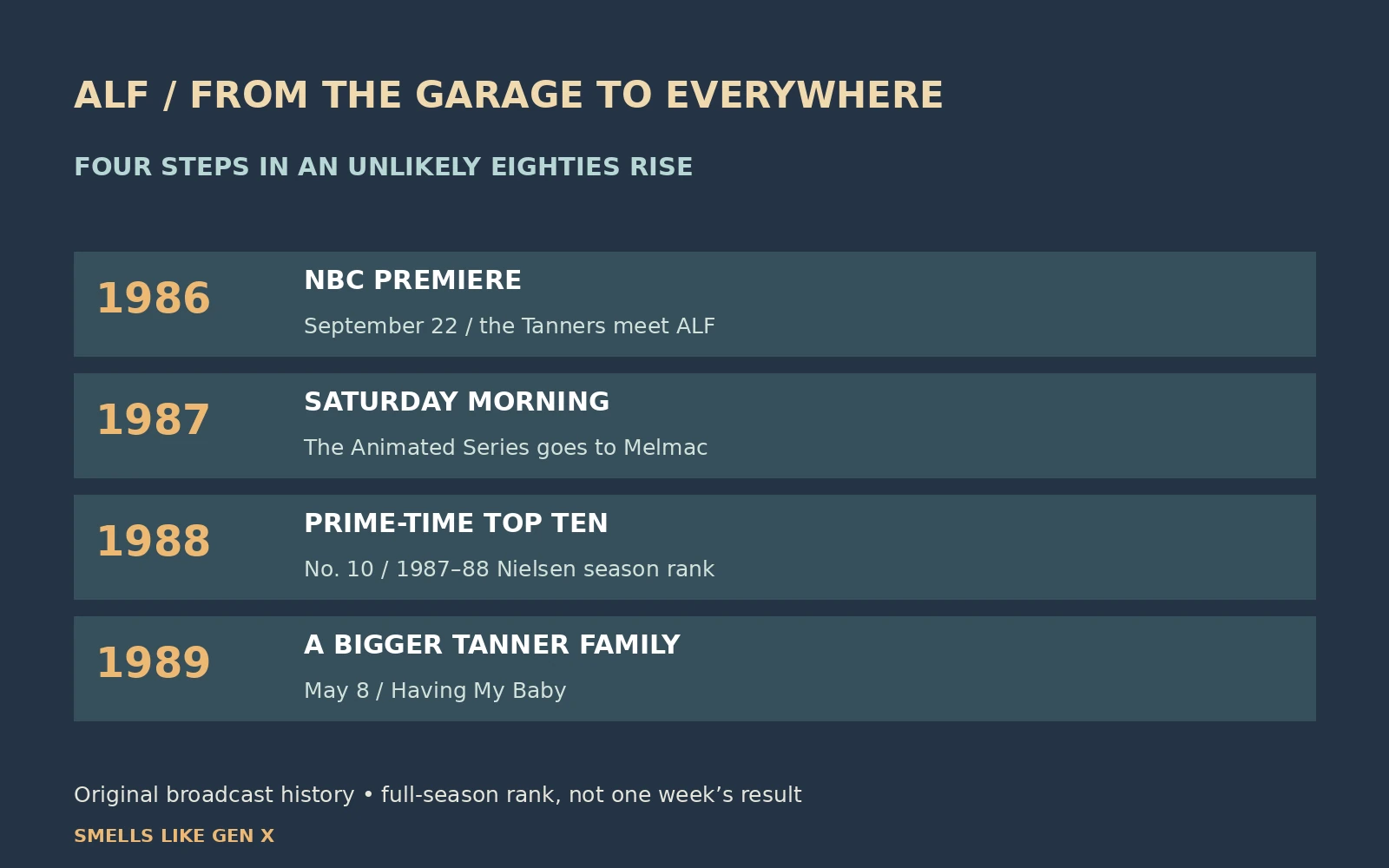
ALF finished tenth in the 1987–88 Nielsen season rankings. That put a wisecracking alien right in the middle of NBC’s big-league hits, not on the network’s shelf of interesting experiments.
That distinction supports the title’s large claim. The character didn’t literally occupy every prime-time slot, but he became a conspicuous part of NBC’s identity. A creature from Melmac had joined the network’s formidable collection of familiar faces.
The wider television picture in 1988 makes the achievement more entertaining. Family comedies were powerful, but most featured people whose existence did not require a puppeteer underneath the set. ALF gave the audience a recognizable household and a highly visible reason this household was unlike the others.
The show even found comedy in the measurement itself. In October 1987’s “Prime Time,” the Tanners participate in a television-ratings system, and ALF discovers that the numbers may affect the survival of programs he likes. His response is not a detached lesson in representative sampling.
He wants the result adjusted. Of course he does. The household has offered him a chance to express a preference, and he begins treating it as a chance to exercise control. The joke is more specific than a general observation that ALF watches too much television: he has found a way for his appetite to reach beyond the refrigerator.
The episode lets a mass-audience sitcom make fun of the process deciding its own value. A family’s viewing becomes information, information becomes a verdict, and a creature who dislikes the verdict decides the system could benefit from his personal attention. Kate has every reason to reconsider giving him access.
It is an especially good use of the outsider. ALF understands the desired outcome immediately and the obligation to behave fairly much less quickly. The same imbalance drives plenty of ordinary human arguments about television. He simply has fewer reservations about announcing that his favorites deserve special treatment.
Its Monday placement also put it in a direct relationship with another kind of resourceful outsider. ABC’s MacGyver offered adventure and practical ingenuity. NBC offered a family attempting to survive a visitor’s practical ingenuity. Both had a strong central identity; only one expected the groceries to be part of the suspense.
Early critics weren’t universally charmed. A Los Angeles Times premiere review had little patience for the human family. That review didn’t stop millions of viewers from inviting the furry troublemaker back. Television critics and families on their couches don’t always cast the same vote.
The subsequent success doesn’t prove every reservation wrong. Some episodes do leave the Tanners underwritten, and the central character can dominate at the expense of a richer ensemble. Those are real weaknesses, even in a hit.
But the audience clearly found more than an amusing design. Fusco’s timing and the family’s responses produced a repeatable pleasure. Viewers could recognize the visitor instantly and still want to hear what he would say next.
In an era when three major networks still supplied much of the shared national television conversation, that recognizability carried weight. ALF became a common reference, not merely a private favorite. You didn’t need to know the latest plot to understand the joke when somebody mentioned the cat.
Under the floor, the easy conversation took work
The Tanner living room looks like a place where a family might sit down and talk. Making ALF participate required a much less ordinary arrangement. The set had access points and spaces underneath for the performers, while the camera and human actors had to preserve the illusion of a creature occupying the room.
Behind the Tanner living room, getting ALF into position could be a production ordeal. Working around a puppet beneath the set wasn’t exactly a normal sitcom afternoon. The pauses between setups made the usual sitcom rhythm impractical. The apparently easy domestic exchange depended on exact preparation.
That changes what a revisit reveals. A movement across the room is not simply an actor taking a few steps. A hand reaching for an object involves coordination. An angle has to show the character while concealing the people making him possible.
The human performers are doing more than waiting for a puppet’s line. Their timing has to meet the physical performance, and their eyelines have to make the space believable. Wright’s frustration or Schedeen’s dry response supplies an emotional reality the machinery alone cannot create.
Michu Meszaros performed in a full-body ALF costume for some early material, but the familiar conversational character was principally a puppetry performance. Confusing the two methods obscures the collaboration that makes the creature seem continuous on screen.
The working conditions also help explain why the public image of a cheerful family comedy and the later accounts of a difficult job can coexist. A light tone in the finished episode doesn’t guarantee an easy production. Nor does a demanding process prove that nobody enjoyed any part of the work.
It is tempting to turn those accounts into a feud story with a single person responsible for everyone’s unhappiness. That produces a tidier headline than a useful understanding. A technically demanding set, unequal attention, long days, and different expectations can create strain without requiring an invented private motive.
The achievement remains visible in the finished scenes. For a moment, we stop thinking about who is underneath the floor and accept that this creature has just said something Willie will have to answer. The effort has disappeared into the argument, which is exactly where a good illusion belongs.
A face made for the toy aisle, with a voice less easily packaged
ALF’s appearance was an obvious merchandising opportunity. You didn’t need a detailed explanation of an episode to recognize the creature on a shelf. The fur, ears, and snout supplied an identity at a glance, while the name was short enough to fit comfortably on almost anything.
The merchandising people were ready before the Tanners had even finished repairing the roof. Coleco was promoting ALF before the premiere. The visitor had business arrangements waiting before he had fully settled into the garage.
Trading cards followed. By 1987, you could carry ALF around in a stack of Topps trading cards, which seemed safer than letting him near the refrigerator. Marvel even put ALF in comic books in 1988. The alien had barely unpacked, and already the merchandising department was asking for more.
Those objects help explain the intensity of the character’s cultural presence. A weekly program occupies a limited amount of time. A toy, card, comic, or image on a familiar object keeps the visitor around after the episode ends. ALF becomes part of a room instead of something appearing briefly inside the set.
There is an amusing mismatch between the cuddly version and the television personality. The face invites affection. The voice may be complaining about the accommodations. A soft toy can’t reproduce the full experience of having a dependent creature criticize the household that is protecting him.
That mismatch is part of the appeal rather than proof of a contradiction. Children can enjoy a funny, rude character without needing every trait converted into an admirable example. The show works when it lets the audience recognize both the charm and the behavior that deserves correction.
Commercial success can still soften an edge. A character useful to many different products may face pressure to remain broadly agreeable, even when the original humor includes selfishness and a running threat to the cat. The more universal the image becomes, the easier it is to forget the small abrasions that made the person interesting.
The best way to recover that distinction is to watch an actual exchange with the Tanners. The object is adorable enough. The houseguest is considerably more complicated.
Saturday mornings send Gordon Shumway back to Melmac
ALF: The Animated Series arrived on NBC in 1987 and moved the character’s life back to Melmac. Instead of confining the visitor to the Tanner house, animation could show the world he had lost, with friends and family of his own.
The change makes a particular kind of sense. A prime-time series built around hiding an alien has limited opportunities to let that alien move freely in public. A cartoon set on his home planet doesn’t have to stop every scene to conceal him behind a sofa.
The animated show took ALF back to life on Melmac; ALF Tales sent him wandering through fairy tales, because apparently one Earth household wasn’t enough territory for a wisecrack. The latter joined NBC’s Saturday programming in 1988, extending the character into another kind of storytelling.
Animation changes the comedy’s proportions. On the sitcom, ALF is unusual because the people around him are human. On Melmac, the surrounding world can be as peculiar as he is. The joke no longer depends on one extraordinary body inside an otherwise ordinary kitchen.
That freedom has a cost as well as a benefit. The Tanner family’s resistance is part of what makes the original character funny. Remove Willie and Kate, and the humor needs a different source of friction. More visible fantasy doesn’t automatically produce a richer version of the sitcom.
The cartoons are therefore best understood as companions rather than interchangeable replacements. They explore an image and a voice already familiar from prime time, but they offer a different viewing pleasure. The domestic irritation becomes a broader animated world.
For a young fan, the expansion also meant the character wasn’t tied to one evening appointment. ALF could belong to a weekend routine as well as a family-comedy slot. That is a substantial presence for a visitor who was supposedly meant to stay out of sight.
There is a little poignancy in the prequel’s premise if you bring the sitcom’s history with you. Melmac is available again, but as a story from before the loss. The comedy can be light while the original series continues carrying the knowledge that Gordon’s return ticket no longer has a destination.
Melmac is funny until the missing part matters
ALF’s stories about home can sound like another opportunity for a ridiculous detail. Different customs, foods, and assumptions supply quick jokes, especially when he treats the human version as the one requiring explanation. The visitor doesn’t consider himself the strange part of the conversation.
That reversal keeps the outsider humor lively. A human habit may look sensible only because humans are accustomed to it. ALF can expose an inconsistency, then immediately reveal one of his own. The show is funnier when neither culture receives a permanent monopoly on good sense.
Underneath the jokes sits the fact that home is gone. ALF isn’t simply bored with Earth or impatient for the next visit from relatives. He is living among people who can offer affection but cannot restore the world he remembers.
The series doesn’t need to stop for a solemn speech every time that fact becomes relevant. A moment of homesickness can change a scene that began as another complaint. The Tanners’ kindness becomes more legible, and his difficult behavior acquires context without receiving an automatic excuse.
This is where the creature can become more than an intrusive roommate. He has survived something the household cannot fully share. Their ordinary routines may comfort him and remind him of everything he doesn’t have, sometimes at the same time.
The emotional balance is delicate. Lean too hard on the sadness and the program becomes a different kind of story. Ignore it entirely and the family’s commitment looks harder to understand. Why continue protecting someone who appears interested only in eating, mocking, and causing expensive problems?
The best episodes keep a trace of the loss inside the comedy. ALF can be unbearable and still be lonely. Willie can be angry and still know what sending him away would mean. Kate can insist on a rule without forgetting the person who has to learn it.
That coexistence gives the premise its staying power. The jokes aren’t required to cure the sadness, and the sadness doesn’t have to silence the jokes. A family makes room for a person whose history it cannot repair. The arrangement is imperfect, which makes the affection more persuasive.
Having My Baby makes room for someone smaller
Kate’s pregnancy changes the household’s center of attention, and ALF is not naturally gifted at sharing that center. A baby promises needs that won’t politely wait while the visitor finishes his latest complaint. The Tanners are preparing for a new dependent while already living with an unusually demanding one.
“Having My Baby,” the third-season finale, aired on May 8, 1989. Eric’s arrival belongs to this later version of the family, after the extraordinary visitor has already had several years to become part of its daily life.
That timeline matters to the feel of the series. ALF has been part of the Tanners’ lives long enough for the family to change around him. He isn’t the only event that can happen in the house, however firmly he may behave as though he should be.
The episode’s borrowing from The Dick Van Dyke Show is particularly apt. A sitcom household draws on an earlier sitcom household to imagine the anxiety of a new arrival. ALF’s version is filtered through the television he has absorbed, which makes the reference part of his character rather than a completely detached tribute.
The baby also sharpens a running tension. ALF wants family status, but family status doesn’t mean receiving unlimited attention. Other people have needs, and the household continues existing when he isn’t the subject of the next conversation.
There is comic value in watching an ancient alien respond with the insecurity of an older child. The age and the appetite suggest authority; the behavior suggests someone who has just noticed the adults shopping for a smaller person’s furniture.
The show risks using a new baby as the familiar sitcom announcement that the room needs fresh material. But within this premise, the addition has a useful purpose. It tests whether ALF’s attachment includes a willingness to yield space, not merely the expectation that space will keep being made for him.
By 1989, the Tanners have moved beyond the initial emergency. The visitor is part of an ongoing family life, and ongoing family life has a habit of refusing to remain arranged around the most entertaining person in the room.
The human family was more than camouflage
A familiar complaint about ALF is that the human characters are dull beside the creature. Sometimes the writing makes the complaint fair. A scene can feel arranged simply to give ALF another line, with everyone else serving as the furniture that answers.
But the family also supplies the show’s necessary resistance. Willie and Kate have something to protect, rules to enforce, and a life that can’t be abandoned every time the guest is bored. Lynn and Brian have different ways of wanting him around. Without those differences, the creature would have nobody interesting to inconvenience.
The strongest family comedies of earlier decades understood that ordinary characters aren’t automatically weak characters. The 1970s television landscape made a great deal of comedy from households and workplaces in which personalities rubbed against the same daily limits. A familiar room can be rich territory if the people inside it are allowed to want things.
ALF is best when it remembers that lesson. A dry response from Kate, an anxious attempt at explanation from Willie, or a child’s unexpected sympathy can change the creature’s behavior. The exchange becomes a relationship rather than a sequence of setups.
There is a useful comparison with The Golden Girls, where no single personality can dominate indefinitely without somebody else answering back. ALF doesn’t need four equally flamboyant stars, but it does need the right to be contradicted.
A revisit makes Wright and Schedeen’s contribution especially clear. The visitor’s most familiar jokes often depend on their timing, restraint, and ability to make the cost believable. The laugh belongs to the exchange, even when the merchandise belongs mostly to the furry participant.
That distinction is worth keeping because it restores the show’s actual comic machinery. ALF is the extraordinary ingredient, but the human household gives him something to react against. A kitchen counter is a useful place to hide a puppeteer. It isn’t, by itself, a scene partner.
The premise had a ceiling, even after the roof came off
Once the family has decided to keep ALF, the series needs reasons for the arrangement to become difficult again. A visitor arrives. A secret nearly escapes. The alien misreads a human custom. A household resource is damaged or consumed. The formula has flexibility, but it doesn’t have infinite space.
Some repetition is part of the pleasure. A returning sitcom offers familiar behavior, and viewers don’t necessarily want every episode to dismantle the premise. ALF’s confidence and Willie’s alarm are enjoyable partly because we know how differently they understand the same situation.
The problem comes when recognition replaces discovery. If ALF makes the same selfish choice and receives the same correction without anything new in the exchange, the story begins feeling like a household trapped in a scheduling loop. Somebody should eventually remember what happened last Monday.
The show sometimes pushes outward through guest characters, fantasy, or more serious material. Those departures can revive the energy, as the Christmas special and the dummy episode demonstrate. They can also expose how difficult it is to preserve the tone while changing the scale.
By the fourth season, beginning in 1989, the central arrangement is both an asset and a constraint. The visitor remains instantly appealing, but the family can’t reveal him freely without changing the show. A premise built on concealment has to keep finding ways for the hidden person to participate.
The famous unresolved ending belongs to 1990, beyond the main period covered here. It shouldn’t be folded into an account of what happened during the eighties as though the decade ended with that broadcast. The later television movie is another subsequent chapter, not evidence that the original family arrangement lasted unchanged forever.
Those boundaries don’t diminish the earlier achievement. They make it easier to appreciate the series’ particular window of success: a startling new presence becoming a familiar household irritation, then a major public character, while the writers searched for ways to keep the room lively.
Every sitcom has a ceiling. ALF simply began by putting a hole in one, which may have created an unreasonable expectation that the limits wouldn’t apply.
Why the visitor is still so easy to recognize
ALF’s afterlife in popular memory isn’t explained by the ratings alone. The character has a readable shape, a distinctive voice, a simple situation, and a contradiction that can be understood immediately: he needs kindness and frequently behaves as though he hasn’t noticed receiving it.
That makes him useful shorthand for a particular kind of guest, roommate, or family member. The person doesn’t have to be malicious to make the household tired. Affection and exasperation can become the same daily conversation.
The design helps preserve the memory, but the actual scenes restore the personality. Watch him wait for Willie’s response. Watch Kate decline to be impressed. Watch the way a small movement gives a line an extra intention. The character is more precise than a general haze of eighties nostalgia.
He also belongs to a period when television figures regularly crossed from a program into toys, cards, weekend cartoons, and casual conversation. That movement continued through the 1990s television world, but ALF offers an especially concentrated eighties example. The visitor appeared to have escaped the garage and entered the rest of the culture.
A fair revisit leaves room for embarrassment as well as affection. Some jokes are thin. Some stories repeat themselves. The sentiment can arrive heavily escorted. No childhood favorite is improved by pretending every installment was an undiscovered masterpiece.
But neither is it improved by reducing the whole thing to an ironic punch line about a puppet. The performances created a workable, often funny set of relationships. The alien’s loneliness gave the family a reason to care. The best writing found a little sting inside the cute design.
And the central image remains irresistible: an ordinary family trying to maintain ordinary life while something thoroughly extraordinary refuses to stop talking. The show understands that wonder, after a few weeks, may start looking a lot like another person who needs feeding.
Willie probably deserved a quieter house. Kate certainly deserved a more considerate guest. Lucky deserved an enforceable guarantee. What viewers got was a visitor whose welcome was constantly under negotiation, and whose absence would have left the room much less interesting. That is a pretty good basis for a sitcom, whatever planet the trouble comes from.
Questions Readers Ask
What does ALF stand for?
ALF is short for Alien Life Form. The Tanner family uses the nickname for Gordon Shumway, the visitor from Melmac who crashes into their garage.
Who performed ALF?
Paul Fusco co-created the series and provided ALF’s voice and puppetry, giving the alien his distinctive wisecracking personality.
When did ALF premiere?
The original NBC sitcom debuted in September 1986. By the 1987–88 season, it was a top-ten network hit.
Sources & further reading
- Official ALF: character and original series history
- Paley Archive: September 22, 1986 premiere and credits
- Paley Archive: Pennsylvania 6-5000
- Out of This World: cast and creative-team oral history
- Apple TV: ALF’s Special Christmas
- Original episode guide
- 1987–88 Nielsen season rankings
- 1987 Topps card-set history
- episode description — tv.apple.com
- Al Jean and Mike Reiss wrote the episode — imdb.com
- October 1987’s “Prime Time,” — tv.apple.com
- Los Angeles Times premiere review — latimes.com
- August 1986 Los Angeles Times report — latimes.com
- first issue’s publication record — comics.org
- Eric’s arrival — tv.apple.com