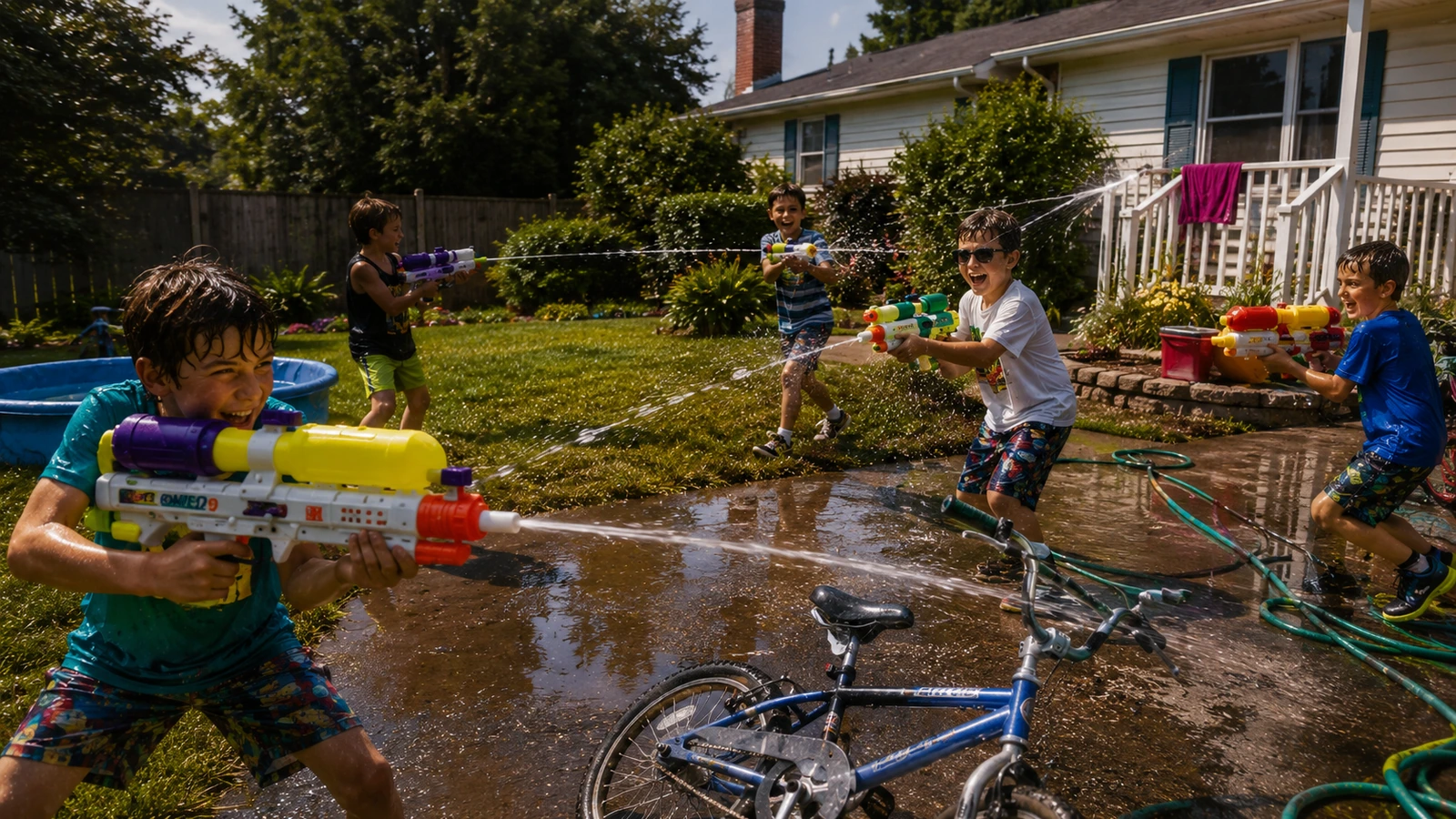
The Water Blaster That Turned Every Cul-de-Sac Into a Low-Budget Action Movie
Super Soaker in the 90s: The Backyard Arms Race That Changed Summer
Super Soaker did not merely improve the water gun. It replaced the weak trigger squirt with a pressurized stream that could cross the yard, soak a shirt and immediately make every older plastic pistol look like something from a dentist’s prize drawer.
From Lonnie Johnson’s original pressure-system invention and the 1990 Power Drencher to the Super Soaker 50, XP line and late-90s CPS monsters, this is the full story of the toy that turned summer into a neighborhood equipment race—with no reliable rules and one refill truce nobody respected.
Why Was Super Soaker One of the Biggest 90s Toys?
Super Soaker became one of the defining toys of the 90s because it replaced the weak squirt pistol with a pressurized water blaster that delivered real range, capacity and soaking power. Inventor Lonnie Johnson’s air-pressure design let kids pump a tank, pull a trigger and send a continuous stream across the yard instead of squeezing out one sad teaspoon at a time.
The toy arrived in 1990 as the Power Drencher and became Super Soaker in 1991. Larami backed it with loud television advertising, an expanding model lineup and a simple promise every kid understood: the bigger tank and stronger stream won. By the middle of the decade, XP models, backpack systems and Constant Pressure System blasters had turned summer water fights into a full equipment competition.
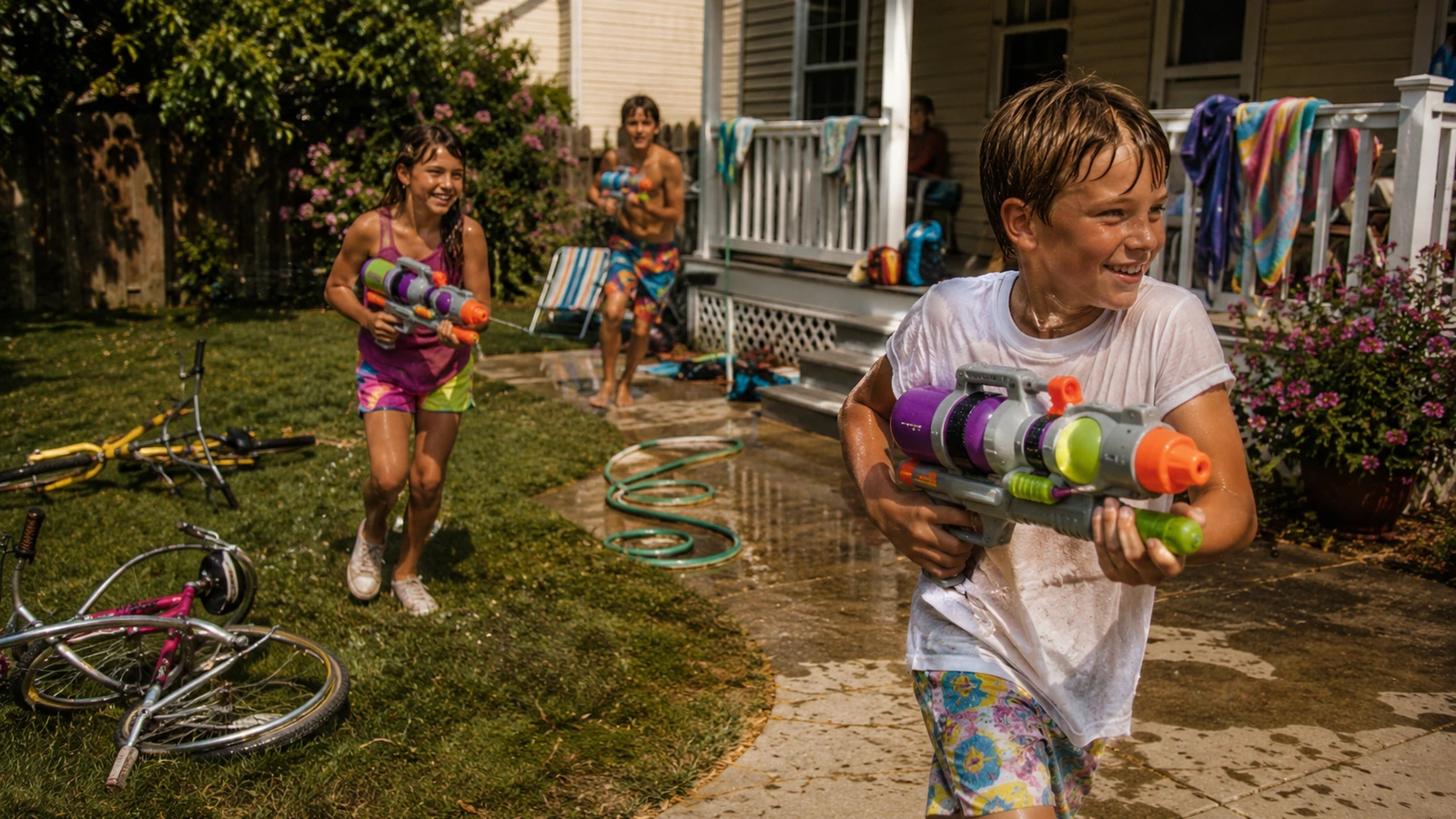
From Heat-Pump Experiment to Summer Dominance
The Complete Story of Super Soaker in the 90s
This post follows Lonnie Johnson’s invention, the Larami launch, the classic numbered models, the XP and CPS generations, the television ads and the real neighborhood culture that made Super Soaker much bigger than a water gun.
Range, Capacity and the Immediate Collapse of Fairness
Why the Super Soaker Formula Worked
The toy turned a familiar summer activity into equipment-based competition without making the basic idea difficult to understand.
Real Pressure
A hand pump compressed air inside the system, creating a stronger and longer stream than traditional squeeze-trigger water pistols.
Visible Power
The tank, pump and oversized body made the toy look serious before anyone fired it.
Instant Escalation
One child getting a Super Soaker made every neighbor’s old water gun obsolete by dinner.
Endless Model Ladder
Small, medium, large, backpack, XP and CPS models created a clear path from “I have one” to “I need a better one.”
That immediate leap is why Super Soaker belongs near the top of the 50 most iconic toys of the 90s: it did not merely sell well—it permanently changed what kids expected the entire category to do.
Before the Pump, We Were All Fighting With Condiment Bottles
Water Guns Before the Original Super Soaker
Traditional water pistols were cheap, simple and fun right up until somebody showed up with pressurized technology.
Most Water Pistols Used a Tiny Trigger Pump
The trigger pulled a small piston that pushed a limited amount of water through the nozzle. Each squeeze produced one short squirt.
Range Was Usually Personal
To hit somebody, the shooter often needed to be close enough to receive immediate retaliation. Strategy mostly involved running faster than the other kid.
Reservoirs Were Small
A plastic pistol held enough water for a brief exchange and then required a trip to the hose, sink or bucket.
Leaks Were Part of the Design Experience
Cheap seams, loose caps and weak seals meant the hand holding the water gun often became wetter than the target.
Squirt Guns Were Disposable Summer Toys
They appeared in party bags, drugstores and beach buckets. Nobody discussed model numbers or pressure systems.
Bigger Did Not Always Mean Stronger
A large plastic body could still contain the same weak trigger mechanism. The toy looked dangerous and performed like a nervous drinking fountain.
Super Soaker Changed the Expected Result
After 1990, a water blaster was judged by distance, stream thickness, capacity, pump speed and whether the opponent had enough time to regret leaving the porch.
The Gen X memory: owning a bright orange squirt pistol, feeling completely prepared and then watching a neighbor hit us from a distance previously associated with garden hoses.
The pressure revolution makes more sense beside the 80s backyard bikes and blasters, when Nerf, BMX bikes and ordinary squirt guns still ruled the driveway before one top-mounted tank changed the balance.
Yes, It Actually Took a Rocket Scientist
Lonnie Johnson: The Engineer Who Invented Super Soaker
Lonnie Johnson was not a toy designer searching for a summer gimmick. He was a mechanical and nuclear engineer whose work included the U.S. Air Force and NASA’s Jet Propulsion Laboratory.
A Childhood Tinkerer
Johnson grew up taking things apart, building devices and learning through hands-on experimentation. That instinct followed him into engineering rather than disappearing when the family radio had been successfully reassembled.
Tuskegee and Engineering Training
He studied mechanical and nuclear engineering at Tuskegee University, gaining the technical background that would later make a toy water gun far more complicated than the category had previously required.
Air Force Work
Johnson worked on advanced systems for the U.S. Air Force, including stealth-related technology. The future backyard toy inventor was already solving problems involving pressure, energy and mechanical systems.
NASA’s Jet Propulsion Laboratory
He worked at JPL and contributed to major space programs, including the Galileo mission to Jupiter. That is the part of the story kids repeated because “NASA engineer invents water gun” sounds like the 90s making a casting decision.
Independent Invention Continued at Home
Johnson did not stop experimenting when the workday ended. His home projects focused on energy and environmentally friendlier systems.
The Super Soaker Was an Accidental Branch
The water blaster came from work on a heat pump, not from a deliberate plan to enter the toy aisle.
He Kept Inventing After the Toy Became Famous
Johnson’s career includes many patents and long-term clean-energy research. Super Soaker became the public icon, but it was one piece of a much larger engineering life.
The Gen X translation: while we were trying to make a bike jump from two boards and a milk crate, Lonnie Johnson was working on Jupiter and accidentally creating the weapon that would ruin our summer shirt.
Why his background matters: Super Soaker felt like a leap because it came from serious pressure-system thinking, not from making the old squirt pistol slightly larger.
A Heat-Pump Test Sent Water Across the Bathroom
The Accidental Stream That Became the Super Soaker
The most important backyard toy of the 90s began when an engineering experiment produced a result that looked more fun than practical.
Johnson Was Testing an Environmentally Friendlier Heat Pump
He was exploring a system that used pressurized water vapor instead of Freon. The project had nothing to do with chasing neighbors around a hedge.
The Nozzle Was Connected to a Bathroom Faucet
During testing, a strong stream of water shot across the room. Johnson immediately recognized that the same principle could create a far more powerful water gun.
The Stream Was Continuous
Traditional trigger pumps delivered small bursts. A pressurized reservoir could deliver a sustained stream when a valve opened.
The Idea Was Mechanically Simple to Understand
Put water in a sealed reservoir, add air pressure with a pump and control release through a trigger-operated valve.
Making It Safe and Manufacturable Was Harder
A toy had to hold pressure, resist leaks, refill easily, survive rough handling and remain affordable.
The Bathroom Became Toy History
The accidental stream was the moment Johnson saw the entertainment value hiding inside an energy experiment.
The Discovery Changed Outdoor Play
Once children could carry pressurized water, the hose was no longer the only backyard weapon with real reach.
The memory we inherited: somebody’s serious scientific experiment crossed the bathroom, and millions of kids eventually had to hear “Do not pump that thing inside the house.”
PVC Pipe, Plexiglas and a Soda Bottle
The Homemade Super Soaker Prototype
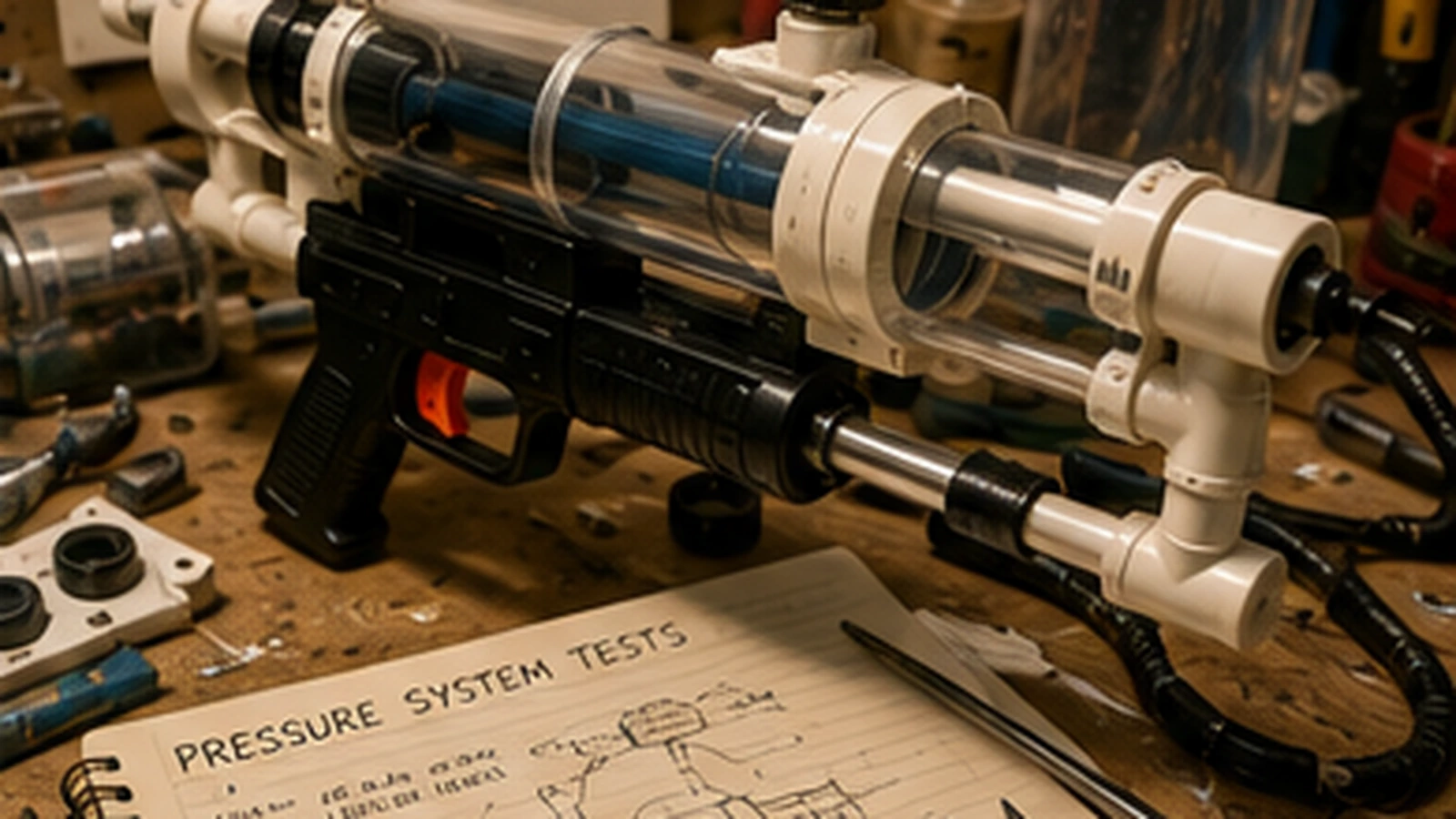
The early prototype looked less like a retail toy and more like something the neighborhood kid with the workbench had been told not to bring outside.
A Soda Bottle Served as the Reservoir
The bottle made the stored water visible and proved an ordinary container could become part of a pressure system.
PVC and Acrylic Parts Formed the Body
Johnson used available materials to build and test the concept before a toy company refined it for mass production.
A Hand Pump Added Air Pressure
Manual pumping compressed the air above the water, storing energy until the trigger opened the valve.
The Prototype Demonstrated Range
The point was not appearance. It was showing that the stream could travel farther and continue longer than a traditional squirt gun.
The Top-Mounted Bottle Became a Visual Signature
Later retail models kept a visible reservoir above the body, making the blaster’s capacity and technology easy to recognize.
Children Understood It Instantly
No engineering lesson was required. Pump, aim, pull trigger, watch somebody sprint.
The Prototype Needed a Company
Johnson could invent and prove the system. Producing millions of safe, affordable plastic units required manufacturing, marketing and retail access.
The Gen X verdict: it looked like science fair equipment, which only made us want it more.
The Patent Called It a Squirt Gun. The Neighborhood Would Disagree.
Lonnie Johnson’s Original Water-Gun Patent
The first patent established the pressure-based system years before the Super Soaker name reached store shelves.
U.S. Patent 4,591,071
Johnson’s patent, titled “Squirt Gun,” was granted on May 27, 1986.
The Design Stored Compressed Air
The reservoir was partially filled with water, leaving space for air. Pumping compressed that air and pressurized the water.
A Trigger Controlled the Valve
Pulling the trigger opened the flow path and allowed the pressure to drive water through the nozzle.
The Patent Emphasized a Continuous High-Velocity Stream
That language describes the exact difference kids noticed immediately. This was not one squeeze and one squirt.
Pressure Required Safety Thinking
A toy containing compressed air and water needed design limits, reliable seals and controlled release.
Later Patents Improved the System
Johnson and collaborators developed additional arrangements involving separate tanks, trigger systems and pressure chambers.
The Patent Became the Foundation of a Huge Toy Business
Licensing the design to Larami allowed the invention to reach mass-market scale while Johnson retained a financial connection to its success.
The neighborhood version: officially, it was a patented pressure-operated toy. Unofficially, it was why nobody could safely stand behind the station wagon anymore.
The Hard Part Was Convincing Adults That Kids Wanted More Water
Finding a Toy Company Willing to Build It
A strong prototype did not automatically create a product. Johnson had to find a manufacturer willing to redesign, tool, advertise and distribute it.
Large Toy Companies Passed
New inventions compete against existing product plans, manufacturing costs and companies that believe they already understand a category.
The Prototype Needed a Live Demonstration
The idea became most convincing when someone saw the range and stream rather than reading a description.
Johnson Met Larami Representatives
Larami was known for lower-cost toys and water guns, making it a logical company to understand the category’s limitations.
A Presentation at Larami’s Headquarters Changed Everything
Johnson demonstrated the prototype and showed that it could outperform conventional water pistols dramatically.
Larami Refined the Product
Engineers and designers adapted the system for plastic manufacturing, safer operation, mass production and retail packaging.
The Company Took a Marketing Risk
The first release needed advertising strong enough to explain why this water gun cost more than a bag of ordinary squirt pistols.
The Risk Paid Off Quickly
The combination of obvious performance and aggressive commercials turned the invention into one of the decade’s biggest outdoor-toy stories.
The lesson: the product did not need a complicated pitch once somebody fired it. The water crossing the room handled the presentation.
The Company That Took the Backyard Seriously
Larami Corporation and the Super Soaker Launch
Larami understood cheap water toys. Johnson showed the company that the category could become premium, technical and extremely loud.
Larami Had Water-Gun Experience
The company sold inexpensive seasonal toys and knew the retail space where water pistols normally lived.
The New Design Changed the Price Point
A pump, sealed pressure system and larger reservoir cost more than a simple molded pistol.
The Product Needed a Bigger Identity
It could not look like another disposable summer toy. The body, tank, graphics and name needed to communicate power.
Engineering Made Mass Production Possible
Larami’s team helped translate the homemade prototype into reliable injection-molded components.
Advertising Became Essential
The difference was best demonstrated visually: pump the blaster, hit a target from a distance and show the victim completely soaked.
Larami Built a Product Family
Instead of relying on one successful model, the company created numbered sizes and later XP, CPS and Super Charger systems.
The Brand Outgrew the Company Name
Kids said “Super Soaker,” not “Larami pressurized water product.” The brand became the category shorthand.
The Gen X test: if somebody said “bring water guns,” nobody asked whether the Super Soaker counted. We asked how big it was.
Before Super Soaker, There Was Power Drencher
Power Drencher in 1990: The Original Super Soaker Launch
The first commercial version reached stores in 1990 under a name that already sounded like a warning.
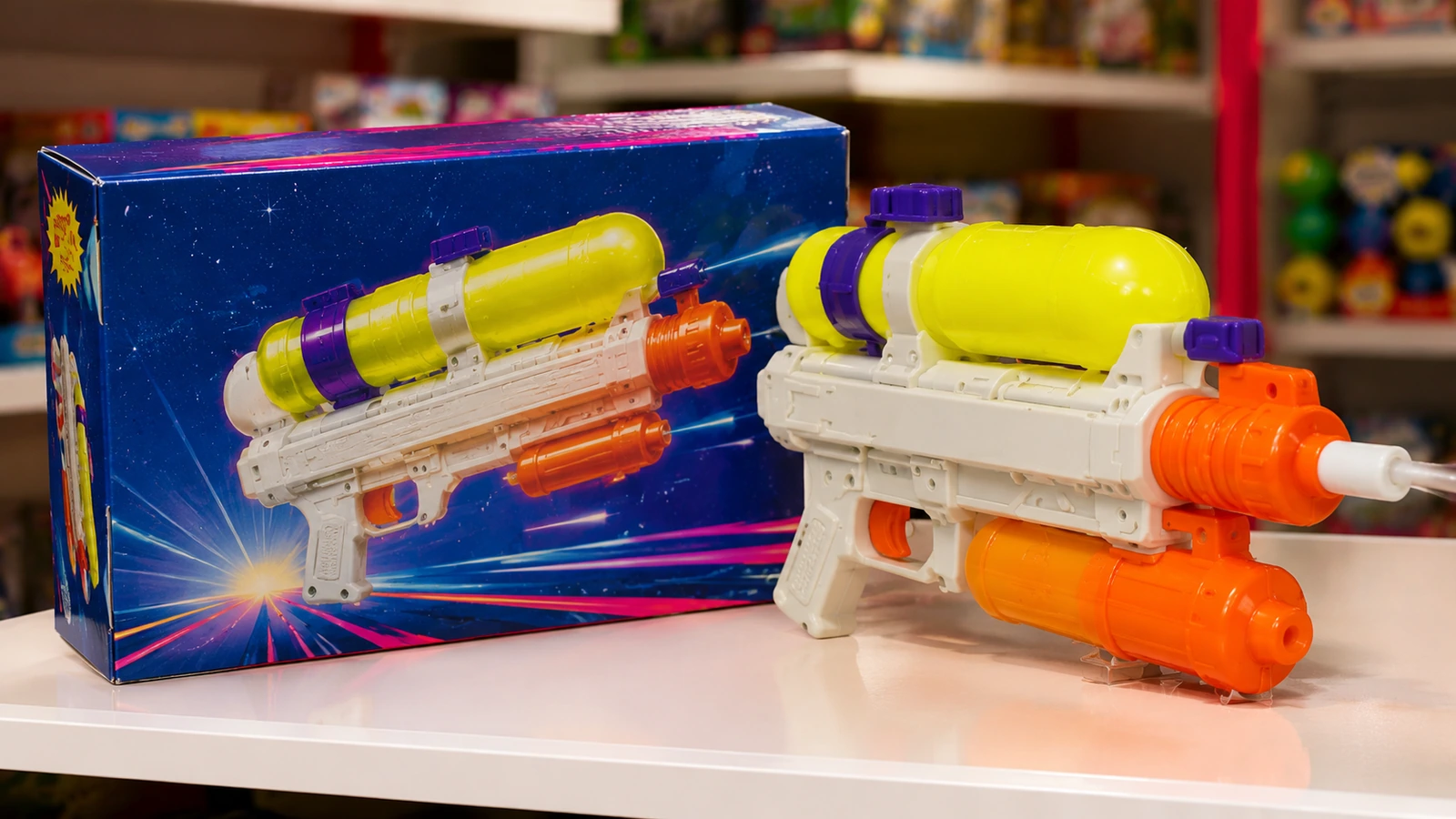
The Power Drencher Introduced the Core Design
The top-mounted bottle, hand pump, trigger and pressurized stream established the visual and mechanical language.
The Name Focused on the Result
“Power Drencher” did not waste time explaining technology. It promised that the other child would become wetter.
The Toy Looked Different From Conventional Pistols
A large clear or translucent reservoir made the water supply visible. The pump handle showed that the user had to charge the system.
1990 Was a Testing Ground
The product proved children and parents would pay more for obvious performance.
The First Name Did Not Last
A trademark issue led Larami to adopt the Super Soaker name.
The Product Identity Survived the Change
The important part was already present: a bright pressure blaster that made traditional water guns look obsolete.
Collectors Treat Power Drencher as the Beginning
Original packaging and surviving examples represent the brief moment before one of the 90s’ most recognizable toy names appeared.
The timing: 1990 got the prototype name. 1991 got the name everybody still remembers.
One Name Explained the Product and the Damage
How Power Drencher Became Super Soaker
The new name turned a powerful water gun into a brand that could support an entire decade of escalation.
The Trademark Problem Forced a Change
Larami could not continue using Power Drencher as planned, so the company needed another name.
“Super” Positioned It Above Ordinary Water Guns
The word immediately separated the toy from small trigger pistols and novelty squirters.
“Soaker” Described the Experience
The goal was no longer landing one hit. It was delivering enough water to change clothing color.
The Name Worked Across Models
Super Soaker 50, 100, 200 and later model names sounded like members of the same equipment family.
It Became Category Shorthand
Parents and kids often used Super Soaker to describe pressurized water blasters generally, even when another company made them.
The Branding Matched the Commercials
Bright lettering, splash graphics and action-heavy ads made the name feel like a summer sports league.
The Name Survived Multiple Owners and Eras
Larami, Hasbro and the later Nerf connection changed the corporate context, but Super Soaker remained the recognizable promise.
The naming achievement: two words told us it was better than our current water gun and what would happen if the neighbor bought it first.
Pump First, Regret Later
How the Original Super Soaker Pressure System Worked
The classic system stored energy in compressed air so the trigger could release a continuous stream rather than operate the pump directly.
Fill the Reservoir With Water
The user removed the tank, filled it and reattached it securely. Overfilling or cross-threading the cap created an early lesson in seals.
Leave Air Space
The system needed compressible air above or beside the water. Water itself does not compress in the same useful way.
Pump the Handle
Each stroke forced more air into the reservoir or moved water into a separate pressure chamber, depending on the model.
Pressure Builds
The compressed air pushed against the water. The toy now contained stored energy waiting behind the valve.
Pull the Trigger
The trigger opened the valve. Pressure forced water through the nozzle until the trigger closed or the pressure dropped.
Pump Again
Performance weakened as pressure fell. Experienced users learned to pump before the stream became embarrassing.
Different Systems Changed the Feel
Classic air-pressure models lost force gradually. Later Constant Pressure System blasters used elastic chambers to maintain a steadier stream.
The practical physics lesson: pumping while staring directly at the opponent was the 90s version of announcing that negotiations had ended.
Why it mattered: the trigger released stored pressure, so the shooter could aim and fire without jerking the blaster through repeated trigger squeezes.
The Blaster That Made the Brand
Super Soaker 50: The Original 90s Icon
The Super Soaker 50 became the recognizable entry point: manageable size, clear tank, pump action and enough range to transform a normal backyard fight.
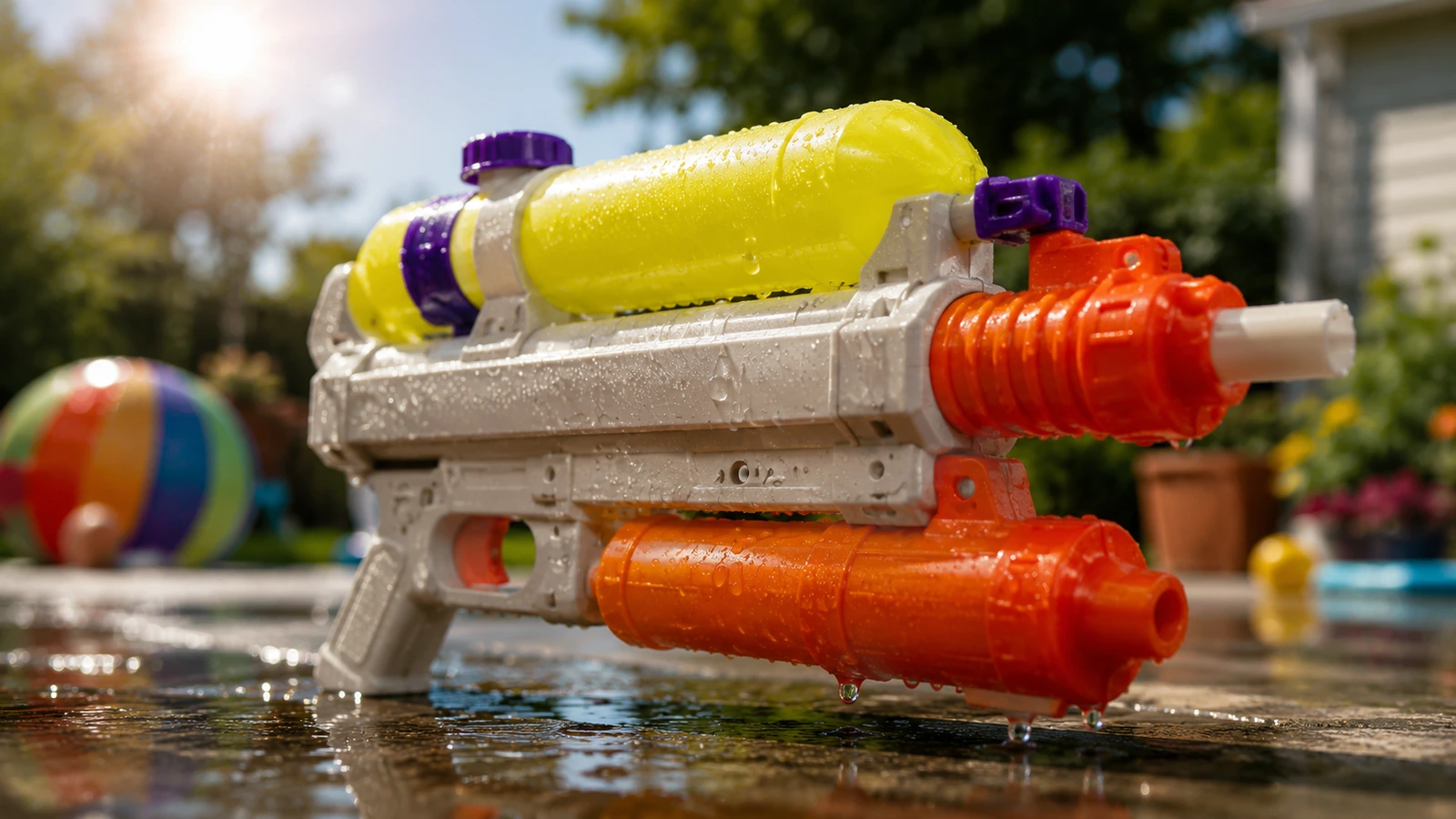
The Size Was Practical
The SS 50 was large enough to feel powerful without requiring a shoulder strap, backpack or weight-training program.
The Top Bottle Defined the Silhouette
The removable reservoir made the water visible and gave the blaster a futuristic profile.
The Pump Was Part of the Ritual
Users charged the blaster before combat. The sound and movement created anticipation.
Range Created Separation
The shooter could hit targets outside the comfortable retaliation distance of ordinary water pistols.
The Stream Lasted
Holding the trigger delivered continuous water until pressure dropped, making one accurate shot more damaging.
The Price Was Reachable
The SS 50 could become a birthday gift, allowance goal or summer purchase without reaching the premium cost of the giant models.
The Model Became Visual Shorthand
Even people who never learned the number recognize the bright body, pump and top-mounted bottle.
The Gen X reality: the SS 50 was enough to dominate the block for exactly one week, until somebody’s cousin arrived with the 100.
The First Serious Upgrade
Super Soaker 100
The Super Soaker 100 made the original concept larger, more imposing and better suited to the child who believed a fair water fight was a design failure.
Larger Capacity
More water meant more trigger time before retreating to the hose.
Separate Pressure Chamber Feel
The larger body and visible components made the system look more technical than the compact SS 50.
Longer Presence in a Fight
The user could remain active while smaller blasters ran dry.
More Weight
Water is heavy. The capacity advantage arrived with a lesson about carrying the tank when full.
Higher Gift Status
The SS 100 looked like a main birthday present rather than a checkout-aisle summer extra.
Immediate Social Rank
Kids noticed model numbers. The 100 sounded twice as serious as the 50 even before anyone compared output.
The Upgrade Cycle Began
Once numbers indicated size and power, the product line created an equipment hierarchy every neighborhood understood.
The moment: somebody carried the 100 out of the garage and the kid with the 50 suddenly started discussing teamwork.
When the Model Number Started Sounding Like Horsepower
Super Soaker 200
The SS 200 pushed the classic design toward premium equipment and made the backyard escalation impossible to ignore.
The Body Looked Substantial
The larger profile communicated that this was not the entry-level model.
Capacity Changed Tactics
A user carrying more water could suppress doorways, protect a refill station or chase opponents farther from the hose.
The Two-Handed Feel Increased
Larger Super Soakers required more support and created a visual relationship to action-movie hardware.
It Became a Premium Wish-List Item
The 200 belonged in catalogs, birthday requests and conversations involving the phrase “I will pay for half.”
Performance Created Resentment
A child with a giant model could become the immediate target of every smaller blaster, which was the closest 90s water warfare came to balancing.
Refill Time Became Longer
More capacity helped during the fight and created vulnerability at the faucet.
The Number Ladder Worked
The existence of 50, 100 and 200 made the product range feel organized like equipment rather than assorted toys.
The economic lesson: the 200 was what happened when a toy company discovered kids understood bigger numbers without needing a spreadsheet.
Every Number Was a New Reason the Current Blaster Was Inadequate
Super Soaker 50, 100 and 200: The Classic Early-90s Line
The early models established a simple ladder of size, capacity and backyard status.
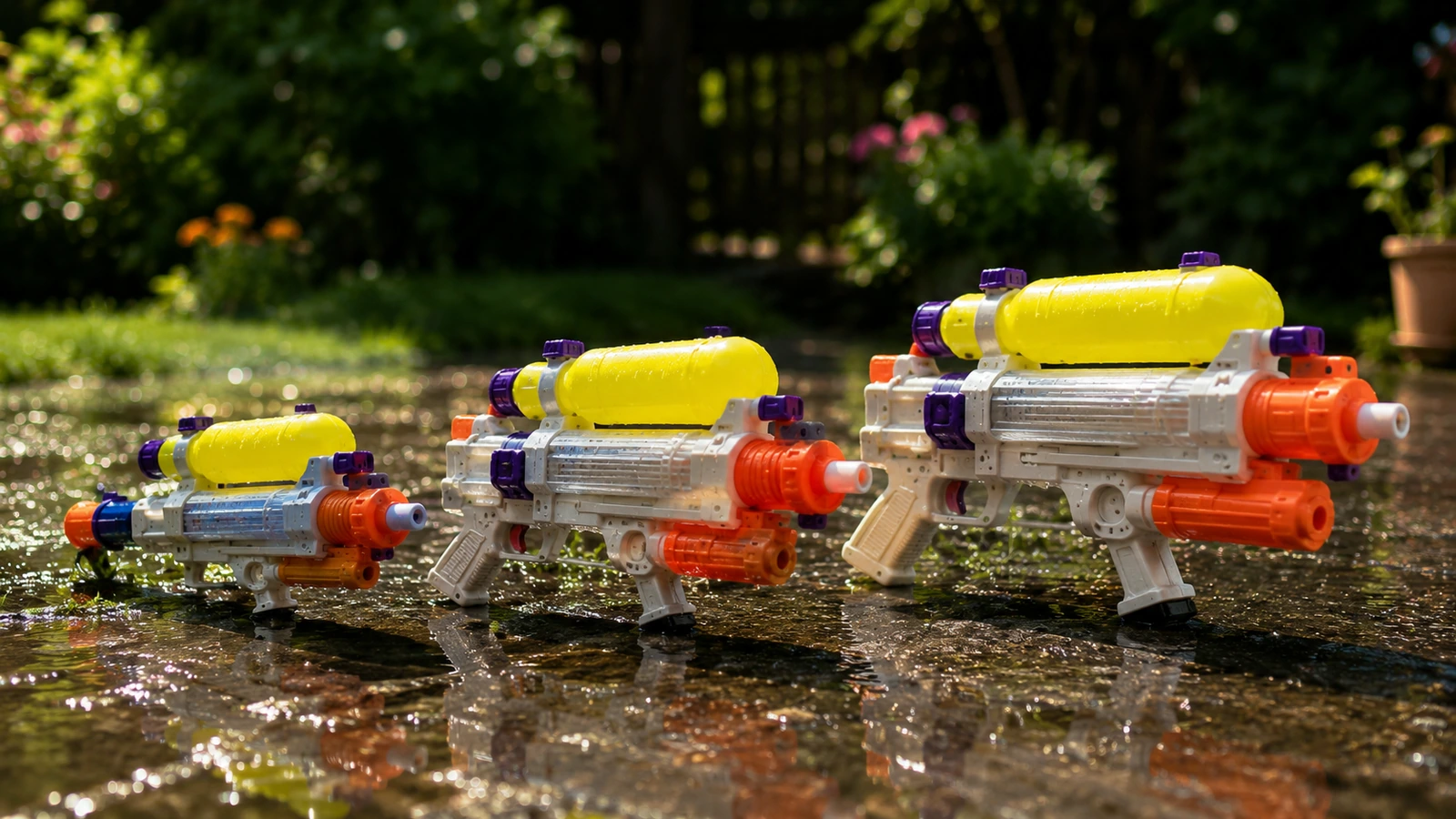
A compact entry model for surprise attacks, backup duty and children not yet trusted with the larger reservoir.
A small step up that preserved portability while offering more presence than a traditional pistol.
A lightweight rifle-style option that sat between pocket-sized defense and the iconic SS 50.
A medium option in the expanding lineup, because no number between 10 and 100 was safe from becoming a summer product.
The classic icon and practical all-around model.
The serious upgrade with more capacity and visual authority.
A premium large-format blaster built for longer engagements.
The backpack-fed system that announced the neighborhood arms race had reached procurement.
They made comparison immediate, even when the exact number did not translate cleanly into one measurable performance statistic.
The numbered Super Soaker ladder belonged to the same early-90s toy climate that produced the Power Rangers Megazord rush and the tiny-world obsession of Polly Pocket in the 90s. One toy sold bigger combining hardware, one sold an entire world inside a compact, and Super Soaker sold the promise that the kid with the larger number probably had the advantage.
The Backpack Changed the Emotional Temperature
Super Soaker 300 and the Backpack Reservoir
The SS 300 looked like a child had received authorization from a very irresponsible quartermaster.
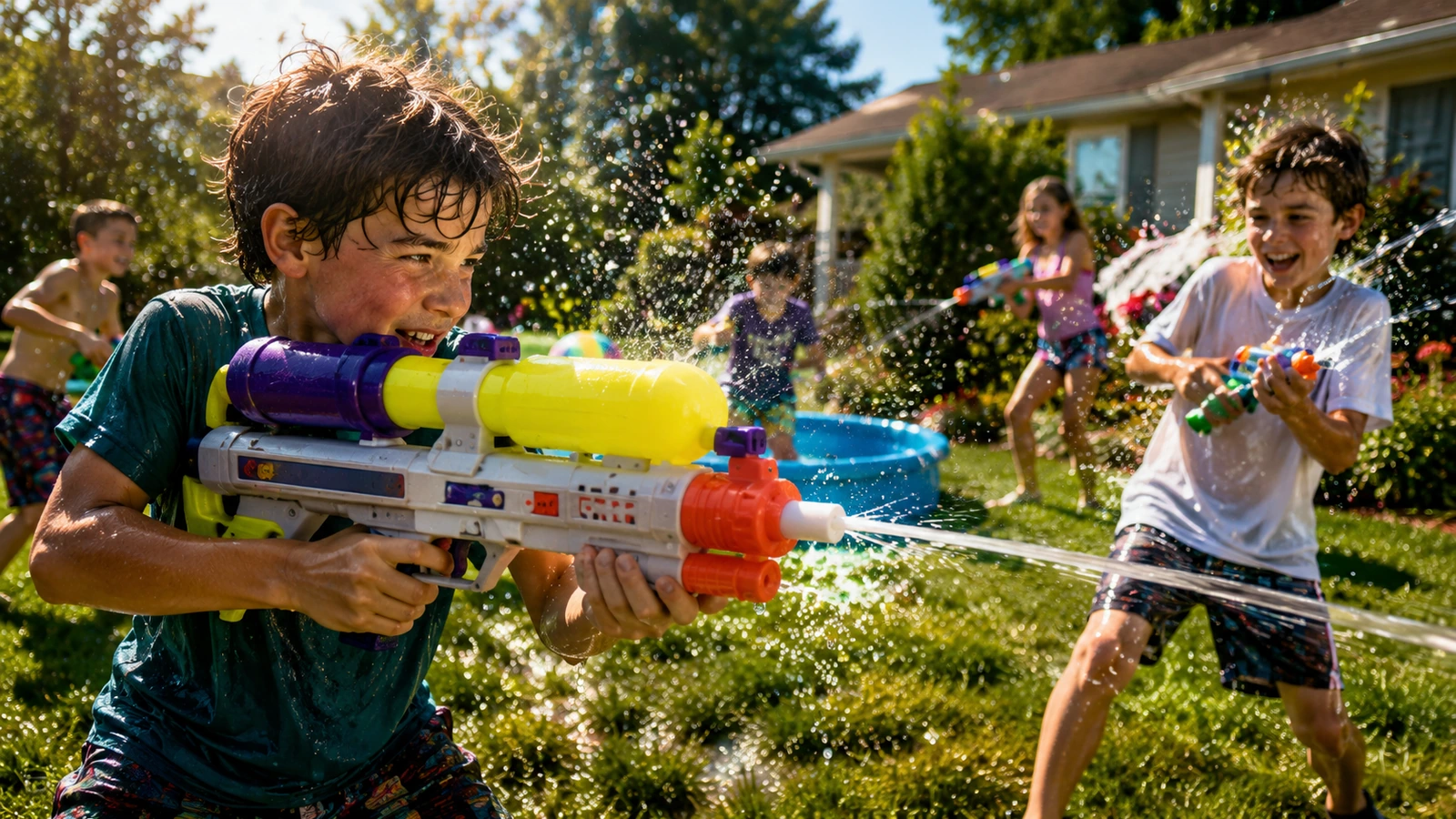
A Large Backpack Held the Water
Moving the reservoir to the user’s back created far more capacity than a normal top-mounted bottle.
A Hose Fed the Handheld Blaster
The user carried the firing unit while the heavy water supply stayed against the body.
Weight Became Distributed
A backpack was easier to carry than placing the same amount of water entirely in the hands.
Capacity Changed the Battle
The SS 300 could remain active while opponents ran toward the hose carrying empty bottles.
The Hose Created a Weak Point
Connections, seals and flexible tubing added complexity and more places for age-related leaks.
The Visual Effect Was Unmatched
Straps, hose and oversized tank made the wearer look prepared for a problem much larger than children behind a hedge.
It Became a Legendary Collector Model
Complete working examples require the reservoir, straps, hose, blaster and functioning pressure system.
The neighborhood rule: when a kid showed up wearing water, everyone else stopped pretending teams were optional.
The SS 300 turned capacity into intimidation before the first trigger pull.
One Nozzle Was No Longer Enough
MDS and the Rise of Adjustable Super Soaker Features
As the line matured, Larami added selectable spray patterns, multiple directions and more obvious mechanical features.
MDS Meant Multi-Directional System
The concept allowed the nozzle or firing direction to change, making the blaster less predictable.
Adjustability Became a Selling Point
The original claim was raw pressure. Later products needed another visible reason to replace the current model.
Nozzle Choice Changed Range and Coverage
A narrow stream favored distance. Wider patterns covered more area at shorter range.
Moving Parts Increased Play Value
Rotating or selectable elements made the user feel like the blaster had modes rather than one fixed function.
Commercials Could Demonstrate the Difference
A quick close-up of the nozzle changing explained the feature better than package text.
More Mechanisms Meant More Aging Problems
Selector seals, valves and rotating components can become stiff, cracked or leaky in vintage examples.
The Line Was Becoming Equipment Culture
Kids discussed settings, capacity and performance instead of simply saying “water gun.”
The 90s upgrade logic: once the blaster could shoot straight, somebody had to make one that shot sideways.
Extra Power, Extra Plastic, Extra Reasons to Upgrade
Super Soaker XP Series: The Mid-90s Upgrade
The XP line arrived in the middle of the decade and modernized the brand with new shapes, separate pressure chambers, pressure gauges and a clearer performance ladder.
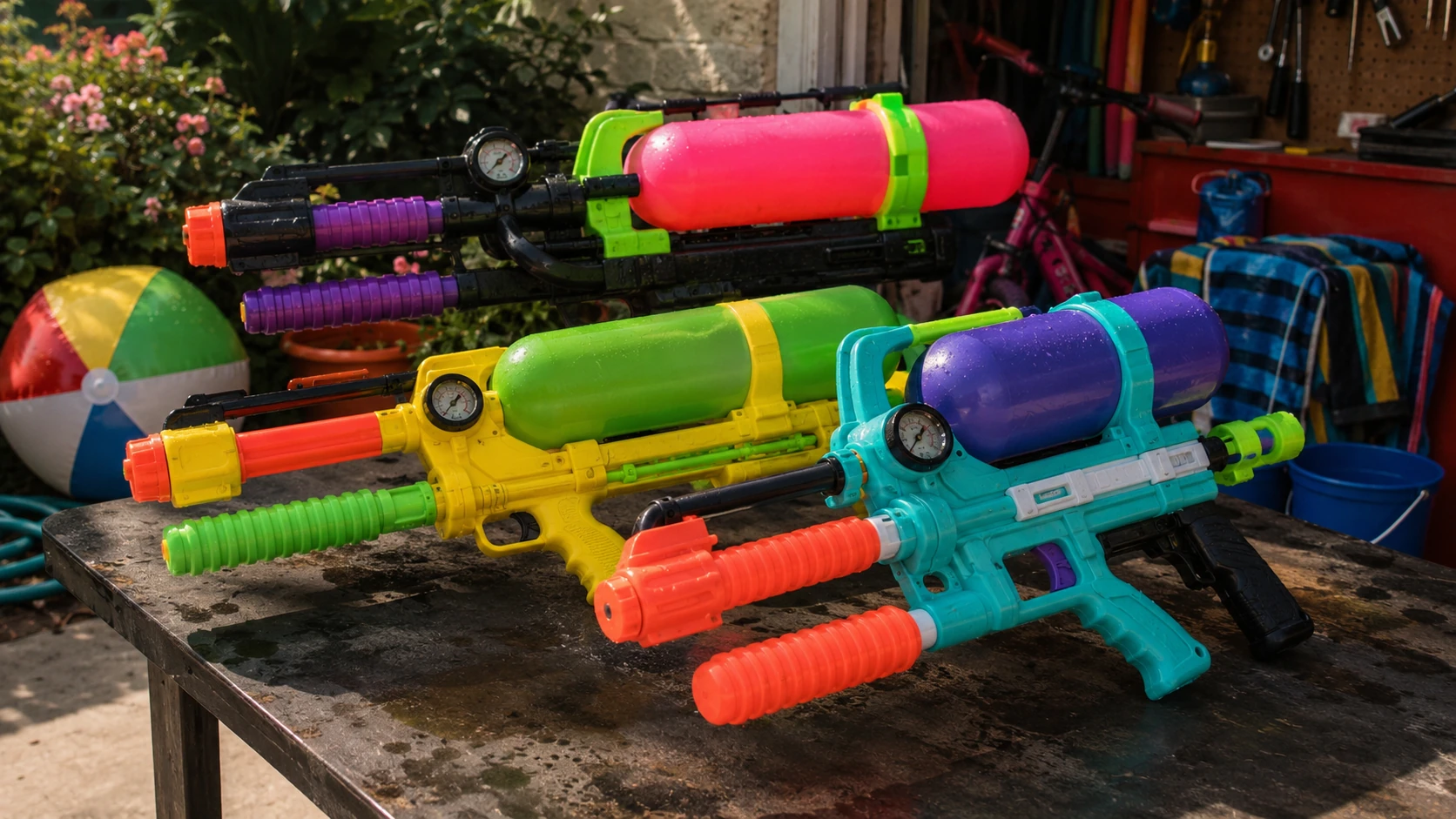
XP Stood for Extra Power
The name promised stronger output than the classic line without requiring parents to understand pressure-volume calculations.
Designs Became More Integrated
Tanks, chambers and bodies looked less like a bottle attached to a pistol and more like purpose-built equipment.
Separate Pressure Chambers Improved Use
Many models pumped water or air into a dedicated chamber, separating stored pressure from the main reservoir.
Pressure Gauges Added Theater
Models such as the XP 105 included a gauge that made pumping feel like preparing a machine rather than a toy.
The Number System Changed
XP numbers still suggested size and status, but did not always map neatly to one exact measurement.
The Line Covered Several Roles
Small sidearms, medium rifles and large primary blasters allowed children to think in loadouts before the term entered normal toy language.
XP Became the Mid-90s Standard
For many Gen X and older millennial kids, XP models are the exact visual memory of Super Soaker at full cultural maturity.
The upgrade pitch: the classic blaster had a bottle. The XP had a chamber, a gauge and enough molded vents to imply somebody had tested it in a wind tunnel.
The Numbers Became a Neighborhood Ranking System
Super Soaker XP 35, XP 65, XP 105 and XP 150
The XP lineup offered recognizable steps from lightweight mobility to larger pressure chambers and longer fighting time.
A compact backup-style blaster for close range, surprise shots and the child who spent the main budget on snacks.
A light rifle-style model that balanced portability, pump speed and enough stream to matter.
A medium all-around model that became a practical main blaster for many backyard fights.
A mid-size step with the visual confidence of a separate pressure chamber and more serious grip.
A heavy rifle-style favorite remembered for its pressure gauge and substantial reservoir.
A later variation that continued the large primary-blaster role.
A big air-pressure model with enough capacity and presence to become the center of a water-war strategy.
Smaller releases proved the brand could create backup blasters without abandoning pressure-system identity.
Choose mobility, capacity or intimidation—and then discover the neighbor had chosen all three.
The Stream Stayed Strong Instead of Fading Away
Super Soaker CPS: How the Constant Pressure System Worked
The CPS system became the late-90s performance benchmark by using an elastic pressure chamber that maintained more consistent force during the shot.
Air Pressure Naturally Drops
In a classic air-pressure blaster, the stream often starts strong and weakens as the compressed air expands.
An Elastic Chamber Pushes Back
CPS models pump water into an expanding rubber bladder or similar elastic chamber. The stretched material applies pressure to the water.
The Output Remains More Consistent
The chamber continues squeezing as it empties, helping the stream stay thick and forceful through more of the shot.
Pumping Filled the Chamber
The user could feel resistance build as the bladder expanded.
The Trigger Released Serious Flow
Large nozzles and steady pressure produced streams that felt more like portable hose output than a toy pistol.
CPS Models Became Premium Equipment
The larger bodies, tanks and chambers increased cost, weight and neighborhood reputation.
The System Created a Collector Peak
Many enthusiasts consider the late-90s CPS designs a high point in Super Soaker performance and engineering.
The difference: an air-pressure stream slowly lost confidence. A CPS stream behaved like it had something personal to prove.
The Water Blaster Kids Spoke About Like a Restricted Vehicle
Super Soaker CPS 2000: The Legendary Late-90s Water Blaster
The 1996 CPS 2000 became the legend of the line: oversized, high-output and remembered as the blaster that made “too powerful” sound like a purchasing recommendation.
It Introduced the CPS Line
The model demonstrated what a large elastic pressure chamber could do when paired with a substantial tank and nozzle.
The Body Was Huge
A carry handle, long pump and large reservoir made it look like equipment from a movie where the city had already been evacuated.
A Pressure Gauge Added Preparation Drama
The user could monitor the charge instead of guessing when enough pumping had happened.
The Stream Was Thick and Forceful
Its reputation came from output, not only distance. A direct hit delivered enough water to end arguments about whether someone had been tagged.
Weight Required Commitment
Filling a large reservoir made the blaster heavy. Mobility and endurance became part of using it.
Rumors Became Part of the Myth
Stories about injuries, recalls and impossible power circulated through playgrounds and later online. Some claims grew beyond documented evidence, but the rumors show how intimidating the model felt.
Surviving Examples Are Closely Watched
Collectors distinguish versions, inspect pressure chambers and treat working condition carefully because aging rubber and seals can fail.
The neighborhood response: nobody asked whether the CPS 2000 was allowed. We asked which adult had agreed to buy it.
Its legend comes from the combination of size, output, rarity and the basic fact that it looked excessive even during the 90s.
Late-90s Water Hardware Reached Its Final Form
The Super Soaker CPS Line After the CPS 2000
Larami expanded constant-pressure technology into several sizes, giving more kids access to steady streams without requiring the largest model.
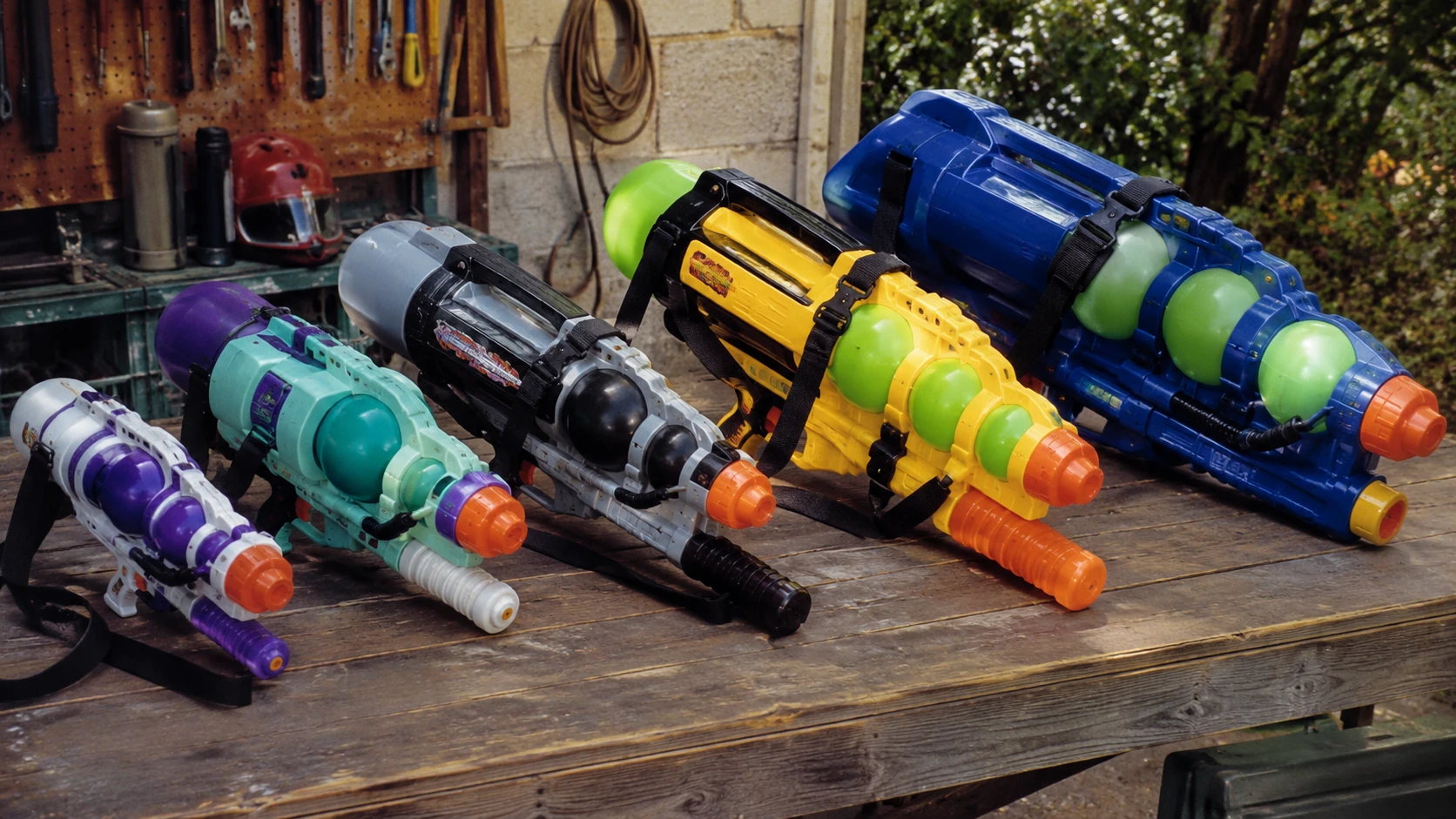
A more manageable constant-pressure blaster that balanced mobility with a strong, steady stream.
A larger primary model remembered for substantial capacity and selectable nozzle output.
A major late-90s model with a large body, multiple nozzle settings and serious battlefield presence.
A backpack-fed CPS system that combined constant pressure with a large remote reservoir.
A later large-format design continuing the heavy primary-blaster idea.
Compact models brought the system’s steady pressure into lighter packages.
Multiple output settings allowed range, stream thickness and water use to become tactical choices.
Large tanks and chambers made support hardware necessary rather than decorative.
By the end of the decade, a Super Soaker could be discussed like sports gear, camping equipment or something requiring a supply officer.
Attach It to the Hose and Skip the Pumping Negotiation
Super Charger Models and Quick-Fill Stations
Super Charger technology used a hose-connected device to refill and pressurize compatible blasters quickly.
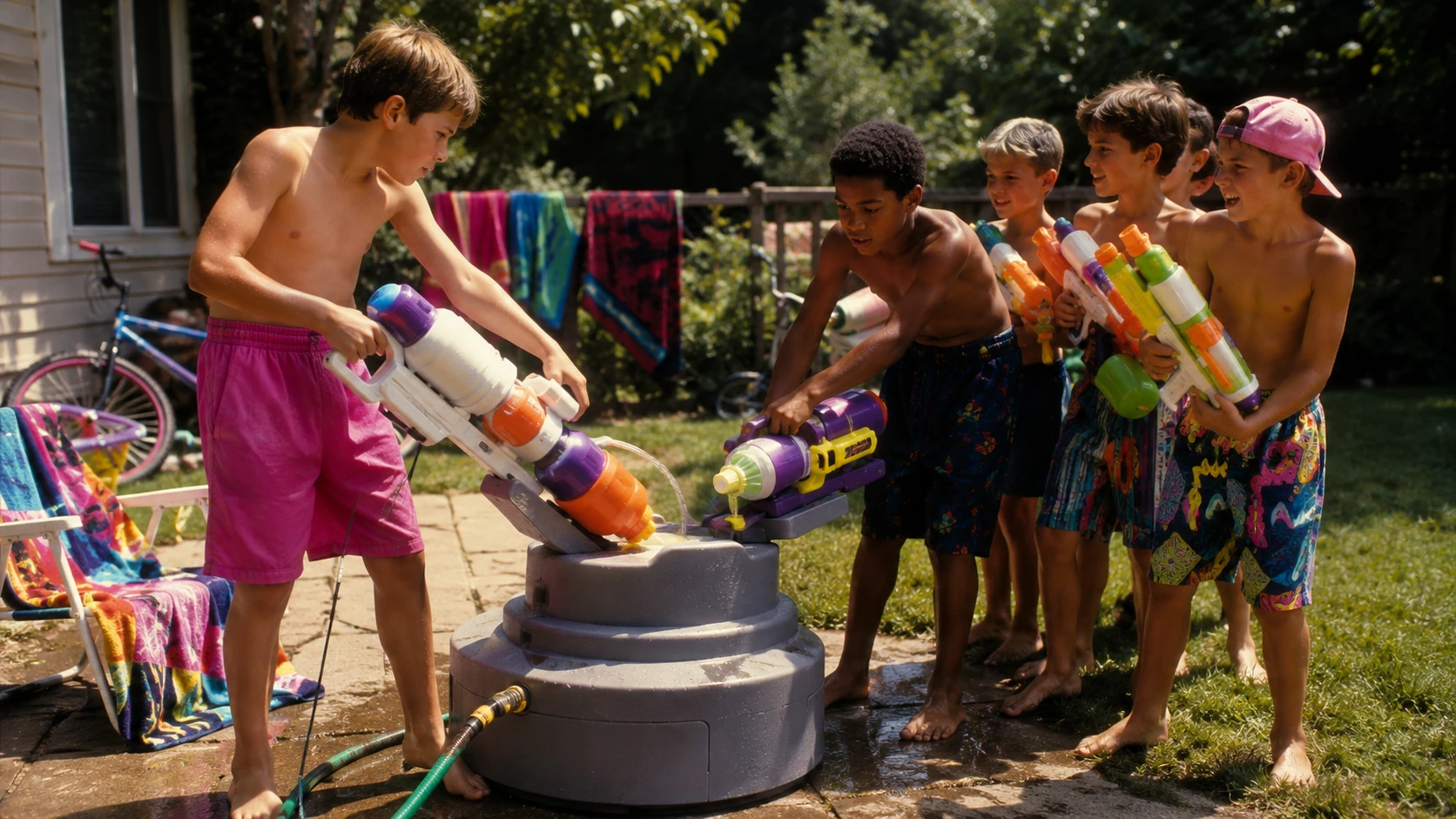
The Charger Connected to a Garden Hose
The station used household water pressure to load compatible models.
Refilling Became Faster
Instead of removing a cap, filling a tank and pumping repeatedly, the user could dock the blaster.
The Hose Became Infrastructure
A yard with a charger had a real supply station and an obvious strategic location.
Compatible Models Gained an Advantage
Fast turnaround mattered when the opposing team was still unscrewing reservoir caps.
The System Encouraged Brand Loyalty
A charger worked best when several blasters used the same connection.
Home Water Pressure Varied
Performance depended partly on the hose and household system, adding another factor children could blame.
The Refill Station Became a Battle Objective
Controlling the hose had always mattered. The charger made that control look official.
The tactical issue: the charger was brilliant until the other team realized it did not move and assigned somebody to stand near it.
Thirty Seconds of Pumping, Sprinting and Children Accepting Their Fate
Super Soaker Commercials Made Water Fights Look Like Action Movies
The ads did not show children calmly spraying a flower bed. They showed teams, ambushes, dramatic camera angles and enough airborne water to require weather radar.
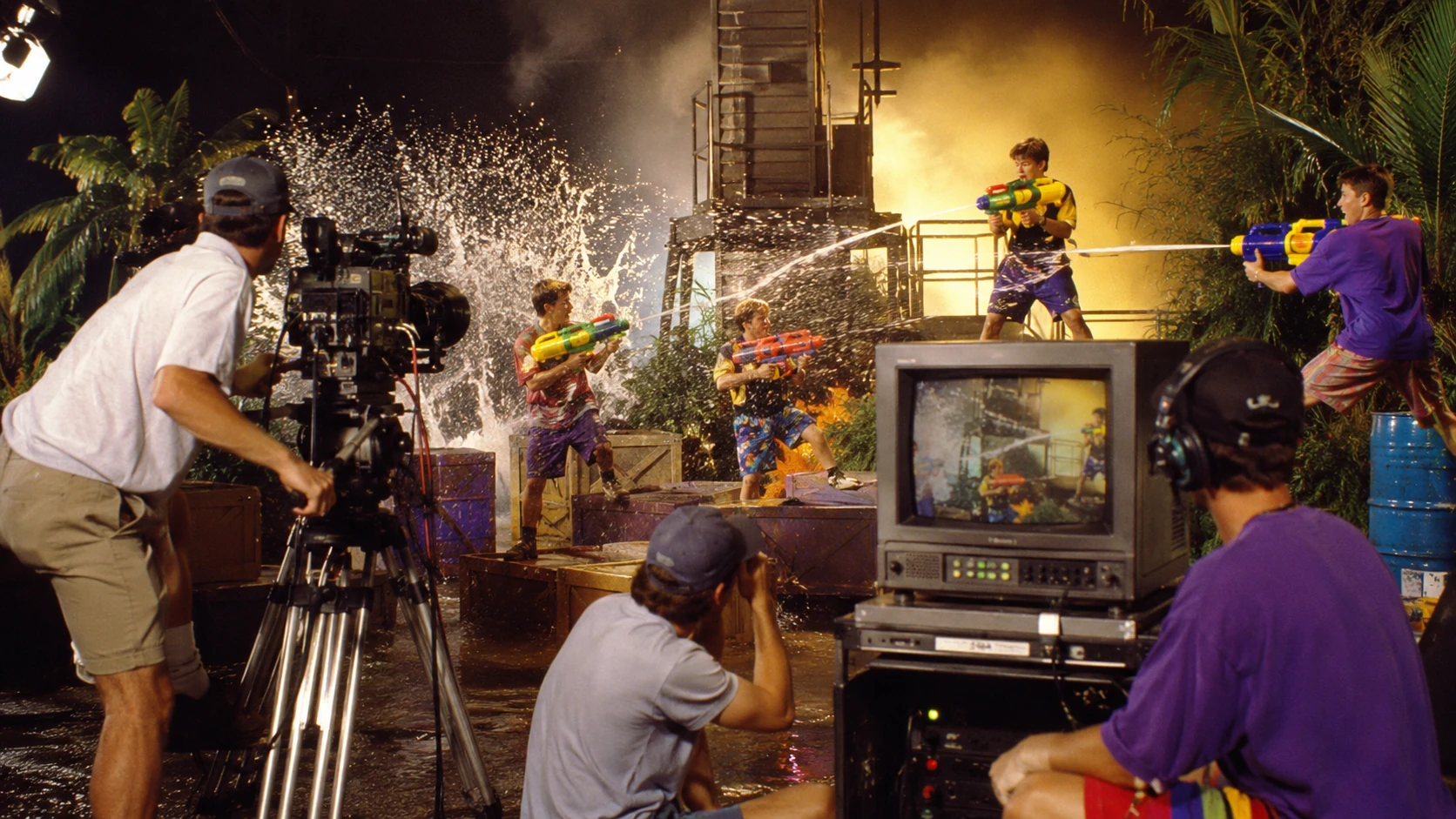
The Product Demonstrated Itself
A long stream crossing the screen immediately explained why the toy was different.
Slow Motion Made Every Hit Look Massive
Water exploded from shirts, hair and faces while the target reacted like a stunt performer.
The Commercials Used Teams
Children did not simply own blasters. They joined a side and entered a neighborhood campaign.
Bigger Models Received Hero Shots
The camera treated tanks, pumps and pressure gauges like high-performance machinery.
Model Variety Appeared Together
One child had the compact blaster. Another had the large primary model. The ad quietly explained the entire upgrade ladder.
The Voice-Over Sold Escalation
Words such as power, pressure, range and capacity gave the toy technical authority.
The Archive Preserves the Mood
The broader 90s toy-commercial collection shows how Super Soaker ads turned a summer product into a competitive identity.
The memory: seeing a commercial child absorb a direct blast, then looking at our weak trigger pistol like it had personally betrayed us.
The Slogan Was Not Subtle Because the Product Was Not Subtle
“Wetter Is Better” and the Super Soaker Brand Voice
The classic slogan turned soaking power into the only meaningful standard.
The Goal Was Clear
A water fight could involve accuracy, strategy and teamwork, but the person dripping onto the driveway had lost the visual argument.
The Slogan Rejected Restraint
More water, longer streams and larger tanks were presented as unquestioned progress.
It Fit the Product Ladder
Every larger model made “wetter” measurable through capacity and output.
It Worked in Television and Packaging
The phrase was short enough for commercials, boxes and children repeating it while adults discussed the water bill.
The Brand Became Competitive
Super Soaker was not marketed as a peaceful pool accessory. It was equipment for defeating another wet child.
The Slogan Captured 90s Toy Marketing
The decade loved louder, bigger and more extreme versions of familiar play.
The Phrase Still Summons the Era
Anyone who watched the ads can hear the delivery and picture neon plastic against a blue-sky backyard.
The parent translation: “Wetter Is Better” meant three towels on the kitchen floor and a strict rule about not entering the house.
Summer Shelves Looked Like a Municipal Water Department Had Gone Neon
Super Soaker in the 90s Toy Store
The line occupied several price points and physical sizes, from small hooks to backpack boxes that required lower-shelf real estate.
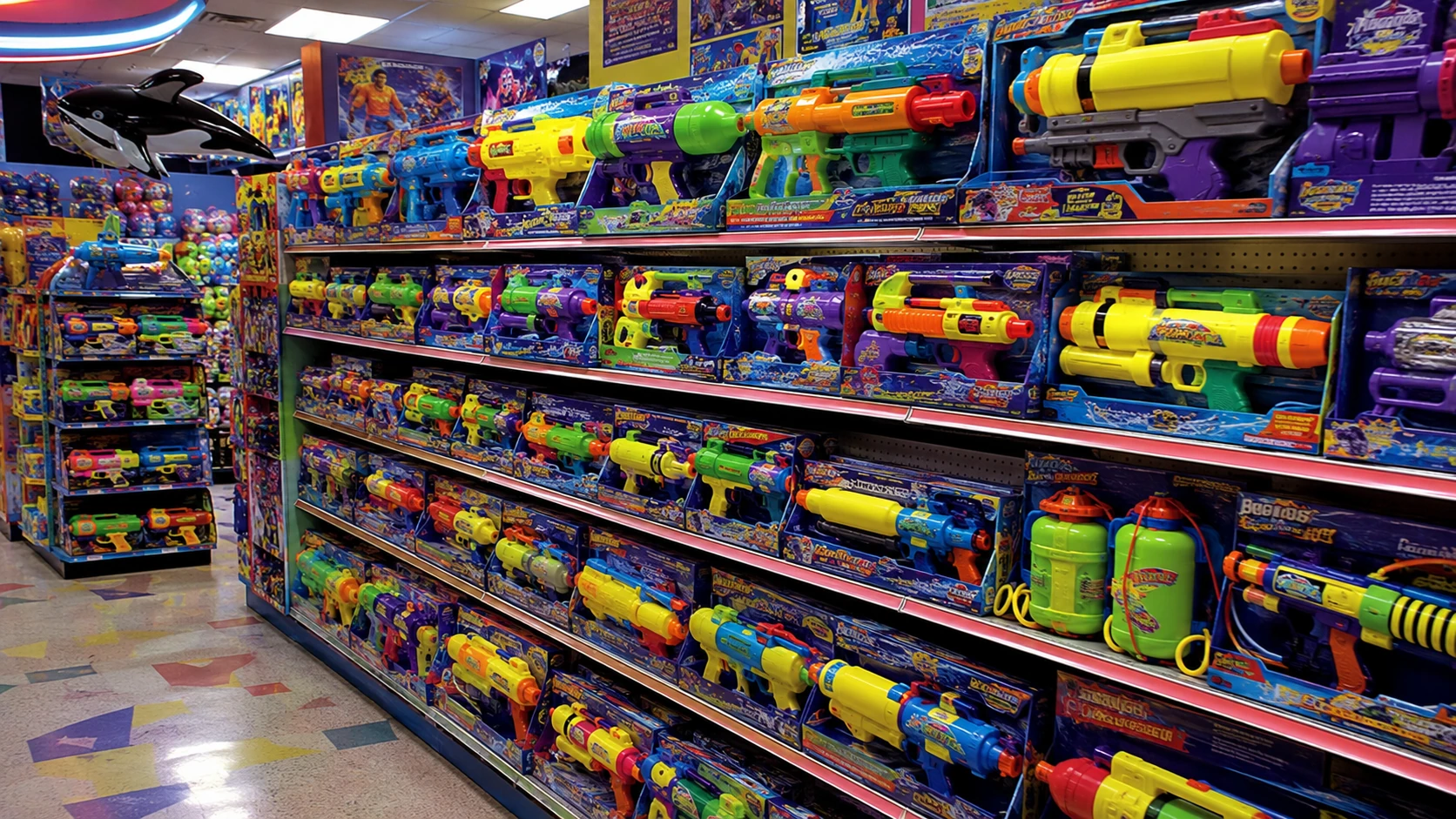
Small Super Soakers hung where an allowance or quick parent decision could reach them.
The recognizable middle model became the safe recommendation when nobody understood the full lineup.
Large XP and CPS boxes displayed tanks, streams and features like sporting equipment.
The SS 300 and later backpack systems needed enough packaging to show the entire hose-fed arrangement.
Water toys mattered most before summer trips, birthdays and the first neighborhood battle.
Children stared at capacity, range claims and nozzle graphics while parents stared at prices.
Wish lists were built months before the weather justified outdoor water.
The brand appeared beyond dedicated toy stores because summer water play had mass-market demand.
The hunt belongs to the broader 90s backyard-toy experience, where bikes, Nerf, rollerblades and Super Soakers competed for the same garage space.
That wall of neon boxes belongs to the larger story of 90s toy-store culture, when comparing package claims in the aisle was half the experience and asking for the largest model was the other half.
Super Soaker also earned an unusual place among the hottest Christmas toys of the 90s. Kids were asking for summer hardware in December because the tank, pump and giant box promised next year’s neighborhood advantage before the snow had even melted.
The same decade could turn a premium pressure blaster into a main gift and a tiny plastic restaurant giveaway into a completion crisis. The full contrast shows up in the story of 90s Happy Meal toys and fast-food giveaways, where the equipment was smaller but the collecting arguments were just as serious.
Every Block Had a Conflict and No Clear Chain of Command
How Super Soaker Created the 90s Backyard Arms Race
The toy changed the social structure of summer because equipment suddenly mattered as much as speed.
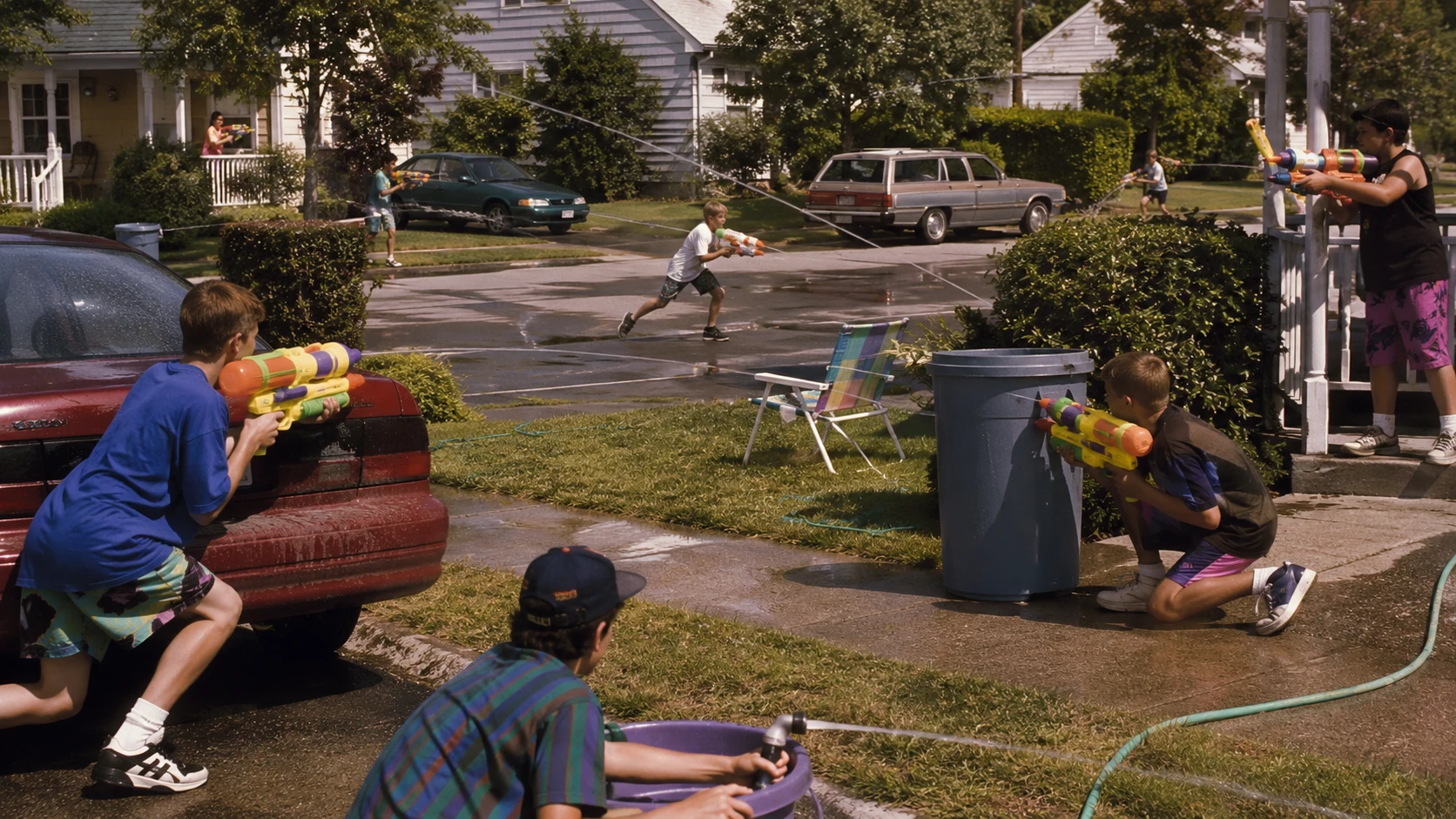
One Blaster Changed the Entire Neighborhood
The first Super Soaker did not join the existing water fight. It dominated it. Everyone else needed an upgrade or a defensive alliance.
Model Numbers Became Status
A 50, 100, 200, XP 105 or CPS model communicated capability before the game began.
Teams Formed Around Equipment
The child with the largest tank became artillery. The fast kid with the small blaster became a scout. The kid near the hose became politically powerful.
Yards Became Terrain
Hedges, parked cars, garages, porches and fences became cover. Open lawns became places nobody sensible crossed alone.
The Hose Became the Supply Base
Control of the refill point could matter more than the first attack.
Clothing Became a Scoreboard
There was no electronic hit sensor. A dark wet patch provided public evidence.
Every Summer Required New Negotiations
As models improved, old rules failed. Backpack tanks, nozzle selectors and CPS streams demanded new restrictions that lasted until someone ignored them.
The Gen X truth: the backyard arms race was not a metaphor. We watched the neighbor buy the bigger one and immediately began budget discussions at home.
The backyard had pressure tanks and hose control; the blacktop had Pogs, yo-yos, digital pets and trading rules made up during lunch. Together, Super Soaker battles and 90s schoolyard toys and recess crazes show how quickly one new object could reorganize an entire group of kids.
The Rules Were Clear Until Somebody Started Losing
Water-War Rules, Safe Zones and Refill Truces
Every group invented rules because the toys arrived with pressure instructions but no neighborhood constitution.
No Shooting During Refills
This was the most common and least respected agreement.
The Porch Was Sometimes Safe
Adults, snacks and dry towels needed neutral territory. That neutrality lasted until a target stepped one shoe onto the grass.
No Faces
Parents frequently established the rule. Children interpreted the face as a much smaller target than adults did.
No Going Inside While Wet
This was not a game rule. It was household law.
No Hose Directly
A garden hose could overpower every portable blaster and destroy the equipment balance.
Tank Hits Did Not Count
Some groups treated the blaster as armor. Others treated any visible splash as proof.
Rules Changed With New Equipment
A CPS 2000, backpack reservoir or Super Charger station could trigger emergency legislation.
The enforcement system: every rule was binding until the person who created it had a clear shot.
Capacity, Mobility and the Kid Who Knew Every Gap in the Fence
Super Soaker Tactics and Team Roles
The different blaster sizes created recognizable jobs during neighborhood water fights.
The Scout
Carried a small blaster, moved quickly and reported where the opposing team was hiding.
The Heavy
Used the largest tank and controlled open space while moving at the speed of someone carrying several liters of water.
The Defender
Protected the hose, bucket or garage entrance.
The Ambusher
Waited behind hedges, cars or trash cans and believed patience justified everything.
The Runner
Used speed to draw fire, create distractions and accidentally leave the agreed play area.
The Refill Specialist
Knew how to remove a tank without cross-threading it while everybody shouted.
The Dual-Wielder
Carried two smaller blasters because action movies had already settled the practical question.
The Hose Operator
Possessed unlimited water and therefore needed to be removed from the game by rule.
The Negotiator
Called truces mainly when personally empty.
Every Great Water Blaster Eventually Becomes an Empty Plastic Weight
The Refill Problem
Capacity created power, but refilling created the most vulnerable moment in the game.
Small Tanks Emptied Quickly
Compact models offered speed and easy carrying but required frequent returns to the water source.
Large Tanks Took Time to Fill
Backpack and large-capacity models stayed active longer, then spent a very noticeable amount of time attached to the hose.
Caps Had to Seal
A poorly threaded cap leaked water and pressure, turning a premium blaster into a decorative watering device.
Hoses Became Crowded
Several players could not refill simultaneously without arguments about order and hose control.
Kitchen Sinks Were Tempting
Indoor refilling was faster in some homes and strictly forbidden in others after the first puddle.
Buckets Created Field Stations
Wide containers allowed removable bottles to be submerged or filled quickly, though the water became increasingly lawn-flavored.
Super Charger Tried to Solve the Delay
Quick-fill technology turned the refill point into a more efficient and more valuable objective.
The strategic truth: the best blaster in the world became a heavy club the moment the last water left the nozzle.
Parents Bought the Toy and Immediately Created Restrictions
The Parent View of the Super Soaker Craze
Adults could appreciate outdoor exercise while remaining deeply suspicious of where the water would end up.
Outdoor Play Approval
Kids ran, planned, played with friends and stayed away from the television for a while.
Indoor Boundary
The blaster was not to be pumped, aimed or even looked at aggressively inside.
Water-Bill Awareness
The hose had been running for a suspicious amount of time.
Clothing Management
Wet children stopped at the door and removed shoes under supervision.
Face-Shot Rules
Adults repeatedly stated a safety restriction the commercials did not make look exciting.
Pressure Anxiety
Large models looked powerful enough to inspire warnings about eyes, windows and younger siblings.
Storage Problems
A fully drained blaster still occupied significant garage space.
Price Escalation
The original request for “a water gun” somehow became a premium pressure system with a strap.
The Exercise Defense
Children argued that the toy encouraged fitness while standing indoors dripping on the floor.
Once Larami Proved Water Could Be Premium, Everybody Wanted a Hose in the Fight
Super Soaker Competitors and the 90s Water-Blaster Boom
The success attracted rival pressure systems, licensed blasters and increasingly elaborate summer hardware.
Traditional Brands Upgraded
Companies that had sold simple pistols needed larger tanks, pumps and stronger streams.
Licensed Blasters Appeared
Action franchises and television properties placed logos on water toys, though a familiar character did not guarantee pressure performance.
Backpack Systems Spread
Large remote reservoirs became an obvious way to compete on capacity.
Multi-Nozzle Features Became Common
Spread shots, rotating heads and selectable patterns offered alternatives to pure range.
Electronic Features Entered the Category
Battery pumps and motorized streams tried to remove manual pumping, adding cost and battery anxiety.
Super Soaker Retained the Name Advantage
The brand had become the standard against which every competing water blaster was judged.
The Category Never Returned to Simplicity
After the pressure revolution, a large summer water toy was expected to have a system, model name and promise of superior soaking.
The shelf test: every competitor said it was powerful. We still turned the box over to see how it compared with the Super Soaker somebody already owned.
Larami’s Biggest Brand Attracted the Biggest Toy Company
Hasbro, Larami and the Super Soaker Business
Super Soaker’s success made Larami far more valuable than a company known mainly for inexpensive seasonal toys.
Hasbro Acquired Larami During the 90s
The purchase brought Super Soaker into one of the world’s largest toy companies.
Larami Continued Developing the Brand
The Larami name remained closely associated with the classic, XP, CPS and Super Charger eras.
Hasbro Added Distribution Power
A larger corporate network helped place the product across more retailers and markets.
Nerf Became a Related Outdoor Brand
Lonnie Johnson also contributed to high-performance Nerf technology, and both brands eventually occupied connected territory under Hasbro.
The Brand Survived Corporate Change
Children cared about the name on the side of the blaster, not the ownership structure printed in smaller type.
Later Products Changed Direction
Designs, pressure systems and branding evolved after the original Larami peak.
The 90s Era Retains a Distinct Identity
Collectors and enthusiasts often separate classic Larami Super Soakers from later Nerf-branded versions because the engineering and product philosophy feel different.
The kid-level corporate analysis: if the new one shot farther, the merger was approved.
By 1999, Water Fights Had Product Ecosystems
The Late-90s Super Soaker Peak
The final years of the decade combined XP reliability, CPS performance, quick-fill technology and a mature culture of model comparison.
The Brand Offered Multiple Pressure Systems
Air-pressure XP models, CPS blasters and Super Charger products gave buyers distinct technologies.
Nozzle Selection Became Normal
Large models offered settings for distance, output and water conservation.
Capacity Reached Backpack Scale
Large external reservoirs supported long fights and created heavy equipment roles.
Children Had Years of Experience
The audience now understood pumping, pressure loss, refill speed and the difference between a thin stream and a flood nozzle.
Commercials Could Sell Details
The category no longer needed basic explanation. Advertising focused on why this year’s system beat last year’s.
Collectors Now Look Back at This Period
Late-90s Larami models are remembered for bold colors, large bodies and performance-focused engineering.
The Backyard Arms Race Had Reached Full Maturity
What began as one pressurized bottle had become an equipment family with sidearms, primaries, backpack systems and refill infrastructure.
The decade’s final form: kids entered the yard carrying enough specialized water equipment to make an ordinary hose feel underqualified.
The CPS 2000 arrived during the 1996 toy year, and the expanding late-90s line can be followed through the top toys of 1997, 1998 and 1999—years when outdoor toys were competing with digital pets, consoles and every other reason to stay inside.
By the late 90s, Super Soaker was competing for attention with Furby mania, the speculative chaos of Beanie Babies and the constant classroom maintenance of Tamagotchi and the digital-pet panic. Those crazes lived indoors, in backpacks and on collector shelves. Super Soaker still required a yard, a hose and somebody willing to ignore the refill truce.
A Vintage Super Soaker Is a Pressure System, Not Just Bright Plastic
Vintage Super Soaker Collecting, Identification and Value
Collecting requires exact model identification and mechanical inspection because a blaster can look complete while leaking pressure internally.
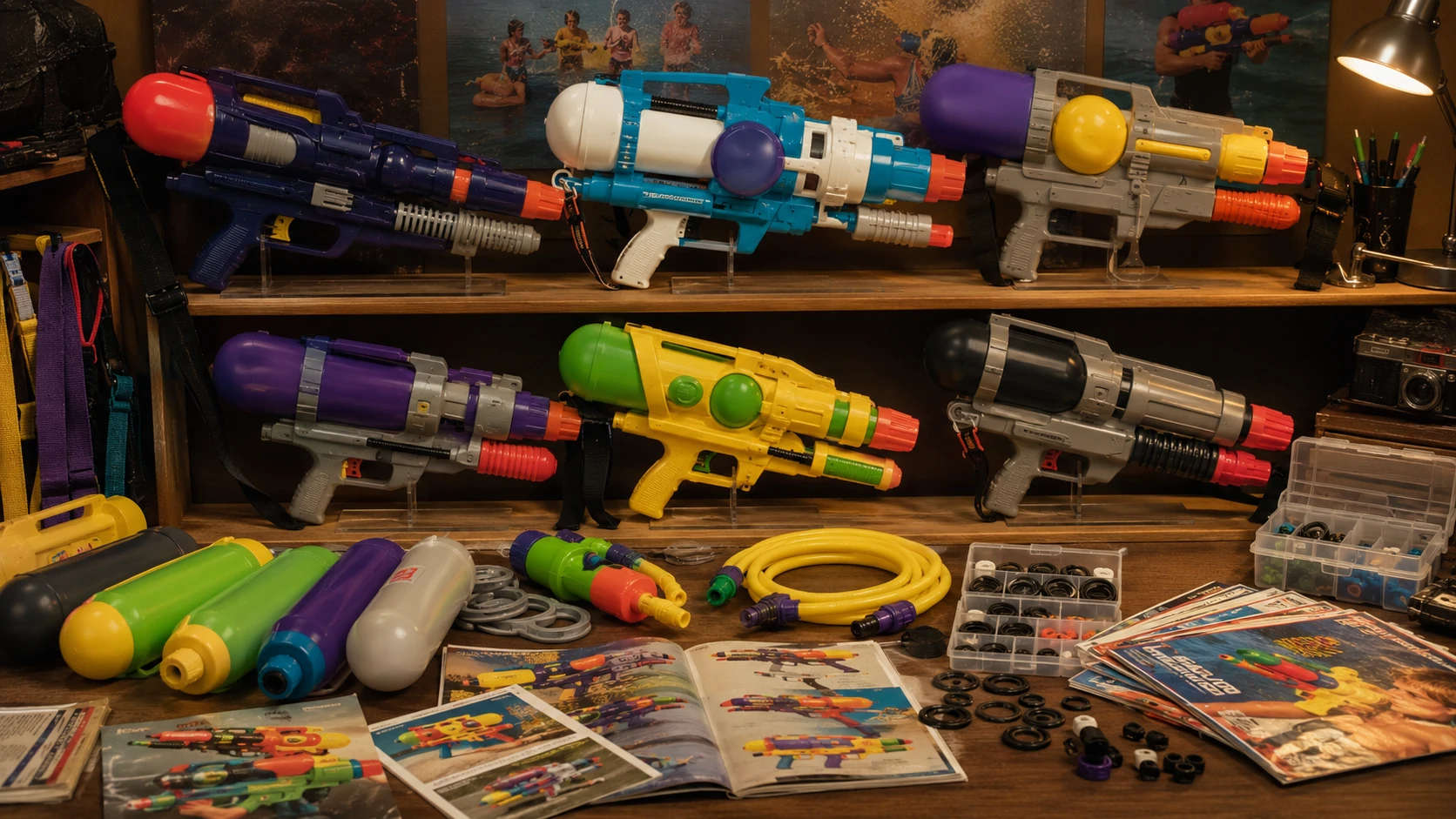
Focus on Power Drencher, classic numbered models, XP, CPS, Super Charger or backpack systems.
Body shape, tank design, nozzle, labels and molded markings help separate similar releases.
Look for cracks, cloudy plastic, missing caps and damaged threads.
The shaft should move smoothly and create resistance without grinding or wobbling.
A vintage blaster should not be aggressively pumped before seals and chambers are evaluated.
A dripping nozzle may indicate valve or seal failure.
Backpack models need flexible tubing, connectors and original carry hardware.
Rubber pressure bladders can harden, crack or rupture after decades.
Current value depends on exact model, working condition, completeness and documented version—not one optimistic listing.
The history and identification details stay useful, but current prices move quickly. Match the exact model and condition against recent completed sales before calling a leaking garage find a retirement plan.
The Sticker May Be Gone, but the Tank Shape Still Knows
How to Identify a Vintage Super Soaker Model
Color alone is not enough because several models appeared in variations and later releases reused familiar design language.
Find Molded Manufacturer Marks
Larami, Hasbro, dates and product information may appear on the body, tank or grip.
Look for the Model Label
Original decals may identify SS, XP, CPS or SC series and the model number.
Study the Reservoir
Top bottle, fixed tank, separate pressure chamber or backpack reservoir immediately narrows the possibilities.
Count the Nozzles and Settings
Selector wheels and multi-directional features distinguish certain large models.
Check the Pump Position
Front pump, under-barrel pump and integrated handles create recognizable silhouettes.
Identify the Pressure System
Air-pressure, CPS and hose-charged systems require different internal layouts.
Separate Reissues and Later Branding
A familiar name or shape does not automatically mean the blaster is an original 90s Larami release.
The safe approach: identify the body, tank, pump, nozzle and markings before trusting a seller who calls every neon water gun a “1991 Super Soaker 50.”
The Stream Should Leave the Nozzle, Not Every Seam
Common Vintage Super Soaker Leaks and Mechanical Problems
Decades of dry storage, heat and pressure cycling can damage seals, tubing, valves and elastic chambers.
Dried O-Rings
Rubber seals can shrink, crack or lose flexibility, allowing air and water to escape.
Tank-Cap Leaks
Damaged threads, missing gaskets or warped caps prevent the reservoir from sealing.
Pump Failure
A worn piston seal may move without building pressure.
Nozzle Drip
A valve that no longer closes fully can leak continuously under pressure.
Cracked Tanks
Old plastic exposed to sunlight or impact can develop fractures that make pressurization unsafe.
Hose Damage
Backpack tubing can stiffen, split or leak around connectors.
CPS Bladder Failure
Elastic chambers can rupture or become brittle. Replacement requires model-specific knowledge and care.
Repairs Should Respect Pressure
Do not test a damaged blaster by pumping it aggressively near the face. Inspect, repair and pressurize gradually.
The collector rule: the fact that it survived the garage since 1997 does not mean the rubber inside has been patiently waiting for one final full-pressure demonstration.
Drain It, Dry It and Stop Storing It in a Sun-Baked Shed
How to Store and Preserve Vintage Super Soakers
Empty Every Reservoir
Standing water encourages odor, residue and material damage.
Release Pressure
Never store a blaster pumped. Long-term pressure stresses seals, tanks and chambers.
Let Internal Parts Dry
Open caps and allow safe airflow before storage.
Avoid Direct Sunlight
UV exposure fades decals and weakens plastic.
Avoid Extreme Heat
Hot attics, trunks and sheds can warp tanks and accelerate rubber deterioration.
Support Large Models
Do not stack heavy bins on backpack reservoirs, long pumps or nozzle selectors.
Store Hoses Without Kinks
Gentle loops reduce stress on vintage tubing.
Document Working Condition
Photos and cautious test notes help track leaks or decline without repeatedly pressurizing the system.
The preservation rule: empty, depressurize, dry and keep it out of the attic. The blaster already survived the 90s; it does not need another endurance test.
From Power Drencher to Constant Pressure
Super Soaker Timeline: 1990–1999
The decade began with one pressure blaster and ended with multiple systems, backpack reservoirs and enough model knowledge to support serious enthusiast debate.
1990: Power Drencher
Larami releases the first commercial version of Lonnie Johnson’s pressure water gun.
1991: Super Soaker Breakout
The renamed brand and aggressive television advertising turn the SS 50 and related models into national toy hits.
1992: The Line Expands
More sizes and models deepen the capacity-and-range ladder.
1993: SS 300 and MDS
Backpack capacity and directional features push the line beyond the original bottle-on-top formula.
1994: XP Era Begins
Extra Power models modernize the design and introduce a new performance hierarchy.
1995: XP Matures
Medium and large XP blasters become the standard equipment of mid-90s backyard fights.
1996: CPS 2000
The first major Constant Pressure System model creates the line’s most powerful legend.
1997–1999: CPS and Super Charger Peak
Multiple constant-pressure and quick-fill models complete the decade’s escalation.
The Toy That Changed What “Water Gun” Meant
Why Super Soaker Still Matters
The invention permanently raised expectations for outdoor water play and became one of the 90s’ clearest examples of real engineering transforming a familiar toy.
It Replaced Trigger Squirts With Stored Pressure
The performance leap was obvious enough for children to understand immediately.
It Created Premium Water Toys
Families began treating a water blaster as a main birthday or holiday gift.
It Made Models Matter
Numbers, series and pressure systems created equipment identity.
It Changed Outdoor Play
Range and capacity made yards, streets and parks tactically different.
It Made Engineering Visible
Tanks, pumps, gauges and chambers showed children that performance came from design.
It Built a Decade-Long Upgrade Cycle
Classic, XP, CPS and Super Charger products kept the brand evolving.
It Became a Cultural Name
Super Soaker often became shorthand for any serious water blaster.
It Earned Toy-History Recognition
The National Toy Hall of Fame inducted Super Soaker in 2015.
It Remains Peak Gen X Summer
Neon plastic, a hose, a driveway and several friendships placed under temporary pressure.
Super Soaker belongs at the center of the 90s Backyard Toys, Bikes & Blasters story because it did more than join outdoor play. It forced every other water toy to explain why it was still invited.
Keep the Garage Door Open
More 90s Backyard Toys, Toy Years and Commercials
The Toy Aisle We Have Rebuilt So Far
More Completed 90s Toy Deep Dives
Super Soaker did not happen in isolation. These completed stories show the other ways 90s toys took over Christmas lists, classrooms, fast-food counters, collector shelves and living-room floors.
Because “My Cousin Said It Shot 100 Feet” Is Not Documentation
History, Patent and Date Notes
Lonnie Johnson’s engineering background, heat-pump experiment, prototype and Larami licensing history were checked against the Smithsonian Lemelson Center, the Lemelson-MIT Program and the National Inventors Hall of Fame. The original pressure-system description was checked against U.S. Patent 4,591,071. The 1990 retail debut, Power Drencher name, early sales impact, Hasbro/Larami history and 2015 Hall of Fame induction were checked against The Strong National Museum of Play. Model histories after the earliest documented line are described conservatively because regional releases, package dates, model revisions and collector terminology can differ. Current resale values are intentionally excluded because exact version, seals, pressure chambers, completeness and working condition change the market dramatically.
Frequently Asked Soaking Questions
Super Soaker in the 90s FAQ
Who invented the Super Soaker?
Engineer and inventor Lonnie Johnson created the pressure-based water-gun design that became the Super Soaker.
Was Lonnie Johnson really a NASA engineer?
Yes. Johnson worked at NASA’s Jet Propulsion Laboratory and contributed to major space programs, including the Galileo mission.
How was the Super Soaker invented?
Johnson noticed a powerful water stream while testing an environmentally friendlier heat-pump concept at home and realized the pressure principle could make a better water gun.
When was the Super Soaker patent granted?
U.S. Patent 4,591,071, titled “Squirt Gun,” was granted on May 27, 1986.
When did the first Super Soaker come out?
The first commercial version reached stores in 1990 under the Power Drencher name.
Why was it originally called Power Drencher?
Power Drencher was Larami’s first retail name for the product. A trademark problem led to the Super Soaker name.
When did the Super Soaker name begin?
The brand broke out nationally as Super Soaker in 1991.
What company made the original Super Soakers?
Larami Corporation manufactured and marketed the classic Super Soaker line under license from Lonnie Johnson.
How did original Super Soakers work?
A hand pump compressed air or moved water into a pressure chamber. Pulling the trigger opened a valve and released a continuous pressurized stream.
What was the original iconic Super Soaker model?
The Super Soaker 50 became the most recognizable early model and the visual symbol of the brand’s breakout.
What was the difference between the Super Soaker 50 and 100?
The 100 was larger and offered more water and battlefield endurance, while the 50 was lighter and easier to carry.
What was the Super Soaker 300?
The SS 300 was a large 1993 backpack-reservoir model connected to the handheld blaster by a hose.
What did XP mean on Super Soakers?
XP stood for Extra Power and identified a major mid-90s line of air-pressure Super Soakers.
What did CPS mean on Super Soakers?
CPS meant Constant Pressure System, which used an elastic pressure chamber to maintain a stronger, more consistent stream.
When did the CPS 2000 come out?
The Super Soaker CPS 2000 was introduced in 1996.
Was the CPS 2000 the most powerful Super Soaker?
It is widely remembered as one of the most powerful classic models, though performance claims depend on version, condition and measurement method.
Was the CPS 2000 recalled for being too powerful?
Stories about recalls and injuries became part of playground and internet legend. Claims should be treated cautiously unless supported by specific documentation.
What was a Super Charger Super Soaker?
Super Charger models could connect to a hose-mounted filling station for rapid refilling and pressurization.
What was the MDS Super Soaker?
MDS referred to a Multi-Directional System that allowed the firing direction or nozzle arrangement to change.
What was the biggest 90s Super Soaker?
Several large models competed for that description depending on whether size means reservoir capacity, body length or output. Backpack models such as the SS 300 and CPS 3000 were among the largest systems.
How many Super Soakers were sold?
The Strong reports that Larami sold 27 million units during the first three years, and the brand later passed hundreds of millions of blasters worldwide.
Did Hasbro buy Larami?
Yes. Hasbro acquired Larami during the 1990s, while Larami continued developing Super Soaker products for years afterward.
When did Super Soaker become part of Nerf?
The brand later became associated with Nerf under Hasbro, after the classic Larami years covered in this article.
Why were Super Soaker commercials so memorable?
They demonstrated long streams, dramatic hits, team battles and larger models using the visual style of action-movie trailers.
What did “Wetter Is Better” mean?
It was the classic brand slogan, reducing the entire water-war philosophy to the amount of visible soaking.
Are vintage Super Soakers valuable?
Some working classic, backpack, XP and CPS models attract collector interest, but value depends on exact model, version, completeness and mechanical condition.
Why do old Super Soakers leak?
O-rings, valves, pump seals, hoses, tanks and CPS bladders can dry out, crack or lose flexibility after decades.
Should I fully pressurize a vintage Super Soaker?
Not before inspecting it. Test gradually and away from the face because old seals, tanks and elastic chambers may fail.
How should I store a vintage Super Soaker?
Empty the water, release all pressure, let it dry and keep it away from sunlight, extreme heat and heavy objects.
Where does Super Soaker fit among 90s outdoor toys?
Read 90s Backyard Toys, Bikes & Blasters for the broader category alongside Nerf, rollerblades, bikes, Skip-It, Moon Shoes and other outdoor favorites.
Pump Until Ready, Then Pretend the Refill Truce Was Never Discussed
Super Soaker Made Summer Bigger, Wetter and Much Less Fair
Before Super Soaker, a water fight was a close-range chase with cheap plastic pistols. After Super Soaker, it had range, capacity, pressure systems, equipment classes and one kid wearing a reservoir like the neighborhood had entered a very specific emergency.
That is why the toy still matters. It was real engineering translated into immediate play. Pump the handle. Feel the resistance. Pull the trigger. Watch a stream cross the yard. Then run, because the other team had also visited the toy store.