Moonlighting in the 80s: Chemistry, Chaos & the Show That Broke the Rules
Maddie, David, a detective agency with questionable office discipline, and the glorious trouble that followed when television stopped behaving itself.
By Gizmo
THE CHEMISTRY.
THE BEAUTIFUL CHAOS.
Inside This Article
- Two detectives, one office, absolutely no peace
- A model loses her money and gains David Addison
- Bruce Willis before the action-hero shorthand
- Cybill Shepherd gives the argument its stakes
- The theme promises a smoother evening than anyone delivers
- Agnes DiPesto answers the phone and improves the office
- The cases matter, until the people matter more
- The night the picture turned black and white
- Atomic Shakespeare, because apparently a mystery wasn’t enough
- Camille walks in, and the guest stars join the mischief
- Billy Joel, Stanley Donen, and a glimpse behind the grin
- Christmas at Blue Moon, with morale in the basement
- When the fourth wall became a revolving door
- Sam Crawford brings the inconvenient possibility of a sensible choice
- March 1987: the argument finally changes
- The morning after was not the end of the audience
- A hit measured in households, and in conversation
- The glamour had a schedule attached
- When absence became part of the plot
- Lunar Eclipse, and the office being taken apart
- What the Moonlighting curse gets wrong
- Revisiting Blue Moon without asking it to be perfect
- Questions Readers Ask
Two detectives, one office, absolutely no peace
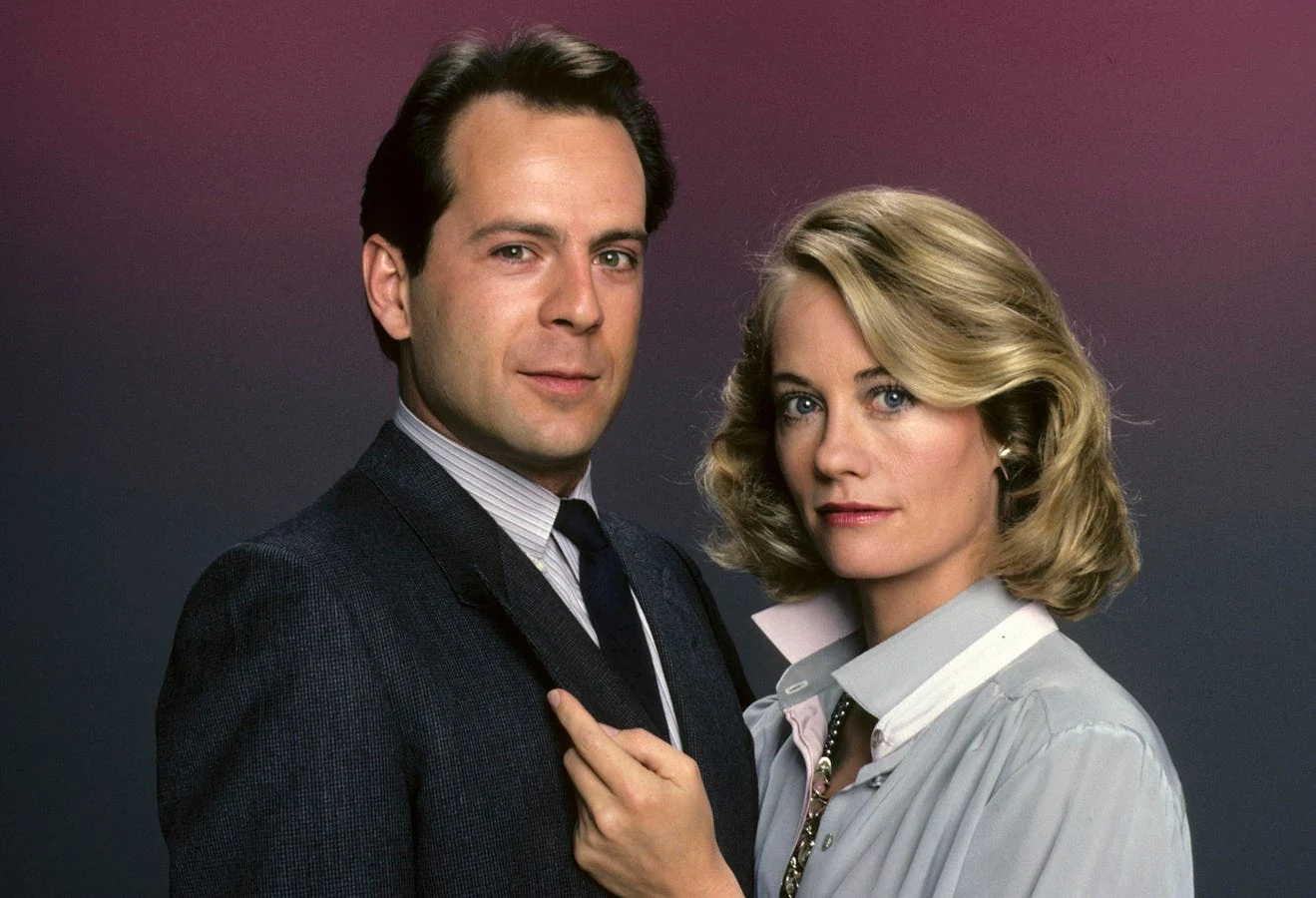
David Addison never entered a room when he could invade it. He talked over people, stretched a joke past its expiration date, and treated a perfectly reasonable instruction as the opening bid in a negotiation. Across the desk stood Maddie Hayes, who had already survived a career built on other people staring at her and now faced the additional indignity of having to listen to this man. Put them together and a missing-person case suddenly seemed like the least interesting thing happening at the detective agency.
That was Moonlighting. Not simply a mystery series with jokes. Not simply a romance interrupted by murders. It was a weekly argument about attraction, taste, work, pride, and who got the last word, conducted by two performers who made even a walk down a hallway feel dangerously eventful. Bruce Willis brought the grin and the velocity. Cybill Shepherd supplied far more than an elegant obstacle. Her timing gave his verbal pinball somewhere worth bouncing.
For a stretch in the middle of the 1980s, the question wasn’t merely whether Maddie and David would get together. It was what the show would dare to do next. Turn black and white? Put everyone in Shakespearean costume? Stop for a dance number? Admit that the episode wasn’t ready? Other detectives worried about fingerprints. These two occasionally worried about the script.
Some of it remains exhilarating. Some of it is exhausting. The late episodes do not become better television just because the early ones were wonderful, and David’s charm occasionally needs its own restraining order. But the good stuff still has an unruly electricity that makes a great deal of supposedly daring television look awfully well behaved.
This is the story of Moonlighting in the 80s: how Glenn Gordon Caron’s ABC series turned a familiar setup into something slippery and strange, why its two stars mattered equally, and why its decline deserves a better explanation than the old warning about letting television characters have sex. The answer involves acting, ambition, schedules, and a detective agency that frequently appeared to employ everyone except someone responsible for completing the paperwork.
Within the larger world of 1980s television, Blue Moon occupied a particularly inviting corner. You arrived expecting a mystery and discovered that the real suspense concerned two people who were very good at noticing everybody’s problems except their own.
A model loses her money and gains David Addison
The premise arrived with an excellent built-in grievance. Maddie Hayes, a successful former model, discovers that her money has been stolen. Among the wreckage is a detective agency, the sort of business that sounds considerably more glamorous before anyone shows you its balance sheet. She intends to close it. David Addison, who works there and enjoys continued employment, argues otherwise.
He has a practical reason to keep talking. She has a practical reason to stop listening. That opposition gives the pilot an engine before the romance even needs to introduce itself. Maddie isn’t wandering into detective work because she has always yearned to interrogate strangers. She’s been cornered by betrayal and bad investments. The agency offers a possible recovery, but only if she can tolerate its most persistent representative.
On March 3, 1985, ABC introduced viewers to a pairing that looked as if it would be lucky to make it through the first argument. Shepherd was already recognizable. Willis was the discovery. The imbalance in their public familiarity became part of the appeal: a polished screen presence facing a man who looked delighted to have slipped past security.
Yet the crucial decision was allowing Maddie to be angry. She’s been humiliated, and the show doesn’t require her to greet financial disaster with charming gratitude. Shepherd makes her irritation specific. Maddie tries to maintain standards because standards are among the few possessions nobody has stolen. David treats those standards as an elaborate invitation to misbehave.
Blue Moon, the agency’s new identity, gives the series a workplace that can hold both impulses. Its name carries Maddie’s glamorous past into an enterprise that is rarely as organized as the sign suggests. Office doors, desks, telephones, and a receptionist establish the reassuring equipment of a private-eye show. Then the people begin using that equipment for anything except efficient detection.
Compared with the competent professionals in many 80s detective shows, Maddie and David make an alarming first impression. But competence isn’t absent. It’s unevenly distributed, hidden beneath performance, and occasionally activated by a crisis. The pleasure lies in discovering that the apparent nuisance has instincts and the supposed ornamental boss has nerve.
Bruce Willis before the action-hero shorthand

It is easy to watch early Bruce Willis with the future already attached. There’s the movie star, there’s the smirk, there’s the man audiences would follow into an exceptionally unpleasant office Christmas party in Die Hard. Strip away that knowledge and David Addison becomes a much fresher proposition: a television leading man whose most conspicuous weapon is his inability to leave a sentence alone.
Willis plays David as somebody who is always auditioning for control of the room. A joke isn’t merely a joke. It buys time, diverts criticism, tests an opponent, or keeps an unwelcome feeling from arriving in plain English. He wants attention, certainly, but he also wants to dictate the terms on which anyone notices him. If everything is a performance, nobody gets to ask what happens when the performance stops.
The grin matters. So does the fraction of a second when it disappears. Willis finds small pockets of hurt beneath David’s bravado, then covers them before the scene turns into a public service announcement about male vulnerability. That hesitation is often more persuasive than an extended confession. David would rather juggle flaming furniture than say something straightforward about being afraid.
His physical comedy has the same restless quality. He leans, sprawls, crowds a doorway, or makes an ordinary office crossing look like a bid for a better camera position. The body keeps talking when the dialogue pauses. Against Shepherd’s more deliberate stillness, the movement becomes an argument before either of them has opened a mouth.
There are limits. David can be rude in ways the show finds more adorable than they deserve. His persistence sometimes ignores what Maddie is actually saying, and a wisecrack doesn’t automatically improve with age. An honest revisit should allow for that irritation. Charm is the reason we keep watching him; it isn’t a universal pardon.
What distinguishes the performance is the mixture. Willis is funny, attractive, needy, inventive, and occasionally a complete pain in the neck, all within the same exchange. Willis won the 1987 drama-actor Emmy for a role that spent half its time making a mockery of the word “drama.” David made that refusal look effortless. The effort belonged to everybody trying to keep up.
Cybill Shepherd gives the argument its stakes
Remove Maddie Hayes from the equation and David becomes a man doing a very long bit. Shepherd doesn’t merely react to him. She changes the pressure in the scene. An arched eyebrow can expose the insecurity behind his grand announcement. A pause can turn his victory into a question. When she finally accelerates to match him, the exchange sounds less like a funny man entertaining a beautiful woman and more like two excellent drivers refusing to yield.
Maddie’s glamour is central, but it isn’t her entire personality. She understands the work involved in looking effortless. She has earned money, lost it, and discovered how quickly other people confuse beauty with stupidity. Her insistence on professionalism is partly self-defense. If she lets David define the workplace entirely, she risks becoming a visitor in the business she owns.
Shepherd also gives Maddie a mischievous streak. The character’s pleasure in an argument sometimes arrives before she admits she’s enjoying herself. Watch for the moment her indignation acquires a little extra energy, as though she has realized that defeating David may be more fun than ignoring him. Their battles work because she has weapons of her own.
The soft lighting attracted plenty of attention, and the show sometimes indulged it to an almost absurd degree. But there is a difference between photographing Shepherd as a movie star and assuming her character exists only to be admired. Maddie makes decisions, gets things wrong, protects her dignity too fiercely, and occasionally recognizes something in David she would prefer to keep unrecognized.
Shepherd had to master the fast dialogue and make the speed seem like Maddie’s natural way of holding her ground. The useful lesson is straightforward: this was a skilled comic performance, not a fortunate collision between cheekbones and a lighting department.
Her best work often makes Maddie simultaneously formidable and exposed. A person who has survived public scrutiny doesn’t necessarily know what to do when somebody sees past the presentation. David occasionally does. Then, being David, he immediately makes a joke and complicates everything.
That balance is why reducing Moonlighting to Willis’s launchpad misses half the show. The series gave him an extraordinary entrance. Shepherd supplied the resistance, authority, and emotional intelligence that made the entrance matter. A tennis match with only one player is mostly exercise and ball retrieval.
The theme promises a smoother evening than anyone delivers
Al Jarreau’s voice opens a door into a Los Angeles that seems made for cocktails, expensive mistakes, and people who look excellent while having them. The theme is relaxed where the dialogue is hectic, graceful where the office is disorderly. That contrast is part of the joke. The music suggests that somebody knows how to handle the evening. The next scene usually offers evidence to the contrary.
Jarreau and Lee Holdridge created the theme music, giving the show a sound as distinctive as the people it introduced. You don’t need to know the credits to understand the promise: this is television with a grown-up sheen, a little melancholy in its glamour, and enough swing to get away with an abrupt change of direction.
The title sequence and the clothes help establish a world in which Maddie’s elegance and David’s rumpled confidence belong together even when the characters insist they don’t. Their appearance tells the same story as the dialogue. She prepares; he improvises. She has considered the effect; he wants you to believe the effect happened accidentally. Both are performing, just with different preparation budgets.
The look also distinguishes the series from the nighttime polish of Miami Vice. Both shows understood that music and images do more than decorate a plot. But Vice often turns beauty into menace. Moonlighting turns it into flirtation, fantasy, or a joke about the gap between a person’s presentation and the mess underneath.
At times that glamorous treatment becomes a distraction. Maddie appears so carefully photographed that the lighting seems to have retained its own attorney. Even then, the excess belongs to the show’s identity. This is not an attempt to catch detectives in documentary daylight. It is a knowingly heightened world where movie romance has wandered into an office full of unpaid bills.
The mood holds the series together when the format wanders. Whether the episode is a mystery, a quarrel, a dream, or a joke about the network, the music reminds us what we came for: sophisticated people behaving unsophisticatedly around feelings they would rather discuss in someone else’s case file.
Agnes DiPesto answers the phone and improves the office

Agnes DiPesto’s rhyming telephone greetings tell you something important before the detectives arrive: even the reception desk has declined to behave normally. Allyce Beasley makes those little performances sound like genuine offerings from a person who has decided the world would improve if more of it rhymed. In this office, that counts as a coherent management philosophy.
Agnes is vulnerable without being empty-headed. She notices moods, wants people to get along, and gives the workplace an emotional continuity its owners frequently neglect. David can turn a disagreement into a vaudeville act. Maddie can turn it into an executive decision. Agnes is the person left standing near the telephone, absorbing the weather.
Beasley’s delivery is essential. The softness doesn’t eliminate the joke; it changes its angle. Agnes isn’t competing to be the fastest person in the room. Her odd logic and sincere responses slow the conversation just enough to reveal how ridiculous the other two have become. Sometimes the sanest reaction to Blue Moon is a mildly puzzled look.
Curtis Armstrong’s Herbert Viola adds another kind of longing. He wants recognition, professional standing, and a place beside Agnes. His efforts at confidence often reveal exactly how nervous he is. Armstrong gives the ambition a comic wobble, keeping Herbert from becoming merely an office functionary wheeled in whenever the leads need a break.
Their relationship offers a useful change in scale. Maddie and David treat attraction as a constitutional crisis. Agnes and Herbert make it look like something ordinary people might survive with a little kindness and a few embarrassing conversations. The contrast gives the series more emotional room than its central duel alone provides.
Later episodes ask the supporting pair to carry more of the load, sometimes exposing how much the show depends on its original stars sharing the screen. That is a problem of balance, not proof that the supporting characters are worthless. Beasley and Armstrong are funny, distinctive performers. No one should be blamed for failing to replace a particular kind of lightning on demand.
When the full ensemble works, Blue Moon feels like a place rather than a two-person stage. You understand why Agnes might care about keeping it open even when the owners are behaving as though the primary business is competitive door-slamming.
The cases matter, until the people matter more
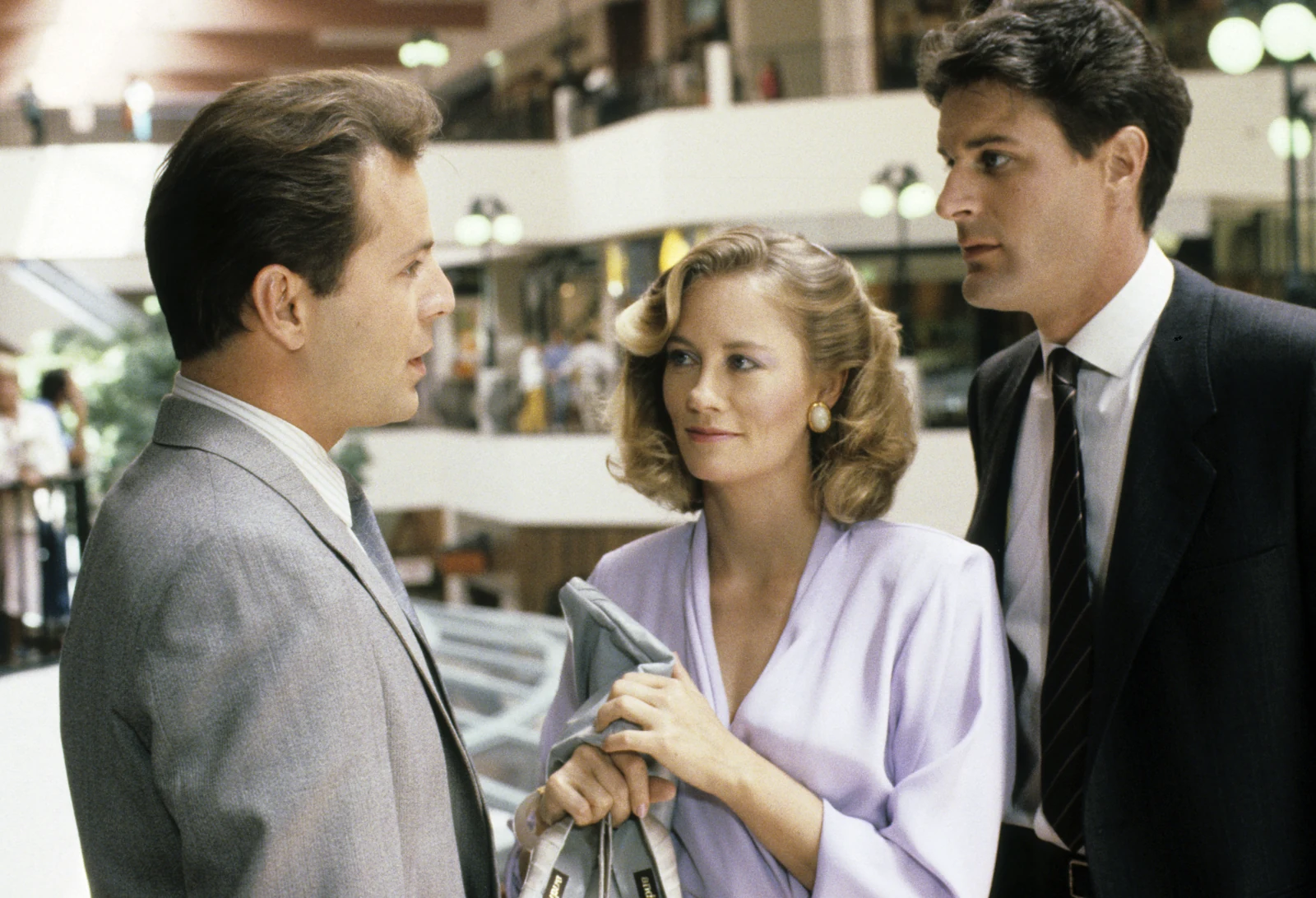
A client enters with a problem. Maddie and David disagree about the problem, the client, the fee, the ethics, or who is taking whom to lunch. An investigation follows, but so does a second investigation, conducted largely through insults, into the state of their relationship. The two stories don’t always proceed at the same speed.
That imbalance can be delightful. A routine interview becomes memorable because Maddie hears one thing and David hears another. A car ride becomes an arena. An apparently silly detour exposes jealousy or disappointment that a more dutiful detective plot would have kept out of sight. You may forget who committed the crime while remembering exactly how David looked when Maddie dismissed him.
It can also be a weakness. Some mysteries feel as though they’ve been asked to wait outside while the stars finish an argument. If you’re arriving for a tightly constructed puzzle, Blue Moon may seem like an agency with a customer-service problem. The show isn’t always wrong to wander, but it doesn’t get a gold star for every abandoned thread.
The contrast with Murder, She Wrote is instructive. Jessica Fletcher’s intelligence organizes the story. Maddie and David’s attraction often disorganizes theirs. Both approaches reward attention, but the pleasures are different. Jessica invites you to notice the clue. David invites you to notice that Maddie noticed him noticing her.
Family complications bring out another side of the detectives. In “Brother, Can You Spare a Blonde?” David’s brother Richard, played by Charles Rocket, creates a revealing rival presence. A man who habitually owns the room has to share it with someone who knows a version of him the office doesn’t. Maddie gets a view of David outside his carefully maintained daily act.
Those excursions work best when the case gives the characters something specific to do. Attraction needs friction, and friction needs a surface. A mystery, a relative, a client with a bad secret: any of these can force the conversation somewhere neither detective intended. When the plot becomes merely an excuse to prolong the same exchange, the air begins leaking out.
The night the picture turned black and white
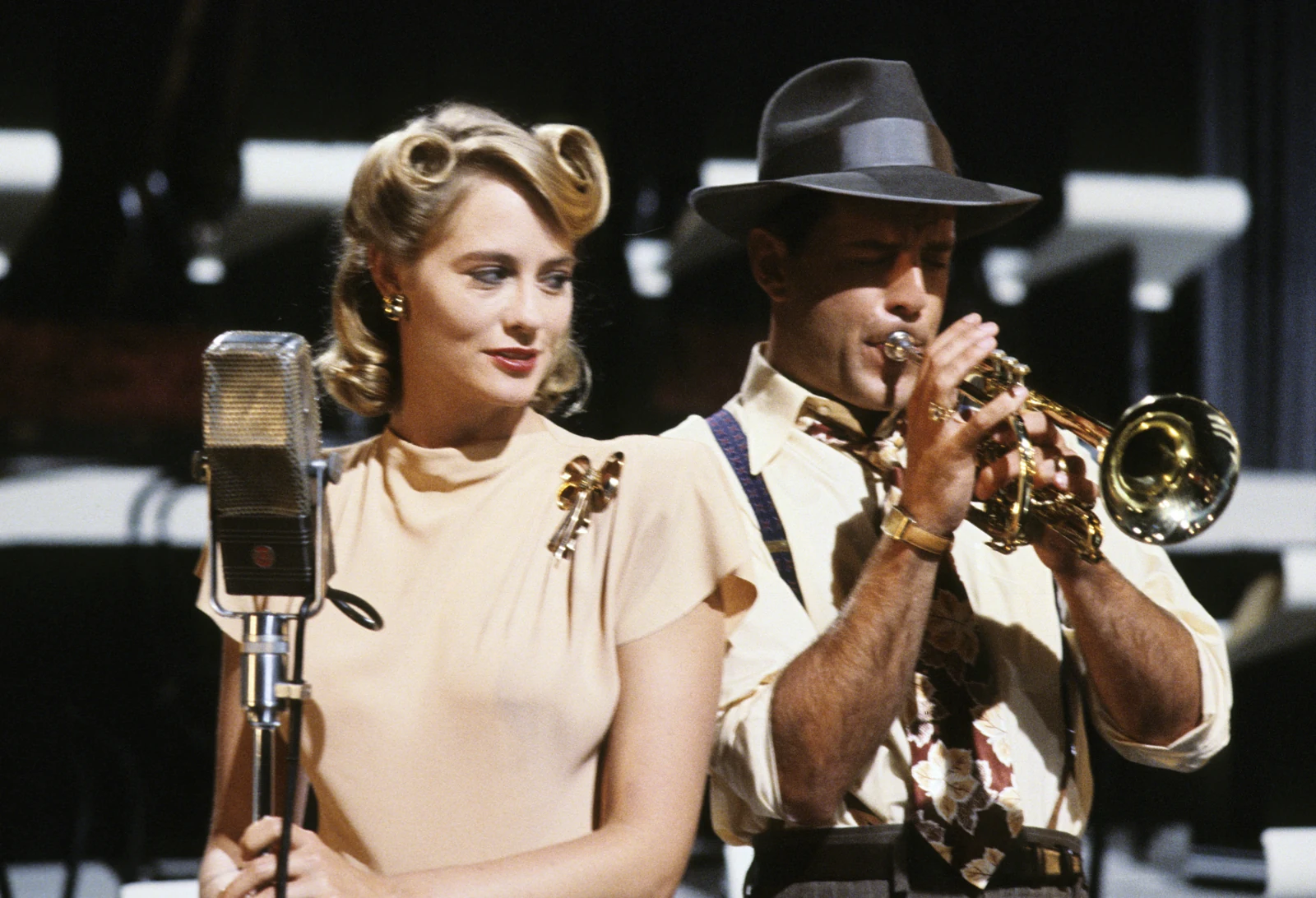
“The Dream Sequence Always Rings Twice” doesn’t simply put the stars in old clothes. It lets their imaginations argue. A decades-old murder produces competing dream versions, with Maddie and David casting themselves inside a movie world that reveals what they think about innocence, guilt, romance, and each other. Naturally, neither dreamer is an entirely trustworthy casting director.
The episode aired on October 15, 1985. Peter Werner directed Debra Frank and Carl Sautter’s script, with Orson Welles introducing the evening’s unusual turn. The presence of that unmistakable voice gives the experiment an immediate sense of occasion. The episode knows it is doing something different and has recruited a magnificent person to announce the fact.
The pleasure isn’t restricted to recognizing old-movie references. Black-and-white changes how you read the faces. The light and shadow make Shepherd’s glamour and Willis’s wise-guy presence feel like parts of a different screen vocabulary. Their familiar opposition survives, but now it has the charged atmosphere of a nightclub story somebody might regret telling the police.
Neither fantasy should be mistaken for reliable evidence. That’s the fun. Each version turns a historical puzzle into a private argument about people, motives, and the roles the dreamer finds appealing. The detectives aren’t merely solving the past. They’re furnishing it to suit themselves.
Music has a purpose here beyond making the scene look expensive. The performances let the series step outside ordinary dialogue and still remain recognizably itself. These are the same two people, discovering another method of talking past each other. An inventive episode doesn’t need to abandon character to earn its novelty.
There is a lovely confidence in the decision to make the audience follow this detour so early in the run. The series hadn’t spent a decade banking goodwill. It simply behaved as though viewers were capable of enjoying a different texture for an evening. That confidence is more interesting than the vague claim that the show was “ahead of its time.” The episode is very much of its time, produced for a mass audience that was apparently willing to meet it halfway.
And it still looks like a treat rather than an assignment. Nobody has to sit an exam on film noir afterward. The detectives will resume arguing in color soon enough.
Atomic Shakespeare, because apparently a mystery wasn’t enough
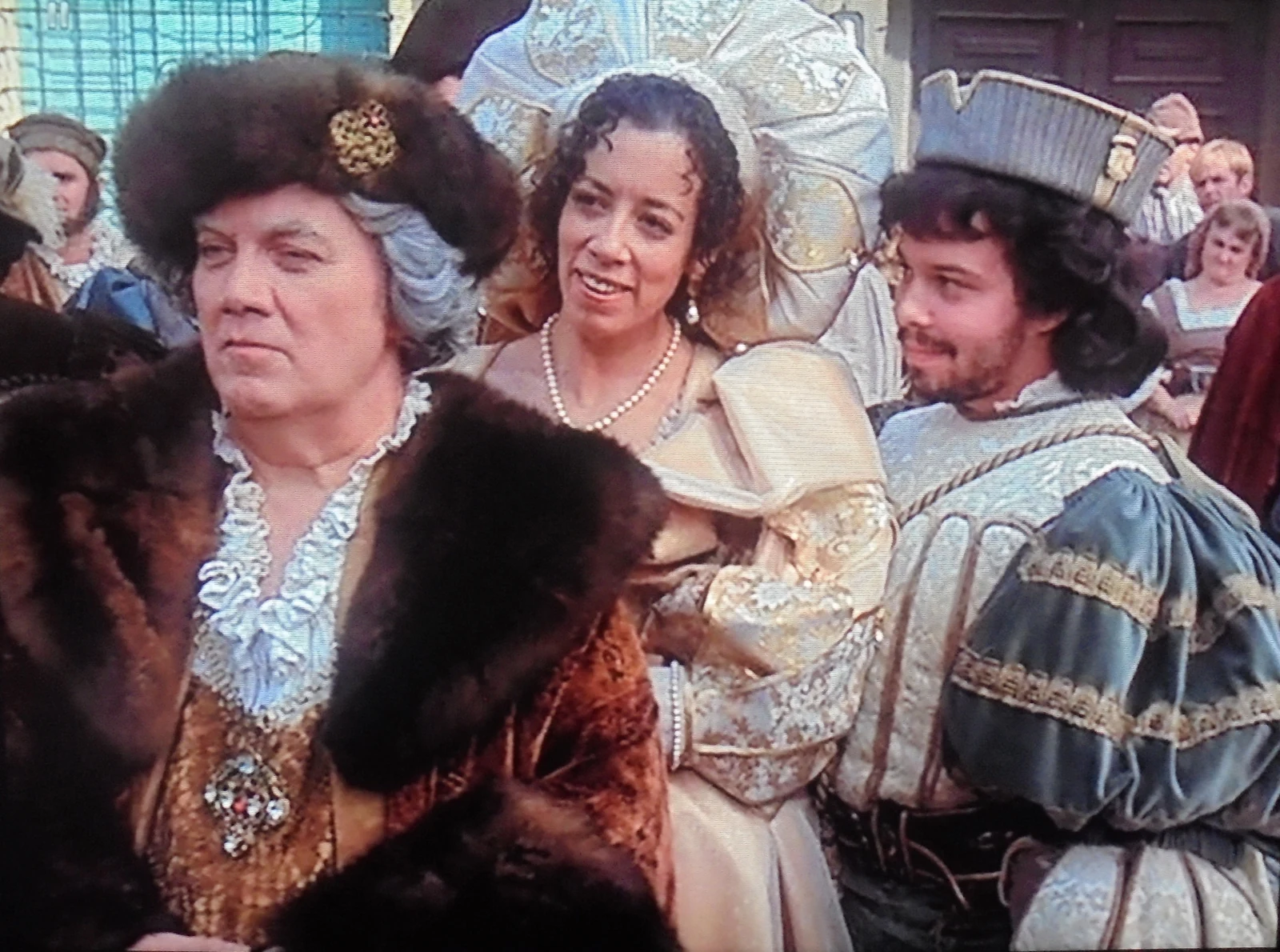
A boy is supposed to be studying The Taming of the Shrew instead of watching Moonlighting. His imagination supplies a compromise that any television-loving student might appreciate: put the familiar cast inside Shakespeare and see whether the homework improves. The result is “Atomic Shakespeare,” an episode whose title gives fair warning that reverence will not be the evening’s governing principle.
On November 25, 1986, Maddie and David become Katherina and Petruchio. Agnes and Herbert join the transformation, as do a wardrobe department and production team plainly being asked for more than another day at the office. Director Will MacKenzie and writers Jeff Reno and Ron Osborn help turn the outrageous proposition into a fully committed hour.
The joke is not simply that television characters can wear elaborate costumes. It’s that Maddie and David’s usual argument already has a recognizable place in this older battle of wills. Their rhythms survive the move, and the deliberate anachronisms make the distance between the worlds shorter and sillier. Willis doesn’t suddenly become a solemn museum exhibit. Thank goodness.
The episode also gives Beasley and Armstrong a chance to play within the same grand joke rather than remain at the reception desk while the leads enjoy it. Their presence helps make the fantasy feel like a transformation of the whole show. The regular cast becomes a repertory company, carrying its familiar relationships into a different set of rules.
There is a complication worth keeping in view. The Taming of the Shrew brings uncomfortable ideas about women and obedience into the room. A viewer can enjoy the costumes, performances, and playful language without pretending that every element of the underlying contest is charming. The episode is most appealing when its irreverence loosens the old power struggle rather than merely dressing it up.
Its scale has sometimes overshadowed its timing. Coming during the third season, it announces a series confident enough to spend an entire hour somewhere its ordinary plot has no business going. For people following Maddie and David, the detour is also a reward: you know these personalities well enough to enjoy watching them try on different names.
The extraordinary thing is how much of it feels like play. You can see the ambition, but you can also see the comic invitation. Television has handed the class clown an Elizabethan costume and access to the scenery. There will be consequences.
Camille walks in, and the guest stars join the mischief
Whoopi Goldberg’s appearance in “Camille,” the second-season finale, gives the agency a visitor who doesn’t need David’s permission to command attention. A woman who has become newsworthy offers Blue Moon a publicity opportunity, and the detectives’ interest in that opportunity tells you something about their business instincts. Discretion is a valuable professional quality. So, apparently, is getting your name mentioned.
The May 13, 1986 finale brings Goldberg, Judd Nelson, and David Paymer into the regular cast’s orbit. Those names locate the episode within the pop-cultural moment without requiring a parade of unrelated celebrity cameos. The visitors enter the show’s comic world rather than merely dropping by to be applauded.
Goldberg is particularly useful because she supplies an energy that doesn’t simply duplicate either lead. David’s wisecracks encounter another strong presence. Maddie’s efforts to maintain order become more complicated. A good guest star changes the shape of the room; the regulars have to adjust rather than continue their usual routine while somebody famous waits for a line.
The episode’s playful handling of its own fiction also shows how confidently the series was expanding by the end of its second season. It had enough identity to fool around with that identity. The danger, already visible, was that the fun of escaping the story might begin competing with the obligation to finish one.
That balance separates the show from the more grounded pleasures of The Rockford Files. Both series understand the appeal of a detective whose personality complicates the work. Blue Moon simply has a more porous boundary between the work, the performance, and the joke about performing it.
“Camille” isn’t necessary viewing because a guest list proves importance. It’s useful because the regular cast can still make room for another personality without losing its own. During the good years, that generosity makes the show seem expansive. Everybody doesn’t have to orbit the central couple in precisely the same way.
Billy Joel, Stanley Donen, and a glimpse behind the grin

“Big Man on Mulberry Street” asks a question David usually avoids answering: what happened before he became the man Maddie knows? News of a death draws him back toward an earlier life, and Maddie’s curiosity about his former marriage becomes impossible to separate from her curiosity about him. She wants information. She may also want reassurance. Those are not necessarily the same request.
The November 18, 1986 episode includes a fantasy dance sequence to Billy Joel’s song, staged by Stanley Donen. Stanley Donen staged the elaborate seven-minute dance, and suddenly a detective show was borrowing the nerve of a big-screen musical. That single production choice tells you how far the series was willing to travel to express something its characters couldn’t comfortably say.
In Maddie’s imagination, David’s past becomes a movie musical. The device is funny and revealing. She doesn’t have complete access to his history, so she supplies images. Beneath her managerial impatience sits a person who wants to understand him and is slightly annoyed to discover that he had an emotional life before she arrived.
Willis’s willingness to enter the number matters. David’s usual defense is verbal, but the sequence requires movement and exposure of another sort. The actor doesn’t simply stand there while the show congratulates itself for hiring a famous director. He becomes part of the fantasy, allowing a different version of his charm to emerge.
The number also demonstrates a distinction easily lost in accounts of the series’ excesses. A departure can deepen the people involved rather than merely advertise the creators’ nerve. Here the spectacle grows out of Maddie’s attempt to imagine David. It’s not a musical intermission pasted into an unrelated case. Her feelings have briefly acquired a choreographer.
There is something touching in the distance between fantasy and knowledge. People in love, or approaching the possibility with considerable resistance, often construct elaborate accounts of the other person’s past. Maddie has the disadvantage of doing it on a show with an ambitious music budget. The result is grander than an ordinary private worry, but the worry remains recognizable.
This is Moonlighting at its most persuasive: showy, yes, but with a reason to be showy. The flourish leads back to two people who are finding it increasingly difficult to pretend that the other is merely a colleague.
Christmas at Blue Moon, with morale in the basement
Not every memorable episode needs a grand costume change. Sometimes the useful starting point is a boss asking too much, employees wanting to go home, and Christmas making everyone feel entitled to a better version of the day. “It’s a Wonderful Job” turns Maddie’s frustration with the agency into a holiday fantasy about what the place means to the people inside it.
Airing on December 16, 1986, it brings the familiar Christmas-story borrowing into a season already brimming with unruly ideas. Maddie is given a chance to imagine a world in which she never kept the business going. The title doesn’t exactly conceal the inspiration. Subtlety has stepped outside to finish its shopping.
What makes the device worthwhile is the office rather than the reference. Blue Moon ordinarily looks like an operation that survives despite its staff’s enthusiasm for avoiding work. Here the emotional ledger comes into view. People need a place to belong, a reason to show up, and other people who will notice if they don’t.
Maddie’s exasperation is understandable. She has financial responsibilities, a roomful of distractions, and a partner who can convert a simple directive into a debate about civilization. The episode doesn’t need to prove that every complaint is unreasonable. It needs her to see that a business is also a set of human attachments, some of which will never fit tidily into the accounts.
Shepherd is especially useful in this sort of story because she can play resistance without making Maddie seem incapable of feeling. The character doesn’t become warmer by suddenly turning into someone else. She recognizes something she has been overlooking. The change is small enough to believe and large enough to matter.
For viewers who associate Moonlighting solely with the central romance, episodes like this restore its workplace heart. Agnes, Herbert, and the others aren’t just background noise between arguments. They have staked something on the agency too. Even a chaotic office can become a community, although it would still be wise to check whether anyone has sent the invoices.
The warmth is earned because the series has spent so much time making the place difficult. A perfect office wouldn’t need a Christmas revelation. Blue Moon needs one, plus a functioning personnel policy and possibly a fire drill.
When the fourth wall became a revolving door
The detectives sometimes know they’re in a television show. More precisely, the series decides when that knowledge will be useful and declines to provide a lengthy philosophical explanation. A glance, a complaint about the episode, or an acknowledgement of the audience suddenly opens the room. The furniture stays where it is. The rules have moved.
That freedom gives Moonlighting an unusually companionable relationship with its viewers. A joke can be shared across the screen rather than confined inside the scene. The audience isn’t always an invisible observer watching private behavior. Occasionally we’re accomplices, being asked to recognize the machinery while it continues running.
In “The Straight Poop,” Rona Barrett appears to investigate the trouble at Blue Moon and the absence of fresh episodes. The show effectively turns its own unreliability into the subject of an installment. Shepherd’s account of the episode recalls its guest appearances and its self-conscious approach to the series’ public image.
There’s audacity in that move. There’s also a risk of sounding like the charming friend who arrives late and expects you to admire the explanation. An audience can enjoy being included in the joke and still want the show it made time to watch. Awareness of a problem doesn’t automatically solve it.
The strongest wall-breaking moments keep their emotional footing. David remains David when he acknowledges the audience; his eagerness to win us over is entirely consistent with his eagerness to win every room. Maddie’s impatience remains hers. The joke expands their personalities rather than replacing them with the writers waving hello.
The earlier holiday episode, “Twas the Episode Before Christmas,” finds a warmer use for the same freedom. Its ending pulls back from the fiction and brings the people making the show into the seasonal greeting. The agency’s world opens into the workplace behind it, and a familiar television ritual becomes a shared performance.
That moment has a different feeling from a joke about a missing script. Instead of making the audience admire the series’ cleverness, it invites us to enjoy the company. The people who have spent the hour pretending can briefly stand together without maintaining the pretense. It’s affectionate, a little theatrical, and exactly the sort of indulgence a Christmas episode can earn.
The distinction matters. Breaking the wall isn’t one fixed effect. It can be sarcastic, evasive, exuberant, or warm, depending on what the show does once it lets us see through. Blue Moon sometimes uses the opening as an escape hatch. Here it feels like somebody has opened the office door to wish the neighbors a good evening.
The weaker moments make the series feel overly pleased with its own freedom. A wink isn’t inherently clever, and repeated assurances that television is artificial can become their own kind of routine. Once viewers know the door opens, opening it again is less of a surprise. Something interesting still has to walk through.
That distinction matters to the show’s reputation. It didn’t invent characters addressing an audience, and it doesn’t need that impossible historical claim. It found a particularly lively way to combine the device with romance, detective stories, production jokes, and two stars who seemed capable of arguing with the camera itself. The novelty was in the mixture and the nerve.
Sam Crawford brings the inconvenient possibility of a sensible choice
Enter Mark Harmon as Sam Crawford, and the romantic argument stops being entirely theoretical. Maddie now has a man who looks like an actual alternative rather than a temporary nuisance hired to make David jealous. Sam’s presence asks whether the attraction at Blue Moon is the beginning of a relationship or simply a very entertaining problem.
Harmon is well suited to the assignment because he doesn’t need to imitate Willis’s energy. Sam offers a different temperature. Beside David’s running commentary, comparative steadiness begins to look appealing. A person can apparently converse without turning every exchange into an improvisational audition. Who knew?
The third-season story makes David confront the cost of perpetual evasion. It’s one thing to keep the relationship undefined when both parties appear willing to participate. It’s another to discover that Maddie may make a decision without waiting for his next joke. The grin becomes less secure when it no longer controls the timetable.
But the triangle also gives Maddie a decision that belongs to her. She isn’t simply a prize suspended between competing male performances. Her uncertainty concerns the sort of life she wants, the risks she trusts herself to take, and whether the person who excites her is also capable of treating her seriously. Shepherd keeps those questions visible beneath the show’s impatience to reach a dramatic moment.
Triangles are dangerous television devices because the outcome can feel prearranged. If the audience has been taught to care only about one couple, the newcomer becomes a man politely waiting to be discarded. Moonlighting is more interesting when it allows Sam’s appeal to register. David should have something real to lose, not merely an obstacle to outtalk.
The resulting tension carries the show toward “I Am Curious… Maddie,” but the buildup has pleasures of its own. Watch Willis adjust David’s usual repertoire when he senses that routine charm may not be enough. Watch Shepherd let Maddie’s reactions remain mixed. Neither performance needs an explanatory speech to reveal that a workplace joke has turned serious.
It’s an uncomfortable development, which is exactly why it works. For once, Blue Moon’s most compulsive talker can’t settle the matter by filling the available silence.
March 1987: the argument finally changes
“I Am Curious… Maddie” aired on March 31, 1987. It is the episode people invoke when they want to explain what happened to Moonlighting, often with the brisk confidence of someone closing a case whose file they haven’t read in years. Maddie and David finally become lovers. The show later declines. Therefore, apparently, romance has committed a murder.
The actual scene is messier than that tidy lesson. Anger, jealousy, attraction, and years of avoidance collide. The physical intensity made it an event, but the hostility around the encounter deserves attention too. A modern viewer doesn’t have to treat every aggressive gesture as proof of passion. Desire and bad behavior can occupy the same scene without becoming the same thing.
That complication is consistent with these characters. They aren’t suddenly two emotionally fluent adults reaching a calm agreement over dinner. They have spent a very long time turning discomfort into conflict. The breakthrough arrives in the language they’ve been using, which is thrilling television and a rather worrying basis for a household.
For an audience following the series week by week, the change carried the accumulated weight of earlier looks, interruptions, arguments, and retreats. The anticipation didn’t exist only in that night’s script. It had been built across evenings when nothing was resolved. A single encounter was being asked to answer a question much larger than itself.
The following week, Moonlighting landed in the top ten. Plenty of people were tuning in to see what Maddie and David would do next; this wasn’t just a private celebration for the faithful. It gave casual viewers a reason to check what all the noise was about.
What followed was the harder assignment: write the people after the release of tension. A long-delayed kiss is a scene. A continuing relationship is an entirely different job. The show needed to discover what these two would want, fear, and argue about once the old question had an answer.
That challenge didn’t make failure inevitable. It made the next phase demanding. Treating the encounter itself as a fatal mistake lets subsequent choices escape examination and turns the audience into a creature interested only in indefinite frustration. Viewers are capable of more than waiting outside a bedroom door. Television occasionally needs reminding.
The morning after was not the end of the audience
“To Heiress Human” returned to Maddie and David after the encounter and confronted the immediate problem: the people involved didn’t necessarily agree about what had happened to their lives. That uncertainty offers perfectly good material. Intimacy doesn’t erase differences in temperament, pride, or expectations. In some cases it makes them much easier to hear.
And the following installment still drew a top-ten audience in May 1987. The notion that viewers immediately abandoned the show after the couple got together doesn’t survive even this modest piece of evidence. People were still interested in what came next.
Interest, though, isn’t an unlimited contract. The series had trained viewers to enjoy confrontation, and the new situation required a fresh balance between attraction and resistance. Too little change would make the milestone feel empty. Too much separation would remove the shared scenes that had made the milestone desirable. This was an awkward creative doorway, but it wasn’t bricked up.
The challenge becomes clearer beside Sam and Diane on Cheers. The comparison isn’t a contest over which pair argued better. It’s a reminder that a romantic engine needs other cylinders. A bar has regulars, rivalries, and a social life. Blue Moon has a supporting ensemble, but its identity rests unusually heavily on the temperature between its owners.
When the show keeps Maddie and David in the same room with something new to negotiate, their chemistry remains useful. When it leaves them circling the same uncertainty without discovery, the energy starts feeling expensive rather than abundant. The problem isn’t that desire has been satisfied. It’s that desire has to become a story instead of a promise.
There are also viewers for whom the original antagonism is the attraction. Any change risks disappointing them. That doesn’t mean a series should freeze forever. It means the writers have to offer a different pleasure strong enough to compete with the one they are retiring.
“They should never have gotten together” is easy to remember. It’s also a remarkably convenient rule for people who don’t have to write the next episode. The more useful question is what the show did with the change, and whether it still found ways to surprise us.
A hit measured in households, and in conversation
Moonlighting wasn’t merely a cult favorite whose reputation expanded later. It reached ninth place in the 1986–87 Nielsen season rankings. It was one of the year’s biggest series, even while NBC was busy claiming just about every other prime-time bragging right.
That distinction matters because the series is often remembered chiefly for being unusual. It was unusual in front of a large audience. The formal games, arguments, musical detours, and long-delayed romance weren’t confined to a small corner of the schedule where experimentation was expected. They were part of a mass-network hit.
The broader television picture in 1987 makes Blue Moon’s position more interesting. Family sitcoms offered recognizable rooms and reliable rhythms. Detective series supplied jeopardy and resolution. Moonlighting borrowed the attractions of both and then behaved as though predictability was something that happened to other programs.
Popularity doesn’t prove that every experiment succeeded. It establishes that viewers had reasons to keep returning even when the show wandered. The stars were part of it, naturally. So was the sense of occasion. An episode might offer a good joke, an emotional shift, or a complete change in visual language. You didn’t always know what kind of hour you were getting.
Contemporary criticism wasn’t unanimous from the beginning. An early Washington Post critic wasn’t sold on the pilot or on Willis’s wisecracking newcomer. A performance later celebrated as a breakthrough first struck at least one critic as an irritation. Watching an insistent stranger become a familiar favorite is part of television’s peculiar alchemy.
The acclaim that followed shouldn’t erase those reservations. David really can be irritating. The cases really can feel secondary. The show’s defenders don’t need to prove that every objection was foolish. Its appeal comes from turning several potentially exhausting qualities into a particular, unstable pleasure.
And that pleasure travelled beyond individual episodes. The pair became a shorthand for unresolved attraction and combative wit. Even people who missed installments knew what Maddie and David represented. The remarkable part is that the actual performances remain more interesting than the shorthand.
The glamour had a schedule attached
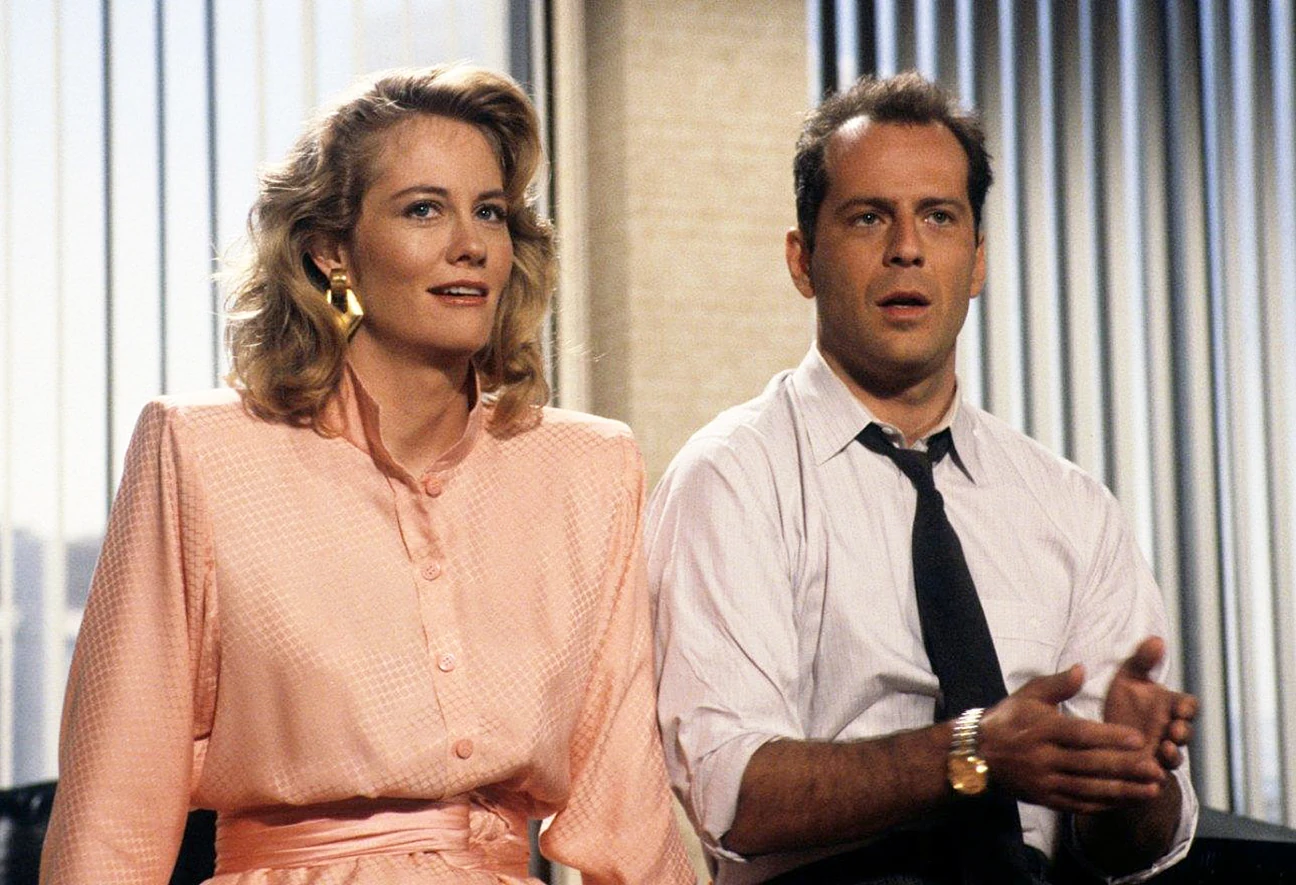
The effortless look of Moonlighting conceals an exceptionally fussy machine. Fast dialogue requires preparation. Moving actors need camera coverage. Glamour requires lighting. An ambitious fantasy sequence does not appear because someone in the writers’ room says, “What if we did a musical?” and everybody goes home at five.
The glossy Blue Moon look demanded long days, complicated scripts, and painstaking work from cinematographer Gerald Perry Finnerman. Even a simple two-shot required care: Shepherd’s luminous close-ups and Willis’s scruffier look had to live in the same frame. The finished show made all that work look effortless.
That detail makes the scenes more impressive, not less. Two people arguing while moving through a room are coordinating far more than dialogue. Their speed has to remain legible. The camera needs the reaction at the right instant. The lighting has to support the look without making the performers seem trapped beneath a lamp.
It’s also a reminder that artistic ambition consumes something. Time, money, concentration, and the patience of people working behind the stars are not abstract resources. A series that routinely demands more has to find a way to obtain it without losing the ability to finish the week.
Behind the wisecracks, the production was often a headache. But this wasn’t a one-villain story with everyone else waiting for the credits. Creator Glenn Gordon Caron and Cybill Shepherd later remembered the turmoil from different sides. Their accounts aren’t identical, which should surprise absolutely nobody who has ever worked on a difficult show.
A fair description can acknowledge friction without diagnosing strangers or turning pregnancy into a moral failing. Shepherd’s pregnancy affected what could be filmed; Willis’s expanding movie career complicated the picture; ambitious storytelling and the demand for new episodes created pressure of their own. These conditions intersected. They don’t need a convenient villain to become understandable.
The finished show sometimes turns its difficulties into comedy, which makes the story tempting to romanticize. But exhaustion isn’t automatically evidence of genius. Sometimes it is the cost of trying to make a more elaborate hour than the available machinery comfortably supports. The audience gets the sparkle. Somebody else has to reset the lights.
When absence became part of the plot
The later run repeatedly confronts the problem of keeping the relationship alive when the leads aren’t consistently sharing the same space. Maddie’s pregnancy becomes part of the story, and separation changes the balance at Blue Moon. The office that once crackled from two people occupying it now has to sustain tension across gaps.
This isn’t inherently impossible television. Letters, telephone calls, uncertainty, and the reactions of people left behind can create drama. But Moonlighting has a particular handicap: its greatest attraction is the immediate exchange. A look prompts a line, the line prompts a counterattack, and the counterattack reveals an unwanted feeling. Distance interrupts that chain.
The supporting cast works to fill the room. Agnes and Herbert have their own complications, and their increasing prominence supplies different comic textures. Still, asking them to maintain the exact atmosphere of a Maddie-David encounter is unfair to both the performers and the audience. A change in focus needs its own convincing reason.
Some later choices feel as though the show is working around constraints rather than pursuing the most revealing next step for its characters. That distinction is visible even without knowing production history. You can sense when a story is discovering something and when it is keeping a space open until someone returns.
The fifth-season opener, “A Womb With a View,” arrived in December 1988 with another conspicuously unconventional premise. The pregnancy story moves into fantasy and painful loss rather than offering a simple domestic solution. The tonal ambition is real, but so is the difficulty of making those turns feel like a continuation of the people we first met.
It is possible to respect the refusal of an easy outcome while disliking the result. The series doesn’t become emotionally profound merely by choosing a sad development, any more than it becomes inventive merely by changing the scenery. What matters is whether the experience belongs convincingly to Maddie and David.
That is where the late show feels most fragile. The machinery is still capable of surprise. The performers still have moments. But surprise alone cannot replace the accumulating intimacy that made the earlier chaos worthwhile. A detective agency can survive a quiet telephone. A romance built on conversation has a harder time surviving the absence of one.
Lunar Eclipse, and the office being taken apart
The final episode, “Lunar Eclipse,” aired on May 14, 1989. The familiar cast was still there for the farewell, although the creative arrangement behind the show had changed. By then, the series was no longer the securely anticipated event it had been at its peak.
Its ending is characteristically self-aware. The world of the show begins coming apart, and Maddie and David confront cancellation as something happening around them. A series that spent years opening holes in its own fiction finishes by making the dismantling impossible to ignore.
There is an undeniable rightness to the idea. A conventional farewell, with everyone neatly placed and the central relationship settled by executive decree, might have felt dishonest to this particular show. Blue Moon was never good at staying inside a tidy frame. Letting the frame become the final problem follows an established instinct.
But an instinct isn’t the same as an emotionally satisfying conclusion. Viewers who had invested in Maddie and David as people were entitled to want more than a demonstration that the scenery could be removed. A joke about cancellation can explain why the story stops. It doesn’t necessarily answer why the relationship mattered.
That tension keeps the finale interesting even when it frustrates. The show chooses exposure over reassurance, reminding us that the office, the cases, and the familiar encounters existed because a group of people kept making them. Once that work ends, the characters have nowhere to go except the final scene.
It is a melancholy destination for a series so often remembered as playful. The wink has acquired a cost. Earlier, breaking the wall invited us into the fun. Here it also shows the limit of the invitation: the audience can’t keep the place open merely by caring about it.
The ratings told their own unhappy ending: ninth place in 1986–87 had become forty-seventh by 1988–89. That isn’t a verdict on every late episode, but it confirms that the audience’s patience had changed. The office closed with some of its original magic intact and much of its old certainty gone.
What the Moonlighting curse gets wrong
The so-called curse offers a beautifully portable explanation: once the central couple gets together, the audience leaves. It fits neatly into a sentence, supplies a cautionary tale for other shows, and saves everyone the inconvenience of discussing schedules, character choices, and the difference between a difficult transition and an impossible one.
It also turns the romance into a mechanical device. Keep the people apart and the machine runs. Bring them together and it breaks. That account underestimates both actors and viewers. People who enjoy a relationship don’t necessarily want it preserved at the same temperature forever. They may want to see whether it can become something else.
For Maddie and David, the real question is what the series learned after the milestone. Could the intimacy make their arguments more revealing? Could the workplace become a place where private choices had public consequences? Could the old defenses begin failing in new ways? Those were available directions, even if none offered an easy weekly solution.
The production conditions matter because storytelling doesn’t occur in a vacuum. Keeping two stars apart for practical reasons changes the material available. A demanding schedule affects what can be attempted. New leadership changes the creative center. Any account that ignores those factors is describing an imaginary version of the series, one in which the only consequential event occurred in a bedroom.
There is a broader history here, stretching from 1970s television into the more openly serialized relationships of 1990s television. Audiences have followed couples through attraction, disappointment, commitment, and separation. The challenge is maintaining interesting people, not preserving virgin territory indefinitely.
None of this requires pretending that Moonlighting handled its later phase brilliantly. It didn’t. The show sometimes lost the pleasurable balance that made its arguments feel alive. The point is that its difficulties deserve specific criticism rather than a superstition.
Blaming the kiss is satisfying because the kiss has a date. A changing workplace, exhausted performers, uneven stories, and the slow loss of an audience are harder to pin to a single moment. Television history, like an actual relationship, becomes less tidy when somebody insists on discussing what really happened.
Revisiting Blue Moon without asking it to be perfect
The best way back into Moonlighting is to pay attention to what the performers are doing rather than wait for the legend to announce itself. Watch Shepherd decide whether Maddie will dignify a remark. Watch Willis fill a pause because David cannot bear to lose the room. Watch Beasley give a tiny reaction that makes the entire office seem ridiculous.
Then let the ambitious episodes be episodes, not monuments. “The Dream Sequence Always Rings Twice” offers mood, music, and competing fantasies. “Atomic Shakespeare” offers a cast enjoying an audacious change of clothes and language. “Big Man on Mulberry Street” gives curiosity and jealousy the dimensions of a musical. Their pleasure doesn’t require you to rank every innovation in television history.
The ordinary installments deserve attention too. Without the office exchanges, the spectacular detours would mean less. You need to know how Maddie stands at her desk and how David moves through a doorway before the show can profitably put them in another century. Familiarity supplies the joke’s foundation.
A revisit also makes some limits clearer. David’s behavior isn’t always charming. Maddie’s presentation can be overmanaged. The series occasionally mistakes a clever premise for a complete story, and its late turns can feel strained. Affection doesn’t require a waiver acknowledging that all criticism has been suspended.
What survives is a particular kind of company. These people are funny because they are difficult, attractive because they are guarded, and moving when the act slips long enough to reveal a person beneath it. The show understands the comedy of wanting someone to notice you while resenting the fact that they have.
That is why its strongest hours still feel lively rather than merely important. They don’t stand at a lectern explaining that television is capable of more. They put two detectives in a room, let an argument become a dance, and trust us to recognize the feeling beneath the racket.
Blue Moon was never a model of sensible working practice. Its owners might have benefited from counseling, an experienced scheduler, and a firm policy about interrupting. But for a while, the place offered something much better than efficiency: the thrilling suspicion that the next conversation might change everything. Even when it began with David behaving like an idiot. Especially then.
Questions Readers Ask
Who starred in Moonlighting?
Cybill Shepherd played Maddie Hayes and Bruce Willis played David Addison, the argumentative detectives at Blue Moon Investigations.
When did Moonlighting first air?
It debuted on ABC in March 1985 and ended in May 1989, leaving behind some of television’s most inventive detective-comedy episodes.
Did the romance between Maddie and David immediately end the show’s popularity?
No. Their relationship changed the series, but episodes after the romantic turning point still drew large audiences. Scheduling and production difficulties were part of the later decline.
Sources & further reading
- Glenn Gordon Caron: Television Academy oral history
- Cybill Shepherd: Television Academy oral history
- American Cinematographer: July 1986 production report
- Paley Archive: The Dream Sequence Always Rings Twice
- Paley Archive: Big Man on Mulberry Street
- Paley Archive: Atomic Shakespeare
- Paley Archive: Lunar Eclipse
- UPI: 1986–87 season ratings
- UPI: May 1989 cancellation report
- March 3, 1985 premiere — interviews.televisionacademy.com
- 1987 Emmy for lead actor in a drama series — televisionacademy.com
- May 13, 1986 finale — paleycenter.org
- contemporary Los Angeles Times preview — latimes.com
- December 16, 1986 — paleycenter.org
- following week’s Los Angeles Times ratings report — latimes.com
- May 1987 contemporary ratings report — latimes.com
- March 1985 Washington Post review — washingtonpost.com