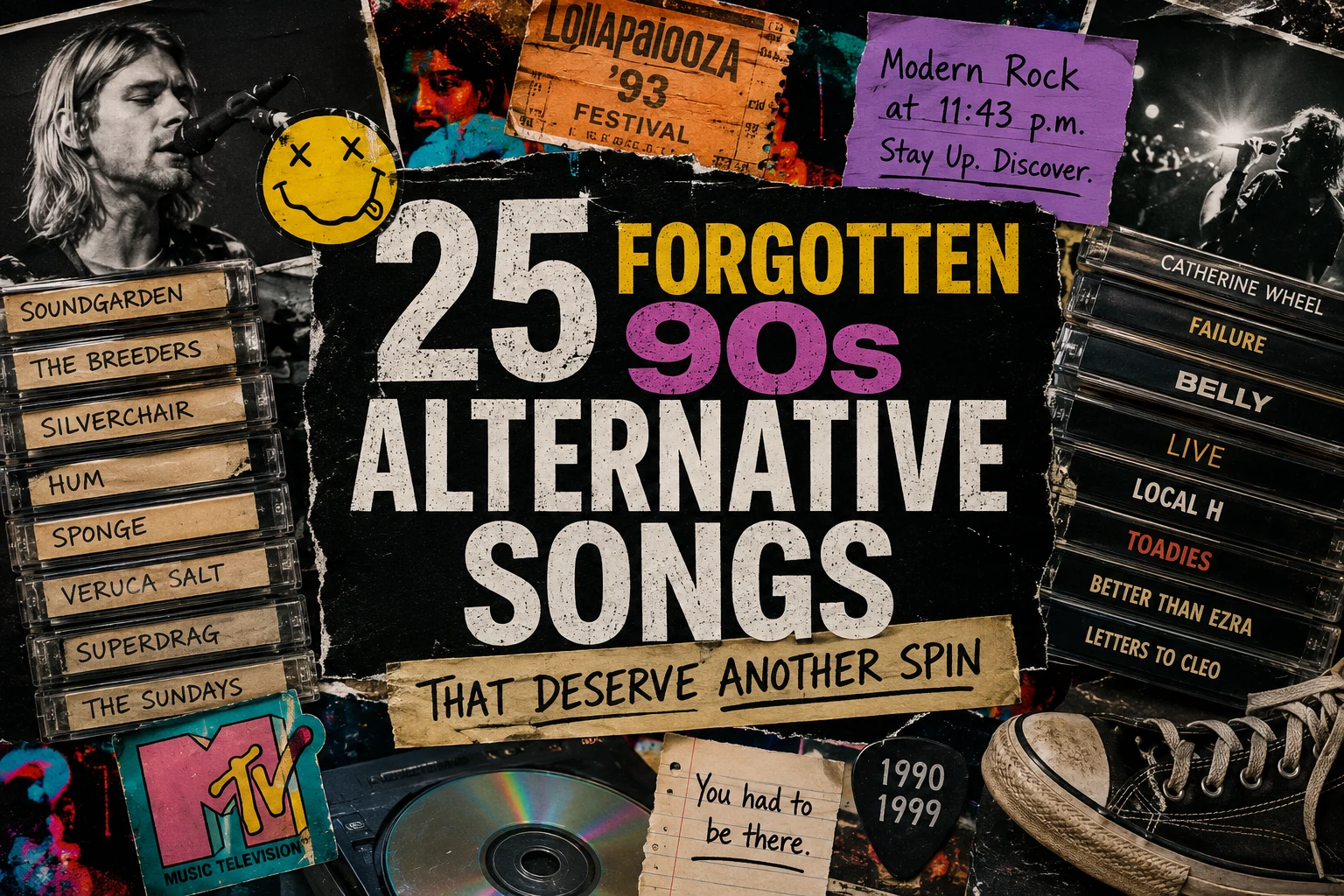
25 Forgotten 90s Alternative Songs That Deserve Another Spin

25 Forgotten 90s Alternative Songs That Deserve Another Spin
Smells Like Gen X • 90s Music

25 Forgotten 90s Alternative Songs

Not every great 90s alternative song became “Smells Like Teen Spirit,” “Wonderwall,” “Creep” or “Black Hole Sun.” Some got one glorious MTV run, some lived on modern rock radio for half a semester, some hid on albums your friend swore were better than the hits, and some just got buried under the same ten songs every nostalgia playlist keeps dragging out like a class reunion name tag.

These are the forgotten 90s alternative songs that deserve another spin: the fuzzy, moody, jangly, sarcastic, dreamy, underplayed and half-remembered tracks that made the decade feel deeper than the obvious greatest-hits version.

Quick Answer: What Are Some Forgotten 90s Alternative Songs?

Some of the best forgotten 90s alternative songs include Hum’s “Stars,” Spacehog’s “In the Meantime,” Superdrag’s “Sucked Out,” Sponge’s “Plowed,” Catherine Wheel’s “Black Metallic,” Failure’s “Stuck on You,” The Sundays’ “Here’s Where the Story Ends,” Belly’s “Feed the Tree,” Letters to Cleo’s “Here & Now,” Veruca Salt’s “Seether,” Elastica’s “Connection” and more.

Forgotten does not always mean obscure. A lot of these songs had real radio, MTV or CD-store life. They just do not get played as often as the giant essential 90s alternative songs that usually dominate the conversation.

Need the Bigger Map?

This page is the deep-cut shelf. For the full visual command center, jump to the 90s Alternative & Grunge Hub. For the big editorial story, go to the 90s Alternative & Grunge pillar post.

Listen While You Rewind

Hit play and let the playlist run while you work through the countdown. It is the same buried 90s alternative rewind in audio form: modern rock radio, CD-binder deep cuts, MTV half-memories and the songs that deserve more than a dusty “oh yeah, that one.”

Why These Songs Got Buried

The 90s alternative world was crowded in the best possible way. Grunge blew the door open. Britpop strutted in. Ska-punk brought horns. Slacker bands showed up looking like they forgot the assignment and somehow aced it. Post-grunge turned the sound into radio rock. MTV made the weird stuff visual. Then nostalgia came along later and flattened the whole decade into the same few giant songs.

That is why this list exists. The deeper story of 90s alternative and grunge is not just the obvious hits. It is also the songs you heard once at midnight on MTV and modern rock radio, the videos you half-remember from 90s MTV, the tracks hiding behind one-hit-wonder reputations, and the bands that made the decade feel bigger, stranger and more specific than the safe playlist version.

These are not leftovers. They are the songs that made the 90s alternative soundtrack feel like a real messy room instead of a museum display.

25 Forgotten 90s Alternative Songs That Deserve Another Spin

Fire up the CD binder in your head. These are the songs that deserve to come back out from under the passenger seat.

1

1995

Hum — “Stars”

Space-rock fuzzModern rock sleeperMassive guitars

“Stars” is the kind of song that makes you wonder how it did not become permanently welded to every 90s alternative countdown. Hum took huge distorted guitars, dreamy vocals and sci-fi melancholy and made a track that sounded like staring at the ceiling while your room slowly lifted into orbit. It had enough muscle for modern rock radio, but it also had a strange floating quality that made it feel different from the usual mid-90s guitar pileup. The chorus is enormous without acting like it knows it is enormous, which is basically the whole charm.

Hum were not really built for the quick-hit version of the 90s. They were heavier than the pretty bands, dreamier than the heavy bands, and too patient for an era where radio was already starting to turn alternative into neat little categories. “Stars” feels like it comes from the same universe as grunge, shoegaze and space rock, but it does not fully belong to any of them. That is exactly why it still feels special.

The song also has one of the best tricks in forgotten 90s alternative: it sounds massive without sounding desperate to be massive. The guitars roar, but the vocal stays almost detached, like the emotional wreckage is happening from a distance. That gives it a weird gravity. It is not a song that grabs you by the collar. It lets you drift close enough to get pulled in, then quietly becomes one of the best things you forgot modern rock radio ever played.

Album / EraYou’d Prefer an Astronaut
Why It Got BuriedIt was too heavy to be dream pop, too spacey to be basic post-grunge and too quietly weird to become one of the obvious hits everyone still overplays.
Gen X MemoryThis is late-night alternative radio, black-light posters, a half-working stereo and the feeling that your bedroom might have accidentally become a planetarium.
A perfect forgotten 90s alternative song because anyone who remembers it acts like they personally discovered oxygen.

Keep rewinding: 90s alternative songs that defined the decade MTV and modern rock radio in the 90s 50 essential 90s alternative songs Best 90s Alternative Albums

2

1995

Spacehog — “In the Meantime”

Glam-alt weirdnessBassline foreverBritish aliens

“In the Meantime” is one of those 90s songs that sounds like it arrived from a parallel universe where glam rock, Britpop, space-rock and alternative radio all shared a suspiciously cool apartment. That bassline does a lot of the heavy lifting, but the whole song has a strange swagger that made it stand out from the gloomier side of the decade. It was stylish, odd, theatrical and weirdly warm, like a lost transmission from the glitter section of the 90s.

Spacehog arrived with a sound that felt out of step in the best possible way. While a lot of mid-90s alternative was still working through grunge’s hangover, “In the Meantime” showed up with glam-rock posture, cosmic weirdness, a killer bassline and enough British attitude to make the whole thing feel like it had smuggled a David Bowie record into a modern rock station.

What makes it more than a novelty is how strong the songwriting is underneath the style. The melody is huge, the chorus lifts, and the track manages to feel both flashy and sincere. It did not sound like a band chasing Seattle. It sounded like a band creating its own glittery little corner of the decade. That made it a weird fit for some playlists, but it also made it unforgettable once you heard it.

Album / EraResident Alien
Why It Got BuriedIt was big enough to remember, but it never got absorbed into the same boring greatest-hits rotation as the usual suspects.
Gen X MemoryThis was the sound of hearing something on the radio and not being sure if it was from 1974, 1995 or a very fashionable spaceship.
The 90s were better when they allowed weird British space-glam detours. This is the evidence.

Keep rewinding: 90s alternative one-hit wonders 25 forgotten 90s alternative songs Britpop in the 90s Britpop in the 90s

3

1996

Superdrag — “Sucked Out”

Power-pop burnoutAlt-radio sarcasmPerfect chorus

“Sucked Out” should have made Superdrag a much bigger name, but the 90s were cruel like that. The song has everything: a sharp riff, a killer chorus, a vocal that sounds both annoyed and melodic, and a whole mood of artistic frustration wrapped in power-pop crunch. It is catchy enough to be a hit and bitter enough to feel like it hates the process of becoming one. Which, honestly, is exactly the kind of contradiction 90s alternative was built to reward and then immediately mishandle.

“Sucked Out” is one of the great songs about the difference between loving music and dealing with the business that tries to package it. Superdrag sounded like they had the hooks to win the room and the attitude to resent the room for needing to be won. That tension gives the song a cranky little glow. It is melodic, but not cheerful. Loud, but not dumb. Bitter, but too catchy to sit still.

The song belongs right next to the best slacker alternative and power-pop moments of the decade because it turns exhaustion into momentum. The chorus feels like release, but the lyrics keep reminding you that the whole thing is about getting drained. That is very 90s: build something irresistible out of your own frustration, then watch the machine ask if you can do that again by Friday.

Album / EraRegretfully Yours
Why It Got BuriedIt had the hook, the attitude and the radio moment, but somehow ended up remembered mostly by people who taped modern rock countdowns and still have opinions.
Gen X MemoryThis is record-store-clerk energy with a chorus big enough for people who did not know what a record-store clerk was mad about.
A song about being drained by the machine that got partially swallowed by the machine. Very tidy, universe.

Keep rewinding: Weezer, Beck and slacker alternative 90s alternative one-hit wonders MTV and modern rock radio in the 90s

4

1994

Sponge — “Plowed”

Rust Belt roarPost-grunge edgeCar-radio blast

“Plowed” is one of the great mid-90s car-radio songs: big, urgent, slightly grimy and built to make you drive like your shift just ended badly. Sponge came out of Detroit with a sound that was heavy enough for the post-grunge moment but less polished than the radio rock that would follow. The song hits because it feels restless. It does not float or brood. It pushes forward with a kind of rusted-out momentum, like a factory town had learned power chords and was not interested in your delicate feelings.

Sponge rarely gets brought up with the biggest 90s alternative names, but “Plowed” absolutely deserves a seat at the table. It has the grit of post-grunge before that sound became fully predictable, and it carries a working-city heaviness that feels different from the coastal scenes people usually talk about. Detroit is in the song’s bones: not as a gimmick, but as a kind of pressure.

The track also proves that the line between 90s alternative and grunge and what came after was messy. “Plowed” has enough rough edges to belong to the earlier explosion, but enough radio muscle to point toward the modern rock wave that followed. It is one of those songs that makes the decade feel less tidy, which is exactly why it needs to be remembered.

Album / EraRotting Piñata
Why It Got BuriedIt got airplay and recognition, but it tends to get left out when people reduce the decade to Seattle, Britpop and the safest radio staples.
Gen X MemoryThis is the sound of a used car with bad speakers somehow making a song better because the distortion was already part of the assignment.
If your 90s alternative memory does not include at least one song that sounds like asphalt, fix that.

Keep rewinding: post-grunge when alternative became radio rock MTV and modern rock radio in the 90s 90s alternative and grunge 90s alternative songs that defined the decade

5

1991

Catherine Wheel — “Black Metallic”

Shoegaze muscleHypnotic buildBeautiful noise

“Black Metallic” is not forgotten because it was weak. It is forgotten because the decade got noisy in a thousand directions and somehow a seven-minute hypnotic guitar storm was easy to lose behind the more obvious hits. Catherine Wheel brought shoegaze atmosphere into a heavier alternative space, and this song builds with the patience of something that knows it does not need to rush. It is dreamy, loud, aching and huge without the usual chest-thumping.

Catherine Wheel were working with a different emotional speed than a lot of the decade. “Black Metallic” does not rush to prove itself. It stretches out, shimmers, builds and swallows the room slowly. In a 90s alternative world that often favored short blasts and obvious hooks, this song asked for patience, then rewarded it with a wall of sound that felt less like a chorus and more like weather.

That is why it still hits for people who want the dreamier edges of the era. It connects to shoegaze, but it has enough weight to sit beside heavier alternative rock. It is romantic without being soft, noisy without being blunt, and emotional without sounding like it is auditioning for a radio format. Some forgotten songs feel like lost hits. This one feels like a secret room in the decade.

Album / EraFerment
Why It Got BuriedIt was too immersive for casual playlists and too beautiful to be treated like standard guitar radio furniture.
Gen X MemoryThis is the song for lying on the floor near the speakers and pretending that counted as plans.
Some songs demand attention. This one slowly changes the air pressure until you notice.

Keep rewinding: 90s alternative songs that defined the decade 90s music best 90s alternative albums Best 90s Alternative Albums

6

1996

Failure — “Stuck on You”

Space-grungeAddiction metaphorCult classic

“Stuck on You” is the kind of song that makes Failure fans look personally offended that the band was not bigger. Fair. The track sounds sleek, heavy, distant and emotionally ruined in a way that has aged ridiculously well. It has a hook, but it does not feel cheap. It has weight, but it does not stomp around trying to prove anything. The whole thing feels like being trapped in orbit with your worst habit and a really good guitar tone.

Failure are one of those bands whose reputation grew because the music aged better than the industry’s attention span. “Stuck on You” sounds like it should have been a bigger hit, but it also sounds too cool to beg for it. The guitars are thick, the melody is smooth, and the whole track has a weightless sadness that feels more futuristic than most mid-90s radio rock.

The song’s genius is how it turns obsession and dependence into something that feels both physical and distant. It is catchy, but not in a cheap way. It feels like a pop song that got stranded in space and came back with emotional frostbite. That is why Fantastic Planet keeps getting rediscovered: it was not just a good 90s record. It was a record the 90s did not fully know how to file.

Album / EraFantastic Planet
Why It Got BuriedIt lived in that unfortunate zone where the people who heard it loved it, and not nearly enough people heard it.
Gen X MemoryThis belongs to the CD-binder crowd who knew the album was better than whatever radio kept forcing into rotation.
A forgotten alternative song that now sounds less dated than a lot of the hits that buried it.

Keep rewinding: 90s alternative songs that defined the decade best 90s alternative albums 90s alternative and grunge

7

1990

The Sundays — “Here’s Where the Story Ends”

Jangle-pop acheCollege-rock bridgeSoft but sharp

“Here’s Where the Story Ends” is quieter than a lot of the songs people associate with 90s alternative, but that is exactly why it belongs here. The Sundays carried the college-rock and jangle-pop thread into the new decade with a song that feels delicate, melancholy and sharp around the edges. Harriet Wheeler’s voice is gorgeous without sounding ornamental, and the guitars shimmer like they are trying not to disturb the room.

“Here’s Where the Story Ends” comes from the part of the 90s alternative story that gets overshadowed when people make the decade all about distortion. The Sundays were quieter, more elegant and more connected to the college-rock and jangle-pop thread that helped alternative exist before it became a radio format. This song is gentle, but it is not background. It has a very specific ache.

Harriet Wheeler’s voice makes the whole track feel like memory happening in real time. The guitars are clean and ringing, but the emotion is not tidy. It is wistful, cutting and oddly durable. Songs like this matter because they show that alternative was never just one volume setting. Sometimes it was the sound of somebody saying goodbye without making a scene, which can be worse.

Album / EraReading, Writing and Arithmetic
Why It Got BuriedIt got buried under the louder version of the 90s story, even though it helped define the softer, smarter side of alternative radio.
Gen X MemoryThis is the soundtrack to thrift-store sweaters, rainy windows, used-book smell and pretending your feelings were literary.
Not every essential 90s alternative song needed to kick down the door. Some just made the room feel haunted.

Keep rewinding: 90s music MTV and modern rock radio in the 90s 25 forgotten 90s alternative songs Women of 90s Alternative Rock

8

1993

Belly — “Feed the Tree”

Dreamy alt-popTanya Donelly magicMTV memory

“Feed the Tree” is one of those songs that feels instantly familiar even if it has slipped out of daily rotation. Belly turned dreamy alternative pop into something strange, melodic and a little mysterious, with Tanya Donelly’s voice giving the song its glow. It is catchy, but not obvious. Pretty, but not soft in a boring way. The lyrics feel like they are telling you a story from a book you found in the attic and probably should not have opened.

Belly’s “Feed the Tree” is one of those songs that feels like it came from a slightly enchanted version of 90s alternative. It has the guitars and MTV memory, but it also has a strange storybook quality, like the lyrics are passing along instructions from some weird old neighborhood myth. Tanya Donelly’s voice gives the track a brightness that keeps the mystery from turning heavy.

The song also shows how important alt-pop and dreamier guitar bands were to the decade’s texture. Without bands like Belly, the 90s soundtrack gets too macho, too gloomy and too obvious. “Feed the Tree” gives the decade color without turning it into bubblegum. It is melodic, strange and memorable in a way that proves forgotten does not mean minor. It just means the nostalgia machine got lazy.

Album / EraStar
Why It Got BuriedIt had a real 90s moment, but it rarely gets the same rewind love as the louder, angrier or more meme-ready songs.
Gen X MemoryThis is MTV’s quieter side: jangly, slightly mystical, and absolutely not trying to win a push-up contest.
A song can be gentle and still be weird enough to deserve permanent respect.

Keep rewinding: 90s alternative videos on MTV 90s alternative and grunge 90s music Women of 90s Alternative Rock

9

1993

Letters to Cleo — “Here & Now”

Boston alt-popSugar rush guitarsKay Hanley hooks

“Here & Now” is pure 90s alt-pop adrenaline: bright guitars, a giant hook, Kay Hanley’s sharp vocal and the feeling that the whole song is sprinting down a hallway with a backpack half-zipped. Letters to Cleo had the kind of energy that made alternative radio feel less gloomy without turning into disposable pop. The song is fun, but it is not flimsy. It has bite, bounce and enough guitar crunch to make it belong among the decade’s best semi-forgotten gems.

Letters to Cleo brought a kind of bright, Boston-powered alt-pop energy that deserves more credit. “Here & Now” is fast, hooky and full of motion, but it does not feel disposable. Kay Hanley’s vocal gives the song personality immediately, and the guitars have enough crunch to keep it from floating away into pure pop sweetness.

This is the kind of song that made the 90s feel more alive between the heavier hits. Not everything needed to be doom, irony or tortured genius. Sometimes the decade needed a three-minute blast that sounded like someone had just run out of school, slammed a locker and decided the rest of the day was going to have a chorus. “Here & Now” captures that feeling perfectly.

Album / EraAurora Gory Alice
Why It Got BuriedIt tends to get filed as a nostalgic “oh yeah, that song” instead of recognized as one of the cleanest power-pop blasts of the era.
Gen X MemoryThis is the sound of a 90s teen movie scene where someone finally makes a decision and immediately complicates their life.
A forgotten song that still sounds like it drank a soda too fast and turned into a chorus.

Keep rewinding: 25 forgotten 90s alternative songs 90s alternative videos on MTV 90s music 90s movie soundtracks

10

1993

Juliana Hatfield Three — “My Sister”

Alt-pop confessionSister mythologySmart hooks

“My Sister” is one of the great 90s songs about admiration, resentment and emotional contradiction. Juliana Hatfield sings it with a plainspoken directness that makes the whole thing feel like a diary entry that accidentally became catchy enough for radio. The guitars are bright, the hook is simple, and the feeling is complicated in that very 90s way where nobody wants to make a big speech but everyone is clearly carrying at least six unresolved issues.

Juliana Hatfield’s “My Sister” works because it understands that relationships are rarely one clean feeling. Admiration, jealousy, affection, irritation and mythology all get tangled together, and the song makes that mess sound simple without actually simplifying it. That is harder than it looks. The hook is plainspoken, but the feeling underneath is complicated.

Hatfield was part of a 90s alternative world where women were writing with a directness that did not always fit the industry’s preferred boxes. “My Sister” does not sound like a grand statement, which is part of its charm. It sounds like a thought you have had for years and finally said out loud while the guitars were on. That everyday honesty is why it deserves more than a passing “oh yeah, that one” memory.

Album / EraBecome What You Are
Why It Got BuriedIt was visible in the moment, but it tends to get overshadowed by the decade’s heavier and louder alternative landmarks.
Gen X MemoryThis is bedroom-floor music: magazines scattered around, stereo on, feelings present but not formally acknowledged.
A song about complicated affection that is more honest than most songs that claim to be honest.

Keep rewinding: 90s alternative and grunge 25 forgotten 90s alternative songs 90s music Women of 90s Alternative Rock

11

1996

The Verve Pipe — “Photograph”

Pre-Freshmen gemMelodic alt-rockUnderrated single

“Photograph” is the Verve Pipe song that deserves more oxygen outside the shadow of “The Freshmen.” It has that mid-90s melodic alt-rock polish, but it also has a sharper pulse than people remember. The chorus lands, the guitars have enough bite, and the song captures that specific moment when alternative radio was starting to drift into cleaner, more adult-feeling territory without fully losing the decade’s edge.

The Verve Pipe became so tied to “The Freshmen” that “Photograph” sometimes feels like it got erased by the band’s own later success. That is a shame, because “Photograph” is a sharp mid-90s alternative rock single with more lift than people remember. It has melody, momentum and just enough polish to fit the direction modern rock radio was heading.

The song also captures that transition point where the rawer early-90s alternative sound was beginning to smooth out into something more melodic and radio-ready. That could go badly, and often did, but “Photograph” keeps enough bite to avoid becoming bland. It is not the song most casual listeners name first, which is exactly why it belongs here. The forgotten corners are often where the better band story lives.

Album / EraVillains
Why It Got BuriedOne huge later song swallowed the band’s memory, which left this track sitting there like a perfectly good CD single nobody put back in the case.
Gen X MemoryThis belongs to the era when every band had one video you caught twice on MTV and then spent months trying to identify.
Sometimes the forgotten song is not obscure. It is just trapped behind the band’s more famous shadow.

Keep rewinding: 25 forgotten 90s alternative songs MTV and modern rock radio in the 90s post-grunge and radio rock

12

“Standing Outside a Broken Phone Booth with Money in My Hand” sounds like a fever dream from a payphone era that no longer exists. The B.B. King sample gives it a haunted, floating quality, while the groove moves like someone wandering through a city at night with no plan and maybe no emotional support system. It is one of the strangest songs to become a 90s alternative hit, and the title alone deserves a small museum exhibit.

Primitive Radio Gods made one of the strangest radio hits of the decade, and the weirdness was not just the title. The song feels like a transmission from a lonely urban dream, built around a sample that gives it age, smoke and distance. It does not rock in the usual way. It drifts. That made it stand out on modern rock radio, where even the odd songs usually still had guitar-band fingerprints.

It also belongs to a very specific pre-smartphone world. Broken phone booth. Money in hand. Waiting, wandering, maybe calling, maybe not. That whole emotional setup feels ancient now, which only makes the song more powerful as a 90s artifact. It is not just forgotten alternative; it is forgotten infrastructure with a beat. Try getting that from a push notification.

Album / EraRocket
Why It Got BuriedIt was everywhere for a minute, then vanished into the same cultural fog as phone booths, calling cards and knowing someone’s number by memory.
Gen X MemoryThis is the sound of late-night radio, weird weather and having exactly enough change to make one emotionally questionable call.
A song title so long it could have its own apartment.

Keep rewinding: 90s alternative one-hit wonders 25 forgotten 90s alternative songs MTV and modern rock radio in the 90s

13

1993

Cracker — “Low”

Alt-country biteDeadpan swaggerModern rock staple

“Low” is one of the great examples of how wide 90s alternative radio could get before everything started hardening into narrower formulas. Cracker brought alt-country dust, deadpan humor and rock attitude into a song that felt both casual and slyly sharp. It did not need to sound like grunge because it had its own kind of scuffed-up personality. The hook is understated but sticky, and the whole track feels like it has a cigarette burn on the dashboard.

Cracker’s “Low” is a great reminder that alternative radio once had room for songs that sounded dusty, sly and loosely rooted in American road music. It did not need the Seattle template, and it did not need Britpop shine. It had a dry groove, a deadpan vocal and a mood that felt like motel curtains, desert highways and bad decisions you could explain later if anyone asked.

That made “Low” stand apart from the more dramatic side of the decade. It is not trying to convince you it is important. It just sits there, cool and slightly beat-up, letting the hook do the work. Songs like this helped modern rock radio feel less like one scene and more like a strange national map of attitudes, accents and guitar tones.

Album / EraKerosene Hat
Why It Got BuriedIt was a real modern rock staple, but it gets less nostalgic oxygen than the songs with bigger drama or louder mythology.
Gen X MemoryThis is gas-station sunglasses, desert highways, and a song that sounds like it knows exactly how bad the coffee is.
Alternative was better when it included songs that sounded like they had been sleeping in a van.

Keep rewinding: MTV and modern rock radio in the 90s 25 forgotten 90s alternative songs 90s music

14

1993

The Lemonheads — “Into Your Arms”

Soft alt-popEvan Dando charmPerfect jangle

“Into Your Arms” is simple, sweet and almost suspiciously perfect. In a decade remembered for distortion and angst, The Lemonheads offered a softer alternative-pop moment that still felt connected to the same world. Evan Dando’s delivery is loose and unforced, the melody is immediate, and the song understands that sometimes the most effective move is not to overcomplicate the feeling. It is not trying to destroy anything. It is just trying to be a great song, and irritatingly, it succeeds.

“Into Your Arms” is easy to underrate because it is so clean and immediate. The Lemonheads did not bury the feeling under distortion or sarcasm here. They just delivered a perfect little alternative-pop song with a melody that sounds like it has always existed. In a decade that often rewarded mess, this song’s simplicity almost made it easier to overlook.

But that simplicity is the craft. Evan Dando’s whole 90s presence had a loose, charming, slightly doomed quality, and “Into Your Arms” captures the best version of it. It is romantic without getting syrupy, soft without getting weak, and catchy without sounding like a product. The song belongs here because forgotten does not always mean strange. Sometimes it means too graceful for its own good.

Album / EraCome on Feel the Lemonheads
Why It Got BuriedIt gets overshadowed because it is gentle, and music memory often confuses gentle with minor. Bad call.
Gen X MemoryThis is the song playing in the background when the crush was probably doomed but everyone’s hair looked better than expected.
Not every forgotten 90s alternative gem has to be angry. Some just have to be annoyingly pretty.

Keep rewinding: 90s music 25 forgotten 90s alternative songs 90s alternative and grunge slacker alternative

15

1993

The Afghan Whigs — “Debonair”

Soulful darknessBad romanceSub Pop edge

“Debonair” is dark, stylish and emotionally suspicious in a way that made The Afghan Whigs stand apart from almost everyone else in the 90s alternative crowd. Greg Dulli brought soul influence, ugly relationship psychology and rock-band tension into a sound that was not grunge, not Britpop, not post-grunge and not interested in being easy to summarize. The song feels like bad decisions dressed well, which is a dangerous but effective combination.

The Afghan Whigs brought something more adult, darker and more psychologically tangled to 90s alternative. “Debonair” does not sound like kids discovering distortion in a garage. It sounds like a bad relationship in a low-lit room where everyone knows exactly what they are doing and does it anyway. That kind of emotional ugliness gave the band a very different charge.

Greg Dulli’s writing and delivery made the Whigs feel dangerous because the songs were often self-aware about their own bad behavior. “Debonair” has swagger, but it is not empty swagger. It has guilt, desire, control and consequences all rubbing against the guitars. The 90s had plenty of angst. The Afghan Whigs brought sin, soul and self-sabotage with better tailoring.

Album / EraGentlemen
Why It Got BuriedThe band had serious critical respect, but they never became the obvious shorthand for the decade, which makes this track feel like buried evidence.
Gen X MemoryThis is the song for people who wanted their alternative rock with better lighting and worse intentions.
A reminder that the 90s also had grown-up darkness, which is just regular darkness with nicer shoes.

Keep rewinding: 90s alternative and grunge best 90s alternative albums MTV and modern rock radio in the 90s 90s alternative songs that defined the decade

16

1996

Soul Coughing — “Super Bon Bon”

Beatnik weirdnessSample-groove altDowntown oddball

“Super Bon Bon” is what happens when alternative rock takes a wrong turn into beat poetry, jazz bass, samples, groove and downtown weirdness and somehow finds a chorus. Soul Coughing did not sound like anyone else on 90s radio, which was the entire point. Mike Doughty’s delivery is clipped, strange and hypnotic, while the band makes the song bounce in a way that feels too cool to explain itself.

Soul Coughing were almost aggressively their own thing, which is probably why nostalgia never knows where to put them. “Super Bon Bon” has a groove that feels borrowed from another species of alternative music. Upright bass energy, samples, clipped vocal rhythms, weird phrases, downtown cool — none of it should have worked on radio as well as it did.

The song matters because it shows how elastic 90s alternative could be before the format started shrinking. This was not guitar angst. It was not grunge. It was not Britpop. It was not exactly hip-hop, jazz or rock, either. It was Soul Coughing being Soul Coughing, and for a minute, modern rock radio let that happen. We should all thank whatever unsupervised program director allowed it.

Album / EraIrresistible Bliss
Why It Got BuriedIt was memorable, but its weirdness kept it from being absorbed into the standard nostalgia machine.
Gen X MemoryThis is the sound of a coffeehouse, a basement club and a very sarcastic notebook all becoming a song together.
Move aside, and let the weird little masterpiece pass.

Keep rewinding: Weezer, Beck and slacker alternative 25 forgotten 90s alternative songs MTV and modern rock radio in the 90s 90s alternative one-hit wonders

17

1997

Eels — “Susan’s House”

Deadpan story-songSad weirdnessSidewalk poetry

“Susan’s House” is one of the strangest little walks through 90s alternative: part spoken narrative, part piano loop, part neighborhood sadness, part deadpan observation. Eels had a gift for making bleakness feel casually melodic, and this song is basically a sidewalk full of small disasters. It does not explode into a huge chorus. It just keeps moving, noticing things, letting the sadness gather like trash along the curb.

“Susan’s House” is a weird little masterpiece of 90s walking-around sadness. Eels take a simple piano figure and turn it into a neighborhood tour where every detail feels slightly off, slightly broken and completely human. The song does not rush toward a big cathartic release. It just keeps noticing things, which somehow makes it more devastating.

That observational quality is what separates it from more obvious sad songs. Mark Oliver Everett sounds like he is telling you what he saw on the way somewhere, but the whole track slowly becomes a portrait of loneliness, decay and numb survival. It is not dramatic in the usual 90s way. It is smaller, stranger and sharper. Sometimes the song that whispers from the sidewalk lasts longer than the one screaming from the roof.

Album / EraBeautiful Freak
Why It Got Buried“Novocaine for the Soul” gets more of the attention, leaving this sharper, weirder track under-discussed.
Gen X MemoryThis is walking somewhere because you had no car, no plan and a lot of feelings you were pretending were errands.
A song that understands the 90s were full of people going places and not getting better.

Keep rewinding: Weezer, Beck and slacker alternative 90s alternative songs that defined the decade 90s music slacker alternative

18

1995

Matthew Sweet — “Sick of Myself”

Power-pop perfectionSelf-loathing hookGuitar candy

“Sick of Myself” is one of the best power-pop songs hiding in the 90s alternative pile. Matthew Sweet made self-disgust sound bright, melodic and weirdly refreshing, which is not easy unless you have hooks strong enough to launder the misery. The guitars sparkle and bite, the chorus lands instantly, and the whole song proves that not every alternative track needed to sound like it was recorded in a room with one working bulb.

Matthew Sweet’s “Sick of Myself” is what happens when power pop and self-loathing shake hands and discover they have excellent chemistry. The guitars are bright, the hooks are clean, and the lyric is basically a confession that sounds too good to be as miserable as it is. That was one of the decade’s underrated skills: making emotional mess sound radio-ready without losing the mess.

Sweet’s best work belongs to the part of 90s alternative that valued melody as much as attitude. “Sick of Myself” is not trying to be heavier than everyone, darker than everyone or cooler than everyone. It just writes circles around half the room. The result is a song that still sounds fresh because good hooks age better than most fashion choices, especially the ones from 1995.

Album / Era100% Fun
Why It Got BuriedIt is beloved by the people who know it, but it does not always get included when the decade gets reduced to heavier or more dramatic sounds.
Gen X MemoryThis is the song you find on a used CD and then wonder why everyone did not make a bigger deal out of it.
Self-loathing with harmonies: the 90s really did have range.

Keep rewinding: 90s alternative songs that defined the decade 90s music MTV and modern rock radio in the 90s Best 90s Alternative Albums

19

1994

Veruca Salt — “Seether”

Crunchy hooksAlt-rock biteLoud women

“Seether” is all crunchy guitars, sharp hooks and controlled chaos. Veruca Salt brought a blast of melodic aggression that fit perfectly into the mid-90s alternative moment while still sounding distinct from grunge, pop-punk or basic radio rock. The vocal interplay gives the song extra bite, and the chorus has that classic 90s quality where it feels both fun and vaguely dangerous, like a sleepover that turned into a property-damage incident.

Veruca Salt’s “Seether” deserves more than casual nostalgia because it is one of the sharpest guitar-pop punches of the mid-90s. The song has crunch, melody and attitude, but it also has control. It does not just throw distortion around and hope that counts as personality. The vocal interplay and hook give it shape, and the guitars make sure nobody mistakes it for polite.

The track also fits into the bigger story of women reshaping 90s alternative from inside the guitar world. Hole, Liz Phair, Belly, Letters to Cleo, Garbage, Veruca Salt — these artists gave the decade voices and perspectives that kept it from becoming one long dude-feelings traffic jam. “Seether” is fun, loud and pissed off in a way that still feels fully awake.

Album / EraAmerican Thighs
Why It Got BuriedIt was a real alt-rock hit, but it deserves more credit as one of the decade’s great guitar-pop explosions.
Gen X MemoryThis is the sound of Doc Martens, chipped nail polish, loud amps and absolutely no interest in being told to calm down.
A song that snarls and sparkles at the same time. Respect the balance.

Keep rewinding: Hole, Garbage, Liz Phair and the messier side of 90s alt-rock 90s alternative and grunge 90s alternative videos on MTV

20

1994

Elastica — “Connection”

Britpop snapMinimalist coolAngular hooks

“Connection” is lean, cool and over before it can wear out its welcome. Elastica brought a sharp, minimalist Britpop/post-punk edge into the American alternative conversation, and this song worked because it did not waste a second. The riff is clipped, the vocal is detached, and the whole thing feels stylish without trying too hard. In a decade full of bands making big emotional statements, Elastica showed up with a smirk and a stopwatch.

“Connection” is tiny by design. Elastica did not waste time building some grand emotional mountain. They made a short, sharp, stylish burst of Britpop/post-punk energy and got out before anyone could ask for an unnecessary bridge. That restraint is part of why the song still works. It knows exactly what it is doing and does not hang around waiting for applause.

In the American 90s alternative context, Elastica offered a different kind of cool than the grunge and post-grunge bands dominating rock radio. Their sound was angular, clipped and fashionable without feeling hollow. “Connection” is all attitude and efficiency, like a song that rolled its eyes at the idea of being longer. Honestly, more songs should have taken the hint.

Album / EraElastica
Why It Got BuriedIt is remembered, but often as a quick 90s flash instead of one of the tightest little alternative singles of the era.
Gen X MemoryThis is the sound of a cool person walking past you in a club and making you reconsider your entire shirt.
Proof that a song can be tiny and still leave a dent.

Keep rewinding: Britpop in the 90s 90s alternative videos on MTV 90s music Britpop in the 90s

21

1996

Lush — “Ladykillers”

Britpop biteShoegaze graduatesSharp sarcasm

“Ladykillers” is Lush moving from shoegaze shimmer toward sharper Britpop bite, and it deserves more love in the 90s alternative conversation. The guitars are bright, the melody is immediate, and the lyrics come with a raised eyebrow sharp enough to cut through the decade’s more bloated swagger. It is catchy and cutting, polished but not toothless, and it shows how British alternative bands were evolving in ways that did not always fit the Oasis-versus-Blur headline machine.

Lush’s “Ladykillers” is the sound of a band sharpening its edges. Earlier Lush had more shoegaze haze, but by the time of Lovelife, they were working with brighter hooks and a more direct Britpop bite. The result is a song that feels glossy, cutting and extremely unimpressed with male ego, which gives it an energy that still feels useful.

The song also shows how much got lost when Britpop memory became too focused on a few big names. Oasis and Blur got the headlines, Pulp got the clever-class-war crown, and bands like Lush often get treated like side notes. “Ladykillers” argues otherwise in under four minutes. It is catchy, stylish and mean in a way that feels earned.

Album / EraLovelife
Why It Got BuriedBritpop memory tends to overfocus on the loudest names, leaving bands like Lush unfairly pushed to the edges.
Gen X MemoryThis is the sound of being unimpressed by a guy who is extremely impressed with himself. A timeless genre.
A song with enough melody to invite you in and enough sarcasm to lock the door behind you.

Keep rewinding: Britpop in the 90s 90s alternative songs that defined the decade 90s music Britpop in the 90s

22

1995

The Rentals — “Friends of P.”

Moog-pop side questWeezer-adjacentNerdy hooks

“Friends of P.” is one of the decade’s great side-quest songs. Matt Sharp stepped out from Weezer’s shadow and into a Moog-heavy power-pop world that sounded nerdy, shiny and slightly off-kilter. The song is catchy in a way that feels almost too casual, like it knows the hook is good and refuses to make a big speech about it. It belongs to that mid-90s pocket where alternative rock could be awkward, melodic and secretly very well designed.

The Rentals’ “Friends of P.” is one of the great 90s alternative side quests because it takes the awkward pop instincts near Weezer’s world and runs them through Moog keyboards, handclaps and a weird little retro-future glow. It is not trying to be huge in the grunge sense. It is trying to be catchy, strange and oddly charming.

What makes it last is how specific it sounds. A lot of 90s bands chased the same guitar-radio moment, but The Rentals built a tiny synth-pop clubhouse and invited everyone who thought regular rock-band cool was overrated. “Friends of P.” feels like a novelty for about ten seconds, then the hook wins and you realize the thing is better constructed than half the serious songs around it.

Album / EraReturn of the Rentals
Why It Got BuriedIt is remembered by 90s alt fans, but it rarely gets the same spotlight as the bigger Blue Album-era universe around it.
Gen X MemoryThis is the song for anyone who thought synthesizers, cardigans and strange friendship dynamics could all belong in the same chorus.
A side project that still sounds like it found a secret door in the 90s apartment complex.

Keep rewinding: Weezer, Beck and slacker alternative 90s alternative one-hit wonders 90s music slacker alternative

23

1995

Tripping Daisy — “I Got a Girl”

Psychedelic alt-popCartoon colorWeird hooks

“I Got a Girl” is a burst of psychedelic alt-pop weirdness that sounds like the 90s briefly ate too much candy and discovered fuzz pedals. Tripping Daisy made the song bright, strange and bouncy, with enough oddball energy to stand out from the heavier modern rock crowd. It is not deep in the Radiohead sense, but it does not need to be. It is a strange little color explosion that reminds you how much room alternative radio once had for personality.

Tripping Daisy’s “I Got a Girl” is forgotten partly because it sounds like it belongs to a very specific 90s color palette: bright, bent, fuzzy and a little ridiculous. That is a strength. It came from a moment when alternative radio could still make room for psychedelic silliness and cartoonish energy instead of demanding everything fit a pre-approved mood board.

The song is not trying to be deep in the solemn sense. It is trying to be alive, weird and infectious. That kind of track mattered because it kept the decade from collapsing under its own seriousness. Grunge gave the 90s weight, but songs like this gave it oxygen, color and the possibility that maybe someone had left the fun part of the brain unlocked.

Album / EraI Am an Elastic Firecracker
Why It Got BuriedIt had a memorable moment, then slipped into the “wait, who did that again?” section of the decade.
Gen X MemoryThis is the song playing in a room with inflatable furniture, weird posters and at least one person wearing tiny sunglasses indoors.
Not every forgotten 90s alternative song needs to brood. Some should bounce weirdly.

Keep rewinding: 90s alternative one-hit wonders 25 forgotten 90s alternative songs MTV and modern rock radio in the 90s 90s alternative one-hit wonders

24

1997

The Dandy Warhols — “Not If You Were the Last Junkie on Earth”

Alt-rock snarkVelvet swaggerLate-90s sneer

“Not If You Were the Last Junkie on Earth” is late-90s alternative with a sneer, a groove and enough detached cool to fog up the room. The Dandy Warhols pulled from older art-rock and psych-pop attitude while still feeling connected to the 90s’ taste for irony and style. The song is catchy, but it also sounds like it is judging the party it came to play. That is a delicate balance, and very few bands could make it work without becoming unbearable.

The Dandy Warhols understood cool as both a sound and a joke, which is why “Not If You Were the Last Junkie on Earth” still has bite. The song grooves with detached confidence, but it also sounds like it is side-eyeing the culture around it. That late-90s mixture of style, cynicism and self-awareness could have become annoying fast, but the Dandys had the hooks to back it up.

This track also points toward the cooler, more art-damaged edges of late-90s alternative, where older psych-rock and Velvet Underground influence mixed with modern rock sneer. It does not sound like the big emotional anthems that dominate 90s memory. It sounds like the party after those bands left, when the lighting got better and everyone became slightly more dangerous.

Album / EraThe Dandy Warhols Come Down
Why It Got BuriedIt has a culty afterlife, but it is still underplayed compared with the decade’s more obvious radio standards.
Gen X MemoryThis is the soundtrack to late-90s cool people acting bored in rooms where everyone was secretly trying very hard.
A song with enough attitude to make the furniture self-conscious.

Keep rewinding: 90s alternative videos on MTV 90s alternative songs that defined the decade 90s music 90s alternative one-hit wonders

25

1997

Marcy Playground — “Saint Joe on the School Bus”

Beyond Sex and CandyDark alt-popUnderplayed gem

“Saint Joe on the School Bus” is the Marcy Playground song that deserves more attention from people who only remember “Sex and Candy.” It is darker, stranger and more interesting than the band’s one unavoidable hit, with a story-song quality that makes it feel like a sketch from the edge of the schoolyard. The guitars are lean, the mood is uneasy, and the whole thing captures a late-90s alt-pop shadow that got lost behind the bigger novelty of their signature song.

Marcy Playground became so permanently attached to “Sex and Candy” that the rest of the debut album got unfairly treated like a footnote. “Saint Joe on the School Bus” proves there was more going on. It is darker, leaner and more story-driven, with a strange schoolyard unease that feels very late-90s in the best uncomfortable way.

The song works because it does not chase the same sleepy atmosphere as the band’s giant hit. It has more motion, more edge and a sharper narrative feel. That makes it a perfect forgotten track: familiar band, overlooked song, better replay value than most people expect. Sometimes the real gem is not hidden in obscurity. Sometimes it is sitting right behind the hit everyone got tired of.

Album / EraMarcy Playground
Why It Got BuriedOne huge song swallowed the band’s memory, leaving this better-than-remembered track sitting in the back of the bus.
Gen X MemoryThis is the sound of a late-90s CD you bought for one song and slowly realized had weirder corners.
The forgotten song by a band remembered too narrowly. That is peak 90s archaeology.

Keep rewinding: 90s alternative one-hit wonders 25 forgotten 90s alternative songs post-grunge and radio rock 90s alternative one-hit wonders

Keep Rewinding the Forgotten Side of 90s Alternative

These songs make more sense when you keep the rest of the room loud: the big hub, the giant pillar, MTV, one-hit wonders, soundtracks, slacker rock, women of alternative and the albums that hid the good stuff behind scratched plastic.

FAQ: Forgotten 90s Alternative Songs

What are some forgotten 90s alternative songs?

Forgotten 90s alternative songs include “Stars” by Hum, “Sucked Out” by Superdrag, “Plowed” by Sponge, “Black Metallic” by Catherine Wheel, “Stuck on You” by Failure, “Feed the Tree” by Belly, “Here & Now” by Letters to Cleo, “Seether” by Veruca Salt and “Connection” by Elastica.

Does forgotten mean obscure?

No. Forgotten does not always mean obscure. Some of these songs had real radio or MTV moments, but they do not get played as often today as the biggest 90s alternative hits.

Why did so many 90s alternative songs disappear from regular rotation?

Many disappeared because nostalgia playlists focus on a small set of massive hits. Deeper modern rock, college rock, Britpop, shoegaze, alt-pop and slacker alternative tracks often get pushed aside.

Are these songs part of 90s alternative rock?

Yes. These songs come from the broader 90s alternative world, including modern rock radio, college rock, post-grunge, shoegaze, Britpop, slacker alternative, alt-pop and power-pop.

What is the difference between essential and forgotten 90s alternative songs?

Essential 90s alternative songs are the major songs that defined the decade. Forgotten 90s alternative songs are the deeper cuts, semi-hits and underplayed tracks that helped make the decade feel richer than the obvious greatest-hits version.

Get the Weekly Gen X Drop

New videos, rewinds, and savage nostalgia — first.

SUBSCRIBE WATCH VIDEOS

MORE REWINDS