Smells Like Gen X • 70s Music
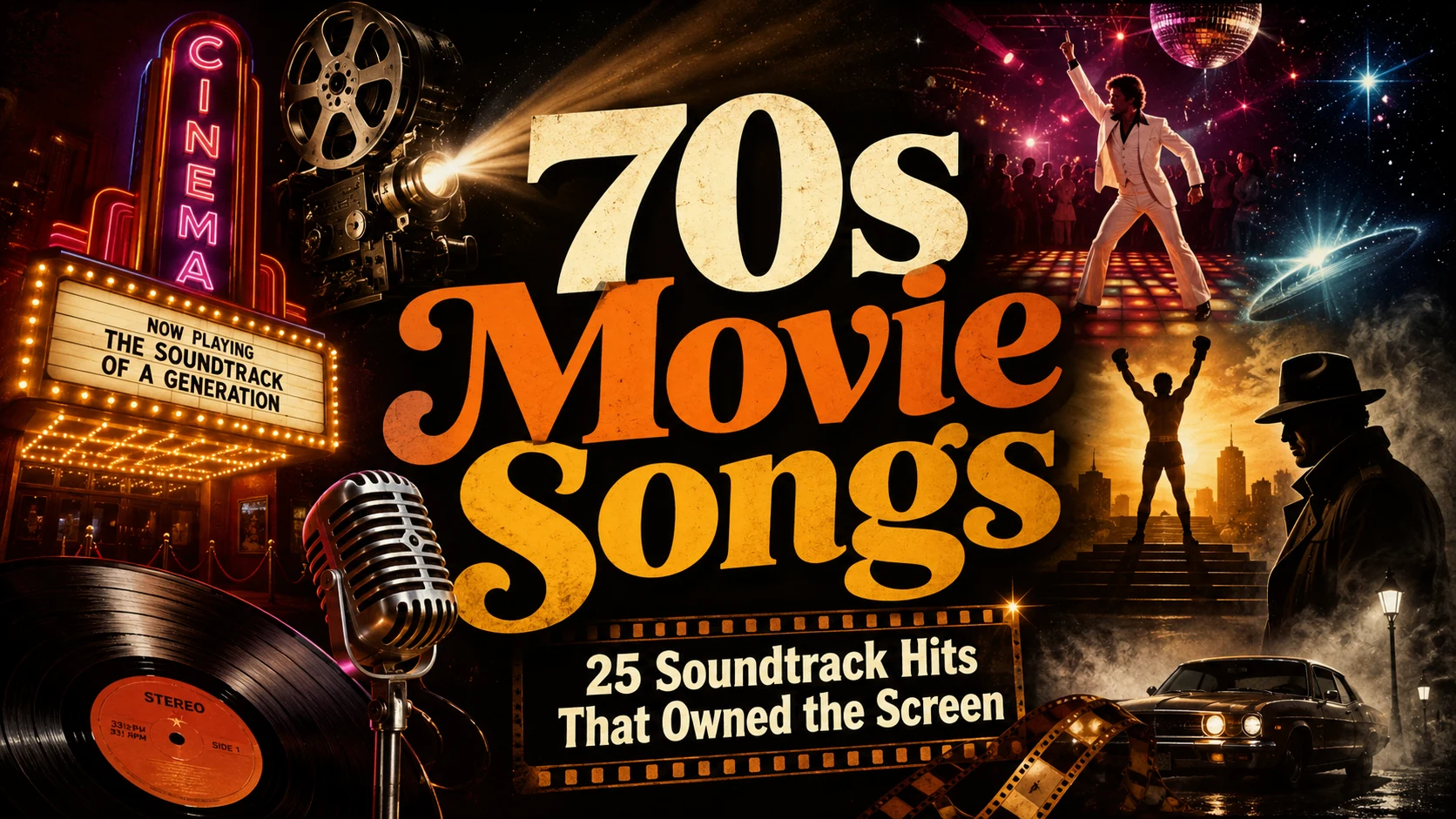
70s Movie Songs: 25 Soundtrack Hits That Owned the Screen
70s movie songs were not just background music. They were the sound of theater speakers, drive-ins, shag-carpet living rooms, family TVs, and soundtrack albums stacked beside the stereo like sacred objects nobody under 12 was allowed to touch.
This was the decade where Saturday Night Fever turned disco into a movie event, Grease made every school dance permanently suspicious, Shaft made cool sound like a wah-wah guitar, Rocky made stairs emotionally complicated, and Star Wars proved an orchestral theme could hit like a rock anthem.
This ranking covers 70s movie songs, soundtrack hits, and movie themes based on cultural memory, soundtrack impact, chart afterlife, Gen X exposure, and how fast they can make a person picture a scene without seeing a single frame.
What Are the Biggest 70s Movie Songs?
The biggest 70s movie songs and soundtrack hits include “Stayin’ Alive” by Bee Gees from Saturday Night Fever, “Theme from Shaft” by Isaac Hayes, “Gonna Fly Now” from Rocky, “Grease” by Frankie Valli, “You’re the One That I Want” from Grease, “Super Fly” by Curtis Mayfield, “Live and Let Die” by Paul McCartney & Wings, “Nobody Does It Better” by Carly Simon, and the Star Wars Main Title by John Williams.
How We Picked These 70s Movie Songs
This is an editorial nostalgia ranking, not a strict chart list. The goal is to capture the songs and themes that became inseparable from 1970s movies and soundtrack culture.
Some were pop singles. Some were disco monsters. Some were orchestral themes. Some were borrowed pieces of music that became permanently glued to a movie because the film used them so well. If it makes you picture the movie, the theater, the album cover, the trailer, or your parents’ record shelf, it belongs in the conversation.
70s Movie Songs at a Glance
Here is the countdown in quick-scan form before the full soundtrack rewind.
| Rank |
Song |
Artist / Composer |
Movie |
Why It Matters |
| #1 | “Stayin’ Alive” | Bee Gees | Saturday Night Fever | Disco movie immortality |
| #2 | “Star Wars Main Title” | John Williams | Star Wars | Blockbuster theme perfection |
| #3 | “Theme from Shaft” | Isaac Hayes | Shaft | Cool became a soundtrack |
| #4 | “Gonna Fly Now” | Bill Conti | Rocky | Training montage fuel |
| #5 | “Grease” | Frankie Valli | Grease | Retro pop opening blast |
| #6 | “You’re the One That I Want” | John Travolta & Olivia Newton-John | Grease | Movie-musical karaoke chaos |
| #7 | “Super Fly” | Curtis Mayfield | Super Fly | Soundtrack as social commentary |
| #8 | “Live and Let Die” | Paul McCartney & Wings | Live and Let Die | Bond theme with rock teeth |
| #9 | “The Way We Were” | Barbra Streisand | The Way We Were | Adult nostalgia in ballad form |
| #10 | “Evergreen” | Barbra Streisand | A Star Is Born | Romantic 70s ballad power |
| #11 | “Nobody Does It Better” | Carly Simon | The Spy Who Loved Me | Elegant Bond pop classic |
| #12 | “Last Dance” | Donna Summer | Thank God It’s Friday | Disco finale energy |
| #13 | “Car Wash” | Rose Royce | Car Wash | Funk-soul workplace party |
| #14 | “Dueling Banjos” | Eric Weissberg & Steve Mandell | Deliverance | Instant movie tension |
| #15 | “The Entertainer” | Marvin Hamlisch | The Sting | Ragtime revival via Hollywood |
| #16 | “Theme from Mahogany” | Diana Ross | Mahogany | Glamorous soul-pop drama |
| #17 | “Ben” | Michael Jackson | Ben | Sweet ballad, weird movie context |
| #18 | “Across 110th Street” | Bobby Womack | Across 110th Street | Gritty soul storytelling |
| #19 | “Suicide Is Painless” | The Mash | M*A*S*H | Melancholy theme with afterlife |
| #20 | “Tubular Bells” | Mike Oldfield | The Exorcist | Instant horror recognition |
| #21 | “Theme from New York, New York” | Liza Minnelli | New York, New York | Big-city showbiz anthem |
| #22 | “Hopelessly Devoted to You” | Olivia Newton-John | Grease | Teen heartbreak ballad |
| #23 | “If I Can’t Have You” | Yvonne Elliman | Saturday Night Fever | Disco heartbreak classic |
| #24 | “A Fifth of Beethoven” | Walter Murphy | Saturday Night Fever | Classical disco novelty done right |
| #25 | “The Rose” | Bette Midler | The Rose | Late-70s movie ballad drama |
Countdown: 25 70s Movie Songs and Soundtrack Hits
Roll the projector, cue the record needle, and prepare for the kind of soundtrack memories that make you smell popcorn, vinyl sleeves, and the inside of a station wagon with no air conditioning.
#25 — “The Rose” — Bette Midler
Why it hit
“The Rose” closes out the decade with full dramatic ballad energy. Bette Midler’s vocal is bruised, theatrical, and huge without needing to scream. It sounds like a spotlight, a cigarette, a backstage breakdown, and a piano all agreed to ruin your evening emotionally.
The song connected because it had that late-70s adult-pop seriousness: simple melody, heavy feeling, and the sense that love, fame, pain, and survival were all somehow being discussed in one slow-building ballad.
Why it worked in the movie
The Rose is built around performance, exhaustion, and the cost of being larger than life. The song feels like the movie’s emotional summary. It does not need to explain the plot. It carries the mood: beautiful, sad, exhausted, and still trying to bloom anyway.
70s lifestyle snapshot
This belongs to the late-70s world of smoky stages, rock-star mythology, adult dramas, and soundtrack ballads that felt too intense for kids but somehow played in the house anyway. Picture a stereo cabinet, low lamps, and adults getting very quiet for reasons nobody explained.
Why Gen X remembers it
Gen X inherited “The Rose” through radio, TV performances, talent shows, piano recitals, weddings, funerals, and every place where one ballad could turn a room into a therapy session. Even if the movie was not a childhood staple, the song absolutely escaped into the culture.
Why it sticks
It turned late-70s movie heartbreak into a ballad sturdy enough to survive every talent show that followed.
#24 — “A Fifth of Beethoven” — Walter Murphy
Why it hit
“A Fifth of Beethoven” is one of those things only the 70s could make feel normal: Beethoven, disco, orchestral drama, and a dance beat walking into the same room wearing platform shoes. Somehow, it works.
The track had novelty energy, but it was not disposable. It was catchy, flashy, and ridiculous in a way the decade fully understood. The 70s did not just bend genres. It put them under a mirror ball and hoped nobody asked too many questions.
Why it worked in the movie
On the Saturday Night Fever soundtrack, it helped show how wide disco’s reach had become. The movie’s music was not just one sound. It was a dance-floor universe where pop, soul, orchestral flourishes, and novelty could all squeeze into the same record sleeve.
70s lifestyle snapshot
This is soundtrack-album culture at its most gloriously weird: parents buying the LP, kids staring at the cover, and everyone accepting that classical disco was apparently part of the national conversation now. Very normal. Nothing to see here except Beethoven in a leisure suit.
Why Gen X remembers it
Gen X remembers this kind of track less as a serious song and more as proof that 70s music had no fear. It showed up on oldies radio, disco flashback specials, skating-rink memories, and soundtrack collections where it always sounded like the grown-ups had lost control of the playlist.
Why it sticks
It made Beethoven briefly eligible for the disco floor, which is both absurd and completely 70s.
#23 — “If I Can’t Have You” — Yvonne Elliman
Why it hit
“If I Can’t Have You” proved the Saturday Night Fever soundtrack was not just the Bee Gees showing up and collecting everybody’s lunch money. Yvonne Elliman brought longing, melody, and a sleek disco-soul feel to one of the soundtrack’s strongest emotional cuts.
The song worked because it had movement and heartbreak at the same time. It could keep people on the dance floor while still sounding like somebody was making terrible romantic choices under colored lights.
Why it worked in the movie
Saturday Night Fever is often remembered as disco fantasy, but the movie is darker and lonelier than the white-suit image suggests. “If I Can’t Have You” fits that tension: glossy surface, messy feelings underneath.
70s lifestyle snapshot
This is late-night disco heartbreak: clubs, city streets, too much cologne, too many feelings, and the belief that dancing could solve things it absolutely could not solve. It belongs to the era when a soundtrack could make heartbreak sound fashionable.
Why Gen X remembers it
Gen X absorbed it through disco retrospectives, oldies radio, parents’ records, and the general cultural cloud around Saturday Night Fever. It became one of those songs that proved disco was not all celebration. Sometimes it was just heartbreak with better lighting.
Why it sticks
It made romantic desperation danceable, because the 70s were emotionally efficient like that.
#22 — “Hopelessly Devoted to You” — Olivia Newton-John
Why it hit
“Hopelessly Devoted to You” gave Grease its big soft-focus heartbreak moment. Olivia Newton-John’s vocal is sweet, clean, and sincere enough to make the whole song feel like a diary entry with a melody.
The song hit because it balanced teen heartbreak with adult pop polish. It is innocent enough for the movie’s high-school fantasy, but produced and sung with the kind of 70s ballad seriousness that made parents pay attention too.
Why it worked in the movie
Grease is loud, colorful, and full of group numbers, but this song slows everything down and gives Sandy a personal emotional center. It lets the movie breathe between the jokes, cars, dances, and hair-based identity crises.
70s lifestyle snapshot
This is teenage heartbreak filtered through late-70s pop: bedroom posters, record players, school dances, and kids learning that movie love apparently required staring into the distance while singing flawlessly. Real life was less generous.
Why Gen X remembers it
Gen X heard this through TV reruns, VHS tapes, school musicals, talent shows, and the endless cultural afterlife of Grease. It became one of those soundtrack songs that practically required someone to dramatically over-sing it at least once in every school auditorium.
Why it sticks
It made teen longing sound innocent, polished, and dangerously singable.
#21 — “Theme from New York, New York” — Liza Minnelli
Why it hit
Before the song became permanently tied to later versions and big-city victory laps, “Theme from New York, New York” belonged to Liza Minnelli and the 1977 film. Her version is pure showbiz electricity: dramatic, brassy, ambitious, and ready to kick open a stage door.
The song works because it sells the fantasy of reinvention. New city, new chance, new lights, new life. Is that how moving actually works? No. Usually there is a security deposit and a broken radiator. But the song makes the dream feel real.
Why it worked in the movie
New York, New York is soaked in performance, romance, ambition, and show-business mythology. The theme gives all of that a musical emblem: big voice, big city, big dream, big emotional bill coming due later.
70s lifestyle snapshot
This is the 70s fascination with showbiz glamour: nightclubs, jazz rooms, city lights, stage makeup, smoke, applause, and the idea that talent could turn a hard city into a personal spotlight.
Why Gen X remembers it
Gen X mostly inherited the song as a cultural anthem, but the movie origin matters. It became part of the larger soundtrack of TV specials, awards shows, sports celebrations, and grown-up entertainment where someone was always belting like rent depended on it.
Why it sticks
It made ambition sound like brass, pavement, and a spotlight you had to earn.
#20 — “Tubular Bells” — Mike Oldfield
Why it hit
“Tubular Bells” was not written as a standard movie theme, but The Exorcist made it inseparable from 70s horror. Those repeating notes are simple, chilly, and instantly wrong-feeling in the best possible way.
The music hit because it did not sound like a monster jumping out of a closet. It sounded like dread quietly entering the room and sitting down. The 70s horror mood was not always loud. Sometimes it was calm enough to be worse.
Why it worked in the movie
The Exorcist needed music that felt eerie without turning into cartoon thunder. “Tubular Bells” gave the movie a strange, hypnotic identity. Once the film attached that sound to its world, the music could never fully escape.
70s lifestyle snapshot
This is the era of serious horror: lines outside theaters, urban legends, adults whispering that the movie was too intense, and kids overhearing just enough to be terrified. The music became part of the warning label.
Why Gen X remembers it
Gen X often encountered The Exorcist too young through cable TV, video stores, older siblings, or adults who really should have changed the channel faster. The music became a shorthand for “something deeply bad is about to happen.”
Why it sticks
It proved horror music does not need to scream when it can quietly ruin your sleep.
#19 — “Suicide Is Painless” — The Mash
Why it hit
“Suicide Is Painless” is one of the strangest theme songs to become culturally familiar: soft, melancholy, pretty, and carrying a title that immediately reminds you the 70s were not especially interested in sanding down sharp edges.
The song fit the era because it mixed beauty with bleakness. That combination was everywhere in 70s film culture: comedy with despair underneath, war stories with anti-war bite, and music that sounded gentle while the meaning sat there like a landmine.
Why it worked in the movie
M*A*S*H used comedy to process war, absurdity, and institutional chaos. The song captures that uneasy tone: casual on the surface, dark underneath, and more complicated than a normal theme song had any right to be.
70s lifestyle snapshot
This is anti-war 70s culture: dark humor, military fatigue, cynical adults, and movies willing to laugh directly at institutions. It belongs to a decade when entertainment could be funny and bitter at the same time, like a sitcom watched through smoke.
Why Gen X remembers it
Gen X knew the melody through the massive TV afterlife of M*A*S*H, even if the movie came first. That gentle tune became background noise in living rooms everywhere, usually right before adults explained absolutely nothing.
Why it sticks
It made a soft melody carry a dark joke for decades.
#18 — “Across 110th Street” — Bobby Womack
Why it hit
“Across 110th Street” is gritty soul storytelling with its collar open and its eyes wide. Bobby Womack’s voice sounds lived-in, urgent, and completely connected to the world the film is showing.
It hit because it felt real. This was not glossy soundtrack wallpaper. It was a city song with pressure in it: survival, crime, desperation, and the line between getting by and getting swallowed.
Why it worked in the movie
The song gives the film instant atmosphere. Before you understand every character, you understand the world. The music makes the city feel alive, dangerous, and morally complicated.
70s lifestyle snapshot
This is gritty 70s urban cinema: street corners, crime dramas, soul soundtracks, theater marquees, and movies that did not polish the city into a postcard. The soundtrack had dirt under its fingernails, and that was the point.
Why Gen X remembers it
Gen X came to this one through soundtrack culture, soul radio, later film references, and the broader rediscovery of 70s crime cinema. It is one of those songs that sounds cinematic even when you are not watching the movie.
Why it sticks
It made a street-level story sound soulful, dangerous, and impossible to ignore.
#17 — “Ben” — Michael Jackson
Why it hit
“Ben” is one of the strangest soundtrack-success stories of the decade: a sweet, tender Michael Jackson ballad connected to a movie about a rat. The 70s did not merely tolerate tonal confusion. It decorated around it.
The song hit because Michael’s young vocal performance is genuinely moving. Detached from the movie’s odd premise, it works as a sincere friendship ballad. Attached to the movie, it becomes peak 70s weirdness with a beautiful melody.
Why it worked in the movie
The song gives the movie an emotional seriousness that its premise probably should not support, but somehow does. It turns something bizarre into something oddly touching, which is a very specific kind of 70s magic.
70s lifestyle snapshot
This belongs to the era when kids could hear a beautiful ballad on the radio, then eventually learn it came from a horror-adjacent rat sequel and just have to live with that information. No parental warning labels. No internet explanations. Just confusion and a 45 single.
Why Gen X remembers it
Gen X remembers “Ben” as part of Michael Jackson’s early ballad legacy, but the movie context adds that extra 70s layer of “wait, what?” It is sentimental, strange, and completely memorable.
Why it sticks
It proved a gorgeous song could come from a movie premise that sounds like a dare.
#16 — “Theme from Mahogany” — Diana Ross
Why it hit
“Theme from Mahogany,” also known as “Do You Know Where You’re Going To,” is Diana Ross in full glamorous-question mode. It is elegant, reflective, and built around one of the most adult-pop questions the 70s ever put on the radio.
The song hit because it sounded like ambition staring into a mirror. It had glamour, uncertainty, romance, and regret all wrapped into a smooth vocal performance that never needed to rush.
Why it worked in the movie
Mahogany deals in fashion, fame, reinvention, identity, and the cost of chasing a dream. The theme song captures that perfectly. It sounds beautiful, but it is not mindless. It keeps asking whether the dream is actually taking you where you wanted to go.
70s lifestyle snapshot
This is 70s glamour with emotional questions attached: fashion photography, big-city ambition, glossy magazines, dramatic lighting, and adults treating self-discovery like it required a string section.
Why Gen X remembers it
Gen X heard this one through adult-contemporary radio, parents’ record collections, TV performances, and movie-song retrospectives. It had the kind of grown-up polish that made kids realize adults had entire emotional departments nobody had mentioned.
Why it sticks
It made ambition sound beautiful, lonely, and slightly suspicious.
#15 — “The Entertainer” — Marvin Hamlisch
Why it hit
“The Entertainer” was vintage ragtime, but The Sting turned it into a 70s pop-culture phenomenon. Marvin Hamlisch’s arrangement made older music feel newly fashionable, proving Hollywood could revive a sound just by placing it in the right movie.
It hit because it was instantly catchy and completely different from the rest of the decade’s radio landscape. Disco, soul, rock, singer-songwriters — and then suddenly everyone was humming ragtime like the calendar had fallen down the stairs.
Why it worked in the movie
The Sting used music to create mood, period flavor, and playful misdirection. The ragtime sound fit the film’s con-game charm perfectly: clever, old-fashioned, nimble, and just a little mischievous.
70s lifestyle snapshot
This is the era of movie themes jumping straight into family life. The tune could show up on piano benches, variety shows, commercials, and dinner parties where someone’s uncle suddenly claimed he “used to play a little.”
Why Gen X remembers it
Gen X remembers it as one of those melodies that seemed to exist everywhere without explanation. It was in movies, TV, school music rooms, and pop culture references — a piece of old-time music revived so thoroughly that it became part of 70s memory too.
Why it sticks
It made ragtime cool again, briefly confusing every decade in the room.
#14 — “Dueling Banjos” — Eric Weissberg & Steve Mandell
Why it hit
“Dueling Banjos” is one of the most recognizable movie music moments of the decade, which is impressive considering how quickly the mood moves from “wow, great musicianship” to “why does this feel like a warning?”
The track hit because it was memorable, unusual, and instantly tied to the film’s atmosphere. It was catchy enough to become a hit, but loaded with enough movie tension to make every rural road trip feel like a questionable life choice.
Why it worked in the movie
In Deliverance, the music scene is not just a performance. It is a cultural collision, a mood-setter, and a warning sign. The playful musical exchange slowly turns uncomfortable because the film makes you feel the social tension underneath.
70s lifestyle snapshot
This is 70s cinema at its unsettling best: outdoorsy adventure turning dark, rural fear, uncomfortable silences, and adults realizing that not every movie trip into nature was going to include wholesome camping.
Why Gen X remembers it
Gen X often knew “Dueling Banjos” through references and jokes before fully understanding the movie. The tune became shorthand for danger, isolation, and “we should probably turn the car around.”
Why it sticks
It made a banjo duet feel like foreshadowing with strings attached.
#13 — “Car Wash” — Rose Royce
Why it hit
“Car Wash” is funk-soul workplace joy in soundtrack form. Rose Royce delivered a groove so strong it made washing cars sound like the best job in America, which is frankly suspicious but musically convincing.
The song hit because it was loose, bright, rhythmic, and instantly useful. Radio loved it. Parties loved it. Commercials would eventually love it way too much. It had the rare soundtrack gift of sounding tied to the movie but not trapped by it.
Why it worked in the movie
Car Wash is built around workplace energy, community, characters, and the daily grind turned into something lively. The song captures that perfectly. It makes ordinary labor feel like a block party with soap.
70s lifestyle snapshot
This is the 70s funk version of everyday life: work uniforms, radios playing in the background, neighborhood characters, big personalities, and the idea that even a regular job deserved a horn section and a chorus.
Why Gen X remembers it
Gen X heard “Car Wash” everywhere: oldies radio, family parties, movies, TV ads, school events, and random moments where adults suddenly started clapping on beat with dangerous confidence.
Why it sticks
It made regular work sound like a funk party with better rhythm than most offices deserve.
#12 — “Last Dance” — Donna Summer
Why it hit
“Last Dance” is a disco finale disguised as a ballad that suddenly remembers it came to move. Donna Summer gives it glamour, tension, lift, and release — basically the whole emotional arc of a night out in one song.
It hit because it understood disco drama. The slow opening gives everyone time to feel important, then the beat arrives and the floor gets one more chance before the lights come up and reality starts filing paperwork.
Why it worked in the movie
Thank God It’s Friday was a disco-era time capsule, and “Last Dance” became its lasting gift. The movie may not be remembered like Saturday Night Fever, but the song nailed the end-of-the-night emotion better than almost anything else.
70s lifestyle snapshot
This is disco as ritual: getting dressed, going out, dancing too long, chasing one more song, and pretending tomorrow morning was not going to be a problem. The 70s understood consequences. They simply scheduled them later.
Why Gen X remembers it
Gen X inherited “Last Dance” through radio, dance recitals, variety shows, weddings, and every place where someone needed one big dramatic disco finish. It was not just a song; it was a closing argument.
Why it sticks
It gave disco its perfect final-call anthem.
#11 — “Nobody Does It Better” — Carly Simon
Why it hit
“Nobody Does It Better” is one of the great Bond themes because it sounds romantic, elegant, and slightly amused by itself. Carly Simon’s vocal turns spy-movie swagger into a sophisticated pop ballad that works even without a tuxedo or a villain with poor workplace boundaries.
The song hit because it was both specific and universal. It flatters Bond, sure, but it also works as a standalone love song. That is the trick: movie branding without becoming trapped inside the movie poster.
Why it worked in the movie
The Spy Who Loved Me is big, sleek 70s Bond. The song gives the movie romance and glamour without trying to out-explode the action. It makes Bond feel less like a plot machine and more like a myth people sing about.
70s lifestyle snapshot
This is lounge-pop Bond glamour: tuxedos, underwater cars, dramatic title sequences, silky vocals, and adults watching network TV broadcasts while kids tried to understand why spy movies needed so many silhouettes.
Why Gen X remembers it
Gen X caught this through Bond marathons, radio, parents’ records, and TV reruns where the opening credits were often more confusing than the actual plot. The song became one of those themes that sounded expensive even coming from a cheap television speaker.
Why it sticks
It made Bond swagger sound romantic instead of merely insured.
#10 — “Evergreen” — Barbra Streisand
Why it hit
“Evergreen” is 70s romantic balladry at its most polished. Barbra Streisand gives the song a sweeping, adult-pop glow that fits the era’s taste for big feelings sung by even bigger voices.
The song hit because it felt timeless on purpose. It had the melody, vocal performance, and emotional size of a movie ballad designed to last beyond the credits. This is not background music. This is “please dim the lights, I am having a feeling.”
Why it worked in the movie
A Star Is Born is all about fame, love, performance, and the emotional cost of being seen. “Evergreen” gives that story a romantic center. It sounds intimate and enormous at the same time, which is the entire movie-ballad assignment.
70s lifestyle snapshot
This is the adult side of 70s soundtrack life: soundtrack LPs near the stereo, formal living rooms nobody was supposed to sit in, and parents treating a Barbra Streisand ballad like a major weather event.
Why Gen X remembers it
Gen X heard “Evergreen” in the background of grown-up spaces: radio stations, award-show clips, TV specials, and record collections. It was not kid music, but it was part of the furniture of the decade.
Why it sticks
It made romantic movie drama sound permanent.
#9 — “The Way We Were” — Barbra Streisand
Why it hit
“The Way We Were” is nostalgia before nostalgia became a full-time industry with merch, streaming rights, and a suspicious number of reboots. Streisand turns memory itself into the main character.
The song hit because it captured the ache of looking backward. Romance, regret, old photographs, things left unsaid — all of it sits inside a melody that sounds like someone opening a box they probably should have left in the closet.
Why it worked in the movie
The film is built around memory, politics, romance, and the distance between who people were and who they became. The song gives all of that a simple emotional language. It does not explain the relationship. It mourns it.
70s lifestyle snapshot
This is 70s adult drama culture: serious movies, serious relationships, serious ballads, and adults getting misty while children wondered why nobody on screen seemed happy for more than four minutes.
Why Gen X remembers it
For Gen X, this was one of those songs that lived on adult radio and in cultural references. It sounded old even when it was new, because it was built to feel like memory. That made it perfect for a generation raised around other people’s nostalgia.
Why it sticks
It made remembering hurt in three-quarter lighting.
#8 — “Live and Let Die” — Paul McCartney & Wings
Why it hit
“Live and Let Die” gave James Bond a rock-and-roll jolt. Paul McCartney & Wings delivered a theme that starts theatrical, swerves into explosive rock drama, and basically refuses to sit still.
It hit because it sounded dangerous and unpredictable. One second it is elegant. The next second it is blowing the doors open. The song has the energy of a tuxedo sprinting away from a fireball, which is extremely Bond and extremely 70s.
Why it worked in the movie
The film pushed Bond into a louder, funkier, more chaotic 70s space, and the theme matched that shift. It did not sound like old spy-movie sophistication. It sounded like a franchise realizing the decade had changed and the explosions needed better music.
70s lifestyle snapshot
This is 70s Bond in full swagger mode: speedboats, villains, title sequences, rock drama, and kids watching edited TV broadcasts while adults insisted the older Bonds were better. They always did that. It was basically federal law.
Why Gen X remembers it
Gen X heard “Live and Let Die” through Bond marathons, classic rock radio, soundtrack collections, and later cover versions. It became one of those movie songs that also worked as a rock song, which gave it a much longer afterlife.
Why it sticks
It made Bond sound like someone plugged the tuxedo into an amplifier.
#7 — “Super Fly” — Curtis Mayfield
Why it hit
“Super Fly” is not just a movie song. It is a soundtrack acting as social commentary. Curtis Mayfield made the track cool, stylish, and uneasy, giving the film’s world a deeper voice.
It hit because it sounded smooth while saying something sharper. The groove invites you in, but the lyrics and tone complicate the fantasy. That tension is why the song still feels powerful instead of simply stylish.
Why it worked in the movie
Mayfield’s soundtrack does not just decorate Super Fly. It talks back to it. The song understands the glamour, danger, and cost of the story being told. That makes it one of the strongest examples of a 70s soundtrack carrying its own point of view.
70s lifestyle snapshot
This is streetwise 70s cinema: big cars, sharp clothes, urban pressure, soul soundtracks, and movie posters that looked cooler than half the movies playing next door. The soundtrack was not background. It was part of the world-building.
Why Gen X remembers it
Gen X encountered “Super Fly” through soul radio, soundtrack culture, hip-hop references, film history, and the broader mythology of 70s cool. It sounds like a whole movie even without the movie.
Why it sticks
It made a soundtrack cooler, smarter, and more morally complicated than the average poster promised.
#6 — “You’re the One That I Want” — John Travolta & Olivia Newton-John
Why it hit
“You’re the One That I Want” is pure movie-musical gasoline. It takes the entire Grease fantasy — teen rebellion, makeover logic, leather jackets, carnival chaos — and turns it into one giant hook.
The song hit because it was ridiculously singable and instantly visual. You hear it and the final scene arrives fully assembled: Sandy’s transformation, Danny’s reaction, the carnival, the choreography, and a whole lot of hair decisions nobody should try at home.
Why it worked in the movie
It gives Grease its explosive finale. The movie is a retro fantasy, and this song lets that fantasy go completely over the top. It is not subtle. It is not realistic. It is a high-school romance resolving itself through leather pants and synchronized movement, because apparently that was an option.
70s lifestyle snapshot
This is late-70s pop culture eating 50s nostalgia for breakfast: school carnivals, jukebox mythology, dance numbers, satin jackets, and the idea that transformation could happen between scenes if the soundtrack was catchy enough.
Why Gen X remembers it
Gen X got this song through TV reruns, VHS tapes, school plays, dance routines, family movie nights, and every party where somebody thought they could handle the duet. Few could. Many tried anyway. History suffered.
Why it sticks
It turned a movie finale into a permanent karaoke hazard.
#5 — “Grease” — Frankie Valli
Why it hit
“Grease” works because it tells you immediately that the movie is not really about the 1950s. It is the 1970s looking back at the 1950s through pop radio, animated opening credits, shiny nostalgia, and hair products strong enough to survive a hurricane.
Frankie Valli gives the title track a smooth, radio-ready feel, while the Bee Gees-written song makes the whole movie feel modern instead of museum-piece retro. It is not trying to sound like a sock-hop relic. It sounds like 1978 selling you a fantasy version of the past, and the sales pitch worked.
Why it worked in the movie
The opening sequence sets the tone perfectly: cartoon cool, teen-movie attitude, and a big title song that tells you the film is going to be more about vibe than historical accuracy. That matters because Grease is not a documentary. It is a jukebox memory machine.
The song gives the movie permission to be exaggerated. The cars are cooler, the hair is higher, the school is shinier, and everybody seems to understand choreography way better than any real teenager ever did.
70s lifestyle snapshot
This is late-70s nostalgia before nostalgia became an industry. Kids saw Grease in theaters, parents remembered a cleaner fantasy of their teen years, and Gen X absorbed the whole thing later through TV reruns, VHS tapes, school productions, and soundtrack albums that seemed to appear in every house with a record player.
Why Gen X remembers it
For Gen X, “Grease” was less a song and more a gateway into the movie’s entire world. You heard it and instantly pictured leather jackets, animated cars, school hallways, drive-ins, carnival lights, and adults pretending they did not know every word.
Why it sticks
It made fake 1950s nostalgia sound like pure 1978 pop radio.
#4 — “Gonna Fly Now” — Bill Conti
Why it hit
“Gonna Fly Now” is the reason stairs became emotional. Bill Conti’s theme took a small underdog story and gave it the sound of personal destiny. The horns, the rhythm, the slow build, the release — it all feels like effort turning into belief.
The genius is that the song is not complicated. It does exactly what a great movie theme should do: it makes you feel the story in your chest before your brain has time to ask whether jogging up museum steps is actually a good idea.
Why it worked in the movie
In Rocky, the training montage is everything. It takes a character who could have stayed small and makes him mythic. “Gonna Fly Now” does not just accompany the scene. It transforms it.
Without that music, Rocky is just a guy working out in sweats. With the music, he becomes every underdog who ever believed they could survive one more round. That is soundtrack magic. Also, it tricked millions of regular people into thinking they should run, which remains one of cinema’s most dangerous lies.
70s lifestyle snapshot
This is 70s grit turned into inspiration: gray city streets, sweatpants, corner stores, old gyms, raw eggs, and the idea that you did not need polished perfection to become a hero. You just needed heart, work, and a theme song loud enough to make stairs look important.
Why Gen X remembers it
Gen X grew up with “Gonna Fly Now” everywhere: TV sports packages, school assemblies, commercials, parody scenes, workout montages, and every moment where someone wanted instant inspiration without writing a speech.
Why it sticks
It turned an underdog workout into American mythology with brass.
#3 — “Theme from Shaft” — Isaac Hayes
Why it hit
“Theme from Shaft” is cool walking into the room before the character does. Isaac Hayes built the track out of hi-hat, wah-wah guitar, strings, deep vocals, and attitude so thick it practically needed its own parking space.
The song hit because it did not sound like old Hollywood. It sounded urban, stylish, dangerous, and modern. It gave the movie a musical identity that was impossible to separate from the character. Shaft did not just have a theme song. He had an aura with a rhythm section.
Why it worked in the movie
The track defines the character before the plot has to do any heavy lifting. You understand the confidence, the swagger, the city, the danger, and the attitude before anyone explains anything.
That is what great movie music does. It does not just tell you what is happening. It tells you how to feel about what is happening. In this case, the feeling is “this man is cooler than everyone in the building, including the building.”
70s lifestyle snapshot
This is early-70s urban movie cool: trench coats, leather, city streets, big cars, theater marquees, and soundtrack albums that made the movie feel bigger than the screen. It belongs to the era when soul and funk were reshaping film music and giving Black cinema a sound as bold as its style.
Why Gen X remembers it
Gen X knew “Shaft” even when they did not fully know Shaft. The theme became shorthand for cool through TV references, comedy bits, commercials, oldies radio, and pop-culture callbacks.
Why it sticks
It made cool audible, then gave it a bassline and sideburns.
#2 — “Star Wars Main Title” — John Williams
Why it hit
The Star Wars Main Title is not a pop song, but leaving it off a 70s movie music list would be insane. John Williams created one of the most recognizable pieces of film music ever, and it arrived at the exact moment movies were becoming modern blockbuster events.
The opening blast does not ease you into the movie. It launches you. The brass hits, the crawl begins, and suddenly the audience is not just watching a sci-fi film. They are entering mythology. Space no longer sounds cold or distant. It sounds huge, heroic, and expensive.
Why it worked in the movie
Star Wars needed music that could make strange planets, droids, laser swords, and space battles feel timeless instead of silly. Williams did that by reaching back to classic adventure scoring and making it feel brand new.
The theme gives the movie instant authority. Before you know Luke, Leia, Han, Vader, or the Death Star, the music tells you this story matters. That is an enormous trick, and it works every single time.
70s lifestyle snapshot
This is the sound of 1977 changing childhood. Theater lines, action figures, lunchboxes, trading cards, bedroom posters, Halloween costumes, and kids turning every cardboard tube into a lightsaber. The theme was not just movie music. It was the starting gun for a whole new kind of pop culture.
Why Gen X remembers it
For Gen X, this theme is practically encoded in the nervous system. It played in theaters, on soundtrack albums, on TV broadcasts, during toy commercials, in school bands, and inside the imagination of every kid who thought a flashlight could become a weapon with enough commitment.
Why it sticks
It made the blockbuster era sound like destiny.
#1 — “Stayin’ Alive” — Bee Gees
Why it hit
“Stayin’ Alive” is the ultimate 70s movie song because the second that beat starts, the movie appears in your head. The sidewalk. The white suit. The paint can. The strut. The attitude. The sense that a whole working-class life is trying to turn itself into a dance-floor fantasy.
The Bee Gees did not just give Saturday Night Fever a hit single. They gave it an identity. The song became bigger than the film, bigger than disco backlash, and bigger than the decade’s crimes against breathable fabric.
Why it worked in the movie
The opening walk is one of the great music-and-image marriages of the decade. Tony Manero does not have to explain who he is. The song does it for him. He is restless, stylish, frustrated, confident, trapped, and dreaming of being seen.
That is why “Stayin’ Alive” works beyond the beat. It sounds like survival disguised as swagger. The title says it outright, but the groove makes it feel cool enough that you almost miss the desperation underneath.
70s lifestyle snapshot
This is late-70s disco culture at full volume: clubs, city streets, platform shoes, polyester, mirror balls, soundtrack LPs, dance-floor status, and the idea that for one night a regular guy could become a legend under colored lights. It is also the sound of suburban kids later discovering disco through TV reruns and parents’ records like they had found forbidden evidence.
Why Gen X remembers it
Gen X inherited “Stayin’ Alive” as a complete cultural object. It was a song, a scene, a dance-floor reference, a Halloween costume, a parody setup, a radio staple, and eventually a CPR rhythm factoid everyone learned against their will.
Even people who have never watched Saturday Night Fever from start to finish know what this song means. That is why it sits at #1. It is not just from a movie. It became the movie’s living logo.
Why it is #1
It turned one sidewalk walk into the defining movie-music image of late-70s pop culture.
Why 70s Movie Soundtracks Mattered
The 70s were a huge decade for soundtrack albums. A movie song could leave the theater, hit the radio, sell records, define a scene, and become part of everyday life. Sometimes the song even outlived the movie, which is awkward for the movie but great for the record collection.
These soundtracks also helped blur lines between film, radio, disco, soul, rock, orchestral scores, and pop culture. By the time the decade ended, movie music was not just background. It was part of how movies sold themselves and how audiences remembered them.
Keep Rewinding 70s Music
Movie songs were only one lane in the 70s soundtrack. The rest of the decade was busy inventing disco dominance, arena-rock excess, soft-rock feelings, funk grooves, one-hit wonders, and radio habits that would follow Gen X around forever.
70s Music
The main 70s music hub for year-end countdowns, playlists, disco, soul, funk, soft rock, one-hit wonders, and soundtrack nostalgia.
70s Disco & Dance Floor Hits
The mirror-ball side of the decade, from Bee Gees and Donna Summer to Chic and ABBA.
70s Soul, Funk & R&B
Stevie Wonder, Marvin Gaye, Al Green, Parliament, Earth, Wind & Fire, and the groove section of the decade.
70s Classic Rock & Arena Rock
Guitars, drum solos, big choruses, and older-sibling record-crate energy.
70s Soft Rock & AM Radio Gold
The mellow dashboard-radio songs that filled station wagons and wood-paneled living rooms.
70s One-Hit Wonders
Massive songs, short shelf lives, and choruses that still ambush your brain.
The Rewind Verdict
The best 70s movie songs did what great soundtrack music is supposed to do: they made the scene bigger, the character cooler, the romance sadder, the monster scarier, the dance floor brighter, and the memory harder to shake.
“Stayin’ Alive” gave disco a movie walk. Star Wars gave blockbuster music a new language. “Shaft” made cool audible. “Gonna Fly Now” turned stairs into destiny. Grease made the past look suspiciously catchy. And somewhere between the drive-in, the record store, and the family stereo, the 70s turned movie songs into permanent pop-culture furniture.
FAQ: 70s Movie Songs
What are the most famous 70s movie songs?
The most famous 70s movie songs include “Stayin’ Alive,” “Theme from Shaft,” “Gonna Fly Now,” “Grease,” “You’re the One That I Want,” “Super Fly,” “Live and Let Die,” “The Way We Were,” “Evergreen,” and “Nobody Does It Better.”
What 70s movie had the biggest disco soundtrack?
Saturday Night Fever is the defining 70s disco soundtrack, powered by Bee Gees songs like “Stayin’ Alive,” “Night Fever,” and “How Deep Is Your Love,” along with other disco-era soundtrack cuts.
Is the Star Wars theme a 70s movie song?
It is more accurately a movie theme than a pop song, but the Star Wars Main Title is one of the most iconic pieces of 70s movie music and belongs in any serious 70s soundtrack conversation.
Why were 70s movie soundtracks so important?
70s movie soundtracks helped songs move from theaters to radio, record stores, TV performances, and everyday nostalgia. A great soundtrack could sell the film, define the scene, and become a hit record on its own.