Smells Like Gen X • 70s Music
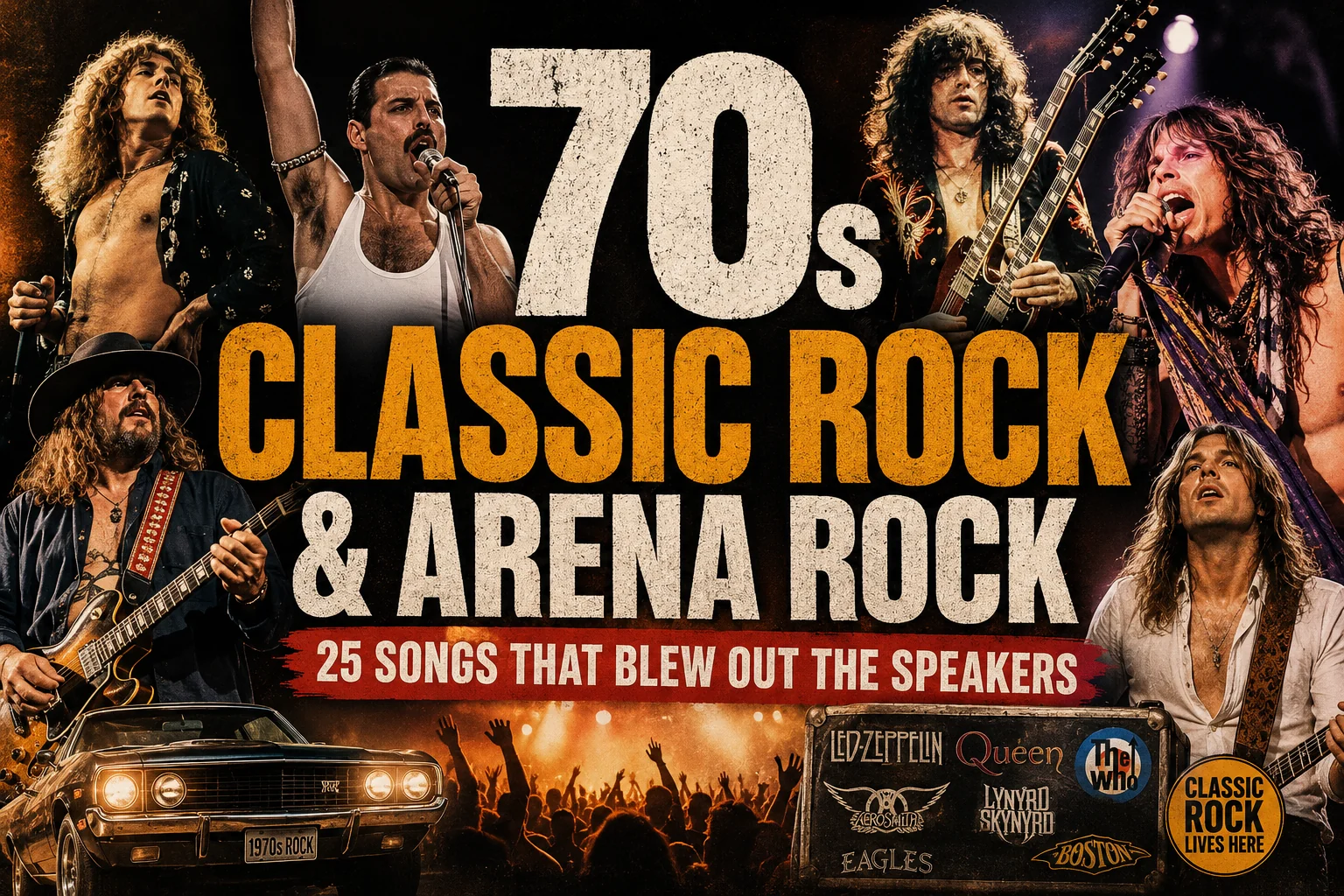
70s Classic Rock & Arena Rock: 25 Songs That Blew Out the Speakers
70s classic rock and arena rock is the sound of giant guitars, longer songs, louder stereos, smoky arenas, basement speakers, album covers that looked important, and older cousins acting like they personally discovered Led Zeppelin.
This is the lane where FM radio got heavier, bands got bigger, concerts became events, and rock songs started sounding like they needed their own parking lot. Some of these songs were album cuts. Some were radio monsters. Some became lighter-raising arena rituals. All of them helped build the classic rock vocabulary Gen X inherited before we were old enough to argue with it.
The ranking below is an editorial Smells Like Gen X countdown based on cultural memory, guitar power, FM radio afterlife, arena energy, Gen X nostalgia, and how quickly a song can make someone air-drum badly at a red light.
What Are the Biggest 70s Classic Rock and Arena Rock Songs?
The biggest 70s classic rock and arena rock songs include “Stairway to Heaven” by Led Zeppelin, “Bohemian Rhapsody” by Queen, “Hotel California” by Eagles, “Free Bird” by Lynyrd Skynyrd, “Dream On” by Aerosmith, “Smoke on the Water” by Deep Purple, “Won’t Get Fooled Again” by The Who, “More Than a Feeling” by Boston, and “Carry On Wayward Son” by Kansas.
How We Picked These 70s Rock Songs
This is an editorial nostalgia ranking, not a strict chart ranking. The goal is to capture the songs that became permanent fixtures of 70s classic rock memory: FM radio staples, guitar anthems, arena singalongs, album-side epics, car-stereo scorchers, and songs that later classic rock stations played until the tape practically melted.
Some songs here are true arena rock. Some are hard rock. Some are Southern rock, progressive rock, blues rock, or album-oriented rock. That is intentional. The 70s rock universe was messy, loud, and not especially interested in fitting neatly into one little playlist box.
Translation: if it sounded huge on FM radio, made teenagers stare at album covers, survived decades of classic rock rotation, and caused at least one person to mime a guitar solo in public, it belongs in the conversation.
70s Classic Rock & Arena Rock at a Glance
Here is the countdown in quick-scan form before the full amp-stack rewind.
| Rank |
Song |
Artist |
Year |
Rock Lane |
| #1 | “Stairway to Heaven” | Led Zeppelin | 1971 | FM epic / classic rock mythology |
| #2 | “Bohemian Rhapsody” | Queen | 1975 | Operatic arena-rock spectacle |
| #3 | “Hotel California” | Eagles | 1976 | California noir guitar epic |
| #4 | “Free Bird” | Lynyrd Skynyrd | 1973 | Southern rock lighter-raiser |
| #5 | “Dream On” | Aerosmith | 1973 | Power ballad blueprint |
| #6 | “Smoke on the Water” | Deep Purple | 1972 | Riff immortality |
| #7 | “Won’t Get Fooled Again” | The Who | 1971 | Big-rock revolution burnout |
| #8 | “More Than a Feeling” | Boston | 1976 | Polished arena-rock lift-off |
| #9 | “Carry On Wayward Son” | Kansas | 1976 | Prog-radio anthem |
| #10 | “We Will Rock You / We Are the Champions” | Queen | 1977 | Arena participation ritual |
| #11 | “Sweet Home Alabama” | Lynyrd Skynyrd | 1974 | Southern rock radio staple |
| #12 | “Rock and Roll All Nite” | Kiss | 1975 | Arena-party mission statement |
| #13 | “Barracuda” | Heart | 1977 | Hard-rock attack |
| #14 | “Sultans of Swing” | Dire Straits | 1978 | Guitar-storytelling cool |
| #15 | “Slow Ride” | Foghat | 1975 | Boogie-rock cruise control |
| #16 | “Paranoid” | Black Sabbath | 1970 | Heavy-metal spark plug |
| #17 | “All Right Now” | Free | 1970 | Blues-rock strut |
| #18 | “American Woman” | The Guess Who | 1970 | Early-70s riff rock |
| #19 | “La Grange” | ZZ Top | 1973 | Texas boogie-rock |
| #20 | “Bad Company” | Bad Company | 1974 | Outlaw FM rock |
| #21 | “Do You Feel Like We Do” | Peter Frampton | 1976 | Live album arena showcase |
| #22 | “Renegade” | Styx | 1978 | Dramatic arena rock |
| #23 | “Radar Love” | Golden Earring | 1973 | Driving-song rock classic |
| #24 | “Mississippi Queen” | Mountain | 1970 | Cowbell-fueled hard rock |
| #25 | “Highway to Hell” | AC/DC | 1979 | Late-70s hard rock handoff |
Countdown: 25 70s Classic Rock & Arena Rock Songs
Now for the full rewind. These are the songs that made the decade louder: FM epics, guitar riffs, live-album monsters, arena stompers, road-trip blasts, basement stereo staples, and the tracks that turned ordinary speakers into a fire hazard.
#25 — “Highway to Hell” — AC/DC
Why it hit
“Highway to Hell” lands at the end of the decade like a warning shot for what hard rock was about to become. It is lean, loud, direct, and built around a guitar riff that does not ask for permission to enter the room.
AC/DC stripped the excess away. No mystical flute intro. No twelve-minute journey. No concept-album homework. Just a road-ready riff, Bon Scott’s dangerous grin of a vocal, and the feeling that rock was about to get meaner, tighter, and less interested in art-school explanations.
Rock culture context
By 1979, classic rock was starting to split into several futures: slick arena rock, punk attitude, new wave sharpness, and heavier guitar music that would feed the 80s hard rock explosion. “Highway to Hell” sits right on that fault line. It still belongs to the 70s, but it has the stripped-down, fist-in-the-air directness that would carry into the next decade.
70s lifestyle snapshot
This is the sound of the late-70s parking lot: denim jackets, muscle cars, gas station cigarettes, older teens leaning against hoods, and the radio getting just a little more dangerous. It feels like the decade handing the keys to the 80s hard-rock explosion and saying, “Try not to wreck it.” Naturally, everyone wrecked it beautifully.
Why Gen X remembers it
Gen X heard this song everywhere classic rock got rowdy: car radios, football warmups, garage stereos, older siblings’ tapes, and every place where volume was mistaken for personality. It was not subtle, but subtle was not why anyone showed up.
Why it sticks
It is the 70s closing the door by kicking it off the hinges.
#24 — “Mississippi Queen” — Mountain
Why it hit
“Mississippi Queen” is short, heavy, sweaty, and built around a riff that feels like it was carved out of a bar fight. Mountain did not need a long runway. The song kicks in and immediately starts moving furniture.
It also has one of the decade’s most famous cowbell openings, which means it became impossible for later generations to hear it without smirking. That is not the song’s fault. The riff still wins.
Rock culture context
This song captures the early-70s moment when blues rock was getting thicker, heavier, and less polite. Before arena rock became glossy and oversized, there was this kind of hard rock: blunt, riff-heavy, sweaty, and still connected to clubs and smaller rooms where the amps felt too large for the walls.
70s lifestyle snapshot
This is early-70s hard rock before everything got polished for arenas: loud amps, heavy blues roots, sweaty clubs, denim, boots, and a sound that still had dirt under its fingernails. It belongs to the world of biker bars, garage bands, and kids discovering that music could feel physically heavy.
Why Gen X remembers it
It became one of those classic rock riffs that showed up in movies, radio bumpers, sports montages, and every moment that needed instant attitude without a lot of lyrical paperwork. The opening alone does most of the job.
Why it sticks
It is basically a riff with a beard.
#23 — “Radar Love” — Golden Earring
Why it hit
“Radar Love” is one of the great driving songs of the 70s because it feels like motion from the first few seconds. The rhythm pushes forward, the vocal has urgency, and the whole thing sounds like headlights cutting through a long stretch of highway.
Golden Earring gave classic rock one of its most durable road songs: part romance, part telepathy, part dashboard-radio adrenaline. It is not just a song about driving. It moves like a car that may or may not have working brakes.
Rock culture context
Road songs mattered in the 70s because cars and radio were still deeply linked. Music discovery often happened through dashboard speakers, late-night FM signals, and long drives where the cassette or station became the whole atmosphere. “Radar Love” was built for that space: restless, propulsive, and just dramatic enough to make a normal drive feel like a mission.
70s lifestyle snapshot
This is CB-radio, gas-station-coffee, overnight-drive rock. It belongs to a decade where road trips had paper maps, cars had ashtrays, and nobody in the back seat had a screen to stare at. The music had to do the work. “Radar Love” did the work at unsafe speeds.
Why Gen X remembers it
It became a permanent car-radio staple, the kind of song that made even a trip to the hardware store feel like a questionable cross-country mission. For Gen X, this is the inherited sound of adults driving too fast and pretending the wagon was a muscle car.
Why it sticks
It is a speeding ticket with a bassline.
#22 — “Renegade” — Styx
Why it hit
“Renegade” is Styx doing what Styx did best: making rock feel theatrical enough to need curtains. It starts tense and almost ghostly, then turns into a full arena charge.
The song works because it balances drama with muscle. The story is over-the-top, the harmonies are big, and the shift from quiet suspense to hard-rock impact gives it the kind of punch that made arena crowds lose their minds.
Rock culture context
Styx lived in that late-70s zone where rock bands could be theatrical, polished, dramatic, and still completely at home on FM radio. “Renegade” is not just a song; it is a mini production. That mattered because arena rock was becoming more visual, more staged, and more interested in giving the crowd a moment, not just a track.
70s lifestyle snapshot
This is late-70s arena rock as mini-movie: dark stage, big lights, smoke machines, and a band turning a simple outlaw story into a full production. It belongs to the era when rock concerts were becoming theatrical events, not just bands playing songs in front of people who smelled like beer.
Why Gen X remembers it
“Renegade” became a classic rock station favorite because it sounds like something important is about to happen even when nothing is happening except your dad changing lanes badly. It has built-in suspense, then built-in release.
Why it sticks
It is a campfire ghost story plugged into an amp stack.
#21 — “Do You Feel Like We Do” — Peter Frampton
Why it hit
“Do You Feel Like We Do” is less a normal song than a live-album event. Peter Frampton’s talk box became one of the strangest and most memorable sounds of the decade, and the track helped turn Frampton Comes Alive! into a household object.
It is long, indulgent, crowd-pleasing, and exactly the kind of thing the 70s loved. Rock was not always trying to be efficient. Sometimes the whole point was stretching out, letting the crowd roar, and making the guitar sound like it had learned to speak.
Rock culture context
The 70s made the live album feel important in a way later decades rarely matched. A live record could define an artist, turn concert energy into living-room mythology, and make fans feel like they owned a piece of the event. Frampton’s talk box moment became one of those “you had to hear it” rock memories, even for people who were not actually there.
70s lifestyle snapshot
This is the era of the live album as a cultural event: double LPs, gatefold sleeves, giant headphones, bedroom stereos, and people treating concert recordings like sacred documents. The song feels like being inside an arena even if you were actually lying on shag carpet staring at speaker lights.
Why Gen X remembers it
Even if you did not know the full album, you knew the weird talking guitar thing. That was enough. The 70s put a robot mouth on a guitar and somehow made it emotional.
Why it sticks
It made a guitar ask questions. The decade was very busy being weird.
#20 — “Bad Company” — Bad Company
Why it hit
“Bad Company” is rock myth-making at its most direct: a band named Bad Company singing a song called “Bad Company” from an album called Bad Company. Subtle? No. Efficient? Absolutely.
The song builds slowly, with a moody piano opening and a heavy sense of outlaw drama. Then it expands into the kind of mid-70s rock that sounded tailor-made for FM radio and people who wanted their rebellion delivered at a manageable tempo.
Rock culture context
Mid-70s FM rock loved the outlaw pose: moody, masculine, slightly dangerous, but still polished enough to sit on mainstream radio. “Bad Company” turned that pose into branding. It is less about speed or technical fireworks and more about atmosphere — the slow walk, the heavy name, the sense that the song wants its own wanted poster.
70s lifestyle snapshot
This is black T-shirt, leather vest, wood-paneled basement rock. It belongs to the side of the decade where teenagers wanted music that sounded older, tougher, and slightly dangerous — even if they were just listening in a split-level house while their mom yelled that dinner was ready.
Why Gen X remembers it
Classic rock radio made this song feel permanent. It was always there, brooding in the background like it had a motorcycle parked outside. It gave regular suburban radio a little outlaw dust.
Why it sticks
It is rock branding so obvious it somehow becomes genius.
#19 — “La Grange” — ZZ Top
Why it hit
“La Grange” is ZZ Top turning blues-rock into a low-slung engine. The groove is simple, nasty, and instantly recognizable, the kind of riff that seems to arrive wearing sunglasses indoors.
The song does not need to explain itself. It crawls, snarls, and then locks into a boogie that became one of the band’s signature sounds. It is not arena bombast. It is road-house cool.
Rock culture context
ZZ Top represented a different flavor of 70s rock than the giant arena epics. This was regional, bluesy, gritty, and built around groove more than grandiosity. “La Grange” helped define the idea that classic rock could be cool because it was spare, not because it was huge.
70s lifestyle snapshot
This is truck-stop, pool-hall, back-road rock. It belongs to smoky rooms, neon beer signs, denim, boots, and cars that sounded like they needed maintenance but nobody cared because the radio worked. The song feels like the part of the 70s that never bothered to clean up for company.
Why Gen X remembers it
It became one of those riffs that made classic rock radio feel instantly dirtier, in a good way. The second it starts, everything smells like motor oil and poor decisions.
Why it sticks
It is three chords, a beard, and a suspicious amount of confidence.
#18 — “American Woman” — The Guess Who
Why it hit
“American Woman” kicks off the decade with a riff that sounds like it has a chip on its shoulder. The Guess Who gave early-70s rock a tense, punchy anthem that hit hard without needing stadium-sized production.
The song’s attitude is the point. It has swagger, bite, and enough mystery in the title to keep people arguing about what it really means. Classic rock loved that kind of ambiguity, especially when the guitar sounded this good.
Rock culture context
Released right as the 70s began, “American Woman” carries some of the late-60s tension into the new decade. It is not yet the giant, polished arena rock that would dominate later. It is sharper and rawer — a bridge between protest-era unease and the riff-driven classic rock machine that was about to take over FM radio.
70s lifestyle snapshot
This is early-decade rock before arena polish fully took over: protest-era hangover, muscle-car energy, radio static, and teenagers realizing rock could feel political, personal, and primal all at once. It fits the world of denim jackets, dorm rooms, and FM stations finding their identity.
Why Gen X remembers it
It stayed alive through classic rock radio, movie trailers, cover versions, and every situation where someone needed a riff that sounded instantly hostile. It is one of those songs that can change a room’s temperature in five seconds.
Why it sticks
That opening riff still walks into the room like it owns the lease.
#17 — “All Right Now” — Free
Why it hit
“All Right Now” is one of those songs built around open space and pure confidence. The riff is loose, the vocal is cool, and the whole thing feels like the band knows exactly how little it needs to do.
Free made a rock song that swings instead of stomps. That gives it a lasting appeal: it is heavy enough for classic rock, bluesy enough to feel grounded, and catchy enough to survive decades of radio rotation.
Rock culture context
Early-70s rock still had a strong blues foundation, and “All Right Now” shows how much power could come from restraint. It is not overloaded. It leaves room. That space makes the groove feel bigger and gives the song its swagger.
70s lifestyle snapshot
This is the sound of early-70s rock swagger before everything became oversized. It belongs to dorm stereos, garage bands, denim flares, and kids discovering that a song did not need ten layers if the groove already had a smirk.
Why Gen X remembers it
It became a permanent classic rock singalong, the kind of song that made even a boring errand feel like you were about to make an entrance somewhere. It is also proof that sometimes the riff does the flirting.
Why it sticks
It is a rock song that knows it looks good in jeans.
#16 — “Paranoid” — Black Sabbath
Why it hit
“Paranoid” is short, sharp, and historically massive. Black Sabbath helped carve out the darker, heavier side of 70s rock, and this song gave that sound a tight, urgent shape.
It does not sprawl like some classic rock epics. It attacks. The riff is anxious, the vocal is uneasy, and the energy feels like the walls are closing in — which made it a perfect early marker for heavy metal’s future.
Rock culture context
Sabbath gave rock a darker center of gravity. While some bands were chasing bluesy swagger or mystical grandeur, “Paranoid” felt nervous, heavy, and stripped down. It helped create a lane for heavier music that was less about partying and more about dread.
70s lifestyle snapshot
This is the sound of the bedroom door closing and the volume going up. It belongs to black-light posters, darker album covers, older kids who seemed slightly intimidating, and the first realization that rock could feel spooky, heavy, and anti-parent without even trying very hard.
Why Gen X remembers it
Gen X inherited Sabbath through older siblings, classic rock radio, metal fans, skate culture, and every kid who discovered that scary-sounding guitars were often more interesting than whatever adults approved of.
Why it sticks
It is anxiety with a riff and a black T-shirt.
#15 — “Slow Ride” — Foghat
Why it hit
“Slow Ride” is classic rock cruise control: a big, greasy groove that takes its time because it knows nobody is going anywhere. Foghat made a song that feels like a car with the windows down and the radio too loud.
The song’s power is repetition and feel. It does not need to reinvent anything. It settles into the groove and lets the riff do the heavy lifting.
Rock culture context
Mid-70s boogie rock was built for movement: cars, parties, bars, and rooms where nobody wanted delicate feelings. “Slow Ride” is not an intellectual puzzle. It is a groove machine. That is exactly why it endured.
70s lifestyle snapshot
This is van-culture rock: custom paint jobs, questionable upholstery, 8-track players, gas-station sunglasses, and people treating a drive across town like an odyssey. It sounds like the decade’s obsession with cars, freedom, and doing absolutely nothing quickly.
Why Gen X remembers it
It became a car-radio staple and later a soundtrack cheat code for anything involving cruising, trouble, or teenagers thinking they were cooler than physics.
Why it sticks
It is a speed limit violation at half speed.
#14 — “Sultans of Swing” — Dire Straits
Why it hit
“Sultans of Swing” is not arena rock in the fireworks sense. It is cooler than that. Dire Straits built a guitar-storytelling classic around Mark Knopfler’s clean, fluid playing and a lyric that feels like a documentary about musicians nobody is paying enough attention to.
The song stood out in the late 70s because it did not chase the biggest possible sound. It had taste, space, and a guitar tone that did not need distortion to prove anything.
Rock culture context
In a decade full of giant riffs and giant shows, “Sultans of Swing” reminded listeners that guitar heroism could be subtle. It was musicianly without being boring, cool without being cold, and detailed without needing a cape.
70s lifestyle snapshot
This is the smoky-pub side of classic rock: small stages, local bands, dim corners, and people who actually listened to the guitar solo instead of waiting for explosions. It captures the working-musician world underneath the decade’s bigger arena fantasies.
Why Gen X remembers it
It became one of those songs that made classic rock radio feel smarter for five minutes. The guitar sounded effortless, which of course made every amateur player immediately overestimate himself.
Why it sticks
It proves guitar heroism can whisper instead of scream.
#13 — “Barracuda” — Heart
Why it hit
“Barracuda” comes in like a warning siren with a galloping riff. Heart made one of the hardest-hitting rock songs of the decade, powered by Ann Wilson’s vocal force and Nancy Wilson’s razor-edged guitar attack.
It is sharp, angry, and completely alive. The song proved Heart could stand toe-to-toe with any hard rock band of the era and still sound like no one else.
Rock culture context
Heart mattered because they were not a novelty in the rock world. They were a serious hard-rock force with massive vocals, serious guitar power, and songs that could cut through male-dominated FM playlists. “Barracuda” is not asking to be included. It is kicking the door open.
70s lifestyle snapshot
This is rock in the era when women had to kick the door open twice as hard and still bring better songs. “Barracuda” belongs to the side of the decade where rock attitude was not just male swagger — it was fury, precision, and a refusal to be handled by the industry machine.
Why Gen X remembers it
It became a permanent blast of classic rock adrenaline: movie trailers, sports arenas, radio blocks, and every moment that needed a riff with teeth. It still sounds like someone just found out who was talking behind their back.
Why it sticks
It does not walk into classic rock history. It bites its way in.
#12 — “Rock and Roll All Nite” — Kiss
Why it hit
“Rock and Roll All Nite” is not complicated, and that is the point. Kiss turned rock into a slogan, a costume party, a marketing machine, and a chant that could survive any arena PA system.
The song is pure mission statement. It does not ask for deep interpretation. It says exactly what the band was selling: volume, spectacle, makeup, fire, and a crowd yelling the same words together.
Rock culture context
Kiss understood something huge about 70s rock: the song was only part of the product. The look, the stage show, the logo, the merch, the makeup, the fantasy — it all mattered. This track became the audio version of the brand.
70s lifestyle snapshot
This is lunchbox rock, poster rock, action-figure rock, bedroom-wall rock. Kiss understood that 70s rock was becoming visual culture before MTV even arrived. For kids, the makeup and stage show were almost as important as the music. For parents, that was the problem. Which, naturally, made it better.
Why Gen X remembers it
Kiss was everywhere in the late 70s: albums, posters, TV, merch, playground arguments, and kids trying to decide which member looked coolest. The answer depended heavily on your tolerance for platform boots.
Why it sticks
It is a rock anthem so simple it became impossible to kill.
#11 — “Sweet Home Alabama” — Lynyrd Skynyrd
Why it hit
“Sweet Home Alabama” is one of the most recognizable Southern rock songs ever recorded. The guitar intro alone is enough to make half a room nod along before anyone even decides whether they should.
Lynyrd Skynyrd gave the song a bright, rolling feel that made it instantly radio-friendly, even as the lyric carried regional pride, argument, and cultural baggage. That mix helped make it unavoidable.
Rock culture context
Southern rock became a major part of the 70s rock landscape because it blended blues, country, rock, and regional identity into something that sounded massive on FM radio. This song became both a staple and a lightning rod, which is part of why people still talk about it.
70s lifestyle snapshot
This is front-porch, pickup-truck, beer-cooler, county-fair rock. It belongs to a decade when Southern rock became a huge force on FM radio, blending country roots, blues riffs, and rock swagger into something that sounded great from car speakers even when the conversation around it got complicated.
Why Gen X remembers it
Classic rock radio played it forever. So did bars, fairs, jukeboxes, parties, movies, and anyone with three chords and confidence well above their skill level. Whether people loved it, argued over it, or just knew the intro, it stayed in the room.
Why it sticks
That guitar intro is practically a zip code.
#10 — “We Will Rock You / We Are the Champions” — Queen
Why it hit
Queen understood arena crowds better than almost anyone, and this pairing became one of rock’s greatest participation rituals. “We Will Rock You” is barely a song in the normal sense — it is a stomp, clap, and threat with a guitar solo attached.
“We Are the Champions” then turns the crowd energy into victory theater. Together, they became sports staples, concert finales, graduation background noise, and the official soundtrack of people celebrating accomplishments of wildly varying importance.
Rock culture context
This pair shows how rock became public ritual. Queen built music that crowds could perform with the band, and that changed how songs lived outside albums. These were not just tracks; they became behaviors.
70s lifestyle snapshot
This is the moment rock fully understands the crowd as an instrument. Stadiums, arenas, bleachers, gym floors, pep rallies — the stomp-stomp-clap escaped concerts and became public behavior. The 70s helped turn rock songs into mass rituals, and Queen basically handed everyone instructions.
Why Gen X remembers it
Every Gen X kid learned the stomp-stomp-clap somewhere: school gym, stadium, movie, commercial, or family room. It was rock as civic duty, and nobody checked whether the occasion actually deserved it.
Why it sticks
Queen made an arena anthem so obvious that even people with no rhythm could participate.
#9 — “Carry On Wayward Son” — Kansas
Why it hit
“Carry On Wayward Son” gives you harmonies, prog-rock twists, big guitar sections, philosophical lyrics, and enough movement to make it feel like three songs successfully sharing one jacket.
Kansas made progressive rock accessible without sanding off all the weird edges. The song was technical enough for musicians, catchy enough for radio, and dramatic enough for anyone who wanted their rock with a hint of destiny.
Rock culture context
Progressive rock could be intimidating, but “Carry On Wayward Son” translated that complexity into something FM radio could digest. It had enough musicianship to feel serious and enough chorus power to make regular listeners feel included instead of assigned homework.
70s lifestyle snapshot
This is headphones-and-black-light-poster rock. It belongs to album collections, basement stereos, fantasy paperbacks, and teenagers pretending they understood lyrics about spiritual journeys. The 70s let rock get philosophical, complicated, and still somehow perfect for a Camaro.
Why Gen X remembers it
Classic rock radio made this song feel eternal, and later pop culture gave it new life. It became the sound of big feelings, big choruses, and air-guitar attempts that usually ended in tragedy.
Why it sticks
It is prog rock that remembered to bring a massive chorus.
#8 — “More Than a Feeling” — Boston
Why it hit
“More Than a Feeling” sounds like someone polished arena rock until it reflected the sun. Boston built a track with soaring vocals, gleaming guitars, and a chorus that feels engineered to rise through the ceiling.
The song is emotional, but not messy. It is nostalgic, but not sleepy. It took the longing of 70s rock and gave it a high-tech studio shine that still sounds massive.
Rock culture context
Boston represented the studio-perfection side of arena rock. This was not raw garage noise. It was layered, controlled, huge, and engineered to sound spectacular on good speakers. In the 70s, better home stereos made that kind of sound feel like a selling point all by itself.
70s lifestyle snapshot
This is stereo-demo rock: the song you played to prove your speakers were worth the money. It belongs to hi-fi systems, wood cabinets, receiver lights, headphones the size of dinner plates, and teenagers discovering that production could feel like rocket fuel.
Why Gen X remembers it
It became a classic rock radio launch button. The second that chorus hits, every commute briefly becomes an arena, even if you are just stuck behind a Buick.
Why it sticks
It is nostalgia with jet engines.
#7 — “Won’t Get Fooled Again” — The Who
Why it hit
“Won’t Get Fooled Again” is enormous. The synthesizer pulse, the power chords, the political exhaustion, and Roger Daltrey’s legendary scream all combine into one of rock’s definitive big statements.
The Who made revolution sound both thrilling and suspicious. That tension gives the song its power: it is angry, huge, and skeptical of anyone promising to fix everything.
Rock culture context
This song captures the post-60s shift from idealism to distrust. By the early 70s, rock was still political, but it was less innocent. The Who turned that exhaustion into a stadium-sized warning, with synthesizers and power chords making disillusionment sound gigantic.
70s lifestyle snapshot
This is post-60s hangover rock. The idealism has bruises, the amps are bigger, and the crowd is old enough to wonder if the new boss might look suspiciously like the old boss. It belongs to a decade trying to turn disillusionment into volume.
Why Gen X remembers it
Even if you did not know the full story, you knew the scream. Classic rock radio treated it like a natural disaster with a drum kit. It is one of those songs that made the end of a long drive feel like the end of civilization.
Why it sticks
It is the sound of political cynicism achieving arena size.
#6 — “Smoke on the Water” — Deep Purple
Why it hit
“Smoke on the Water” has one of the most famous guitar riffs in rock history. It is simple enough for beginners to attack badly and powerful enough that professionals still cannot kill it.
Deep Purple turned a real-life recording disaster into a hard rock anthem, but the story is almost secondary now. The riff is the song’s permanent passport.
Rock culture context
The 70s turned guitar riffs into cultural currency. A riff could be more famous than the verses, more memorable than the album cover, and more likely to be butchered by beginners than any full song. “Smoke on the Water” became the ultimate example.
70s lifestyle snapshot
This is guitar-store rock, garage-band rock, basement-practice rock. It belongs to the first week someone got an electric guitar and immediately made the entire household regret that decision. The 70s created riffs that became rites of passage, and this one might be the biggest offender.
Why Gen X remembers it
Every Gen X kid knew someone who tried to play it. Usually badly. Usually loudly. Usually while believing they were seconds away from forming a band.
Why it sticks
It is the riff that launched a million terrible practice sessions.
#5 — “Dream On” — Aerosmith
Why it hit
“Dream On” is one of the great early power ballads: piano, tension, slow build, existential lyrics, and Steven Tyler escalating until the song practically levitates.
Aerosmith showed that hard rock could be dramatic without losing its teeth. The song is emotional, but not soft. It is theatrical, but still dangerous around the edges.
Rock culture context
Before the 80s turned power ballads into a full commercial machine, “Dream On” showed how rock could move from fragile to explosive. It helped define a template: start vulnerable, build tension, then let the singer and guitars go absolutely over the cliff.
70s lifestyle snapshot
This is bedroom-ceiling rock: the kind of song teenagers played while staring dramatically into space, thinking they had already suffered enough to understand life. It belongs to headphones, posters, incense, and the age when every big feeling needed a piano intro and a final scream.
Why Gen X remembers it
Classic rock radio made “Dream On” feel like a rite of passage. Eventually every kid learned the final vocal climb was coming and waited for it like a roller coaster drop.
Why it sticks
It turned teenage existential dread into an arena-sized scream.
#4 — “Free Bird” — Lynyrd Skynyrd
Why it hit
“Free Bird” is one of the definitive long-form rock songs of the 70s: part ballad, part farewell, part guitar-solo endurance event. It starts emotional and ends like the band is trying to outrun its own amplifiers.
Lynyrd Skynyrd created a song that became bigger than itself. The live versions, the shouted requests, the mythology, the sheer length — all of it turned “Free Bird” into a classic rock ritual.
Rock culture context
The 70s gave rock songs room to stretch. “Free Bird” is a perfect example of a song becoming an event because it refused to behave like a three-minute single. Its long guitar finale became part of its identity, and eventually part of rock comedy, too.
70s lifestyle snapshot
This is lighter-in-the-air, denim-vest, outdoor-concert rock. It belongs to festival fields, long hair, beer coolers, and a time when a guitar solo could be long enough for someone to leave, buy food, come back, and still catch the ending.
Why Gen X remembers it
Gen X mostly inherited “Free Bird” as both a serious anthem and a joke shouted at every band ever. That is a strange legacy, but honestly, the song can handle it.
Why it sticks
It is half farewell, half guitar hostage situation.
#3 — “Hotel California” — Eagles
Why it hit
“Hotel California” is California rock turning haunted. The Eagles took smooth production, mysterious lyrics, and one of the most famous twin-guitar endings in rock and built a song that still feels like a warning sign in neon.
The song works because it is polished and creepy at the same time. It sounds beautiful, but the story feels trapped. That contradiction made it endlessly replayable and endlessly overanalyzed.
Rock culture context
The Eagles were masters of making polished 70s rock sound effortless, but “Hotel California” adds a darker layer. It captures the decade’s suspicion that the dream had gone strange — fame, excess, California glamour, and the feeling that paradise might come with a locked exit.
70s lifestyle snapshot
This is the darker side of 70s California fantasy: luxury, burnout, excess, desert highways, record-label glamour, and the suspicion that paradise might be a very expensive trap. It belongs to the decade’s sunlit dream curdling into something much stranger.
Why Gen X remembers it
This song was unavoidable on classic rock radio. It showed up on long drives, late nights, family trips, and every moment when the adult in charge wanted to hear all seven minutes whether anyone else had plans.
Why it sticks
It is a beautiful hotel you can never emotionally check out of.
#2 — “Bohemian Rhapsody” — Queen
Why it hit
“Bohemian Rhapsody” is what happens when a rock band decides normal song structure is for cowards. Queen built a six-minute opera-rock fever dream with ballad sections, stacked vocals, hard rock eruptions, and enough drama to power a small theater department.
It should not have worked as a mainstream rock classic. It is too strange, too theatrical, too ambitious, and too committed to its own madness. Naturally, that is exactly why it became immortal.
Rock culture context
This song shows how much freedom 70s rock could have at its peak. Radio rules were not gone, but Queen pushed past normal structure and made excess feel essential. It is one of the clearest examples of rock as spectacle, studio art, theater, and mass singalong all at once.
70s lifestyle snapshot
This is the 70s at its most gloriously excessive: stereo headphones, elaborate album production, theatrical rock shows, and bands discovering that audiences would follow them into very strange places if the payoff was big enough. It belongs to a decade that let rock be weird, grand, ridiculous, and brilliant all at once.
Why Gen X remembers it
Gen X got this song twice: first through classic rock inheritance, then through pop culture revival. Either way, we learned that everyone in a car thinks they can sing all the parts. Everyone is wrong. Everyone does it anyway.
Why it sticks
It is a rock song, an opera, a breakdown, and a group karaoke incident waiting to happen.
#1 — “Stairway to Heaven” — Led Zeppelin
Why it is #1
“Stairway to Heaven” is the ultimate 70s classic rock song because it became more than a song. It became a myth, a radio event, a guitar-store curse, a teenage philosophy seminar, and the track that made millions of people believe eight minutes was a reasonable length for enlightenment.
Led Zeppelin built it like a climb: quiet acoustic opening, mystical lyrics, gradual build, electric surge, and one of rock’s most famous guitar solos. It has the shape of a journey, which is exactly why FM radio listeners treated it like scripture.
It also captures the strange magic of 70s rock: the freedom to be long, serious, mystical, indulgent, and massive without apologizing. Nobody was trimming this down for attention spans. Attention spans had to report for duty.
Rock culture context
“Stairway” became the center of classic rock mythology because it represented the album-rock era at full power. It was not just a hit people heard in passing; it was something listeners sat with. It belonged to FM radio, album collections, teenage bedrooms, guitar lessons, and the idea that rock could be mysterious enough to feel like a secret society.
70s lifestyle snapshot
This is bedroom-stereo mythology: headphones on, album sleeve open, incense maybe happening, black-light poster nearby, and someone taking the lyrics way too seriously. It belongs to the era when rock songs could feel like secret knowledge passed down from older siblings who also owned a suspicious number of denim jackets.
Why Gen X remembers it
Gen X inherited “Stairway” as the sacred classic rock object: always on the radio, always on greatest-songs lists, always being attempted badly by someone with a guitar, and always carrying the weight of a decade that wanted rock music to mean something enormous.
Why it sticks
It is not just a song. It is the entire 70s classic rock cathedral with a guitar solo at the altar.
Listen to the 70s Classic Rock & Arena Rock Playlist
Want the full amp-stack experience without digging through a crate of scratched vinyl and suspicious 8-tracks? Hit play on the companion Spotify playlist and let the 70s do what it did best: giant riffs, long solos, FM-radio drama, arena choruses, road-trip burners, and songs that made ordinary speakers question their life choices.
This is the soundtrack version of the page — Led Zeppelin, Queen, Eagles, Lynyrd Skynyrd, Aerosmith, Boston, Kansas, Heart, AC/DC, and the rest of the loud, glorious pileup.
Classic Rock vs. Arena Rock
Classic rock is the broad label that later radio gave to the rock music that endured from the late 60s, 70s, and early 80s. Arena rock is more specific: big choruses, big shows, big crowds, big guitars, and songs built to fill stadiums and arenas with people pretending they knew every word.
This page blends both because the 70s rock story is not clean. Led Zeppelin, Queen, Aerosmith, Boston, Kiss, Kansas, Heart, Lynyrd Skynyrd, The Who, and the Eagles did not all sound alike, but they all became part of the same classic rock ecosystem: FM radio, album collections, concert shirts, car stereos, basement speakers, and the lifelong human need to turn the volume knob too far.
Keep Rewinding 70s Music
The classic rock side of the 70s is only one lane. The decade also gave us disco, soft rock, AM Gold, soul, funk, singer-songwriters, one-hit wonders, movie soundtracks, and TV themes that explained the entire plot before anyone had acted yet.
70s Music
The main 70s music hub for year-end countdowns, playlists, disco, soft rock, classic rock, one-hit wonders, and Gen X rewind energy.
70s Disco & Dance Floor Hits
The mirror-ball anthems, roller-rink grooves, and dance floor classics that made the decade sweat through polyester.
70s Soft Rock & AM Radio Gold
The mellow dashboard-radio songs that filled station wagons, kitchens, and wood-paneled living rooms.
70s One-Hit Wonders
Massive songs, short shelf lives, and choruses that still ambush your brain.
Top 10 Songs of 1975
Queen, disco, soft rock, AM radio, and the mid-decade collision of every possible radio mood.
Top 10 Songs of 1976
The year Boston, disco, ballads, and giant radio songs all fought for speaker space.
Top 10 Songs of 1977
A key year for rock, disco, Fleetwood Mac, Queen, and late-70s radio overload.
80s Music
The next decade: MTV, synth-pop, power ballads, new wave, hair metal, and bigger everything.
You May Also Remember
the 70s music hub,
70s disco and dance floor hits,
70s soft rock and AM radio gold,
70s one-hit wonders,
the songs of 1976,
the songs of 1977,
and the full 70s nostalgia hub.
Basically: giant riffs, long solos, FM radio, denim jackets, live albums, bedroom stereos, black-light posters, and the exact moment rock decided every song needed enough drama to reach the cheap seats.
The Rewind Verdict
The best 70s classic rock and arena rock songs were not just songs. They were rituals. They told people when to raise a lighter, when to air-guitar, when to stare at an album cover like it contained classified information, and when to turn a normal car ride into a private concert no one else asked for.
“Stairway to Heaven” gave the decade its mythology. “Bohemian Rhapsody” gave it theater. “Hotel California” gave it mystery. “Free Bird” gave it the endless solo. “Dream On” gave it the scream. And somewhere between the FM dial and the basement stereo, 70s rock became the sound of volume as a personality trait.
FAQ: 70s Classic Rock & Arena Rock
What are the biggest 70s classic rock songs?
The biggest 70s classic rock songs include “Stairway to Heaven,” “Bohemian Rhapsody,” “Hotel California,” “Free Bird,” “Dream On,” “Smoke on the Water,” “Won’t Get Fooled Again,” “More Than a Feeling,” and “Carry On Wayward Son.”
What was the most iconic classic rock song of the 70s?
For this Smells Like Gen X ranking, “Stairway to Heaven” by Led Zeppelin takes the top spot because of its FM radio legacy, mythic status, famous guitar solo, and permanent place in classic rock culture.
What is arena rock?
Arena rock is big, crowd-focused rock music built for large venues, with huge choruses, loud guitars, dramatic stage presence, and songs that work well in stadiums or arenas. Queen, Kiss, Boston, Styx, and Aerosmith all helped define that lane in the 70s.
Is classic rock the same as hard rock?
No. Classic rock is a broader radio and nostalgia label that includes many styles: hard rock, Southern rock, blues rock, progressive rock, folk-rock, arena rock, and album-oriented rock. Hard rock is one part of the bigger classic rock universe.
What are good 70s arena rock songs for a playlist?
Good 70s arena rock songs include “We Will Rock You,” “We Are the Champions,” “More Than a Feeling,” “Dream On,” “Rock and Roll All Nite,” “Renegade,” “Carry On Wayward Son,” and “Do You Feel Like We Do.”
Why was classic rock so big in the 70s?
Classic rock grew huge in the 70s because FM radio, album culture, improved stereo systems, bigger concerts, louder guitars, and arena touring all came together. Rock became more than singles — it became albums, concerts, posters, identities, and entire bedroom walls.