Smells Like Gen X • 70s Music
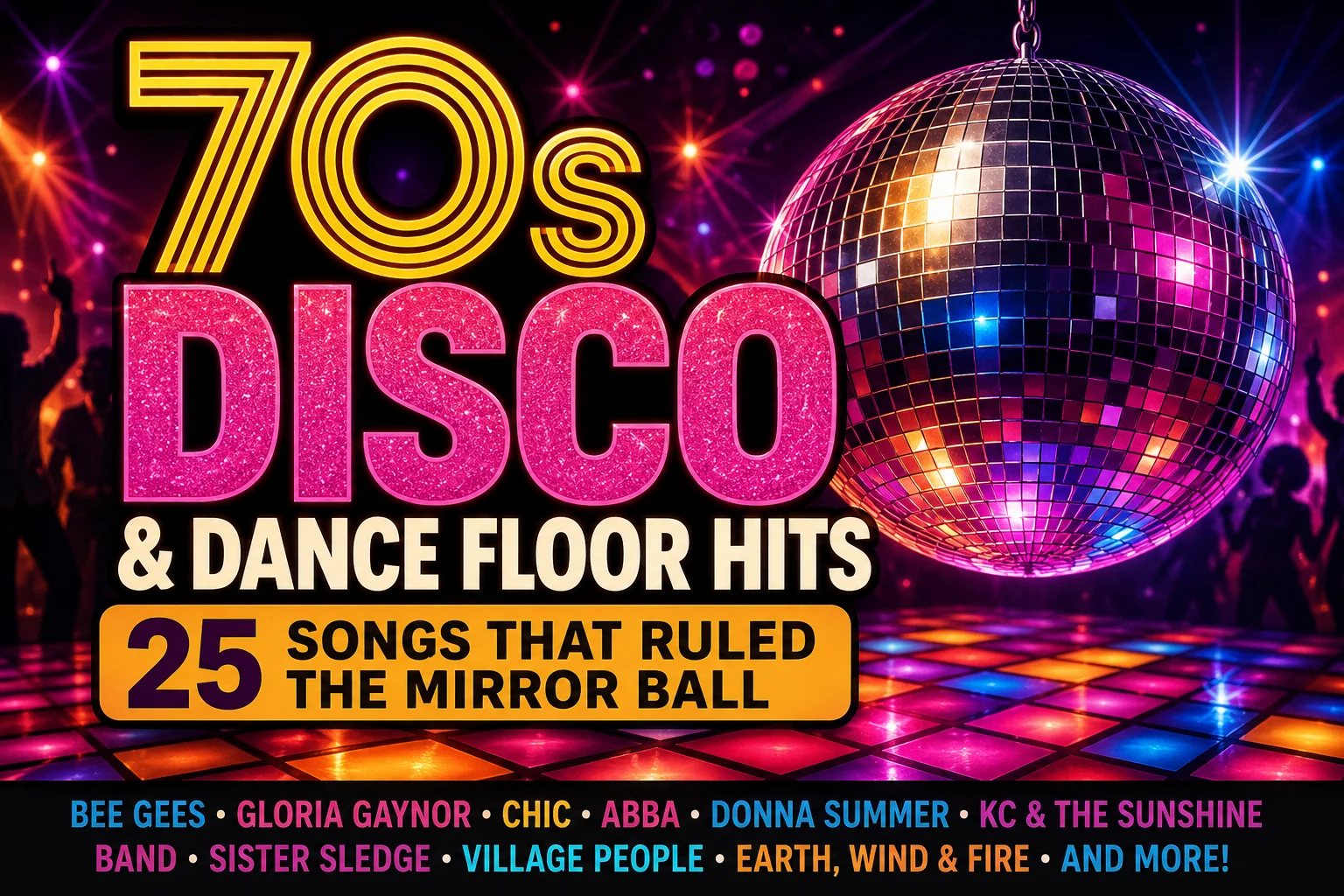
70s Disco & Dance Floor Hits: 25 Songs That Ruled the Mirror Ball
70s disco and dance floor hits were not background music. They were the sound of the decade putting on something shiny, turning up the lights, and deciding that subtlety could wait outside with the sensible shoes.
This is the lane where club culture, pop radio, funk grooves, soul voices, movie soundtracks, roller rinks, wedding receptions, and mirror balls all crashed into one sweaty, glorious pile of polyester. Some songs are pure disco. Some are funk-disco. Some are soul-dance classics. Some are pop records that became permanent dance floor furniture.
The ranking below is an editorial Smells Like Gen X countdown based on cultural memory, dance-floor power, radio afterlife, Gen X nostalgia, and how quickly a song can make at least one uncle point at the ceiling like he just invented rhythm.
What Are the Biggest 70s Disco and Dance Floor Hits?
The biggest 70s disco and dance floor hits include “Stayin’ Alive” by Bee Gees, “I Will Survive” by Gloria Gaynor, “Le Freak” by Chic, “Dancing Queen” by ABBA, “Disco Inferno” by The Trammps, “Night Fever” by Bee Gees, “I Feel Love” by Donna Summer, “Good Times” by Chic, and “That’s the Way (I Like It)” by KC and the Sunshine Band.
How We Picked These 70s Disco Songs
This is an editorial nostalgia ranking, not a strict Billboard chart list. The goal is to capture the songs that define the 70s dance floor in the broadest cultural sense: disco, funk-disco, soul-disco, dance-pop, roller-rink staples, soundtrack anthems, and club records that crossed over into everyday radio life.
Some songs on this list are pure disco. Others lean funk, soul, pop, or R&B. That is intentional. The 70s dance floor was not a sealed laboratory. It was a sweaty, crowded, blinking-light ecosystem where genres borrowed each other’s clothes and somehow made it work.
Translation: if it made people move, survived decades of wedding DJs, roller rinks, movie soundtracks, family parties, and questionable living-room dancing, it belongs in the conversation.
70s Disco & Dance Floor Hits at a Glance
Here is the countdown in quick-scan form before the full mirror-ball rewind.
| Rank |
Song |
Artist |
Year |
Dance Floor Lane |
| #1 | “Stayin’ Alive” | Bee Gees | 1977 | Disco soundtrack immortality |
| #2 | “I Will Survive” | Gloria Gaynor | 1978 | Survival anthem |
| #3 | “Le Freak” | Chic | 1978 | Luxury disco groove |
| #4 | “Dancing Queen” | ABBA | 1976 | Pop-disco perfection |
| #5 | “Disco Inferno” | The Trammps | 1976 | Burn-the-floor anthem |
| #6 | “Night Fever” | Bee Gees | 1977 | Soundtrack disco fever |
| #7 | “I Feel Love” | Donna Summer | 1977 | Electronic disco future |
| #8 | “Good Times” | Chic | 1979 | Bassline blueprint |
| #9 | “That’s the Way (I Like It)” | KC and the Sunshine Band | 1975 | Miami dance-floor command |
| #10 | “Last Dance” | Donna Summer | 1978 | Slow-build disco finale |
| #11 | “We Are Family” | Sister Sledge | 1979 | Family-party anthem |
| #12 | “Y.M.C.A.” | Village People | 1978 | Participation disco |
| #13 | “September” | Earth, Wind & Fire | 1978 | Joy-powered funk-disco |
| #14 | “Don’t Stop ’Til You Get Enough” | Michael Jackson | 1979 | Solo-star dance explosion |
| #15 | “Boogie Oogie Oogie” | A Taste of Honey | 1978 | Bass-led disco groove |
| #16 | “Hot Stuff” | Donna Summer | 1979 | Rock-disco heat |
| #17 | “You Should Be Dancing” | Bee Gees | 1976 | Pre-fever dance command |
| #18 | “Car Wash” | Rose Royce | 1976 | Soundtrack funk-disco |
| #19 | “The Hustle” | Van McCoy | 1975 | Dance-craze instrumental |
| #20 | “Shake Your Groove Thing” | Peaches & Herb | 1978 | Disco-pop joy |
| #21 | “Got to Be Real” | Cheryl Lynn | 1978 | Vocal-power dance classic |
| #22 | “Turn the Beat Around” | Vicki Sue Robinson | 1976 | Percussion-driven disco |
| #23 | “Ain’t No Stoppin’ Us Now” | McFadden & Whitehead | 1979 | Philly soul-disco uplift |
| #24 | “I Love the Nightlife” | Alicia Bridges | 1978 | Night-out disco strut |
| #25 | “More, More, More” | Andrea True Connection | 1976 | Disco pulse |
Countdown: 25 70s Disco & Dance Floor Classics
Now for the full rewind. These are the songs that made the decade move: the club records, soundtrack monsters, roller-rink staples, wedding-reception survivors, and pop-radio dance floor commands that turned the 70s into one long glitter emergency.
#25 — “More, More, More” — Andrea True Connection
Why it hit
“More, More, More” is disco reduced to its most efficient parts: a pulse, a simple hook, a glossy vocal, and a title that sounds less like a lyric and more like a dance-floor demand. It does not overthink anything, which is exactly why it works.
Andrea True Connection gave the song a slick mid-70s feel — playful, repetitive, and built for a room where the beat mattered more than anyone’s deep inner life. Sometimes disco did not need to explain itself. It just needed to make the floor move.
70s lifestyle snapshot
This is the song for the side of the decade that loved shiny fabric, smoky clubs, mirrored walls, and a night out that felt like a tiny escape from regular life. It belongs to the era of dance floors as social currency — where the right groove could make an ordinary Saturday feel like a scene from a movie your parents hoped you were too young to understand.
Why Gen X remembers it
This is one of those songs that kept resurfacing everywhere: oldies radio, commercials, party playlists, movie scenes, and the weird zone where a song becomes more famous than most people realize.
Why it sticks
It proves repetition is not a flaw when the groove knows where it is going.
#24 — “I Love the Nightlife” — Alicia Bridges
Why it hit
“I Love the Nightlife” is disco with a smirk, a strut, and absolutely no interest in staying home. Alicia Bridges sounds like she is not asking for permission to go out. She is announcing a personal constitution.
The song works because it captures the fantasy of nightlife as reinvention. The day can be boring, awkward, broke, or emotionally suspicious. But at night, under lights, with the right song, everybody gets to pretend they are the main character.
70s lifestyle snapshot
This is late-70s going-out culture in one song: perfume, cologne, feathered hair, cab rides, low-lit bars, dance clubs, and people acting like the night had magical powers. It captures that pre-smartphone world where nightlife was mystery, confidence, bad decisions, and maybe a little too much polyester moving under colored lights.
Why Gen X remembers it
It is pure late-70s adult-world mystery: grown-ups going somewhere after dark, wearing too much cologne, and acting like the night might fix their entire personality.
Why it sticks
It is the sound of putting on something shiny and pretending tomorrow morning does not exist.
#23 — “Ain’t No Stoppin’ Us Now” — McFadden & Whitehead
Why it hit
“Ain’t No Stoppin’ Us Now” brought Philly soul polish to the disco era and turned the dance floor into a motivational speech with a groove. It is smooth, confident, and impossible to hear without feeling like somebody just opened the curtains on your life.
The song’s power comes from its momentum. It does not just ask people to dance. It tells them they are moving forward. That gave it a life beyond clubs: reunions, celebrations, cookouts, graduations, and every moment that needed joy with a bassline.
70s lifestyle snapshot
This is the celebratory side of disco — block parties, family reunions, community halls, backyard speakers, and adults turning the dance floor into a victory lap. It feels less like nightlife fantasy and more like collective lift: everybody dressed up, everybody moving, everybody deciding the week was over and the floor belonged to them.
Why Gen X remembers it
It is one of those songs that adults used like a celebration button. The second it came on, someone was guaranteed to say, “That’s my jam,” and then prove it with limited coordination.
Why it sticks
It made optimism danceable without sounding fake.
#22 — “Turn the Beat Around” — Vicki Sue Robinson
Why it hit
“Turn the Beat Around” is a percussion workout disguised as a pop hit. It has movement everywhere: drums, handclaps, rhythm accents, vocal energy, and a chorus that sounds like it is physically spinning the room.
Vicki Sue Robinson’s vocal gives the song its bright, commanding energy. She does not just ride the rhythm — she pushes it. That made the record a natural fit for clubs and radio at a time when disco was getting bigger, faster, and more rhythm-obsessed.
70s lifestyle snapshot
This song fits the roller-rink side of the decade perfectly: flashing lights, rented skates, wood floors, snack-bar soda, and kids trying to look cool while absolutely not knowing how to stop. It is rhythmic, bright, and almost athletic — the sound of disco becoming motion for people who were not necessarily trained for it.
Why Gen X remembers it
Even if you did not know the title, you knew the feeling: adults clapping on the wrong beat while the song itself desperately tried to help them.
Why it sticks
It is a disco cardio routine with better vocals.
#21 — “Got to Be Real” — Cheryl Lynn
Why it hit
“Got to Be Real” is disco with lungs. Cheryl Lynn’s vocal is the whole event: bright, huge, joyful, and strong enough to make the track feel like it has a spotlight built into it.
The groove is clean and celebratory, but the vocal makes it soar. That combination gave the song a long afterlife in parties, dance floors, weddings, and basically anywhere someone needed a guaranteed mood upgrade.
70s lifestyle snapshot
This is the song for the moment when the dance floor gets confident. Not mysterious. Not moody. Confident. It sounds like big hair, bright dresses, sharp suits, and someone stepping into the room knowing they are about to make an entrance. It belongs to a decade where a party song could also feel like personal branding.
Why Gen X remembers it
It has the kind of chorus that makes people think they can sing higher than they can. Many have tried. The ceiling remains undefeated.
Why it sticks
It is joy with a vocal cord flex.
#20 — “Shake Your Groove Thing” — Peaches & Herb
Why it hit
“Shake Your Groove Thing” is disco-pop with a smile plastered across its face. It is not trying to be mysterious, dramatic, or cool in a dark corner. It is trying to get everybody onto the floor immediately.
Peaches & Herb give the song an easy, celebratory feel that helped it jump from radio to parties to variety-show America. It is disco as invitation, not intimidation.
70s lifestyle snapshot
This is family-room disco. Coffee tables pushed aside, shag carpet underfoot, somebody’s aunt trying to start a line dance, and kids watching adults behave like the living room had suddenly become Studio 54. It is bright, harmlessly suggestive, and built for people who wanted disco without needing a velvet rope.
Why Gen X remembers it
This is family-party disco: the kind of song that made adults who normally complained about noise suddenly believe they were dance professionals.
Why it sticks
It is impossible to hear the title and not understand the full assignment.
#19 — “The Hustle” — Van McCoy
Why it hit
“The Hustle” is one of the great moments where a dance craze became a national sound. It is smooth, instrumental, instantly recognizable, and so tied to the decade that it practically comes with choreography instructions.
Van McCoy turned a club movement into a pop record without making it feel stiff. The song is polished enough for radio, rhythmic enough for dancing, and simple enough for America to pretend it had coordination.
70s lifestyle snapshot
Dance-craze culture was a real part of the decade’s social life: lessons, parties, weddings, discos, school gyms, and people asking, “Do you know the steps?” before proving they barely did. “The Hustle” is the sound of dance becoming a shared activity, not just something cool people did in dark clubs.
Why Gen X remembers it
This is the song that made it seem like every adult in the 70s had a secret dance step they were waiting to unleash at weddings, rec rooms, and office parties.
Why it sticks
It turned a dance-floor move into a decade-wide command.
#18 — “Car Wash” — Rose Royce
Why it hit
“Car Wash” is one of those soundtrack songs that became bigger than the thing it came from. Rose Royce turned a workplace setting into a funk-disco celebration, complete with a groove that feels like it was built to roll across asphalt.
The song has bounce, humor, rhythm, and a chorus that makes the whole thing feel communal. It is not glamorous disco. It is working-class dance-floor energy with a smile.
70s lifestyle snapshot
The 70s were full of songs that made ordinary life feel cinematic, and “Car Wash” is a perfect example. It turns a regular job into a party, the kind of blue-collar funk fantasy that could play from a drive-in speaker, a dashboard radio, or a neighborhood block party and make everything feel a little more alive.
Why Gen X remembers it
It is one of those songs that made ordinary places sound like party locations. Suddenly even a car wash had a better soundtrack than your living room.
Why it sticks
It gave soap, hoses, and minimum wage a bassline.
#17 — “You Should Be Dancing” — Bee Gees
Why it hit
Before the Bee Gees became inseparable from the full Saturday Night Fever explosion, “You Should Be Dancing” already proved they could dominate the dance floor. The title alone is basically disco peer pressure.
The record has a sharper, funkier edge than some of their later soundtrack classics. The rhythm is urgent, the falsetto is locked in, and the whole thing sounds like the Bee Gees realizing the dance floor was about to be theirs.
70s lifestyle snapshot
This is the disco transition moment: rock-era listeners being dragged toward the dance floor, pop radio getting shinier, and the Bee Gees becoming the unexpected landlords of nightlife. It fits the image of adults learning new dance-floor rules in real time, one falsetto command at a time.
Why Gen X remembers it
It is the sound of the Bee Gees shifting from “hitmakers” to “disco overlords,” which is a very specific promotion and apparently came with tight pants.
Why it sticks
The song does not suggest dancing. It files a formal complaint if you are not.
#16 — “Hot Stuff” — Donna Summer
Why it hit
“Hot Stuff” gave Donna Summer a tougher edge by blending disco momentum with rock guitar heat. It still moved like disco, but it had enough bite to stand out in a crowded late-70s dance landscape.
Summer’s vocal sells the song with confidence and control. She sounds glamorous, impatient, and completely uninterested in subtlety. That was the right temperature for 1979.
70s lifestyle snapshot
By 1979, disco was not just glitter and strings. It was getting harder, louder, and more aggressive as rock guitars, club beats, and pop-star attitude collided. “Hot Stuff” belongs to the dance-floor moment where the mirror ball met leather, and nobody asked which genre was in charge.
Why Gen X remembers it
This is disco with a leather jacket thrown over the sequins — the kind of song that made the adults in the room act cooler than they were.
Why it sticks
It proved disco could pick up a guitar and still own the floor.
#15 — “Boogie Oogie Oogie” — A Taste of Honey
Why it hit
“Boogie Oogie Oogie” is built on one of those bass grooves that walks in before the rest of the song and immediately starts rearranging furniture. A Taste of Honey gave disco a funkier, heavier pulse without losing the party feel.
The hook is simple, but the rhythm section does the real talking. It is dance music that does not need to beg for movement. The groove handles that.
70s lifestyle snapshot
This is roller-rink, basement-party, and rec-center disco with a bassline strong enough to survive terrible speakers. It belongs to the era when dancing was not always glamorous — sometimes it was kids in tube socks, adults with questionable sideburns, and one person taking the groove way too seriously.
Why Gen X remembers it
Even if the title sounds like something a toddler invented after too much sugar, the track itself is serious dance-floor business.
Why it sticks
The bassline does not ask you to dance. It quietly removes your options.
#14 — “Don’t Stop ’Til You Get Enough” — Michael Jackson
Why it hit
“Don’t Stop ’Til You Get Enough” is the sound of Michael Jackson stepping into a new era. It is disco, funk, pop, and star power fused into a track that feels weightless and unstoppable at the same time.
The arrangement is tight, the rhythm sparkles, and Jackson’s vocal rides the track with nervous electricity. It is a late-70s dance record that already points toward the pop dominance of the 80s.
70s lifestyle snapshot
This song feels like the decade turning the lights toward the future. It still belongs to the disco floor, but it also hints at the solo pop superstar era, music videos, bigger choreography, and dance music that would soon become visual culture. It is 1979 with one foot already stepping into the 80s.
Why Gen X remembers it
For Gen X, this is part of the pre-MTV ignition sequence. The 80s superstar is already there, but the disco floor is still glowing underneath him.
Why it sticks
It sounds like the 70s handing Michael Jackson the keys to the next decade.
#13 — “September” — Earth, Wind & Fire
Why it hit
“September” is joy with horns, harmonies, and a rhythm section that refuses to acknowledge bad moods. Earth, Wind & Fire made a dance classic that feels celebratory without becoming cheesy.
The song’s genius is its emotional brightness. It sounds like a party, but not a forced one. It is polished, muscular, warm, and absolutely built for group movement.
70s lifestyle snapshot
This is the sound of everybody being invited: weddings, cookouts, school dances, family reunions, block parties, and any room that needed instant joy. It does not feel like exclusive club culture. It feels communal, like the whole neighborhood just found the same beat.
Why Gen X remembers it
This is one of those songs that outlived its own decade and became a permanent celebration tool. Weddings, school events, cookouts, commercials — “September” never stopped working.
Why it sticks
It is what happiness would sound like if happiness had a horn section.
#12 — “Y.M.C.A.” — Village People
Why it hit
“Y.M.C.A.” is not just a song. It is a group activity that somehow became a global reflex. Village People turned disco into participatory theater, complete with a chorus and arm movements nobody can resist for long.
The track is campy, catchy, communal, and completely shameless in the best way. It took the club’s sense of performance and pushed it into mainstream pop culture so hard that people are still spelling with their bodies decades later.
70s lifestyle snapshot
This is disco leaving the club and taking over public life. Ballparks, weddings, cruise ships, school gyms, office parties — anywhere a crowd gathered, the song eventually showed up and forced people into alphabet choreography. It is nightlife camp turned family-friendly ritual, which is both impressive and mildly alarming.
Why Gen X remembers it
Every Gen X kid eventually saw adults do the letters. At weddings. At school dances. At baseball games. At places where dignity had clearly left the building.
Why it sticks
It weaponized spelling against the dance floor.
#11 — “We Are Family” — Sister Sledge
Why it hit
“We Are Family” is disco as togetherness. Sister Sledge, powered by Chic’s production magic, turned family pride into a dance-floor anthem that felt universal without losing its warmth.
The groove is elegant, the chorus is instant, and the message is broad enough to belong to actual families, chosen families, teams, parties, reunions, and anyone else who needed a song to make the room feel connected.
70s lifestyle snapshot
This is the record that turns any gathering into a group photo with rhythm. It belongs to reunions, weddings, graduation parties, church halls, VFW rooms, and backyards where folding chairs lined the wall and someone’s aunt was absolutely going to lead the dance floor.
Why Gen X remembers it
This is one of those songs that showed up whenever adults wanted everyone to dance together. Which meant children were not safe either.
Why it sticks
It made unity sound stylish instead of corny.
#10 — “Last Dance” — Donna Summer
Why it hit
“Last Dance” understood drama. It starts like a slow song, opens the emotional door, then explodes into disco release. That structure made it feel like a whole night out compressed into one record.
Donna Summer’s vocal gives the song both vulnerability and power. She could make disco feel glamorous, sensual, lonely, triumphant, and cinematic all at once. “Last Dance” is one of her great showcases.
70s lifestyle snapshot
Every dance night needed a closing ritual, and this song sounds like the lights coming up, the floor clearing, and somebody making one last dramatic attempt at romance before the ride home. It belongs to discos, proms, wedding receptions, and every event where the final song felt weirdly important.
Why Gen X remembers it
This was the ultimate end-of-the-night song: the grown-ups were sweaty, the lights were coming up, and somewhere a kid was asleep on a folding chair.
Why it sticks
It turned the final dance into a full emotional event.
#9 — “That’s the Way (I Like It)” — KC and the Sunshine Band
Why it hit
“That’s the Way (I Like It)” is a dance-floor instruction manual with a bassline. KC and the Sunshine Band specialized in songs that understood movement first and philosophy never.
The groove is simple, repetitive, and wildly effective. It has handclaps, brass, rhythm, call-and-response energy, and a chorus that sounds like everybody already agreed with it before the song started.
70s lifestyle snapshot
This is the hot-weather side of disco: Miami grooves, open shirts, sweaty dance floors, brass hits, and songs that sounded like they were made for people who considered sitting down a personal failure. It captures the 70s obsession with rhythm as lifestyle — direct, physical, and not especially interested in nuance.
Why Gen X remembers it
This is peak family-party disco: every generation could understand it, which meant every generation could embarrass themselves to it.
Why it sticks
It is not deep. It is better than deep. It is useful.
#8 — “Good Times” — Chic
Why it hit
“Good Times” is Chic at their most deceptively simple. The groove sounds effortless, but everything is locked in: bass, guitar, strings, drums, vocals, space. It is dance music engineered with frightening taste.
The song also became massively influential beyond disco. That bassline helped point toward hip-hop’s early mainstream breakthroughs, proving that a great groove does not stay in one genre for long.
70s lifestyle snapshot
“Good Times” captures the late-70s desire to party through uncertainty. The title sounds carefree, but the groove feels sophisticated, almost urban and knowing. It belongs to stylish clubs, crowded apartments, radio speakers, and a culture trying to dance even when the world outside the floor felt shaky.
Why Gen X remembers it
Even if you did not know “Good Times” first, you heard its DNA everywhere. That is how powerful it was. The song did not just rule the floor; it left fingerprints on the next decade.
Why it sticks
It is a bassline with a passport to the future.
#7 — “I Feel Love” — Donna Summer
Why it hit
“I Feel Love” sounds like 1977 accidentally opening a portal. Donna Summer and Giorgio Moroder created a record that did not just fit the disco era — it pointed toward electronic dance music, synth-pop, and club music that had not fully arrived yet.
The track is hypnotic, mechanical, sensual, and futuristic. Summer’s voice floats over the machine pulse like the human part of a neon circuit. It is one of the most forward-looking records of the decade.
70s lifestyle snapshot
This is disco leaving the shag-carpet living room and walking into the future. It fits the late-night club world better than the family party: dark rooms, pulsing lights, electronic repetition, and people realizing music could feel less like a band in the room and more like a machine designed to keep bodies moving.
Why Gen X remembers it
This is the disco song that sounds least trapped in the 70s. It feels like the decade suddenly saw the 80s, the club scene, and half of electronic music waiting in the distance.
Why it sticks
It is less a song than a transmission from the dance floor’s future.
#6 — “Night Fever” — Bee Gees
Why it hit
“Night Fever” is the Bee Gees turning nightlife into a floating, falsetto-powered fantasy. It has the glide, the pulse, the harmonies, and the unmistakable feeling that the whole city is suddenly lit by a mirror ball.
The song’s connection to the disco movie era gave it extra cultural weight, but it works even without the visuals. It sounds like movement, confidence, and late-night possibility.
70s lifestyle snapshot
This is the cinematic disco lifestyle: sidewalks as runways, clubs as destinations, and Saturday night as a weekly identity crisis with better lighting. It captures the idea that nightlife was not just something you did — it was a version of yourself you stepped into when the week finally let go.
Why Gen X remembers it
For many Gen X kids, this is the sound of adults trying to explain disco by mostly pointing at John Travolta and hoping that covered it.
Why it sticks
It made disco sound like an entire city catching a fever at once.
#5 — “Disco Inferno” — The Trammps
Why it hit
“Disco Inferno” is not a subtle record. It is a dance-floor fire alarm where nobody evacuates because the groove is too good. The Trammps gave disco one of its biggest, loudest, most theatrical anthems.
The song builds and burns with huge vocal energy, strings, rhythm, and a chorus that feels built for a room full of people yelling with complete commitment.
70s lifestyle snapshot
This is disco as spectacle: flashing lights, packed floors, dramatic vocals, and a room that feels like it might actually overheat. It belongs to the side of the decade where dancing was not background entertainment — it was the main event, the release valve, the whole reason people dressed like the future had been dipped in glitter.
Why Gen X remembers it
This is the kind of song that made disco feel enormous even to kids who only knew it from TV, radio, movies, and adults acting like polyester was breathable.
Why it sticks
It turned the dance floor into a controlled blaze with a horn section.
#4 — “Dancing Queen” — ABBA
Why it hit
“Dancing Queen” is disco filtered through perfect pop craftsmanship. ABBA made a song that feels like youth, glitter, longing, and a dance floor that exists mostly in memory.
The arrangement is immaculate: piano sparkle, layered vocals, emotional lift, and a chorus that feels instantly familiar even the first time you hear it. It is not the grittiest disco song, but it may be the most universally loved.
70s lifestyle snapshot
This is the fantasy version of the dance floor: young, glowing, dramatic, and just innocent enough to play at a school dance while still making everyone feel older than they were. It belongs to teen bedrooms, TV variety shows, skating rinks, and every place where pop made ordinary people feel briefly glamorous.
Why Gen X remembers it
It became one of those songs that crossed generations. Parents knew it, kids absorbed it, later movies revived it, and somehow it never stopped sounding like a party starting in slow motion.
Why it sticks
It is pure pop-disco sunlight in platform shoes.
#3 — “Le Freak” — Chic
Why it hit
“Le Freak” is disco with taste, attitude, and a groove so clean it should have been expensive to touch. Chic made dance music that sounded luxurious without becoming stiff.
Nile Rodgers and Bernard Edwards understood that space matters. The guitar, bass, strings, and vocals all leave room for each other, which makes the groove feel bigger than if everybody were fighting for attention.
70s lifestyle snapshot
“Le Freak” is the velvet-rope side of disco: stylish, exclusive, a little intimidating, and absolutely aware of how good it looks. It fits the image of the late-70s club as a social stage, where clothes, attitude, movement, and access all mattered almost as much as the music.
Why Gen X remembers it
This is the classy side of disco — the sound of people who knew the club had a door policy and were absolutely judging your shoes.
Why it sticks
It made “freak out” sound like a luxury brand.
#2 — “I Will Survive” — Gloria Gaynor
Why it hit
“I Will Survive” is one of the strongest survival anthems ever put on a dance beat. Gloria Gaynor does not just sing about getting over someone. She stages an emotional eviction.
The song’s brilliance is the way it turns heartbreak into power. It starts from injury, then builds into confidence, defiance, and freedom. Disco often sold escape, but this one sold recovery.
70s lifestyle snapshot
This is disco as personal comeback. It belongs to crowded clubs, breakups, bad dates, apartment stereos, and anyone who needed the dance floor to double as therapy. In a decade full of escapism, “I Will Survive” made the escape feel earned — like you could walk out stronger than you walked in.
Why Gen X remembers it
This is the song that made every breakup, bad day, comeback, and dramatic exit feel like it deserved a spotlight. Adults sang it like therapy. Kids just knew something serious was happening.
Why it sticks
It made resilience danceable, which is why it never really left.
#1 — “Stayin’ Alive” — Bee Gees
Why it is #1
“Stayin’ Alive” is the ultimate 70s disco and dance floor hit because it is more than a song. It is a strut, a silhouette, a soundtrack moment, a radio monster, and one of the most recognizable grooves ever attached to the decade.
The Bee Gees built the song around tension and swagger. The rhythm walks like it owns the sidewalk. The falsetto cuts through everything. The groove is tight, stylish, and instantly tied to the disco explosion that defined the late 70s in pop culture.
It also has more grit than people sometimes remember. Under the shine is a song about survival, pressure, and keeping your head up in a city that does not care. That tension is why it still hits harder than a simple dance track.
70s lifestyle snapshot
This is the whole late-70s disco image compressed into one beat: city sidewalks, white suits, big collars, smoky clubs, neon signs, and the idea that walking down the street could be a performance if the soundtrack was strong enough. It gave the decade a pose, a pace, and a cultural uniform.
Why Gen X remembers it
You did not need to see the movie to understand the cultural image. The second that beat started, everybody saw the walk, the suit, the attitude, and the disco era pretending it would never end.
Why it sticks
It is the official sound of the 70s putting on a white suit and daring history to look away.
Listen to the 70s Disco & Dance Floor Hits Playlist
Want the full mirror-ball treatment without waiting for someone’s uncle to find the right cassette? Hit play on the companion Spotify playlist and let the 70s dance floor do what it does best: falsettos, basslines, strings, handclaps, survival anthems, roller-rink grooves, and enough glitter energy to violate several fire codes.
This is the soundtrack version of the page — Bee Gees, Gloria Gaynor, Chic, ABBA, Donna Summer, The Trammps, KC and the Sunshine Band, Sister Sledge, Village People, and the rest of the disco pileup.
Disco vs. Funk vs. Dance-Pop
Disco was never just one sound. It pulled from soul, funk, pop, R&B, Latin rhythms, orchestral arrangements, club DJ culture, and eventually electronic production. That is why the best 70s dance-floor songs do not all sound alike.
Funk brought the heavier groove. Soul brought the vocal power. Pop brought the hooks. Disco brought the extended pulse and the club atmosphere. Dance-pop brought the whole thing into living rooms, roller rinks, TV specials, and radio playlists where even people who claimed they hated disco still somehow knew every chorus.
Keep Rewinding 70s Music
The disco side of the 70s is only one lane. The decade also gave us soft rock, AM Gold, classic rock, soul, funk, singer-songwriters, one-hit wonders, movie soundtracks, and songs that made every family party a potential crime scene for dancing.
70s Music
The main 70s music hub for year-end countdowns, playlists, disco, soft rock, one-hit wonders, and Gen X rewind energy.
70s Soft Rock & AM Radio Gold
The mellow dashboard-radio songs that filled station wagons, kitchens, and wood-paneled living rooms.
70s One-Hit Wonders
Massive songs, short shelf lives, and choruses that still ambush your brain.
Top 10 Songs of 1975
The year disco, soft rock, pop, and AM radio all battled for the dial.
Top 10 Songs of 1977
A key year for disco’s explosion, pop radio, and late-70s soundtrack energy.
Top 10 Songs of 1978
Late-70s radio as disco, soft rock, funk, and pop all crowded the floor.
Top 10 Songs of 1979
The end-of-decade handoff as disco, rock, pop, and new wave fought for control.
80s Music
The next decade: MTV, synth-pop, power ballads, new wave, hair metal, and bigger everything.
You May Also Remember
the 70s music hub,
70s soft rock and AM radio gold,
70s one-hit wonders,
the songs of 1977,
the songs of 1978,
the songs of 1979,
and the full 70s nostalgia hub.
Basically: mirror balls, falsettos, basslines, roller rinks, dance crazes, movie soundtracks, family-party chaos, and the exact moment the decade decided every room needed a beat.
The Rewind Verdict
The best 70s disco and dance floor hits were not just songs. They were cultural reflexes. They told people when to clap, when to strut, when to survive, when to freak out, when to spell letters with their arms, and when to pretend they had rhythm in front of relatives.
“Stayin’ Alive” gave the decade its walk. “I Will Survive” gave it resilience. “Le Freak” gave it style. “Dancing Queen” gave it glow. “Disco Inferno” gave it fire. And somewhere under every mirror ball, the 70s left behind a beat strong enough to keep embarrassing dance floors for generations.
FAQ: 70s Disco & Dance Floor Hits
What are the biggest 70s disco songs?
The biggest 70s disco songs include “Stayin’ Alive,” “I Will Survive,” “Le Freak,” “Dancing Queen,” “Disco Inferno,” “Night Fever,” “I Feel Love,” “Good Times,” and “Last Dance.”
What was the most iconic disco song of the 70s?
For this Smells Like Gen X ranking, “Stayin’ Alive” by Bee Gees takes the top spot because of its unmistakable groove, soundtrack legacy, pop-culture image, and permanent connection to the disco era.
Is disco the same as funk?
No. Disco and funk overlap, but they are not the same. Funk usually emphasizes deeper grooves, syncopation, and instrumental feel, while disco often adds a steady dance pulse, strings, club production, and a more continuous floor-focused rhythm.
Why was disco so popular in the 70s?
Disco became popular because it combined club culture, danceable rhythms, glamorous nightlife, radio-friendly hooks, movie soundtracks, and a sense of escape. It turned music into a full-body experience at a time when people wanted release, style, and movement.
What are good 70s dance floor songs for a playlist?
Good 70s dance floor songs include “Stayin’ Alive,” “Le Freak,” “Dancing Queen,” “September,” “That’s the Way (I Like It),” “Y.M.C.A.,” “We Are Family,” “Boogie Oogie Oogie,” and “Shake Your Groove Thing.”
Was Donna Summer the Queen of Disco?
Donna Summer is widely remembered as the Queen of Disco because her voice and records helped define the genre’s mainstream sound, from sensual club tracks to dramatic dance-floor anthems like “I Feel Love,” “Last Dance,” and “Hot Stuff.”