Smells Like Gen X • 70s Music
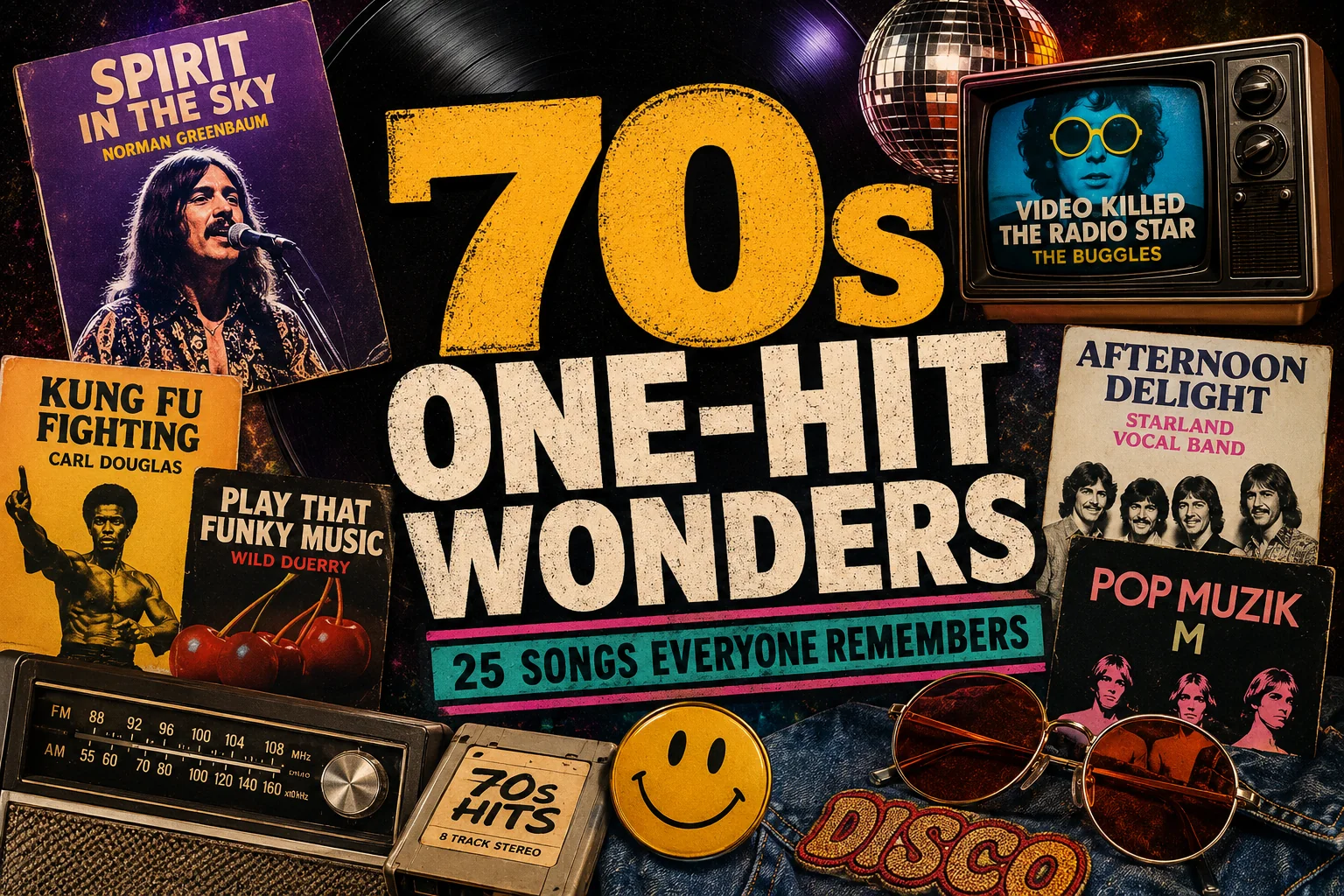
70s One-Hit Wonders: 25 Songs Everyone Remembers
The 70s one-hit wonders are proof that sometimes one perfect song is all it takes to become permanent. Some of these artists vanished from U.S. pop radio almost as quickly as they arrived. Some had deeper careers, cult followings, overseas success, or another minor chart moment. But for most listeners, one song became the name tag, the calling card, the instant memory trigger.
This list focuses on the songs that still feel welded to the decade: AM radio staples, disco explosions, soft-rock confessionals, novelty chaos, funk-rock lightning strikes, soundtrack-adjacent weirdness, soul comfort, and late-70s new wave signals from the world that was coming next.
In other words, this is not a courtroom. It is a jukebox. The ranking below is an editorial Smells Like Gen X countdown based on memory power, cultural stickiness, radio afterlife, and how fast the song sends your brain back to shag carpet, wood-paneled speakers, dashboard radios, record-store bins, and somebody’s older sibling acting like they had discovered music first.
What Are the Biggest 70s One-Hit Wonders?
The biggest 70s one-hit wonders include “Spirit in the Sky” by Norman Greenbaum, “Play That Funky Music” by Wild Cherry, “Kung Fu Fighting” by Carl Douglas, “Afternoon Delight” by Starland Vocal Band, “Video Killed the Radio Star” by The Buggles, “Pop Muzik” by M, “Hooked on a Feeling” by Blue Swede, and “Dancing in the Moonlight” by King Harvest.
How We Picked These 70s One-Hit Wonders
One-hit wonder arguments can turn into full-contact trivia night fast, so here is the working rule: this list focuses on artists who are primarily remembered in the U.S. for one major 1970s pop hit, especially songs that remained culturally sticky long after their original chart run.
Some entries are clean one-hit-wonder cases. Others are cultural one-hit wonders: artists with deeper careers, international success, cult followings, or another smaller chart moment, but one song that completely swallowed the rest of their mainstream memory.
Translation: if the song starts and everyone immediately knows it, but most people cannot name another hit by the artist without staring into the middle distance like they are trying to remember their locker combination, it belongs in the conversation.
70s One-Hit Wonders at a Glance
Here is the countdown in quick-scan form before the full rewind.
| Rank |
Song |
Artist |
Year |
70s Lane |
| #1 | “Spirit in the Sky” | Norman Greenbaum | 1970 | Fuzz-guitar gospel rock |
| #2 | “Video Killed the Radio Star” | The Buggles | 1979 | New wave prophecy |
| #3 | “Play That Funky Music” | Wild Cherry | 1976 | Funk-rock party command |
| #4 | “Kung Fu Fighting” | Carl Douglas | 1974 | Novelty disco lightning |
| #5 | “Pop Muzik” | M | 1979 | Synth-pop future shock |
| #6 | “Afternoon Delight” | Starland Vocal Band | 1976 | Soft-pop innuendo |
| #7 | “Hot Child in the City” | Nick Gilder | 1978 | Glam-pop radio heat |
| #8 | “In the Summertime” | Mungo Jerry | 1970 | Sunburned jug-band pop |
| #9 | “Hooked on a Feeling” | Blue Swede | 1974 | Ooga-chaka pop oddity |
| #10 | “O-o-h Child” | Five Stairsteps | 1970 | Soul comfort anthem |
| #11 | “Dancing in the Moonlight” | King Harvest | 1973 | Feel-good soft rock |
| #12 | “Seasons in the Sun” | Terry Jacks | 1974 | Melancholy pop singalong |
| #13 | “The Hustle” | Van McCoy | 1975 | Disco dance-floor signal |
| #14 | “Rock Your Baby” | George McCrae | 1974 | Proto-disco groove |
| #15 | “Ring My Bell” | Anita Ward | 1979 | Disco earworm |
| #16 | “I Love the Nightlife” | Alicia Bridges | 1978 | Disco liberation |
| #17 | “Driver’s Seat” | Sniff ’n’ the Tears | 1979 | Late-70s road-rock cool |
| #18 | “Love Is in the Air” | John Paul Young | 1978 | Romantic disco-pop |
| #19 | “How Long” | Ace | 1975 | Blue-eyed soul-rock |
| #20 | “Magic” | Pilot | 1975 | Glossy pop sparkle |
| #21 | “Midnight at the Oasis” | Maria Muldaur | 1974 | Boho soft-rock lounge |
| #22 | “Convoy” | C.W. McCall | 1976 | CB-radio novelty country |
| #23 | “Beach Baby” | The First Class | 1974 | California nostalgia pop |
| #24 | “Please Come to Boston” | Dave Loggins | 1974 | Soft-rock heartbreak |
| #25 | “More, More, More” | Andrea True Connection | 1976 | Disco pulse |
Countdown: 25 Unforgettable 70s One-Hit Wonders
Now for the full rewind. These are not just records that charted once and vanished. They are the songs that kept showing up on oldies radio, movie soundtracks, commercials, mixtapes, wedding receptions, roller rinks, family cars, and random grocery-store speakers decades after their moment supposedly ended.
#25 — “More, More, More” — Andrea True Connection
Why it hit
“More, More, More” is pure disco economy: a pulse, a title that doubles as a command, and a groove that sounds like it was built for mirror balls, dance floors, and radio programmers who needed something immediately understandable. It does not overcomplicate anything. That is the magic.
Andrea True Connection gave the song a breathy, glossy, slightly decadent feel that fit the mid-70s perfectly. It was catchy enough for pop radio, danceable enough for clubs, and simple enough that nobody needed a second listen to understand the assignment. The song practically walks in, points at the dance floor, and says, “You know what to do.”
What makes it feel so 70s
The record has that specific pre-disco-backlash shine: sleek, repetitive, a little naughty, and completely unashamed of chasing pleasure. It belongs to the part of the decade where the dance floor was becoming a lifestyle, not just a place to stand awkwardly near someone’s cousin at a wedding.
Why it sticks
It turns repetition into a superpower. By the second chorus, subtlety has already packed a suitcase and left town.
#24 — “Please Come to Boston” — Dave Loggins
Why it hit
“Please Come to Boston” is the sensitive-songwriter side of the decade: lonely cities, romantic distance, and a narrator making travel sound like an emotional crisis. It is soft, aching, and very 70s in its belief that a man with an acoustic guitar could make geography feel tragic.
The song works because it feels personal without sounding small. Each city becomes a different version of the same problem: he keeps moving, she keeps staying, and neither person quite becomes the life the other one imagined. That gives the song more emotional weight than a simple “come back to me” ballad.
What makes it feel so 70s
This is prime AM-radio loneliness: gentle arrangement, wounded vocal, tasteful sadness, and a storyline that sounds like it was written on hotel stationery. It captures the decade’s soft-rock obsession with distance, regret, and people making dramatic decisions while wearing denim.
Why it sticks
It is one of those songs that feels small until you realize the chorus has been renting space in your head for decades.
#23 — “Beach Baby” — The First Class
Why it hit
“Beach Baby” sounds like somebody tried to bottle the Beach Boys, summer radio, and a teenage memory that may or may not have happened. It is not subtle about its nostalgia. It practically shows up wearing sunglasses and asking if you remember that one perfect summer.
The First Class built the song around a fantasy version of California that could travel anywhere. You did not need to live near the ocean to feel it. The harmonies, the brass, the sunburned chorus, the whole arrangement is designed to make a listener feel like they missed a perfect summer and somehow remember it anyway.
What makes it feel so 70s
The 70s loved nostalgia almost as much as the 80s would later love neon. “Beach Baby” is not really about the beach as much as it is about memory itself — the decade looking backward while pretending it is just cruising with the windows down.
Why it sticks
It proves fake California memories can still feel emotionally accurate if the harmonies are shiny enough.
#22 — “Convoy” — C.W. McCall
Why it hit
“Convoy” is so specifically 70s it should come with a CB radio, a trucker hat, and a warning that your parents may suddenly start saying “10-4” for no reason. It turned a communications fad into a full-blown pop hit, which is both ridiculous and kind of beautiful.
Part of the appeal was that it sounded like a whole secret world. The CB slang, the outlaw-trucker image, the spoken-word delivery, and the rolling rhythm made it feel like listeners were being patched into an underground highway movie. It was novelty music, but it had world-building.
What makes it feel so 70s
The song captures a very specific moment when trucker culture, CB radios, road movies, and anti-authority fantasy all collided. It is almost impossible to imagine this becoming a hit in any other decade. That is exactly why it belongs here.
Why it sticks
It is not just a song. It is a weird little museum exhibit for the exact moment America got obsessed with CB radio.
#21 — “Midnight at the Oasis” — Maria Muldaur
Why it hit
“Midnight at the Oasis” is the 70s taking a lounge chair, a sly vocal, and a very strange desert fantasy and somehow turning it into mainstream pop. It is smooth, playful, vaguely exotic in the old radio way, and instantly recognizable once that groove settles in.
Maria Muldaur’s vocal is the key. She does not belt the song into submission. She lets it curl around the arrangement, giving the whole thing a sly, knowing quality. It feels relaxed, but not sleepy. Weird, but not alienating. That balance made it perfect for a decade that loved a little eccentricity as long as the melody stayed friendly.
What makes it feel so 70s
It lives in the same universe as wicker chairs, incense, embroidered shirts, and someone’s apartment with too many plants. It is bohemian soft rock with a lounge-pop smirk, and somehow that combination made total sense on 70s radio.
Why it sticks
It sounds like the record collection of someone who owns both incense and a fondue pot.
#20 — “Magic” — Pilot
Why it hit
“Magic” is bright, simple, and so aggressively catchy that it feels engineered in a lab where the only scientific goal was “make people hum this in grocery stores forever.” Pilot found the perfect little pop-rock shimmer and rode it straight into the decade’s permanent memory bank.
The song is built from pure lift. The arrangement sparkles, the hook arrives quickly, and the mood is almost suspiciously optimistic. It has none of the heaviness that shows up elsewhere in the decade. It just floats in, smiles, and refuses to become complicated.
What makes it feel so 70s
Mid-70s radio had endless room for songs like this: polished, sweet, melodic, and catchy enough to work in the car, at home, or through a tiny speaker that made everything sound like it was coming from inside a lunchbox.
Why it sticks
It is practically made of hooks. Not a song so much as a glitter-covered mousetrap.
#19 — “How Long” — Ace
Why it hit
“How Long” is one of those songs that sounds effortless in a way that usually means a lot of people worked very hard to make it feel that casual. The groove is relaxed, the vocal is cool, and the whole thing moves like it knows it does not have to beg for attention.
Ace found the sweet spot between rock, soul, and soft-pop polish. The song has a clean emotional hook, but it never turns dramatic in a theatrical way. It is wounded, but controlled. Betrayed, but not messy. That cool restraint helped make it one of those records that still feels adult without feeling dusty.
What makes it feel so 70s
It belongs to the smoother side of the decade, where musicianship mattered and songs could simmer instead of explode. You can hear the era’s taste for groove, restraint, and studio warmth all over it.
Why it sticks
It is smooth enough to survive decades of radio rotation without sounding desperate.
#18 — “Love Is in the Air” — John Paul Young
Why it hit
“Love Is in the Air” is not trying to be cool. It is trying to be big, romantic, and impossible to misunderstand. That confidence is why it works. It floats somewhere between disco, pop, and wedding-reception destiny, wearing its heart completely outside its shirt.
John Paul Young sells the song with full commitment, and the production gives it enough rhythmic lift to keep the romance from sinking into syrup. It is sentimental, yes, but it has motion. That made it useful everywhere: radio, dances, weddings, variety shows, and any moment where someone needed romance with a disco pulse.
What makes it feel so 70s
It has that late-70s combination of sweep and sparkle. The decade loved love songs, but it also wanted them to move. This one gives you both: a giant romantic idea with enough beat to keep the shoes working.
Why it sticks
It is romantic in a way that could only happen when subtlety was illegal under disco law.
#17 — “Driver’s Seat” — Sniff ’n’ the Tears
Why it hit
“Driver’s Seat” has late-70s cool all over it: sleek guitar, steady momentum, and the feeling of driving at night with no destination except “away.” It does not hit like a novelty. It hits like a mood, which is why it aged better than plenty of bigger songs.
The song has a lean, controlled energy that separates it from the softer pop surrounding it. It is not disco, not arena rock, not punk, not new wave exactly — but it borrows enough attitude from the changing musical climate to feel like it belongs near the decade’s exit door.
What makes it feel so 70s
“Driver’s Seat” catches the transitional part of 1979, when rock was tightening up and pop was getting ready for a more angular, stylish 80s. It sounds like headlights on wet pavement.
Why it sticks
It sounds like the bridge between classic rock radio and the leaner new-wave decade waiting around the corner.
#16 — “I Love the Nightlife” — Alicia Bridges
Why it hit
“I Love the Nightlife” is disco with a wink, a strut, and absolutely no interest in staying home. Alicia Bridges delivers it with enough attitude to make the title feel less like a preference and more like a personal constitution.
The song works because it taps directly into disco’s fantasy of reinvention. Daytime problems do not matter under the lights. The night becomes a place where you can be sharper, cooler, freer, and probably wearing something with far too much shine. The record understood that fantasy and sold it cleanly.
What makes it feel so 70s
It is late-70s nightlife as a pop identity: club doors, smoky rooms, dance-floor confidence, and the sense that the evening might fix your whole personality if the DJ does their job.
Why it sticks
It is the sound of putting on something shiny and pretending tomorrow morning does not exist.
#15 — “Ring My Bell” — Anita Ward
Why it hit
“Ring My Bell” is disco at its most sticky. It has a title that will not leave, a rhythm that keeps bouncing, and a vocal that floats over the track like it already knows it is about to be everywhere.
Anita Ward’s delivery gives the song a lightness that keeps the groove playful instead of heavy. It is clean, repetitive, and built around a hook that behaves like a doorbell you cannot stop pressing. That kind of immediate recognition was gold in the disco era.
What makes it feel so 70s
The production has that late-disco snap: bright, synthetic, smooth, and entirely committed to the dance floor. It sounds like the genre right before the backlash, still having a great time and refusing to read the room.
Why it sticks
Once the hook gets in, it behaves like it signed a long-term lease.
#14 — “Rock Your Baby” — George McCrae
Why it hit
“Rock Your Baby” helped point pop music toward the disco future without sounding like it was waving a flag. The groove is easy, warm, and almost hypnotic. It feels like the decade figuring out that dance music was about to become one of its dominant languages.
George McCrae’s vocal rides the track with an ease that makes the whole record feel almost weightless. The rhythm does not shove. It glides. That made it one of those records that could work on pop radio, soul radio, and dance floors before disco fully became the cultural machine it would soon be.
What makes it feel so 70s
This is the sound of disco’s foundation being poured: sensual groove, warm production, repetitive motion, and a song built less around big drama than around how good it feels to stay inside the rhythm.
Why it sticks
It is not just a hit. It is a preview of the dance-floor decade about to take over.
#13 — “The Hustle” — Van McCoy
Why it hit
“The Hustle” is one of the great moments where a dance craze and a pop instrumental fused into one giant cultural signal. It is light, slick, and instantly identifiable — the kind of record that makes the whole decade look like it had choreography.
Van McCoy turned a dance-floor movement into a clean pop product without killing the groove. The song is easy to recognize, easy to move to, and polished enough to work far beyond clubs. That made it a perfect crossover moment for disco before the genre became completely unavoidable.
What makes it feel so 70s
The 70s loved a dance craze, and this one had class. “The Hustle” feels like the moment disco stops being a scene and starts becoming a national instruction manual.
Why it sticks
It turned a dance-floor move into a piece of pop shorthand.
#12 — “Seasons in the Sun” — Terry Jacks
Why it hit
“Seasons in the Sun” is cheerful-sounding sadness, which is one of the most dangerous combinations in pop music. It has a singalong melody wrapped around a farewell song, and that contrast is why it became both massive and weirdly haunting.
Terry Jacks delivers it with a plainness that makes the song feel almost childlike, which only makes the subject matter stranger. It does not sound like a grand tragedy. It sounds like a schoolyard melody accidentally carrying grown-up grief. That uneasy contrast gave it enormous staying power.
What makes it feel so 70s
70s radio had a surprising tolerance for emotional darkness if the melody was bright enough. This song is a perfect example: sad enough to be dramatic, catchy enough to become unavoidable, and odd enough to remain impossible to fully shake off.
Why it sticks
It sounds like a sunny day where everyone involved is emotionally ruined.
#11 — “Dancing in the Moonlight” — King Harvest
Why it hit
“Dancing in the Moonlight” has one of the most durable good vibes of the decade. It does not try to overpower you. It just glows. The groove is gentle, the melody feels eternal, and the whole thing sounds like the safest possible outdoor party.
King Harvest made a record that feels communal without being loud. It is not a big anthem in the usual sense. It is more like a mood everyone agrees to share for three minutes. That easy warmth helped it survive long past its original radio moment.
What makes it feel so 70s
It has the era’s mellow optimism without tipping into blandness. It sounds like string lights, warm air, and somebody’s backyard stereo doing a lot of emotional heavy lifting.
Why it sticks
It is one of those songs that feels like nostalgia even when you hear it for the first time.
#10 — “O-o-h Child” — Five Stairsteps
Why it hit
“O-o-h Child” is pure reassurance. It is not flashy. It is not trying to win a shouting match. It just shows up with one of the most comforting hooks of the decade and tells you things are going to get easier. Sometimes that is all a song needs to do.
The Five Stairsteps gave the record a family-soul warmth that made it feel sincere without becoming heavy. The arrangement builds gently, and the message is simple enough to work across generations. It is the kind of song people return to when they need comfort that does not sound fake.
What makes it feel so 70s
Early-70s soul had an incredible gift for making hope sound grounded. “O-o-h Child” does not promise a perfect world. It just offers a little light. That was enough.
Why it sticks
It became one of pop’s great emotional first-aid kits.
#9 — “Hooked on a Feeling” — Blue Swede
Why it hit
“Hooked on a Feeling” had already been a song before Blue Swede got to it, but the “ooga-chaka” intro turned this version into its own strange animal. It is goofy, bold, and impossible to separate from the weird little chant that made it immortal.
The brilliance is that the song is both ridiculous and genuinely strong. Under the novelty is a big, satisfying pop chorus. The intro gets people laughing or leaning in, but the melody keeps them there. That combination made it perfect for 70s radio and even better for later pop-culture recycling.
What makes it feel so 70s
Only the 70s could take a strange chant, a dramatic arrangement, a cover version, and a completely sincere chorus and somehow turn it into a #1-sized cultural object. It is odd in the exact way 70s pop often was: confidently, almost heroically odd.
Why it sticks
It proves one ridiculous intro can turn a cover into a permanent pop-culture artifact.
#8 — “In the Summertime” — Mungo Jerry
Why it hit
“In the Summertime” sounds like a backyard barbecue learned how to play jug-band pop. It is loose, sunny, and slightly feral — the kind of song that feels like nobody involved read the rulebook and everybody was better off for it.
Mungo Jerry created a summer record with almost cartoonish confidence. The rhythm lopes, the vocal grins, and the whole thing feels like it might fall apart if it ever stopped having fun. That looseness became the charm. It did not sound polished. It sounded alive.
What makes it feel so 70s
It captures the early part of the decade before everything got slicker. This is not disco glamour or soft-rock polish. It is sun, dirt, rhythm, and a song acting like responsibility is something other people invented.
Why it sticks
It is summer-radio DNA: weird little rhythm, huge mood, zero sunscreen.
#7 — “Hot Child in the City” — Nick Gilder
Why it hit
“Hot Child in the City” has late-70s heat all over it: glam residue, city-night tension, and a chorus that slides into memory fast. Nick Gilder gave the song a sleek, dangerous little shine that made it stand out from softer radio fare.
The song feels like it belongs under streetlights, not sunshine. It has a darker pop charge than a lot of the decade’s big radio singles, and that helped it cut through. The vocal is sharp, the production is tight, and the whole record carries a sense of urban unease without losing its pop shape.
What makes it feel so 70s
It is glam-pop after the glitter started to look a little grimier. You can hear the decade’s move from bright AM-radio innocence toward the sharper, moodier sound that would make more sense in the early 80s.
Why it sticks
It sounds like the neon sign outside the 70s finally buzzing into the 80s.
#6 — “Afternoon Delight” — Starland Vocal Band
Why it hit
“Afternoon Delight” is what happens when a song sounds wholesome enough for a family picnic but is absolutely not about potato salad. The harmonies are bright, the arrangement is clean, and the entire thing feels like the 70s smuggling adult content inside a church-bake-sale melody.
Starland Vocal Band made the song so sunny that the innuendo became part of the joke. It was catchy enough to work as soft pop, suggestive enough to raise eyebrows, and clean-sounding enough to slip onto radio without feeling dangerous. That combination made it huge and, frankly, very weird.
What makes it feel so 70s
The decade had a special gift for songs that sounded innocent until you listened for more than eight seconds. “Afternoon Delight” is one of the crown jewels of that tradition: smiling, harmonized, and absolutely not fooling anyone.
Why it sticks
It is awkward, catchy, sunny, and deeply committed to pretending nobody knows what is happening.
#5 — “Pop Muzik” — M
Why it hit
“Pop Muzik” sounds like the decade glitching into the future. It is robotic, catchy, strange, and weirdly self-aware — a pop song about pop music that arrived right as the 70s were starting to look over their shoulder at the video age.
M made a song that felt synthetic without becoming cold. The hooks are playful, the production is odd, and the whole thing feels like it knows pop culture is about to become faster, stranger, and more image-driven. In 1979, that made it sound less like a novelty and more like a warning shot.
What makes it feel so 70s
It belongs to the end-of-decade handoff: disco is still around, rock is mutating, new wave is arriving, and everyone can feel technology creeping into the room. “Pop Muzik” sounds like it noticed first.
Why it sticks
It feels like a transmission from the decade after the decade, which is exactly why 1979 needed it.
#4 — “Kung Fu Fighting” — Carl Douglas
Why it hit
“Kung Fu Fighting” is ridiculous in the most commercially perfect way. It took a martial-arts craze, disco momentum, and a hook that could knock down a wall, then smashed them into one of the most recognizable records of the decade.
Carl Douglas caught a pop-culture wave at exactly the right moment. Martial arts films were exploding in visibility, disco was becoming a broader force, and novelty records could still break wide if the hook was strong enough. This one had a hook built like a carnival ride.
What makes it feel so 70s
It is a perfect example of the decade’s willingness to turn a fad into a hit single. Today it might become a meme for a week. In the 70s, it became a record everybody knew.
Why it sticks
It is novelty music with a black belt in survival.
#3 — “Play That Funky Music” — Wild Cherry
Why it hit
“Play That Funky Music” does not ask. It orders. Wild Cherry built one of the most durable funk-rock party records of the decade around a bass line, a direct command, and the kind of groove that makes standing still feel like a personal failure.
The song worked because it had a story, a joke, a groove, and a chorus that could flatten a room. It also arrived at a moment when rock audiences and dance audiences were not as separate as people sometimes pretend. The record made the crossover feel effortless.
What makes it feel so 70s
It captures the decade’s genre collisions: rock bands trying to groove, funk moving into pop spaces, dance music taking over, and radio rewarding songs that sounded like a party starting before anyone had permission.
Why it sticks
It is one of the few songs that can still make a wedding DJ look briefly competent.
#2 — “Video Killed the Radio Star” — The Buggles
Why it hit
“Video Killed the Radio Star” is technically a 70s song, emotionally an 80s prophecy, and culturally tied forever to MTV’s birth. That combination makes it one of the strangest and most important one-hit wonders of the era. It sounds like pop music realizing the screen is about to matter as much as the speaker.
The Buggles built the song like a miniature future: bright synths, theatrical vocals, studio polish, and a concept that turned media change into a singable pop hook. It was catchy on its own, but its afterlife made it enormous. Once MTV used it as its first video, the song became permanently attached to the beginning of the music-video age.
What makes it feel so 70s
It sounds like 1979 standing in the doorway between two eras. The 70s are ending, the 80s are loading, and this song is basically the screen flickering on.
Why it sticks
It predicted the next decade so well that the next decade adopted it as opening credits.
#1 — “Spirit in the Sky” — Norman Greenbaum
Why it hit
“Spirit in the Sky” is the ultimate 70s one-hit wonder because it does everything a one-hit wonder is supposed to do: arrive fully formed, sound like nothing else around it, become instantly recognizable, and then refuse to leave the culture. That fuzz guitar riff is a monster. The gospel-rock energy is strange and gigantic. The whole record feels like a dusty speaker cabinet being struck by lightning.
Norman Greenbaum did not need a second song to secure the legacy. This one was enough. It became a movie-trailer staple, a classic-rock radio fixture, a road-trip blast, and one of those records that sounds both completely of its time and weirdly outside of time.
What makes it feel so 70s
The song fuses spiritual imagery, heavy fuzz guitar, handclap energy, and a big communal stomp into something that could only have come from a very specific cultural soup. It sounds like gospel, garage rock, hippie weirdness, and early-70s radio all got locked in a room together and came out with a riff.
Why it is #1
The riff alone could carry a decade. The song did the rest.
Listen to the 70s One-Hit Wonders Playlist
Want the full rewind without arguing with a jukebox? Hit play on the companion Spotify playlist and let the decade do what it does best: fuzz guitars, disco hooks, soft-rock heartbreak, novelty chaos, soul comfort, and late-70s weirdness all fighting for space in the same living room.
This is the soundtrack version of the page — Norman Greenbaum, Wild Cherry, Carl Douglas, Starland Vocal Band, The Buggles, M, Blue Swede, King Harvest, and the rest of the glorious one-hit-wonder pileup.
Wait — What About “My Sharona,” “Brandy,” and “Come and Get Your Love”?
This is where one-hit wonder arguments get spicy. Some songs get called one-hit wonders constantly, even though the artist may have had another smaller U.S. hit, a major career outside the Hot 100, a deeper fan base, or a second song that chart-watchers will absolutely bring up in the comments.
The biggest 70s “argue about it forever” picks include “My Sharona” by The Knack, “Brandy (You’re a Fine Girl)” by Looking Glass, “Come and Get Your Love” by Redbone, “Werewolves of London” by Warren Zevon, “Bang a Gong (Get It On)” by T. Rex, “The Boys Are Back in Town” by Thin Lizzy, and “Autobahn” by Kraftwerk.
They are all essential 70s songs. Some are better described as signature-song artists, U.S. one-hit cases, or cultural one-hit wonders rather than clean “only one hit, period” examples. That is why they belong in the conversation, but not all of them belong in the cleanest version of the countdown.
Keep Rewinding 70s Music
The one-hit wonders are only one corner of the 70s music story. The decade also gave us disco, yacht rock, AM gold, singer-songwriters, funk, soul, arena rock, soft rock, novelty hits, soundtrack moments, and songs that somehow made every dashboard radio feel dramatic.
70s Music
The main 70s music hub for year-end countdowns, playlists, one-hit wonders, AM radio memories, disco, soft rock, and Gen X rewind energy.
70s Nostalgia Hub
The broader decade hub for 70s music, movies, TV, toys, fads, commercials, and pop culture.
Top 10 Songs of 1970
The year that kicked off the decade with soul, rock, pop, and AM-radio transition energy.
Top 10 Songs of 1974
The year of soundtrack emotion, soft rock, early disco, novelty hits, and radio weirdness.
Top 10 Songs of 1976
Disco, soft rock, pop ballads, novelty chaos, and the sound of the decade getting shinier.
Top 10 Songs of 1979
The end-of-decade handoff as disco, pop, rock, and new-wave signals crowded the radio.
More Smells Like Gen X Videos
Music countdowns, chart flashbacks, commercials, nostalgia rewinds, and Gen X pop-culture clips.
80s Music
The decade that inherited disco fallout, new wave, MTV, power ballads, pop-metal, and synth hooks.
You May Also Remember
the 70s music hub,
the songs of 1974,
the songs of 1976,
the songs of 1979,
more Smells Like Gen X videos,
and the full 70s nostalgia hub.
Basically: fuzz guitars, disco instructions, novelty radio, CB trucker slang, ooga-chaka chants, moonlight dancing, soft-rock heartbreak, and a late-70s video prophecy waiting to ambush the 80s.
The Rewind Verdict
The best 70s one-hit wonders are not just songs by artists who disappeared. They are songs that got one perfect shot and made it count. Some are funny. Some are beautiful. Some are deeply weird. Some are so overplayed that your brain already knows the chorus before the first verse has finished parking the van.
That is the magic of the one-hit wonder: the artist may not have owned the decade, but the song absolutely rented a room in it. “Spirit in the Sky” still feels massive. “Play That Funky Music” still starts a party. “Kung Fu Fighting” still makes zero sense and somehow all the sense. “Video Killed the Radio Star” still sounds like the future calling collect from 1979.
One hit was enough. The 70s made sure we never forgot it.
FAQ: 70s One-Hit Wonders
What is a one-hit wonder?
A one-hit wonder is usually an artist strongly associated with one major hit song. Some definitions are strict and count only artists with one Billboard Top 40 hit. Others are more cultural and include artists remembered mostly for one signature song.
What are the biggest 70s one-hit wonders?
The biggest 70s one-hit wonders include “Spirit in the Sky,” “Play That Funky Music,” “Kung Fu Fighting,” “Afternoon Delight,” “Video Killed the Radio Star,” “Hooked on a Feeling,” “Pop Muzik,” and “Dancing in the Moonlight.”
What was the best 70s one-hit wonder?
For this Smells Like Gen X ranking, “Spirit in the Sky” by Norman Greenbaum takes the top spot because of its instantly recognizable riff, cultural afterlife, and permanent classic-rock radio presence.
Was “My Sharona” a 70s one-hit wonder?
“My Sharona” by The Knack is often treated as a cultural one-hit wonder, but chart-focused fans may argue about it because the band had another U.S. Top 40 single. It belongs in the conversation, but it is not the cleanest one-hit-wonder case.
Was “Brandy” by Looking Glass a one-hit wonder?
“Brandy (You’re a Fine Girl)” is widely remembered as a one-hit wonder, but it can get messy under strict chart definitions. It is best treated as a cultural one-hit wonder or signature-song classic.
Why are there so many disco songs on this list?
Disco created a perfect one-hit-wonder environment. A huge groove, a simple hook, and the right dance-floor timing could launch an artist into the national spotlight even if they never repeated that same level of success.
Why are 70s one-hit wonders so memorable?
The 70s had an incredibly wide radio landscape. Soft rock, disco, soul, novelty records, funk, pop, and early new wave could all break through. That variety created a lot of one-hit wonders that still sound completely tied to the decade.
Where can I find more 70s music nostalgia?
Start with the 70s Music hub, then keep rewinding through the year-by-year song countdowns, decade pages, and Smells Like Gen X video archive.