Smells Like Gen X • 70s Music
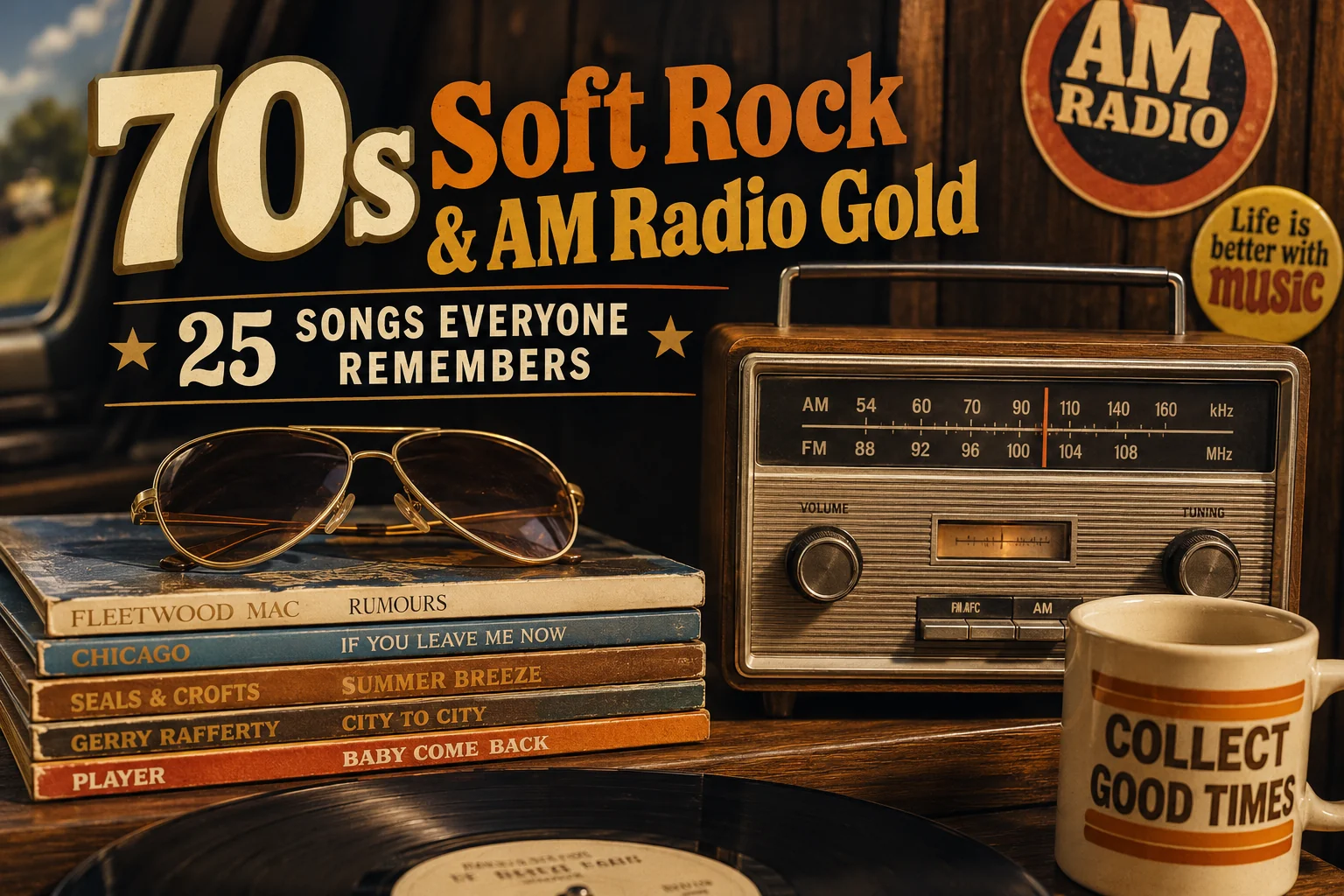
70s Soft Rock & AM Radio Gold: 25 Songs Everyone Remembers
70s soft rock and AM radio gold is the sound of back-seat childhood, dashboard speakers, kitchen radios, wood-paneled stereos, and parents who somehow knew every lyric to songs you were too young to understand.
This is not just a soft rock list. It is the mellow side of 70s radio: polished pop, singer-songwriter heartbreak, smooth grooves, yacht-adjacent radio comfort, folk-rock drift, adult-contemporary ancestors, and songs that filled the air before Gen X controlled the dial.
The ranking below is an editorial Smells Like Gen X countdown based on memory power, radio afterlife, 70s atmosphere, and how quickly a song can teleport you into a station wagon with hot vinyl seats and no one asking if you wanted to hear this again.
What Is 70s Soft Rock and AM Radio Gold?
70s soft rock and AM radio gold refers to the mellow, melodic, radio-friendly songs that dominated car radios, kitchen speakers, office stereos, and adult pop stations throughout the decade. Think Gerry Rafferty, Fleetwood Mac, Seals & Crofts, Player, Chicago, Firefall, Little River Band, and all the songs that sounded like grown-up feelings coming through a tiny dashboard speaker.
How We Picked These Songs
This is an editorial nostalgia ranking, not a strict chart ranking. The goal is to capture the songs that define the softer, smoother, more radio-friendly side of the 1970s — the music that lived in the background of Gen X childhood before we had the power to change the station.
The list blends soft rock, AM Gold, mellow pop, light rock, folk-rock, smooth soul-pop, and yacht-adjacent radio classics. Some songs are technically bigger rock or pop records, but they belong here because they became part of the same mellow radio ecosystem.
Translation: if it sounds like it came through a dashboard speaker while someone’s dad adjusted the rearview mirror and told you to stop kicking the seat, it belongs in the conversation.
70s Soft Rock & AM Radio Gold at a Glance
Here is the countdown in quick-scan form before the full rewind.
| Rank |
Song |
Artist |
Year |
Radio Lane |
| #1 | “Baker Street” | Gerry Rafferty | 1978 | Saxophone-soaked AM gold |
| #2 | “Dreams” | Fleetwood Mac | 1977 | California soft-rock perfection |
| #3 | “Summer Breeze” | Seals & Crofts | 1972 | Warm-weather mellow rock |
| #4 | “Brandy (You’re a Fine Girl)” | Looking Glass | 1972 | Nautical AM radio heartbreak |
| #5 | “Baby Come Back” | Player | 1977 | Smooth regret pop |
| #6 | “How Deep Is Your Love” | Bee Gees | 1977 | Disco-era soft-pop ballad |
| #7 | “If You Leave Me Now” | Chicago | 1976 | Horn-band heartbreak ballad |
| #8 | “Right Down the Line” | Gerry Rafferty | 1978 | Smooth loyalty anthem |
| #9 | “Reminiscing” | Little River Band | 1978 | Adult radio nostalgia |
| #10 | “I’d Really Love to See You Tonight” | England Dan & John Ford Coley | 1976 | Casual-soft-rock yearning |
| #11 | “Sundown” | Gordon Lightfoot | 1974 | Folk-rock suspicion |
| #12 | “All by Myself” | Eric Carmen | 1975 | Big lonely piano drama |
| #13 | “Year of the Cat” | Al Stewart | 1976 | Story-song sophistication |
| #14 | “Fooled Around and Fell in Love” | Elvin Bishop | 1976 | Soulful soft-rock confession |
| #15 | “Jackie Blue” | Ozark Mountain Daredevils | 1975 | Dreamy AM pop-rock |
| #16 | “Dance with Me” | Orleans | 1975 | Gentle harmony pop |
| #17 | “Still the One” | Orleans | 1976 | Anniversary-radio gold |
| #18 | “You Are the Woman” | Firefall | 1976 | Soft-rock devotion |
| #19 | “Just Remember I Love You” | Firefall | 1977 | Comfort-song soft rock |
| #20 | “Lotta Love” | Nicolette Larson | 1978 | Warm pop optimism |
| #21 | “Lowdown” | Boz Scaggs | 1976 | Smooth groove crossover |
| #22 | “Magnet and Steel” | Walter Egan | 1978 | California crush-pop |
| #23 | “Moonlight Feels Right” | Starbuck | 1976 | Marimba-powered mellow pop |
| #24 | “Sharing the Night Together” | Dr. Hook | 1978 | Country-pop soft-rock flirtation |
| #25 | “Escape (The Piña Colada Song)” | Rupert Holmes | 1979 | Late-70s novelty-soft-pop story |
Countdown: 25 70s Soft Rock & AM Radio Classics
Now for the full rewind. These are the songs that turned mellow into a lifestyle, heartbreak into a radio format, and adult feelings into something every kid in the back seat had to hear whether they understood them or not.
#25 — “Escape (The Piña Colada Song)” — Rupert Holmes
Why it belongs
“Escape” sits at the funny end of AM radio gold: a soft-pop story song with a twist ending, a tropical hook, and enough late-70s smoothness to make bad relationship decisions sound like vacation planning.
What makes it work is how casual the whole disaster feels. The narrator is bored, answers a personal ad, discovers the mystery woman is his own partner, and somehow everyone just shrugs and treats it like a cute rediscovery. Healthy? Absolutely not. Catchy? Unfortunately, yes.
Musically, it is light enough for adult pop radio, funny enough to feel like a novelty record, and polished enough to avoid sounding cheap. That is a very late-70s combination: smooth surfaces, questionable choices, and a chorus that refuses to leave.
Why Gen X remembers it
This is one of those songs kids heard without fully processing the plot. Then you grow up and realize the whole thing is a relationship red flag wearing a tiny paper umbrella.
Why it sticks
It turned romantic dysfunction into a singalong cocktail menu. The 70s were not okay, but they were catchy.
#24 — “Sharing the Night Together” — Dr. Hook
Why it belongs
Dr. Hook had a gift for making songs sound like they were leaning against the jukebox trying to buy you one more drink. “Sharing the Night Together” is mellow, flirtatious, and just polished enough to land perfectly on late-70s adult pop radio.
The song has a relaxed country-pop warmth, but it never feels dusty or rural. It is smoother than that — the kind of crossover hit that could work on pop stations, adult contemporary stations, and anywhere somebody wanted romance without too much vocal acrobatics.
Its power is in the ease. Nothing about it feels like a grand declaration. It is more like a low-lit invitation, which was a huge part of the 70s soft-radio universe: grown-up songs that were suggestive without kicking down the door.
Why Gen X remembers it
This is the kind of song that floated out of radios in rooms where adults were talking about adult things and kids were pretending not to listen.
Why it sticks
It sounds like the last slow song before the lights came up at a wood-paneled lounge.
#23 — “Moonlight Feels Right” — Starbuck
Why it belongs
“Moonlight Feels Right” is one of those 70s radio songs that sounds like it was recorded inside a warm breeze. It is smooth, breezy, slightly strange, and instantly separated from the pack by that marimba break.
That instrumental signature matters. A lot of mellow 70s songs blur together if you are not paying attention, but this one has a weird little sparkle that makes it identifiable almost immediately. It is soft pop, but it has personality.
The song also has that coastal, summer-night feeling the decade loved. Not quite yacht rock, not quite soft rock, not quite novelty — just a strange, warm, moonlit groove that somehow made perfect sense on the radio.
Why Gen X remembers it
It feels like something you heard from a car radio while half-asleep in the back seat, driving home from somewhere your parents said would be “fun.”
Why it sticks
Because somebody put a marimba solo in a soft-pop radio hit and somehow everyone just accepted it.
#22 — “Magnet and Steel” — Walter Egan
Why it belongs
“Magnet and Steel” is soft-rock infatuation with a Southern California shine. It has that late-70s studio polish where every guitar, harmony, and vocal choice feels airbrushed but still human.
The song is built around attraction, but it never gets messy. It glides. The guitars shimmer, the vocals stay cool, and the whole thing feels like a crush filtered through expensive studio glass.
It also belongs to the same orbit as Fleetwood Mac’s California radio universe. That does not mean it is copying anyone. It means it shares that warm, smooth, slightly romantic sound that made late-70s pop radio feel like everyone had better lighting than real life.
Why Gen X remembers it
It is pure background-radio magic: the kind of song that may not have screamed for attention, but still somehow trained your brain to recognize it decades later.
Why it sticks
It is the sound of a crush with backing vocals and a suspiciously expensive studio tan.
#21 — “Lowdown” — Boz Scaggs
Why it belongs
“Lowdown” is smoother and funkier than a lot of this list, but that is exactly why it matters. Boz Scaggs brought a polished groove to pop radio that felt adult, stylish, and impossible to classify with one clean label.
It is not soft in the fragile sense. It is soft in the sleek sense — controlled, sophisticated, and cool enough to make other songs nearby look like they were trying too hard.
The groove gives it movement, but the production gives it polish. That balance is the whole point: it could live on pop radio, adult radio, and the smoother side of 70s R&B-adjacent playlists without feeling out of place anywhere.
Why Gen X remembers it
This is the kind of song that made adults seem like they had some secret nightlife kids were not allowed to understand. Which, honestly, was probably for the best.
Why it sticks
It is the moment AM gold puts on sunglasses and pretends it was always this cool.
#20 — “Lotta Love” — Nicolette Larson
Why it belongs
“Lotta Love” is one of those records that sounds like sunlight breaking through a kitchen window. Nicolette Larson’s version has warmth, movement, and an easy optimism that fits perfectly into late-70s mellow radio.
The song does not force anything. It floats. That made it ideal for stations looking for something soft enough for adult listeners but bright enough to avoid sinking into background wallpaper.
There is also a generosity to the track. It feels open-hearted without turning into a greeting card. That was one of the great soft-rock tricks: making sincerity feel listenable instead of embarrassing.
Why Gen X remembers it
It sounds like weekend morning radio: light coming through curtains, adults making coffee, and kids trying to find the cereal with the most sugar before anyone noticed.
Why it sticks
It makes optimism sound casual, which is harder than it looks.
#19 — “Just Remember I Love You” — Firefall
Why it belongs
Firefall specialized in soft rock that felt like reassurance with harmonies. “Just Remember I Love You” is gentle, supportive, and built for anyone who wanted their emotional crisis wrapped in a clean guitar tone.
It is not edgy. It is not trying to be. This is comfort-radio music: the kind of song that makes a bad day sound slightly more survivable while still keeping both hands on the steering wheel.
The melody is simple and direct, which is exactly why it works. Soft rock did not always need dramatic storytelling or huge vocal moments. Sometimes it just needed a chorus that sounded like someone putting a blanket over your nervous system.
Why Gen X remembers it
It is the sound of grown-up reassurance from a decade when nobody wore seatbelts properly and every car smelled faintly like vinyl, cigarettes, and spilled soda.
Why it sticks
It is basically a cardigan with a chorus.
#18 — “You Are the Woman” — Firefall
Why it belongs
“You Are the Woman” is almost impossibly smooth: gentle guitar, easy tempo, romantic directness, and harmonies that sound like they came pre-installed in every 70s dashboard radio.
Firefall understood the soft-rock formula without making it feel mechanical. The song is simple, but that simplicity is the point. It says what it came to say, then politely gets out before anyone has to explain their feelings twice.
It also shows how much 70s radio rewarded restraint. Nothing explodes here. Nobody tries to win the Olympics of singing. The song just moves gently, lands the hook, and lets the mood do the work.
Why Gen X remembers it
Even if you did not know the title, you knew the feeling: adult romance floating out of the speakers while you were in the back seat trying to avoid touching your sibling.
Why it sticks
It is soft rock boiled down to its dashboard-radio essence: sincere, melodic, and wearing earth tones.
#17 — “Still the One” — Orleans
Why it belongs
“Still the One” has a different kind of softness. It is upbeat, but not loud. Romantic, but not syrupy. Catchy, but not annoying enough to be arrested. Orleans found a sweet spot that made the song useful for radio, commercials, weddings, and every anniversary montage ever threatened into existence.
The song’s strength is its durability. It does not depend on heartbreak or drama. It depends on familiarity, commitment, and a hook that sounds like it was born ready for repeat play.
That made it an AM radio natural. It could brighten a playlist without disrupting the mellow mood. It was feel-good, but not frantic. Romantic, but still safe for the whole car.
Why Gen X remembers it
It is one of those songs that seemed to be everywhere without asking permission: radio, TV, ads, reunions, and any event where adults clapped slightly off beat.
Why it sticks
It sounds like commitment with a rhythm section and matching shirts.
#16 — “Dance with Me” — Orleans
Why it belongs
“Dance with Me” is soft rock as an invitation. It has a graceful melody, gentle guitar, and the kind of easy romantic mood that sounds like the lights dimmed by themselves.
The song is not desperate. It is patient. That restraint gives it a grown-up charm, the sort of mellow confidence that 70s radio loved and later decades mostly forgot how to do without irony.
It also shows how important harmonies were to the softer side of the decade. The voices do not compete. They blend, making the whole thing feel warmer and more intimate than the lyric alone.
Why Gen X remembers it
It sounds like the song adults danced to while kids sat at folding tables drinking flat soda and wondering when the cake was happening.
Why it sticks
It made “please dance with me” sound like a full lifestyle plan.
#15 — “Jackie Blue” — Ozark Mountain Daredevils
Why it belongs
“Jackie Blue” has a strange, dreamy ease that makes it stand out. It is not straightforward soft rock, but it belongs to the same 70s radio zone where pop, country-rock, and mellow studio polish blurred together.
The vocal floats, the groove stays light, and the whole thing feels slightly detached from reality in the best possible way. It is one of those songs that makes AM radio feel like a place, not just a format.
There is a hazy quality to it that gives the song its staying power. It does not grab you by the collar. It drifts past, and somehow that makes you remember it more.
Why Gen X remembers it
“Jackie Blue” feels like a song that was always playing somewhere else in the house — not loud enough to dominate, but loud enough to haunt the wallpaper.
Why it sticks
It sounds like a daydream that learned how to drive.
#14 — “Fooled Around and Fell in Love” — Elvin Bishop
Why it belongs
“Fooled Around and Fell in Love” brings more soul and blues-rock flavor than some of the cleaner soft-rock entries, but its radio afterlife places it firmly in AM Gold territory. It is mellow enough to slide into the format and emotional enough to cut through it.
The vocal is the secret weapon. It gives the song vulnerability without making it weak, and that emotional honesty helped it become one of the decade’s great “oops, feelings happened” records.
What makes the song endure is the balance between confession and groove. It feels like someone admitting they got emotionally outmaneuvered by their own bad decisions, but the track is too warm to judge them too harshly.
Why Gen X remembers it
This is one of those songs that worked for adults, teenagers, and eventually movie soundtracks because regret never really goes out of style. It just gets better speakers.
Why it sticks
It turned romantic accidental damage into a chorus everyone could admit to.
#13 — “Year of the Cat” — Al Stewart
Why it belongs
“Year of the Cat” is soft rock for people who wanted their mellow radio hits with a passport, a screenplay, and a little fog machine. Al Stewart’s storytelling gives the song a cinematic quality that separates it from simpler love songs.
It is polished, mysterious, and quietly dramatic. The arrangement unfolds like a travel poster coming to life, which made it perfect for 70s listeners who liked their AM Gold with a little sophistication.
The song does not rush. It lets the atmosphere build, which is part of the appeal. The saxophone, piano, guitar, and narrative all work together to create something that feels more like a short film than a standard radio single.
Why Gen X remembers it
It was the kind of song that made adult radio seem oddly glamorous, even when you were just hearing it from the back seat on the way to a hardware store.
Why it sticks
It made mellow radio feel worldly, even if you were just stuck in traffic behind a station wagon.
#12 — “All by Myself” — Eric Carmen
Why it belongs
“All by Myself” is where soft rock stops politely sighing and starts staring out a rainy window like it is auditioning for the saddest commercial ever made. Eric Carmen turned loneliness into a giant piano confession.
The song is dramatic, yes, but still rooted in the mellow 70s radio world. It gave listeners a big emotional release without becoming hard rock, disco, or soul. It was adult heartbreak made enormous.
The piano gives it elegance, the vocal gives it desperation, and the chorus makes sure nobody misses the point. This is not casual loneliness. This is loneliness with a spotlight and a fog machine.
Why Gen X remembers it
Kids may not have understood the adult emotional collapse, but they understood the giant chorus. Some songs do not explain themselves; they just overwhelm the room.
Why it sticks
It is soft rock for when quiet sadness is not enough and the piano needs to file a report.
#11 — “Sundown” — Gordon Lightfoot
Why it belongs
“Sundown” brings a darker edge to the mellow-radio lane. Gordon Lightfoot’s voice is calm, but the song feels watchful, uneasy, and a little dangerous around the edges.
That tension is what makes it special. It has the acoustic warmth of folk rock, the smoothness of AM radio, and a shadowy story underneath. It is mellow, but it is definitely not harmless.
The groove is restrained, almost hypnotic. Instead of exploding, the song circles. That makes the suspicion inside it feel more intense, like someone trying very hard to stay calm and failing quietly.
Why Gen X remembers it
It sounded grown-up in a way that felt mysterious, like adults knew what the song meant but nobody was going to explain it in the car.
Why it sticks
It proves soft radio could still sound like someone was about to make a terrible decision at sunset.
#10 — “I’d Really Love to See You Tonight” — England Dan & John Ford Coley
Why it belongs
This is one of the most quietly perfect soft-rock records of the decade. It is not dramatic. It is not demanding. It is just a gentle phone call in song form, complete with the emotional ambiguity of someone pretending they are being totally casual.
The arrangement is light, the harmonies are smooth, and the lyric sits in that very 70s space between romance and denial. It is the sound of someone trying to keep things breezy while absolutely not being breezy.
The genius is the understatement. A lesser song would beg. This one shrugs, smiles, and tries to act like the whole thing is no big deal. That makes it even more painfully obvious that it is a big deal.
Why Gen X remembers it
It is peak “adult conversation overheard from the back seat” music: calm on the surface, complicated underneath, and way too smooth for the emotional mess involved.
Why it sticks
It made “no pressure” sound like a full emotional crisis.
#9 — “Reminiscing” — Little River Band
Why it belongs
“Reminiscing” is nostalgia about nostalgia, which makes it basically lab-grown for Smells Like Gen X. Little River Band created a smooth, romantic, backward-looking song that sounds like it was designed to play while someone flips through a photo album with a drink in hand.
It is polished without feeling cold, sentimental without completely collapsing into mush, and catchy enough to turn memory into a hook. That is AM Gold magic.
The song is also a reminder that 70s soft rock loved looking backward. Even when it was new, it often sounded like it was already remembering itself. That gave songs like this a weird built-in nostalgia.
Why Gen X remembers it
For kids, this was music adults played while remembering things we had not lived through yet. Then we grew up and became the ones doing the same thing. Rude, frankly.
Why it sticks
It is a memory song that became a memory itself. That is cheating, but it worked.
#8 — “Right Down the Line” — Gerry Rafferty
Why it belongs
“Right Down the Line” is smooth devotion with a hypnotic groove. Gerry Rafferty had a gift for making songs feel both intimate and radio-ready, and this one glides instead of announces itself.
It is not as dramatic as “Baker Street,” but that is the charm. It feels steady, sincere, and quietly addictive. The song has the confidence of someone who knows the groove is already doing most of the work.
The production is warm but not sleepy, the vocal is relaxed but not detached, and the rhythm gives the song a quiet persistence. It is love-song loyalty without theatrical kneeling in the driveway.
Why Gen X remembers it
It has that adult-radio smoothness that made every car ride feel slightly more serious than it needed to be. You could be going to the grocery store and still feel like a montage was happening.
Why it sticks
It is loyalty with a soft-rock pulse and a mustache-shaped aura.
#7 — “If You Leave Me Now” — Chicago
Why it belongs
Chicago could be loud, brassy, and musically muscular, but “If You Leave Me Now” showed how powerful they could be when everything softened. The result is one of the defining heartbreak ballads of 70s radio.
Peter Cetera’s vocal gives the song its fragile center, while the arrangement keeps things lush and restrained. It is emotional, but never chaotic. That made it perfect for adult pop radio and every room where someone wanted to feel sad with good production values.
The song also marks a shift for Chicago’s public identity. For a lot of casual listeners, this kind of ballad became the version of the band they remembered most. Soft rock had that power in the 70s: it could rewrite a band’s image with one enormous slow song.
Why Gen X remembers it
This is the sound of adults being quietly devastated while children in the room wondered if they were still allowed to ask for McDonald’s.
Why it sticks
It is the sound of a horn band putting down the brass and picking up the emotional damage.
#6 — “How Deep Is Your Love” — Bee Gees
Why it belongs
The Bee Gees may be tied forever to the disco explosion, but “How Deep Is Your Love” is pure soft-pop elegance. It is smooth, intimate, and built around harmonies so polished they practically reflect light.
The song worked because it gave the disco era a slow-burn romantic centerpiece. It could live beside dance-floor hits without sounding like one, and it helped prove that the Bee Gees were not just beat-driven hitmakers. They were melody assassins.
Everything here is controlled: the tempo, the vocal blend, the emotional temperature. It never has to shout because the harmonies do all the heavy lifting. That is why it still feels expensive.
Why Gen X remembers it
For a lot of kids, this was not “disco.” It was just one of those smooth songs adults loved, floating through the house while somebody was getting ready to go somewhere.
Why it sticks
It is soft enough for the back seat, elegant enough for adults, and catchy enough to survive every decade afterward.
#5 — “Baby Come Back” — Player
Why it belongs
“Baby Come Back” is one of the great smooth-regret records of the decade. Player wrapped heartbreak in a polished groove and made pleading sound suspiciously stylish.
Everything about the record is radio-ready: the chorus, the clean guitar, the smooth vocal, the emotional directness. It is a breakup song that somehow sounds like it has good lighting.
The song’s secret is that it never lets the regret get ugly. The narrator is clearly miserable, but the arrangement keeps everything sleek. That contradiction is pure 70s soft rock: emotional damage, professionally arranged.
Why Gen X remembers it
This is the kind of song that taught kids the adult world was apparently 80 percent breakups, 20 percent harmonies.
Why it sticks
It made desperation sound smooth enough to wear linen.
#4 — “Brandy (You’re a Fine Girl)” — Looking Glass
Why it belongs
“Brandy” is AM radio storytelling at its most durable: a seaside bar, a woman everybody knows, a sailor who cannot stay, and a chorus that somehow made maritime emotional unavailability feel romantic.
Looking Glass created a song that feels like a little movie. It is soft enough for this list, pop enough for radio, and vivid enough that listeners still remember the entire setup decades later.
The song works because it gives listeners characters, setting, conflict, and a hook. That is a lot of storytelling for a radio single, but the 70s had room for that. AM radio could make space for a whole coastal tragedy between commercials.
Why Gen X remembers it
It is one of those songs kids heard as a catchy chorus and adults heard as a warning about falling for someone emotionally unavailable with a boat.
Why it sticks
It turned a woman being second place to the ocean into one of the decade’s most singable tragedies.
#3 — “Summer Breeze” — Seals & Crofts
Why it belongs
“Summer Breeze” is one of the defining soft-rock mood pieces of the decade. It does not just describe comfort. It manufactures it. The melody, harmonies, and gentle atmosphere make the song feel like windows open in a house you half remember.
Seals & Crofts captured the domestic, sunlit side of 70s radio: not dramatic, not flashy, just impossibly warm. It is the kind of song that can make a room feel calmer before you even notice what happened.
The song’s magic is sensory. You do not just hear it; you can almost smell the laundry, feel the evening air, and see the curtains moving. Very few soft-rock songs create a setting this effectively.
Why Gen X remembers it
It is the sound of being little in a house where adults controlled the stereo and summer felt longer than it had any right to be.
Why it sticks
It is basically a soft-focus photograph with harmonies.
#2 — “Dreams” — Fleetwood Mac
Why it belongs
“Dreams” is bigger than soft rock, but it also helped define the smooth, emotionally complicated California sound that dominated late-70s radio. The beat is simple, the vocal is cool, and the whole song feels like heartbreak wearing sunglasses indoors.
Fleetwood Mac made adult romantic chaos sound elegant. That is why the song still works. It is not trying to overpower you. It just settles in, lets the groove breathe, and proves that calm can be devastating.
The song’s restraint is the whole weapon. Stevie Nicks does not sound like she is begging. She sounds like she already knows how this ends. That cool sadness is what makes it timeless.
Why Gen X remembers it
“Dreams” was everywhere: parents’ records, radio stations, later classic-rock formats, grocery stores, movie soundtracks, and eventually the internet rediscovering what the dashboard already knew.
Why it sticks
It is the sound of relationship disaster delivered with perfect hair and zero panic.
#1 — “Baker Street” — Gerry Rafferty
Why it is #1
“Baker Street” is the ultimate 70s soft rock and AM radio gold record because it has everything: melancholy, polish, urban loneliness, a hypnotic groove, and one of the most recognizable saxophone lines in pop history.
Gerry Rafferty made a song that sounds like walking alone through a city after realizing adulthood is mostly rent, regret, and trying to remember where you parked. It is smooth, but not empty. Mellow, but not weak. That is the sweet spot this whole page is chasing.
The sax line is the obvious reason people remember it, but the song lasts because the mood is so specific. It feels like late-70s exhaustion wrapped in gold radio light.
It also captures something deeper about AM Gold: these songs were polished enough for mass radio, but many of them were not actually simple. “Baker Street” has loneliness, ambition, disappointment, escape, and resignation all moving under that instantly recognizable hook.
Why Gen X remembers it
You did not need to know the title. You did not need to know Gerry Rafferty. You just needed to hear that saxophone come blasting through the car speaker, and suddenly the whole decade was leaning against a streetlight in a brown leather jacket.
Why it sticks
That sax riff could walk into a room by itself and everyone would know what decade just arrived.
Listen to the 70s Soft Rock & AM Radio Gold Playlist
Want the whole dashboard-radio experience without fighting the dial? Hit play on the companion Spotify playlist and let the softer side of the 70s do what it does best: saxophone drama, warm harmonies, breakup ballads, gentle guitars, smooth grooves, and adult feelings coming through speakers that were never built for bass.
This is the soundtrack version of the page — Gerry Rafferty, Fleetwood Mac, Seals & Crofts, Looking Glass, Player, Chicago, Firefall, Little River Band, and the rest of the AM radio gold pileup.
Soft Rock vs. AM Gold vs. Yacht Rock
Soft rock is the broadest label here: mellow, melodic rock and pop-rock with smooth production and emotional lyrics. AM Gold is more of a nostalgia-radio idea — the catchy, familiar hits that lived on oldies stations, car radios, and adult pop playlists. Yacht rock is narrower and usually smoother, slicker, and more studio-polished.
This page borrows from all three, but the main rule is memory. These are the songs that felt like 70s radio wallpaper in the best possible way: always there, always familiar, and somehow still able to drag you back to a time before every song had to fight a phone screen for attention.
Keep Rewinding 70s Music
The soft-rock side of the 70s is only one lane. The decade also gave us disco, classic rock, funk, soul, singer-songwriters, novelty hits, one-hit wonders, movie themes, and TV songs that did more exposition than the actual scripts.
70s Music
The main 70s music hub for year-end countdowns, playlists, one-hit wonders, AM radio memories, disco, soft rock, and Gen X rewind energy.
70s One-Hit Wonders
The unforgettable songs by artists who got one giant shot at immortality and somehow made it count.
Top 10 Songs of 1972
AM gold, soul, pop, and soft-rock staples from the early part of the decade.
Top 10 Songs of 1976
Disco, soft rock, pop ballads, and radio songs that made the decade feel fully 70s.
Top 10 Songs of 1978
Late-70s radio as disco, soft rock, and smooth pop all crowded the dial.
Top 10 Songs of 1979
The end-of-decade handoff as pop, disco, rock, and new wave all battled for the radio.
70s Nostalgia Hub
The broader decade hub for 70s music, movies, TV, toys, fads, commercials, and pop culture.
80s Music
The next decade: MTV, synth-pop, power ballads, new wave, hair metal, and bigger everything.
You May Also Remember
the 70s music hub,
70s one-hit wonders,
the songs of 1976,
the songs of 1978,
the songs of 1979,
and the full 70s nostalgia hub.
Basically: sax solos, breakup harmonies, gentle guitars, warm grooves, yacht-adjacent feelings, and grown-up emotions coming through speakers that could not handle bass anyway.
The Rewind Verdict
The best 70s soft rock and AM radio gold songs were not background music because they were weak. They were background music because they were everywhere. They filled cars, kitchens, waiting rooms, department stores, roller rinks, and family rooms before anyone had a skip button.
That is why they work so well as nostalgia. You may not have chosen these songs as a kid, but they chose you. “Baker Street” brought the saxophone drama. “Dreams” made heartbreak sound cool. “Summer Breeze” made mellow feel eternal. “Baby Come Back” turned regret into a smooth groove. And somehow, after all these years, the dashboard still remembers.
FAQ: 70s Soft Rock & AM Radio Gold
What is 70s soft rock?
70s soft rock is mellow, melodic rock and pop-rock built around smooth production, gentle instrumentation, romantic lyrics, and radio-friendly hooks. It became one of the defining sounds of 1970s adult pop radio.
What does AM radio gold mean?
AM radio gold usually refers to familiar, nostalgic radio hits from the 60s and 70s, especially the songs that stayed in heavy rotation on oldies, adult contemporary, and easy-listening stations.
What are the best 70s soft rock songs?
Some of the best 70s soft rock and AM radio classics include “Baker Street,” “Dreams,” “Summer Breeze,” “Baby Come Back,” “How Deep Is Your Love,” “If You Leave Me Now,” “Right Down the Line,” and “Reminiscing.”
Is yacht rock the same as soft rock?
No. Yacht rock overlaps with soft rock, but it usually refers to a smoother, slicker, more studio-polished sound. Soft rock is broader and includes folk-rock, mellow pop, singer-songwriters, ballads, and adult pop radio hits.
Why was soft rock so popular in the 70s?
Soft rock fit the 70s radio landscape perfectly. It was melodic, emotional, adult-friendly, easy to play at home or in the car, and broad enough to sit between pop, rock, folk, soul, and adult contemporary formats.
What music did Gen X hear growing up in the 70s?
Gen X kids heard a mix of whatever adults controlled: soft rock, disco, soul, funk, singer-songwriters, country-pop, TV themes, classic rock, and AM radio hits playing from kitchen radios, car stereos, and older siblings’ record collections.