Tour of Duty in the 80s: Vietnam Comes to Network Prime Time
Anderson, Goldman and a platoon whose familiar faces made the next order matter.
Experience, rank and loyalty have to become a decision somebody can live with.

That opening could stop a conversation. Paint It Black, soldiers moving through the frame and the knowledge that this wasn’t going to be an hour in which the uniforms stayed clean. Tour of Duty had a way of announcing itself before anybody in the room had decided how much attention they were going to give the television.
The CBS series began in 1987 and followed American soldiers in Vietnam. Terence Knox’s Zeke Anderson and Stephen Caffrey’s Myron Goldman supplied a continuing center, but the platoon around them mattered. These were people you learned to recognize by face, manner and the way they reacted when the plan began to go wrong.
That familiarity was both the invitation and the problem. Once you knew the men, a patrol wasn’t simply a collection of uniforms crossing a landscape. Somebody you’d been watching for weeks was doing the crossing. The show could use an ordinary exchange to make the next silence feel much less ordinary.
I don’t come back to Tour of Duty expecting it to provide the complete history of the Vietnam War. I come back to see how a late-eighties network drama tried to turn combat, authority, friendship and moral uncertainty into an ongoing relationship with its audience. Its best hours don’t let being attached to the men settle every question about what they are being asked to do.
Inside This Article
- CBS Put the War Inside the Ordinary Television Week
- Zeke Anderson Makes Experience Visible Without Turning It Into Omniscience
- Myron Goldman Has to Make Rank Become Trust
- Anderson and Goldman Need Each Other's Uncomfortable Knowledge
- The Platoon Has to Become More Than a Row of Names
- Doc Matsuda Has a Different Immediate Objective
- The Pilot Introduces Replacement as a Disturbing Routine
- Notes From the Underground Changes the Size of the World
- Dislocations Makes a Mission's Description Part of the Problem
- Burn, Baby, Burn Brings Racial Conflict Inside the Unit
- Nowhere to Run Gives Percell a Consequence He Cannot Leave in the Field
- Roadrunner Asks What Happens When the Experienced Man Is Tired
- Pushin' Too Hard Puts an Audience Inside the Mission
- Under Siege Makes the Supposed Safe Place Answerable to the War
- Soldiers Takes the Men Out of the Setting That Explains Them
- The Short Timer Turns Going Home Into Another Kind of Pressure
- The Hill Makes Repetition the Thing You Cannot Ignore
- The 1989 Second Season Changes the Surrounding World
- Alex Devlin and Jennifer Seymour Change Who Can Ask the Questions
- Another Promised Land Brings News of King's Death Into the Story
- Friendship Is Necessary Without Being a Cure for Everything
- Sound Makes the Threat Reach Beyond the Picture
- Paint It Black Became Part of the Show's Identity
- A Television Platoon Is Still a Selection of the War
- The Drama Can Be Direct Enough to Show Its Seams
- China Beach Offers Another Place to Follow the Consequences
- The Weekly Schedule Made Familiarity Grow in Small Pieces
- The 1989 Changes Shouldn't Be Confused With the Whole 1990 Ending
- A Return Route That Lets the First Season Establish Its People
- Why the Platoon Still Has a Place in the Memory
- Questions About Tour of Duty in the Eighties
CBS Put the War Inside the Ordinary Television Week
Tour of Duty arrived on CBS in 1987 and continued until 1990. The first season and the 1989 second season form the core of this return, with the beginning of season three still part of the late-eighties broadcast history. The full run extends across the decade boundary.
The continuing-series format changed the invitation. A feature film can ask for one evening and a concentrated set of relationships. A weekly drama asks you to recognize the same people again, learn their irritations and carry some memory of their previous decisions into the next assignment.
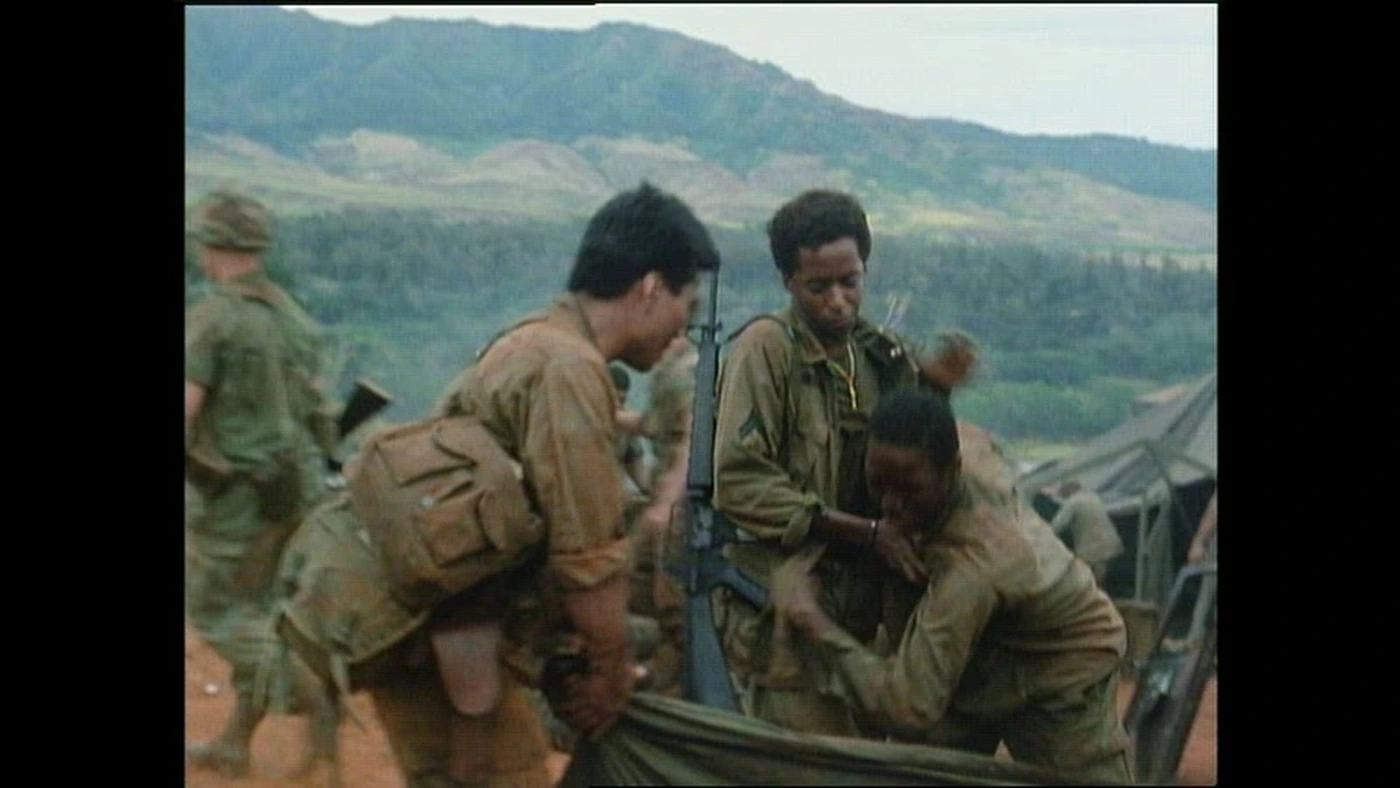
The setting initially places the platoon in Vietnam in 1967. The broadcast audience, meanwhile, was receiving those stories two decades later. Those two dates shouldn’t be collapsed. The series was a late-eighties attempt to depict and remember an earlier war, with all the choices and limits that description implies.
CBS’s original fall announcement placed the new drama on Thursday night against NBC’s established comedy strength. That’s a striking reminder of the delivery system. The war story wasn’t presented in a separate room reserved for viewers who had selected a historical-film evening. It was competing for the same household set as familiar laughs.
In the wider television world of 1987, that made Tour of Duty a different sort of appointment. It had to introduce a difficult setting while still giving viewers a reason to return. The men supplied that reason, but the setting made it impossible to promise that returning would always feel reassuring.
Zeke Anderson Makes Experience Visible Without Turning It Into Omniscience
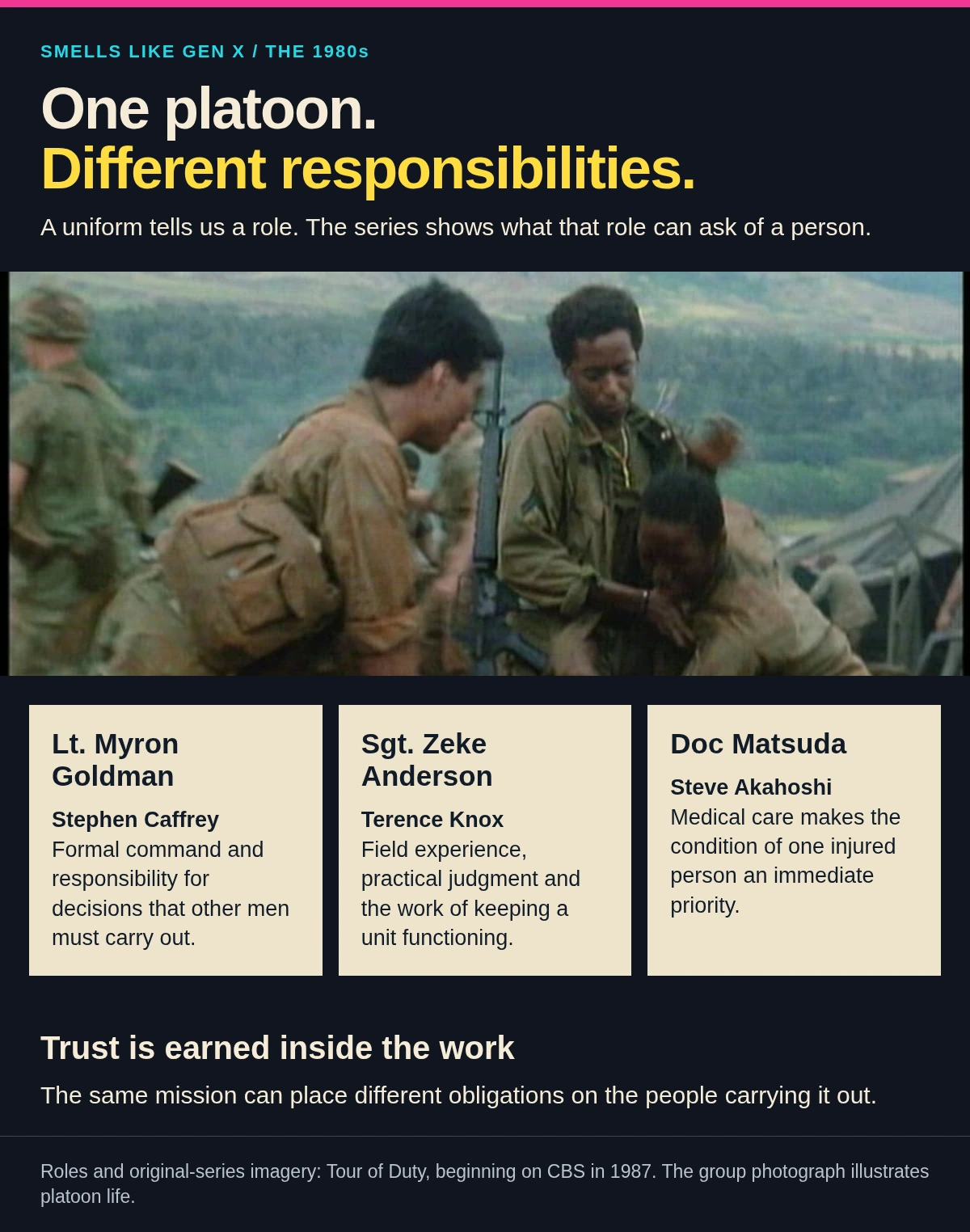
Sergeant Clayton Zeke Anderson, played by Terence Knox, brings experience into the platoon’s daily life. He can assess a situation with the economy of somebody who has had reason to learn what matters. The performance gives that authority some wear instead of presenting it as a permanently available supply of confidence.
Knox’s face does a lot of work. Anderson can look impatient with the circumstances before anyone has finished explaining them. That expression is useful because the show doesn’t need him to greet every questionable order with a long speech. Sometimes the audience only needs to see that the experienced man has registered the problem.
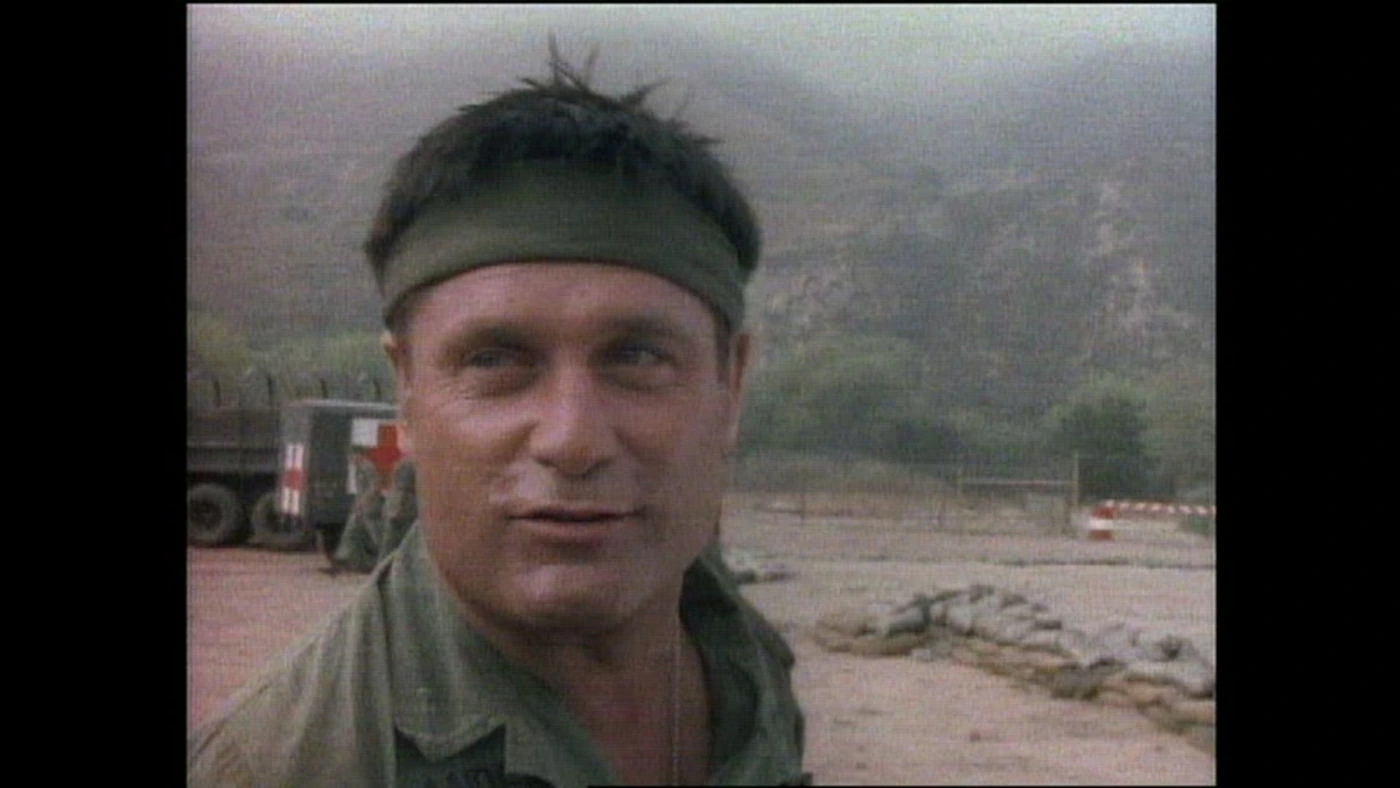
He isn’t outside the system he’s criticizing. Anderson still has duties, loyalties and decisions to make within it. Knowing something is dangerous doesn’t automatically provide a route around the danger. His responsibility is often to make a bad situation survivable, which isn’t the same as having the power to prevent it.
The personal life adds another pressure. A man useful to a platoon can have a much less settled account of what he wants beyond it. Experience in the field doesn’t make every relationship clear, and the series is stronger when it allows that limitation to remain visible.
I find Anderson convincing when the practical judgment and the exhaustion share a moment. He doesn’t need to be the character who has the final correct opinion on everything. He needs to be somebody the younger men have reasons to listen to, and somebody whose limits matter because other people are relying on him.
Myron Goldman Has to Make Rank Become Trust
Lieutenant Myron Goldman, played by Stephen Caffrey, occupies a different position. Rank gives him authority, but authority isn’t the same thing as the platoon’s confidence. A decision must still survive contact with men who will bear its physical consequences.
That is a useful source of continuing tension. Goldman cannot simply become a subordinate to the experienced sergeant whenever the drama wants us to admire Anderson. He has a job to perform and responsibility that doesn’t vanish because another man has spent longer learning the ground.
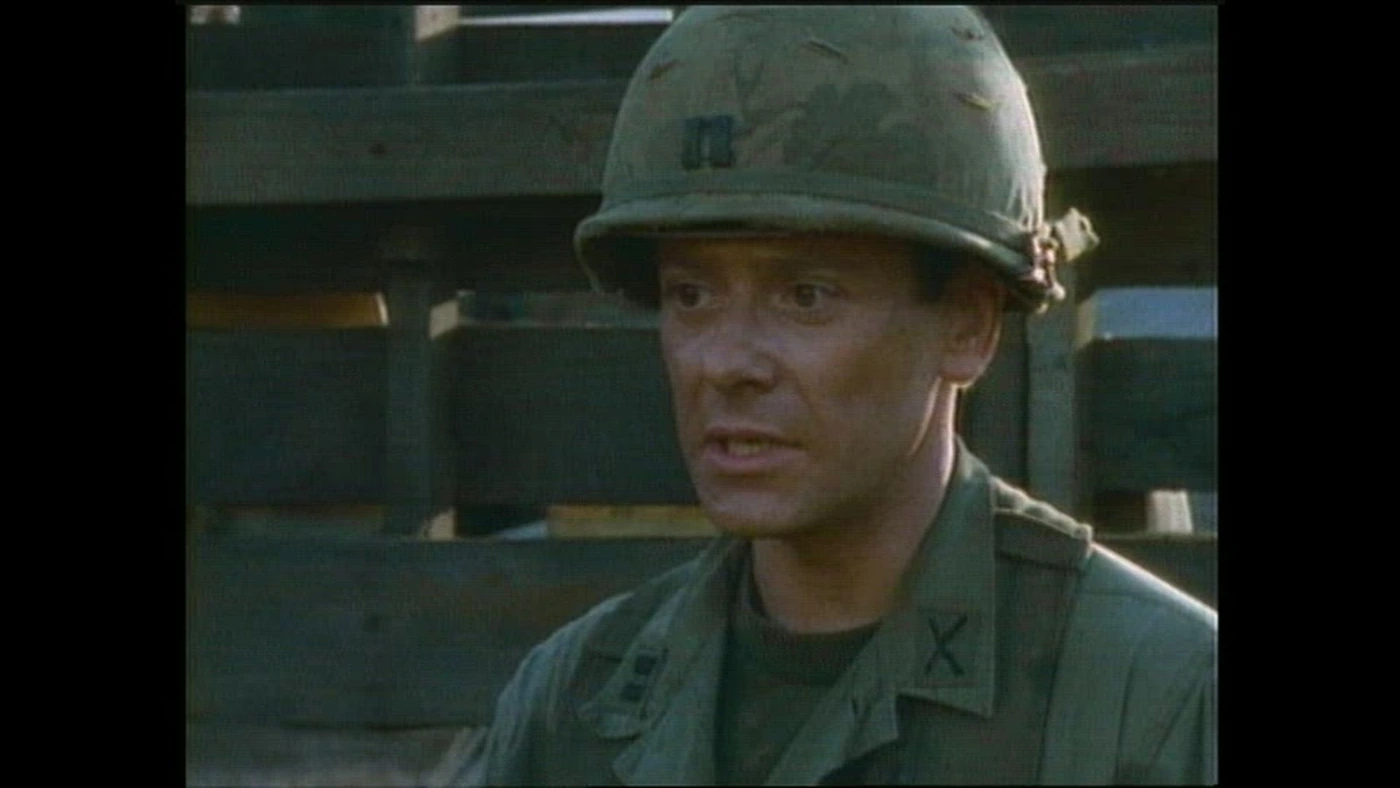
Caffrey lets the pressure show without making Goldman only an emblem of youth. The character can want to do the job well and still find that wanting inadequate. He has to judge information, respond to orders and accept that a decision made with limited knowledge can become permanent for someone else.
The role also prevents the platoon from becoming a collection of men united solely by a sensible older guide. A chain of command contains different kinds of responsibility. The officer may have to articulate a decision the men dislike; the sergeant may have to make it workable without pretending he likes it either.
The relationship gives Tour of Duty a durable center because trust can grow without removing disagreement. A viewer can understand why the men follow Goldman while still noticing the strain involved in being followed. The uniform announces the rank immediately. The series spends much longer showing what that rank asks of the person inside it.
Anderson and Goldman Need Each Other's Uncomfortable Knowledge
The two men aren’t interesting only because one has experience and the other has rank. That could become a very simple weekly lesson, with the lieutenant learning the obvious answer from the sergeant and everybody waiting for the next episode to repeat the arrangement.
The better version gives each knowledge the other cannot entirely replace. Anderson understands habits, reactions and the practical shape of a threat. Goldman has responsibilities that extend through the command structure, including the burden of deciding how to act on information that may remain incomplete.
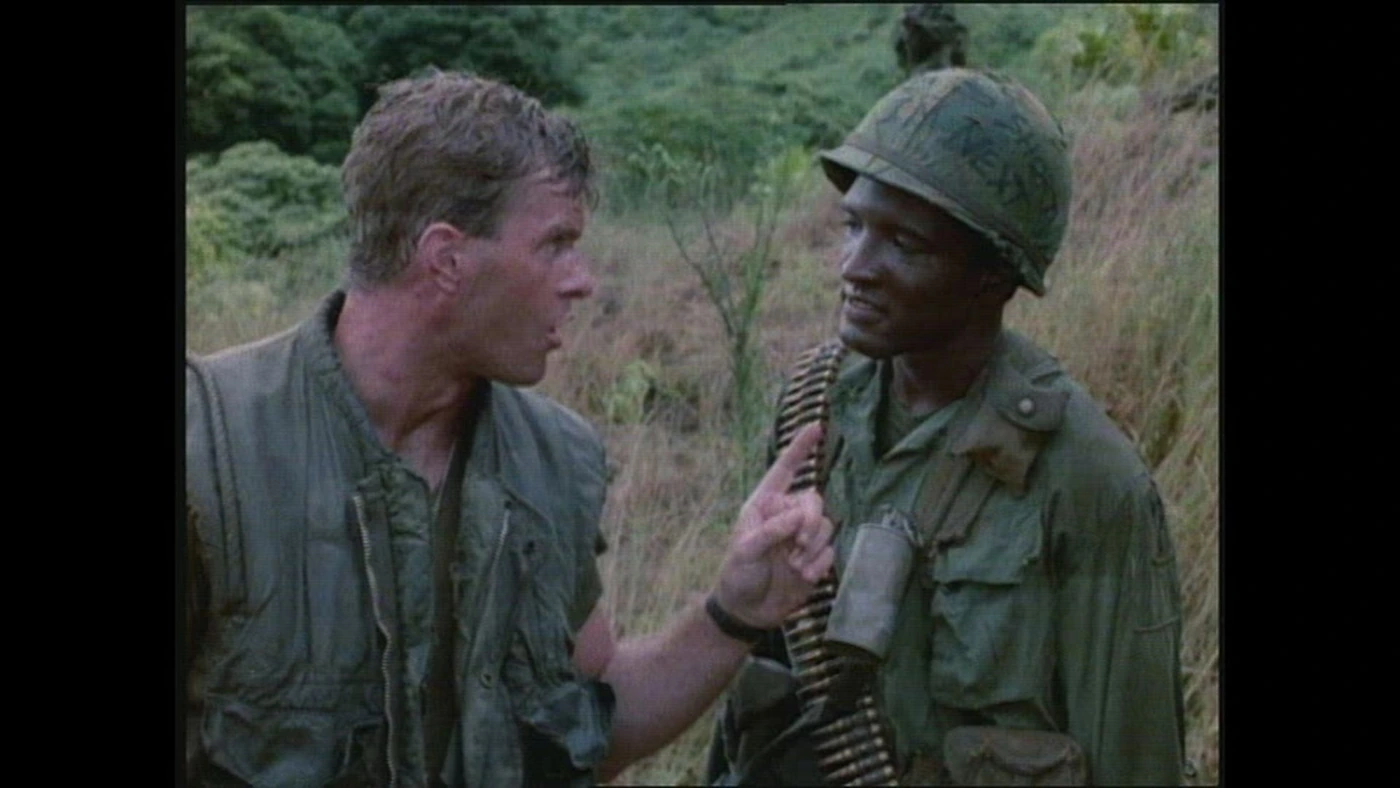
Their exchanges can therefore carry more than a contest over who sounds tougher. A disagreement may concern the value of a mission, the condition of a man or how much risk an order is requiring the platoon to accept. The stakes exist before either character has found a satisfying way to describe them.
There is a family resemblance to the argumentative partnerships in other eighties television dramas, but the physical dependence changes the register. A professional disagreement isn’t simply something to revisit over a drink after work. The men may have to act together before the disagreement feels resolved.
For me, the most valuable moments are the ones in which respect doesn’t become agreement. The show can let two competent people remain uneasy about a decision. That feels more substantial than giving the audience a designated sensible man whose approval makes every difficult action acceptable.
The Platoon Has to Become More Than a Row of Names
The original group includes Danny Percell, played by Tony Becker; Marcus Taylor, played by Miguel A. Núñez Jr.; Alberto Ruiz, played by Ramón Franco; Marvin Johnson, played by Stan Foster; Roger Horn, played by Joshua Maurer; and Doc Matsuda, played by Steve Akahoshi. Eric Bruskotter’s Scott Baker is another part of the early company.
A cast list is only the beginning. The series needs us to distinguish these men quickly enough that an argument doesn’t feel like two anonymous uniforms shouting. Voice, expression and the way somebody responds to a joke become practical storytelling tools.
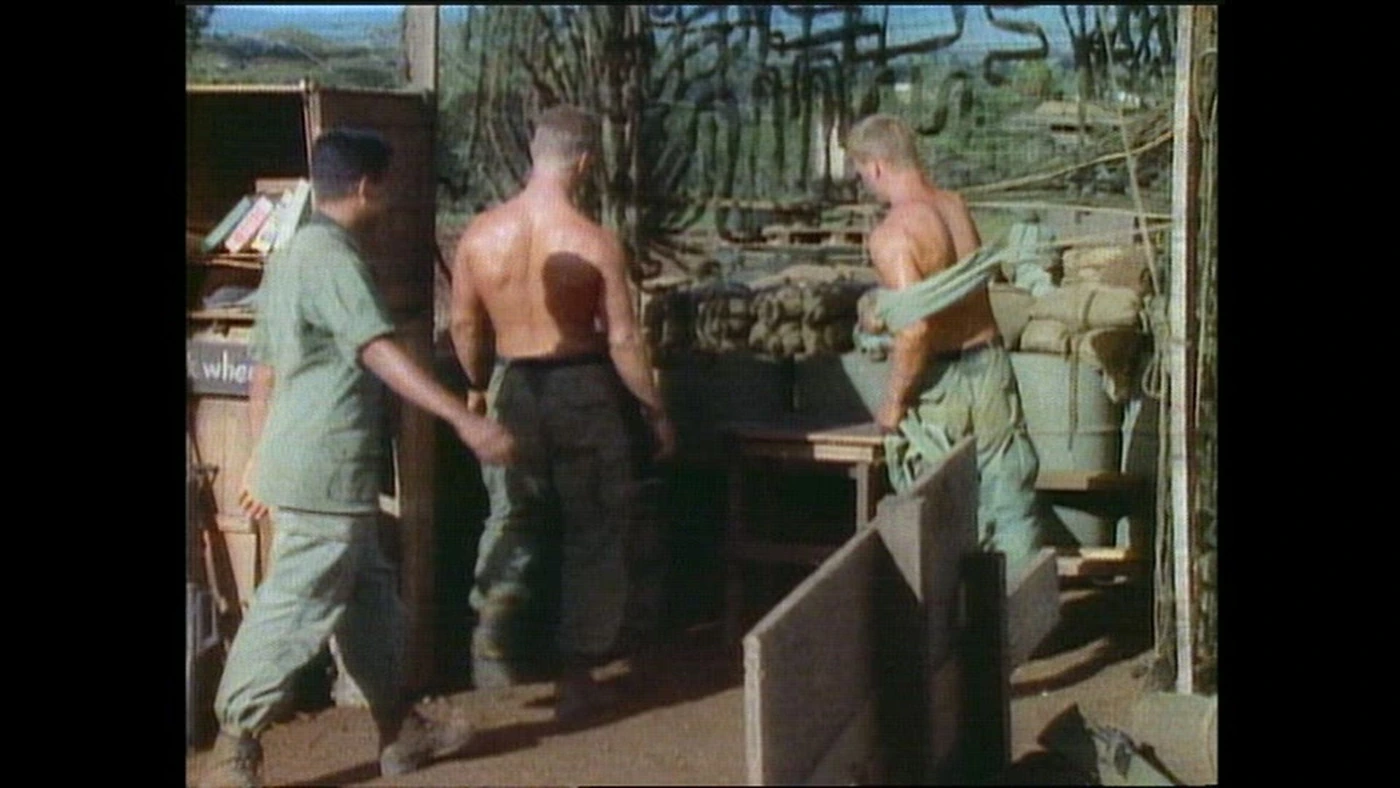
A platoon drama also gives the familiar ensemble arrangement a specific reason to exist. The men cannot choose every person they must depend on. Shared danger may produce loyalty, but it doesn’t automatically produce affection, equal understanding or compatible beliefs.
The younger performers help make that mixture socially active. The men can tease, complain and behave as if an irritating colleague is the most pressing problem in the world for a minute. Those moments matter because they give the danger a set of particular lives to threaten.
I think the show works best when you can imagine an exchange continuing after the camera leaves it. A joke has a history. An insult lands differently depending on who says it. Somebody’s confidence may be tolerated because the others have learned when to rely on it. The continuing characters need that texture before a dramatic loss or division can mean much beyond an instruction to feel sad.
Doc Matsuda Has a Different Immediate Objective
Steve Akahoshi’s Doc Matsuda gives the group a practical responsibility that isn’t identical to completing the mission. A medic has to attend to the person whose body has become the emergency. The surrounding situation may be moving quickly, but an injured man cannot always move with it.
That difference can make a scene’s priorities collide. Securing a position, withdrawing and treating somebody may all be necessary without being possible at the same moment. The medic’s work forces the larger plan to meet the condition of one particular person.
It also changes how the men relate to usefulness. A soldier may spend much of the day trying to remain capable and unremarkable, then suddenly depend entirely on somebody else’s attention. The familiar address of Doc carries trust because the role becomes personal when it is your turn to need it.
The character gives the early company another recognizable rhythm. Looking for danger and looking for what an injured person needs are different acts of attention. The platoon requires both, and the show gains something when it allows the second to occupy the frame for more than a brief confirmation that help has arrived.
The Pilot Introduces Replacement as a Disturbing Routine
The pilot sends Anderson to seek replacements, who soon find themselves under fire. That’s a blunt starting point. Before the audience has become comfortable with the group, the series identifies a system in which absence creates a demand for another person to fill the position.
A replacement is both an individual and an administrative answer. The platoon needs somebody who can perform a job. The new man needs to survive long enough to learn what the job actually requires. The gap between those needs provides immediate tension.
For Anderson, assessing newcomers is practical work with emotional consequences. He cannot give every arrival an unlimited period of patient instruction, but failing to understand a weakness can endanger more than the person who has it. Experience becomes responsibility for people whose habits he hasn’t yet learned.
The setup also tells the audience something about its own future relationship with the series. Becoming attached doesn’t create protection. The group exists because people are sent into it, removed from it or lost. A recurring television cast sits inside a setting where continuity is not a dependable condition of life.
That is a strong beginning for this kind of drama. It gives the introductions an uncomfortable edge. We want to learn the men because that’s how a series becomes familiar. The pilot reminds us that the machinery around them can regard a new face as the answer to a vacancy, while the person behind that face has an entire life the vacancy does not describe.
Notes From the Underground Changes the Size of the World
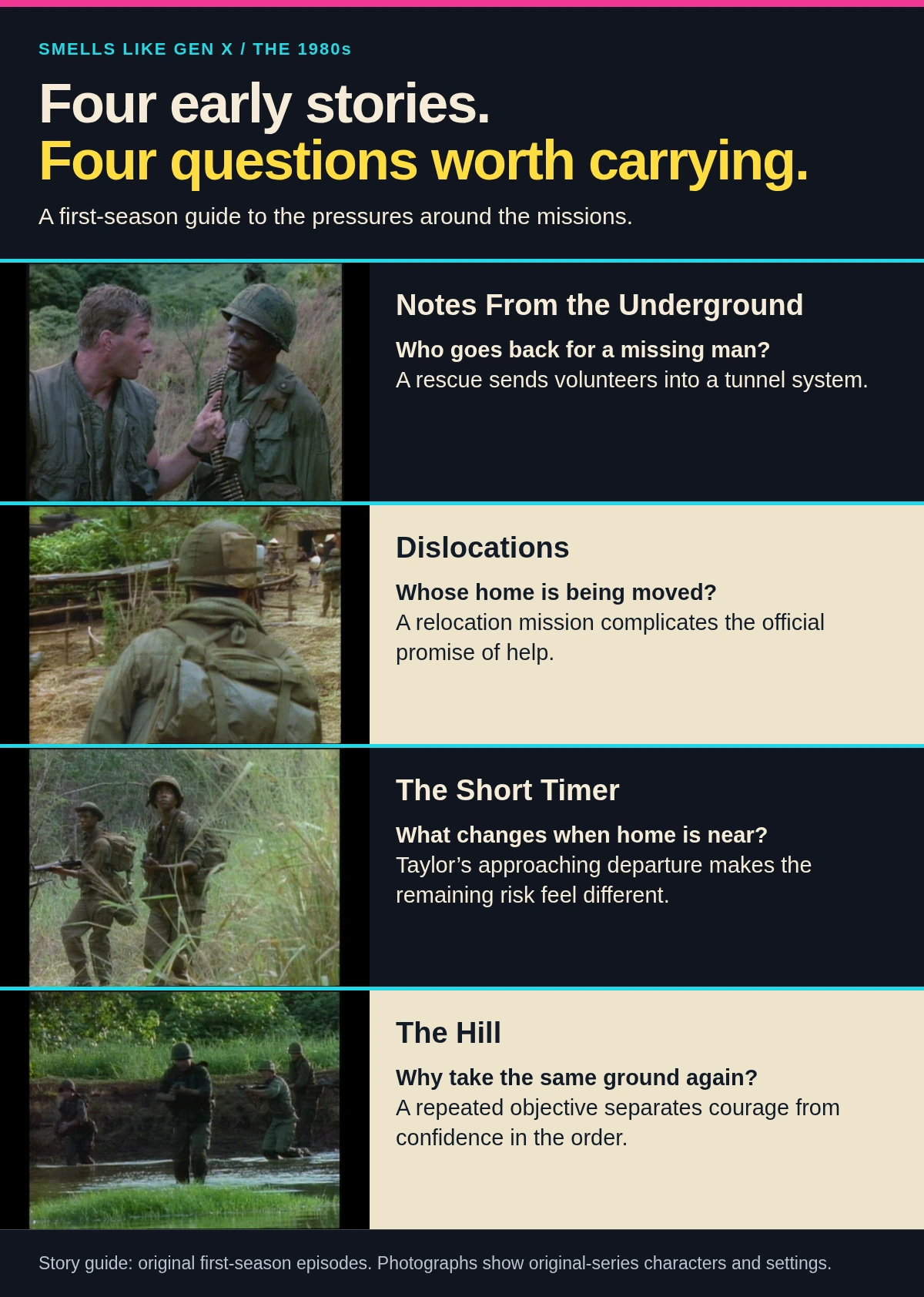
Notes From the Underground sends volunteers into a North Vietnamese tunnel system to rescue Taylor. The rescue objective is immediately understandable: a member of the group is missing and others are going after him. The environment makes that familiar loyalty physically difficult.
A tunnel changes the meaning of ordinary movement. Space narrows, visibility changes and the ability to retreat can no longer be assumed in the same way. The landscape isn’t an open picture a commander can inspect from a convenient distance. It becomes a succession of places a body has to enter.
That gives the episode suspense without requiring the audience to know every detail of the wider campaign. We understand what the rescuers want and why achieving it will be dangerous. The continuing relationship supplies the reason the risk matters.
It is also an early reminder that the Americans don’t control every kind of knowledge in the setting. Another force understands and uses a physical environment the platoon must approach with uncertainty. Superior equipment doesn’t make every space legible.
The episode can be enjoyed as a tightly constructed rescue story while still prompting a broader question about the show’s viewpoint. We follow the Americans into the tunnels because Taylor is the person we know. The surrounding war contains other lives and purposes the episode won’t be able to follow equally. Keeping that limitation visible doesn’t remove the immediate fear; it keeps the fear from pretending to be the entire account.
Dislocations Makes a Mission's Description Part of the Problem
Dislocations gives the company an assignment involving the relocation of Vietnamese villagers. The official idea is that American technology is helping. The practical work requires moving people from a place they inhabit, which immediately raises questions a reassuring description may not answer.
That is fertile ground for a platoon drama. The men can complete a task without having the authority to determine whether the task is wise. A plan that sounds orderly at a distance becomes contact with households, possessions and people whose reasons for resisting may be more substantial than the schedule allows.
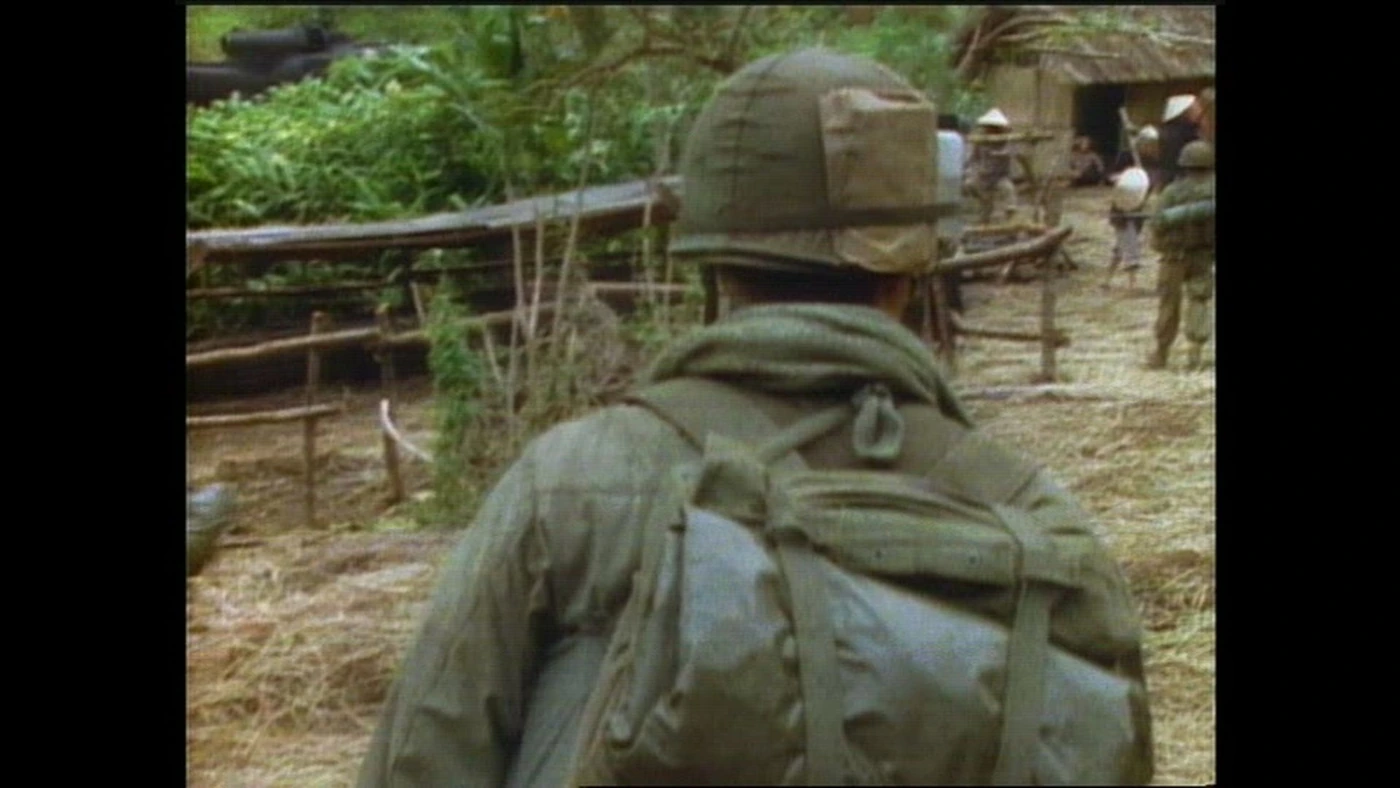
The episode also changes what the audience is asked to notice. A civilian settlement cannot responsibly function only as scenery on the way to the next firefight. The people living there have ties to the location that don’t begin when the American characters arrive.
The series’ American focus remains a limitation, but a story like this can at least make the limitation uncomfortable. Helping is not a neutral word simply because someone in authority has used it. The effects of a mission need to be considered alongside its stated purpose.
I appreciate this kind of early episode because it prevents the show from becoming a sequence of dangers that automatically justify themselves. The soldiers’ exposure to harm is real within the drama. So is the possibility that an assignment imposes harm or loss on somebody else. The two facts belong in the same conversation, however difficult they make the familiar characters’ job.
Burn, Baby, Burn Brings Racial Conflict Inside the Unit
Burn, Baby, Burn places racial tension within the platoon’s world, with Johnson accused after a racist soldier is killed. The story makes it impossible to treat division as something safely confined to the country the men have left behind.
A shared task does not guarantee equal treatment. The series can show men depending on one another physically while still carrying assumptions and hostilities that damage the group. A general statement about brotherhood can’t settle the accusation or remove the conditions that make it believable to particular people.
Johnson’s place in the continuing cast gives the situation weight beyond a guest story about intolerance. The audience has a relationship with him. That familiarity can expose how little some of the other men have been willing to understand, even while serving beside him.
The risk in a television construction like this is making one murder mystery carry the whole subject of racism. Finding an individual answer doesn’t repair a system or explain every experience within it. The episode’s immediate resolution should not be mistaken for the end of the underlying conflict.
Still, the choice to put the strain inside the unit matters. Tour of Duty cannot reserve every threat for the other side of a patrol. Its own familiar space contains power and danger. A return viewer can value the show’s willingness to disturb its central group while remaining alert to how quickly an hour of television may try to make the disturbance manageable again.
Nowhere to Run Gives Percell a Consequence He Cannot Leave in the Field
Nowhere to Run centers on Percell after he shoots a Vietnamese youth and goes absent without leave. The story turns attention from the immediate event toward what follows inside the person who acted. The unit’s next assignment cannot simply make that experience disappear.
Tony Becker’s continuing presence is important here. Percell isn’t a visiting case introduced solely to demonstrate a problem. The audience already has a developing impression of him, and the event has to be carried by that recognizable person rather than by a label called troubled soldier.
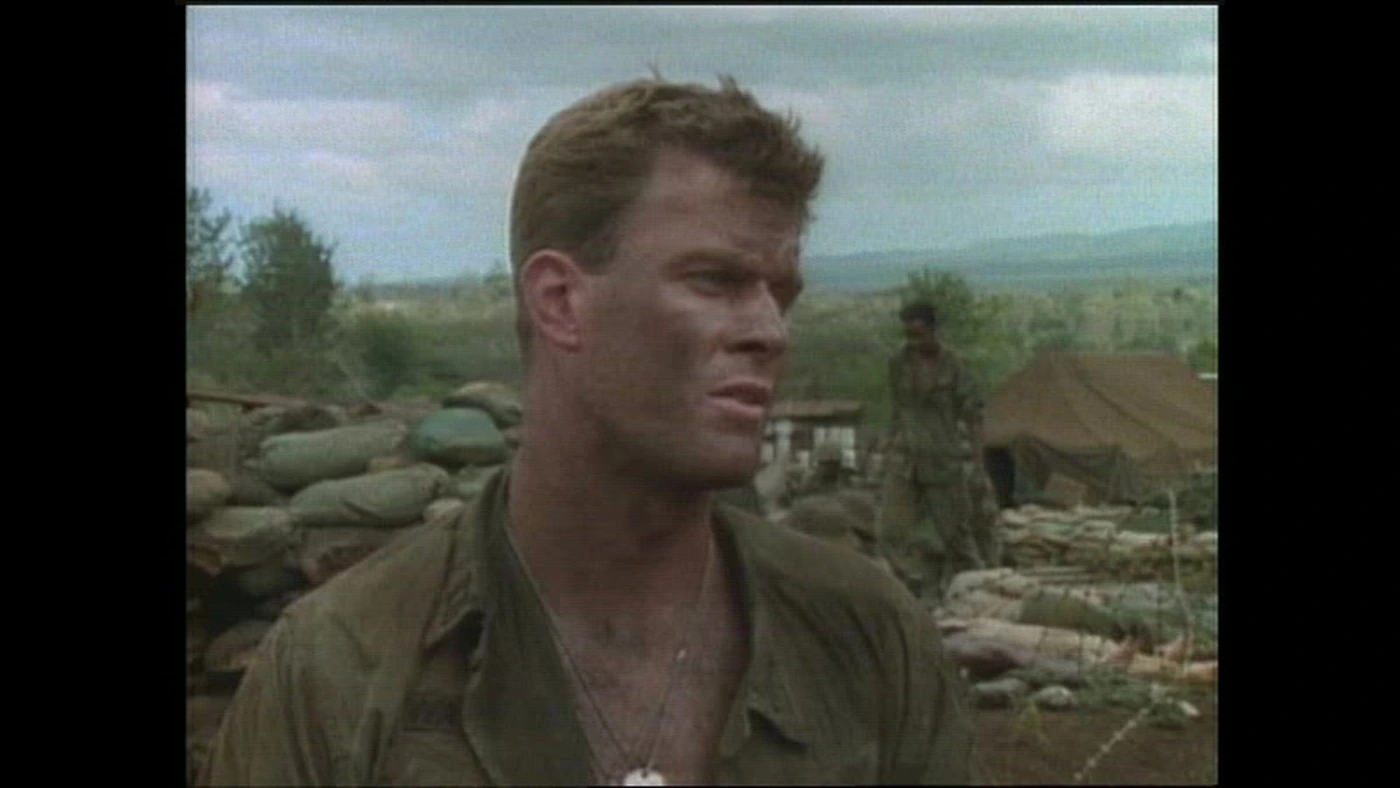
The absence creates practical demands as well as emotional ones. Other people have to decide how to find him, what his conduct means and what responsibilities remain to the man and to the group. Concern does not automatically tell them the appropriate response.
There is a hard representational imbalance to notice too. The Vietnamese youth’s death can become the occasion for following an American character’s pain. The series’ focus explains the choice without making it sufficient. A thoughtful viewing should remember that the event contains a lost life beyond the continuing character’s reaction.
That complication is part of why the episode belongs in a return to the early show. Tour of Duty is trying to give an action a moral and psychological aftermath. We can take that effort seriously while also asking whose aftermath the camera is prepared to remain with, and whose receives much less time.
Roadrunner Asks What Happens When the Experienced Man Is Tired
Roadrunner places Anderson’s fatigue alongside a letter from his daughter. The combination opens a useful crack in his established authority. The sergeant who has been expected to recognize danger and keep other people moving also has a body, a family and a limit to what repeated demands can take from him.
A leader’s exhaustion changes the whole group’s circumstances. It isn’t only a private problem. People may have built their confidence around the expectation that Anderson will notice what they miss, and that expectation can make his own vulnerability difficult to admit.
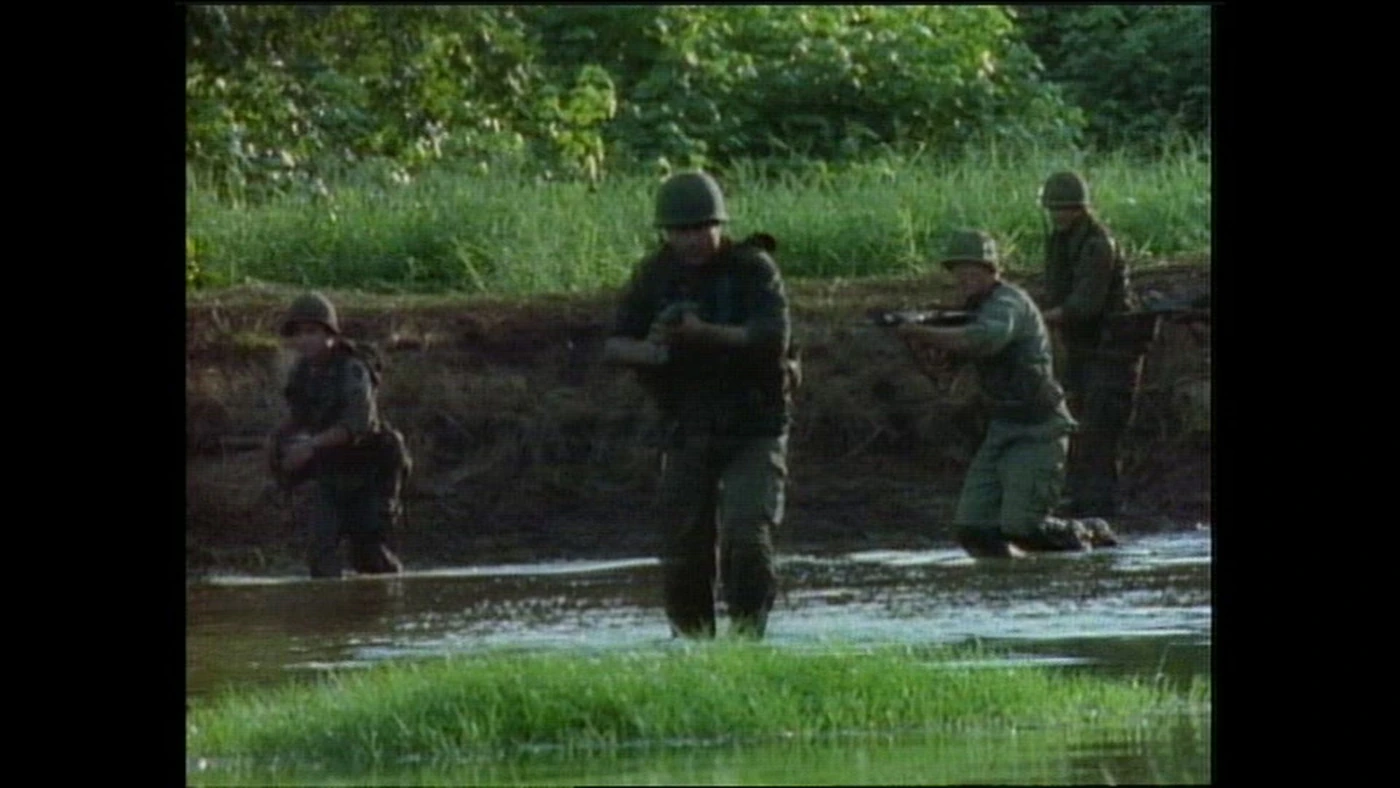
The family connection gives the strain another measure. A letter arrives from a life that continues elsewhere, with needs that the field situation cannot conveniently accommodate. Knowing someone is waiting doesn’t necessarily make the immediate job easier. It can make the distance more difficult to ignore.
The episode is valuable because it challenges the fantasy of permanent seasoned competence. Experience can improve judgment while also being the result of repeated exposure to things that wear a person down. Those effects aren’t opposites; they can be present in the same man.
On a return viewing, I find this a more revealing use of Anderson than simply giving him another chance to be right about a foolish plan. The platoon depends on his usefulness. The story asks what happens when usefulness has become the reason everyone assumes he can continue, even when continuing is exactly the question he needs somebody to notice.
Pushin' Too Hard Puts an Audience Inside the Mission
Pushin’ Too Hard introduces a television crew and a dangerous assignment. That changes the unit’s environment even before anything goes wrong. The men are no longer only carrying out work; they are being observed by people who will prepare some version of it for other viewers.
The setup gives a television series a chance to look at the temptation of a good picture. An image can be dramatic, clear and useful to a story while being a poor guide to the decisions that produced it. A camera’s presence may encourage behavior as well as record it.
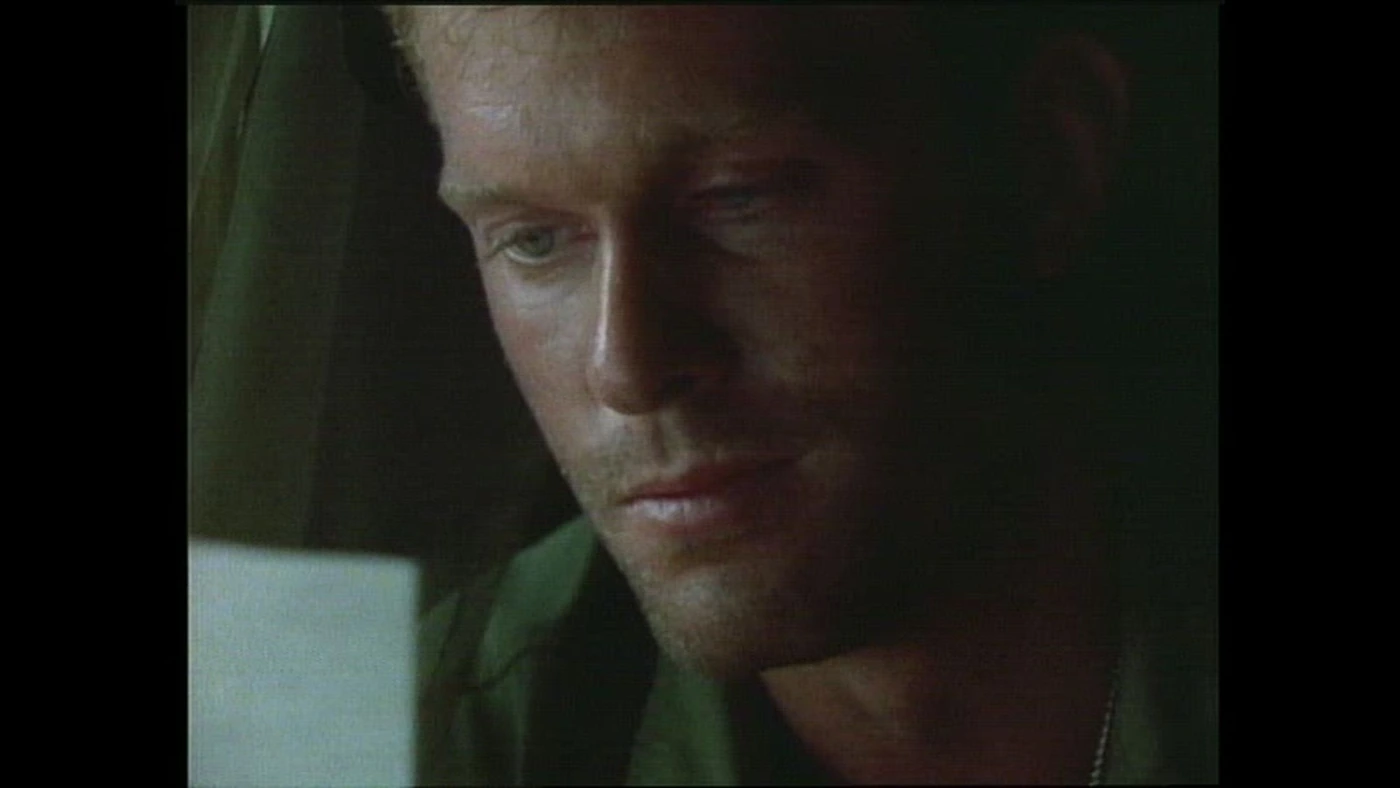
For the soldiers, being seen can have mixed value. Recognition matters. So does the possibility that someone elsewhere will understand a little more of what the work requires. But attention can also turn an individual into a representative of an idea they didn’t choose.
The viewer at home occupies an uncomfortable position. We are watching actors perform a story about people being watched. Enjoying the episode’s dramatic construction doesn’t make us immune to the same appetite for a clear image or a satisfying account.
That is what makes this episode a useful companion to the more straightforward patrol stories. It asks who gets to explain what the platoon has done and what a prepared audience is likely to receive. The danger exists in the field, but a second contest takes place over the version of the danger that will be carried away.
Under Siege Makes the Supposed Safe Place Answerable to the War
Under Siege brings an attack to a firebase whose readiness has already become a concern. The episode removes a basic comfort of the patrol structure: the idea that the men leave a recognizable center, encounter danger outside it and then return to the center afterward.
A fixed position can feel familiar without being secure. The routines of sleeping, preparing and waiting create habits the audience learns alongside the characters. When those routines fail, the setting itself becomes part of the threat instead of a reliable frame around it.
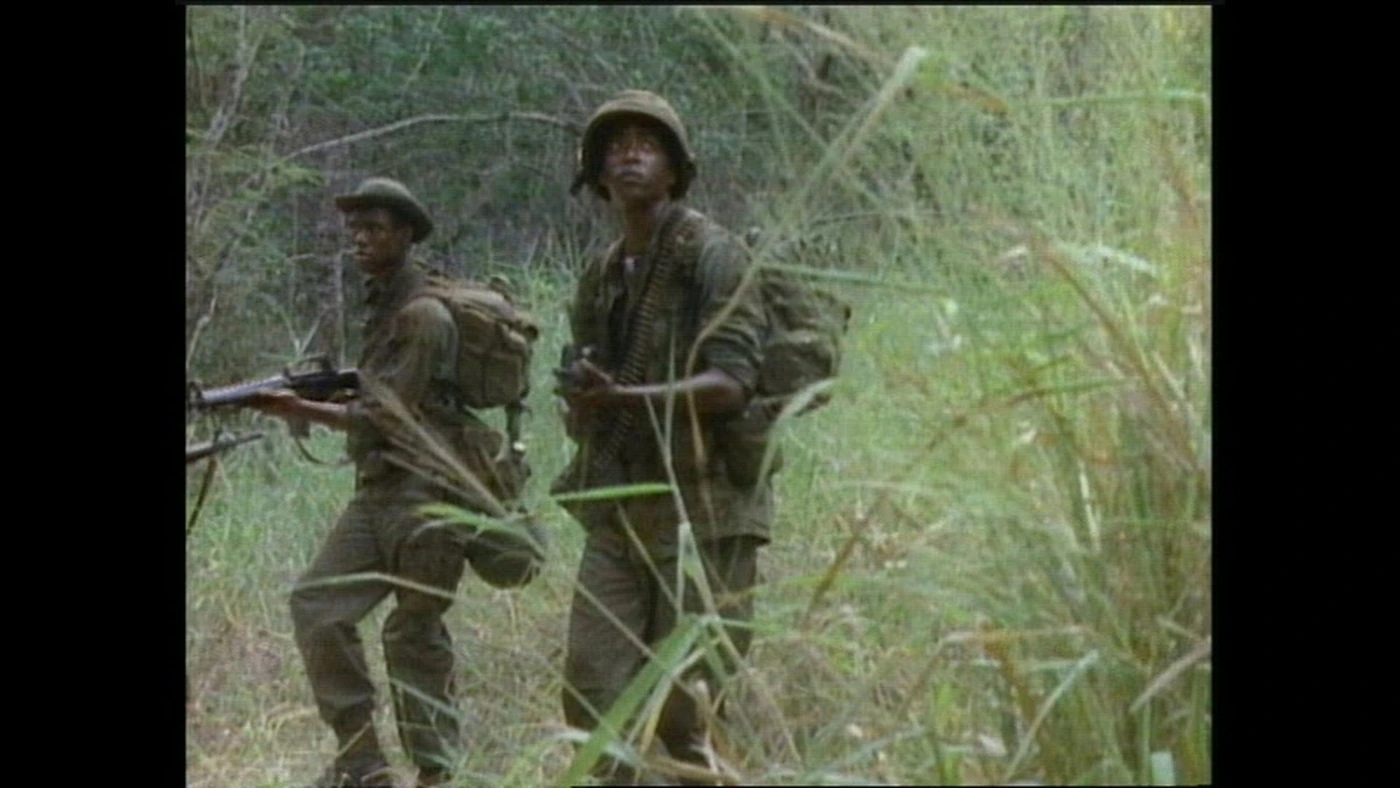
The episode also gives medical care a particularly stark position. A medic’s obligation to a patient can require remaining with someone when another part of the situation is demanding withdrawal. The job’s meaning becomes physical rather than ceremonial.
This is a story with significant consequences for the early group. A first-time viewer who wants to preserve those turns should approach it before browsing a list of character exits. The important point here is that the series allows danger to change the company, rather than merely keeping everyone occupied until the next familiar beginning.
For a returning viewer, the effect is partly cumulative. You know the men well enough that the episode’s pressure lands on particular relationships. The base is no longer only a location, and a loss is no longer only evidence that the show takes war seriously. It changes the conversations the series can have afterward.
Soldiers Takes the Men Out of the Setting That Explains Them
Soldiers gives the men leave in Hawaii. A change of location offers relief, but it also removes the context in which their behavior has become understandable to the audience. The habits that help them get through the field can meet a very different set of expectations outside it.
That makes leave more interesting than a simple pause between missions. A man may want ordinary pleasure while discovering that he can’t instantly perform the version of ordinary other people expect. The uniform can attract attention without producing understanding.
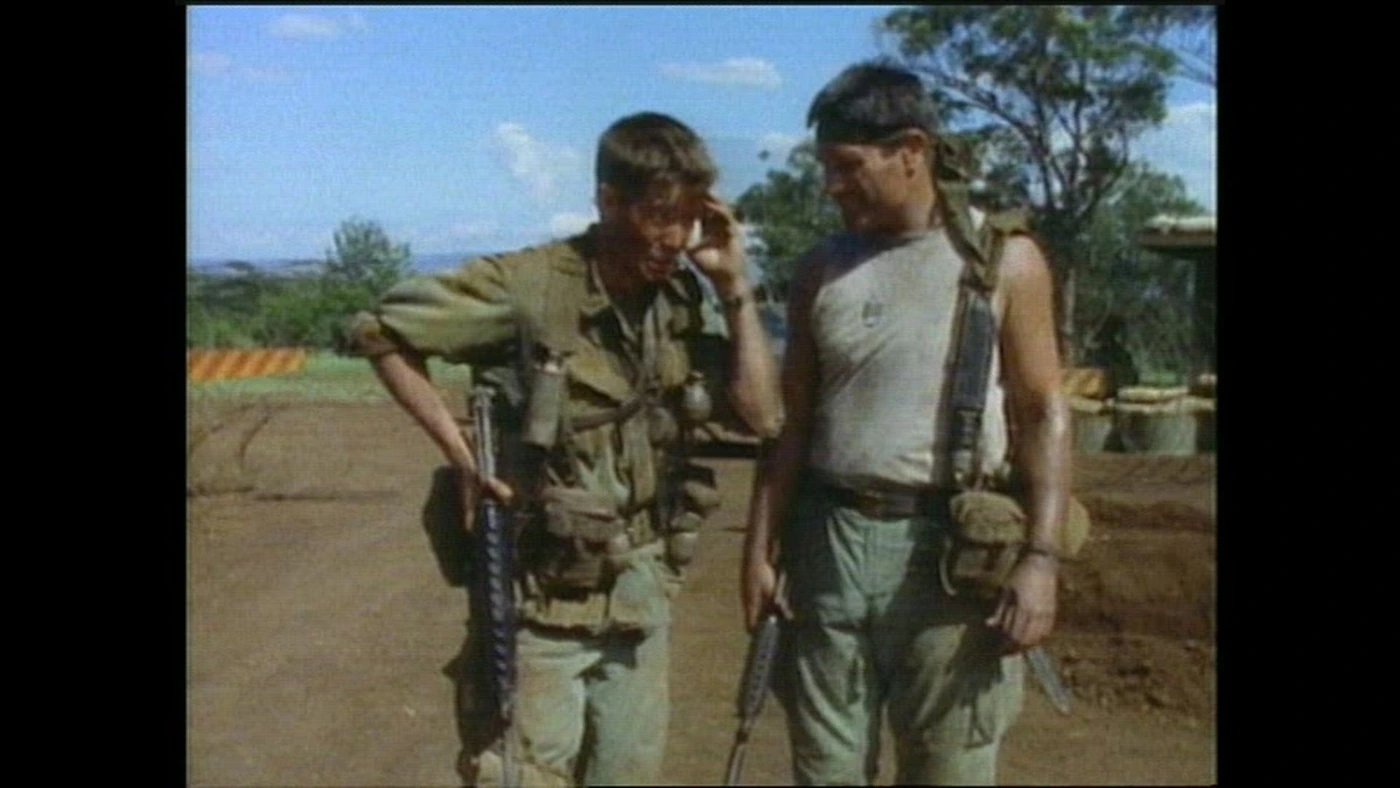
The episode’s civilian encounters also complicate the idea that the unit has one coherent audience waiting at home. People outside the war can respond with attraction, indifference, judgment or curiosity. The soldiers don’t all need or receive the same thing from those reactions.
It is useful to see the group in a setting where their immediate dependence on one another changes shape. In the field, staying together can be a practical necessity. On leave, the choice of company becomes more personal, and disagreements may have more room to surface.
I like these episodes when they allow discomfort to remain ordinary rather than turning every civilian into an uninformed obstacle. Returning to a social world requires more than transportation. The men have experiences they may not know how to explain, while the people meeting them have lives that didn’t stop while the soldiers were away. The conversation can fail without either side having entered it solely to be cruel.
The Short Timer Turns Going Home Into Another Kind of Pressure
The Short Timer gives Taylor the problem of nearing the end of his tour. A countdown sounds reassuring from outside: fewer days remain, so the danger should feel progressively more manageable. Inside the situation, the remaining exposure can become harder to tolerate precisely because leaving is imaginable.
That is a strong recurring-series problem. The audience has become accustomed to the character being present, while the character has a reason to want a life beyond the group. Our preference for another episode is not identical to his interest in getting home.
The approaching boundary can change the meaning of a risk. Something accepted earlier may now feel unbearable. A future that had to remain abstract begins acquiring rooms, people and ordinary plans. The possibility of losing it can sharpen instead of soften the fear.
The unit also has its own practical needs. It cannot suspend every task for the person whose departure is near. That mismatch creates friction without requiring a simple villain. An individual has a reason to protect the remaining days; the group still needs him to behave as a dependable member of it.
For me, the story exposes one of the central tensions in a war series. Television familiarity encourages continuity. A tour is supposed to end. The show can make a character’s desire to leave entirely understandable even while his departure threatens a relationship the audience has learned to value.
The Hill Makes Repetition the Thing You Cannot Ignore
The Hill gives the platoon a position to take again, after earlier fighting over the same ground. An objective that might look clear on a map becomes a question when the men have already paid for it and are asked to pay again.
That repetition changes the action. Moving uphill isn’t only a new obstacle; it carries memory of the previous effort. The audience is asked to consider what it means for a successful task to lead back to the same task, with the same people exposed to fresh harm.
Horn’s involvement gives the question a personal dimension. His relationship to the men can matter even while his confidence in the larger purpose is badly strained. Loyalty to the group and belief in an order are different things, and the episode gets force from allowing them to separate.
The story doesn’t need to become a complete account of military strategy to make that separation understandable. The men know the immediate cost of the objective. They have much less control over how the objective is selected, abandoned or presented as necessary again.
I find this one of the clearest early examples of what Tour of Duty could do when it let action produce a question instead of automatically answering one. The platoon can act courageously and still be caught in a situation whose logic deserves challenge. Admiring the men should not require the viewer to call every demand placed on them sensible.
The 1989 Second Season Changes the Surrounding World
In the television year of 1989, the second season began with Saigon introducing a changed environment and the approach of the Tet Offensive. The shift opens more room for city life, relationships and institutions beyond the early field setting, while the platoon’s dependence on Anderson and Goldman continues.
A location change is more than a production detail to the viewer. It changes where people can meet, who can enter a scene and what kind of private life appears possible. A patrol remains dangerous, but the time around it can acquire a different social rhythm.
The series also widens its continuing company. Kim Delaney’s Alex Devlin and Betsy Brantley’s Jennifer Seymour bring reporting and psychiatric work into relationships with the central men. Those roles provide other ways to ask what an experience means and how a person is managing it.
The expansion can be appealing without being uniformly successful. A viewer particularly attached to the first season’s immediate platoon life may feel the difference when more time goes to romance or the surrounding city. The show is negotiating how to continue rather than simply repeating the exact conditions of its introduction.
That negotiation belongs to its late-eighties history. The series wasn’t a frozen set of first-season images, however strongly those images remain in the memory. By 1989 it was trying to widen the lives around the missions, and the results make a different sort of return viewing possible.
Alex Devlin and Jennifer Seymour Change Who Can Ask the Questions
A reporter and a psychiatrist have very different reasons to listen. Alex Devlin’s work can turn an event into a public account. Jennifer Seymour’s work can ask what a person is able to understand or disclose about his own experience. Neither role is simply a romantic accessory, even when personal relationships become part of the story.
Kim Delaney gives Alex a position from which to challenge what is being presented as an acceptable version of events. A relationship with a soldier does not remove the professional question of what should be reported. Affection and responsibility can pull in different directions.

Betsy Brantley’s Seymour introduces another pressure around the experienced man who is accustomed to being useful. Anderson can have an opinion about everybody else’s readiness without being equally comfortable becoming the person somebody is trying to assess or help.
The danger for the writing is making the women exist mainly to reveal hidden parts of the male leads. The characters become more convincing when their work and choices have implications beyond how a man reacts. The series’ broader world needs other people to possess purposes of their own.
On a return visit, I think it’s useful to watch those scenes with both possibilities in mind. The relationships can deepen the central men, and they can also expose where the show is willing to grant someone else an independent point of view. Expanding the cast only expands the world if the new people are allowed to want something besides a better understanding of the old ones.
Another Promised Land Brings News of King's Death Into the Story
Tour of Duty’s second-season Promised Land addresses the racial tension following Martin Luther King Jr.’s assassination. Anderson also encounters related divisions while escorting a Black soldier’s body home. The episode brings the country beyond the platoon directly into the unit’s moral and personal surroundings.
The title needs care in a conversation about late-eighties television: China Beach also has a 1989 episode called Promised Land that addresses the same historical event. They are different dramas, not a crossover or a shared production story.
The parallel is revealing. Both shows reject the idea that service abroad places the characters outside America’s racial conflicts. The news reaches people whose experiences of the country are not interchangeable, and a generic appeal to unity cannot explain away the difference.
Anderson’s journey adds another contrast between practical duty and the society in which it is performed. Escorting a body is a specific responsibility. The circumstances around the responsibility can expose attitudes the task itself has no power to repair.
The episode is useful to a return viewing because it carries the argument beyond the boundary of one bad individual in the unit. The relationships in Vietnam and the response at home belong to a connected world. The show cannot responsibly describe the men as a complete miniature America and then act surprised when America’s conflicts remain present among them.
Friendship Is Necessary Without Being a Cure for Everything
The men’s loyalty gives Tour of Duty much of its appeal. You can understand why somebody would go back for a particular member of the group, or why a small recognition from a colleague would matter after a difficult day. The series gives companionship a practical weight.
But loyalty can also become a way to avoid a question. Protecting a friend may conflict with telling the truth about what happened. An insult can be dismissed as ordinary banter by the person who doesn’t have to absorb it. The group’s desire to continue functioning may pressure somebody to keep a problem quiet.
The better episodes allow that tension. Brotherhood should not operate as a word that makes every internal decision admirable. The men can need one another while still causing harm, excluding somebody or accepting an arrangement that deserves resistance.
That complexity distinguishes the show from a simple collection of action heroes assembled for a weekly victory. The group isn’t free to leave the institution and pursue whatever mission it considers morally satisfying. The men carry the pressure of orders, uneven information and dependence on the people beside them.
I appreciate the warmth most when it exists alongside those limits. A joke or a shared task can make an afternoon bearable without becoming an explanation for the whole war. The friendship is valuable because it helps particular people endure, not because it settles every question about what they are enduring or what they are being required to do.
Sound Makes the Threat Reach Beyond the Picture
A war drama cannot rely entirely on what the camera can show. Sound tells us that something is approaching, that the space is larger than the visible frame and that a familiar noise may require an immediate response. Tour of Duty uses that surrounding world to keep the men from looking as if they control every edge of the scene.
The effect can be physical even on a household television. A helicopter, an abrupt burst or a silence after activity changes the viewer’s expectation before the next image supplies an explanation. The sound gives a direction to attention.
It also helps distinguish the men’s state of readiness. A person who reacts before a newcomer understands the noise is carrying experience in a visible way. The production doesn’t have to stop for a lesson about what he has learned; the response demonstrates it.
The Television Academy recognized the series with the 1988 Emmy for Outstanding Sound Mixing for a Drama Series. Its sound work received additional nominations in 1989 and 1990. Those dates place the craft recognition inside the original run rather than in a later celebration of the show.
That is a useful part of the memory to recover. We tend to remember faces, the opening song and particular events. The work joining voices, environmental sound and sudden action is less easy to name, but it helps make those events occupy a place. The men can only react to the danger the program has made available to their senses and ours.
Paint It Black Became Part of the Show's Identity
The Rolling Stones’ Paint It Black is strongly associated with the original Tour of Duty opening. The choice gives the images an immediate force that isn’t the same as a conventional martial theme. It can energize the sequence while leaving its atmosphere unsettled.
That musical recognition became part of how viewers remembered the series. A familiar recording can attach itself to a set of television images until hearing it elsewhere briefly restores the show. The association belongs to the viewer’s memory as well as the production’s decision.
Later releases complicate that memory because the music has not been identical across every edition. A return on home video can therefore feel different before the story has even begun. It is unwise to assume that any current copy automatically contains every original recording.
The production history of the Fabulous Films UK releases is a useful documented example. The account by the people involved in its retrospective documentary identifies that edition as restoring the original music, including Paint It Black. That is a claim about a particular release, not a promise about every disc, region or streaming version.
For me, the larger point is how much music can contribute to the identity of a television hour. The plot may be intact while the emotional doorway has changed. Remembering the original opening doesn’t require us to turn the whole show into a music video, but it does mean the sound belongs in an honest account of what made the series feel the way it did.
A Television Platoon Is Still a Selection of the War
Tour of Duty follows Americans whose faces and relationships become familiar. That is a clear dramatic choice and a substantial limitation. Vietnamese characters do not consistently receive the same continuing space in which to explain themselves, change and remain known to the audience.
The distinction matters most when a Vietnamese person’s suffering becomes the occasion for an American character’s development. The soldier’s response may deserve attention, but the person harmed does not exist only to produce that response. A returning viewer can notice where the camera stays and where it moves on.
The unit is also arranged for drama. Different backgrounds and temperaments give the writers arguments to stage and relationships to develop. That construction can illuminate a pressure without making the group a statistically complete picture of every American who served.
None of this requires pretending the show had nothing useful to say. A limited perspective can still confront racism, fear, damaged judgment and the gap between orders and consequences. The useful approach is to recognize the scale of the claim rather than treating concern as proof of completeness.
I think the series rewards that kind of attention. You can care about Anderson, Goldman and the men without asking their story to be everybody’s story. The show becomes more substantial when attachment to its familiar characters leaves room to ask what the same situation looks like from outside their group.
The Drama Can Be Direct Enough to Show Its Seams
Tour of Duty sometimes makes a point with a large marker. A conflict may arrive in the form of a particularly obvious racist, an especially reckless order or a guest character whose behavior has been designed to force the central men into a decision. It is still network television organizing an hour.
That directness can be effective. A clear immediate problem gives the actors something to work against and the audience a route into the story. It becomes less satisfying when a single person’s bad judgment seems to explain a much larger system too neatly.
The same issue applies to emotional aftermath. An episode can focus attention on a man’s distress and then have less room than the subject deserves to follow it. A resolution may be necessary for the hour’s shape without being a convincing claim that the experience is over.
I don’t think returning to the show requires defending every shortcut. A favorite series can contain strong performances, useful questions and some conspicuously efficient writing in the same installment. Noticing the construction doesn’t cancel the feeling; it helps explain why one scene lands and another feels arranged.
The strongest hours give the men enough conflicting obligations that an answer has a cost. The weakest make a position obvious and then wait for the familiar characters to endorse it. Watching with that distinction in mind is more rewarding than deciding in advance that the entire series must either be a flawless classic or a period embarrassment.
China Beach Offers Another Place to Follow the Consequences
Watching Tour of Duty beside China Beach makes the different points of entry clearer. The field unit and the hospital world can exist inside the same broad historical setting while organizing attention around different work, relationships and rhythms.
A patrol has a route, an objective and an immediate problem of movement. Receiving the wounded brings another kind of responsibility, often one that begins when the patrol’s central action has already happened. Neither vantage point makes the other unnecessary.
The two shows also create different social groups. Tour of Duty’s platoon is bound by military structure and dependence in the field. China Beach includes military and civilian roles that meet around medical care, entertainment and personal arrangements. Their arguments don’t all pass through the same chain of command.
The comparison is especially useful because the programs reached viewers in overlapping late-eighties years. They were different fictional ways of returning to Vietnam through the ordinary household set. The audience could be asked to care about a mission one evening and about the people receiving its consequences another.
I wouldn’t turn the pair into a contest over which one owns the right to be remembered. Their differences make both easier to see. The war is larger than either program’s chosen company, and the space between the shows is an invitation to keep that larger picture in mind.
The Weekly Schedule Made Familiarity Grow in Small Pieces
Tour of Duty benefited from the way a recurring series gradually teaches you people. An expression, a voice over somebody’s shoulder or the shape of a joke could become recognizable before you had consciously memorized the character’s full name.
That recognition accumulated in the world of eighties television viewing. Episodes arrived within a week full of other obligations and programs. A character’s previous decision might remain in your memory without the immediate option of replaying the whole scene.
The format also made absence noticeable. If a familiar man wasn’t in the expected place, the viewer had reason to look for him. A new arrival could change the balance of the group even before an episode openly explained what would be different.
A TV Guide listing could tell you enough about an upcoming story to create anticipation without reproducing the full experience. The actual hour still had to make the names in that short description feel like people whose choices mattered.
Returning with episodes available together changes the pace, but the small pieces still count. It is worth letting the early conversations establish themselves rather than racing only toward the major events. A platoon becomes a recognizable group through the supposedly minor moments, and those moments supply much of the force when the larger story interrupts them.
The 1989 Changes Shouldn't Be Confused With the Whole 1990 Ending
The third season began in the fall of 1989 and continued in 1990. That means some of its changed personnel and later style belong to the eighties, while the conclusion of the original run belongs to the following year. The season number alone doesn’t answer the decade question.
A long-term memory of the series can blend those phases. An early field story, a second-season relationship and a later assignment all become part of the same mental collection. That’s understandable for a viewer, but less useful when trying to explain how the show developed.
Keeping the boundary clear also lets the first season stand on its own terms. Its platoon life has a particular texture. The wider social and professional world of 1989 adds something different. Neither needs to be treated as an incomplete version of the final episodes in order to be worth revisiting.
The original run’s movement is part of the appeal and part of the possible frustration. A continuing series has to find new circumstances, and a viewer may prefer one arrangement of people and places. That preference doesn’t require pretending the change never happened.
This return stops short of giving the 1990 conclusion an eighties label. The earlier work already contains plenty to consider: replacements, trust, racial conflict, the cost of a command and the question of what it means to keep following men through a situation they have reasons to want to leave.
A Return Route That Lets the First Season Establish Its People
Begin with the pilot and Notes From the Underground. Together they establish the uncomfortable routine of replacement and the immediate force of going back for somebody the unit knows. The men need a little time to become particular before the more demanding stories can have their full effect.
Dislocations and Burn, Baby, Burn then widen the questions beyond survival in a firefight. The missions and the group itself can contain arrangements that deserve challenge. An outside enemy is not the only source of danger or moral difficulty.
Nowhere to Run and Roadrunner make useful companions because each asks what happens inside a man expected to keep functioning. The circumstances and characters differ, but neither story lets practical usefulness erase the person carrying it.
Under Siege, The Short Timer and The Hill deserve attention within the developing group rather than as isolated famous episodes. The relationships leading into them are part of what makes the danger and disagreement matter. Viewers approaching the series for the first time may want to avoid character-exit summaries before those hours.
Then move into the 1989 second season and let its changed setting register. The wider company offers other ways of listening to the men and other pressures on their private lives. That route won’t settle which phase you prefer, but it gives the preference a real basis in what the show is doing.
Why the Platoon Still Has a Place in the Memory
The opening song can bring Tour of Duty back quickly. Staying with an episode requires more than the opening’s force. The series has to make a group of men feel particular, then let their attachment to one another exist inside questions it cannot neatly resolve.
Knox and Caffrey provide a strong center because authority remains a working relationship. Anderson’s experience and Goldman’s rank have to meet in decisions, with other people waiting for the result. The younger men make those results more than an exercise conducted between two leads.
At its best, the show gives loyalty both value and limits. It can help a person endure, bring somebody back and make a difficult hour bearable. It cannot automatically justify an order, repair a prejudice or provide the whole account of a war.
That’s the version I find worth returning to. The drama can be direct, occasionally too efficient and unmistakably shaped by its era. It can also make a familiar face in the frame carry enough history that an ordinary instruction to move has weight.
The original run continues into 1990, but its late-eighties place is secure: a CBS series asking the household audience to spend recurring time with soldiers in Vietnam, and to understand that caring about them was the beginning of the conversation rather than its final answer.
Questions About Tour of Duty in the Eighties
When did the original Tour of Duty air?
Tour of Duty aired on CBS from 1987 to 1990. The first season and the 1989 second season belong to its eighties history, as does the opening part of season three. The conclusion of the original run belongs to 1990.
Who played Anderson and Goldman?
Terence Knox played Sergeant Clayton Zeke Anderson, and Stephen Caffrey played Lieutenant Myron Goldman. Their relationship joins field experience, formal authority, disagreement and the practical need to trust one another’s judgment.
What was the original Tour of Duty theme song?
The original opening is associated with the Rolling Stones’ Paint It Black. Music differs among some later editions, so the original soundtrack should not be assumed for every release. The documented Fabulous Films UK editions restored original music, including that opening recording.
Is Tour of Duty connected to China Beach?
They are separate television dramas with overlapping Vietnam settings and late-eighties broadcast years. Tour of Duty concentrates on soldiers in the field; China Beach gives the hospital and surrounding ensemble a different emphasis. Their episodes titled Promised Land are different stories, not a crossover.
Is Tour of Duty a documentary?
No. It is a scripted drama with fictional continuing characters. Its stories can prompt useful questions about military life, race, authority and consequences, but the platoon’s perspective should not be treated as a complete historical account of the Vietnam War.
Sources & Further Reading
- Apple TV’s original-series record identifies the principal cast and early story premises.
- Notes From the Underground, Dislocations and Burn, Baby, Burn have individual licensed episode records.
- The Hill’s licensed description documents its repeated objective and character stakes.
- The first-season catalog and the 1989 second-season catalog provide story summaries for the original series.
- The Television Academy’s Tour of Duty awards record identifies the 1988 sound-mixing win and later nominations.
- UPI’s contemporary CBS schedule announcement records the network’s original placement and description of the new drama.
- The retrospective documentary production account identifies participating cast and crew and the original-music restoration in the specific Fabulous Films UK releases.
- For What It’s Worth and Popular Forces document Jennifer Seymour’s role in the 1989 stories.