Super Friends and the Saturday Morning Superhero Boom

Super Friends and the Saturday Morning Superhero Boom
TROUBLE ALERT CHANNEL 70s HERO GUIDE ONE HALL • ONE TEAM • ENDLESS EMERGENCIES
Smells Like Gen X • Meanwhile, at the Hall of Justice

Super Friends and the Saturday Morning Superhero Boom

Super Friends put Superman, Batman, Robin, Wonder Woman and Aquaman in one headquarters and made the entire DC universe feel close enough to visit before lunch. For millions of children, the Hall of Justice was not a crossover event. It was simply where heroes went to work.

The show changed names, lineups and formats across the 1970s, but its promise remained steady: the trouble alert would sound, the team would divide the mission and every power—from super strength to turning into a bucket of water—would eventually matter.

Quick Answer • Hall of Justice Desk

Why did Super Friends matter to Saturday morning television?

It made a shared superhero universe understandable to children. The series gathered DC’s most recognizable heroes, gave them a common headquarters and translated comic-book spectacle into stories built around teamwork, rescue, problem-solving and lessons parents could live with.

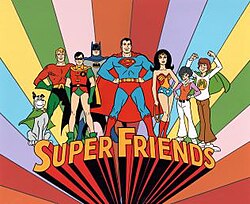
The original Super Friends team, including Superman, Batman, Robin, Wonder Woman and Aquaman
Meanwhile, at the Hall of Justice…The alarm sounded, the map glowed and somebody divided the mission before the cereal got soggy.
The Saturday Morning Superhero Boom

Why the show was bigger than its stiff animation

Super Friends simplified DC mythology, but that simplification became an enormous front door for children who had never entered a comic shop.

The whole universe finally lived in one place

Batman no longer belonged to one isolated adventure while Superman lived somewhere else. Wonder Woman did not need a special guest appearance. Everybody reported to the Hall of Justice, listened to the emergency and divided the crisis like the world’s most overqualified group project.

That shared-space idea made continuity intuitive. Children did not need publication histories or crossover charts. If a hero walked through the hall, the hero belonged to the same world. The series taught the basic relationships first; the comics could provide the deeper mythology later.

For Gen X, the show became part of the Saturday morning operating system. We remembered the narrator, the trouble alert, the transformation ritual and the villains holding meetings in a swamp before we remembered which title card belonged to which season.

Hanna-Barbera Development File

DC’s Justice League became television’s friendlier team

The original 1973 series was designed for a Saturday morning environment that wanted adventure, cooperation and very little visible injury.

The source

A Justice League foundation

The core idea came from DC’s established team tradition: major heroes combining powers against threats too large for one champion. Television softened the branding and the conflict, but the shared-universe appeal remained intact.

The network climate

Adventure under new rules

By the early 1970s, networks faced pressure over violence in children’s programming. Super Friends responded with danger that could be solved through investigation, rescue, invention and cooperation rather than extended combat.

The junior partners

Wendy, Marvin and Wonder Dog

The original young members gave viewers a human-scale route into the headquarters. They asked questions, investigated clues and contributed without powers, making bravery look available to ordinary kids.

The evolution

From social problems to supervillains

Later revivals increased the pace, widened the roster and embraced comic-book spectacle. By the time the Legion of Doom arrived, the show had become a full team-versus-team superhero universe.
1970s Franchise Timeline

How Super Friends kept reinventing itself

The franchise disappeared, returned and changed titles repeatedly, which is why childhood memory often merges every version into one long trouble alert.

1973

The original Super Friends opens the Hall

Superman, Batman, Robin, Wonder Woman and Aquaman join Wendy, Marvin and Wonder Dog in longer, gentler stories built around global emergencies, science problems and cooperation.

1977

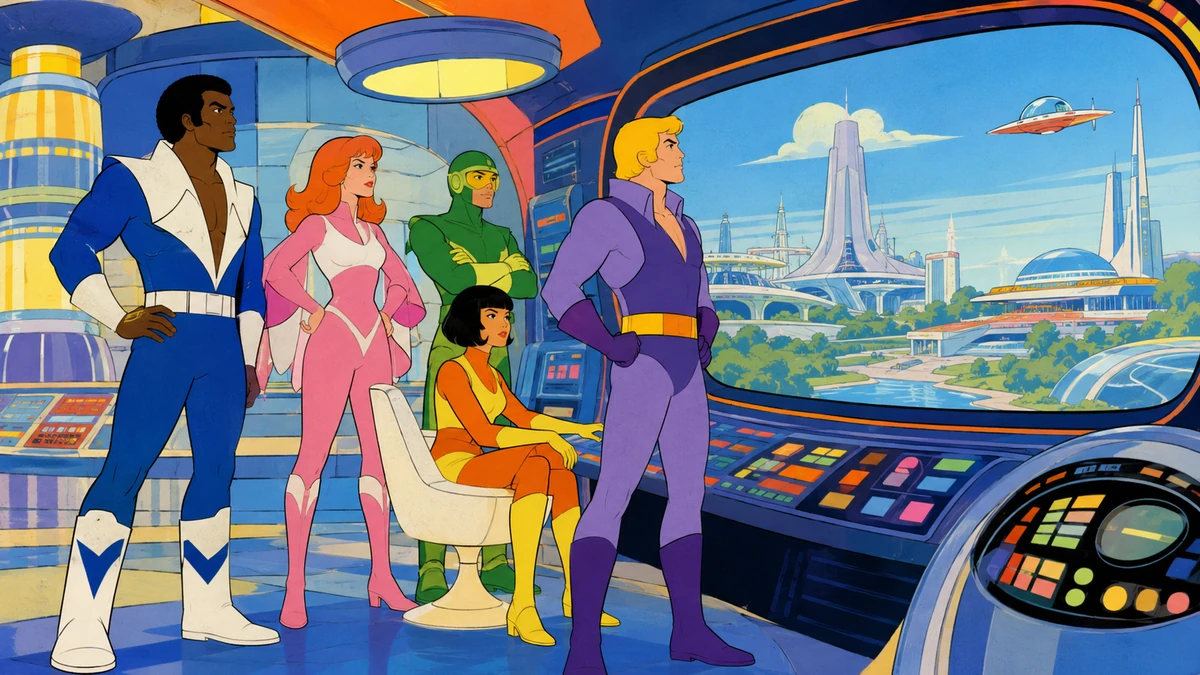
The All-New Super Friends Hour adds speed and the Wonder Twins

Zan, Jayna and Gleek arrive, shorter segments increase variety and “Wonder Twin powers, activate” becomes playground choreography almost immediately.

1978

Challenge of the Superfriends unleashes the Legion of Doom

Lex Luthor organizes a villain team, the swamp headquarters opens for business and the series finally embraces the comic-book rivalry many viewers remember most vividly.

1979

The World’s Greatest SuperFriends keeps the universe moving

The title changes again while the core team, shared headquarters and large-scale adventures remain recognizable. By the decade’s end, Super Friends is no longer an experiment; it is a durable television institution.

The Hall of Justice Roster

The characters made the universe readable

Every hero had a clear job, visual identity and power set that a child could understand before the opening narration finished.

The symbol

Superman

Superman provides raw power and moral certainty. The show often sends him toward the largest object in the story, but his calm presence establishes the team’s ideal: strength is useful because it serves people.

The planners

Batman and Robin

Batman brings deduction, gadgets and sentences beginning with “I have a hunch.” Robin supplies speed, enthusiasm and the exclamation point. Together they turn detective logic into Saturday morning momentum.

The warrior

Wonder Woman

Wonder Woman stands beside the male heroes with strength, flight, the invisible jet and the magic lasso. For many children, the series offered their most consistent animated access to the character.

The specialist

Aquaman

Aquaman becomes essential whenever the emergency reaches water, marine life or underwater civilization. The formula could limit him, but it also made his powers instantly clear to young viewers.

The first junior team

Wendy, Marvin and Wonder Dog

They investigate, ask the questions viewers need answered and prove the headquarters has room for courage without superpowers. Their ordinary status gives the original season a different emotional scale.

The transformation ritual

Zan, Jayna and Gleek

Jayna can become animals. Zan can become water, ice or increasingly specific objects made from water. Gleek usually ensures that a perfectly reasonable plan becomes television.

The Headquarters That Became Canon

The Hall of Justice made the universe feel physically real

It was less a building than a promise that every hero could be summoned into the same story.

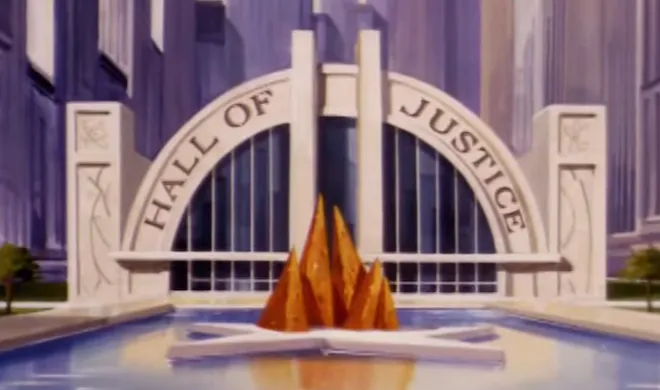
The Hall of Justice headquarters from the Super Friends animated series
The Hall of Justice gave the entire DC hero roster one unmistakable place to assemble.

A child could understand the architecture immediately

The giant façade, central table and glowing trouble screen told viewers that this was where the superhero world organized itself. The building gave the team permanence even when the title, episode format or supporting cast changed.

The Hall also became one of the rare television inventions to feed back into the larger DC mythology. Later comics, animation and live-action productions referenced or adopted it because the image communicated “shared heroic universe” in a single shot.

The Weekly Mission Plan

The formula turned teamwork into the real superpower

The structure was repetitive by design. Repetition let children understand the mission and anticipate where each hero would matter.

STEP 01

The trouble alert

A crisis appears on the giant screen with no respect for geography, jurisdiction or the team’s breakfast schedule.

STEP 02

Divide the mission

The heroes split into smaller teams so strength, deduction, underwater powers and junior-partner investigation can operate at once.

STEP 03

Discover the real problem

The apparent villain is often tied to pollution, reckless technology, misunderstanding or a plan with consequences larger than its creator expected.

STEP 04

Combine powers

No hero solves every part. The show repeatedly demonstrates that different abilities become more useful when coordinated.

STEP 05

Rescue before punishment

Civilians, cities and ecosystems usually matter more than defeating an enemy. The team saves first and explains afterward.

STEP 06

Leave a lesson behind

Safety, conservation, honesty and cooperation are stated clearly enough that nobody can claim the message was hidden in subtext.

The Villain Counterpart

The Legion of Doom gave evil its own conference table

The heroes had civic architecture and good lighting. The villains had a skull in a swamp and dramatically worse workplace culture.

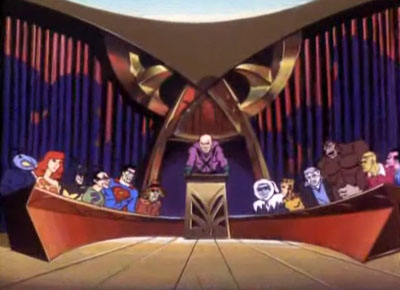
Lex Luthor and the Legion of Doom gathered inside their villain headquarters
Lex Luthor and the Legion of Doom gave Saturday morning television a villain team as organized as the heroes.

The perfect dark reflection

Lex Luthor, Cheetah, Sinestro, Black Manta, Captain Cold, Solomon Grundy and their colleagues gave the show recognizable enemies with personal history. Their organized alliance made the conflict feel larger than another isolated scientific accident.

The Legion’s headquarters was ridiculous, ominous and unforgettable. It turned villainy into a branded institution and established an ensemble-villain model later animation, comics, toys and games would keep returning to.

First-Watch Guide

10 essential Super Friends episodes

These ten episodes trace the franchise from the gentle 1973 format to the Legion of Doom era.

EPISODE01
The original mission statement

The Power Pirate

The series premiere sends the team after an alien draining electrical energy from Earth. Instead of treating the crisis as a straight brawl, the story divides the heroes across investigation, rescue and technical problem-solving, establishing the cooperative structure the franchise would keep returning to.

It is a useful starting point because the 1973 version is gentler and more procedural than the later Legion of Doom era. Wendy, Marvin and Wonder Dog participate alongside the powered heroes, and the episode shows exactly how Hanna-Barbera translated a Justice League-sized emergency into child-friendly Saturday morning television.

EPISODE02
A worldwide communication crisis

The Baffles Puzzle

A mysterious figure disrupts language and communication, giving the first season one of its most conceptual threats. The danger is not a giant monster or a familiar supervillain; it is the collapse of understanding itself, which forces the team to investigate patterns rather than simply overpower an enemy.

The episode captures the original series at its most earnest. It trusts a young audience to follow a problem built around symbols, translation and cooperation, while still delivering enough danger and movement to feel like superhero television rather than a classroom exercise.

EPISODE03
Automation before the personal computer

Professor Goodfellow’s G.E.E.C.

Professor Goodfellow creates a machine capable of performing nearly every task, and civilization quickly becomes dependent on it. When the system goes wrong, the Super Friends face a problem created less by evil than by convenience, overconfidence and the assumption that technology can replace judgment.

The story is unmistakably a product of 1970s anxiety about automation, but it feels surprisingly current. Its best idea is that the invention is not inherently wicked; the real danger comes from people surrendering responsibility because the machine appears efficient.

EPISODE04
Climate becomes the battlefield

The Weather Maker

A scientist manipulates weather patterns to improve conditions for his isolated homeland, creating destructive consequences elsewhere. The heroes must stop the crisis while recognizing that the villain’s motive grows from a real need rather than simple conquest.

That moral complication makes the episode stronger than its broad premise suggests. Aquaman has meaningful work, the team must divide across different environments, and the story demonstrates the early show’s habit of treating global problems as issues requiring both power and negotiation.

EPISODE05
The ocean demands attention

Dr. Pelagian’s War

A marine scientist attacks the surface world after years of pollution and neglect. The episode gives Aquaman a central role and turns environmental anger into a large-scale superhero conflict without pretending the underlying grievance is imaginary.

The message is blunt, but that bluntness is part of the period. Super Friends frequently used villains whose methods were unacceptable even when their complaint made sense. The heroes restore order, but the episode still asks viewers to notice what caused the crisis.

EPISODE06
The Legion of Doom arrives

Wanted: The Super Friends

Lex Luthor assembles a team of major villains and turns the Super Friends into wanted criminals. The episode introduces the swamp headquarters, the skull-shaped silhouette and the organized villain conference table that would become the perfect dark reflection of the Hall of Justice.

This is the point where the franchise becomes the version many Gen X viewers remember first. Familiar villains, larger schemes and a true team-versus-team structure give the series more comic-book energy while preserving the basic Saturday morning promise that cooperation will eventually defeat ego.

EPISODE07
History itself becomes the target

Secret Origins of the Super Friends

The Legion of Doom travels through time to prevent Superman, Wonder Woman and Green Lantern from becoming heroes. By attacking origin stories, the villains threaten not just one city but the entire structure of the heroic world.

The episode works because it understands that viewers already treat those origins as sacred mythology. Watching the team defend its own past turns continuity into adventure and gives the story a scale beyond another machine pointed at Earth.

EPISODE08
A toy-box premise at full size

The Giants of Doom

The Legion enlarges several villains while shrinking the heroes, creating one of the Challenge era’s cleanest visual hooks. The conflict is immediately readable: enormous enemies dominate the landscape while the heroes must improvise without their usual physical advantage.

It is not the franchise’s deepest story, but it is one of its most purely satisfying. Super Friends often worked best when the concept could be understood in a single image and then stretched into a series of team combinations, escapes and reversals.

EPISODE09
The franchise leans into horror

Swamp of the Living Dead

The heroes face ghostly forces and a supernatural atmosphere stronger than the original 1973 season usually allowed. The swamp setting, spectral danger and darker tone bring the program closer to the eerie comic-book adventures its early safety rules had often softened.

The episode matters because it shows how far the franchise had moved by the late 1970s. The Super Friends could still reassure younger viewers, but the stories were now willing to feel stranger, more dangerous and more visually dramatic.

EPISODE10
Heroes and villains on the same board

The Final Challenge

A cosmic being forces selected Super Friends and Legion of Doom members into a deadly contest. The setup creates unusual pairings, separates characters from their headquarters and makes the conflict feel connected to a universe much larger than Earth.

The episode reveals the dramatic advantage of a deep roster. Once the show had enough heroes and villains, it could create matchups that felt special simply by rearranging the pieces. That ensemble flexibility became one of the franchise’s most durable strengths.

How the Cartoon Was Built

Limited animation still created a giant universe

Held poses, recycled movement and urgent narration did not stop children from seeing a world much larger than the screen.

Visual clarity

Every hero read instantly

Bold costumes, symbols and silhouettes let a crowded team remain understandable even when movement was economical.

Narration

Every alarm sounded historic

The booming narration could make a weather disturbance feel like the collapse of civilization and gave short segments immediate scale.

Voice continuity

Familiar performances held versions together

Recurring voices made shifting titles, formats and lineups feel like chapters of the same larger program.

Design economy

Headquarters did heavy work

The Hall of Justice and Legion of Doom base instantly established sides, stakes and tone before the episode spent a frame on explanation.

The imagination supplied the missing frames: a held pose and urgent music could move a mountain when the symbol, voice and mission were already doing the dramatic work.
The Honest Rewatch

What aged well—and what did not

The series is easier to appreciate when its enormous influence and obvious limitations are allowed into the same room.

Still powerful

The shared-universe idea

Modern audiences expect heroes to cross paths. Super Friends made that expectation part of childhood long before cinematic universes became corporate road maps.

Still useful

Teamwork over perfection

The program repeatedly shows that different powers, viewpoints and levels of experience matter when a crisis is too large for one person.

Clearly dated

Stiff movement and dialogue

Limited animation, recycled action and formal speech are impossible to miss. Nostalgia does not need to pretend otherwise.

Worth discussing

Representation and tokenism

The expanding roster brought more nonwhite heroes to the screen, but characterization was often thin and some designs relied on stereotypes.

The Gen X Rewind

Why the show survives before the exact title cards do

Reruns merged seasons and formats into one long childhood shift at the Hall of Justice.

The headquarters was real enough to build from couch cushions

Gen X children did not need a licensing presentation to understand the Hall of Justice. It was where heroes worked. We drew it, built it from blocks and assumed every city had one just beyond the highway.

The Wonder Twins activation became playground choreography. The child assigned to Zan quickly discovered that “form of a bucket of water” was less satisfying than becoming an eagle, but the fist bump remained nonnegotiable.

The Legion of Doom taught us that villains also held meetings, which explained a lot about adulthood. Their swamp headquarters looked unsafe, dramatic and completely superior to any school building.

Beyond the Original Schedule

The legacy is larger than the show’s production limits

Later DC animation could refine or reject the tone because Super Friends had already taught a mass audience how the universe fit together.

It created access

Children who did not buy monthly comics still learned Superman’s role, Wonder Woman’s lasso, Batman’s planning, Aquaman’s underwater responsibilities and the basic idea that the heroes knew one another.

The Hall of Justice, Wonder Twins and Legion of Doom escaped the original program and became durable pieces of DC culture. Later creators referenced, reworked and parodied them because the images were already shared language.

The show’s deepest influence is emotional: it made the superhero shelf feel welcoming. The stories were simplified, but the door was open. Viewers could move toward richer comics and later animation at their own pace.

Meanwhile, at the Hall of Justice, an entire generation was learning that the universe worked better when everyone answered the same alarm.
Questions From the Hall of Justice

Frequently asked questions about Super Friends

The quick facts behind the original lineup, Wonder Twins, Legion of Doom and the franchise’s place in DC history.

When did Super Friends first air?

The original Hanna-Barbera series premiered on ABC in 1973. Revised versions and successor titles continued, with breaks, through 1986.

Which heroes were in the original Super Friends lineup?

The original core team featured Superman, Batman, Robin, Wonder Woman and Aquaman, joined by Wendy, Marvin and Wonder Dog.

When did the Wonder Twins join Super Friends?

Zan, Jayna and Gleek joined during The All-New Super Friends Hour in 1977.

What was the Legion of Doom?

The Legion of Doom was an alliance of major DC villains led by Lex Luthor and headquartered in a skull-shaped base in a swamp.

Was Super Friends the same as the Justice League?

The series drew from DC’s Justice League concept but used the Super Friends name and a child-friendly television format built for Saturday mornings.

Why was Super Friends important?

It introduced generations of children to a shared DC universe and created or popularized lasting elements including the Hall of Justice, Wonder Twins and Legion of Doom.

What are good Super Friends episodes for a first-time viewer?

Start with The Power Pirate, The Baffles Puzzle, Wanted: The Super Friends, Secret Origins of the Super Friends, The Giants of Doom and The Final Challenge.

Why did Super Friends use so little fighting?

The series was produced during a period of increased concern about violence in children’s television, so stories emphasized rescue, problem-solving, teamwork and clear moral lessons.

Sources

Where the production history comes from

These references cover the series, Hanna-Barbera’s production history and the rise of superhero cartoons on Saturday morning.

First-watch guide: These ten episodes offer a useful introduction to the Hall of Justice, the Wonder Twins, the Legion of Doom and the show’s changing format.

Get the Weekly Gen X Drop

New videos, rewinds, and savage nostalgia — first.

SUBSCRIBE WATCH VIDEOS

MORE REWINDS