Designing Women in the 80s: Southern Wit and a Sitcom With Teeth
Julia, Suzanne, Mary Jo, Charlene, Anthony, and Bernice make Sugarbaker’s a workplace with warmth, wit, and a formidable supply of objections.
CBS, beginning in 1986. Four Southern women, an interior design firm, and a conversation nobody else gets to manage.

If Julia Sugarbaker began by being polite, you had a brief opportunity to appreciate it. Then somebody would say the wrong thing about her sister, her business, or the way women were supposed to behave, and the temperature in the room would change. A man who had expected a little agreeable conversation might discover that he had accidentally purchased a ticket to his own dismantling.
Designing Women put that possibility inside a lovely Atlanta house full of furniture samples, attractive clothes, ringing telephones, and women trying to get some work done. The business was interior design. The conversation had a much larger service area.
For Gen X viewers who encountered it alongside the family comedies of the late eighties, the office offered a different sort of adult room. These women had children, former husbands, current romantic troubles, bills, ambitions, and opinions that didn’t need to wait for a man to finish explaining the subject. They could be generous, vain, perceptive, furious, and occasionally magnificent at making an ordinary problem worse.
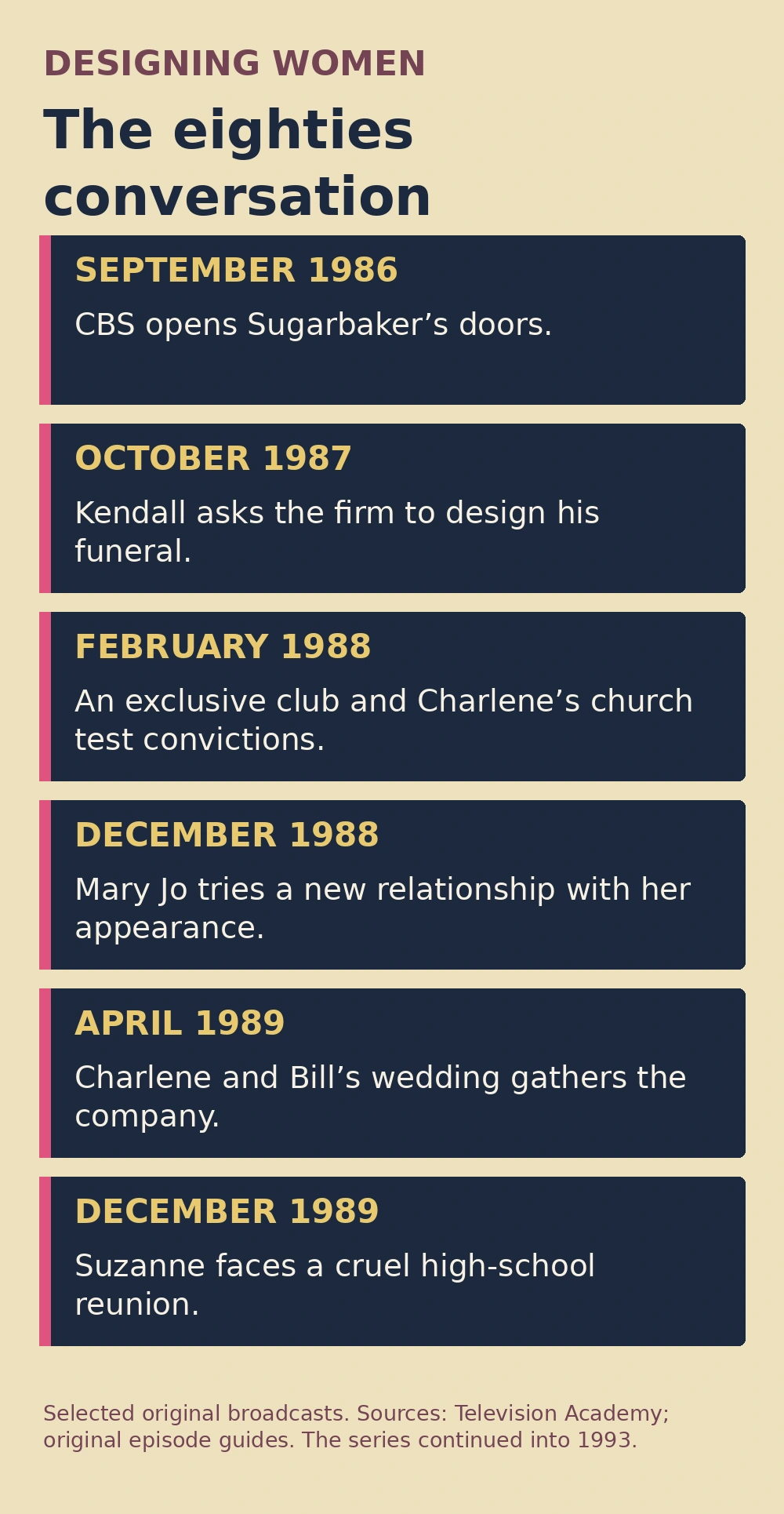
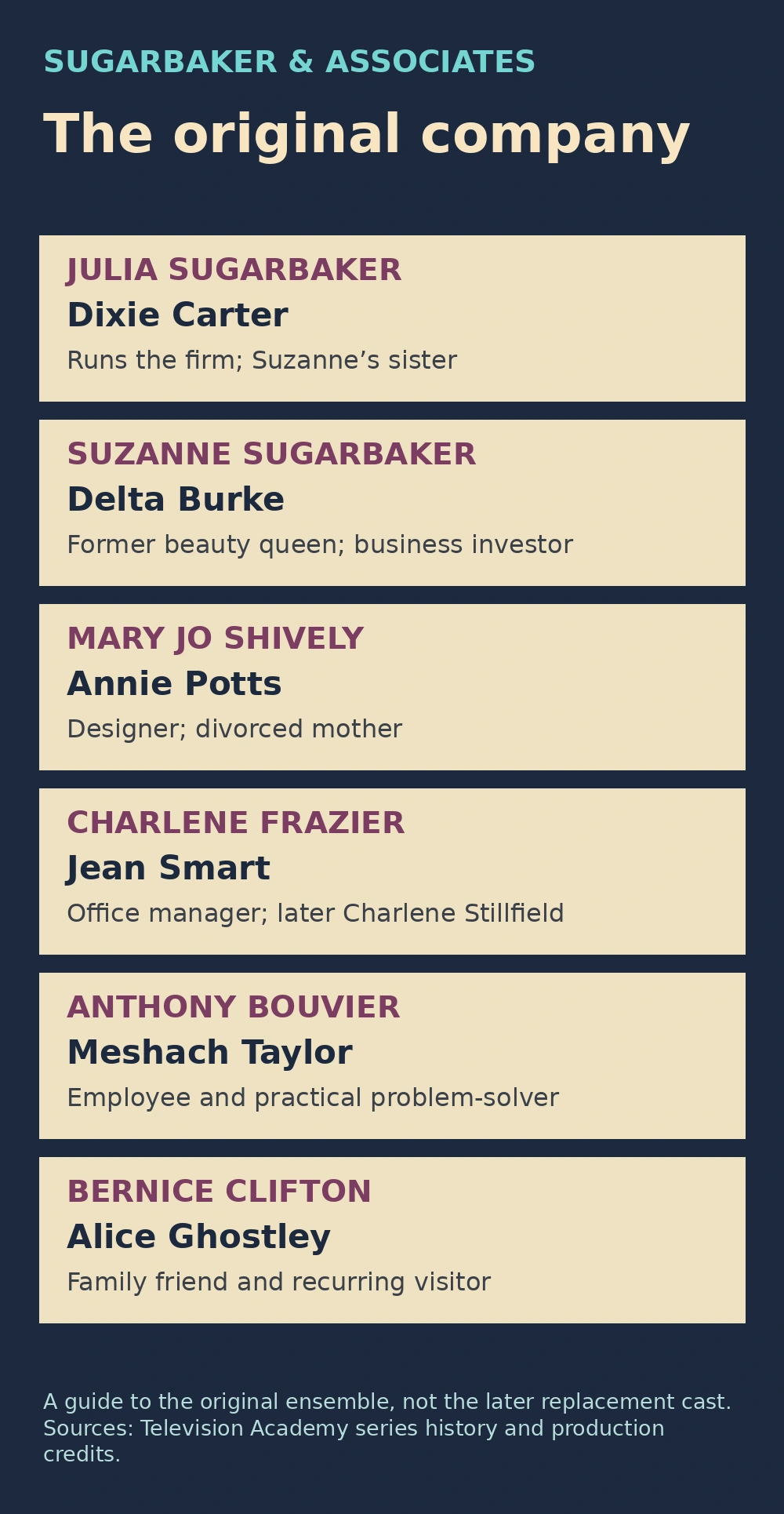
The original quartet arrived on CBS in September 1986: Dixie Carter as Julia, Delta Burke as Suzanne, Annie Potts as Mary Jo, and Jean Smart as Charlene. Meshach Taylor’s Anthony and Alice Ghostley’s Bernice helped turn the business into a company worth spending time with. Linda Bloodworth-Thomason supplied a voice that could move from a devastating joke to an argument about the world without pretending the women had stopped being funny.
The later cast changes and backstage disputes have taken up plenty of space in the show’s reputation. The eighties episodes deserve some of that room back. Start with the people working at Sugarbaker’s, and the reasons a disagreement over a client, a man, or a beauty contest could become the most entertaining thing on television that evening.
Inside This Article
- Four women open the conversation
- The room looked civilized. That was useful cover.
- Julia Sugarbaker can finish that thought for you
- Suzanne would like the world to return to its original offer
- Mary Jo has work, children, and no spare patience for your theory
- Charlene can tell you the whole story. She knows several more.
- Anthony Bouvier is trying to have a working day
- Bernice arrives with information nobody requested
- Julia and Suzanne can argue. You should probably stay out of it.
- The beauty contest produces a speech with a family history
- Suzanne would like to be taken seriously at work
- A good client can make a very awkward question
- Julia meets an age difference she hadn’t prepared a position for
- Reese Watson can make Julia less composed too
- A client’s money doesn’t buy Mary Jo’s consent
- A furniture bargain lands the designers on the wrong side of a cell door
- Kendall asks them to design his funeral
- Suzanne discovers a kind of attention she hadn’t ordered
- Anthony and Suzanne get the last motel room
- A very exclusive club asks the sisters what acceptance is worth
- Charlene has a question for her minister
- A decorating contest awards the firm a gas station
- Mary Jo tries on a different version of being noticed
- Charlene’s wedding brings the office to the ceremony
- Suzanne goes to a reunion and meets everybody’s entitlement
- Julia’s dignity gets stuck in the banister
- Southern voices that didn’t agree to be background noise
- The original company is the reason to come back
- A few questions from the Sugarbaker office
Four women open the conversation
Designing Women premiered on CBS on September 29, 1986. Creator Linda Bloodworth-Thomason placed the action at Sugarbaker & Associates, an Atlanta interior design business run from Julia’s home. The setting could accommodate clients and coworkers during the day, then reveal how little distance there was between their professional arguments and their personal lives.
The women weren’t assembled as four copies of the same viewpoint. Julia was commanding and politically outspoken. Suzanne, her younger sister and a former beauty queen, had strong ideas about comfort, appearances, and the attention she ought to receive. Mary Jo was a divorced mother with work to do and a dry response waiting. Charlene brought enthusiasm, stories, and a capacity to believe the best in a situation that could make everyone else nervous.
That arrangement gave the show more useful possibilities than a simple division into the wise woman and the fools. Julia could overreach. Suzanne could see a person more clearly than the sensible people expected. Mary Jo could be insecure. Charlene could discover a line she would not cross. They needed one another’s different ways of looking at things.
The debut belongs to the broadcast season ending in 1987. It arrived in a television landscape already full of successful comedies about households and workplaces. This particular room put Southern women in charge of both the work and most of the talking, with a willingness to disagree that made the conversation feel less like background music.
The office’s physical comfort helped. You could settle into the scene before anybody had settled the issue. The chairs looked inviting, the work seemed tangible, and the women had known each other long enough to interrupt without filing a request. Then an opinion would arrive that somebody else couldn’t let pass. Sugarbaker’s was open for business, and the business was about to pause for a response.
The room looked civilized. That was useful cover.

An interior design firm is a very good place to put characters who disagree about taste, money, and what a person is worth. Clients arrive wanting their lives to look a certain way. The people doing the work have to translate that desire into choices, schedules, and a bill somebody will actually pay.
At Sugarbaker’s, the work also made the house a social crossroads. A client could bring a problem through the door. A relative could turn a professional afternoon into a family argument. A personal crisis could unfold while somebody still needed to answer the telephone. The women didn’t inhabit separate worlds labeled business and friendship; they kept crossing the room between them.
The setting gave the dialogue something to lean against. Fabric, furniture, samples, paperwork, and appointments kept the people occupied. A long conversation could begin because they were already together doing ordinary work. It didn’t always need the ceremonial announcement that television was about to discuss a subject.
The physical beauty of the room also set up an enjoyable discrepancy. A polished environment can encourage a visitor to expect polished agreement. Julia’s manners might initially reinforce that expectation. Then the visitor discovered that an attractive chair did not include an agreement to tolerate whatever he felt like saying.
That is part of what makes the show satisfying now. The women could appreciate pretty things without being reduced to decoration themselves. Their work involved making spaces for other people. The series made sure they occupied their own, sometimes loudly, sometimes unwisely, and often with the confidence of people who knew there was another paying appointment after this argument.
Julia Sugarbaker can finish that thought for you
Dixie Carter gave Julia a speaking voice that could make a paragraph feel like a controlled detonation. Her delivery had shape. A mild opening could acquire precision, speed, and force until the person being addressed seemed to have very little useful territory left to stand on.
The pleasure wasn’t simply volume. Julia sounded as though she had followed the other person’s argument all the way to its unpleasant conclusion and was prepared to explain the route. The elegant posture and careful diction made the anger more pointed. She could be furious without surrendering the conviction that she was conducting herself properly.
That conviction could also make her ridiculous. Julia had a high opinion of her judgment and a very definite idea of how things should be done. Put her in a situation where her own behavior fell short and the comedy gained a particularly rewarding victim. Authority is funnier when it can be caught at an inconvenient angle.
She was also a sister, mother, employer, friend, and woman with romantic feelings. Those relationships gave her more to defend than a position in an argument. The celebrated speeches mattered because there was usually someone or something she cared about inside the complaint. Without that attachment, she might have become a very well-dressed editorial page.
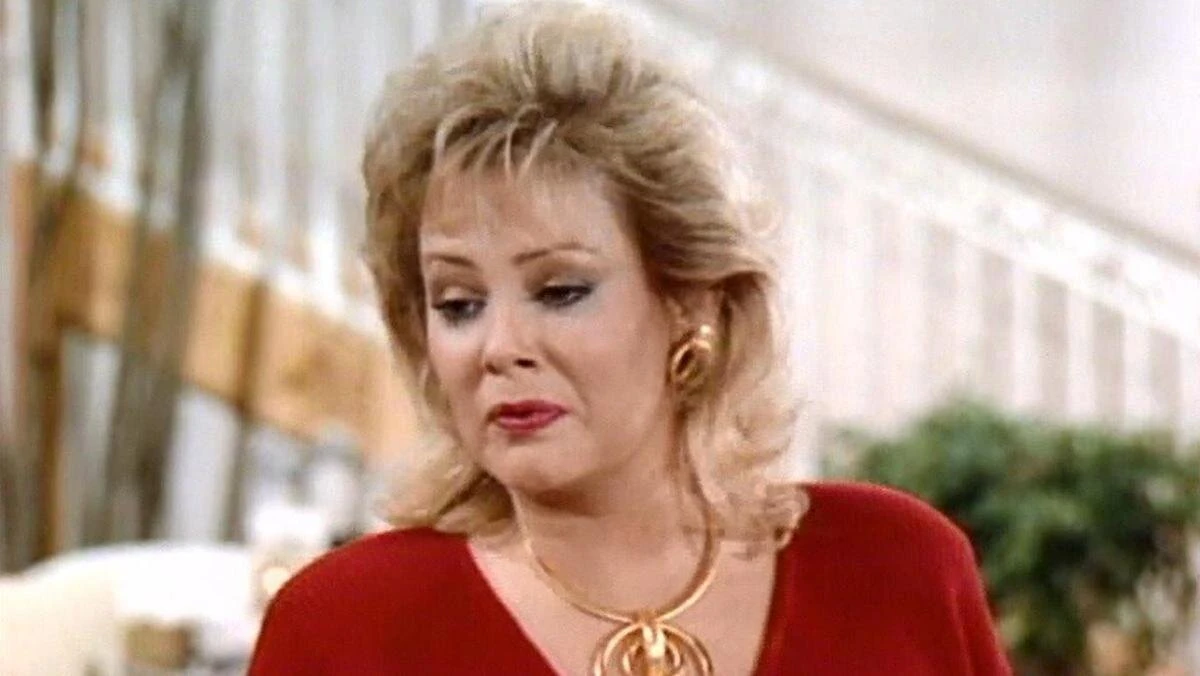
Carter kept the human attachments in view. Julia could be protective of Suzanne and maddened by her in the same conversation. She could want dignity while behaving jealously. She could have the right answer and still enjoy giving it a little too much. The show benefited whenever it allowed her to win the argument without guaranteeing that she had been the easiest person in the room.
Suzanne would like the world to return to its original offer

Delta Burke’s Suzanne Sugarbaker understood attention as something she had a reasonable claim to receive. Beauty contests had given her a public identity, and she had very little interest in pretending appearance didn’t matter after spending so much of her life being rewarded for it.
That could make her vain, demanding, and gloriously impractical. Suzanne might assess a crisis partly by how uncomfortable it was making Suzanne. The advantage of Burke’s performance was that the selfishness had a complete personality behind it. Her certainty could be enormous. So could her surprise when the expected arrangement failed to materialize.
She was also funny without needing Julia to provide a correction after every sentence. Burke could let a remark emerge with such complete confidence that the pause afterward did half the work. Suzanne didn’t think she was supplying a ridiculous observation for the sensible women to handle. She thought she had made a useful contribution.
The character’s vulnerability becomes clearer as the eighties episodes accumulate. Attention has conditions. A person whose value has been publicly tied to beauty can discover that the same crowd feels entitled to judge any change. Suzanne’s concern with appearances isn’t automatically admirable, but the show can understand why she has learned to defend that territory so fiercely.
The most affecting stories let the women see past the performance without requiring her to abandon it permanently. Suzanne can care for a child, feel wounded at a reunion, or be unexpectedly kind, then return to an extravagant demand. She doesn’t have to become modest to be a person worth loving. Julia may require a few minutes to remember that after the next expensive suggestion.
Mary Jo has work, children, and no spare patience for your theory

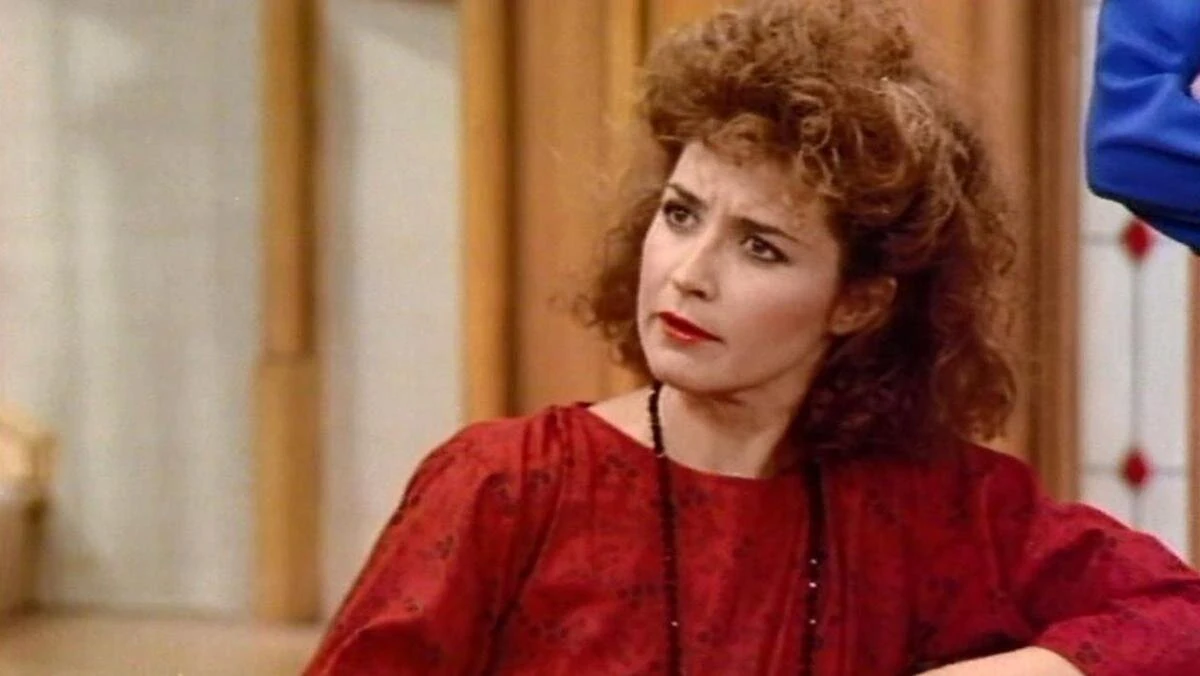
Annie Potts gave Mary Jo Shively a wonderful combination of practicality and pent-up exasperation. She could observe the other women’s behavior with a dry little reaction, then discover that her own emotional life had become the problem everyone was discussing.
Divorce and raising children gave her concerns a different daily weight from Suzanne’s preferred arrangements. Money mattered. Dating mattered, but so did the work of getting through the week. A romantic possibility didn’t arrive in a life with an unlimited supply of time and nobody else needing anything.
Potts could make Mary Jo quick without making her invulnerable. The sharp response might cover embarrassment or hurt. Her frustration with an ex-husband wasn’t merely an opportunity to deliver a joke about men; it belonged to a continuing relationship whose consequences didn’t disappear when the marriage did.
The pilot makes that awkwardness immediate when Suzanne dates Mary Jo’s former husband. It is an efficient way to show how tightly connected the women’s lives can become. A coworker’s evening out is suddenly a personal problem, and the person creating it doesn’t necessarily regard the connection as a reason to stop.
Mary Jo’s point of view is especially useful because she can appreciate an argument and still worry about the bill. In a room capable of producing a grand speech, she often has something more immediate at stake. Her practical concerns don’t make her less passionate. They make the passion feel lived in, with children waiting outside the elegant boundary of the current discussion.
Charlene can tell you the whole story. She knows several more.

Jean Smart’s Charlene Frazier brought enthusiasm to a room that could otherwise become an extremely efficient criticism service. Her stories could wander, her confidence in people could outrun their qualifications, and an appealing possibility might have her halfway down the road before the others finished objecting.
Smart made that openness active. Charlene wanted to participate. She could be excited by a person, a song, a romance, or a bit of news that everyone else was treating with less generosity. A character who believes the world might contain something wonderful gives skeptical coworkers a great deal to respond to.
The naivety could be played broadly, but it didn’t exhaust her. Charlene had convictions, including religious ones, and she could find herself needing to decide what those convictions required when authority disappointed her. Being sweet-natured wasn’t an agreement to surrender every difficult judgment to Julia.
She also gave the show a different sort of romantic energy. Her developing relationship with Bill Stillfield, played by Douglas Barr, carried genuine longing alongside the opportunities for comic interference. The women could be helpful, intrusive, amused, and protective about the same relationship.
For a viewer watching the four together, Smart’s contribution was the willingness to keep the room open. Julia could close an argument. Mary Jo could identify the practical problem. Suzanne could object to the accommodations. Charlene might still be interested in hearing more. Sometimes that led directly to trouble; sometimes it was the reason a person in trouble felt welcome enough to ask for help.
Anthony Bouvier is trying to have a working day

Meshach Taylor’s Anthony becomes the man who has to inhabit this very talkative workplace while also getting things done. Deliveries, errands, practical assistance, and the women’s personal complications can all find their way into his schedule.
Anthony’s experience of prison gives him a past the series can treat seriously, even when other characters are making the current situation absurd. He has had to rebuild a life. That history changes the meaning of a joke about trouble with the law or a casual assumption about what sort of person he must be.
Taylor supplies a different rhythm from the four women. He can be patient, wary, dryly amused, or suddenly at the end of the patience. A reaction doesn’t have to be large to make clear that he has understood exactly how unreasonable the proposed favor is becoming.
His relationship with Suzanne is particularly useful. Her sense of what she deserves can encounter the man expected to make an inconvenient part of it happen. Their disagreements are funny partly because they know one another. Anthony can recognize her vulnerability without being obliged to admire the demand currently attached to it.
He also widens the business beyond a discussion among four white women. Race, class, opportunity, and the judgment people make about a person’s past are present in his working life. The show doesn’t always escape the limitations of its own perspective, but Taylor gives Anthony enough intelligence and self-possession to make him a participant in the conversation, rather than a chair pulled up for somebody else’s lesson.
The eighties story is his growing place in that company. Later developments in the firm’s ownership belong to the continuation. Here, the immediate pleasure is watching someone try to complete a day’s work in a house where the people giving instructions are perfectly capable of becoming the chief obstacle.
Bernice arrives with information nobody requested
Alice Ghostley’s Bernice Clifton could change the direction of a conversation simply by appearing to have followed it. Her contribution might arrive from an angle the others hadn’t anticipated, delivered with the confidence of someone who didn’t consider clarification an urgent requirement.
Bernice is connected to the Sugarbakers through their mother, bringing another generation into the office’s complicated family. She isn’t an employee waiting to be useful. She has her own observations, interests, and reasons to visit, along with a capacity to make the women wonder how exactly they have become responsible for the next development.
Ghostley’s timing gives the character more than eccentric lines. The uncertainty can live in a look, a pause, or a statement that seems to have been completed to her satisfaction while everyone else is still trying to locate its beginning. She doesn’t need to compete with Julia’s verbal force.
The 1989 episode Bernice’s Sanity Hearing brings a more serious question underneath that running comedy. A niece wants her declared incompetent, and the women come to her defense. The story makes their affection practical: enjoying Bernice’s unusual company is one thing; speaking up when someone proposes taking decisions away from her is another.
Some of the jokes rely on confusion and forgetfulness, and a modern viewer can have mixed feelings about how easily old sitcoms treated those traits as a dependable laugh. What gives Bernice more staying power is Ghostley’s stubborn presence. The character remains someone the women know and care about, capable of having an opinion about a future other people have begun arranging around her.
Julia and Suzanne can argue. You should probably stay out of it.
The Sugarbaker sisters give the show an argument with a very long memory. They can disagree about money, manners, men, work, and what counts as a reasonable way to get through the afternoon. Their differences don’t require a stranger to provoke them. They can develop quite satisfactorily over an ordinary exchange between themselves.
Julia’s disapproval and Suzanne’s self-regard make a reliable pair, but the relationship would be thin if it stopped there. A sister can be maddening precisely because you know her so well. You remember what she was like before she learned to present the current version of herself to other people.
Carter and Burke can let that familiarity sit beneath an insult. Julia may be exasperated by Suzanne’s performance, yet she also knows the person being protected by it. Suzanne can push Julia’s dignity because she knows where it is most carefully assembled.
Then an outsider makes the mistake of treating the disagreement as permission. A complaint that Julia can make about her own sister doesn’t necessarily become available to the room. That double standard has supplied family comedy for generations because it is immediately recognizable. Affection doesn’t prevent the fight; it determines who is allowed to join it.
The relationship also gives Julia’s famous protective speeches an emotional charge. She isn’t defending an abstract idea of a vain woman. She is defending Suzanne, with all the irritation and love that includes. The fact that she may return to criticizing her later doesn’t cancel the defense. It is the privilege of someone who plans to remain in her sister’s life after the visitor has gone.
The beauty contest produces a speech with a family history

In the first season’s The Beauty Contest, Mary Jo’s daughter Claudia enters a preteen pageant, with Charlene’s encouragement and Suzanne’s considerable expertise available. The setting puts several ideas about appearance and success in the same room: a child hoping to do well, adults deciding what that should involve, and a former titleholder who has lived inside the machinery.
Suzanne’s knowledge is real. The fact that the others can find her vanity exasperating doesn’t make her ignorant about the world that helped create it. Pageants have rules, techniques, expectations, and a particular way of making a young woman’s performance into a public judgment.
The episode also gives Julia the defense of her sister that became one of the series’ most replayed moments. A reigning beauty queen disparages Suzanne. Julia responds by recalling Suzanne’s pageant triumph and baton performance with a level of detail that makes the family pride unmistakable.
The scene is funny partly because Julia has an enormous store of information ready for exactly this purpose. She may consider Suzanne’s priorities frivolous on an ordinary day. She has nevertheless remembered the accomplishment, the spectacle, and the effort. Anyone assuming she has no respect for her sister has misunderstood the family arrangement.
It also complicates the show’s view of beauty. The women can question what a contest asks of Claudia without pretending Suzanne’s achievement meant nothing to her. Julia’s defense turns a public image back into a person whose sister was watching. Carter’s delivery does the rest, leaving the person who began with the casual insult in considerably less command of the room.
The remembered payoff invokes the lights going out in Georgia. The pleasure lies in hearing Julia build toward it, fully certain that her sister’s story deserves to be told properly. A half-hour comedy had found a way to make an extravagant pageant memory feel like an act of loyalty.
Suzanne would like to be taken seriously at work
Design House, from the first season, gives Suzanne a complaint with more substance than the women might initially expect. She is tired of being treated as the pretty front of the business and wants to do design work herself. The request asks them to see a capability beyond the one everybody already recognizes.
The women have grown comfortable knowing who does what. Sugarbaker’s depends on different kinds of contribution, and that familiarity can become an obstacle when Suzanne asks for work outside her usual role. A person who has been useful as an image may discover how difficult it is to persuade her own colleagues to look elsewhere.
The project goes disastrously wrong when her work burns. The catastrophe supplies a large comic setback, but the desire that led her into it remains understandable. Suzanne wants a claim on the business that doesn’t depend entirely on looking right in the room.
Burke can let that need show through the character’s usual confidence. Suzanne may not express herself with Mary Jo’s practicality or Julia’s carefully developed argument. She can still recognize that being dismissed hurts. The comedy is richer when the women have to consider whether their assessment of her has become too convenient.
The episode is a useful early promise. The former beauty queen will keep making demands and giving the others reasons to roll their eyes. She can also want something they ought to take seriously. Sugarbaker’s isn’t improved by assuming that the people working together have already discovered everything worth knowing about one another.
A good client can make a very awkward question
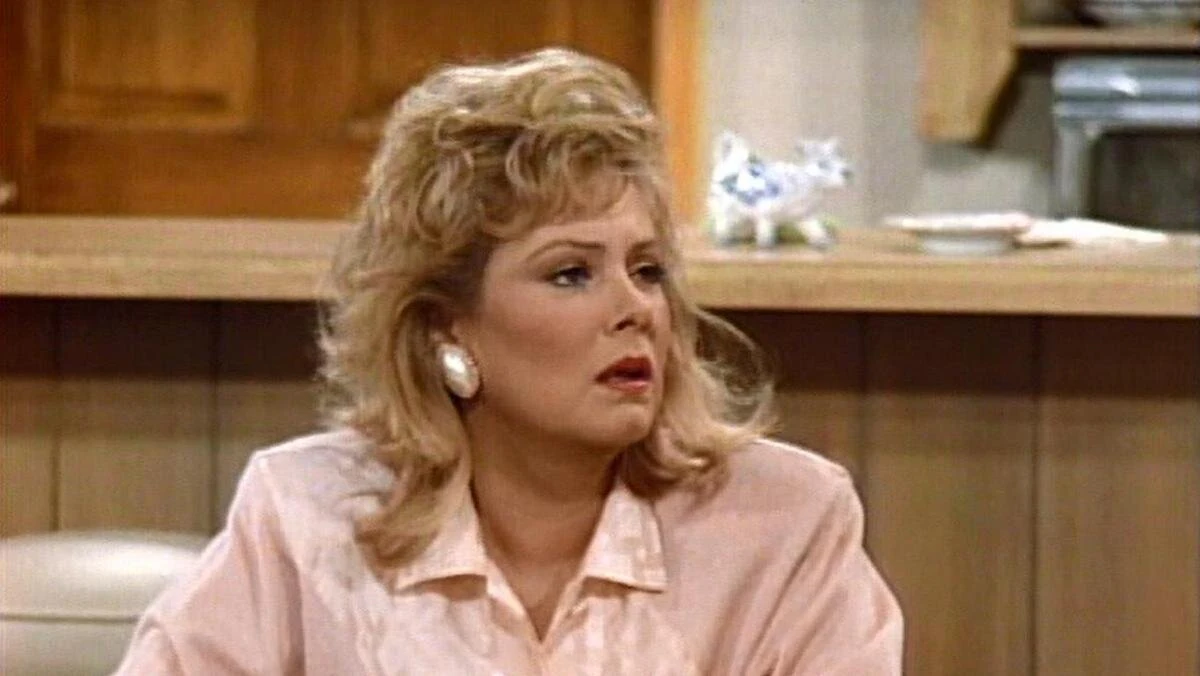
The first-season episode Monette brings Charlene’s old friend back into her life as a potentially lucrative client. The women then have to consider the source of the money when they learn that her work is prostitution. A decorating commission becomes a question about friendship, judgment, and the moral comfort of accepting a check.
The setup is especially useful because it distributes the pressures. Charlene knows a person from before the new information arrived. The business sees work it could use. Each woman has an opinion that can become more complicated when it has to be applied to somebody sitting in front of her.
That is familiar ground for Designing Women: a declared principle meets an actual visitor. A person can sound very certain while discussing a category of people. It becomes harder to keep the category tidy when the person has a history, a name, and something to say back.
The episode doesn’t need the audience to agree about every choice to make the conversation interesting. Its comic energy comes from the women discovering where their standards sit beside their needs and their affection. A small business isn’t insulated from ethical questions by having attractive curtains.
It also gives the office a reason to argue that grows directly from its work. Nobody has to arrive holding a sign announcing a controversial subject. A client wants a room designed. Before the afternoon is over, the designers have found considerably more than a color scheme to discuss.
Julia meets an age difference she hadn’t prepared a position for

In the first season’s Julia’s Son, her nineteen-year-old son brings home a girlfriend who is a forty-year-old professor. Julia’s ability to speak eloquently about other people’s choices now has to survive a visitor standing inside her own family.
The problem isn’t merely that she disapproves. It is that she has to decide what to do with the disapproval while continuing to think of herself as a reasonable, sophisticated woman. A principle can seem quite sturdy until your child introduces the person who will test it over dinner.
Carter is funny with that effort. Julia’s composure is valuable to her, which gives every disturbance a little extra force. She doesn’t want to become a sputtering stereotype of an alarmed mother. She would prefer to remain in command of both the conversation and the impression she is making, while the family has acquired a fact she would very much like to revise.
The episode also gives the younger man some independence from her. Julia may know how the room ought to work, but a grown child has begun bringing his own decisions through the door. The role she occupies as the person with authority is changing whether or not she has found a graceful sentence for it.
It is a useful corrective to remembering her only as the woman who always knew what to say. Sometimes the show hands Julia something she is not ready to accept. Watching her negotiate that gap can be as enjoyable as watching her close somebody else’s poorly considered argument.
Reese Watson can make Julia less composed too
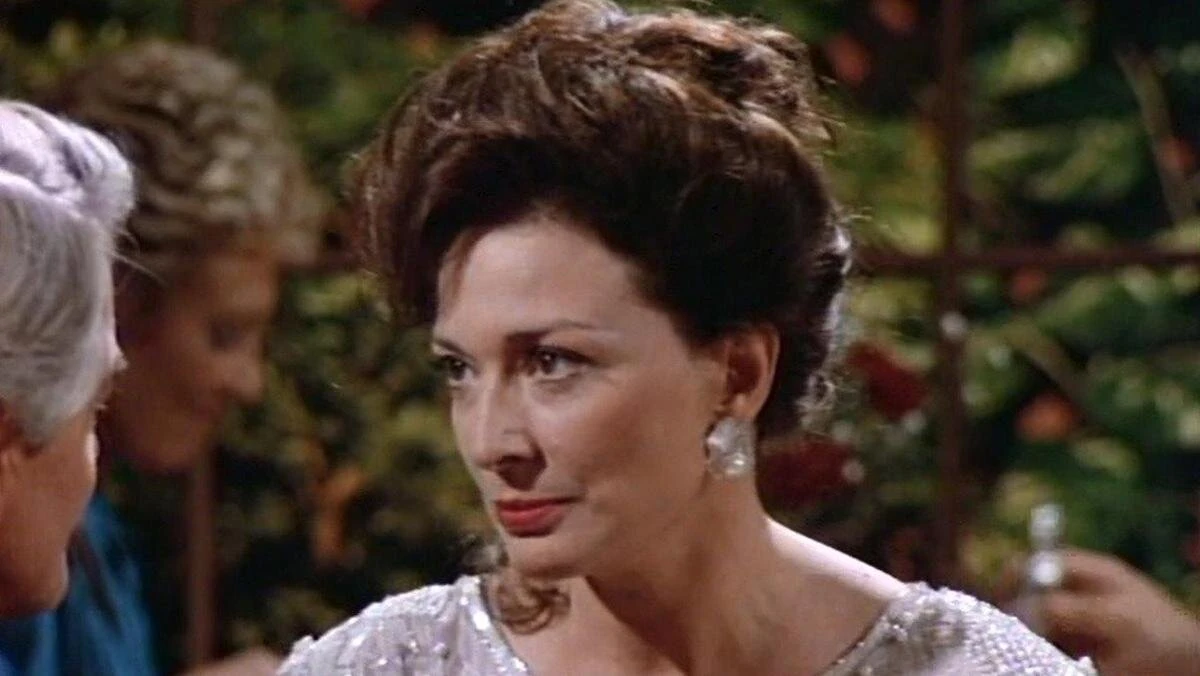
Hal Holbrook’s Reese Watson gives Julia a romantic relationship with someone who has a life and authority of his own. He is a lawyer, a familiar presence, and a man capable of bringing out feelings she would prefer to present in a more dignified form.
The early episode I Do, I Don’t moves an impulsive celebration into a marriage and then an anxious reconsideration. The morning after has a different emotional calendar from the evening before. Julia’s wish to undo the arrangement becomes more complicated when Reese appears ready to help her undo it.
That is good romantic comedy because wanting control of the decision can become entangled with wanting to be wanted. An exit may seem attractive until the other person opens it too readily. Julia’s intelligence doesn’t make that experience unfamiliar; it gives her more ways to try explaining why she is reacting.
Other stories use jealousy, including her concern about an attractive woman working at Reese’s law office. The character who can identify a foolish assumption in somebody else’s behavior remains capable of building one around her own insecurity. Her friends are close enough to notice.
Holbrook’s presence gives those scenes an adult ease. The romance doesn’t need to imitate a teenage misunderstanding with older actors in the clothes. These people have histories, routines, and reasons to hesitate. Julia can want affection and independence at once, with the entirely human difficulty of being more certain about that combination in theory than in the next conversation.
A client’s money doesn’t buy Mary Jo’s consent
The first season closes with Bachelor Suite, in which a wealthy client’s attention to Mary Jo becomes unwanted pressure. The business opportunity carries a demand that has nothing to do with choosing furniture, and Mary Jo has to face the cost of refusing someone whose money the firm could use.
The office setting makes the situation concrete. This is a client, not an abstract example in an argument about manners. Professional politeness can be misread deliberately. A woman doing her work can find herself expected to manage another person’s wishes as though they were included in the contract.
Potts gives Mary Jo a strong point of view because the character has practical responsibilities. Turning down a lucrative job isn’t a decorative gesture made from a place of unlimited comfort. It affects the business and the people relying on its work. That pressure is part of what makes the client’s behavior objectionable.
The other women can help by recognizing the problem rather than asking Mary Jo to make it less inconvenient for everyone. Their business relationship has to accommodate a colleague’s boundaries. The show can make room for a sharp response without losing the anxiety that made a response necessary.
It is one of the clearest early examples of why these particular women belong in a workplace comedy. Work creates dependencies. Money and status can make a person feel entitled to cross a line. Having coworkers who will listen can change what happens next, and the scene gives that solidarity something more demanding to do than admire a clever comeback.
A furniture bargain lands the designers on the wrong side of a cell door
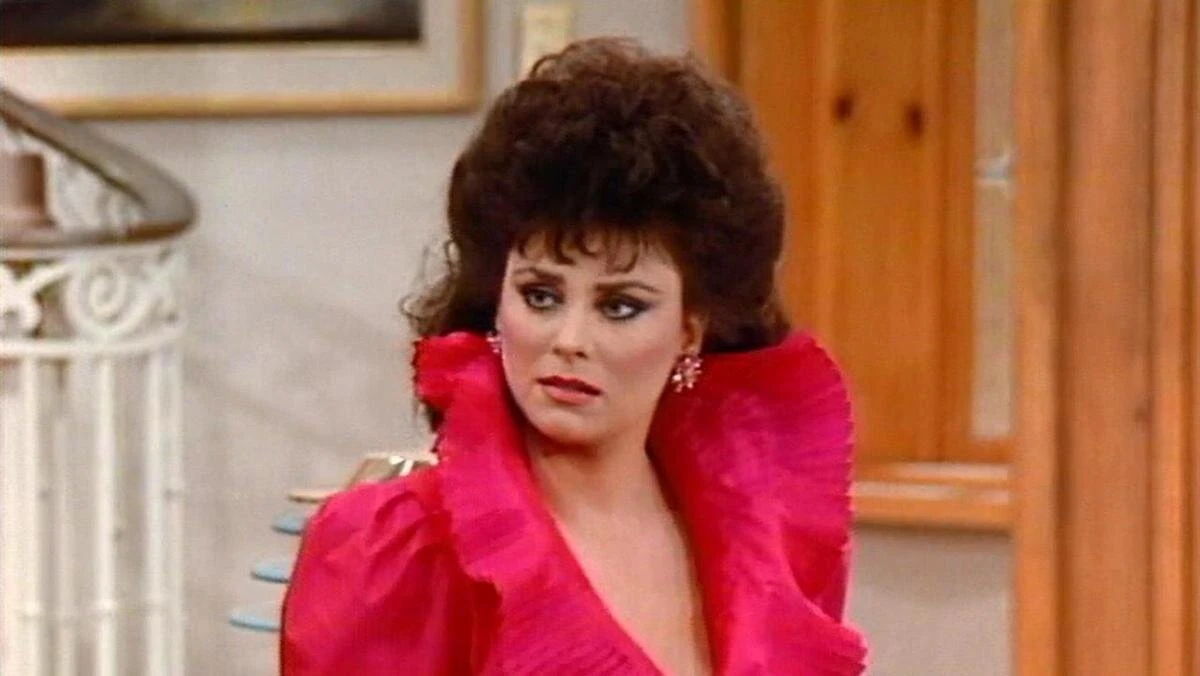
And Justice for Paul begins with the pleasing prospect of authentic antique furniture at bargain prices. It then provides a reason the prices may have been too pleasing: the goods are stolen. The women’s professional enthusiasm ends with an encounter with the law that they hadn’t included in their calculations.
A decorating business needs an eye for value, and the characters understandably enjoy finding it. That makes the mistake more useful than a random arrest pasted onto the sitcom. They want something that belongs directly to the work they know, and their interest in a good deal helps carry them past the questions they should have asked.
The offer comes through Charlene’s boyfriend Paul, which makes the mistake more personal. The women have trusted a connection inside their own circle, rather than simply answered an anonymous advertisement. When they are asked to testify against him, threatening telephone calls make the choice about what to do next considerably less comfortable.
Their standing in the outside world doesn’t make confinement comfortable. A business owner can explain who she is with considerable authority and still discover that the door remains locked. Julia’s usual verbal command has found a setting with a different procedure for deciding who gets to leave.
The bargain has become a test of courage as well as judgment. Finding out that the goods are stolen doesn’t end the episode’s problem; the women still have to decide what to say when telling the truth carries a threat. Their office friendship now has something more difficult to handle than the embarrassment of having bought unwisely. The furniture was supposed to improve somebody’s room. It has led everyone into one with substantially worse accommodations.
Kendall asks them to design his funeral
Killing All the Right People aired on October 5, 1987. Tony Goldwyn plays Kendall Dobbs, a young designer and friend of the firm who is dying of AIDS. He asks the women to plan his funeral while he is able to tell them what he wants. Their ordinary professional skills suddenly have to serve a person preparing for his own absence.
The request is powerful because it gives Kendall a wish beyond being the subject of concern. He wants decisions made, details handled, and some control over the occasion his family and friends will face. The women have work they can do for him. Compassion becomes an action with a shape and a purpose.
The episode then brings open cruelty into the room. Another woman’s comment treats the deaths of people with AIDS as something to welcome. Julia refuses it. Her anger comes from the immediate fact of someone she knows being reduced to a category of people the speaker considers disposable.
This is a different use of Carter’s rhetorical force from a triumphant comic putdown. There is a vulnerable person in the conversation, and the speech has to restore attention to his humanity. A clever final line would mean little if the episode had forgotten the young man who came asking for help.
Mary Jo has a related conflict over a school discussion of sex education and contraception. The subjects connect the private tragedy to the public arguments adults were having about information, young people, and responsibility. The comedy’s office is still a workplace, but what happens there cannot be separated neatly from the world outside.
Bloodworth-Thomason has discussed the personal grief behind the episode: her mother died after contracting AIDS through a blood transfusion. That experience gives the script’s anger a source beyond a writer selecting a topical issue for an evening. The cruelty in the title is being answered by someone who has heard what it costs when a person becomes less important than somebody else’s prejudice.
Place the episode in the television season ending in 1988 and its presence in an ordinary comedy lineup matters. A viewer could arrive expecting the familiar office arguments and be asked to stay with a young man’s approaching death. The episode doesn’t need a joke over his suffering to earn its place in the series. The women are still themselves; this time, being themselves includes showing up for Kendall.
Suzanne discovers a kind of attention she hadn’t ordered
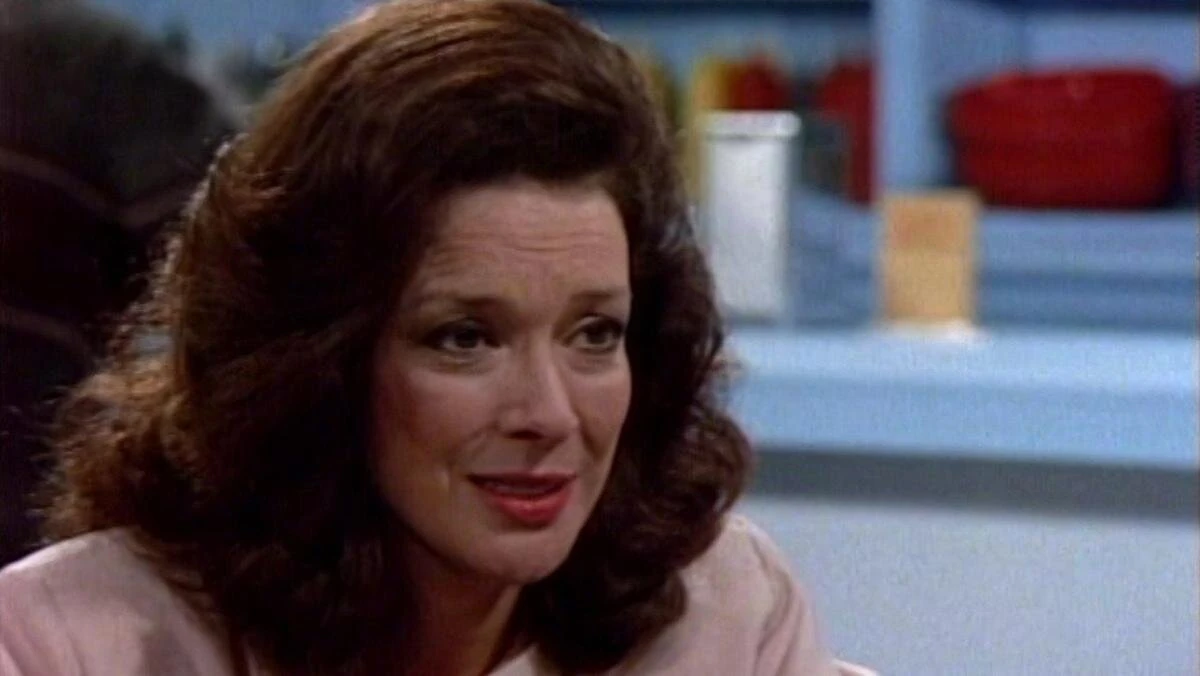
In the first season’s Oh, Suzannah, Suzanne becomes a temporary foster mother. The setup puts her in charge of a child’s needs, a change from the usual arrangement in which she is trying to persuade other adults to give proper attention to hers.
It could have been played as an easy joke about an unsuitable woman and a small person requiring care. Burke gives it somewhere more affectionate to go. Suzanne’s appetite for being loved is part of the character already. The episode places that appetite beside someone whose own need cannot be handled as another social transaction.
The temporary nature of the arrangement matters. Becoming attached doesn’t give Suzanne the power to decide everything that follows. A person accustomed to treating persistence, money, or beauty as useful tools encounters a relationship whose terms aren’t hers to set.
The other women also have to adjust their estimate of what she can feel. They know the vain, demanding sister and colleague. Caring for a child exposes a capacity they cannot explain away as another elaborate attempt to get her own way. Suzanne’s familiar behavior has a person beneath it, and the child has reached her.
It is one of the episodes that gives later stories more emotional room. You can continue laughing at Suzanne’s absurd requirements while remembering that the woman making them has a heart capable of surprising her. The series doesn’t need to cure her vanity to let that heart become visible.
Anthony and Suzanne get the last motel room
The second season’s Stranded puts Suzanne and Anthony on the road after a snowstorm cancels her flight. She insists on accompanying him in the van, and the journey eventually leaves them sharing the last available motel room. Privacy, comfort, and Suzanne’s expectations have all become scarce at once.
The pairing is particularly effective because Anthony has spent enough time around her to recognize the performance. He is not a stranger overwhelmed by her presentation. He knows how easily an ordinary inconvenience can become an emergency when Suzanne is the person experiencing it.
But confinement also makes it harder to preserve a familiar role. She can’t remain only the demanding woman at the office, and he can’t remain only the person expected to provide the practical help. They have to negotiate the evening as two people already tired and uncomfortable, with nowhere else to go.
That gives Burke and Taylor a chance to move between irritation and affection without announcing a grand change in their relationship. A little honesty can emerge because the room has run out of places to put the usual defenses. The situation is funny, but the people don’t have to stay on the surface of it.
The show’s strongest pairings often work that way. Familiar characters are placed close enough that their assumptions about one another become inconvenient. By morning, Suzanne can still be Suzanne and Anthony can still have excellent reasons to object. The evening has nevertheless given them another piece of each other’s company to carry home.
A very exclusive club asks the sisters what acceptance is worth
The Incredibly Elite Bona Fide Blue-Blood Beaumont Driving Club, from 1988, makes even the title sound pleased with itself. Julia and Suzanne are accepted into an exclusive organization, then confront the prejudice attached to the privilege.
It is a fitting problem for sisters whose relationships with status differ. Suzanne knows the appeal of being selected. Julia has a strong account of the principles a person ought to defend. Membership lets the show put the invitation and the objection in the same hands.
Social exclusion can be discussed as somebody else’s bad behavior until an institution offers you a comfortable place inside it. Then refusing has a cost, however small or large. The women have to decide whether an honor remains flattering once they understand the rules that make it exclusive.
The Southern setting gives that question a local history, but the mechanism isn’t confined to Atlanta. A club, profession, neighborhood, or school can present discrimination as tradition and ask the people benefiting from it to enjoy the benefit quietly. Julia’s willingness to speak becomes useful when silence would be the more convenient membership condition.
The series was at its sharpest when it allowed those arguments to involve actual social rewards. It is easy to oppose a prejudice that offers you nothing. An invitation makes the principle a decision. Suzanne’s delight and Julia’s objections can make that decision funny without making the people kept outside the institution an abstract footnote to the sisters’ afternoon.
Charlene has a question for her minister
In How Great Thou Art, the second season gives Charlene a conflict involving her church and the authority of a minister. Julia’s singing with the Atlanta Symphony sits alongside a story in which Charlene has to find the confidence to oppose something she has been told to accept.
Charlene usually gives the other person the benefit of the doubt. Questioning a minister asks her to think harder about where that trust belongs. Her faith matters to her, so the disagreement has to be worked through by her. Julia cannot simply supply an impressive paragraph and take possession of the entire matter.
Smart can make the hesitation recognizable. Challenging a person associated with a community you value can be much harder than arguing with a stranger. A disagreement may feel like disloyalty before you have even said the words. Charlene has to separate what she believes from the assumption that authority always speaks adequately for it.
The show can be outspoken about politics while still recognizing that its characters arrive at their convictions through different lives. Charlene doesn’t have to become a copy of Julia to stand up for herself. Her warmth and sincerity can carry an objection in their own voice.
It is another reason the ensemble matters. The series has more than one way to give a woman a strong moment. Sometimes the room gets a brilliantly constructed denunciation. Sometimes a woman who has been listening decides that she is going to disagree, even though she knows the disagreement will make the next encounter harder.
A decorating contest awards the firm a gas station
The second-season opener, 101 Ways to Decorate a Gas Station, gives the business a job that tests its own promotional enthusiasm. A contest winner wants the firm to refurbish his dilapidated gas station. The prize has become work, and the work is less glamorous than the women may have pictured.
Sugarbaker’s still has work to deliver after the promotional excitement has passed. The firm has made a promise, and the gas station is waiting. A contest has terms. A client has expectations. Creativity has to be applied to the actual place available, rather than the charming room everyone might have preferred.
It also puts taste under pressure. The women have professional standards, but a paying or prize-winning client doesn’t necessarily begin with the same image of success. Design requires an encounter between what the expert recommends and what the owner thinks the property needs.
Anthony’s practical presence keeps the situation connected to the labor. A fresh idea still has to be carried, arranged, installed, or explained to somebody. Television businesses can sometimes appear to exist mainly to give attractive people somewhere to sit. Here the difficult assignment reminds the room that work continues even when nobody has delivered a speech.
The episode’s modest premise also suits the ensemble’s comic range. Suzanne has reasons to object to the surroundings. Mary Jo can worry about what the job requires. Charlene can find a possibility worth considering. Julia can try to maintain the firm’s dignity while the rest of the day takes a less dignified interest in it.
Mary Jo tries on a different version of being noticed
December 1988’s Big Haas and Little Falsie gives Mary Jo an inheritance she must spend on something frivolous. She considers breast enlargement and experiments with different sizes before making a decision. A private insecurity becomes something the office can hardly avoid discussing.
Potts can play the sudden change in how Mary Jo occupies a room. The possibility of being seen differently has an attraction, and trying out that possibility can alter her behavior before anything permanent has happened. The comedy has a physical prop, but the desire underneath it is more complicated than the prop.
The story also belongs in a workplace that includes Suzanne. The women don’t share one experience of appearance. Attention has been Suzanne’s currency; Mary Jo can feel less visible while also resenting the standards by which visibility is awarded. Neither position makes the subject easy to discuss without a joke getting in the way.
Some of the episode’s visual humor is broad. A viewer can enjoy Potts’s performance and still notice how heavily the setup depends on other people responding to a woman’s body. The stronger part of the story is the permission to ask what Mary Jo hopes the change will give her, rather than treating her wish as automatically ridiculous.
That question returns with more force in Suzanne’s reunion story the following year. The women can laugh about the labor of looking a certain way while also living under the judgments that make the labor feel necessary. Sugarbaker’s has plenty of mirrors, literal and otherwise, and not all of them give a generous account of the person looking in.
Charlene’s wedding brings the office to the ceremony
Charlene’s relationship with Bill reaches the wedding in Come On and Marry Me, Bill, broadcast in April 1989. The approach to the ceremony gathers the people and expectations around her, then introduces a complication involving the bachelor party, handcuffs, and an entertainer nobody had planned to include in the wedding arrangements.
The farce works partly because Charlene cares so much about the day. A ceremony can become a very large container for hopes that have taken years to form. The more lovingly people imagine it, the more opportunities there are for a small practical disaster to feel enormous.
The other women participate with the full force of their personalities. Helpful intentions don’t necessarily produce a calm bride, especially when Suzanne has opinions about how a person should look for an occasion. Friendship can be a generous thing to bring to a wedding; it can also require a certain amount of supervision.
Set the relationship against the season ending in 1989 and Charlene’s development is visible alongside the show’s workplace life. The women still have clients, but they have also spent enough time together to be part of one another’s major events.
The baby and the New Year’s story arrive in 1990. The wedding is firmly an eighties milestone. Keeping the two apart lets Charlene’s happiness have its own place in the decade, complete with the considerable evidence that knowing these people does not guarantee an orderly trip down the aisle.
Suzanne goes to a reunion and meets everybody’s entitlement
They Shoot Fat Women, Don’t They? aired on December 11, 1989. Suzanne attends her high-school reunion expecting the pleasure of seeing people who knew the beautiful girl she had been. Instead, she encounters comments and judgments about the weight she has gained.
The cruelty lands because she has arrived with a history, while other people appear interested mainly in the comparison photograph they carry in their heads. They treat a change in her body as information they are entitled to discuss. Suzanne’s personality, memories, and life between the two versions become secondary to their verdict.
Burke lets the hurt complicate the familiar performance. The woman who has often seemed too certain of her own beauty discovers that the old social arrangement has terms she cannot simply insist on restoring. Her confidence has been real, but some of the room’s generosity depended on whether she continued to look as expected.
The episode gives her an answer that reaches beyond asking the crowd to acknowledge that she is still attractive. Suzanne can remember the people they were with more tenderness than they have shown her. That difference becomes the measure of the encounter. The audience is asked to consider who has actually lost sight of whom.
Another thread has Julia and Mary Jo joining Anthony in a fast connected with world hunger. The proximity of food, bodies, public virtue, and private judgment gives the episode more to work with than a single cruel reunion. People can think seriously about one form of suffering while being careless about another much closer to them.
It is a particularly strong place to end the eighties account of Suzanne. The character has given the series enormous laughter through vanity and self-interest. Burke has also made her capable of generosity under circumstances in which she has excellent reasons to be angry. The former beauty queen remains recognizable, but the room has to see more of the woman who has been standing there all along.
Julia’s dignity gets stuck in the banister
A few weeks earlier, Julia Gets Her Head Stuck in a Fence gave the show a wonderfully literal way to interrupt its most commanding woman. While the designers work at the governor’s mansion, Julia poses for a silly photograph with her head through an antique banister. The decision becomes much less amusing when she cannot get free.
The setting supplies an excellent obstacle to the obvious solution. The banister is valuable, and the mansion’s manager does not want it cut. Julia’s discomfort has become a preservation problem for somebody else’s property. Her usual verbal gifts cannot alter the shape of either object involved.
Carter’s authority makes the predicament funnier. This is a woman who prefers to determine how an occasion will proceed. Now she is physically attached to the setting, awaiting help, with an important event approaching. The gap between the Julia she presents and the Julia people can currently see has become measurable in inches.
It is also a welcome reminder that the series wasn’t made entirely of speeches. Bodies, props, timing, and the indignity of needing assistance could carry a whole comic story. The other women don’t have to win an argument to gain the upper hand. Julia has already provided them with a situation that will be difficult to forget.
Some days she could tell the room exactly where it had gone wrong. On this occasion, the room had a banister and a fairly convincing response. A comedy that can enjoy its heroine at that angle has earned a little more trust when it later lets her stand upright and deliver the devastating paragraph.
Southern voices that didn’t agree to be background noise
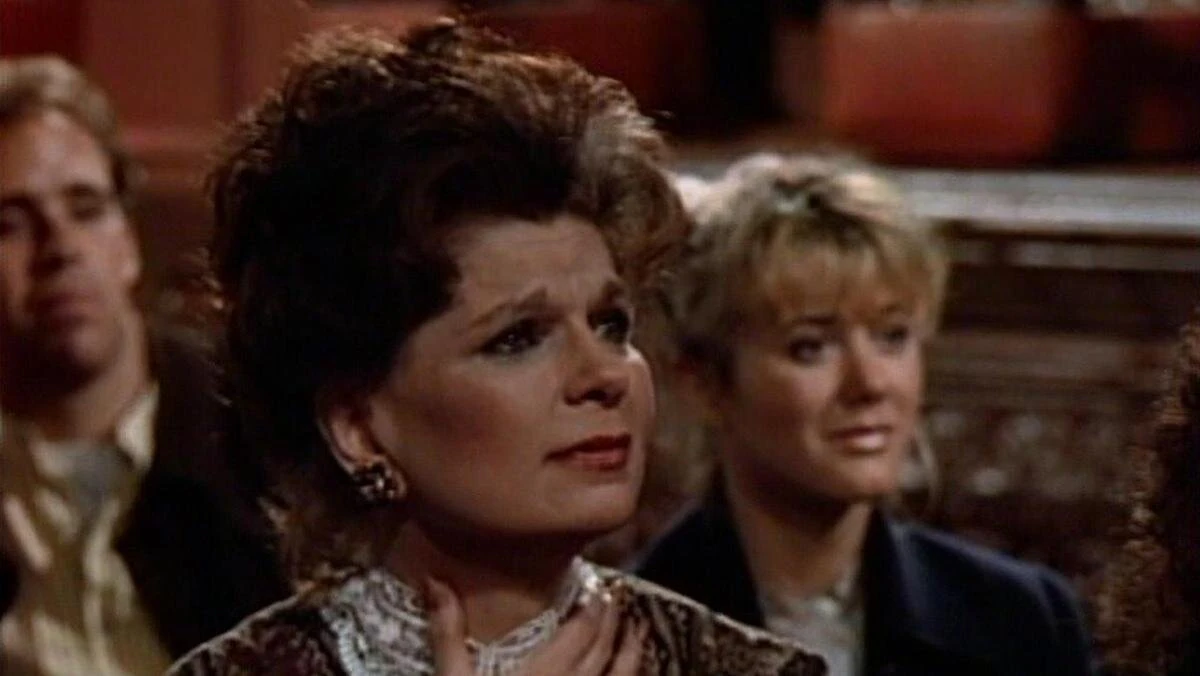
Bloodworth-Thomason’s writing gave the women a sense of place through cadence, history, names, stories, and assumptions about how people might behave. The South could supply warmth and a beautifully specific insult in the same exchange. It could also supply traditions the women had reasons to challenge.
No one character speaks for every Southern woman, and the show is more interesting when their differences stay audible. Julia’s politics don’t erase Charlene’s faith. Suzanne’s relationship with status doesn’t become Mary Jo’s experience of paying for children. Anthony’s knowledge of how the world judges him doesn’t collapse into the women’s account of their own difficulties.
That is what keeps the office useful as a comic setting. An argument has people in it. A disagreement can start with affection, jealousy, fear, or something irritating that happened before work. The show can carry an opinion without making every character a perfectly coordinated representative of it.
It belongs beside The Golden Girls as part of the decade’s pleasure in women who had lived enough to have something to say. The settings and rhythms differ, but both could make female friendship feel like a resource with practical uses, including telling a friend that she had just said something indefensible.
The characters also occupied adult lives beyond the usual television family arrangement. The work-and-home negotiations of Who’s the Boss? offer one neighboring comparison; the eccentric workplace company of Newhart offers another. Sugarbaker’s particular contribution to eighties sitcoms was a room where the women could set the agenda, then cheerfully lose control of the afternoon anyway.
The original company is the reason to come back
The series continued until May 1993, with major changes to the company in its later years. Those developments have their own story. They don’t need to take over the account of the 1986–89 episodes, when the original four women, Anthony, and Bernice gave the office its familiar life.
Returning to those episodes, the performances remain the most immediate pleasure. Potts can register an objection before the sentence arrives. Smart can make enthusiasm feel like a resource somebody ought to protect. Burke can be extravagantly pleased with herself and suddenly wounded. Carter can gather an entire room into the shape of a reply.
Taylor and Ghostley prevent the company from becoming a sealed quartet. Another person can arrive with a need, an opinion, or information that shifts who seems sensible. The familiar workplace has enough doors to keep the conversation from congratulating itself for very long.
For viewers who first met these people from the less powerful end of a family living room, there was something satisfying about adults who spoke so vividly and still needed one another. They were working, dating, arguing, raising children, and occasionally requiring emergency assistance from an antique staircase.
Sugarbaker’s would probably have looked nice even if everyone had behaved. It would have been a considerably less interesting place to spend half an hour. Leave the samples on the table, let Suzanne finish the complaint, and give Julia another second. She appears to have decided how she is going to answer.
A few questions from the Sugarbaker office
Who were the original four Designing Women?
Dixie Carter played Julia Sugarbaker, Delta Burke played Suzanne Sugarbaker, Annie Potts played Mary Jo Shively, and Jean Smart played Charlene Frazier, later Stillfield. Meshach Taylor’s Anthony Bouvier became central to the company, and Alice Ghostley frequently appeared as Bernice Clifton.
Was Sugarbaker’s a business or the sisters’ house?
The interior design firm operated from Julia’s Atlanta home. That combination let clients, coworkers, relatives, and personal problems occupy the same recurring rooms. The business gave the women work to do together; the house made it difficult to keep that work separate from their lives.
Which eighties episodes show the series’ range?
The Beauty Contest demonstrates the sisters’ loyalty, Killing All the Right People brings Kendall’s funeral request and the AIDS epidemic into the office, and They Shoot Fat Women, Don’t They? gives Suzanne’s reunion real emotional force. Julia Gets Her Head Stuck in a Fence supplies a very physical objection to remembering the series only for speeches.
Did Designing Women end in the eighties?
No. It began on September 29, 1986, and ended on May 24, 1993. This feature follows its original eighties television years. The major later cast changes and the final seasons belong to its early-nineties continuation.
Sources & Further Reading
- Original series history and production interviews
- Sony Pictures Museum production collection
- Linda Bloodworth-Thomason discusses the writing
- Paley collection: Killing All the Right People
- Original episode chronology
- Detailed original-run episode archive