Knight Rider in the 80s: KITT, Hasselhoff & Peak Tech Fantasy
Revisit Knight Rider in the 80s: Michael and KITT, Bonnie, April, Devon, KARR, Goliath, RC3, and the talking Trans Am that made every road an adventure.
The shows, the moments, and the nights we were there for it.
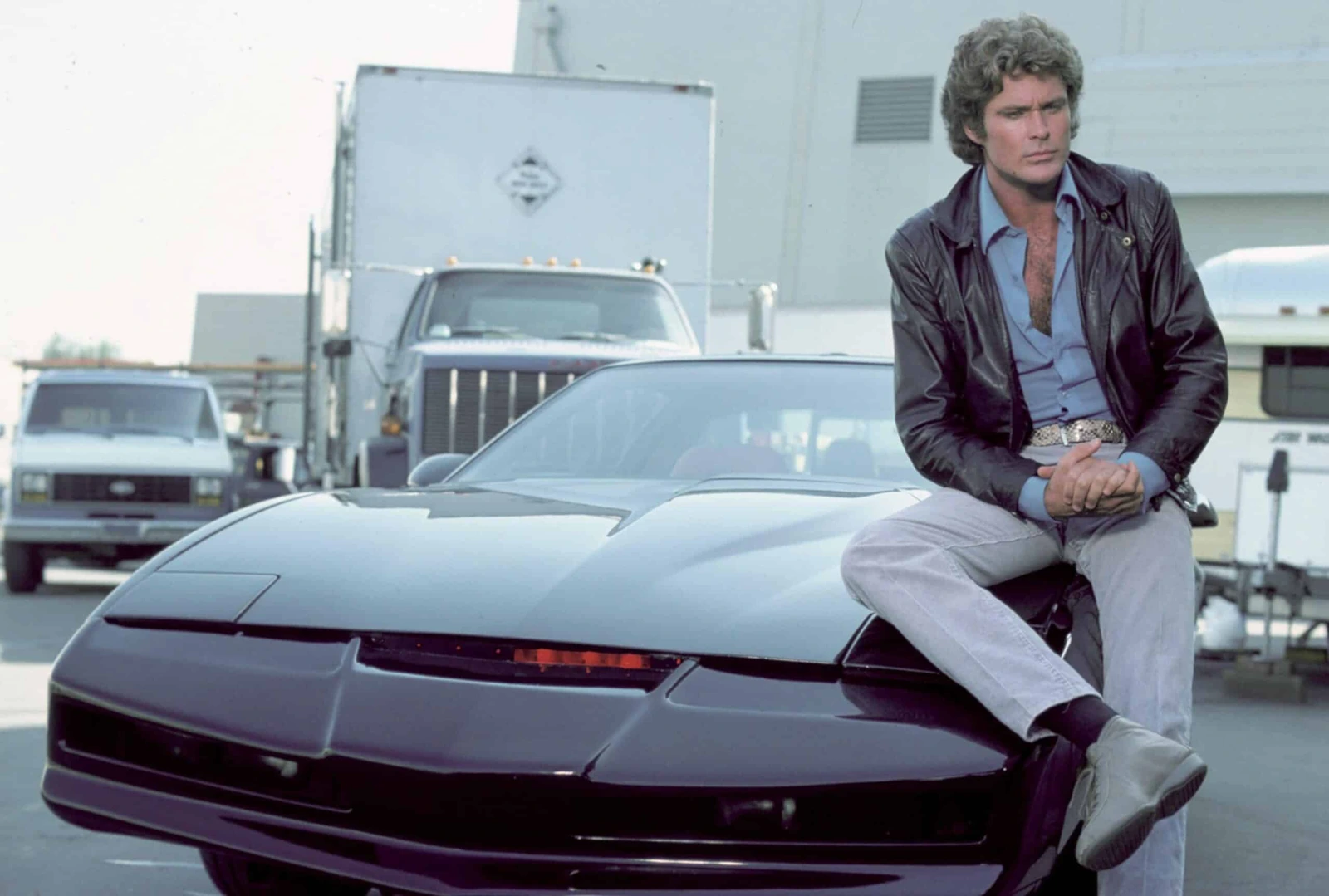
The red light went back and forth. That was enough. Before Michael Knight had climbed through a window, punched a henchman, or persuaded Devon that this particular detour was absolutely necessary, KITT could announce himself with a strip of moving light. Most cars needed an owner. This one appeared to be considering whether his owner was qualified.
Knight Rider arrived on NBC in September 1982 with a black Trans Am, David Hasselhoff, and a gloriously unreasonable proposition: the future would be fast, loyal, bullet resistant, and mildly disappointed in your decision making. KITT could drive himself, analyze trouble, and leap over whatever the road department had failed to provide. He also had William Daniels’ voice. Put that voice inside a refrigerator and you might still have a series. Put it inside this car and you had a partnership.
The four-season original was an adventure show with a gadget budget in its imagination that no actual company could have approved. It could be clunky. It could be wonderful. It could send its hero after stolen military hardware one week and into a stunt show the next. The constant was the conversation between a big, affable man who tended to act first and a small red display that would have preferred a little consultation. Among the memorable machines of the 1980s, KITT had the rare advantage of being good company.
Inside This Article
- A car that could raise an eyebrow
- Michael Long dies; Michael Knight gets the keys
- Wilton Knight leaves an unusually complicated inheritance
- Hasselhoff makes room for the other star
- William Daniels gives the machine its manners
- Devon Miles has to manage this operation
- Bonnie knows what is actually under the hood
- The dashboard was a destination
- Turbo Boost: the button no sensible adult should approve
- Bikers, ranchers, and the people who need a hand
- Slammin’ Sammy gives KITT a proper audience
- KARR is what happens when the car has the wrong priorities
- The first year finds its cruising speed
- White Bird lets the old life catch up
- April Curtis takes the second-season shift
- Garthe Knight brings the beard
- When the invulnerable car gets hurt
- Race for Life makes the deadline human
- Soul Survivor puts the personality in a smaller box
- Knightmares and Lost Knight pull at the connection
- Bonnie returns, and the third year rearranges the furniture
- Halloween Knight gives Bonnie a very bad address
- KITT vs. KARR earns its billing
- Junk Yard Dog takes the damage personally
- The FLAG semi is the clubhouse on wheels
- The theme tells the road to get moving
- RC3 and the fourth-season rebuild
- More isn’t always faster
- Killer KITT turns the trusted arrival into a threat
- The Scent of Roses gives Michael something the car can’t fix
- The road stops without a grand parking ceremony
- Knight Rider questions worth settling
A car that could raise an eyebrow
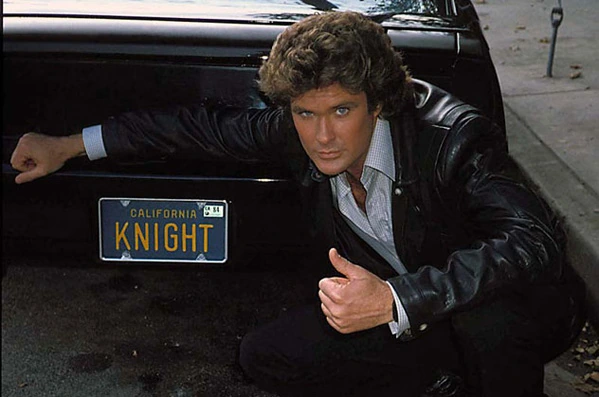
There is an easy version of Knight Rider to remember: Michael hits Turbo Boost, the car flies, the bad guys discover that their roadblock was an optimistic suggestion. That version is accurate as far as it goes. It leaves out the best part, which is often the moment before the jump. Michael has a plan. KITT has reservations. Neither is especially surprised by the other.
A red voice display is an absurdly small stage for a performer. Daniels filled it with distinctions. KITT could sound offended, worried, pleased with himself, or unconvinced by a human explanation. The car wasn’t simply a calm voice reading instrument data. His composure had a social edge. He possessed a very precise sense of how things ought to be done and the misfortune of being assigned to Michael Knight.
Hasselhoff supplied the other half. He looked as if he belonged behind the wheel, but he didn’t treat the machine as a dashboard appliance. He answered KITT, teased him, trusted him, and occasionally tried to get around him. An actor talking into an empty interior can look desperately lonely. Here it usually looked like two friends getting through a workday with incompatible ideas about acceptable risk.
That made the premise more inviting than its hardware. A viewer didn’t need an interest in computers or cars to understand an exasperated companion. The show could explain a new button in ten seconds. Michael and KITT’s affection accumulated over years. One got the posters; the other could carry a scene while parked. This was a very unfair division of automotive talent.
Michael Long dies; Michael Knight gets the keys
The pilot, Knight of the Phoenix, begins with an undercover policeman named Michael Long. Betrayal and a near-fatal shooting strip away his old life. Wilton Knight’s organization saves him, reconstructs his face, and gives him a new name. The new Michael has a second chance and an assignment. He also receives a car whose capabilities make ordinary police equipment look as though someone forgot to finish the order.
Glen A. Larson built a modern wandering-hero story around that transformation. The damaged man can move outside the life that failed him, using extraordinary resources to help people who cannot get a fair hearing. It’s a sturdy adventure foundation. Give the hero a fresh town, a threatened business, an intimidated witness, or a powerful local crook, and there is a reason to drive into the next episode.
The origin also gives Michael something more interesting than professional enthusiasm. His identity is borrowed, his survival is a gift, and his freedom comes with obligations. He can be relaxed and flirtatious, but underneath the easy grin is a man whose earlier existence ended violently. Knight Rider seldom becomes a prolonged examination of that trauma. When it returns to it, the familiar adventure suddenly has a bruise.
The pilot’s extravagance is part of its appeal. A dying millionaire doesn’t merely arrange medical treatment. He provides a face, a name, a mission, an organization, and a talking car. Other benefactors establish scholarships. Wilton Knight apparently looked at the available options and decided one handsome man with a highly argumentative Pontiac would be the better investment.
Wilton Knight leaves an unusually complicated inheritance
Richard Basehart gives Wilton Knight the gravity needed to sell the beginning. Michael isn’t recruited by a cheerful inventor demonstrating a weekend project. He is entrusted with something by a man running out of time. Wilton’s belief that an individual can make a difference becomes the series’ statement of purpose, repeated through the familiar opening narration in Basehart’s voice.
It’s a promise the show keeps in a very particular way. Michael rarely changes a whole system. He helps a person standing in front of him: a frightened daughter, a small operator being squeezed out, someone with evidence that the wrong people want buried. The cases make the lofty introduction tangible. The hero might arrive with an expensive machine, but the weekly stakes often belong to people who can’t afford to lose their livelihood.
The Foundation for Law and Government, usually shortened to FLAG, lets the series have institutional support without chaining Michael to a conventional precinct. Money, technical staff, and Devon’s authority are there when needed. So is the freedom to disappear down a highway. It’s a splendid employment package, provided you don’t ask too many questions about jurisdiction or the reimbursement policy for jumping a vehicle over a ravine.
Wilton’s name also refuses to stay safely attached to the good intentions. His son Garthe will turn the family connection into something dangerous. By then Michael’s new face and inherited mission have become more than a pilot device. The Knight legacy contains a decent ambition, an extraordinary machine, and a family problem large enough to require a very large truck.
Hasselhoff makes room for the other star
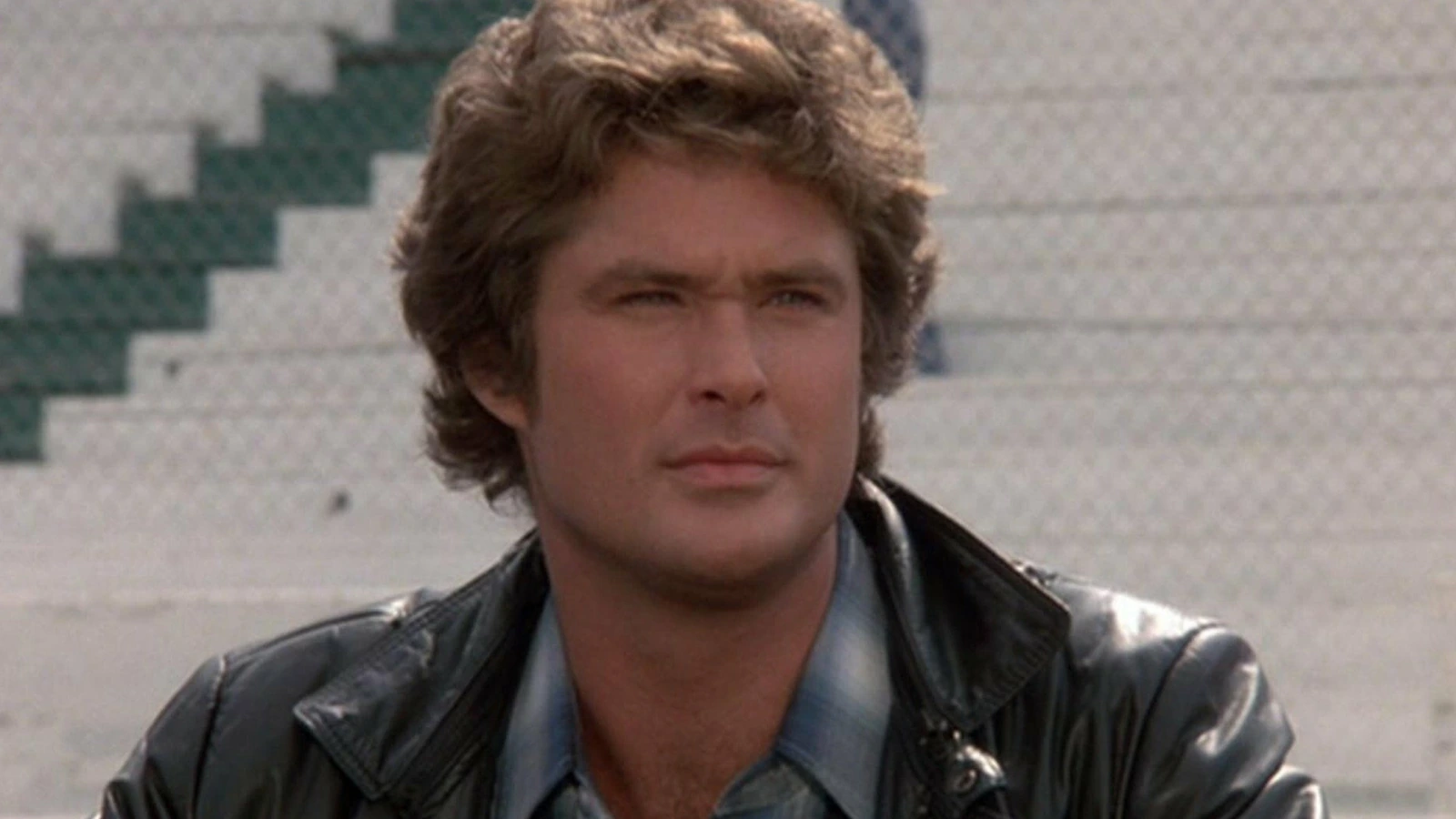
Michael Knight is not a tightly wound action hero. Hasselhoff plays him with a broad, approachable confidence. He can stand up to a bully, help a child, or become interested in a woman without changing the basic temperature of the performance. The leather jacket suggests danger. The face generally suggests that he would be perfectly willing to explain the car if you asked nicely.
That openness matters because the series needs people to bring Michael their trouble. An intimidating loner might fit the desert road, but he would be less useful in a show that runs on strangers deciding to trust him. Hasselhoff is persuasive as someone who will stop and listen. Once he decides something is wrong, his conviction is uncomplicated enough to get the next chase moving.
He is also willing to look faintly ridiculous. Michael sings undercover, negotiates with eccentric clients, and argues with a machine about manners. The show doesn’t seal him inside an impenetrable shell of cool. KITT can puncture his vanity without puncturing his heroism. A hero who never allows a joke at his expense would have made this a very long four seasons.
The pairing differs from the sunlit private-eye ease of Magnum, P.I. Michael doesn’t have Thomas Magnum’s household arrangement or the same circle of old friends. His closest everyday companion travels with him. A long drive can supply the banter that another series would stage in a kitchen or an office. Hasselhoff’s willingness to play that intimacy straight is one reason the car feels alive.
William Daniels gives the machine its manners
KITT’s voice is cultured without being soothing in the usual customer-service sense. Daniels could put a little blade into a polite sentence. A warning might carry concern, judgment, and the suggestion that this problem had been foreseeable. He never needed to make the car sound human by adding constant verbal clutter. The measured delivery was the personality.
The choice gave Knight Rider a comic rhythm that a more generic computer voice couldn’t have supplied. Michael’s enthusiasm met an adult who had read the instructions. Sometimes that adult was himself vain, nervous, or offended. KITT could be both the sensible one and the difficult one, an excellent arrangement for a two-person comedy concealed inside an action series.
Daniels was also playing Dr. Mark Craig on St. Elsewhere during the same era. The two roles make a delightful double bill: one performance uses a surgeon’s face and physical presence, the other turns a car into a recognizable colleague. Both benefit from his command of impatience. Neither character seems likely to accept a weak excuse just because it was delivered with confidence.
The voice performance also keeps a potentially sentimental friendship from becoming sugary. KITT cares about Michael, but he needn’t announce that affection in soft-focus speeches. Concern arrives as a complaint, a warning, or immediate practical help. The loyalty is built into the work. By the time Michael genuinely needs him, the audience has heard enough everyday irritation to recognize how much sits beneath it.
Devon Miles has to manage this operation
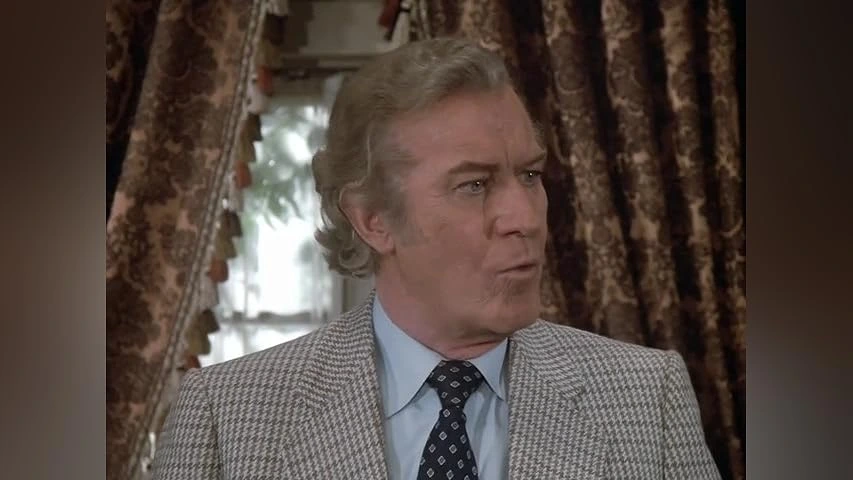
Edward Mulhare’s Devon Miles brings the bearing of a man whose day was supposed to include civilized conversation. Instead, he is supervising Michael Knight. Devon can introduce a case with polish, deliver a reprimand with exquisite control, and make the Foundation seem older and more respectable than the lunacy currently rolling out of its garage.
He provides a second kind of authority alongside KITT. The car questions a maneuver because it is dangerous or inefficient. Devon questions Michael because somebody has to account for the larger operation. Michael’s improvisations may be morally sound and administratively exhausting at the same time. Mulhare lets both things be true. Devon can disapprove without becoming the stuffed shirt who exists only to be proved wrong.
No Big Thing gives that dignity a rough outing when Devon’s minor encounter with local law turns into imprisonment and danger. Taking the supervisor out of his comfortable position is a useful early move. He isn’t merely the person who phones in the assignment. He can be exposed to the same corrupt local machinery that Michael confronts on behalf of strangers.
The friendship grows warmer without requiring Devon to abandon his standards. Michael needs someone who will stand behind him; he also needs someone who can occasionally suggest that his interpretation of an instruction was imaginative. Mulhare’s dry authority makes the Foundation feel like a small working family. It happens to be a family whose disagreements can involve stolen weapons and a car with a superior attitude.
Bonnie knows what is actually under the hood
Patricia McPherson’s Bonnie Barstow has a practical advantage over the men who admire KITT from a distance: she has to keep him functioning. She understands the machine as a complicated responsibility. Michael sees the next impossible maneuver. Bonnie sees the consequences arriving back at the workshop.
The character helps make the futuristic fantasy feel staffed. KITT doesn’t spring from the earth fully repaired between adventures. There is somebody with knowledge, tools, and opinions about what he has endured. Bonnie can be affectionate toward the car while being unimpressed by Michael’s handling of him. That triangle is a steady source of humor, with the human driver occasionally appearing to be the least technically necessary member.
Chariot of Gold turns Bonnie’s access to KITT into a vulnerability when a sinister group uses her in a plan involving the car. The episode reminds us that expertise isn’t decorative. Whoever can reach the systems can change the balance of power. The person usually trusted to restore the machine can become the route through which an enemy reaches it.
Her place in the original run needs no elaborate explanation: Bonnie is there in the first season, absent during the second, and back for seasons three and four. The return restores an especially familiar part of the ensemble. It is pleasant to see a technician whose relationship with the supposedly unbeatable hardware includes the right to be annoyed. Someone has to tell the future that it has come home in terrible condition.
The dashboard was a destination
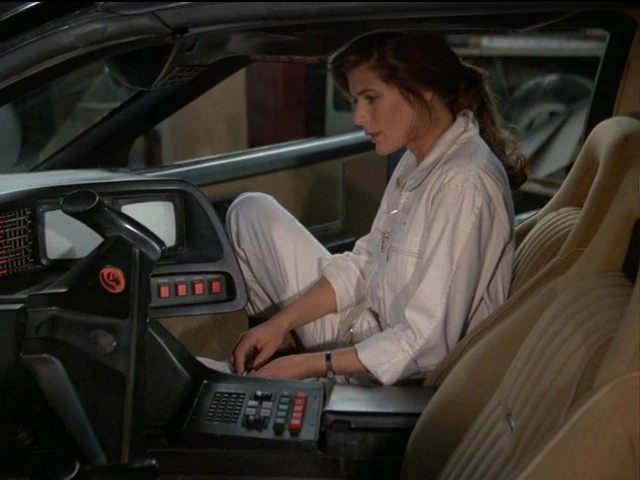
Even standing still, KITT offered an excursion. The instruments, displays, switches, and steering arrangement made the cabin look like a command center that had somehow acquired road registration. The red voice display gave the eye somewhere to go when the invisible actor spoke. The scanner outside gave the car a face without adding an actual face, a decision for which everyone should remain grateful.
The cabin was dense with the promise of functions. A viewer didn’t have to know precisely what each control did. There were enough lights to suggest that whatever trouble arose, the solution might already be installed. It was a particularly effective kind of television wish fulfillment: more approachable than a spaceship bridge, because the whole apparatus fit into a car someone could recognize on a street.
Recognizable is the key. KITT’s basic form was a Pontiac Trans Am, modified into an object with a new identity. The black body and low nose offered clean, memorable shapes. The scanner supplied motion before the wheels moved. You could reduce the car to a dark outline and a red streak and still know who had arrived.
The dashboard also made exposition feel like activity. A screen could provide a clue, a scan could sharpen a suspicion, and Michael could conduct a conversation while information appeared around him. Ordinary detective scenes often require a desk and a file. Knight Rider could put the desk, file, partner, laboratory, and escape route in the same shot. Office efficiency had rarely looked so irresponsible.
Turbo Boost: the button no sensible adult should approve
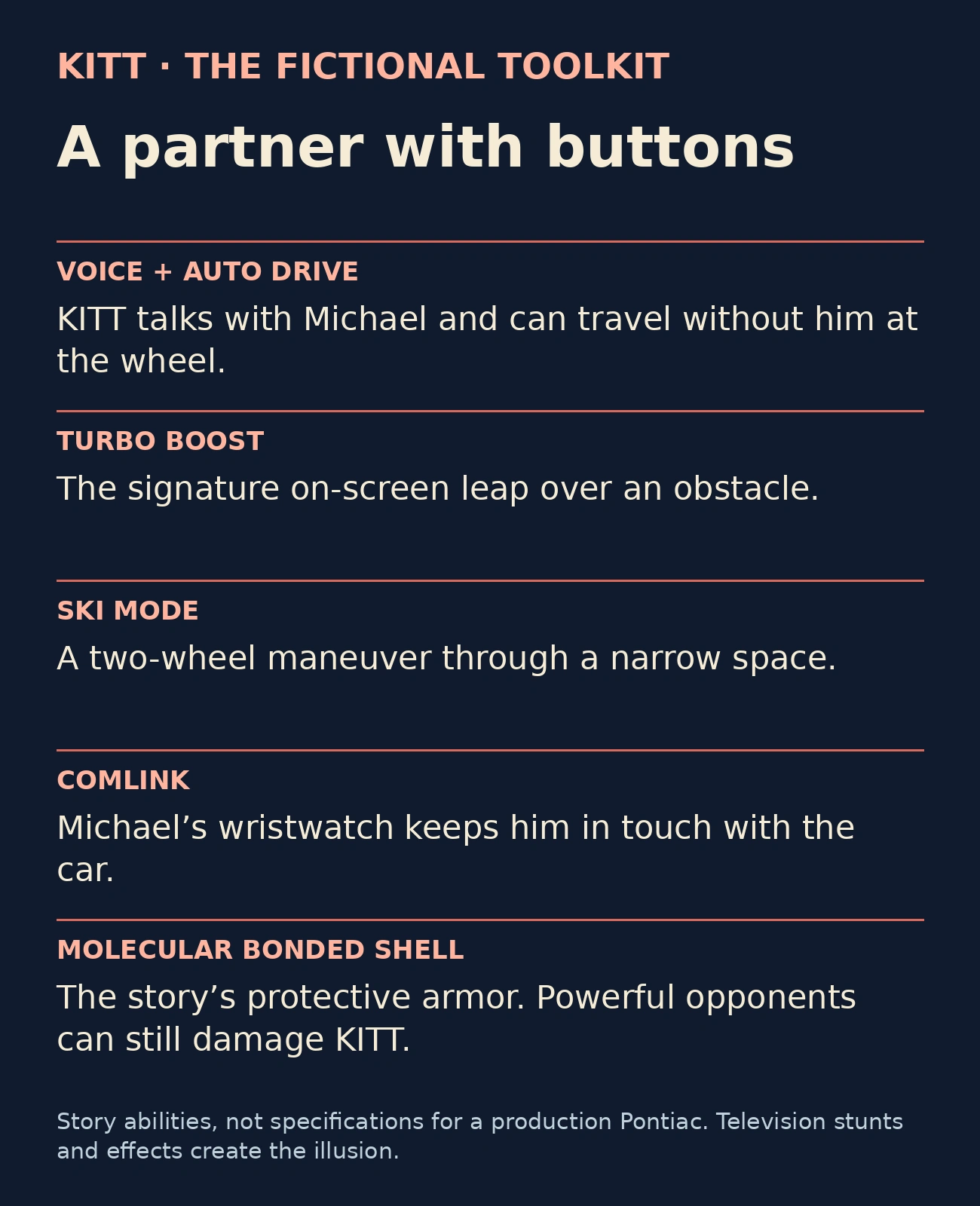
Turbo Boost is the signature because it makes the show’s promise visible. A barrier that would stop an ordinary driver becomes an invitation to leave the ground. Michael presses a control, the series delivers a spectacular leap, and the road resumes on the other side. Planning permission does not appear to have been requested.
Within the fiction, the ability belongs to KITT. On television, the excitement comes from the physical spectacle, editing, sound, and the sight of an actual car moving through an actual environment. You don’t need to pretend the Pontiac could perform every claimed feat in real life to appreciate the skill and impact of the screen illusion. The visible weight is part of the pleasure.
Ski Mode, with KITT tilted onto two wheels, offers another instantly legible solution to a narrow problem. The car’s protective shell gives Michael confidence in situations where a normal vehicle would be finished. His communications wristwatch allows the partnership to continue when he leaves the driver’s seat. These aren’t isolated gadgets in a catalog. Each gives the writers a way to separate the pair, put one in danger, or let one rescue the other.
The limits shift with the needs of the adventure, and sometimes the flexibility is too convenient. A computer capable of so much can make a mystery suspiciously short. The better episodes create a problem that cannot be solved by requesting another reading: divided loyalties, a hostage, lost trust, an enemy who understands the car. The most important feature is still the ability to make Michael listen, and that one never works perfectly.
Bikers, ranchers, and the people who need a hand
Good Day at White Rock interrupts Michael’s attempted vacation with a motorcycle gang and a town that needs help. It’s the kind of story the series can tell with very little setup. The hero wants a break, the local trouble won’t permit one, and the audience gets to watch overconfident aggressors discover that they have misjudged the available transport.
Not a Drop to Drink sends the pair into a dispute involving ranchers and water rights. Knight Moves deals with truckers under pressure. The scenery changes, but the appeal is consistent: the person being pushed around receives a formidable ally. Knight Rider likes a powerful machine, yet its sympathies often sit with small businesses and people defending something modest.
That connection keeps the weekly formula from becoming exclusively a parade of stolen government devices. Michael can look comfortable among ordinary working people. KITT can enter their world as an astonishing visitor. The contrast gives the car opportunities to react to human habits, and gives the humans opportunities to react to a car that has more to say than their local officials.
There is a lineage here with wandering troubleshooters and television’s earlier private eyes. The hero arrives with enough independence to act where an intimidated community can’t. Knight Rider adds technological armor and a very talkative horse. Its place among the decade’s action shows rests partly on how cheerfully it updates that old arrangement. The mission is recognizable even when the method requires an airworthy Trans Am.
Slammin’ Sammy gives KITT a proper audience
Slammin’ Sammy’s Stunt Show Spectacular is a wonderfully direct title for an episode built to enjoy its own vehicle. A stunt operation is in trouble, sabotage is involved, and Michael gets a reason to put KITT in front of people who expect something extraordinary. The usual problem of concealing the machine’s abilities becomes less urgent when astonishing spectators is part of the job.
Stunt-show and racing settings are a natural fit because they let the series turn its special attraction into the subject of the story. The hero doesn’t simply use the car to reach a suspect. Driving, danger, professional pride, and the financial survival of the event belong to the plot. There is a useful alignment between what the characters need and what the audience came to see.
The premise also brings KITT’s dignity into contact with show business. A machine that regards itself as sophisticated has to function as a public spectacle. Michael is comfortable selling the performance. KITT’s personality gives the familiar business of a car stunt a companionable commentary track, without requiring the episode to abandon its jeopardy.
Later stories return to racing and performance worlds because the fit remains strong. Speed Demons uses a motorcycle event; Circus Knights takes the pair into a circus. These are places where a flashy visitor makes immediate sense and where sabotage can hide among everyday hazards. Some Knight Rider plots need a fair amount of contrivance. Here the invitation practically writes itself: you have a remarkable car, we have an audience, and somebody is behaving very badly backstage.
KARR is what happens when the car has the wrong priorities
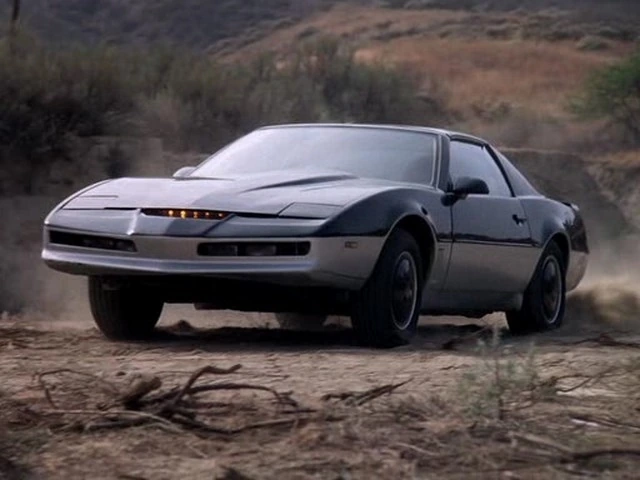
Trust Doesn’t Rust introduces KARR, KITT’s dangerous predecessor, after two thieves awaken a machine they do not understand. The episode first aired in November 1982, early enough to establish a threat that could follow the series well beyond its first year. KITT’s specialness suddenly has an uncomfortable qualification: someone built another one.
The crucial difference is in purpose. KARR’s self-preservation makes him a very different partner from the car programmed to protect human life. The outward resemblance makes the danger personal. Michael can’t simply rely on having the most remarkable vehicle in the story. KITT has to face something close enough to himself to expose what makes him trustworthy.
KARR also makes a better opponent than a crook who merely carries a bigger gun. An enemy machine can answer the hero’s advantages with comparable abilities. It knows speed, calculation, and survival. The humans who discover it think they have acquired a tool. The episode’s fun comes partly from how quickly that assumption becomes inadequate.
The conflict has a wonderfully clean children’s-adventure shape without becoming empty. Two impressive cars embody different loyalties. One will risk itself for people; the other puts itself first. The special effects give them a contest, but the personalities give us a side. Knight Rider could have returned to this enemy every few weeks. Using KARR sparingly helped preserve the charge of meeting him again.
The first year finds its cruising speed
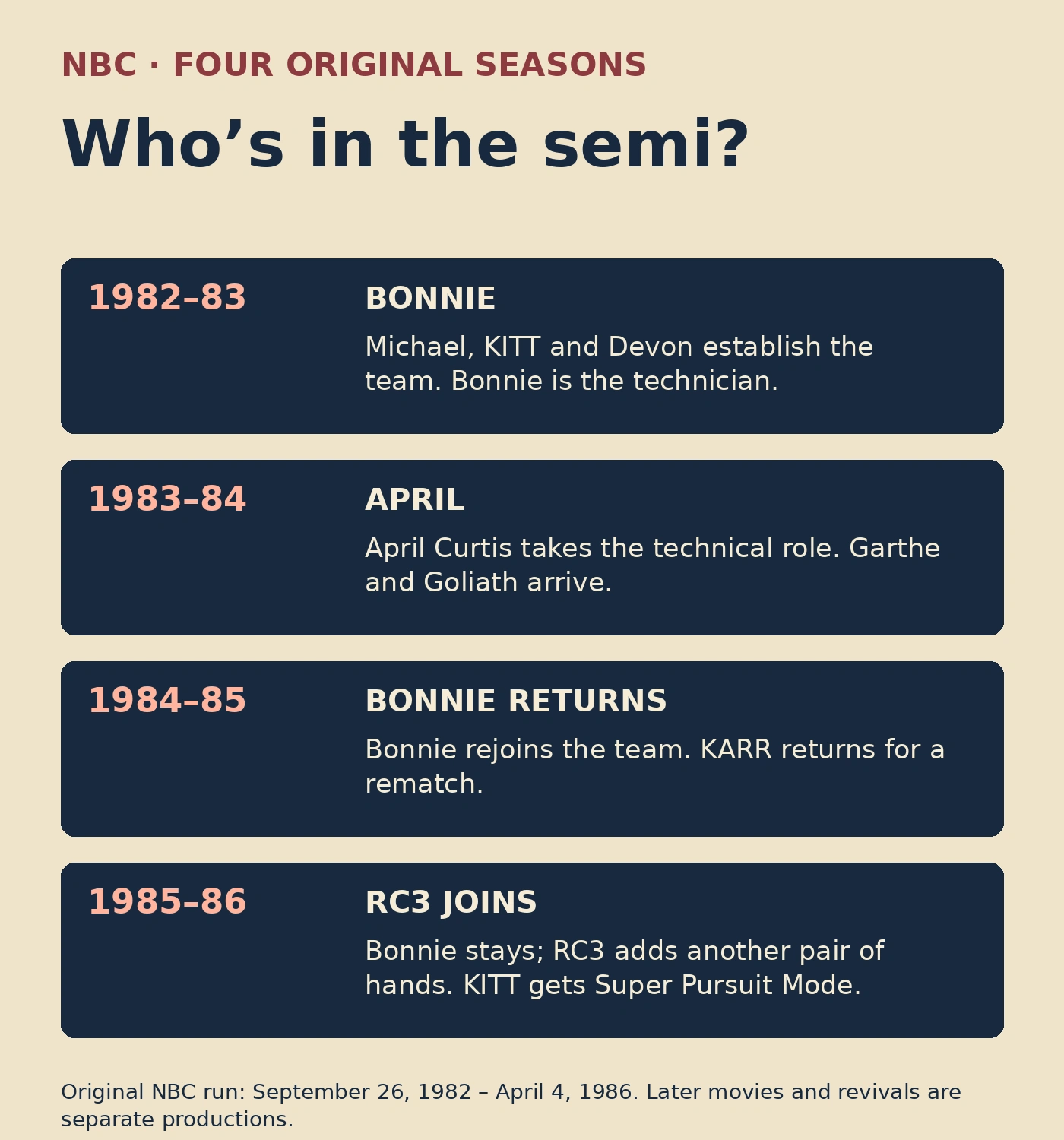
The first season moves through military intrigue, local corruption, theft, racing, and cases tied to Michael’s earlier life. That variety is part of the original series’ identity. It isn’t a heavily serialized mystery in which every clue points toward one final revelation. It is a weekly promise that the car will be needed somewhere new.
Deadly Maneuvers follows the pilot with an Army-base investigation. Inside Out puts Michael into a criminal operation as a getaway driver. The Topaz Connection turns on a murdered publisher and a dangerous story. These are compact adventure engines, with KITT helping Michael cross the gap between suspicion and proof. The specific crimes matter less to the long-term relationship than the opportunities they create for the pair to work together.
The season also establishes the show’s elastic tone. A serious threat can give way to a joke about KITT’s vanity without requiring a complete change of genre. Children can enjoy the car’s personality; older viewers can enjoy the familiarity of the crime-show machinery and the dryness of Mulhare and Daniels. The result is broad television, made for people with different reasons to stay in the room.
The debut belongs to fall 1982, while its first full television season ends in 1983. That is the appropriate setting for the 1983 television charts. Knight Rider’s cultural visibility should not be confused with a claim that it led those rankings. Its particular achievement was easier to spot than a number: NBC had put a car on the air that people could recognize as a character.
White Bird lets the old life catch up
White Bird brings Michael face to face with Stevie, the woman connected to the life he lost as Michael Long. Catherine Hickland plays the returning love, and the story makes the new identity hurt in a way ordinary assignments usually don’t. Michael can help someone he loves, but doing so doesn’t magically restore the circumstances in which they knew each other.
It’s a useful reminder that the pilot’s reset wasn’t an uncomplicated upgrade. A new face and a remarkable car do not erase old attachments. Michael’s easy behavior on the road can make him seem almost free of history. Stevie brings history into the room and asks him to behave as a person with something to lose.
The series returns to that relationship in Let It Be Me and, later, The Scent of Roses. Each visit changes the balance between the continuing mission and the possibility of an ordinary personal future. Those episodes don’t have to turn Knight Rider into a tragic romance to matter. They only have to let the audience see a part of Michael that is harder to protect than the car.
Hasselhoff is especially useful when the usual confidence cannot solve the scene. Michael can get people out of physical danger and still be unable to give them the life they wanted. KITT can remain beside him, but there are questions no scan can answer. That is a modest emotional claim for a talking-car show, and a valuable one. Without it, Michael might be little more than an excellent jacket delivery system.
April Curtis takes the second-season shift
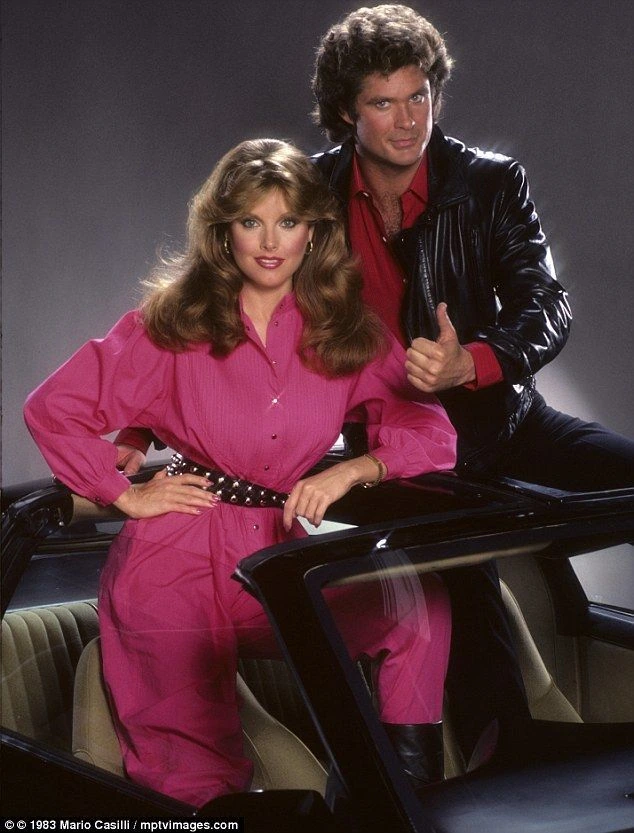
Rebecca Holden joins the second season as April Curtis, the Foundation’s technician during Bonnie’s absence. April is a different character, with her own presence in the workshop and the field. She isn’t Bonnie under a new name, and treating the two as interchangeable misses how much a small ensemble depends on the person delivering the familiar duties.
Holden brings assurance to the technical role and has to establish it in a season that immediately expands the threat level. Goliath is not the sort of problem a new employee wants to find on the first assignment. KITT’s durability is challenged, and the people who understand him become essential to keeping the partnership on the road.
April can explain and repair, but the series also places her in danger. Goliath Returns draws her and Devon into Garthe’s scheme. The technician isn’t safely outside the action, watching a clean demonstration. Technical knowledge belongs to a group of people whose lives are part of the adventure. When the car is damaged, their work has immediate human consequences.
The season ending in 1984 supplies the setting for the broader 1984 ratings picture, while Knight Rider is busy testing its own formula with bigger rivals and more personal threats. April’s one-season place is easy to flatten in retrospect because Bonnie returns. Watching the episodes makes her contribution more concrete. For this stretch, she is the person helping an extraordinary machine survive a very hard working year.
Garthe Knight brings the beard
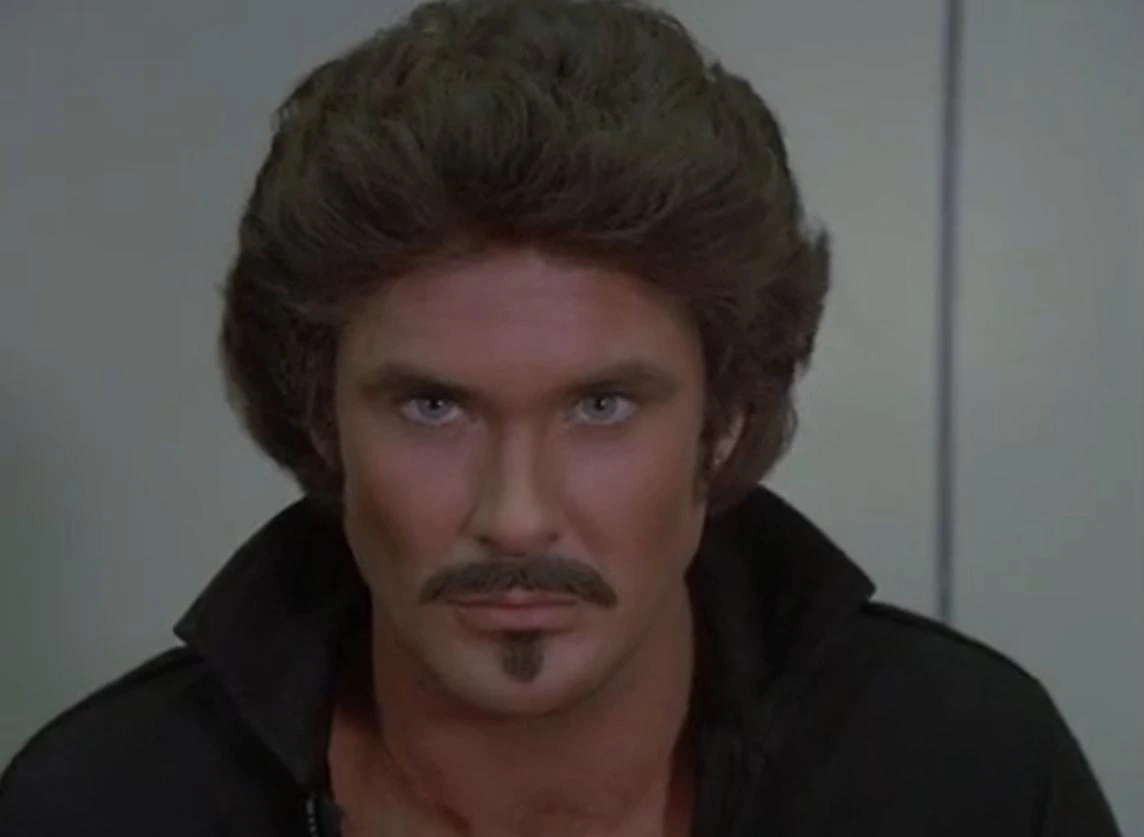
Then Hasselhoff plays the bad version of Hasselhoff, and subtlety sensibly leaves the premises. Garthe Knight, Wilton’s estranged son, arrives with a beard, a grudge, and Goliath, a truck built to make KITT’s advantages seem less absolute. If the normal series asks whether Michael can help the little guy, this story asks whether Michael can survive being flattened by family history.
The double casting supplies an immediate, enjoyable disorientation. The face associated with an approachable hero is attached to someone meaner and more theatrical. The origin’s connection between Michael’s reconstructed appearance and the Knight family now produces a villain who looks back at him. It’s a soap opera complication delivered at action-show speed.
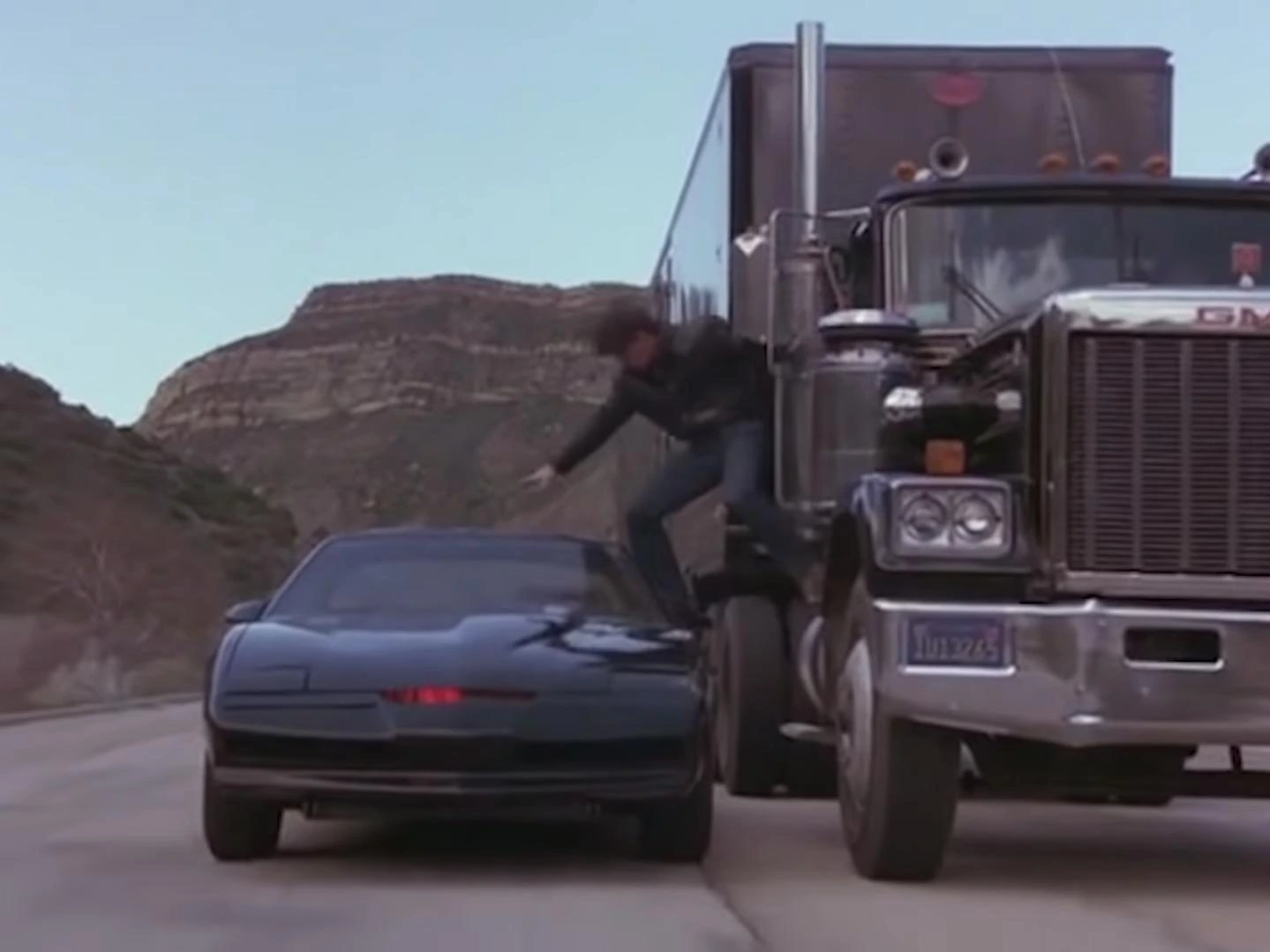
Goliath is an equally blunt piece of storytelling. KITT is sleek, agile, and conversational. The truck is mass and intimidation. It looks like the sort of object that could end an argument by continuing forward. Putting the two together changes the visual arithmetic. The familiar black car can seem small, which is a rare and useful shock.
The episodes know the attraction of excess. A single villain would have been enough. A huge vehicle might also have been enough. Combining an evil family member, the star in a second role, and a nearly unstoppable truck is the sort of decision that makes the series feel unmistakably itself. Nobody appears to have looked at the outline and worried that it contained too much television.
When the invulnerable car gets hurt
Goliath matters because it damages the promise on which the audience has come to rely. KITT usually gives Michael an advantage before a chase begins. When that advantage fails, the show briefly makes us worry about an object we have been trained to regard as safe. The damage is mechanical, but it lands as injury.
That’s the reward of giving the vehicle a voice and a temperament. An ordinary wreck can be spectacular. Damage to KITT affects a partner. Michael’s alarm and the Foundation’s repairs are responses to a character in trouble, even when the visual evidence consists of bodywork and electronics. The series has earned a surprisingly strong reaction to a car being unable to do what he normally does.
Goliath Returns revisits the rivalry in the second season, adding the pleasure of a rematch. Garthe hasn’t become more restrained during his absence. Devon and April’s involvement makes the danger reach into the support team, and Michael has to contend with an enemy who already understands much of the Foundation’s unusual world.
These stories also expose the useful contradiction in KITT’s appeal. Viewers want him to be almost unbeatable, because that is the fantasy. They also need him to be vulnerable occasionally, because that makes the loyalty visible. A car that always wins can be a fabulous gadget. A car whose partner fears losing him can become something more. Knight Rider finds that feeling without spending an hour explaining why anybody should care about a Pontiac.
Race for Life makes the deadline human
Race for Life gives the second season an emergency that has little use for KITT’s superiority in a conventional chase. A child needs a bone marrow donor, and the person who may be able to help is a fugitive. Finding him is only part of the job. Michael also has to reach a human being whose reasons for remaining hidden are powerful enough to collide with someone else’s urgent need.
The premise makes good use of a hero who can cross distances quickly but cannot simply order a decent outcome. KITT can help locate and transport. The moral choice still belongs to a person. An impressive arrival doesn’t remove fear, distrust, or the consequences waiting at the other end of a journey. Michael’s ability to persuade matters as much as his ability to pursue.
It also lets April’s connection to the endangered child give the Foundation team a personal stake. The people who normally supply expertise now need the field operation to succeed for someone they care about. The urgency isn’t a device Michael can leave on Devon’s desk after a briefing. It travels with the group and makes the familiar machinery feel necessary in a different way.
Stories like this help explain the program’s broad appeal. Its view of goodness can be uncomplicated, but the wish beneath it is generous: the extraordinary resources ought to be used for someone with very little power. KITT’s speed is exciting. Getting a frightened person to the place where he can save a life gives the speed a destination worth the fuss. The car isn’t merely winning a race against another car; the team is trying to beat a clock that won’t negotiate.
Soul Survivor puts the personality in a smaller box
Soul Survivor offers one of the show’s cleverest reductions. A young computer enthusiast helps steal KITT, and Michael is left working with the car’s intelligence in a portable television. Take away the handsome body, the scanner, and the spectacular entrances, and the voice is still recognizably KITT. He is also understandably displeased with the accommodations.
The episode turns a practical problem into a comic test of the premise. What exactly have we become attached to? The car is the image on the poster, but the companion survives outside it. Michael can carry the personality around while trying to reclaim the hardware. The resulting indignity is funny because KITT has such a developed sense of himself.
It also gives Michael a more awkward rescue assignment than usual. He can’t simply ask the car to come and collect him, because collecting the car is the job. The series temporarily removes the solution it normally reaches for and makes the human half do more improvising. Meanwhile, KITT remains capable of offering opinions, which may or may not be the assistance Michael wanted at that particular moment.
Stories about a stolen machine can become impersonal very quickly. This one understands that theft is more interesting when the displaced intelligence can complain about it. The episode doesn’t need a grand speech about consciousness. It lets KITT be funny, inconvenienced, and unmistakably himself in a ridiculous container. A television sitting there with an attitude turns out to be a fairly persuasive argument for the performance.
Knightmares and Lost Knight pull at the connection
Knightmares sends Michael back toward his old identity after an explosion leaves him with memory loss. The man who has built a new life with FLAG no longer understands that life in the same way. Familiar people and equipment have to be encountered again. For an episodic series, it’s an efficient way to make the standing premise strange.
Lost Knight later gives KITT his own separation and memory problem. The car becomes involved with a boy in danger while Michael searches for him. The partner who usually knows where everyone is and what is happening can no longer provide the same secure center. The relationship has to be reconnected through action and care.
Amnesia is one of television’s well-used cupboards, and Knight Rider opens it without embarrassment. What helps is the symmetry. Both members of the team can lose the knowledge that makes them a team. Their habitual shorthand is suddenly unavailable. A car that can speak and reason allows the show to play that old device from an unusual direction.
The episodes work best when the confusion reveals attachment instead of merely delaying the next chase. Michael’s concern for KITT isn’t dependent on the car being useful at that moment. KITT’s value isn’t exhausted by remembering the assignment. After enough adventures, looking for the missing partner is the assignment. That’s a simple emotional turn, but it makes the program’s frequent talk about loyalty feel earned by behavior.
Bonnie returns, and the third year rearranges the furniture
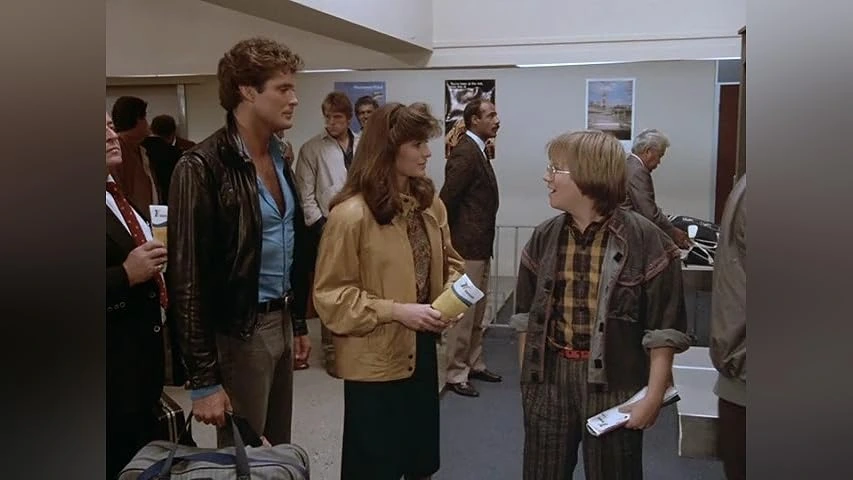
Knight of the Drones opens the third season in fall 1984 and brings Bonnie back into the group. The dashboard has changed as well. The show is refreshing familiar attractions while retaining the relationships that make the refresh worthwhile. New lights are welcome. A familiar person who knows what the lights are supposed to do is even more welcome.
The third year has room for odd corners. The Ice Bandits heads into wine country and a criminal puzzle involving monks. Halloween Knight gives Bonnie a frightening new apartment and a plot with an unmistakable taste for spooky misdirection. Knight by a Nose puts a racehorse into the investigation. The series doesn’t insist that every episode resemble an arms-trafficking thriller.
That looseness can be a strength. KITT encounters worlds he would never choose from a menu, and Michael has to deal with people whose priorities do not match the Foundation briefing. A show with such a conspicuous central gimmick can benefit from changing the surroundings. The machine remains extraordinary while the week’s human business becomes comically particular.
The season ending in 1985 is where these adventures sit beside the biggest television hits of 1985. The annual list describes the larger broadcast landscape; it doesn’t contain the whole story of why a particular program stays lodged in memory. For Knight Rider, a returning technician, a redesigned cabin, and an occasional very strange case could matter more to an attached viewer than any movement in the charts.
Halloween Knight gives Bonnie a very bad address
Halloween Knight places Bonnie in a new apartment where an apparent murder and a series of frightening events make her question what is happening around her. It’s a welcome change of emphasis. The technician who normally helps interpret the car’s problems has a problem of her own, and Michael has to take her account seriously while sorting out the trickery.
The episode enjoys the seasonal opportunity for costumes, suspicious neighbors, and movie-flavored scares. KITT still belongs in the story, but his existence doesn’t make the human mystery disappear. A car can gather information. It cannot automatically tell Bonnie which apparently ordinary person deserves her trust. The familiar team has to operate in a setting designed to make ordinary observations unreliable.
McPherson’s return is useful for more than putting a familiar face back in the semi. Giving Bonnie a story outside the workshop lets her be unsettled, angry, and determined in her own right. Her professional confidence doesn’t mean she is immune to intimidation. The episode’s playful fright-show setting provides a different kind of trouble from missiles or truck armor, and gives the series room to enjoy being a television mystery with a talking car parked nearby.
KITT vs. KARR earns its billing
The title K.I.T.T. vs. K.A.R.R. doesn’t waste anybody’s time. The third-season return brings the dangerous prototype back into circulation and gives the series another direct confrontation between its two talking machines. By this point KITT’s personality is deeply familiar, so his rival doesn’t have to be explained from scratch to make the encounter feel important.
KARR’s rediscovery places him among humans who again think they understand what they have found. The bargain between a powerful machine and people who want something from it is unstable from the beginning. Unlike KITT and Michael’s working friendship, it rests on incompatible appetites. An alliance can be useful without being loyal.
The episode also gives the rival a striking visual distinction through his altered exterior appearance. That helps the action read immediately while preserving the unnerving similarity. One of the show’s best ideas is that a reassuring shape can carry a very different intention. KITT’s trustworthiness is a character trait, not a property that automatically comes with the body style.
The eventual contest supplies the spectacle the title promises. It also demonstrates why KARR is memorable despite relatively few original-series appearances. He doesn’t merely oppose the hero; he makes the hero’s closest companion define himself. Plenty of weekly villains would like to kill Michael Knight. KARR threatens to make the remarkable car look replaceable, and KITT has several persuasive objections to that suggestion.
Junk Yard Dog takes the damage personally
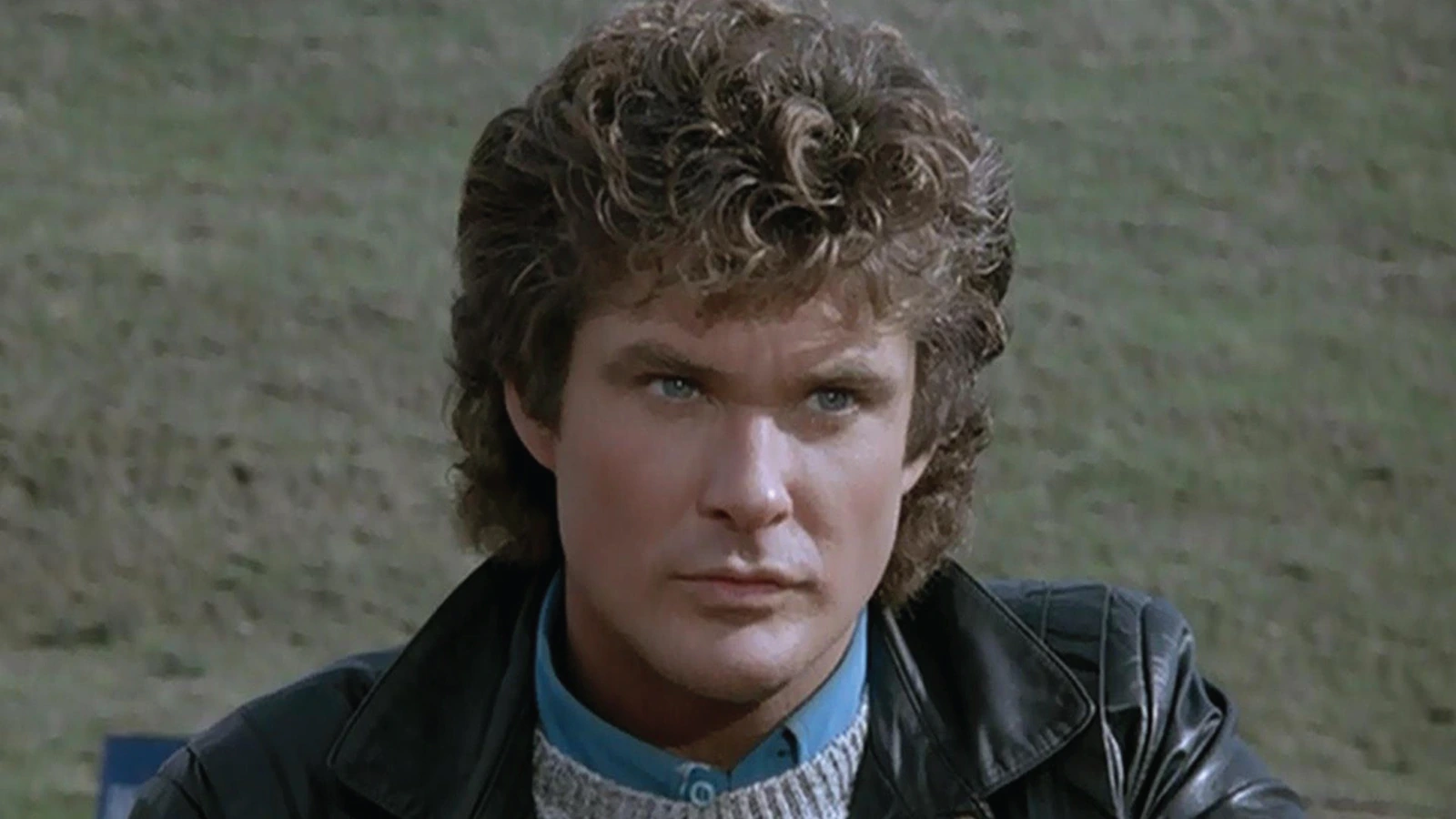
Junk Yard Dog pushes KITT into a toxic-waste nightmare. The car is nearly destroyed in an acid pit, and rebuilding him becomes the center of the story. It’s a harsh treatment for a series whose chief attraction is usually a sleek, unmarked machine arriving with the answer.
The emotional work continues after the physical repair. KITT’s confidence is damaged as well as his body. That choice gives Daniels something beyond a return-to-service announcement. The car has to face the prospect of danger after an experience that has made danger feel different. The show grants him a version of fear, and Michael has to respond to it as a friend.
Bonnie and the technical team are essential here because reconstruction is part of the drama. The support apparatus isn’t a convenient offscreen reset button. Work has to be done, and the person emerging from that work isn’t immediately identical in attitude to the one who went in. The shiny exterior can’t tell the whole story.
For a program often dismissed as a weekly stunt delivery service, this is an unusually revealing episode. Knight Rider understands how to make its invincible attraction fragile without permanently abandoning the fantasy. The eventual recovery matters because we have seen what it costs. KITT’s courage becomes more meaningful when he has a reason to hesitate. A fearless machine can be impressive; a frightened one choosing to help can be moving.
The FLAG semi is the clubhouse on wheels
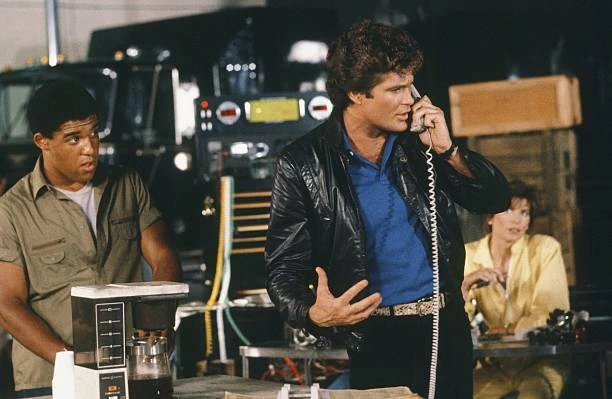
The Foundation’s mobile unit is one of those supporting details that can steal a large piece of a viewer’s affection. KITT rolling into the semi links the open-road adventures to a recurring workplace. The pair may be between towns, but there is still somewhere to return, compare information, repair damage, and receive the next round of professional concern.
It gives the series a home without making Michael stop traveling. Devon and the technicians can remain part of the action’s geography. The contrast is delightful: a highly polished car enters a large working truck and finds a small technical world inside. The vehicle that looks like freight transport carries the people responsible for the future.
Those scenes also put the ensemble together. Michael can be optimistic, Bonnie or April can be focused on what he has done to the machinery, Devon can be concerned about what he intends to do next, and KITT can contribute from his place on the floor. The staging is ordinary enough to let the performances carry the humor.
There is an appealing toy-box logic to the arrangement, but the storytelling benefit is real. A road series risks becoming a succession of interchangeable strangers. The semi restores the familiar group and its particular arguments. After the episode’s villains and clients have departed, these are the people who will still be around to discuss Michael’s methods. They have accumulated enough evidence to make it a lengthy meeting.
The theme tells the road to get moving
The Knight Rider theme, part of our 80s TV theme-song collection, was credited to Stu Phillips and Glen A. Larson and is one of the program’s most efficient pieces of design. Its repeating figure supplies forward motion before the story has made a demand. The electronic sound belongs comfortably beside the dashboard, but the tune has enough shape to remain recognizable away from the picture.
That matters for a series built around travel. The road needs a sound as distinctive as the car. The music can suggest mystery, speed, and technological confidence without turning the opening into an explanation. Then Basehart’s narration gives the adventure its mythic frame. The combination is slightly grander than a typical weekly case, which is exactly the point.
Inside the episodes, music helps sell transitions from ordinary locations to extraordinary pursuit. A familiar stretch of pavement can become the route toward danger. KITT’s scanner and engine sounds add their own signatures. The series is unusually easy to identify with only a brief sample of sound and image.
Other 1980s television favorites had great theme tunes; this one feels inseparable from the object at its center. You can describe the car in a sentence, but the theme supplies the feeling of being on the way somewhere. It turns a machine sitting in a driveway into the beginning of an adventure. That is a lot of work for a repeating musical phrase, and it does the work without asking Michael to explain anything.
RC3 and the fourth-season rebuild
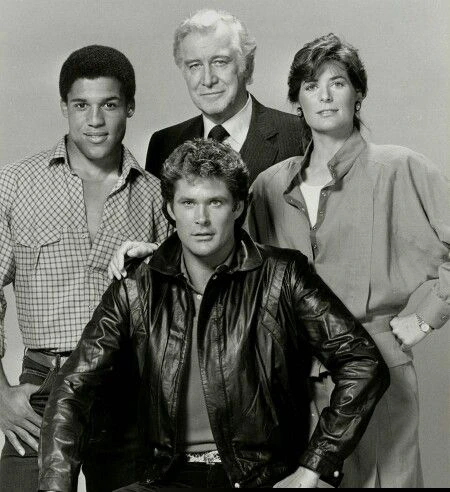
Peter Parros joins the fourth season as Reginald Cornelius III, better known as RC3. Knight of the Juggernaut introduces him in a story that again dismantles the assumption that KITT can withstand everything. The car is badly damaged, and the rebuild opens the way to new capabilities and a new member of the working group.
RC3 brings a different energy from Devon’s formality and Bonnie’s established technical authority. He is resourceful, direct, and useful in a crisis. The series gains another person who can act alongside Michael rather than only send him toward the case. His presence makes the mobile operation feel a little less like a small circle that has stopped admitting anyone.
Super Pursuit Mode is the fourth season’s great visual escalation. Panels and aerodynamic pieces transform the familiar silhouette into something busier and more emphatic. The convertible transformation adds another attraction. Whether a viewer prefers the original clean lines or enjoys the new spectacle, the intent is obvious: the remarkable car is being asked to become remarkable again.
The last original season ends in 1986, the proper annual context for the 1986 television rankings. Knight Rider’s refresh belongs to a moment when the show was trying to keep an established fantasy lively. New hardware could provide fresh shots for the promotions. RC3 was valuable for a different reason: another human personality could change the conversations after the spectacular transformation was over.
More isn’t always faster
The late-series additions reveal both the ingenuity and the strain of an action show built around an extraordinary object. Once the audience knows that the car can survive bullets, drive alone, and clear a barrier, each new threat has to make those abilities feel insufficient. The writers can increase the opponent, disable the car, separate the partners, or add a new function. Knight Rider tries all of them.
Sometimes the result is a terrific episode. Sometimes it feels like an accessory has arrived before a compelling reason to use it. The simple sight of Michael and the original black car already carried a great deal of appeal. Adding more moving parts could make the effect noisier without making the partnership more interesting.
The comparison with The A-Team is useful. Both series know the pleasure of a plan that becomes improbable machinery and a burst of action. Knight Rider concentrates more of that pleasure in one recurring vehicle. MacGyver would find suspense in assembling a solution from ordinary things; Michael often starts with the extraordinary solution and has to discover why it isn’t enough today.
The program is strongest when a threat reveals something about KITT or Michael. A machine becoming frightened, a man facing his old love, or a rival built around the wrong priorities gives the spectacle a reason to matter. Bigger equipment can be enjoyable on its own. It still helps if the people in and around it have a problem worth caring about.
Killer KITT turns the trusted arrival into a threat
Killer K.I.T.T. attacks the partnership from inside the software. A vengeful computer expert reprograms the car and sets him against Michael and the Foundation. The familiar approach of the black vehicle becomes an alarm instead of a rescue. It’s a late-series way of taking the audience’s trust and using it to make an otherwise routine piece of road suddenly uncomfortable.
KARR is frightening because he resembles KITT while having different loyalties. Here the threat is closer: the actual companion has been changed. Michael knows what the car can do and has usually welcomed those abilities. Now he has to survive them. A locked door or an approaching bumper can carry more suspense when the object responsible used to be the safest part of the scene.
The story belongs to a recurring concern across the run. Sophisticated hardware doesn’t remain virtuous simply because it looks impressive. People can manipulate it, steal it, rebuild it badly, or use their access for revenge. The Foundation’s confidence always depends on care and trustworthy expertise. Bonnie’s work is part of that security, not background decoration around a machine that maintains itself.
For Michael, restoring KITT also means restoring a friend. That is a stronger goal than obtaining an expensive piece of equipment in working order. The show can lean heavily on a villain’s technical convenience, but its central feeling remains clear. The person who has spent years answering that voice wants the voice back on his side. After enough miles together, a car coming toward you ought to mean help. This episode earns its unease by temporarily breaking that agreement.
The Scent of Roses gives Michael something the car can’t fix
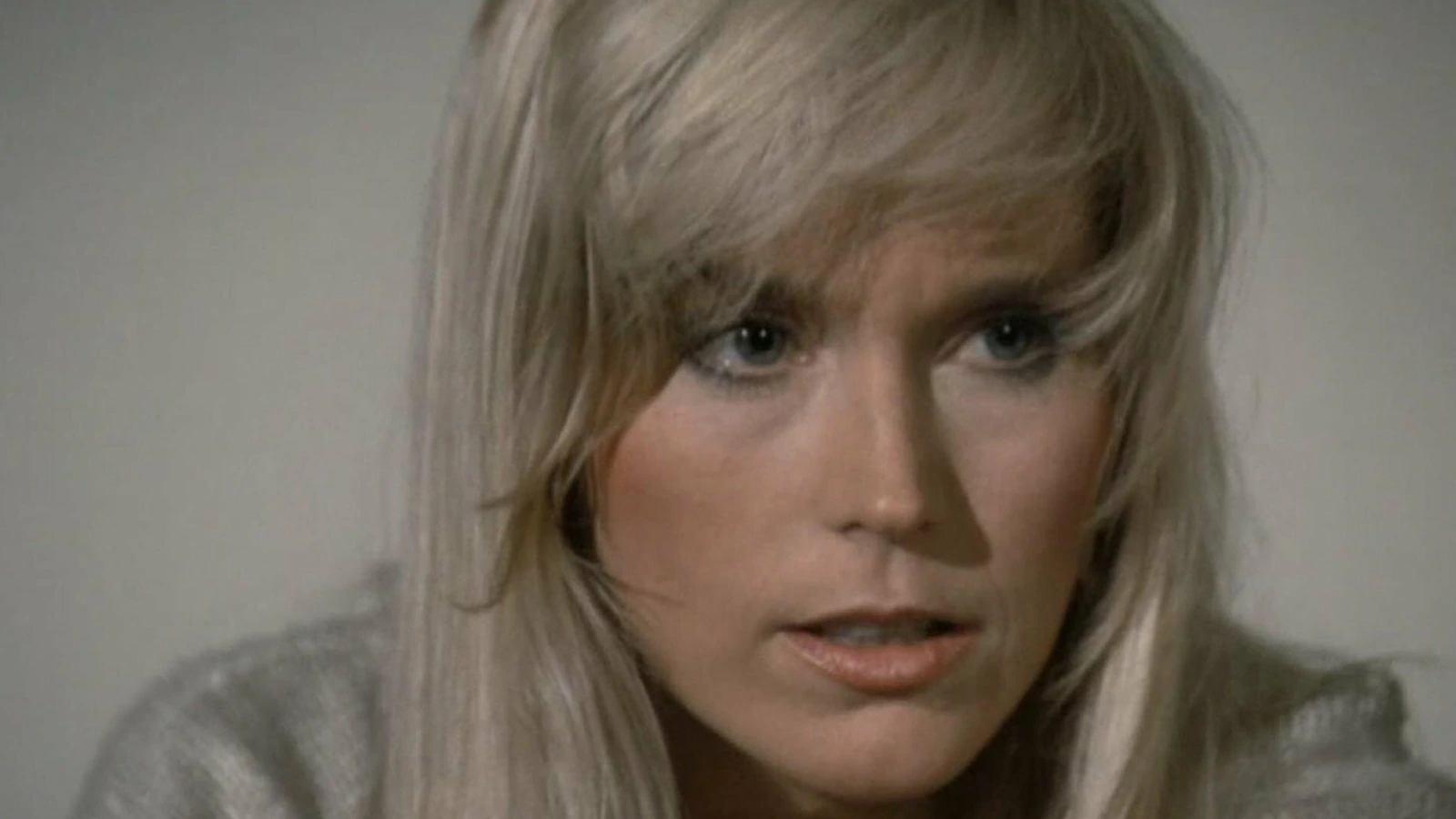
The Scent of Roses, broadcast in January 1986, brings Michael’s relationship with Stevie to its most painful point. He considers leaving the Foundation, and marriage offers the possibility of a different life. Violence destroys that possibility. The episode asks Hasselhoff to carry grief instead of merely the determination needed to catch the next villain.
It stands apart because the cost reaches beyond the week’s threatened stranger. Michael’s hope is personal and specific. His work has given him purpose, companionship, and extraordinary freedom, but it has not placed a protective shell around everyone he loves. KITT’s abilities cannot reverse the central loss.
That doesn’t mean the series suddenly becomes a different program. The adventure continues, and the familiar partnership remains the place Michael can return. But the episode gives the mission a heavier shadow. A man who usually arrives to help other people is the person who needs support. KITT’s presence can be valuable without offering a technological solution.
It is also worth placing the episode correctly. This is not the last original broadcast. Several adventures follow it, including the actual final episode in April. Remembering it as an emotionally substantial late story is fair; silently moving it to the end rewrites the viewing history. Knight Rider’s final months contain a potential farewell feeling, new assignments, and the ordinary unevenness of a series approaching cancellation.
The road stops without a grand parking ceremony
The original NBC run ends on April 4, 1986, with Voo Doo Knight. The last broadcast isn’t a carefully arranged summary of everything Michael and KITT have meant to each other. It is another adventure, with the kind of outlandish premise the later series was quite willing to entertain. For viewers expecting a formal goodbye, the road simply runs out.
That ending helps explain why memories of the series don’t usually organize themselves around a final scene. The durable images are recurring ones: the scanner moving, Michael talking to his watch, the car arriving without a driver, Devon waiting with a case, and KITT expressing a perfectly reasonable objection that is about to be ignored.
Later television movies and revivals extend the property in different directions, but the original four-season run is its own recognizable object. The black Trans Am and Daniels’ voice belong together. A later vehicle can carry the name and a new set of effects without reproducing the exact balance that made the first partnership work.
For a show so interested in futuristic equipment, its lasting attraction is remarkably social. The technology gives Michael and KITT things to do. Their familiarity gives us a reason to watch them do it again. The car is loyal enough to come when called and opinionated enough to make the arrival entertaining. That’s a harder combination to replace than a dashboard, however many new buttons someone installs.
Knight Rider questions worth settling
When did the original Knight Rider air?
The original series premiered on NBC on September 26, 1982, and ended its first-run broadcast on April 4, 1986. Its four seasons are the 1982–83, 1983–84, 1984–85, and 1985–86 television seasons. Later movies and revivals belong to separate productions.
Who supplied KITT’s voice?
William Daniels supplied the original KITT’s voice. He was also playing Dr. Mark Craig on St. Elsewhere during this period. David Hasselhoff played Michael Knight, the human half of the partnership, and also played the villainous Garthe Knight.
What do KITT and FLAG stand for?
KITT is the Knight Industries Two Thousand. FLAG is the Foundation for Law and Government, the organization supporting Michael’s assignments. The original car’s familiar screen identity is built around a black Pontiac Trans Am, with fictional systems far beyond a road-going production car.
Why are Bonnie and April both remembered as the technician?
Patricia McPherson plays Bonnie Barstow in season one and seasons three and four. Rebecca Holden plays April Curtis in season two. They are separate characters serving the Foundation during different stretches of the original run, not one character recast under the same name.
Is The Scent of Roses the finale?
No. It is a significant late episode involving Michael and Stevie, broadcast in January 1986. Voo Doo Knight was the last original NBC episode broadcast that April. The emotional weight of Stevie’s story can make it feel like a farewell, but it did not close the original broadcast order.