MacGyver in the 80s: The Hero Who Could Build His Way Out of Anything
Pete, Jack, Penny, Murdoc—and the action hero who made a pocketknife and an idea seem more useful than another round of ammunition.
By Gizmo
THINK FASTER.
FIND ANOTHER WAY.
Inside This Article
- The man who looked around before he threw a punch
- September 1985: an underground lab and a different proposition
- Richard Dean Anderson makes competence approachable
- A gun-free identity, with a few uncomfortable edges
- The MacGyverism: first the object, then the possibility
- Opening gambits, and the promise of an adventure already underway
- Pete Thornton, the friend inside the organization
- Harry Jackson knew him before the reputation
- The Human Factor: a clever system meets an inconvenient person
- Jack Dalton arrives with a plan you should probably decline
- Penny Parker, a human complication with excellent timing
- Murdoc, who apparently never received the memo about moderation
- Partners makes the friendship part of the danger
- The Widowmaker lets the hero fail to save someone
- Nikki Carpenter doesn’t arrive to admire the cleverness
- Blood Brothers gives the gun aversion a history
- Runners asks him to listen before he rescues
- The outdoors becomes something worth protecting
- Thin Ice, and a different kind of bad judgment
- Vancouver changes the air around the adventures
- The creative team had to invent the problem and the answer
- ABC’s durable adventurer wasn’t the decade’s ratings champion
- 1989 keeps widening the map
- What the cleverness looks like after all these years
- Questions Readers Ask
The man who looked around before he threw a punch

Other action heroes entered a room looking for the man with the gun. MacGyver entered looking for everything else. A loose wire. A damaged machine. A useful piece of somebody’s thoroughly unremarkable furniture. You could practically see the inventory forming behind Richard Dean Anderson’s eyes while the villain continued explaining why escape was impossible. The villain really should have stopped talking and removed the office supplies.
That was the pleasure of MacGyver in the 80s. The situation looked hopeless, the available equipment looked insulting, and the hero treated both assessments as preliminary. He wasn’t waiting for a bigger weapon or a better-funded rescue team. He was considering whether the things already in the room might have been underestimated.
Anderson made the thinking feel friendly. His Mac was capable without being a lecture, decent without appearing polished for inspection, and just exasperated enough to suggest that hanging from a dangerous height wasn’t his preferred afternoon activity. The character’s intelligence didn’t separate him from ordinary people. It made him more attentive to them, and to the ordinary objects they overlooked.
Beginning on ABC in September 1985, the series offered a different kind of action star at a moment when television and movies were hardly suffering a shortage of men willing to settle a disagreement with ammunition. MacGyver was physically brave, certainly. He also liked the possibility that nobody needed to die before the closing credits.
The show could be formulaic, preachy, or scientifically optimistic to a degree that deserved a raised eyebrow. Its hero had an extraordinary ability to find exactly the materials required by that week’s script. But the invitation underneath the contrivance remains appealing: pay attention, learn something, help the person beside you, and don’t assume force is the only available answer.
Within the noisy adventure landscape of 1980s television, that was a strong identity. A leather jacket, an unruly haircut, a small pocketknife, and the conviction that a problem might reward thought. Not a bad collection of things to put in front of an audience growing up in the 1980s.
September 1985: an underground lab and a different proposition

The pilot begins with the reassuring scope of an adventure series. MacGyver is already in dangerous territory, rescuing a downed pilot before the main story turns toward an underground laboratory in New Mexico. Scientists are trapped, damage threatens a larger disaster, and the man called in to help has no obvious army following him down the corridor.
The September 29, 1985 premiere also contains a complication for anyone remembering the character as a completely settled invention: MacGyver fires a gun during the opening rescue. The familiar aversion wasn’t yet expressed with the consistency it acquired afterward.
That exception matters because a beloved character’s identity often becomes neater in memory than it was on the first night. The show didn’t arrive with every rule settled. It found its emphasis, strengthened it, and taught viewers what to expect. Pretending the early oddity doesn’t exist makes the history less interesting, not more coherent.
The laboratory story establishes the real attraction. A disaster creates physical obstacles, and Mac addresses them one at a time. He notices materials, makes connections, and tests a way forward. His explanations give the audience enough information to follow the intention even when the practical result is enjoying a very generous relationship with reality.
The pace is important. Thinking is allowed to occupy the screen. A close look at a pipe or a panel isn’t dead time between confrontations; it’s the beginning of the solution. The series turns a pause into suspense by letting us understand that an observation is about to matter.
There is another early wrinkle: Dana Elcar appears as Andy Colson, not Pete Thornton. The actor who became such a central part of Mac’s world was present before that world had its familiar arrangement. It’s a small casting detail with a large effect on a revisit. You recognize the reassuring face, then discover the name on the door hasn’t caught up yet.
As a first hour, the pilot is less a perfect statement of every later principle than a promising demonstration. Put this actor in a difficult space, give him something to study, and the audience has a reason to stay.
Richard Dean Anderson makes competence approachable
MacGyver doesn’t carry himself like a man who expects applause for entering a room. Anderson gives him a relaxed, slightly self-effacing manner that makes the extraordinary competence easier to accept. He looks at people when they talk. He reacts when something hurts. He isn’t delighted every time the script finds another opportunity to drop him off a structure.
The performance depends on small signs of thought. A glance shifts from the obstacle to the available material. A hand tests something. The face registers an idea before the explanation arrives. Anderson makes the process readable without turning every discovery into a theatrical revelation.
His humor also helps. Mac isn’t a machine dispensing solutions. He can be irritated, amused, or quietly aware that the plan sounds absurd. That little acknowledgment invites the audience to come along. We don’t have to believe the predicament is ordinary; we have to believe this person would keep trying inside it.
MacGyver didn’t need to look like he could bench-press the bad guy’s car. That was part of the casting magic: Richard Dean Anderson looked like someone who would rather think his way out. Anderson’s appeal fits that recollection. His physical capability is visible, but the character’s authority doesn’t depend on making everybody else look small.
The difference becomes especially clear around frightened people. Mac explains rather than merely orders, and his confidence can become something another person borrows. That’s a warmer kind of heroism than the fantasy of being the toughest man present. It leaves room for somebody else to contribute.
There are episodes where the decency becomes so emphatic that the character seems in danger of turning into an extremely fit guidance counselor. Anderson usually rescues the moment by keeping the delivery plain. A hint of impatience or concern restores the person inside the message.
His appearance is part of the equation too. The practical clothes, casual posture, and famously expanding hair make Mac look like an adventurous person rather than a brand-new action figure still attached to its packaging. The haircut deserves some of the jokes it receives. It doesn’t deserve to obscure how much controlled, unflashy acting holds the series together.
A gun-free identity, with a few uncomfortable edges
MacGyver’s refusal to rely on firearms is more than an absence in the prop department. It changes the sort of scene the writers have to build. If the hero can’t solve the immediate problem by shooting the person causing it, the room needs other possibilities. A chase, a diversion, a trap, a conversation, or an improvised escape becomes the action.
That doesn’t make the series free of violence. Mac fights, gets hurt, uses force, and participates in stories filled with threats. The important distinction is the preference: lethal force isn’t his default expression of competence. He would rather find another way and usually has the patience to look for it.
By 1989, Anderson and producer Henry Winkler were already talking about what made this hero different. The idea was already part of how the series understood and presented itself during the original run, not an admirable interpretation attached decades later.
The best episodes make the principle dramatic rather than decorative. Mac has to choose under pressure. Somebody else may be ready to use a gun, and he has to offer a credible alternative rather than simply announce his superiority. A principle becomes interesting when it costs time, exposes risk, or demands trust from another person.
The weaker episodes treat the distinction as a moral shortcut. Our hero is right because he’s our hero, the opponent is foolish, and a difficult human problem yields to a firm speech plus an ingenious device. That can feel reassuring, but it isn’t always persuasive.
There’s also a tension between nonlethal intent and the spectacular methods television enjoys. A dangerous environment doesn’t become harmless because the protagonist avoids pulling a trigger. The show asks us to accept a particular adventure logic, with outcomes managed by the story’s generous hand.
Still, the emphasis matters. Among 80s action shows, MacGyver made restraint part of the attraction. He wasn’t interesting despite looking for alternatives. He was interesting because he looked. That gave the audience a hero whose first question wasn’t how to overpower a room, but how to understand it well enough to get everyone out.
The MacGyverism: first the object, then the possibility
A good MacGyver sequence begins before the assembly. The camera lets you notice an object without announcing its final purpose. Later, when Mac reaches for it, recognition supplies part of the pleasure. You saw that. You simply didn’t see it the way he did.
The ordinary quality of the materials is essential. A secret gadget designed for exactly one impossible task belongs to a different fantasy. Mac’s tools are appealing because they seem to belong to the same world as a kitchen drawer, a garage shelf, or the neglected contents of a school science cupboard.
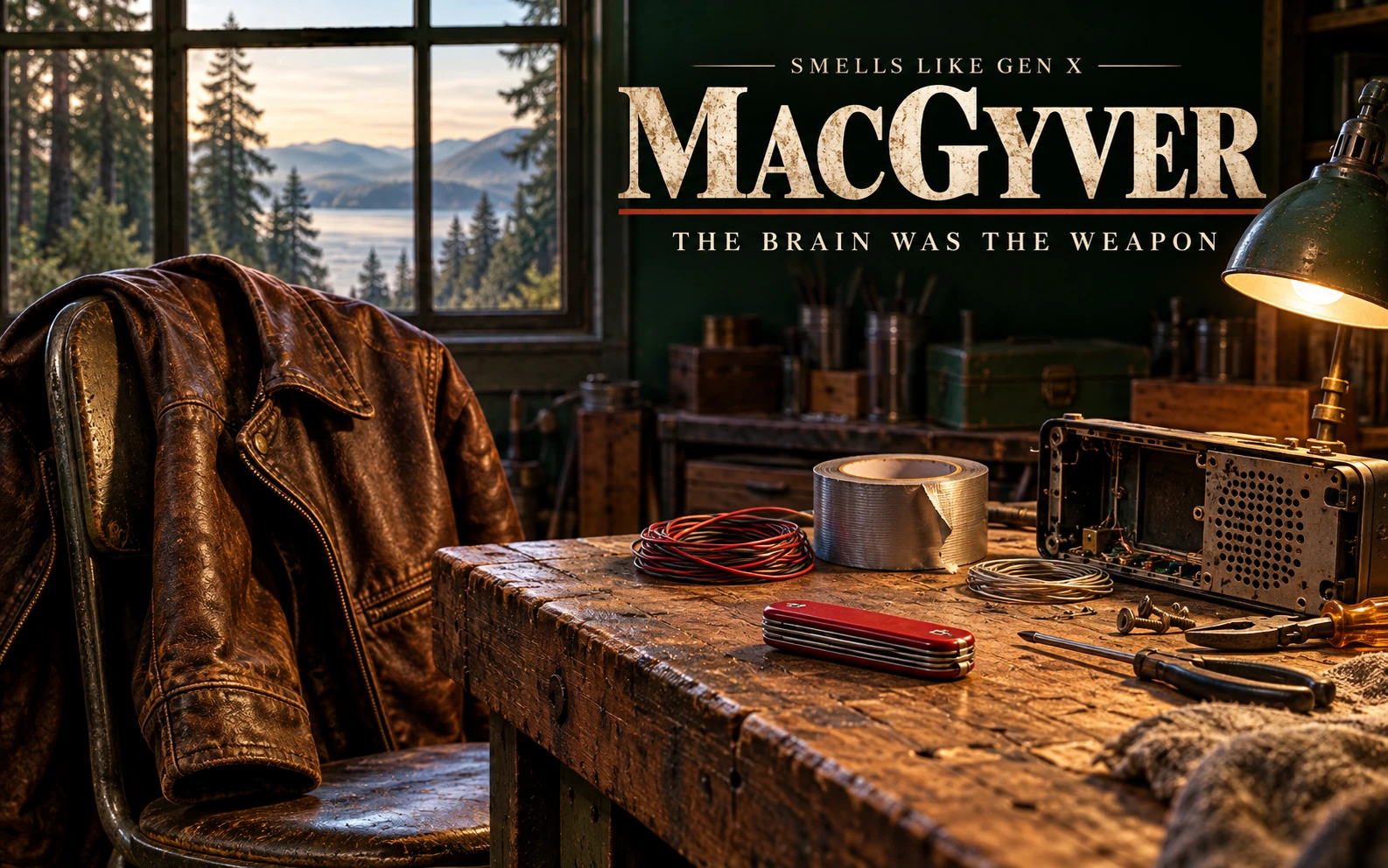
The red pocketknife becomes the compact symbol of that approach. It isn’t an all-powerful machine. It’s a way to begin working on the situation. Tape serves a similarly unglamorous role. The series makes resourcefulness look less like owning everything and more like understanding a few things well enough to use them differently.
The early voice-over helps make that invitation personal. Mac can explain what he’s noticing without turning to deliver a lesson to another character. Anderson’s conversational delivery gives the impression of a capable person thinking aloud, letting the audience stay close to a process that might otherwise be difficult to photograph.
There’s a limit to the device. If the explanation does all the work, the scene becomes narration accompanied by busy hands. The better moments allow the image to carry part of the answer: a glance, a test, a change in the machinery, then the result. We aren’t simply being told that Mac is clever. We are being given enough time to recognize the shape of the idea.
Of course, the available materials are rarely as random as they appear. A television writer has been there first. The necessary object is present because the solution requires it, and the time allowed for constructing the solution may be considerably kinder than a real emergency would permit.
Recognizing that doesn’t spoil the scene. A magic trick doesn’t stop being enjoyable because you understand that somebody arranged the cards. The question is whether the arrangement feels clever enough, and whether the performance lets you share the discovery rather than merely endure an explanation afterward.
At its best, the series gives a child watching at home a satisfying kind of agency. Intelligence is something you do: observe, compare, remember, try. You don’t need a costume or a mysterious inheritance to begin. You need curiosity and the willingness to admit the first idea may fail.
At its worst, the invention feels like a password. Mac names the principle, moves his hands, and the universe agrees to cooperate. There is no real suspense because the story has made his ingenuity unlimited. The most rewarding scenes keep a little resistance in the material, a little uncertainty in the attempt, and a person on the other side who needs the result.
The famous improvisations endure because the underlying invitation is generous. The world contains more possibilities than it first appears to. Even that unimpressive object over there might be useful. Especially after the production department has thoughtfully placed it within reach.
Opening gambits, and the promise of an adventure already underway
Early MacGyver episodes often begin with a separate miniature adventure. Before the main assignment has even settled into view, our hero is retrieving something, rescuing somebody, or extracting himself from a place whose security arrangements discourage visitors. These opening gambits give the show a running start.
The effect is slightly different from a conventional teaser. The little mission can feel like a glimpse of a much larger life, one in which Mac was busy before we arrived and will continue being busy after the credits. The world doesn’t wait politely for the week’s main guest star to enter.
“Thief of Budapest” begins with a stolen horse, a helicopter, and the sort of rescue that makes you wonder whether anyone in the writers’ room had ever heard the word “insurance.” It is the sort of large, cheerfully improbable image that tells a viewer exactly what sort of evening is being offered. You may wish to adjust your expectations about both aviation and convenient timing.
Those sequences also establish Mac’s rhythm quickly. He assesses the problem, improvises, takes a physical risk, and leaves with the sense that the day has barely begun. The main story can then slow down long enough to introduce a client or a location without losing the initial promise of action.
Randy Edelman’s theme completes the invitation. Its energetic lift makes the series feel forward-moving even before anyone has started running. Like the best television themes, it doesn’t summarize the plot so much as tune the viewer’s expectations. This is an adventure; thought and motion will eventually meet.
The gambits aren’t automatically better than the main stories. Some are essentially elaborate demonstrations of a concept, enjoyable but thin. Their importance is tonal. They let the audience meet Mac as a person already exercising his peculiar skills, rather than spend every opening listening to somebody explain that he has them.
There’s an appealing confidence in that approach. The show trusts the character to sell the premise through behavior. A man hanging from an unlikely situation doesn’t require a long biography. He requires an exit, and we have been invited to watch him invent one.
Pete Thornton, the friend inside the organization

Dana Elcar gives Pete Thornton something an action series badly needs: weight that doesn’t come from a threat. Pete has authority, experience, and an understandable wish that Mac would occasionally complete an assignment without turning the return journey into another rescue operation.
But he isn’t merely the man behind the desk. The friendship makes the arrangement warmer. Mac can push back, tease, worry, or recognize when Pete is concealing a problem. Elcar supplies the sense of a person with responsibilities outside the hero’s immediate adventure, which makes his confidence in Mac feel like a decision rather than a weekly formality.
The distinction from the pilot is worth remembering. Elcar’s first appearance as Andy Colson isn’t an early Pete scene under a different pronunciation. The recurring Pete identity develops afterward. The series assembles its familiar world over time, and a revisit is more rewarding when those changes are allowed to remain visible.
Once the Phoenix Foundation becomes the regular institutional home, Pete helps make its wide range of assignments believable enough for television. An organization with broad interests can send Mac toward scientific dangers, environmental trouble, international intrigue, or a person who simply needs help. The letterhead is flexible. The friendship is the fixed point.
That flexibility occasionally stretches credibility. One begins to wonder whether the foundation has a clear mission statement or whether Pete simply answers the telephone and says yes. But Elcar grounds the enterprise in practical concern. He looks like a man who has read the report, considered the risks, and knows exactly whom he is about to inconvenience.
The best Pete stories let the competence flow in both directions. He isn’t helpless so that Mac can be impressive. His experience matters, and Mac’s loyalty is personal. The hero has someone whose disappointment would mean more than a reprimand from an anonymous government official.
Their ease together makes the adventures less lonely. Mac can remain a wanderer without becoming a man with no attachments. Pete is proof that independence doesn’t require emotional emptiness. Occasionally it requires a friend patient enough to hear the explanation for the damaged equipment.
Harry Jackson knew him before the reputation
“Target MacGyver,” from December 1985, gives the hero an estranged grandfather and a reason to look uncomfortable without anybody pointing a weapon. John Anderson plays Harry Jackson, a man whose history with Mac cannot be settled by the younger man’s current reputation for competence.
The visit becomes dangerous when a contract killer follows Mac. The action forces grandfather and grandson to cooperate, but the reunion already has a different sort of tension. Being useful to strangers doesn’t tell you how to repair a family distance.
John Anderson gives Harry enough firmness to make the relationship feel like a meeting between two people rather than a ceremonial encounter with a wise older relative. Mac has somebody to answer, and the usual easy manner doesn’t settle everything. A person who knows your past may be less impressed by the polished explanation you offer the rest of the world.
The story also keeps the series’ independence fantasy from becoming too clean. Mac’s freedom has a family history attached. He may prefer movement and self-reliance, but he hasn’t arrived in adulthood without people who can still make him feel like a younger version of himself.
The pursuit supplies the necessary danger, yet the emotional hook belongs to that awkward reunion. It is another early sign that the series becomes richer when the man with the answers has a relationship he cannot resolve simply by finding the right object in the room.
The Human Factor: a clever system meets an inconvenient person
The second-season opener offers an especially suitable enemy for MacGyver: a security system that has become much too confident in its own judgment. In “The Human Factor,” a test turns into a trap, and the computer controlling a top-secret facility no longer treats the people inside as participants in an exercise.
The September 22, 1986 episode puts Mac and the system’s designer inside the very machinery that was supposed to demonstrate security. The premise gives the usual ingenuity a clean purpose. A human being has to identify something the system hasn’t anticipated.
It’s a familiar science-fiction fear, but it suits this particular hero unusually well. Mac doesn’t worship a machine because it is sophisticated, and he doesn’t dismiss one because it is complicated. He wants to know what it does, what it assumes, and where the assumption might fail.
The story turns his habit of looking closely into a contest between different kinds of intelligence. A security system works by defining permitted behavior. Mac works by recognizing possibilities outside the obvious path. The suspense comes from watching a person improvise inside a place designed to prevent improvisation.
There is a wonderfully period-specific pleasure in the equipment and the premise. The computer is a formidable physical presence, not a vague cloud of digital power. Doors, rooms, surveillance, and air become parts of the problem. The threat has surfaces a television camera can show and a resourceful character can investigate.
The episode doesn’t need to predict modern technology to remain enjoyable. Its useful concern is older: what happens when a system treats its model of the world as more important than the people standing inside it? Mac’s answer involves action rather than a conference panel, which is probably just as well for the ratings.
As a statement of the show’s appeal, it’s strong. Intelligence isn’t simply knowing the rules. It’s recognizing when the rules have stopped describing reality. The computer has procedures. Mac has judgment, persistence, and an annoying tendency not to remain where the security plan expects him.
Jack Dalton arrives with a plan you should probably decline

Bruce McGill’s Jack Dalton is the friend whose enthusiastic greeting ought to make Mac check whether his passport is still in his pocket. Jack usually has a plan, a reason the plan is excellent, and a few details he would prefer to disclose after everybody is too committed to leave.
“Jack of Lies,” in 1986, establishes the recurring pleasure. A rescue assignment brings Mac into another of Jack’s complicated enterprises. The title is refreshingly candid. You can’t accuse the episode of failing to notify interested parties.
McGill gives Jack a larger, more theatrical personality than Mac’s. His optimism is often indistinguishable from salesmanship, but there’s enough affection beneath it to explain why Mac doesn’t simply change his telephone number. Jack creates trouble; he also creates a history in which the hero has someone who remembers less solemn versions of him.
The friendship gives Anderson room for comedy. Mac’s skepticism arrives before the full explanation, and the pleasure lies in watching him calculate how much of the story remains undisclosed. He isn’t fooled in the same way every time. Sometimes he knows perfectly well that the sensible choice is to leave and helps anyway.
Jack’s aviation identity adds another useful texture. The cap, the cockpit, and the confidence offer a romantic version of adventure, the kind that sounds excellent until the engine or the authorities become involved. Mac is often the person left translating that romance into a survivable afternoon.
Jack’s arrival during the second season gives the adventures another recurring source of both warmth and extremely questionable judgment. As the series adds friends rather than merely clients, the assignments become more personal. Mac isn’t always responding to an official request; sometimes he’s responding to the consequences of knowing Jack.
That distinction helps prevent the hero from becoming too tidy. A decent man can make an unreasonable choice because he cares about somebody unreasonable. The relationship is affectionate without requiring us to pretend Jack is a sound investment. He is, however, an excellent recurring guest star.
Penny Parker, a human complication with excellent timing

Teri Hatcher’s Penny Parker enters Mac’s world in “Every Time She Smiles,” and the trouble begins almost immediately. He’s trying to complete a mission in Bulgaria. She’s an American whose romantic entanglement complicates his departure. Neither itinerary benefits from the introduction.
Hatcher first plays Penny on February 19, 1986, amid a microfilm assignment that really doesn’t need another complication. The setup gives the series a different source of disorder. Not every problem originates with an elaborate villain. Sometimes an exuberant person has made decisions that now require an extremely patient companion.
Hatcher plays Penny with brightness and momentum. The character can be heedless, but she isn’t interesting merely because she makes mistakes. Her openness changes the atmosphere around Mac. He has to respond to another person’s hopes and assumptions, not simply solve a mechanical obstruction.
That also creates a comic risk. A lively young woman who repeatedly needs help can become an excuse for the hero to demonstrate competence while everybody laughs at her. Penny works better when the series lets her enthusiasm register as a real quality rather than a symptom of foolishness.
Her later stories stretch the show toward different genres. “The Secret of Parker House,” which opens the fourth season in 1988, brings an inheritance and a spooky house into Mac’s orbit. The man who usually explains what is happening now has to move through an atmosphere designed to encourage the opposite conclusion.
By “Cleo Rocks” in 1989, Penny’s performing ambitions give the series another theatrical setting and another route toward Murdoc. A recurring friend creates continuity without requiring a permanent domestic arrangement. Mac can have attachments that pull him into trouble while remaining recognizably the wandering troubleshooter.
The best Penny scenes let the actors enjoy their differences. Hatcher’s energy runs forward; Anderson’s reaction tries to determine what has already gone wrong. It isn’t the combustible romantic duel of Maddie and David in Moonlighting. It’s closer to the affection and exasperation of somebody who has agreed to help a friend and is now discovering the full meaning of “help.”
Murdoc, who apparently never received the memo about moderation
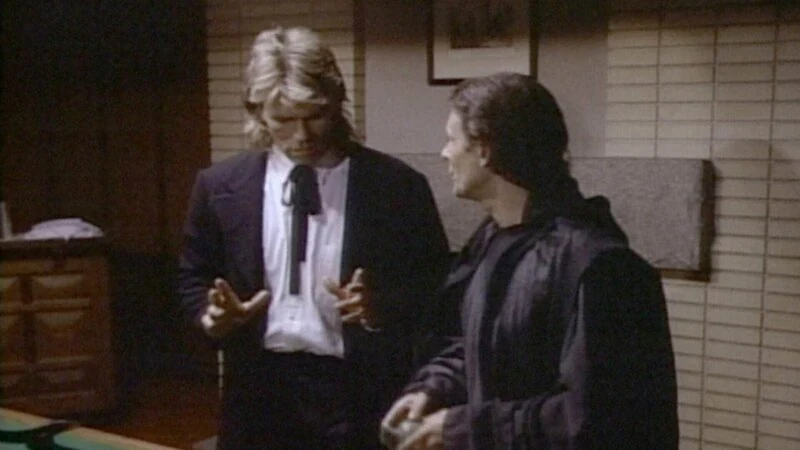
Michael Des Barres’s Murdoc belongs to the grand tradition of television villains who approach murder as a performance art. He doesn’t merely want MacGyver out of the way. He wants the encounter arranged, the trap appreciated, and the exit remembered. Modesty is not among his operating principles.
Introduced in “Partners” in March 1987, Murdoc gives the series an antagonist whose personality can compete with the hero’s ingenuity. A disposable opponent poses a problem and disappears. Murdoc brings history, resentment, disguise, and the unsettling possibility that the last apparent conclusion wasn’t conclusive at all.
Des Barres understands the necessary scale. He doesn’t play the character like a small administrative inconvenience at the foundation. The pleasure is theatrical: the relish in a threat, the elaborate setup, the insistence on turning a practical criminal objective into a personal event.
That makes him an effective opposite for Mac. Our hero would prefer a useful solution with minimal harm. Murdoc enjoys control, spectacle, and the knowledge that another person has been placed at his mercy. Their encounters turn ingenuity into a moral contrast rather than a contest over who owns the better equipment.
There is absurdity in the recurrence, and the show knows how close it is to a game. A villain who repeatedly survives apparent catastrophe begins to acquire the resilience of a cartoon character, however dangerous the immediate scene may be. Viewers can enjoy the return while acknowledging that the insurance paperwork must be extraordinary.
The 1989 episode “Halloween Knights” complicates the pattern by making Murdoc ask Mac for help rescuing his sister. For once, the man who usually wants MacGyver dead needs him alive. A person Mac distrusts has a request involving someone innocent, and the usual division between opponent and beneficiary becomes less convenient.
That doesn’t require the villain to become secretly admirable. It makes the hero’s values harder to apply. Helping only people you like isn’t a particularly demanding form of decency. Murdoc supplies an unusually extravagant test, complete with the continuing suspicion that accepting the invitation may be a terrible idea.
Partners makes the friendship part of the danger
“Partners” brings Mac and Pete’s shared past into the present trap. The episode uses their history with Murdoc to give the current predicament more than an immediate physical stake. These men aren’t simply two people the villain happens to have captured. They have survived something together, and that survival has become part of the friendship.
The March 2, 1987 episode also gives Jack a place in that history. The series is broadening its world through relationships, not merely adding another logo to the organization’s stationery. Mac’s life has happened partly offscreen, and a returning enemy can bring pieces of it into view.
Flashbacks can feel like an economical way of postponing the next event, but here the structure has a useful purpose. The present danger and the earlier encounter speak to each other. What the characters remember affects how they read the threat in front of them.
Elcar is particularly valuable in this arrangement. Pete’s concern isn’t a generic superior’s worry about losing an employee. He knows what Mac has done, what they have already risked, and why the man beside him is likely to attempt another improbable solution. Trust carries experience inside it.
The story also sharpens Murdoc’s personal grievance. Mac’s resourcefulness is no longer simply useful to the assignment; it is the quality somebody else resents. A professional talent has produced an enemy. The work follows him home, even when the home is a place he doesn’t expect the villain to know.
For an action show, that is an efficient way to create continuity without requiring every week to end on a cliffhanger. A viewer can enjoy a separate adventure and still feel that people accumulate histories. The next returning face changes the meaning of an otherwise familiar situation.
It is also more satisfying than endlessly increasing the size of the threat. The world doesn’t have to be closer to destruction every time. Sometimes the danger becomes more interesting because the person trapped with Mac matters to him, and because the man arranging the trap remembers exactly why he dislikes them both.
The Widowmaker lets the hero fail to save someone
In “The Widowmaker,” a climbing accident kills Mac’s friend Mike Forrester. The event strikes directly at a defining promise of the series: this is the man who usually finds a way. Here, there isn’t one. His resourcefulness doesn’t reverse what has happened, and his confidence can’t prevent the grief that follows.
The November 1987 story withdraws him from his usual purposeful movement. He wants isolation, not another assignment. Anderson allows the stillness to become uncomfortable. A hero who is always able to act has to live with the possibility that action would not have been enough.
Nikki Carpenter’s effort to reach him makes the episode more than a solitary display of anguish. Another person is trying to get past the closed door, and Mac’s reluctance isn’t presented as an inspiring demonstration of independence. It is part of being hurt.
Murdoc’s arrival turns the emotional retreat into a physical ordeal. That move is both effective and slightly blunt: grief has barely settled before the action machinery comes roaring back. The episode wants the psychological consequence and the cliffside suspense in the same hour.
When it works, the danger forces Mac to engage with the world again without magically curing the loss. He has to act while carrying what happened. That is more interesting than a story in which the death exists only to give the hero a temporary excuse to look troubled.
When it strains, you can feel the genre insisting that sorrow will have to share its appointment with an elaborate villain. The two tones don’t always blend seamlessly. Yet the willingness to let Mac’s usual competence fail gives the episode weight the routine missions don’t automatically possess.
It’s a useful corrective to the cartoon version of the character, the man who can apparently fix anything with miscellaneous stationery. Some things can’t be fixed. Watching him face that limit makes the ordinary rescues matter more, because the series has briefly acknowledged that success isn’t a law of nature.
The title refers to the climbing danger, but the lasting impression belongs to the person left below the achievement. For once, the question isn’t simply whether Mac can get out. It’s whether he will let someone else help him move at all.
Nikki Carpenter doesn’t arrive to admire the cleverness
Elyssa Davalos’s Nikki Carpenter gives the third season another strong presence around the foundation. She has judgment, a will of her own, and no permanent obligation to treat Mac’s instincts as the final word. The friction is useful. An agreeable room can make even an appealing hero seem suspiciously unchallenged.
Nikki’s place in the series differs from Penny’s. She isn’t simply an energetic friend whose circumstances need sorting out. She works within the world of the assignments and can question the assumptions behind them. Mac has someone nearby who is neither his boss nor an admirer collecting evidence of his brilliance.
That difference creates room for Anderson to play defensiveness and irritation without turning them into a major character crisis. Mac’s decency doesn’t make him universally easy to work with. He can be private, stubborn, and convinced that he understands what needs doing. Being right often enough is not the same as being pleasant all the time.
In “The Widowmaker,” Nikki’s insistence on making contact has emotional value because she doesn’t vanish when his resistance becomes inconvenient. Concern isn’t always expressed through agreement. Sometimes it arrives in the form of somebody refusing to accept the explanation you’ve prepared for being left alone.
The show’s treatment of women can still be uneven. Recurring female characters may have energy and skill while remaining subject to the familiar requirement that a dangerous situation eventually demonstrate the leading man’s usefulness. Nikki is most effective when the partnership allows mutual contribution rather than merely a new arrangement of rescue and gratitude.
Her limited stretch in the series also helps explain why the settled popular memory centers so heavily on Mac, Pete, Jack, Penny, and Murdoc. Not every promising relationship becomes a permanent part of the format. Television develops by addition and subtraction, sometimes leaving an intriguing possibility behind.
On a revisit, Nikki is worth noticing for what she adds while she’s there. The hero doesn’t need an opponent in every conversation, but he benefits from a colleague who expects an actual answer. Ingenuity is admirable. It can still be asked to explain itself.
Blood Brothers gives the gun aversion a history
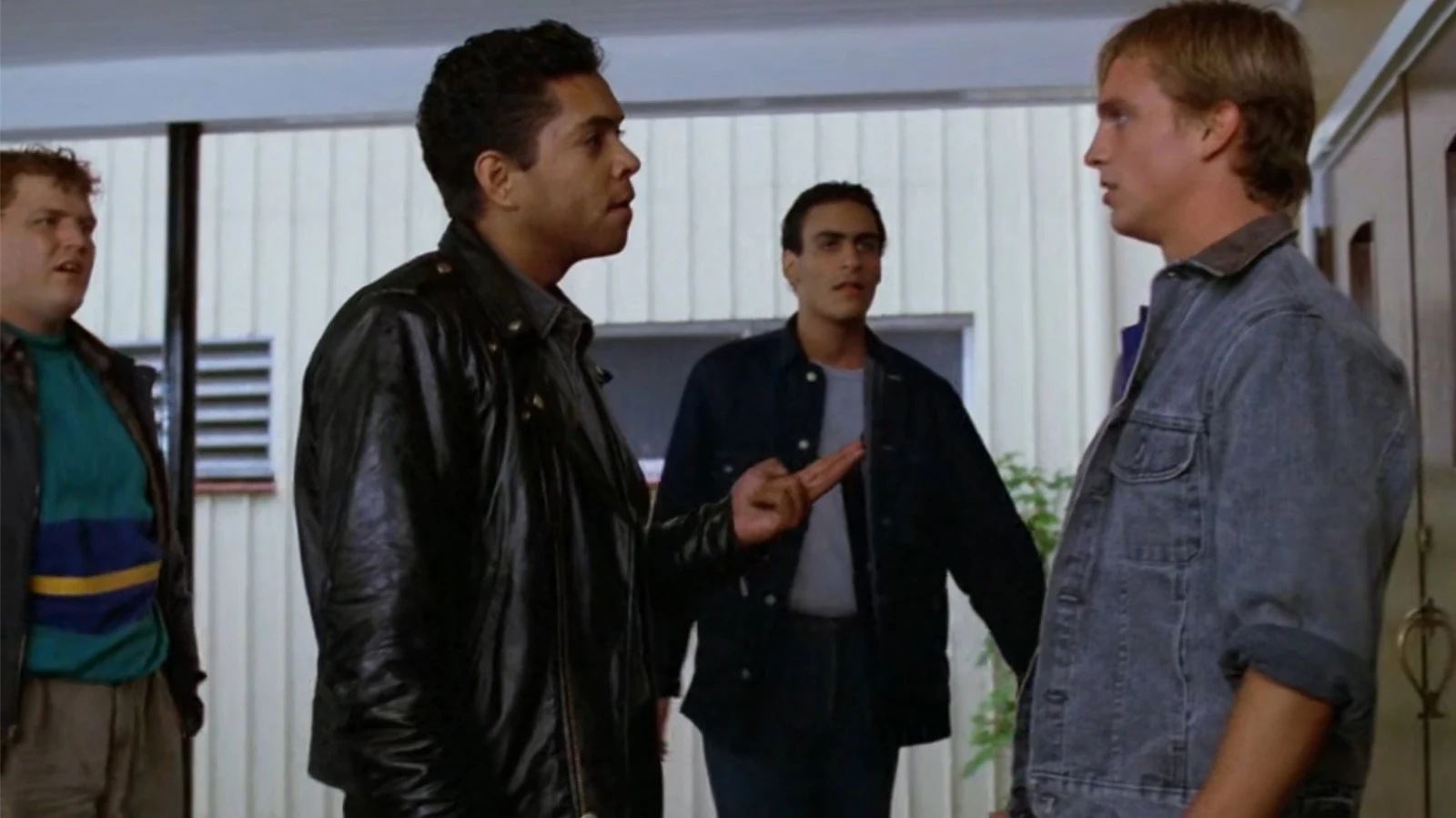
“Blood Brothers” takes Mac back to his hometown and makes a reunion with old friends uncomfortable before the present-day danger fully takes hold. A buried time capsule promises a harmless encounter with childhood. The memories attached to it are anything but harmless.
The November 21, 1988 episode connects a fatal shooting from Mac’s youth with a younger person’s readiness to use a gun in the present. The series gives a familiar principle an emotional origin rather than leaving it as an admirable item in the character description.
That choice changes the way you hear his objections. He isn’t arguing from a clean distance, secure in the knowledge that bad decisions happen to other people. He remembers what a mistake can do and how long the people left behind may carry it.
The time capsule is a particularly good object for this story. Ordinarily it offers a cheerful comparison between what children imagined and what adults became. Here it forces the characters to confront something they might prefer to keep buried. The adventure’s most consequential artifact isn’t a secret weapon or a stolen document. It’s a reminder.
The present-day drug threat belongs recognizably to late-eighties issue television. At times the episode’s message is delivered with the firmness of a school assembly that has acquired a stunt team. The plotting can be broad, and the distinction between good guidance and convenient sermon deserves attention.
But the personal history gives the moral argument a cost. Mac isn’t merely telling another person what to do. He’s trying to prevent a repetition he recognizes too well. Anderson’s restraint helps keep the concern from becoming only a speech.
The episode also complicates the comforting idea that being a good adult means having left childhood behind. Mac has skills, experience, and a reputation for finding answers. None of them grants immunity from an old memory. Returning home can make an accomplished person feel abruptly unfinished.
For a series associated with clever repairs, that is useful emotional territory. The point isn’t that Mac can fix his past. It’s that he may be able to help someone else avoid inheriting the same sort of damage.
Runners asks him to listen before he rescues
The 1989 episode “Runners” puts Mac beside a teenage runaway whose immediate danger doesn’t tell the whole story. Holly Fields plays Jennifer, also known as Crystal, and the circumstances she has escaped are not safer simply because they belong to a family home.
The trouble is uglier than another runaway adventure: the girl faces both a vicious pimp and a disturbing secret involving her policeman father. Mac’s task isn’t completed by getting her away from one threatening man and returning her to another.
That is an important demand to place on this hero. He has to pay attention to what the vulnerable person is telling him, rather than assume he knows what the correct destination must be. The solution can’t be assembled from objects alone.
The story belongs to the series’ growing interest in social problems, and it carries the strengths and weaknesses of that approach. It gives a familiar leading man a reason to care about a person other adults might dismiss. It also risks making a complicated situation feel resolvable within the emotional and practical limits of a television hour.
Anderson’s plain manner helps. Mac’s concern doesn’t depend on a grand announcement of his own goodness. He stays with the problem and tries to understand it. His competence becomes useful because it is attached to patience.
Some of the language and shorthand show their age. A modern viewer may wish the story gave Jennifer more space beyond the danger surrounding her. That criticism can coexist with appreciation for the refusal to treat a return home as automatically safe. The episode asks a more serious question than its initial rescue setup suggests.
In a series famous for making do with what is available, this is another kind of resourcefulness: recognizing when the obvious answer is wrong. It doesn’t produce the same neat visual payoff as a repaired mechanism, but it belongs to the character’s most appealing quality. Mac looks again when other people think the matter has already been settled.
The outdoors becomes something worth protecting
MacGyver’s wilderness isn’t only a place where the camera can find a cliff. It is also a place the series increasingly treats as worth defending. Forests, wildlife, and threatened landscapes give his practical concern a broader object. The world isn’t merely an obstacle course for an adventurous man.
In “The Endangered,” from May 1988, a reunion with a former girlfriend who works as a park ranger becomes a confrontation with poachers. The old relationship and the danger to the wildlife become the same problem.
The episode’s appeal comes partly from placing Mac’s attention in a setting where observation has obvious value. A person who notices a damaged object might also notice a disturbed landscape or an animal in trouble. His practical intelligence doesn’t need a laboratory to become relevant.
“The Spoilers,” earlier that year, approaches environmental harm through toxic dumping and a witness whose past complicates the case. The story connects damage to a place with damage to a person. Its handling of a troubled veteran deserves a critical eye, but the concern isn’t limited to stopping an anonymous bad guy with an unpleasant business plan.
These plots are more distinctive when the environment affects the action rather than serving as a scenic backdrop to a speech. Mac has to understand the ground, the weather, the available shelter, and the people who depend on the place. The setting becomes part of the problem’s reality.
The series can still make its villains too convenient. Environmental harm doesn’t always arrive wearing a face a television audience can immediately dislike, and complex responsibility is harder to dramatize than a poacher aiming at the wrong animal. The hour sometimes simplifies the issue until the conclusion arrives very cleanly.
Even so, the emphasis adds something to the hero’s identity. He doesn’t only rescue people from danger. He cares about the conditions in which people and other living things will continue to exist after the assignment is over. For a man whose reputation rests on temporary repairs, that longer view is welcome.
Thin Ice, and a different kind of bad judgment
“Thin Ice” trades some of the familiar adventure scenery for a hockey rink. Mac returns to help his old coach and confronts a talented young player’s temper. The February 1988 episode turns the question of force into something less exotic than international intrigue: how does a competitive person behave when winning begins to excuse everything?
Martin Milner plays the coach, and MacGyver suddenly has a problem that can’t be fixed by improvising a gadget before halftime. Mac has to influence someone whose ability is real and whose conduct threatens to overwhelm it.
That premise suits a character who distinguishes capability from permission. Being strong enough to hurt someone doesn’t settle whether you should. Being good enough to win doesn’t make every method admirable. The principle sounds obvious until ambition supplies a persuasive excuse.
The rink also makes Mac seem less sealed inside his profession. He has interests, old connections, and a life shaped by more than assignments. Anderson’s easy physical presence helps the setting feel like a place the character understands rather than a temporary costume the plot has handed him.
Sports stories can become predictable very quickly. The talented hothead receives guidance, the important game approaches, and the audience can begin filling in the moral before the final period. “Thin Ice” doesn’t escape every familiar beat. Its value lies in the fit between the lesson and the person delivering it.
Mac’s authority comes from the same restraint the action plots test. He isn’t asking the player to become timid. He’s asking him to stop confusing aggression with skill. That distinction gives the episode a connection to the series beyond the convenient presence of its leading actor.
There is also pleasure in the change of pace. Not every week needs a locked laboratory or a heavily armed opponent. A hero becomes more credible when his values remain recognizable in an ordinary competitive setting. The haircut travels surprisingly well from international trouble to a hockey bench. The conflict, at least, doesn’t require another passport.
Vancouver changes the air around the adventures

By the third season, the series was filming in Vancouver. The move gave Mac’s world a different physical texture: forests, water, industrial spaces, and an urban landscape that could suggest several destinations while retaining a strong sense of weather and ground.
The production eventually found a home in British Columbia, where the landscape could provide everything from rugged adventure to a convincing stand-in for someplace else.
The locations aren’t just trivia for people comparing street corners. They affect how the hero occupies the screen. Mac’s practical clothes look at home against wet timber, machinery, rough ground, and working waterfronts. The adventures acquire surfaces that seem less interested in glamour than in whether somebody can get a useful grip.
The houseboat gives his private life a particularly apt address. It suggests independence and a preference for something a little outside the usual arrangement, while still placing him close enough to other people for trouble to find him. A floating home is romantic. It is also presumably an excellent source of maintenance tasks for a man who finds repairs relaxing.
The change doesn’t make every setting convincingly unique. Like many adventure series, MacGyver asks a limited set of places to stand in for a wide world. Sometimes the disguise is more persuasive than others. A familiar patch of landscape can develop an impressively varied international career.
But the production gains a useful relationship with its surroundings. The outdoors doesn’t feel like a brief scenic interval before everybody returns to a permanent living-room set. It becomes a working part of the show, shaping danger, movement, and atmosphere.
That physical identity remains one of the pleasures of revisiting the middle years. Before an improvised solution begins, the environment has already established what resistance might feel like. Wood, metal, stone, and water matter. The world is full of things Mac may be able to use, provided he notices them before the villain notices him.
The creative team had to invent the problem and the answer
Lee David Zlotoff created the series, with Henry Winkler and John Rich as executive producers. Their names connect a deceptively simple premise with the less simple weekly task of making it work. A resourceful hero needs more than a writer declaring him resourceful.
Zlotoff, Winkler, and Rich’s central premise left the weekly creative team with a demanding practical assignment, far beyond merely giving the leading man a pocketknife. The scripts needed predicaments interesting enough to threaten Mac and solutions legible enough for the audience to follow.
That’s a different burden from equipping a hero with a reliably superior weapon. The ingenuity has to be designed twice: first as an idea and then as something a camera can show. A solution that sounds clever in conversation may become confusing, slow, or visually unconvincing when someone has to perform it.
The stunt and effects work supply the other half. Mac’s thinking needs a physical consequence, whether that means movement, escape, distraction, or a machine behaving differently. Anderson’s performance bridges the plan and the result, allowing the idea to remain attached to a person rather than become a detached demonstration.
It would be easy to romanticize all of this as endless inspired improvisation. A weekly television series also has schedules, budgets, available locations, and material that has to function on the day. The apparent spontaneity is supported by preparation.
There is a productive irony in that arrangement. The character looks inventive because a group of people has carefully organized his opportunity to invent. That doesn’t diminish the fiction. It explains why the best sequences feel satisfying rather than arbitrary.
When the preparation shows too plainly, the room seems stocked for the solution instead of lived in. When it works, the object is just part of the scenery until Mac changes our understanding of it. The difference is craftsmanship, a quality the series celebrates in its hero and requires from the people making him look clever.
ABC’s durable adventurer wasn’t the decade’s ratings champion
MacGyver became a familiar part of ABC’s schedule without becoming the era’s dominant Nielsen attraction. Its first broadcast finished fifty-fourth for the week. Not exactly an instant ratings smash. That is a useful antidote to the assumption that every enduring television name arrived as an immediate smash.
The series found a longer life through persistence, a clear identity, and an audience that wanted to return to this particular hero. The move from the first season’s Sunday position into Monday scheduling placed it in a different weekly rhythm, associated for much of the run with the evening that also carried ABC’s football coverage.
A weekly position can become part of a show’s memory without requiring everyone to have watched it in the same household routine. Some viewers met Mac through original broadcasts. Others found reruns later, when the episode’s immediate problem mattered more than its original place in a season.
By the end of the decade, kids and adults alike knew the trick: give MacGyver a handful of junk, stand back, and wait for the impossible to become his next Tuesday.
That distinction is especially useful beside a series such as The A-Team. Both offered a recognizable adventure formula, resourceful heroes, and a great deal of machinery being asked to do unusual work. They reached their audiences through different personalities and tones, not a single undifferentiated wave of action-show popularity.
Mac’s reputation eventually became larger than any one weekly result. People who didn’t follow every assignment still understood the name as a description of ingenuity. That cultural afterlife is real, but it shouldn’t be retroactively substituted for the original ratings history.
A lasting character doesn’t need a fabricated number-one season. The more interesting achievement is building an identity strong enough to survive the disappearance of the original schedule. Long after the immediate competition has become a table in an archive, the audience still knows what sort of person to call when the available equipment looks hopeless.
1989 keeps widening the map
By the end of the decade, the series had room for both large adventure fantasies and stories tied to current concerns. “Legend of the Holy Rose,” opening the fifth season, sends Mac into an archaeological quest. The format can accommodate hidden history and treasure-hunt momentum without pretending the foundation’s ordinary working day is particularly ordinary.
Then “Children of the Light,” broadcast on November 6, 1989, brings a Chinese student’s evidence connected to Tiananmen Square into his home. The dangerous information includes a videotape and communications material. The show is responding to events from the same year, not retreating entirely into a timeless adventure playground.
That range is both a strength and a source of unevenness. A quest for legendary artifacts asks one kind of belief from the audience. A story attached to recent political violence asks another. The recurring hero provides continuity, but the change in weight can be abrupt.
Mac’s basic response remains recognizable: somebody vulnerable needs help, powerful people want to control the outcome, and the available resources have to be made useful quickly. The premise is broad enough to carry the shift even when the individual script struggles to manage its implications.
The serious stories deserve scrutiny precisely because the series has earned affection. A familiar, decent hero can make difficult material approachable. He can also make it seem simpler than it is. An adventure’s resolution doesn’t settle the history surrounding it.
The fifth-season material marks the end of this article’s main territory. The series continued into the 1990s television landscape, but its 1980s identity was already secure: Mac, Pete, the foundation, recurring friends, an extravagant enemy, and a widening sense of what practical heroism might address.
It is a surprisingly flexible arrangement for a show so often reduced to a pocketknife joke. The tools remain small. The stories keep finding larger things for the man carrying them to care about.
What the cleverness looks like after all these years
A modern revisit benefits from two permissions: enjoy the ingenuity, and decline to believe every convenient result. The show is an adventure, not an instruction manual. Scientific inspiration and dramatic reliability are different things, however confidently the hero explains the next step.
The suspense is often more convincing at the human level than the technical one. Somebody is trapped, frightened, or losing time. Mac has noticed a possibility. Anderson makes the attempt feel purposeful. Even if the eventual result deserves a skeptical look, the emotional line can remain intact.
The series also looks different when the adults are no longer simply background authorities. Pete’s responsibilities become more visible. Jack’s evasions look less harmless when you imagine being the person required to solve the consequences. Mac’s steady willingness to help can seem admirable and occasionally exhausting. A good friend is not the same thing as an unlimited emergency service.
The older private-eye tradition offers useful company here. Jim Rockford’s 1970s adventures also understand that a practical man may be interesting because he is reluctant, vulnerable, and attached to other people. Mac is a different creation, but he doesn’t arrive from nowhere. Television already knew that an audience might prefer a capable person who didn’t behave like an invulnerable monument.
That is the quality worth recovering beneath the jokes. The character isn’t appealing merely because he knows a lot. He pays attention, shares what he knows, and treats another person’s safety as a reason to keep trying. Intelligence becomes social rather than decorative.
The series has its sermons, flimsy villains, convenient materials, and episodes that mistake a worthy subject for a finished story. It also has Anderson and Elcar’s ease, McGill’s comic trouble, Hatcher’s bright energy, and Des Barres making restraint look like a missed opportunity for a bigger entrance.
Most of all, it offers a deeply satisfying change of reflex. When something goes wrong, the hero doesn’t immediately reach for the loudest answer. He looks around. Somewhere in the room is a possibility everybody else has dismissed. The show asks us to look too, and that invitation has aged rather better than the hair.
Questions Readers Ask
Who played the original MacGyver?
Richard Dean Anderson played Angus MacGyver, the resourceful troubleshooter who relied on observation and improvised solutions rather than a conventional action-hero arsenal.
When did MacGyver begin?
The original ABC series premiered in September 1985 and continued beyond the end of the decade.
Did MacGyver ever use a gun?
Yes, including in the opening rescue of the original pilot. His well-known aversion to guns became a much more consistent part of the character as the series developed.
Sources & further reading
- Television Academy: original series and creators
- Richard Dean Anderson: original episode guide
- Radio Times: A Head for Adventure, April 1989
- 1998 Paley seminar with the creative team
- Christian Science Monitor: Vancouver production, December 1987
- Bridge Studios: facility history
- Apple TV: Blood Brothers original episode
- Apple TV: Runners
- September 29, 1985 premiere — rdanderson.com
- guide to “Thief of Budapest” — rdanderson.com
- visit becomes dangerous when a contract killer follows Mac — rdanderson.com
- September 22, 1986 episode — rdanderson.com
- Jack’s arrival during the second season — macgyveronline.com
- Hatcher first plays Penny on February 19, 1986 — rdanderson.com
- March 2, 1987 episode — macgyveronline.com
- original-series distributor’s description — paramountplus.com
- Martin Milner plays the coach — imdb.com
- episode description — tv.apple.com