Growing Pains in the 80s: The Seavers and the Family-Sitcom Boom
Mike had a plan, Carol had objections, and Jason had a professional interest in knowing what on earth his children were thinking.
By Gizmo
THE GROWING UP.
THE FAMILY.

Inside This Article
- Mike Seaver had an explanation ready
- Dad moved his office. Mom went back to work
- Alan Thicke knew the value of a raised eyebrow
- Maggie wasn’t just returning from somewhere offscreen
- Mike’s charm was both the attraction and the problem
- Carol had read the assignment
- Ben was taking notes, selectively
- Those opening photographs made a promise
- The exam answers were on the shoes
- Springsteen was easier than being seen with Dad
- The Seavers were not applying to become the Cleavers
- Jason’s band had not improved with age
- The party wasn’t the one Mike expected
- Boner was more than the friend with the unfortunate nickname
- Second Chance didn’t offer the easy ending
- The new baby arrived on Ben’s day
- Mike actually reached graduation
- Superdad had a downside for Mom
- Madonna had entered the suburban imagination
- The hit grew beyond its Tuesday berth
- Their house was comfortable. Their judgment was still a work in progress
- The jokes didn’t all age at the same speed
- Later faces belong to a later chapter
- The grown-ups look different on a return visit
- Questions Readers Ask
Mike Seaver had an explanation ready

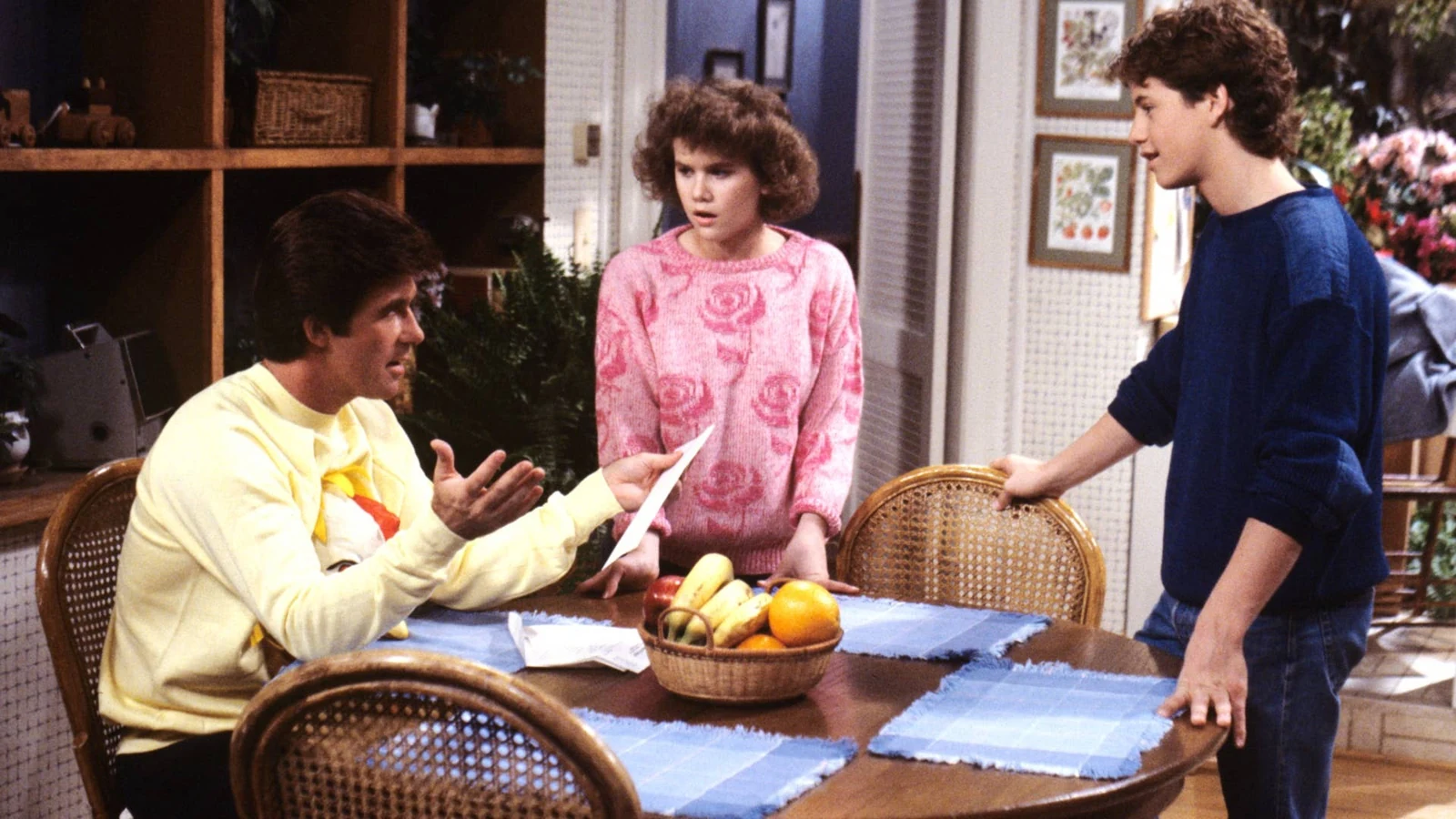
Kirk Cameron’s grin was a remarkably efficient piece of equipment. It suggested that Mike Seaver knew he was in trouble, had already considered denying the trouble, and might still persuade his father to admire the creativity involved. Alan Thicke’s expression usually suggested that Jason Seaver had heard an earlier model of this explanation and hadn’t liked that one either.
That exchange is the small, durable pleasure at the center of Growing Pains. A teenager tries his luck. A father who makes his living understanding people discovers that understanding his own son doesn’t necessarily make the son easier to manage. Somewhere nearby, Carol is prepared to point out the flaw in Mike’s argument, Ben is learning something he probably shouldn’t, and Maggie has a working day to finish before dealing with this one.
The Seavers were comfortable, affectionate, and capable of making a fairly ordinary disagreement sound like the household’s latest constitutional crisis. Their problems ranged from an exam to a bad party, from a neglected birthday to a sudden death. The show generally promised that the family would remain available to one another, even when someone had made an excellent case for being left alone for ten minutes.
On 1980s television, that combination traveled well. Growing Pains turned the return of a mother to work, a father’s home practice, and three very different children into a major ABC hit. Cameron became a teen star, but the house needed more than a photogenic troublemaker. It needed Tracey Gold’s impatience, Jeremy Miller’s opportunism, Joanna Kerns’s energy, and Thicke’s ability to make parental concern sound both sincere and slightly amused.
It’s easy to remember the theme song and file the whole thing under reassuring family comedy. Then an episode like “Second Chance” comes along and makes the recollection less tidy. The Seavers offered comfort, certainly. They also occasionally reminded the audience that a familiar living room couldn’t protect everybody from the consequences waiting outside it.
Dad moved his office. Mom went back to work

Growing Pains premiered on ABC on September 24, 1985. Neal Marlens created the series, and John Pasquin directed the pilot. The Seavers live in Huntington on Long Island: Jason is a psychiatrist, Maggie returns to work as a reporter, and their children Mike, Carol, and Ben must adjust to a new distribution of parental attention.
The important detail is that Jason hasn’t simply stopped working. He moves his psychiatric practice into the house. That gives the sitcom a father who is more available to the children while remaining a professional with responsibilities of his own. He can be physically close and still have a working day. Anyone who has tried that arrangement can probably see several problems approaching before Mike opens his mouth.
Maggie’s return is equally important. Her career isn’t a passing whim designed to create one episode of domestic confusion. It helps establish the household’s new rhythm. The series wants to know how a family manages when the mother has ambitions beyond the house and the father becomes more directly involved in what happens inside it.
The idea arrived a year after Who’s the Boss?, another ABC comedy that put a man into work conventionally assigned to a woman. But Jason and Maggie begin with a marriage and shared children, not an employment contract and unacknowledged attraction. Their central question is less whether they’ll get together than how they’ll avoid driving each other to distraction while already together.
The cast makes the premise feel less schematic than that description. Thicke and Kerns have an easy adult rapport. The children don’t all resist the changes in the same way. A new routine can be useful to Mike when he wants freedom, inconvenient to Carol when she wants privacy, and exploitable by Ben when he wants something immediately.
The title is flexible enough to include all five of them. Children are growing, but parents are changing too. Jason’s expertise doesn’t exempt him from jealousy or vanity. Maggie’s determination doesn’t eliminate guilt. The Seavers aren’t a demonstration household that has solved modern family life. They’re people with a nice house, good intentions, and an alarming amount of discussion still required.
Alan Thicke knew the value of a raised eyebrow
Jason Seaver is a psychiatrist, which ought to make him unusually well equipped to understand teenage behavior. The series wisely treats that qualification as a source of comedy rather than a guarantee. Understanding a motivation and enjoying the behavior it produces are very different activities, especially when the behavior belongs to someone who lives upstairs.
Alan Thicke gives Jason a conversational ease that keeps the parental scenes from becoming a succession of lectures. He can joke with Mike, acknowledge the appeal of a bad idea, and still refuse permission. His authority feels strongest when he doesn’t need to announce it. A question delivered with mild interest can reveal that the explanation has a substantial hole in the middle.
The performance also leaves room for vanity. Jason likes believing he is reasonable, current, and more approachable than a teenager might expect a father to be. That belief is occasionally useful and occasionally the reason he needs correcting. Thicke is funny when Jason’s self-image arrives at a conversation a little before the facts do.
His professional training doesn’t prevent the ordinary parental temptation to solve a problem too quickly. Sometimes a child wants attention rather than interpretation. Sometimes Maggie needs a partner rather than an amateur diagnosis of the evening. The show benefits whenever it lets Jason discover that being well intentioned isn’t the same as having supplied the right response.
There’s warmth behind the timing. Mike’s latest evasion may amuse him, but the concern underneath isn’t merely a setup for a punch line. Thicke can move from teasing to seriousness without making it feel as if another actor has entered the room. That flexibility becomes essential when the series ventures into a story that can’t be cleared away with a joke.
Jason is sometimes too conveniently wise, and an episode can make the rest of the family seem briefly less intelligent so he can deliver the closing lesson. Thicke’s better work is in the messier passages: a father trying to help, getting something wrong, and discovering that his children have retained an inconvenient ability to surprise him. The job has excellent emotional rewards. The performance reviews are inconsistent.
Maggie wasn’t just returning from somewhere offscreen
Joanna Kerns gives Maggie Seaver the energy of a woman who wants several parts of her life to work and sees no reason to pretend those parts never conflict. She loves the children. She wants a career. She is capable of wanting a little peace as well, although the show offers that last ambition limited support.
The reporter’s work matters because it gives Maggie an identity that doesn’t begin with a child’s problem. The family has to respond to her commitments, not simply wait for her to become available again. A mother can leave the house for something meaningful without the sitcom treating the departure as abandonment.
Kerns keeps the balancing act from becoming a permanently strained expression. Maggie has humor, appetite, irritation, and an adult relationship with Jason. She can enjoy her husband while finding him exasperating. That mixture gives the marriage more life than a division in which one parent supplies jokes and the other supplies the schedule.
Her comic strength often lies in speed. Maggie may be moving between tasks, discovering a new complication, and revising the plan before another person has finished explaining why the old plan won’t work. The activity looks familiar without requiring every episode to announce that she is under pressure. Sometimes the joke is simply that the household has produced another need at exactly the wrong moment.
The show can slip into a familiar trap when it makes her work primarily a reason to feel guilty. A career woman who must prove her maternal devotion every time she becomes busy isn’t being offered quite the freedom the premise advertises. Kerns helps by making the guilt a feeling Maggie has rather than the final verdict the audience must accept.
She also gives the children different kinds of access. Mike may need a response less tangled in his contest with Jason. Carol may want someone to recognize a feeling before turning it into an argument. Ben may simply want an undivided stretch of attention. Maggie’s presence lets those needs vary. She isn’t one generic comforting function stationed behind the kitchen counter.
When the family is working at its best, you can see that she and Jason are still interested in one another as people. That is part of the reassurance. The parents have a relationship worth keeping, not merely an alliance formed to monitor three children with unreliable judgment.
Mike’s charm was both the attraction and the problem
Mike Seaver is good at recognizing what a person wants to hear. The difficulty is that he often prefers using the information to escape work rather than perform it. Kirk Cameron makes that instinct enjoyable by allowing the effort to show. Mike isn’t a serene master manipulator. He’s a teenager trying very hard to keep an advantage from collapsing.
The character’s appeal depends on his being more than lazy. He wants attention, freedom, girls, and the feeling that something exciting might happen if he can get out of the house. Schoolwork competes badly with those possibilities. The audience can recognize the temptation without agreeing that he should be allowed to reorganize everyone’s life around it.
Cameron’s timing gives the household arguments their bounce. He waits for an opening, offers an explanation with more confidence than it deserves, and reacts when somebody notices the flaw. The grin is useful because it suggests Mike knows part of the game. He can see the absurdity even while insisting his own position is entirely reasonable.
The teen-idol response grew around that performance, but the series is stronger when it doesn’t confuse popularity with immunity. Mike needs to be wrong sometimes. He needs a sister who isn’t dazzled, parents who recognize a sales pitch, and friends whose choices reveal the limits of his apparent sophistication. Otherwise the comedy becomes a weekly celebration of a boy successfully avoiding consequences.
There is genuine vulnerability available when the charm stops working. A frightening party, a friend’s departure, or an emotional disappointment can leave Mike without the social tactic he usually trusts. Cameron is effective when the character has to become briefly quieter. It gives the audience a reason to care about him after the smile has finished doing its job.
Later public arguments about the actor can dominate discussion of the series if allowed to. The eighties performance deserves to be examined as a performance. Here is a young actor helping create a hugely recognizable sitcom teenager: funny, self-interested, sometimes touching, and capable of being infuriating. Mike is most convincing when all of those qualities are allowed to coexist. Loving the character shouldn’t require pretending his parents had no cause to look tired.
Carol had read the assignment

Tracey Gold’s Carol Seaver has the disadvantage of being right in a household where her brother is often more entertaining while being wrong. She studies, notices things, and would like intelligence to receive a little of the applause that charm seems to collect automatically. Mike can find this desire exhausting. Carol can find Mike exhausting without any additional incentive.
The sibling comedy works because Gold doesn’t play her as a saint of diligence. Carol can be competitive, cutting, and intensely pleased when a prediction about Mike’s latest disaster proves accurate. Being the studious child doesn’t abolish vanity. It simply gives vanity a report card to consult.
Her frustration is recognizable. A responsible child can discover that responsibility earns less attention than a brother or sister’s latest emergency. The family may appreciate reliability while inadvertently treating it as something that requires no maintenance. Carol’s sharpness sometimes looks like a request that somebody notice the work behind being dependable.
Gold also gives the character a romantic life that doesn’t feel like a minor variation on Mike’s. Carol can be academically assured and emotionally inexperienced at the same time. A compliment or a promising relationship can make her suddenly less interested in supplying the household’s sensible answer. That is growth, not a contradiction the show needs to fix.
The writing doesn’t always serve her generously. Jokes aimed at her appearance or size can feel meaner than the sibling rhythm is meant to suggest. The audience’s laughter doesn’t automatically make the target harmless. Carol is at her best when her intelligence and emotional life supply the story, rather than when the script needs her to absorb another insult so Mike can finish a scene brightly.
That makes the stronger Carol episodes especially valuable. Gold can carry embarrassment, hope, disappointment, and an abrupt change in the show’s temperature. She gives the family more than an antagonist for its most popular teenager. Once the series allows viewers to stay with her point of view, it discovers a girl whose feelings are every bit as interesting as her brother’s capacity for getting into trouble.
Ben was taking notes, selectively
Jeremy Miller’s Ben has an excellent position from which to study the household. Mike demonstrates what can be attempted. Carol identifies why it is stupid. Jason and Maggie demonstrate how long the consequences will last. Ben is free to absorb whichever part seems most useful to him at the time.
As the youngest of the original three children, he begins with a little more permission to be openly self-interested. He wants attention, entertainment, and an adult to take his concern seriously. These aims don’t always line up with the household’s larger priorities. A family crisis may be important, but so is the thing Ben wanted to do before the crisis rudely arrived.
Miller makes that scale funny without turning Ben into a miniature villain. Children can care about other people and still feel a perfectly timed disaster has been deeply inconsiderate to them personally. The performance catches the immediacy: this problem, this disappointment, this opportunity to gain a little ground while the adults are distracted.
He also supplies a different relation to Mike. An older brother’s behavior can look glamorous before you understand the cleanup involved. Ben may admire the freedom while missing the anxiety it creates. Watching him learn which parts of Mike’s example are worth copying gives the series a useful echo without simply repeating the same teenager at a smaller size.
His stories are often less prominent than Mike’s or Carol’s, but the family needs his particular energy. Without him, the home becomes a competition between two older children and two parents. Ben brings the less organized demands of childhood, when a change in the household can feel enormous even if the adults regard it as a practical adjustment.
The arrival of a new baby will make that position especially clear. Being the youngest has advantages a child may not recognize until someone else acquires them. The Seavers are pleased to welcome another family member. Ben would appreciate knowing whether anyone has considered the effect on his existing service arrangement.
Those opening photographs made a promise
The opening credits move through childhood photographs toward the people who are now playing the Seavers. It’s a simple, effective idea for a show about time passing inside a family. Before the week’s problem begins, the faces have already changed in front of you. Growth is visible rather than merely announced in the title.
“As Long as We Got Each Other” supplies the emotional invitation. B. J. Thomas’s voice, joined in familiar versions by Jennifer Warnes, offers warmth without making the show sound solemn. Steve Dorff and John Bettis wrote the song. For a series featuring Alan Thicke, himself associated with television songwriting, it’s a useful reminder that the star didn’t write every familiar theme in his orbit.
The photographs make the cast feel as if they have histories beyond the first scene. These aren’t characters arriving fully formed at their current ages. Children were smaller, adults were young, and time has already been doing what time does. A viewer doesn’t need an exact date attached to every picture to understand the invitation.
That approach is especially effective for a family sitcom because it prepares the audience to be generous. Mike’s newest scheme may be irritating, but the credits have just placed his face in a sequence of growing up. Jason and Maggie can become comic obstacles while remaining people with lives that began before they became parents.
The song is one of the more durable eighties television themes, in part because the sentiment belongs so neatly to the program. The family may argue about almost everything else. Its availability to one another is supposed to remain the dependable part.
Of course, a good theme can flatter a merely adequate episode. Familiar music has a powerful ability to improve the mood before the writing has earned it. But the best Seaver stories fulfill the opening’s promise through behavior: someone listens, helps, waits, or stays present after a mistake. That’s more persuasive than singing about togetherness and then assigning everybody another cutting line.
The exam answers were on the shoes
In the first season’s “Reputation,” Mike prepares to cheat by writing answers on the soles of his sneakers. It’s a brilliantly unglamorous image of academic resourcefulness. A boy who has avoided doing the assigned work has nevertheless found the time to turn footwear into a reference library.
The result complicates the expected lesson. Mike earns an unusually high grade and faces suspicion, while insisting he didn’t actually use the illicit help. The family has to decide whether his reputation has made an honest achievement impossible to believe. A scheme designed to avoid studying turns into a test of trust.
That’s a good problem for Jason because an automatic answer won’t do. Blindly defending Mike would ignore his history; automatically assuming the worst would make the boy’s past behavior a permanent sentence. A father who prides himself on understanding people has to distinguish between justified doubt and a refusal to recognize improvement.
Carol’s place in the argument gives it an additional sting. Academic effort is her territory. Mike finding a spectacular result through suspicious preparation is likely to irritate her for reasons that extend well beyond civic concern about cheating. The show can play the family loyalties against individual pride without requiring anybody to become a cartoon enemy.
Cameron’s confidence is useful because it can be read in more than one way. Mike knows how to sound persuasive when he isn’t entitled to be. This time the audience has to consider what happens when the same manner accompanies a claim that might deserve belief. Charm is neither proof of innocence nor proof of guilt, however convenient either shortcut would be.
The episode also captures a particular teenage misery: discovering that adults have a settled idea of you. A reputation can become a room with no visible exit. The story doesn’t require viewers to excuse the original plan in order to recognize that problem. Mike put the answers on the shoes. Whether anyone is willing to hear the rest of the explanation is the more interesting part.
Springsteen was easier than being seen with Dad
The second broadcast episode, “Springsteen,” gives Mike a powerful reason to test the new arrangement at home. A concert offers the sort of night that makes ordinary parental restrictions look intolerably unreasonable. The show’s early family negotiations suddenly have a soundtrack outside the theme song.
The appeal is specific to the period. Bruce Springsteen was an enormous cultural presence in 1985, and a teenager wanting to be part of that excitement doesn’t require elaborate explanation. The episode doesn’t need to invent a fictional star with a suspiciously generic name. One real name establishes the magnitude of the temptation.
Jason goes with him, and a television interviewer captures the father’s enthusiastic display of affection for his son. Mike’s friends consequently acquire excellent material. Getting to the concert turns out to be less complicated than being publicly adored by Dad. The gap between an enjoyable shared evening and a teenager’s preferred image supplies the comedy.
Maggie is meanwhile trying to establish her work routine. A family can support her career in principle and still create a fresh complication that demands her attention at exactly the wrong time. The early episodes are strongest when that friction is attached to a recognizable desire rather than an abstract debate over who ought to be home.
The concert setting also widens Mike’s world quickly. He doesn’t want freedom only so he can sit in a different room. He wants experiences that make him feel less like a child being supervised. The household has to decide how much independence is reasonable while he supplies every incentive to suspect his definition will be generous.
Stories like this help explain why the series felt accessible to younger viewers. The adult lesson isn’t the only attraction. There is a thing the teenager desperately wants to do, and the audience can understand the urgency even while recognizing the flaws in his method. A concert isn’t just an item on a calendar when you’re fifteen. It’s apparently the entire future, unless somebody ruins it by asking about homework.
The Seavers were not applying to become the Cleavers
January 1986’s “The Seavers vs. the Cleavers” turns a school dance into a dispute about what a respectable family is supposed to look like. Jason and Maggie volunteer as chaperones and discover that the PTA has objections. The title points toward an older television model before the argument has properly begun.
For Mike and Carol, parents at a dance are initially an inconvenience. Then the reason for their exclusion becomes a different kind of problem. It’s one thing to be embarrassed by your own family. It’s another to hear outsiders explain that the family doesn’t meet their preferred standard. Teenagers can switch from criticism to defense with impressive speed when someone else claims the right to deliver the criticism.
The episode lets the series make its case without pretending the Seavers are wildly unconventional. They are a comfortable married couple with children and a nice house. Their alleged departure from the ideal has more to do with how they work and behave than with a radical domestic experiment. That makes the disapproval look particularly pinched.
Thicke and Kerns are good at the mixture of irritation and wounded pride. Jason may be prepared to explain calmly why the objection is foolish, but calmness doesn’t entirely conceal the insult. Maggie has reason to resent being measured against a standard that treats her ambitions as evidence against her household.
The reference to the Cleavers places the show inside a conversation with television’s own past. Family comedy had long supplied images of how a home should function. The Seavers aren’t rejecting affection or responsibility. They are objecting to the idea that those qualities require everyone to reproduce the same arrangement.
The argument belongs beside the changes explored in 1970s family television, which had already made room for less tidy images of domestic life. This series packages its objection more softly, with attractive people and a reliable supply of jokes. The point still lands: a family doesn’t become less caring because its daily schedule would have confused an earlier sitcom father.
Jason’s band had not improved with age
“Jason and the Cruisers,” which opens the second season in September 1986, gives the father his own version of wanting to escape the role everyone expects him to play. Feeling older isn’t one of Jason’s favorite experiences. Maggie arranges a reunion with his college band, the Wild Hots, as an attempted cure.
A parent rediscovering an old performing identity is almost unfairly good sitcom territory. The children know the current version: the man who asks questions, keeps appointments, and has opinions about bedtime. An earlier version who played music and perhaps believed himself exciting can look like alarming new information.
Thicke enjoys the gap between Jason’s remembered self and the person his children see. Confidence may be entirely justified in a consulting room and less persuasive when attached to an old musical ambition. The comedy doesn’t need him to be a complete fraud. It needs him to care a little too much about appearing as if the years haven’t altered anything.
Maggie’s effort has a kindness the jokes don’t erase. She knows a husband who has a life before and beyond being the family’s sensible adult. Trying to reconnect him with it is affectionate, even if the resulting evening doesn’t follow the exact emotional plan. Marriage here includes remembering which earlier version of a person they might still miss.
The premise also gives the children a useful correction. Their parents didn’t spring into existence with jobs and rules. They once had friends, foolish ambitions, and reasons to believe they were interesting. Whether the band supplies convincing evidence is another matter, but the fact of that earlier life is worth discovering.
The episode is a lighter companion to the show’s growing-up stories. Jason isn’t becoming an adolescent again; he’s negotiating what age has taken and what it hasn’t. The distinction is available beneath the performance jokes. Mike wants to be treated as older. His father would appreciate being treated as slightly younger. Both are prepared to make the household watch while they try.
The party wasn’t the one Mike expected

February 1987’s “Thank God It’s Friday” takes a familiar teenage ambition—getting into a better party—and makes the word better suddenly questionable. Mike and his friends Eddie and Boner find themselves among people using cocaine. The atmosphere he hoped would make him feel older now asks him to make a decision he hadn’t planned to discuss with anyone.
The episode works because Mike’s desire to belong is already part of the character. The writers don’t have to invent an entirely new vulnerability for a warning story. He wants to be liked, wants to seem experienced, and doesn’t enjoy being the person who has to admit discomfort. The party places those wishes against a limit he needs to recognize.
At home, Jason and Maggie are having a much less eventful evening watching television. The contrast gives the story its perspective. Parents can be physically comfortable while a child is navigating something they would very much like to know about. Availability doesn’t equal omniscience, however much the Seavers’ kitchen sometimes makes it appear otherwise.
Cameron’s usual manner becomes useful in another way. Mike is accustomed to treating a room as something he can charm. Here the room’s expectations are the problem. Confidence doesn’t automatically tell him how to respond when other people assume a risky choice is ordinary. The actor lets the discomfort interrupt the performance of sophistication.
The episode carries its message plainly. It isn’t a subtle study of every reason teenagers use drugs, and some of its party atmosphere is tailored to the clean outlines of network television. A viewer can recognize those limitations while appreciating that the story asks its popular character to be afraid of looking uncool rather than simply afraid of being caught.
That’s a more useful pressure point than a lecture delivered to a teenager who never wanted to participate. Mike has to decide what he wants this particular group to think of him. The choice belongs to him, even though the family has helped supply the values he brings into it.
The installment also changes the weight of his usual pursuit of freedom. Most weeks, a night out leads to an argument and a joke. Here, getting what he wanted creates the problem. The title promises relief after the working week. Mike discovers that a Friday invitation can contain a question he would rather have left at the door.
Boner was more than the friend with the unfortunate nickname

Andrew Koenig’s Richard “Boner” Stabone belongs to Mike’s world of schemes, school trouble, and plans that haven’t been inspected especially carefully. The nickname is an emphatic reminder that eighties family television had its own peculiar ideas about what needed explaining. The character himself supplies something more useful: a friend whose loyalty isn’t based on whether Mike has thought things through.
Koenig gives him an amiable looseness that contrasts with Cameron’s busy charm. Mike is often selling an idea. Boner looks more willing to see where it goes. Their friendship makes the teenage stories feel populated by actual company rather than a hero accompanied by interchangeable witnesses.
Those friends also let the series show Mike in another position. At home he can be the worldly older brother, the difficult son, or the person defending his independence. Among peers he has to negotiate a different hierarchy. He may be admired, challenged, teased, or forced to acknowledge that his judgment isn’t the only one available.
February 1989’s “Semper Fidelis” gives the friendship an unexpectedly serious departure. After failing his first semester at college, Boner joins the Marines. Mike feels abandoned and reacts badly. The friend he has associated with shared foolishness has made a decision about his own future, and Mike isn’t immediately prepared to respect it.
That is a strong subject for a show with a popular central teenager. A friend doesn’t exist solely to remain available for the next adventure. Growing up may mean choosing a route that leaves someone else behind. Mike’s hurt is understandable; his claim on Boner’s life has limits.
The story doesn’t need to establish military service as a universal answer to uncertainty. Its immediate interest is the friendship and the change in direction. Boner is doing something serious while Mike is still reacting to what the decision means for Mike. The distinction gives Jason room to challenge his son without reducing the whole episode to a lecture about laziness.
Koenig’s exit leaves a particular gap. A familiar companion has been part of how viewers understood the young man’s life beyond the house. The show can introduce other people, but it can’t make this departure meaningless without weakening the growing-up story it has just told. Sometimes the future arrives wearing a uniform and explaining that it won’t be hanging around after school.
Second Chance didn’t offer the easy ending

“Second Chance,” broadcast April 12, 1989, is the episode many viewers remember when an otherwise comfortable recollection of Growing Pains takes a hard turn. Carol’s boyfriend Sandy, played by Matthew Perry, is hospitalized after a crash involving drinking and driving. She visits him. He can talk. There is room, briefly, to believe that the danger has passed.
The episode then takes that reassurance away. Sandy dies after Carol has left the hospital, and Mike has to bring the news home. The scene hurts because the visit has encouraged both Carol and the audience to expect recovery. Television has often trained viewers to believe a conversation in a hospital room means the most frightening part is over. This time the conversation isn’t a guarantee.
Gold has to carry the movement from hope to disbelief without the usual protection of a quick family joke. Carol tries to understand information that doesn’t fit the person she has just seen. Her intelligence doesn’t make the loss easier to accept. The show lets the girl who often supplies a sharp answer encounter something for which there isn’t one.
Perry’s presence now carries another layer of recognition, but the original performance doesn’t depend on knowledge of Friends or his later life. Sandy is a young man Carol likes, given enough warmth to make the relationship matter. Reading every moment through what happened to the actor afterward would obscure the specific story being told in 1989.
The Los Angeles Times noted the episode’s unusually sobering turn when it aired. The shock isn’t an accidental byproduct. The story deliberately denies the comfortable conclusion that a familiar series might otherwise provide. A frightening choice has consequences that don’t disappear because the person involved is charming or the family has learned the intended lesson.
There are fair questions about a sitcom using a recurring character’s death to deliver a message. The construction is conspicuous, and the episode asks the audience to shift emotional gears quickly. But the performances give the design human weight. Carol isn’t merely an example in a warning. She’s someone whose hopeful conversation has become a memory she can no longer revise.
For the Seavers, the house becomes a place to receive terrible news rather than prevent it. Jason and Maggie can’t organize a solution. Mike can’t talk his way around the fact. The family’s value lies in staying present with Carol. That is a sterner version of the promise in the opening credits: being there for one another when togetherness doesn’t produce a happy ending on schedule.
The new baby arrived on Ben’s day
October 1988’s “Birth of a Seaver” enlarges the household and gives Ben a particularly personal reason to regard the timing as unfair. Maggie goes into labor during his birthday celebration. Adults are understandably excited by the coming baby. Ben is understandably aware that a previously scheduled event has just lost its position at the center of the universe.
The comedy rests on a child’s scale of importance. A birth is a major family event; a birthday is the major event for the person having it. Ben doesn’t need to be monstrous to resent the competition. He needs only to be young enough that sharing the spotlight feels like a fresh and unreasonable demand.
Miller’s reaction helps keep the change from becoming a purely adult celebration. The family has been organized around three children with settled positions. A fourth child alters those positions, especially the youngest child’s. People can be delighted and displaced in the same afternoon.
Chrissy is a baby during this part of the series. The older child played by Ashley Johnson belongs to the nineties, after television applies its familiar acceleration to the calendar. Keeping the infant years in view preserves what the arrival means here: the Seavers aren’t simply acquiring another source of dialogue. They are returning to a demanding stage of family life while the older children are moving in the opposite direction.
For Jason and Maggie, the new baby also gives their planning an affectionate shove. Careers, teenagers, and a household routine have been negotiated with effort. The next development doesn’t wait for every part of that arrangement to become convenient. The family can welcome the change without pretending it will simplify anything.
New babies on established sitcoms sometimes feel like a request for fresh plots with a blanket wrapped around it. This story has a concrete emotional advantage: Ben’s resentment gives the event another viewpoint. The show is funnier when everyone isn’t obliged to feel the approved feeling at once. The parents can celebrate, the siblings can adjust, and Ben can wonder whether anyone has remembered that the cake was originally meant for him.
Mike actually reached graduation
“Graduation Day,” broadcast in May 1988, makes Mike’s high-school completion an occasion for family memory. The Seavers look back toward his birth, early childhood, and the moments when this particular destination had seemed less than certain. A ceremony that is routine on paper becomes a record of everything it took to arrive there.
For Jason and Maggie, the milestone carries pride and the disorienting recognition that a child is moving beyond a stage they have spent years managing. A parent can want the homework arguments to end without being entirely prepared for the larger change their ending represents. Thicke and Kerns give that contradiction a familiar warmth.
Mike’s reputation makes the occasion funny without requiring the show to deny his achievement. The family has accumulated enough evidence to be surprised by sustained progress. Carol’s skepticism belongs to the shared history, but there is room for affection beneath it. An older brother can be irritating and still be someone whose important day matters.
The episode also benefits from the real passage of time across the cast. Cameron no longer looks like the boy who first asked for more freedom in the pilot. The show doesn’t have to explain every change; viewers can see one. A family sitcom gains something when its young performers grow alongside the characters rather than remaining in a permanent school year.
Graduation isn’t presented as the end of all uncertainty, and the later stories will have plenty of room to demonstrate that point. A diploma doesn’t instantly provide judgment, purpose, or an agreeable response to advice. It does establish that the family has reached an actual threshold rather than simply repeating the same argument forever.
That makes the backward glance more useful than a generic collection of favorite scenes. Memory is part of what the day means to the parents. Mike is thinking about the future; Jason and Maggie can still see the smaller child inside the person wearing the gown. Everybody is attending the same ceremony and, in a quiet way, experiencing a different one.
Superdad had a downside for Mom
The early episode “Superdad” gives Maggie a less comfortable response to the new routine. Jason is present when the children need someone, and they begin turning to him for conversations she might previously have expected to share. The arrangement is working in practical terms. Emotionally, she feels edged out.
It’s a useful complication because nobody has to be wrong about the original decision for the new feeling to exist. Maggie can value her job and miss being the first person a child tells. Jason can be a good father and fail to notice that enjoying his new importance has made him a little smug. Successful adaptation still creates losses.
Kerns gives the jealousy a human scale. Maggie isn’t suddenly opposed to the children being close to their father. She is discovering that changing a working day also changes what she knows and when she hears it. The things missed aren’t necessarily emergencies. Sometimes they’re the small details that make a parent feel included.
Thicke’s Jason has a similarly ordinary adjustment to make. Being needed is gratifying. It’s easy to call a system sensible when the system has increased your share of the interesting conversations. Recognizing another person’s displacement requires a little more attention than congratulating yourself on how well everyone is managing.
The story avoids its least interesting conclusion when it doesn’t treat Maggie’s career as the error. The family needs a way to share its life differently, not a proof that she should never have left the house. A mother is allowed to feel conflicted without that conflict becoming a verdict against working.
That tension gives the show more substance than a simple reversal in which Dad effortlessly masters everything Mom used to do. Children form habits around availability. Adults form identities around those habits. Change the schedule and both sides have to discover which parts are flexible. The Seavers can be pleased with themselves for being modern while still finding the daily adjustments surprisingly personal.
Madonna had entered the suburban imagination
“Mike’s Madonna Story,” from November 1985, brings the pop star’s influence to the Seavers’ front door in the form of a young woman whose look immediately attracts attention. The series doesn’t need Madonna herself to make the reference work. Clothing, attitude, and the adults’ response establish how thoroughly the star has entered the culture.
It’s an amusingly concentrated piece of period television. A teenager’s appearance becomes a household event, and the parents have to decide what they think they are seeing. Mike’s interest is not especially mysterious. Jason and Maggie’s reactions offer more room for comedy: how relaxed do they wish to appear, and how relaxed do they actually feel?
The episode is broad about sexual confidence, and some of that broadness has aged more awkwardly than the fashion. A girl’s clothes aren’t a complete description of her intentions. The show is more enjoyable when it lets the Seavers expose their assumptions than when it treats the visitor as a single-purpose problem wearing accessories.
Still, the reference does something valuable for the texture of the series. The children aren’t growing up in a sealed sitcom world populated only by invented bands and generic fashions. The larger culture of the 1980s is visible. Their parents are responding to changes in style and behavior that viewers could recognize outside the screen.
That is a stronger kind of nostalgia than simply displaying an old product. A cultural figure has affected how somebody dresses, how somebody else reacts, and what an ordinary family suddenly has to discuss. The detail belongs to the people and the argument.
Placed beside the Springsteen episode, it shows the range of parental discomfort available in 1985. One pop phenomenon makes a father embarrass his son by being too enthusiastic. Another makes the family inspect an unfamiliar look with rather more interest than the wearer probably requested. The Seavers have a television and access to the outside world. Peaceful generational agreement was always going to be an optimistic expectation.
The hit grew beyond its Tuesday berth

Growing Pains began at 8:30 p.m. on Tuesdays, following Who’s the Boss?. ABC had paired two inviting households with recognizable children, capable parents, and enough adult comedy to keep the evening from feeling like a babysitting assignment. The Seavers didn’t have to build an audience in a vacuum. They had compatible company at the door.
By the 1986–87 season, the show ranked eighth in the Nielsen series standings. The following season, 1987–88, it reached fifth. Those are full-season places, not a claim that every individual episode finished in the same position. The climb made the Seavers one of the most visible families in the country.
The 1987 television rankings place that success among NBC’s formidable comedies and CBS’s major dramas. The 1988 rankings show the household at its eighties peak. A series about a reporter returning to work and a psychiatrist moving his office home had become much more than a promising companion for an existing hit.
During 1988, ABC shifted the series to Wednesdays. A familiar family could now be used to help another part of the schedule. That is the practical consequence of becoming a dependable attraction: a network begins asking whether your viewers will follow you through the week.
The move also helps separate original broadcast memory from the rerun version. Syndication can make several years feel like a single continuous afternoon, with characters changing age between episodes and scheduling history largely disappearing. Originally, the show occupied a particular night, beside particular competitors, and new episodes arrived with a week’s wait between them.
There were several reasons to return. Cameron’s teen-star appeal was substantial, but the show also had children viewers recognized, parents adults found pleasant, and a theme that sounded as if the next half hour would be manageable. Ratings don’t tell us which person every viewer came to see. The Seavers’ advantage was giving different members of a household different reasons to remain in the same room.
Their house was comfortable. Their judgment was still a work in progress
The Seavers’ affluence is part of the show’s atmosphere. Professional parents, a substantial home, and resources sufficient to absorb many ordinary disruptions give the family a soft landing. The series can discuss responsibility without spending every week worrying about whether a mistake will cost the house.
That comfort doesn’t make the emotional problems imaginary, but it changes their scale. Mike can make a foolish choice and return to adults with time, education, and options. Maggie can renegotiate work inside a marriage with another professional income. Ben’s fear of being overlooked unfolds in a home where several people care what happens to him.
The show is least persuasive when it lets those advantages disappear from the moral equation. A teenager’s bad judgment isn’t always solved elsewhere by one excellent conversation. A family without comparable resources may face consequences the Seavers rarely have to consider. The series’ advice travels unevenly even when its affection is sincere.
Within its own setting, though, the professional background creates a useful embarrassment. These parents ought to be good at communication. Jason does it for a living. Maggie asks questions professionally. Their children still manage to conceal information, misunderstand motives, and react as if a calmly phrased request were an unprecedented assault on liberty. Credentials are not a household force field.
The comparison with The Cosby Show is natural because both feature prosperous professional families. The Seavers’ particular flavor comes from the more openly boyish father, the working mother’s adjustments, and Mike’s restless pursuit of an interesting life. Their comedy doesn’t need to imitate the Huxtables’ rhythm to participate in the same broad family-sitcom revival.
Likewise, the political generational comedy in Family Ties gives that household a different source of friction. The Seavers are more often negotiating immediate behavior: what happened, what was hidden, what the child thought would happen, and why the explanation keeps changing. The house may be reassuring. Human judgment remains impressively capable of making a mess inside it.
The jokes didn’t all age at the same speed
Affection for Growing Pains doesn’t require treating every joke as a protected family heirloom. Some of the teasing is lively and specific to the relationships. Some leans too heavily on Carol as an available target. A brother’s sharp remark can be funny; a continuing pattern that asks one girl to absorb insults deserves a less indulgent response.
The distinction is visible in what follows a joke. Does the target get an answer, an advantage, or a point of view? Or does the episode move on after using her discomfort to make somebody else look quick? Gold is strong enough to give Carol an inner life even when the writing hasn’t been particularly generous. The viewer isn’t obliged to share the script’s preferred distribution of sympathy.
Mike’s popularity presents another risk. A charming actor can make a selfish decision entertaining, and the show can grow too pleased with the effect. The better stories let him encounter people who aren’t impressed. They allow a consequence that requires more than a rueful smile to manage.
The parents aren’t exempt from convenient writing either. A closing speech may explain the intended feeling so thoroughly that the scene loses the ordinary awkwardness that made it interesting. Jason can become less a person finding the right thing to say than a delivery system for what the episode wants everyone to understand.
Yet those weaknesses stand out partly because the cast supplies a higher standard elsewhere. A quiet exchange between Jason and Maggie, Carol’s hopeful expression, or Ben’s transparent calculation can feel natural enough that the more manufactured passages become obvious. The series has a real human center even when it decorates the center too heavily.
The fairest judgment is that it was an effective, uneven family comedy with several performances worth keeping close. Its best moments don’t prove every moral or redeem every insult. They show what the people were capable of when the writing trusted them. A favorite show can survive that distinction. It may even become more interesting once nostalgia stops insisting that every member of the household was always delightful.
Later faces belong to a later chapter
The series continued through April 25, 1992, completing seven seasons and 166 episodes. The later years brought changes in cast, careers, relationships, and the shape of the Seaver household. They also supplied images that now circulate beside the original five-person cast as if every version belonged to the same moment.
Ashley Johnson’s older Chrissy and Leonardo DiCaprio’s Luke are part of that later history. They weren’t in the living room when the series began its eighties climb. The difference matters to the viewing experience: the original family has three children whose positions are firmly established before a baby arrives to alter them.
Reruns can make the chronology feel pleasantly loose. A young Ben appears in one episode; a much older child takes the next day’s story somewhere else. The opening photographs help create continuity even when an afternoon’s schedule compresses several years of change. For viewers discovering the series that way, the later faces may be just as familiar.
The eighties story has its own shape, though: Maggie’s return to reporting, Jason’s home practice, Mike’s growing popularity, Carol’s increasing emotional range, Ben’s changing place, and a move from promising ABC companion to top-five hit. By the time 1990s television arrives, the show has already established the relationships that make its later adjustments meaningful.
That is worth holding onto when discussing a long-running family comedy. Its identity isn’t simply a list of everyone who ever appeared. It’s the accumulated knowledge of how particular people behave together. The Seavers acquired new circumstances, but the audience’s attachment began with five faces, a set of ordinary arguments, and the expectation that somebody would still be listening when the explanation finally ran out.
The grown-ups look different on a return visit
Watch Growing Pains young and Mike’s bid for freedom may seem like the obvious center. Return as an adult and Jason and Maggie become considerably more interesting. Their patience has limits. Their work matters. Their children appear to believe a household can be maintained through affection and a mysteriously self-renewing supply of groceries.
That change in sympathy doesn’t mean the children have become less enjoyable. It means the family offers more than one place to stand. Sameness would be a poor reward for revisiting a show about people changing. Carol’s irritation may now look particularly reasonable; Ben’s hunger for attention may be easier to recognize; Mike’s latest pitch may sound startlingly familiar for reasons a parent doesn’t find comforting.
The best episodes let those positions coexist. “Reputation” asks whether a child can escape an established view of him. “Superdad” lets a mother miss part of her old role without surrendering a new one. “Semper Fidelis” allows a friend to choose a future Mike hasn’t approved. “Second Chance” places the family before a loss it cannot organize into a solution.
Those stories give substance to the promise of eighties family comedy without requiring the Seavers to represent every household. Their money, setting, and circumstances are particular. The feelings travel more easily: wanting to be trusted, wanting to remain needed, wanting someone to understand why the thing that looks small to them feels enormous to you.
The series has enough flaws to resist embalming. Its lectures can be tidy, its teasing can be unfair, and its favorite teenager can test the viewer’s patience as well as his father’s. It also has a cast that makes the house feel inhabited. The warmth isn’t an abstract position. It’s in how these actors look at one another after the joke.
Mike still has an explanation. Jason still suspects there is another sentence coming. Maggie has noticed the thing both of them are avoiding, Carol would like her intelligence acknowledged, and Ben is assessing whether the distraction will help. The tune at the beginning promised company. On a good night, the Seavers were very good company indeed.
Questions Readers Ask
When did Growing Pains begin?
The ABC family sitcom premiered in September 1985, with the Seavers’ household at the center of its stories.
Who played the Seaver parents?
Alan Thicke played psychiatrist Jason Seaver, and Joanna Kerns played journalist Maggie Seaver.
Who played Mike Seaver?
Kirk Cameron played Mike, whose confidence and questionable plans supplied much of the early comedy.