The Tiny Toy World That Made Carpet Feel Like a Search-and-Rescue Zone
Polly Pocket in the 90s: Tiny Worlds, Lost Pieces and Peak Pocket Play
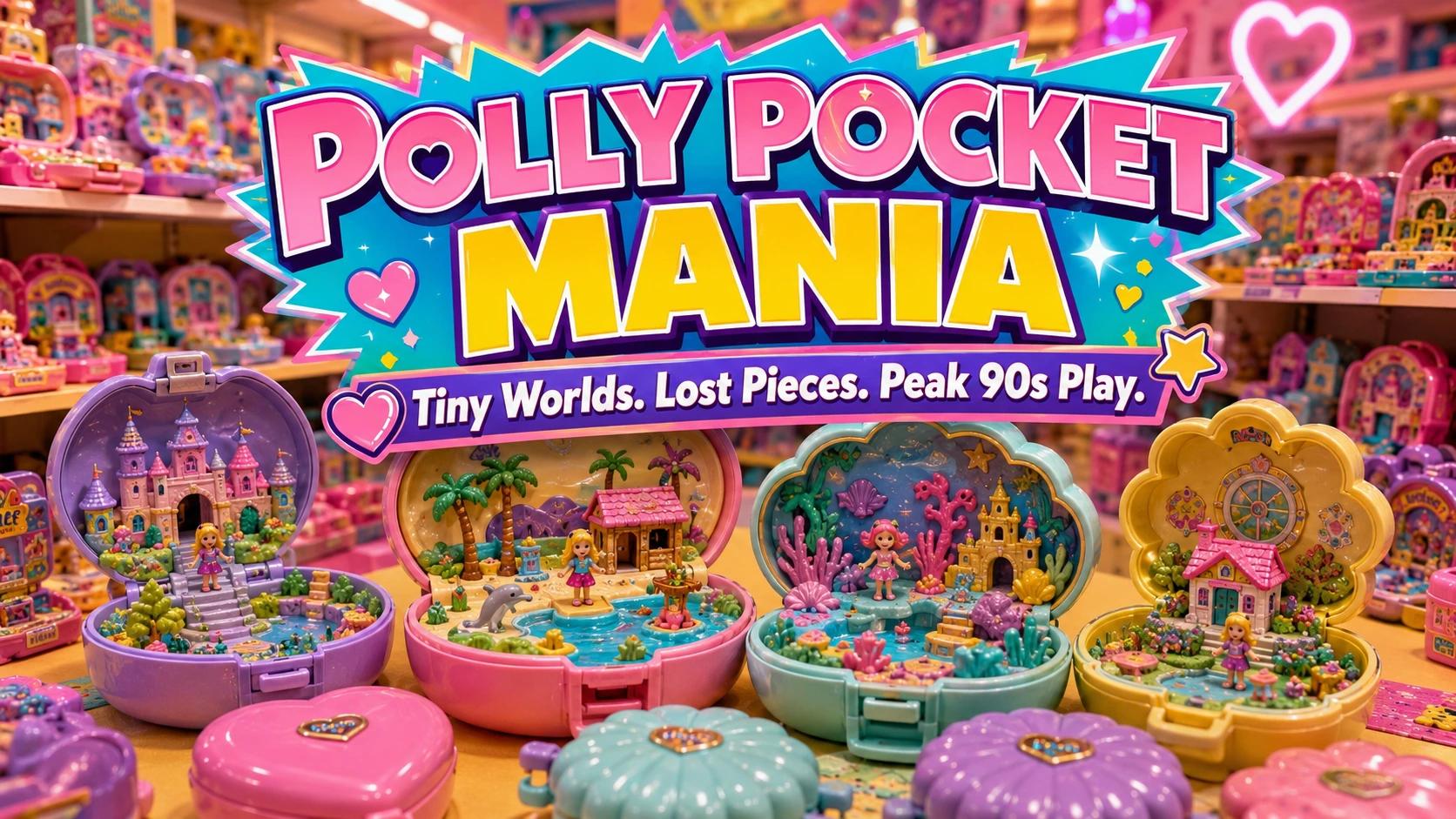
Polly Pocket toys took the dollhouse, shrank it until the furniture required eye strain, folded the whole thing into a pastel compact and somehow made that feel bigger than a full-size playset. The original Bluebird Polly Pocket line packed houses, schools, cafés, pools, castles and vacation worlds into cases small enough to ride in a coat pocket.
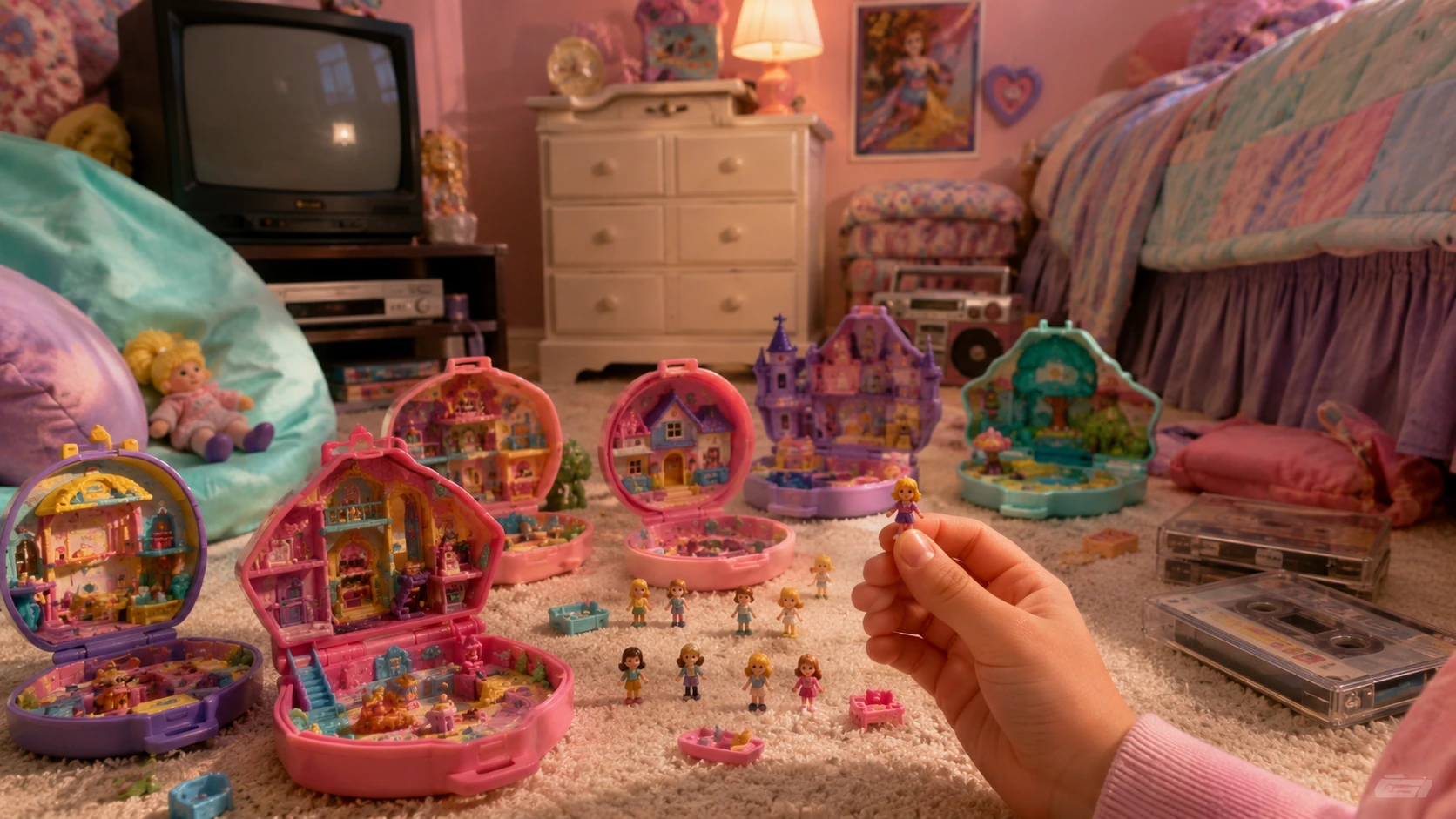
That is why 90s Polly Pocket nostalgia is more than a product timeline. It is the click of the latch, the tiny waist-bending dolls, the moving doors, the perfect molded rooms—and the sudden silence when somebody realized the main character had disappeared into beige carpet.
Why Were Polly Pocket Toys So Popular in the 90s?
Polly Pocket became a defining 90s toy because each compact opened into a complete miniature world. The original Bluebird sets combined tiny dolls, molded rooms, printed details, moving parts and bright portable cases that could fit in a pocket, bag or coat. Kids could own an entire house, school, café, castle or vacation scene without giving up half the bedroom.
The small scale made play feel private and personal. Polly could be carried anywhere, mixed between sets and placed into little slots around the environment. The same design also created the line’s permanent joke: the world snapped shut neatly, but the loose figure usually vanished before the compact did.
A Complete Rewind of the Original Compact Era
The Full Story of Polly Pocket in the 90s
The story begins with a homemade miniature in 1983, reaches stores in 1989, becomes a pastel early-90s toy empire and ends the decade with Mattel changing the scale, styling and direction of the brand.
A Dollhouse, a Secret and a Storage Case in One
Why the Original Polly Pocket Formula Worked
Polly Pocket did not ask kids to choose between a doll, a playset and something collectible. The compact did all three jobs while taking up less room than a sandwich.
Complete Tiny Worlds
Every set offered a beginning, middle and end. The compact itself became the house, school, shop, castle or vacation.
Secret-Object Energy
A closed case looked small and ordinary. Opening it revealed something private, colorful and much more detailed than the outside suggested.
Portable Play
The whole environment could travel in a pocket or bag. The toy worked in bedrooms, cars, restaurants and waiting rooms.
Collectible Variety
New shapes, colors, themes, characters and mechanisms made another compact feel like another world rather than a duplicate doll.
A Makeup Compact Became a Toy Empire
Chris Wiggs, His Daughter Kate and the Original Polly Pocket Idea
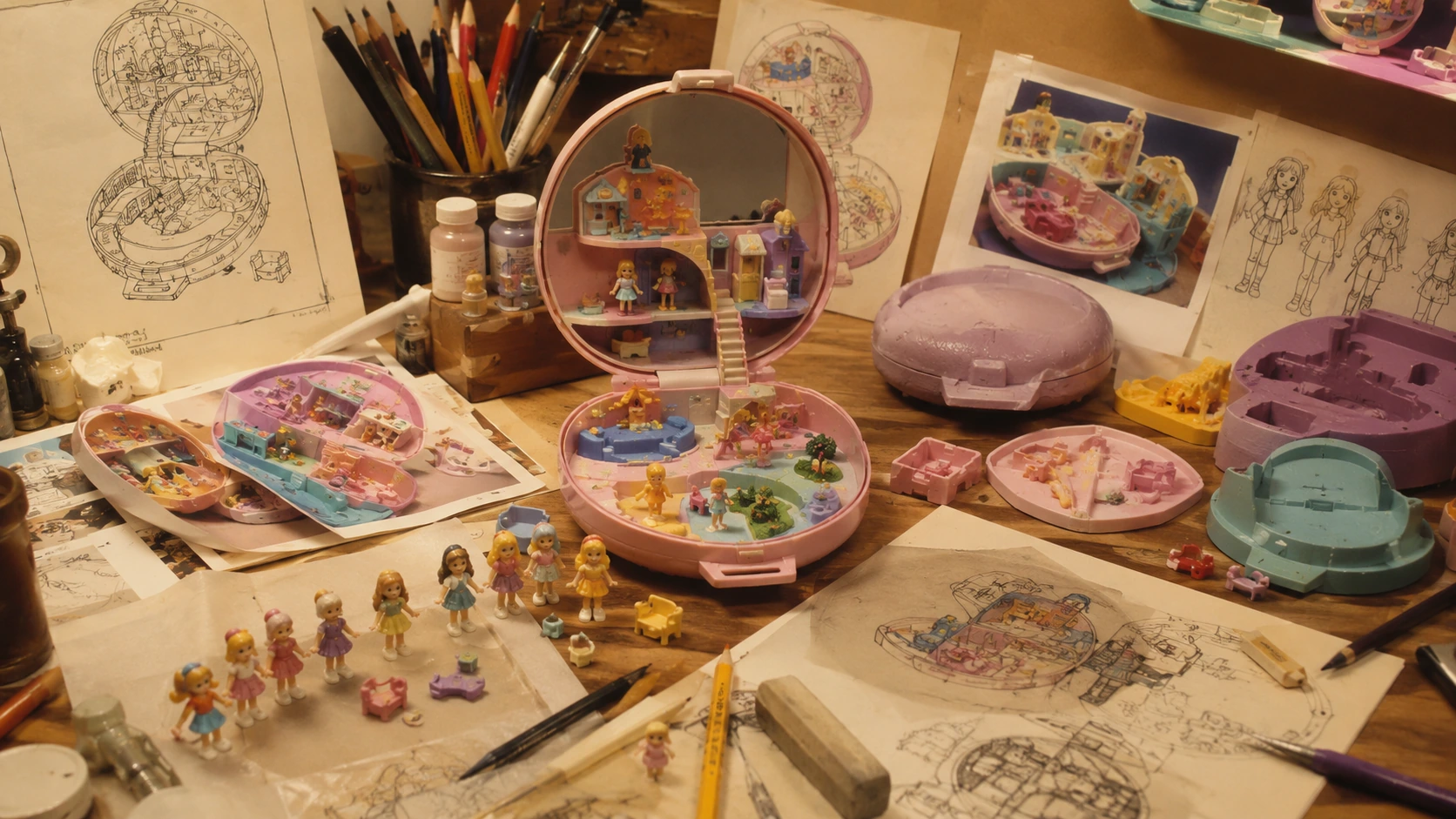
Polly Pocket began in 1983 when British designer Chris Wiggs made a tiny dollhouse inside an old makeup compact for his daughter, Kate.
The First World Was Homemade
The original idea was not a giant product-development program. It was a parent building something small and imaginative for one child. A makeup powder compact already had the key feature: it opened, closed and protected whatever lived inside.
Wiggs used that familiar object as the shell for a miniature house and tiny doll. The case was not merely packaging. It was the architecture.
The Compact Solved Three Problems at Once
A dollhouse normally needed space. Dolls needed storage. Small accessories needed a container. The compact combined all three. The world opened for play and closed for travel.
The Scale Created Intimacy
Large toys take over a room. Tiny toys pull the child closer. Polly Pocket made kids lean in, study the rooms and notice details that would have been background decoration in a bigger playset.
The Name Explained the Idea
“Polly Pocket” sounded friendly and told parents exactly what made the toy different. The character and the format were built into the same two words.
The Concept Was More Than a Mini Doll
The breakthrough was not simply making a person very small. Tiny figures already existed. The breakthrough was making a self-contained world that could disappear into a pocket and return fully formed.
Why the Origin Still Fits the Toy
The final retail line kept the handmade idea’s emotional center. Polly Pocket always felt like someone had built a private world specifically for the person opening it.
The Gen X translation: a parent reused an old makeup compact, and within a few years children were asking for entire plastic towns small enough to be swallowed by the couch.
The lasting idea was simple: the case should not hold the toy. The case should become the toy.
From One Homemade Compact to Store Shelves
How Bluebird Toys Turned Polly Pocket Into a Retail Line
Bluebird Toys licensed Chris Wiggs’s idea and introduced Polly Pocket in 1989, turning the miniature compact into an expandable brand.
Bluebird Already Understood Container Play
The British company had experience with toys that turned containers into environments. Polly Pocket pushed that concept into a much smaller, more collectible form.
1989 Was the Official Debut
Mattel’s corporate history identifies 1989 as the year the world met Polly Pocket. The original doll stood about one inch tall inside a miniature world that could fit into a small case.
The Product Was Immediately Easy to Demonstrate
A closed compact created curiosity. An open compact created the sales pitch. No long explanation was necessary. The transformation happened in one motion.
Different Themes Expanded the Same Core Idea
Bluebird could reuse the clamshell format while changing the destination. One set became a cottage. Another became a café. Another became a beach, school, salon or fantasy world.
The Case Shape Became Part of the Story
Hearts, shells, flowers, rectangles, houses and other forms made the exterior communicate the mood before the compact opened.
Mattel Helped Bring Polly to Wider Markets
During the Bluebird era, Mattel distributed Polly Pocket in major markets. That relationship placed a British miniature toy beside huge American doll and playset brands.
The Line Grew Because the Format Could Grow
The compact could remain familiar while the interior became more ambitious. Bluebird did not need to reinvent Polly every year. It only needed another place for her to go.
The memory: seeing several closed compacts together and knowing each one contained a completely different life, which was a stronger argument than most adults were prepared to defeat.
The First Year of Tiny Everything
Original Bluebird Polly Pocket Compacts: The 1989 Debut
The earliest Bluebird sets established the basic language of the entire brand: colorful cases, miniature environments, tiny dolls and worlds that closed around them.
Country Cottage
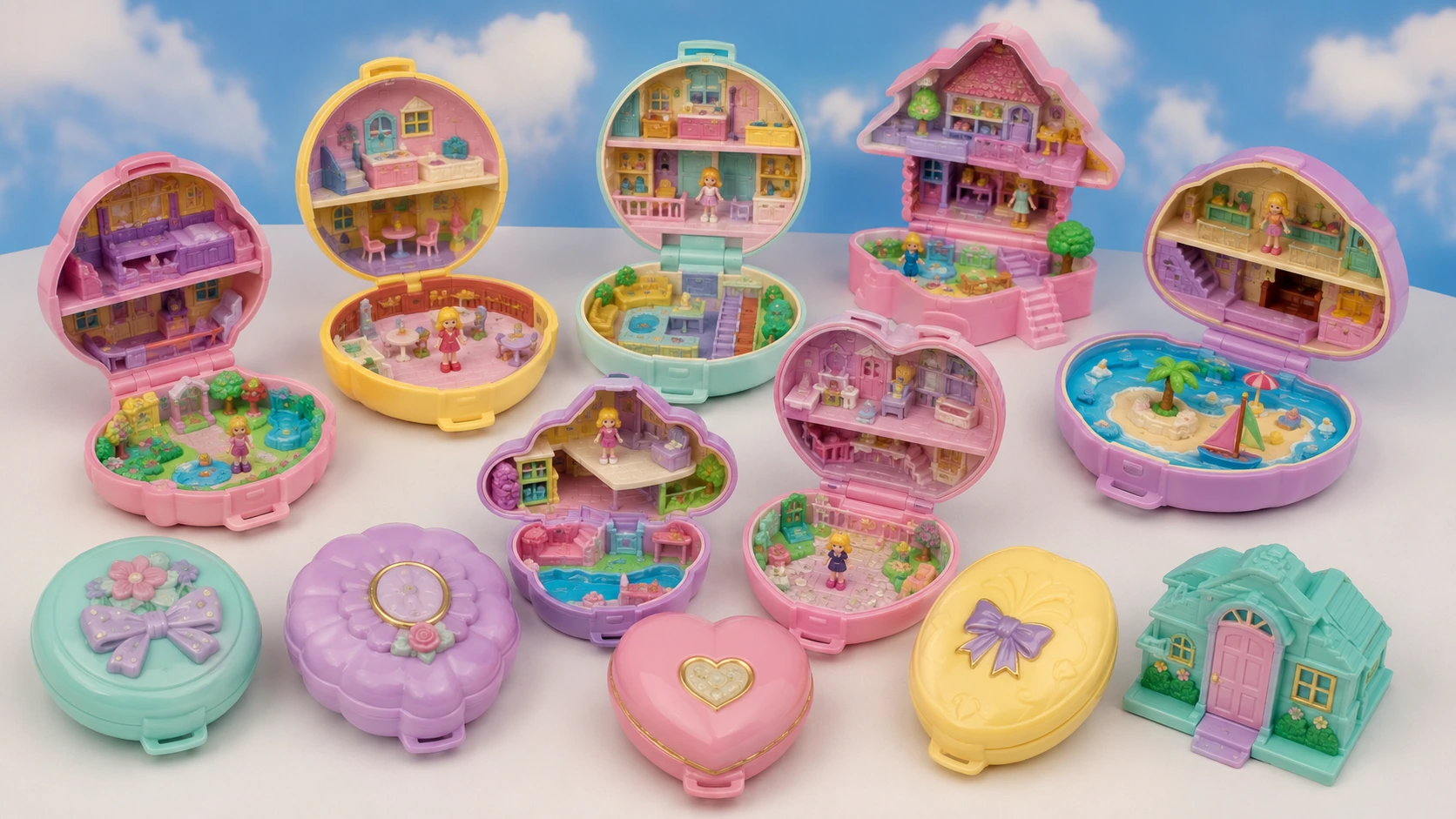
The cottage format captured the line’s home-based appeal. A small exterior opened into a complete domestic setting with rooms, furniture and places to position figures.
Polly’s Flat
An apartment-style set proved Polly did not need a fantasy castle to feel complete. Ordinary rooms became fascinating when they were miniaturized.
Polly’s Café
The café expanded the play beyond home. Tiny tables, service areas and social spaces turned the compact into a miniature public world.
Beach Party
A shell-shaped case made the exterior and interior work together. Open it and the compact became a vacation scene.
Jewel Case and Special Formats
Early releases already experimented with shapes and functions beyond the basic round or heart compact.
The Bowling Alley Cassette Player
One of the most ambitious early ideas combined a miniature play environment with a working cassette player. This was 1989 logic at full strength: make the toy tiny, then attach it to the largest portable music technology available.
Why the First Year Still Feels Special
The earliest sets were simple enough to preserve the handmade compact idea. Later worlds became larger and more engineered, but the first releases had the clean surprise of opening a case and finding a life inside.
The memory: the compact clicking open, the figure falling out and the search beginning before the actual story did.
Every Millimeter Had a Job
How an Original Polly Pocket Compact Worked
The classic compact was simple from across the room and surprisingly complicated once opened.
Hinged Shell
The case folded shut to protect the interior and folded open to become the environment.
Upper and Lower Worlds
Both halves could contain rooms, outdoor scenes, stairways, balconies or decorative views.
Standing Holes
Small circular points accepted the bases of the figures so Polly and friends could stand in specific locations.
Molded Furniture
Beds, chairs, counters, stairs and fixtures were often built into the plastic rather than supplied as loose pieces.
Printed Detail
Walls, floors, windows, rugs and scenery used printed graphics to create depth without adding bulky parts.
Moving Features
Doors, stages, rides, tables, pools, elevators and hidden spaces made the world respond to touch.
Latch
The compact clicked shut, creating one of the most satisfying sounds in the 90s toy box.
Exterior Identity
The color and shape turned the closed compact into a decorative object rather than plain storage.
Loose Figures
The entire engineering achievement still depended on one tiny person remaining somewhere within the same house.
One Inch Tall and Somehow Carrying an Entire Social Life
Original Polly Pocket Dolls: The One-Inch Micro Figures
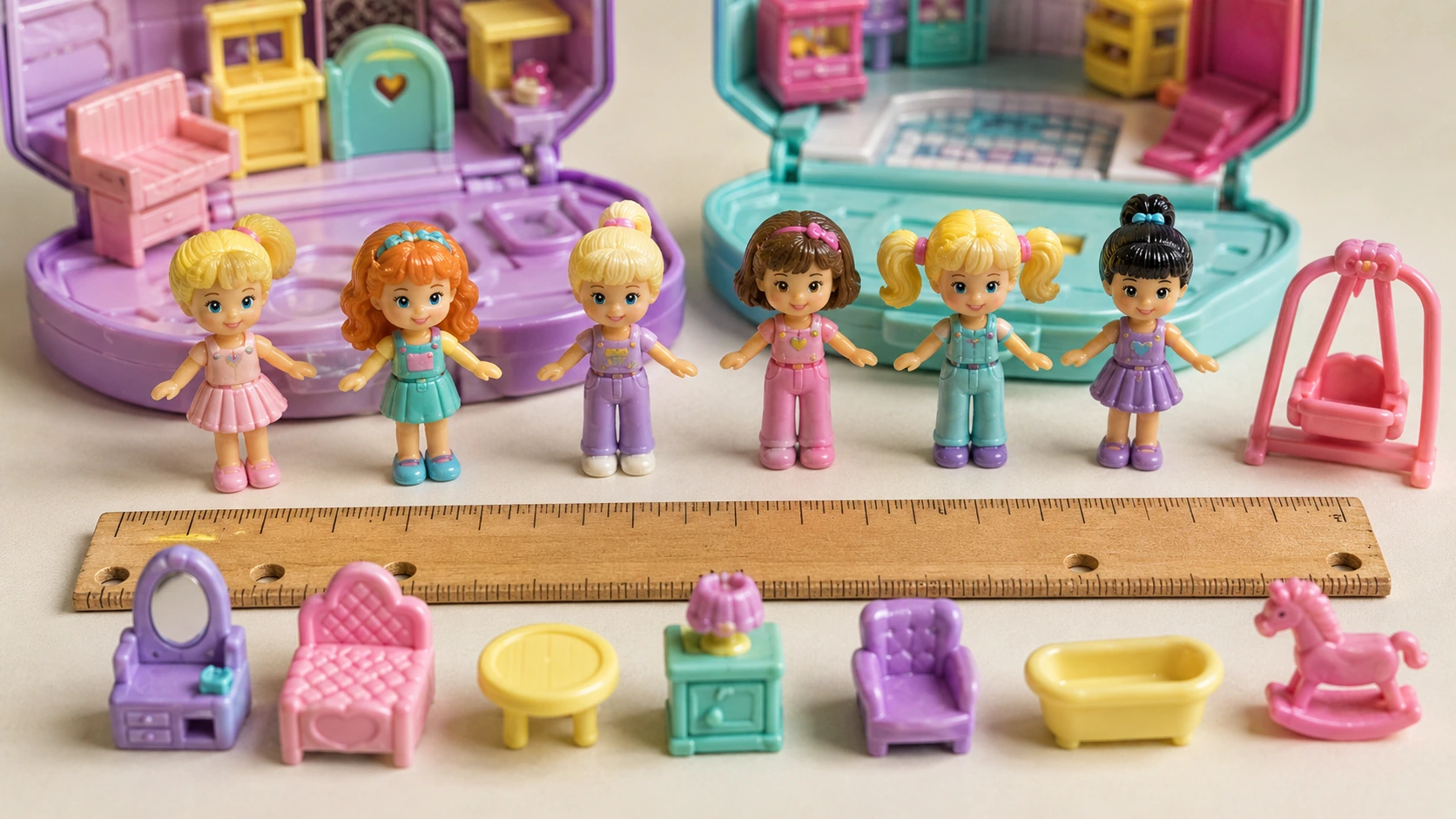
The original Bluebird dolls were tiny hard-plastic figures, generally less than an inch tall, with a bend at the waist and circular bases that fit into the compact.
Polly Could Sit and Stand
The waist joint allowed the figure to bend into seats, beds, rides and other parts of the environment. The motion was small but important.
The Base Created Stability
A circular foot or base could slot into molded holes around the playset. This prevented every scene from ending with the cast lying flat.
Paint Did a Lot of Work
At that scale, a few dots and color blocks created faces, hair and clothing. Small paint loss could erase an expression or turn a detailed character into a tiny plastic witness.
Characters Were Read Through Color
Hair color, outfit color and pose helped children distinguish figures that were only slightly taller than a fingernail.
Polly Had Friends and Family
The line included many recurring and one-set characters. The compact world became social rather than a series of empty rooms.
Tiny Size Increased Attachment
The dolls felt fragile and personal. A figure held between two fingers demanded more care than a full-size fashion doll—at least until it disappeared into the car seat.
Scale Also Created the Main Problem
Figures were easy to transport because they were tiny. They were also easy to lose because they were tiny. The feature and the flaw were the same design decision.
The memory: holding the compact safely while the actual Polly figure traveled loose in a pocket like a very small hostage.
The dolls were not detailed because they were large. They were memorable because the whole world had been designed around their scale.
The Smaller It Got, the More Important Every Room Felt
Why Polly Pocket’s Tiny Scale Felt So Big
Miniature play changes attention. A large dollhouse is furniture. A compact world is a secret.
Tiny Rooms Encouraged Close Looking
Children leaned toward the toy. A bed, chair or staircase became meaningful because it had been squeezed into almost no space.
The Whole World Could Be Seen at Once
Open a compact and the entire environment appeared immediately. The child could understand the geography before moving the first figure.
Scale Turned Ordinary Places Into Fantasy
A school or café might sound ordinary at full size. In miniature, it became a private, perfect version with no waiting, no homework and no adult supervision.
Small Objects Felt Collectible
Compacts stacked, displayed and compared easily. Different colors and shapes created a collection before the child intended to become a collector.
Miniature Play Created Control
The child controlled every room, schedule, friendship and destination. Polly’s world could be rearranged without needing a floor plan or another person’s cooperation.
The Compact Created a Boundary
The play happened inside a defined space. That made the story feel focused, even when the plot was mostly “everyone is now at the pool.”
Closing the Case Preserved the Story
The world disappeared with a click, then returned later exactly where it had been—unless the figures had been removed and relocated by household forces.
The Gen X truth: Polly Pocket proved an entire mansion could fit in a palm, but one missing figure could occupy the whole family for twenty minutes.
One Compact Was Never Going to Be Enough
The Early Polly Pocket Sets That Defined the Line
The first years established several themes Bluebird would keep revisiting: home, school, shops, holidays, entertainment and fantasy.
A home world that made rooms, furniture and domestic routines feel magical through scale.
A compact apartment that turned everyday city living into a tiny private stage.
A social setting with tables, service areas and miniature food-world energy.
A shell-shaped vacation world with sand, water and outdoor play.
A seasonal compact that linked Polly with Christmas and special-gift presentation.
A large hybrid that combined miniature play with real music technology.
Classrooms and activity spaces let children recreate school with fewer worksheets and more control.
Tiny mirrors, counters and styling spaces connected Polly to the wider doll aisle.
Celebration sets made cakes, gifts, music and friends the entire reason the compact existed.
Ordinary Life Became More Interesting at One-Inch Scale
90s Polly Pocket Houses, Schools, Cafés and Everyday Worlds
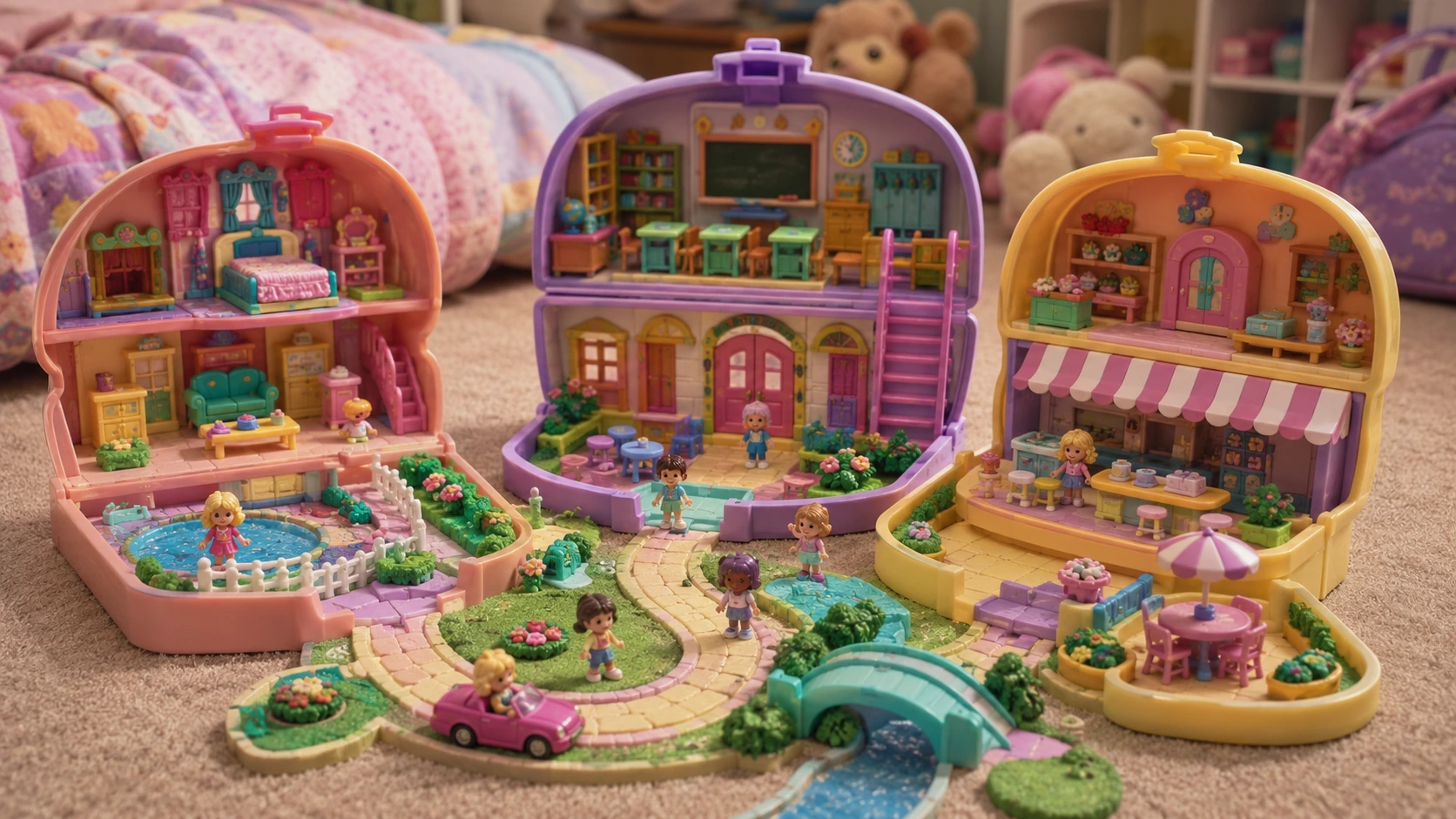
The line did not need constant fantasy. Miniaturizing ordinary places was already enough to make them feel special.
Homes and Cottages
Bedrooms, kitchens, bathrooms, gardens and living rooms gave Polly a complete domestic life. These sets worked like tiny dollhouses without requiring a permanent corner of the room.
Schools and Classrooms
School sets let children control the schedule, assign the roles and remove every unpleasant part of actual education. Tiny desks were charming because nobody had to sit in them for six hours.
Cafés and Restaurants
Food-service worlds created social stories. Polly could meet friends, work behind a counter or spend an entire afternoon at a table without anyone asking whether she planned to order.
Shops and High Streets
Retail environments allowed several tiny activities inside one case. The compact could suggest a whole town through a few storefronts and printed backgrounds.
Hospitals and Care Settings
Medical worlds added caretaking and role play. Beds, treatment areas and tiny patients made the environment more structured than a normal home compact.
Hair and Beauty Sets
Salons connected Polly with fashion-doll play while keeping the main appeal architectural. The room mattered as much as the character.
Why Everyday Sets Were Powerful
Children already understood these places. The miniature version did not need explanation. It offered control, perfection and a world where every door opened and every appointment happened instantly.
The memory: arranging a tiny home more carefully than the actual bedroom surrounding it, which contained clothing on the chair and a glass nobody remembered bringing upstairs.
When a Heart Compact Opened Into a Kingdom
Polly Pocket Castles, Mermaids and Fantasy Worlds
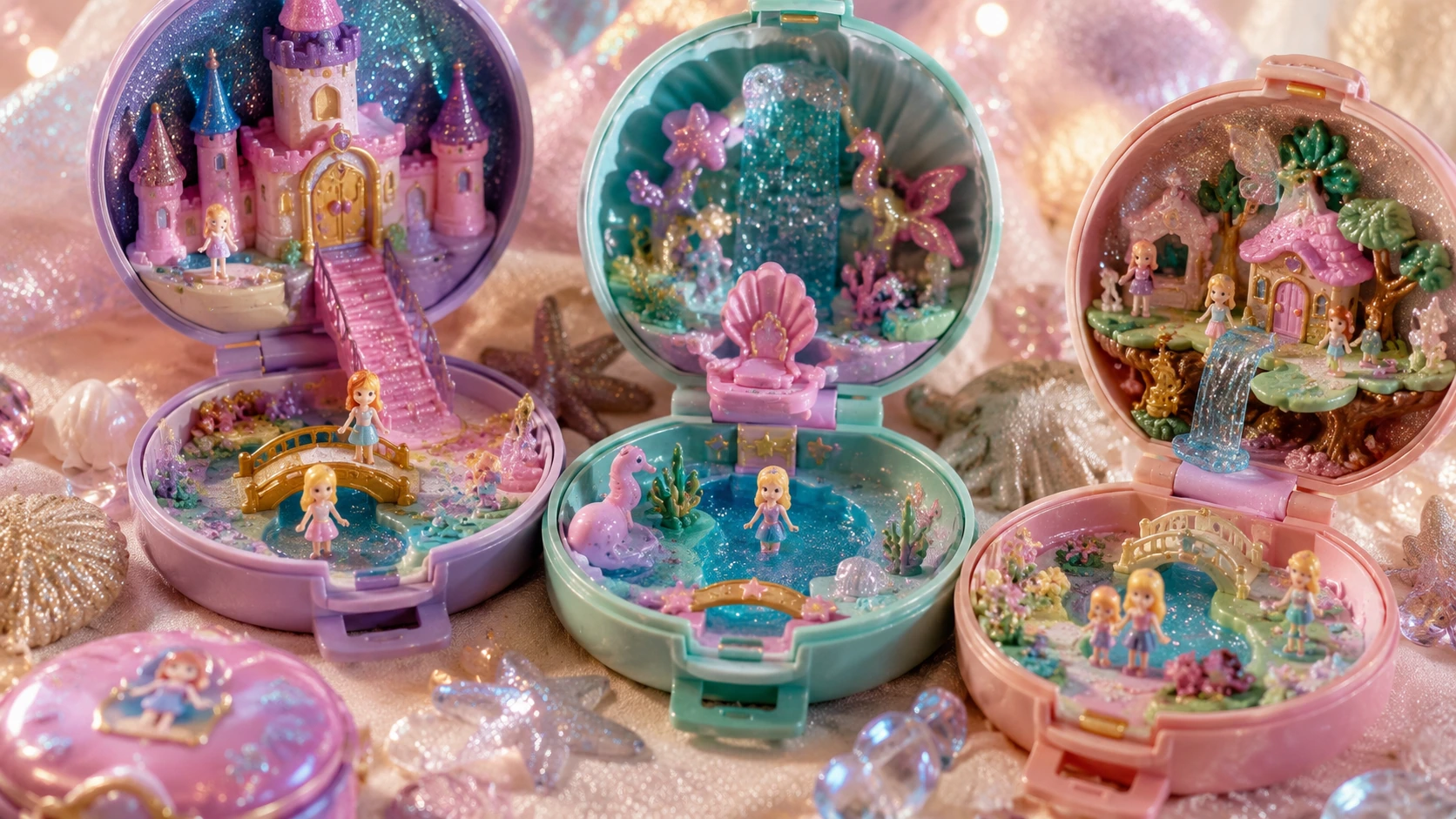
Fantasy sets used the compact format to deliver palaces, islands, enchanted rooms and fairy-tale architecture in a space smaller than a paperback.
Castles and Palaces
Towers, ballrooms, thrones and hidden rooms made the vertical compact especially useful. The upper shell could become height rather than just background.
Mermaid Worlds
Underwater themes allowed shells, coral, pools and bright blue interiors. The figure scale made sea creatures and tiny grottoes feel natural.
Fairies and Enchanted Gardens
Flowers, wings, bridges and magical spaces fit the decorative exterior shapes perfectly.
Princess Stories
Storybook cases and palace scenes offered a contained fairy tale. Open the cover and the setting was ready.
Glitter and Light Effects
Fantasy sets benefited from translucent plastic, sparkles, bright paint and features that made the case feel jewel-like.
The Compact Was Already Magical
Fantasy did not require a huge change in play. The act of opening the case already felt like entering another world.
Why These Sets Became Display Favorites
The exterior shapes, color combinations and detailed interiors made fantasy compacts visually strong even when they were not being played with.
The memory: opening a tiny castle while sitting in the back seat of a station wagon, because fantasy had finally become small enough to survive a family road trip.
A Vacation World That Could Travel on the Actual Vacation
Polly Pocket Beach, Holiday and Travel Sets
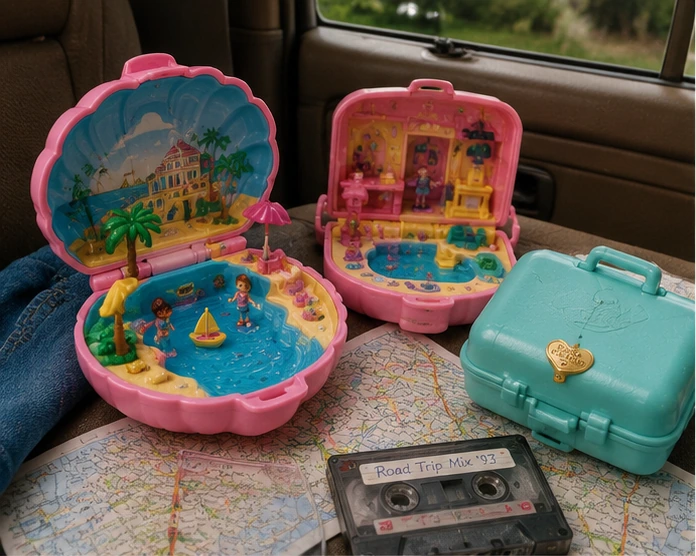
Portable toys and travel themes reinforced each other. Polly could visit the beach while the compact itself rode in the car to one.
Beach Compacts
Shell exteriors, umbrellas, water and sand scenes made the closed case feel connected to the destination.
Holiday Resorts
Pools, patios, hotel rooms and outdoor activities gave Polly a complete vacation schedule.
Travel Cases
Larger formats carried more figures or linked multiple locations while preserving the fold-and-go idea.
Winter Holidays
Snow, Christmas rooms and seasonal accessories turned compacts into gift-specific worlds.
Camping and Outdoor Play
Tents, trees and camp activities brought the miniature world outside without exposing actual figures to nature for long.
Transportation Themes
Cars, boats and travel accessories gave the tiny cast a reason to move between compacts.
Polly Pocket was portable before “portable entertainment” automatically meant a screen. A compact could occupy a car ride, restaurant wait or relative’s house without batteries, headphones or a charger nobody packed.
Tiny Pools, Small Boats and Several Drops of Questionable Sink Water
Polly Pocket Pools and Water-Play Worlds
Water themes looked especially convincing inside bright blue compacts, even when the actual water supply came from the bathroom faucet.
Pools Created Movement
Slides, diving boards, boats and water areas gave the figures activities beyond standing in molded rooms.
Blue Plastic Did Most of the Work
A glossy blue surface could become a pool, lake or ocean without needing real water.
Some Sets Encouraged Actual Water
Water-compatible features made the play feel more interactive and made adults evaluate whether the compact was truly staying near the sink.
Boats and Floating Accessories Expanded the Scene
Tiny transportation added another level of movement but also another category of object to lose.
Pool Worlds Fit the Aspirational Mood
A perfect miniature resort was more attractive than the local public pool and contained fewer whistles.
Drying the Compact Became Part of Ownership
Water left inside hinges and recesses could create grime, residue or sticker damage. Nobody considered this during the commercial.
The memory: adding “just a little water,” creating a full bathroom production and then leaving the compact open on a towel like a tiny flooded property.
Not Every World Looked Like a Makeup Compact
Polly Pocket Jewelry, Storybooks, Lockets and Special Formats
Bluebird kept the core miniature idea while experimenting with objects that could be worn, carried, displayed or used for something else.
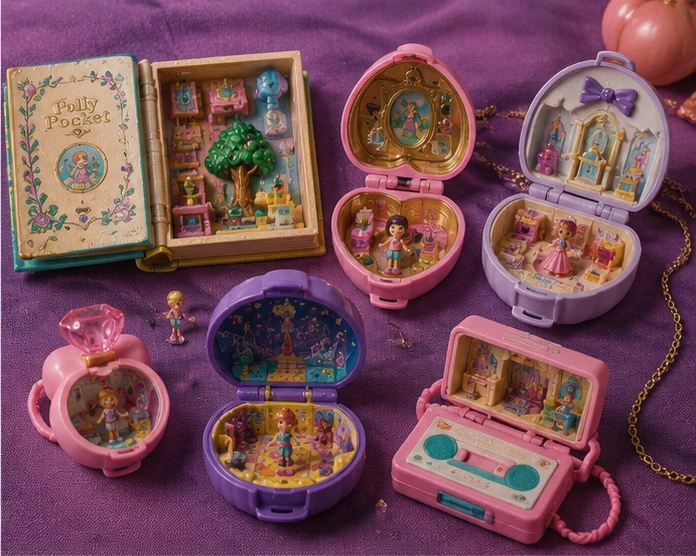
Book-shaped cases opened like stories and made the visual metaphor extremely literal.
Wearable formats turned the toy into jewelry and made the world even more personal.
Small jewelry-style sets pushed “pocket size” toward “possibly lost before lunch.”
Functional objects could hide miniature scenes, mixing practical design with compact play.
Music technology and miniature environments collided in some of the line’s most ambitious hybrids.
Storage formats gave the exterior another purpose and made the toy feel more like a personal possession.
Mechanical expansion allowed a small closed object to become a taller environment.
The line returned to its origin by making toy compacts resemble real cosmetic objects.
A miniature playset could become something worn around the neck, which made losing the doll while preserving the case entirely possible.
When “Pocket” Started Requiring a Very Generous Definition
Polly Pocket Houses, Mansions and Larger Playsets
As the line expanded, some worlds grew beyond true pocket size while keeping the same miniature figures and foldaway logic.
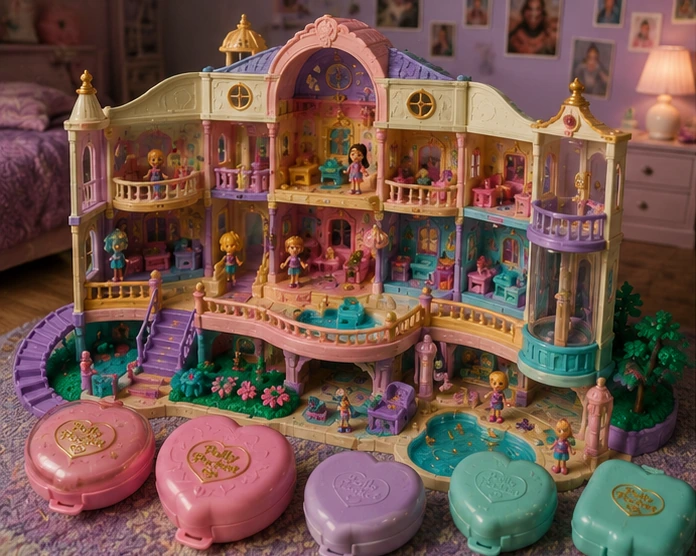
Larger Sets Allowed More Rooms
Mansions, hospitals, hotels and multilevel homes created room for complex stories and several figures at once.
Pop-Up and Pull-Out Mechanisms Added Space
A compact could unfold, rise or extend beyond its original footprint. The closed toy stayed manageable while the open world became more ambitious.
More Space Meant More Features
Elevators, stairways, patios, pools, stages and hidden rooms could coexist without turning every interior into a molded traffic jam.
The Gift Hierarchy Became Clear
Small compacts worked as regular purchases, birthday presents and stocking stuffers. Large houses became main-event gifts.
Collections Needed a Centerpiece
A bigger playset gave loose dolls and smaller compacts a central home. Polly’s entire town could gather somewhere.
Storage Became Less Perfect
The larger the set, the less likely it was to disappear neatly into a pocket. Bluebird gained play space and gave up some of the original compact purity.
Why Big Sets Still Felt Like Polly
The scale of the people and the detail of the environments remained miniature. Even a mansion felt like something discovered rather than something installed.
The memory: requesting a “small dollhouse” and presenting a closed plastic mansion as evidence that the request was technically reasonable.
Tiny Engineering Hidden Behind Pastel Plastic
Moving Parts, Secret Doors and Mechanical Features
The best compacts rewarded poking, sliding, turning and opening everything that looked suspicious.
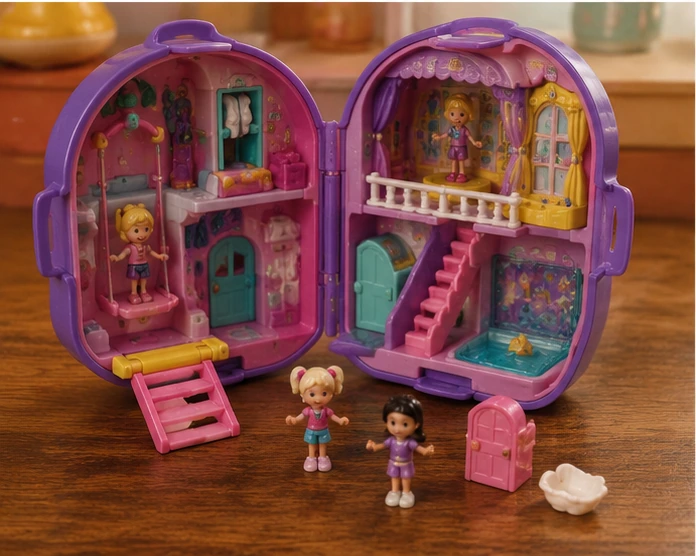
Doors and Hinged Walls
Small doors made rooms feel connected and gave children the important responsibility of opening them repeatedly.
Rotating Floors and Stages
A twist could move a character between scenes or turn a quiet room into a performance space.
Elevators and Lifts
Vertical sets needed ways to move figures upward, especially when the doll was too small to survive realistic stairs without adult fingers.
Slides and Rides
Amusement and pool features created obvious action. A doll could actually travel through the world instead of only being placed.
Hidden Compartments
Secret areas increased discovery and offered another place for the child to forget where the figure had been stored.
Lights and Music
Special sets added battery-powered or mechanical effects, giving the tiny world a little spectacle.
Printed Illusion and Molded Reality Worked Together
Bluebird did not make every object functional. The designers used moving parts where they mattered and graphics where space disappeared.
Why Collectors Check Mechanisms
Old hinges, tabs, buttons and rotating sections can become stiff or brittle. A complete set is not fully complete if the feature that defined it no longer moves.
The memory: finding a hidden compartment months after owning the compact and briefly feeling like an archaeologist with a plastic heart.
The Closed Compact Had to Sell the World Before It Opened
Why Polly Pocket Colors and Case Shapes Mattered
The exterior was not leftover packaging. It was the first half of the design.
Heart Shapes
Hearts made the cases look like jewelry and communicated sweetness before the latch opened.
Shell Shapes
Beach and mermaid worlds could announce their setting from the exterior.
Flowers and Stars
Decorative shapes made fantasy and garden sets feel like objects worth displaying.
Books and Boxes
Rectangular forms created room for stories, shops and larger interiors.
Pastel Color Coding
Pink, purple, turquoise, yellow and mint helped children recognize sets and helped toy aisles look like candy architecture.
Transparent and Glitter Plastic
Special materials made fantasy sets look jewel-like and premium.
Exterior Decoration
Logos, molded symbols and printed details identified the compact even when it remained closed.
Color Variants
Some sets appeared in more than one color or packaging version, creating modern identification problems.
Stack-and-Display Appeal
A group of closed compacts looked like a collection before anyone opened a single world.
Polly Had a Social Calendar Bigger Than the Actual Child
Polly Pocket Characters, Friends and Tiny Families
Bluebird produced recurring figures and many one-set characters, letting each compact feel populated rather than decorative.
Polly Was the Center Without Being the Only Figure
The brand name made Polly the anchor, but the worlds needed friends, relatives, workers, babies, pets and fantasy characters.
Different Sets Created Different Casts
A school needed classmates. A café needed customers. A hospital needed patients. A castle needed royalty. The environment determined the social group.
Recurring Friends Created Continuity
Characters such as Tiny Tina, Wee Willie, Midge and others appeared across the wider Bluebird world, giving children familiar faces beyond Polly.
Pets Added Immediate Story
Tiny dogs, cats, horses and other animals created caretaking and outdoor play with almost no explanation.
Figures Moved Between Compacts
The official character assigned to one set rarely stayed there. Friends visited schools, cafés, castles and hospitals with no concern for packaging accuracy.
Mixed Casts Made Collections Feel Connected
Each new compact brought another location and often another group. Over time, the child created a town larger than any single product.
Modern Identification Is Difficult
Loose dolls from several sets can look similar. Hair, clothing, pose and base color become essential clues.
The memory: deciding every tiny blonde figure was Polly, every brown-haired figure was her best friend and all babies belonged to whoever was closest.
Open, Arrange, Narrate, Lose Somebody, Repeat
How Polly Pocket Play Actually Worked
Polly Pocket did not need instructions because the environment itself suggested what should happen next.
Open the Compact
The reveal was part of every play session. The world changed from object to place in one motion.
Place the Figures
Standing holes, chairs, beds and rides created obvious starting points for the story.
Assign Roles
Polly became student, shop owner, traveler, patient, princess or whatever the compact required that afternoon.
Move Through the Features
Doors opened, rides turned, stages rotated and characters traveled between levels.
Mix Sets Together
A compact collection became one town. Figures moved freely between worlds and created stories Bluebird had never written.
Close and Carry
The case preserved the environment and offered the illusion that all pieces had been safely stored.
Search the Floor
The final phase began when the count of figures did not match the memory of figures.
The full cycle: open the world, arrange the cast, create a tiny life, close the compact, realize someone is missing and interrogate the carpet.
Entertainment That Traveled Without a Battery Compartment
Polly Pocket Was Portable Before Childhood Went Digital
The line arrived before smartphones, tablets and streaming. A tiny plastic world was enough to make waiting less painful.
Car Rides
The compact fit in a lap and created a destination even when the actual destination was another relative’s house.
Restaurants
A small case occupied the table without requiring enough pieces to build a full dollhouse beside the ketchup.
Waiting Rooms
Polly offered quiet story play in the exact places where time slowed down.
Sleepovers
Several compacts traveled easily and combined into one miniature social event.
School Bags
The toy could fit where larger dolls could not, though tiny pieces and classroom floors remained natural enemies.
Grandparents’ Houses
A self-contained playset solved the problem of visiting a house with no current toys and one cabinet nobody was allowed to touch.
Polly Pocket belongs beside the quieter side of 90s doll and miniature play: imaginative, portable and deeply personal without needing noise, lights or a television license.
The Tiny World Was Organized. The Bedroom Was Not.
How Polly Pocket Lived in Gen X Bedrooms
This is where the toy stops being product history and becomes the memory of actually owning it.
Compacts Collected on Dressers
Closed Polly Pockets looked decorative. Hearts, shells and bright cases formed a stack of secret worlds beside hair brushes, cassette tapes and whatever jewelry had survived the week.
Figures Lived in Improvised Containers
Tiny dolls moved into plastic bags, film canisters, jewelry boxes and random cups because the original compact did not always contain the original cast.
Several Worlds Became One Town
The school sat beside the beach. The castle opened next to the café. A hospital appeared behind a heart-shaped cottage. Scale unified everything even when city planning had failed.
Older and Younger Siblings Shared Uneasily
One child arranged the rooms. Another borrowed a figure. A third denied involvement. The carpet remained silent.
Real Objects Became Expansion Packs
Jewelry boxes became mansions. Shoebox lids became roads. Mirrors became lakes. A single earring could become a table if nobody recognized it.
The Compact Felt Private
Unlike a large dollhouse, Polly’s world could close. The child controlled when it appeared, where it traveled and who got to see inside.
Play Could Be Quiet and Detailed
There was no explosion, launch mechanism or electronic voice. The drama happened through arrangement and narration.
The Bedroom Evidence Was Tiny
A missing Barbie shoe was visible. A missing Polly figure became rumor. Adults vacuumed with the caution of bomb technicians.
The Gen X truth: the compact contained a cleaner, more organized and more emotionally stable household than the one surrounding it.
Peak Pocket Play, Peak Floor Search
Why Polly Pocket Pieces Disappeared So Easily
The original Polly figures were small enough to make portability possible and small enough to turn ownership into forensic work.
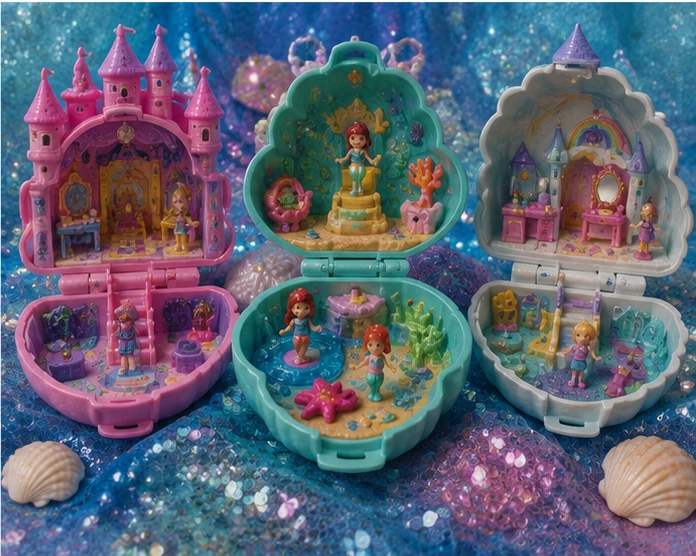
Figures Left the Compact During Play
The case could close securely only after every loose person had been returned. Children did not always conduct a head count.
Carpet Hid the Bases
The circular base that helped figures stand also allowed them to settle flat between fibers.
Furniture Created Blind Spots
A tiny doll could travel beneath a dresser, couch or car seat without making enough sound to reveal the route.
Sets Mixed Together
Once several compacts opened at the same time, returning every figure to the correct world became optional.
Small Pets and Accessories Were Worse
Animals, babies and loose pieces could be smaller than Polly herself.
Vacuum Cleaners Became Villains
The unmistakable sound of hard plastic entering the vacuum created a household emergency and a discussion about whether anyone was opening the bag.
Missing Pieces Changed the Story
The compact still worked. A lost figure simply created a new character shortage that imagination solved.
The memory: hearing one click inside the vacuum, freezing the room and suddenly caring more about waste-bag archaeology than any human should.
The lost-piece problem was not separate from the magic. Polly felt special because she was tiny enough to disappear.
The Box Had to Explain a World Smaller Than the Logo
Original Polly Pocket Packaging and Toy-Aisle Presentation
Packaging showed the compact closed, open and populated so children could understand the transformation before touching the latch.
Open-World Photography
Boxes and blister cards needed to reveal the interior because the closed shell alone could not show the play value.
Bright Brand Colors
Pink, purple, blue and yellow made the products visible in a crowded doll aisle.
Tiny Figures Needed Enlarged Explanation
Artwork and photography helped children see what each miniature person represented.
Feature Callouts Sold the Mechanisms
Arrows and illustrations pointed toward moving doors, pop-up rooms, lights, sounds or hidden areas.
Regional Packaging Varied
Bluebird and Mattel distribution created different logos, names and package designs across markets.
The Packaging Became Part of Modern Identification
Collectors use product names, dates, figure placement and artwork to distinguish similar sets.
Children Opened It Anyway
The package existed to sell the toy. The compact existed to be opened repeatedly. Most original packaging never had a chance.
The memory: studying the back long enough to identify three more sets, then removing the packaging with the patience of a raccoon entering a cereal box.
Tiny Worlds Looked Enormous Under Commercial Lighting
Polly Pocket Commercials Sold the Reveal
The television ads understood the central trick: show a closed case, open it dramatically and make every room look large enough to enter.
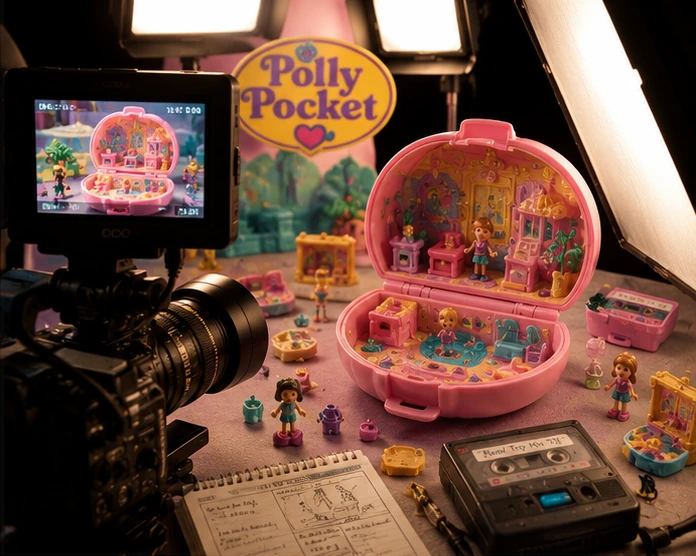
The Compact Opened on Camera
The transformation from small object to detailed world made an ideal first shot.
Close-Up Photography Changed the Scale
Macro views made the dolls and rooms fill the television screen. The toy looked more immersive than it did sitting beside a remote control.
Every Feature Received a Demonstration
Doors opened, figures rode attractions, rooms moved and hidden areas appeared in quick sequence.
The Jingles Made “Polly Pocket” Stick
The brand name already had rhythm. Commercials made sure nobody forgot it before the next toy-store trip.
Several Sets Appeared Together
Advertising rarely presented one compact as the finish line. A row of worlds suggested a collection.
Portability Became Part of the Fantasy
Children carried the cases, shared them with friends and reopened them in different places.
The Archive Still Explains the Appeal
The 90s toy-commercial archive shows how miniature photography, jingles and feature demonstrations made small plastic worlds feel like major events.
The memory: watching a compact fill the entire TV screen and then meeting the actual doll in person, where she was roughly the size of the commercial’s copyright symbol.
A Pastel Wall of Places Nobody Knew They Needed
Polly Pocket in the 90s Toy Store
The line worked at several price points and sizes, which meant Polly could occupy hooks, shelves and large-box space at the same time.
Basic worlds could hang in rows and create immediate color variety.
Mansions and special formats gave the brand premium holiday presence.
Children could spot a heart, shell or flower case before reading the name.
Small sets felt special without requiring main-event Christmas money.
Seeing many closed cases together made the existing collection feel incomplete.
When one retailer lacked a specific set, another store offered one more search.
Children circled compacts and larger houses like tiny real-estate investors.
The closed case looked self-contained and manageable to adults who had not yet met the loose figures.
Polly belongs to the larger experience of walking a 90s doll aisle where every shelf offered a different lifestyle in plastic.
The shelf experience belongs to the larger story of 90s toy-store culture, when the package, peg wall, catalog photo and mall detour were all part of owning the toy before the latch ever clicked.
The Compact Became a Full Toy-Aisle Language
Polly Pocket’s Early-90s Takeover
The line launched in 1989, but the first half of the 90s was when the format expanded into a global childhood fixture.
More Worlds Arrived Every Year
Homes, schools, shops, vacations and fantasy sets gave the brand constant variety without abandoning the core format.
Small Sets Encouraged Repeat Purchases
A new compact did not feel like replacing the old one. It added another destination.
Large Sets Created Aspirational Goals
Mansions, hotels and playhouses became the centerpieces small compacts could orbit.
The Design Improved
Bluebird refined the balance between molded spaces, printed detail and moving parts as the decade progressed.
The Doll Aisle Needed Something Different
Barbie dominated full-size fashion play. Polly offered architecture, portability and miniature storytelling.
The Line Crossed Age and Play Styles
Younger children enjoyed the characters. Older kids appreciated collecting, arranging and the privacy of tiny worlds.
Early-90s Culture Fit the Toy
The decade loved portable objects, bright plastic and personal collections. Polly Pocket delivered all three without batteries.
For the rest of the toy aisle around Polly, start with the top toys of 1990, then follow how dolls, games, action figures and electronic toys crowded the decade around Polly.
By the time the 1991 toy aisle was filling with handheld games, action figures and louder electronic competition, Polly’s quiet little compact worlds still had a completely different kind of pull.
The Worlds Became Larger, Stranger and More Engineered
Polly Pocket in the Mid-90s
By the middle of the decade, the original compact idea had expanded into hundreds of environments and special formats.
More Detailed Interiors
Designers used tighter combinations of molded furniture, wall graphics and interactive parts.
Larger Buildings
Hospitals, mansions, clubs and hotels offered more rooms and broader stories.
Special Effects
Lights, sounds, glitter and translucent materials made certain sets feel premium.
Licensed Worlds
Disney characters and familiar stories moved into the miniature compact format.
Stronger Collection Depth
By then, a child could choose worlds by theme rather than simply choosing Polly Pocket.
Competition Increased
Electronic toys, action figures and other miniature lines fought for the same attention.
Packaging Became More Important
The shelf needed to explain why one new compact differed from the many already available.
The Original Idea Stretched
Not every later set fit a pocket, but the promise of a self-contained tiny world remained.
Nostalgia Locked In
These years produced the compacts many collectors now remember most clearly.
Same Miniature Logic, More Skulls
Mighty Max and the Gendered Twin of Polly Pocket
Bluebird introduced Mighty Max in 1992, applying the compact-world idea to monsters, danger, vehicles and action-oriented marketing.
The Basic Engineering Was Familiar
A closed case opened into a miniature environment filled with small figures and features.
The Exterior Changed the Message
Hearts and shells became skulls, creatures and threatening shapes. The format stayed similar while the marketing changed dramatically.
The Worlds Focused on Conflict
Instead of homes, salons and holidays, Mighty Max offered traps, monsters, temples and survival scenarios.
The Split Reflected 90s Toy Marketing
Companies often divided the same play mechanics into pink and action-coded aisles, even though kids regularly crossed those boundaries in real life.
The Comparison Shows Polly’s Strength
The compact format was not inherently a doll format. It was a powerful way to package miniature world-building.
Collections Sometimes Mixed
Figures traveled between lines because actual childhood was less obedient than packaging departments.
Both Lines Helped Bluebird
Polly Pocket and Mighty Max became central miniature brands during Bluebird’s strongest 90s years.
The memory: one child had the pastel town, another had the skull full of monsters and the carpet border between them lasted about four minutes.
The 1992 launch also landed during a toy year crowded with bigger personalities; the top toys of 1992 show just how much miniature worlds were competing with games, gross-out toys and action lines.
The Compact Format Meets Familiar Movie Worlds
Polly Pocket, Disney Tiny Collection and Licensed Miniature Sets
Bluebird expanded its miniature expertise into Disney properties during the mid-90s, showing that the compact format could carry famous stories as well as Polly’s original worlds.
Known Characters Reduced Explanation
A child already understood the castle, heroine or scene. The compact offered a tiny physical version.
Storybook Shapes Made Sense
Licensed fairy tales worked naturally inside book-like cases and decorative shells.
Miniature Scale Fit Disney Architecture
Castles, cottages, underwater kingdoms and palaces compressed effectively into compact interiors.
The Tiny Collection Expanded Bluebird’s Reach
Families who did not collect Polly specifically could still buy into the same play format through a favorite film.
Licensed Sets Compete for Collector Attention
Today, buyers must distinguish Polly-branded worlds from related Bluebird miniature releases.
The Broader 90s Pattern
The sets belong to the decade’s larger system of character-driven doll and miniature play, where a familiar screen world could become a portable plastic environment.
Polly Remained the Original Format Star
The licensed lines showed the engineering was versatile, but Polly Pocket remained the name children used to describe the entire idea.
A Dependable Tiny World in a Very Loud Toy Year
Polly Pocket in 1996
By 1996, Polly Pocket was no longer a new surprise. It was an established toy-aisle brand that still worked because the compact idea remained clear.
The Line Had Years of Depth
Children could inherit older compacts, receive new ones and mix figures across nearly the entire Bluebird era.
Miniature Play Still Had a Place
The year included louder electronic toys and major licensed products, but Polly offered quiet, portable storytelling.
The Brand Worked as a Gift
Small compacts were recognizable, self-contained and easy for relatives to understand.
Large Sets Created Bigger Requests
Mansions and feature-heavy worlds kept the line present in the main-gift category.
Polly Appears in the Year Ranking
The top toys of 1996 place Polly Pocket at number ten, representing the decade’s enduring love of portable miniature worlds.
The Toy Was Now Part of Childhood Infrastructure
Polly had become the kind of brand people assumed would remain in the aisle, which made the coming redesign more significant.
The memory: receiving another compact years after the first and discovering the old dolls still moved in immediately, regardless of who technically belonged there.
The Date Line Collectors Need to Understand
Bluebird vs. Mattel Polly Pocket: How the 90s Toys Changed
The original Bluebird era and the Mattel era are related, but they are not visually or mechanically identical.
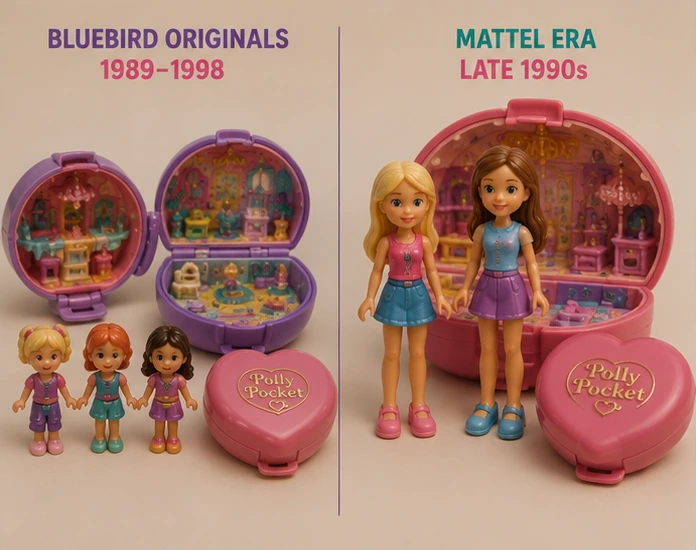
Bluebird Era: 1989–1998
Bluebird’s classic Polly Pocket identity centered on hard-plastic micro dolls, compact environments and tiny molded worlds.
The figures were generally less than an inch tall and bent at the waist. Their bases fit into small holes in the playsets.
Cases could be truly pocket-sized or grow into larger houses, books, jewelry formats and feature-heavy playsets.
Collectors often use “vintage Polly Pocket” to mean these original Bluebird-designed compact worlds.
Mattel Era: 1998 Forward
Mattel acquired Bluebird Toys in 1998 and began changing Polly’s scale, appearance and fashion emphasis.
Late-90s and later dolls became larger and more human-proportioned than the tiny originals.
The brand moved through several designs, including larger fashion-oriented dolls that no longer felt like the same one-inch compact system.
Mattel later returned to micro-scale compact play, but a modern small Polly is not automatically the same product as an original Bluebird compact.
The useful collector rule: identify the manufacturer, molded date, package era, figure scale and exact set before using “original,” “vintage” or “90s” as if they all mean the same thing.
The Compact Survived, but Polly Started Growing
The 1998–1999 Mattel Redesign
The end of the decade marks the clearest break between the classic micro-doll era and the larger fashion-oriented direction that followed.
Mattel Acquired Bluebird in 1998
The purchase brought Polly Pocket under the same company as Barbie and other major doll brands.
Polly’s Body Changed
Later figures became larger, more proportioned and more expressive than the original one-inch hard-plastic dolls.
Fashion Became More Important
The brand moved toward clothing, styling and character-driven doll play rather than making the environment the uncontested star.
The Compact Idea Did Not Vanish Immediately
Some late-90s products still used cases and miniature scenes, but the visual language was changing.
Compatibility Became Less Straightforward
Larger dolls did not fit the old standing holes, furniture or scale in the same way.
Children Experienced It as a New Polly
To a kid entering the aisle in 1999, the new version was simply current. To someone who grew up with the Bluebird compacts, it could feel like Polly had outgrown her own house.
The Change Created Two Nostalgia Eras
Collectors now distinguish original compact nostalgia from later fashion-doll nostalgia, even though both use the same brand name.
The Gen X reaction: Polly was called “Pocket,” then somebody made her too tall for the old furniture. Corporate growth had become literal.
The Original Compacts Were Architecture First
Why Vintage Bluebird Polly Pocket Sets Feel Different
The classic sets are remembered less as dolls with accessories and more as designed places with tiny inhabitants.
The Environment Was the Star
The room, castle or beach often made the first impression before the figure did.
The Scale Was Extreme
One-inch dolls made the world feel private, intricate and genuinely pocket-sized.
The Exterior Had Meaning
The heart, shell or book shape contributed to the fantasy instead of serving as plain storage.
Features Rewarded Discovery
Doors, lifts and hidden rooms made repeated examination part of play.
The Colors Were Distinctly 90s
Pastels, jewel tones, glitter and molded detail created a look that remains instantly recognizable.
The Worlds Were Self-Contained
Opening one compact provided a complete setting without requiring another purchase.
Collections Connected Naturally
Another set added a destination rather than replacing the old toy.
Play Was Quiet and Personal
The toy invited arrangement, narration and observation rather than spectacle.
The Flaw Became the Joke
The lost figures are now part of the memory because almost every owner lived through the search.
The Compact Is Easy to Find. The Correct Three People Are the Problem.
How to Identify and Collect Vintage 90s Polly Pocket Sets
Vintage 90s Polly Pocket collecting starts with exact identification: Bluebird or Mattel, molded date, compact shape, interior layout, moving features and the complete set of dolls, pets and accessories.
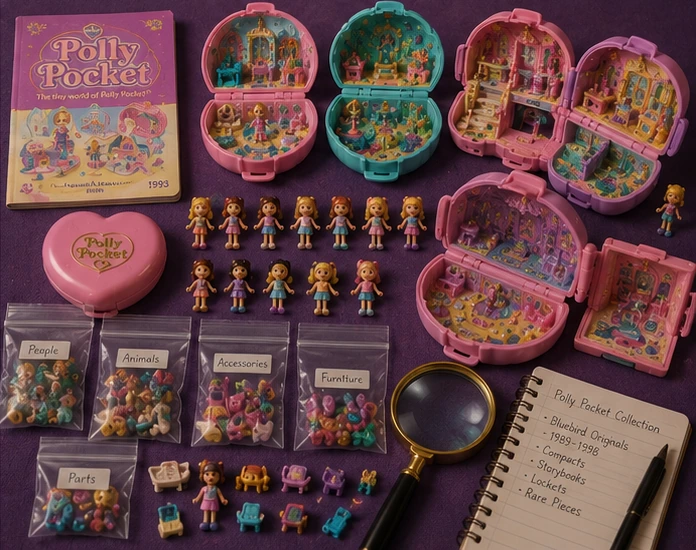
Decide whether the focus is original Bluebird compacts, late-90s Mattel sets, licensed miniatures or modern collector releases.
Match exterior shape, color, interior layout, molded date, package name and known figure list.
A compact can look complete while missing one person, pet or baby that materially changes the set.
Micro-doll details wear easily. A few missing dots can erase an entire expression.
The case should close securely without being forced.
Stress, cracking and warping can affect whether the compact opens and stands correctly.
Old elevators, doors and rotating parts may be brittle or jammed.
Moisture, rubbing and sunlight can damage the details that create the environment.
Match the exact set, condition and completeness. A seller’s ambitious asking price is not a market result.
The history and identification details stay useful, but current prices move with completeness, condition, region and demand. Check matching recent completed sales before believing a dramatic asking price.
Polly also sits beside the decade’s broader collectible toy crazes, although the original appeal was building tiny worlds—not sealing every compact away and calling the carpet an investment portfolio.
One Pink Heart Can Have Several Extremely Specific Identities
How to Identify an Original Polly Pocket Compact
Color and shape are a starting point, not a final answer.
Check the Molded Markings
Manufacturer names, copyright information and product codes may appear on the underside or interior.
Do Not Treat the Molded Date as the Entire Story
A mold can remain in use across later releases. Packaging and set details help determine the actual retail version.
Compare the Interior Layout
Room arrangement, stair locations, printed floors and moving features can distinguish cases with similar exteriors.
Match Every Figure
Hair color, clothing, pose, base color and accessories should align with the set’s original inventory.
Watch for Color Variants
Some compacts appeared in different exterior or interior colors across regions and releases.
Separate Bluebird, Mattel and Licensed Lines
Brand markings and packaging help distinguish original Polly sets from Disney Tiny Collection, later Mattel releases and similar miniature toys.
Modern Reissues Need Their Own Category
Mattel has recreated the compact idea for new audiences and collectors. Modern nostalgia packaging should not be sold as unopened since 1991.
The safe rule: identify the case, then the interior, then every figure. “It is pink and tiny” is how mixed lots become family folklore.
Preserve the Tiny World Without Creating a Tiny Prison
How to Store and Preserve Vintage Polly Pocket
Keep Figures With the Correct Set
Use labeled archival bags or small compartments. Do not let every one-inch blonde figure become the same Polly.
Avoid Direct Sunlight
UV exposure fades exterior plastic, printed interiors and delicate painted details.
Control Heat
High temperatures can warp cases, weaken hinges and change how latches align.
Keep Water Away
Moisture damages stickers, paper details, metal parts and battery compartments in special sets.
Remove Old Batteries
Light-up, sound and hybrid electronic products should never remain stored with aging batteries.
Do Not Force Hinges or Features
Stop when a part resists. A feature that has survived thirty years does not need to prove itself on command.
Store Compacts Closed but Not Under Pressure
Closing protects interiors, but heavy stacking can stress shells and latches.
Photograph Complete Inventories
Clear photos make it easier to return figures after display, cleaning or moving.
The preservation rule: label the dolls, remove the batteries, avoid sunlight and never test an old elevator with the confidence of a seven-year-old.
From a Homemade Compact to a Global Miniature Brand
Polly Pocket Timeline: 1983–1999
The original idea arrived before the decade, dominated the 90s and changed direction just before Y2K.
1983: The Homemade Idea
Chris Wiggs creates a miniature dollhouse inside a makeup compact for his daughter Kate.
1989: Polly Pocket Launches
Bluebird Toys brings the first Polly Pocket sets to stores, establishing the micro-doll compact format.
1990: The Range Expands
More homes, schools, salons and themed worlds turn one clever idea into a broad toy line.
1991: Compact Variety Grows
Shapes, colors, pop-up structures and feature-heavy interiors deepen the collection.
1992: Miniature Worlds Multiply
Polly remains central while Bluebird introduces Mighty Max as an action-oriented compact cousin.
1993–1995: Peak Bluebird Detail
Larger houses, fantasy worlds, moving features and licensed miniature formats expand the system.
1996–1997: Established Classic
Polly stays visible in a changing toy aisle while the original line reaches deep catalog maturity.
1998–1999: Mattel Transition
Mattel acquires Bluebird and begins shifting Polly toward larger, more fashion-oriented dolls.
The World Was Tiny. The Memory Was Not.
Why 90s Polly Pocket Still Matters
The original compacts remain powerful because they made imagination architectural, portable and deeply personal.
It Made Miniature Play Mainstream
Polly turned one-inch dolls and micro environments into a major global toy system.
It Made the Case Part of the Story
The exterior did not merely hold the world. It shaped the world.
It Rewarded Observation
Rooms, features and hidden details invited close attention rather than quick spectacle.
It Traveled Anywhere
The compact was an analog portable-entertainment device before childhood carried screens.
It Balanced Doll and Playset
Polly offered characters and architecture without making either one secondary.
It Expanded Without Replacing
Every new world made the existing collection more useful.
It Created a Collector Language
Shapes, colors, years, dolls and mechanisms now support detailed identification and preservation.
It Became a Gen X and Millennial Bridge
Older kids remember the early Bluebird explosion; younger 90s kids remember the mature line and Mattel transition.
It Turned Missing Pieces Into Shared Memory
Almost everyone remembers the magic and the search in the same breath.
Polly Pocket belongs in the main 90s Toys rewind because it represents something the decade did exceptionally well: take a simple idea, make it bright, collectible and portable, then produce enough tiny versions to keep every bedroom vacuum cleaner on alert.
Keep the Tiny Toy Aisle Open
More 90s Dolls, Toy Years and Commercials
Because “The Pink Heart One” Is Not a Complete Product History
History, Manufacturer and Date Notes
The 1989 launch date, one-inch scale and miniature-world concept were checked against Mattel’s corporate history and Mattel Creations’ Polly Pocket history. Chris Wiggs’s 1983 makeup-compact origin, Bluebird’s development of the line and the design appeal of the original clamshell worlds were cross-checked against Architectural Digest’s history of the original compacts. Early set names and year identification were checked against the collector archive at Only Polly Pocket’s 1989 catalog. Mattel’s 1998 ownership and the distinction between Bluebird originals and later versions were checked against People’s collector history. Current prices are intentionally excluded because value changes with exact set, region, condition, completeness and recent completed sales.
Frequently Asked Tiny Questions
Polly Pocket in the 90s FAQ
When did Polly Pocket first come out?
The first retail Polly Pocket toys were introduced by Bluebird Toys in 1989.
Who invented Polly Pocket?
British designer Chris Wiggs created the original idea in 1983 for his daughter Kate using a makeup compact.
Who made the original 90s Polly Pocket toys?
Bluebird Toys developed and produced the classic original compact line. Mattel distributed the brand in major markets and acquired Bluebird in 1998.
How tall were original Polly Pocket dolls?
The original Bluebird micro dolls were generally about one inch tall or slightly smaller.
Were original Polly Pocket dolls bendable?
Yes. Many classic micro dolls bent at the waist so they could sit in molded furniture, vehicles and rides.
How did Polly Pocket dolls stand inside the compacts?
The figures had small circular bases that fit into molded holes around the playset.
Why were the toys called Polly Pocket?
The name referred to Polly and the original idea that her miniature world could fit into a pocket-sized case.
Did Polly Pocket start in the 80s or the 90s?
The concept was created in 1983 and the toy launched in 1989, but most of its original cultural takeover happened during the 1990s.
What were original Polly Pocket compacts made of?
The classic cases and figures were primarily hard molded plastic, with printed details, paint and occasional electronic or mechanical parts.
What kinds of Polly Pocket sets existed in the 90s?
The line included houses, cottages, schools, cafés, hospitals, beaches, pools, castles, mermaid worlds, storybooks, jewelry formats, mansions and licensed miniature worlds.
What was special about the compact design?
The case opened into the playset and closed around the world, combining environment, storage and portability.
What was the first Polly Pocket set?
Several Bluebird sets appeared in the 1989 debut range rather than one single product representing the entire launch.
Was there a Polly Pocket cassette player?
Yes. The early line included a Bowling Alley Cassette Player that combined miniature play with a working cassette player.
Did Polly Pocket have larger houses?
Yes. The line expanded beyond truly pocket-sized compacts into mansions, hospitals, hotels and larger multilevel playsets.
What was Mighty Max?
Mighty Max was Bluebird’s action-oriented compact line, introduced in 1992 with monsters, danger themes and small figures inside shaped playsets.
Were Disney compact toys part of Polly Pocket?
Bluebird produced Disney miniature playsets using similar compact engineering. They are related to the same toy tradition but should be identified as their specific licensed line.
Why are original Polly Pocket figures so often missing?
The figures were extremely small, moved between sets and easily disappeared into carpet, furniture, bags and car seats.
Why did Polly Pocket change in the late 90s?
Mattel acquired Bluebird Toys in 1998 and shifted the brand toward larger, more human-proportioned and fashion-oriented dolls.
Are Bluebird and Mattel Polly Pocket dolls the same size?
No. Original Bluebird dolls were tiny micro figures. Many later Mattel versions were larger and did not fit the original worlds in the same way.
What does vintage Polly Pocket usually mean?
Collectors often use the phrase for original Bluebird-era compacts from 1989 through 1998, though sellers may use it more broadly.
How can I identify a vintage Polly Pocket set?
Check the molded markings, exterior shape and color, interior layout, feature design, packaging name and exact figures.
Does the molded date prove the exact release year?
Not always. Mold dates can remain in use across later releases, so packaging and catalog references should also be checked.
Are old Polly Pocket toys valuable?
Some complete and hard-to-find sets attract strong collector demand, but value depends on the exact set, condition, figures, working features and recent completed sales.
What parts are commonly missing?
Micro dolls, pets, babies, loose accessories, battery covers and small detachable pieces are commonly absent.
Should I force a stuck Polly Pocket feature?
No. Old plastic and small mechanisms can become brittle. Stop when a door, lift or rotating part resists.
How should vintage Polly Pocket sets be stored?
Keep them dry, away from direct sunlight and extreme heat, with figures labeled by set and batteries removed from electronic products.
Why did Polly Pocket appeal to kids so strongly?
The line offered a complete secret world, detailed miniature rooms, portability, collectible variety and control over every person and place inside.
Where does Polly Pocket fit among 90s dolls?
Read 90s Dolls, Plush & Pet Toy Crazes for the wider category alongside Barbie, American Girl, Littlest Pet Shop and other lines.
Which year page features Polly Pocket?
Polly Pocket appears at number ten in the Smells Like Gen X ranking of the top toys of 1996.
Where can I see more 90s toy-commercial content?
Visit 90s Toy Commercials and Videos for the broader commercial archive.
A Mansion in One Hand and One Missing Person Somewhere Under the Bed
Polly Pocket Made Tiny Play Feel Enormous
The original compacts did not need a screen, a speaker or a giant footprint. They opened, revealed a complete life and trusted the child to handle the story.
That was the magic. A heart became a house. A shell became a beach. A book became a kingdom. A small plastic case became private real estate in a world where children did not control much else. Then Polly vanished into the carpet and reality returned.