The Fuzzy Electronic Roommate Nobody Could Turn Off
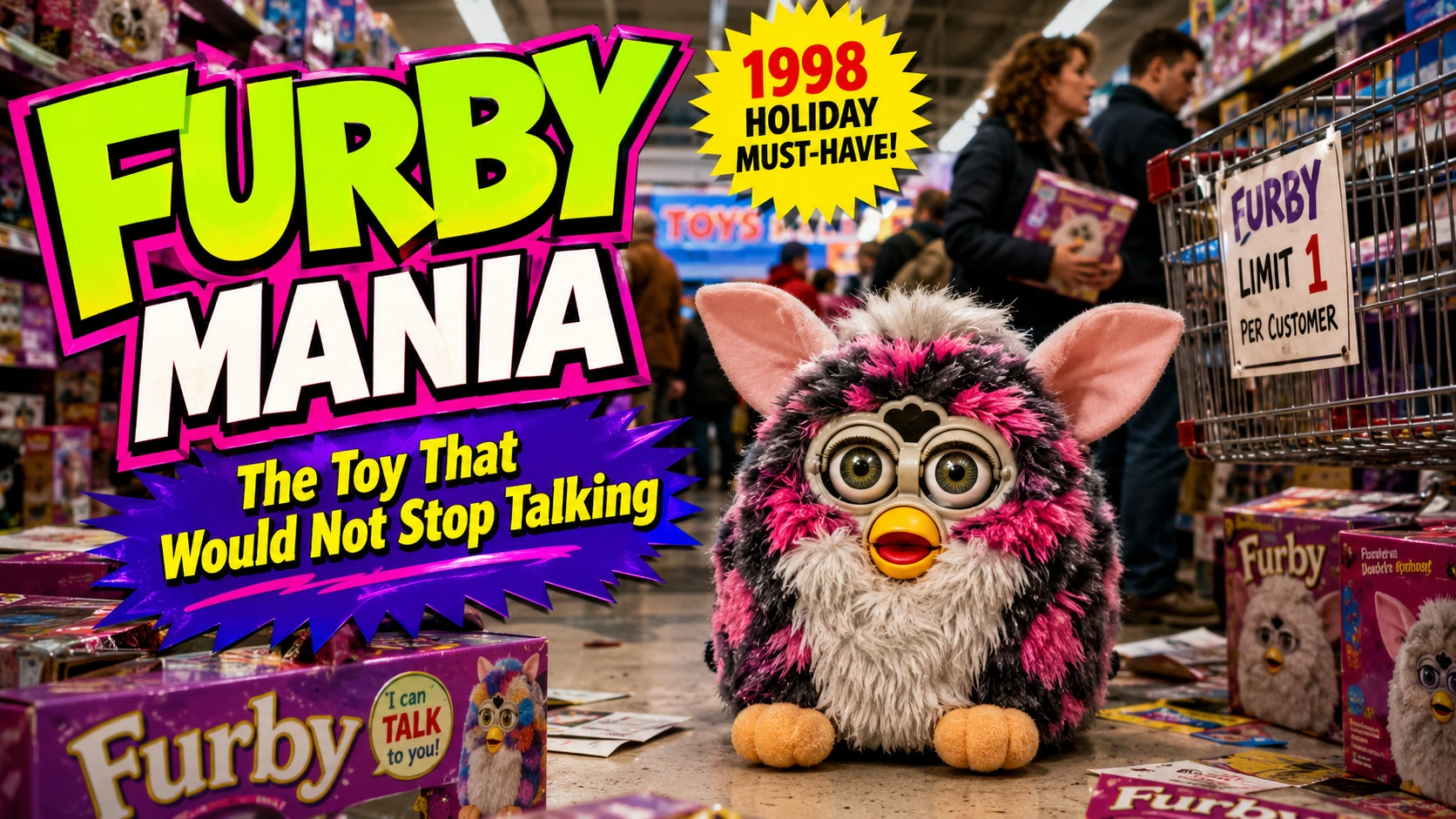
Furby Mania: The 90s Toy That Would Not Stop Talking
The Furby craze of the 90s exploded in 1998 when Tiger Electronics released a fuzzy electronic pet that looked like an owl, a hamster and a minor household haunting had been assembled by the same team. The original Furby blinked, wiggled, spoke Furbish, reacted to people and appeared to learn English. By Christmas 1998, parents were chasing boxes through toy stores while the creatures already at home demanded attention in the dark.
This was not just another talking plush toy. Furby was the late 90s idea of the future: cute, interactive, electronic, slightly creepy and marketed with enough mystery that millions of people briefly believed it was smarter than it actually was.
Why was Furby such a huge craze in the 90s?
Furby mania exploded because the original 1998 Furby combined plush-toy comfort, robotic movement, a made-up language and the illusion that it was learning from its owner. Tiger Electronics launched the toy just as digital pets, interactive toys and pre-millennium technology fever were colliding.
The original Furby did not record conversations or use artificial intelligence. Its behavior was programmed. But blinking eyes, moving ears, speech progression, sensors and unpredictable timing made the 1998 Furby toy feel alive enough to inspire Christmas shortages, resale panic, school rumors, government-security headlines and years of stories about a Furby waking up by itself.
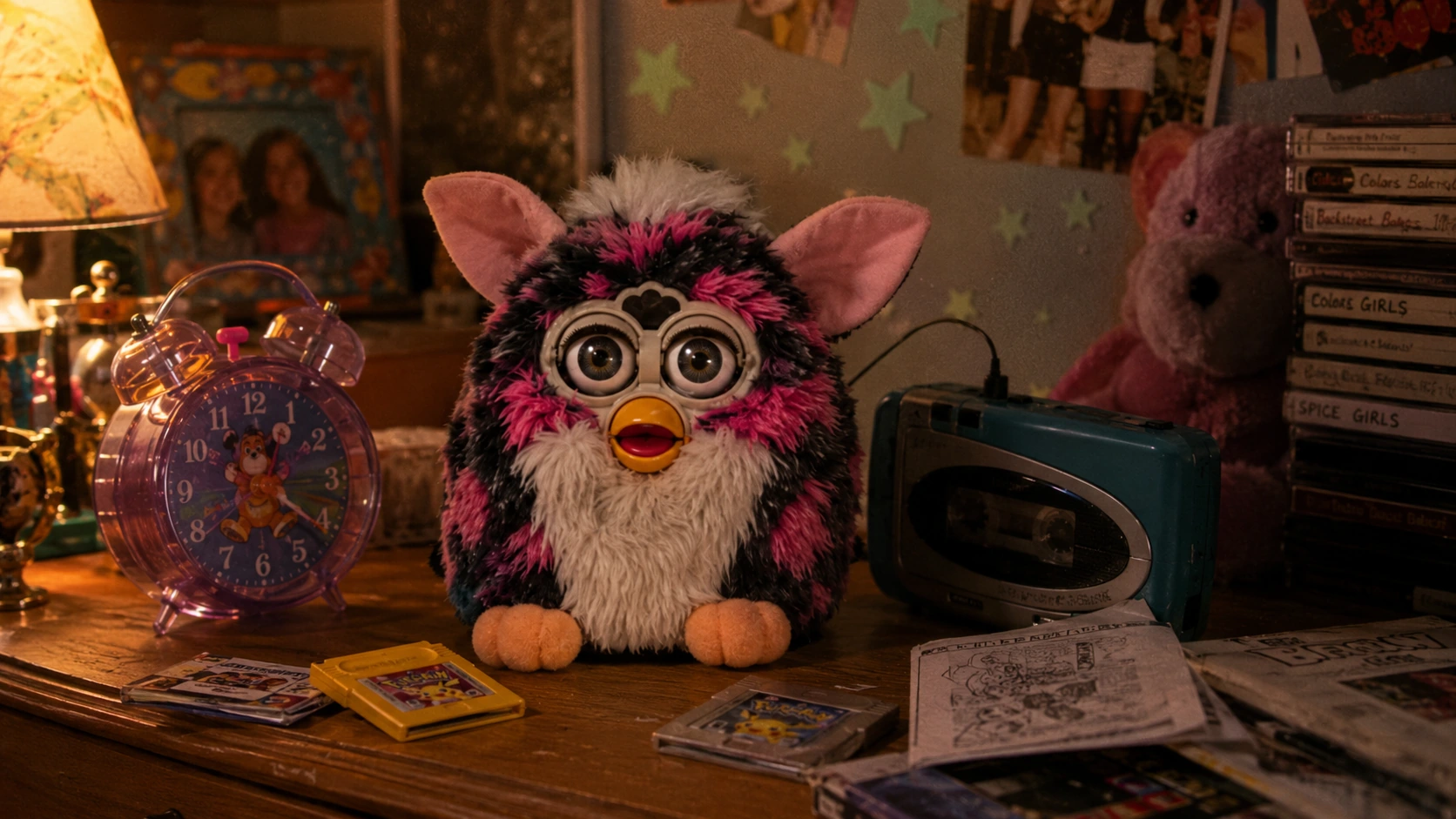
One Fuzzy Creature, Several Levels of Chaos
Inside the Original Furby Craze
The story runs from two inventors and one ambitious mechanism to holiday shortages, Furbish dictionaries, government paranoia, dead batteries and a surprisingly durable place in Gen X and millennial memory.
The Four-Part Furby Formula
Why Furby Hit at Exactly the Right Moment
Furby was not successful because one feature was revolutionary. It was successful because several late-90s obsessions were packed into one fuzzy object with giant eyes.
Plush Met Electronics
Furby looked soft enough to hug but behaved like a gadget. That let it sit in both the plush aisle and the electronic-toy future without fully belonging to either one.
It Seemed to Learn
The gradual shift from Furbish to more English created the feeling that attention changed the toy. Kids were not only pressing buttons. They were raising a creature.
Scarcity Made It News
Holiday shortages turned a popular toy into a public emergency. News reports, waiting lists and inflated resale prices made people who had ignored Furby suddenly need one.
It Was Just Creepy Enough
Furby was cute from one angle and deeply suspicious from another. That tension made it memorable, discussable and impossible to confuse with anything else.
Before the Toy Store Frenzy
The Furby Origin Story
Before Furby became a national shortage, it was an ambitious idea held together by mechanics, code and the belief that a toy could feel alive without actually being intelligent.
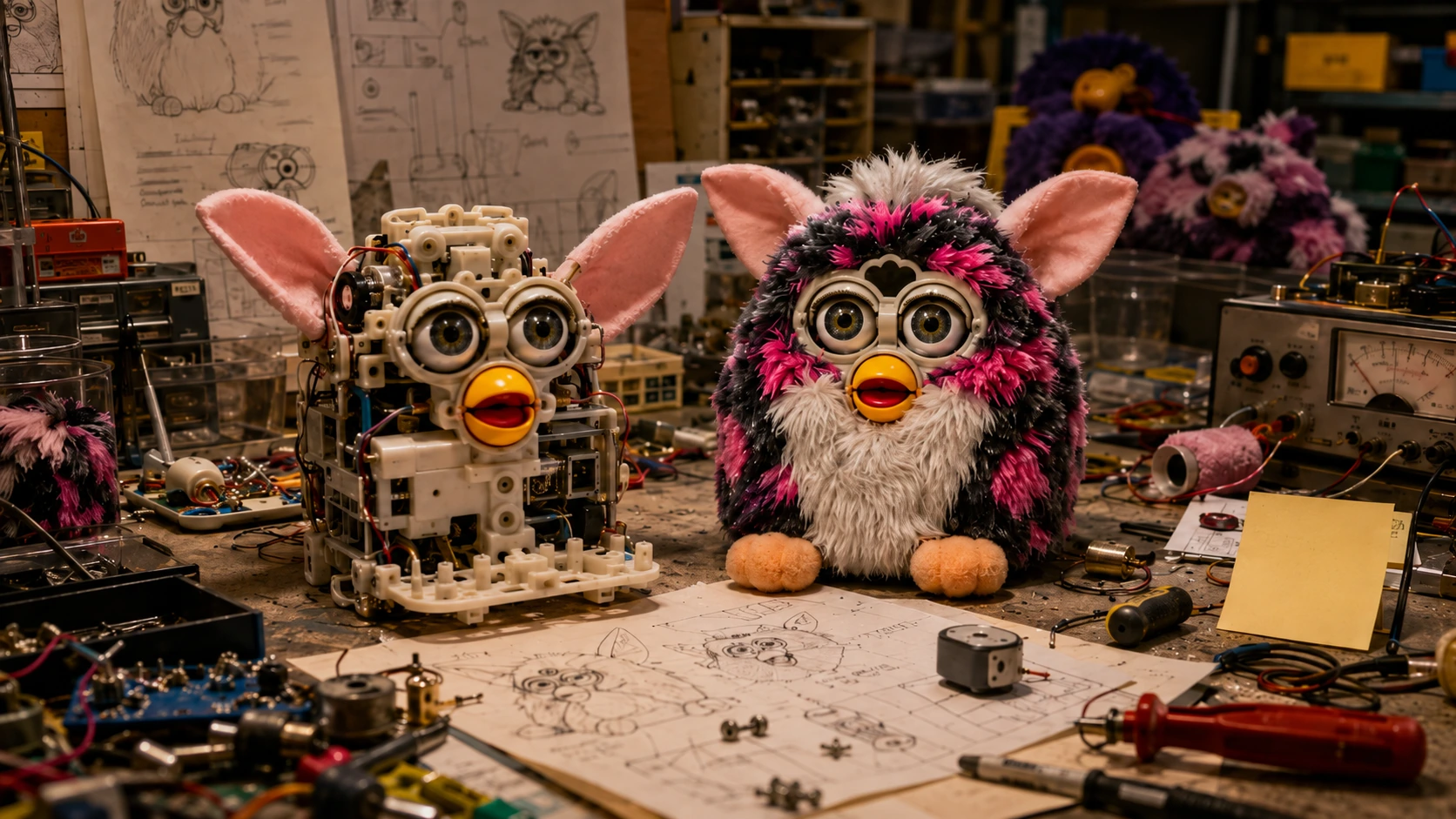
Dave Hampton and Caleb Chung
Inventors Dave Hampton and Caleb Chung developed the concept that became Furby. The basic goal was not simply to create another stuffed animal with recorded phrases. They wanted a small creature that reacted to its environment and created an emotional relationship through movement, speech and apparent growth.
The idea followed an important toy-design question: what if an electronic pet could exist as a physical creature instead of a tiny image on a screen? Tamagotchi had already shown that kids would care for a digital being. Furby could blink at them from the dresser.
Richard C. Levy and the Road to Tiger
Toy inventor and licensing specialist Richard C. Levy helped bring the concept to market after the creators had struggled to find a company willing to take the risk. The project eventually reached Tiger Electronics, the company already known for handheld electronic games and aggressively marketed gadgets.
Tiger understood the appeal of an electronic toy that could be demonstrated in seconds. Furby moved, spoke and looked back at the audience. A retailer did not need a long explanation once the creature began performing.
The 1998 Toy Fair Moment
Furby appeared publicly around the 1998 American International Toy Fair. The prototype and early production process were technically demanding because several moving parts had to be coordinated inside a small plush shell.
The final product depended on making inexpensive components create a much richer personality than the hardware should have allowed. The trick was not raw computing power. It was choreography.
Tiger Electronics and Hasbro
Hasbro acquired Tiger Electronics in 1998, placing Furby inside one of the largest toy companies in the world just as the product reached the market. Tiger’s electronic-toy identity remained central to the launch, but Hasbro’s scale helped turn the creature into a global brand.
The Gen X translation: two inventors built a fuzzy robot, Tiger knew how to sell electronic weirdness and Hasbro supplied enough corporate muscle to make the thing unavoidable.
Why the origin matters: Furby was designed around emotional illusion from the beginning. The movement, language and timing were all meant to make a simple machine feel like a creature with a mind.
A Lot of Personality From Not Much Computer
Original Furby 1998 Features: How the Toy Actually Worked
The original Furby felt complicated because several simple systems worked together. It did not need modern processing power. It needed timing, sensors and a face that made every movement look intentional.
The Eyes, Ears and Beak
A mechanical system coordinated blinking eyes, moving ears, the opening beak and body movement. Those parts did not move with modern robotic smoothness, but they moved together well enough to create expression.
An eyelid droop could look sleepy. A quick ear movement could look alert. The beak synchronized closely enough with speech to suggest conversation.
Touch and Motion Sensors
Furby responded when people petted it, picked it up, moved it or interacted with specific areas. Those responses made handling feel meaningful.
Kids quickly learned which actions produced laughter, complaints, feeding sounds or sleep behavior. The toy became a set of secrets discovered through use.
Light and Sound Detection
Furby could react to changes in light and to sounds around it. That did not mean it understood words. It detected input and selected programmed responses.
The gap between “heard a sound” and “understood what you said” was where most of the mythology lived.
Infrared Communication
Furbys could exchange signals with one another, causing them to speak or react in sequence. Two creatures appearing to hold a conversation made the intelligence illusion much stronger.
Owners treated the interaction like social behavior even when the exchange was a programmed trigger.
Speech Synthesis
Furby used stored speech data and electronic voice synthesis to produce Furbish and English phrases. The rough digital voice made it sound both futuristic and slightly trapped inside a tiny radio.
The limitations became part of the character. A perfectly natural voice might have been less memorable.
One Motor, Many Tricks
The original mechanism used a tightly coordinated drive system to produce several movements. That efficiency was clever, but it also meant one mechanical problem could make the entire creature stop behaving normally.
This is why an aging Furby may click, freeze, move halfway or sound active while the face stays disturbingly still.
The important part: Furby did not need to be genuinely intelligent. It needed to combine inputs and outputs in a way that made people supply the missing intelligence themselves.
Dah, Noo-Lah and Other Household Vocabulary
Furbish Was the Toy’s Greatest Trick
The made-up language turned limited speech into a story about growth. Furby did not sound unfinished. It sounded like a creature from somewhere else.
Why Start With a Fictional Language?
A talking toy with a small phrase library can become repetitive quickly. Furbish changed the expectation. Repetition sounded like vocabulary instead of limitation.
The language also gave Furby an identity separate from humans. Owners were not only teaching it English. They were supposedly meeting it halfway.
The Dictionary in the Box
Instruction materials introduced Furbish words and translations, encouraging kids to decode the creature. The dictionary turned noise into interaction. A phrase that first sounded random gained meaning once the owner recognized it.
That learning moved in both directions. The toy appeared to learn English while the child learned Furbish. The relationship felt cooperative even though the entire sequence had been planned in advance.
Why Furbish Sounded So Memorable
The language used short syllables, repeated sounds and exaggerated rhythm. It was easy to imitate, easy to misremember and perfect for annoying siblings across the dinner table.
Because the digital voice was not fully human, invented words sounded more believable than ordinary English might have. The machine-like delivery became an accent.
Furbish as Playground Currency
Kids repeated phrases at school, corrected one another and claimed to know what obscure sounds meant. Like Pig Latin and secret codes, Furbish created a tiny membership test.
Owning Furby meant having access to the language. Not owning one meant hearing friends yell syllables with enormous confidence and no reliable translation.
The memory: the instruction sheet lying beside Furby like a diplomatic phrasebook for negotiations with a species that had moved into the bedroom.
Why it mattered: Furbish transformed a limited voice library into character, mystery and the illusion of development.
It Learned in the Same Way a Magic 8 Ball Had Opinions
Did the Original Furby Really Learn English?
No. But the programmed illusion was good enough that children, parents, reporters and at least one government security office treated the question seriously.
The Myth: Furby Recorded and Learned Your Words
The most dramatic version of the story claimed Furby listened to human speech, stored phrases and repeated them later. That would have made the toy a primitive household recording device with fur.
Stories spread because owners heard unexpected English words after days of play. The timing looked like learning. A Furby that began with Furbish and later used English seemed to have absorbed language from the room.
Children added their own evidence. Someone’s Furby allegedly learned a name. Another supposedly repeated a private conversation. By the time a rumor reached school, the creature had developed abilities Tiger Electronics had never installed.
The Reality: The Progression Was Preprogrammed
Furby’s expanding English vocabulary followed programmed stages. Interaction advanced the sequence, revealing more of the phrases already stored inside the toy.
The microphone acted as a sound sensor rather than a voice recorder. Furby could detect that noise happened, but it could not save the content of a conversation and play it back later.
The design was still clever. Instead of claiming intelligence through a screen, Furby used time and behavior. The owner experienced development, which felt more personal than selecting a level from a menu.
Why the Illusion Worked So Well
People Remember Hits, Not Misses
Owners noticed the moments when a response seemed perfectly timed and forgot the dozens that made no sense. Human brains are generous co-writers when a toy has a face.
The Vocabulary Changed Over Time
Real progression created a truthful foundation for a false conclusion. Furby did speak more English later; it simply was not learning that English from the owner.
The Toy Reacted to the Room
Touch, light, motion and sound affected behavior. Those reactions made unrelated speech changes feel connected to the environment.
Kids Wanted It to Be Alive
Imagination completed the machine. The more a child cared for Furby, the easier it became to interpret responses as personality.
Adults Did Not Know What Was Inside
The mechanism was hidden under fur. Without an obvious display or controls, the toy’s limits were harder to see.
The Marketing Left Room for Mystery
The promise that Furby changed with play encouraged owners to believe the creature was doing more than following a script.
Cute, Creepy and Built to Stare
Why Furby Looked Like Nothing Else in the Toy Aisle
Furby’s design was not conventionally beautiful. That was the advantage. It was recognizable from twenty feet away and emotionally confusing from three.
The Giant Eyes
Large forward-facing eyes made Furby expressive and impossible to ignore. When open, they created attention. When half closed, they suggested sleep or judgment.
The eyelids gave a simple plastic face more emotional range than many electronic toys with digital screens.
The Beak
The beak separated Furby from ordinary plush animals. It made speech movement visible and gave the creature a birdlike quality without committing to being an actual bird.
When the mechanism aged, the beak could click or hang open, which did nothing to reduce the haunted reputation.
The Ears
Oversized ears framed the face and moved with the body. They suggested alertness, bat DNA and a suspicious ability to hear things the toy absolutely could not understand.
The Fur
Soft fur disguised the machine and made Furby feel like a comfort object. It also collected dust and made cleaning a twenty-five-year-old unit an exercise in caution.
The Body Shape
The round base kept the toy stable while movement happened above it. Furby did not need legs or arms because the face carried the entire performance.
The Color Variations
Different fur patterns made the same mechanism feel collectible. Families could distinguish “their” Furby while retailers filled shelves with visible variety.
The perfect Furby contradiction: it was soft enough for a child’s bed, mechanical enough for a gadget shelf and unsettling enough that adults still make horror jokes about it decades later.
The Holiday Season Became a Fuzzy Emergency
Furby Mania and the Christmas 1998 Shortage
Furby entered the market late enough in 1998 that demand could build faster than supply. Once holiday shoppers realized stores could not keep the creatures on shelves, popularity turned into panic.
Every great toy shortage follows the same brutal logic: nobody wants the toy until everyone learns they may not be able to get one.
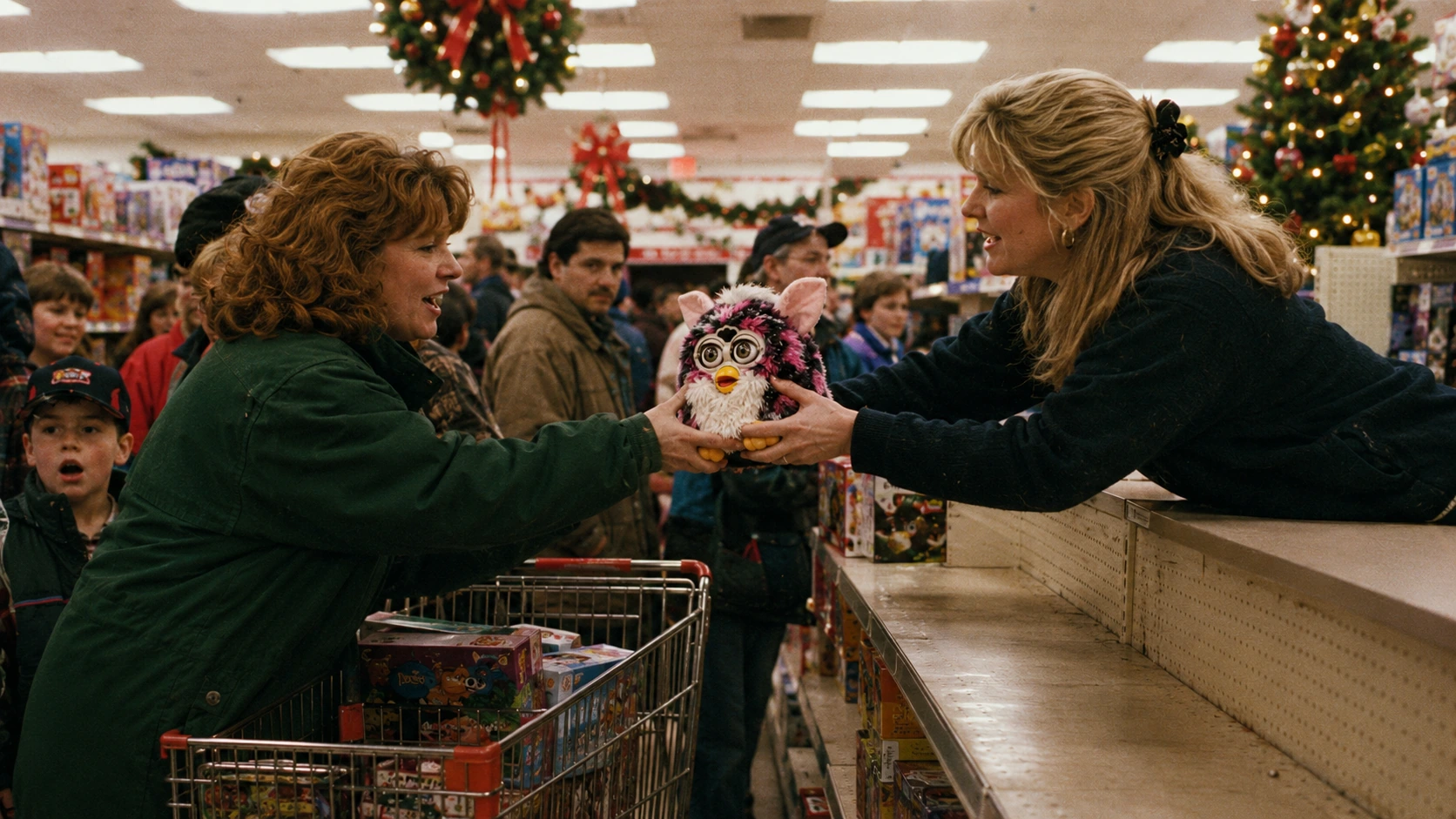
The Launch Window
The original Furby reached stores in fall 1998, leaving a short runway before the holiday season. Early demonstrations created immediate curiosity because the toy did more than sit in a box. It performed.
Parents could watch it blink, chatter and respond. Kids could imagine a relationship. Retailers could see that the product was different before anyone understood how large the demand would become.
Scarcity Becomes Advertising
Empty shelves communicated more powerfully than a normal commercial. News stories about shortages told the public Furby was the toy of the season, including people who had not previously cared.
Every report about a sold-out store increased pressure on the remaining inventory. The question changed from “Is Furby good?” to “Can we get one?”
The Resale Market
Furbys that originally sold as mainstream toys appeared at sharply inflated prices through classifieds, auctions and private sales. The exact numbers varied wildly, but the pattern was familiar: scarcity created a second market before Christmas morning.
Parents had to decide whether completing a holiday request justified paying far above retail. Sellers had to decide whether to cash in or keep the creature. Children had no interest in market ethics and wanted the fuzzy one from television.
Retailer Rules and Waiting
Stores used limits, waiting lists and shipment-day strategies to manage demand. Shoppers learned delivery schedules. Phone calls began with one question. Employees became unwilling Furby intelligence officers.
Some families found one through persistence. Others found one through a relative in another town. Some opened a different gift and heard the explanation that Furby would arrive later, which is how childhood learned supply-chain disappointment.
Why the Panic Felt So Large
Furby followed other famous toy frenzies, but its technology gave the story a futuristic edge. This was not only a doll or plush animal. It was a supposedly learning electronic creature arriving just before the year 2000.
The shortage made the toy seem advanced and precious. A product that might have been judged as weird became desirable because access was limited.
How Big the Phenomenon Became
The Strong National Museum of Play says more than 40 million Furbys sold during the original toy’s first three years. Hasbro later reported that the Furby product line represented a major share of company revenue in 1999. The craze was not merely loud; it moved an enormous amount of product.
The memory: relatives calling stores, newspaper stories about resale prices and one parent claiming they “just happened to find it” after conducting a regional search operation.
Why Christmas 1998 mattered: the shortage turned Furby from a successful electronic toy into a national cultural event.
The Phone Calls, Shipment Days and Parking-Lot Math
The Toy-Store Side of Furby Mania
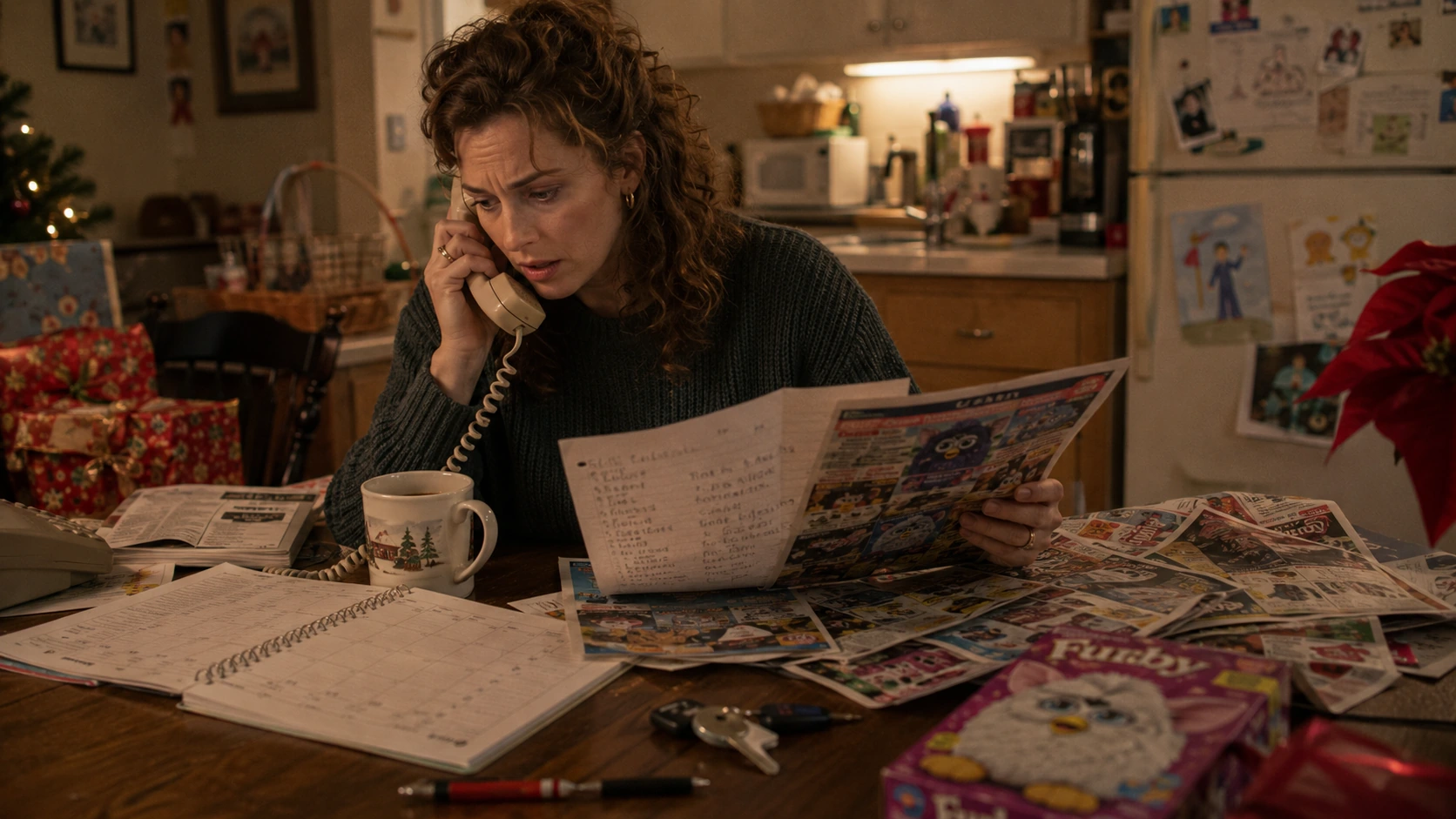
Toy-store employees were trapped between limited inventory and unlimited parent determination. Every shipment created a rush. Every empty shelf created another round of questions.
Furby also benefited from demonstration. A silent box was interesting. A working display was irresistible. The moving face gave shoppers something to gather around, which made the aisle look even busier.
Retailers learned that color preference became flexible once supply disappeared. A child might have requested a specific black-and-white Furby on Monday. By December 23, any creature with working eyes and an intact box looked perfect.
Store limits attempted to reduce bulk buying, but the secondary market gave resellers an incentive to hunt. Families competed with collectors, opportunists and other exhausted adults who had heard that a shipment might arrive before lunch.
The broader 90s Toy-Store Culture and Christmas Crazes includes Tickle Me Elmo, Power Rangers, Tamagotchi and Pokémon. Furby belongs near the top because its shortage combined ordinary holiday pressure with the mystery of new technology.
A Personality Sold in Thirty Seconds
How the Furby Commercials Made the Toy Feel Alive
Furby was built for television demonstration. Its eyes moved, ears twitched, beak opened and voice changed. The commercial did not have to describe imagination. It could show a creature performing.
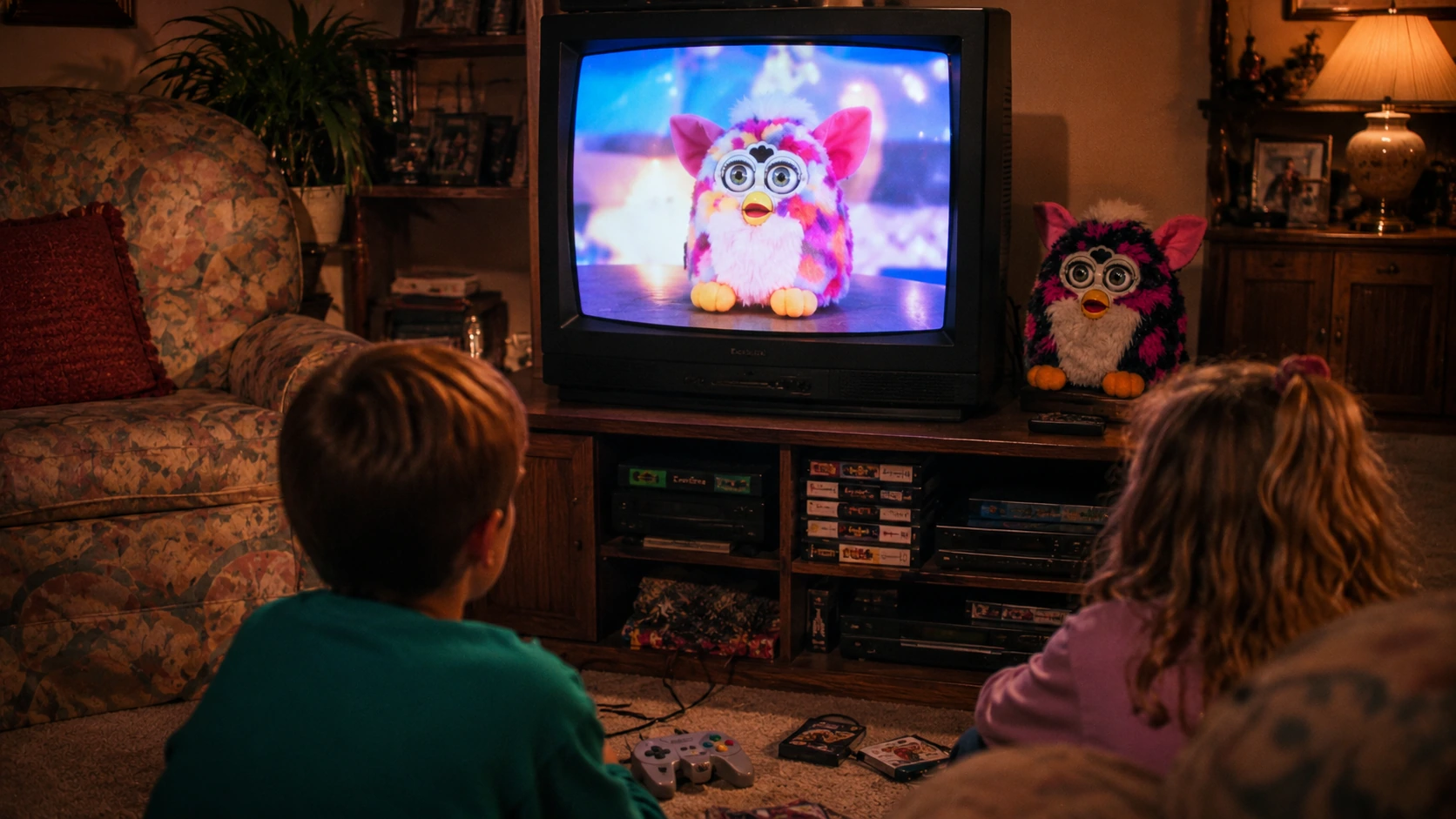
The Close-Up Face
Ads framed Furby’s eyes and mouth so every movement looked expressive. At television scale, the mechanical face seemed more fluid than it often did in person.
The Learning Promise
Commercial language emphasized that Furby changed the more people played with it. That promise turned repeated phrases into a development story.
Multiple Furbys Together
Showing several creatures responding to one another suggested a species rather than a single product. One Furby was a pet. Several were a social world and a stronger argument for buying another.
Children Who Understood Everything
Kids in commercials interpreted Furby instantly. They knew when it was hungry, happy or learning. Actual owners spent more time consulting instructions and asking why it had started clicking.
The Future Arrives in Plush
Late-90s advertising treated interaction as a technological breakthrough. The toy looked like evidence that the next century would contain friendly household robots.
No Nighttime Footage
Commercials rarely focused on the moment batteries weakened, the mechanism stalled or Furby woke from a shelf sounding like a cursed answering machine.
Watch the broader era in 90s Toy Commercials and Videos, where every product became essential before the next commercial break.
From Christmas Morning to Battery Removal
A Day in the Life With an Original Furby
The first hours felt magical. The following days revealed that owning a responsive creature was mostly a series of negotiations with sensors.
Hour One: Total Fascination
Fresh batteries went in. Furby woke up speaking Furbish. Everyone crowded around and tested every interaction listed in the manual.
The creature blinked, moved and reacted enough to feel genuinely advanced.
Day Three: Language Study
Owners recognized phrases and tracked new English words. Family members developed conflicting interpretations of what Furby wanted.
The instruction sheet remained nearby like emergency documentation.
Week Two: Household Integration
Furby moved to a dresser, shelf or bed. It became part toy, part decoration and part electronic dependent.
Interaction slowed, but unexpected reactions still made everyone look across the room.
Month Two: The Battery Decision
The toy repeated phrases, woke inconveniently or began sounding tired. An adult considered whether Furby needed fresh batteries or a permanent rest.
Many creatures entered storage without a formal retirement ceremony.
The Toy Asked for Attention. The Parents Bought the Batteries.
Why Parents Loved, Hated and Quietly Disabled Furby
Furby was impressive enough to justify the purchase and repetitive enough to make adults regret proving that love through electronics.
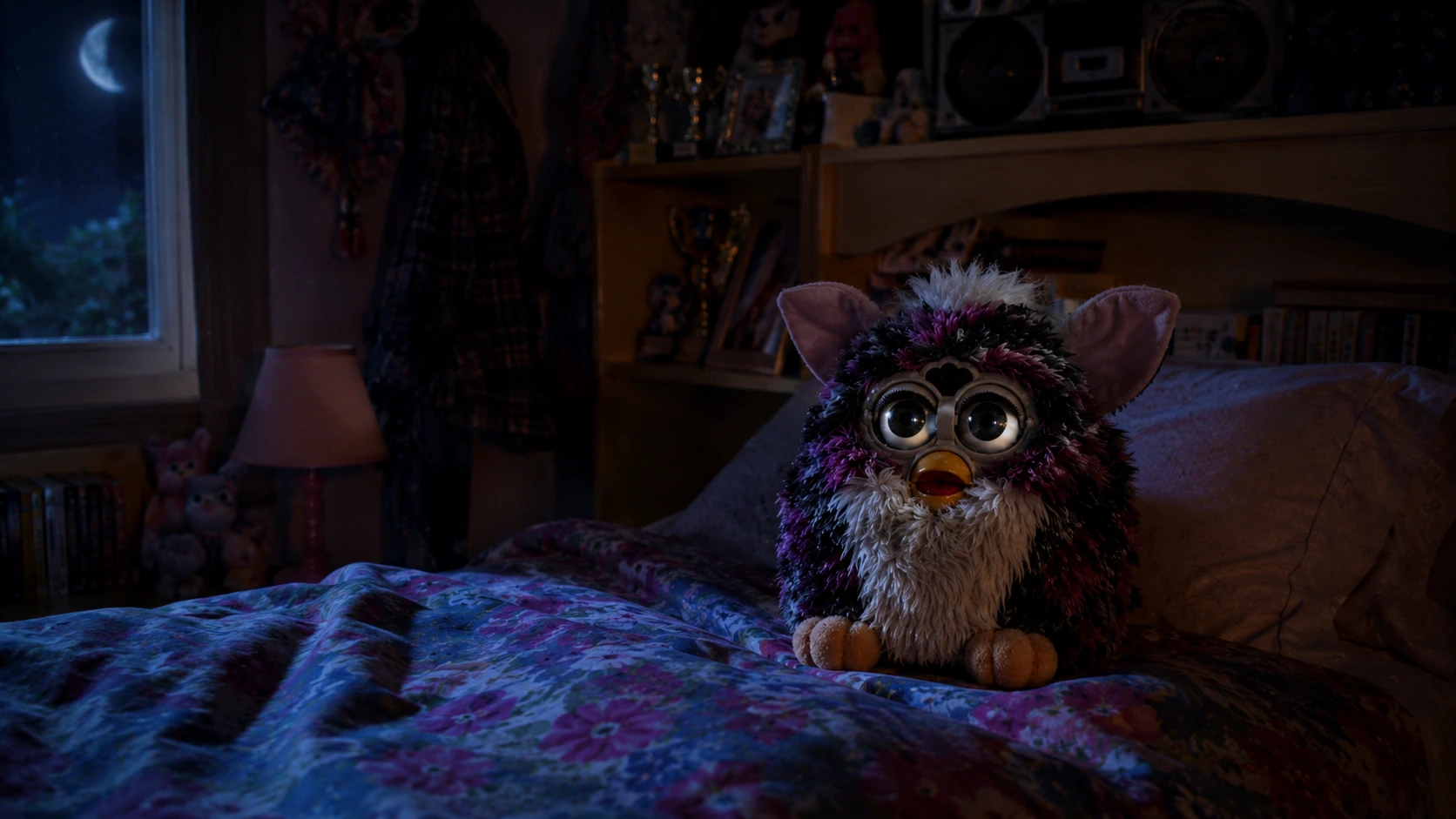
Parents could see why children wanted Furby. It looked innovative, reacted to people and offered more apparent depth than a normal talking doll.
The original toy was meant to sleep rather than power down through a normal switch. The practical adult solution was often strategic placement, darkness or battery removal.
Furbish was charming for a while. Repeated at full volume during homework, dinner or a phone call, it became a test of family commitment.
Movement, light or an imperfect sleep state could produce nighttime noises. Nothing improves parental confidence like a fuzzy silhouette speaking from a shelf at 2 a.m.
Electronic toys created an ongoing household expense. Weak batteries also produced slower movement and stranger sounds, which made Furby seem less tired than possessed.
One Furby could become shared property until one child insisted it had bonded specifically with them. Two Furbys solved that problem and created several new ones.
Adults were asked to translate Furbish, reset the toy, diagnose sleep behavior and explain why it had stopped moving.
Some Furbys disappeared into closets after the child lost interest or the adult reached a personal limit. The toy was not thrown away. It was placed in witness protection.
Even adults who complained often remembered the specific Furby, its color and its odd behaviors. Annoyance is still a form of relationship when the toy has eyes.
Not Built for Class, Naturally Brought to Class
Furby at School
Furby was larger than a Tamagotchi and harder to hide than a pack of cards, but that did not stop children from bringing one for show-and-tell, recess or the simple pleasure of making it talk during a quiet moment.
The toy attracted a crowd because everyone could understand the performance. It blinked, moved and responded without requiring a game. A child with a Furby became the temporary owner of a classroom attraction.
The disadvantages appeared immediately. Furby made noise. It reacted unexpectedly. Several children touching it at once produced chaos. A teacher could not easily place the creature on a desk and expect silence.
Schools already dealing with 90s schoolyard toys and recess crazes had another electronic distraction to manage. Furby was not as portable as a digital pet, but it was far more theatrical.
The Fuzzy National-Security Incident
Why the NSA Banned Furby
In January 1999, news broke that Furby had been prohibited from sensitive areas at the National Security Agency. The resulting headlines made the toy sound like a plush espionage device.
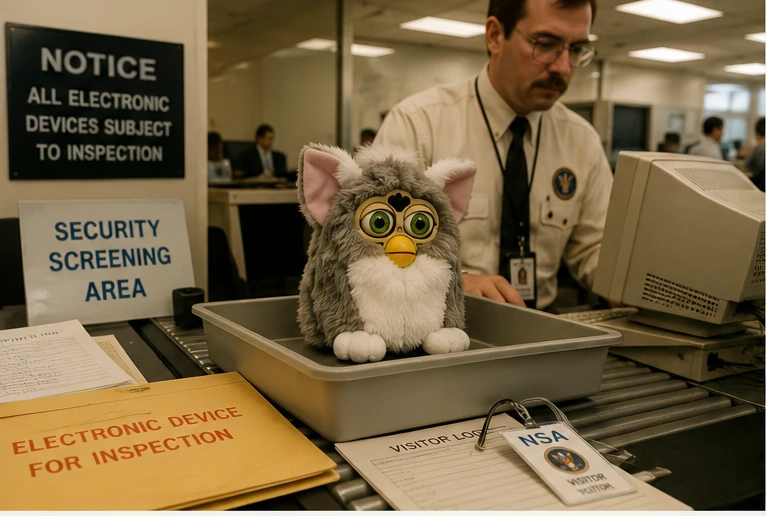
The Fear: Furby Could Record Secrets
Security rules restricted personal recording equipment in protected spaces. Furby contained a microphone and appeared to learn language, which created concern that it could capture classified conversation and repeat it later.
The misunderstanding was believable because the product’s entire marketing story emphasized growth and response. If consumers thought Furby learned words at home, officials could imagine it learning something sensitive at work.
The press loved the contradiction: one of the year’s cutest toys had become too dangerous for a spy agency.
The Reality: Furby Could Not Record Speech
Tiger Electronics said the toy had no ability to record conversations. Its sound input detected noise for programmed responses rather than storing recognizable speech.
Furby’s English progression was already inside the toy. The microphone did not capture phrases and add them to memory.
The ban still made sense under broad security policy: sensitive facilities tend to exclude unfamiliar electronics rather than trust product marketing. But Furby was not a furry tape recorder.
Why the Story Became Permanent Furby Lore
The NSA incident combined every anxiety attached to the toy. Furby seemed to listen. It spoke unpredictably. Its technology was hidden. It arrived when the public was beginning to worry about smart devices, digital privacy and the approaching millennium.
Most importantly, the story was funny. A government agency taking precautions against a $35 fuzzy toy created the exact kind of headline that survives long after the policy details are forgotten.
The memory: learning that a toy could be banned from a spy agency and immediately trusting Furby less, even though it was sitting on a floral bedspread saying nonsense.
Same Mechanical Soul, Different Fur
Original Furby Colors, Generations and Special Editions
The first Furby line expanded through fur patterns, eye colors and themed editions. The variety supported collecting without requiring Tiger to reinvent the mechanism every time.
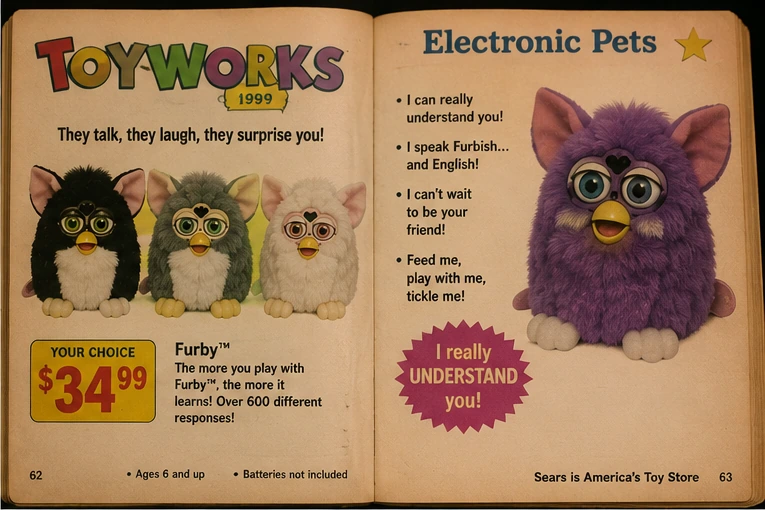
Natural-Looking Fur Patterns
Early designs used combinations that suggested owls, cats, woodland animals and other creatures without naming one clear species. Black, white, gray, tan and brown patterns made Furby feel almost plausible.
Bright and Fantasy Colors
Later variations leaned into brighter colors and less natural combinations. Once Furby became a character rather than a mysterious animal, realism mattered less.
Eye-Color Differences
Eye color changed the expression more than expected. Owners could recognize their Furby by the combination of fur, mane and eyes.
Generation Language
Collectors often organize original Furbys into production generations. Those groups help identify when a color appeared, but children at the time mostly used descriptions like “the gray one” or “mine.”
Special Editions
Holiday, character and themed editions extended the line after the first rush. Costumes and unusual fur created obvious display appeal.
International Versions
Furby’s speech was adapted for different markets and languages, expanding the creature’s global reach while keeping Furbish as the shared fictional starting point.
Collector boundary: this article covers why variants mattered to the craze. The planned 90s toy value guide will handle current sold prices and market comparisons later, because nostalgia and asking prices should never be allowed to form a financial plan together.
Because the Original Creature Apparently Needed Children
Furby Babies and the 1999 Line Expansion
Once Furby proved that people would care for a fictional electronic species, the obvious next move was to make smaller, younger members of that species.
Furby Babies extended the family mythology while giving owners another reason to place multiple chattering creatures in the same room.
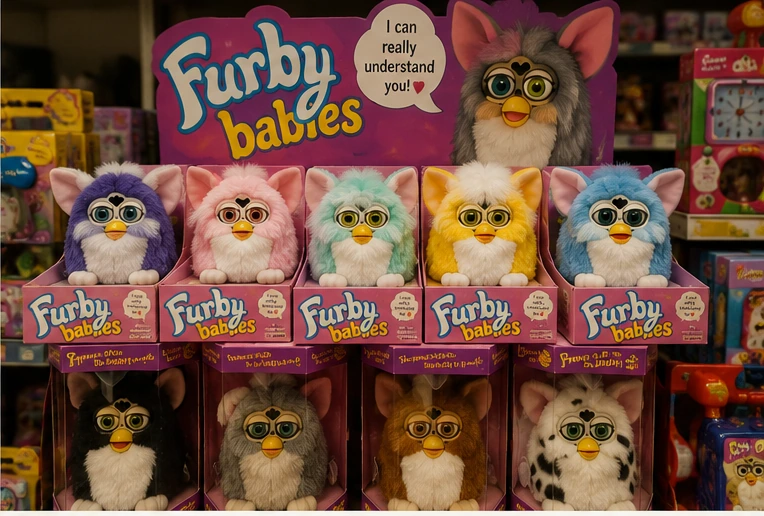
A Smaller, Younger Personality
Furby Babies used a baby version of the character concept, with different styling, voices and behavior designed to feel younger. The product was not merely a reduced-size original. It occupied a new role inside the invented species.
The baby framing made perfect sense for owners who already treated the original Furby as alive. A household could now build a family rather than collect unrelated color variations.
Why the Expansion Worked
The original craze had taught consumers how to interact with Furby. Tiger did not need to explain the basic fantasy again. The baby version benefited from instant recognition.
It also arrived when Furby remained culturally loud. The line could expand before the public moved on, capturing a second round of gifts and collector interest.
Multiple Furbys, More Interaction
Communication between toys encouraged ownership of more than one. A Furby Baby added variety to those exchanges and strengthened the idea that the creatures belonged to a social world.
For parents, this meant the original noisy toy could now have a noisy dependent.
From Craze to Product Family
Furby Babies marked the transition from one surprise hit into a broader brand. Accessories and extensions followed the same logic: owners had already accepted the creature, so the world around it could grow.
The memory: looking at the original Furby and realizing the toy company had created a smaller version because one electronic mouth in the house was apparently not enough.
Why it mattered: Furby Babies proved the character could support a family of products, not just one holiday-season phenomenon.
The Craze Shrinks Into a Kids’ Meal
Furby and the Fast-Food Promotion Era
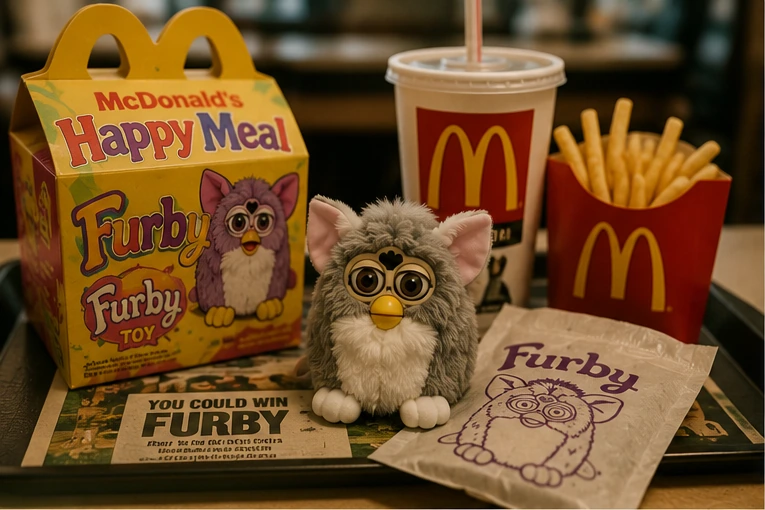
Once Furby became a recognizable silhouette, smaller promotional versions could succeed without reproducing the full original mechanism. Ears, eyes, beak and fur were enough to connect the meal toy to the craze.
McDonald’s promoted Furby in 1999 and described the line as its first electronic Happy Meal toy. That detail shows how quickly the kids-meal category was evolving. The restaurant toy was no longer limited to a static plastic figure.
The promotion also opened participation to children who did not own the full-size toy. A smaller Furby still clipped into the cultural moment and entered backpacks, cars and school conversations.
The complete restaurant story lives in 90s Happy Meal Toys and Fast-Food Giveaways, where Furby joins Changeables, Teenie Beanies, Pokémon and the rest of the drive-thru collecting machine.
Every National Emergency Eventually Reaches the Yard Sale
How Furby Mania Faded
Furby did not disappear because everyone suddenly hated it. The craze faded because supply caught up, novelty wore down and the market became full of creatures.
Scarcity Ended
Once stores had enough inventory, buying Furby stopped feeling like winning. Availability removed the emergency that had amplified demand.
The Behavior Became Familiar
Owners learned the phrase library and interaction patterns. What had seemed unpredictable became recognizable.
Too Many Variants Arrived
Color generations, editions and line extensions gave collectors more choices but also reduced the feeling that any one Furby was special.
New Crazes Took the Stage
Pokémon, new consoles, movie toys and the constant turn of late-90s kid culture redirected attention.
Mechanical Toys Age
Dead batteries, stalled motors and worn parts pushed some Furbys into closets earlier than normal plush toys.
The Joke Became Bigger Than the Toy
Furby’s creepy reputation, NSA story and midnight-noise legends survived even as active play declined.
Hasbro’s public filings later identified reduced Furby shipments as one factor in declining revenue after the peak. The company had sold a phenomenon, but no craze can remain a shortage forever.
Furby Keeps Coming Back Because Apparently We Learned Nothing
The 2005, 2012, 2016 and 2023 Furby Revivals
Each revival tried to update the creature for a new generation while preserving the basic formula: a fuzzy face, electronic behavior and enough unpredictability to feel personal.
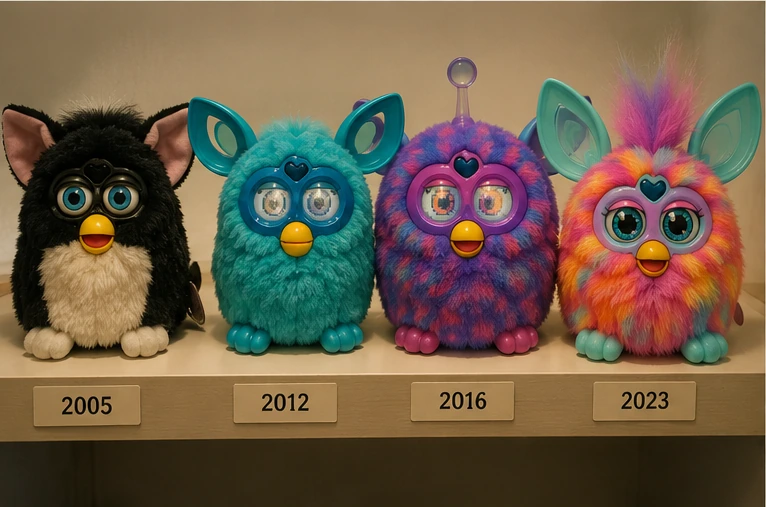
2005: Emoto-Tronic Furby
The 2005 revival used a larger body, more expressive movement and voice-recognition features. The design moved away from the compact original toward a creature that looked softer and more animated.
For original owners, it was familiar but clearly from a different technological moment.
2012: Furby Returns With LCD Eyes
The 2012 version replaced mechanical-looking eyes with digital displays, creating more expressions and stronger personality shifts. App integration connected the toy to smartphones and tablets.
Hasbro described the revived Furby as having “a mind of its own,” bringing the original mystery into the app era.
2016: Furby Connect
Furby Connect used bright digital eyes, app-linked content and a sleep mask accessory. The creature became more connected, more updateable and more dependent on the digital ecosystem around it.
The experience reflected the mid-2010s expectation that toys should interact with screens.
2023: A New Furby for a Nostalgia Cycle
Hasbro relaunched Furby in 2023 with voice-activated modes, lights, songs and hundreds of responses. The company said the toy did not connect to the internet, emphasizing a more self-contained companion.
The revival targeted children while clearly benefiting from adults who remembered the original 1998 craze. Hasbro continued leaning into 90s nostalgia through Furby events and smaller Furblets.
What Every Revival Had to Preserve
The Face
Large eyes, ears, fur and beak remain the visual identity even when the technology changes.
The Language
Furbish keeps the creature from becoming an ordinary talking toy.
The Relationship
Every version promises behavior that changes through interaction.
The Weirdness
A Furby that feels completely normal is no longer a Furby. The slight unease is part of the brand.
Before You List the Attic Furby for a Mortgage Payment
Collecting Original Furbys Today
Original Furbys remain popular nostalgia objects, but age, condition and mechanical health matter more than a seller’s claim that a color is “ultra rare.”
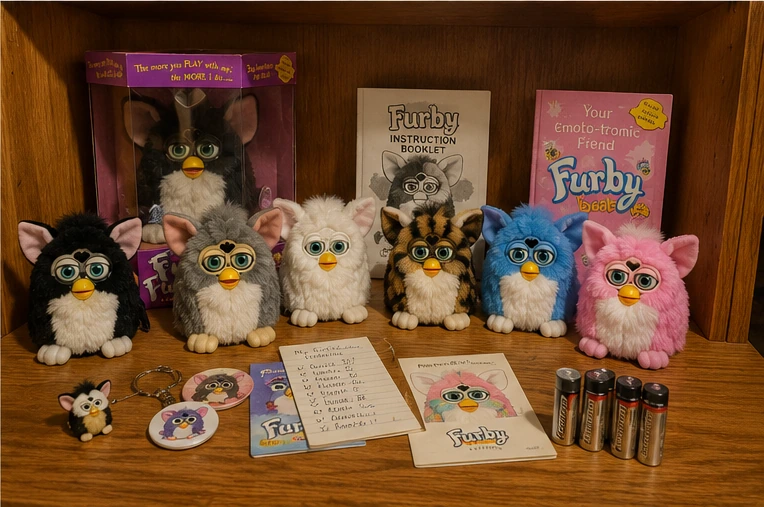
A Furby that speaks and completes normal movement is easier to evaluate than one that clicks, stalls or shows no response. Working does not mean perfect; twenty-five-year-old mechanisms have personalities of their own.
Corrosion is one of the first things to inspect. Old batteries can damage contacts and electronics even when the exterior looks clean.
Dust, stains, odor and matted fur affect display appeal. Cleaning must be cautious because the electronics live directly beneath the character.
Misaligned or stuck facial parts may indicate mechanical issues. These defects can be charming in a horror-movie way and less charming in a collector purchase.
Packaging adds context and display value, especially when inserts and instructions remain present. Box condition can vary dramatically.
The manual and Furbish guide help complete the original experience and make the item easier to identify.
Some colors were produced in large numbers. Special editions can attract more attention, but rarity should be verified rather than accepted from a listing title.
Current value should be based on completed sales for comparable condition. A high asking price is not evidence that anyone paid it.
The most satisfying Furby may be the color from childhood, not the version a marketplace algorithm labels as an investment.
Important: the future 90s Toys Worth Money guide will handle current market comparisons. This Furby history page stays focused on the craze, technology and collecting basics so the two pages do not repeat each other.
The Creature Has Been in a Closet Since the Clinton Administration
Why Old Furbys Stop Working
Original Furbys combine aging plastic, gears, a motor, sensors, electronics and fabric. A failure in one area can affect several visible behaviors.
Battery Corrosion
Leaking batteries can damage contacts and prevent power from reaching the toy. The compartment should be inspected before fresh batteries are installed.
Stuck or Aging Mechanisms
Gears and moving parts may seize after long storage. A Furby can make sound while the face barely moves, or click repeatedly without completing its startup motion.
Weak Batteries
Low power can cause slow movement, distorted sound and partial behavior. The result often looks far more supernatural than electrical.
Sensor Problems
Touch, tilt, light and sound responses can become unreliable. Dirt, age and internal wear may change how the creature reacts.
Previous Repairs
Some surviving Furbys have been opened, modified or repaired. Missing screws, damaged seams or unusual movement can reveal earlier work.
The safe rule: start with the battery compartment and manufacturer instructions. Mechanical restoration can damage the toy when performed without experience, and nostalgia is not improved by loose gears on the kitchen table.
What You Actually Did With the Thing
The Original Furby Play Experience, One Interaction at a Time
The marketing described a learning creature. Daily life involved petting sensors, feeding a plastic beak, clapping, tilting, waiting and trying to remember which sequence made Furby do the thing it did yesterday.
Fresh batteries started the relationship with a full mechanical performance. Eyes opened, ears moved, the body shifted and Furbish began immediately. The startup sequence felt like hatching because the creature appeared to come online as a personality rather than a device.
That first wake-up mattered. A normal talking toy waited for a button. Furby behaved as if it had returned from somewhere.
A touch sensor rewarded petting with happy sounds, purring-style reactions or affectionate phrases. The response was simple, but it trained owners to treat physical care as communication.
Repeated petting could feel like bonding. The child supplied emotional meaning while the switch under the fur supplied the input.
Pressing Furby’s tongue or feeding area triggered eating noises and reactions. Owners used a finger, toy food or whatever object seemed appropriate until an adult asked everyone to stop placing household items in the beak.
The feeding mechanic turned the face into a care routine and connected Furby to the virtual-pet trend without adding a screen-based hunger meter.
Clapping patterns and other noises could trigger games or responses. This made Furby appear to listen for instructions even though it was detecting sound events rather than understanding speech.
Owners experimented with loud voices, music, television and sibling shouting. The room became an uncontrolled test lab.
Motion sensors allowed Furby to react when moved, tipped or held in different positions. The creature could complain, laugh or respond as though it understood what was happening to its body.
This was one of the strongest life illusions because physical handling produced emotional interpretation.
Owners learned routines involving darkness, inactivity, petting or positioning to encourage sleep. Success produced closed eyes and sleep sounds. Failure produced another conversation when everyone wanted silence.
The absence of a normal off switch made sleep part of the relationship instead of a power-management choice.
The toy included interactive routines that asked owners to follow or remember responses. These games expanded play beyond random reactions and gave the creature a role as leader rather than pet.
Instructions mattered because many sequences were not obvious. The manual served as a cheat sheet for a personality with hidden menus.
Placing two compatible toys face to face could trigger infrared exchanges. One spoke, the other answered and every person in the room interpreted the sequence as a conversation.
Sometimes the exchange worked smoothly. Sometimes one creature seemed to ignore the other, which only made the personalities feel more convincing.
Owners listened for words that had not appeared before and treated each one as progress. The vocabulary reveal gave long-term structure to the first weeks of ownership.
Children often remembered the first clearly recognized English phrase as proof their Furby was developing faster than somebody else’s.
Furby’s identity felt partly supplied by the toy and partly by the owner. Some children used a name associated with the toy’s sounds; others invented a completely unrelated name and insisted Furby recognized it.
Naming made color and behavior personal. A replacement of the same model would not necessarily feel like the same creature.
When active play slowed, Furby remained visually powerful. It sat on dressers, shelves and beds as room décor with the unsettling possibility of movement.
The creature’s large eyes meant it never became visually neutral. It looked asleep, not inactive.
Battery removal was the final adult interaction: practical, decisive and emotionally framed as temporary. The toy went quiet, but the face remained.
Years later, many original Furbys were discovered with batteries still installed, which is why collectors now approach the compartment with more fear than the eyes.
The design victory: none of these actions was technically extraordinary by itself. Together, they created enough ritual that owning Furby felt like maintaining a relationship.
Furby Was Not the Only Toy Causing Adult Distress
Furby Versus Tamagotchi, Tickle Me Elmo and Beanie Babies
The late 90s produced several giant toy crazes, but each one pulled a different emotional lever. Furby succeeded by combining pieces of all of them.
Furby
Core fantasy: raise a physical creature that seems to learn and respond.
What created urgency: technology, holiday shortage, media attention and unpredictable behavior.
What kept it memorable: the face, voice, myths and stories about waking up at night.
Tamagotchi
Core fantasy: keep a digital creature alive through constant care.
What created urgency: school portability, responsibility, death mechanics and social comparison.
What Furby borrowed: the feeling that neglect affected a dependent electronic life.
Tickle Me Elmo
Core fantasy: a beloved television character reacts physically and laughs.
What created urgency: character recognition, Christmas shortage and media footage of shoppers.
What Furby added: a new character whose mystery was part of the sales pitch.
Beanie Babies
Core fantasy: collect small named plush animals that may become scarce or valuable.
What created urgency: variations, retirement rumors and adult speculation.
What Furby shared: fur colors, editions and the dangerous belief that every version might be special.
Why Furby Felt Like the Craze That Combined Everything
Furby had the emotional-care routine of a digital pet, the plush surface of a Beanie Baby, the reactive comedy of Tickle Me Elmo and the color variations of a collectible line. It added robotic movement and a fictional language, giving the product a stronger technology story than the other crazes.
The toy was also easier to demonstrate than Tamagotchi. A digital pet required explanation. Furby blinked and spoke immediately. It was more interactive than a Beanie Baby and less dependent on an existing television character than Elmo.
That combination explains why Furby occupied so many parts of the toy aisle. It belonged with plush, electronics, dolls, pets, gadgets and collectibles. Every category could claim part of it, and none completely explained it.
The comparison also shows why the late 90s were such a perfect environment. Children had been trained to care for digital creatures, chase limited plush, trust television hype and treat holiday shortages as evidence of quality. Furby arrived ready to use every lesson.
A Robot Pet for the Last Christmas Before the Future
Furby and the Late-90s Y2K Technology Mood
Furby launched when ordinary households were rapidly becoming more electronic. Family computers were moving online. Digital cameras and DVD players looked futuristic. Cellular phones were becoming visible. News coverage treated the year 2000 as both a technological milestone and a possible systems failure.
Inside that atmosphere, Furby felt like a preview. It was a consumer robot that children could own, even though the actual hardware was modest. The creature responded to the room, changed behavior over time and communicated with others of its kind. Those features sounded like the beginning of domestic artificial intelligence.
The Future Was Supposed to Have Personal Robots
Popular culture had promised helpful robots for decades. Furby delivered a smaller and stranger version: not a machine that cleaned the house, but one that demanded food noises and attention.
The limitation did not weaken the fantasy. A personal robot arriving as a toy made sense because children are often the first people invited to normalize new technology.
Software Hidden Under Fur
Most children did not think about code, memory or sensors. The fur concealed those systems and made their output emotional. Instead of presenting a menu, Furby blinked.
That design predicted a larger technology trend. Modern devices increasingly hide complexity behind personality, voice and friendly surfaces.
Pre-Internet Mystery
In 1998, owners could not instantly watch a teardown, search a complete phrase list or read thousands of troubleshooting posts from a phone. The toy’s behavior remained mysterious longer.
Rumors traveled through television, newspapers, school and early websites. A false story had enough time to become local truth before anyone checked the mechanism.
Y2K Anxiety Made the NSA Story Better
The NSA concern landed in a culture already debating what computers knew, what systems might fail and how much technology had entered daily life. A toy that secretly recorded people felt ridiculous and just plausible enough.
The late-90s feeling: the future had arrived, it was covered in synthetic fur and nobody was completely sure whether it was listening.
The Toy Was Weird. The Stories Made It Weirder.
Furby in the News, Urban Legends and Playground Mythology
Furby generated more stories than most toys because its actual abilities were difficult to explain quickly. Every misunderstanding added another feature.
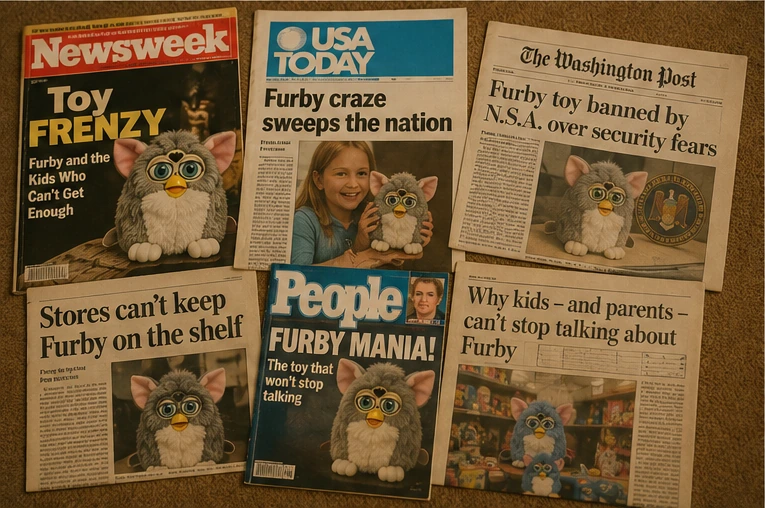
“It Learned My Name”
Owners connected a familiar sound to a name or phrase and remembered the coincidence as proof of learning. Once repeated at school, the story became a feature.
“It Repeated a Conversation”
The recording myth grew from Furby’s microphone and delayed English progression. A phrase appearing after a conversation seemed connected even when it had always been in memory.
“It Turned On With No Batteries”
Stories about battery-free speech are part of haunted-toy folklore. In reality, forgotten batteries, residual motion, another device or memory usually did the work.
“Two Furbys Planned Something”
Infrared exchanges looked coordinated. When the toys answered in sequence, children supplied motives and translated nonsense into conspiracy.
“The Government Banned It Everywhere”
The NSA story expanded into claims that Furby was illegal in airports, military bases or government buildings generally. The real issue involved security restrictions in sensitive spaces.
“Every First Generation Is Valuable”
Collector mythology later attached extreme prices to ordinary versions. Production was massive, and condition matters more than simply being old.
Why Reporters Loved Furby
The toy provided visual television. A reporter could place Furby on a desk and let it move during the segment. Holiday shortages supplied shoppers and empty shelves. The NSA story supplied comedy. Resale listings supplied dramatic prices.
Furby also represented a larger question about technology: when does programmed response begin to feel like intelligence? The answer was not scientifically complicated, but it made good television.
News coverage increased demand even when the story sounded negative. A toy strange enough to worry adults looked more interesting to children.
Why Children Improved Every Story
Playground rumor does not preserve nuance. A microphone became a recorder. Programmed English became learning. Infrared signals became secret communication. A security restriction became a national ban.
The resulting mythology became part of the product. Furby was not only what the mechanism did. It was what people believed it might do when nobody watched.
The Furby rule: when a toy is mysterious, interactive and slightly creepy, every technical misunderstanding becomes free marketing.
Furbish Traveled Better Than English
How Furby Became a Global Toy Phenomenon
The fictional language gave Furby a shared identity across markets while localized speech helped the creature adapt to different countries.
A Universal Starting Point
Furbish did not belong to one real country, which meant every owner began with the same basic joke: the creature spoke its own language first. Local versions could then reveal words from the market’s human language.
This structure made translation part of the character rather than a technical necessity. Furby was not being localized; it was supposedly learning to communicate with a new owner.
The Face Needed No Translation
Large eyes, ears, beak and fur communicated emotion without words. Packaging and commercials could show the same basic interactions in different regions.
A sleepy blink looked sleepy everywhere. A hungry mouth movement did not require subtitles.
Global Demand Strengthened the Brand
International sales made Furby more than an American holiday fad. The creature became a recognizable global toy character with local language versions and region-specific packaging.
That reach also created collector interest in international boxes and speech versions, though exact rarity should be verified carefully.
Why the Language Gimmick Was So Exportable
Most talking toys begin with a fixed script in one language. Furby began with invented speech and treated human vocabulary as progression. The design turned localization into part of play.
The clever part: every Furby could arrive as a foreign creature, no matter which country sold it.
The Machine Did Not Have Feelings. The Owner Did.
Why Children Became Emotionally Attached to Furby
Furby’s behavior invited care. It appeared hungry, sleepy, pleased, frightened or lonely. Those states were programmed, but the child’s response was real.
Attention Produced Visible Change
Petting caused affection. Feeding caused satisfaction. Repeated play revealed more English. The toy appeared to reward commitment, making attention feel important.
The Face Created Responsibility
Eyes are powerful. Furby’s blinking face made neglect look personal. Leaving a digital device untouched is easy; ignoring a creature staring from the dresser is different.
Unpredictability Felt Like Personality
A fully predictable toy becomes a machine quickly. Furby’s timing varied enough that owners described individual units as sweet, stubborn, loud, sleepy or mean.
Imperfection Increased Attachment
Misheard sounds, mechanical pauses and odd responses made each Furby’s behavior feel unique. A slightly broken movement could become a trait rather than a defect.
Children Practiced Interpretation
Owners learned to read movement and sound as emotional signals. The toy became a small exercise in empathy, even though the target of that empathy was a motorized object.
The relationship: Furby did not need to feel anything. It only needed to behave in ways that made the owner feel needed.
From Prototype to Pop-Culture Punchline
The Original Furby Timeline: 1997–2001
The craze moved fast: concept, launch, shortage, expansion, security headlines, saturation and decline in only a few years.
1997: The Physical Digital-Pet Idea
Hampton and Chung developed a creature that combined electronic interaction with a physical body. The toy required enough mechanics to move expressively without becoming too expensive for mass retail.
The concept reached the licensing and manufacturer stage as virtual pets proved children would form relationships with electronic creatures.
Early 1998: Prototype Pressure
The team prepared Furby for industry demonstration and Toy Fair attention. Coordinating eyes, ears, beak, body movement and speech inside a compact shell was a serious engineering challenge.
Tiger Electronics recognized the product’s demonstration power and prepared it for a fall launch.
Fall 1998: Furby Reaches Stores
The toy arrived shortly before the holiday season with a mainstream price and unusual technology story. Demonstrations and commercials introduced Furbish, learning and interaction.
Demand accelerated faster than the available supply.
Christmas 1998: National Shortage
Furby became the season’s must-have electronic toy. Empty shelves, resale prices and media reports transformed the product into a holiday symbol.
Any color became the right color once Christmas approached.
January 1999: The NSA Story
Reports that Furby was restricted from NSA spaces created the spy-toy legend. Tiger publicly explained that the toy could not record speech.
The controversy added technology mystery without hurting recognition.
1999: Expansion Everywhere
Furby Babies, new colors, editions, accessories and promotional versions extended the brand. The original shortage eased while total sales grew dramatically.
Furby moved from one hot toy into a full product family.
2000: Saturation
Furbys were easier to find, more variations existed and the novelty had become familiar. The toy remained visible but no longer controlled every holiday conversation.
Collectors and dedicated fans continued while casual owners moved on.
2001: The Original Wave Recedes
Hasbro reported reduced Furby shipments as the product line declined from its peak. Surviving creatures entered closets, yard sales and family storage.
The active craze ended, but the myths and visual identity remained ready for future revivals.
The Creature Was Mostly Gears, Timing and Nerve
What Was Really Happening Under Furby’s Fur
The original Furby created a surprisingly rich performance with modest electronics. Its brilliance came from combining mechanisms so that one small action appeared to carry emotion.
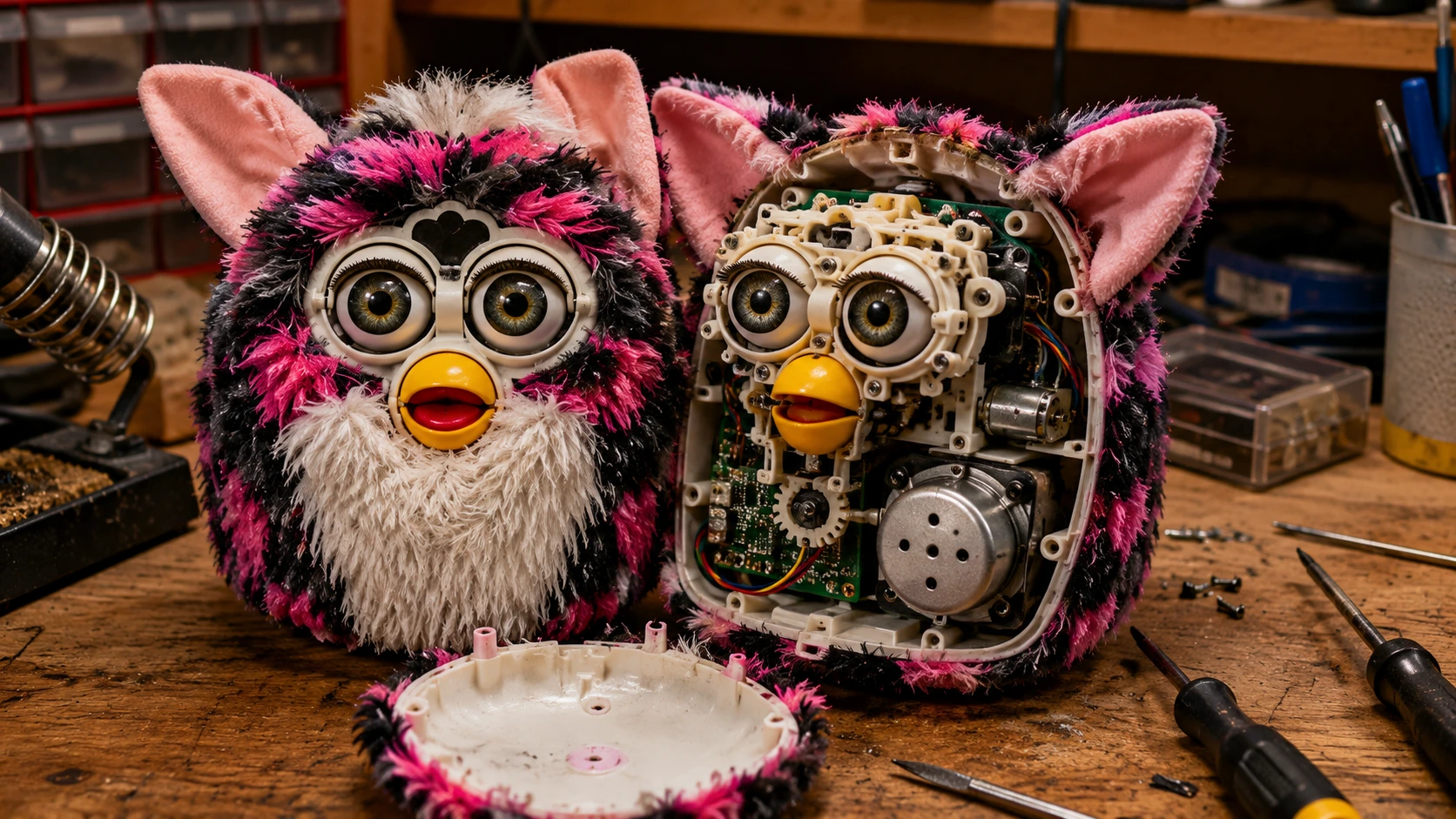
The Mechanical Core
Furby’s face and body were not powered by a collection of independent motors. A coordinated mechanical system translated motor movement into blinking, ear movement, beak motion and body shifting. That kept cost and size under control while allowing several parts to move in sequence.
The result was less flexible than a modern robot but more expressive than a normal electronic plush. Furby did not need to perform every movement separately. It needed enough combinations to suggest moods.
Why Timing Mattered More Than Power
A slow blink during a sleepy sound felt intentional. A beak opening during a phrase felt like speech. Ears moving after a clap looked like attention. The hardware created motion, but timing created meaning.
This is why weak batteries change the personality so dramatically. Slower or incomplete movement breaks the timing. Furby may still speak, but the face no longer supports the performance correctly.
The Microcontroller and Stored Behavior
The original toy used a small embedded processor and stored program instructions to manage sensor input, speech progression and motor sequences. By modern standards the memory was tiny. By 1998 toy standards, the experience felt unusually layered.
The program did not build a model of the owner or understand context. It tracked states and selected responses. The behavior seemed intelligent because the toy could choose among enough reactions to avoid feeling like one repeated button phrase.
The Sound System
Furby’s voice came from compressed and synthesized audio designed to fit limited memory. The roughness helped. A cleaner human voice might have made repeated phrases more obvious, while the electronic accent made Furbish sound natural for the creature.
Owners learned to distinguish words through repetition. The brain became better at understanding Furby even though Furby itself was not improving its pronunciation.
The Sensors as Personality Inputs
Touch, tilt, sound and light created multiple ways to affect behavior. Each sensor was simple, but the combination made Furby appear aware of the room.
A light change could wake it. Movement could produce complaint. Petting could create happiness. Sound could start a response. Because the owner caused visible effects through different actions, the toy felt less like a machine with one trigger.
Infrared and the Social Illusion
The infrared system allowed nearby Furbys to send simple signals. The toys did not exchange thoughts, vocabulary or private opinions about the family. They triggered compatible responses.
Still, the effect was powerful. Human conversation is built from turn-taking, and the toys appeared to take turns. That rhythm was enough to suggest social awareness.
Why the Fur Was More Than Decoration
The plush covering hid screws, seams and hard plastic, keeping the electronics from visually dominating the toy. Owners touched Furby like an animal rather than operating it like a device.
The fur also softened mechanical noise and changed expectations. Clicking from a bare robot might sound normal. Clicking from a fluffy creature sounded medical.
The Limits Were Part of the Charm
Furby could become repetitive, misfire and react at the wrong moment. Those failures did not always expose the illusion. Owners often interpreted them as temperament.
A Furby that refused to sleep was stubborn. One that responded slowly was tired. One that spoke after being ignored was needy. The same errors that frustrated adults gave children more personality to work with.
The engineering trick: Furby used inexpensive parts to create expensive-looking emotion, then let the owner’s imagination cover the remaining gap.
Every Household Developed Its Own Furby Policy
Furby, Siblings and the Family-Room Experience
The official product story focused on one child and one magical creature. Real homes added siblings, pets, television noise, bedtime rules and adults who had already spent December trying to find the thing.
The Ownership Argument
A Furby given “to the kids” quickly required legal clarification. Who named it? Who slept with it? Who had advanced its English? Who had left it on the stairs?
Shared ownership usually lasted until one sibling claimed Furby responded better to them.
The Color Hierarchy
When siblings owned different versions, color became identity. One pattern was cute, another looked mean and one was clearly superior because it belonged to the child making the ranking.
The Pet Reaction
Dogs barked at it. Cats watched it with professional suspicion. Furby’s movement and sound placed it in the uncomfortable category between toy and small animal.
The Television Problem
Loud shows, clapping and music could trigger reactions. Furby joined the family conversation without understanding a single thing and often chose the quietest scene to contribute.
The Bedtime Negotiation
Children wanted Furby nearby. Adults wanted it asleep and preferably facing away from everyone. Weak batteries made the nighttime voice even less comforting.
The Grandparent Demonstration
Every new visitor received the same presentation: watch it blink, hear the language and wait for the English word. Grandparents reacted with delight, confusion or the conviction that toys had become too complicated.
The Second Furby Decision
Owning two promised conversation and reduced sibling conflict. It also doubled the sound, battery use and possibility of synchronized nighttime activity.
The Closet Phase
When interest declined, Furby did not immediately leave the house. It moved into storage, where the face remained visible through a box and the batteries were hopefully removed.
The Adult Memory
Parents who complained most can often describe the exact fur pattern decades later. A toy does not need to be peaceful to become part of family history.
The household truth: Furby was marketed as a child’s companion but functioned as a family member everybody had an opinion about.
“First Generation” Does Not Automatically Mean College Fund
How Collectors Identify Original Furbys
Collector language can make the original line sound more mysterious than it was. The useful goal is identification: which production group, fur pattern, eye color, edition, language and condition does the toy actually have?
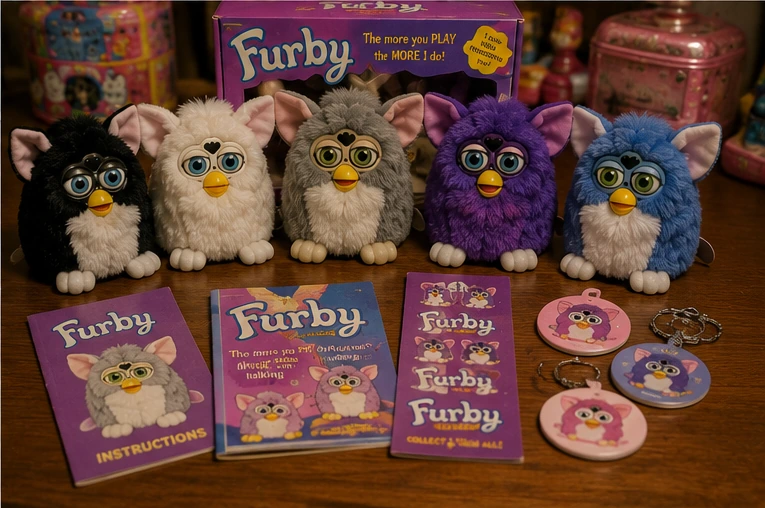
Collectors group many original Furby releases into generations based on when colors and patterns entered the line. Generation labels help organize the catalog but do not guarantee rarity or value.
The main coat, belly, mane, ears and tail create the most obvious identity. Similar colors can look different under lighting, age and yellowing.
Eye color can distinguish otherwise similar units. Because the eyes dominate the face, the difference also changes the perceived expression.
Packaging and spoken language help identify the intended market. International versions may interest collectors, but scarcity should be supported by evidence.
Costumes, themed fur, unusual packaging and named editions can separate special releases from standard color waves.
An original box should match the toy version and language. Mixed boxes happen after years of storage and resale.
Instruction manuals, Furbish dictionaries, tags and inserts add completeness and help verify the original package.
Working movement, clear sound and responsive sensors matter. A clean exterior can hide a stalled mechanism or damaged battery contacts.
Custom Furby culture is creative and active, but altered fur, painted parts or internal modifications place the toy in a different collector category from an original-condition example.
The Most Common Collector Mistakes
Trusting Asking Prices
A seller can request any amount. Only completed sales show whether similar buyers actually paid it.
Assuming Age Equals Rarity
Original Furbys are old, but tens of millions were sold. Survival and condition vary; age alone does not create scarcity.
Ignoring Battery Damage
Corrosion can turn a visually attractive toy into a repair project. Always inspect the compartment.
Buying the Story Instead of the Toy
Claims such as “prototype,” “factory error” and “only one online” need evidence. Nostalgia listings are not peer-reviewed research.
The best collecting rule: identify the Furby accurately, inspect the condition honestly and buy the version you actually enjoy looking at.
The Toy Faded. The Stories Did Not.
Why Furby Still Hits So Hard
Furby survives because it represents more than one object. It captures a moment when consumer electronics were becoming emotional, personal and slightly invasive.
It Was a Bridge Toy
Furby sat between plush animals and household robots, between analog childhood and connected life. It made software feel like personality.
Everyone Has a Furby Story
Owned one, wanted one, hunted one, hated one or heard one speak from a closet. The memories are unusually specific.
The Design Never Became Generic
A Furby silhouette remains instantly recognizable. Few toys combine adorable and threatening so efficiently.
The Myths Improved the Product
Rumors about learning, recording and secret behavior gave the toy abilities beyond its hardware.
The Craze Was Public
Shortages, resale prices and news coverage made Furby part of adult culture, not only a bedroom toy.
It Predicted the Future
Modern homes contain voice assistants, responsive devices and toys that update through apps. Furby’s promise was primitive, but the emotional idea was early.
Furby captured the late 90s perfectly: a future-facing gadget wearing fake fur, asking for attention and creating privacy concerns before most homes had broadband. For more toys that vanished from the spotlight but never left the memory bank, revisit the forgotten toys of the 90s.
Keep the Fuzzy Rewind Going
More 90s Toy Crazes
Keep the Late-90s Rewind Going
Furby Arrived in 1998—and the Culture Around It Was Just as Loud
Furby did not land in a quiet year. The toy arrived while pop culture, television, movies and technology were all sprinting toward the millennium. Revisit the two years when the fuzzy creature went from impossible-to-find Christmas gift to full-blown product family.
Because Furby Myths Multiply Faster Than Furbys
Dates, Technology and Source Notes
The master-plan scope for this article is the original Furby craze, with later revivals included only where they explain the toy’s lasting nostalgia. Historical and technical details were checked against The Strong National Museum of Play, the original interactive-toy patent, IEEE Spectrum’s engineering history, Hasbro’s SEC filings, Hasbro’s 2023 relaunch announcement, and contemporary reporting on the 1999 NSA Furby story. The NSA concern was real; the idea that the original Furby could record conversations was not.
Frequently Asked Furbish
Original Furby and 90s Furby Craze FAQ
When did the original Furby come out?
The original Furby launched in 1998 through Tiger Electronics and became one of the defining holiday toys of Christmas 1998.
Who invented Furby?
Dave Hampton and Caleb Chung developed the original Furby concept. Richard C. Levy helped bring the idea to Tiger Electronics, which produced and marketed the toy.
What company made the original Furby?
Tiger Electronics made the original Furby. Hasbro acquired Tiger Electronics in 1998 as Furby reached the market.
Why was Furby so popular in 1998?
Furby combined plush-toy appeal, robotic movement, sensors, a made-up language and the illusion of learning. Holiday shortages and news coverage made demand even stronger.
Did Furby actually learn English?
No. The original Furby gradually revealed preprogrammed English phrases as interaction advanced its internal stages. It did not learn new words from the owner.
Could the original Furby record conversations?
No. The original toy used sound detection for programmed responses but did not record and store human conversations.
Why did the NSA ban Furby?
The NSA restricted Furby from sensitive spaces because officials were concerned that its microphone and supposed learning ability might allow it to record information. Tiger Electronics said the toy had no recording capability.
What language did Furby speak?
Furby began by speaking Furbish, a fictional language created for the toy, and gradually used more preprogrammed English phrases.
Did Furbys talk to each other?
Yes. Original Furbys could exchange infrared signals that triggered responses, creating the appearance that the toys were communicating.
Did the original Furby have an off switch?
The original Furby did not use a normal on-off switch. Owners could put it to sleep, place it in darkness or remove the batteries when silence became more important than the relationship.
Why did Furbys wake up at night?
Movement, light, sensor input, weak batteries or an incomplete sleep state could cause Furby to react unexpectedly. The nighttime setting made ordinary electronic behavior feel much creepier.
What batteries did the original Furby use?
The original adult Furby used four AA batteries. Battery condition strongly affects movement, sound and startup behavior.
What were Furby Babies?
Furby Babies were a smaller, younger-styled extension of the Furby line introduced in 1999, with different voices, colors and behavior.
How many original Furbys were sold?
The Strong National Museum of Play reports that more than 40 million Furbys sold during the original toy’s first three years.
Why does an old Furby click but not move?
Clicking can indicate a stalled or aging mechanism, weak batteries or internal gear problems. Old battery corrosion and long storage can also affect operation.
Can an original Furby be washed?
An electronic Furby should not be soaked or machine-washed. Surface cleaning must be cautious because the motor, sensors and electronics sit beneath the fur.
Are original Furbys worth money?
Some working, boxed or special-edition Furbys attract collectors, but value depends on exact version, condition, completeness and actual completed sales. High asking prices are not reliable proof of value.
What is the rarest Furby?
Several limited and special editions are described as rare, but rarity claims should be verified through production information and completed sales. The planned 90s toy value guide will handle market comparisons separately.
When did Furby come back?
Major Furby revivals appeared in 2005, 2012, 2016 and 2023, with each version updating the technology while keeping the fuzzy creature identity.
Does the 2023 Furby connect to the internet?
Hasbro states that the 2023 Furby does not connect to the internet. It uses built-in voice-activated modes, lights, songs and responses.
Where can I read more about 90s electronic toys?
The 90s Electronic Toys and Digital Pets page covers Furby alongside Tamagotchi, handheld electronics, talking toys and other battery-powered roommates.
Where does Furby rank among iconic 90s toys?
Furby is one of the decade’s most recognizable electronic toys and appears near the top of the 50 Most Iconic Toys of the 90s.
Kah May-May, Tiny Electronic Menace
Furby Was the Future—Just Not the Future We Expected
Furby did not understand us, record our secrets or develop a personality in the scientific sense. It performed a relationship so effectively that millions of people supplied the missing intelligence.
That is why the toy remains unforgettable. Furby was cute enough to love, irritating enough to remember and mysterious enough to become a story bigger than the hardware inside it. The creature stopped talking eventually. Gen X has not.