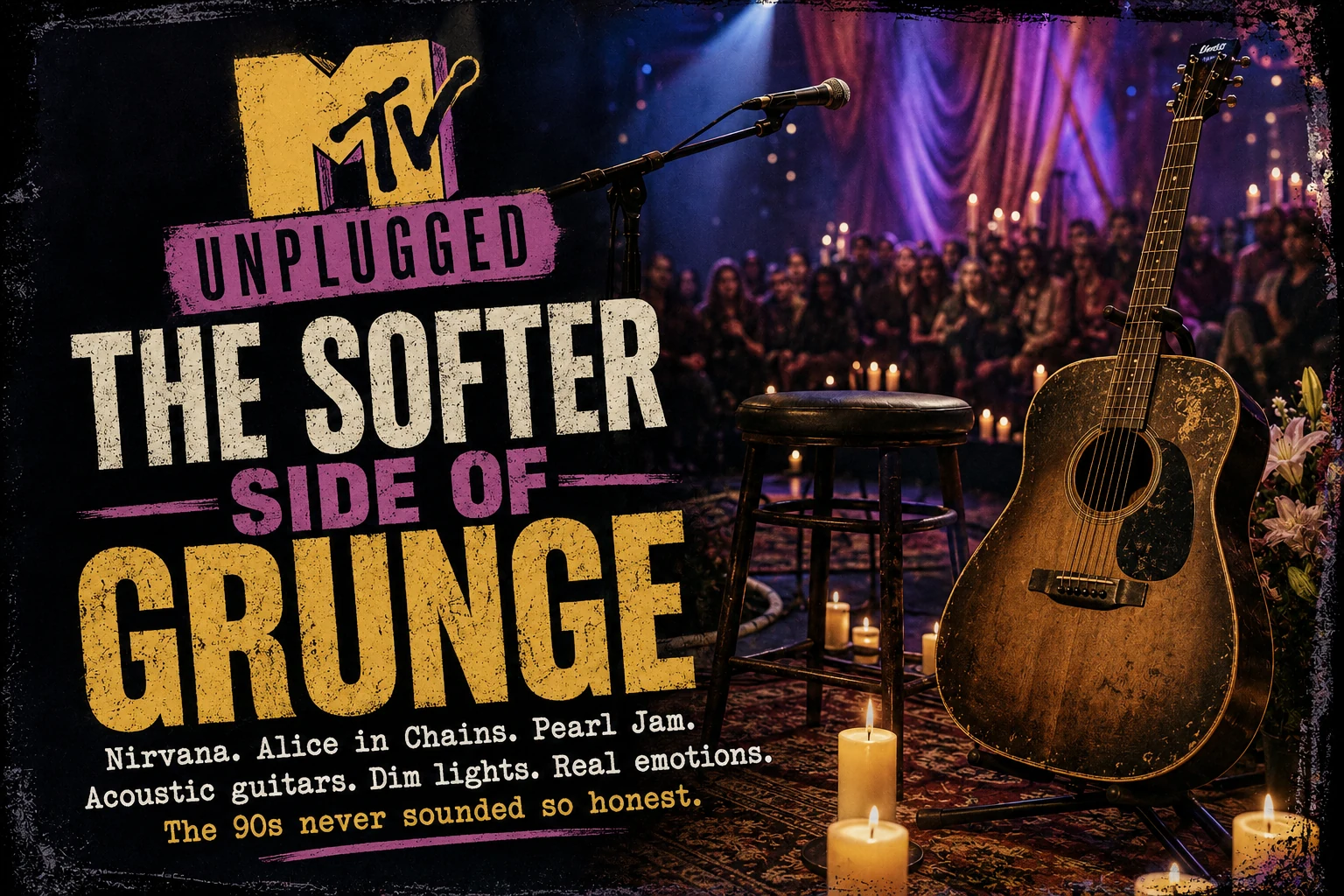
MTV Unplugged and Grunge: The Softer Side of the 90s
Grunge became famous for distortion, feedback, flannel and guitars that sounded like they had been dragged behind a van. But some of the best MTV Unplugged grunge performances hit even harder after the amps came down. Nirvana, Alice in Chains, Pearl Jam and Stone Temple Pilots used acoustic arrangements to expose the melodies, tension and damage hiding under the noise.
Acoustic grunge was never soft in the easy-listening sense. It was soft like a bruise. The vocals moved forward, the room got smaller, and all that Gen X sarcasm suddenly had nowhere to hide. These performances changed how the 90s remembered grunge—and why the songs still land decades later.
Why MTV Unplugged Mattered to Grunge
MTV Unplugged mattered because it proved grunge was built on songs, not just volume. Nirvana, Alice in Chains, Pearl Jam and Stone Temple Pilots stripped back their biggest material without stripping away the tension. The acoustic settings pushed the vocals, lyrics and melodies forward, revealing how much vulnerability had always been buried beneath the distortion.
The performances also connected two sides of the decade. The 90s alternative music guide maps the bands, songs and scenes, while the full 90s alternative and grunge story explains how the culture exploded. Unplugged sits between them: a close-up view of the songwriting after the noise and mythology were pulled back.
Why Acoustic Grunge Worked
Acoustic grunge worked because it did not try to become pretty. That is the key. This was not rock stars proving they could behave at a dinner party. It was not “here is our sensitive side, please buy the deluxe candle.” The best unplugged performances kept the tension, dread and weirdness of grunge intact. They just removed the armor.
In the loud versions, distortion could carry some of the emotional weight. A giant riff could swallow the awkwardness. Feedback could blur the edges. A screaming chorus could turn pain into force. But when the guitars were acoustic, when the drums were pulled back, when the vocals were suddenly right there in front of everybody, the songs had to stand on their own. No hiding behind the wall of noise. No smoke machine. No leather-pants hero nonsense. Just the song, the room and whatever emotional damage came with it.
That is why MTV Unplugged became such a perfect Gen X artifact. The format exposed how much of grunge was built on actual songwriting. Nirvana’s melodies got stranger and sadder. Alice in Chains’ harmonies became even more haunted. Pearl Jam’s intensity felt less like arena release and more like someone trying to keep a lid on a boiling pot. Stone Temple Pilots’ grunge-adjacent mood shifted from radio-rock muscle to something more intimate and uneasy.
When the volume dropped, weak writing would have folded. The best grunge songs got stronger because the bones were already good.
Kurt Cobain, Layne Staley, Eddie Vedder and Chris Cornell did not need polish. Their voices carried personality, damage and weather.
Acoustic did not mean soft-rock dentist-office music. It meant every lyric suddenly had eye contact.
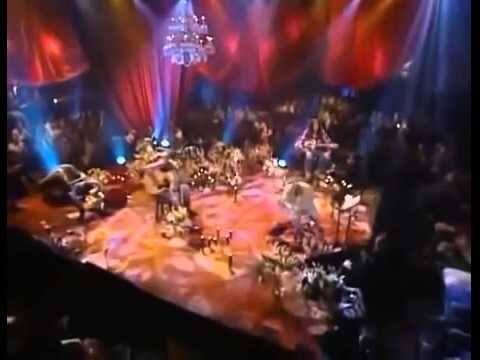
The dim lights, candles, rugs, stools and awkward applause made the performances feel intimate, fragile and slightly haunted.
Why MTV Unplugged Fit the 90s
MTV Unplugged could only become that important in a very specific media world. This was before every performance was instantly clipped, posted, ranked, reacted to, re-ranked, and turned into a discourse landfill by noon. You had to catch it, tape it, hear about it from someone, buy the album later, or wait for MTV to rerun it when you were supposed to be doing something productive. Productivity, obviously, lost.
The 90s made MTV feel like a shared living room. A video could become a national memory. A performance could become a myth because everyone saw it in roughly the same cultural fog. The channel helped make grunge visible in the first place, and the unplugged format helped make it feel human. That is why the acoustic performances sit right beside the bigger story of MTV’s alternative rock takeover. MTV sold the image, sure, but it also captured moments that still feel weirdly alive decades later.
For Gen X, MTV Unplugged hit a specific nerve. We were fluent in emotional deflection. Sarcasm was basically a household utility. But these performances made detachment harder. They were too quiet to ignore, too imperfect to dismiss and too intimate to treat like normal rock promotion. The bands looked less like untouchable stars and more like people stuck in the same room as their own songs.
The Essential MTV Unplugged and Acoustic Grunge Moments
Not every grunge or grunge-adjacent act had the same kind of unplugged legacy, but a few performances became permanent pieces of the decade. Some felt like revelations. Some felt like warnings. Some felt like the room got colder and nobody knew whether to clap or quietly reconsider their entire personality.
Nirvana Unplugged: The Funeral Before the Funeral
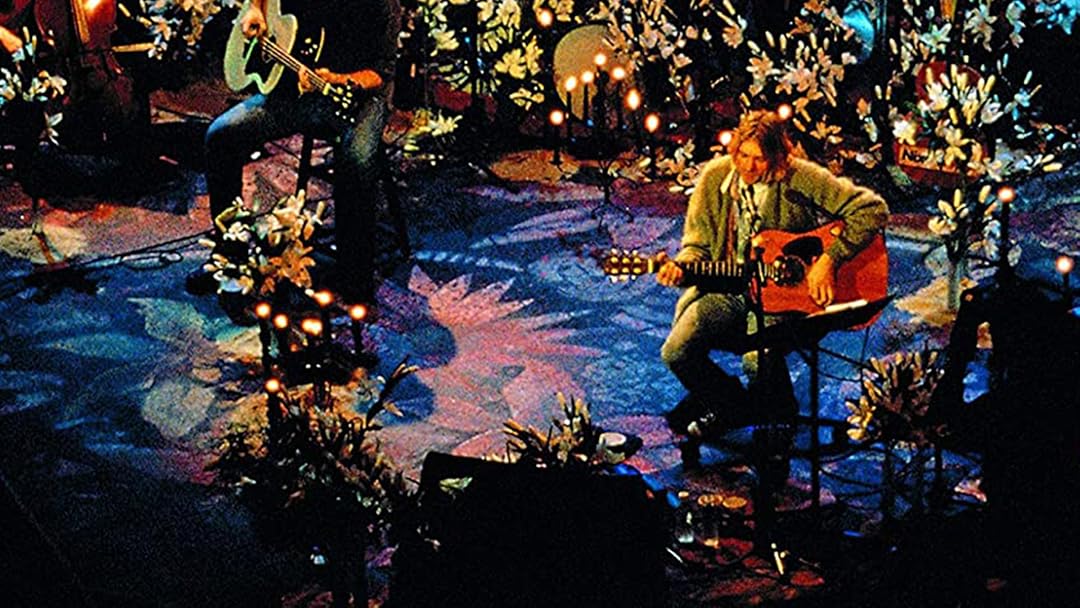
Nirvana’s MTV Unplugged performance is the one everybody talks about because it does not feel like a normal concert. It feels like a transmission. The room looked funereal even before history made that feeling impossible to ignore: dim lights, flowers, dark stage tones, a band that did not seem interested in doing the obvious victory-lap version of itself. No big glossy rock moment. No crowd-pleasing parade of hits. No “here is the acoustic version of the single you already know, please clap on schedule.”
That restraint is what made it legendary. Nirvana did not treat Unplugged like a brand extension. They treated it like a weird little room where they could pull from older songs, covers, deep moods and the stranger corners of their identity. “About a Girl” suddenly felt like a perfect bridge between their earlier songwriting and their mainstream explosion. “Come As You Are” became less slippery and more tired. “All Apologies” felt less like a song and more like a sigh that accidentally became a generational document.
The covers mattered just as much. “The Man Who Sold the World” gave a lot of Gen X listeners their first real doorway into David Bowie’s song, because MTV was occasionally an accidental education system with better hair. The Meat Puppets songs made the performance feel less predictable and more rooted in underground taste. And then there was “Where Did You Sleep Last Night,” the closer that still feels like the room stops breathing. Cobain’s voice at the end is not polished, not pretty, not safe. It is the kind of moment that makes nostalgia feel less like comfort and more like a bruise you forgot was there.
Nirvana Unplugged also reshaped how people understood the band. The loud myth was already huge thanks to Nirvana’s massive impact on 90s music, but Unplugged revealed how much old folk, punk, pop melody, underground weirdness and emotional fatigue lived inside the songs. It made Nirvana feel less like a movement’s mascot and more like a band haunted by the weight of being turned into one.
That is why the performance sits so naturally beside the band’s albums. Nevermind blew the door open. In Utero pushed back against the machine. Unplugged felt like the exhausted afterimage of both: quiet, strange, bitterly funny in spots, and completely unwilling to become easy.
Alice in Chains Unplugged: The Haunted Masterpiece
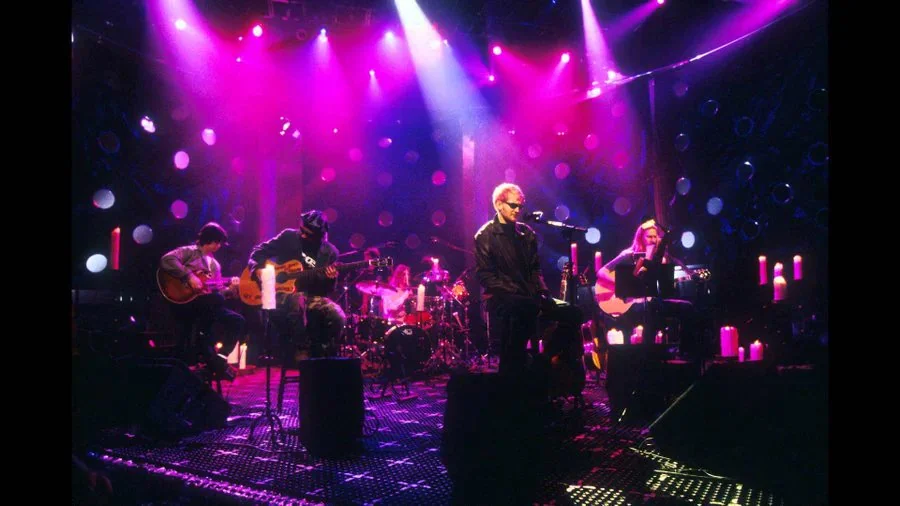
Alice in Chains Unplugged is not just one of the best MTV Unplugged performances. It is one of the defining documents of the darker side of grunge. Nirvana’s set feels spectral. Alice in Chains’ set feels like the ghosts stayed for the whole show and harmonized. The band’s music already carried a heavy acoustic undercurrent through Sap, Jar of Flies and songs like “Down in a Hole,” but Unplugged pulled that darkness into full view.
What makes it so powerful is the tension between fragility and precision. Layne Staley’s presence is impossible to separate from the performance’s emotional gravity. He sounds tired, damaged, still brilliant. Jerry Cantrell anchors everything with calm, shadowy control. Their harmonies are not pretty in the traditional sense. They are beautiful because they sound wounded, locked together, and almost too honest. The whole band plays with restraint, which makes the songs heavier instead of lighter.
“Nutshell” is the obvious emotional center. It already felt devastating on Jar of Flies, but the Unplugged version gives it even more air and even less escape. “Down in a Hole” becomes a slow collapse. “No Excuses” proves the band could write something radio-friendly without losing its haunted edge. “Rooster” feels stripped of spectacle and left with only memory. “Would?” closes with the kind of weight that makes applause feel slightly inappropriate, like clapping after someone reads your diary out loud.
Alice in Chains were always more than volume. Their darkness lived in melody, harmony and atmosphere, which is why the unplugged format fit them so perfectly. If Alice in Chains were the darkest sound of grunge, then their Unplugged performance is the dark with the lights dimmed just enough to make everything worse.
The performance also explains why acoustic grunge mattered beyond MTV novelty. This was not a band “toning it down.” It was the same emotional world with fewer walls. The distortion went away, but the damage did not. If anything, the quieter arrangements made the songs feel more exposed, like the band had removed the armor and kept the wound.
Pearl Jam Unplugged: Intensity Without the Arena
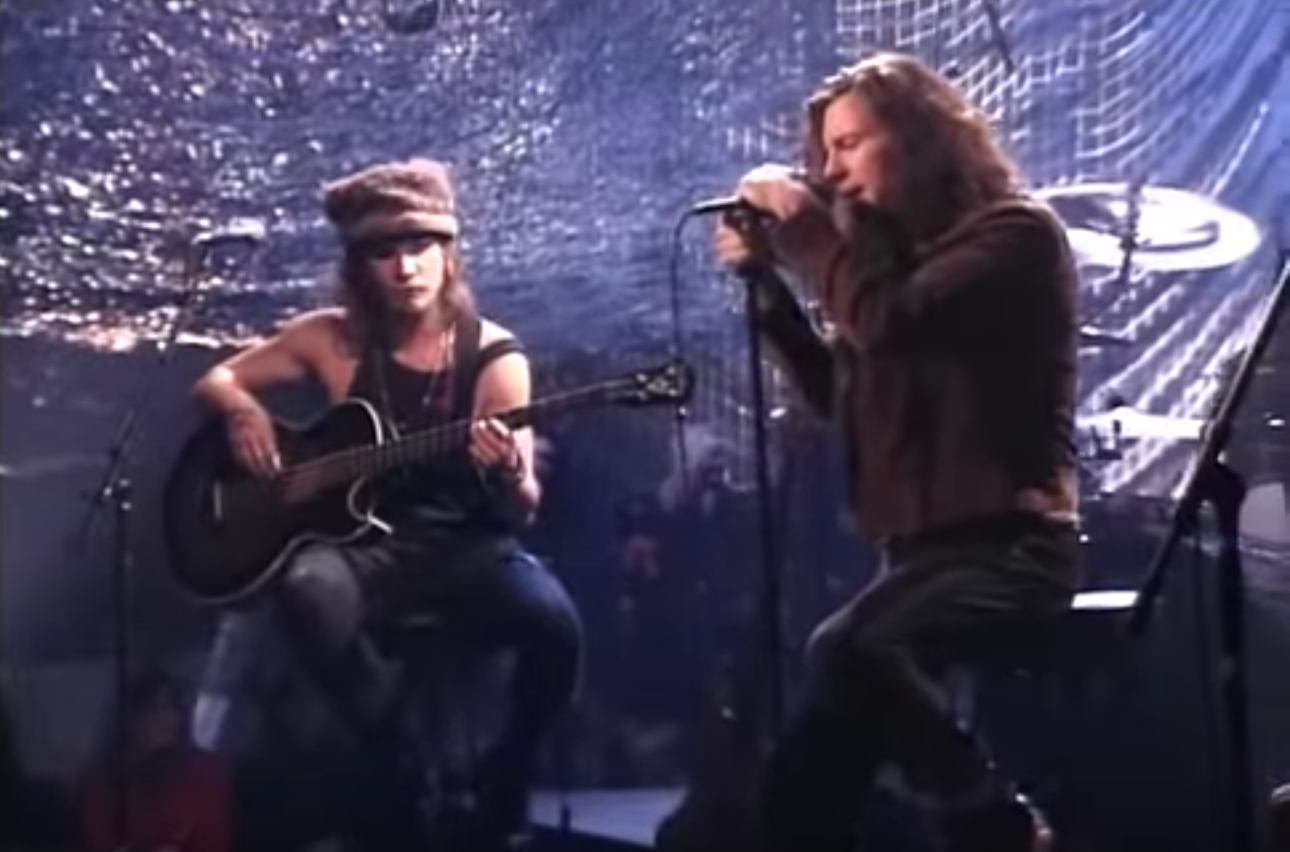
Pearl Jam’s Unplugged performance captured the band before the full weight of being Pearl Jam had settled on them. That is part of its magic. They still had the hungry, wired, almost unstable energy of a band riding the first wave of Ten, but the acoustic setting forced that energy into a smaller room. It did not calm them down. It just made the pressure more visible.
Eddie Vedder’s voice was already a generational instrument by that point: huge, wounded, dramatic, sometimes like a confession and sometimes like someone trying to escape the building through sheer vocal force. But Unplugged showed that Pearl Jam’s intensity was not dependent on electric volume. “Black” still aches. “Jeremy” still burns. “Even Flow” still moves. “Alive” still feels like a survival statement. “Porch” still threatens to kick a chair through the ceiling.
The performance is fascinating because Pearl Jam were not really built to sit still. The band had the physical urgency of a live act that wanted the stage to become a weather event. Acoustic guitars and stools could not domesticate them. Instead, Unplugged made the tension between restraint and release even more obvious. You can feel the songs trying to break out of the format.
That is why Pearl Jam represent the other side of grunge so well. Their songs could be heavy, but they often reached for release instead of collapse. The acoustic setting made the emotional architecture clearer. Pearl Jam were not just loud. They were open, intense and almost alarmingly sincere for a decade that preferred to wrap sincerity in seven layers of sarcasm.
Their Unplugged performance also shows why Ten became such a slow-burn giant among the best 90s grunge albums. The songs worked because the melodies, the voice and the emotional stakes were already there. Strip away the arena, and the bones still stood.
Stone Temple Pilots Unplugged: “Plush” Without the Radio Armor
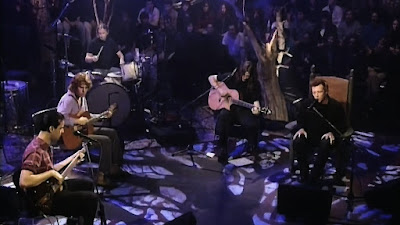
Stone Temple Pilots were not part of the Seattle scene, but they absolutely belonged in the MTV Unplugged story. The band recorded an official set in 1993, during the Core era, and the stripped-down format made the songwriting easier to hear beneath the heavy radio-rock surface.
“Plush” was the center of gravity. The studio version was already moody and winding, but the acoustic performance pulled Scott Weiland’s voice forward and exposed the song’s uneasy softness. The set also showed that Stone Temple Pilots were more than a loud aftershock of Seattle: their hooks, dynamics and strange glam-tinted personality held up without full electric muscle.
STP’s role in this story is not that they defined grunge’s roots. They did not. Their role is that they show how quickly the mood spread. By the early-to-mid 90s, the acoustic alternative template was everywhere: on MTV, on radio, on CD singles, in dorm rooms, at coffeehouses where someone was absolutely about to play “Plush” whether anyone requested it or not.
That wider spread is part of the road from grunge to post-grunge and alternative becoming radio rock. The original Seattle scene was messy and local. The national version became a sound, a format and eventually a whole lot of bands trying to sound emotionally weathered in very clean studios. STP sit right in that complicated middle: argued over, overplayed, and still absolutely part of the 90s memory.
Soundgarden Never Did MTV Unplugged — But Their Softer Side Still Hit
Soundgarden never did a proper MTV Unplugged episode, which still feels like one of those 90s alternate-timeline things that should have happened. Imagine Chris Cornell in that room, under those weird moody lights, with the band turning the volume down just enough for every dark melody to crawl out from under the floorboards. MTV gave us plenty, but it also denied us that, so yes, we are filing a complaint thirty years late. Very Gen X. Very on brand.
Even without an official Unplugged performance, the softer side of grunge would be incomplete without Soundgarden. Their heavy songs were huge and weird, obviously. This is the band that could make a riff feel like industrial equipment having a nightmare. But underneath all that weight, Soundgarden had a deep melodic and atmospheric side that could be just as unsettling as the crushing stuff.
“Fell on Black Days” is one of the great examples. It is not acoustic in the MTV Unplugged sense, but it carries the same exposed darkness. “Black Hole Sun” became surreal and huge, but its core melody is eerie and almost lullaby-like if you strip away the video’s nightmare suburbia. “Burden in My Hand” and “Like Suicide” showed how Chris Cornell’s voice could make quieter spaces feel enormous.
Cornell’s voice was the key. He could be volcanic, but he could also sound wounded, soulful and searching. That meant Soundgarden’s softer moments did not feel like detours. They felt like another chamber in the same weird building. The band’s heaviness was not only volume. It was mood, scale and tension.
This is where Soundgarden’s heavy, weird side connects to grunge’s quieter emotional current. The band could crush the room, but they could also make it feel like the ceiling was slowly lowering. Different method. Same damage.
Nirvana vs. Alice in Chains: Two Different Kinds of Haunted
Nirvana and Alice in Chains are the two Unplugged performances that still dominate the grunge conversation, but they do not hit the same way. Nirvana’s set feels like a strange, intimate art object that became heavier because of what happened after it. Alice in Chains’ set feels heavy in real time, like everyone in the room understands the songs are carrying more than songs should have to carry.
Nirvana Unplugged is eerie because it avoids the obvious. It does not chase the biggest hits. It leans into covers, mood and negative space. The performance feels curated but not slick, controlled but not comfortable. It is the sound of a band refusing to play the role the world had assigned them.
Alice in Chains Unplugged is eerie because the band’s entire sound already felt like a haunted room, and the acoustic setup only made the walls thinner. Layne Staley and Jerry Cantrell’s harmonies were built for this kind of exposure. The songs did not need to be rearranged into vulnerability. They were already vulnerable. The Unplugged stage just removed the last protective layer.
Minimal hits, deep covers, candlelit atmosphere, weird humor and a final song that still feels like the air leaving the room.
Dark harmonies, fragile presence, devastating acoustic arrangements and songs that sounded like they had been waiting for this room.
Why Gen X Connected With Stripped-Down Sadness
There is a reason these performances still hit Gen X so hard. We came up in a culture that was allergic to emotional speeches but extremely comfortable expressing an entire personality through a scratched CD, a sarcastic T-shirt and a mixtape assembled with the seriousness of a court deposition. Feelings were not always discussed. They were sequenced.
MTV Unplugged fit that emotional language perfectly. It did not ask the bands to give speeches about vulnerability. It just put them in a room where the songs had to do it. Nirvana did not need to explain alienation. Alice in Chains did not need to explain damage. Pearl Jam did not need to explain catharsis. The performances carried it all in the sound, the faces, the pauses, the cracked notes and the uncomfortable silence between applause.
That is why acoustic grunge never felt like a novelty. It felt like the private version of the public thing. The electric songs were what you played in the car. The unplugged versions were what followed you into your room afterward. One was volume. The other was evidence.
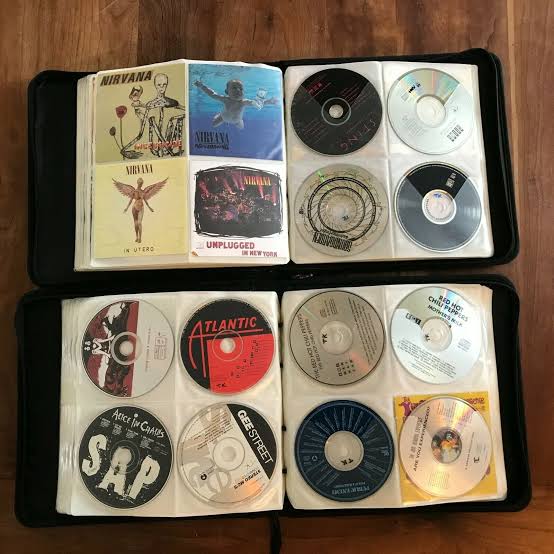
Unplugged made that harder. The songs were too direct, too quiet and way too good at sneaking past sarcasm.
Cracked vocals, awkward pauses and rough edges made the performances feel real in a way glossy rock rarely did.
You did not just stream the performance. You caught it, taped it, bought it, borrowed it or heard about it from someone cooler.
These performances did not turn pain into a speech. They turned it into a chord change and let everyone pretend that was enough.
20 Essential Acoustic Grunge and Unplugged Songs
Some of these are MTV Unplugged performances. Some are acoustic grunge songs, softer album tracks or stripped-down 90s alternative moments that belong in the same emotional drawer. The drawer is wooden, slightly warped, and probably full of old ticket stubs.
- “About a Girl” — Nirvana
- “Come As You Are” — Nirvana
- “The Man Who Sold the World” — Nirvana
- “All Apologies” — Nirvana
- “Where Did You Sleep Last Night” — Nirvana
- “Nutshell” — Alice in Chains
- “Down in a Hole” — Alice in Chains
- “No Excuses” — Alice in Chains
- “Brother” — Alice in Chains
- “Rooster” — Alice in Chains
- “Black” — Pearl Jam
- “Jeremy” — Pearl Jam
- “Alive” — Pearl Jam
- “Porch” — Pearl Jam
- “Plush” — Stone Temple Pilots
- “Creep” — Stone Temple Pilots
- “Doll Parts” — Hole
- “Fell on Black Days” — Soundgarden
- “Burden in My Hand” — Soundgarden
- “Hunger Strike” — Temple of the Dog
These songs are the softer hallway off the main grunge room. They connect back to the big distorted classics, but they also prove the genre had more emotional range than the lazy stereotype suggests. Grunge was not just loud sadness in a thrift-store shirt. It was melody, restraint, grief, humor, anger, fatigue and the occasional acoustic guitar doing way more emotional labor than it signed up for.
The Albums Behind Acoustic Grunge
MTV Unplugged did not invent acoustic grunge out of nowhere. The softer side was already hiding inside the albums. Nirvana had melody and folk weirdness running through the catalog. Alice in Chains had Sap and Jar of Flies. Pearl Jam had “Black,” “Release,” “Daughter,” “Elderly Woman Behind the Counter in a Small Town” and a whole emotional architecture built for communal release. Soundgarden had dark melody under the heavy machinery. Temple of the Dog had grief at the center.
That is why the unplugged performances work best when you hear them beside the albums. They are not separate from the grunge album era. They are another way into it. The same records that lived in CD binders and car stereos also had quieter corners where the songs could breathe, bleed and occasionally ruin your evening in a productive way.
How MTV Unplugged Changed Grunge’s Legacy
MTV Unplugged changed the memory of grunge because it gave the genre a second visual language. The first language was loud: stage dives, distortion, messy hair, flannel, clubs, videos, weird lighting, bodies in motion, guitars held like weapons. The second language was quiet: stools, candles, rugs, acoustic guitars, close-up faces, voices cracking, songs slowing down until the lyrics had nowhere to run.
That second language matters because it complicated the stereotype. Grunge was not only angry young men yelling through fuzz pedals. It was also grief, fatigue, tenderness, dread, storytelling and dark humor. It was Andrew Wood’s shadow in Temple of the Dog. It was Layne Staley and Jerry Cantrell’s harmonies sounding like a locked room. It was Kurt Cobain choosing a Lead Belly song to close a performance instead of doing the obvious thing. It was Eddie Vedder making acoustic Pearl Jam feel like the arena was still somehow trying to fit inside the studio. And it was Soundgarden, even without an official Unplugged episode, proving through songs like “Fell on Black Days” and “Burden in My Hand” that quiet could still feel massive.
The unplugged performances also made the genre feel more timeless. Electric sounds can get tied to production trends. Acoustic performances age differently. A voice, a chord, a room and a song can still feel immediate decades later. That is why these performances keep finding new listeners even after the old MTV world disappeared into memory, streaming clips and people saying, “Back when MTV played music,” as required by federal Gen X law.
The softer side of grunge did not replace the loud side. It completed it. Without the distortion, you heard the songs. Without the stage chaos, you saw the people. Without the armor, you felt the decade’s nervous system.
Where to Go Next in 90s Alternative and Grunge
The unplugged side is only one corner of the rabbit hole. The full 90s grunge story runs through Seattle clubs, MTV, modern rock radio, record stores, movie soundtracks, thrift-store fashion, massive albums, tragic endings, overplayed radio descendants and the ongoing mystery of how every CD case hinge broke immediately.
Questions About MTV Unplugged and Acoustic Grunge
Why was MTV Unplugged important to grunge?
MTV Unplugged was important to grunge because it stripped away the distortion and showed the songwriting, emotion and vulnerability behind the songs. Nirvana, Alice in Chains and Pearl Jam all proved that grunge could be just as powerful when it was quieter.
What is the most famous grunge MTV Unplugged performance?
Nirvana’s MTV Unplugged performance is usually the most famous grunge Unplugged set. Its dark atmosphere, unusual song choices and haunting closing performance of “Where Did You Sleep Last Night” made it one of the defining music moments of the 90s.
Why is Alice in Chains Unplugged so powerful?
Alice in Chains Unplugged is powerful because the band’s dark harmonies, acoustic arrangements and fragile atmosphere made songs like “Nutshell,” “Down in a Hole,” “No Excuses” and “Would?” feel even more exposed.
Did Pearl Jam do MTV Unplugged?
Yes. Pearl Jam performed on MTV Unplugged early in their rise, giving acoustic versions of songs from the Ten era and showing that their intensity worked even without full arena volume.
Did Stone Temple Pilots perform on MTV Unplugged?
Yes. Stone Temple Pilots recorded an official MTV Unplugged set in 1993. The performance included acoustic versions of Core-era songs and helped make “Plush” one of the decade’s most memorable stripped-down rock performances.
Did Soundgarden ever do MTV Unplugged?
No. Soundgarden never had a proper MTV Unplugged episode, which is still one of the great missed opportunities of the 90s alternative era. But songs like “Fell on Black Days,” “Black Hole Sun,” “Burden in My Hand” and “Like Suicide” show that the band’s softer side could be just as powerful as its heavy side.
What are the best acoustic grunge songs?
Some of the best acoustic grunge songs and performances include Nirvana’s “About a Girl,” “All Apologies” and “Where Did You Sleep Last Night,” Alice in Chains’ “Nutshell,” “Down in a Hole” and “No Excuses,” Pearl Jam’s “Black,” and Stone Temple Pilots’ “Plush.”
Is acoustic grunge still grunge?
Yes. Acoustic grunge is still grunge when it keeps the genre’s emotional weight, dark melodies, tension and rawness. The instruments may be quieter, but the mood and songwriting still belong to the grunge era.
Why did Gen X connect with MTV Unplugged?
Gen X connected with MTV Unplugged because the performances felt intimate, imperfect and emotionally direct without becoming sentimental. They matched a generation that often processed feelings through music, mixtapes, CDs and sarcasm instead of speeches.
Did MTV Unplugged change how people remember Nirvana?
Yes. Nirvana’s Unplugged performance helped people hear the band’s melody, folk influences, underground taste and emotional depth beyond the loud mainstream hits. It became one of the most important parts of the band’s legacy.
Was Stone Temple Pilots part of grunge?
Stone Temple Pilots were not part of the Seattle grunge scene, but they were a major grunge-adjacent 90s alternative band. Their acoustic performances, especially “Plush,” fit the wider unplugged alternative mood of the decade.
Why do unplugged grunge performances still hit so hard?
They still hit because the stripped-down format exposed the songs instead of softening them. The vocals, lyrics and melodies feel closer, making the performances age differently than many louder or more polished 90s rock moments.
Keep the Unplugged Rewind Going
Get more 70s, 80s and 90s nostalgia, music rabbit holes, TV memories, toy chaos and Gen X cultural therapy from Smells Like Gen X.