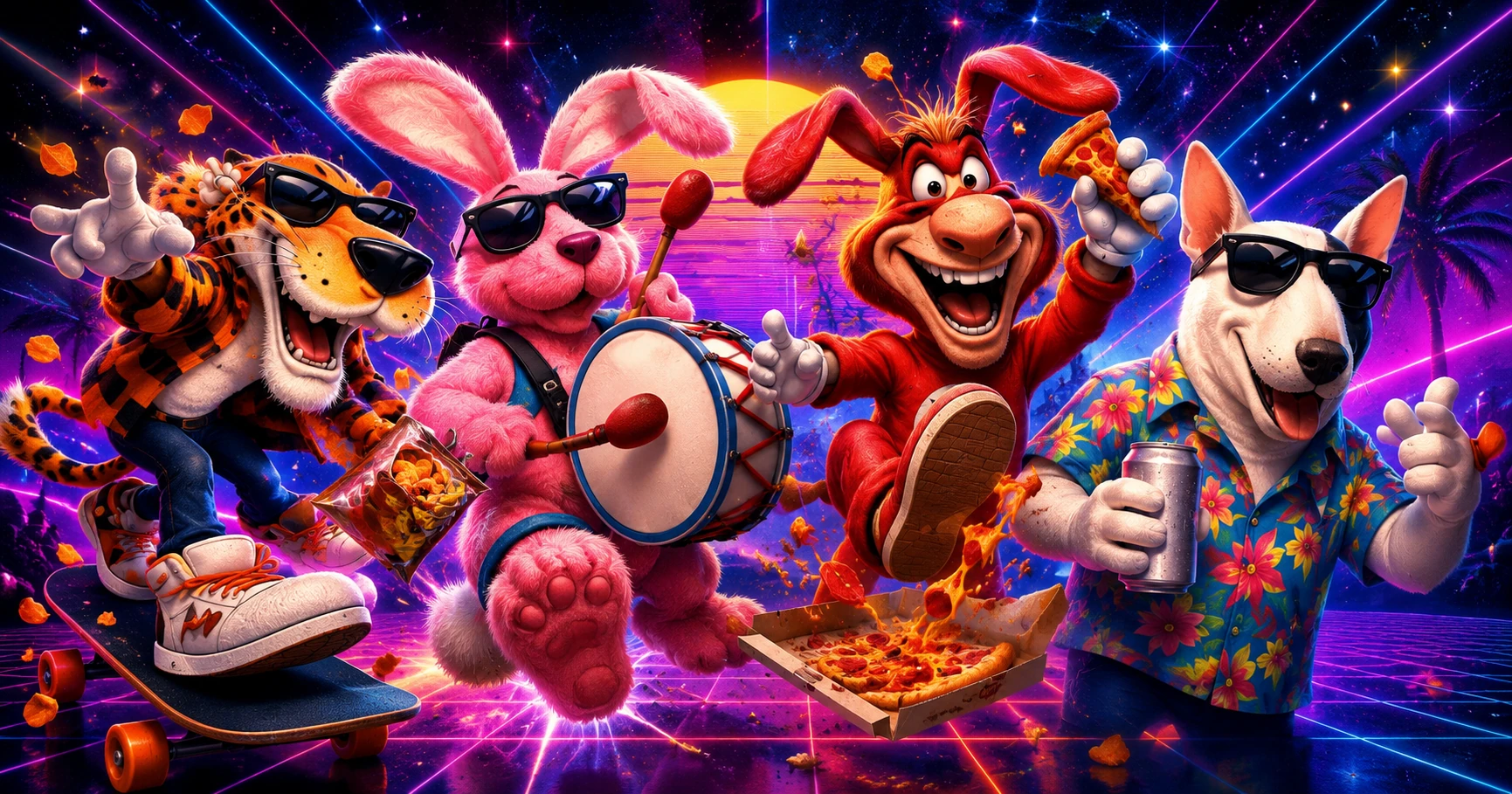
80s Commercial Mascots Spuds MacKenzie, The Noid, Energizer Bunny & Chester Cheetah
The best 80s commercial mascots did not stand beside the product and wave. They arrived with jobs. Spuds MacKenzie made Bud Light look like the center of the party. The Noid turned pizza delivery trouble into a red-suited villain. The Energizer Bunny made battery life visible. Chester Cheetah gave a cheese snack sunglasses, swagger and a point of view.
These characters worked because the decade treated advertising like casting. A mascot needed a silhouette, a gimmick, a personality and enough repeatable behavior to survive hundreds of commercial breaks. By the time Gen X heard the slogan or saw the first half-second of movement, the product message was already loading.
We did not merely recognize these characters. We knew what kind of trouble, joke or attitude was about to enter the screen before the commercial finished introducing itself.
Who Were the Most Memorable 80s Commercial Mascots?
Four defining 1980s advertising mascots were Spuds MacKenzie for Bud Light, the Noid for Domino’s, the Energizer Bunny for Energizer batteries and Chester Cheetah for Cheetos. They became memorable because each character translated a product message into one instantly readable personality: social cool, delivery chaos, relentless endurance and snack-food attitude.
Why 80s Commercial Mascots Felt Like Television Characters
Older advertising had plenty of mascots, but the strongest 1980s campaigns often treated the character less like a logo and more like a recurring performer. The mascot entered with a role, a predictable kind of behavior and a visual language that could carry an entire campaign before anybody explained the product.
That shift mattered because television advertising had become faster, louder and more competitive. Commercials needed to identify themselves instantly. A bull terrier surrounded by party energy, a red saboteur attacking pizza, a rabbit marching through another ad or a cheetah wearing shades could claim the screen in a fraction of a second.
The concentrated television culture of the decade amplified everything. Viewers were not scattered across thousands of personalized feeds. The same commercial could run through sitcoms, sports, cartoons, local news, movies and late-night reruns until a mascot became common language. That is why these characters still feel bigger than thirty-second advertisements. They occupied the shared room.
The best 80s mascots were not decorations. They were compressed brand strategies with faces, costumes and repeatable behavior.
Why repetition did not kill them
Each campaign had a reusable engine. Spuds could enter another party. The Noid could attempt another sabotage. The Bunny could interrupt another fake commercial. Chester could chase another impossible cool-guy scheme. Repetition strengthened the premise instead of merely repeating the slogan.
The character made the selling point visible
This is the part the four campaigns share. Bud Light wanted social energy, so Spuds became a walking party. Domino’s wanted to dramatize the hazards of delivery, so the Noid became the hazard. Energizer wanted to communicate longevity, so the Bunny refused to stop. Cheetos wanted a sharper, younger personality, so Chester behaved like the snack aisle had hired its own too-cool spokesman.
1986 to 1989: Four Characters Enter the Commercial Break
The lineup came together in a remarkably short window. Chester Cheetah and the Noid appeared in 1986, Spuds MacKenzie became a national television phenomenon in 1987, and the Energizer Bunny arrived in 1989. Together they capture the late-80s move toward louder, more character-driven brand identities.
Spuds MacKenzie: The Mascot Who Sold the Party
Spuds MacKenzie did not explain Bud Light. He made the beer look socially connected, fashionable and parked at the center of late-80s party culture.
Spuds began as a poster concept before becoming a national television personality during Super Bowl XXI in 1987. That origin helps explain the campaign. The character was built as an image first: a bull terrier with one black eye, formal clothes, an entourage and the confidence of somebody who had never once checked whether he was invited.
The product message was atmosphere. Bud Light wanted to feel like the drink already waiting at the good party, and Spuds became the evidence. He did not deliver tasting notes or explain why the beer was light. He entered scenes where everyone appeared thrilled to see him, which made the brand feel socially magnetic without needing to say those words.
That was extremely late-80s. Advertising increasingly sold a world around the product: the people, the clothes, the energy, the access and the suggestion that choosing correctly might improve the room around you. Spuds was less a spokesman than a fantasy host.
The campaign also demonstrated the strange power of a mascot becoming larger than the item being advertised. Spuds appeared on posters, shirts and promotional merchandise, and the “Original Party Animal” identity became recognizable even to people who were nowhere near the legal drinking age. That reach generated criticism, but it also proved how completely the character had crossed into mainstream pop culture.
In memory, Spuds belongs beside the Miller Lite “Tastes Great, Less Filling” commercials . Both campaigns sold beer by creating behavior people could recognize immediately. Miller Lite created an argument. Bud Light created a party guest.
Why the Spuds campaign worked
The Noid: Domino’s Turned Delivery Trouble Into a Villain
The Noid gave Domino’s a living enemy—an absurd red saboteur whose entire purpose was to damage, delay or otherwise ruin the pizza before it reached the customer.
Domino’s introduced the Noid in 1986, and the concept was brilliantly direct. Fast delivery could be difficult to dramatize without showing clocks, traffic and a driver running toward a door. A villain solved the problem. Every obstacle associated with getting a hot, intact pizza to the customer could be compressed into one red-suited source of chaos.
That made “Avoid the Noid” more than a rhyme. It became the campaign’s complete story logic. The Noid tries to interfere. Domino’s defeats him. The pizza survives. The commercial can change locations, traps and slapstick routines while the product claim remains completely stable.
The character’s design did important work. The long ears, red suit, twitchy movement and clay animation made him impossible to confuse with a friendly mascot. He looked like irritation had developed limbs. That was useful because the audience never had to wonder what side he was on.
The Noid also captured the decade’s willingness to make a brand premise stranger than necessary. A modern campaign might visualize delivery speed through an app map and arrival timer. The 80s created a physical manifestation of pizza anxiety and sent him bouncing through elaborate traps. It was ridiculous, but the ridiculousness made the message easier to remember.
The campaign sits naturally beside Wendy’s “Where’s the Beef?” commercial. Wendy’s gave people a question to repeat. Domino’s gave them a villain to name. Both turned a competitive product claim into shorthand that could survive outside the advertisement.
Why the Noid campaign worked
Energizer Bunny: A Battery Demonstration That Hijacked the Ad Break
The Energizer Bunny turned product endurance into a running joke: no matter what commercial seemed to be playing, the pink rabbit could keep drumming straight through it.
The Energizer Bunny debuted in 1989, near the very end of the decade, but the concept felt like a perfect summary of everything 80s advertising had learned about repetition. The mascot did not merely claim the batteries lasted. He performed longevity by refusing to leave.
The original format was especially smart because the Bunny interrupted advertisements that appeared to belong to other products. Viewers would begin watching what looked like a coffee, headache remedy or long-distance commercial, only for the rabbit to enter and reveal that the real advertisement had been Energizer all along. The interruption was the product demonstration.
That structure gave the campaign nearly unlimited range. The setting could change. The fake commercial could change. The people reacting to the interruption could change. The Bunny only needed the drum, sunglasses and forward motion. Every return strengthened the same idea: this thing is still going.
The character also became automatic cultural shorthand. Saying somebody “keeps going like the Energizer Bunny” communicates persistence even when no battery is involved. That is the highest level of mascot success: the character’s behavior becomes a phrase people use to describe real life.
In strategic terms, the Bunny belongs beside Nike’s “Just Do It” campaign. Nike compressed motivation into three words. Energizer compressed endurance into one moving image. Both escaped the product category and became broader language.
Why the Energizer Bunny campaign worked
Chester Cheetah: When the Snack Aisle Hired a Cool Guy
Chester Cheetah made Cheetos feel less like a generic cheese snack and more like a brand with sunglasses, schemes, swagger and a permanently raised eyebrow.
Chester became the Cheetos spokescheetah in 1986, replacing the older Cheetos Mouse era with a sharper personality built for late-80s television and print. The design communicated the basic idea instantly: fast animal, dark sunglasses, confident posture, no visible concern about whether anybody else found him impressive.
That attitude gave the brand a useful lane. Snack advertising can easily collapse into close-ups, crunch sounds and people announcing that something tastes good. Chester gave Cheetos a continuing character whose desire for the product could drive stories, jokes and failed plans without requiring the commercial to reinvent the brand every time.
The “It Ain’t Easy Being Cheesy” line made the character feel self-aware. Chester understood that he was performing coolness and behaved like the performance was exhausting work. That wink separated him from mascots designed mainly to be friendly. He was not asking the audience for affection. He was posing for it.
Chester also fit the decade’s obsession with attitude as a product benefit. Shoes, soda, snacks, jeans and electronics increasingly needed a personality that suggested who the consumer might become. Cheetos was selling cheese-flavored corn snacks, but Chester made the bag feel like it had joined the arcade, music-video and mall-culture side of the decade.
That move resembles what Pepsi accomplished with Michael Jackson, although at a completely different scale. Pepsi borrowed the aura of the biggest star in music. Cheetos built its own permanently available star.
Why the Chester Cheetah campaign worked
Cool, Chaos, Endurance and Attitude
The mascots look unrelated because they were solving different problems. That is exactly what makes the lineup useful. Together they show four distinct ways a commercial character can carry a brand.
Each mascot reduced explanation
The strongest brand characters make copy shorter because their behavior explains the promise. You do not need a paragraph about social belonging when Spuds enters the party. You do not need a delivery-risk diagram when the Noid attacks a pizza. You do not need a battery chart when the Bunny keeps marching. You do not need a youth-positioning memo when Chester slides into the frame wearing shades.
That efficiency is the real legacy of 1980s advertising mascots. The characters did not merely make the commercial more entertaining. They made the strategy easier to understand.
How Mascot Campaigns Fit Into the Bigger 80s Advertising Machine
Mascots were only one of the decade’s major advertising systems. Some campaigns created characters. Others created phrases, borrowed celebrity power or staged one giant cinematic event. The reason the 80s commercial break still feels so rich is that all of those approaches competed in the same television space.
Spuds, the Noid, the Bunny and Chester created recurring personalities that could return in new situations. The character was the long-term engine.
Wendy’s “Where’s the Beef?” and Miller Lite’s “Tastes Great, Less Filling” gave audiences language they could repeat away from the television.
Apple’s “1984” commercial created a one-night spectacle, while Pepsi used Michael Jackson to merge soda advertising with the MTV universe.
The Pepsi Challenge used a fourth lane: participation. The Coke-vs.-Pepsi blind taste test turned viewers into participants at malls and stores. The California Raisins blurred the categories by beginning as ad characters and rapidly becoming recording, television and merchandise personalities.
What all of these campaigns understood was that the commercial needed a life after the commercial. A mascot could reappear. A phrase could be repeated. A celebrity song could be remembered. A taste test could be reenacted. A cinematic spot could become an event people discussed the next morning.
Why Gen X Remembers the 80s Mascot Era So Clearly
The obvious answer is repetition, but repetition alone does not explain the detail. Plenty of commercials ran constantly and vanished. These mascots survived because each one arrived with a clean emotional signal. Before the plot unfolded, viewers knew whether the commercial was offering cool, conflict, persistence or attitude.
They also belonged to an era when the commercial break was part of the viewing experience instead of a cue to pick up a phone. Kids and adults watched the same channels, saw many of the same national campaigns and carried the references into school, work, sports, family dinners and shopping trips. The mascot became shared shorthand.
The first frame was enough
A color, silhouette, drumbeat or costume could identify the campaign before the product appeared.
The characters returned
Recurring behavior made each new spot feel like another episode rather than a disconnected sales pitch.
Everybody knew the reference
Concentrated television exposure turned the campaigns into common language across age groups and regions.
The larger memory is not only about four mascots. It is about the texture of television itself: local station IDs, network promos, toy commercials, cereal spots, music-video countdowns, fast-food campaigns, late-night reruns and the sense that the same noisy collection of characters was passing through millions of living rooms.
For more of the kid-focused side of that advertising world, the 80s Toy Commercials and Videos archive shows how action figures, dolls, electronic toys and cartoon licenses used many of the same repetition, character and catchphrase tactics.
Spuds MacKenzie, the Noid, the Energizer Bunny and Chester Cheetah endured because each one made a brand promise visible before the voice-over could finish. They were not simply mascots from the 80s. They were four different answers to the same advertising question: how do you make a product feel like a character people already know?
1986, 1987, 1988 and 1989 Beyond the Commercial Break
The four campaigns emerged during a late-80s run packed with MTV stars, giant movies, toy-store escalation, mall culture and television that still controlled the living room. Keep the same years moving:
Questions About 80s Commercial Mascots
Who were four famous 80s commercial mascots?
Spuds MacKenzie, the Noid, the Energizer Bunny and Chester Cheetah were four of the decade’s most memorable advertising mascots.
When did Spuds MacKenzie first appear on national television?
Spuds MacKenzie made his national television breakout during Bud Light’s Super Bowl XXI commercial in 1987.
When did Domino’s introduce the Noid?
Domino’s introduced the Noid in television commercials in 1986 as a villain who tried to damage or delay pizza deliveries.
When did the Energizer Bunny debut?
The Energizer Bunny debuted in 1989, interrupting fake commercials to demonstrate that Energizer batteries kept going.
When did Chester Cheetah become the Cheetos mascot?
Chester Cheetah became the Cheetos spokescheetah in 1986 and appeared in national television and print advertising.
Why were mascot commercials so effective in the 1980s?
They converted product claims into recognizable personalities and benefited from repeated exposure across a concentrated television culture.
What did each mascot represent?
Spuds represented social cool, the Noid represented delivery chaos, the Energizer Bunny represented endurance and Chester represented attitude.
Were the California Raisins commercial mascots too?
Yes, although they quickly became more than ordinary mascots. The claymation characters expanded from advertisements into music, television and merchandise.
Campaign History Sources
Launch years and campaign-history details were checked against official brand histories and contemporary reporting.