Start Before You Feel Ready • 1988 Campaign FeedThree Words • One Command • No ExcusesWalt Stack • Golden Gate Bridge • Just Do ItStart Before You Feel Ready • 1988 Campaign FeedThree Words • One Command • No ExcusesWalt Stack • Golden Gate Bridge • Just Do It
Smells Like Gen X • Classic 80s Commercials
Nike’s 1988 “Just Do It” Commercial
How Three Words Changed Sports Advertising
Some advertising slogans remain attached to the product that paid for them.
“Just Do It” escaped almost immediately. Nike launched the campaign in 1988,
but the phrase did not stay inside shoe commercials, locker rooms or running culture.
It became a command people used on themselves.
The first Nike “Just Do It” commercial did not open with Michael Jordan,
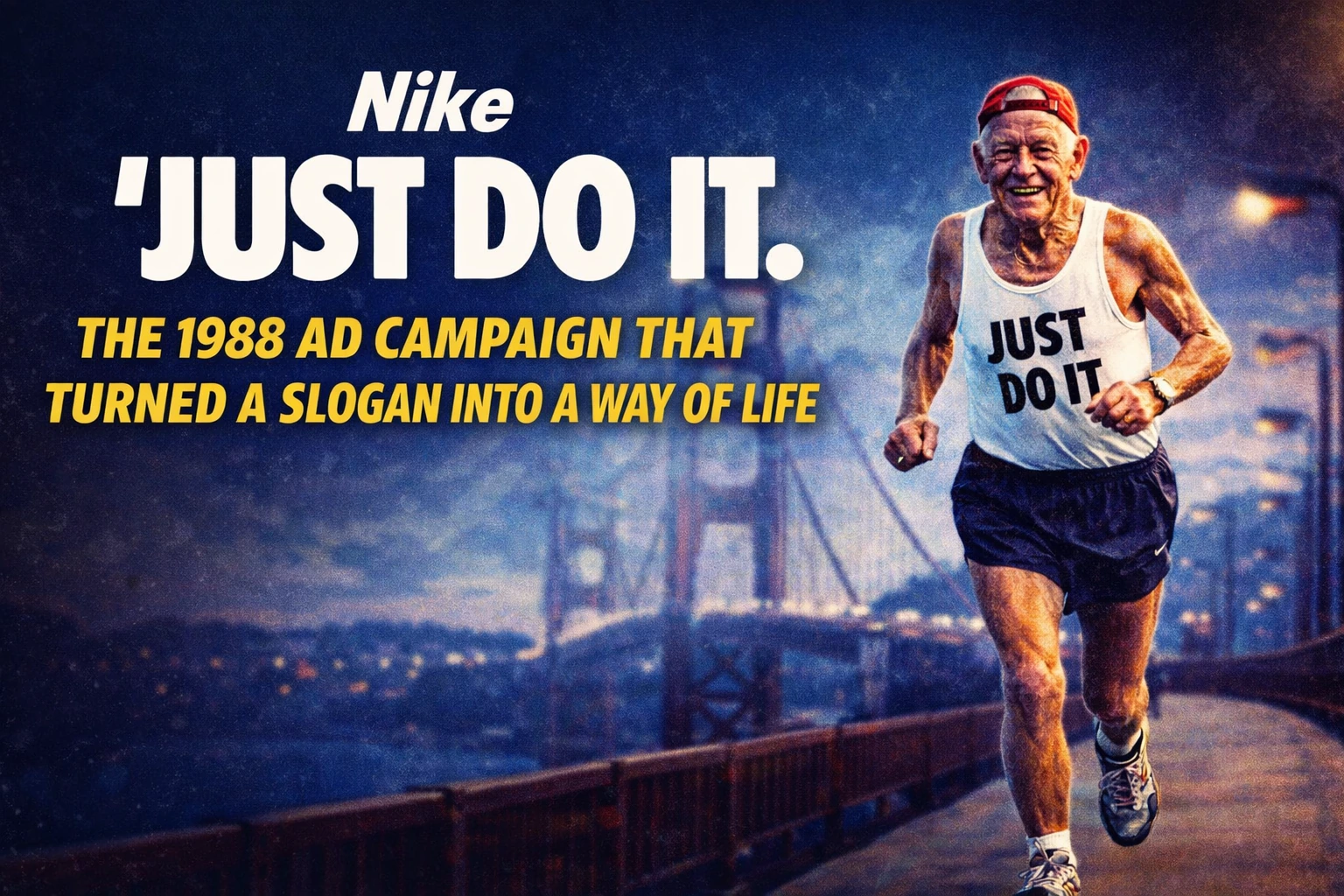
a championship montage or a laboratory full of shoe technology. It followed 80-year-old
runner Walt Stack jogging across San Francisco’s Golden Gate Bridge. The message was
stripped down enough to survive the decade: begin, keep moving and stop negotiating with yourself.
Gen X had heard plenty of commercials yelling for attention. This one sounded like it had
already made the decision and was waiting for us to catch up.
Nike launched “Just Do It” in 1988 with a simple television commercial featuring
80-year-old San Francisco runner Walt Stack jogging across the Golden Gate Bridge.
Created as a unifying line for a broader group of Nike ads, the three-word command
turned sport into something open to ordinary people and helped move Nike’s advertising
away from product specifications toward effort, identity and action.
CampaignNike “Just Do It”
Launch1988
First adWalt Stack running across the Golden Gate Bridge
AgencyWieden+Kennedy
The Starting Line
How “Just Do It” Arrived at Exactly the Right Moment
By 1988, Nike needed more than a memorable shoe advertisement. The athletic market was spreading
beyond organized competition into aerobics, recreational running, gym culture, fashion and everyday
identity. Different sports could still require different products and different athletes, but the brand
needed one idea large enough to hold all of them together.
“Just Do It” solved that problem because it was not tied to one sport, body type, skill level or
definition of success. The phrase could sit beneath an elite athlete, a weekend runner, a teenager
practicing alone or somebody trying to begin for the first time. It did not describe the shoe.
It described the moment before movement.
That distinction changed the emotional center of the campaign. A conventional sports ad might prove
that a product was lighter, faster or better cushioned. Nike made the larger promise that action itself
was available. The shoes remained in the picture, but the brand increasingly owned the attitude around them.
Before 1988
Nike had strong products, famous athletes and sport-specific advertising, but the work did not yet
share one universal rallying cry.
July 1988
The first “Just Do It” campaign ad features Walt Stack, then 80 years old, running across the
Golden Gate Bridge during his regular morning routine.
Late 1980s
The line connects everyday athletes with Nike’s growing roster of stars and gives different sports
one recognizable emotional voice.
Long after
“Just Do It” becomes useful language beyond sports, surviving because people can apply it to work,
fear, procrastination, recovery and almost any difficult beginning.
The slogan landed when fitness had become much more visible than it had been a decade earlier.
Running was no longer confined to school tracks and serious road racers. Aerobics classes filled
shopping-center studios. Home workout tapes moved the gym into the living room. Athletic shoes,
warm-up suits, sweatbands and gym bags had crossed over from equipment into everyday style.
That mattered because Nike was speaking to an audience already learning to see exercise as part of
identity. You did not have to be competing for a trophy to think of yourself as a runner, a lifter,
a basketball player or somebody who trained. The late 80s gave ordinary people more ways to participate,
and the campaign gave all of those people one language.
Culture File 01Late-80s Fitness Became Everyday Life
Editorial recreation: the kind of late-80s training gear that made fitness feel
increasingly portable, personal and tied to everyday identity.
The portable cassette player was part of that shift. So was the boom in recreational races, neighborhood
gyms and branded sportswear worn nowhere near an actual sporting event. Exercise was becoming something
people could build into a routine and display as a version of themselves. Nike did not create that cultural
movement, but “Just Do It” condensed it better than almost anyone else.
The phrase also matched the decade’s appetite for self-reinvention. The 80s could be excessive, glossy and
thoroughly impressed with ambition, but Nike removed the executive-office polish. There was no ten-step plan,
no seminar language and no promise that the universe would reward positive thinking. The message was simpler:
movement comes before transformation.
That is why the campaign could sit naturally beside the year’s larger pop culture. The
biggest fads of 1988
show how quickly products, looks and attitudes could spread, while the
top songs of 1988
carried the same bright, ambitious late-decade energy. Nike found the rare line that belonged to the moment
without becoming trapped inside it.
Watch It Like It Is 1988
What Happens in the First “Just Do It” Commercial
The commercial does not behave like a monument announcing one of the most famous slogans in advertising
history. It opens quietly, almost casually. Walt Stack is already moving, jogging across the Golden Gate
Bridge in San Francisco while the camera treats the run as part of his ordinary morning rather than a
heroic event.
That restraint is the first smart choice. There is no packed stadium, dramatic tunnel entrance or announcer
explaining why the viewer should be impressed. Stack’s age supplies the surprise, but the commercial does
not turn him into a sentimental symbol. He comes across as funny, stubborn and completely comfortable inside
the routine.
Campaign File 02The Morning Run That Opened the Campaign
Editorial recreation inspired by the setting: an older runner crossing a foggy bridge
at dawn. This is not an archival Nike campaign photograph.
Stack talks about running seventeen miles every morning and jokes about keeping his teeth from chattering
during winter. The humor is dry enough that the ad never becomes a lecture about aging or determination.
Nike lets the viewer do the math: an 80-year-old man is out there putting in mileage before most people
have finished negotiating with the alarm clock.
Then the slogan appears. It does not arrive with a long explanation because Stack has already demonstrated
the idea. The spot gives us action first and language second. By the time “Just Do It” reaches the screen,
the phrase feels less like a sales pitch than the plain-English description of what we just watched.
No product lecture
The commercial does not stop to explain cushioning, materials or shoe technology. The person and the
routine carry the message.
No manufactured triumph
Stack is not shown winning anything. The achievement is that he keeps going and apparently expects
to be back tomorrow.
Humor without a punch line
His delivery keeps the spot human and prevents the message from turning into a syrupy inspirational film.
The slogan comes last
Nike earns the command by showing it in practice before asking the audience to remember the words.
That construction is why the advertisement still works even after the slogan has become familiar enough
to disappear into everyday speech. The ad does not depend on surprise, effects or celebrity recognition.
It depends on a believable person doing something difficult without acting as though the world owes him a parade.
The First Runner
Why Walt Stack Was a Smarter Opening Than a Superstar
Nike had access to elite athletes, and the company would use them brilliantly. But opening the campaign
with Walt Stack established something a superstar could not. Stack made the line feel possible before it
felt aspirational.
The commercial follows him during a regular run rather than presenting a polished championship performance.
He was 80 years old, visible proof that the act of showing up could matter more than age, celebrity or speed.
The joke in the spot is dry and human. The discipline underneath it is unmistakable.
The first face of “Just Do It” looked like persistence, not perfection.
What Stack made clear
Nike was not reserving sport for professionals. The campaign could recognize greatness in a daily
routine, a private goal and a person who kept moving whether anyone was watching or not.
That broad invitation was essential. If the first campaign film had depended entirely on celebrity,
“Just Do It” might have sounded like a command from gifted people to everybody else. Stack made it feel
like the line belonged to the person tying a shoe before sunrise.
The choice also gave Nike room to expand. Michael Jordan and other stars could later represent exceptional
performance without narrowing the slogan, because the campaign had already established that the command
applied to ordinary athletes too.
The Campaign Gets Bigger
How “Just Do It” Expanded Beyond Walt Stack
Walt Stack established the campaign’s floor: effort belonged to anybody willing to begin. From there,
Nike could stretch the message toward elite competition without breaking it. Professional athletes supplied
fame, speed and championship pressure, while ordinary people remained inside the same idea.
That range was essential. A slogan built only around superstars can become a spectator message—admire what
this gifted person can do. “Just Do It” turned the camera back toward the viewer. The star might demonstrate
the outer edge of performance, but the command still landed in the second person.
Culture File 03One Message Across Different Kinds of Athletes
Editorial recreation: the campaign’s broad emotional territory—from a neighborhood run
and driveway basketball to a makeshift home gym.
Nike could now tell stories about different ages, bodies, sports and levels of ability while preserving one
recognizable center. A runner finishing a private morning route and a superstar performing under arena lights
could both represent the same thing: the moment when preparation turns into action.
The slogan also gave individual commercials permission to change tone. One spot could be funny, another severe,
another inspiring and another confrontational. The line did not require every ad to look or sound identical.
It required each one to reach the point where excuses stopped mattering.
That is harder than it sounds. Most broad slogans become vague because they try to include everyone.
“Just Do It” remained specific at the level that counted. It did not define the athlete or the goal.
It defined the required behavior.
Why the Language Worked
Three Ordinary Words Built Like a Starting Gun
“Just Do It” looks almost too simple to analyze, which is part of its strength. The line does not explain,
flatter or negotiate. Each word removes a different piece of resistance.
Just
Cuts through overthinking. The word makes the task sound smaller than the excuses surrounding it.
Do
Moves the message from intention to action. Thinking, planning and wishing are no longer the finish line.
It
Leaves the goal open. Running, lifting, returning, trying or beginning—the audience supplies the meaning.
It could sound different without changing
The same phrase can feel encouraging, impatient, reassuring or confrontational depending on the person
hearing it. That range gave the campaign unusual durability. On a good day, it sounds like confidence.
On a bad day, it sounds like somebody has taken away the escape route.
The line also avoids the syrupy language that often makes motivational advertising age badly.
It does not promise that success will be easy, certain or spiritually transforming. It only demands
the next action. That bluntness is one reason it still sounds more Gen X than self-help seminar.
The Dark Footnote
Where Dan Wieden Found the Phrase
Advertising executive Dan Wieden created the line while trying to unite a group of Nike commercials
under one idea. The origin story is unexpectedly grim. Wieden later said he remembered the reported
final words of convicted murderer Gary Gilmore—“Let’s do it”—and reshaped the thought into “Just Do It.”
That does not mean the campaign carried Gilmore’s story into the ads. Viewers were not being asked to
recognize the reference, and most never knew it existed. Wieden had found a fragment of language with
unusual finality, changed it and placed it in a completely different emotional setting.
The origin and the meaning are not the same thing
Once the campaign launched, athletes and consumers supplied their own meaning. The phrase became
associated with beginning, discipline, courage and persistence because those were the stories Nike
repeatedly placed around it.
The strange source is memorable, but the larger lesson is about editing. “Let’s do it” is collective.
“Just Do It” is personal, immediate and slightly impatient. The revision removed the discussion and
aimed the command directly at one person.
The Brand Leaves the Shoe Box
How “Just Do It” Changed What Nike Could Sell
The campaign did not make product performance irrelevant. Nike still needed athletes, design, innovation
and shoes people wanted to wear. What changed was the level of the argument. Nike could now speak about
the person using the product rather than only the object being sold.
One voice across sports
Running, basketball, tennis and training could use different stories while ending at the same command.
Everyday effort counted
The campaign could celebrate daily discipline without abandoning the drama of elite competition.
The consumer joined the story
“It” remained undefined, allowing each viewer to place a personal obstacle inside the slogan.
That flexibility made the line useful for decades of athletes and cultural moments. The campaign could
grow older without needing to replace its central thought, because the challenge to begin never became obsolete.
It also helped establish a model modern brands use constantly: sell a behavioral identity rather than a
feature list. Today that strategy is familiar enough to feel obvious. In 1988, Nike made it unusually clear,
unusually broad and almost impossible to separate from the brand.
One Campaign in a Loud Decade
How Nike Fit Into the Bigger 80s Advertising Machine
The late 80s commercial break was not short on personality. Brands used mascots, celebrities, catchphrases,
cinematic spectacle and public participation to make themselves harder to ignore. Nike’s advantage was restraint.
The line was loud because it was short.
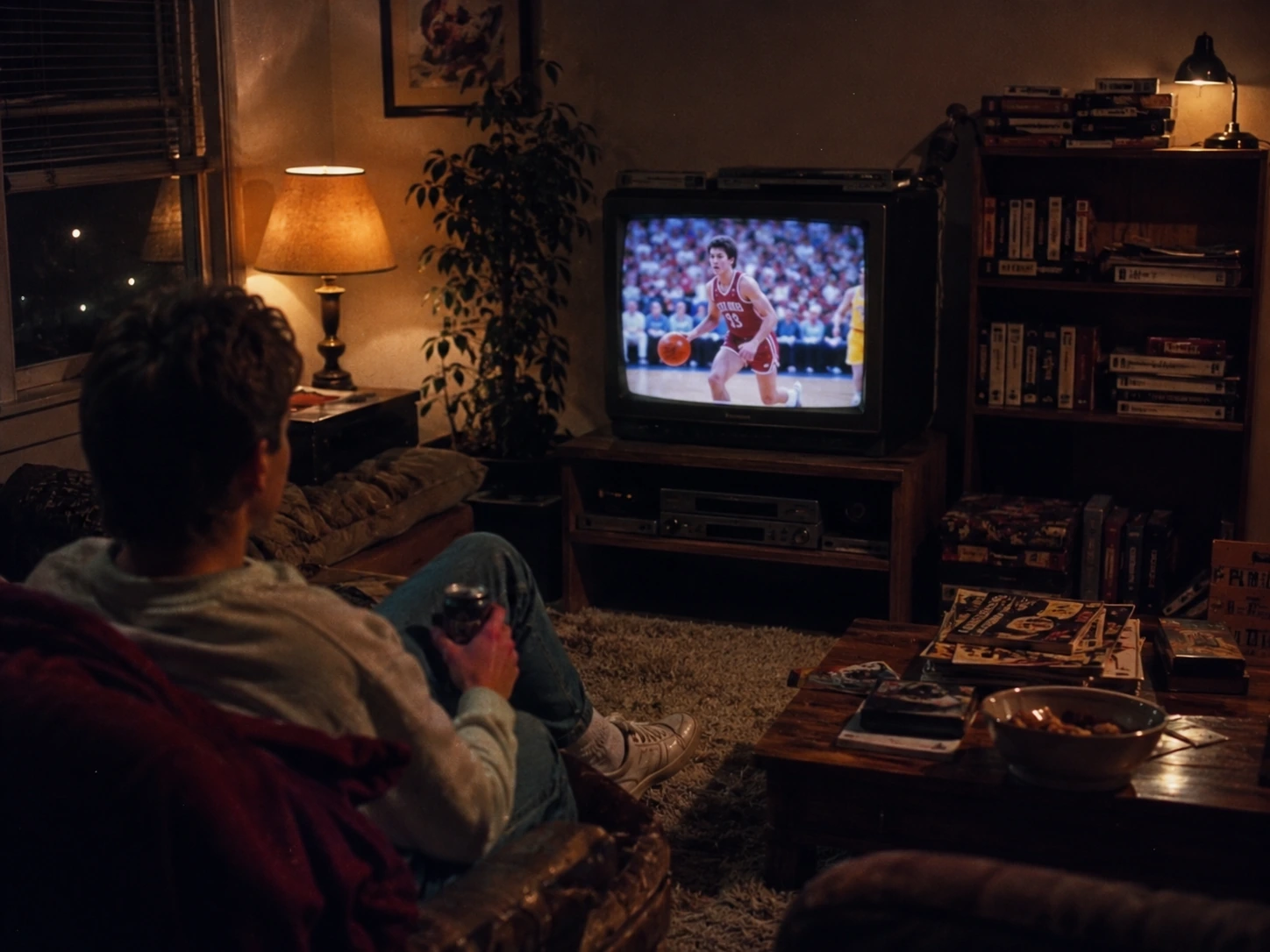
Broadcast File 04When One Commercial Could Reach Nearly Everybody
Editorial recreation: the shared television environment that allowed a campaign phrase
to leave the commercial break and enter everyday conversation.
National television gave the campaign something the fractured media world rarely produces now: repeated
exposure across a huge shared audience. The same viewer could encounter the slogan during basketball,
a sitcom, the evening news or a music-video block. By the time it appeared on shirts, posters and gym walls,
the phrase already felt familiar.
Nike’s line belonged in that world without behaving like most of it. There was no complicated joke to
remember, no character name to repeat and no product comparison to settle. The audience already knew what
“it” meant in the moment. The commercial only removed the delay.
The Copycats Learned the Big Lesson
What Other Advertisers Took From “Just Do It”
The campaign helped prove that a brand could own a behavior rather than merely a product claim.
Nike still sold shoes, but the advertising increasingly occupied the emotional territory around deciding,
training, returning and pushing through resistance. Competitors could compare materials and prices.
Copying that mental territory was much harder.
Other advertisers had already shown that commercials could become entertainment or public language.
Apple’s “1984” commercial
made a product launch feel cinematic.
Pepsi’s Michael Jackson campaign
borrowed the scale of pop stardom.
The Pepsi Challenge
turned consumers into participants. Nike’s contribution was to make the consumer’s internal decision
the main event.
Sell the identity around the product
A shoe could wear out. The idea of being somebody who acts, trains and keeps going could renew itself.
Let the audience complete the line
Because Nike never defined “it,” the slogan created a personal opening rather than a closed product statement.
Use stars without excluding everyone else
Celebrity athletes increased the scale, while the basic command remained available to ordinary people.
Repeat the center, vary the story
Different directors, athletes and moods could keep the work fresh without sacrificing recognition.
That formula now appears everywhere, which can make the original breakthrough harder to see. Brands routinely
talk about purpose, mindset, belonging and personal identity. The difference is that “Just Do It” reached that
territory with almost no verbal clutter. Three words carried the strategy, and the individual ads did the proving.
It also set a high bar that many later campaigns missed. Borrowing motivational language is easy.
Connecting it to believable people, specific effort and decades of consistent storytelling is the part
that keeps the words from becoming wallpaper.
Why the Line Stayed in Our Heads
Why “Just Do It” Still Sounds Right to Gen X
Gen X grew up surrounded by motivational language that often arrived with too much shine. “Just Do It”
had almost none. It did not ask us to visualize abundance, unlock a hidden destiny or applaud ourselves
for considering the possibility. It told us to move.
That tone fit a generation raised on latchkeys, pickup games, after-school jobs, questionable playground
equipment and adults who were not always standing nearby to provide a ceremonial confidence boost.
The slogan was motivational, but it was not tender about it.
It sounded useful
The phrase worked in a locker room, classroom, garage, office or private argument with yourself.
It did not overpromise
The line guaranteed no trophy. It only insisted that beginning was your responsibility.
It grew older well
At sixteen it sounded bold. Later it sounded practical. The command changed because the listener did.
The slogan also arrived when national television could make one phrase nearly universal. People heard it
during sports, sitcoms, news, music television and the rest of the shared broadcast soup. Then the words
followed them into gyms, schools, shirts, posters and everyday conversation.
Rewind Verdict
Nike’s 1988 “Just Do It” campaign lasted because it made the audience complete the message.
Walt Stack gave the line credibility, Dan Wieden gave it force and Nike gave it enough different
human stories to keep it from becoming empty. The shoes changed. The athletes changed. The thing
each person needed to do changed. The command never had to.
Keep Rewinding 1988
The Music, Movies, Television, Toys and Fads Around the Campaign
“Just Do It” arrived during a year already operating at full late-80s volume. Radio was glossy,
television still ruled the living room, the toy aisle had become a licensing battlefield and brands
were fighting to turn products into identities.