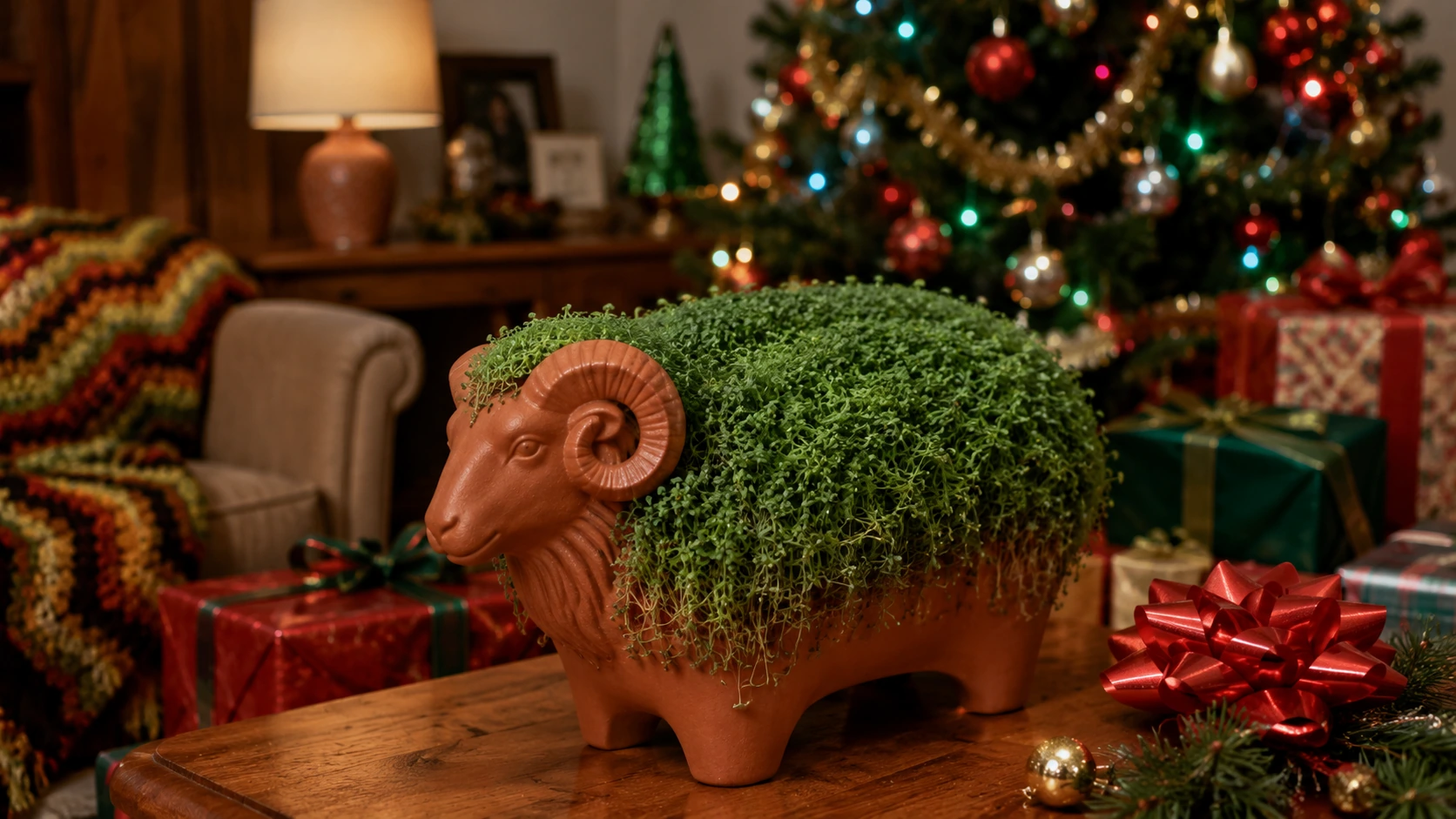
The 1984 Chia Pet Commercial
How “Ch-Ch-Ch-Chia!” Became an 80s TV Legend
Chia Pet was the kind of product only television could fully explain: a grooved terra-cotta animal,
a packet of seeds and the promise that wet green sprouts would eventually become fur.
It sounded like somebody had combined a planter, a craft project and a mild dare.
Yet the 1984 Chia Pet commercial helped make the strange little planter feel completely normal.
The demonstration was clear, the holiday-gift angle was easy to understand and the brand already had
one of advertising’s most durable sound triggers.
Gen X did not need to own a Chia Pet to know exactly what it was. Television handled that part.
The 1984 Chia Pet commercial was an early national television spot for the grow-it-yourself
terra-cotta planter sold by Joseph Enterprises. It demonstrated how chia seeds sprouted across
the grooved pottery, presented the product as an unusual holiday gift and reinforced the
“Ch-Ch-Ch-Chia!” advertising identity that helped turn Chia Pet into an enduring 80s icon.
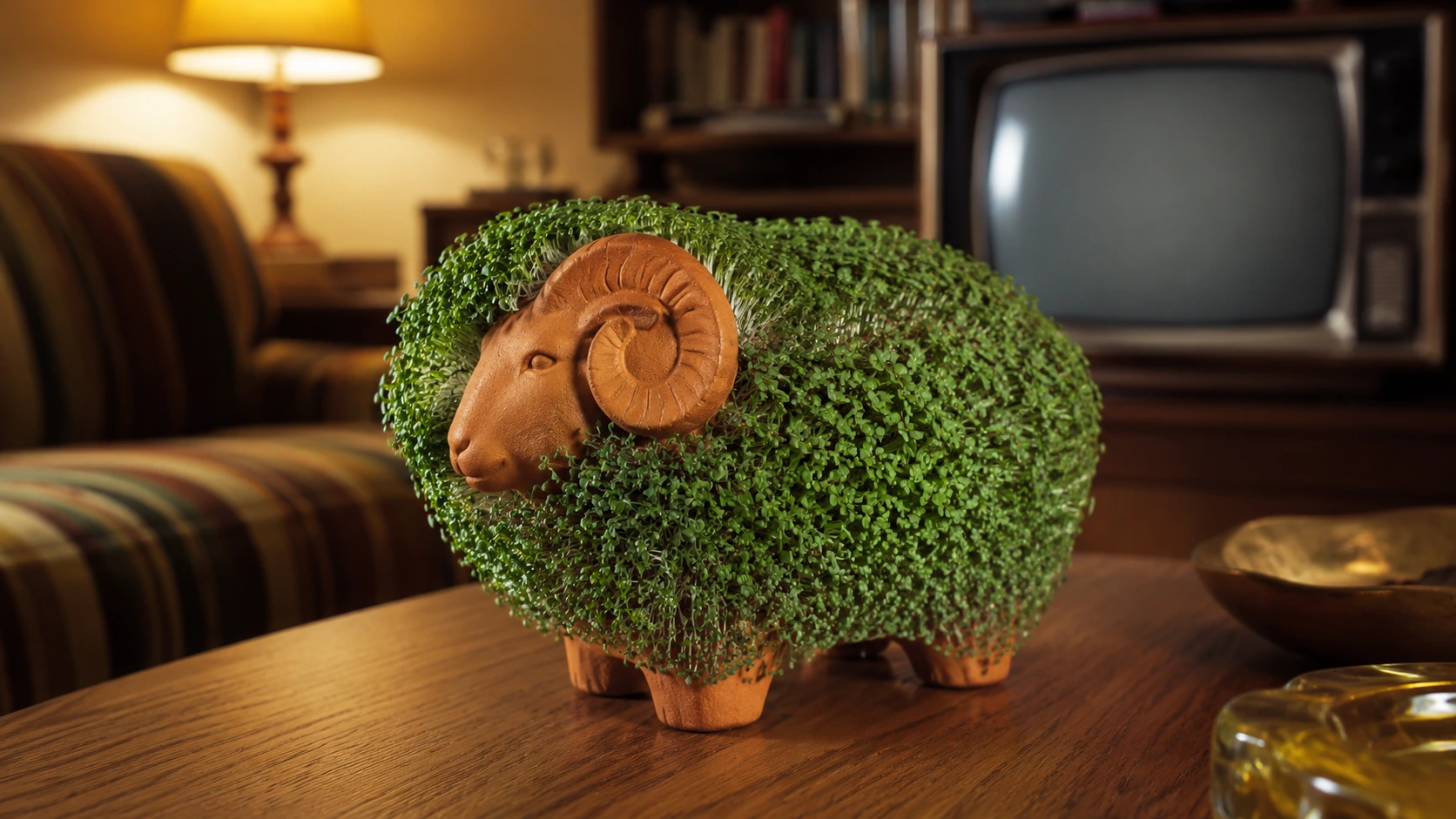
First major modelThe ram became the first widely marketed and distributed Chia Pet in 1982.
Marketing forceAdvertising executive Joseph Pedott bought the concept and rebuilt its production and promotion.
Commercial advantageThe before-and-after growth could be understood without a complicated explanation.
Long afterlifeThe product survived long enough to enter museum archives, parody and licensed-character culture.
The Origin File
How a Terra-Cotta Ram Became Chia Pet
Chia Pet did not begin as a polished national brand. Joseph Pedott encountered the terra-cotta planter
at a housewares trade show while looking for products and clients. The animal-shaped pottery was already
being imported from Mexico, but the business behind it was not working especially well.
Pedott saw something the original operation had not fully captured: the product was built for television.
The planter changed visibly. The instructions were simple. The finished result was strange enough to make
people stop. He acquired the rights, investigated the manufacturing process in Oaxaca and removed costly
problems from the production chain.
In 1981, he formed Joseph Enterprises. The company introduced the Chia ram as its first widely marketed
Chia Pet in 1982, and television advertising did the heavy lifting. The spots looked inexpensive because
they were, but that low-budget directness became part of the appeal.
The original ram design had exactly what early television advertising needed: an odd silhouette, a visible transformation and a finished result viewers could recognize instantly.
1980
Pedott encounters the terra-cotta grower at a housewares show, buys the rights and begins rebuilding the business.
1981
Joseph Enterprises is formed to manufacture and market products including Chia Pet.
1982
The Chia ram becomes the first widely marketed and distributed Chia Pet, supported by holiday television advertising.
1984
The brand is established enough for its odd little pottery animals to feel like recurring seasonal television characters.
Afterward
New animals, celebrity figures, parody and licensed characters extend the idea far beyond the original ram.
Grow Instructions
Why Chia Pet Was Almost Perfect for Television
Chia Pet had one enormous advertising advantage: the product explained itself through a visual transformation.
Viewers could see a plain clay animal become a green, living novelty. There was a beginning, process and payoff,
all compact enough to fit inside a short commercial.
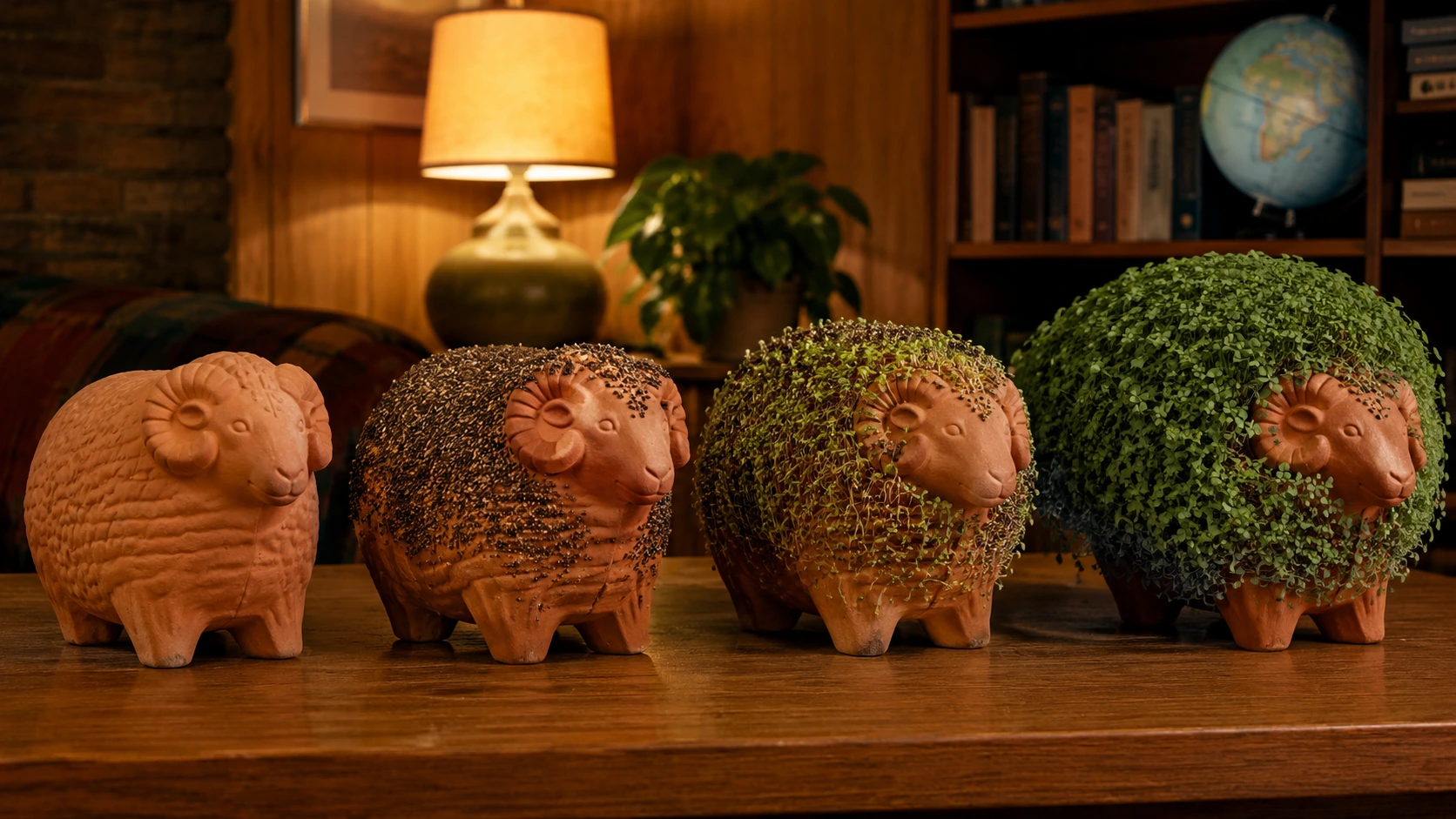
Soak the planter
The porous terra-cotta absorbed water and prepared the surface for the seed mixture.
Spread the seeds
Moistened chia seeds formed a gel-like coating that could be pressed into the grooves.
Keep it watered
The planter and seeds needed regular moisture while the sprouts developed.
Watch the fur arrive
The sprouts created the animal’s green coat and delivered the commercial’s visual payoff.
The entire Chia Pet pitch fit into one visual sequence: bare pottery, wet seeds, emerging sprouts and the fully grown green coat.
The product was not solving a serious household problem. It was selling transformation, novelty and the
small satisfaction of watching something grow. Television did not need to convince viewers that a Chia Pet
was necessary. It only had to make the result look amusing enough to give as a gift.
That is the same 80s commercial ecosystem that later turned dancing raisins into celebrities.
The California Raisins commercial phenomenon
used a different technique, but the basic lesson was similar: a strange visual idea could become
completely normal after enough television exposure.
Commercial Playback Notes
Why the 1984 Chia Pet Commercial Worked
The commercial does not waste time pretending Chia Pet is elegant. It leans into demonstration.
Viewers see what the pottery looks like, what it becomes and why the finished object might be funny
enough to place in a home.
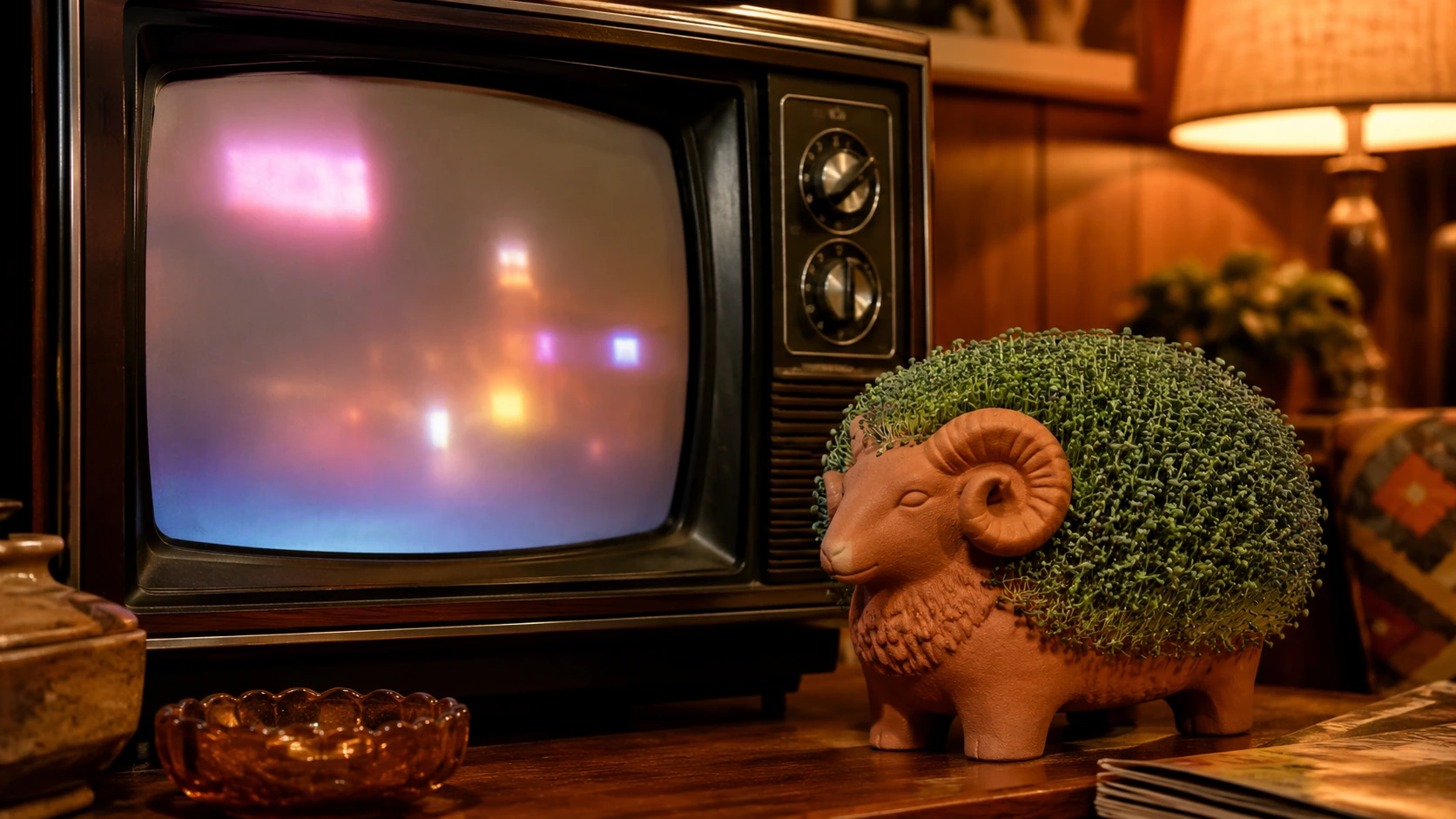
Chia Pet and the CRT belonged together. The television supplied the repeated demonstration, while the finished ram supplied the unforgettable visual punchline.
The product is visibleNo abstract lifestyle pitch is required. The viewer sees the planter and understands the basic trick.
The change is satisfyingPlain terra-cotta becomes a green animal, giving the commercial a clean before-and-after payoff.
The gift idea is obviousIt is inexpensive-looking, unexpected and strange enough to hand somebody at Christmas.
The tone stays cheerfulThe ad never pauses to examine whether a sprouting ceramic ram is a sensible object to own.
Repetition does the workHoliday rotation kept the same simple image and sound returning until recognition became automatic.
The product name carries rhythmChia was short, unusual and perfectly suited to a stutter-style jingle nobody could completely forget.
The commercial sells recognition before desire
Chia Pet’s real first victory was not making everybody buy one. It was making everybody know one.
Once the product became recognizable, it could live for years as a seasonal gift, a joke, a curiosity
and eventually a piece of shared television memory.
The low-budget look became part of the brand
A glossier campaign might have made the product feel overproduced. The plain demonstration,
straightforward narration and visible pottery matched what was being sold. Chia Pet looked like
something discovered in a drugstore gift aisle because that was exactly the lane it occupied.
Timeline Correction
Was the 1984 Commercial Really From Before the Famous Jingle?
Not exactly. Some surviving Chia Pet spots circulate without the familiar chant, which can make an individual
commercial feel like a pre-jingle experiment. But the broader brand history places “Ch-Ch-Ch-Chia!” inside
Chia Pet’s early national television campaign, beginning with the 1982 holiday-commercial era.
That makes 1984 part of the jingle’s early takeover, not a period before it existed.
The useful distinction is between a particular commercial that may emphasize demonstration and the larger campaign
identity viewers already associated with the product.
The correction actually makes the ad more interesting. Chia Pet did not become famous because one perfect commercial
suddenly appeared. The brand accumulated recognition through several low-budget spots, repeated holiday scheduling,
retailer information and a sound cue that kept returning even when the exact footage changed.
One ad is not the whole campaignDifferent edits and product demonstrations could circulate while the larger Chia identity remained consistent.
The jingle was already part of the eraOfficial and trade histories connect the famous chant with the early-1980s national television push.
Repetition created the final memoryViewers now combine several commercials, seasons and product models into one permanent Chia Pet memory.
Audio Memory Trigger
How “Ch-Ch-Ch-Chia!” Took Over the Brand
The famous Chia Pet jingle did not need a melody with emotional range. It needed a sound that could
attach permanently to the name. According to the company’s own history, the phrase emerged when
somebody playfully stuttered “Chia,” and Pedott recognized that the repetition was catchy.
That tiny decision gave the brand something most novelty products never receive: an audio identity
stronger than the object itself. Once viewers heard the name, the brain supplied the rhythm.
Even people who never bought a planter could perform the commercial.
Ch-Ch-Ch- Chia!
It says the product nameThe jingle does not compete with the brand. The brand is the jingle.
It matches growthThe repeated syllables feel like stages, making the sound oddly compatible with sprouts appearing over time.
It survives without the pictureSomeone can say the first sound and an entire commercial returns from memory.
It invites imitationViewers could repeat it immediately, which turned ordinary conversation into free advertising.
The strongest 80s commercial sounds worked this way. They could survive apart from the advertisement
and reappear in daily speech. That same memory machine powered slogans, mascot voices and jingles across
the decade, as seen throughout the site’s look at 80s commercial mascots and advertising characters.
Seasonal Sales Machine
Why Chia Pet Became a Holiday Television Tradition
Chia Pet fit the Christmas advertising calendar almost too well. It was inexpensive enough to feel
plausible, unusual enough to solve the “what do I buy this person?” problem and visual enough to benefit
from heavy television repetition.
A 1984 Washington Post column captured the product at exactly that moment: a weird commercial discovery
treated as a possible answer for people who already had everything. Joseph Pedott told the paper that the
company had commissioned 200,000 units the previous year and sold all but 25,000, then increased production
to 250,000 for 1984.
Heavy holiday rotation turned the Chia ram into the perfect television-era odd gift: inexpensive, recognizable and just strange enough to wrap.
The “person who has everything” gift
Chia Pet did not need to beat a practical product. It needed to occupy the odd-gift category before somebody else did.
Seasonal repetition built the reflex
Seeing the ads every holiday season made the product feel permanent even when it disappeared from attention for months.
Drugstores were part of the strategy
The original distribution fit the product’s personality. A Chia Pet could appear near practical purchases,
holiday displays and impulse gifts. It did not require a specialty store or a long sales conversation.
The commercial created recognition, and the retail shelf completed the transaction.
Did the Weird Thing Sell?
Chia Pet Was More Than a Commercial Punchline
The easy modern assumption is that Chia Pet survived mainly as a joke. The sales story says otherwise.
In a December 1984 interview, Joseph Pedott said the company had commissioned 200,000 Chia Pets for the previous
holiday season and sold all but 25,000. For 1984, production rose to 250,000 units.
Those numbers help explain why the commercials kept returning. Chia Pet occupied a profitable middle ground:
recognizable enough to advertise nationally, inexpensive enough to buy impulsively and strange enough to work
as a gift without requiring deep knowledge of the recipient.
The product created its own buying occasion
Nobody needed to wait for a broken household item or a practical problem. Chia Pet was purchased because it was Chia Pet.
The product created a category around itself: the funny present, the desk curiosity, the seasonal novelty or the object
given to somebody after every normal gift idea had failed.
Registration cards revealed real attachment
Pedott also described receiving a steady stream of registration cards that read more like affectionate notes than routine
product paperwork. That reaction mattered. The product was ridiculous, but owners often treated it with the same playful
attachment people give a plant, craft project or novelty object that becomes part of the house.
Shared Television Memory
Why Gen X Remembers Chia Pet Even Without Owning One
The simple explanation is repetition, but that does not cover the whole effect. Gen X grew up when a relatively
small number of channels could expose millions of people to the same commercial language. An ad did not need to
become anybody’s favorite. It only needed to return often enough to become part of the room.
Chia Pet was especially good at occupying that background. The product image was strange, the jingle was easy to repeat
and the seasonal timing gave the commercials a recurring place in the calendar. The ads felt less like individual campaigns
and more like a yearly television weather pattern.
Limited-channel repetitionThe same spot could reach viewers again and again because there were fewer places for attention to go.
A visual nobody confusedThere was no risk of mistaking a sprouting ceramic animal for another household product.
A sound people could performThe jingle turned viewers into participants with no purchase required.
That is why Chia Pet belongs beside the larger fads and pop-culture crazes of 1984.
It was not necessarily the most important product in anybody’s life. It was simply one of those things television made
impossible not to know.
The 80s Sales System
What Chia Pet Reveals About As-Seen-on-TV Advertising
Chia Pet belongs to a specific advertising tradition: products that television could demonstrate more effectively
than a shelf display could explain. The commercial was not merely announcing availability. It was performing the product,
showing the transformation and teaching the viewer how to retell the pitch.
Demonstration beat descriptionShowing sprouts grow across the planter communicated more than any package paragraph could.
Retail tags closed the loopJoseph Pedott’s advertising operation became known for dealer tagging that told viewers where a product could be purchased locally.
Holiday rotation supplied frequencyThe same pitch could return every season without needing to become a year-round lifestyle brand.
Low production costs helpedA straightforward studio demonstration left more room for repeated airtime and retailer-specific versions.
The viewer could repeat the pitch“Pottery that grows” and the Chia chant were simple enough to survive after the commercial ended.
Strangeness reduced competitionThere were many gifts and planters, but there was only one heavily advertised sprouting ceramic animal.
That system also explains why the decade produced so many durable commercial memories.
The Pepsi Challenge campaign used public taste tests,
while Chia Pet used a visual transformation. Different products, same principle: give the audience a simple event
they can understand, repeat and discuss.
Long-Term Growth Report
How Chia Pet Outlived the Novelty-Product Graveyard
Most novelty products have a short life. The joke becomes familiar, the commercial disappears and the remaining inventory
finds a clearance shelf. Chia Pet avoided that fate by remaining recognizable while constantly changing the shape.
The core idea stayed simple
A grooved figure grows chia sprouts. New models could change while the demonstration remained instantly understood.
The product became parody-proof
Jokes and spoofs reinforced recognition. Once the name was culturally secure, parody worked like another advertisement.
Licensed figures opened a new lane
Characters and celebrities allowed the same growing gimmick to connect with different fan communities.
The history became museum material
Joseph Pedott’s papers, packaging and commercials entered the Smithsonian’s National Museum of American History archives.
The company says more than 25 million Chia Pets have been sold, and the lineup now extends far beyond the ram.
That does not mean the product stopped being weird. It means the weirdness became dependable.
Chia Pet became a format, not one object
Once consumers understood the system, almost any recognizable shape could become a Chia figure.
The product could keep changing without requiring the commercial to teach the audience from the beginning.
That is one reason the brand could move from animals to fictional characters, musicians, television personalities
and other licensed designs.
Rewind Verdict
The 1984 Chia Pet commercial worked because the product, demonstration and jingle were all doing the same job.
Each one made the idea easier to recognize. Chia Pet was strange enough to stop the viewer, simple enough to explain
and repeatable enough to become a holiday ritual. Gen X remembers it because television did not merely sell the planter.
Television turned the planter into a permanent sound effect.
What was advertised in the 1984 Chia Pet commercial?
The commercial advertised a grooved terra-cotta planter coated with moistened chia seeds so sprouts would grow across the figure like green fur or hair.
Who turned Chia Pet into a national brand?
Advertising executive Joseph Pedott acquired the product rights, improved the manufacturing operation and marketed Chia Pet through Joseph Enterprises.
When was the first widely marketed Chia Pet released?
The Chia ram became the first widely marketed and distributed Chia Pet in 1982.
Was the Ch-Ch-Ch-Chia jingle already used in the early 80s?
Yes. Company histories place the jingle in the brand’s early national television era, beginning with the 1982 holiday commercials.
Where did the Ch-Ch-Ch-Chia jingle come from?
Accounts differ on the exact setting, but the company says someone playfully stuttered the word Chia and Joseph Pedott recognized the phrase as a strong advertising hook.
Why was Chia Pet effective in television commercials?
The product offered a fast visual demonstration: a plain clay figure became covered in green sprouts, creating an obvious before-and-after payoff.
Why was Chia Pet marketed as a holiday gift?
It was unusual, easy to demonstrate and suited to buyers searching for an inexpensive novelty gift for someone difficult to shop for.
What was the original Chia Pet animal?
The ram was the first widely distributed Chia Pet model.
Were Chia Pets made in the United States?
The early terra-cotta figures were manufactured in Oaxaca, Mexico. Production arrangements changed later in the company’s history.
Why does Gen X remember Chia Pet so clearly?
Seasonal repetition, limited-channel television, the unusual visual product and the unforgettable jingle created a shared memory even among people who never owned one.
Did Chia Pet remain popular after the 1980s?
Yes. The line expanded into more animals, licensed characters and celebrity figures while retaining the same grow-it-yourself concept.
Is Chia Pet represented in the Smithsonian?
Yes. The Smithsonian’s National Museum of American History holds Joseph Pedott materials including Chia Pet business records, packaging and television advertising.