The Rise of the Single-Adult Sitcom in the 1990s

The Rise of the Single-Adult Sitcom in the 1990s
Apartments, dating, careers and city life became a repeatable 90s sitcom machine. Here’s how single-adult comedy took over prime time.
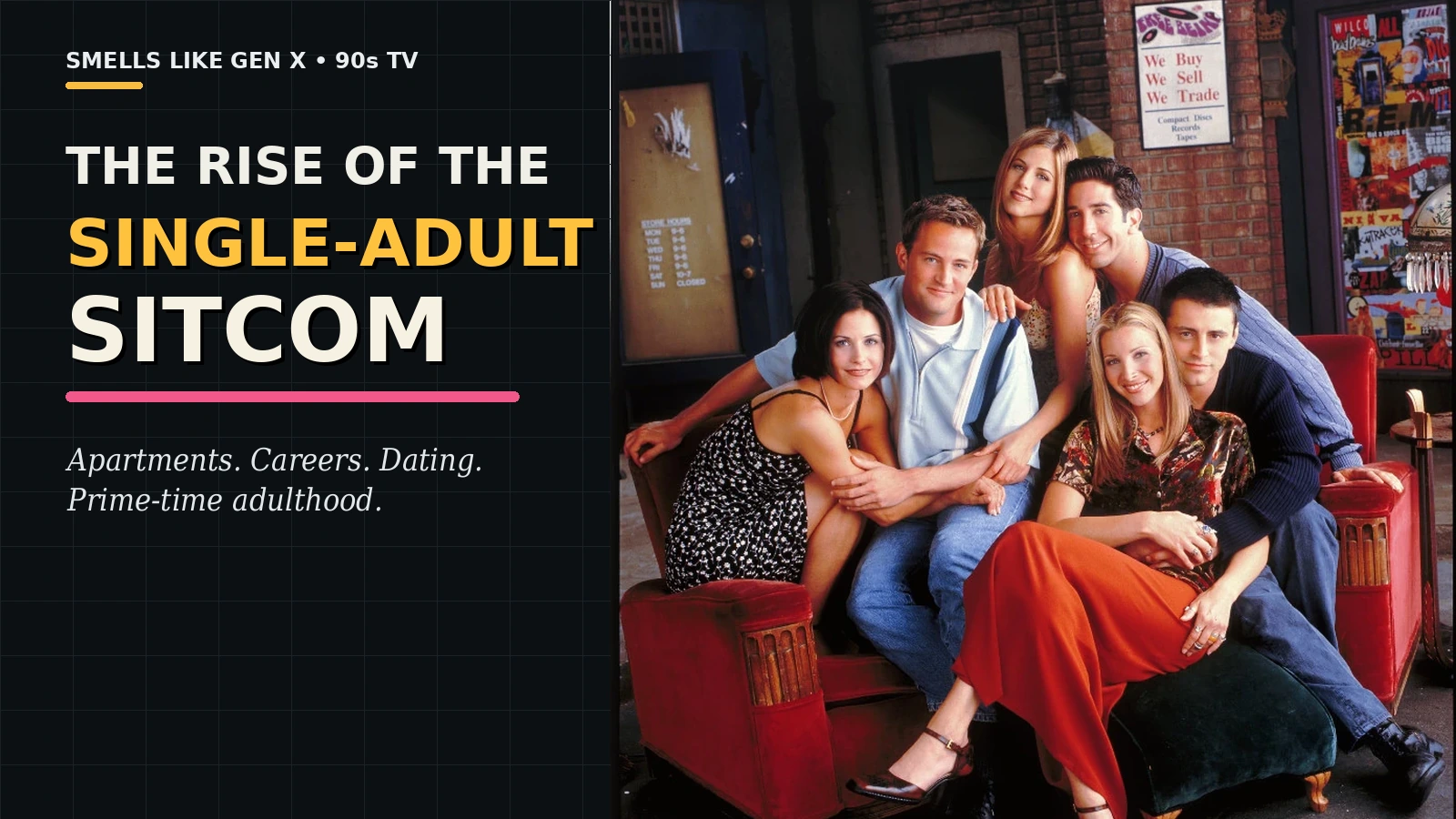
Why did single-adult sitcoms become so common in the 1990s?
Because the format generated stories almost automatically. Single characters could date, change jobs, move apartments, fight with roommates and build chosen-family friend groups without resetting the premise. Seinfeld and Friends proved the audience was enormous, and networks—especially NBC—spent the decade trying variations on the same adult-life engine.
Single Adulthood Became a Sitcom Format of Its Own
The broader cultural shift from household families toward friend groups is covered in our story about the rise of friend-centered 90s sitcoms, while the larger decade sits inside our 1990s TV guide. Here, the focus is the machinery that appeared once network programmers realized that single adulthood itself could produce an almost endless run of plots: dating, rent, jobs, roommates, breakups, career envy, bad bosses and the recurring question of whether any of these people were actually becoming adults.
The format was flexible because nothing had to stay solved. A family sitcom begins with obligations already locked in. A single-adult sitcom begins with open doors. A character can quit a job, meet somebody, dump somebody, move across the hall, inherit a roommate, embarrass themselves at work and still return next week with the premise intact.
The result was a story engine that could be warm, cynical, romantic or workplace-heavy without changing its basic grammar. The apartment or hangout stayed put while adult life kept throwing new problems through the door.

Marriage Wasn’t the Destination Because There Was No Destination
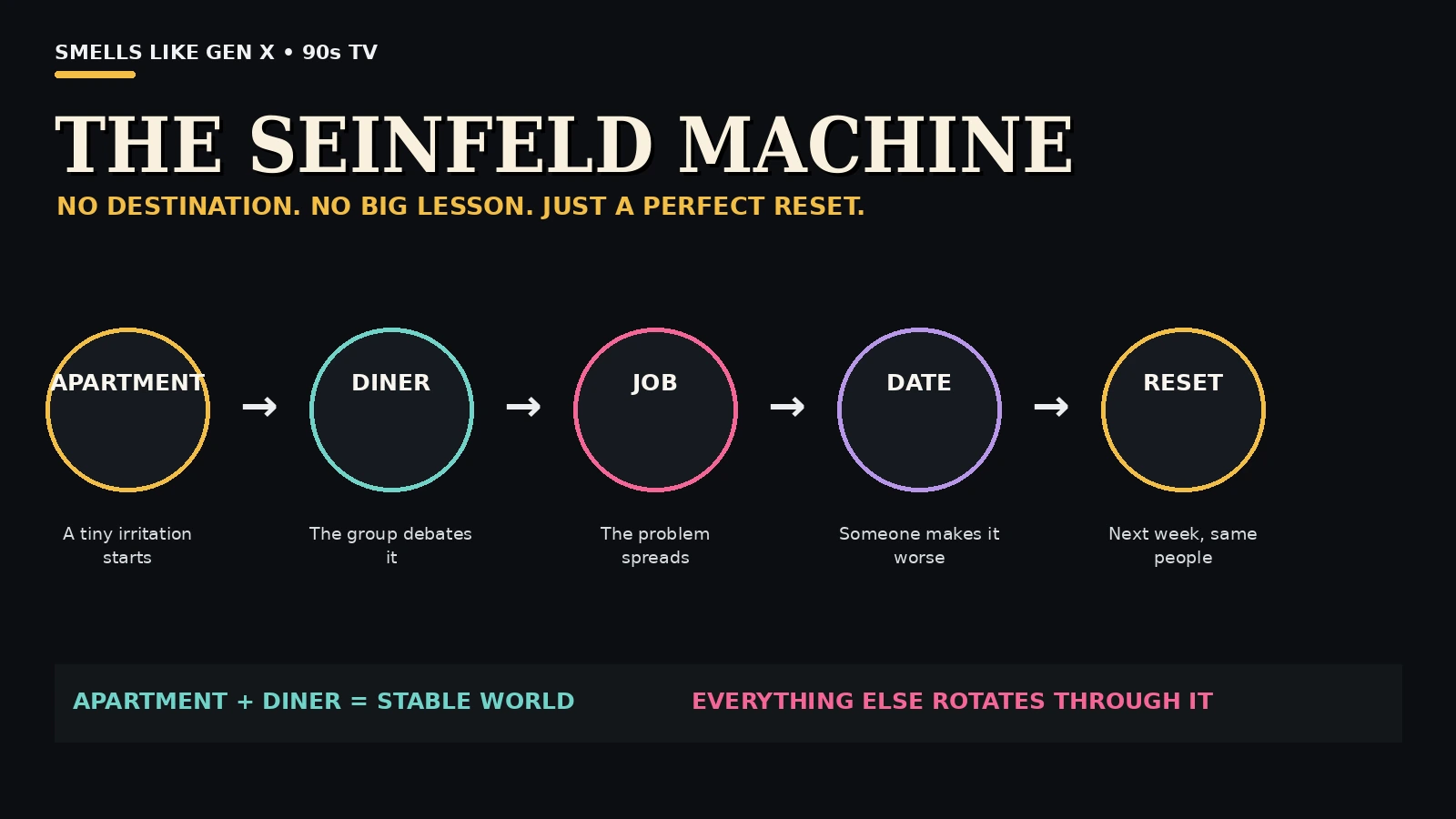
Seinfeld established one of the most important rules of the format: adulthood did not need to be a story about progress. Jerry, George, Elaine and Kramer could cycle through dates, jobs, schemes and petty disasters without becoming better people. Their lives were not waiting for a family-sitcom endpoint. The refusal to arrive was part of the joke.
That made the show an unusually useful model for networks. A romance could matter without threatening to transform the series. A job could matter without defining the character forever. The apartment and diner held the center while everything else rotated through. The audience understood the stability of the world even when the characters were constantly creating instability inside it.
Seinfeld also taught programmers that a single-adult sitcom did not have to be sentimental to be sticky. Friendship could be the structure without becoming the moral lesson. That opened the category to a much wider tonal range.
The Apartment Was Messy, but the Social Safety Net Was Perfect
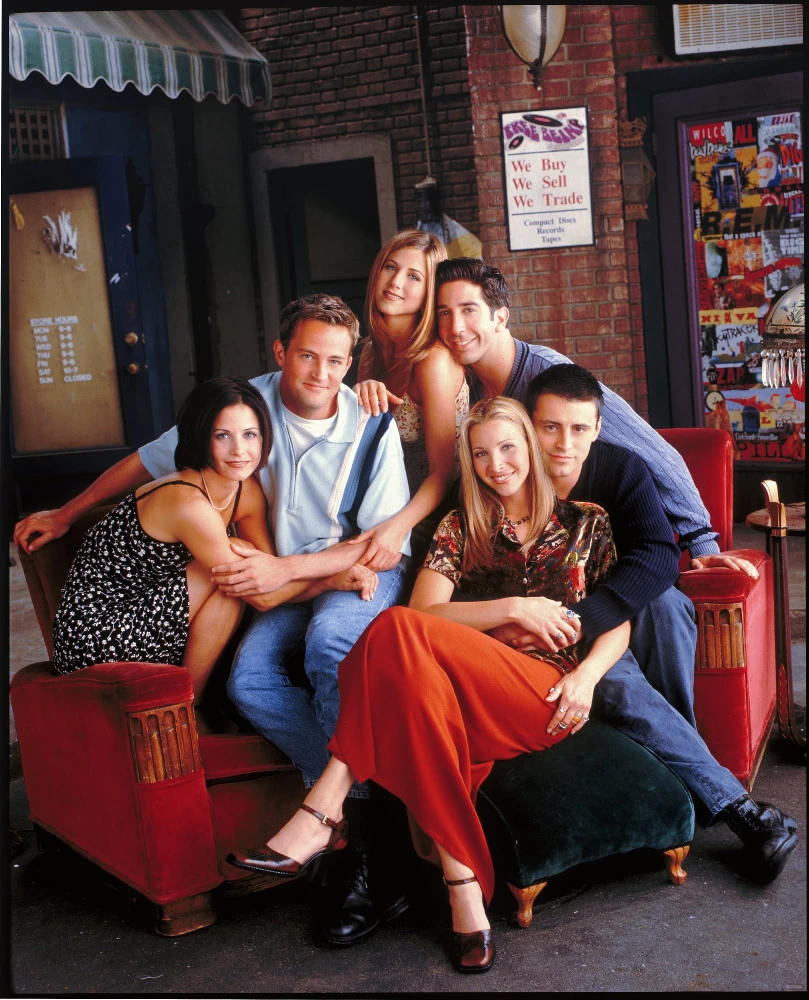
Friends took a warmer route. Its characters were not anti-growth; they wanted relationships, careers and eventually families. But the series still treated the unstable years before those outcomes as a complete world worthy of ten seasons. Jobs could be temporary. Relationships could fail. The group remained.
That combination—instability around a stable social core—was gold for network comedy. Viewers could invest in change without losing the weekly comfort of the ensemble. It also gave the show an aspirational quality that advertisers loved: young adults in the city, building careers, dating, buying coffee and turning friendship into infrastructure.
The apartments were impossibly generous by real New York standards, but the emotional fantasy was the point. The characters had a place to return to and people who would be there. In a decade where adulthood was increasingly delayed and improvised, that fantasy had enormous pull.
NBC Tried to Industrialize the Life Stage
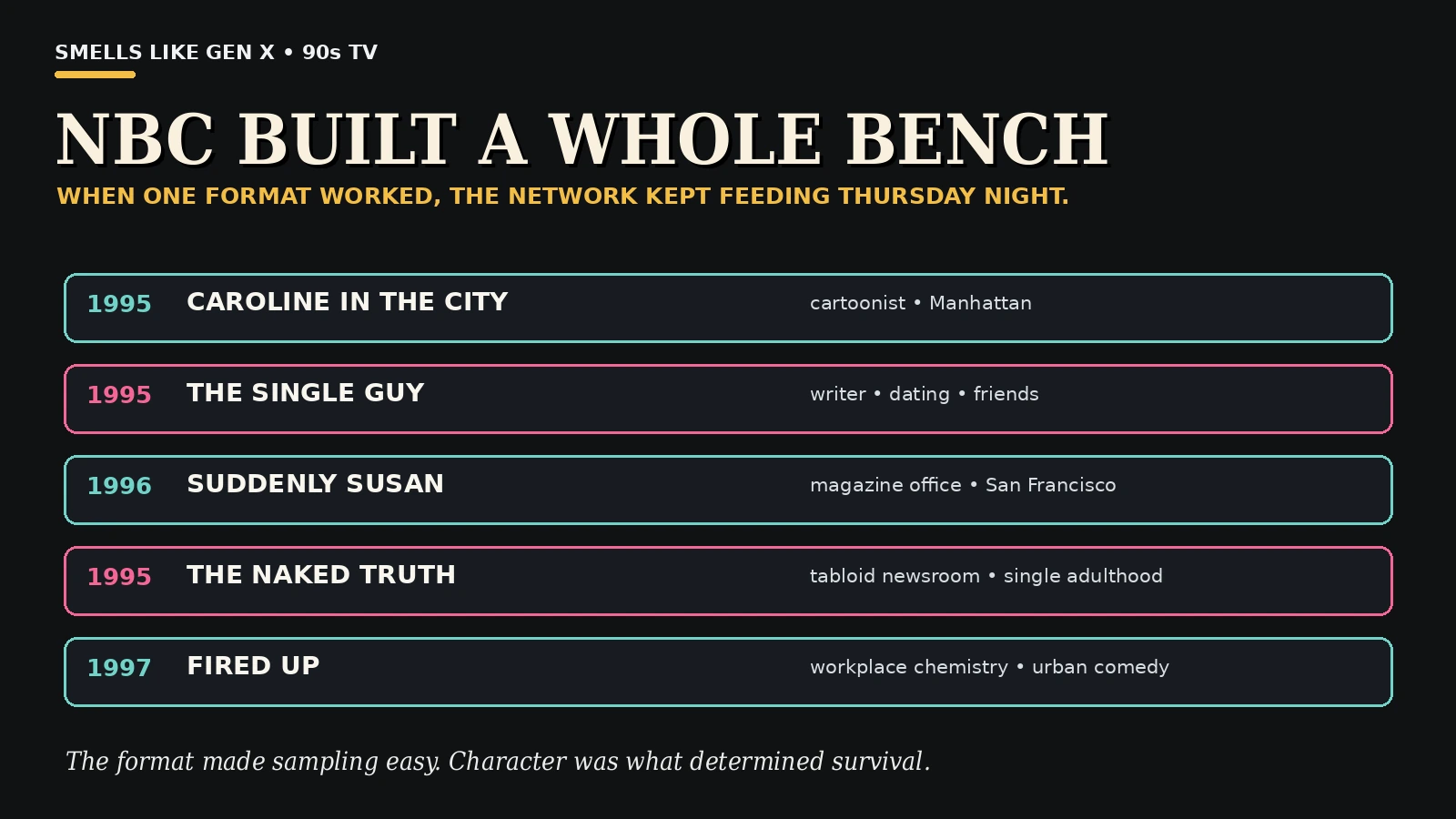
Once Seinfeld and Friends proved the scale of the audience, NBC filled the schedule with variations. Caroline in the City, The Single Guy, Suddenly Susan, The Naked Truth, Fired Up and others shuffled careers, cities, roommates and romantic complications into different combinations. Some became real hits for a season. Some disappeared quickly. The format itself was bigger than any one result.
That bench is why the forgotten Must See TV sitcoms are so revealing. Ratings success and cultural memory are not the same thing. A single-adult show could inherit a giant lead-in, post a remarkable number and still fail to create characters people cared about ten years later.
The repetition eventually exposed the weakness of the formula. If every show had attractive adults, a stylish apartment and a bad date, viewers needed a reason to care about this particular group. The format created sampling; character created survival.
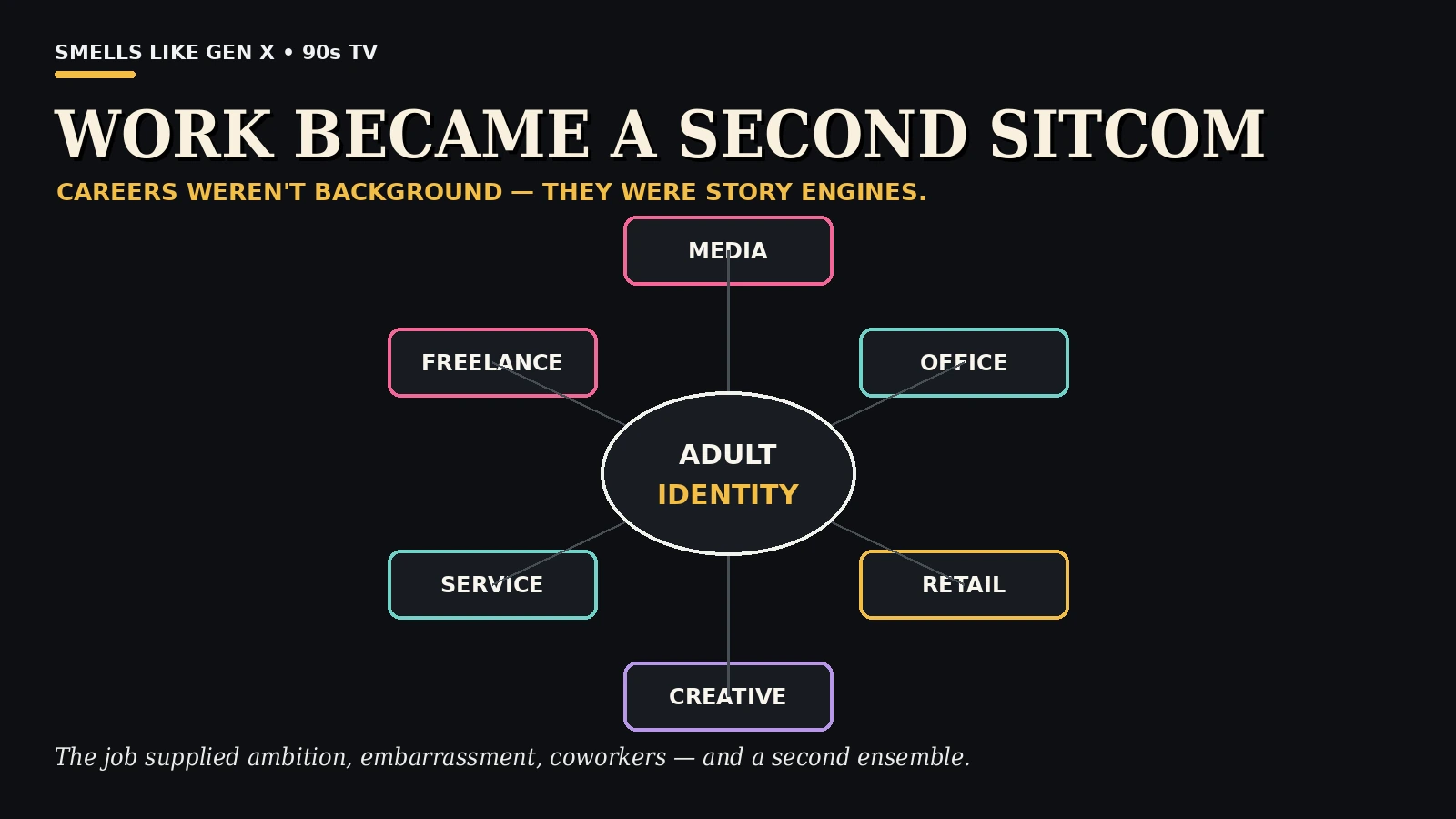
Careers Became Character Engines Instead of Background Information
Single-adult sitcoms needed story sources beyond romance, and work was perfect. A character’s job could generate new coworkers, status anxiety, bosses, ethical conflicts and identity crises without tying the show to a family structure. Publishing, television, advertising, journalism, fashion, service jobs—prime time suddenly had a lot of young adults trying to figure out what they were good at.
The 90s version of career often looked suspiciously flexible, especially given the size of the apartments, but the emotional idea landed. Work was one of the places where Gen X viewers were building adult identity. The comedy came from the mismatch between what adulthood was supposed to look like and the reality of being underpaid, underqualified or simply confused.
Work also supplied a second ensemble. A character could have one social world at home and another at the office, letting writers cross romantic and professional stories without expanding the permanent cast too far.
Every Guest Star Could Be a New Problem
Dating gave the format renewable energy. A family sitcom might need to invent an outside crisis; a single-adult sitcom could simply introduce a person. The new date could expose insecurity, class differences, weird habits, jealousy or fear of commitment. One episode later the character could be gone, leaving behind a story without permanently changing the premise.
The danger was repetition. Once every sitcom had a disastrous blind date and a misunderstanding with an ex, the genre could start to feel like a factory. The best shows survived because dating revealed character. The weaker ones treated the date itself as the joke. That difference separates the durable series from the shows we now remember mostly because they once followed Friends.
The format also allowed long arcs without sacrificing episodic accessibility. A relationship could last half a season, collapse, and leave the show’s larger social unit intact. That balance made single-adult comedy unusually easy to serialize just a little.

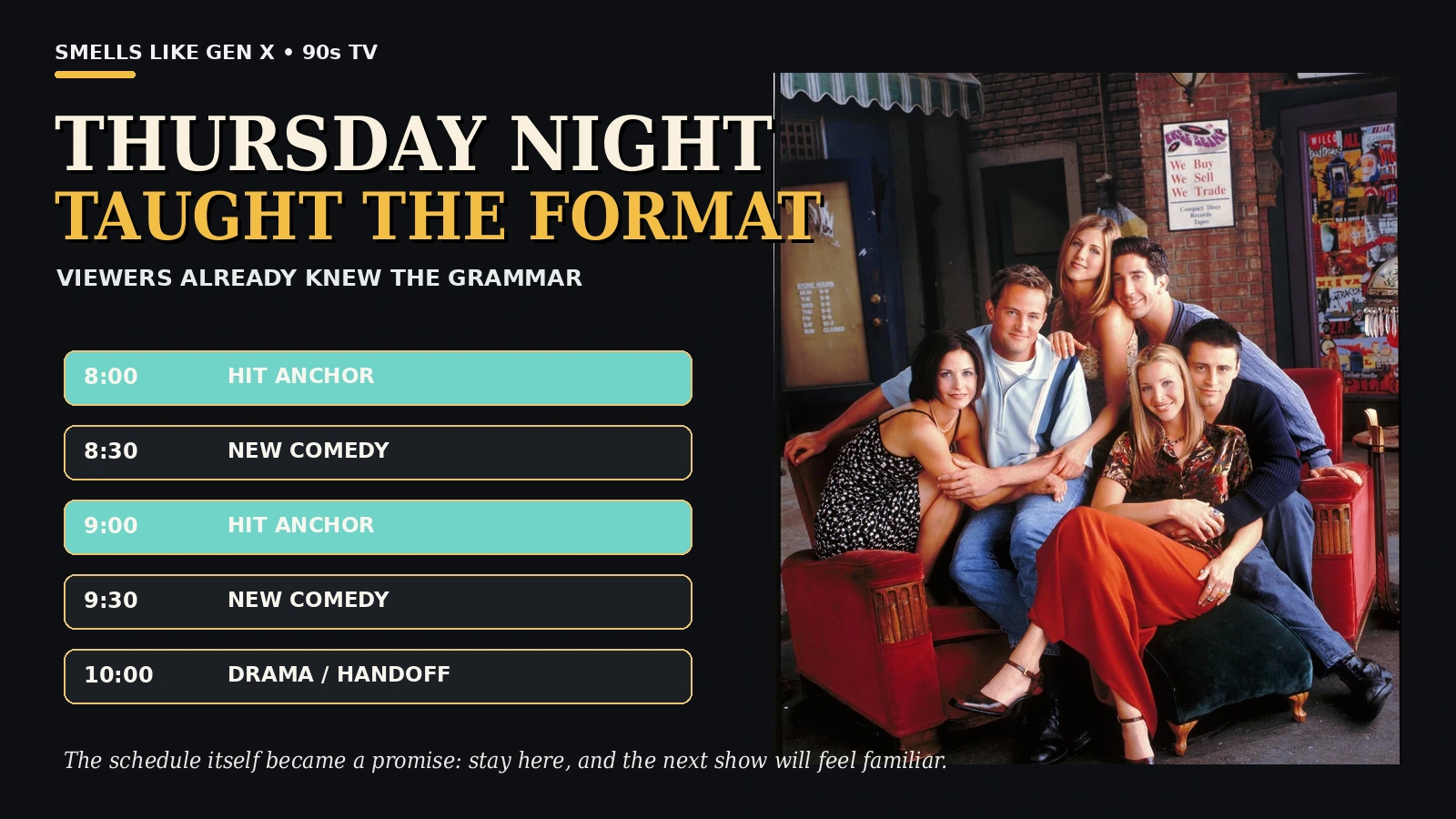
Thursday Night Made Single Adulthood Look Like Prime-Time Normal
The bigger network strategy belongs to our Must See TV history, but the single-adult format was one of its favorite building blocks. NBC could place a new comedy between established hits and tell the audience, essentially, “you already understand this world.” Apartment, job, dating problem, attractive cast, familiar rhythm. The learning curve was tiny.
That efficiency helped create the boom and eventually the fatigue. When the network had too many similar shows, the distinctions got smaller. Yet the repetition itself tells us how completely the form had been normalized. By the late 90s, a sitcom about unmarried adults in a city did not need a special explanation. It was simply television.
That normalization is the format’s real victory. The single-adult sitcom stopped being a novelty category because it became one of the default ways network comedy imagined adulthood.
Modern Ensemble Comedy Still Uses the 90s Blueprint
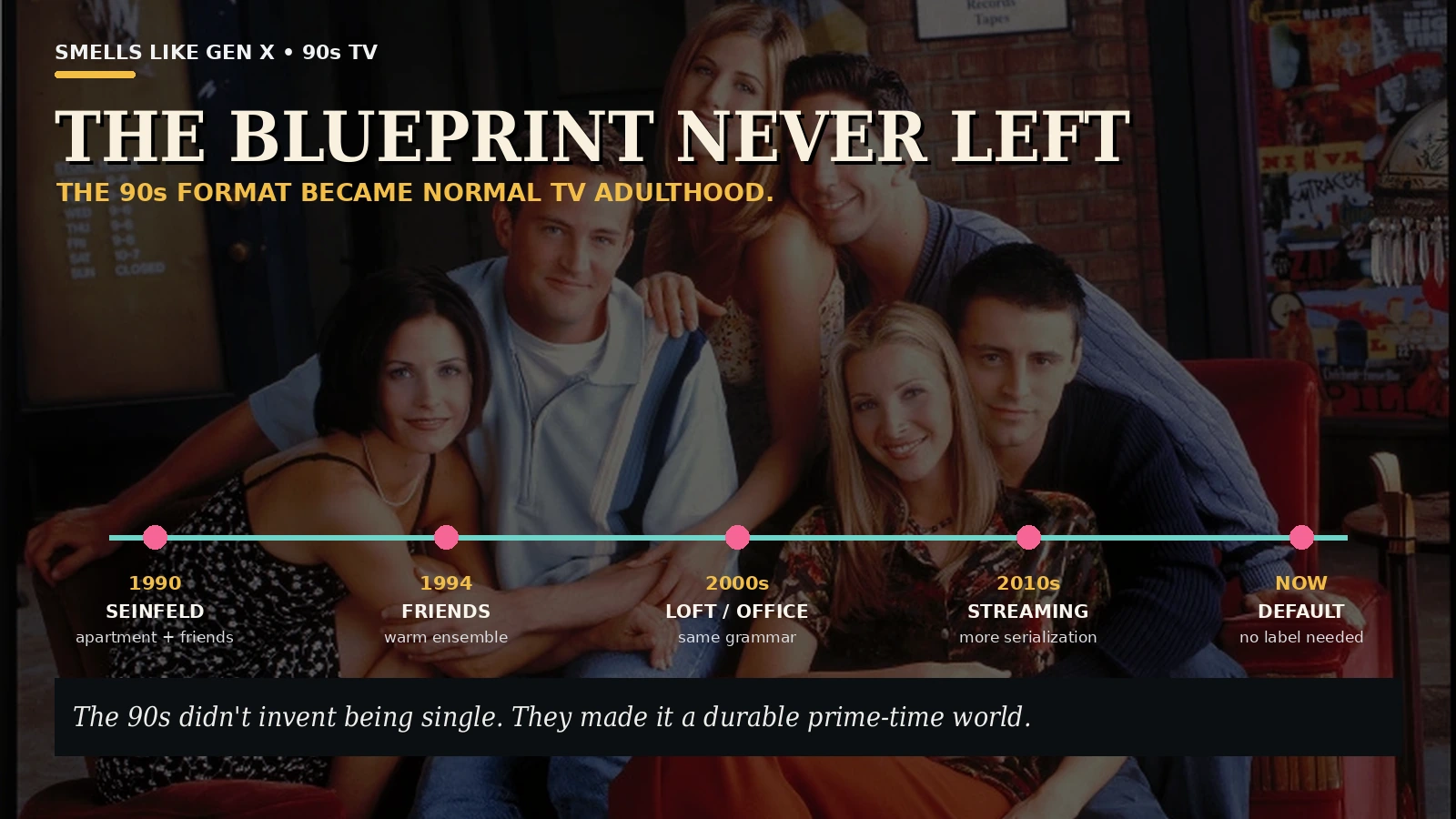
The single-adult sitcom stopped feeling like a 90s category because it became ordinary. Later shows could move the apartment to a loft, office, bar, restaurant or shared house and keep the same engine: friends, work, romance and the long delay between youth and whatever comes next. The furniture changed. The structure stayed.
That is the clearest legacy. The 90s did not invent unmarried adults or workplace comedy, but they made the combination a repeatable mass-market formula. Once television learned it could build an entire emotional universe around adults who had not yet settled down—and might never want to—it gained one of its most durable comedy formats.
For Gen X, the appeal was especially obvious. The shows captured the years when adulthood felt less like a destination than a series of temporary arrangements. They exaggerated the apartments, polished the wardrobes and improved the coffee, but the uncertainty underneath was real.
Single Adulthood Was Cheap to Explain and Expensive to Replace
The single-adult sitcom was attractive to networks because viewers understood the premise almost instantly. You did not need a complicated mythology. Put a handful of adults in a city, give them jobs, apartments and romantic problems, and the pilot could start generating stories before the audience had learned every last name. That efficiency mattered in a schedule where a new comedy might get only a few weeks to prove itself. The format reduced the amount of setup a show needed and let casting, chemistry and dialogue do the differentiating.
It was also advertiser-friendly in a very 90s way. Young and middle-young adults living independently represented a consumer fantasy even when the characters were supposedly broke. They bought clothes, ate out, dated, moved, decorated apartments and worried about careers. The shows could be emotionally about uncertainty while visually selling a version of adulthood that looked active and connected. That combination helped make the category attractive to networks chasing viewers advertisers valued, especially on nights built around upscale comedy.
The weakness was that easy legibility could become sameness. Once the schedule filled with apartments, witty coworkers and improbable dates, a new series had to establish personality fast. Some never got beyond the premise. Others found one voice, one performer or one relationship that separated them from the pile. That is why the forgotten NBC bench is so useful historically. The network was not stupid for making so many similar shows; it was responding rationally to a format that kept producing ratings. Cultural memory simply turned out to be much harsher than the overnight numbers.
The long-term winner was not any particular knockoff. It was the idea that television adulthood could exist before or outside marriage. That sounds unremarkable now because later comedy absorbed it completely. Roommates, coworkers, exes and friend groups became sufficient foundations for an ensemble. The 90s single-adult boom helped sever the old assumption that a sitcom needed a household family to feel emotionally complete. Once that door opened, television had many more ways to define home.
The boom also reflected a practical generational shift in what adulthood looked like on screen. Marriage and children remained central to millions of real lives and to successful sitcoms, but prime time no longer treated them as the only markers that made an adult character complete. Renting, changing jobs, dating badly, living with roommates and relying on friends could sustain a full narrative world. That widened the comedy map for writers and viewers at the same time. A character did not have to “graduate” into a family premise for the show to take the character seriously. The instability itself became legitimate subject matter, which is one reason the format lasted beyond the decade that made it fashionable.
The category also worked because it sat at the intersection of several existing sitcom traditions. It borrowed the recurring workplace from office comedies, the emotional intimacy of family sitcoms, the romantic churn of dating comedies and the urban independence of older shows about single women and men. The 90s version bundled those pieces into one flexible package. Networks could adjust the tone without rebuilding the engine: make it more cynical, more romantic, more workplace-driven or more ensemble-focused, and the audience still understood the basic world.
That flexibility explains why the format survived even after the late-90s glut cooled. The specific look of the era—oversized apartments, coffeehouses, answering machines, landlines, suits that were somehow both boxy and expensive—dated quickly. The underlying structure did not. Friends, work and romance remain renewable story sources because adult life keeps producing new versions of the same tensions. The 90s boom was historically specific, but the mechanism it normalized was much bigger than the decade.
By the end of the decade, the premise was so familiar that parody became possible. Viewers already knew the visual shorthand: apartment door, takeout containers, office crush, answering machine, friend on the couch. That familiarity is one of the clearest signs the format had won. Television no longer had to explain why unmarried adults deserved to be the center of a sitcom; the audience had spent the decade practicing that assumption.
Frequently asked questions
What is a single-adult sitcom?
A sitcom centered on unmarried adult characters whose stories revolve around friends, dating, careers, roommates and urban or semi-urban independence.
Did Seinfeld invent the format?
No, but Seinfeld became one of the most influential 90s examples by proving the characters did not need a conventional family endpoint.
Why was Friends important?
Friends made the same life stage warmer and more aspirational, with the friend group functioning as the stable support system.
Which forgotten 90s shows used the format?
Caroline in the City, The Single Guy, Suddenly Susan, The Naked Truth and Fired Up are prominent NBC examples.
Why did networks like this format?
It generated renewable stories around work, dating and friendship while keeping the basic ensemble intact.
How is this different from the friend-group story?
That story looks at chosen family as a broader cultural shift. This one looks specifically at the repeatable single-adult sitcom machinery built around apartments, dating, careers and friendship.