Why 90s Sitcoms Shifted From Families to Friends

Why 90s Sitcoms Shifted From Families to FriendsThe decade did not abandon the family sitcom. It widened the definition of who could feel like family.
At the start of the 1990s, the sitcom still knew exactly where home was. By the middle of the decade, some of television’s biggest comedies were spending just as much time in apartments, coffee shops, diners and offices. Seinfeld, Living Single and Friends did not kill the family sitcom. They proved that friendship, work, dating and chosen family could carry prime time on their own.
Why did so many 90s sitcoms become centered on friends?
Because television discovered that young-adult life could sustain an entire sitcom world. Seinfeld made single city life and friendship the permanent story instead of a waiting room for marriage. Living Single built a warm, culturally specific chosen family around six Black friends in Brooklyn. Friends turned the idea into one of the biggest television fantasies of the decade. Family comedies stayed huge, but they no longer owned the only road to prime-time success.
The 90s Sitcom Family Got Bigger
The cleanest way to understand 90s friend-group sitcoms is to stop treating the decade like television flipped a switch. It did not. Parents, children and suburban houses remained enormously popular. What changed was that prime time finally gave equal weight to another version of adulthood: people whose everyday emotional lives were organized around friends, roommates, coworkers and dates.
That sounds ordinary now because television has spent decades building comedies around friend groups. In the early 90s, it still felt like a genuine expansion of the map. A character could be thirty, unmarried, unsure about work and nowhere near settling down, and the show no longer had to treat that condition as a temporary problem waiting to be solved.
That is the lane this story owns. The companion piece on the rise of single-adult sitcoms in the 90s goes deeper into dating, urban independence and the network appetite for young singles. Here, the bigger change is emotional: who counted as the people you came home to?
The broader transformation makes more sense beside our guide to 1990s TV shows and prime-time culture. The decade was not moving in one direction. It was making room for more than one definition of grown-up life.
The Family Sitcom Was Still a Powerhouse
If you turned on a television around the beginning of the decade, the family household was still one of comedy’s safest pieces of machinery. Put people under one roof, give them conflicting personalities, and make sure nobody can escape the dinner table for very long. The structure had worked for generations because family guarantees recurrence. The same people have to deal with one another next week.
The late 80s had already given television several versions of that engine. The Cosby Show, Family Ties, Growing Pains and Roseanne did not share one tone or one idea of America, but they all used family as the reason the cast remained emotionally locked together.
The 90s kept that tradition alive. Family Matters and Full House remained fixtures. Roseanne kept making the Conner household one of television’s sharpest places to talk about money, marriage and working-class pressure. Then Home Improvement arrived and became one of the decade’s largest mainstream comedy hits.
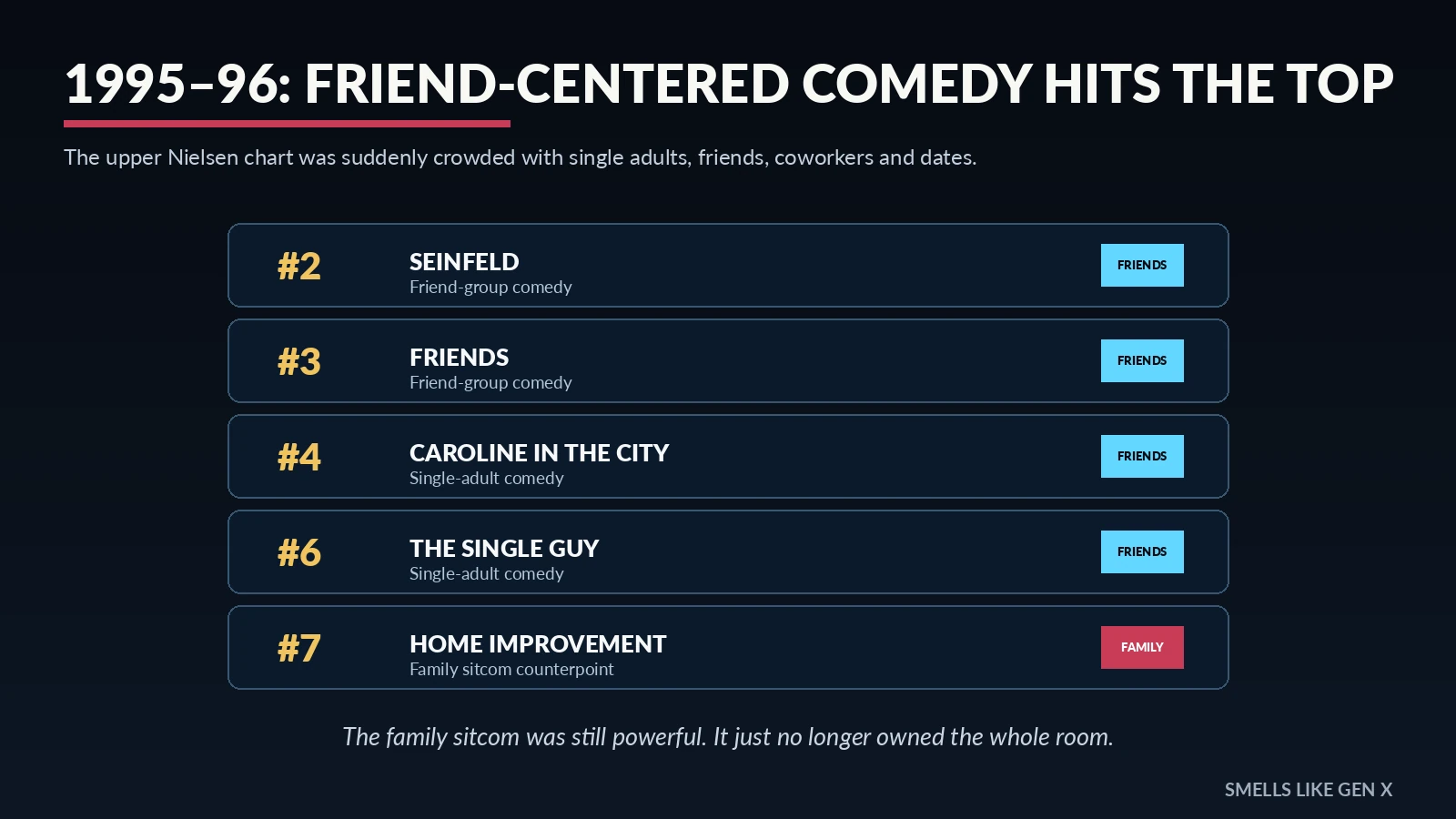
That last example matters because it prevents the story from becoming too neat. In the 1995–96 Nielsen season, while Seinfeld and Friends were near the top of television, Home Improvement still finished #7. The family sitcom had not been rejected. It had simply lost its monopoly on what mainstream adulthood could look like. Our Home Improvement deep dive follows that family-comedy lane in much more detail.
Seinfeld Made Single Adulthood the Whole Story
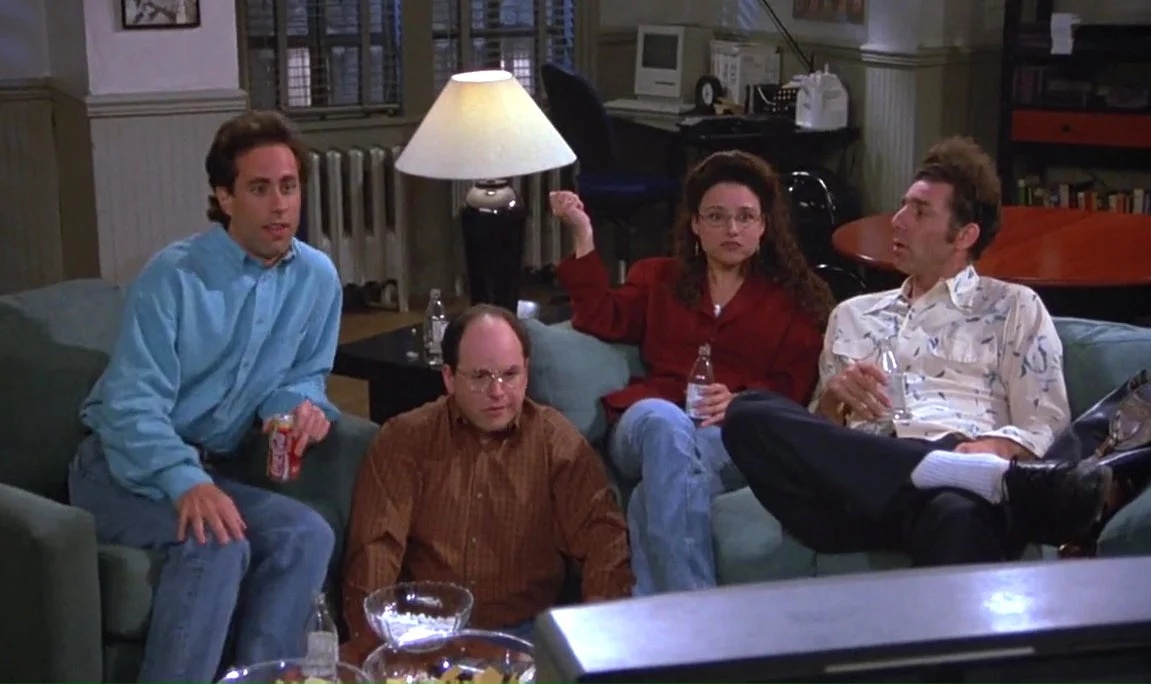
Seinfeld is where the transition becomes impossible to ignore. Jerry, George, Elaine and Kramer were adults with jobs, parents, romances and occasional ambitions, but the show never behaved as if those ingredients were supposed to deliver them into a more respectable final form. Their unfinished adulthood was not a prelude. It was the premise.
Jerry’s apartment became the gravitational center because everyone could wander in. Monk’s Cafe gave them a second recurring home. The streets, offices, movie theaters, restaurants and other corners of New York supplied the rest. Instead of one household, the series built a social circuit.
Even more important, the show did not sentimentalize friendship. These characters were not a support group in the way Friends would later be. They were often selfish, competitive and delighted by one another’s humiliation. Yet they kept coming back. Their history together did the same structural work blood relations had done in older sitcoms: it guaranteed that everybody would still be in the room next week.
The Television Academy’s history of the series describes its core as four thirtysomething New Yorkers living the single life, repeatedly gathering in Jerry’s apartment and their regular café. That pattern is exactly why the series belongs at the front of this shift. It proved that the ordinary friction of unmarried adult life could support a giant mainstream sitcom without treating marriage and children as the destination.
For the show-level story, see how Seinfeld changed 90s comedy. Here, its role is simpler: it made the waiting room interesting enough that nobody needed to leave.
Living Single Put Friendship, Careers and Black Young Adulthood at the Center
Living Single deserves more than a passing mention between Seinfeld and Friends. When it premiered on Fox in 1993, Yvette Lee Bowser built an ensemble around four women and two men whose friendships, work lives and romances overlapped in and around a Brooklyn brownstone.
The Peabody Awards later described the series as one of television’s early hangout comedies and emphasized the chosen-family structure at its center. That matters because the show did not simply substitute friends for parents. It gave the friendships texture. Khadijah ran Flavor magazine. Max was a lawyer. Régine’s ambition and taste were part of her identity. Synclaire and Overton grew from friendship into romance. Kyle’s career and confidence created another kind of tension with Max.
In other words, the six characters were not waiting around for the week’s dating plot to begin. Their work, loyalty, competitiveness and affection were already the story.
Bowser has spoken about wanting Living Single to be female-centered and about how the ensemble grew into four strong women balanced by Kyle and Overton. She also built the show from the experience of being a young single person in the city. That lived-in specificity is one reason the series feels so important to this larger transition. It was not an abstract idea of “young people.” It was a Black social world with recognizable careers, cultural detail, conflict and joy.
It also complicates the lazy version of 90s sitcom history that jumps directly from Seinfeld to Friends. Living Single had already shown that a six-person friend ensemble could carry work stories, romance, apartment life and chosen family before Central Perk became a national landmark.

Friends Turned the Support System Into the Main Event
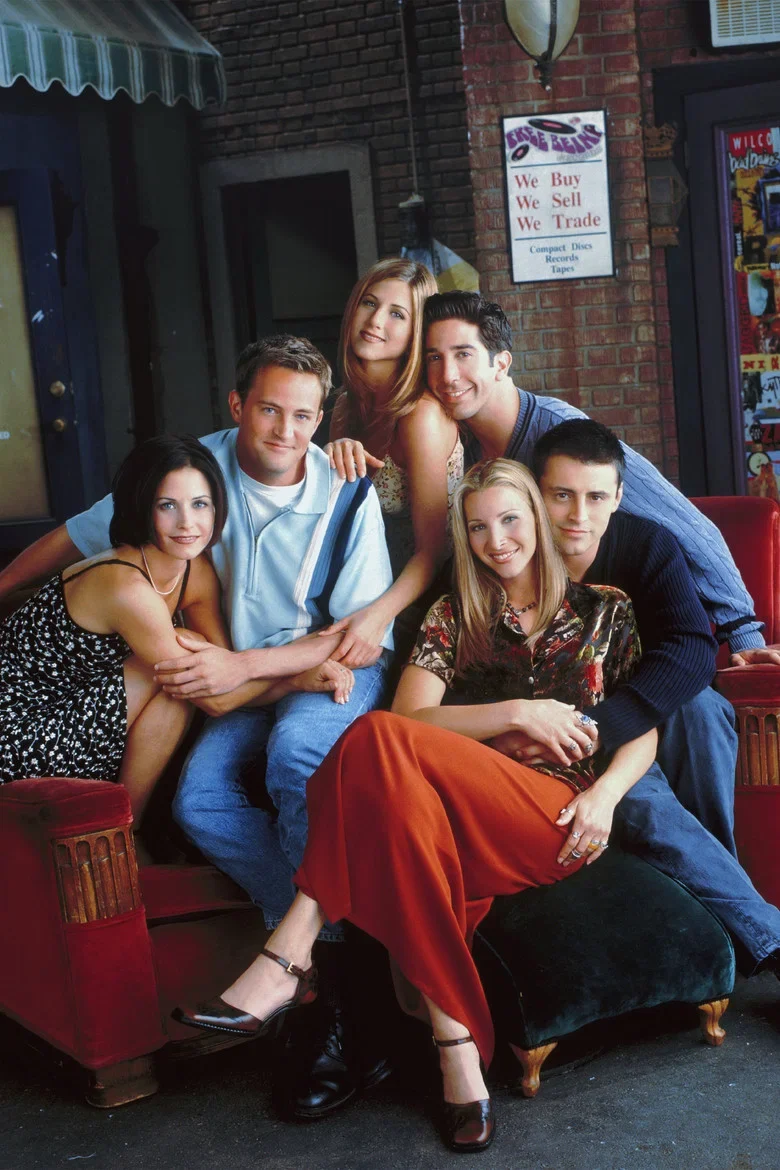
When Friends premiered in 1994, the premise was already legible: six young adults in New York trying to figure out work, love and the distance between the life they expected and the life they actually had. What the show did was make that arrangement feel enormous, warm and almost impossibly inviting.
The Television Academy’s history of Friends gets straight to the premise. Producer Kevin Bright recalled that the team did not want another comedy about a family sitting in a living room. They wanted the years when young adults step into the world and friends become the day-to-day extended family.
Monica’s apartment and Central Perk were the physical expression of that idea. Nobody needed an invitation. People wandered in. Meals happened together. Breakups became group business. A bad day at work could become everybody’s evening. The six-person circle made adulthood communal.
That did not mean parents and siblings vanished. They appeared often, sometimes in major stories. But they were visitors to the weekly center rather than the reason the center existed. The emotional promise was the group itself: jobs might change, romances might fail, roommates might move, but these six people would still know where to find one another.
Our Friends deep dive covers the larger legacy of the series. In this story, the turning point is how thoroughly Friends normalized the idea that friendship could be the main adult institution in a mass-audience sitcom.
Apartments, Coffee Shops and Diners Became Emotional Real Estate
Once the central characters were connected by choice instead of one address, sitcom geography got more interesting. The family comedy usually knew where everybody would end up at night. The friend-group comedy needed a route.
Jerry’s apartment worked because George, Elaine and Kramer could show up. Monk’s Cafe gave the group a public version of the same room. Living Single used the Brooklyn brownstone as a social anchor without turning it into a traditional family home. Friends paired Monica’s apartment with Central Perk so completely that the two sets began to feel like adjoining rooms.
That geography sold an appealing kind of independence: your own job, your own dating life, maybe even your own apartment, but your people were somehow always nearby. Real life rarely coordinates six schedules that perfectly. Sitcoms are allowed to improve logistics when the emotional fantasy is good enough.
New York became especially useful because it could behave like one giant campus. Apartments, coffeehouses, offices, diners, streets and bars were all stops on the same social loop. The old family sitcom had an address. The friend-group sitcom had a route.

That same habit of moving through a whole television night instead of selecting one isolated episode is part of the larger story in why a night of 90s TV felt like an event.
Workplaces Became Part of the Chosen-Family System
Older family sitcoms certainly had workplaces, but home usually remained the emotional headquarters. Friend-centered 90s comedies blurred that boundary. Jobs were where characters met people, embarrassed themselves, dated badly, quit impulsively, got promoted, got fired and discovered that adulthood involved far more office politics than anyone had warned them about.
Living Single used Khadijah’s magazine career as a major part of who she was, not just a reason to leave the brownstone every morning. On Seinfeld, Elaine’s bosses and offices could generate entire comic worlds of their own. On Friends, Rachel’s move from Central Perk into fashion gave her a long work-life arc independent of Ross, while Chandler’s mysterious corporate career became a running joke precisely because jobs were expected to be part of the adult identity puzzle.
The workplace also widened the cast without weakening the core group. A boss or coworker could become important for an episode or a season, then disappear while the main friendships remained intact. That gave writers another source of recurring friction without having to rebuild the emotional center every time.

Dating Became the Perfect Story Engine
There is also a brutally practical reason single-adult comedy works: dating generates stories forever. A traditional family sitcom has to protect its central marriage unless it wants to rebuild the premise. A show about friends can introduce a date, an ex, a crush, a breakup, a blind setup or a terrible first impression whenever it needs fresh trouble.
The key is that romance can remain unstable because the friend group is stable. Ross and Rachel can break up without ending Friends. Max and Kyle can spar, flirt and collide without dissolving the world of Living Single. Jerry can cycle through relationships because George, Elaine and Kramer are still coming through the door.
That is why these shows could talk about adulthood as experimentation instead of arrival. Careers were unsettled. Relationships were unsettled. Apartments changed. The group was the safety net.
There is a more specific story about how networks filled the 90s with single professionals, urban dating and apartment comedies. That belongs to the single-adult sitcom companion. The point here is narrower: friendship gave television something durable enough to let romance stay messy.
The 1995–96 Season Is the Cleanest Snapshot of the Shift
The Nielsen chart matters because it keeps this story from becoming a theory built only from nostalgia. By the 1995–96 season, friend-centered and single-adult comedies were not some fashionable side lane. They were sitting near the top of American television.
Seinfeld finished #2. Friends finished #3. Caroline in the City was #4, and The Single Guy was #6. At the same time, Home Improvement remained enormous at #7.
That is the whole decade in miniature. The friend-group and single-life model had become fully mainstream without pushing the family sitcom off the screen. The audience was large enough for both.
Our 1996 Nielsen ranking lays out the complete top ten, including ER at #1 and several more NBC Thursday hits. The numbers are especially revealing because they show that what later became a cultural memory was already visible in real audience behavior at the time.
Must See TV Made Young-Adult Comedy Feel Like the Language of Thursday Night
NBC did not invent every piece of the friend-group sitcom, but it had the scheduling power to make the broader young-adult comedy wave feel unavoidable. Friends could open Thursday. Seinfeld could anchor the middle. A newer comedy about dating, work or single life could sit in the protected space around them and inherit an audience that would be almost impossible to manufacture from scratch.
That environment helped make titles such as Caroline in the City, The Single Guy, Boston Common and later Suddenly Susan part of the same national conversation, even if some of them faded much faster from memory.
The important thing is not that every NBC Thursday comedy was secretly a friend-group masterpiece. It wasn’t. The larger point is that the network had found an audience comfortable spending hours with adults whose biggest weekly problems involved work, dating, roommates and social life.
For the full scheduling story, including how NBC used lead-ins and 8:30/9:30 slots to build a ratings machine, see Must See TV: How NBC Owned Thursday Nights in the 1990s.

For a Lot of Viewers, Friends on TV Looked More Familiar Than Parents on TV
This is where the shift stops being an industry story and turns into a memory. Gen X reached adulthood carrying a familiar checklist of what grown-up life was supposed to look like: job, marriage, house, kids. Television had spent years making comedy out of life after those boxes were checked. The 90s friend-group sitcom spent more time in the corridor before, between or instead of them.
That corridor had its own rituals. First apartments that were not as nice as the ones on television. Roommates. Jobs you did not plan to keep forever. Relationships that lasted three weeks or three years. Parents on the phone reminding you that your old home still existed somewhere else. Friends becoming the people who knew whether you got the job, survived the breakup or had enough money to make it to Friday.
The sitcom version was richer, prettier and suspiciously good at getting six adults into the same room at the same time. But the emotional map was recognizable.
And remember how much more local friendship could feel before smartphones. You called a landline. You dropped by. You met at the same place. If somebody moved across town, that could actually change how often you saw them. The people physically near you mattered because there was no permanent digital layer keeping every relationship equally available.
That is why the 90s friend-group sitcom is such an efficient memory trigger. The clothes and hair get you first. The deeper nostalgia is the idea that adulthood still felt open-ended, and that the people figuring it out beside you might become the family you chose.
After the 90s, Television No Longer Needed Blood Relations to Justify Belonging
The long-term legacy is not simply that later television copied Friends. It is that the 90s made chosen family feel structurally normal. Once audiences accepted that a sitcom could build real emotional weight around friends, roommates, coworkers or a recurring hangout, later shows had far more freedom.
Will & Grace could make friendship and urban adulthood the emotional center. Sex and the City could treat four women’s friendship as the relationship sturdy enough to survive the changing men around it. How I Met Your Mother could build an entire mythology around a bar and a friend group. New Girl could turn roommates into family. Community could do it with a study group. The Office could let a workplace slowly become something far more intimate than a job.
None of those shows are identical, and that is the point. The 90s did not create one rigid formula. It expanded what audiences would accept as the recurring social unit at the center of a comedy.
Seinfeld proved friendship did not have to be sentimental. Living Single showed how culturally specific and emotionally rich a chosen family could be. Friends turned the idea into a mass-audience fantasy. Home Improvement and other family comedies kept proving the old model still worked at the same time.
The family sitcom survived. The friend-group sitcom simply joined it as an equal language. Once that happened, prime time never had to move everyone back under one roof again.
90s Friend-Group Sitcoms: Frequently Asked Questions
Did family sitcoms disappear in the 1990s?
No. Home Improvement, Family Matters, Full House, Roseanne and other family-centered comedies remained major parts of prime time. The change was that friend-centered and single-adult sitcoms became equally mainstream.
Which 90s sitcoms helped popularize the friend-group format?
Seinfeld, Living Single and Friends are three of the clearest examples. Each used friendship differently, but all treated adult social relationships as the durable center of the weekly comedy.
Was Living Single on television before Friends?
Yes. Living Single premiered on Fox in 1993. Friends premiered on NBC in 1994.
Why is Living Single important to the history of 90s sitcoms?
The series centered six Black young adults whose friendships, careers and romances formed a chosen family around a Brooklyn brownstone. It showed how much story a friend ensemble could carry before Friends became a global hit.
How was Seinfeld different from Friends?
Seinfeld used friendship as a recurring comic ecosystem without the same emotional warmth. Friends made mutual support part of the premise. Both proved that unrelated adults could provide the stable center of a long-running sitcom.
Why did 90s networks like sitcoms about single adults?
Single-adult casts gave writers a flexible supply of stories about dating, jobs, apartments, roommates and changing relationships while the central friend group could remain intact.
Were friend-group sitcoms actually popular in the ratings?
Yes. In the 1995–96 Nielsen season, Seinfeld finished #2 and Friends #3, while several other city and single-adult comedies also reached the top ten.
What does chosen family mean in a sitcom?
It describes a recurring emotional support system built primarily from friends, roommates, coworkers or neighbors rather than from parents, spouses and children.
Sources Behind This Story
- Television Academy Interviews — Friends
- Television Academy Interviews — Seinfeld
- Television Academy Interviews — Living Single
- Television Academy — Foundation Interview: Yvette Lee Bowser
- Peabody Awards — The Great Black American Comedy Wave of the 1990s
- Los Angeles Times — NBC’s Thursday Night Juggernaut Rolls On