The Forgotten Must See TV Sitcoms That Were Actually Huge

The Forgotten Must See TV SitcomsThat Were Actually Huge
Some of the biggest sitcoms of the 1990s are barely talked about now. NBC’s Thursday machine could turn a new comedy into a top-ten hit overnight—and then, just as quickly, reveal how much of that success belonged to the time slot.

Which forgotten Must See TV sitcoms were actually huge?
Caroline in the City, The Single Guy, Boston Common, Suddenly Susan, The Naked Truth, Fired Up, Veronica’s Closet and Jesse all posted surprisingly large ratings. Several reached the Nielsen top ten because NBC placed them inside one of the most powerful scheduling systems television had ever seen.
Forgotten 90s NBC Sitcoms Were Not Small Shows
One of the strangest things about revisiting 90s television is discovering how many shows that feel obscure now were absolutely enormous when they aired.
We remember the anchors. Friends. Seinfeld. ER. Frasier. Those series survived because they kept working after their original time slots disappeared. Syndication, DVD, streaming and endless reruns turned them into permanent fixtures.
But NBC Thursday was bigger than the anchors. It was also a launch system. In 1995–96, Caroline in the City finished #4, The Single Guy #6 and Boston Common #8. A year later, Suddenly Susan, The Naked Truth, Fired Up and The Single Guy all landed in the top ten by household rating. By 1998–99, Veronica’s Closet and Jesse were tied at #5.
Those numbers are the reason this story belongs beside the larger history of NBC Must See TV in the 90s. The network did not just schedule hits. It built a circulation system in which a giant at 8 p.m. could deliver viewers to 8:30, another giant at 9 could reset the night, and ER could keep millions from changing the channel at 10.
The result is a weird split between memory and measurement. Some of these comedies were sampled by more people than many shows we now call classics. Their ratings were real. Their cultural afterlife was simply much weaker.

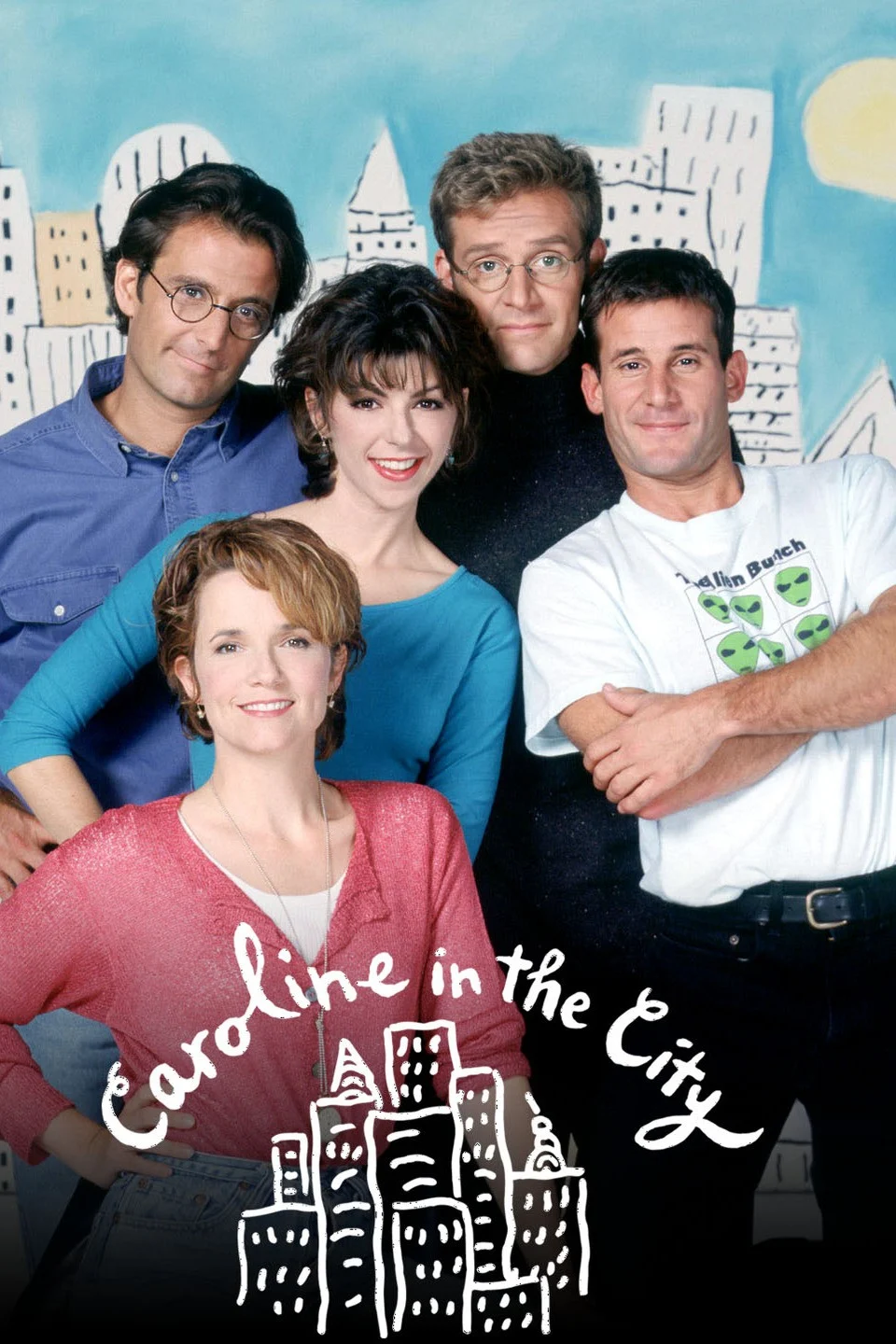
Caroline in the City Finished #4 in 1995–96
Caroline in the City is the cleanest place to start because its first season landed between Friends and Monday Night Football in the national rankings.
Lea Thompson played Manhattan cartoonist Caroline Duffy, a character built for the single-professional sitcom wave of the decade. The series had a recognizable hook, a bright New York setting and a romantic tension engine. But it also had the luck of entering NBC Thursday while the machine was at full force.
The 1995–96 Nielsen ranking put ER, Seinfeld, Friends, Caroline in the City, Monday Night Football, The Single Guy, Home Improvement, Boston Common, 60 Minutes and NYPD Blue in the top ten. Three of NBC’s lesser-remembered comedies were sitting there with some of the most durable franchises in television history.
What happened next is the revealing part. When Caroline moved away from the Thursday flow, its rank fell sharply. That does not mean the first-season audience was an illusion. It means schedule context was part of the product.
The Single Guy Became a Top-Six Show Without Becoming a 30-Year Classic
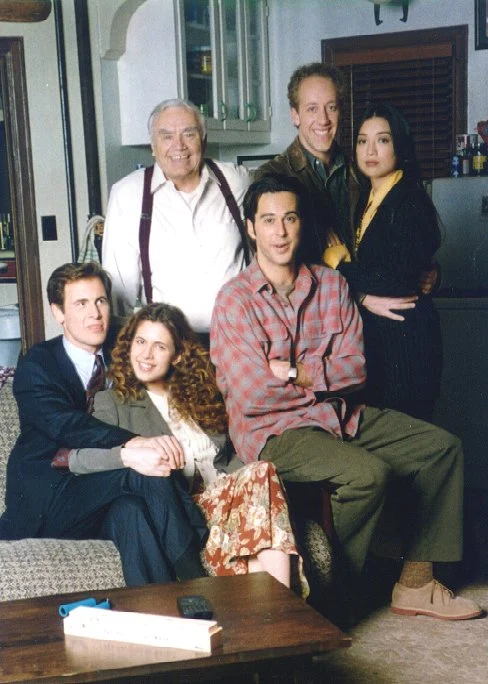
Jonathan Silverman’s The Single Guy is almost a laboratory example of the Must See TV effect.
The premise was straightforward: a single writer in Manhattan surrounded by married friends and relationship complications. It fit the era, it fit NBC’s audience, and it fit the half-hour slot behind a larger hit. In 1995–96 it finished #6.
That number is astonishing in hindsight because The Single Guy does not occupy anything close to the cultural space of the shows surrounding it. There is no giant streaming rediscovery, no endless quote culture, no permanent syndication identity. Yet millions of homes watched it during its original run.
That disconnect is the point. Ratings capture audience behavior at a particular moment. Cultural staying power measures what a show can do after the machinery around it disappears. Must See TV could manufacture extraordinary exposure. It could not guarantee that a comedy would still matter after the time slot stopped doing part of the work.
Boston Common Reached #8 Almost Immediately
Boston Common arrived late in the 1995–96 season and still finished #8.
The comedy starred Anthony Clark as Boyd Pritchett, a Virginia man who followed his younger sister to college in Boston and then became tangled in campus life. The premise had energy, but the ratings story was bigger than the premise: NBC placed a fresh comedy inside the most valuable neighborhood on television and millions of people sampled it.
The following year, when the show was moved to Sunday, its rank collapsed. That swing is one of the clearest pieces of evidence that the Must See TV bench needs to be understood structurally, not just show by show.
In the middle of the 90s, being on NBC Thursday could make a new series look instantly established. Moving away from it could expose how much of the audience was loyal to the night rather than the program.

Suddenly Susan Became a Household-Rating #3 Hit
Suddenly Susan is the show people point to when they want proof that 90s ratings can look surreal from the streaming era.
Brooke Shields returned to series television as Susan Keane, a San Francisco magazine writer rebuilding her life after leaving her fiancé. The show had genuine star power, a strong promotional push and one of the best launch positions NBC could provide.
By household rating, Suddenly Susan finished the 1996–97 season at #3 with a 17.0 rating. Some season summaries based on average viewer totals place it just behind Friends, which is why contemporary tables can show #3 or #4 depending on the measurement. The frozen Smells Like Gen X article about how Suddenly Susan became a #3 show owns that specific ratings curiosity.
The larger lesson is what happened when it left Thursday. Its rank collapsed in the following season after a move to Monday. Again, the audience had not been fake. NBC had simply supplied a huge number of people who were already there.
The 1996–97 ranking makes the NBC concentration unmistakable: the network occupied most of the top positions, and several of those shows later became far less memorable than their original ratings suggested.
The Naked Truth and Fired Up Show How Deep NBC’s Advantage Became
By 1996–97 the network had enough momentum that even shows with complicated histories could ride into the upper reaches of the ratings.
The Naked Truth, starring Téa Leoni as a tabloid photographer, had started on ABC before moving to NBC. Fired Up, with Sharon Lawrence and Leah Remini, entered as a midseason workplace comedy. Both were part of a season in which NBC crowded the top of the ratings chart.
The household-rating table tied The Naked Truth with Friends at 16.8 and placed Fired Up at #6 with a 16.5. Those numbers look almost comically large now for shows that many viewers would struggle to identify from a cast photo.
This is why “forgotten” should not be confused with “unsuccessful.” These were successful shows in the only sense that mattered to a network in the moment: people watched them in very large numbers. What they lacked was the kind of identity that kept generating value decades later.

Veronica’s Closet Became a Top-Three Show in 1997–98
The end of the decade did not immediately end NBC’s ability to launch big Thursday comedies.
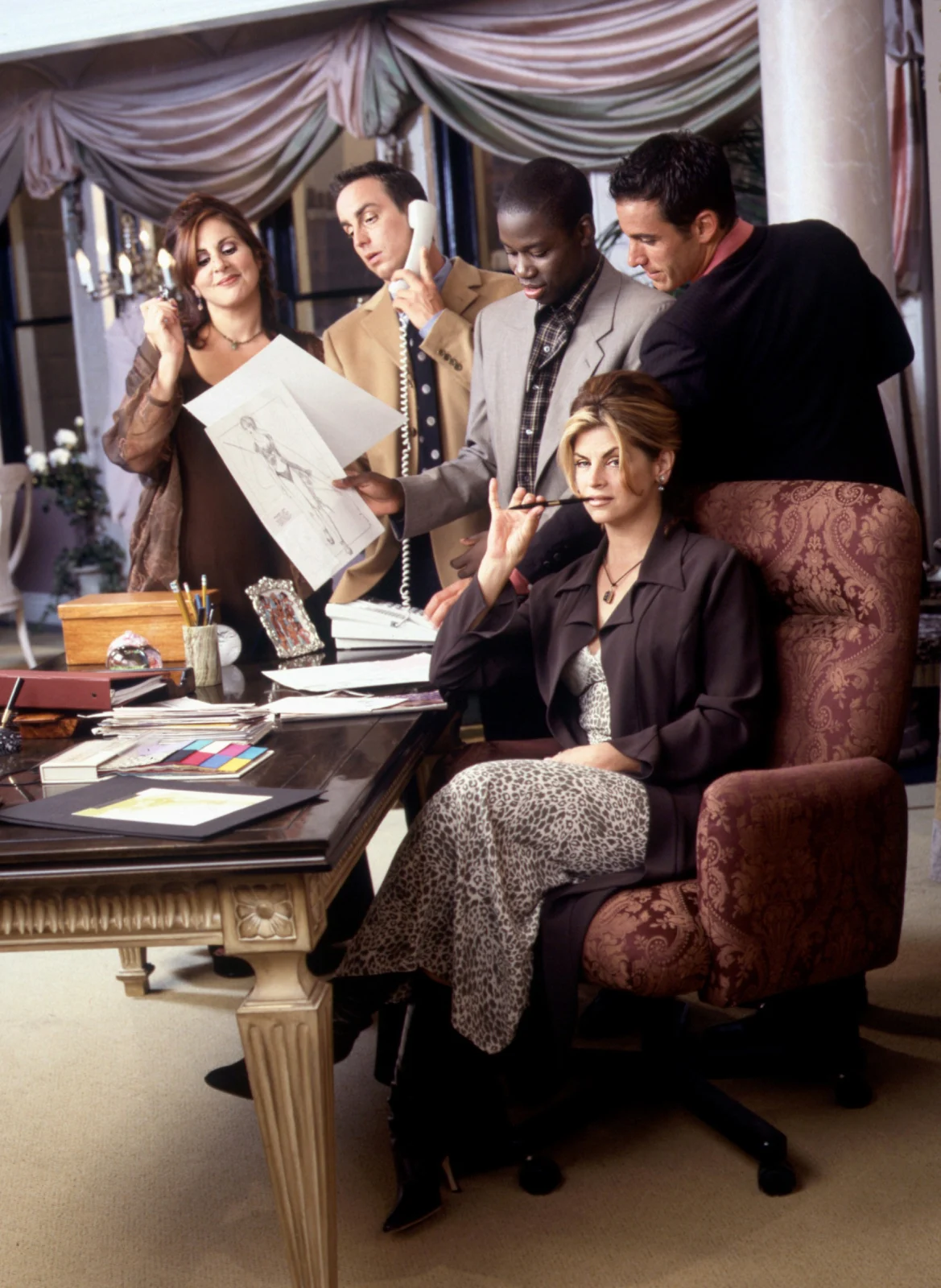
Veronica’s Closet starred Kirstie Alley as the head of a lingerie company and premiered behind Seinfeld. In its first season it finished #3, behind only Seinfeld and ER. That is an extraordinary debut for a show whose long-term cultural footprint became relatively small.
It is also a reminder that the bench changed from year to year. The system did not depend on one particular secondary comedy. NBC could keep swapping new programs into valuable slots, using familiar anchors to generate sampling.
Once the anchors disappeared or the schedule changed, those secondary shows had to stand on their own. Some could. Others could not. The Thursday machine was excellent at creating first chances and much less capable of creating permanence.
Jesse and Veronica’s Closet Were Tied at #5 in 1998–99
By 1998–99, the old network order was beginning to crack—and NBC could still put two supporting Thursday comedies into the top five.
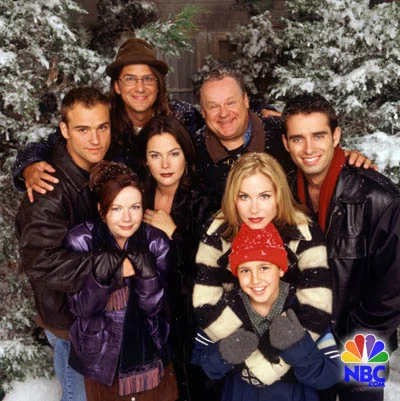
Jesse, starring Christina Applegate as a single mother in Buffalo, entered the post-Seinfeld Thursday lineup while Veronica’s Closet returned for its second season. Both posted a 13.7 household rating and tied at #5.
The 1998–99 season ranking is especially revealing because NBC’s ER, Friends and Frasier occupied the top three positions. The network still had a massive concentration of audience even as cable was pulling viewers away from broadcast television overall.
The dedicated Veronica’s Closet and Jesse ratings article owns that tied-#5 story. Here, the pair functions as the last clean demonstration of the same Must See TV pattern that had boosted Caroline, The Single Guy and Boston Common a few years earlier.
Why So Many Huge Must See TV Sitcoms Faded
The answer is not that audiences were foolish in the 90s. It is that television success was built differently.
A network schedule once controlled discovery. Viewers did not open an app and choose from thousands of titles. They arrived at a channel for a known hit and often stayed for the next show. That behavior gave secondary programs a scale that is almost impossible to recreate now.
After the original run, however, the environment changed. Syndication buyers favored shows with enough episodes and strong repeat value. Home video favored series with passionate fan bases. Streaming later rewarded titles with durable identity and binge appeal. A show whose biggest advantage had been its neighborhood on the schedule could lose that advantage completely.
There was also brutal internal competition. NBC was producing so many urban workplace and relationship comedies that the weaker ones could blur together. A great time slot created exposure, but it also placed a new show next to Friends and Seinfeld, which made the difference in comic voice painfully obvious.
That is why the forgotten Must See TV bench is so useful historically. It separates two ideas we often treat as the same thing: being watched and being remembered.
The Forgotten Sitcoms Explain Must See TV Better Than the Classics Alone
If we only remember Friends, Seinfeld, Frasier and ER, we miss what made NBC Thursday unusually powerful.
The anchors prove that NBC had great shows. The forgotten comedies prove that NBC had something more: the ability to move audience from one program to another and to turn that flow into instant sampling for new series.
That was the real competitive advantage. Caroline, Jonathan, Boyd, Susan, Nora, Gwen, Veronica and Jesse lived inside a television ecosystem that could make a new sitcom feel important before it had earned a history of its own.
Some of those shows were good. Some were uneven. Some benefited enormously from where NBC placed them. All of them mattered to the larger 1990s television story because they show what mass-audience scheduling could do before streaming broke the schedule apart.
The ratings were huge. The memories got selective. Both things can be true at once.
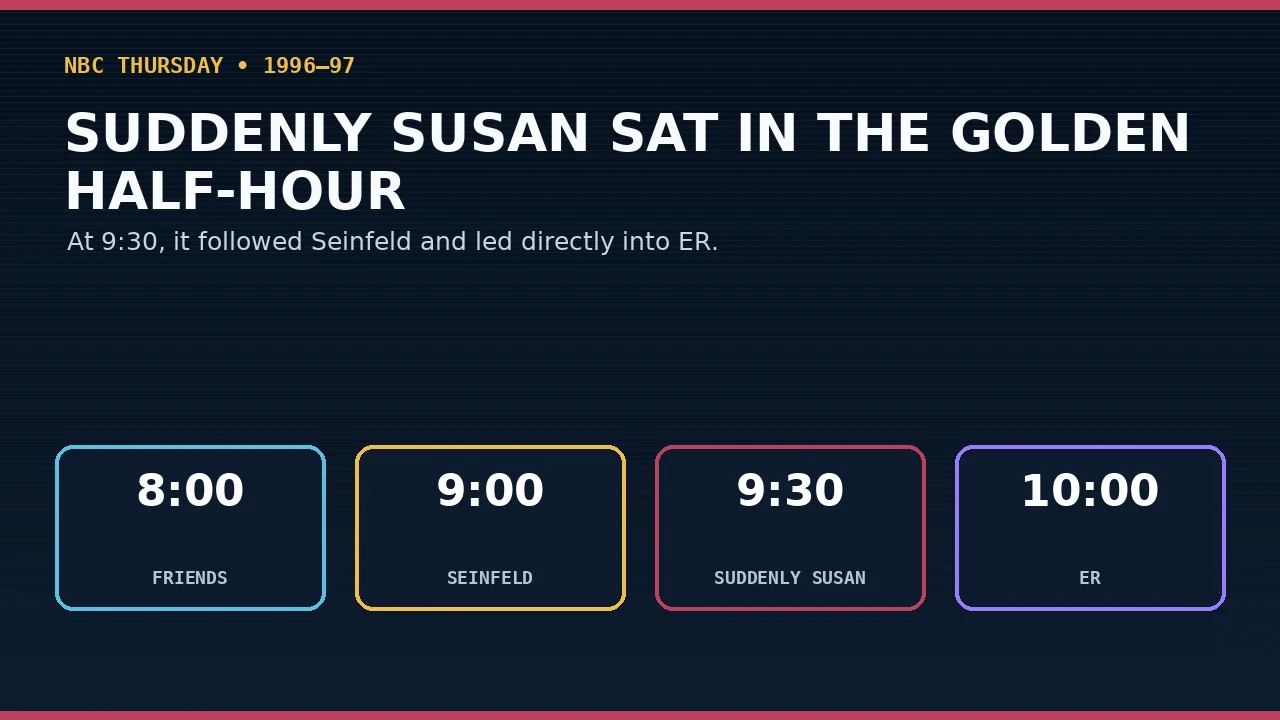
8:30 and 9:30 Were Where NBC Turned Audience Flow Into New Hits
The most revealing pieces of Must See TV were often the half-hours that sat between the famous anchors.
At eight, Friends could pull a huge young-adult audience onto NBC. At nine, Seinfeld could pull an enormous audience back toward the center of the night. At ten, ER gave viewers a completely different reason to stay. That left 8:30 and 9:30 as unusually valuable real estate.
Put a new comedy at 8:30 and it inherited viewers who had already made the decision to watch NBC. Put another at 9:30 and the show could benefit from both the Seinfeld lead-in and the knowledge that ER was coming next. The network did not need every viewer to love every series. It needed enough people to avoid reaching for the remote.
That is why the bench could rotate without destroying the night. NBC could cancel a weaker comedy, move another series into the slot and market the replacement to an audience that already knew exactly where it would be on Thursday. The schedule itself reduced the cost of discovery.
For Gen X viewers, this often happened without any conscious thought about lead-ins or audience flow. You watched Friends, went to the kitchen during the commercials, came back, and the next show was already starting. By the time Seinfeld appeared, the channel had been on NBC for an hour. The network built a habit from a series of tiny decisions not to change anything.
Streaming platforms imitate part of that behavior with autoplay, but the social scale is different. NBC was doing it simultaneously to tens of millions of households, with the same shows beginning at the same time and the same commercials promoting what came next.
The 1996–97 Ratings Chart Shows How Strange the NBC Concentration Became
When a modern viewer sees the 1996–97 top ten for the first time, the list can look wrong.
ER was #1. Seinfeld was #2. Suddenly Susan was #3 by household rating. Friends and The Naked Truth were tied at #4. Fired Up was #6. Monday Night Football broke the NBC run at #7. Then The Single Guy came in at #8.
That is seven NBC programs inside the top eight household-rating positions if the tie is counted separately. The broader companion on NBC’s 1997 ratings dominance owns the full data story. For the forgotten-sitcom question, the important part is how many short-lived or lightly remembered comedies were caught inside the same wave.
It also explains why raw rank is not a clean quality score. A show can be #6 because it is beloved, because it is heavily promoted, because it follows a monster hit, because viewers have few alternatives at that moment, or because all of those things are true at once. Nielsen measured behavior, not artistic merit.
That distinction becomes more obvious with distance. Friends and Seinfeld survived every change in distribution. Fired Up did not. Yet for a period in 1997, the schedule placed them in the same rarefied ratings neighborhood.
This is one of the reasons old ratings tables are so much fun to revisit. They preserve the television world as it actually behaved, not as nostalgia later edited it.

The Forgotten Must See TV Shows Lived Between the Shows We Never Forgot
Memory has a funny way of compressing an entire television night into the programs that survived.
Ask someone to picture NBC Thursday in the 90s and the brain usually jumps to the Central Perk couch, Jerry’s apartment, the KACL skyline or the emergency room doors at County General. The bench shows are harder to summon. Maybe you remember Lea Thompson drawing cartoons. Maybe you remember Brooke Shields at the magazine. Maybe Kirstie Alley’s lingerie-company premise triggers a vague flash of the late 90s.
But the forgotten shows were part of the experience. They were the half-hour between the thing you tuned in for and the thing you refused to miss. They were the commercials you saw promoted all week. They were the pilots everybody sampled because the television was already on NBC.
That makes them valuable even when the episodes themselves are not canonical. They tell us what the schedule felt like. They remind us that a network once had enough control over audience flow to place a brand-new comedy beside two giant hits and create an audience before word of mouth had time to form.
They also explain why some old Nielsen rankings produce arguments now. People assume a top-five show should still be famous. In the 90s that was not always how it worked. A time slot could make a show nationally visible for a season without giving it the ingredients for permanent cultural life.
That gap between “everybody watched it” and “nobody talks about it” is the whole charm of the forgotten Must See TV bench.
A Great Lead-In Could Make a New Sitcom Huge Before It Became Durable
The easiest mistake is to look at these old season rankings and assume every top-ten NBC comedy had created a giant fan base entirely on its own.
That is not how Thursday worked. In 1995–96, Friends, Seinfeld and ER were not just hits; they were audience reservoirs. A new or still-developing sitcom placed beside them inherited millions of people who were already on NBC, already in a comedy mood and often waiting for the next anchor. Caroline in the City finished #4, The Single Guy #6 and Boston Common #8 in the same season. Those numbers were real, but the schedule helped create the conditions in which they were possible.
The clearest evidence comes when the pieces moved. Caroline left Thursday and fell well outside the top ten the next season. Boston Common moved away from the block and dropped dramatically. The same broad pattern later hit Suddenly Susan, The Naked Truth and Fired Up. None of that means the shows were frauds. It means network television was an ecosystem, and NBC had built the richest piece of real estate in that ecosystem.
For viewers, the transaction barely felt like a transaction. You watched Friends, stayed for whatever came next, settled in for Seinfeld and knew ER was waiting at ten. The 8:30 and 9:30 shows benefited from that continuity. Thirty years later, the anchors are remembered as classics while some of the bridge shows feel almost impossible to place. The ratings charts preserve the part memory lost.
The Forgotten Must See TV Sitcoms Show How Ratings and Cultural Memory Split Apart
A television series can be enormously successful in the moment and still leave a surprisingly small footprint later.
Long-term memory depends on more than first-run Nielsen rank. Syndication matters. Home video matters. Streaming availability matters. Memorable catchphrases, instantly recognizable sets and a few episodes that keep being rediscovered matter. So does whether younger viewers can stumble across the show twenty years later without hunting for it.
The biggest NBC anchors had all of those advantages in different combinations. Friends and Seinfeld became rerun machines. Frasier accumulated awards, syndication and a durable character world. ER became a benchmark for the modern medical drama. Many of the forgotten comedies had a different relationship with their moment: they were scheduled brilliantly, sampled heavily and watched by huge audiences, but they never developed the same second life.
That is why calling them “forgotten” should not be read as calling them failures. It is almost the opposite. The weirdness is that shows like Caroline in the City, The Single Guy, Boston Common, Suddenly Susan, Veronica’s Closet and Jesse could post numbers that would define a modern network season and still become footnotes beside the shows surrounding them.
For Gen X viewers, the recognition often comes from the schedule before it comes from the plot. You remember the NBC chimes, the Thursday promos, the apartment or office set, maybe a face you have not thought about in decades. Then you see the season ranking and realize: wait, that was one of the biggest shows on television?
There is another reason these shows deserve to be remembered together instead of as isolated trivia. They reveal how much power a network once had to manufacture sampling. NBC could take a comedy without an established audience, place it between proven hits, promote it relentlessly during the same evening and expose it to more viewers in one night than many later series would reach in an entire season. That did not guarantee affection or longevity, but it gave the show a chance to become familiar almost instantly. In the 90s, familiarity itself was a competitive advantage: once a sitcom became part of the Thursday routine, viewers did not need to consciously choose it every week. Sometimes they simply stayed. That kind of automatic sampling is difficult to recreate in a media world where every viewer can jump instantly to a different app, service or library.
Frequently asked questions
What were the forgotten Must See TV sitcoms?
Major examples include Caroline in the City, The Single Guy, Boston Common, Suddenly Susan, The Naked Truth, Fired Up, Veronica’s Closet and Jesse.
How high did Caroline in the City rank?
Caroline in the City finished #4 in the 1995–96 season by household rating.
Was Suddenly Susan really a top-three show?
Yes by Nielsen household rating, Suddenly Susan finished the 1996–97 season at #3 with a 17.0 rating. Some viewer-total summaries place Friends slightly ahead, so tables can differ by measurement.
Why did so many NBC sitcoms become huge so quickly?
NBC placed them next to enormous Thursday anchors such as Friends, Seinfeld and ER, giving new shows unusually strong lead-ins, promotion and sampling.
Why are some top-ten shows forgotten now?
Original ratings measured what people watched in a specific schedule. Long-term memory depended on syndication, repeat value, distinct characters, enough episodes and later distribution.
Did Must See TV guarantee success?
No. It could create exposure and an excellent launch, but shows still needed to retain viewers once they moved time slots or lost stronger neighbors.