Why 90s Sitcoms Stopped Being About Families and Started Being About Friends

Why 90s Sitcoms Stopped Being About Familiesand Started Being About Friends
The family sitcom did not disappear in the 1990s. It just stopped owning the whole room. The decade’s comedy center shifted toward apartments, coffee shops, workplaces, dating disasters and the people you called when your actual family lived three states away—or when you simply preferred your friends.

Why did so many 90s sitcoms start focusing on friends instead of families?
Because young-adult life became one of television’s most useful comedy engines. Shows such as Seinfeld, Living Single and Friends built their worlds around friendship, work, dating and apartments, turning the chosen family into a durable prime-time structure while traditional family sitcoms continued alongside them.
The Classic Sitcom Center Was the Household
For decades, the American sitcom had a dependable piece of machinery: put a family under one roof, give everybody a strong personality, and let the outside world keep crashing into dinner. You could change class, neighborhood, race, politics or generation, but the household remained the emotional engine. Even when characters went to work or school, the episode usually knew where home was.
The 1980s perfected that structure in multiple directions. The Cosby Show, Family Ties, Growing Pains and Roseanne did not resemble one another very much, but each used family as the reason the same people had to keep dealing with one another. Blood, marriage and the inability to move out were excellent story engines. Television knew exactly how to use them.
Then the 90s started widening the map. The family sitcom stayed alive, sometimes spectacularly so, but it had to share the cultural center with adults whose daily lives were organized around friends, roommates, coworkers and dating. The larger decade is full of that transition, which is why it fits so naturally inside our broader guide to 1990s TV shows, sitcoms and prime-time culture. The living room did not disappear. It just got competition from the apartment across town.
Seinfeld Proved a Friend Group Did Not Need to Be a Substitute Family in the Sentimental Sense
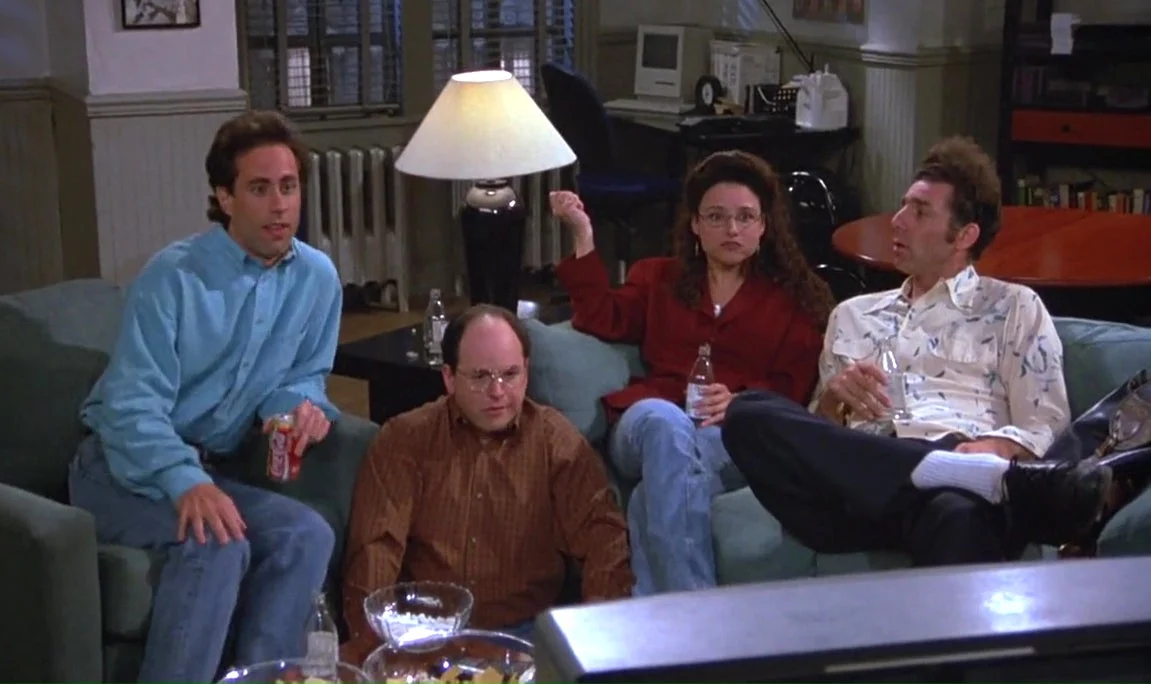
Seinfeld is an important starting point because it built a tight recurring group without asking viewers to believe the characters were emotionally healthy. Jerry, George, Elaine and Kramer were friends because their lives kept intersecting, because they understood one another’s ridiculous logic, and because the show needed them in the same orbit. Their closeness was real. So was their selfishness.
That made the series a bridge between older ensemble comedies and the friend-group boom that followed. The apartment, the diner and New York itself became recurring social spaces. Parents and relatives existed, sometimes hilariously, but they did not define the weekly center. The characters’ adult lives were not a temporary waiting room before the “real” story of marriage and children. The waiting room was the story.
The full show-level legacy belongs in our deep dive on how Seinfeld changed 90s comedy. For this larger shift, what matters is the structure: four adults could build a durable sitcom world out of conversation, work, errands, dating and petty grievances. They did not need to be related, and they did not even need to become nicer.
Living Single Made Chosen Family Warm, Black and Fully Lived-In
Living Single premiered on Fox in 1993 and deserves to be in the center of any honest discussion about 90s friend-group sitcoms. Created by Yvette Lee Bowser, the series followed four women and two men whose friendships, careers and romantic lives overlapped around a Brooklyn brownstone. The Peabody Awards has described it as one of television’s early hangout comedies and emphasized the chosen-family structure at its core.
What made the show important was not merely that it used friends instead of parents. It gave those friendships density. Khadijah’s magazine, Max’s law career, Régine’s ambition, Synclaire and Overton’s relationship, Kyle’s professional confidence—these were adults building lives while remaining deeply entangled with one another. The group did not exist to kill time between romantic plots. The group was the stable thing the romances moved around.
For Black viewers especially, the show also put professional, funny, flawed young adulthood on screen without requiring the characters to explain their existence to a white audience every week. That specificity matters. The friend-group sitcom was never one single urban fantasy. It could carry different communities, different work lives and different ideas about success while still using the same basic emotional truth: sometimes the people who know you best are the people you chose.

Friends Turned the Support Group Into the Main Event
When Friends premiered in 1994, its creators Marta Kauffman and David Crane were drawing from a life stage they knew: the years when people leave school, establish careers, date badly, live with roommates and lean heavily on friends. Television Academy interviews with the creative team make the premise clear. They did not want another family arranged around a living-room couch. They wanted the period when friends become the day-to-day extended family.
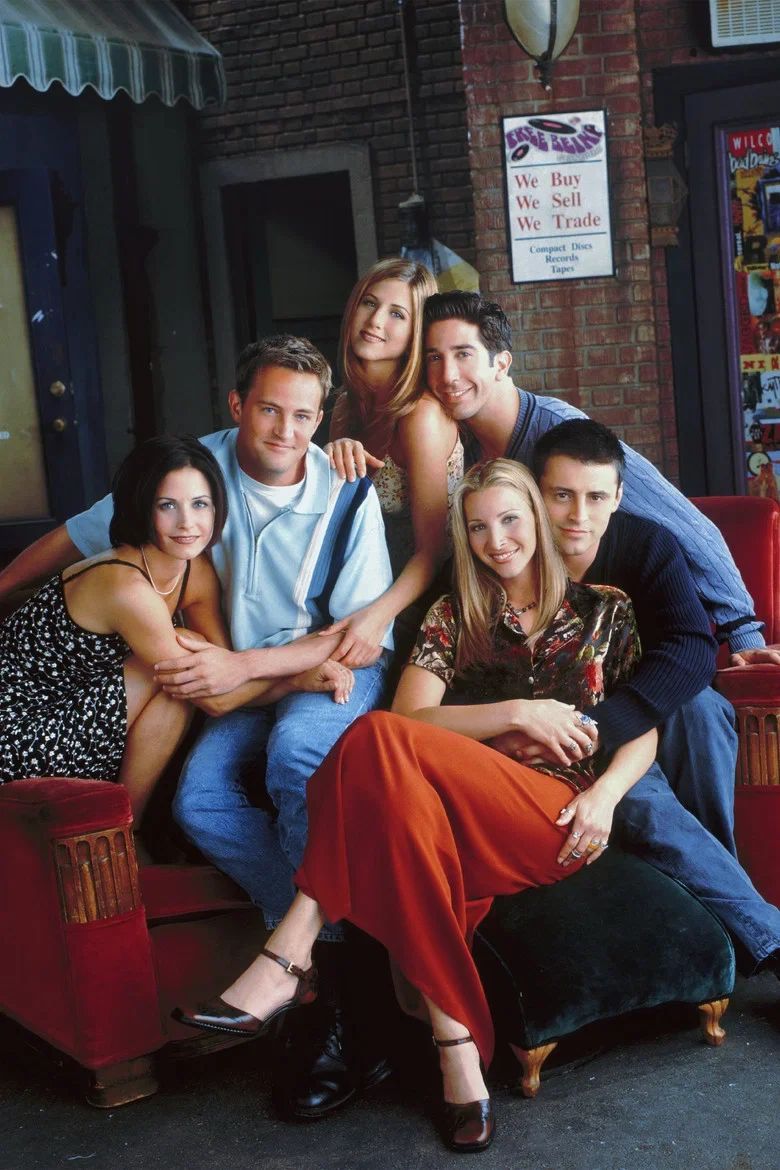
That distinction sounds obvious now because Friends helped make it obvious. Monica’s apartment and Central Perk were not just sets; they were emotional infrastructure. Characters wandered in without appointments. Meals happened together. Breakups became group events. Jobs changed, relationships changed and eventually marriages changed the geometry, but the six-person support system remained the basic promise of the show.
The show-level story is much bigger than this structural point, and we cover it in our deep dive on how Friends redefined 90s adulthood. Here, the useful thing is how quickly the premise became legible to everybody else. A sitcom no longer needed parents and children to create stakes around loyalty, responsibility, jealousy or belonging. Friends could do all of that—and they could leave at the end of the night without anybody having to go upstairs to bed.
Apartments, Coffee Shops and Hangouts Became Emotional Real Estate
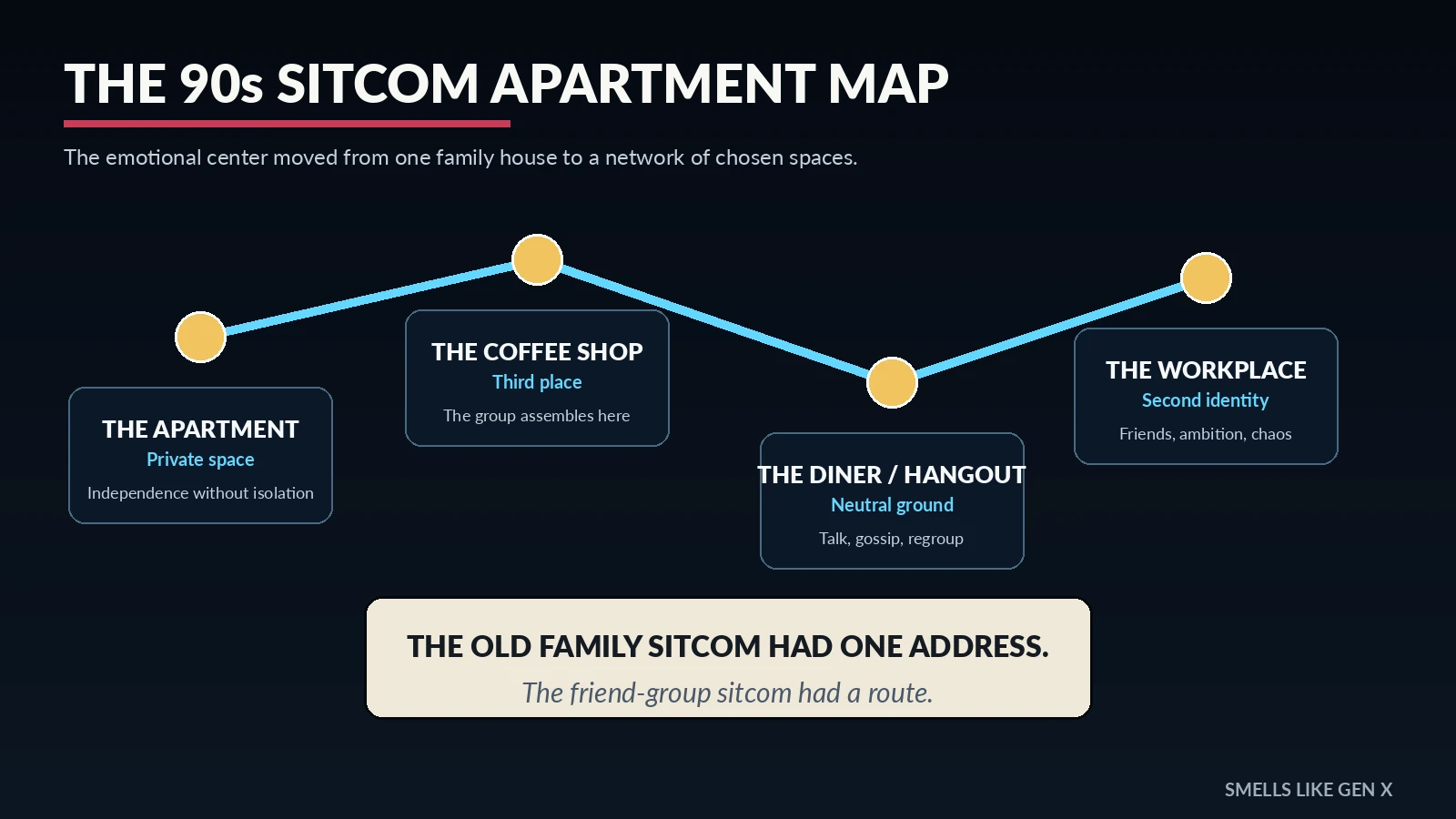
Once the characters were no longer bound by one family home, sitcom geography got more interesting. Jerry’s apartment could be one anchor, but Monk’s Cafe gave the group another place to assemble. Friends had Monica’s apartment and Central Perk. Living Single used the brownstone and neighborhood spaces. The sets did not merely provide variety. They reflected a different definition of home.
This is why the 90s apartment became such a durable television fantasy. It represented independence without isolation. You could have your own job, your own romantic life and theoretically your own front door, but your people were still ten feet away and somehow always available. Real life rarely coordinates six schedules that politely, but sitcoms are allowed to improve logistics when the emotional truth is good enough.
The change also made cities feel like social ecosystems rather than intimidating backdrops. New York in particular became the great sitcom campus: apartments, diners, coffee shops, offices, streets and bars all functioning as rooms in one enormous house. The old family sitcom had one address. The friend-group sitcom had a route.
Workplaces Became Part of the Chosen-Family System
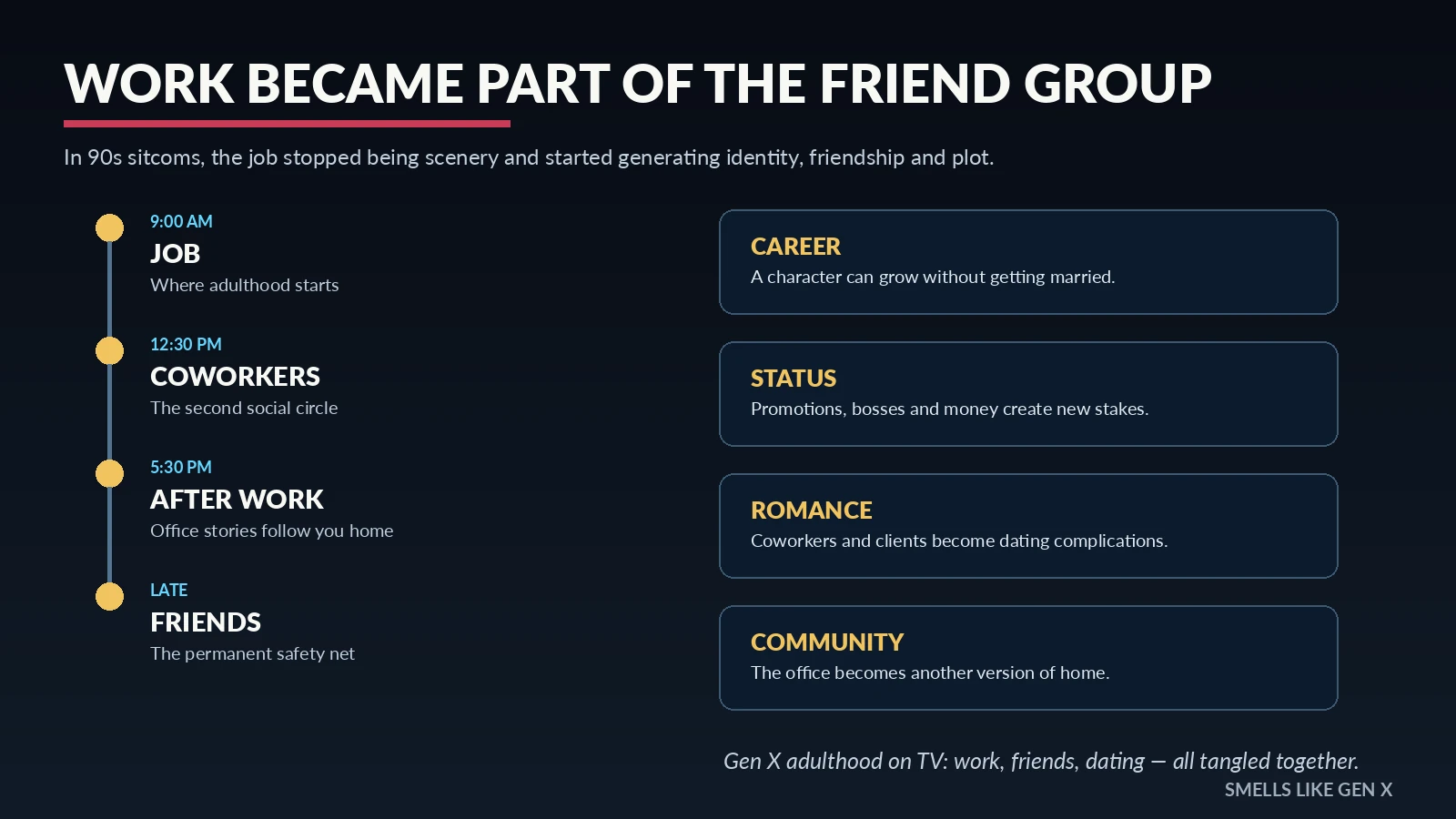
Older family sitcoms certainly had workplaces, but the job often existed in a separate zone from the real emotional action at home. Friend-centered 90s comedies blurred that line. Careers were where characters met people, changed status, embarrassed themselves, dated coworkers, quit impulsively and discovered that adulthood involved far more office politics than anyone had warned them about.
That mattered because work gave the characters a second identity beyond romance. Khadijah was not simply a single woman; she ran a magazine. Chandler’s mysterious corporate life became a joke because work was expected to be part of the character puzzle. Rachel’s movement from coffee-shop waitress toward fashion gave her a growth path that mattered independently of Ross. Elaine’s bosses and workplaces on Seinfeld could generate entire comic ecosystems.
The result was a broader picture of adulthood. Family still mattered, but it was no longer the only institution the sitcom took seriously. Your boss, roommate, ex, coworker and best friend might all affect your week more than your parents did. For Gen X viewers entering jobs where nobody handed you a map, that felt less like a trend and more like television finally admitting how much of adult life happens after you leave home.
Single Characters Gave Sitcoms an Endless Supply of New Trouble
There is a practical reason networks loved the single-adult world: dating is an outrageously efficient story machine. A family sitcom has to protect its central marriage unless it wants to rebuild the premise. A show about single friends can introduce a date, a breakup, an ex, a crush or a disastrous blind setup whenever it needs fresh energy. The emotional consequences can be real without destroying the show’s foundation.
That flexibility helped 90s sitcoms talk about adulthood as experimentation rather than arrival. Characters could be uncertain about careers and relationships at the same time. They could make bad choices, repeat patterns and still return to the same friend group at the end of the episode. The group became the safety net that allowed romance to stay unstable.
There is a narrower format story here—the specific rise of single adults, dating and urban apartment comedy—and that belongs in our companion on the rise of the single-adult sitcom. This page owns the broader emotional shift: television increasingly treated friends as the durable relationship and everything else as something that might change by next Thursday.

Home Improvement Is the Reminder That Television Expanded Instead of Flipping a Switch
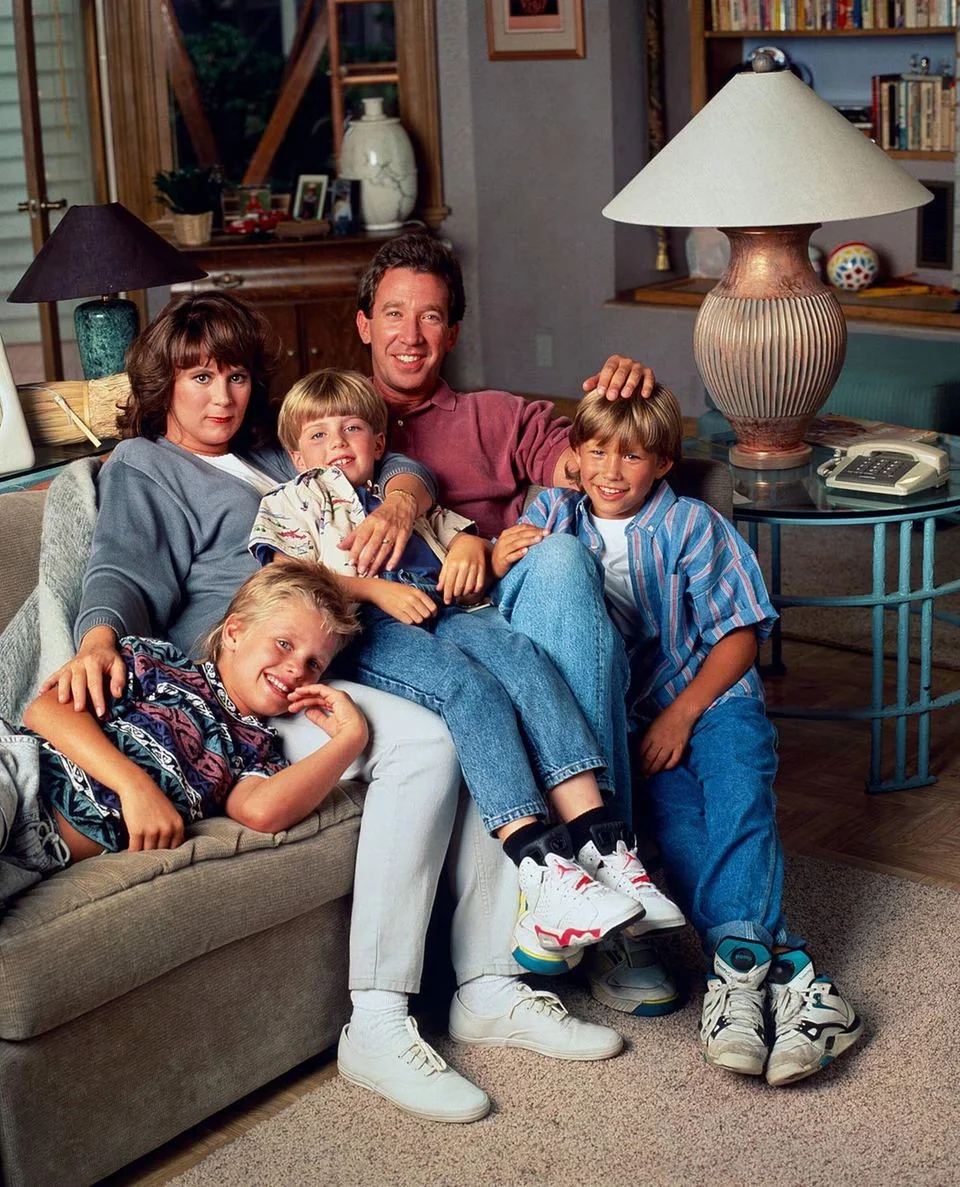
It would be easy to overstate the shift and pretend families suddenly vanished from comedy. They did not. Home Improvement was one of the biggest shows of the decade, and its entire engine depended on Tim, Jill and their sons. Family Matters and Full House remained major cultural fixtures. Roseanne continued to make the family household one of television’s sharpest social spaces.
That coexistence is actually the more interesting story. The sitcom stopped requiring one definition of adulthood. You could watch the Taylors raise kids, then watch Jerry and George avoid responsibility, then watch the women of Living Single build careers and relationships, then watch the six friends at Central Perk make a family out of availability and repetition. Prime time became a bigger map.
The friend-group boom therefore says less about audiences rejecting family and more about television recognizing another stage of life as worthy of staying in. The period between childhood and marriage no longer had to be treated as narrative scaffolding. It could last for years, because viewers understood that jobs, friends, roommates and dating were not a prelude to real life. They were real life.
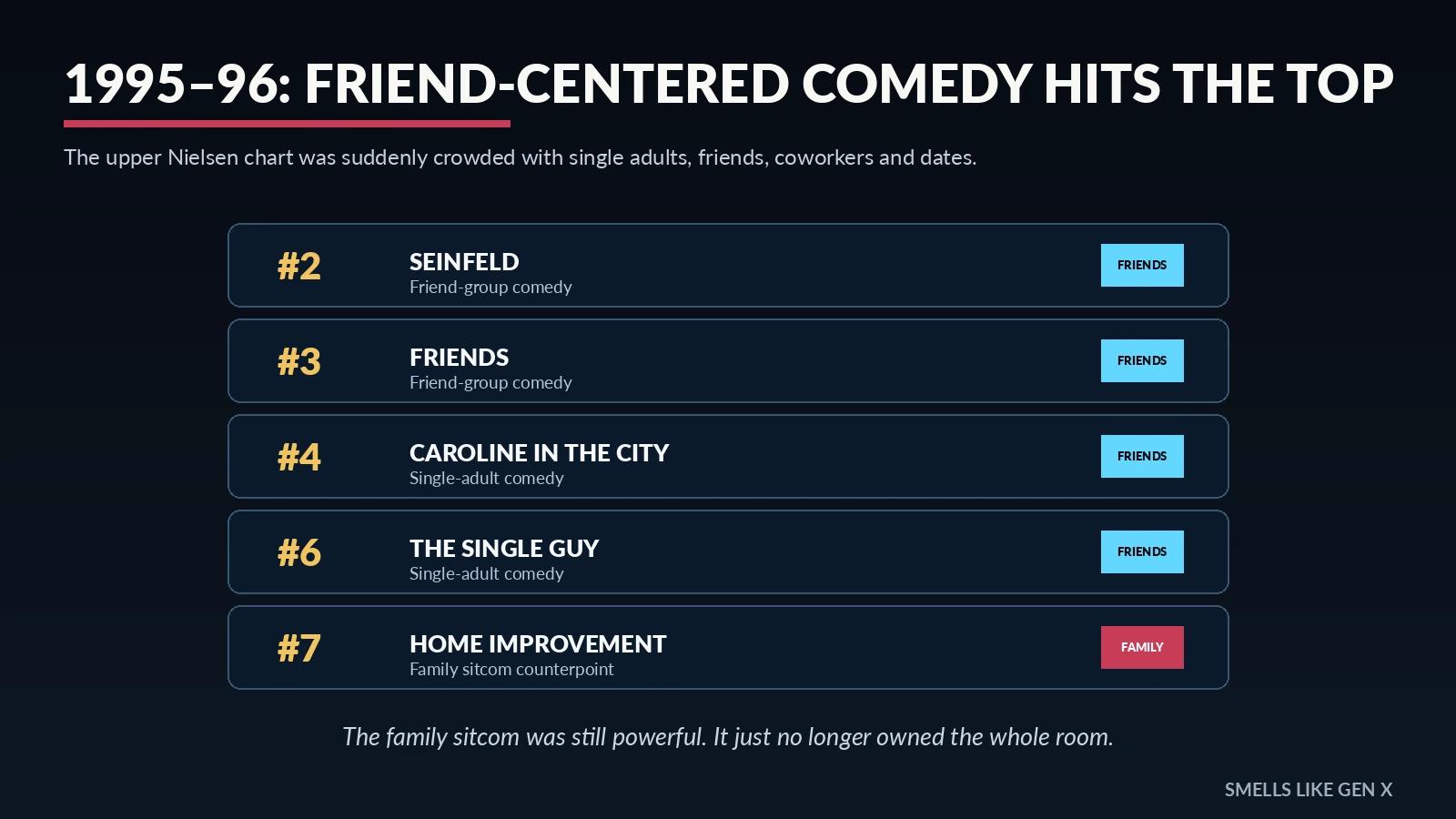
By 1996, Friend-Centered Comedy Was Sitting Near the Top of Television
The ratings are useful because they keep this from becoming a story told only with hindsight. In the 1995–96 season, Seinfeld finished #2 and Friends #3 by household rating. The same chart also included Caroline in the City at #4 and The Single Guy at #6, two more comedies built around single urban adults rather than traditional households.
That season is laid out in our ranking of the biggest TV shows of 1996, and it captures the transition in one glance. Home Improvement was still there at #7, proving the family sitcom had plenty of muscle. But the upper chart was now crowded with adults whose main recurring relationships were friends, coworkers and dates.
The trend held into the following season. The titles changed, the Thursday bench changed and some shows crashed once they left protected time slots, but the friend-centered premise itself was not fading. It had become one of network television’s safest ways to talk about modern adulthood while still delivering familiar multi-camera comedy.
Must See TV Made Friend-Group Comedy Feel Like the Default Language of Thursday Night
NBC did not invent every piece of the friend-group sitcom, but it had the schedule powerful enough to turn the format into a national habit. Friends and Seinfeld became anchors, and the network spent years surrounding them with comedies about single adults, dating, apartments and work. Some were great. Some were ratings rockets that vanished from cultural memory almost immediately. The machine kept moving.
The larger scheduling story belongs in our history of NBC’s Must See TV Thursday. For the friend-group shift, the important thing is exposure. When millions of people arrived for Friends and stayed for another comedy about young professionals, then returned for Seinfeld, the network trained viewers to accept a whole category of adulthood as prime-time normal.
The 1996–97 season pushed that dominance even further, and the 1997 Nielsen rankings show just how much of the upper chart NBC controlled. By then, the old question—can a sitcom work without centering a family?—felt almost quaint. The new problem was figuring out how many variations of single adulthood one schedule could support before the audience noticed the furniture repeating.

The Best Shows Understood That Friendship Creates Obligations Too
The format worked because friendship was not merely convenient. Good friend-group sitcoms understood that chosen relationships create duties, resentments and expectations. You can leave a bad date. You cannot always leave the friend who warned you about the date without hearing about it for six months. That is where the comedy gets its memory.
Friends leaned openly into loyalty and emotional support. Living Single let affection coexist with ambition and rivalry. Seinfeld played the same structure more cynically, showing people who were bonded partly because nobody else would tolerate their logic for very long. Different tones, same basic engine: the group remembers who you were last week.
That continuity gave the shows an emotional advantage over a pure dating comedy. Partners could come and go, jobs could change, apartments could shift, but the central social unit remained recognizable. In the family sitcom, blood guaranteed recurrence. In the friend-group sitcom, history did the same job.
For a Lot of Viewers, Friends on TV Looked More Familiar Than Parents on TV
Gen X hit adulthood in a media world that still carried a lot of inherited expectations about what grown-up life was supposed to look like. Get a job. Get married. Buy a house. Have kids. Television had spent decades organizing comedy around the part after those boxes were checked. The 90s friend-group sitcoms spent more time in the messy corridor before, between or instead of them.
That corridor had its own rituals: bad apartments, roommates, jobs you did not plan to keep, relationships that lasted three episodes or three years, calls from parents that reminded you how far away home was, and friends who became the people you saw most. The sitcom version was prettier, richer and suspiciously spacious, but the emotional map was recognizable.
I think that is part of why these shows remain such efficient memory triggers. The hair and clothes are obvious nostalgia, but the deeper pull is the idea that adulthood once felt open-ended. Nobody had an app telling them what everyone else was doing. You met people in rooms. You called landlines. Your social world was smaller, more accidental and sometimes more stubbornly local. The friend group made sense because it was the network you actually had.
After the 90s, Television Never Needed Blood Relations to Justify Belonging Again
The chosen-family sitcom did not end with the decade. Its basic structure became so normal that later shows could remix it without having to explain the premise. Workplaces could become families. Roommates could become families. Bars, restaurants, lofts and offices could become the recurring home base. The emotional legitimacy of the group had already been established.
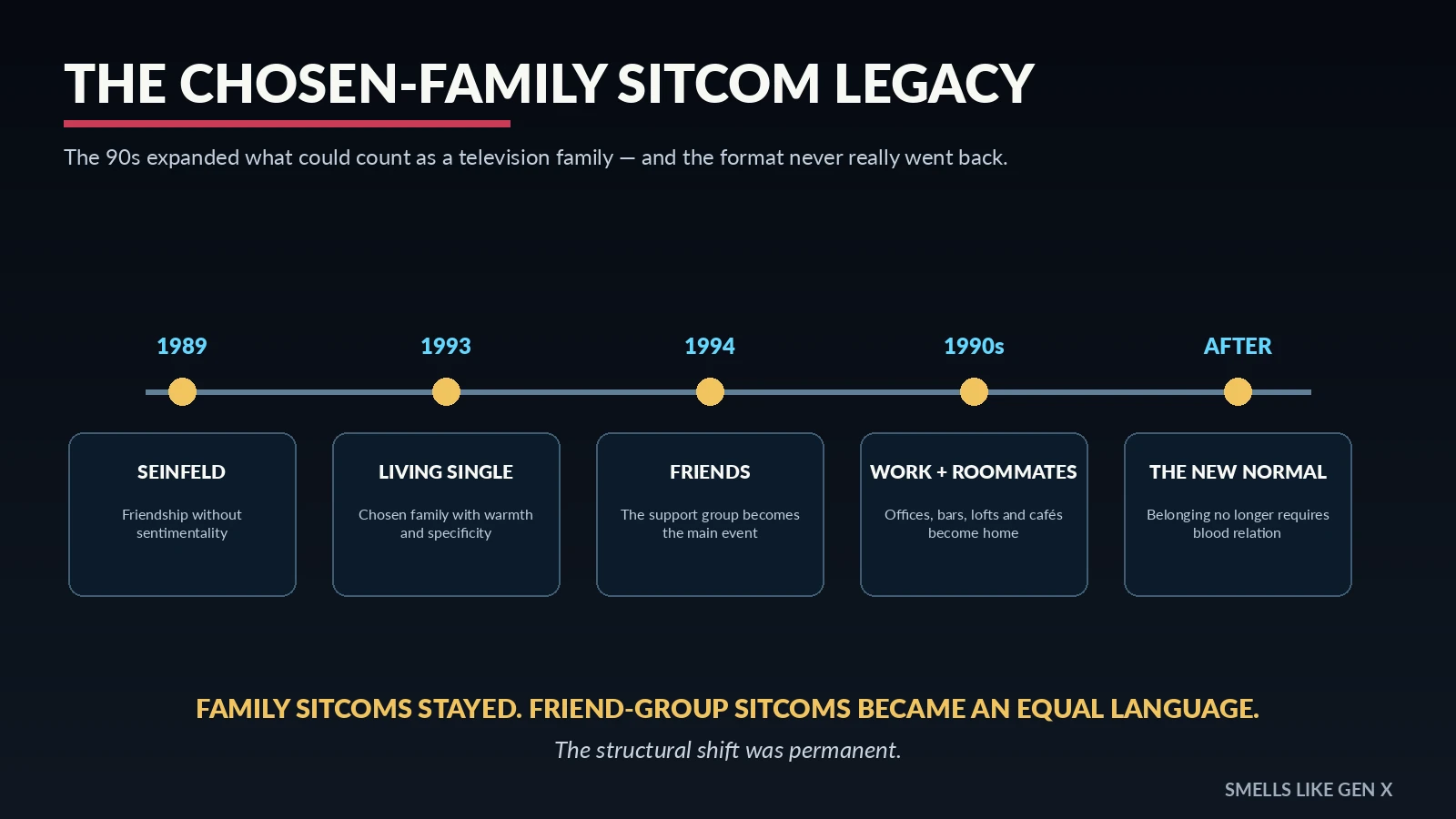
That is the real change behind the phrase “90s sitcoms about friends.” It was not merely a demographic swing toward younger casts. It was a structural expansion in what counted as a sitcom family. Seinfeld could make friendship unsentimental, Living Single could make it culturally specific and warm, and Friends could make it a global fantasy. Together, those models gave television more than one way to build belonging.
Family sitcoms stayed. Friend-group sitcoms joined them as an equal language. And once prime time learned that viewers would care deeply about people who were connected by choice rather than obligation, the American sitcom never had to move back into one house again.
Frequently asked questions
Did family sitcoms disappear in the 1990s?
No. Home Improvement, Family Matters, Full House and other family-centered comedies remained popular. The change was that friend-centered and single-adult sitcoms became equally central to prime time.
Which 90s sitcoms helped popularize the friend-group format?
Seinfeld, Living Single and Friends are major examples, alongside shows such as Mad About You and a large bench of apartment, dating and workplace comedies.
Was Living Single before Friends?
Yes. Living Single premiered on Fox in 1993; Friends premiered on NBC in 1994.
Why was Friends so important to the shift?
Its creators built the series around six young adults whose friends functioned as their day-to-day support system. The concept became one of the defining sitcom models of the era.
How was Seinfeld different from Friends?
Seinfeld used friendship as a comic ecosystem without the same sentimental emphasis. The group remained tightly connected even while the show mocked the idea that closeness automatically made people better.
What does chosen family mean in a sitcom?
It means the central emotional support system is built from friends, roommates, coworkers or neighbors rather than primarily from parents, spouses and children.
Sources behind this story
- Television Academy Interviews — Friends
- Television Academy — Friends at 30 oral history
- Television Academy Interviews — Seinfeld
- Television Academy — Larry David biography
- Peabody Awards — The Great Black American Comedy Wave of the 1990s
- Los Angeles Times — 1995–96 Nielsen Top 10
- Los Angeles Times — 1996–97 season ratings