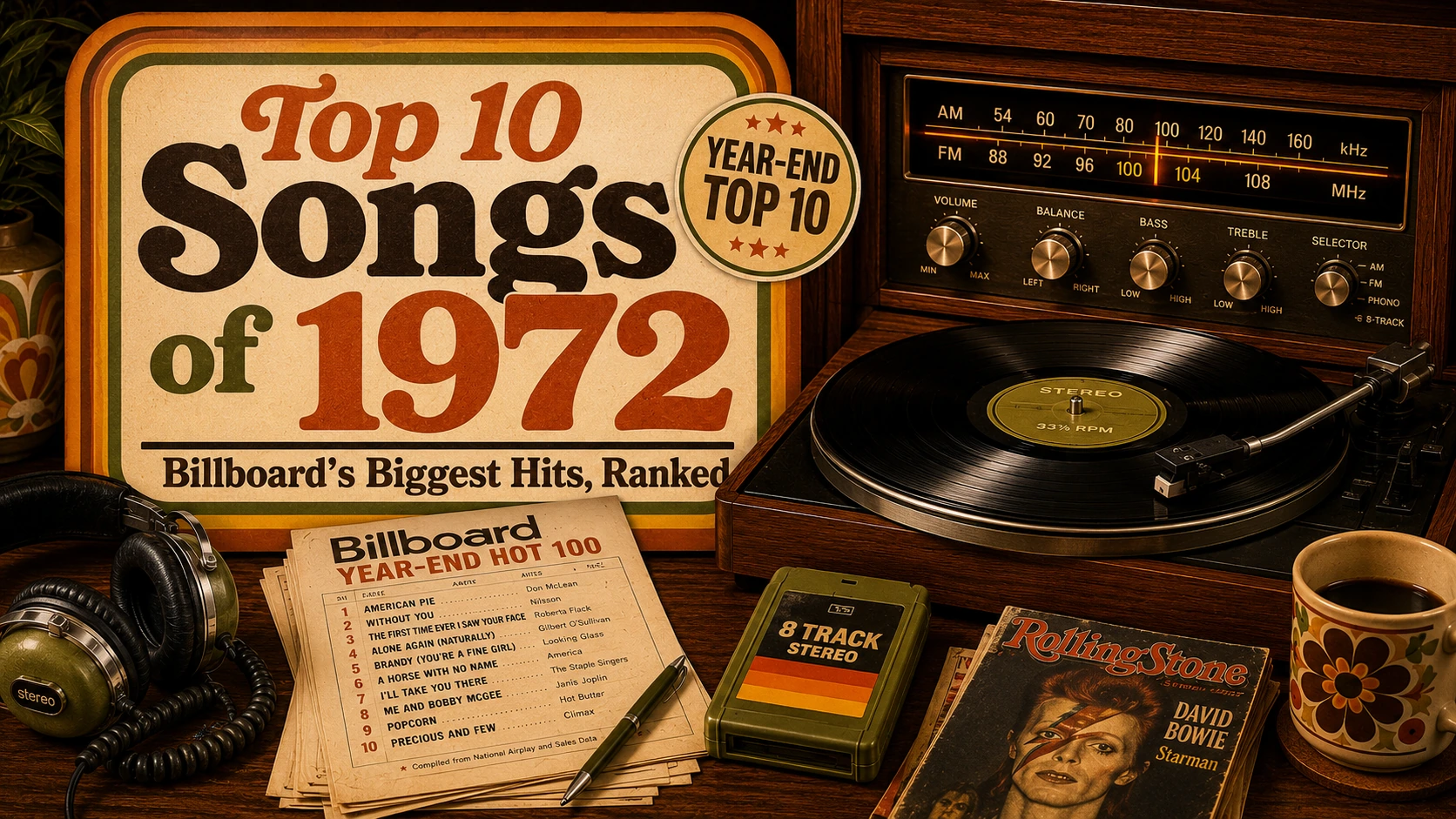
Top 10 Songs of 1972: Billboard’s Biggest Hits, Ranked
The top 10 songs of 1972 could move from a whisper to a cultural event without warning. Roberta Flack slowed time almost to a stop, Gilbert O’Sullivan hid despair inside graceful pop, and Don McLean turned eight and a half minutes of American memory into a four-week number-one single.
Elsewhere, Bill Withers made community sound practical, Harry Nilsson turned heartbreak into a vocal emergency, and Joe Tex brought enough Southern-soul swagger to finish sixth for the year without ever reaching number one.
This countdown follows Billboard’s 1972 year-end Hot 100. It ranks the biggest U.S. singles of the chart year by cumulative performance, not the best songs released during the calendar year.
“The First Time Ever I Saw Your Face” by Roberta Flack was Billboard’s number-one year-end song of 1972. “Alone Again (Naturally),” “American Pie,” “Without You,” and “The Candy Man” completed the year’s top five.
Billboard Hot 100 Year-End Ranking
Billboard’s annual ranking rewarded performance across the full chart period. A record’s weekly peak mattered, but longevity, sales and radio activity could carry a song high on the year-end list even when it never reached number one.
1972 Let Quiet Songs and Giant Songs Share the Same Radio
The biggest songs of 1972 did not follow one emotional or musical rule. The year-end chart included intimate soul, country-pop confession, theatrical show-business pop, Southern funk, folk-rock mythology and one of the darkest melodies ever disguised as easy listening.
That variety reflected a Top 40 system still willing to surprise its audience. A seven-minute cultural epic could follow a candy-colored singalong. Roberta Flack’s stillness could coexist with Joe Tex’s spoken swagger, while Bill Withers could make plain language feel as large as any orchestra.
The result is a 1972 music snapshot that feels unusually human. These records are funny, bruised, reassuring, theatrical and occasionally strange. They sound less like a single trend than an entire country turning the dial.
Quick List: Top 10 Songs of 1972
- #1 “The First Time Ever I Saw Your Face” — Roberta Flack
- #2 “Alone Again (Naturally)” — Gilbert O’Sullivan
- #3 “American Pie” — Don McLean
- #4 “Without You” — Harry Nilsson
- #5 “The Candy Man” — Sammy Davis Jr.
- #6 “I Gotcha” — Joe Tex
- #7 “Lean on Me” — Bill Withers
- #8 “Baby, Don’t Get Hooked on Me” — Mac Davis
- #9 “Brand New Key” — Melanie
- #10 “Daddy Don’t You Walk So Fast” — Wayne Newton
1972 Billboard Year-End Top 10 at a Glance
This table shows Billboard’s complete 1972 year-end top 10, each song’s weekly Hot 100 peak and the number of weeks it spent at number one.
| Year-End Rank | Song | Artist | Hot 100 Peak | Weeks at #1 |
|---|---|---|---|---|
| #1 | “The First Time Ever I Saw Your Face” | Roberta Flack | #1 | 6 |
| #2 | “Alone Again (Naturally)” | Gilbert O’Sullivan | #1 | 6 |
| #3 | “American Pie” | Don McLean | #1 | 4 |
| #4 | “Without You” | Harry Nilsson | #1 | 4 |
| #5 | “The Candy Man” | Sammy Davis Jr. | #1 | 3 |
| #6 | “I Gotcha” | Joe Tex | #2 | 0 |
| #7 | “Lean on Me” | Bill Withers | #1 | 3 |
| #8 | “Baby, Don’t Get Hooked on Me” | Mac Davis | #1 | 3 |
| #9 | “Brand New Key” | Melanie | #1 | 3 |
| #10 | “Daddy Don’t You Walk So Fast” | Wayne Newton | #4 | 0 |
Put 1972 Back on the Dial
Radio in 1972 could move from Roberta Flack’s near-silence to Joe Tex’s full-body groove, then hand the next eight minutes to Don McLean without worrying whether the styles belonged together. The dial was the organizing principle. If listeners stayed, the record belonged.
Continue through the complete 70s Music archive for year-by-year countdowns, soul, funk, disco, classic rock, soft rock and the AM-radio soundtrack that followed Gen X through kitchens, station wagons and wood-paneled family rooms.
Countdown: The Top 10 Songs of 1972
The countdown runs from Wayne Newton at #10 to Roberta Flack at #1, with chart peaks, number-one runs, musical context, 1972 radio history and the memories these records carried into Gen X childhood.
“Daddy Don’t You Walk So Fast”
Wayne Newton
Why It Hit
“Daddy Don’t You Walk So Fast” is unapologetic early-70s emotional theater. It begins with a family breaking apart and then places a child’s plea directly in the center of the record. There is no mystery about what the song wants from the listener. It wants the lump in the throat, the sudden silence in the car and the adult who insists the song is corny while quietly turning it up.
That directness helped make it one of the biggest songs of 1972. The melody is broad and immediately understandable, the arrangement keeps building toward the child’s interruption, and Wayne Newton delivers the story with the kind of stage-trained conviction that refuses to hide behind understatement. Pop radio of the period still had enormous room for narrative ballads that treated a domestic crisis like a three-act drama.
Inside the Record
The record’s structure does most of its work through escalation. The opening verses establish the separation from the father’s point of view, but the child’s voice changes the emotional balance. Suddenly the adult decision is no longer private. The song becomes about the damage visible from the back seat, which is why the central line lands so much harder than an ordinary breakup refrain.
Newton’s vocal is cleaner and more controlled than the subject might suggest. He does not shout his way toward the climax. Instead, the orchestra, backing voices and repeated title carry the emotional weight. That combination made the single feel equally at home on pop stations and adult-oriented radio, where dramatic story songs remained a reliable part of the early-70s format.
Why It Mattered in 1972
Although the song peaked at number four rather than number one, its year-end position shows how long it stayed useful to radio. Billboard’s annual rankings rewarded sustained performance, and “Daddy Don’t You Walk So Fast” kept accumulating spins and sales after the initial emotional impact should have worn off.
It also represents a side of 1972 pop that later histories often minimize. The year was not only singer-songwriters, soul and ambitious rock. Sentimental pop remained a major commercial force, and listeners still welcomed songs that told complete stories in plain language. This record was one of the clearest examples.
Gen X Rewind
For Gen X kids, this was the kind of record that made the adults’ world suddenly audible. Divorce, distance and regret came through the same dashboard speaker that had just played a cheerful singalong.
It belongs to kitchen radios, wood-paneled family rooms and long drives when nobody in the front seat explained why the song had made the car so quiet.
“Brand New Key”
Melanie
Why It Hit
“Brand New Key” sounds as though it wandered onto the radio from a sunnier, stranger neighborhood than everything around it. Melanie sings in a deliberately playful voice, the rhythm bounces with almost nursery-rhyme simplicity, and the central image—a pair of roller skates looking for a key—is peculiar enough to be remembered after a single listen.
That mixture of innocence, suggestion and pure melodic efficiency made the song enormous. It was easy for children to sing, sly enough for adults to debate and distinct enough that no program director could confuse it with another record. Three weeks at number one proved that being unusual was not a commercial liability when the chorus was this immediate.
Inside the Record
The arrangement is remarkably spare. Acoustic instruments, hand-played rhythm and Melanie’s expressive phrasing keep the track from feeling overproduced. The record creates motion without needing a heavy drum attack; it practically rolls forward on the shape of the melody.
Much of its durability comes from what the lyric does not settle. Melanie described the song as having innocent origins, but listeners heard layers of flirtation and double meaning. That uncertainty became part of the single’s identity. People could enjoy it as whimsical folk-pop, hear it as a joke or decide the whole thing was far less innocent than it appeared.
Why It Mattered in 1972
Among the top songs of 1972, “Brand New Key” represents the period when folk-derived songwriting could still produce a mass-market novelty without losing its handmade personality. It did not sound like polished studio pop, yet it occupied the very center of the Hot 100.
Its success also shows how broad early-70s radio remained. A song this quirky could sit beside Roberta Flack, Joe Tex, Harry Nilsson and Don McLean without needing to be forced into a narrow format category. The only requirement was that listeners wanted to hear it again.
Gen X Rewind
This is sidewalk and driveway music: roller skates, bicycles, open windows and a chorus that followed you outside whether you invited it or not.
For Gen X listeners, it often arrived as one of those adult-era hits that somehow felt as though it had been written directly for kids, even while the adults kept exchanging knowing looks.
“Baby, Don’t Get Hooked on Me”
Mac Davis
Why It Hit
Mac Davis built “Baby, Don’t Get Hooked on Me” around a contradiction that radio listeners recognized immediately: the singer sounds warm and charming while explaining why he should not be trusted. That tension gives the record more personality than an ordinary country-pop romance. He is warning someone away, but the melody keeps inviting her—and the audience—closer.
The chorus is conversational, the production is polished without becoming glossy, and Davis delivers every line with the relaxed confidence of someone who knows exactly how persuasive he sounds. That easy manner helped the single cross from country-influenced songwriting into mainstream pop and remain at number one for three weeks.
Inside the Record
The track works because it never overstates the arrangement. Acoustic guitar, steady rhythm and supportive strings leave room for the lyric’s mixed message. Davis does not perform the song as a villainous confession. He sounds almost reasonable, which makes the warning more complicated and the record more replayable.
Its title phrase is also exceptionally efficient. The word “hooked” carries romantic, emotional and almost addictive implications, while the descending melody makes the caution sound gentle. It is a hook about avoiding a hook—exactly the kind of compact pop idea that thrives on repeated radio exposure.
Why It Mattered in 1972
“Baby, Don’t Get Hooked on Me” was part of a larger early-70s movement in which country songwriting, soft rock and adult pop increasingly overlapped. The biggest songs of 1972 did not treat those categories as separate neighborhoods. A record could borrow from all three and reach listeners who might never have called themselves country fans.
The hit also established Davis as more than a successful songwriter for other performers. Its three-week number-one run gave him a signature record in his own voice and placed his easygoing Southern style in the middle of national Top 40 radio.
Gen X Rewind
This is adults-talking-around-the-subject music. The words sound casual until you are old enough to understand that the entire relationship is already in trouble.
It belongs to station-wagon dashboards and kitchen radios where grown-up complications were delivered in melodies smooth enough for everybody in the house to hum.
“Lean on Me”
Bill Withers
Why It Hit
“Lean on Me” became one of the top songs of 1972 because Bill Withers wrote comfort in language that sounded usable. The opening piano figure is plain, sturdy and instantly recognizable. The lyric does not promise that pain will disappear. It promises that another person can help carry it, which is a far more believable offer.
Withers sings without theatrical distance. His voice has warmth, grain and authority, but it never feels as though he is performing compassion for an audience. He sounds like somebody sitting nearby and saying what needs to be said. That honesty gave the song broad appeal across soul, pop and adult radio and carried it to number one for three weeks.
Inside the Record
The song’s construction is almost architectural. The piano establishes a communal pulse, the verses speak directly to one listener and the chorus widens until everybody can participate. The famous call-and-response ending transforms private reassurance into a roomful of voices.
Withers also avoids decorative language. Lines about swallowing pride, needing a hand and having problems are ordinary enough to belong to anyone. That simplicity is not a lack of sophistication; it is the craft. The song leaves listeners room to place their own family, friend, church, classroom or neighborhood inside it.
Why It Mattered in 1972
In a year filled with confession, novelty and emotional spectacle, “Lean on Me” offered something different: solidarity. It became a major 1972 soul hit without relying on romantic desire or heartbreak, and its message worked during a period when the country had no shortage of social and personal strain.
Its chart success also reinforced Bill Withers’s unusual place in popular music. He brought an adult working-life perspective, restrained arrangements and direct writing into the mainstream. The record sounded timeless almost immediately because it was built around a need that does not age.
Gen X Rewind
For Gen X, this became bigger than an old radio hit. It showed up at school assemblies, community events, television specials and every moment when a group needed one song everybody already understood.
Before it became institutional, though, it was simply a warm voice coming through household speakers and making the room feel a little less separate.
“I Gotcha”
Joe Tex
Why It Hit
Joe Tex does not ease into “I Gotcha.” He talks, shouts, teases and commands his way across the groove as though the record has already been playing for several minutes and the listener has just walked into the best part. That immediate personality separated it from the smoother pop surrounding it.
The rhythm section is tight and physical, the horns punch through at exactly the right moments, and Tex treats the lyric as a live exchange rather than a carefully polished studio monologue. The result feels spontaneous even though every stop and response is placed with precision. It peaked at number two but remained strong enough to finish sixth for the year.
Inside the Record
Much of the single’s energy comes from Tex’s hybrid delivery. He moves between singing and spoken exhortation, drawing on gospel, Southern soul and the stagecraft that later funk and hip-hop performers would recognize immediately. His voice is not merely carrying the melody; it is directing the entire band.
The arrangement leaves useful pockets of space around him. Bass and drums lock into a clipped groove while guitar and horns answer the vocal. That conversation gives the record tension and motion without requiring a complicated chord progression. It is less a traditional song than a concentrated performance.
Why It Mattered in 1972
“I Gotcha” demonstrated that the 1972 Billboard chart still had room for raw Southern soul at near-number-one scale. It did not soften its accent or smooth away Joe Tex’s humor and edge to reach pop audiences. The crossover happened because the personality was impossible to ignore.
Its year-end rank also illustrates why annual charts reveal more than peak positions. A record that never reached number one could still outperform shorter-lived chart-toppers through months of sales, airplay and audience demand. “I Gotcha” was one of 1972’s clearest endurance stories.
Gen X Rewind
This is the record that made an ordinary speaker sound as though somebody had kicked open the door. Even kids who did not follow the lyric understood the attitude.
It belongs to basement stereos, family parties and car radios turned up just enough for the groove to feel mildly dangerous.
“The Candy Man”
Sammy Davis Jr.
Why It Hit
“The Candy Man” dominated because Sammy Davis Jr. understood that cheerful material only works when the performer commits without embarrassment. He does not treat the song as a disposable novelty or apologize for its sweetness. He delivers it like a full-stage production, complete with a children’s chorus, orchestral lift and a smile large enough to reach the back row.
The melody is immediate, the images are colorful and the central promise—that the Candy Man can make the world taste good—offered an uncomplicated fantasy during a complicated period. Three weeks at number one and a fifth-place year-end finish show just how thoroughly mainstream America accepted the invitation.
Inside the Record
The song came from the film “Willy Wonka & the Chocolate Factory,” but Davis’s version reshaped it into a traditional pop showcase. The arrangement moves away from the film’s character setting and toward television-variety-show grandeur, where Davis was completely at home.
His phrasing gives the record its adult polish. He stretches certain words, snaps others into the beat and turns a simple children’s melody into a piece of show-business craftsmanship. The chorus supplies innocence; Davis supplies confidence. Together they keep the record from collapsing under its own sugar.
Why It Mattered in 1972
As one of the biggest 1972 pop songs, “The Candy Man” captures the continuing power of pre-rock entertainment traditions inside the Hot 100. Singer-songwriters and soul artists were reshaping radio, but a consummate nightclub and television performer could still produce the year’s fifth-largest single.
The hit also gave Davis his only number-one song on the Billboard Hot 100. After decades of success across music, film and television, the chart summit arrived through a record so cheerful that later listeners sometimes underestimate how professionally it was assembled.
Gen X Rewind
This is television-variety-hour music—the sound of a performer in a tuxedo, a bright set, a smiling chorus and every adult in the room accepting the corniness as part of the bargain.
For Gen X kids, it also connected old-school show business to the strange, colorful world of Willy Wonka, making the record feel both grown-up and entirely ours.
“Without You”
Harry Nilsson
Why It Hit
Harry Nilsson’s “Without You” begins in restraint and ends in emotional free fall. The verses sound almost private, with piano and voice holding the grief close. Then the chorus opens, Nilsson climbs into the upper edge of his range and the record becomes too large to remain background music.
That contrast turned the song into one of the biggest hits of 1972. The melody is direct enough to register immediately, but the performance keeps raising the stakes. Four weeks at number one proved that listeners were willing to revisit the same emotional collapse again and again because Nilsson made it sound newly unbearable each time.
Inside the Record
The song was written by Pete Ham and Tom Evans of Badfinger, who had woven two separate song ideas together. Nilsson recognized the power of the composition and transformed it through a grander arrangement and a vocal performance that became the definitive reading for millions of listeners.
The production understands scale. Strings and rhythm build gradually rather than arriving at full force, preserving space for the verses before the chorus expands. Nilsson’s voice remains the center, moving from tender control to a high, sustained cry that sounds technically astonishing and emotionally unstable at the same time.
Why It Mattered in 1972
“Without You” helped establish the blueprint for the enormous pop power ballads that would become even more common later in the decade and beyond. It proved that intimate singer-songwriter material could be expanded into cinematic radio without losing the hurt inside the lyric.
The single also gave Nilsson his only U.S. number-one hit as a performer. He was admired as a songwriter, studio craftsman and singers’ singer, but this record placed his voice at the center of mainstream culture for one extraordinary chart run.
Gen X Rewind
This is the song that made the stereo seem too small for what was coming through it. The chorus could turn a quiet room into a full emotional emergency.
Gen X heard it through parents’ records, car radios and later movie and television placements, usually before having enough romantic damage to understand why the adults looked exhausted.
“American Pie”
Don McLean
Why It Hit
“American Pie” was too long, too cryptic and too culturally crowded to fit the normal rules of a pop single, so it simply changed the scale of the rules. Don McLean turned the memory of Buddy Holly’s death into an eight-and-a-half-minute reflection on music, innocence, politics and a country that no longer sounded certain about itself.
The verses invited decoding, but the chorus required no explanation. Once the familiar line arrived, the record became communal. Listeners could argue over every king, jester and marching band while still joining the same giant refrain. Four weeks at number one and a third-place year-end finish made it a genuine mass phenomenon rather than a specialist folk-rock curiosity.
Inside the Record
The composition works through repeated cycles. Each verse adds characters and historical shadows while the chorus returns as a stable ritual. The arrangement follows the narrative, beginning with piano and voice before expanding into full-band momentum. That growth allows the song to feel like both an intimate remembrance and a public event.
McLean never supplied one official line-by-line explanation, which protected the record’s long life. The lyric contains recognizable references, but it also leaves enough ambiguity for generations of listeners to project their own version of American cultural decline onto it. Mystery became part of the hook.
Why It Mattered in 1972
Among the top songs of 1972, “American Pie” was the clearest proof that Top 40 audiences would accept ambition when the emotional center remained accessible. Its length challenged radio programming, yet stations played it because listeners demanded the complete journey.
The single also helped turn rock history itself into a subject for popular songwriting. The first rock-and-roll generation was already looking backward, measuring what had been lost and trying to understand how quickly youth culture had changed.
Gen X Rewind
This was the song where every adult claimed to know what at least three lines meant. The chorus belonged to everybody; the rest became a family-room seminar conducted with wildly uneven evidence.
For Gen X, it arrived already installed as American cultural furniture—too long to ignore, too familiar to escape and always waiting on the radio when a short song would have been more convenient.
“Alone Again (Naturally)”
Gilbert O’Sullivan
Why It Hit
“Alone Again (Naturally)” is one of pop history’s most deceptive hits. The melody is gentle, the piano setting is tidy and Gilbert O’Sullivan sings with an almost conversational calm. Underneath that pleasant surface, the lyric moves through abandonment, despair, faith and death with startling directness.
That contrast made the song difficult to resist. Listeners could absorb the tune before fully processing the darkness, and repeated plays revealed more of what the narrator was carrying. Six weeks at number one made it one of the most dominant Billboard songs of 1972 and placed quiet despair at the center of mainstream radio.
Inside the Record
O’Sullivan’s phrasing is crucial. He does not perform the lyric as a dramatic breakdown. He sounds reflective, polite and nearly resigned, which makes the most painful lines feel less like theatrical gestures and more like thoughts that have been quietly repeated for a long time.
The arrangement maintains that restraint. Piano, bass, light percussion and carefully placed orchestral color provide motion without relieving the loneliness. Even the melodic turns that sound bright carry a downward emotional pull. The record is meticulously crafted to remain listenable while saying things far heavier than ordinary pop convention allowed.
Why It Mattered in 1972
The song’s six-week number-one run demonstrated the expanding emotional range of early-70s pop. Singer-songwriter introspection had moved far enough into the mainstream that a record this bleak could become one of the year’s most frequently heard songs.
It also showed that darkness did not require musical heaviness. “Alone Again (Naturally)” reached millions precisely because it sounded approachable. The melody offered companionship to a lyric about isolation, creating a tension that radio audiences returned to rather than avoided.
Gen X Rewind
This is one of those records that could make a childhood room feel unexpectedly serious. The music sounded soft enough for the daytime, but something underneath it clearly belonged to the adults.
Gen X often encountered it before understanding the references, then returned years later and discovered that the pleasant little radio song had been carrying an emotional wrecking ball the entire time.
“The First Time Ever I Saw Your Face”
Roberta Flack
Why It Hit
Roberta Flack reached the top of 1972 by doing the opposite of what a blockbuster single is expected to do. “The First Time Ever I Saw Your Face” is slow, spacious and almost motionless. It does not chase the listener or force an emotional climax. It creates stillness and trusts that the voice, the lyric and the silence between them will hold attention.
They did. The song spent six weeks at number one and became Billboard’s biggest song of 1972. Flack’s performance turns remembrance into something physical: the first sight, the first kiss and the first intimate moment arrive with such measured detail that the record seems to slow time around them.
Inside the Record
Ewan MacColl wrote the song years earlier, and many artists recorded it before Flack. Her interpretation transformed it through tempo, phrasing and restraint. She stretches the melody until every word has room to settle, while piano, bass and minimal accompaniment remain almost reverent around her.
The vocal never depends on volume. Flack controls breath, tone and timing so precisely that the smallest change feels significant. When the arrangement finally broadens, it does so without breaking the intimacy. The record remains a private memory even while millions of people are listening.
Why It Mattered in 1972
Its success marked a major moment for sophisticated soul and adult pop. One of the biggest songs of 1972 was not built around a loud hook, dance rhythm or novelty premise. It was built around interpretive singing and emotional patience.
The recording had first appeared on Flack’s 1969 album, but its use in the film “Play Misty for Me” brought renewed attention and helped turn it into a single. That delayed breakthrough is part of the song’s remarkable chart story: a quiet album performance found the right cultural moment and became the year’s defining hit.
Gen X Rewind
This is not a song that blended into the household. It changed the air. Conversations softened, movement slowed and the stereo suddenly seemed to be asking everybody to listen.
For Gen X kids, it was one of those mysterious adult records whose emotional gravity was obvious long before the details made sense.
1972 Rewind Verdict
The 1972 Billboard year-end chart sounds less like one dominant movement than a crowded American living room. Sentimental pop sat beside sophisticated soul. Folk-rock stretched beyond normal single length. Country-pop smiled through mixed intentions, and a quiet Roberta Flack performance became larger than all of them.
That range is why the top songs of 1972 still hold together. The production styles differ, but every record has an unmistakable emotional center. They comfort, seduce, grieve, joke, remember and occasionally make a complete spectacle of themselves. Early-70s radio had room for all of it.
FAQ: Top Songs of 1972
What was the number-one song of 1972?
“The First Time Ever I Saw Your Face” by Roberta Flack was Billboard’s number-one year-end song of 1972. It also spent six weeks at number one on the weekly Hot 100.
What were the top five songs of 1972?
Billboard’s year-end top five were “The First Time Ever I Saw Your Face,” “Alone Again (Naturally),” “American Pie,” “Without You” and “The Candy Man.”
Did “American Pie” reach number one?
Yes. Don McLean’s “American Pie” spent four weeks at number one on the Billboard Hot 100 and finished third on the 1972 year-end chart.
Why did “I Gotcha” rank so high without reaching number one?
Billboard’s year-end ranking reflected cumulative chart performance rather than peak position alone. Joe Tex’s “I Gotcha” peaked at number two but remained successful long enough to finish sixth for the year.
What kinds of music were popular in 1972?
Mainstream radio included soul, folk-rock, singer-songwriter pop, country crossover, soft rock, theatrical pop and funk. The year-end top 10 shows how little the chart was confined to one sound.
How long was “Alone Again (Naturally)” number one?
Gilbert O’Sullivan’s “Alone Again (Naturally)” spent six weeks at number one and finished second on Billboard’s 1972 year-end Hot 100.
Where can I find more 70s music?
Continue through the Smells Like Gen X 70s Music archive for additional Billboard countdowns, genres, artists and deeper decade rewinds.