How NBC Put Seven Shows in the 1997 Nielsen Top 10
How NBC Put Seven Showsin the 1997 Nielsen Top 10
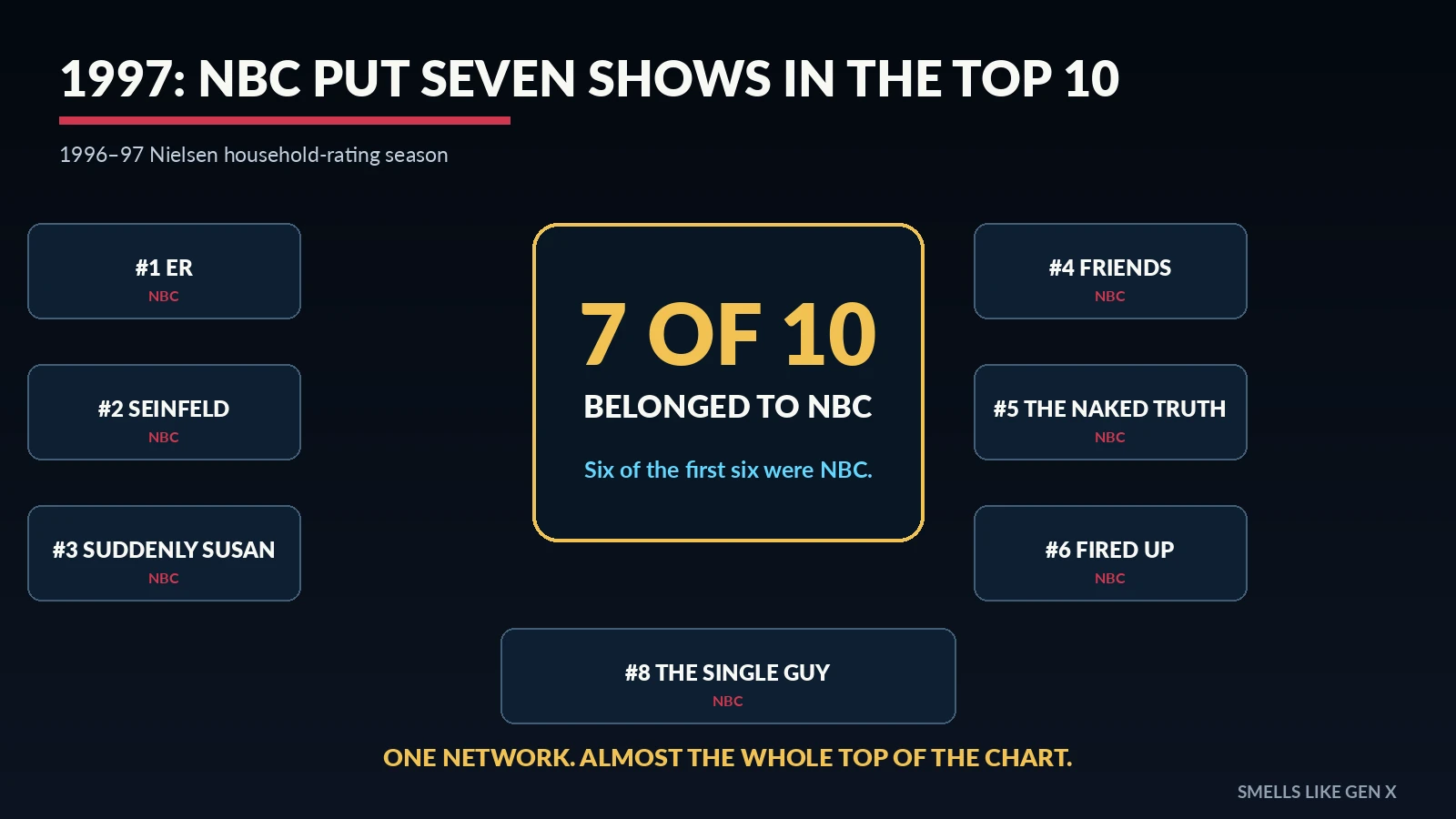
Seven of the ten highest-rated prime-time series in the 1996–97 season belonged to NBC. Not seven of the top twenty. Seven of the top ten. ER, Seinfeld, Suddenly Susan, Friends, The Naked Truth, Fired Up and The Single Guy turned one network into the center of gravity.
Did NBC really have seven shows in the 1997 Nielsen Top 10?
Yes, using the 1996–97 season-ending Nielsen household ratings. NBC held #1, #2, #3, #4, #5, #6 and #8. Only Monday Night Football, Home Improvement and Touched by an Angel prevented a complete sweep.
NBC Owned Seven of the Ten Highest-Rated Shows in the 1996–97 Season
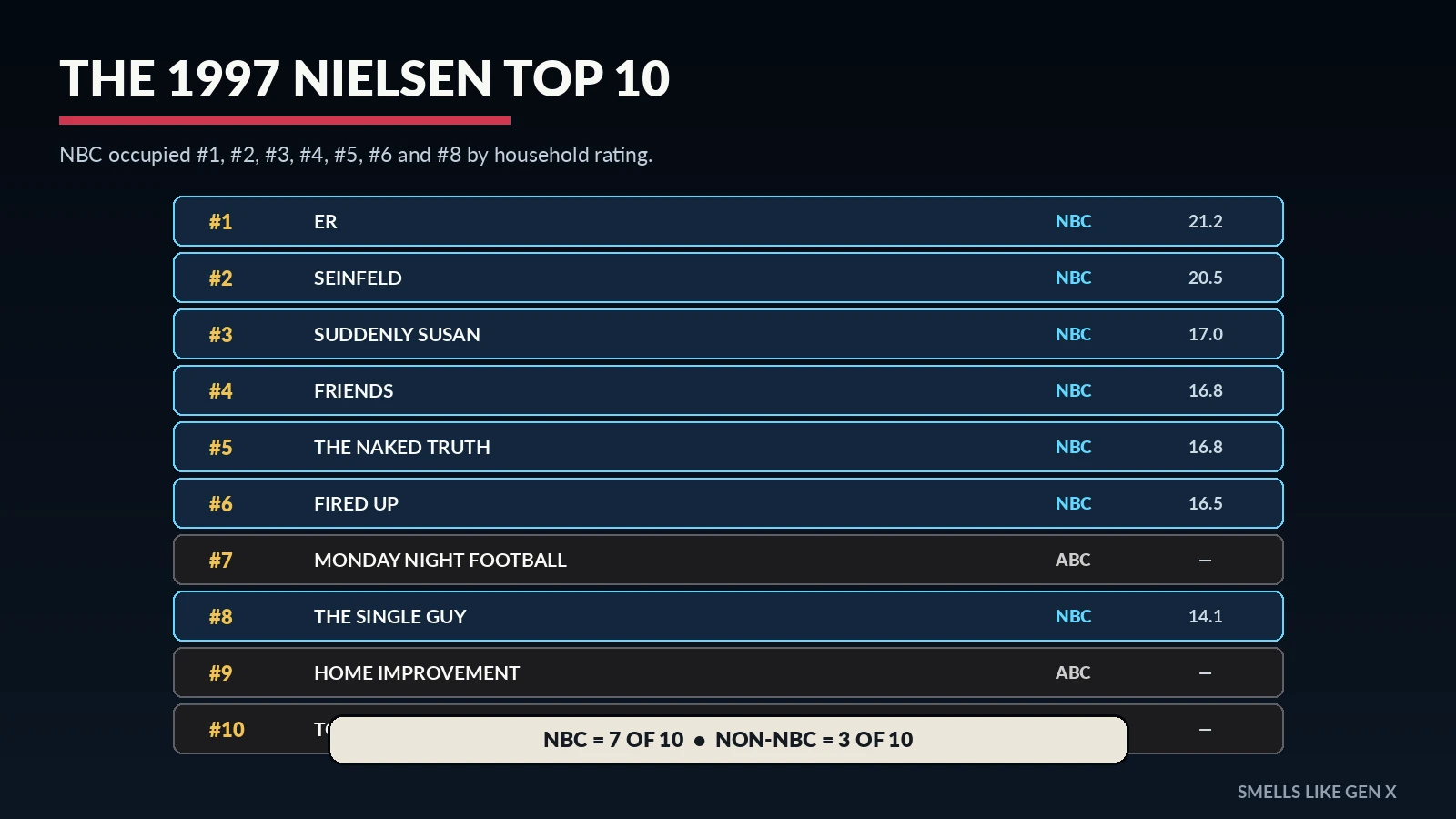
There are old Nielsen charts that look familiar, and then there is 1996–97. By season-ending household rating, NBC had ER at #1, Seinfeld at #2, Suddenly Susan at #3, Friends and The Naked Truth tied at 16.8 in the next two slots, Fired Up at #6 and The Single Guy at #8. Seven shows. One network. The top of the chart looked less like a competition than a scheduling memo.
The three programs that broke through were formidable in their own right: Monday Night Football, Home Improvement and Touched by an Angel. That makes NBC’s concentration even stranger. It was not feasting on a weak year. It was crowding out a live NFL institution, one of ABC’s defining family comedies and a CBS drama that had just found a massive Sunday audience.
The full annual ranking belongs on our 1997 Nielsen Top 10 page. This article is about the seven-of-ten fact itself: how a broadcast network used anchors, lead-ins, promotion and one terrifyingly efficient Thursday lineup to make itself almost unavoidable.
Household Rating and Average Viewers Can Shuffle the Middle of the List
If you look up 1996–97 ratings in different historical sources, you may notice that Friends and Suddenly Susan sometimes switch places, and Monday Night Football can appear tied differently depending on the metric. That is not evidence that Nielsen was making things up in a dark room. It is usually a difference between household rating and average-viewer totals.
Smells Like Gen X uses the season-ending household-rating framework for the year pages because that is the cleanest way to keep the 1991, 1996, 1997 and 1999 comparisons consistent. On that basis, Suddenly Susan is #3 at 17.0, while Friends and The Naked Truth are both at 16.8. A Los Angeles Times viewer-total list puts Friends slightly ahead of Suddenly Susan. Either way, the larger fact does not budge: seven NBC programs are in the Top 10.
That distinction matters because ratings history gets mangled easily when calendar years, TV seasons, households and individual viewers are mixed together. Here, “1997” means the prime-time season ending in 1997. It is the 1996–97 season, not a January-through-December list.
ER and Seinfeld Gave NBC the Kind of Anchors Networks Dreamed About
NBC’s depth gets the headline here, but depth is easier to build when the schedule begins with certainty. ER and Seinfeld were certainty. One was the most-watched drama on television; the other was the comedy every network executive wished they had developed. They delivered huge audiences with very different tones, which gave NBC more than one path into the night.
ER finished #1 with a 21.2 household rating, still riding the visual and emotional momentum that had made County General appointment television. The larger legacy of the series is covered in our ER deep dive, but its scheduling value is simple: viewers knew where they were ending Thursday night. That certainty made every earlier half-hour more valuable.
Seinfeld, meanwhile, sat at #2 with a 20.5 rating and provided NBC with a comedy anchor that could survive the kind of cynical, self-centered tone that would have scared network executives a decade earlier. Its show-level history belongs in our look at how Seinfeld changed 90s comedy. In 1997, though, its most important job was being the gravitational center at 9 p.m.
Thursday Night Turned Audience Flow Into an Industrial Process
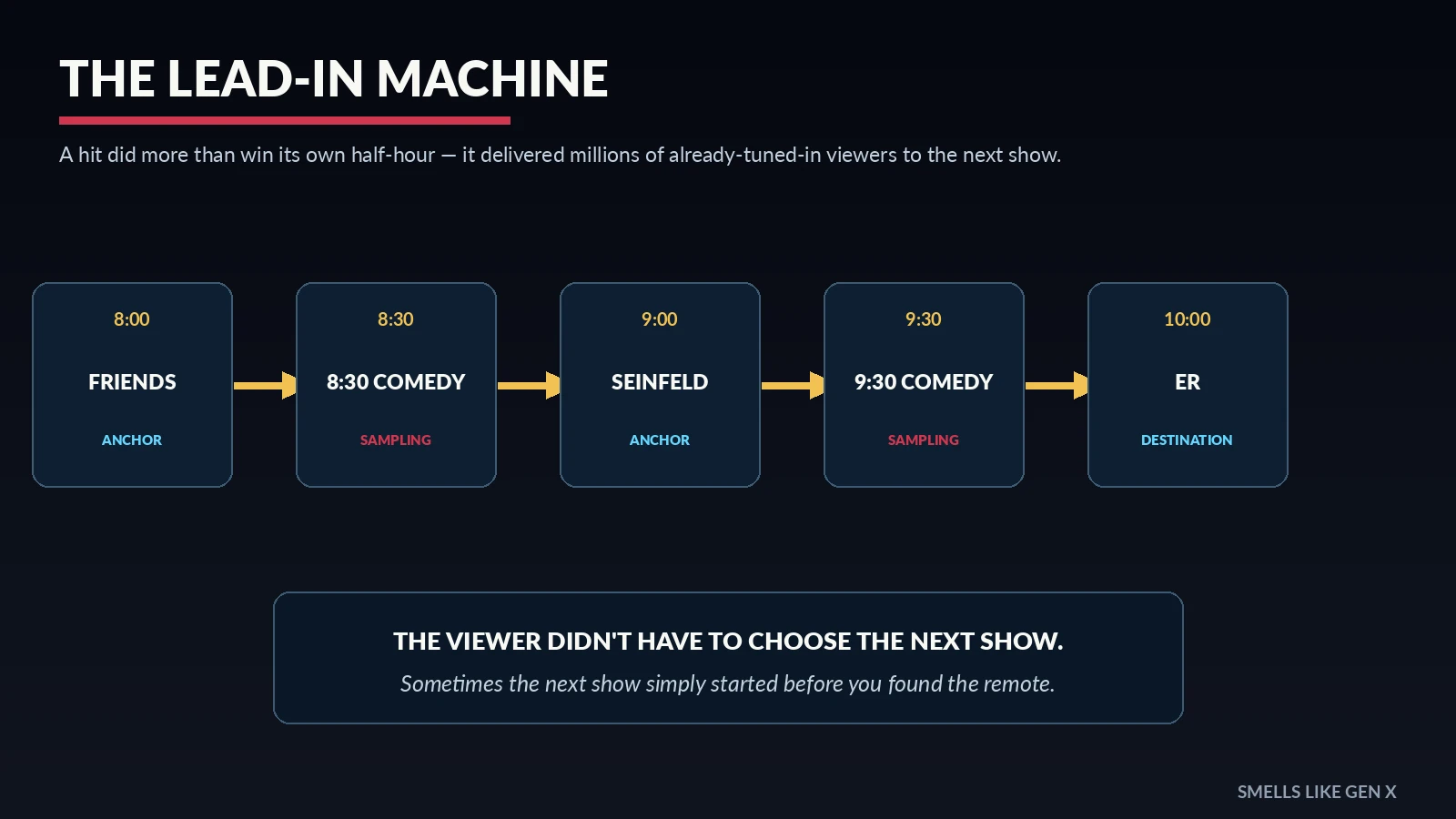
The old broadcast schedule mattered because changing the channel required an active decision. There was no autoplay asking whether you wanted the next episode. There was also no endless library waiting behind a home screen. If you were already on NBC for a show you loved, the program that followed had a chance to inherit you before you found the remote under a couch cushion.
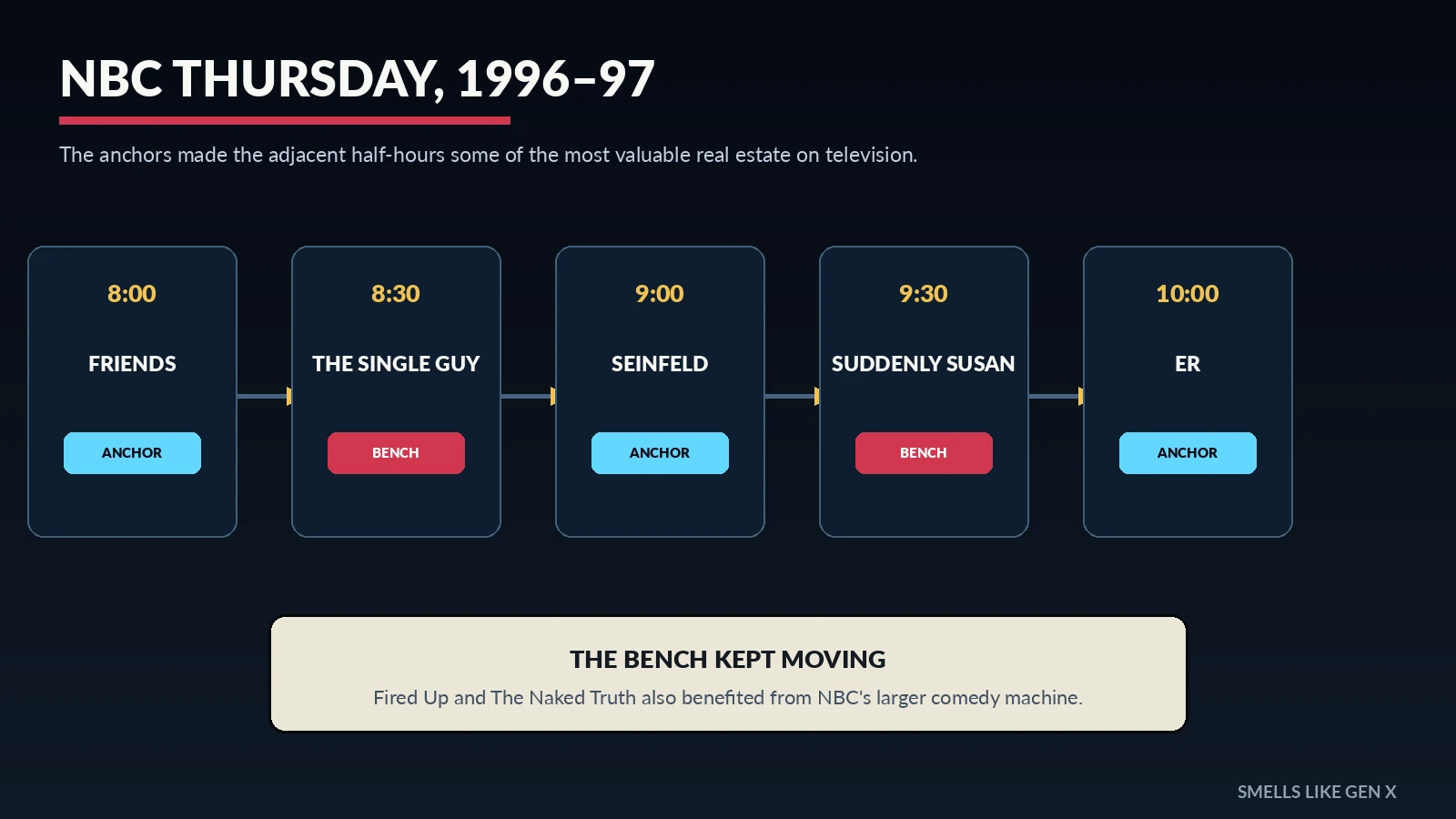
NBC understood that behavior and built around it. A giant at 8 could expose an 8:30 comedy. Seinfeld at 9 could reset the night and deliver another audience to 9:30. ER at 10 made the final hour feel non-negotiable. The network could promote the entire block during itself, creating a loop in which the audience was constantly being told that the next thing was also part of the event.
That network-wide strategy is the territory of our Must See TV history. The 1997 data story is narrower: this was the season when the strategy produced an almost comical statistical result. Six of the first six household-rating positions belonged to NBC, and most of those programs were tied directly to Thursday.
Suddenly Susan Is the Cleanest Example of the Machine’s Launch Power
Nothing explains 1997 better than Suddenly Susan. Brooke Shields gave the show instant name recognition, and NBC placed it in one of the most valuable pieces of television real estate imaginable: after Seinfeld and before ER. The first season finished #3 by household rating. Read that again if your memory insists the show was a modest mid-tier sitcom. The chart says otherwise.
That does not mean the time slot manufactured every viewer from nothing. A lead-in can get people through the door, but a show still has to hold enough of them to post a season average. What the placement did was guarantee a scale of sampling that almost no new comedy could reproduce on its own. Millions of people encountered Suddenly Susan because it was built into an already habitual Thursday route.
The later fall after leaving that protected neighborhood is part of the reason the show’s first-season rank remains so striking. We unpack the whole rise-and-fade story in our Suddenly Susan ratings deep dive. In the seven-of-ten story, it is the clearest reminder that a network schedule could function like a launch platform, not merely a list of programs.

Friends Was Already Bigger Than a Hit Sitcom
Friends finished with a 16.8 household rating in 1996–97, essentially tied with The Naked Truth in household measurement and ahead of it in some viewer-based season summaries. The number matters, but the cultural position matters more. The show had become one of NBC’s most reliable entry points for younger viewers and one of the decade’s defining pictures of single adulthood.
Unlike some of the bench comedies around it, Friends did not depend on Thursday simply to remain visible. It had characters, settings and relationships that kept gaining cultural weight. That durable identity is why its influence belongs in our full Friends legacy article rather than being reduced to a slot in a chart.
But within NBC’s 1997 dominance, Friends did something very practical: it started the night with a huge, desirable audience and made 8:30 valuable. When the first half-hour is already appointment television, the next half-hour gets a chance most new sitcoms would kill for.
The Naked Truth, Fired Up and The Single Guy Show How Deep NBC’s Advantage Really Was
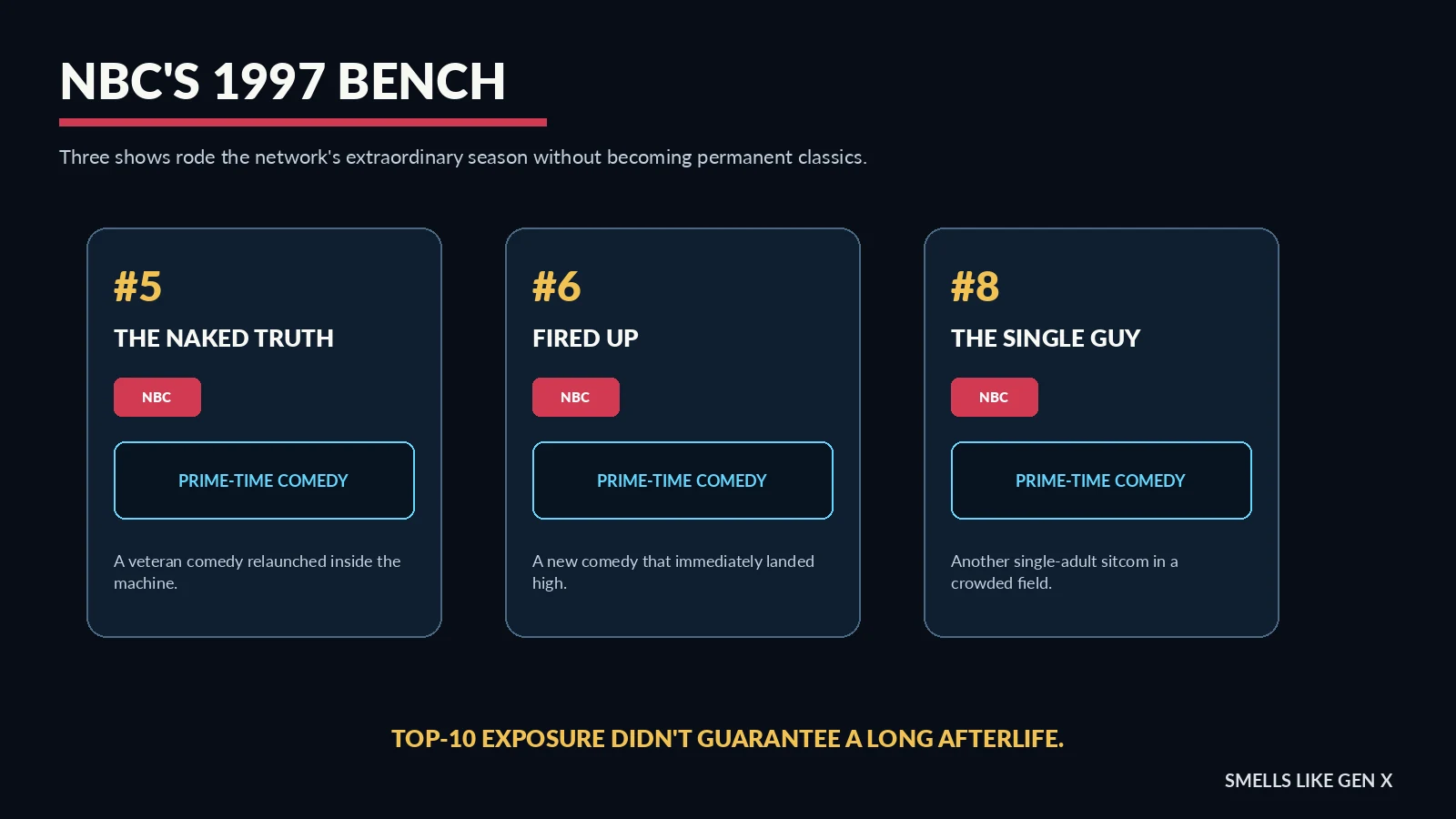
The famous shows explain why NBC was strong. The less-remembered shows explain why NBC was dominant. The Naked Truth posted a 16.8 household rating. Fired Up came in at 16.5. The Single Guy landed at 14.1. These are not footnote numbers. They placed all three inside the national Top 10.
None of those shows has the modern cultural footprint of Seinfeld, Friends or ER. That gap is precisely the point. The schedule could make a show enormous in first-run exposure without guaranteeing the second life that creates a classic. Syndication, episode count, repeatability, character identity and later availability all affect memory. A Thursday slot could not manufacture those things forever.
What it could manufacture was opportunity at ridiculous scale. NBC could take a comedy that had not yet built an independent audience and place it beside one of television’s biggest shows. In a pre-streaming world, that adjacency was power. The 1997 chart is what happens when a network uses that power repeatedly and the rest of the schedule fails to break the chain.
Football, Home Improvement and Touched by an Angel Were the Exceptions
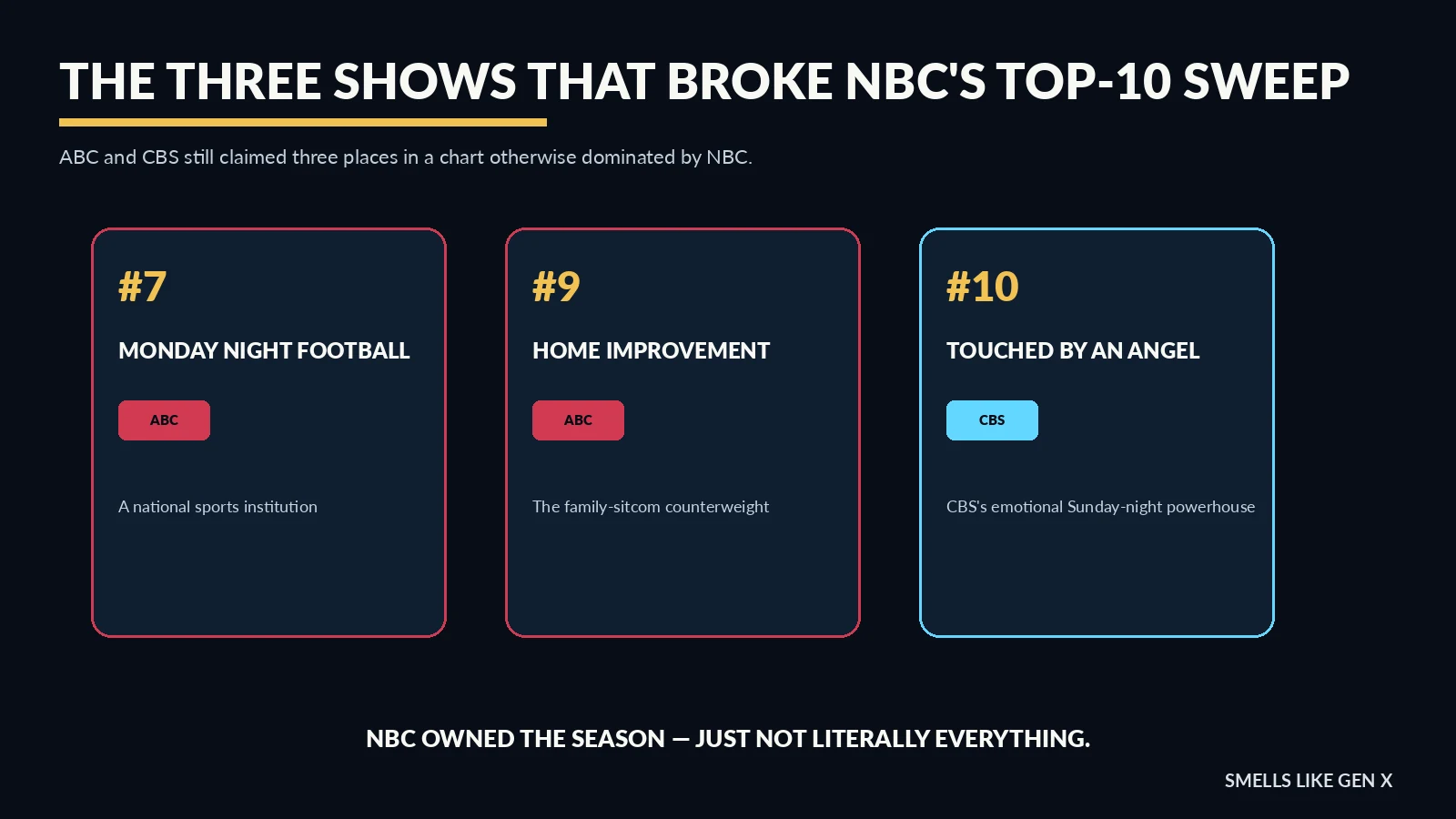
The three non-NBC programs in the household-rating Top 10 tell their own story. Monday Night Football finished #7 because live NFL football was already one of the few weekly events strong enough to ignore whatever sitcom block the networks put against it. Home Improvement finished #9, proving the traditional family sitcom remained a mass-audience force even as NBC leaned harder into urban adults and friend groups.
Then there was Touched by an Angel at #10, a very different kind of hit. CBS had moved the series to Sunday and found an audience that wanted warmth, spirituality and emotional reassurance rather than the faster, younger, more ironic identity NBC sold on Thursdays. That contrast matters because it shows viewers were not moving in one cultural direction. Multiple kinds of mass television could still coexist.
NBC’s seven programs did not conquer an empty field. They conquered a field where football, family comedy and a sentimental Sunday drama were all powerful enough to reach the Top 10. That makes the concentration more impressive—and more revealing about how much leverage NBC had accumulated.
A Lead-In Could Deliver Millions of Accidental First Episodes
One of the hardest things to explain about 90s television is how much viewing happened because you were already there. That sounds passive, but it was a central part of the business. Networks spent decades learning how audiences flowed across a night. Put the right show after a hit and you could expose it to millions of people who had not made a deliberate decision to watch it.
Sampling is not the same as loyalty. NBC’s genius was in getting the sampling event to happen at a giant scale. A new comedy did not have to convince a viewer to seek it out in a menu. It only had to keep the viewer from changing the channel. Promotion during the previous half-hour reinforced the handoff. The next show began before inertia had time to break.
This is why 1997 feels so foreign now. Modern platforms are excellent at recommendation, but the old network could place nearly the entire country inside the same sequence and let one hit physically feed the next. The Nielsen chart records that circulation system in numerical form.
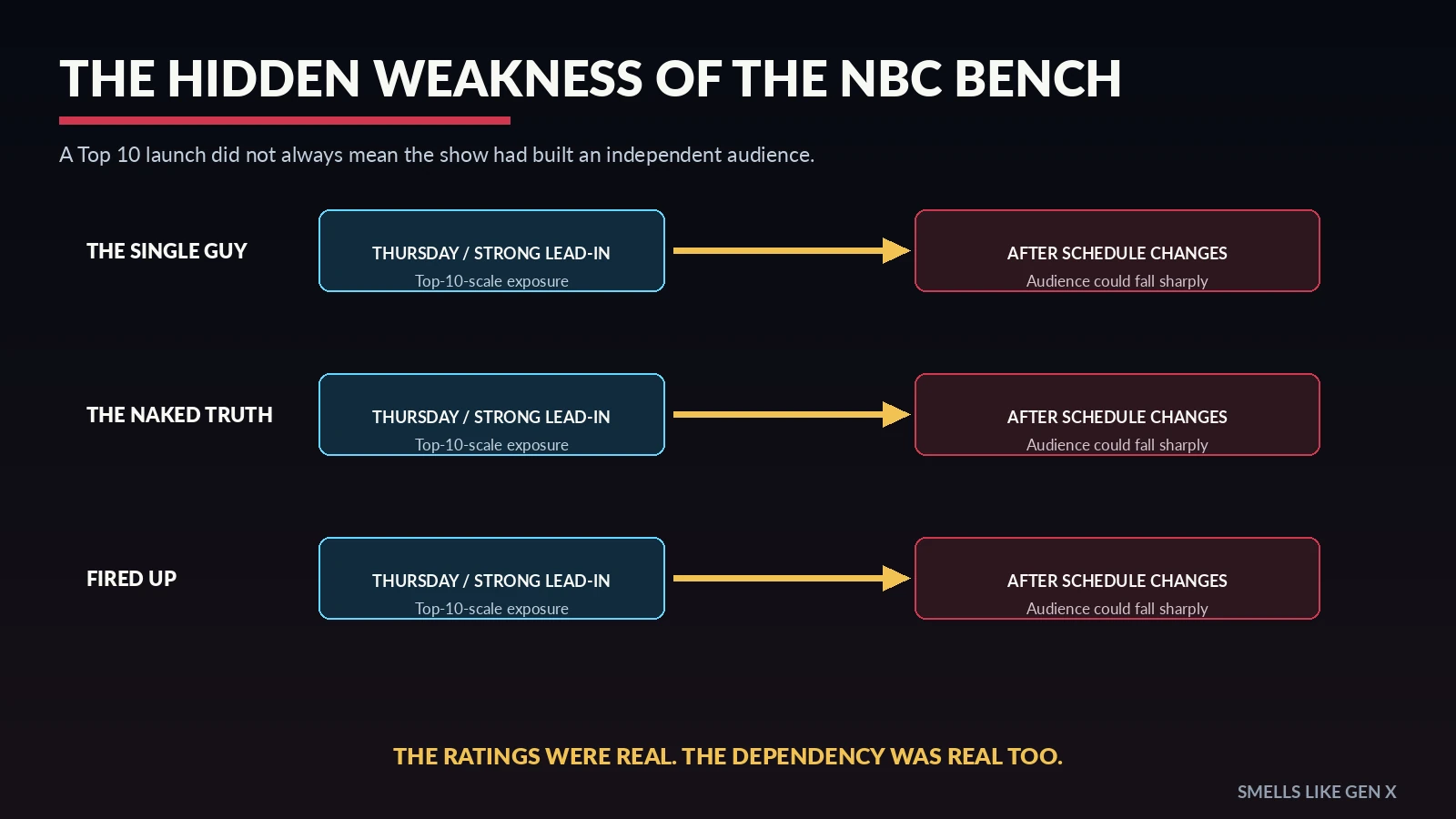
Moving a Show Could Reveal How Much of the Audience Belonged to the Time Slot
The same system that created huge launches also created a brutal test: move the show. Several NBC comedies discovered that a Top 10 rank did not guarantee an independent audience. Once removed from Thursday’s strongest traffic, some fell sharply. The viewer had sampled the show, maybe even watched regularly, but the habit belonged partly to the entire night.
That does not make those ratings fake. Nielsen measured real households watching real broadcasts. It does mean first-run success and durable cultural attachment are different things. A restaurant can be packed because it is next to the stadium and still serve real meals. Move it twenty miles away and you learn how many customers were there for the restaurant itself.
NBC’s 1997 dominance therefore contains both the triumph and the warning. The network had extraordinary control over exposure, but exposure could disguise dependency. The more impressive the machine became, the harder it was to tell where the machine ended and the individual show began.
NBC Thursday Was Less a Schedule Than a Default Setting
If you were watching television in the mid-90s, the dominance did not arrive as a spreadsheet. It arrived as repetition. NBC promos during NBC shows. Thursday-night jokes on radio Friday morning. Cast members from one hit turning up on talk shows beside cast members from another. The network’s identity became self-reinforcing because its biggest programs kept advertising the existence of the others.
For Gen X, this was also the last era when a network night could feel close to unavoidable without being a championship game. You might prefer ABC or Fox, you might actively hate one of the NBC comedies, but you knew what was on. The culture carried the schedule even when you did not watch it. That kind of ambient awareness is difficult to reproduce in a fragmented media environment.
The funny part is how selective memory became. We remember the anchors and lose the bridges. Seinfeld, Friends and ER remain permanent. The Naked Truth and Fired Up require a little more rummaging through the mental VHS shelf. The Nielsen chart puts all of them back in the same room for one season and reminds us just how powerful the room was.
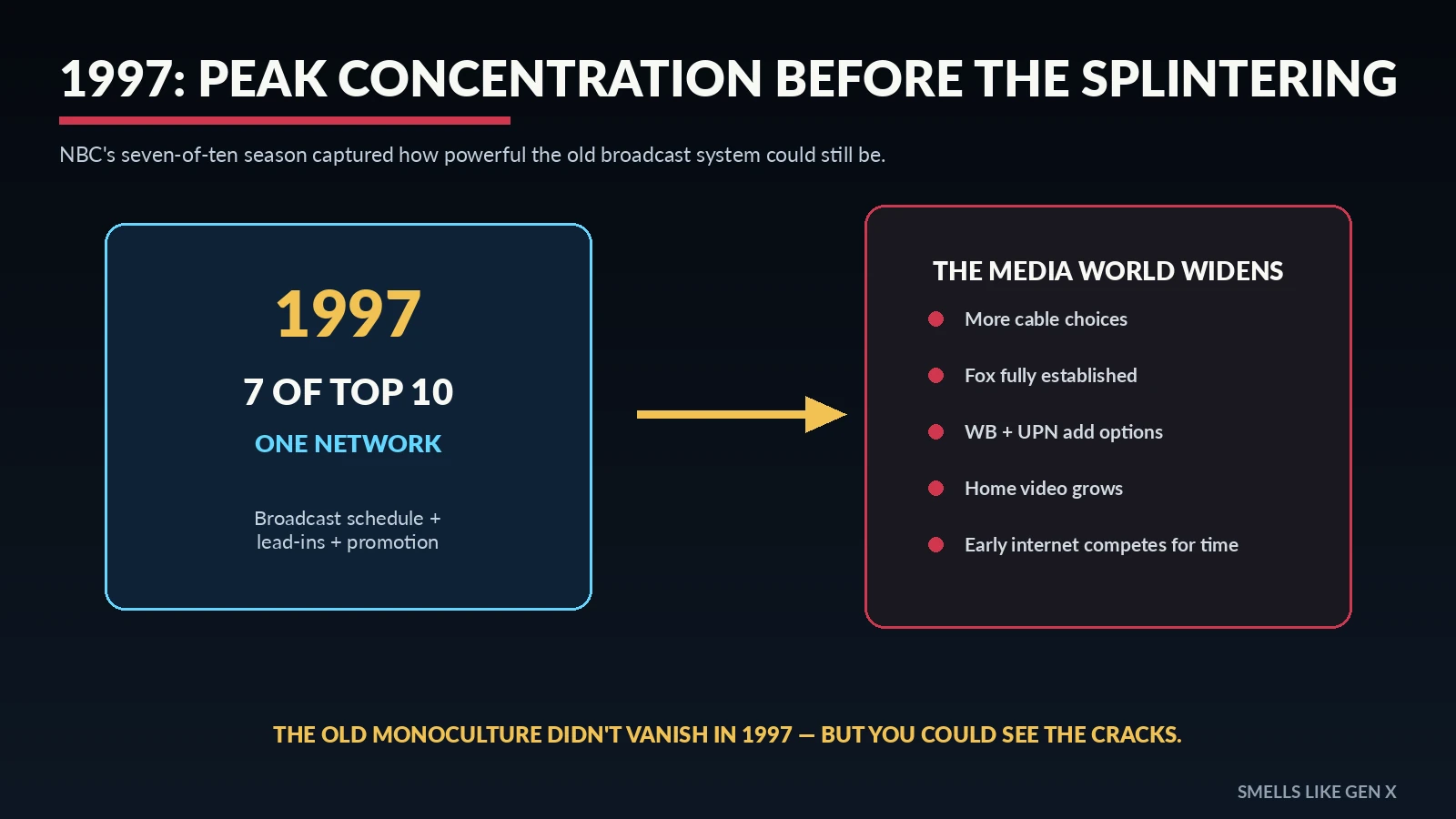
1997 Is a Snapshot of Broadcast Concentration Near Its High-Water Mark
NBC would remain powerful after 1997, but the media environment was already starting to pull apart. Cable choices kept multiplying. Fox was fully established. WB and UPN added more broadcast options. Home video, games and the early internet were beginning to compete for time in ways that would only accelerate. The idea that one network could occupy seven Top 10 slots was becoming harder to sustain.
That is why this chart matters beyond network bragging rights. It captures an ecosystem where schedule position, promotion and shared viewing could concentrate attention at a national scale. NBC did not merely have several good shows. It had enough audience gravity to make the surrounding shows bigger, and enough promotional reach to turn the entire night into a brand.
The 1996–97 season is therefore one of the clearest numerical portraits of the old broadcast monoculture still functioning at full force. Seven NBC shows in the Top 10 sounds ridiculous now because it was ridiculous then too. The difference is that, in 1997, the system was still capable of making it happen.
Frequently asked questions
Which seven NBC shows were in the 1997 Nielsen Top 10?
By household rating: ER, Seinfeld, Suddenly Susan, Friends, The Naked Truth, Fired Up and The Single Guy.
What season does the 1997 ranking cover?
It covers the 1996–97 prime-time television season, the season ending in 1997.
Why do some 1997 rankings list Friends ahead of Suddenly Susan?
Some season summaries rank by average viewers rather than household rating. The order changes slightly, but NBC still placed seven programs in the Top 10.
What was the #1 show in 1996–97?
ER was #1 by household rating at 21.2, followed by Seinfeld at 20.5.
Which non-NBC shows made the Top 10?
Monday Night Football on ABC, Home Improvement on ABC and Touched by an Angel on CBS.
Did NBC's dominance mean every show was a lasting classic?
No. Several programs posted huge first-run ratings but faded quickly once schedules changed or after their original runs ended. That gap between ratings and cultural memory is part of what makes the 1997 chart so fascinating.