Beauty and the Beast in the 80s: Romance, Fantasy and Cult Television
A city above, a home below and a relationship that made the journey between them worth waiting for.
Catherine had a life above. Vincent had a home below. Their meetings had to hold both worlds.

There was a secret city under New York, a woman with a demanding job above it and a man who could make reading a poem feel like the most important thing on television. Beauty and the Beast was an unusual proposition for CBS in 1987. It asked the audience to accept the impossible, then rewarded the acceptance with a relationship built around attention.
Linda Hamilton’s Catherine Chandler and Ron Perlman’s Vincent didn’t need to explain the whole world every week. A balcony, a quiet conversation and the knowledge that one of them had made a difficult journey could be enough to restore the feeling. The crime story might keep the hour moving, but the meeting was often what you had been waiting for.
I like how completely the original series committed to its romantic language. The tunnels had books, candles, arguments and people who had made a home there. Vincent had a remarkable face that the story didn’t need to remove before he could be loved. Catherine had a life outside the fantasy, and the tension between those lives gave the show somewhere to go.
This is the original CBS series with Hamilton, Perlman and Roy Dotrice, concentrating on its 1987–89 years. There is a clearly marked discussion of the late-1989 story change near the end. Before that, we’re returning to the relationship and community that made the first two seasons so distinctive.
Inside This Article
- A Fairy Tale Found a Route Through Contemporary New York
- Catherine's Rescue Begins a Change in Her Life
- Linda Hamilton Gives Catherine More Than the Job of Believing
- Ron Perlman Makes Stillness Part of Vincent's Presence
- Vincent's Face Is Not a Problem the Romance Has to Solve
- Rick Baker's Design Had to Remain a Face an Actor Could Use
- Father Gives the Hidden World an Older Memory
- The Tunnels Have to Be a Community, Not Only a Romantic Backdrop
- Mouse Makes a Rule Become Somebody's Experience
- Catherine's Work With Joe Maxwell Keeps the City Above Active
- Elliot Burch Gives the Upper World an Attractive Form of Power
- The Balcony Is a Meeting Place With a Limit Built Into It
- The Empathic Bond Is Powerful Because It Is Also Uneven
- Terrible Savior Asks What a Familiar Face Can Prove
- Masques Gives Vincent a Brief Different Relationship With the Street
- Song of Orpheus Gives Father a Past Outside the Tunnels
- Nor Iron Bars a Cage Turns Curiosity Into a Threat
- Dead of Winter Makes Belonging a Shared Occasion
- A Fair and Perfect Knight Lets Vincent Feel Something Less Noble
- Ozymandias Makes a Building Project Reach Into the Love Story
- A Happy Life Gives Catherine's Grief Its Own Time
- Poetry and Music Give a Conversation Room to Become an Event
- The Rescue Pattern Can Be Exciting and Limiting
- A Sanctuary Also Has to Decide Who Gets Through the Door
- George R.R. Martin Was Part of the Writing World, Not the Sole Creator
- The Devotion Made Sense Before Fandom Had Today's Tools
- Late-1989 Story Change — Major Spoilers Ahead
- The Show Could Be Earnest Without Always Being Graceful
- Its Place Beside the Other Unusual Dramas of the Decade
- A Good Return Begins Before the World Has Become Familiar
- Why the Original Still Feels Like Its Own Place
- Questions About the Original Beauty and the Beast
A Fairy Tale Found a Route Through Contemporary New York
Ron Koslow created the original Beauty and the Beast, which began on CBS in 1987 and continued into 1990. Its city setting allowed familiar television work to sit beside an entirely different imaginative world. Catherine could investigate a case while somewhere beneath the streets a hidden community maintained another way of living.
That contrast made the fantasy accessible without making it small. You didn’t have to learn a remote kingdom’s entire history before understanding the immediate situation. A woman had a job, friends and obligations. A man cared for her but couldn’t simply accompany her into the public life she occupied.

The title provided a recognizable invitation, while the details changed the bargain. Vincent wasn’t waiting for romance to turn him into a conventional leading man. His appearance remained part of the person the audience was asked to know. Catherine’s change involved how she lived and what she valued, rather than discovering that her affection had earned a more ordinary-looking partner.
The double setting also gave the series practical range. An episode could begin with a threat above, an argument below or a question crossing the boundary between them. The secret city wasn’t simply a hiding place to visit after the actual plot had finished. It had its own people, rules and vulnerabilities.
Inside the varied world of eighties television fantasy, that mixture feels particularly individual. The show could use danger and rescue, but it also trusted a conversation to be an event. Accept the tunnels, it seemed to say, and then pay attention to the people who have to decide what a life there means.
Catherine's Rescue Begins a Change in Her Life
The opening story subjects Catherine to a violent assault and leaves her in need of help. Vincent finds her and brings her into the hidden world, where she can recover. It is a harsh beginning for a romance, and the essential circumstances are disturbing without needing a close inventory of the violence.
The rescue creates a relationship founded on care before Catherine has a complete account of the person caring for her. Fear, gratitude and curiosity don’t arrive in a neat sequence. She must recognize that an unfamiliar face is not an adequate guide to the intentions behind it.
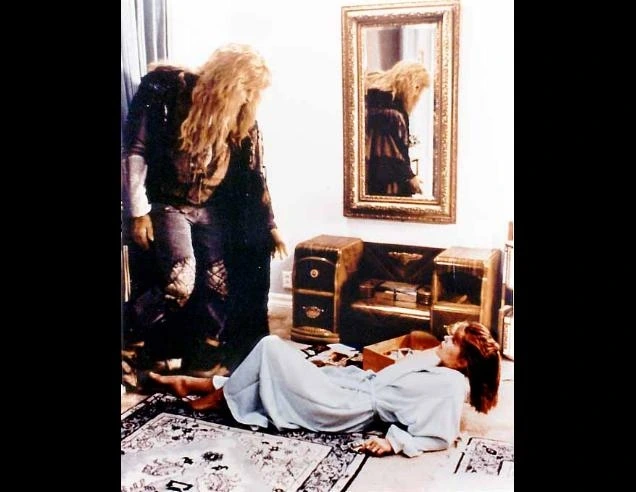
The experience changes the direction of her life above. Her legal work becomes connected to people and problems that require more than preserving a comfortable position. The series gives her a professional route into the city’s danger as well as a private route into Vincent’s world.
That matters because the romance can’t survive very long as repayment for a rescue. Catherine has to make continuing choices as a person with a life of her own. Gratitude can begin the connection; it cannot be the whole explanation for why she keeps returning.
The pilot also establishes the show’s characteristic movement. A violent public world leads into a place of care, and then the person who has received that care must go back out. The underground refuge doesn’t erase the life above. It changes the expectations Catherine brings to that life, including what she is prepared to notice and what she is willing to do about it.
Linda Hamilton Gives Catherine More Than the Job of Believing
Catherine could have become a very passive television role: the woman who accepts the extraordinary man, gets into danger and waits for the rescue. Linda Hamilton brings an alertness that makes that reduction less comfortable. Catherine can be moved by Vincent without appearing to have surrendered the rest of her intelligence.
Her professional life supplies an important anchor. A case has other people in it, with consequences that don’t exist solely to test the romance. Hamilton can make a work conversation feel like work even while the audience knows the character has another life she cannot explain to the room.

The secret also requires a kind of acting from Catherine herself. She must choose what to disclose, avoid answers and continue relationships with people who are not being allowed the full account. Her commitment to Vincent therefore changes ordinary conversation as well as the grand romantic moments.
Hamilton is particularly useful when determination and uncertainty share a scene. Catherine doesn’t need to understand every implication of a choice before being willing to make it. At the same time, a choice made out of love may still leave her lonely, frustrated or unsure about the future.
I find the performance strongest when Catherine remains recognizably occupied by several demands. The romance should be important enough to complicate the job and the public life, without making those other parts of her existence decorative. Hamilton gives the fantasy a person whose day continues after the balcony scene has ended.
Ron Perlman Makes Stillness Part of Vincent's Presence
Vincent is visually extraordinary before he speaks. Ron Perlman’s performance has to work through that immediate impression and give the audience somebody more particular than a remarkable makeup design. The voice, the careful attention and the physical restraint do a great deal of the work.
A smaller actorly choice can become unusually visible when the character’s appearance is so strong. A pause, the way Vincent listens or a slight alteration in how he holds himself can change the emotional meaning of the face. The performance doesn’t need to keep announcing that there is sensitivity beneath it.

Perlman also gives the character weight. Vincent isn’t a disembodied poetic voice drifting through a set of attractive tunnels. He has a body whose strength can matter urgently, and whose capacity for violence complicates his understanding of himself.
That combination makes the quiet scenes more valuable. Gentleness isn’t simply the absence of power. It can be a way of choosing how power is held. The series gives Vincent enough danger that a careful gesture can feel deliberate, rather than a default characteristic assigned to a harmless fantasy figure.
The result is a leading man who can carry a scene by remaining present. I don’t need the show to apologize for taking a little time with him. The relationship depends on believing that Catherine has found somebody worth listening to, and Perlman makes listening feel reciprocal. Vincent seems to hear her, rather than wait for his next beautiful line.
Vincent's Face Is Not a Problem the Romance Has to Solve
One of the original show’s most important choices is allowing Vincent to remain Vincent. Catherine’s affection doesn’t lead to the removal of his distinctive appearance as a reward. The relationship asks for recognition, rather than promising that recognition will eventually be made unnecessary by a transformation.
That changes the meaning of attraction. The viewer is invited to become familiar with a face that initially announces difference. Over time, an expression can register as the expression of a particular person. The extraordinary design doesn’t disappear, but familiarity gives it another emotional scale.

The choice also places a limit on an old romantic bargain. The woman does not have to prove her goodness in order to receive a partner the surrounding world would approve without effort. Loving him as he is remains the actual proposition.
There are still complications. Vincent’s separation from public life is treated as a powerful dramatic condition, and the series doesn’t imagine an easy alternative to secrecy. Acceptance by Catherine and the underground community does not mean the larger world has become accepting.
For me, that unresolved pressure is part of the show’s identity. The romance doesn’t erase the social situation that makes it difficult. It creates a relationship inside that difficulty. A familiar face on the balcony can be loved without the series pretending the rest of the city would respond in the same way.
Rick Baker's Design Had to Remain a Face an Actor Could Use
The makeup design associated with Rick Baker gives Vincent the features that make the original series immediately recognizable. The achievement isn’t only inventing something striking. The result must carry a continuing performance, including scenes in which very little happens beyond two people speaking quietly.
That is a different demand from a brief creature appearance designed primarily for shock. The audience needs to read attention, fear, embarrassment and tenderness. If the design overwhelms every small change, the relationship loses a great deal of its available language.
Perlman’s work and the makeup therefore have to be considered together. The physical construction establishes the face, while the actor makes it part of a person whose reactions can become familiar over time. Neither contribution fully explains the effect on its own.
The production’s makeup work received Emmy nominations in 1988. The credit belongs to a team, not to the idea that one famous name personally performed every task on every episode. The Television Academy’s records also distinguish those nominations from the show’s wins for cinematography, art direction and dramatic underscore that year.
I think this is one reason the character survives a return to the original images so well. The design has a strong period identity, but it isn’t dependent on looking like the newest effect available. It was built to let a performance recur, to let the audience know the person in the face. That is a more durable assignment than briefly persuading us we have seen something technically surprising.
The Tunnels Have to Be a Community, Not Only a Romantic Backdrop
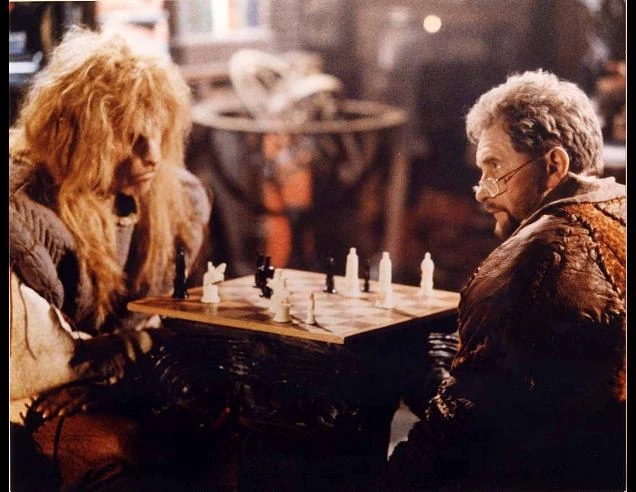
The hidden world is one of the show’s great invitations. Books, stone passages, warm light and improvised domestic spaces make it feel like a place assembled from different needs and histories. It offers the pleasures of a secret refuge without looking like a newly furnished apartment nobody has used.
Its people give that atmosphere practical weight. They need food, work, care and ways to resolve an argument. A sanctuary doesn’t sustain itself merely because everyone agrees the world above can be cruel. Somebody has to do the maintenance, share resources and decide what happens when a member breaks a rule.

That is why stories involving residents beyond Vincent and Father matter. The romance may provide the most immediate emotional center, but other people have a claim on the space. A threat to the tunnels endangers homes, relationships and routines, not only the couple’s meeting place.
The community also depends on helpers above. The boundary between the two worlds is therefore more porous than an uncomplicated fantasy of escape would allow. Secrecy and interdependence have to coexist, which creates both warmth and vulnerability.
I enjoy the place most when the ordinary work is visible beneath the enchantment. A tunnel home can be beautiful because someone has made it habitable. The show gains credibility when it remembers that belonging has chores, disagreements and obligations. A candlelit room doesn’t prove that everybody living in it has already solved the problem of being human.

Mouse Makes a Rule Become Somebody's Experience
David Greenlee’s Mouse gives the underground world an inventive, socially awkward presence. The character’s relationship to objects and rules is part of his appeal, but it also gives the community something concrete to argue about. A person can be useful, loved and difficult to fit into a standard expectation.
Shades of Grey makes that tension clear. Mouse is punished for theft through a period of enforced silence, then the community faces an emergency in which his abilities matter. The situation tests what the punishment is meant to achieve and how the group regards the person receiving it.
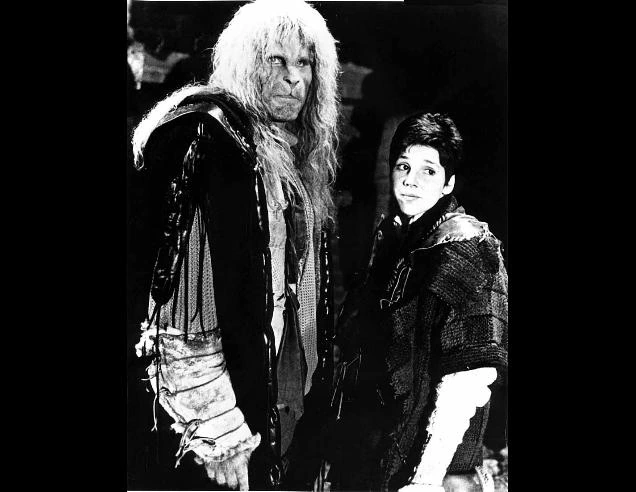
A sanctuary needs rules, but rules become more revealing when their effects land on someone we know. Is the aim to protect trust, enforce conformity or communicate that a behavior has consequences? The episode can make those purposes collide instead of treating them as automatically identical.
The character also keeps invention at a human scale. The hidden world’s solutions don’t all arrive through official expertise or comfortable access to resources. Somebody notices what might be useful, tries something and sometimes causes a new difficulty in the process.
I like Mouse because he makes the community’s kindness something to examine. It is easy for a fictional refuge to welcome an agreeable outsider. The more demanding question is what welcome means when the person is inconvenient, misunderstands an expectation or contributes in a way the group doesn’t immediately know how to value.
Catherine's Work With Joe Maxwell Keeps the City Above Active
Jay Acovone’s Joe Maxwell belongs to Catherine’s professional world. Their working relationship gives the series a continuing space where an urgent case is not merely the opening move in a private romantic story. Other people have deadlines, doubts and reasons to expect Catherine’s attention.
The workplace is particularly useful because Joe doesn’t have the audience’s information. He can respond to an absence, an explanation or a change in Catherine’s behavior without knowing the hidden history that makes it understandable to us. The secret creates a difference between his reasonable questions and what she can safely answer.
That arrangement can produce humor without making Joe foolish. A character isn’t less intelligent because he hasn’t been admitted to the fantasy. He is trying to conduct a real working relationship with someone who cannot tell him a substantial part of what is happening.
The cases also give Catherine active responsibilities. Evidence, witnesses and vulnerable people don’t become less important because Vincent is waiting below. The writing needs that competition of demands if the heroine is going to retain a public life worth caring about.
For me, these scenes help the romance. Catherine isn’t returning to Vincent because the rest of the world has become dramatically empty. She is choosing a relationship that must exist alongside work with genuine consequences. The city above needs enough life to make crossing away from it a meaningful decision.
Elliot Burch Gives the Upper World an Attractive Form of Power
Edward Albert’s Elliot Burch brings money, development and romantic possibility into Catherine’s surroundings. His presence is useful because the public world should offer something more complicated than a collection of dangers. A life above can be attractive in ways Vincent understands and cannot casually dismiss.
Burch’s power also changes the scale of a decision. A building project can threaten a community even when the people conducting it do not begin with a full understanding of whose home lies in its way. The visible city has plans that can reach into the invisible one.
The character therefore gives the show more than a conventional rival. Catherine’s response to him can involve the life she might lead, the consequences of influence and the question of how much she is prepared to disclose to protect another world. Personal feeling and public power arrive together.
The risk is simplifying the contrast until money automatically means moral emptiness and the tunnels automatically mean truth. The series is more interesting when it allows attraction, generosity, ambition and danger to coexist in the same person.
I think Burch works best when he makes the alternative life feel possible. Vincent’s concern then becomes more than a misunderstanding that one reassuring speech can settle. Loving Catherine includes recognizing that she has options and ambitions beyond the hidden world’s boundaries. Asking her to remain close may carry a cost she has the right to consider.
The Balcony Is a Meeting Place With a Limit Built Into It
The balcony is one of the original show’s defining spaces because it lets the two worlds meet without pretending they have merged. Catherine can stand beside her home. Vincent can reach her, but his arrival remains a journey conducted under conditions other people don’t share.
That gives an apparently simple conversation a structure. One person can go inside and continue an ordinary public life. The other must leave by a route the city isn’t prepared to recognize. The tenderness is intensified by the practical inequality around it.

The setting also allows anticipation to become visible. A look toward the edge, a pause or the awareness that someone might come can carry emotional movement before a word has been spoken. A weekly viewer learns to read the space.
It is tempting to remember only the beauty of those scenes, and the beauty is real. The light, the voices and the distance from the busy city make a particular kind of television romance possible. But the separation is part of what makes them more than attractive tableaux.
For me, the balcony works because the show doesn’t need to pretend the meeting solves the future. The couple can have a meaningful moment while still not knowing how their lives will fit together. That uncertainty leaves room for affection to feel generous rather than mechanically reassuring. Being able to reach someone tonight is important; it isn’t the same as having settled what tomorrow can be.
The Empathic Bond Is Powerful Because It Is Also Uneven
Vincent’s ability to sense Catherine’s emotions gives the relationship its supernatural connection. It can make distance feel less absolute and provide a route into danger before ordinary information has reached him. The bond is part of how the series makes private feeling active in the plot.
It is also an uneven form of knowledge. Feeling that someone is frightened or distressed isn’t the same as understanding every reason for the feeling. The story becomes more interesting when it remembers that emotional access cannot replace conversation.
A rescue mechanism can otherwise become too convenient. Catherine encounters danger, Vincent senses it and the action arrives at the necessary moment. The better scenes allow the connection to carry concern and uncertainty rather than operating only as an invisible alarm system.
The bond can also make a modern viewer think about privacy and independence. A romantic fantasy may present extraordinary closeness as reassuring, while the actual relationship still needs room for choice. Caring for somebody should not mean assuming that every reaction grants complete understanding of their wishes.
I find the show’s language most persuasive when the couple continue to ask and listen. The impossible connection can establish that they matter to one another. It doesn’t do the ordinary work of deciding how to respect the life the other person must live. That remaining work gives the fantasy a human point of contact.
Terrible Savior Asks What a Familiar Face Can Prove
Terrible Savior uses reports of a violent vigilante to disturb Catherine’s understanding of Vincent. The resemblance between a description and the person she knows creates a fear she cannot dismiss simply because she would prefer a different answer.
The setup is useful early in the relationship. Catherine is learning to trust someone whose appearance invites other people’s assumptions. The episode can then ask whether she has entirely escaped those assumptions herself. Affection doesn’t automatically make uncertainty disappear.
It also places the audience in an uncomfortable position. We are being invited to know Vincent through gentleness, conversation and care, but the series has already established that his strength can become dangerous. The question isn’t whether he is capable of harm in the abstract. It’s how we judge a particular accusation.
A story like this can become simplistic if the eventual answer is treated as proof that doubt was always foolish. Trust is more interesting when it includes the willingness to seek information instead of refusing to hear something disturbing. A relationship shouldn’t require blindness in order to remain romantic.
On a return viewing, the episode’s value is the pressure it places on recognition. Knowing a face can change the meaning of a description, but knowing a person also requires attention to what they do. The show is testing the difference between defending someone because we love them and understanding why the defense is warranted.
Masques Gives Vincent a Brief Different Relationship With the Street
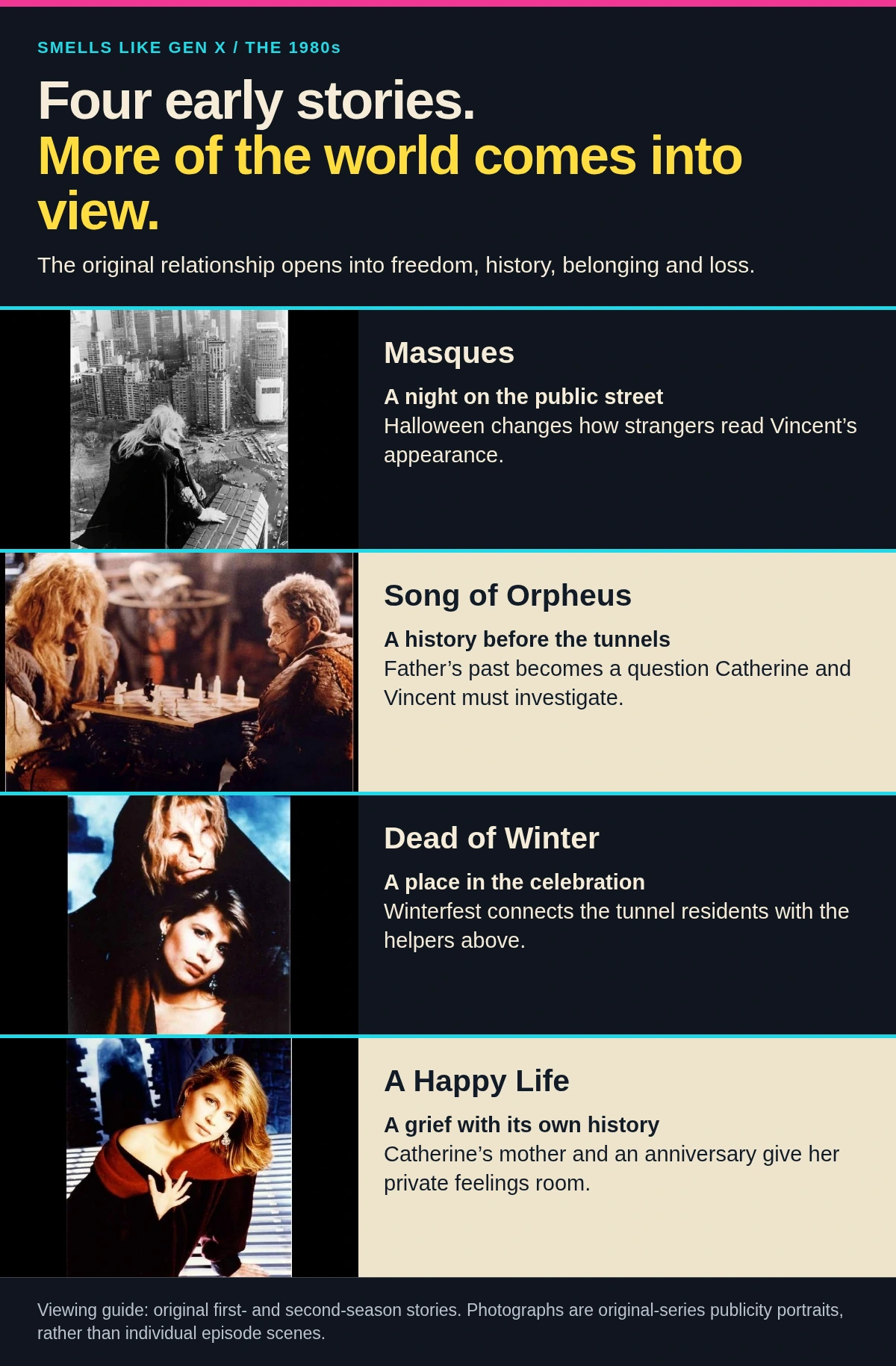
Masques uses Halloween to let Vincent move openly through the city in a way his ordinary circumstances do not allow. The night changes how strangers interpret his appearance. What would usually demand explanation can be accepted as part of the surrounding occasion.
That is an elegant fantasy situation because the physical character doesn’t need to change. The city’s expectations change. Vincent receives a temporary freedom through the audience around him reading the same face differently.
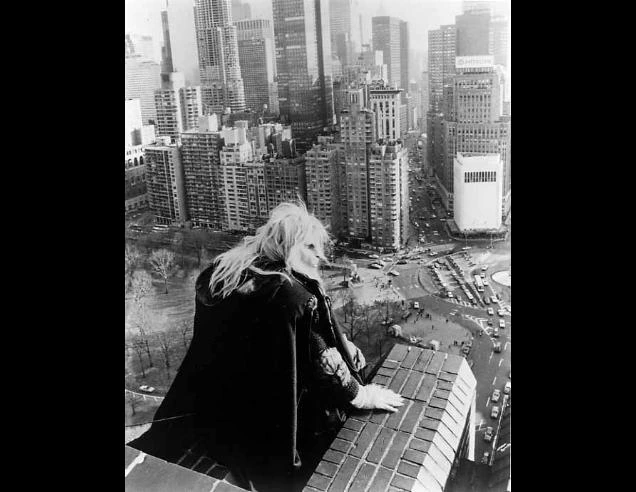
The episode also gives him a protective role involving an Irish peace activist. A night that promises release still contains danger, so the freedom doesn’t become a simple sightseeing holiday. The wider world continues to make demands even when it is briefly willing to let him pass.
What stays with me is the distinction between safety and recognition. Being able to walk without immediate alarm isn’t the same as being known. The strangers who accept the apparent costume haven’t necessarily accepted Vincent as a person whose appearance belongs to his life.
That makes the occasion both pleasurable and sad. A city can make room for difference under a particular label, for a particular night, while remaining unprepared to extend the same ease outside that arrangement. The episode gives the romantic fantasy another route into an ordinary question: how much of belonging depends on what other people have decided they are willing to see?
Song of Orpheus Gives Father a Past Outside the Tunnels
Song of Orpheus takes Father above and into an accusation of murder, requiring Catherine and Vincent to examine a history that has not been fully available to them. The familiar authority figure becomes somebody with a life that preceded his current role.
That is important for the community’s credibility. Father cannot remain only the wise man in the room whose judgments arrive without a personal source. An earlier history gives those judgments a context and creates the possibility that his account of himself has left something out.
For Catherine, the situation also reverses the direction of help. Her knowledge of the public world becomes necessary to somebody whose position below might otherwise seem self-sufficient. The two settings are connected by practical need as well as romance.
Vincent has another kind of challenge. Loving Father and respecting what he has done do not mean possessing every fact about him. Discovering that an older person had a complicated life before becoming your familiar guide is a recognizable emotional experience, even without a hidden city underneath it.
The episode shows how the series could expand without abandoning its atmosphere. A mystery provides movement, but the more lasting effect is a change in how we understand somebody we already thought we knew. The past becomes another room in the community, one the characters can enter without finding that everything inside is comfortable.
Nor Iron Bars a Cage Turns Curiosity Into a Threat
Nor Iron Bars a Cage begins with Vincent being caught on film and attracting a scientist’s interest. The episode makes being visible a danger of its own. A person who has remained outside the public picture can become an object somebody else believes they are entitled to examine.
That is a useful pressure for this fantasy. The audience enjoys looking at Vincent. The story can then make a less generous kind of looking visible: attention that values the unusual body while disregarding the wishes and relationships of the person living in it.
Scientific curiosity isn’t automatically villainous, but curiosity does not grant possession. The episode’s threat depends on the gap between wanting to know something and accepting another person’s right to decide what may be known or done to them.
Catherine’s knowledge of Vincent stands in contrast to that objectifying attention. She isn’t simply collecting information about an extraordinary appearance. The relationship has obligations, including the responsibility to recognize when someone is being reduced to a problem another person wants to solve.
The story can be direct in its construction, as network fantasy often is. Its underlying question still suits the series well. Being seen is not always the same as being recognized. A photograph can prove that someone exists while revealing very little about how that person should be treated.
A Fair and Perfect Knight Lets Vincent Feel Something Less Noble
A Fair and Perfect Knight brings Vincent’s pupil Michael into Catherine’s home before college, where the younger man’s feelings for her create a new difficulty. Vincent has to confront jealousy rather than remain safely positioned as the person who responds to everything with exceptional generosity.
That is good for the character. A romantic lead who is always morally above the ordinary feelings around him can become less believable with each display of nobility. Allowing jealousy gives his idealism something to work through instead of making it a permanent exemption from human discomfort.
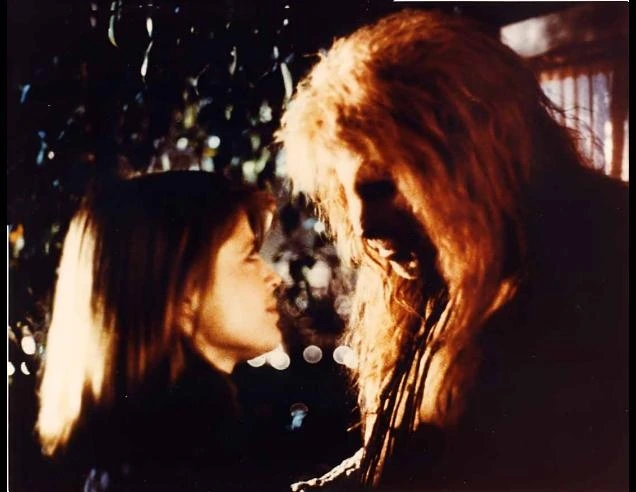
The situation also exposes an inequality in the couple’s circumstances. Michael can enter a familiar part of Catherine’s daily world with an ease Vincent doesn’t possess. The threat isn’t only another person’s attraction. It is a reminder of the ordinary possibilities the relationship has difficulty sharing.
Catherine’s position matters too. She isn’t a prize whose meaning should be decided entirely by the men’s reaction to one another. Her feelings and choices have to remain part of the situation, including the way she regards the younger man in her care.
I find this kind of episode valuable in a series so comfortable with elevated language. The characters need room to be less graceful than their favorite sentences. Love becomes more convincing when it can survive a feeling the person experiencing it would rather not admit. Another conversation is still required after the first rush of hurt.
Ozymandias Makes a Building Project Reach Into the Love Story
Ozymandias puts the tunnel world at risk through a development associated with Elliot Burch. The threat is practical: what happens above can damage or destroy the home below. Catherine faces a difficult decision because the people involved do not all possess the same information.
The setup joins the show’s two scales particularly well. A private romance exists inside an urban environment where money and construction change physical space. The lovers’ problem isn’t only that other people might disapprove. The place that allows one of them to live can be endangered by an ordinary exercise of public power.
Secrecy complicates resistance. Explaining why a project matters would require exposing people who have depended on remaining unseen. Catherine’s legal and social knowledge is valuable, but the available solutions may carry obligations she cannot treat casually.
The story also makes Burch more than a man standing outside the balcony scene. His decisions have reach. A character can participate in a threat without beginning the episode as someone who fully understands the community affected by it.
On a return visit, this shows why the hidden world should have other residents. If the tunnels were only Vincent’s dramatic address, the danger could be reduced to one couple’s inconvenience. A continuing community makes the stakes broader. Catherine’s choice concerns people whose homes and relationships do not exist solely to provide a setting for her own.
A Happy Life Gives Catherine's Grief Its Own Time
A Happy Life responds to the anniversary of Catherine’s mother’s death. The story gives the heroine a source of feeling that predates Vincent and cannot be entirely explained by the current romance. An older loss can become newly present without asking permission from the rest of her life.
That is important for a character whose weekly danger can otherwise organize our attention. Grief doesn’t need a criminal investigation or a new threat to matter. The episode can allow a private emotional history to occupy space without turning it into evidence in a case.
The relationship still matters, but it cannot be treated as a universal repair. Loving someone doesn’t remove everything that happened before the meeting. Vincent may care deeply while remaining unable to supply a simple answer to what Catherine is experiencing.
The situation also reveals the pressure of trying to have the life other people imagine for you. An idea of happiness can become another expectation to meet, particularly when a loss makes the gap between the image and the actual day harder to ignore.
I like the episode as a return to Catherine herself. She has family history, memory and wishes that aren’t merely an extension of the man waiting below. Giving those things attention makes the central romance stronger. There is more of a person available to choose it, and more of a life for the choice to affect.
Poetry and Music Give a Conversation Room to Become an Event
The original Beauty and the Beast is willing to slow down for words. Reading, quotation and conversation are part of how the characters reach one another. In a television landscape full of problems to solve before the credits, that willingness gives the show a distinctive rhythm.
The effect depends on performance. A line offered as a display of the program’s own sensitivity could become unbearable quickly. Perlman and Hamilton make the exchange work when it feels like one person choosing something another person needs to hear. The scene has to be about the people, even when the words are beautiful enough to enjoy on their own.

Lee Holdridge’s music helps give that space an emotional shape. The score can sustain a feeling across a pause without requiring every thought to become spoken explanation. The series’ 1988 Emmy for dramatic underscore recognizes part of that craft.
The atmosphere isn’t equally persuasive in every scene. Sometimes the language can feel too polished for the immediate circumstance, and a viewer is allowed to notice the effort. The better moments have a specific emotional need underneath the beauty, which gives the words somewhere to land.
For me, the pleasure is that the show believed a quiet exchange could be the thing worth waiting for. A rescue might provide the evening’s movement, but a conversation could provide its destination. That is a substantial part of why the original remains distinct from an action series that happens to contain a romance.
The Rescue Pattern Can Be Exciting and Limiting
Catherine’s work repeatedly brings her into danger, and Vincent’s connection to her can turn that danger into a rescue. The pattern supplies suspense and an immediate reason for the two worlds to cross. It is also a construction whose repetition deserves attention.
Hamilton can make Catherine capable within a scene while the overall plot still places her in the position of needing to be saved. Those are different levels of agency. A character may argue forcefully, investigate intelligently and then be moved by the story into the same dependent conclusion.
The series is more satisfying when the exchange of help travels in both directions. Catherine’s professional knowledge, choices and access above can protect Vincent and the community in ways his strength cannot replace. Those stories make the relationship more reciprocal in practical terms.
The show’s romantic appeal does not require denying the limitation. We can enjoy the urgency of Vincent arriving while also wanting more situations in which Catherine’s work carries the resolution. Affection for a series is allowed to include a clear memory of where it made things too easy for itself.
That is worth keeping in mind because the central bond is so persuasive. A strong relationship can lend feeling to a familiar device long after the device has become predictable. The best return viewing appreciates the feeling and still asks whether this particular danger has given the characters something new to do.
A Sanctuary Also Has to Decide Who Gets Through the Door
A place built around refuge has a difficult continuing question: how does it respond to someone whose arrival may put the existing residents at risk? Secrecy keeps the tunnels possible, yet complete withdrawal would contradict much of what makes the community worth loving.
The second season repeatedly tests different aspects of that problem. A person can need shelter while also carrying an illness, a dangerous history or an obligation that cannot be erased by moving below. Welcoming someone is a beginning, and the consequences still need attention afterward.
This makes Father’s caution more substantial than the familiar older man saying no. He is responsible to people who didn’t volunteer to become the supporting cast in one visitor’s escape. At the same time, caution can harden into a rule that makes it too easy to turn away the next vulnerable person.
The community’s dependence on helpers above prevents an entirely clean separation. Someone is already crossing the boundary for supplies, care or work. The hidden home exists through relationships with the outside, even when those relationships make it vulnerable.
I think those practical complications are part of the reason the setting invites so much affection. You can imagine living there because the show gives people decisions to make about one another. A perfect refuge with no difficult guest and no argument about a rule would be attractive scenery. A home where care has consequences gives the imagination something to remain occupied with.
George R.R. Martin Was Part of the Writing World, Not the Sole Creator
George R.R. Martin’s connection is now one of the facts people often learn about the original show after knowing his later work. His career account places him on Beauty and the Beast as an executive story consultant in 1987, a producer in 1988 and a co-supervising producer in 1989.
The connection is interesting without turning the program into a preface to something else. Ron Koslow created the series. Martin worked within a writing and production group whose credits include other major contributors. A later famous name should widen our curiosity about that work rather than erase the people alongside him.
Martin’s bibliography lists teleplays for the show, including Terrible Savior. That gives a reader a concrete route into his contribution. It is more useful than the vague claim that a familiar fantasy writer was somehow responsible for everything unusual about the series.
The broader production records also identify Alex Gansa, Howard Gordon, Tony Thomas, Paul Junger Witt and others in the show’s history. The specific credits change across episodes and seasons. What reaches the screen is a collaboration involving writing, performance, music, design and the work of sustaining the hidden world visually.
I enjoy noticing that history on a return visit, but I wouldn’t let it replace the original experience. The pleasure is still Catherine, Vincent and the people around them trying to conduct their lives. Knowing a future famous writer worked on the show is a useful extra doorway, not the reason every scene is required to matter.
The Devotion Made Sense Before Fandom Had Today's Tools
Beauty and the Beast offers a world that invites a viewer to remain after the episode ends. The tunnels contain rooms we haven’t seen, residents with unfinished histories and rules that can be argued about. The central relationship leaves feelings and possibilities that don’t disappear when a case closes.
That is fertile ground for fan writing, artwork and discussion. A series doesn’t have to explain every corner of its world to feel substantial; sometimes the unvisited space is part of what gives people somewhere to imagine. The show supplies enough shared detail for another person to understand the invitation.
The history belongs to an earlier media environment. Fans could exchange material and sustain conversations without having today’s social platforms available. Texas A&M’s George R.R. Martin collection includes records identified as Beauty and the Beast CompuServe discussions from 1987–89, a concrete trace of that period’s online activity.
An archive label doesn’t tell us how every viewer participated, and it shouldn’t be turned into an invented claim about the size of the fandom. It does establish that the conversation around the original show has a history worth preserving. It began long before whichever modern website happens to survive.
I think the devotion is easy to understand from the work itself. The series takes longing seriously and builds a home around people who have reasons to value sanctuary. Viewers can disagree sharply about a later story choice precisely because the earlier world has given them something particular to care about.
Late-1989 Story Change — Major Spoilers Ahead
The third season began in December 1989, so its fundamental change cannot honestly be moved entirely into the nineties. The original run continued through 1990, but the break in the Catherine-and-Vincent story arrived before the eighties ended.
In Though Lovers Be Lost, Catherine is held captive while carrying her and Vincent’s child. The story leads to her death. Jo Anderson’s Diana Bennett then becomes the new female lead, investigating what happened and entering Vincent’s world from another direction.
That is a substantial alteration to the program’s central promise. The first two seasons have built a relationship around recurring meetings, separation and the possibility of a future the couple cannot easily describe. Removing Catherine changes the reason many viewers had been returning.
A person can recognize the narrative possibilities of the new arrangement without pretending it supplies the same emotional experience. Diana is a different character with a different relationship to the story. Accepting that distinction is more useful than asking her to occupy Catherine’s place as if the earlier attachment were interchangeable.
For this return, the important point is the date and the scale of the change. The original show’s eighties identity includes both the relationship that established its devotion and the late-1989 decision that disrupted it. Viewers coming back primarily for Hamilton and Perlman may reasonably prefer to spend their return with the first two seasons, where that relationship remains the center.
The Show Could Be Earnest Without Always Being Graceful
Beauty and the Beast is willing to risk being called sentimental. Its people speak about love, belonging and responsibility with a seriousness that doesn’t arrive wrapped in a joke. That commitment is part of its appeal, and sometimes part of its difficulty.
An episode can make an ethical contrast too neat. The world above may provide a particularly cruel visitor, or a community dispute may resolve in a way that makes the intended lesson very clear. The show is strongest when the people complicate the idea instead of standing politely inside it.
The same applies to the romantic language. A quiet line can be moving because someone has earned the right moment to say it. Several beautiful lines in succession can begin to sound as if the scene has been asked to carry more refinement than the relationship needs.
I don’t think the answer is to demand that the original become a different, more self-mocking series. Its sincerity is part of the contract. The useful question is whether a particular scene gives that sincerity a specific person and circumstance, so the feeling has something to attach to.
The best moments still do. Father worries, Catherine has another obligation, Vincent doesn’t know how to ask for what he wants and the conversation has to find its way through. The emotional subject can be large while the immediate problem remains familiar. Somebody needs to tell the truth without being sure how the other person will receive it.
Its Place Beside the Other Unusual Dramas of the Decade
The original show belongs in a television decade that could make room for several very different forms of the impossible. Highway to Heaven placed an angel and an ex-policeman on a changing road. Quantum Leap’s 1989 debut put a lost scientist inside other people’s lives. Beauty and the Beast built a continuing hidden home.
All three can use an extraordinary premise to direct attention toward an ordinary need. Their structures differ, which changes what the audience is invited to expect. A traveling assignment can end with departure. A recurring sanctuary has to live with the person and the decision afterward.
The series also shares part of its appeal with Moonlighting’s central relationship, although the tone and romantic language are very different. In both cases, the official weekly story is only part of why the audience wants the two leads together in a room.
The broader television year of 1988 offers useful context without requiring this show to resemble the largest audience favorites. A program could become intensely important to particular viewers through an atmosphere and relationship that weren’t designed to be interchangeable with every other evening’s entertainment.
That identity is what I value on a return. There are other eighties TV favorites to enjoy for speed, jokes or familiar domestic comfort. This one made room for a difficult journey to a balcony and trusted the audience to care about what would be said when the visitor arrived.
A Good Return Begins Before the World Has Become Familiar
Start with the pilot, allowing Catherine’s recovery and Vincent’s care to establish the relationship before the tunnel world becomes a collection of beloved objects. The emotional invitation is clearer when we remember that Catherine didn’t begin with the audience’s confidence about the face she would meet.
Terrible Savior and Masques then give different tests of how Vincent is seen. One uses suspicion, the other a temporary public freedom. Both make the difference between appearance and recognition more active than a general statement that people shouldn’t judge.
Song of Orpheus, Shades of Grey and Nor Iron Bars a Cage widen the attention to Father, Mouse and the vulnerability created by being observed. The community becomes more credible when its problems aren’t limited to arranging the couple’s next meeting.
For the second season, Dead of Winter and A Fair and Perfect Knight make a useful pair: one concerns belonging in a shared occasion, the other a less comfortable feeling inside the romance. A Happy Life, at the first season’s end, deserves room for Catherine’s emotional history.
That route isn’t a final ranking. It is a way to recover several different reasons the original worked. Leave time for the quieter scenes, because the setting and the performances do much of their work there. The story can move us into the tunnels quickly; becoming familiar with the people inside them is the slower and more rewarding part.
Why the Original Still Feels Like Its Own Place
The strongest memory of Beauty and the Beast isn’t a list of completed investigations. It’s an atmosphere and the people who made it feel inhabited. A voice from the shadows, a light left on and the knowledge that another life was continuing below the street could carry a whole set of expectations.
Hamilton and Perlman give that atmosphere a relationship with choices inside it. Catherine has a life she cannot fully explain. Vincent has a home that protects him and boundaries that hurt. Neither can solve the future simply by proving that the affection is real.
Dotrice and the wider community keep the private connection from being the entire world. Other people have histories and needs, including reasons to worry about what the lovers want. Sanctuary becomes more interesting when it belongs to a group rather than operating as an unlimited resource for the central couple.
The series can be too neat, too elaborate or too convinced that a scene needs one more lovely sentence. I can notice those things and still want to stay with the people. The best moments have enough particular feeling to make the elaborate surroundings useful rather than empty.
That’s the original I enjoy returning to: a late-eighties fantasy willing to treat listening, loyalty and an unconventional face as the center of a romance. The city above keeps moving. Underneath it, someone has made a room where a person can be known.
Questions About the Original Beauty and the Beast
When did the original Beauty and the Beast air?
The original CBS series ran from 1987 to 1990. Linda Hamilton played Catherine Chandler, Ron Perlman played Vincent and Roy Dotrice played Father. This article concentrates on 1987–89, including the third-season change that began in December 1989.
Does Vincent become an ordinary-looking man?
No. The original series doesn’t require him to transform into a conventional human leading man to complete the romance. His distinctive face remains part of the person Catherine and the audience are asked to recognize and love.
Who created the original show?
Ron Koslow created Beauty and the Beast. George R.R. Martin was an important writer and producer within its creative team; his career account dates his involvement from 1987. His later fame should not be mistaken for sole creation of the series.
What is Winterfest?
Winterfest is the tunnel community’s shared celebration with its helpers above. The second-season episode Dead of Winter brings Catherine into that occasion, making the hidden world feel like a community with its own traditions as well as a romantic refuge.
Is this the Disney story or the later television remake?
This is the original live-action CBS series set in New York with Catherine, Vincent and the tunnel community. It is a different adaptation from Disney’s animated and live-action films and from the later television series with different leads and a different premise.
Sources & Further Reading
- The Television Academy’s original-show material identifies the original production and links interviews with Rick Baker, Lee Holdridge and Tony Thomas.
- The Television Academy awards record distinguishes the 1988 makeup nominations from the cinematography, art-direction and dramatic-underscore wins.
- The original-series first-season catalog and second-season catalog provide licensed episode descriptions.
- Apple TV’s original-show record identifies the principal cast; Though Lovers Be Lost documents the late-1989 third-season story.
- George R.R. Martin’s career account dates his roles on the production, and his bibliography lists individual teleplays.
- Texas A&M’s George R.R. Martin collection listing identifies archival Beauty and the Beast CompuServe discussions from the original period.