Perfect Strangers in the 80s: Balki, Larry & ABC’s Odd-Couple Hit
Larry and Balki take on Chicago, the discount store, the Chronicle, dating, baking, and an instrument that definitely requires two people.
ABC, beginning in 1986. Larry has a plan, Balki has faith, and the furniture has other ideas.
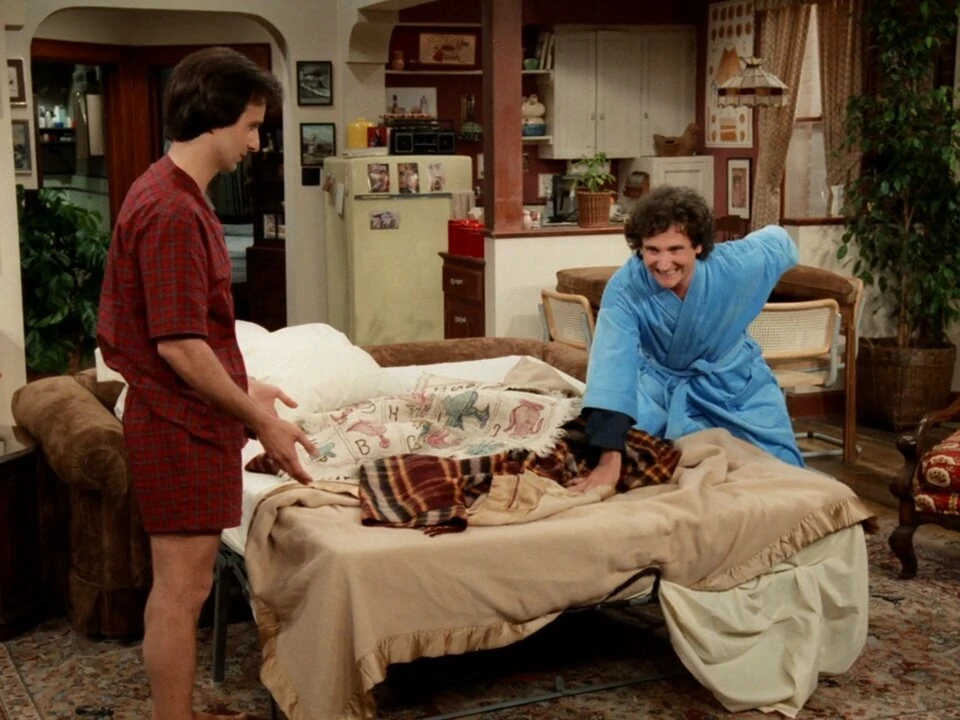
Larry Appleton was finally going to be his own man. He had an apartment in Chicago, a plan for his future, and the freedom to arrange his life without a large family getting involved. Then the door opened and a distant cousin from Mypos arrived. Larry’s independence had lasted just long enough to become a premise.
Perfect Strangers made a very good living from the difference between having a plan and being remotely qualified to carry it out. Larry usually supplied the plan. Balki Bartokomous supplied enthusiasm, unexpected competence, and the sort of question that could expose a weakness Larry preferred to address after the catastrophe. The apartment was rarely large enough for both the scheme and its consequences.
For a Gen X kid somewhere near the television, it was also one of the great arguments for letting actors fall over things. Mark Linn-Baker and Bronson Pinchot could make a respectable amount of comedy out of standing together. Give them a piano, a kitchen task, a health club, or something with wheels, and respectable quickly became optional.
The ABC series arrived in March 1986 and developed through the rest of the eighties into a Friday-night fixture. It had a discount store, a newspaper, women who could see through Larry’s performance, and a cousin who remained willing to trust him after a remarkable amount of contrary experience. The familiar catchphrases were part of the fun. The better reason to go back is the pair of performers underneath them, trying to get through the next ordinary task without turning the room into an insurance claim.
Inside This Article
- March 1986: one apartment, two very different arrivals
- Larry Appleton has a system. You should be worried.
- Balki brings more than a suitcase full of misunderstandings
- Mypos is fictional. Balki’s homesickness doesn’t have to be.
- Before the newspaper, there was Mr. Twinkacetti
- Larry spots a shortcut to the career he wants
- Checks look easy until the furniture arrives
- Teaching your cousin to drive is a commitment
- Larry joins a health club and overestimates the disguise
- Jennifer and Mary Anne have to live around these plans too
- Las Vegas gives Larry a lesson he had prepared for Balki
- Everybody can play, right up until Larry wants to win
- The landlord has leverage. So do the tenants, if they stick together.
- Christmas in Chicago wasn’t Larry’s plan
- Two actors, one task, absolutely no graceful way out
- The Chicago Chronicle gives the cousins a bigger playground
- Gorpley, Lydia, and the hazards of having coworkers
- Harriette Winslow has heard enough to recognize nonsense
- An office joke can turn into a real problem
- Balki discovers cable. The rest of his life waits.
- The kitchen requests coordination. Larry and Balki provide an interpretation.
- A piano is a very large test of a small partnership
- Larry’s father arrives, and the plan needs to look impressive
- Balki wants to send a little movie home. Larry sees a production.
- Friday night came later than the memory sometimes suggests
- The opening promised progress. The episode checked how it was going.
- Go back for the people carrying the piano
- A few cousin-related questions
March 1986: one apartment, two very different arrivals
Perfect Strangers premiered on ABC on March 25, 1986. Dale McRaven created the series, putting Linn-Baker’s Larry Appleton together with Pinchot’s Balki Bartokomous in Chicago. Larry had come from Wisconsin with hopes of a photography career. Balki had come from the fictional Mediterranean island of Mypos with a family connection and considerably less interest in respecting Larry’s proposed solitude.
The first season ran just six episodes. That short spring introduction is part of the television season ending in 1986, before the show acquired its longer run of fall stories and before Friday-night branding became the main way many viewers remembered it. This comedy didn’t emerge fully formed from a TGIF logo.
The pilot’s title, Knock Knock, Who’s There?, gets the machinery moving at the most convenient possible point. Larry’s new domestic arrangement exists, and somebody is already asking to change it. You don’t need a lengthy account of their family tree. An ambitious young man has acquired a houseguest whose welcome will require considerably more than an overnight bag.
They are both newcomers, which helps the premise. Larry can present himself as the experienced American without having mastered his own new city. Balki’s unfamiliarity gives Larry someone to instruct. It also gives the audience an excellent view of how much authority Larry has awarded himself after a fairly limited amount of independent living.
The apartment becomes a family before Larry has agreed to the procedure. That is the emotional bargain underneath the noise. He wanted space away from the people who knew him too well. He gets someone who knows very little about the new world around them and nonetheless expects them to face it together. It is inconvenient, affectionate, and a terrible arrangement for preserving an inflated opinion of your own expertise.
Larry Appleton has a system. You should be worried.
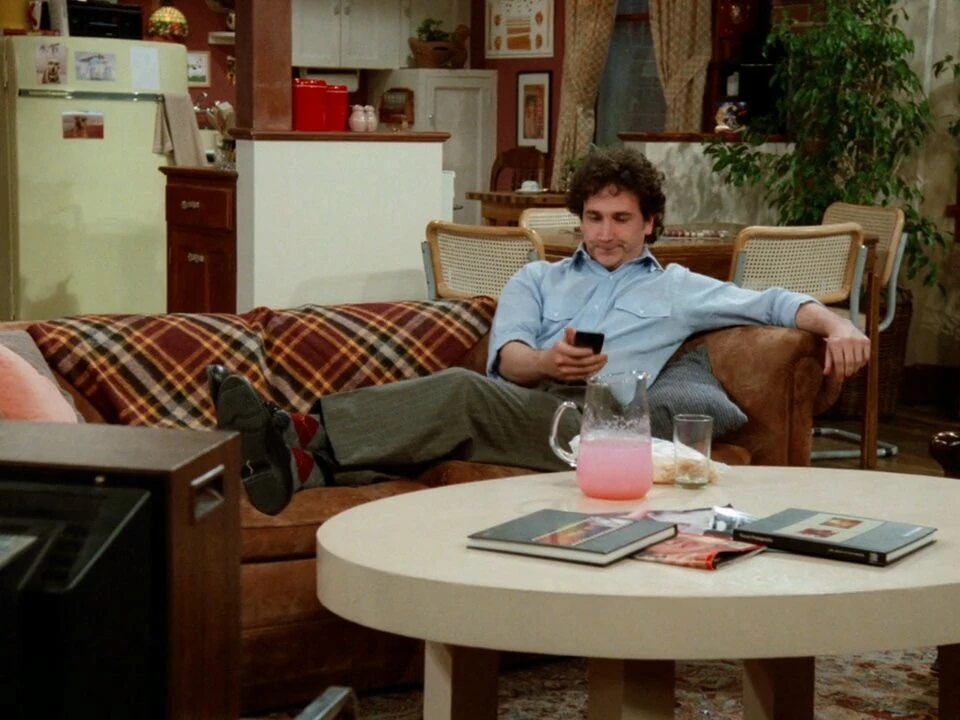
Larry is the kind of person who can turn wanting a good evening into a difficult managerial assignment. He wants the right job, the right impression, the right relationship, and the moment when somebody notices that he is doing better than expected. None of those desires is strange. His confidence in the elaborate method he has selected to achieve them is where the danger begins.
Mark Linn-Baker makes the striving visible. Larry can seem tightly wound before he has even received bad news. He anticipates embarrassment and tries to get ahead of it, sometimes creating a much larger embarrassment in the process. The face, the posture, and the bursts of explanation tell you how much work it takes him to appear in control.
That makes him more than a sensible man inconvenienced by a funny relative. Larry can be the engine of the trouble. Balki might misunderstand a custom; Larry can understand it quite well and still decide that deception will improve his chances. A surprising number of problems become physical because he has already talked himself past the last comfortable opportunity to admit the truth.
His photography ambitions give that behavior a specific direction. He wants to make something of himself in a competitive city. The next photograph, the next contact, or the next job could feel like the point when the life he imagines finally starts. For someone fresh from a crowded household, being taken seriously is a powerful reward.
You can laugh at the lengths he goes without losing sight of that need. Larry isn’t a villain devising a plan to make Balki miserable. He is a young adult whose estimate of his own sophistication often outruns his achievements. He wants the big city to discover him. Instead, the next person to discover him is usually his cousin, at exactly the moment he is doing something difficult to explain.
Balki brings more than a suitcase full of misunderstandings
Balki’s openness is the force Larry has the most trouble budgeting for. He trusts people, takes promises seriously, and approaches a new situation with a willingness that can be either delightful or dangerous. Larry might spend ten minutes deciding how he should look. Balki is already participating.
Bronson Pinchot gives him a large physical vocabulary. The voice is the part people imitate, but his face, shoulders, hands, and whole approach to personal space do just as much work. Balki can be absolutely invested in a task that Larry regards as a passing inconvenience. The discrepancy turns an ordinary object or instruction into something they have to negotiate with their bodies.
His unfamiliarity with American habits also gives him a useful vantage point. An arrangement that Larry regards as normal can sound fairly ridiculous when somebody asks what it is for. The newcomer doesn’t always need to supply an ingenious argument. Sometimes the simple question is enough to reveal how much of Larry’s explanation rests on everybody already agreeing not to question it.
The character works best when he has judgment of his own. Kindness doesn’t prevent him from seeing that Larry is being selfish. Trust doesn’t require him to enjoy being manipulated. Balki can be confused about a phrase and quite clear about what one person owes another. Those abilities need to coexist for the friendship to feel like a partnership.
Pinchot’s enthusiasm also makes room for disappointment. If Balki were merely a cheerful machine for getting words wrong, Larry’s repeated failures would have little emotional cost. Instead, the cousin who has arrived asking to belong can look genuinely hurt. It gives the apology at the end somewhere to land beyond resetting the apartment for the next week’s damage.
Mypos is fictional. Balki’s homesickness doesn’t have to be.
Mypos gives the series a flexible store of customs, family stories, food, and bewildering comparisons. It is a made-up island, not a reliable guide to the habits of any actual Mediterranean country. That freedom can produce an excellent piece of nonsense. It can also encourage the show to reach for the easy laugh of making foreignness itself sound funny.
Those two possibilities are part of revisiting the comedy honestly. The accent and mixed-up expressions are prominent. Some jokes lean heavily on Larry’s ability to correct the newcomer. The more satisfying exchanges let Balki’s own knowledge matter, or expose a weakness in the life Larry is so busily explaining.
Balki has left people behind. Mypos can be the source of an improbable recipe in one episode and a place he misses in another. A viewer doesn’t have to believe the island’s agricultural traditions to understand the ache of being far from home while the ordinary work of home continues without you.
Beautiful Dreamer, in the second season, uses his worries about the harvest back on Mypos to trouble his sleep. That is a useful direction for the character. A new apartment and an eager cousin don’t erase the earlier obligations and relationships that made him who he is. His American life has acquired a roommate; his sense of responsibility reaches much farther away.
The show can let the cultural invention be broad while allowing the feeling underneath it to be recognizable. Many viewers were not immigrants and didn’t share Balki’s journey. They could still understand missing a place, worrying about relatives, or feeling guilty about enjoying something new while other people carried on at home. At its warmer moments, Perfect Strangers gave the man behind the comic accent a life that extended beyond Larry’s front door.
Before the newspaper, there was Mr. Twinkacetti
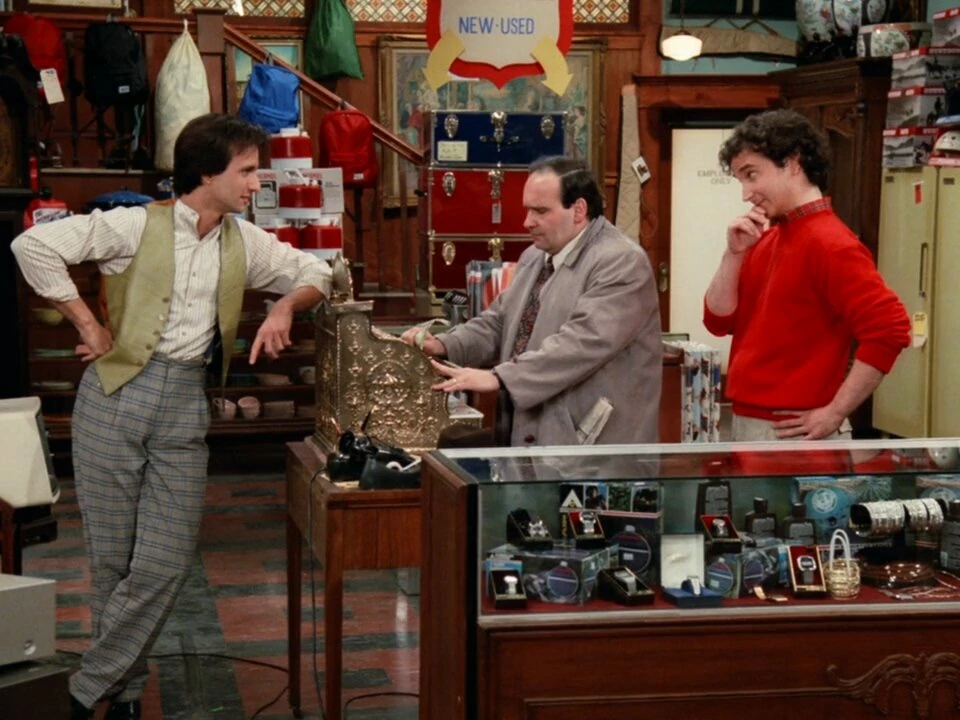
The early cousins work at the Ritz Discount store for Donald Twinkacetti, played by Ernie Sabella. He is also Larry’s landlord, which gives him an exceptionally efficient arrangement for making other people uncomfortable. A bad day at work can follow you home without either party requiring a change of address.
The store is a good starting place for Larry because it falls some distance below his dream. He wants a photographic future; the immediate present involves a boss with much more interest in his own advantage. Every ambitious scheme has to contend with the job actually paying the bills.
Sabella can give Twinkacetti a grubby confidence. The man has authority, property, and the ability to make a reasonable request seem extravagantly inconvenient. Larry and Balki need the employment while also needing to preserve some degree of self-respect. That is a familiar working arrangement, even for viewers whose first paid job still lay several years ahead.
Belita Moreno plays his wife, Edwina, in these early stories. Her presence gives his behavior consequences outside the store. He can be a difficult boss and an exasperating husband in the same week, bringing one problem into a room already occupied by the other. The cousins don’t always get to leave the business behind when the transaction ends.
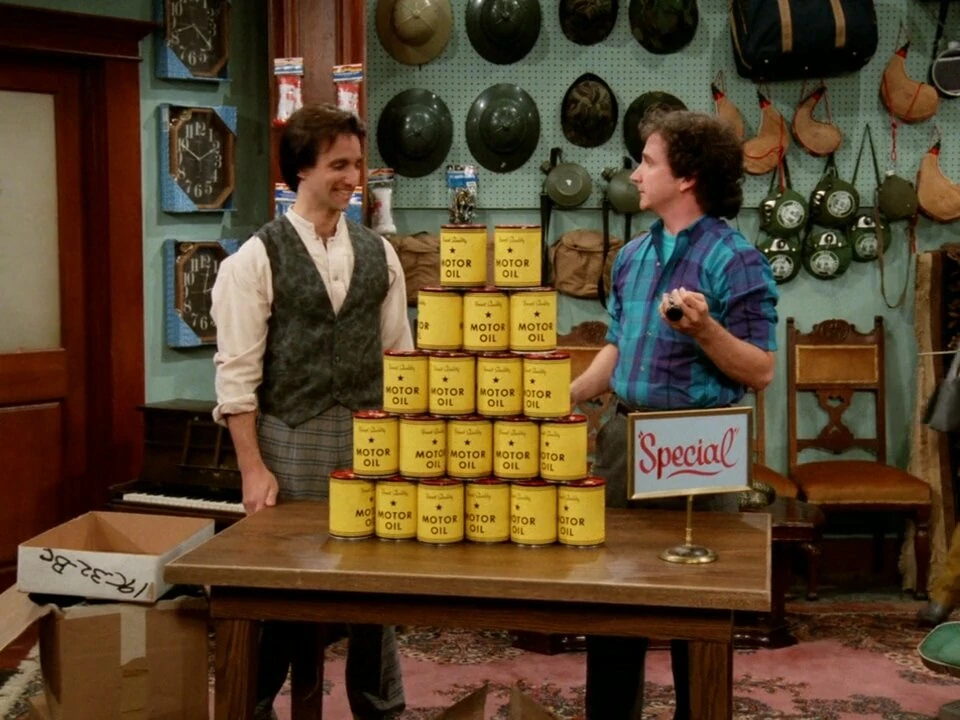
The shop also supplies a useful stage for the double act. Merchandise, counters, displays, deliveries, and customers give the performers things to handle while disagreeing. An apartment can accommodate a grand plan. A discount store lets the plan meet somebody else’s property, which tends to make the timing of the mistake more important.
Larry spots a shortcut to the career he wants
The second episode, Picture This, puts Larry’s photographic ambition beside a much less dignified opportunity. A possible tabloid photograph involving Dolly Parton promises a quicker route to attention than waiting for the work he actually wants. The name supplies the lure; Larry’s response supplies the comedy. It is a story about what the fictional photographer is willing to pursue, not a report of an actual event in Parton’s life.
The temptation fits his position. He has come to Chicago to become somebody, and the city has not yet arranged a welcoming committee from the profession. A picture that might sell can look like evidence that he is moving forward. Questions about the sort of photographer he wants to be become easier to postpone when a possible payday has entered the conversation.
The other thread has Larry teaching Balki to refuse requests. His cousin’s willingness to do favors needs limits, at least when Larry is explaining the principle. Once Balki begins applying it, Larry encounters the inconvenience of having recommended a rule that also covers requests coming from Larry.
That pairing gives an early episode a good picture of both men. Balki needs to learn that kindness doesn’t require saying yes to everybody. Larry needs to discover that being the person with advice doesn’t place him outside the reach of it. Each lesson becomes more awkward when it stops being theoretical.
The photograph and the favors also make a useful distinction between helping someone and using them. Larry’s ambitions can recruit the person closest to him before he has considered what the recruitment costs. Balki’s trust can make the arrangement easy to accept. The series will return to that imbalance often, sometimes with a larger stunt attached. Here, very near the beginning, it already knows that Larry’s best explanation may be concealing the part that benefits Larry most.
Checks look easy until the furniture arrives
In the first season’s Check This, Larry encourages Balki to open a checking account. Balki treats the ability to write checks as though it has solved more problems than it actually has. New furniture follows, and the limits of Larry’s explanation become impossible to overlook.
It is a good example of how the series can make the experienced cousin responsible for a misunderstanding. Larry understands the banking convention. He hasn’t necessarily explained the part that makes the convention work. Balki’s confidence grows in the space where a useful detail should have been.
The temptation is to hear that premise as a simple joke about the newcomer not understanding money. But Larry’s role complicates it. He has taken charge of the lesson and enjoyed knowing the answer. That creates an obligation to make sure his cousin understands more than how to perform the visible part of the task.
For younger viewers learning adult life through television, the objects carried a peculiar authority. A checkbook looked like something grown-ups were issued after they had passed a test. Here was a sitcom suggesting that possessing one didn’t mean the test had happened. The furniture was a very tangible consequence of an abstract mistake.
The episode gives the pair a problem they have to face together. Larry can be annoyed, but he can’t honestly put all the confusion at Balki’s feet. Their relationship becomes more interesting whenever the lesson runs in both directions. Balki learns about the account. Larry gets another demonstration that being the person who knows something is a different responsibility from being the person who has bothered to teach it.
Teaching your cousin to drive is a commitment
Baby, You Can Drive My Car brings another first-season rite of American adulthood into the cousins’ relationship. Balki wants a driver’s license. Larry believes he can do it, backs that belief with a bet, and becomes involved in a lesson with rather more at stake than a few encouraging words.
A car is an excellent place to put the pair because Larry’s desire to control the situation becomes immediately understandable. The other person is learning, the vehicle is valuable, and the space in which to express concern is limited. Any theoretical patience you possess has to survive sitting beside somebody else doing the actual driving.
The familiar sitcom arrangement gives Linn-Baker somewhere to put his nervous energy. Larry can issue an instruction, react to the response, and then try to revise the instruction while events continue moving. Pinchot’s concentration gives Balki his own physical business. He isn’t there simply to receive a lecture.
The underlying joke also survives beyond driving. We’ve all seen somebody volunteer another person’s competence into a bet or a boast. What begins as confidence in a friend can become a need for the friend to perform on command. Larry’s support has acquired a selfish little investment, which makes the emotional temperature inside the car more interesting.
The early series was good at finding these shared tasks. An account, a license, a job: the cousins needed ordinary things and could disagree about how to get them. The absurdity grew out of participation. You didn’t have to invent a distant fantasy adventure when two people with different expectations were already trying to use the same steering wheel.
Larry joins a health club and overestimates the disguise

The second season’s Hunks Like Us introduces Jennifer Lyons and Mary Anne Spencer into the cousins’ lives. Melanie Wilson plays Jennifer; Rebeca Arthur plays Mary Anne. Larry sees an opportunity at a health club and decides that the impression he wants to make is more important than an accurate account of the person making it.
There is something especially cruel about a setting that requires the body to support the story. Larry can suggest that he is athletic. Eventually, a machine, an exercise, or a more athletic person is going to request supporting evidence. A verbal exaggeration acquires muscles it cannot borrow on short notice.
Linn-Baker is funny because the strain belongs to Larry’s ambition. He doesn’t merely encounter a random physical mishap. He has a reason to continue past the moment when stopping would be sensible. Romance can make an ordinary adult decide that visible suffering is a smaller risk than an honest introduction.
Balki’s comparatively easy willingness to engage with people makes the problem worse. Larry has invested in the strategy and may still find himself watching his cousin connect without nearly as much advance preparation. It is a particularly irritating outcome for the self-appointed expert in American social life.
The women become important to the show’s longer development, but this first health-club arrangement states the trouble clearly. Larry wants Jennifer to like him. He worries that the unembellished Larry may not be enough. The show can spend a whole scene letting his attempted improvement become physically less convincing by the second.
Jennifer and Mary Anne have to live around these plans too
Jennifer and Mary Anne widen a world that could otherwise close around the cousins’ apartment. As flight attendants and friends, they have work and a relationship with each other outside Larry’s latest arrangement. They also provide a different audience for the men, one that doesn’t necessarily admire what Larry has decided is impressive.
Wilson gives Jennifer a steadier presence opposite his nerves. Larry can talk himself into a performance and then meet a woman who would have preferred a straightforward answer. His attempts to impress her expose a familiar dating problem: wanting to be appreciated as yourself while continually presenting a revised edition.
Arthur’s Mary Anne participates in the show’s broader comic style, including jokes about her understanding of a situation. Those jokes can be very broad. The friendship and the developing connection with Balki work better when she is allowed some warmth and an expectation of being treated well, rather than being used only to supply another misunderstanding.
In Trouble in Paradise, the cousins disagree about a supposedly casual dinner for the women, and the disagreement spreads. A meal that ought to help two relationships instead becomes a demonstration of how much competitive planning can fit around a table. The men are hardly qualified to treat romance as a project they have under control.
The addition also gives the 1986–87 season a different social shape from the six-episode spring run. The show is building recurring company around its central pair. Larry can still have an extraordinary afternoon with Balki, but now there are people he will have to explain it to afterward.
Las Vegas gives Larry a lesson he had prepared for Balki
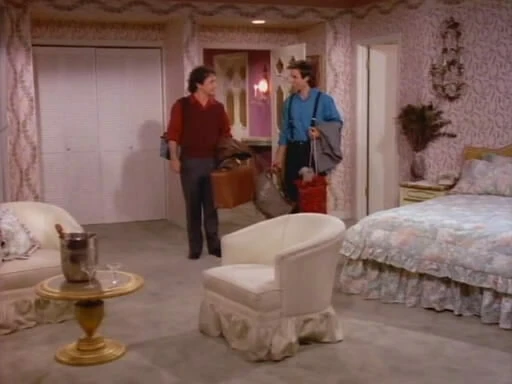
In Babes in Babylon, a trip to Las Vegas lets Larry appoint himself the supervisor of Balki’s exposure to gambling. He anticipates the danger, organizes the experience, and prepares to keep his trusting cousin safe. It is a reassuring role to assign yourself if you would rather not inspect your own susceptibility.
The episode reverses the arrangement. Balki has good luck, Larry starts playing, and the man providing the warning becomes the man who needs one. The casino doesn’t have to explain the irony. Larry has already delivered enough instruction to establish how thoroughly he ought to know better.
This is fertile ground for Linn-Baker because a person insisting that the next attempt will fix everything has begun making an argument against his own face. Larry’s need to recover the situation can feed the behavior that makes it worse. Balki’s job becomes getting through to a cousin whose claim to superior judgment is rapidly running out of money.
The reversal also treats Balki as something more than a permanent responsibility. He can recognize the problem and try to intervene. His American experience may be limited, but he has eyes, concern, and less personal investment in pretending that Larry’s current decision is part of a successful strategy.
The comedy makes a fairly pointed observation about the cousins. Larry’s knowledge is real, but it doesn’t make him immune to temptation. Balki’s innocence is real, but it doesn’t prevent him from noticing when someone he loves is behaving foolishly. Their partnership gains something whenever the rescue travels in the direction Larry wasn’t expecting.
Everybody can play, right up until Larry wants to win
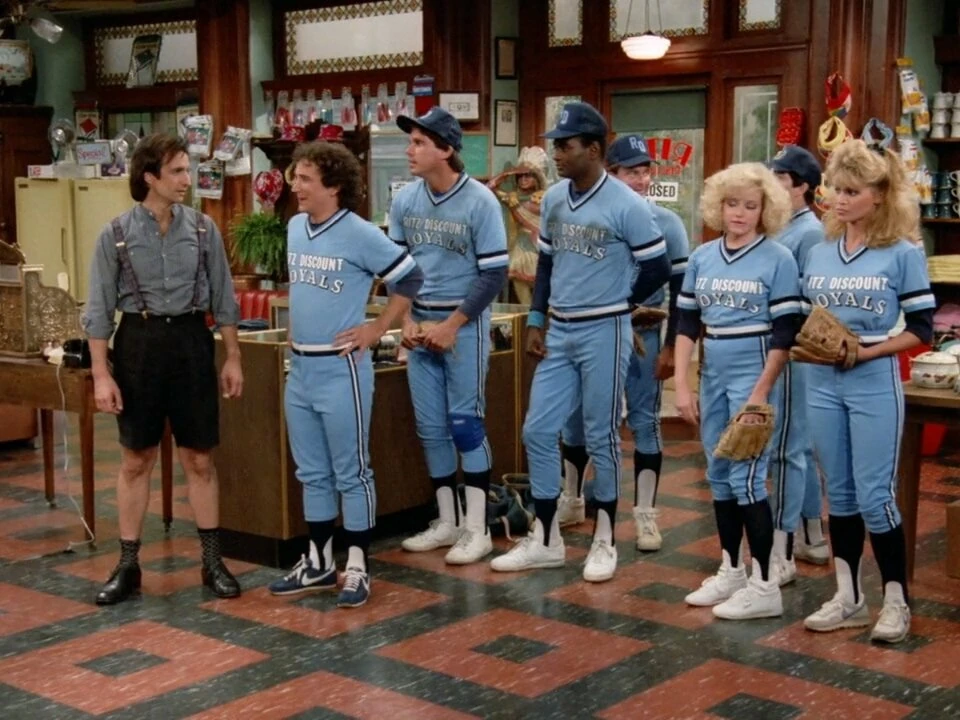
The Unnatural puts Balki on the edge of another kind of belonging: a softball team. Larry has a chance to include him, then becomes interested in what a stronger player might do for the team’s chances. A game meant to bring people together becomes an opportunity to sort them by usefulness.
The story is particularly suited to the cousins because Larry can explain why his decision is practical. Winning has a clear objective. A friend wanting to participate creates a less easily measurable obligation. Larry’s talent for making his preferred result sound sensible can carry him a long way toward ignoring the person standing beside him.
Sports episodes were familiar sitcom territory, but this one has the advantage of the existing relationship. Balki has come to a new country and joined his cousin’s life. Being invited to stand with a team is a small extension of that welcome. Being pushed aside tells him where the invitation stops.
The physical comedy belongs to a social problem you can understand before anybody reaches for equipment. Larry wants the happy result and may be prepared to borrow the language of friendship to get it. Balki has to discover whether the friendship includes being wanted when he isn’t the best option for the job.
That is a useful place for a family comedy to work. A younger viewer doesn’t need a speech about sportsmanship to recognize the awful moment when someone decides the game would go better without them. The cousins can make a mess of the afternoon while keeping that little injury visible enough to matter.
The landlord has leverage. So do the tenants, if they stick together.
In the second season’s The Rent Strike, dissatisfaction with Twinkacetti becomes a shared problem among the tenants. The cousins’ employer and landlord isn’t meeting his obligations, and a group of people decide that asking nicely has had enough time to work.
The setting makes Larry’s position awkward. This is someone with influence over more than the apartment. Standing up to a boss can feel like a decision that follows you into the next workday; standing up to the person who also controls your home adds another room to the consequences.
Balki’s readiness to act on what is fair can be useful in that situation. Larry is often the person worrying about the practical repercussions. Sometimes those worries are sensible. Sometimes they provide a sophisticated vocabulary for continuing an arrangement that everybody knows is unfair. Bringing the cousins into a group gives that disagreement a wider audience.
Twinkacetti’s response, cutting services to make the tenants uncomfortable, turns the dispute into ordinary physical deprivation. A room without heat is a great deal less abstract than a complaint about management. The pressure tests whether the agreement to stand together survives the moment when standing together becomes cold.
The story also gives the early supporting cast something to do beyond witnessing Larry and Balki. These people share a building and a problem. A sitcom apartment can make city living look like a collection of private adventures. For an episode, the neighbors’ circumstances connect. The comedy has room for collective aggravation as well as the usual household variety.
Christmas in Chicago wasn’t Larry’s plan

A Christmas Story, broadcast in December 1986, leaves the cousins snowbound in Chicago when Larry wants to reach his family in Wisconsin. Being stuck isn’t simply a travel inconvenience for him. It interrupts an idea of how the holiday is supposed to feel, and he has considerable difficulty making room for an alternative.
Balki is an especially apt person to share the disappointment. He is already living far from home. Larry’s inability to reach a familiar Christmas can seem enormous in the moment, but his cousin has had to carry a much longer distance into the apartment with him. The difference doesn’t require either person to stop feeling what they feel.
The episode gives Pinchot’s warmth somewhere to go. Balki can try to make the room festive without pretending it is the place Larry intended to be. That generosity is part of the show’s appeal. He can be the source of trouble in one scene and the person who notices what the other man needs in the next.
For viewers whose own holidays involved an improvised plan, an unavailable relative, or weather that had declined to cooperate, the emotional setup was easy to recognize. Television Christmas often arrived as an impossibly coordinated event. The cousins had to work with the people and space they actually had.
It is one of the stories that makes the friendship worth the inconvenience. Balki is not just the guest Larry agreed to tolerate. He is the person in the apartment when Larry’s better arrangements fall through. A home can be built partly from the people willing to help you have an evening you hadn’t planned on wanting.
Two actors, one task, absolutely no graceful way out
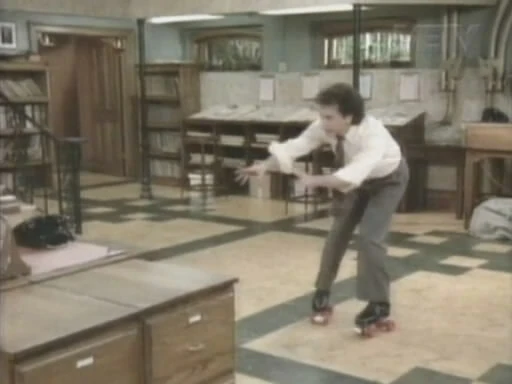
The great advantage of Linn-Baker and Pinchot was that both could do the physical work. Larry wasn’t stationed safely outside the stunt supplying a disapproving remark. His pride regularly put him right in the middle of it, where he could twist, scramble, hang on, and discover a new reason to regret having described the task as simple.
Watch the way a shared job changes their relationship. One person needs to lead. The other needs to anticipate the move. Then something slips, and leadership becomes a rapidly revised theory. The men have to communicate while doing the thing that makes communication difficult. A good line can help; a look of dawning panic can often help more.
Pinchot has spoken in later interviews about the physical ambition of their work and the trust between the performers. The results are visible without needing a technical breakdown. A scene has the pleasure of two people working together closely enough that the next mistake can look spontaneous while arriving at exactly the point where the laugh needs it.
That is why the comparison with silent comedy makes sense as an account of what they could do, rather than as a fancy certificate to pin on a sitcom. Bodies explain a problem very quickly. You can miss a word and still understand that the furniture is moving in the wrong direction and that neither man has enough hands left to correct it.
The family audience helped make that skill valuable. Adults and children might respond to different parts of Larry’s romantic anxieties or Balki’s language. Both could see a job getting spectacularly out of control. The series didn’t require everybody in the room to share the same knowledge before they could share the laugh. That shared visual language helped it fit among the decade’s family-friendly sitcom choices.
The Chicago Chronicle gives the cousins a bigger playground
The third season moves the working world to the Chicago Chronicle. Larry gets closer to the career he wants, and Balki finds work in the mailroom. A newspaper supplies more departments, more authority figures, and more ways for Larry’s professional ambitions to become somebody else’s immediate inconvenience.
The move matters because the first job had kept the cousins under one particularly overbearing man. The Chronicle has an institution’s worth of pressures. Larry wants an opportunity, the editors want something useful, and Balki has to deal with a boss who doesn’t necessarily appreciate his existence. A person can make progress in one room and lose his standing in the next.
Larry’s relationship with journalism also changes the shape of his striving. He wants a byline, a story, or the chance to prove he belongs among the professionals. His appetite for recognition can run into questions of judgment and responsibility. The consequences can become larger than a bad photograph or a disappointed customer at the discount store.
The 1987–88 broadcast season is the right annual context for that change. The show has moved beyond its original small spring introduction and established a workplace that can sustain it through the later eighties. It is still about the cousins, but their working day no longer depends on the same counter and cash register.
The office setting doesn’t make them sophisticated overnight. Larry remains capable of bringing a very personal insecurity to a professional task. Balki remains capable of doing exactly what he thinks he was asked to do, leaving the person who asked to consider whether the wording could have been improved. The building is bigger. The supply of awkward explanations expands to meet it.
Gorpley, Lydia, and the hazards of having coworkers
Sam Anderson’s Mr. Gorpley gives Balki a workplace antagonist with considerably less patience than Larry. A boss who dislikes the person working for him can make every little error seem like an employment hearing. Balki’s goodwill doesn’t automatically soften Gorpley; sometimes it simply gives the man one more quality to find irritating.
Anderson is particularly effective at making authority feel small and personal. The position provides power, but the character’s pleasure can come from wielding it over people close enough to annoy him. That supplies a different kind of pressure from Twinkacetti’s shop. The newspaper may be a step up in Larry’s ambition, yet it still employs people with very ordinary appetites for making the day worse.
Belita Moreno returns in a different role as advice columnist Lydia Markham. Edwina and Lydia are separate characters, an easy distinction to lose if your rerun memories have compressed the two workplaces into one continuous set of familiar faces. Moreno gets another way to enter the cousins’ problems, with the possibility that someone professionally associated with advice may need a considerable amount of help herself.
Editors and supervisors extend the world further. Larry can’t simply declare a story important because it is important to Larry. Someone else gets to decide what the newspaper wants. The arrangement keeps his ambition in contact with people who have no sentimental obligation to reward it.
The ensemble also gives the cousins opportunities to disagree about how coworkers should be treated. Larry is susceptible to a professional advantage. Balki tends to see the person in front of him. Neither approach guarantees a smooth workday, particularly when the person in front of them is Gorpley, who would prefer considerably less of whatever assistance is being offered.

Harriette Winslow has heard enough to recognize nonsense
Jo Marie Payton’s Harriette Winslow operates the Chronicle’s elevator and gives the cousins another person whose attention they cannot assume is unlimited. Larry may have a long account of what is happening. Harriette often seems capable of arriving at the useful part well before he has finished establishing his own importance.
Payton brings a grounded authority to a show whose central men can spend considerable energy escalating an ordinary problem. Harriette has a job, opinions, and an ability to meet their behavior without being absorbed by it. A workplace needs people who have no desire to participate in the latest scheme.
Her presence also matters beyond this particular series. Harriette continued into Family Matters in the fall of 1989, alongside Reginald VelJohnson as Carl and the Winslow household. That is the concrete connection between the shows. It is more useful than allowing a later memory of Steve Urkel to wander backward and take over the Chronicle.
The development of a spinoff involves production decisions and performers beyond the simple observation that an audience enjoyed a supporting character. Harriette’s originating role is clear. That doesn’t require a fairy tale in which one elevator scene instantly created a whole other program, or a claim that everything Family Matters later became was already sitting inside Perfect Strangers.
Within the earlier show, Payton’s contribution is immediate. She changes the air around Larry and Balki. The viewer gets the pleasure of watching someone who knows these men, can help them, and is perfectly able to let an objection show on her face. The cousins aren’t the only people working in this building, however much of its available attention they may consume.
An office joke can turn into a real problem
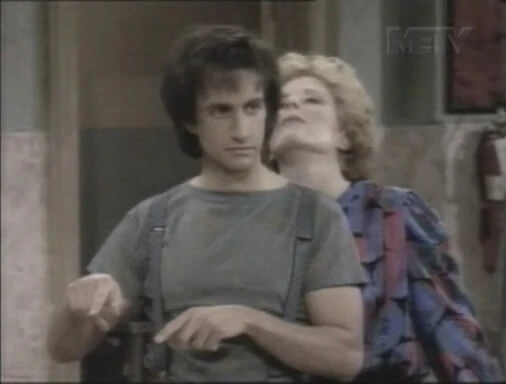
Sexual Harassment in Chicago, from the third season, places Balki under unwanted attention from a woman with power at the newspaper. Holland Taylor plays Olivia Crawford, an editor whose position makes refusing her more complicated than simply declining a date.
The setup turns a familiar expectation around. Balki’s openness isn’t an invitation, and his discomfort doesn’t become harmless because the person creating it is a woman. A workplace hierarchy gives the attention consequences beyond embarrassment. Saying no can feel dangerous when the other person may influence whether you keep the job.
A broad comedy has a difficult balance to manage with that material. The central problem needs to remain visible through the performance and the jokes. Balki is not responsible for making the unwanted behavior flattering. Larry’s concern has to reach beyond his usual tendency to provide a confident explanation of how American life works.
The episode is worth remembering partly because it gives the trusting newcomer a problem his customary goodwill cannot solve. Being agreeable and trying hard don’t protect him from a person taking advantage of authority. The pleasant account of joining a new workplace runs into a much uglier part of what a workplace can ask someone to endure.
It also supplies a limit to treating the show as nothing but a collection of falls and mispronounced words. Its people could encounter genuine anxiety. Whether every tonal choice lands for a modern viewer is another question, but the situation itself belongs to Balki as a person with boundaries and a need to earn a living. Those stakes deserve more attention than the novelty of which character is pursuing whom.
Balki discovers cable. The rest of his life waits.
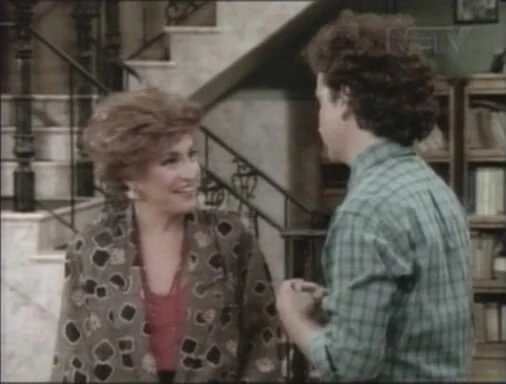
The third-season episode Couch Potato gives the newcomer an American abundance he has difficulty putting down: cable television. More channels turn the apartment into a place where there is always another thing to watch. Balki’s enthusiasm begins crowding out sleep, work, and the world outside the room.
For viewers in households where cable had arrived, or was still being negotiated, the attraction needed very little explanation. A television that once seemed to run out of interesting possibilities could suddenly look inexhaustible. The next option was waiting just a little farther along the dial.
The episode makes Larry the person trying to retrieve his cousin from that supply. It is a funny change from the many stories in which Balki interrupts Larry’s plans. Here the problem is getting Balki to participate in anything else. The apartment has acquired a new center of gravity, and it isn’t the family relationship.
There is an appealing contradiction in a television comedy making a joke about too much television. Its audience is, after all, currently watching. The exaggeration works because viewers can enjoy the temptation without needing to approve its takeover of an entire day. Balki has found something fun and allowed it to become the schedule.
The story also catches a very specific late-eighties household experience without pretending cable reached everyone at once. Some families had a converter box, some had different services, and others were still managing broadcast reception. Wherever the extra channels were available, though, the argument about when to turn the set off could become as important as the argument about what should be on it.
The kitchen requests coordination. Larry and Balki provide an interpretation.
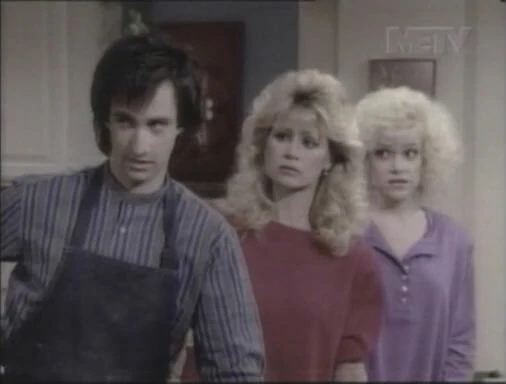
Larry’s interest goes beyond enjoying the dessert: he sees something they might sell. That commercial impulse adds a deadline to a preparation Balki says cannot be rushed. The cousin with an eye for an opportunity meets the cousin who actually knows how to make the product. Their disagreement has a very practical test waiting in the kitchen.
Just Desserts, from the third season, is the home of the remembered bibi-babka routine. Balki’s recipe asks for more than measuring ingredients. Its preparation comes with a rhythm and a procedure, which means Larry’s participation requires him to follow a system he did not invent.
That alone is a promising difficulty. Larry likes knowing the efficient way to do something. A Myposian baking method gives Balki the expertise and Larry the role of learner. There is no reason to assume that the American cousin’s impatience represents a useful improvement on the recipe.
The physical pleasure comes from watching the pair coordinate. Words, movement, timing, and the task on the table have to line up. A routine can become funny through repetition when the viewer is learning the pattern along with the performer. You begin anticipating the next action, then enjoy the pressure of seeing whether they will arrive there together.
The scene is also a reminder that props can supply a whole grammar of comedy. A kitchen doesn’t need to become a spectacular new location. It needs an activity that makes the bodies matter. Hands are occupied, the next step has a correct moment, and stopping to debate the process may create a fresh problem.
Fans can remember the rhythm years after forgetting the surrounding plot. That is a kind of success sitcoms sometimes achieve more effectively than a densely serialized drama. The episode leaves behind a playable piece of behavior, something people can begin together and recognize immediately. No lyrics need to be printed here to bring back the sight of two cousins attempting to make a dessert while remaining in time with each other.
A piano is a very large test of a small partnership
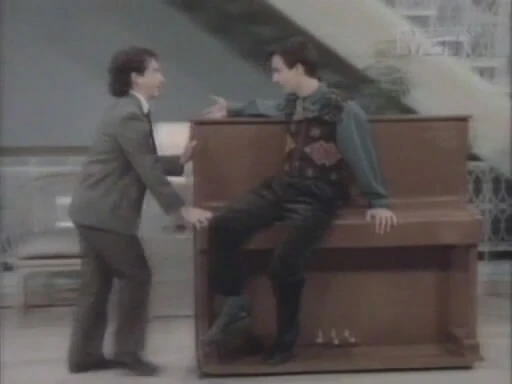
The request comes from Lydia, who wants the instrument moved upstairs for a musical opportunity involving a record producer. Larry’s bad back adds a further objection. The job therefore arrives with another person’s hopes attached, several flights between the instrument and its destination, and two volunteers whose enthusiasm has not changed the laws of weight. It is a very expensive shape to discover you should have asked more questions about.
The fourth season’s Piano Movers gives the cousins an object that cannot be persuaded by Larry’s confidence. A piano has weight, size, and a serious lack of interest in how easily the men thought the job would go. It is an excellent opponent for two performers who know how to make a shared task look increasingly precarious.
Furniture-moving comedy has a long history for a good reason. The object obliges people to cooperate, then prevents them from standing wherever cooperation would be easiest. One person sees a problem the other cannot. An instruction travels badly. Someone needs to let go, which may be exactly what the other person cannot allow.
Larry and Balki bring their particular relationship to that old arrangement. Larry would like the authority of being the man with the answer. Balki needs an answer that works while both are still holding the thing. A speech about the next move is less helpful when the present one is becoming difficult to maintain.
It also lets Linn-Baker’s panic become physically eloquent. You can watch Larry try to preserve a little composure while his body makes a more accurate report. Pinchot can answer with an entirely different kind of urgency, leaving the cousins involved in the same emergency without approaching it at the same speed.
The appeal is wonderfully direct. A viewer doesn’t need to know the Chronicle’s office politics or remember a romantic disagreement from a previous week. Two men have a piano and an increasingly bad idea of what to do next. For a few minutes the whole comedy sits inside a problem you can see. They need to finish the job, and the instrument has yet to agree to their terms.
That clarity is one reason the sequence belongs near the center of the show’s reputation. The catchphrases can identify Perfect Strangers in a second. The piano shows the labor that made the identification worth anything.
Larry’s father arrives, and the plan needs to look impressive
The two-part Father Knows Best, in November 1989, gives Larry an audience whose approval he wants much more than he admits. James Noble plays Walter Appleton, the father whose visit makes Larry particularly eager to demonstrate that his new life deserves a favorable review.
It gives the nervous striving a source closer to home than professional competition. The young man who left a large family hasn’t stopped wanting someone from that family to see him succeeding. Independence and the desire for approval can occupy the same apartment without being introduced to each other.
The story eventually traps people in a flooding basement. Larry’s need to solve the immediate problem and his need to seem capable in front of his father become unpleasantly intertwined. A person can prepare a reassuring account of their life. Rising water has a way of moving the conversation toward what they can actually do right now.
The confined setting gives the performers pressure to work against, but it also gives Larry something to say that isn’t another attempt to improve his image. His relationship with his father has to make room for feelings he has been organizing around rather than expressing. The physical emergency creates an opening that a comfortable visit might have allowed him to avoid.
By this point, the series has spent several seasons watching Larry worry about his standing. The father story makes that worry personal. He doesn’t become a different man because the episode has found a serious thread. The same need that pushes him into an absurd scheme can also make a son’s disappointment intelligible. Linn-Baker can carry both without requiring the audience to forget how funny Larry was ten minutes earlier.
Balki wants to send a little movie home. Larry sees a production.
In December 1989’s Home Movies, Balki wants to send a video to his mother for a reunion he won’t be attending. Larry gets involved and begins turning a personal message into a more elaborate undertaking. The cousin who means to help is once again tempted to substitute his own ambitions for the task actually requested.
The setup catches two recognizable pleasures of home video. A camera can make distant people feel closer. It can also make the person holding it suddenly behave as though a studio has requested their services. A simple recording acquires direction, correction, and an increasing distance from the ordinary moment it was supposed to preserve.
For Balki, the point is contact. His mother wants to see him, and he wants to be present in some form among people he misses. Larry’s interest in making the result impressive has to contend with the possibility that impressive isn’t what the audience back home needs.
It is a particularly fitting late-eighties story for a show about these two men. Larry has always wanted to make images and be noticed for them. Balki has always wanted to connect with people. A home movie lets those desires work together or get directly in each other’s way.
The episode also gives the apartment another temporary identity. It has been a classroom, a place to entertain women, a refuge from work, and a kitchen for demanding recipes. Now it can become a film set because Larry has detected an opportunity to take charge. The room keeps accommodating his aspirations, though the people inside it don’t always appreciate the new job titles.
Friday night came later than the memory sometimes suggests
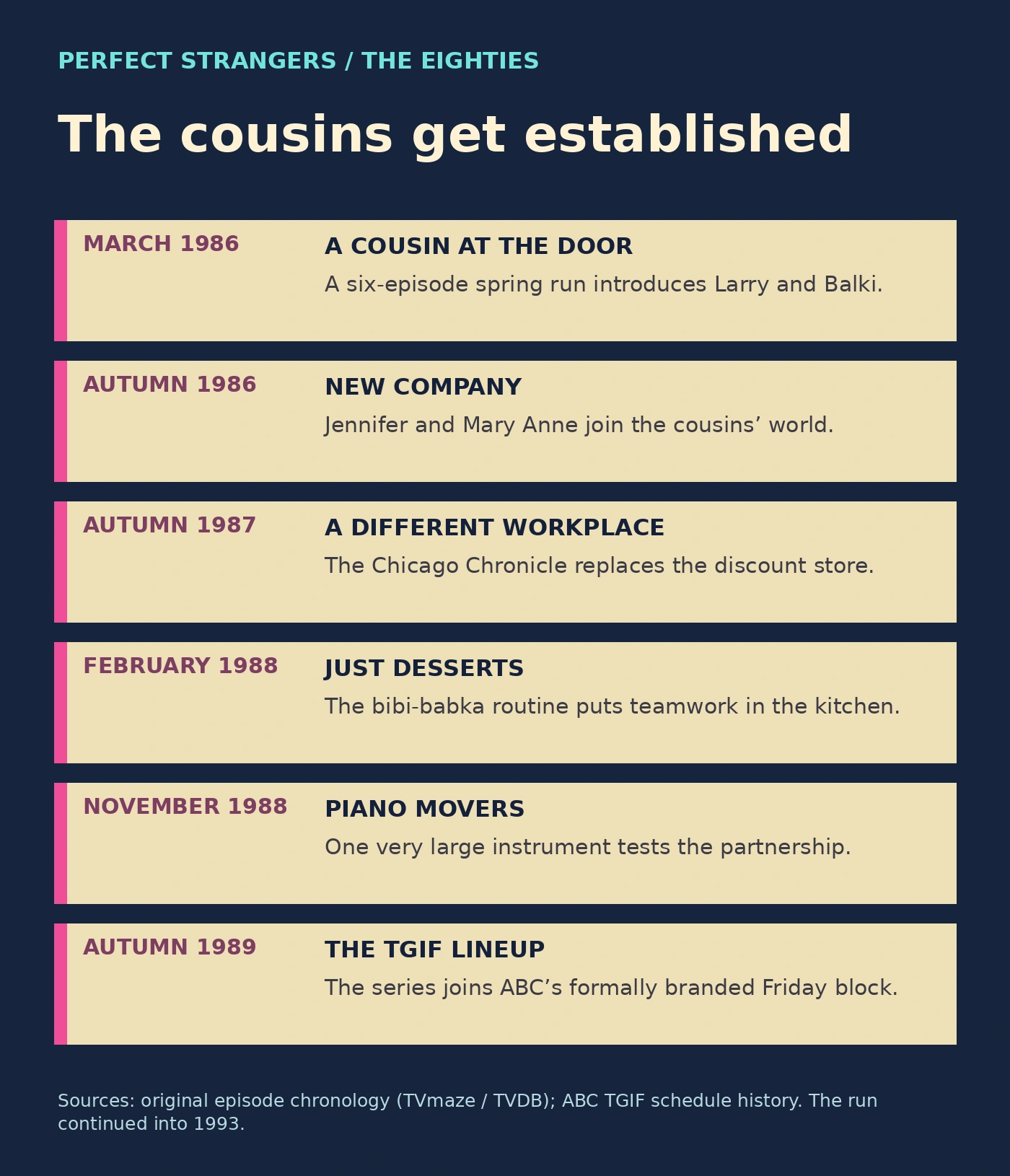
The series began on Tuesdays, spent time on Wednesdays, and moved to Fridays before ABC’s fully branded TGIF era. The distinction is useful because a later viewing habit can spread backward in memory and make every episode feel as though it arrived beneath the same logo.
The season ending in 1989 belongs to that developing Friday-night story. The next fall, ABC’s 1989–90 lineup made TGIF a formal home for a cluster of family comedies. Perfect Strangers sat in company that included Full House, the new Family Matters, and Just the Ten of Us.
That packaging mattered to the experience of watching. One funny half hour could encourage the room to stay for the next. Cast appearances and promotions could make a network evening feel like a shared invitation, particularly for younger viewers who might not otherwise think of a broadcast schedule as something with its own personality.
The cousins were well suited to that role because their comedy crossed age lines. A parent might recognize Larry’s self-defeating ambition. A child could follow the immediate physical problem. Balki’s warmth gave the episodes a reassuring emotional center even when the room itself had become a mess.
It also places them among the broader family-comedy choices of the decade. Growing Pains had parents and children negotiating the Seaver household. Who’s the Boss? built a home around a different employment and family arrangement. Larry and Balki made two adult cousins into the people who had to find a way to live together. The responsibility was smaller in head count than a family household and frequently no smaller in effort.
The opening promised progress. The episode checked how it was going.
The theme, Nothing’s Gonna Stop Me Now, gave the series an enormous helping of optimism before Larry had done anything to complicate the evening. David Pomeranz’s vocal supplied the sense of a new life opening ahead. The pictures of the cousins and Chicago made the move feel exciting rather than merely expensive and confusing.
That confidence was a very good introduction to a show about people who kept discovering obstacles. The opening could suggest forward motion; the story might soon find them having trouble crossing a room with an object. It didn’t undermine the promise so much as reduce it to a scale Larry and Balki could make funny.
Chicago mattered as an image of possibility. The cousins’ immediate world was largely made of recurring interiors, but the city outside helped explain why Larry wanted to be there and why Balki found the new life worth approaching with enthusiasm. A local job could be discouraging without extinguishing the sense that something better might be available.
The optimism also softens Larry. He can be petty and foolish, but the show keeps returning to the hope that he can build a life worth sharing. Balki’s belief in him is part of that hope. It would be a much meaner comedy if every plan failed because the audience was simply waiting for Larry to be punished for wanting something.
Instead, the pleasure often lies in watching him lose the pose and keep the relationship. The world may stop his current scheme fairly decisively. The cousin standing beside him is still interested in what happens after they pick everything up.
Go back for the people carrying the piano
The original series continued into 1993. Marriages, a different household arrangement, and the eventual farewell belong to that later part of its life. The eighties story already contains the essential partnership: the spring arrival, the discount-store years, Jennifer and Mary Anne, the Chronicle, and the growing confidence of a double act that could make a practical job last gloriously too long.
Some of the jokes have dated. The accent is asked to do heavy work, and the writing doesn’t always give the supporting women the same range it gives the cousins. A fond memory needn’t be asked to certify every line before you can enjoy the performers again.
The strongest reason to revisit it is specific. Watch Larry decide he can manage something. Watch Balki believe him, question him, or become the person trying to rescue him. Watch the instant the task acquires enough momentum that a sensible apology will no longer finish it.
Beside the quieter discomfort of Newhart’s Vermont inn, the cousins offer another pleasure: two people with nowhere to put their arms, more confidence than preparation, and a job that refuses to become easier because they are related.
The Dance of Joy gets the reunion applause, understandably. It is a lovely celebration for two men who have put themselves through so much unnecessary labor. But stay for the work before the celebration. Larry and Balki usually have to earn the right to stop moving, and watching them attempt it remains the best part of the evening.
A few cousin-related questions
Are Larry and Balki brothers?
They are distant cousins. Larry Appleton is the aspiring photographer from Wisconsin who has moved to Chicago. Balki Bartokomous arrives from the fictional island of Mypos and joins him. Mark Linn-Baker plays Larry, and Bronson Pinchot plays Balki.
Did Perfect Strangers begin as a TGIF show?
It began on ABC on March 25, 1986, with a short Tuesday-night spring run. The series later moved through other time periods, including Fridays, and became part of the formally branded TGIF lineup in fall 1989. Its association with Friday family comedy is real, but it doesn’t describe the original premiere schedule.
What connects it to Family Matters?
Jo Marie Payton first played Harriette Winslow as the elevator operator at the Chicago Chronicle on Perfect Strangers. Harriette continued in the Winslow-family spinoff, which began in 1989. The later show’s long development is its own story; the concrete connection here is the character and performer who moved between them.
Why do early episodes have a different workplace?
Larry and Balki initially worked for Mr. Twinkacetti at the Ritz Discount store. The third season moved their working lives to the Chicago Chronicle, adding a newspaper ensemble and new professional problems. Both periods belong to the eighties television run, before the series’ early-nineties continuation.
Sources & Further Reading
- Original series and episode chronology
- Detailed episode guide (some dates vary between catalogs)
- Episode summaries and original-season context
- Bronson Pinchot on acting and physical comedy
- Jo Marie Payton on Harriette and the two series
- Producer Bob Boyett on the comedy
- David Pomeranz’s screen work