READY. SET. REC.When the VCR Was Our DVR
Before “watch later” was a button, it was a plan: find a tape, check the speed, set the clock, enter the channel, pray the cable box stayed put and hope nobody hit STOP while you were gone.
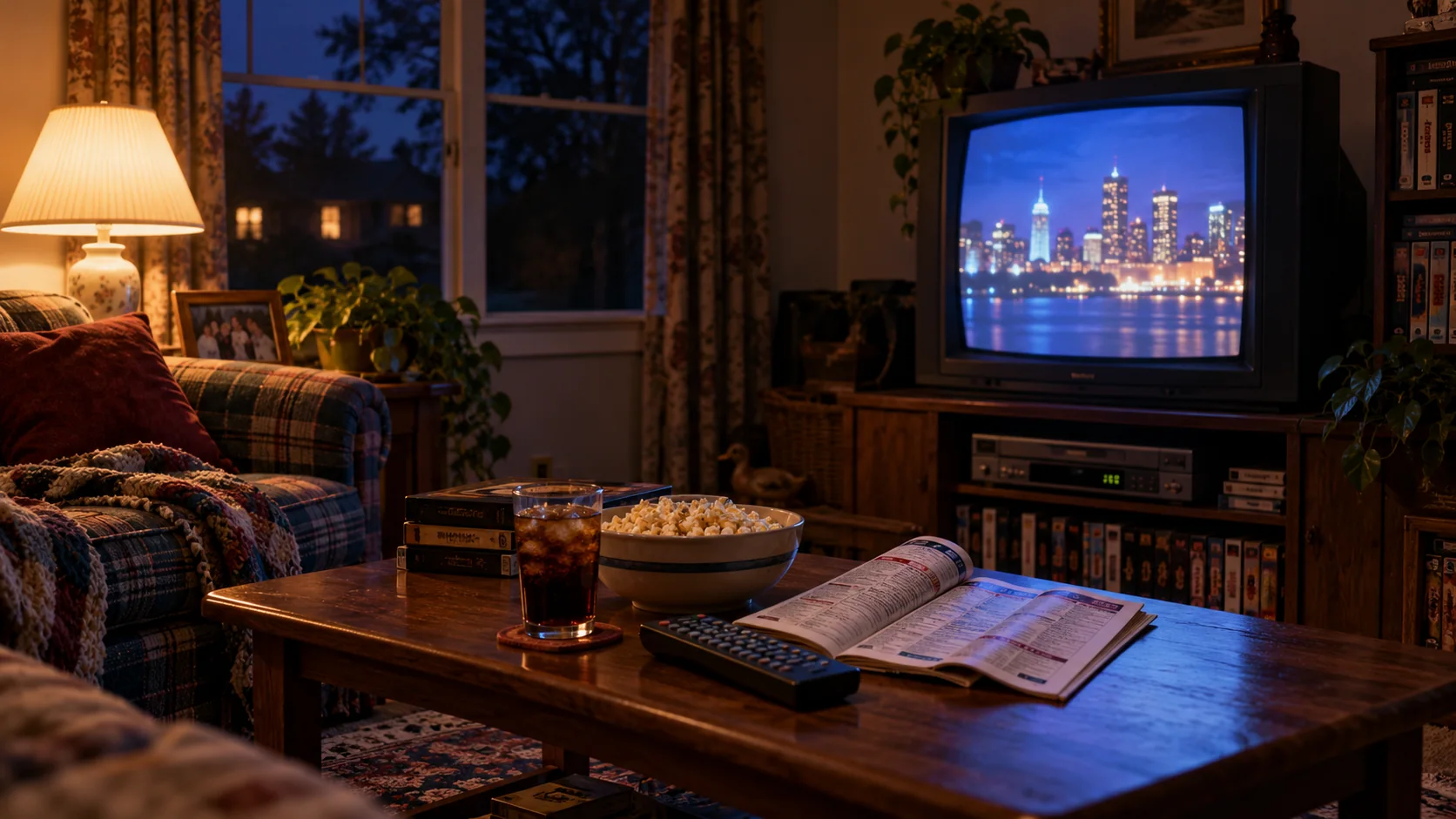
What was recording TV in the 90s actually like?
It was equal parts freedom and friction. The VCR let us break the television schedule for the first time, but only if we could make the machine cooperate. Recording a show meant managing tape length, recording speed, channels, timers, cable boxes and family politics. It was clumsy compared with a DVR, yet that clumsiness made the programs we saved feel strangely valuable.
Why the VCR Changed Television Before We Ever Said “On Demand”
The VCR did something that is easy to underestimate now: it separated a television program from the moment the network chose to air it. Before that, television was mostly a live appointment. Miss the episode and you waited for a rerun, hoped somebody could tell you what happened or accepted that you had simply missed it. The VCR did not make television on-demand in the modern sense, but it opened the first little crack in the schedule’s authority.
By 1990, VCR ownership had reached roughly 70 percent of American television homes, according to contemporary Nielsen figures reported by the Los Angeles Times. That means the machine sitting under the television was no longer a gadget for early adopters. It had become part of the furniture. For Gen X households, the VCR was where movie rentals, home videos, taped sitcoms, wrestling, cartoons, award shows, late-night appearances and “don’t touch this tape” all collided.
The important thing is that recording television was never invisible. You had to decide to do it. You had to commit a physical object to the job. You had to know whether there was enough tape. You had to remember that the machine’s clock was wrong after a power outage. You had to decide whether picture quality mattered more than squeezing three hours onto a two-hour cassette. That friction created a kind of intentional viewing that streaming later removed.
Television Used to Move On Without You
To understand why taping a show felt powerful, you have to remember how little control a viewer had before home video.
A network put a show on Tuesday at 9:00 and that was the deal. If you worked late, had practice, went to a school event, got stuck at somebody else’s house or simply forgot, the episode moved on without you. Reruns were part of the system, but the viewer did not control when they appeared either. Syndication eventually made many shows easier to catch, yet even reruns were still controlled by a station schedule.
The arrival of home video recording in the 1970s introduced a new verb into television life: tape it. By the 1980s and especially the 1990s, that phrase had become ordinary household language. “Can you tape it for me?” could mean a parent programming the machine before dinner, a sibling pressing RECORD while you were out, or a friend saving something you could not receive on your cable system.
That simple request was the ancestor of every watchlist, cloud DVR and “save for later” button that came after it. The difference was that in the VCR era, saving something required somebody in the house to do actual work.
How Taping a Television Show Actually Worked
Recording a show was simple only when you were sitting in front of the television and the program was already on.
In that easiest version, you put a cassette into the VCR, made sure the little record-protection tab had not been broken out, selected the correct input and channel, chose a tape speed if your machine offered the choice, and hit RECORD. If the VCR was connected correctly, red lights came on and magnetic tape began moving past the video heads. Congratulations: you were now the programming department.
But the moment you wanted to record something later, the process became more complicated. The VCR had to know the date, the start time, the stop time and the channel. If the machine’s clock was wrong, the recording was wrong. If the cable box was on the wrong channel, the VCR could faithfully record two hours of whatever happened to be there. If somebody turned the cable box off, changed the channel or took the tape out, your brilliant plan was over.
This is why so many 90s recordings begin a little early, end a little late, contain the last thirty seconds of the previous show or suddenly cut to another channel halfway through. Those mistakes were not rare glitches. They were part of the medium.
Find a tape and decide whether you are allowed to use it.
Check the recording speed and estimate whether the program will fit.
Set the timer: date, channel, start time, stop time.
Leave the VCR powered the way the manual expects and hope nobody interferes.
Come home, rewind, press PLAY and discover what actually happened.
Blank Tape Culture Turned Recording Into a Negotiation
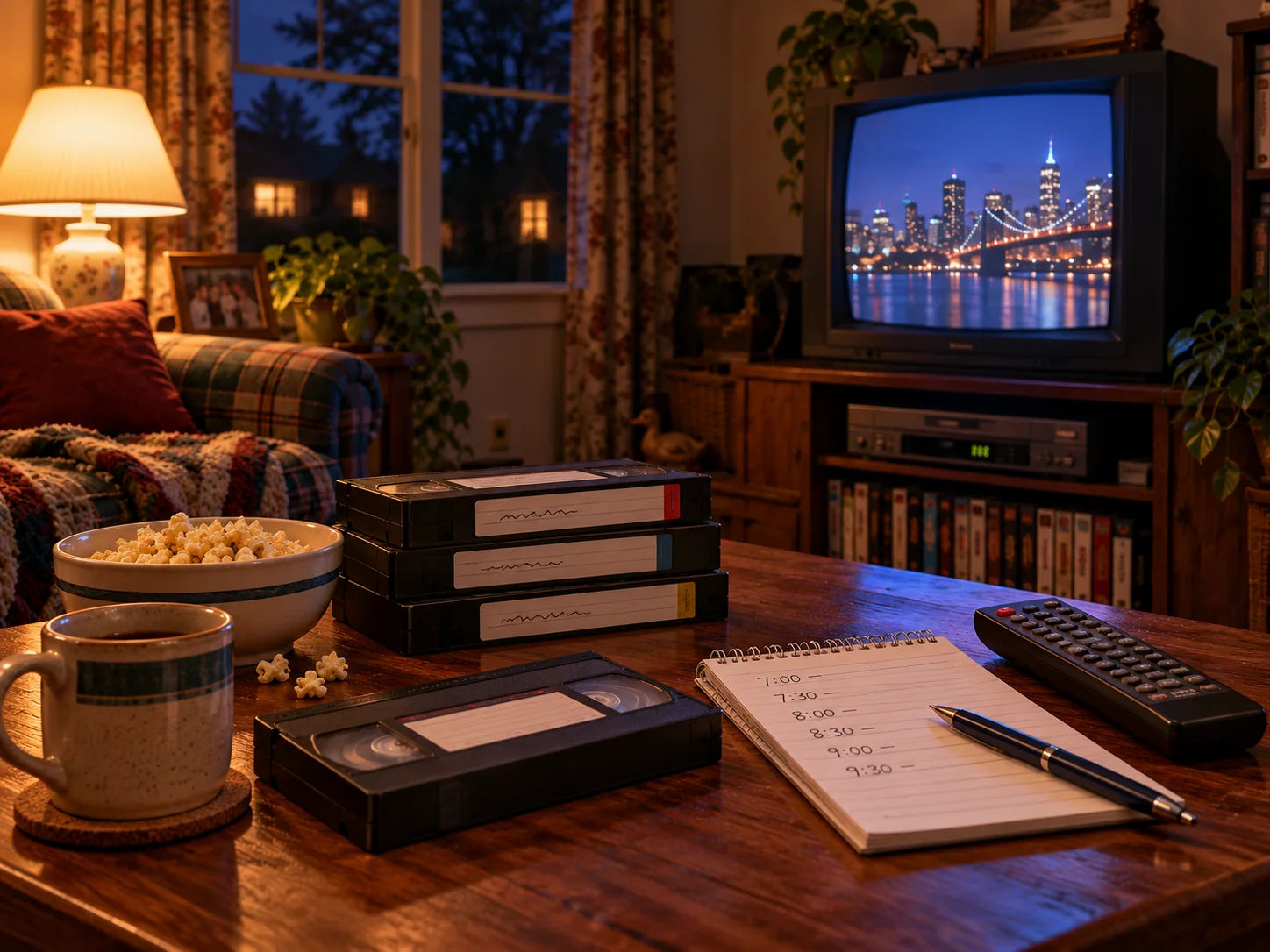
Blank VHS tapes were not just storage media. They were household resources.
A new three-pack or five-pack of blank cassettes could feel like possibility. Every tape represented hours of future television, but using one permanently required a decision. Was this episode important enough to keep? Was the movie worth six hours in EP? Could you record over the tape labeled “Christmas 1992” if nobody remembered what was actually on it? Who had authority over the cassette with the hand-written warning in all caps?
Most households developed informal classes of tapes. Some were temporary: record tonight, watch tomorrow, reuse next week. Some were semi-permanent: a handful of sitcom episodes, a sports game, an awards show, a concert or a made-for-TV movie. A smaller number became protected territory. Those were the tapes with multiple labels, crossed-out titles, arrows, dates and increasingly desperate notes telling everybody else not to erase them.
That is where recording television became collecting. The VCR gave viewers the ability to build private libraries from broadcast material, something the Supreme Court itself noted when it discussed “library building” alongside ordinary time-shifting. Our separate feature on the VHS television libraries Gen X made at home goes deeper into that culture of labeled tapes, homemade compilations and accidental archives.
The Tape-Speed Decision Was a Tiny Lesson in Compression
The recording-speed switch was one of the most important little decisions on the front of a VCR.
The Smithsonian notes that VHS cassettes were originally designed around roughly two hours of programming, with longer recording times made possible by slowing the tape and sacrificing some image resolution. By the 90s, most people knew the practical version: SP looked better and used tape faster; LP, where available, stretched the cassette; EP or SLP squeezed much more onto the tape but gave away picture quality.
A T-120 cassette was the classic example. At standard play, you were thinking in roughly two-hour chunks. Extended play could stretch that same cassette to around six hours. That meant one tape could hold a movie in better quality, or an entire evening of television in fuzzier quality. For collectors, the choice mattered. For a one-time time-shift, maybe it did not. For kids trying to fit a marathon onto one cassette, EP was a superpower.
The tradeoff showed up years later when people rediscovered old tapes. SP recordings often held up better visually because more tape surface was used for each second of video. EP recordings could be softer, noisier and less forgiving of tracking problems. At the time, though, the equation was simpler: how badly do you want this, and how many blank tapes are left?
Programming the VCR Was the Price of Freedom
Programming a VCR timer became one of the signature jokes of the era because the joke was earned.
Manufacturers had to fit scheduling controls onto small front panels and remotes with limited displays. Some machines used rows of tiny buttons. Others required you to enter one field, confirm it, move to the next and remember which mode you were in. The result was that plenty of people could play a rented movie perfectly well yet never become comfortable scheduling a recording for Thursday at 9:00.
The most famous symptom was the blinking “12:00.” It represented more than laziness. A power outage could reset the clock, and an unset clock could make timer recording useless. The VCR might know everything except what time it was. In some houses, one person became the designated clock-setter and timer-programmer because everybody else had surrendered.
The Los Angeles Times reported in 1990 that the problem was widespread enough to create a market for products whose entire purpose was making timer programming easier. The irony is perfect: the VCR had already given people control over the schedule, but the interface often made that control feel like a puzzle.
VCR Plus+ Tried to Save Us From Our Own VCRs
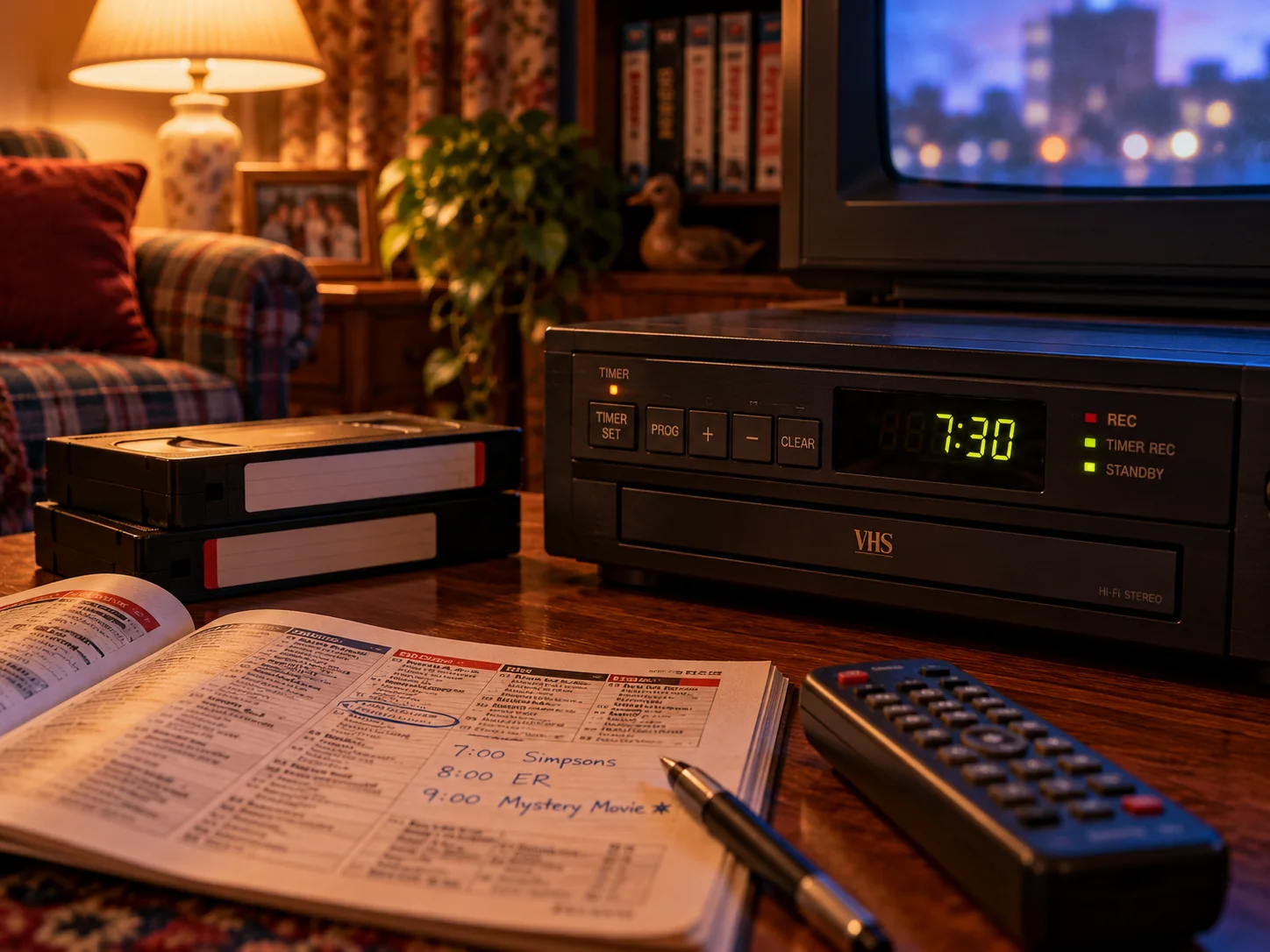
VCR Plus+ arrived in 1990 with an almost magical promise: stop programming the VCR the hard way.
Gemstar’s system assigned a short numerical code to television programs. Newspapers and TV listings printed the code next to a show. Instead of manually entering the date, channel, start time and stop time, the user entered the PlusCode. The device translated that number into recording instructions and sent them to the VCR.
Contemporary Los Angeles Times coverage described the first VCR Plus unit as a roughly $60 remote-like accessory and noted that participating newspapers and TV Guide were beginning to print the codes. Later VCRs built the system in, so the extra box disappeared. By the late 90s, Gemstar said the codes were appearing in thousands of publications around the world.
The reason VCR Plus+ mattered is not that it turned recording into one button. It mattered because it acknowledged the obvious: viewers wanted time-shifting, but the machines were making it too hard. VCR Plus+ was an early example of consumer electronics admitting that the interface was the problem.
The Cable Box Could Wreck a Perfect Timer Recording
Cable made television better and VCR programming worse at the same time.
With over-the-air channels, a VCR with its own tuner could often select the channel directly. Cable complicated the chain. Depending on the setup, the VCR might receive a fixed output from the cable box rather than independently tune every cable channel. That meant the cable box had to remain on the channel you wanted to record. Change it and the VCR recorded the new channel instead.
This created a uniquely 90s domestic trap. You could set the VCR perfectly for a show at 10:00, leave the house, and somebody else could sit down at 9:30, change the cable box to MTV and unknowingly destroy your plan. Or you could be home and discover that recording one cable program effectively locked the main television to that channel unless the household had a more elaborate setup.
VCR Plus+ tried to address this by controlling compatible cable boxes, but every extra device introduced another point of failure. Infrared emitters had to be positioned correctly. Channel mappings had to match. The cable box had to stay on. There was no cloud account quietly making a copy somewhere else. The entire recording existed because a chain of plastic boxes in your living room behaved for sixty minutes.
We Learned to Skip Commercials—and Accidentally Preserved Them
Commercials became the first thing viewers learned to edit out of television, even if the editing was crude.
If you were recording live and sitting there, you could hit PAUSE when a commercial break began and resume when the show returned. The Supreme Court’s Betamax decision specifically described this capability. It worked, but it required concentration. Miss the return from break by five seconds and you cut off dialogue. Resume too early and you preserved half a car commercial anyway.
More often, people recorded the whole broadcast and fast-forwarded later. That became its own skill. You learned how quickly your VCR moved through a commercial block and how far past the return bumper you could go before pressing PLAY. Some remotes had commercial-skip features later on, but the basic 90s experience was manual: FF, watch the streaking picture, stop, overshoot, rewind, play.
The accidental result is that old home-recorded tapes often preserve the commercials we tried to avoid. Decades later, those ads, promos, station IDs and local news teases can be more evocative than the program itself. The disposable material survived because the VCR recorded television as a stream, not as a clean episode file.
That accident is central to our companion feature on home VHS television collections. The stuff between the shows is often what makes an old tape feel like time travel.
Recording TV Was Also Family Politics
A VCR was personal technology sitting in a shared room.
That combination guaranteed conflict. The tape in the machine might belong to one person, the program being recorded to another and the television itself to the entire household. Somebody wanted to watch a movie. Somebody else had a show scheduled. A parent had set the timer. A kid had put in a different tape. A sibling pressed STOP because they thought the red light meant something was wrong.
Families developed rules without ever formally announcing them. If the timer light was on, do not touch the VCR. If a tape had a label, ask before using it. If the plastic record-protection tab was broken out, the tape was sacred. If the cassette said “TAPE OVER,” it was fair game. If it said “DO NOT TAPE OVER,” using it anyway was an act of war.
This is one reason the VCR feels more emotionally specific than later recording technology. DVR storage was shared too, but deleting a digital recording did not feel like physically recording over the only copy of somebody’s concert or championship game. A VHS mistake was destructive in a visible way. The new recording literally replaced the old one on the tape.
Sports, Award Shows and Late Night Made Taping Feel Essential
The VCR was especially valuable when television refused to respect bedtime.
Late-night talk shows, music performances, awards, wrestling, sports, election coverage, movie premieres and special broadcasts often lived outside the ordinary schedule of school and work. The VCR let viewers keep the event without staying awake for all of it. For teenagers, that could mean recording a band’s appearance and watching it before school. For sports fans, it could mean saving a game that overlapped another obligation—then spending the evening trying not to hear the score.
The stakes felt higher with one-time events because there might never be an ordinary rerun. A sitcom episode would probably return. A weird late-night interview, a local news appearance or an awards-show performance might not. The VCR transformed those moments from “you had to be there” into “did anybody tape it?”
That created a peer-to-peer television network long before file sharing. A friend could lend you the tape. A relative across town could record a channel you did not receive. Somebody could duplicate a cassette from one VCR to another, losing some quality but extending the life of the recording. Television could now travel socially after the broadcast ended.
The larger culture of 90s network nights and event television depended on the schedule, but the VCR gave viewers a small way to resist it. That tension—appointment viewing versus time-shifting—is one of the defining contradictions of 90s television.
The Betamax Case Made Home Recording Part of Television Life
The legal foundation for ordinary home time-shifting was settled before the 90s began.
In Sony Corp. of America v. Universal City Studios, decided in 1984, the U.S. Supreme Court considered whether Sony could be held liable because consumers used Betamax recorders to copy television broadcasts. The Court’s discussion centered heavily on “time-shifting”—recording a program to watch once later and then erasing it. The surveys in the case found that time-shifting was the primary use for most owners studied, although a meaningful number of viewers also built libraries of tapes.
The decision rejected the studios’ attempt to hold Sony liable for selling the recorder and concluded that private, noncommercial time-shifting of broadcast television could qualify as fair use under the circumstances before the Court. That mattered enormously for the future of home recording. By the time Gen X was programming VCRs in the 90s, the ordinary act of taping a broadcast to watch later was part of settled consumer culture rather than a fringe technical experiment.
The decision did not turn every possible act of copying into fair use, and it did not erase copyright law. What it did was protect the core behavior that made a VCR useful: shifting a broadcast to a more convenient time. In everyday life, that legal principle became something much less formal—“Tape it. I’ll watch it when I get home.”
Why a VCR Was Not Really a DVR
Calling the VCR “our DVR” is useful shorthand, but it can hide how different the experience actually was.
A DVR silently creates digital files on a hard drive. It knows the schedule, usually knows when a program has moved and can often record multiple channels at once. A VCR knew none of that unless a human told it. It did not understand an episode title. It understood time, channel and tape. If a football game ran long and pushed the next show back, the VCR did not care. At the programmed stop time, it stopped.
The VCR also had hard physical limits. A cassette held only so much. A timer had only so many program slots. One tuner could create conflicts. Tape had to be rewound. Picture quality declined with longer-play speeds and generations of copying. You could not search a tape by title unless your machine had a special indexing system and the recording had been made in a compatible way. Mostly, you searched by memory and fast-forward.
But the VCR had one advantage modern systems sometimes lack: possession felt obvious. The cassette was in your hand. If you had recorded something and kept the tape, there was no subscription expiration, no title rotating out of a service and no cloud library changing underneath you. The copy was imperfect, but it was yours in the practical household sense.
Why Recording TV Still Feels Like a Gen X Memory Trigger
The VCR gave us control, but it never let us forget that control had a cost.
You had to plan. You had to choose. You had to maintain a little personal archive of cassettes and remember what lived where. You had to understand enough about the machine to make the timer work. You learned that technology could solve one problem and create three new ones. You also learned that a television program was something you could value enough to preserve.
That is why old VCR memories are so tactile. People remember the sound of the cassette loading. The thunk when it ejected. The whine of rewind. The counter racing backward. The red REC light. The tracking bars. The moment you pressed PLAY and realized, with relief, that the show was actually there.
Those details belong beside the shows themselves in any real memory of 1990s television. The decade was not only Friends, ER, The X-Files and Seinfeld. It was also the machinery that decided whether we saw them. It was the schedule described in our Appointment TV feature, the network-night packaging explored in why a whole night of 90s TV could feel like an event, and the VCR sitting under the set giving us our first imperfect escape route.
The modern promise is effortless access. The VCR’s promise was smaller: with enough preparation, you might not have to miss it. For a generation raised before television waited for us, that felt enormous.
Weekly Timers Were Useful Until the Schedule Changed
The most advanced timer feature in a 90s household was not “record this episode.” It was “do this again next week without making me enter everything from scratch.”
Many VCRs offered daily or weekly timer modes. In theory, that made series recording possible. You could set the machine to capture the same channel at the same time every Tuesday, or every weekday afternoon for a soap, talk show or cartoon block. In practice, repeating timers worked only as long as the television industry behaved itself. A preemption, a special, a delayed sports event or a schedule change could turn an elegant weekly timer into an hour of the wrong program.
That gap between “series recording” and a modern DVR season pass is important. A VCR did not know the name of the show. It knew a recurrence pattern. If your sitcom moved from 9:00 to 9:30, the machine stayed loyal to 9:00. If the network aired a rerun, the VCR recorded it. If the episode started late, the cassette did not understand context. You learned to pad the recording by starting a few minutes early and ending late, but padding used more tape and sometimes collided with the next timer.
This was especially tricky for syndicated strips and daytime television. A show that aired every weekday could be wonderfully easy to collect if the station was consistent, but local schedules shifted around holidays, sports and specials. The recorder’s obedience was absolute and stupid. It did exactly what you told it to do, even when what you told it had stopped matching reality.
The result was a kind of low-level schedule literacy. Regular tapers knew which networks ran late, which events tended to overrun, which channels moved things around and how much buffer to add. We were not “power users.” We were people trying not to lose the last scene of a show because the VCR shut off at 10:00:00.
Finding the Show Again Meant Counters, Index Marks and Fast-Forward
Recording a program was only half the battle. Finding it again could be its own project.
Most VCRs had counters, but early counters were often relative rather than true timecode. You could reset the counter to 0:00 at the start of a recording and write “Simpsons starts at 1:37” on the sleeve, then hope the machine, tape tension and future playback all behaved closely enough for that number to remain useful. Some decks offered index-search functions that placed electronic marks at recording starts, but those features depended on compatible recordings and were never as intuitive as selecting a thumbnail from a menu.
So people fast-forwarded. A lot. You watched the picture race by, recognized the color of a commercial block, overshot the beginning, rewound, overshot backward, hit PLAY and repeated the process. High-speed visual search turned us into experts at recognizing shows from a one-second blur. Opening credits were landmarks. Commercials were road signs. A station logo in the corner could tell you which segment of the tape you had reached.
Rewind itself took time. Returning a six-hour EP tape to the beginning was a physical process you could hear across the room. Some households bought dedicated rewinders partly to reduce wear on the VCR and partly because nobody wanted to wait. Video rental stores made “Be Kind, Rewind” a cultural slogan, but home-recorded tapes created the same expectation: put the cassette back in a usable state for the next person.
Those mechanics made watching recorded television feel like operating equipment rather than opening a file. The friction is exactly what nostalgia tends to remember: the clunk, the motor, the on-screen blue input, the tracking noise, the sudden clean picture when PLAY finally locked in.
Movie Rentals Made the VCR Common; Recording Made It Personal
The VCR lived at the intersection of two home-video cultures: recording television and renting movies.
A machine bought so the family could rent a new release from Blockbuster or a neighborhood video store was the same machine that could capture Thursday-night television. That overlap helped normalize VCR ownership even for households that rarely programmed the timer. In 1990, contemporary reporting noted that many owners still used VCRs mainly for prerecorded rentals because timer programming remained confusing. The hardware succeeded before everyone mastered the feature that was supposed to revolutionize scheduling.
Rental culture also changed how blank tapes were valued. A prerecorded movie cassette looked permanent and official. A blank cassette looked open-ended. The same slot in the machine could contain a Hollywood film one night and a homemade six-hour television marathon the next. Home video blurred the boundary between consumer and archivist: you rented professionally packaged media, then created your own rough version of a library from the broadcast stream.
That contrast made homemade recordings feel unofficial but intimate. There were no menus, trailers chosen by a studio or matching box art. There was your handwriting, your station, your commercials and whatever happened before you hit STOP. The VCR was not merely a playback device. It was the first mass household media machine that let ordinary viewers author the contents of the cassette themselves.
That is why the machine deserves more than a cameo in the history of 90s TV. It changed both access and ownership psychology. We did not control television completely, but for the first time millions of homes could make a piece of the broadcast schedule physically stick around.
The VCR Brought Daytime Television Into Prime Time at Home
The VCR also changed what counted as accessible television during the school and work day.
Daytime schedules were full of programs that a teenager, student or nine-to-five worker could not watch live: talk shows, soaps, game shows, syndicated reruns, music programming and local broadcasts. Timer recording made those hours portable. A show that aired at 3:00 in the afternoon could become a 7:00 p.m. routine after homework or dinner. In that sense, the VCR quietly rearranged the day without changing the station schedule at all.
Soap opera viewers had used recording technology this way for years, and the habit spread naturally to other serialized or daily programs. A recurring weekday timer could capture an entire week, provided the tape had enough room and somebody remembered to rewind or replace it. Missing one day could matter, which made the machine feel less like a convenience and more like a backup system for keeping up with a story.
Talk shows created a different use case. A celebrity appearance might be buried inside an hour of television that aired when fans were in school. Recording the whole program let the desired ten-minute segment survive. That same logic helped fill homemade celebrity compilation tapes and music-video collections: the VCR moved daytime television into the viewer’s personal prime time.
This is another reason home recording mattered culturally. It expanded access not by creating more programs but by loosening the link between a program and the viewer’s daily schedule. Long before “time-shifted viewing” became a ratings category, households were already remapping television around their own lives one cassette at a time.
Recording TV in the 90s FAQ
When did VCRs become common in American homes?
By 1990, contemporary Nielsen figures reported in the Los Angeles Times put VCR ownership at about 70 percent of U.S. television homes. The machines had moved from novelty to ordinary household equipment.
What did “time-shifting” mean?
Time-shifting meant recording a broadcast television program so you could watch it later rather than at the time the station aired it. The term became central to the Supreme Court’s 1984 Betamax decision.
How long could a VHS tape record?
It depended on the cassette and tape speed. A common T-120 tape held about two hours at SP and could stretch to roughly six hours at EP/SLP, with a tradeoff in picture quality.
Why did VCR clocks always blink 12:00?
Power interruptions could reset the clock, and setting the clock was often buried in an unfriendly button sequence. The blinking display became a running joke about consumer electronics that were technically capable but annoying to program.
What was VCR Plus+?
VCR Plus+ was a Gemstar system introduced in 1990. TV listings printed numerical codes for programs; entering the code let the device or compatible VCR translate it into date, channel, start time and stop time information.
Could you record one channel while watching another?
Sometimes. It depended on the television, VCR, antenna or cable configuration and whether the VCR could tune the recording channel independently. Cable boxes often made this more complicated.
Could you skip commercials while recording?
If you were present during the recording, you could pause when commercials began and resume when the program returned. More commonly, people recorded everything and fast-forwarded through commercials during playback.
Was recording TV shows legal?
The 1984 Sony Betamax case held that private, noncommercial time-shifting of broadcast television could be fair use under the circumstances considered by the Court. That does not mean every type of copying or distribution is automatically lawful.
Why do old VHS recordings sometimes include commercials and station promos?
Because a VCR recorded the continuous broadcast feed. Unless somebody manually paused during breaks, everything between the start and stop times was captured—including ads, promos, local news teases and station IDs.
Why do old EP recordings look worse than SP recordings?
Long-play modes moved the tape more slowly so more time could fit on the cassette. That economy came with reduced picture quality and could make aged recordings more sensitive to tracking and playback problems.
How is this different from Appointment TV?
Appointment TV is about the shared schedule and watching when a program aired. This article is about the technology viewers used to resist that schedule by recording a program for later.
What happened to VCRs after the 90s?
DVD players took over prerecorded movie playback while DVRs made television recording easier. VCR ownership remained surprisingly high for years because households kept old tapes, but the format steadily declined as digital systems replaced it.
Sources & Further Reading
- Legal Information Institute — Sony Corp. of America v. Universal City Studios, 464 U.S. 417 (1984)
- Smithsonian National Museum of American History — Video Cassette Recorder
- Smithsonian — Sony SL-7200A Betamax video tape recorder
- Los Angeles Times — “The Time Machine: Using Listed Codes, VCR Plus Will Simplify Recording Off TV” (1990)
- Los Angeles Times — “Despite Cable’s Growth, Networks Remain Mr. Big” (1990)
- Los Angeles Times — Gemstar and the rise of VCR Plus+ (1998)
- Nielsen — U.S. home technology trends and VCR ownership (2010)
Keep the tape rolling: Continue with the homemade VHS TV libraries Gen X built, then head back to the 1990s TV hub.