THE VHS TAPES WE MADEHow Gen X Built Its Own TV Library
Before a “library” meant thumbnails in an app, it could mean a milk crate, a cabinet, a bedroom shelf and forty cassettes with handwriting that only one person in the house could decode.
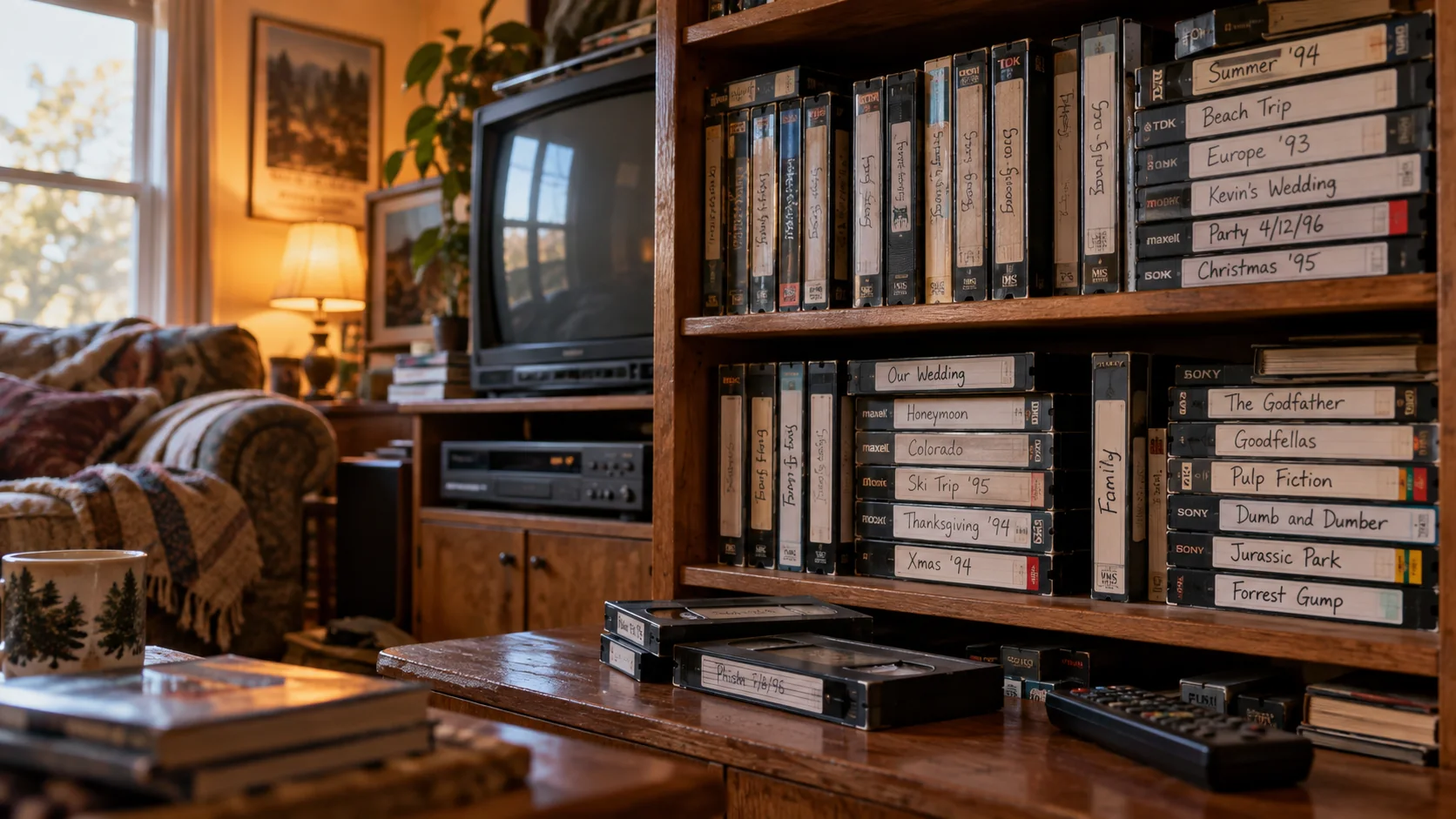
What was a homemade VHS TV library?
It was a personal collection of television built directly from broadcasts. People recorded favorite episodes, movies, concerts, cartoons, wrestling, music videos, holiday specials and one-off events onto reusable cassettes. The result was messy, incomplete and deeply personal—and today those tapes often preserve commercials, promos and local television that official releases never kept.
A Homemade VHS Library Was Television Curated by the Household
A streaming library is designed by somebody else. A VHS library was designed by you.
That is the biggest difference. The tapes stacked beside the television or lined up in a bedroom did not represent everything available. They represented the things somebody in that house had decided were worth keeping. Maybe it was every episode of a favorite sitcom that happened to rerun that summer. Maybe it was professional wrestling. Maybe it was Saturday Night Live sketches, MTV videos, holiday specials, late-night interviews or three made-for-TV movies separated by commercials for products that no longer exist.
The collection was shaped by access, memory and luck. You could only record what you received. You could only save what you remembered to tape. You could only keep as much as your blank-tape budget and shelf space allowed. That limitation made the collection more revealing than a complete digital archive. A homemade tape library was a map of what somebody cared about enough to capture.
The Supreme Court’s 1984 Betamax decision distinguished ordinary “time-shifting” from “library building” and noted that a substantial number of home recorder owners accumulated tapes for repeated viewing. By the 1990s, library building had become an ordinary domestic habit. It rarely looked like an archive. It looked like a crooked stack of Maxell, TDK, Scotch, Fuji and store-brand cassettes with increasingly desperate handwriting.
Handwritten Labels Were Our Search Interface
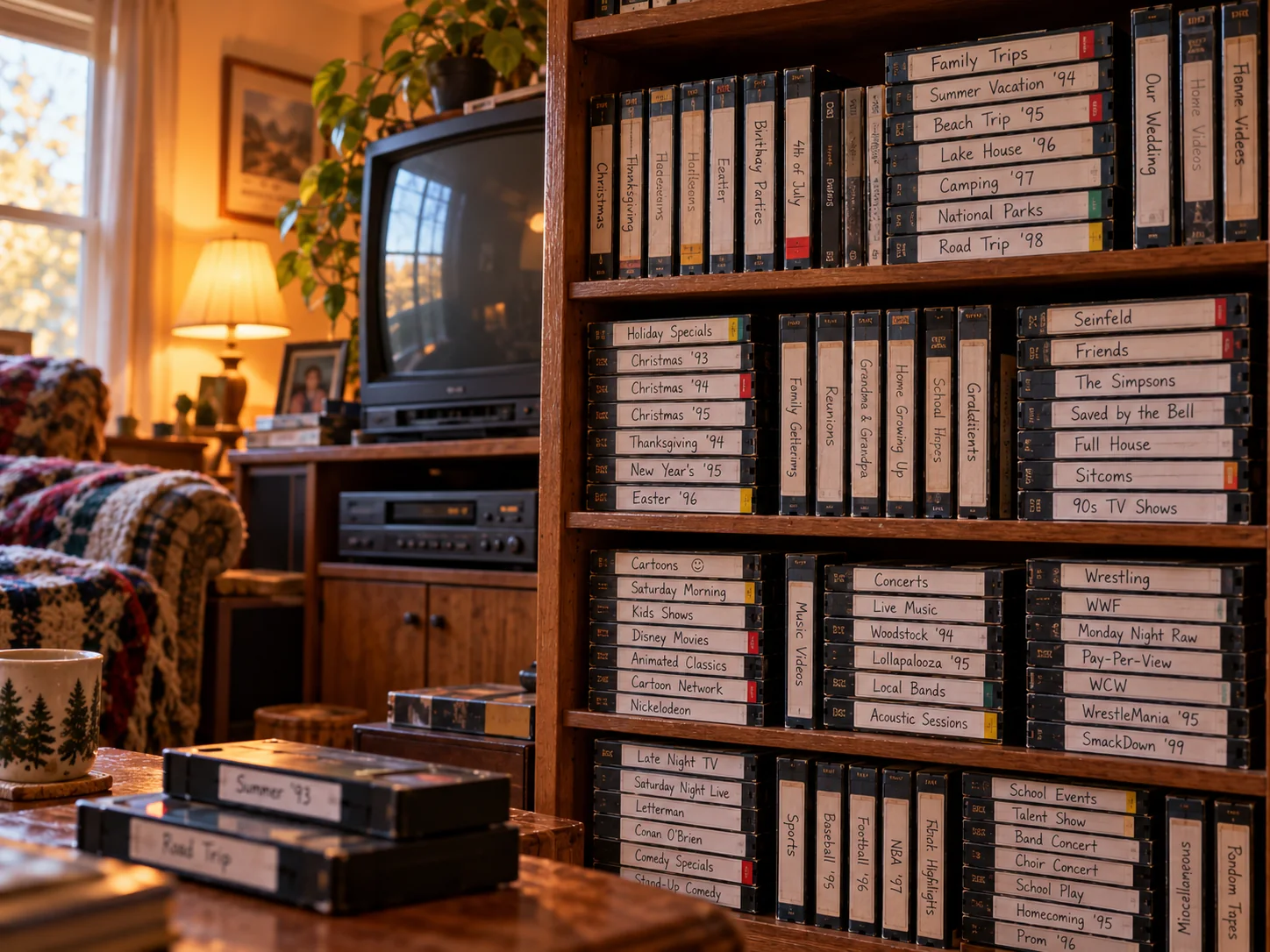
The label was the search engine.
A cassette could hold hours of material, and there was no universal way to know what was on it without playing it. That made handwriting infrastructure. Some people labeled only the spine: “Simpsons.” Others turned the cardboard sleeve into a miniature database with dates, episode names, recording speeds and arrows showing where one program ended and another began. The ambitious kept notebooks or index cards listing tape numbers and contents.
The system usually decayed over time. A neat “TAPE 4 — X-FILES” might become “X-FILES / SNL / MTV / DO NOT ERASE 2:13-2:47.” Old titles were crossed out but remained readable underneath. A cassette inherited three owners and five purposes. One side of the label had a movie title from 1991; the other had a wrestling pay-per-view from 1996. The physical object recorded its own history of reuse.
Some VCRs tried to automate indexing with electronic marks placed on the tape at the start of recordings. Those features could help you jump between segments, but they never replaced the handwritten label because labels survived different machines and told you what mattered. The family member with the best handwriting sometimes became the unofficial archivist.
From Sitcoms to Wrestling, the Collection Followed the Person
What people saved tells you what television meant before everything was permanently available.
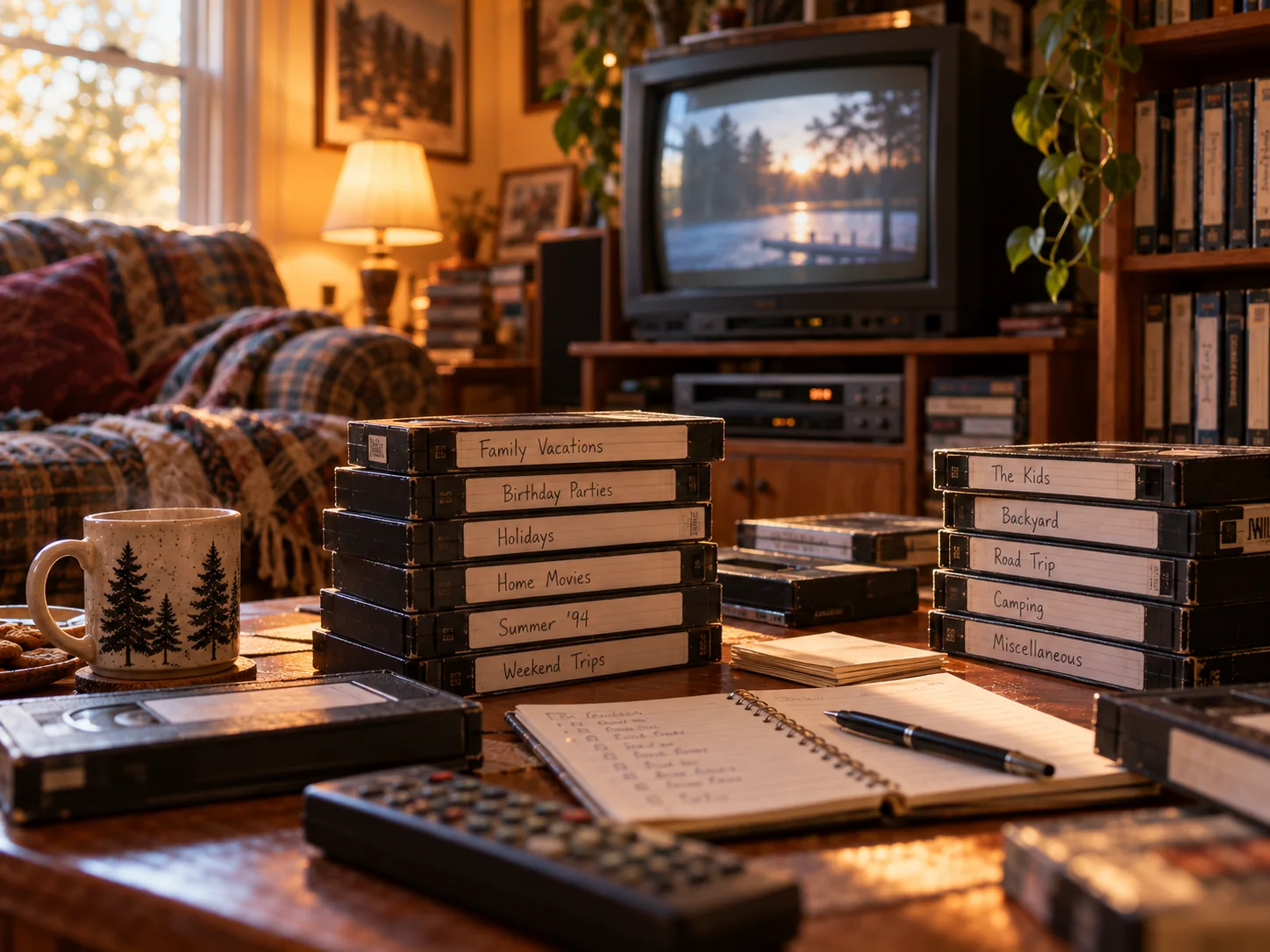
Scripted series were obvious candidates, especially shows with continuing stories. A fan might try to catch every episode of The X-Files, Buffy or a soap opera. Sitcom viewers often built “best of” tapes by recording favorite reruns whenever they appeared. Kids collected cartoons because weekday and Saturday-morning schedules turned old episodes into a rotating buffet. Sports fans kept championships, rivalry games, wrestling cards or the moment a favorite player did something they wanted to see again.
Music television created another kind of library. A person might record hours of MTV or VH1, then keep the tape because it contained a particular video, countdown, live performance or artist interview. Talk shows and late-night television were similar. An actor promoting a movie for seven minutes could become the reason an entire two-hour cassette was protected for years.
Holiday television was especially tape-friendly because the programs returned seasonally but not always predictably. Christmas specials, Halloween episodes, Thanksgiving marathons and New Year’s countdowns became reusable family media. A tape made in 1993 could come out every December like an ornament box.
Then there were the impossible categories: local commercials, school closings, weather coverage, station sign-offs, cable-access weirdness, movie-host segments, news reports, channel previews, telethons, infomercials and random fragments captured because the recorder started early or stopped late. Those scraps are often what make a rediscovered tape priceless.
Compilation Tapes Were Personal Television Before Algorithms
The compilation tape was the playlist before the playlist.
You could build one deliberately by recording a sequence of favorite things: music videos, comedy sketches, cartoon episodes, movie scenes, sports highlights or television appearances by one celebrity. More often, the compilation happened accidentally. A tape started as a movie, gained two sitcom episodes in the blank space at the end, got reused for an awards show and eventually became a strange three-year collage of whatever the household had cared about.
Music-video collections were especially personal. A teenager could spend weeks waiting for a particular video to come on, keeping a tape cued and ready. The result might contain beautiful clean starts, late button presses that missed the first ten seconds, VJ introductions, channel graphics and partial commercials. The flaws became part of the artifact.
Comedy fans did the same thing with sketch shows and late night. Before official box sets made it easy to own a season, a homemade “best of” tape could be the only practical way to replay favorite bits on demand. The tape was not complete and it was not authorized as a commercial collection. It was simply the household’s version of television memory.
This is where the difference between recording TV for later and building a library becomes clear. Time-shifting was about convenience. Compilation was about taste. The person with the remote became an editor.
Home Tapes Became Accidental Archives of Commercials and Promos
The most historically interesting part of an old VHS tape is often the material nobody meant to save.
A VCR recorded the broadcast stream. Unless the person operating it manually paused during every break, the tape captured commercials, network promos, local station IDs, weather crawls, news teases and the little continuity announcements between programs. At the time, those were interruptions. Today, they can be the most vivid evidence of when and where the tape was made.
A nationally syndicated sitcom can be found in dozens of places. A local furniture commercial from 1994 may exist nowhere else. A thirty-second promo announcing “Tonight after Friends” preserves the network’s schedule, voice, graphics and assumptions about its audience. A station break can show local branding that disappeared after a merger. Even the price in a grocery ad can anchor a recording to a specific month.
This accidental preservation is why collectors and media historians care about off-air recordings. Official home-video releases usually remove the surrounding broadcast context. The episode survives; the night disappears. A home-recorded cassette keeps the edges attached.
That makes a random tape a cultural layer cake. The show tells you what people watched. The ads tell you what companies wanted them to buy. The promos tell you what networks wanted them to watch next. The local break tells you where the television was sitting. None of that was the reason somebody pressed RECORD, but all of it came along for the ride.
Recording Over a Tape Was How the Library Evolved
The painful truth about a VHS library is that it was never stable because the tapes were always reusable.
Recording over something was both the strength and the danger of the format. A cassette that had served its purpose could become blank space again. That kept costs down and made the system practical. It also meant a collection was constantly being edited by necessity. Yesterday’s “must keep” could become next month’s “I guess we can tape over this.”
The little record-protection tab on the back of a VHS cassette was the closest thing the format had to a lock. Break it out and most VCRs would refuse to record on the tape. Put a piece of tape over the hole and the protection could be defeated. That tiny plastic tab carried surprising emotional weight. Removing it meant declaring that the contents had graduated from temporary recording to protected property.
Mistakes still happened. The wrong tape went into the machine. A label was misunderstood. The timer fired while a treasured cassette was loaded. Half of a movie disappeared under an episode of something else. Because new recordings replaced the old magnetic information, recovery was generally not part of the household plan. The loss was immediate and personal.
That impermanence made curation ruthless. A digital library can grow until storage becomes a number in a settings screen. A VHS library took up furniture. Every tape you kept was one more object to store, move and defend.
Tracking, Tape Speed and Generation Loss Were Part of the Library
VHS quality was a ladder, and every step could cost you something.
Record at SP and the picture used more tape per minute. Record at EP and you gained hours but lost clarity. Duplicate one cassette to another and you introduced generation loss: noise, softness and color instability accumulated because an analog copy was reproducing the imperfections of the source along with the program. Copy a copy again and the decline became easier to see.
Tracking was another part of the ritual. Different machines could record the control track slightly differently, and worn or misaligned equipment made old tapes roll, tear or fill with horizontal noise. The TRACKING buttons on the remote became a tiny emergency department. Adjust left. Adjust right. Stop when faces stopped bending.
None of this prevented people from sharing. A second-generation copy of a concert you had never seen was better than no concert. A fuzzy wrestling tape from a friend could be valuable because the event itself was unavailable. The scarcity of the material often mattered more than the fidelity.
That tradeoff is one reason today’s surviving tapes vary so dramatically. A carefully stored SP original can look surprisingly good. A sixth-generation EP copy recorded on a worn machine may look like television being transmitted through weather. Both are still part of the story.
Sharing Tapes Created Small Human Distribution Networks
A cassette could move television from one household to another.
That sounds trivial now, but it changed access. A friend who received a premium channel could tape a movie for somebody who did not. A relative in another city could mail a local broadcast. A fan could duplicate a rare television appearance. A teenager could bring a music-video tape to a friend’s house. The content traveled because the cassette traveled.
This was slow, physical and socially specific. You had to know somebody. The tape had to be handed over, borrowed, mailed or copied. There was no global search bar. That limitation created little networks of trust: “I’ll lend you this, but give it back.” Some cassettes accumulated histories of ownership in the handwriting on the labels.
Fans of niche programming benefited the most. Anime, wrestling, concerts, imported television and regional broadcasts often circulated in copied form because official availability was limited. Quality could deteriorate with each generation, but the cassette solved a bigger problem: access.
The social exchange also made the collection less private than it looked. Your tape shelf could contain programs recorded by three different people in two different states. A home library was sometimes a small community archive held together with cardboard sleeves and promises.
A Random Home Tape Can Be a Time Capsule of One City
Local television is where old VHS tapes become especially valuable.
National programs usually survived somewhere in corporate archives, syndication masters or commercial releases. Local TV was more vulnerable. Newscasts, weather coverage, commercials, station promotions, public-access shows, locally produced children’s programs and regional sports coverage could disappear when stations changed ownership, moved buildings or reused tape. A viewer recording something else might accidentally preserve the only copy still circulating publicly.
An ordinary tape can therefore contain two histories at once. The intended program might be a network sitcom available today in perfect quality. The commercial break might contain a defunct local restaurant, a dealership jingle, a mayoral ad, a station personality or a news promo that has never been uploaded anywhere. The “junk” becomes unique.
This is why old off-air recordings can feel more immersive than clean streaming episodes. Streaming gives you the text of the program. A VHS recording gives you the environment around it. The station bug, the signal noise, the announcer, the local spots and the abrupt cut to news all tell you where the television lived.
For a site built around lived Gen X memory, that surrounding context matters. The goal is not to pretend every old tape is a museum object. It is to recognize that some of the most ordinary household recordings now contain pieces of media history nobody planned to preserve.
Rediscovering an Old VHS Box Is Part Memory, Part Mystery
Finding a box of old VHS tapes now creates a weird archaeological problem: the labels are clues, not guarantees.
The tape marked “1995 Christmas” may contain forty minutes of Christmas morning, an hour of a network special and the first half of a movie recorded two years later. The cassette labeled “Simpsons” may open with a news bulletin because the recording started early. A tape with no label at all may turn out to be the one that contains the thing everybody in the family remembers.
The temptation is to fast-forward aggressively until something recognizable appears. That can be risky with aging tape and old hardware. A cassette that has sat untouched for twenty-five or thirty years may have physical problems invisible from the outside. The National Archives warns that magnetic tape can suffer distortion, binder problems, mold and other deterioration, and that playback itself can cause damage.
The safest approach is patience. Inspect the cassette. Look for mold or obvious damage. Use a known-good VCR rather than the machine that has been eating tapes in the garage. If the content is genuinely important or the cassette appears compromised, professional transfer may be smarter than experimentation.
The reward can be enormous. Old tapes do not only return programs. They return rooms. The picture quality, the commercials and the sound of a local announcer can trigger memory in a way a restored HD stream never will because the imperfection is part of how we actually saw it.
How to Preserve Old VHS Without Pretending the Tape Will Last Forever
Magnetic tape is not a forever medium, and institutions that preserve audiovisual material treat reformatting as a race against deterioration and obsolete playback equipment.
The National Archives recommends storing videotapes vertically in their cases, away from strong magnetic fields, excessive heat, humidity and water risk. It also notes that tapes can vary widely because manufacturers used different binders, substrates and magnetic formulations. The Council on Library and Information Resources published a full guide to magnetic tape storage and handling in 1995 because long-term stability was already a concern while VHS was still current technology.
For a personal collection, the practical lesson is straightforward: if a tape matters, do not assume the cassette itself is the preservation plan. Digitize it while you still have a working playback path. Create a high-quality master file and a smaller access copy for everyday viewing. Keep copies in more than one location. Preserve the original cassette if it has sentimental or evidentiary value, but do not make it carry the entire burden.
The National Archives also cautions against casual repair of broken magnetic tape and recommends trained specialists for damaged media. Moldy or sticky tapes are not a good weekend project. A cheap capture dongle can be useful for healthy family tapes; fragile material deserves more care.
Digitization changes the nature of the collection. A shelf becomes files and folders. Search improves. Sharing becomes easy. But the best transfers keep the whole recording—including the commercials, promos and dead air—because trimming too aggressively can erase the very context that makes an off-air tape historically interesting.
Why These Messy Tape Collections Still Matter
A homemade tape library is valuable precisely because it is incomplete.
Official archives aim for completeness and quality. Home collections reveal selection. They show what one person, family or friend group thought was worth capturing. They show what the television schedule offered at a particular moment and what the viewer wanted enough to interrupt ordinary life and press RECORD.
That personal filter is why a box of tapes can tell a better nostalgia story than a list of the decade’s highest-rated shows. The shelf might contain ER beside a local wrestling program, a movie-of-the-week, three hours of MTV, a Christmas parade and a tape labeled simply “COOL STUFF.” It is messy because memory is messy.
The 1990s TV hub tells the larger story of the decade. The ratings tell us what was biggest. Appointment TV explains why the schedule mattered. The VCR story explains how we fought that schedule. The tape library is the personal layer underneath all of them: what we decided to save after the broadcast moved on.
Streaming gives us abundance. Old VHS libraries give us evidence of desire. Somebody chose those programs. Somebody sacrificed tape space. Somebody wrote the label. Somebody put the cassette back on the shelf instead of recording over it. Decades later, that choice is the reason anything is still there.
The Economics of Empty Cassettes Shaped What We Kept
Blank tapes had their own consumer culture, and serious recorders developed opinions about them.
The aisle of blank VHS cassettes was a wall of promises: two-packs, three-packs, five-packs, standard grade, high grade, extra high grade, recognizable brands and cheaper store labels. Packaging emphasized recording time, picture quality and durability. For a household that reused tapes casually, almost anything might do. For someone building a collection, tape choice could become part of the ritual.
The economics shaped what survived. Blank media cost real money, so a permanent recording had to justify taking a cassette out of circulation. A teenager with three tapes might reuse them constantly. An adult sports fan with a cabinet full of blanks could keep entire seasons of games. A family that bought cassettes in bulk could become an accidental archivist simply because it had enough physical capacity not to erase everything.
Tape length mattered too. T-120 became a familiar designation because it fit the standard two-hour movie-and-prime-time world well, but longer cassettes existed and extended-play modes stretched them further. More runtime encouraged compilation behavior: why use a fresh tape for one half-hour episode when five more hours were available? That logic is why so many home recordings contain unrelated programs layered in chronological order.
The box, label and brand can also help date a rediscovered collection. Packaging changed. Retail stickers changed. Handwriting changed. The cassette itself became part of the evidence. A home library is not only the magnetic recording; it is the object history around it.
Wrestling, Music, Anime and Niche TV Turned VHS Into a Fan Economy
Genre fandoms pushed VHS collecting far beyond ordinary sitcom reruns.
Wrestling fans traded events, regional television and pay-per-view recordings. Music fans collected videos, concerts and late-night performances. Anime fans built tape-trading networks long before legal streaming made entire catalogs easy to sample. Horror fans kept television broadcasts of movies with local host segments. Sports collectors saved not only championships but pregame shows, postgame coverage and local news reactions. Soap viewers accumulated story arcs because a missed day could matter.
These communities developed their own standards and shorthand. A tape might be identified by generation, source, broadcast date or whether commercials were intact. Fans learned that “master” meant the recording closest to the original broadcast and that every analog copy away from the master could look worse. Lists circulated by mail, bulletin boards and early online communities. The cassette became a social object inside fandom.
This is where home recording starts to resemble grassroots preservation. Nobody had a mandate to save a regional wrestling show, a local horror host or a one-time music interview. Fans did it because they wanted to watch it again. Years later, those motives can leave behind the only circulating copies of material that broadcasters themselves did not prioritize.
That does not mean every fan tape can be freely redistributed; copyright still exists. The historical point is different: cultural memory often survives because somebody with no archival title decided the thing was worth a blank cassette.
The emotional value could be enormous. A fuzzy fourth-generation copy of something unavailable anywhere else had more practical worth to a fan than a pristine tape of a movie already sold in every store. Scarcity reordered the quality hierarchy.
A Thoughtful Digitization Keeps More Than the Main Program
Digitizing a tape is not the same thing as preserving its meaning.
The easiest transfer workflow is to start at the first recognizable program and stop at the final credits. That creates a convenient viewing file, but it can erase context. If the tape is an off-air recording, the minutes before and after the show may contain the date clues, station IDs, local news promos and commercials that make the cassette historically specific. A preservation-minded transfer should capture the whole signal when practical.
File organization matters too. “Tape1.mp4” is the digital equivalent of an unlabeled cassette. A useful archive records what the physical label said, what the tape actually contains, the approximate dates, the source station or channel when known and any technical problems. Photographing the cassette and sleeve before transfer preserves handwriting and packaging that will disappear if the physical object is later discarded.
A good personal workflow separates a high-quality master from everyday copies. The master should preserve as much of the captured signal as reasonably possible. Smaller MP4 access files can be easier to browse, share with family and post privately. Keeping more than one copy in different places protects against a failed hard drive turning digitization into a new single point of failure.
The National Archives makes the same conceptual distinction at institutional scale: a preservation copy is meant to retain the record for the long term, while an access copy is optimized for convenient playback. You do not need an archive budget to borrow that principle. Save one good master. Make easy copies from it. Do not keep recapturing the aging tape every time somebody wants to watch.
Most important, document uncertainty instead of inventing certainty. If the label says “Summer 94?” keep the question mark. If a station cannot be identified, do not guess. A trustworthy personal archive can admit what it does not know.
Movies Taped Off TV Became Household Editions of Their Own
Recorded movies created their own strange category inside home tape libraries because they were halfway between broadcast television and commercial home video.
A movie taped from a network was not the same thing as the rental-store version. It might be edited for language, reframed for television, shortened for time, interrupted by commercials and surrounded by network promos. Premium cable recordings could be cleaner but still carry channel IDs or lead-in material. Local-station movies could include host segments, weather interruptions or odd late-night ad breaks. The title was familiar; the version was specific to that broadcast.
Those differences mattered to memory. Plenty of people first encountered favorite films not from a store-bought cassette but from a recording somebody had made off television. The movie might begin thirty seconds late because the timer started after the opening logo. A commercial break might arrive in the middle of a scene. The final credits might be squeezed while a station announcer promoted the news. That compromised version could become the version a family watched for years.
Movie tapes also encouraged aggressive reuse. A two-hour feature fit neatly on a standard cassette, which made it easy to label and protect. But if the film turned out not to be a keeper, the tape could be recycled for television later. That is why old collections sometimes contain sleeves labeled with a famous movie while the cassette itself now holds three sitcoms and a football game.
The broadcast copy therefore sits at the intersection of official media and home archive. The movie came from a studio, but the object on the shelf was created by a viewer. Its commercials, edits, station voice and recording mistakes belong to the particular night it was captured.
Labels, Sleeves and Wear Were Part of the Archive Too
The physical appearance of a tape collection told a story before the VCR even turned on.
Some shelves were immaculate: matching sleeves, numbered spines, typed labels and a handwritten index. Others looked like controlled collapse. Cassettes leaned sideways. Cardboard sleeves had softened at the corners. Rental-store stickers had been repurposed. Labels overlapped. Pencil, ballpoint pen and marker from different years mapped the history of who had recorded what.
That visual mess matters because digital migration tends to flatten it. Once every tape becomes a neat filename, the collection can lose evidence about how it was used. A child’s handwriting, a parent’s warning, a date added later, a star drawn next to a favorite episode—none of that appears in the video signal, yet all of it belongs to the object’s history.
For family archives, photographing each cassette and sleeve before digitization is an easy way to preserve that layer. The images can be stored beside the video file and any notes about the contents. It takes minutes and protects information that may be impossible to reconstruct later.
The point is not to fetishize clutter. It is to recognize that analog collections carried metadata physically. Wear, handwriting and packaging were part of the interface. A clean digital file is more usable, but the battered sleeve may be the thing that tells you who cared enough to keep the recording in the first place.
Homemade VHS TV Collections FAQ
What is a VHS TV library?
A VHS TV library is a personal collection of television recorded from broadcasts onto videocassettes for repeated viewing. It can include complete programs, compilations, commercials, station promos and accidental fragments.
Did people really keep whole collections of recorded TV shows?
Yes. The Supreme Court’s Betamax decision discussed “library building” as a distinct use of home video recorders, and many households built collections of favorite programs, events and movies.
Why are handwritten VHS labels so messy?
Because tapes were reusable. A cassette could hold several unrelated recordings over its life, so titles were crossed out, added, abbreviated or moved to the sleeve as the contents changed.
Why are old commercials on VHS tapes interesting now?
Commercials, station IDs and promos can be harder to find than the programs they surrounded. They preserve local businesses, graphics, prices, network schedules and cultural details that official releases usually removed.
What is generation loss?
Analog copying reproduces the imperfections of the source and adds new noise. A second-generation VHS copy generally looks worse than the original recording, and repeated duplication compounds the decline.
Should I throw away old VHS tapes after digitizing them?
Not automatically. If the physical tape has sentimental, historical or evidentiary value, keeping the original can make sense. But the content should not depend on a single aging cassette.
How should VHS tapes be stored?
The National Archives recommends storing magnetic tapes vertically in their cases, away from strong magnetic fields, excessive heat, humidity and water risk.
Can I digitize VHS tapes myself?
Healthy personal tapes can often be captured with a reliable VCR and video-capture device. Damaged, moldy, sticky or irreplaceable tapes are better handled by a preservation or transfer specialist.
Why do some old VHS recordings have terrible tracking?
Playback alignment, tape wear, recording speed and the condition of the original machine all matter. Tapes recorded at slower speeds can be less forgiving, and different VCRs may track the same cassette differently.
What kinds of TV were most often saved?
There was no universal answer. Common categories included movies, sitcoms, cartoons, sports, wrestling, soaps, music videos, concerts, awards, holiday specials and late-night appearances.
How is this different from recording TV in the 90s?
Recording TV is the act of time-shifting a program for later. A VHS library is what happened when viewers decided certain recordings were worth keeping long-term.
Why are home-recorded tapes historically useful?
They often preserve broadcast context—local commercials, promos, station branding and news fragments—that was stripped away from official copies of the main program.
Sources & Further Reading
- Legal Information Institute — Sony Corp. of America v. Universal City Studios (time-shifting and library building)
- Smithsonian National Museum of American History — Video Cassette Recorder
- National Archives — Machine-Readable Media: care and reformatting of magnetic tape
- National Archives — Video Guidance: Storage of Materials
- National Archives — Video Condition Assessment and longevity
- National Archives — Playback and Digitization of Video Materials
- Council on Library and Information Resources — Magnetic Tape Storage and Handling (1995)
- Library of Congress — Reformatting and digitizing personal collections
Next tape: Read how we actually recorded television in the 90s, then revisit why whole network nights felt like events.