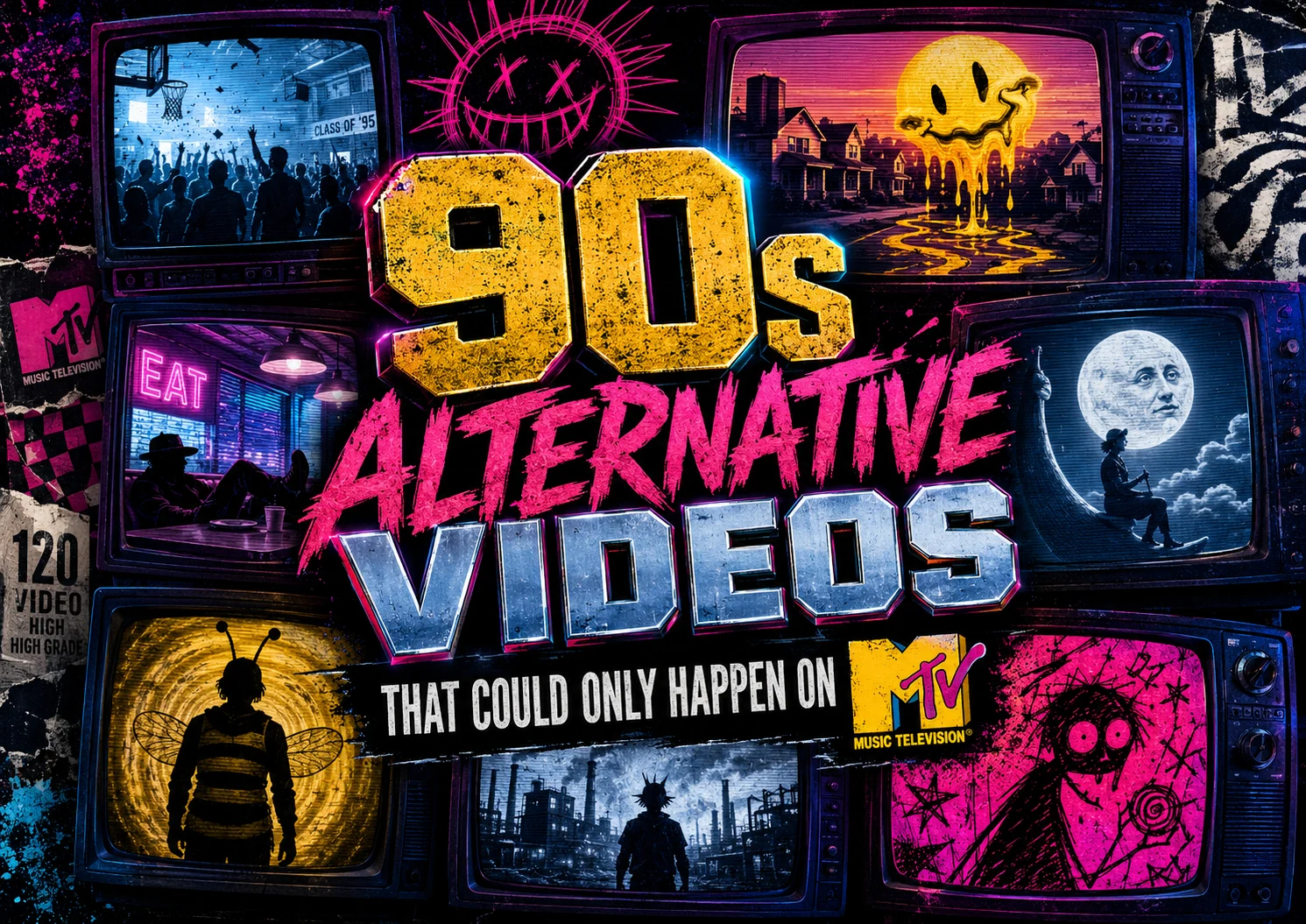
20 90s Alternative Videos That Could Only Have Happened on MTV
The best 90s alternative videos did not merely promote songs. They created entire visual worlds: a corrupted school pep rally, melting suburbia, a silent-film moon voyage, thrift-store surrealism, cartoon dread, industrial nightmare fuel and enough strange imagery to permanently occupy the part of the Gen X brain that was supposed to remember algebra.
These 20 videos show how MTV made Nirvana, Soundgarden, Pearl Jam, Smashing Pumpkins, Beck, Weezer, Radiohead, No Doubt, Garbage, Nine Inch Nails and the wider 90s alternative and grunge era feel cinematic, communal and impossible to forget.
MTV made songs visible.
Radio gave alternative rock a signal. MTV gave it a school gym, a melting neighborhood, a Bee Girl, giant hands, a retro diner, scratched film stock and a thousand images that came rushing back the second the opening riff started.
What Are the Most Iconic 90s Alternative Videos on MTV?
The five essential starting points are Nirvana’s “Smells Like Teen Spirit,” Soundgarden’s “Black Hole Sun,” Pearl Jam’s “Jeremy,” Smashing Pumpkins’ “Tonight, Tonight” and Beck’s “Loser.” Together, they capture MTV alternative at its most explosive, surreal, serious, cinematic and gloriously strange.
The complete 20 also includes Weezer, Radiohead, No Doubt, Garbage, Blind Melon, Foo Fighters, Nine Inch Nails, R.E.M., Green Day, Björk, Alice in Chains, The Breeders, Hole, The Cranberries and Alanis Morissette. The 90s alternative music guide connects these videos to the bands, albums, songs, scenes and MTV programs around them.
Why 90s Alternative Videos Hit Differently
Before every song had a vertical clip, a lyric video, a short-form edit and a dozen reaction thumbnails, MTV made music videos feel like events. You waited for them. You taped them. You saw them in countdowns. You caught them late at night when the weird stuff came out. A video could completely change how you understood a song.
That was especially true during the MTV and alternative rock takeover. Alternative bands were not always natural pop stars. Some looked uncomfortable. Some looked angry. Some looked like they had been awake since 1991. The videos helped turn that discomfort into style.
MTV also gave 90s alternative a visual vocabulary. Grunge could look like a corrupted pep rally, a haunted room or a suburban apocalypse. Slacker alternative could look like thrift-store surrealism or retro-TV comedy. Industrial rock could look like a forbidden museum film. Alt-pop could look bright, sharp and sarcastic. Suddenly, 90s music was not just divided by sound. It was divided by atmosphere.
This is also why the video era connects so strongly to 90s movie soundtracks that made alternative rock feel bigger. Videos and soundtracks both turned songs into scenes. MTV gave you the clip. Movies gave you the moment. CD stores gave you the object. The whole decade was basically one giant cross-platform identity crisis with better guitars.
20 Essential 90s Alternative Videos at a Glance
The fast rewind for anyone who wants the countdown before the full video essays, Gen X memories and cable-static emotional damage.
20 90s Alternative Videos That Could Only Have Happened on MTV
These are not just “good videos.” They are 90s visual fingerprints. They explain the decade’s mix of grunge gloom, slacker irony, surreal comedy, industrial dread, alt-pop color, punk anxiety, feminist rage and late-night cable weirdness better than any neat little definition ever could.
Nirvana — Smells Like Teen Spirit
The pep rally from another planet.
If 90s alternative had a visual detonation point, this was it. “Smells Like Teen Spirit” did not look like a normal rock video. It looked like someone broke into a high school gym after the adults had given up, turned the lighting into a headache, hired cheerleaders from a bad dream and let the entire room rot into a mosh pit.
That was the genius of it. The video took something familiar — school spirit, bleachers, pep rallies, teenage boredom, the forced happiness of institutional life — and made it feel sick. It turned a clean American ritual into something sweaty, sarcastic and combustible. The gym did not look like a place where school pride lived. It looked like a place where it went to get shoved into a locker.
The song already changed everything, but the video gave the change a face. It helped explain how Nirvana changed 90s music without needing a lecture. The band did not look like rock stars trying to sell an image. They looked like people who had accidentally wandered into the wrong cultural moment and decided to short-circuit it.
MTV made the explosion repeatable. You could see it after school, late at night, on countdowns, in fragments while changing channels, or blasting in a friend’s living room while someone’s parents wondered what had happened to music. Every replay made the gym feel more mythic, turning one clip into a shortcut for the whole 90s alternative and grunge mood. The song became the anthem, but the video became the evidence.
For Gen X kids watching while pretending homework was a rumor, this clip felt like permission. You did not have to smile. You did not have to look polished. You could be bored, tired, sarcastic, loud and allergic to fake enthusiasm. Apparently, that was television now.
Soundgarden — Black Hole Sun
Suburbia melted into nightmare fuel.
“Black Hole Sun” is one of those videos that feels permanently lodged in the part of the brain responsible for weird weather, fake smiles and childhood television trauma. It took bright suburban imagery — lawns, families, barbecues, sunlit streets, polite faces — and stretched it until everything became grotesque.
The genius was that it was not simply dark. It was cheerful in the most alarming possible way. The sky looked wrong. The smiles looked wrong. The perfect little neighborhood looked like it had been built on top of a cosmic sinkhole. The video understood that the scariest version of suburbia is the one where everyone keeps acting like nothing is happening.
That fit the song beautifully. Soundgarden were never just heavy. They were strange, psychedelic, crooked and huge. This video made that visible in a way a straightforward performance clip never could. It belongs right beside any conversation about Soundgarden’s heavy, weird side of grunge, because it made grunge look less like rain-soaked realism and more like a sunlit hallucination.
MTV loved a clip you had to watch more than once, and “Black Hole Sun” was built for repeat viewing. You watched it for the song. Then you watched it again because you needed to know what you just saw. Then you watched it again because the exaggerated smiles and melting sky had apparently moved into your nervous system.
It also showed that alternative videos could look expensive without looking safe. The effects, colors and faces were polished enough to be unforgettable, but the overall feeling was deeply wrong. That was a very 90s music sweet spot: major-label budget, nightmare energy.
Pearl Jam — Jeremy
The video MTV could not stop playing and nobody could forget.
“Jeremy” was not surreal in the cartoon-nightmare sense. It was disturbing because it felt close. Classroom walls, social isolation, angry drawings, kids watching, adults missing the point — the video turned the song’s story into something stark and unavoidable.
A lot of early-90s alternative visuals were built around release: the explosion, the performance, the catharsis. “Jeremy” did the opposite. It trapped you in the pressure before the release. It made the room feel airless. It gave you symbols, faces, chalkboards, stillness and flashes of violence without letting the song become a simple spectacle.
Pearl Jam famously became wary of the music-video machine, and you can understand why. MTV could turn pain into rotation. It could take a serious, complicated song and place it between ads, bumpers and VJ banter. That friction is part of what makes the video such a 90s artifact: sincerity and mass media locked in an uncomfortable handshake.
But the impact is undeniable inside the larger 90s alternative story. “Jeremy” showed that alternative rock visuals did not have to be fun, glamorous or ironic. They could be heavy. They could ask you to sit with something. They could make the living room feel too quiet for a few minutes.
For viewers raised on after-school television, this clip landed differently. It did not feel like escape. It felt like the thing happening down the hall while everyone pretended the hallway was normal.
Smashing Pumpkins — Tonight, Tonight
A silent-film fever dream with arena-sized feelings.
By the mid-90s, alternative videos were not just gritty warehouse clips anymore. “Tonight, Tonight” proved they could be ornate, theatrical and weirdly old-fashioned while still feeling completely modern. The video borrowed from silent-film fantasy and turned the song into a grand little dream machine.
The Smashing Pumpkins always had a dramatic streak large enough to require permits, and this video leaned all the way in. Moon travel, vintage effects, painted skies, strange creatures, theatrical costumes — it looked like a lost film reel from another universe, which was exactly the kind of thing MTV could make feel normal between commercials.
What made it work was the contrast. Alternative rock had spent years making messiness feel authentic. Here was a video saying beauty, artifice and huge emotions could be authentic too. It did not need to be small to be sincere. It did not need to pretend it had no budget to keep its credibility.
That mattered because the Pumpkins occupied a strange space in 90s music: too grand for slacker minimalism, too wounded for pure arena rock, too arty to be ordinary, too melodic to stay underground. “Tonight, Tonight” gave all of that a visual language. It made ambition look like another form of weirdness.
This is the kind of clip that could only thrive in a music-video culture where visuals mattered as events. You did not just hear “Tonight, Tonight.” You remembered the moon, the costumes, the theatrical sweep, and the sense that someone had spent actual money making your teenage feelings look like antique science fiction.
Beck — Loser
Slacker surrealism with a leaf blower and no explanation.
“Loser” looked like someone dumped thrift-store America, cable-access nonsense, desert weirdness and deadpan Gen X irony into a blender, then refused to clean it. It was confusing, funny, shabby and weirdly magnetic — which is basically a complete Beck mission statement.
The video did not try to make “Loser” look cool in the traditional sense. It made not-trying look like its own form of cool. Random objects, oddball images, low-budget textures, a little hip-hop rhythm, a little folk-rock shrug, a lot of sideways humor. It felt like MTV had briefly been taken over by a guy who found culture in a garage-sale box.
That visual language matters because Beck helped define the slacker wing of 90s alternative. The same crooked charm that powers Weezer, Beck and the rise of slacker alternative is right there in the video: self-aware, detached, playful and allergic to rock-star seriousness.
You did not need to understand every image. That was the point. “Loser” was not a puzzle with an answer. It was a vibe with a leaf blower. It made sense because the decade itself made very little sense — analog and digital, irony and sincerity, thrift-store cool and major-label money all crashing into each other.
MTV was the only place that could make this kind of visual nonsense feel mainstream. Radio gave the song the hook. The video gave it the attitude: bored, funny, broken, cheap, strange and smarter than it looked.
Weezer — Buddy Holly
Happy Days, nerd rock and the Windows 95 bonus-disc miracle.
“Buddy Holly” is one of the most perfect 90s alternative video concepts because it should not have worked. Take a nerdy power-pop song. Insert the band into Happy Days. Make the whole thing look like lost television history. Somehow, instead of collapsing under its own gimmick, it became iconic.
The video understood Weezer’s slacker-alternative appeal immediately: awkward, melodic, self-conscious, catchy and funny without looking like it was trying too hard to be funny. It gave the band a visual world where outsider energy could be charming instead of tortured.
That was important because 90s alternative had a lot of pain, anger and darkness. Weezer offered a different kind of alienation — nerdy, melodic, embarrassed, sincere but hiding behind a joke. The “Buddy Holly” video made that easier to understand in three minutes than any profile ever could.
Then came the extra 90s twist: the video ended up bundled with Windows 95, meaning an entire generation discovered or rediscovered it through a computer demo folder. That is peak transitional-decade nonsense — MTV culture crossing into home computers while nobody had any idea what the future was about to do.
As an MTV artifact, “Buddy Holly” made alternative feel playful. It did not brood. It did not scream. It did not stare into the abyss. It put the band in a retro diner and made geeky sincerity look like a power move.
Radiohead — Paranoid Android
Cartoon dread for kids who knew things were getting worse.
“Paranoid Android” did not look like a band video. It looked like a damaged cartoon broadcast from a world where everyone was either numb, grotesque, doomed or somehow worse. Which, for Radiohead in the late 90s, was basically brand alignment.
The video’s animated style made the song’s paranoia feel less literal and more universal. Instead of showing the band performing in a warehouse, it created a visual nightmare of alienation, cruelty, absurdity and modern rot. Fun stuff. Great for after school.
Radiohead arrived near the end of the decade as alternative rock began mutating away from flannel, hooks and easy catharsis. Their videos helped make that shift visible. Alternative was no longer just rejecting glam-metal polish or mainstream pop cheer. It was staring at technology, capitalism, anxiety and emotional collapse like it had found new homework.
The video also proved MTV could still create space for something deeply strange in the middle of mainstream rotation. A long, animated, art-damaged clip could sit in the same universe as countdown shows and celebrity interviews. That contradiction is exactly why the era remains fascinating.
“Paranoid Android” did not ask you to like it in a simple way. It asked you to enter its diseased little cartoon world and accept that the future was probably going to be exhausting. Extremely rude. Also accurate.
No Doubt — Just a Girl
Bright colors, sharp hooks and a grin with teeth.
“Just a Girl” looked brighter and cleaner than a lot of the decade’s grunge-adjacent videos, but do not confuse brightness with softness. The video used color, performance energy and Gwen Stefani’s charisma to make a very pointed song feel instantly accessible.
That was No Doubt’s gift in the 90s. They could bring ska, punk, pop and new-wave bounce into the alternative lane without making it feel like a committee decision. The video felt playful, but the message had bite. It made gender frustration catchy enough for MTV rotation and direct enough that nobody could pretend it was just decoration.
This mattered because alternative videos were not all gray walls and tormented men in sweaters. MTV also made room for bright, kinetic clips that widened what alternative could look like. No Doubt helped push the format toward color, movement and personality without losing edge.
The clip also showed how powerful a front-person could be in the video era. Stefani’s performance gave the song its visual center: expressive, sarcastic, annoyed, playful and impossible to ignore. The band looked like a blast, but the whole thing had a spine.
For viewers, the video was immediate. It had the hook, the look, the performance and the attitude. It turned a song about being underestimated into a visual shrug that basically said, “Cute. Anyway, watch this.”
Garbage — Stupid Girl
Cool detachment with film scratches and dangerous eyeliner.
Garbage videos understood texture. “Stupid Girl” looked sleek and damaged at the same time: grain, scratches, red tones, industrial glamour, Shirley Manson staring through the camera like she had already read your flaws and found them repetitive.
The clip gave the band’s sound a perfect visual match. Garbage lived in that 90s space between guitars, samples, alt-rock hooks, electronic polish and cynical glamour. The video made that mixture look modern without making it feel sterile.
What stands out now is how strongly it captured the decade’s fascination with damaged cool. Everything looked stylish, but not clean. Sexy, but not glossy. Detached, but not empty. That was a very specific 90s mood, and Garbage wore it better than almost anyone.
MTV helped turn that mood into iconography. You did not just hear Shirley Manson’s voice. You saw the stare, the red haze, the static, the edited fragments. The whole thing felt like a fashion magazine left too close to a blown speaker.
In a decade full of flannel authenticity and slacker anti-style, Garbage offered something more metallic: smart, controlled, bruised and dangerous. “Stupid Girl” made that attitude visible in every scratched frame.
Blind Melon — No Rain
The Bee Girl turned loneliness into MTV shorthand.
The “No Rain” video is proof that 90s alternative could be sweet, sad and weird without trying to crush your skull. The Bee Girl became one of the decade’s most recognizable video images because she was funny at first glance and heartbreaking about two seconds later.
The clip worked because it understood outsider loneliness in a simple, visual way. A kid in a bee costume wants to dance. People laugh. She keeps looking. Eventually, she finds others like her. That is not complicated, which is exactly why it landed.
Alternative culture often sold alienation through darkness, distortion and bad weather. “No Rain” used sunshine, tap dancing and a homemade costume. Somehow that made the loneliness feel even more exposed. The song was warm. The video was odd. The emotional hit was real.
MTV made the Bee Girl unavoidable, but not in a bad way. She became shorthand for every kid who felt out of step and secretly hoped there was another weird little parade happening somewhere.
That is what made the video so durable. It was not trying to look cool. It was trying to be understood. In the middle of a decade full of sarcasm, irony and distortion, that kind of open-hearted weirdness stood out.
Foo Fighters — Everlong
A dream inside a dream with giant hands and actual heart.
“Everlong” is one of the rare 90s videos that manages to be funny, strange and genuinely emotional without breaking the spell. The dream logic, oversized hands, bedroom weirdness, horror-comedy touches and Michel Gondry-style imagination all serve the same purpose: making the song feel like memory, not just performance.
Foo Fighters could have made a straightforward rock video and been fine. Instead, “Everlong” became something more durable. It captured the odd, half-asleep emotional quality of the song — romantic, anxious, surreal, sincere and slightly ridiculous.
That mix is very MTV. The channel rewarded videos that gave you images you could not shake. Giant hands should not make sense in a love song. Here, they do. That is the whole point. 90s videos often worked because they trusted weird ideas more than literal ones.
The video also showed how post-grunge alternative could build its own visual identity without just repeating the early-90s template. It was not Seattle gloom. It was dream comedy with a heart beating underneath it.
The result is one of the decade’s best examples of alternative rock becoming cinematic through dream imagery. Not darker. Not heavier. Just stranger and more emotionally specific.
Nine Inch Nails — Closer
Industrial dread, museum rot and a whole lot of parental concern.
Nine Inch Nails videos were not designed to make parents comfortable inside the broader 90s alternative universe, and “Closer” may be the ultimate example. It looked like an antique medical nightmare, a decayed museum exhibit and an industrial confession booth all at once.
The video’s power was not just shock. It was design. The textures, old film stock, disturbing objects, mechanical imagery and religious unease made the song feel like it had been found in a locked drawer. It was provocative, but it was also meticulously constructed.
On MTV, that mattered. The censored version still felt dangerous because the atmosphere did half the work. You did not need every image explained. In fact, explanation would have ruined it. The video worked because it felt forbidden, artful and diseased in exactly the right proportions.
This was the industrial side of 90s alternative becoming visual culture. It showed that rock videos could look like experimental film, nightmare collage and major-label promotion all at once. What a decade.
It also proved that MTV could make something feel infamous even when the edges were trimmed for television. The missing pieces became part of the mythology. Everyone knew there was a version they were not seeing. That made the version they were seeing feel even more dangerous.
R.E.M. — Losing My Religion
Southern gothic, art-school melancholy and mandolin anxiety.
“Losing My Religion” arrived before the full grunge explosion, but its video helped set the table for alternative’s mainstream breakthrough. It was moody, symbolic, painterly and strange in a way that made college-rock seriousness feel ready for prime time.
The video did not chase rock excitement. It used religious imagery, stillness, color, shadow and Michael Stipe’s magnetic awkwardness to create a mood that felt both intimate and theatrical. It looked important without looking like it was begging to be important.
That was huge for MTV. It showed that an alternative-adjacent song could be subtle, arty and massive. Not everything needed pyrotechnics, dancers or leather pants. Sometimes a room, a stare and a mandolin could apparently conquer the world.
The clip also arrived at a moment when the definition of mainstream was starting to crack across 90s music. R.E.M. had come from the college-rock world, but the video helped make that world feel accessible to people who had never read a zine, haunted a campus record store or pretended to understand all the references.
The video belongs in this list because it helped prove there was an audience for visually ambitious, emotionally complicated music outside the usual rock-star template. The 90s ran with that idea until things got wonderfully weird.
Green Day — Basket Case
Punk-pop anxiety in a very colorful institution.
“Basket Case” looked like anxiety after someone colorized it with expired candy. The video’s exaggerated asylum setting, tilted energy and bright palette turned punk-pop nervousness into something instantly readable and endlessly replayable.
Green Day’s genius in the 90s was making panic sound catchy. The video helped by refusing to make anxiety look subtle. Everything felt heightened, silly, unstable and loud. It matched the song’s jittery energy without turning it into a lecture or a generic performance clip.
This mattered because MTV was the perfect machine for punk-pop crossover. The channel could take a short, sharp, bratty song and give it an image strong enough to stick after one viewing. “Basket Case” did exactly that.
It also widened alternative’s visual range. Here was a video that was funny, fast, anxious and cartoonish without losing the song’s edge. It helped bring punk energy into suburban living rooms at a speed parents definitely did not authorize.
Most importantly, it made nervousness feel communal. The song was about a spiral, but the video turned that spiral into a shared joke, a shared jolt and a shared mess. Very 90s. Very helpful. Also maybe not.
Björk — Human Behaviour
Fairy-tale weirdness before weirdness needed a permission slip.
Björk was not 90s alternative rock in the narrow guitar-band sense, but MTV’s alternative universe had room for her because the channel still rewarded strange imagination. “Human Behaviour” looked like a fairy tale built by someone who had no interest in making the forest safe.
The video mixed bears, toy-like scale, handmade surrealism and dream logic into something that felt completely separate from rock-video cliché. It was odd, playful, eerie and unmistakably Björk. You could not confuse it with anything else on the channel.
That is why it belongs here. 90s alternative video culture was not only about guitars. It was about the permission to be visually strange. MTV made room for artists who treated music videos like little art films, dream boxes or cultural pranks.
This clip helped broaden what alternative could mean visually. It proved that weird did not have to be aggressive. It could be delicate, funny, uncanny and still totally unforgettable.
In the middle of a decade that often wore cynicism like armor, Björk’s videos felt like they came from a different emotional weather system. MTV let that weather system drift right into the living room.
Alice in Chains — Man in the Box
Grunge before the whole country knew what to call it.
“Man in the Box” looked darker, heavier and more claustrophobic than the polished rock clips that had dominated the late 80s. It did not feel like a party. It felt like a warning from a room with bad ventilation.
The video’s imagery — shadowy performance, unsettling religious and rural fragments, heavy mood, Layne Staley’s stare — gave Alice in Chains a visual identity before grunge had fully become a national category. This was not glam. It was not shiny. It was not trying to charm you. It sounded and looked like something crawling out from under the floorboards.
MTV’s role mattered because this was the kind of heavy alternative that could have stayed niche without visual rotation. Once the video got in front of people, it made the band’s darkness easier to recognize and harder to ignore.
The clip also showed that grunge was never just one sound. Nirvana had explosive sarcasm. Pearl Jam had earnest intensity. Soundgarden had psychedelic heaviness. Alice in Chains had dread. “Man in the Box” made that dread visible.
It is one of the videos that reminds you how strange it was that this music became mainstream at all. There is nothing soft-sell about it. It just showed up, heavy and haunted, and MTV let it in.
The Breeders — Cannonball
Low-budget cool with one of the decade’s greatest opening basslines.
“Cannonball” is the kind of video that proves 90s cool did not always need a giant concept. Sometimes it needed a room, a band, a few odd visual tricks, a bowling-ball-ish object, and the confidence to let the song’s sideways energy do most of the work.
The video feels loose in the best way. It is playful without being cute, strange without being precious, and casual without feeling lazy. That matched The Breeders perfectly: melodic, noisy, off-center and completely uninterested in behaving like a conventional rock band.
MTV made room for clips like this because the alternative boom briefly expanded what mainstream viewers would accept. A video could look like art-school rehearsal footage crossed with a private joke and still become part of regular rotation. That window did not stay open forever, but while it was open, a lot of great weirdness got through.
“Cannonball” also mattered because it gave women in alternative rock another kind of visual presence. Not glossy pop-star perfection. Not one-note anger. Just a cool, weird, funny band making a song that sounded like it had rolled in from a better basement.
The clip still feels alive because it does not over-explain itself. It trusts the song, trusts the band and trusts the viewer to keep up. Very refreshing. Very rare.
Hole — Doll Parts
Soft focus, sharp edges and emotional damage in lipstick.
“Doll Parts” did not need a giant visual gimmick to belong in the 90s alternative visual canon. Its power came from tension: softness and anger, glamour and damage, vulnerability and threat, all sitting in the same frame. The video looked delicate at first, then slowly reminded you that delicate things can still cut.
Courtney Love’s presence was central. She could make a quiet stare feel confrontational and a fragile image feel like a dare. That was a major part of Hole’s 90s visual force: refusing to separate beauty from rage or femininity from noise.
MTV often flattened artists into easily repeatable images, but “Doll Parts” resisted being simple. It was pretty and ugly, wounded and theatrical, intimate and performed. That contradiction was exactly the point.
The video also belongs in the broader alternative-video story because it pushed against the decade’s male-heavy visual landscape. It showed a different kind of anger, one tied to body, image, desire, humiliation and control. It did not look like the boys’ version of angst. It looked like its own weather system.
For viewers, especially anyone who recognized the pressure behind the prettiness, the clip hit hard. It was not loud in the obvious way. It was quiet like a match before the room knows it is on fire.
The Cranberries — Zombie
Gold paint, grief and one of the decade’s most unavoidable choruses.
“Zombie” was one of those MTV videos that felt enormous even before you understood everything behind it. The imagery was bold, mournful and dramatic: Dolores O’Riordan painted gold, children, soldiers, crosses, performance footage and a sense of grief too big for a normal rock clip.
The video matched the song’s intensity by refusing to make it casual. Nothing about it felt tossed off. It looked like a statement, which made sense because the song itself carried political weight, pain and anger that went far beyond typical alternative-radio moodiness.
For 90s viewers, “Zombie” stood apart from the more ironic or surreal clips. It was direct, theatrical and heavy. Dolores looked almost saint-like in the gold imagery, but the song was not soft. It was a howl, and the video gave that howl a symbolic frame.
MTV helped make the clip unavoidable, which also meant a lot of younger viewers encountered political grief through the format of an alternative-rock video. That is a strange sentence, but the 90s were full of strange media pathways.
The video remains powerful because it does not let the song shrink into background 90s nostalgia. It still feels urgent, wounded and larger than the rotation that carried it.
Alanis Morissette — You Oughta Know
Desert catharsis for everyone who had officially had enough.
The “You Oughta Know” video is simple compared with some of the decade’s surreal monsters, but that simplicity is part of why it worked. Desert, performance, movement, hair, heat, anger. No complicated mythology required. The whole thing looked like someone took a breakup, drove it into the wilderness and let it scream.
Alanis did not need elaborate visual trickery because the song already arrived with a flamethrower. The video’s job was to give that rage a body and a landscape. It did. The wide-open setting made the emotion feel bigger, like the song needed empty space because no room could contain it.
On MTV, the clip helped announce a different kind of 90s female anger to a massive audience. This was not polished heartbreak. This was not delicate longing. This was accusation, hurt, sarcasm and release, delivered with the kind of intensity that made viewers either lean in or get uncomfortable. Good.
The video also fit the broader alternative moment because it rejected glossy pop framing while still becoming unavoidable pop culture. Alanis could be raw, direct and massive at the same time. The 90s loved that contradiction.
It remains one of the decade’s clearest examples of how a relatively stripped-down video could still become iconic if the performance had enough voltage.
Why MTV Made These Videos Feel Like Shared Memory
The videos mattered, but so did the way we found them. You did not open an app and search. You waited. You stumbled into them. You caught the last ninety seconds and felt personally betrayed. You watched a VJ introduce something like it was contraband. You saw a video once and then spent three days hoping it would come back around.
How Music Videos Made 90s Alternative Feel Bigger
MTV gave alternative rock scale. Radio made the songs familiar, but video made them visual landmarks. Nirvana had the gym. Soundgarden had the melting suburbs. Blind Melon had the Bee Girl. Weezer had the diner. Smashing Pumpkins had the moon. Nine Inch Nails had the nightmare museum. Those images did not just support the songs. They became part of how we remember them.
MTV also created space for artists who did not fit older rock-star templates. Nirvana could look exhausted. Beck could look unserious. Garbage could look dangerous and glossy. Radiohead could look like animated dread. Weezer could turn awkwardness into a bit. Soundgarden could make suburbia terrifying. The weirdness was not a bug. It was the point.
This is what separated the MTV version of alternative from a simple radio format. It had a look. Actually, it had a lot of looks: grunge rot, industrial decay, slacker junk culture, retro irony, feminist confrontation, cartoon paranoia, art-school melancholy and neon teen-movie polish. It was not one style. It was an argument against one style being enough.
Explore More 90s Alternative, MTV and Music
The videos were only part of the transmission. Keep going through the rest of the static.
Questions About 90s Alternative Videos on MTV
What 90s alternative videos could only have happened on MTV?
Major examples include Nirvana’s “Smells Like Teen Spirit,” Soundgarden’s “Black Hole Sun,” Pearl Jam’s “Jeremy,” Smashing Pumpkins’ “Tonight, Tonight,” Beck’s “Loser,” Weezer’s “Buddy Holly,” Radiohead’s “Paranoid Android,” No Doubt’s “Just a Girl,” Garbage’s “Stupid Girl,” Blind Melon’s “No Rain,” Nine Inch Nails’ “Closer,” Alice in Chains’ “Man in the Box,” Hole’s “Doll Parts” and The Cranberries’ “Zombie.”
Why were 90s alternative videos so weird?
90s alternative videos were weird because MTV rewarded unforgettable visuals, directors were experimenting with surreal and cinematic styles, and many alternative bands rejected polished rock-star imagery in favor of irony, distortion, animation, strange storylines and unsettling moods.
How did MTV help alternative rock?
MTV helped alternative rock by putting unusual, heavy, funny and visually ambitious videos into regular rotation, turning songs into images that viewers remembered long after the song ended.
Were MTV videos important to 90s alternative culture?
Yes. MTV videos were central to 90s alternative culture because they shaped how listeners remembered songs, bands and scenes. The visuals made grunge, industrial, slacker alternative, alt-pop and late-90s art rock feel bigger than radio alone.