How Roseanne, Murphy Brown and A Different World Changed Early-90s Prime Time
How Roseanne, Murphy Brown and A Different WorldChanged Early-90s Prime Time
The 1990–91 ratings chart still looks like classic broadcast television. But inside the Top 10, the center was widening. Roseanne brought working-class frustration into the living room. Murphy Brown put an opinionated professional woman at the center of a newsroom comedy. A Different World made Black college life part of mainstream Thursday night.
How did early-90s sitcoms change prime time?
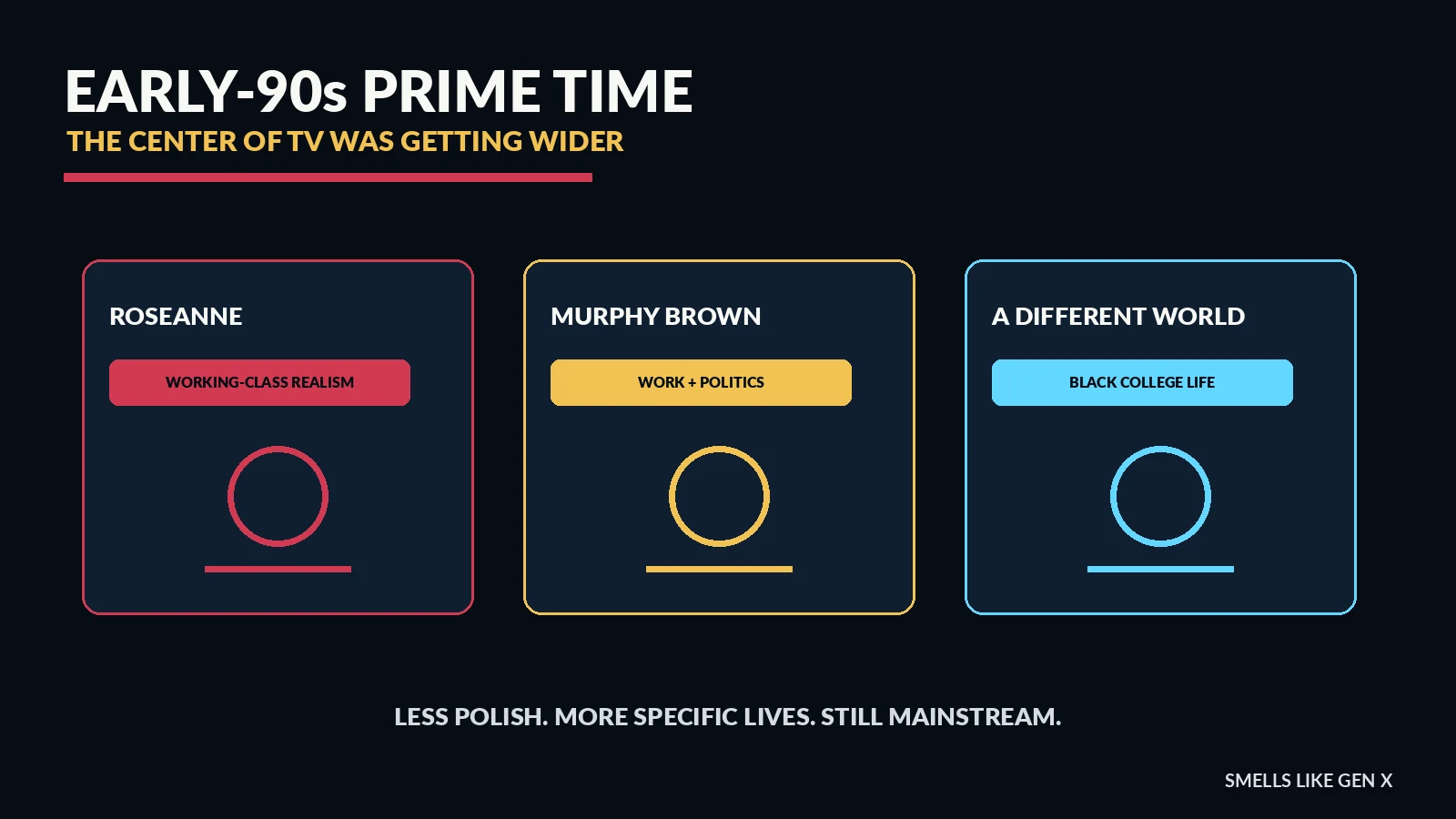
They broadened what a mainstream hit could sound like and whose life could sit at the center. Roseanne, Murphy Brown and A Different World were not marginal experiments; all three finished in the 1990–91 Top 10 while bringing class, professional identity, politics, race, college life and sharper social conflict into mass-audience comedy.
The 1990–91 Ratings Chart Looked Traditional Until You Looked at What the Hits Were Actually About
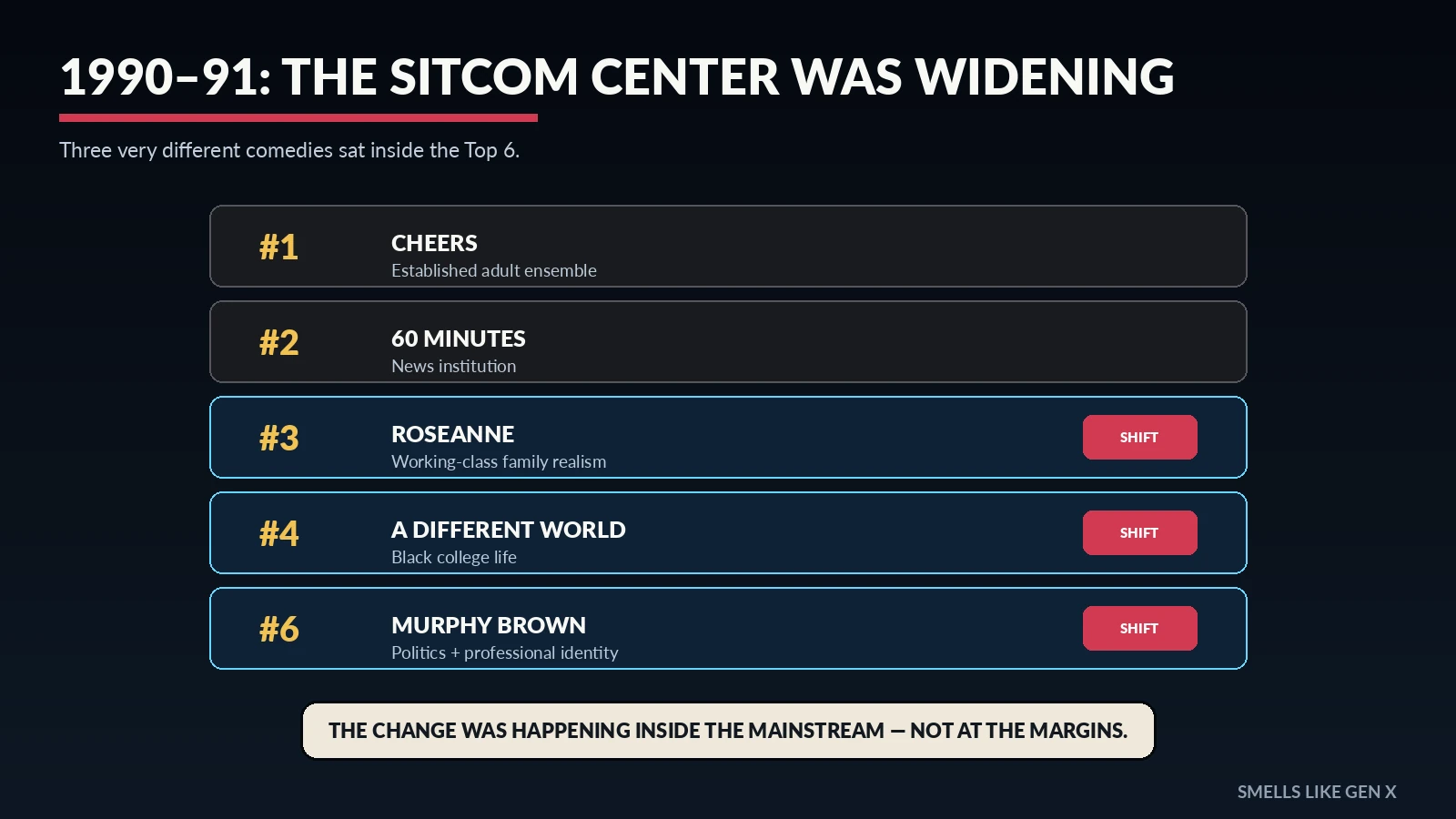
Start with the numbers because they keep nostalgia honest. Cheers was #1 in the 1990–91 season. 60 Minutes was #2. Then came Roseanne at #3, A Different World at #4 and Murphy Brown at #6. These were not niche favorites being celebrated years later by critics. They were sitting in the middle of mass-audience television while doing things that would have felt much less conventional a decade earlier.
The complete ranking is on our 1991 Nielsen season page. What matters here is the pattern inside the comedy hits. A working-class Illinois family worried about money. A Black college campus carried stories about education, relationships and social issues. A middle-aged female television journalist was ambitious, abrasive, sober and openly political. Prime time was getting more specific without becoming less popular.
That is the key to the early-90s transition. Television did not suddenly abandon comfortable formats. It widened the center. The old network audience was still huge enough that different versions of American life could become mainstream at the same time, which is one reason the opening years of the decade remain such a fascinating hinge in the larger story of 1990s prime-time television.
Roseanne Made Working-Class Friction Impossible to Airbrush Away
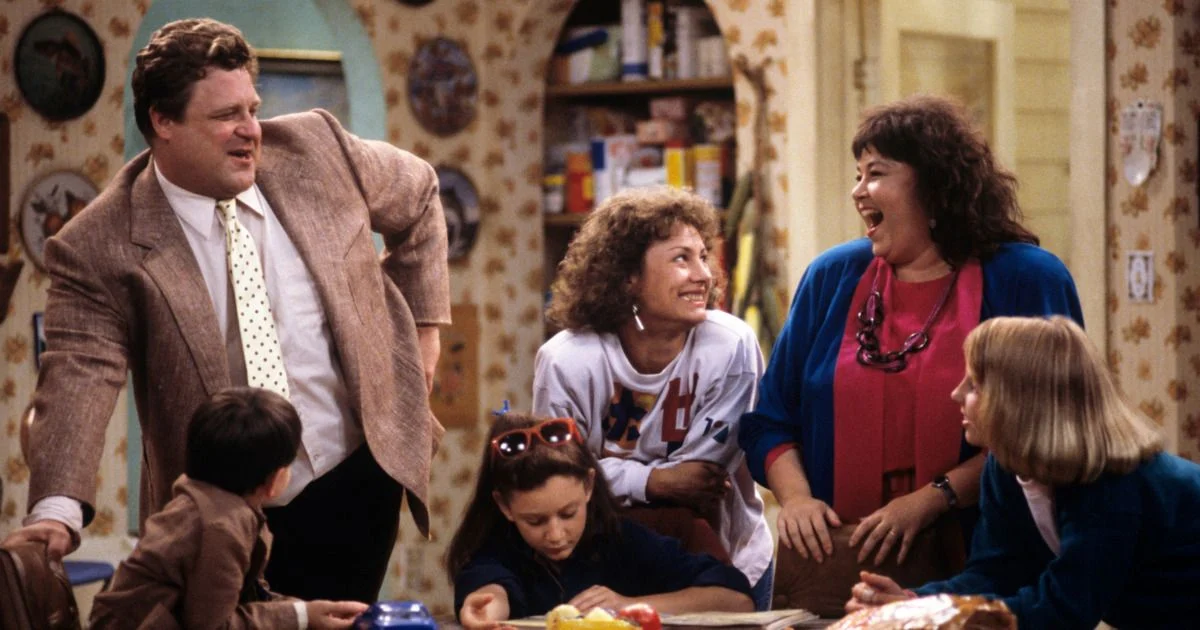
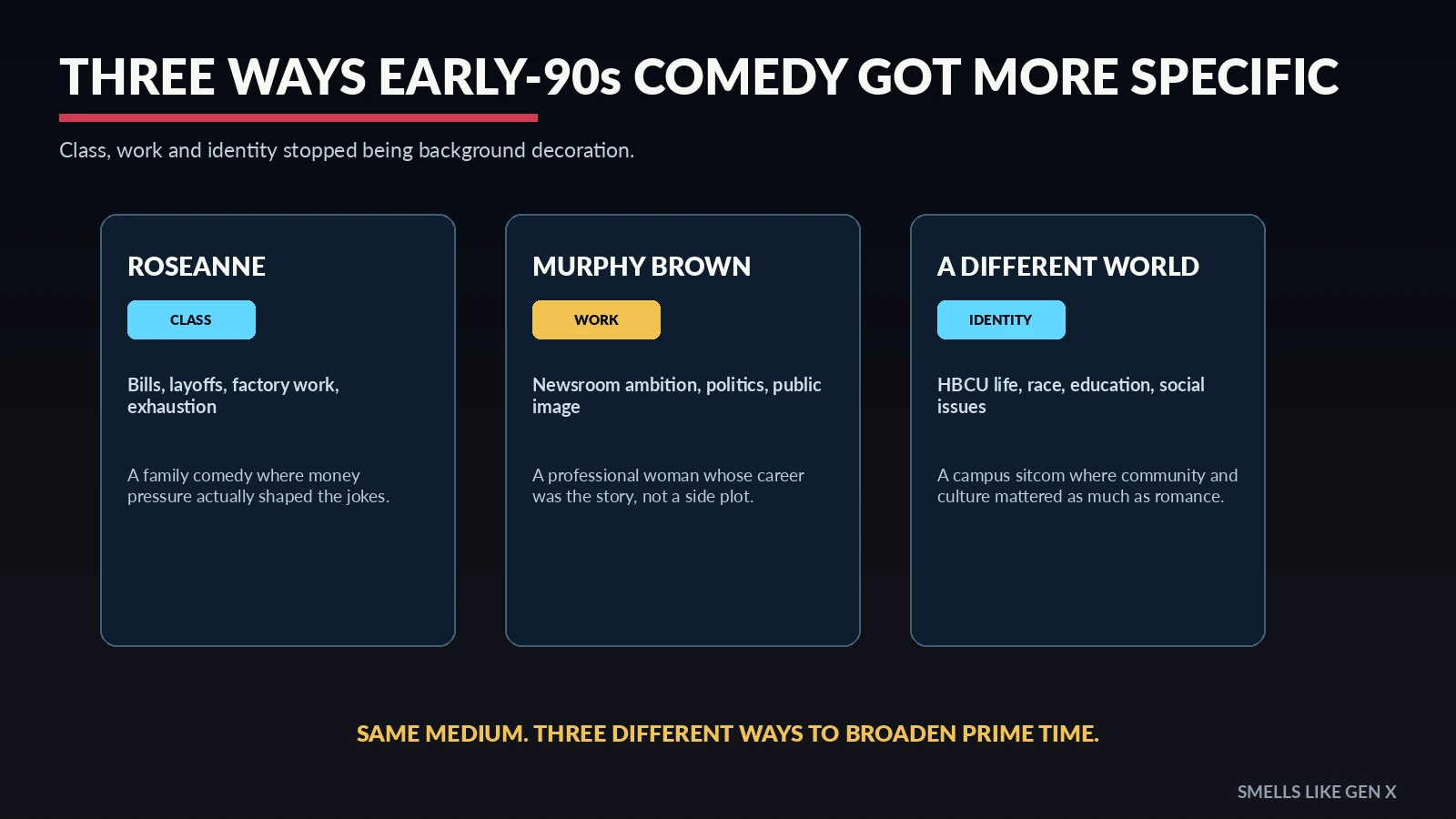
Roseanne had already arrived as a phenomenon before the 90s began, but its position at #3 in 1990–91 matters because it showed the novelty had become normal. The Conners did not stop being financially stressed once audiences got used to them. Jobs were insecure, money arguments were ordinary, parenting was exhausting and the house looked lived in rather than dressed for a furniture catalog.
The show could be broad and loud, but the class details gave the comedy weight. Dan and Roseanne were not sitcom parents floating above economic reality. Their patience, marriages, choices and arguments were shaped by work and money. That made the series feel unusually recognizable to viewers who had spent years seeing television families with kitchens larger than their entire houses and financial problems that disappeared by the closing credits.
We go much deeper into that show’s individual legacy in our Roseanne working-class television deep dive. In this three-show comparison, its role is simple: Roseanne proved that economic pressure did not have to be cleaned up before a family could become one of the biggest comedies in America.
Murphy Brown Put a Difficult Professional Woman at the Center and Refused to Sand Her Down
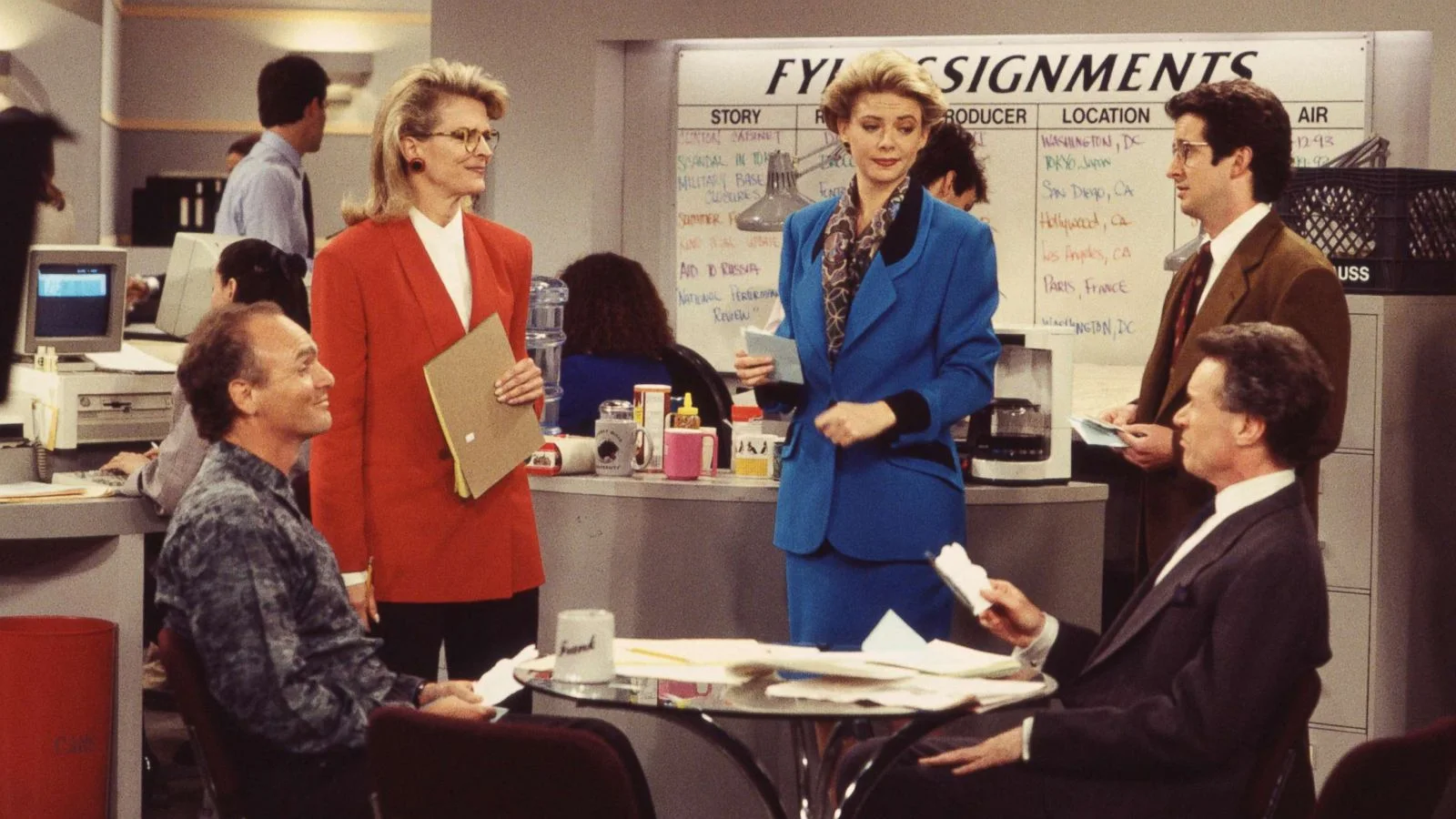
Murphy Brown was not built around the idea that a female lead needed to be pleasantly relatable at all times. She was a successful television journalist, a recovering alcoholic, an opinionated boss, a difficult coworker and a person with enough confidence to be wrong loudly. Candice Bergen played the character with the kind of authority usually reserved for male workplace leads, and the show treated Murphy’s professional life as central rather than decorative.
The FYI newsroom gave the series a setting where politics, media and career ambition could enter the comedy naturally. Stories could be about network executives, journalistic ethics, public image or the collision between private life and a very public job. The jokes did not require Murphy to apologize for wanting power. She was allowed to be good at work and still complicated enough to make everyone around her tired.
For the full show-level story, see our Murphy Brown deep dive. In the early-90s transition, the show matters because it made professional identity and an argumentative female point of view part of mainstream CBS comedy, then demonstrated just how far a sitcom character could spill into public debate.
A Different World Made Black College Life Part of Mainstream Prime Time
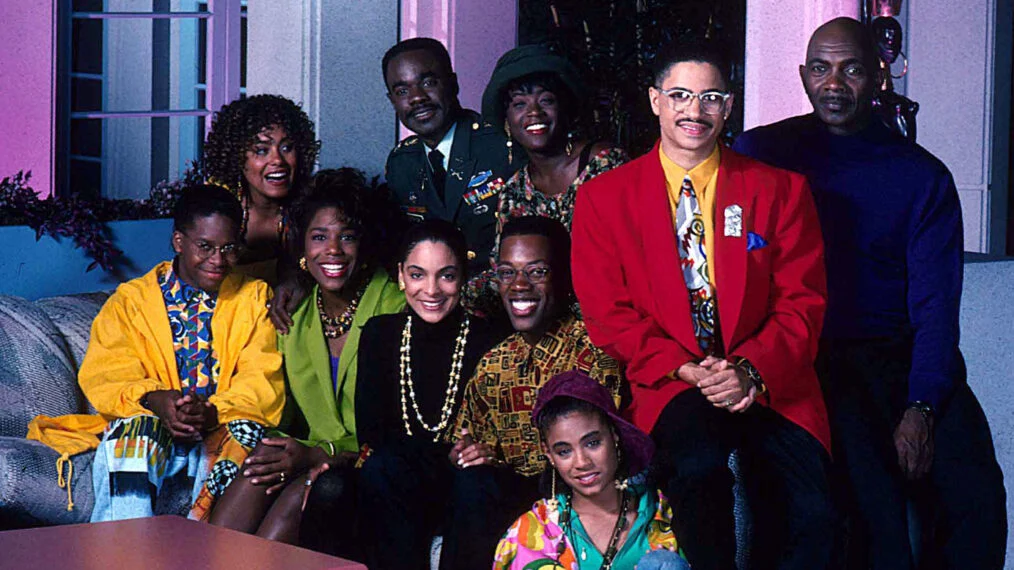
A Different World began as a spin-off, but by the early 90s it had developed a cultural identity that belonged to Hillman rather than to the show it came from. Debbie Allen joined after the first season and has described pushing the series toward greater relevance, more authentic HBCU culture and stories that addressed the actual pressures young adults were facing.
That meant fraternities and sororities, career decisions, romance and campus rituals, but it also meant episodes engaging with subjects such as AIDS, war, sexual assault and race. The series could still be funny and romantic—Dwayne and Whitley hardly required a sociology lecture to hold attention—but it treated the college setting as a real community with history, expectations and political life.
The individual legacy is covered in our A Different World article. In 1990–91, its #4 household-rating finish showed something larger: a sitcom centered on Black students at a fictional HBCU was not sitting at the edge of television. It was one of the most-watched series in the country.
Cheers at #1 Shows This Was Evolution, Not a Revolution That Erased the Past
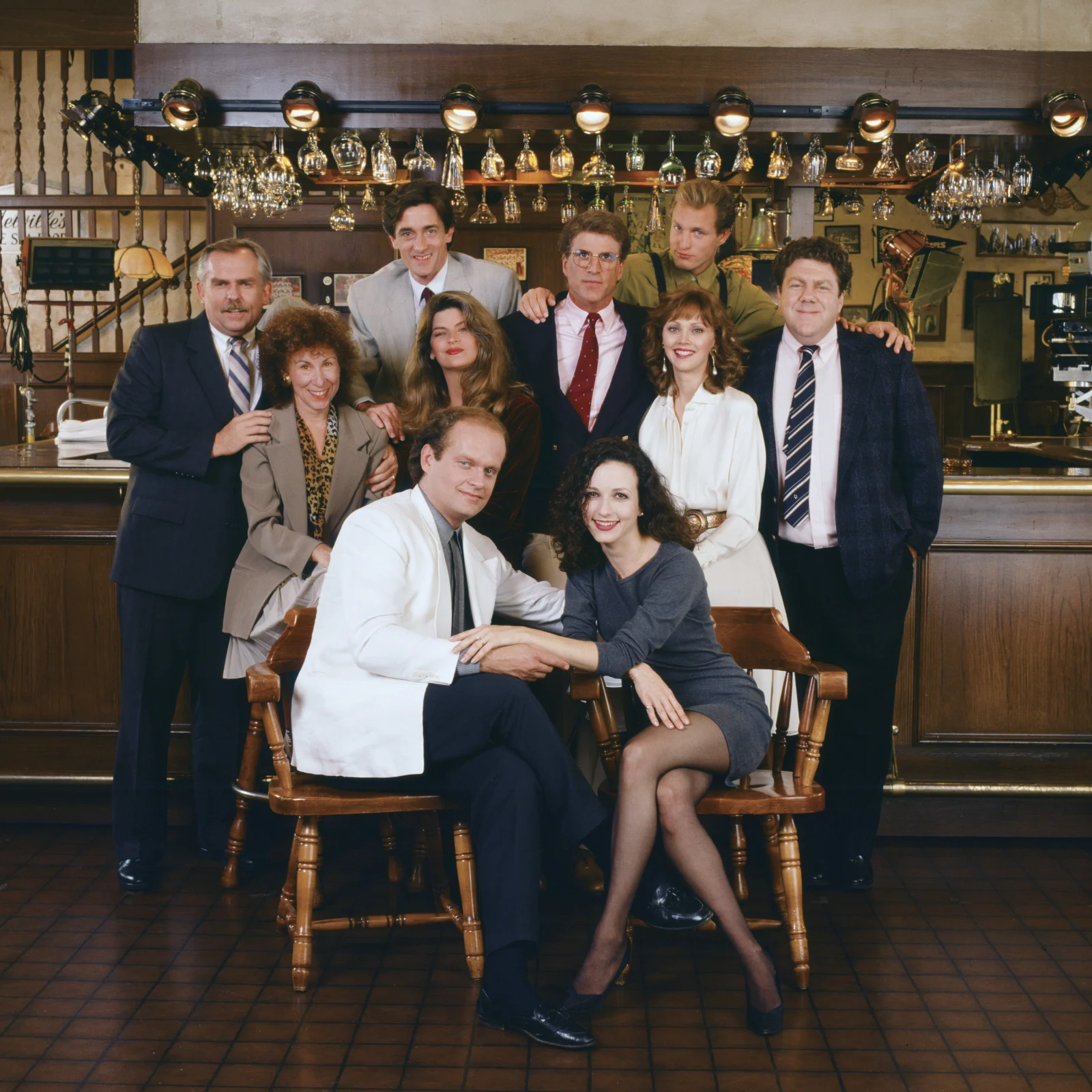
The most useful counterweight to all this talk about change is sitting at the top of the same chart. Cheers finished #1 in 1990–91. It was an 80s institution, an ensemble comedy built around a bar, romantic tension, workplace friendship and characters who had been in viewers’ homes for years. There is no clean break where one era ends and another begins.
In fact, Cheers had already helped normalize some of the things the 90s would push further: adults building a social family outside the home, a workplace that functioned as a community, recurring characters whose personal flaws mattered as much as weekly plots. The difference was that the new decade would apply those permissions to more kinds of people and more socially specific worlds.
That bridge is why the story of how Cheers reached #1 in 1991 belongs next to these shows. Early-90s prime time was not burning down everything before it. It was taking the strongest ensemble traditions of the previous decade and widening who could occupy the center.
Working-Class Reality Became Part of the Weekly Comedy Rhythm
Class had always existed on television, but sitcoms often treated money problems as a temporary plot device. Roseanne made the lack of money environmental. It affected how the house looked, how the parents worked, how the kids understood opportunity and how small frustrations could become larger fights. The Conners did not need a special “we are struggling this week” episode because the struggle was already in the room.
That authenticity changed the emotional temperature of family comedy. Love did not automatically produce patience. Parents could resent work, kids could know when the family was broke, and a bad day at the job could still be present at dinner. The show was funny because the Conners were funny, not because poverty itself was a punch line.
For viewers from households where layoffs, overtime, bills and broken appliances were more familiar than the problem of which vacation house to visit, the specificity mattered. Prime time was acknowledging that ordinary family life could include economic pressure without turning the entire series into a social-issue lecture.
Murphy Brown Made Professional Identity as Important as Romance or Family
Murphy’s job was not the place the character went until the writers could return her to a home plot. The newsroom was home base. Her authority came from experience, reputation and the fact that she was very good at what she did. The comedy could challenge her ego without pretending ambition was a character defect that needed to be cured.
That distinction matters in the context of early-90s television. Female characters had obviously worked on TV for decades, but Murphy Brown built its entire identity around a woman whose public voice was part of the attraction. The show could make her stubborn, politically engaged, difficult and funny without requiring every episode to ask whether success had made her insufficiently feminine.
The newsroom setting also made the series porous to real events. Presidents, campaigns, media controversies and public arguments were part of the air the fictional characters breathed. That created opportunities—and eventually a famous collision between sitcom fiction and national politics.
A Different World Expanded What Black Life on a Network Sitcom Could Contain
One of the strengths of A Different World was abundance. Hillman was not one character representing an entire community. It was students with different backgrounds, politics, ambitions, class positions and personalities arguing inside the same institution. That multiplicity let the show address race without reducing every story to explaining Blackness to outsiders.
Debbie Allen has said she wanted the series to reflect the purpose and culture of historically Black colleges, including traditions and serious issues the first season had not fully embraced. Television Academy interviews document the show’s willingness to tackle subjects such as AIDS and the Gulf War while still functioning as a comedy about friendship, dating and growing up.
That combination is what made the series culturally potent. A serious subject did not require the characters to stop being young, funny, romantic or occasionally ridiculous. The show could hold joy and social pressure at the same time. That balance made Hillman feel like a place viewers wanted to visit rather than a weekly assignment.
The Murphy Brown–Dan Quayle Controversy Showed How Far a Fictional Character Had Entered Public Life
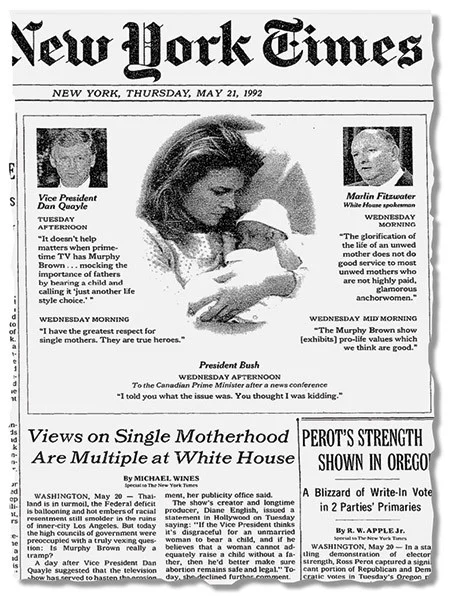
The clearest example of these sitcoms crossing into the broader culture came after Murphy Brown became a mother. In a May 19, 1992 speech, Vice President Dan Quayle criticized the storyline and argued that having the character raise a child outside marriage mocked the importance of fathers. His remarks were part of a broader speech about family, responsibility and social conditions, and they immediately triggered national debate over both the politics and the fact that a vice president was arguing with a fictional television journalist.
Supporters of Quayle’s argument said popular culture had influence and that television should not treat family structure as irrelevant. Critics argued that the comments oversimplified single parenthood and turned a sitcom into a political symbol. The show responded in its next season premiere, using footage of Quayle’s remarks and having Murphy defend a broader definition of family. The exchange became one of the era’s best-known examples of politics and entertainment talking directly at each other.
The useful historical point is not to declare a winner in that argument. It is to notice that Murphy Brown had become culturally central enough for a vice president’s speech and a network sitcom episode to occupy the same public conversation. A comedy about a fictional newsroom was now part of an actual debate about family values, media influence and changing social norms.
Early-90s Comedy Had More Room for Anger, Argument and Specificity
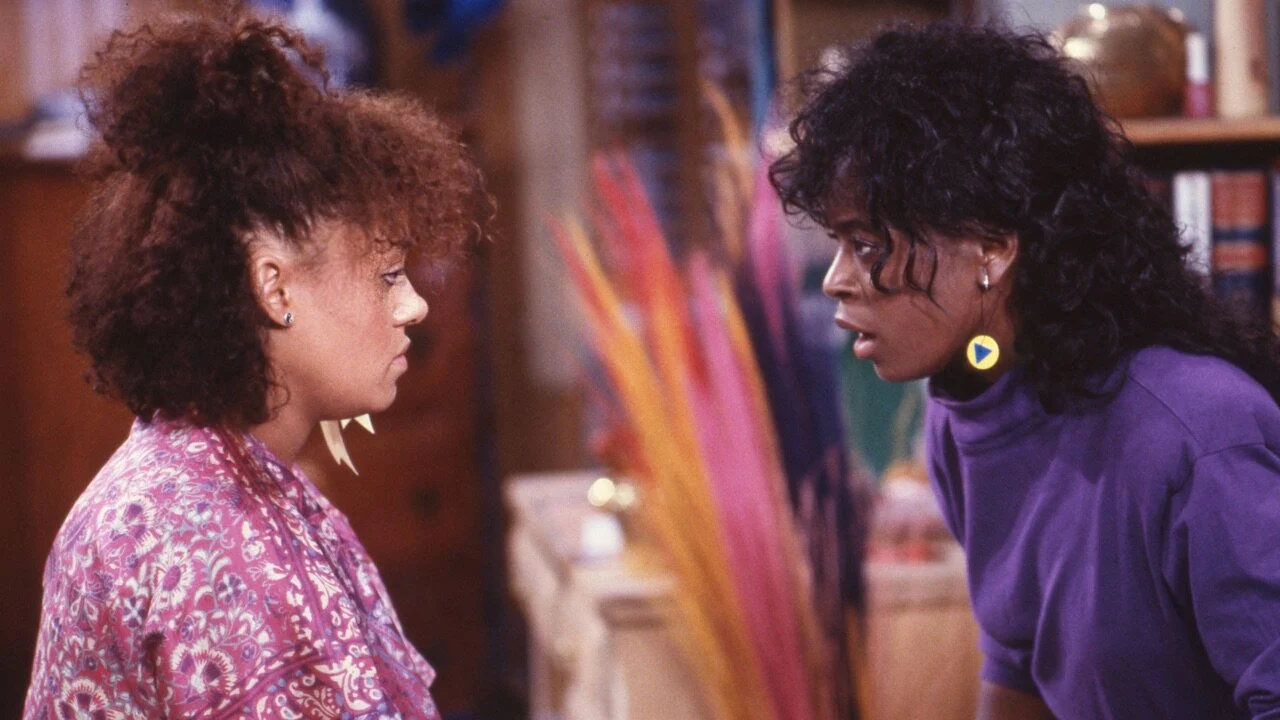
These three shows shared very little on the surface, which is exactly why grouping them is useful. Roseanne Conner was not Murphy Brown, and neither would have lasted ten minutes at Hillman without starting an argument. What connected them was the refusal to file away sharp edges simply because a sitcom was supposed to be comfortable.
Characters raised their voices. They carried political opinions. They talked about money, sex, race, jobs and social expectations in ways that could create real friction inside the ensemble. The comedy did not always resolve that friction into a perfect consensus. Sometimes the point was that people who cared about one another could still disagree, fail or carry the problem into next week.
That tougher voice helped prepare audiences for the broader 90s comedy landscape. Seinfeld would make selfishness an engine. Living Single would center ambitious young Black adults. Friends would make chosen-family adulthood a dominant fantasy. The early-90s hits helped prove that specificity did not scare a mass audience away.
These Shows Changed the Center From Inside the Top 10
Television history often celebrates boundary-pushing programs that were critically important but watched by relatively small audiences. There is nothing wrong with that. But the 1990–91 chart tells a different kind of story. Roseanne, A Different World and Murphy Brown were not asking for permission from the margins. They were already in the center.
That gave their choices outsized influence. When a #3 show lets a family worry about bills every week, other producers notice. When a #4 show centered on an HBCU combines romance and comedy with serious issues, the idea that Black college life is too specific for mass television becomes harder to defend. When a #6 sitcom builds its identity around a politically outspoken professional woman, the old boundaries around likability and subject matter look less stable.
Ratings do not prove artistic virtue, and popularity does not settle cultural arguments. What the numbers prove is reach. These shows had access to millions of households, week after week, while widening the kinds of lives network comedy treated as ordinary enough to build a hit around.
For Gen X, the Early 90s Started Removing Some of Television’s Protective Glass
A lot of Gen X grew up fluent in two versions of America: the one in commercials and sitcom establishing shots, and the one at the kitchen table. The second version had money stress, layoffs, parents with rough edges, racial realities, political arguments and the possibility that adults did not have any idea what they were doing. Early-90s comedy let more of that second version leak onto the screen.
It was not documentary realism. Nobody is arguing that every Roseanne joke sounded like your house or that Hillman represented every Black college experience. The connection was tonal. These worlds felt less polished. People had stronger opinions. Work mattered. Money mattered. Identity mattered. The problems were allowed to linger long enough to change how you understood the characters.
That is why the nostalgia hits differently than simply remembering a logo or theme song. The early 90s were when network comedy began to feel more comfortable admitting that mainstream America was not one household with one set of assumptions. The picture was getting messier, and for once the mess was part of the entertainment.
The Lasting Change Was Permission for More Kinds of Lives to Be Ordinary Television
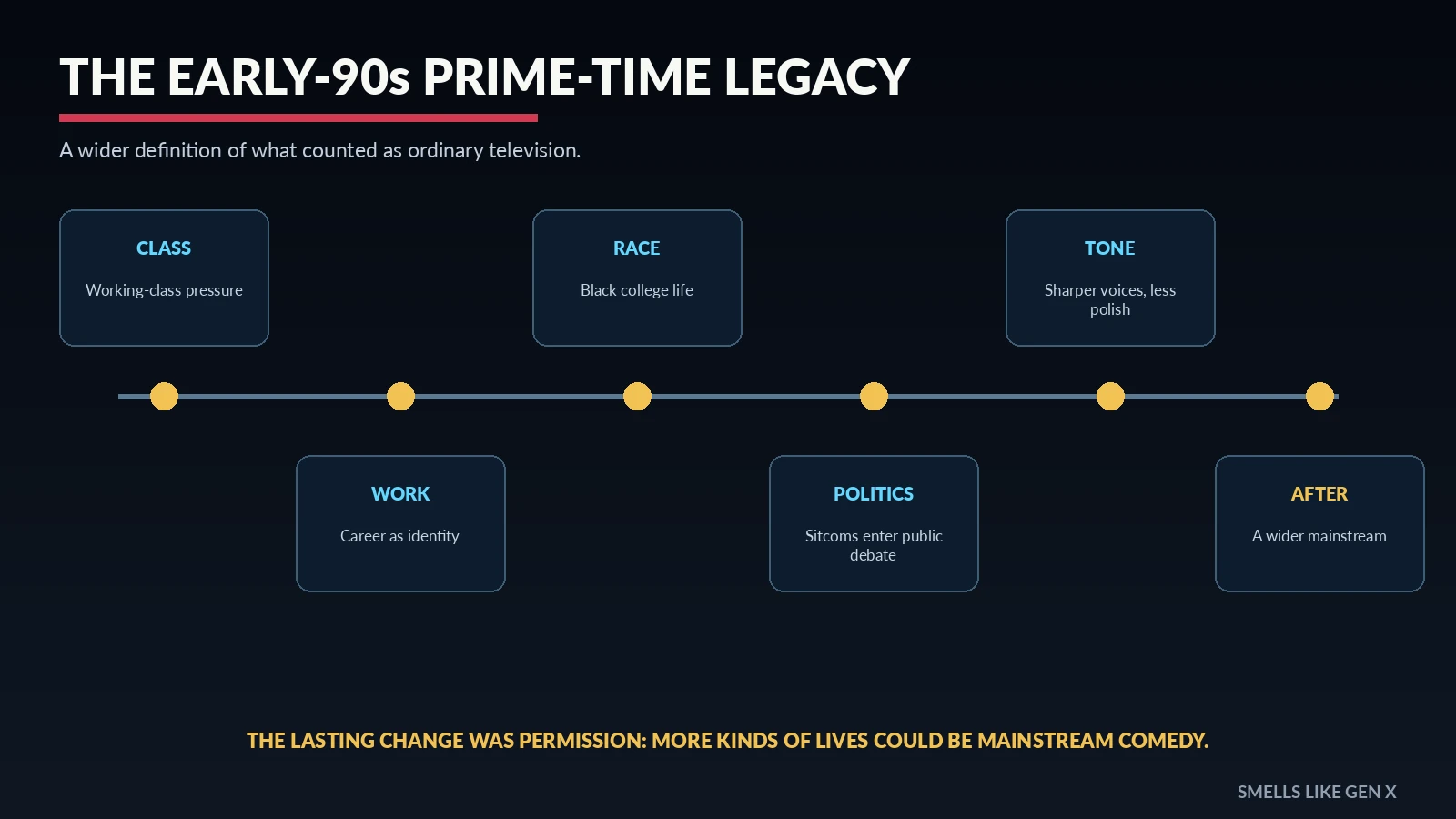
The most important legacy of Roseanne, Murphy Brown and A Different World is not that later sitcoms copied them directly. It is that they weakened the idea that mass-audience comedy needed to smooth out class, politics, race or professional ambition before viewers could relate. Their success made specificity look less like a risk and more like a source of identity.
The shift also made prime time harder to define with one stereotype. The same audience era could support Cheers, Roseanne, A Different World, Murphy Brown, The Golden Girls and family sitcoms on ABC. That range is part of what made early-90s television feel transitional. The old center was still there, but it had more doors.
By the middle of the decade, the sitcom would move even further toward friends, apartments, workplaces and single adulthood. But the opening years had already done something essential: they showed that the mainstream did not have to look or sound the same in every half hour. Once prime time learned that lesson, it became very difficult to unlearn.
Frequently asked questions
How high did Roseanne rank in 1990–91?
Roseanne finished #3 in the 1990–91 prime-time season with an 18.1 household rating.
How high did A Different World rank in 1990–91?
A Different World finished #4 with a 17.5 household rating.
How high did Murphy Brown rank in 1990–91?
Murphy Brown finished #6 with a 16.9 household rating.
What did Dan Quayle say about Murphy Brown?
In a May 1992 speech, Vice President Dan Quayle criticized the show’s unmarried-mother storyline and argued that the character’s choice mocked the importance of fathers. The series responded in its next season premiere.
Why was A Different World important?
The series centered life at the fictional HBCU Hillman College and, especially after Debbie Allen joined as producer and director, addressed college culture and serious social issues within a network sitcom.
Did these shows replace traditional sitcoms?
No. Cheers was the #1 series in 1990–91, and family comedies remained strong. The change was that prime time widened enough to support more class, political, racial and professional specificity at the same time.
Sources behind this story
- TV Guide — 1990–91 Top 10 ratings summary
- Classic TV Database — 1990–91 Top-Rated TV Shows
- Television Academy — Murphy Brown awards and nominations
- Voices of Democracy — Dan Quayle's May 19, 1992 speech transcript
- Los Angeles Times — Murphy Brown and Quayle controversy, May 1992
- Los Angeles Times — Murphy Brown responds, September 1992
- Television Academy Interviews — Debbie Allen on A Different World
- Television Academy Interviews — A Different World