1999 and the End of the Great Network TV Monoculture
1999 and the Endof the Great Network TV Monoculture
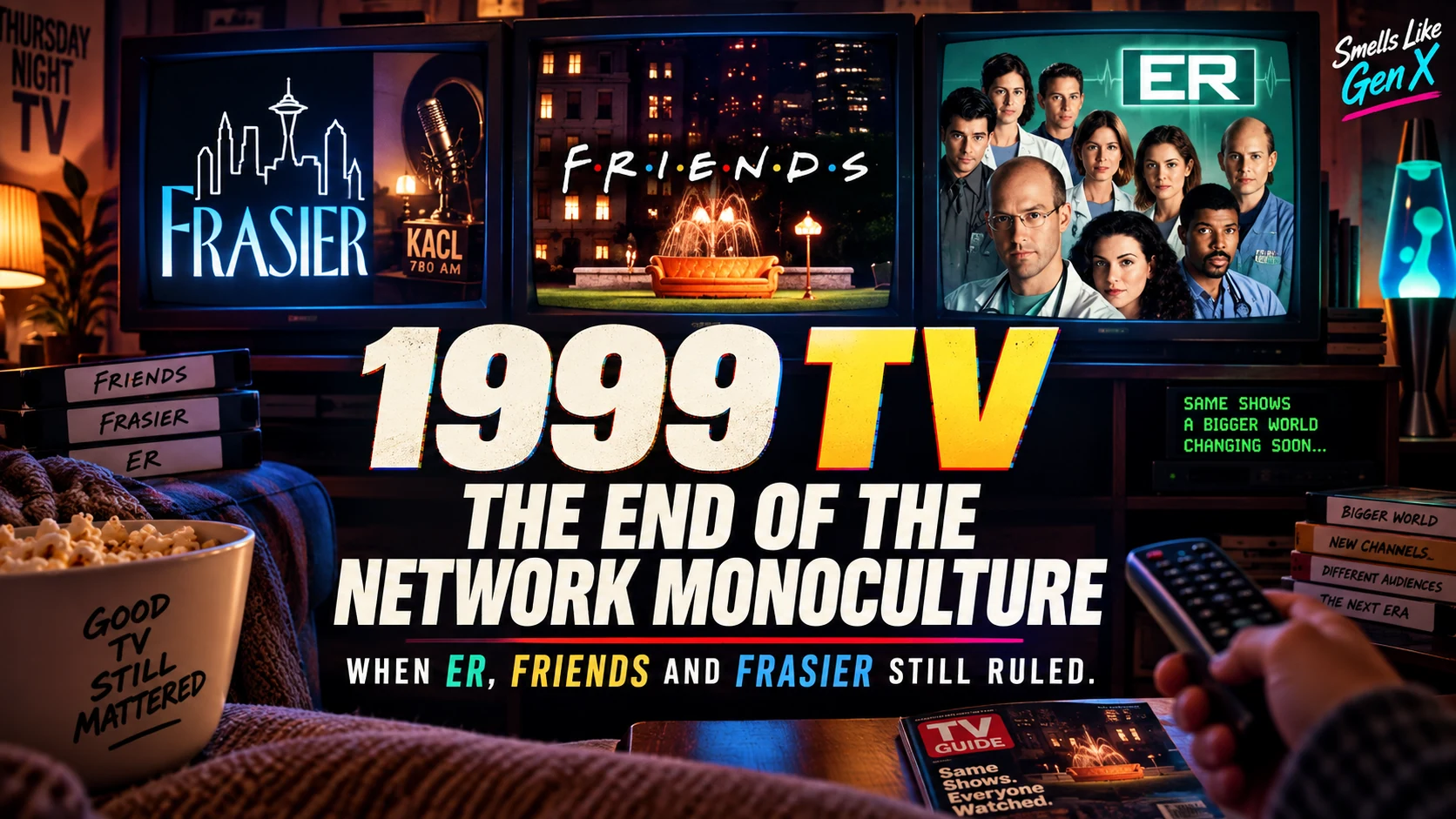
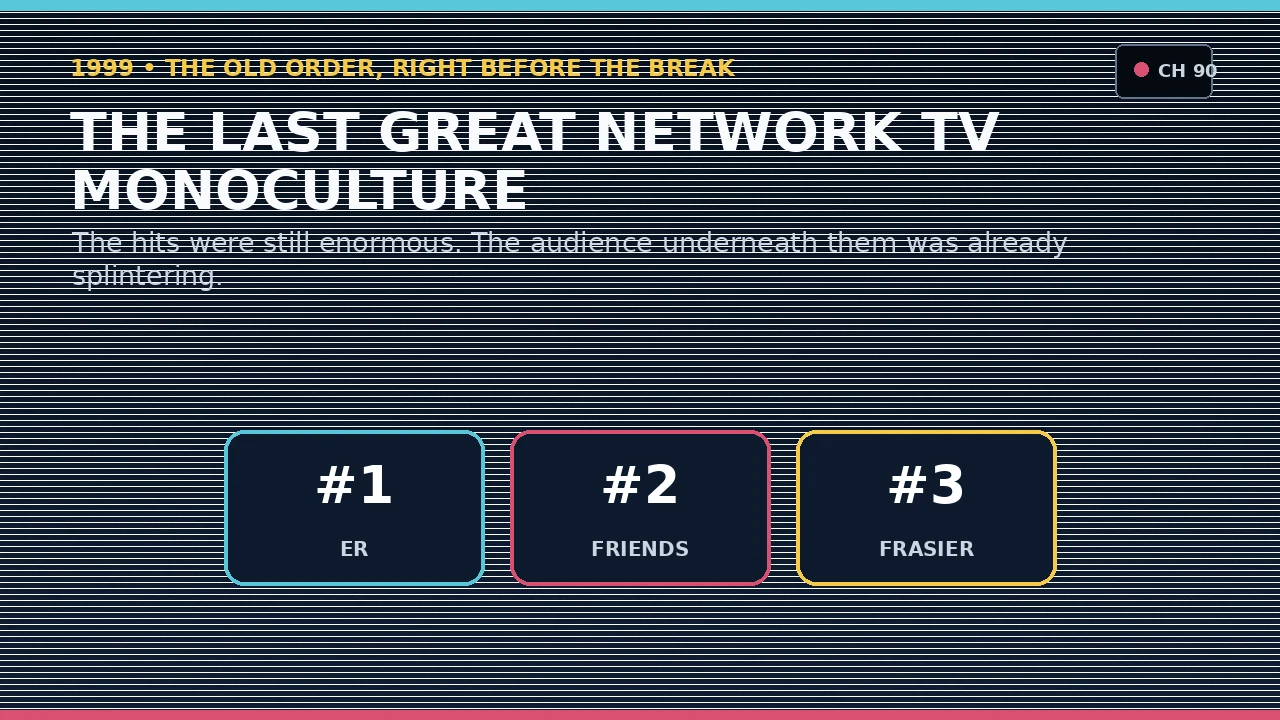
1999 looked like network television was still on top. ER, Friends and Frasier owned the first three places in the ratings. But underneath those giant numbers, cable was taking share, the number of choices was exploding, and the old idea that a few networks could define the national conversation was already breaking apart.
Did the network TV monoculture really end around 1999?
It did not disappear overnight, but 1999 was a clear turning point. Broadcast hits were still massive, yet Nielsen reported that the four major networks’ combined prime-time share had fallen sharply while basic cable kept growing. The old network system was still powerful, but no longer uncontested.
1999 Television Looked Dominant Right Before the Old Network Order Broke Apart
The easiest way to misunderstand 1990s television at the end of the decade is to look only at the biggest shows.
ER was still enormous. Friends was still enormous. Frasier had just surged to #3. Monday Night Football was #4. 60 Minutes and Touched by an Angel were still drawing audiences that would make a modern network executive faint.
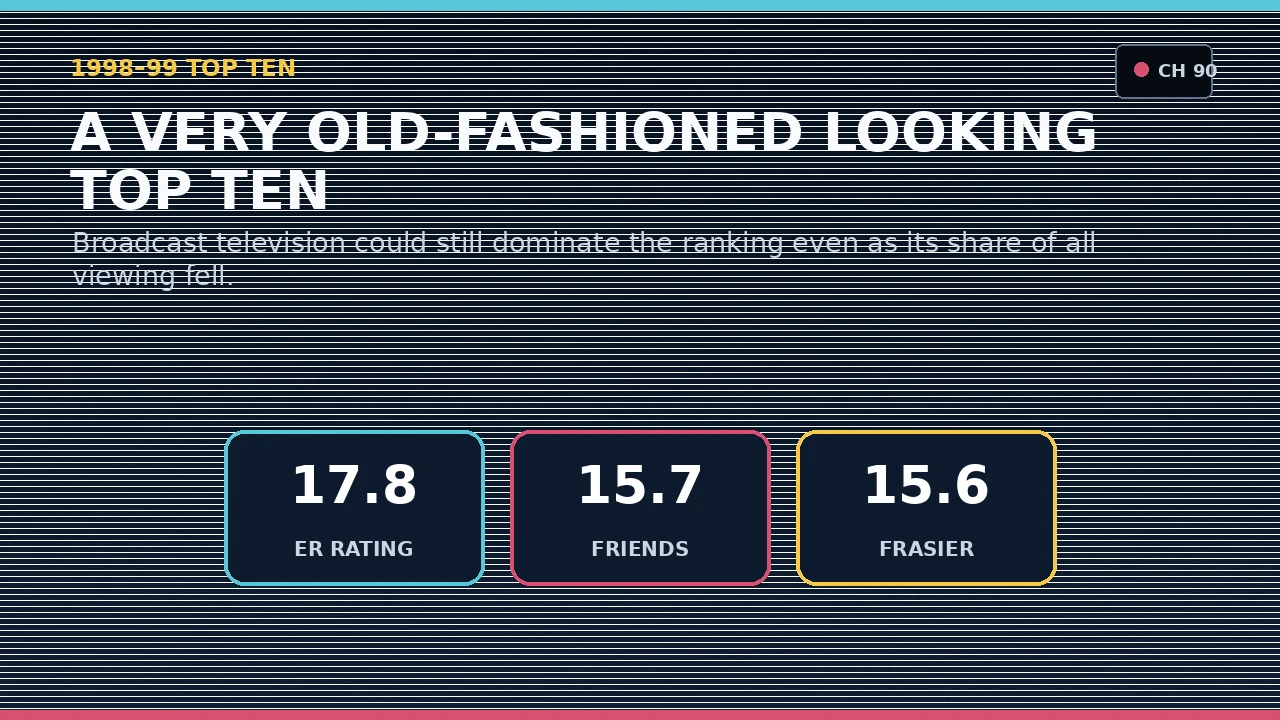
The 1998–99 Nielsen ranking is not a list of a dying medium. It is a list of a medium still capable of assembling tens of millions of people around a handful of programs.
And that is exactly what makes 1999 interesting. The biggest broadcast shows were thriving at the same time the broadcast system around them was losing control. Cable networks were gaining share. Specialty channels were multiplying. Satellite was expanding. Video games were taking more evening attention. The early consumer internet was beginning to compete for time rather than merely coexist with television.
The old monoculture did not end because nobody watched network TV anymore. It ended because network television stopped being the default center of nearly everybody’s viewing universe.
That distinction is the entire article: the peak hits survived longer than the system that had made mass audiences feel normal.
ER, Friends and Frasier Were the Top Three Shows of 1998–99
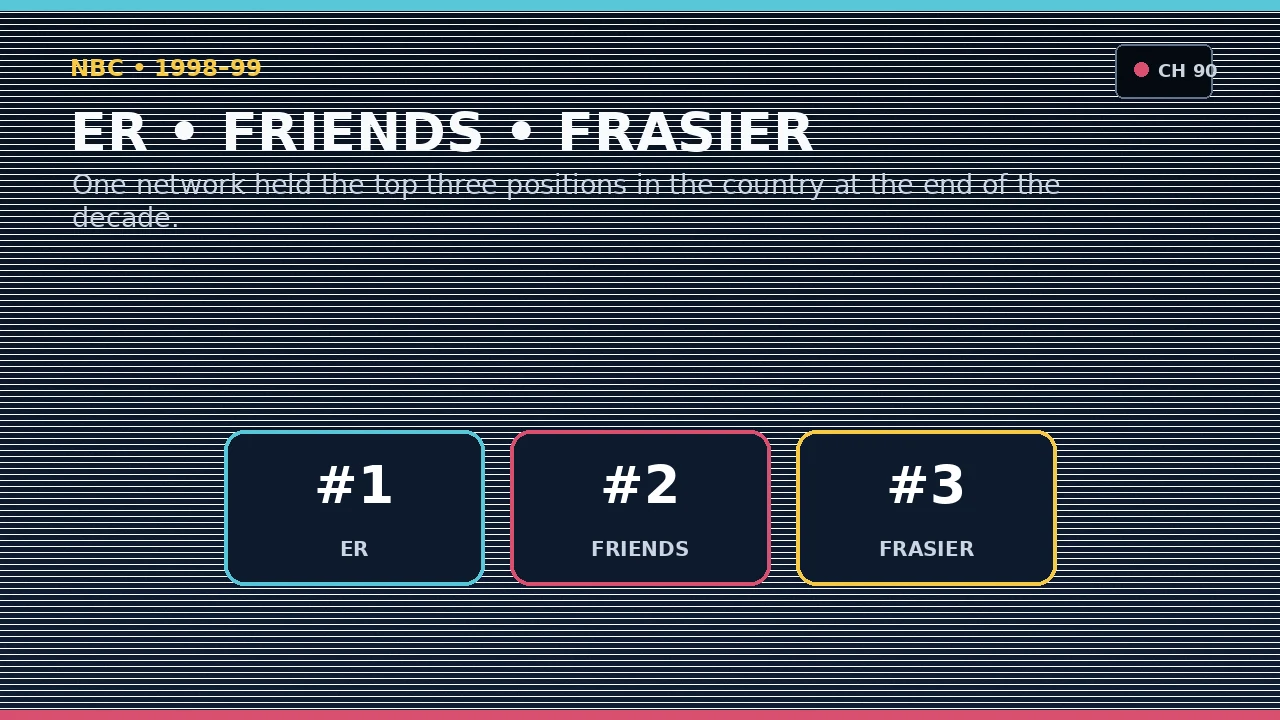
If 1999 was the end of an era, NBC did not look like a network in retreat at the top of the chart.
ER finished #1 with a 17.8 household rating. Friends was #2 at 15.7. Frasier was #3 at 15.6 after moving into the Thursday 9 p.m. slot vacated by Seinfeld.
The show-level stories belong in the individual deep dives on ER, Friends and Frasier. Here, what matters is what their combined strength tells us about the transitional moment.
NBC could still make Thursday feel like the center of television. A network could still use scheduling, promotion and lead-ins to create a night with national scale. The old machinery had not stopped working.
But dominance at the top hid erosion across the rest of the schedule. When fewer people were watching broadcast television overall, having the three biggest shows did not mean controlling the same share of American attention that the Big Three networks had controlled twenty years earlier.
The winners were still winning. The pie had changed.
The Four Biggest Broadcast Networks Lost Prime-Time Share Even While the Hits Stayed Huge
The clearest evidence of fragmentation is not a single show rating. It is the share of the total prime-time audience going to broadcast networks as a group.
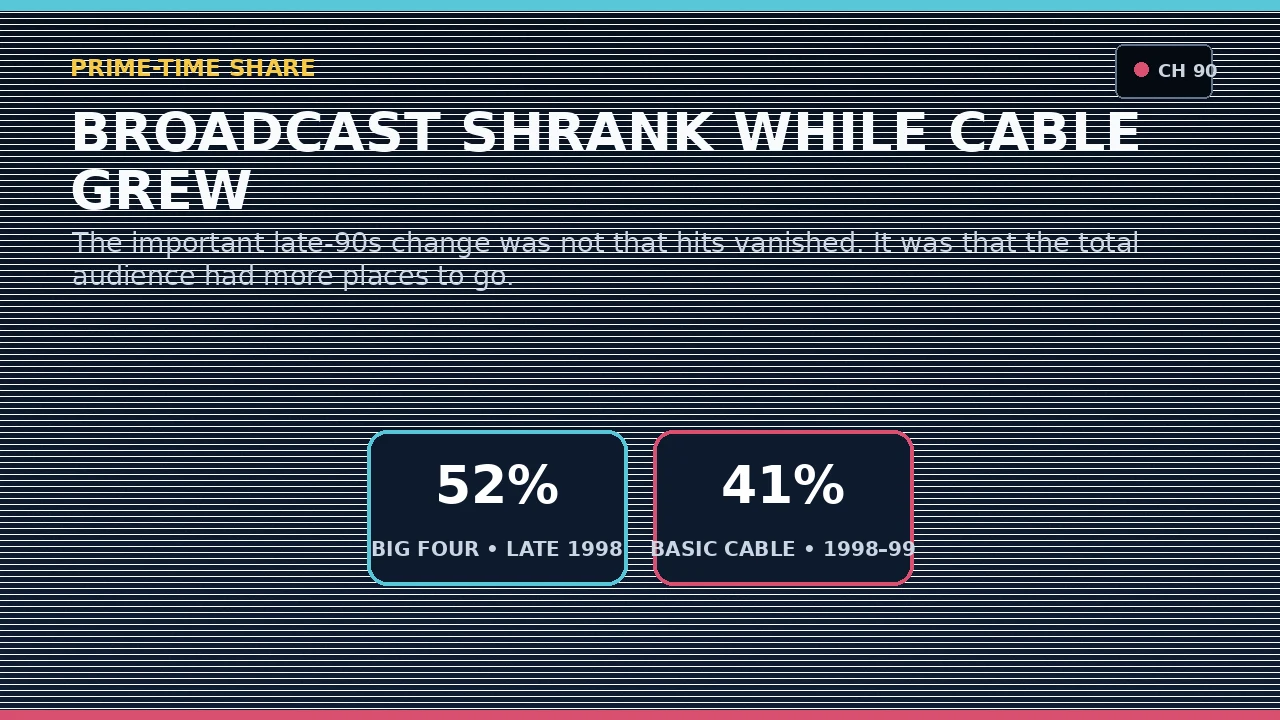
In February 1999, the Washington Post reported Nielsen data showing that the four major broadcast networks’ combined prime-time share had fallen to 52 percent during the final three months of 1998, down from 58 percent in the same period a year earlier.
That is a remarkable drop in one year. No single cable channel needed to beat NBC or CBS by itself. Hundreds of alternatives only had to siphon away a little audience each. The result was a television ecosystem in which the big broadcast networks remained individually larger than most cable competitors while collectively losing their old grip.
By the broadcast season ending in 1999, basic cable networks attracted 41 percent of U.S. viewers, according to Nielsen figures reported by the Los Angeles Times. Broadcast networks still had 54 percent, but the direction was unmistakable.
The shift matters more than any single percentage. Once viewers developed habits across dozens of channels, the network schedule no longer had the same power to define what “everybody” was watching.
By 1999, Cable Was a Parallel Television Universe
Cable in the early 80s could feel like extra television. By the end of the 90s it felt like television.
ESPN, CNN, MTV, Nickelodeon, A&E, USA, TNT, TBS, Lifetime, Comedy Central, Discovery, History, E!, FX and dozens of other services had trained viewers to leave the broadcast dial for specific interests. HBO was turning premium cable into a home for ambitious original programming. Syndicated network hits were filling cable schedules and competing with new episodes of the same programs.
The Washington Post noted the irony in 1999: viewers could find familiar network series in cable reruns, meaning the broadcast networks were increasingly competing with their own libraries.
That changed the psychology of the remote. The choice was no longer “Which network?” It was “What kind of thing do I feel like watching?” Sports, music, movies, kids’ shows, news, true crime, old sitcoms, home improvement and documentary programming all had dedicated destinations.
Once television became organized around niches, monoculture could survive mainly around the biggest events and the very biggest scripted hits.

A #1 Show Could Be Huge Without Owning America the Way Earlier #1 Shows Had
Rank is relative. Audience concentration is historical.
A show that finishes #1 in a fragmented environment can still be a tremendous success while reaching a smaller share of the total population than a #1 show from an earlier era. That is why comparing raw 90s ratings with modern ratings requires context.
The future ratings explainer owns the measurement mechanics, but the cultural point is simple: there were more places for the audience to go.
In 1980, the dominant networks controlled most prime-time viewing. By the late 90s, cable and newer broadcast networks had broken that concentration. A hit could still produce a national conversation, but the conversation had more people outside it.
This is also why nostalgia can mislead us. We remember Friends as if every household watched it. Millions did. Millions also watched something else—and by 1999 there were far more “something elses” available than there had been at the start of the decade.
Why the Biggest Network Franchises Stayed Huge Longer Than the System Around Them
Once viewers build a habit around a franchise, that habit can survive long after the environment begins to change.
ER had accumulated years of loyalty. Friends had become a weekly social ritual. Frasier brought a mature audience and a decade of character familiarity dating back to Cheers. Monday Night Football had been part of ABC since 1970. 60 Minutes had a Sunday habit older than many of its viewers.
Those franchises did not have to build an audience from scratch in 1999. They were carrying accumulated behavior into a more fragmented media world.
New shows had a harder problem. The same fragmentation that gave viewers more options made sampling less automatic. A network could still use a giant lead-in, but the pool of available viewers was no longer as concentrated as it had once been.
That is why the late-90s top ten can look strangely old-fashioned even while the industry around it was changing quickly. Long-running habits were masking a structural shift.
60 Minutes and Touched by an Angel Proved Old-School Schedule Habits Still Worked
NBC Thursday was not the only part of the old television order still producing mass audiences.
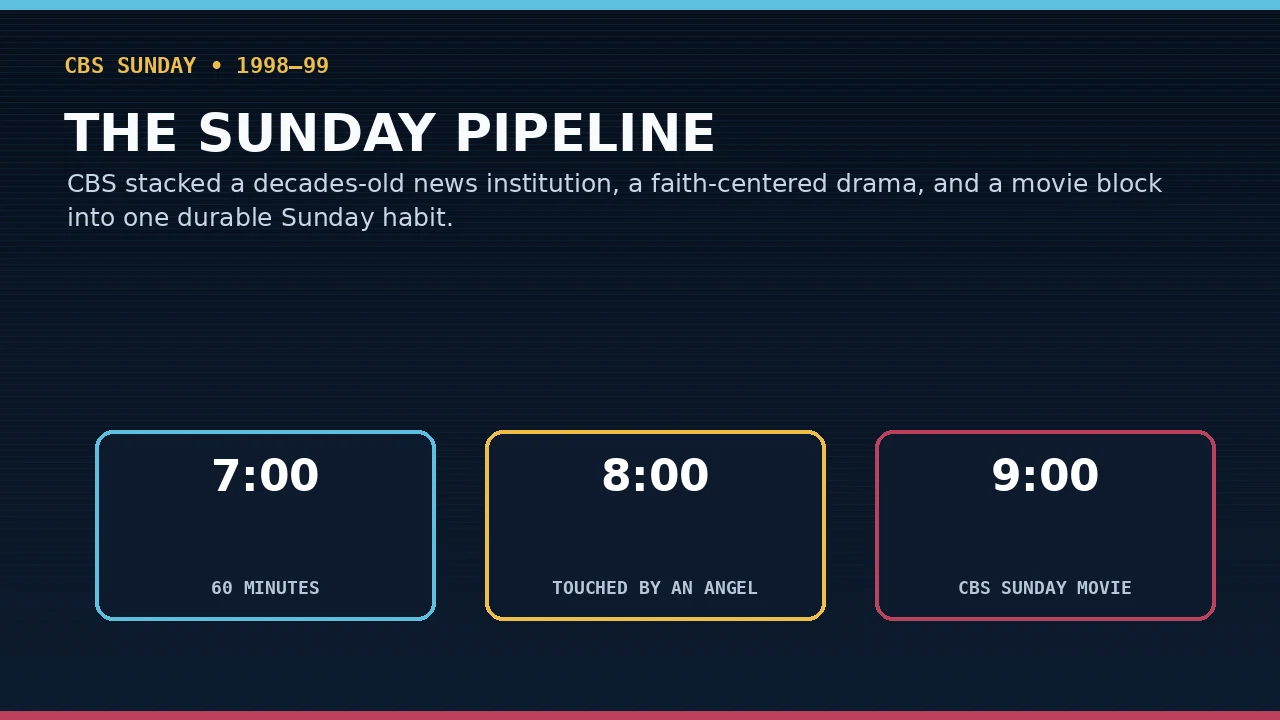
CBS Sunday remained a powerful viewing block built around 60 Minutes, Touched by an Angel and the Sunday movie. In 1998–99, 60 Minutes finished #7, Touched by an Angel #8 and the CBS Sunday Movie #9.
The dedicated CBS Sunday night article owns that ecosystem. Its relevance here is that schedule habit still mattered even as the audience fragmented elsewhere.
Older viewers, family audiences and people accustomed to Sunday television did not instantly abandon the networks because cable existed. Media transitions overlap. New habits grow beside old ones for years.
1999 was not a clean break. It was a year when both systems were visible at the same time.
1999 Was Also the Moment the Screen in the Other Room Started Mattering
The internet did not destroy network television in 1999. It did introduce a new competitor for attention that television executives could no longer dismiss.
Dial-up connections were slow. Video online was primitive. Most people were not replacing a sitcom with streaming because streaming did not exist in any practical consumer sense. What the internet competed for was time: chat rooms, AOL, email, message boards, web browsing and the strange novelty of being online at night.
Pew Research would report in 2000 that younger Americans were increasingly using the internet for news while network news audiences continued to shrink. That shift was only one part of a broader behavioral change: media time no longer automatically meant television time.
The early web also changed conversation around television. Fans could find episode guides, message boards and communities devoted to specific shows, reinforcing the move from one mass audience toward many smaller interest groups.
That was the cultural direction of travel. The same technology that fragmented discussion would eventually fragment distribution too.

The End of the Monoculture Was Really the End of Automatic Viewing
Network television had always depended on scarcity more than viewers realized.
When only a few major channels offered new prime-time entertainment, choosing what to watch meant choosing among a limited set of options. That made a good schedule disproportionately powerful. If Friends led into another comedy, millions of viewers might remain simply because NBC was already on.
As alternatives multiplied, inertia became weaker. Cable taught viewers to surf. VCRs and home video taught them that television time could be rearranged. The internet taught them that the television did not have to be the center of the room every evening.
The shared ritual discussed in Appointment TV did not vanish, but it became something programs had to earn rather than something the structure of the medium supplied automatically.
That is the real end of the network monoculture: not the disappearance of hits, but the disappearance of the assumption that a few hits represented nearly everyone.
What 1999 Television Felt Like Before Streaming Made the Change Obvious
The strange thing about a media era ending is that nobody puts a chyron on the screen saying this is the last year it will feel normal.
In 1999, the TV still came on after dinner. NBC Thursday still mattered. Sunday night still had its CBS rhythm. Monday still meant football. The local newspaper still printed listings. TV Guide still had a reason to exist.
At the same time, the remote had more buttons worth pressing. The cable box offered entire categories of programming. The computer modem made its noise from another room. Kids could disappear into games while parents watched a drama. Teenagers could spend an hour online and miss whatever everybody else was supposedly watching.
None of those changes felt individually revolutionary. Together, they made the old center weaker.
That is why 1999 works as an end-of-era marker. The monoculture was still visible enough to recognize, but fragile enough that the next decade would not be able to rebuild it in the same form.
The Network Monoculture Faded Before the Network Hits Did
The best way to remember 1999 is not as the year television became small. Television was still gigantic.
The change was distribution of attention. The networks could still create national events, but they no longer owned the majority of viewing choices in the way they once had. Cable had become a peer environment. New networks had matured. The internet had entered the home. The audience was learning to split.
That is why the 1998–99 top ten looks like a finale and a preview at the same time. ER, Friends, Frasier, Monday Night Football and 60 Minutes were monuments to the mass-audience era. The falling network share beneath them was a preview of everything that came next.
The old system did not collapse. It lost its monopoly on normal.
And once that happened, there was no realistic path back to a television world where a handful of channels could assume the whole country would show up together.
Fox, The WB, UPN and PAX Meant the Old Big Three Were No Longer the Whole Story
Cable gets most of the credit for breaking the old network order, but broadcast television was fragmenting from inside too.
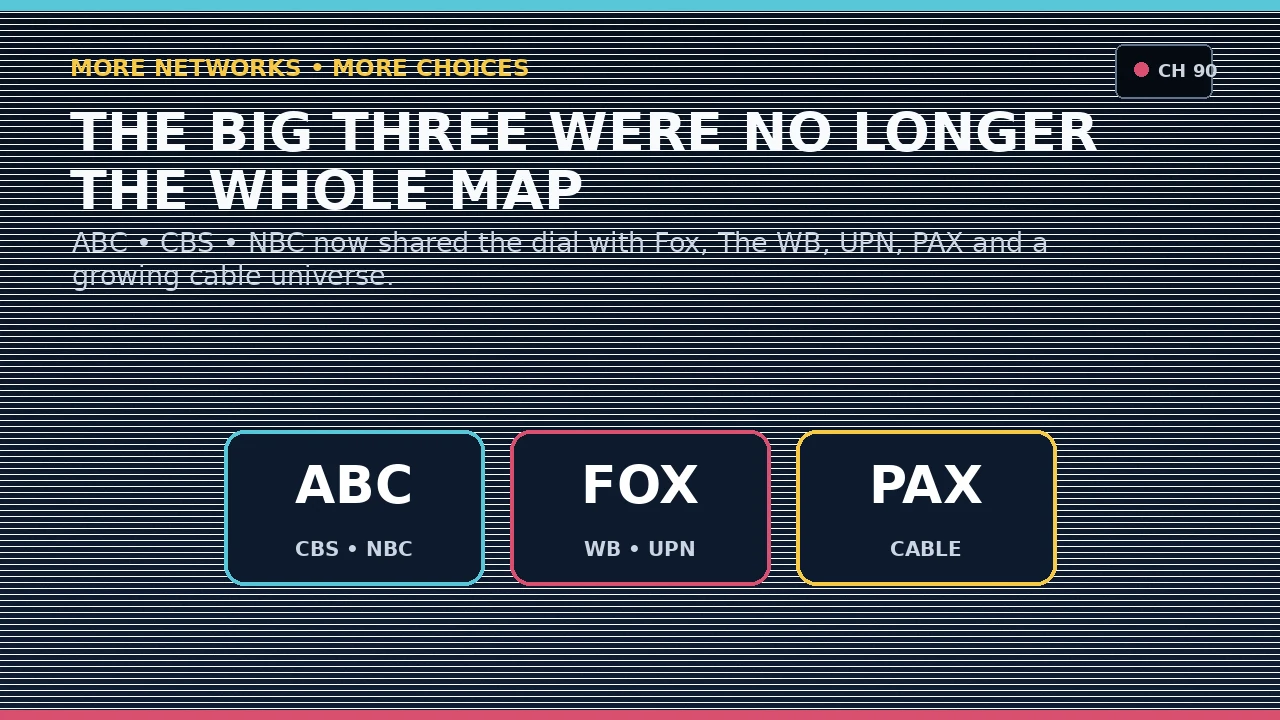
Fox had matured from an upstart fourth network into a genuine competitor, with NFL rights, The X-Files, The Simpsons and other programs that gave younger viewers reasons to build habits outside ABC, CBS and NBC. The WB and UPN targeted narrower audiences with shows the older networks might not have centered. PAX arrived with a family-oriented strategy and a patchwork of stations that expanded the number of national broadcast identities.
The result was not that every new network became equally powerful. It was that the old assumption of three dominant national schedules no longer described the market. Even within free over-the-air television, viewers had more branded choices.
That mattered culturally because a smaller network could become deeply important to a specific audience without ever approaching the household rating of ER. The definition of success started to shift from “everybody watches” toward “the right audience watches.”
That logic would become normal in cable and then streaming. In 1999 it still felt like a departure from the scale television had taught viewers to expect.
Cable Could Use the Networks’ Own Hits Against Them
One of the strangest late-90s developments was that a successful broadcast series could compete with itself.
Off-network reruns moved quickly onto channels such as USA, Lifetime, FX and other cable services. A viewer could spend an evening with an older episode of a familiar network show instead of watching the newest episode on broadcast. The Washington Post reported in 1999 that this competition with the networks’ own rerun libraries was becoming a real problem.
That changed the value of a library. Syndication money was attractive, but the reruns also trained audiences to think of television as an endless shelf rather than a single current schedule. The distinction between “what is on tonight” and “what do I want to watch” began to loosen.
Home video pushed in the same direction. Taped episodes, rented movies and growing DVD adoption gave households more control over when the television was used and what appeared on it.
None of this looked like streaming yet. But the behavior was moving toward it: more choice, more control, less dependence on a network telling you what came next.
Sports, Finales and Breaking News Became the Places Mass Television Retreated To
As everyday viewing fragmented, truly simultaneous events became more valuable.
The Super Bowl, major playoff games, presidential events, breaking news and giant series finales could still pull viewers back into one common experience. The Seinfeld finale in 1998 drew an audience on a scale ordinary weekly television increasingly could not match.
That pattern matters because it shows what survived the transition. The audience did not lose the desire to share big moments. It lost the structural requirement to share ordinary evenings.
By 1999, a normal Tuesday could splinter across dozens of cable channels and several broadcast networks. A major live event could still collapse those choices back into one screen.
That is the shape of television after the monoculture: fewer universal habits, more occasional universal moments.
Shared Conversation Survived After Shared Viewing Weakened
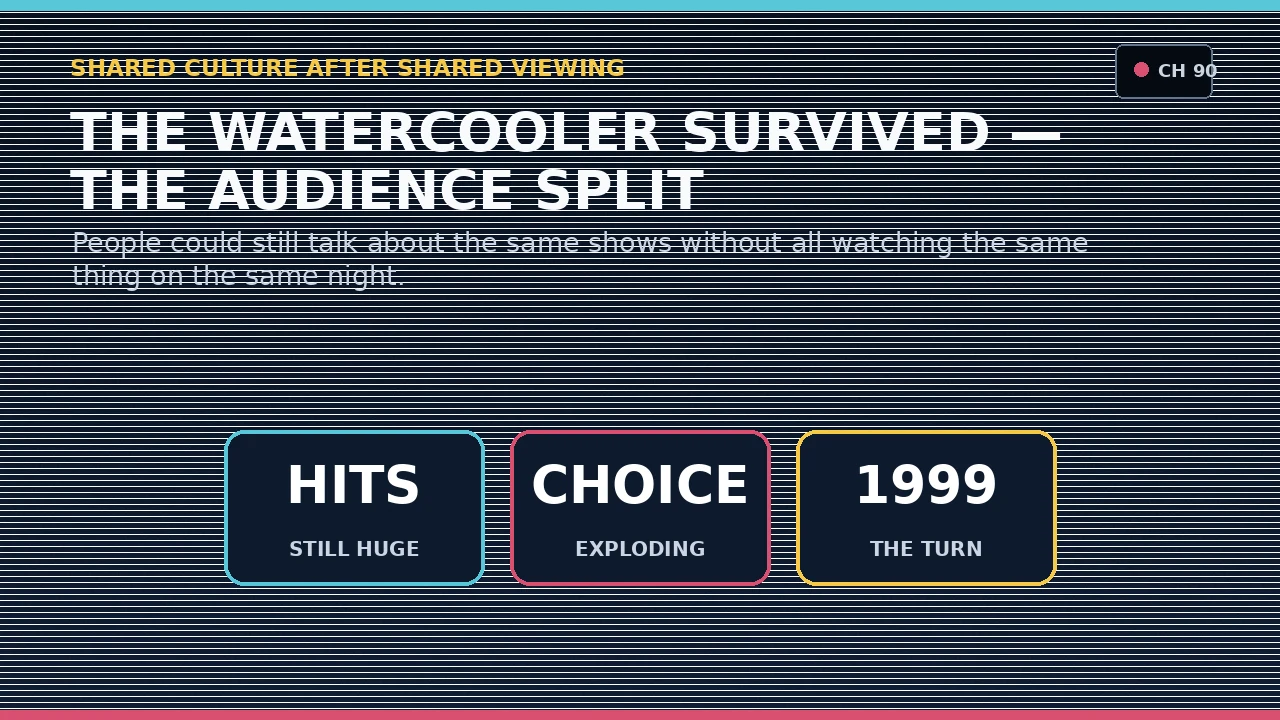
The end of monoculture did not mean people stopped talking about television. It meant fewer conversations started from exactly the same program.
One office group might still be talking about ER. Another was obsessed with The X-Files. Teenagers could be following WB dramas that older viewers barely knew existed. Sports fans were on ESPN. Kids were on Nickelodeon. Movie fans were watching premium cable. The common television language became a set of overlapping dialects.
That fragmentation was not necessarily a loss for viewers. Niche channels could serve interests the old networks ignored. Smaller shows could build intense fan communities without needing a twenty-point household rating. The tradeoff was that television became less reliable as one giant national meeting place.
The early internet accelerated the same trend. Message boards let fans find one another around a specific series, even if nobody else at school or work watched it. Television culture became deeper in pockets and thinner across the whole population.
Streaming would later make that pattern feel normal. In 1999, it was still new enough that the giant network hits and the emerging niche world sat side by side.
Media Eras Fade in Layers, Not on New Year’s Eve
Calling 1999 “the end” is useful only if we do not pretend January 1, 2000 flipped a switch.
Network television remained powerful well into the 2000s. Friends still had years left. ER remained a major series. Reality television soon created new mass hits. American Idol would prove that broadcast could still assemble giant audiences.
What changed by the end of the 90s was the default assumption. The networks no longer owned the entire map. Cable was structurally important. New broadcast networks had carved out identities. The internet was competing for attention. The audience had learned habits that made permanent fragmentation possible.
So 1999 is best understood as a visible boundary. The old system was still recognizable enough to dominate the top ten, but weak enough that its future decline no longer looked temporary.
That makes the year more interesting than a clean ending would be. We can see the old television world and the new one occupying the same living room.
1999 Ratings Show Both the Strength and the Weakening of Broadcast TV
The same data can look triumphant or ominous depending on whether you focus on individual hits or the market around them.
ER at #1 was a triumph. Friends at #2 was a triumph. Frasier at #3 was a triumph. Monday Night Football at #4 was a triumph. Yet the combined share of the major broadcast networks was moving downward while cable’s share moved upward.
That is not a contradiction. It is what a mature media system looks like during fragmentation: the strongest brands remain powerful even as the average program loses the structural advantage of limited choice.
By the time streaming arrived years later, that logic was familiar. A few giant titles could still dominate attention while the total audience spread across hundreds of alternatives. The late 90s were the rehearsal.
That is why 1999 matters so much. The old center still held, but it no longer held everything.
Local habits changed too. Newspapers still printed television grids and families still planned around network nights, but channel surfing had become normal behavior rather than an occasional detour. A viewer could move from a broadcast sitcom to cable news, a movie channel, sports highlights and a music network without leaving the same evening. That constant availability of alternatives weakened the old network assumption that a large lead-in audience would naturally stay put.
For advertisers and programmers, the challenge was no longer only beating the show on the other two networks. It was holding attention against an expanding universe of choices that did not share the same schedule at all.
That shift also changed what success could look like for creators. A series no longer had to become a universal household habit to matter culturally; it could dominate a narrower audience and still influence fashion, language or fandom. The late 90s were when television started learning how to be both massive and niche at the same time.
1999 Was a Transition Year, Not a Funeral for Network Television
The old system did not collapse on New Year’s Eve. It simply stopped being the only system that mattered.
That is why the end of the network monoculture is easier to see in hindsight than it was from the couch. You could still spend Thursday with NBC, Sunday with CBS and Monday with football and feel as if nothing fundamental had changed. Meanwhile, cable share kept rising, younger viewers were adding online habits, and the number of viable alternatives kept multiplying. The mass audience was still there; it was just becoming harder for any one schedule to contain all of it.
Within a few years, reality television, faster cable growth, DVRs, broadband and eventually streaming would make the shift impossible to miss. In 1999, the old world and the next one were sitting in the same living room.
Frequently asked questions
What does “network TV monoculture” mean?
It refers to the era when a small number of broadcast networks captured such a large share of viewing that the biggest shows became common national reference points.
Why use 1999 as an end-of-era marker?
Broadcast hits were still enormous in 1999, but cable’s audience share and the number of viewing choices had grown enough that the old network concentration was clearly weakening.
Were network ratings already collapsing in 1999?
The top programs were still huge. The important change was the collective share of viewing going to broadcast networks as more audience moved to cable and other media.
How much audience did cable have by the end of the 90s?
Nielsen figures reported in 1999 put basic cable at about 41% of total U.S. viewing for the season ending that June, while broadcast networks had about 54%.
Did the internet matter yet?
Not as a television replacement, but it increasingly competed for time, especially among younger users, and helped normalize fragmented interest communities.
What survived the monoculture best?
Live sports, major finales, news events and the strongest long-running franchises remained capable of producing shared mass audiences.