How ER and NYPD Blue Changed Network Drama in the 1990s
How ER and NYPD Blue ChangedNetwork Drama in the 1990s
Network drama did not change in one clean step. ER made television feel faster, denser and more physically immediate. NYPD Blue made it rougher, more adult and more willing to let damaged people stay damaged. By the middle of the decade, the old prime-time rulebook suddenly looked a lot less permanent.
How did ER and NYPD Blue change network drama in the 1990s?
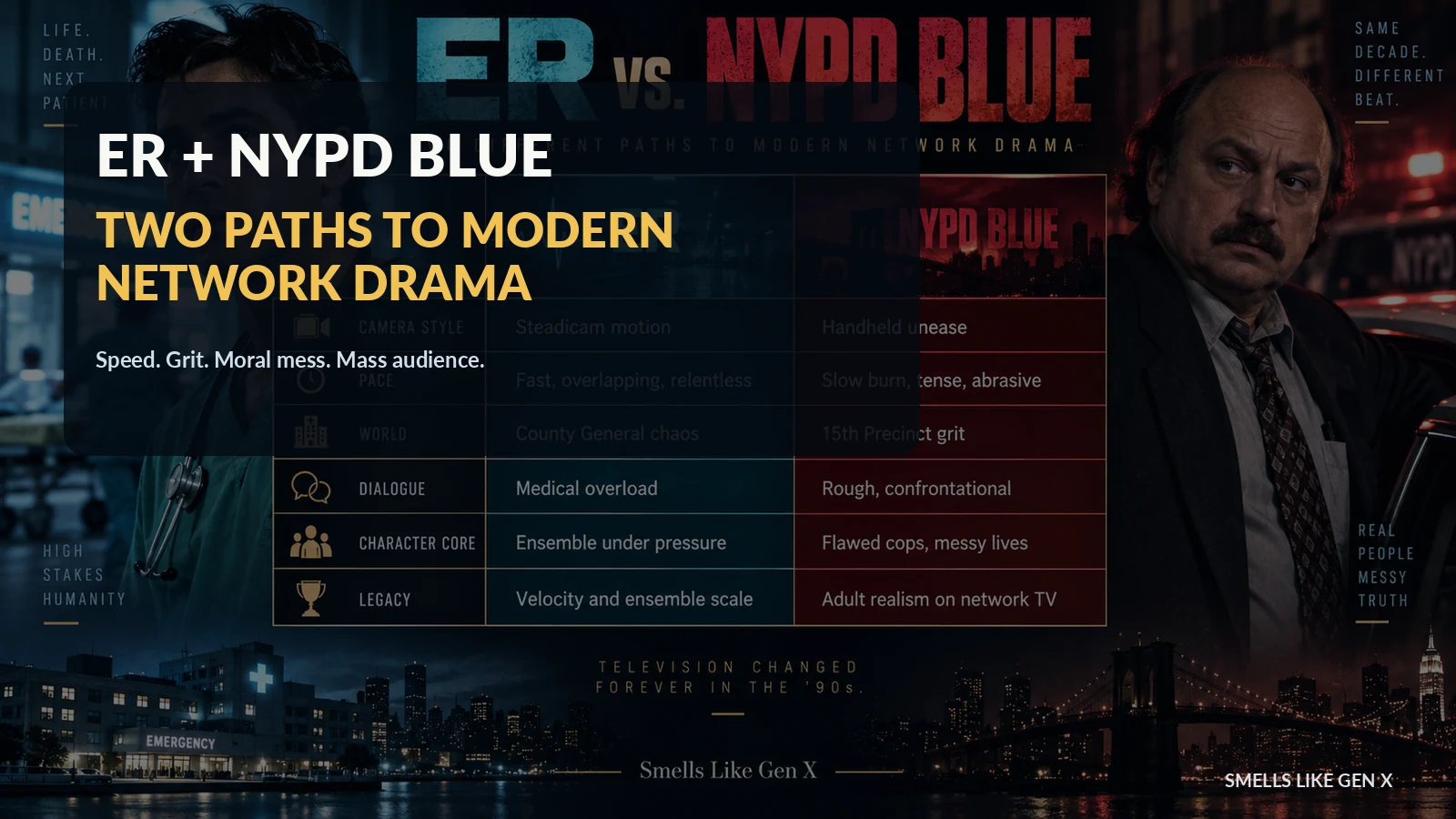
They pushed in different directions and arrived at the same conclusion: network television could be more demanding than viewers had been trained to expect. ER used speed, overlapping action and ensemble storytelling; NYPD Blue used moral ambiguity, raw dialogue and standards-pushing realism. Both proved ambitious drama could still draw a mass audience.
Network Drama Was Already Good. These Shows Made It Feel Dangerous Again
The lazy version of television history says the 1990s suddenly invented serious drama. That is nonsense. Hill Street Blues, St. Elsewhere, thirtysomething, L.A. Law and other 80s series had already complicated characters, serialized stories and the neat little moral boxes that older procedurals liked to use. What changed in the 90s was not the discovery of complexity. It was the willingness to package that complexity with a more aggressive physical and emotional style.
That is where ER and NYPD Blue matter. They did not look alike, sound alike or move alike. One lived in a fluorescent Chicago trauma center where five things could happen before you finished processing the first one. The other lived in squad rooms, apartments and interrogation spaces where the air often seemed stale with resentment. Yet both treated viewers like adults who could keep up without being walked through every beat.
If you grew up on network television, the change was obvious even if you never used words like visual grammar or ensemble architecture. These shows simply felt different when they came on. They were louder in some ways and quieter in others. They were willing to leave you unsettled. That broader shift is part of the larger story of 1990s television and prime-time culture, but these two dramas are where the before-and-after line gets especially easy to see.
NYPD Blue Pushed Network Standards Before Viewers Even Saw the Pilot
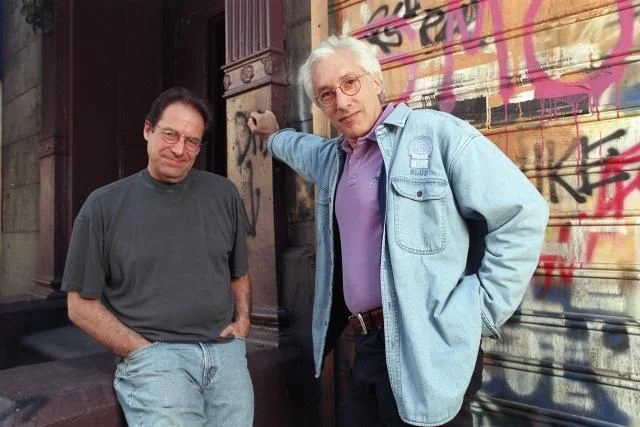
NYPD Blue arrived in September 1993 carrying controversy like a marketing campaign it had not exactly asked for but certainly did not run from. Steven Bochco and David Milch wanted a police drama that used harsher language, partial nudity and a less sanitized emotional world than the major networks usually allowed. ABC knew it was testing boundaries. So did affiliates, advocacy groups and advertisers, which meant the argument about the show began before most people had seen a full episode.
The scale of the affiliate revolt is still striking. ABC ultimately confirmed that 57 of its 225 affiliated stations declined to air the premiere, covering roughly 11 percent of the country. That was not a cable-channel controversy happening off to the side. This was a major broadcast network deliberately trying to move the line while some of its own local stations said no. The strange part is how quickly the debate shifted from whether the show should exist to whether everybody else needed to catch up.
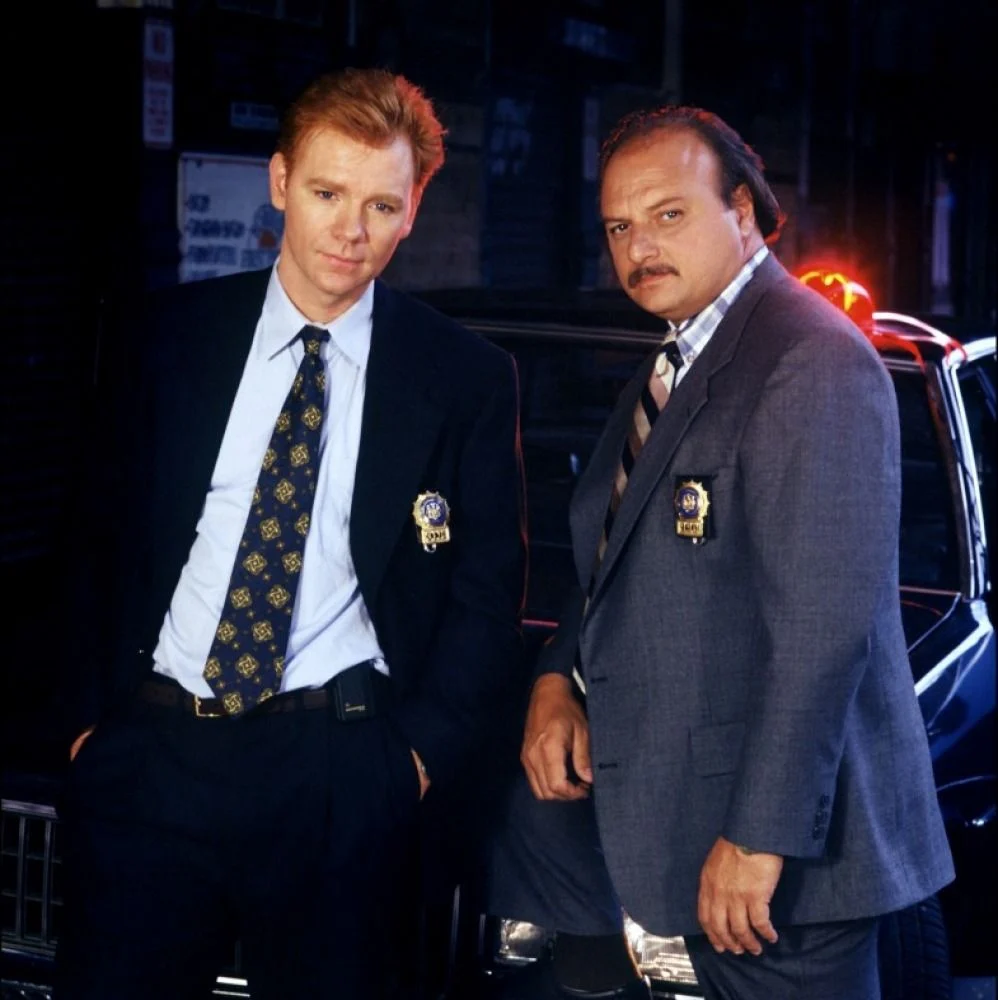
Viewers did show up. So did awards attention, and the series soon proved it could be more than a headline about standards. Its lasting power came from the precinct itself: Andy Sipowicz’s ugliness and vulnerability, the changing partner dynamics, Lt. Fancy’s authority, the friction between cops who were not especially good at talking about anything that mattered. The detailed show-level story belongs in our deep dive on how NYPD Blue made network television grittier; here, the important point is that ABC discovered viewers would accept a lot more abrasion than conventional wisdom suggested.
ER Made Speed Feel Like Storytelling Instead of Decoration
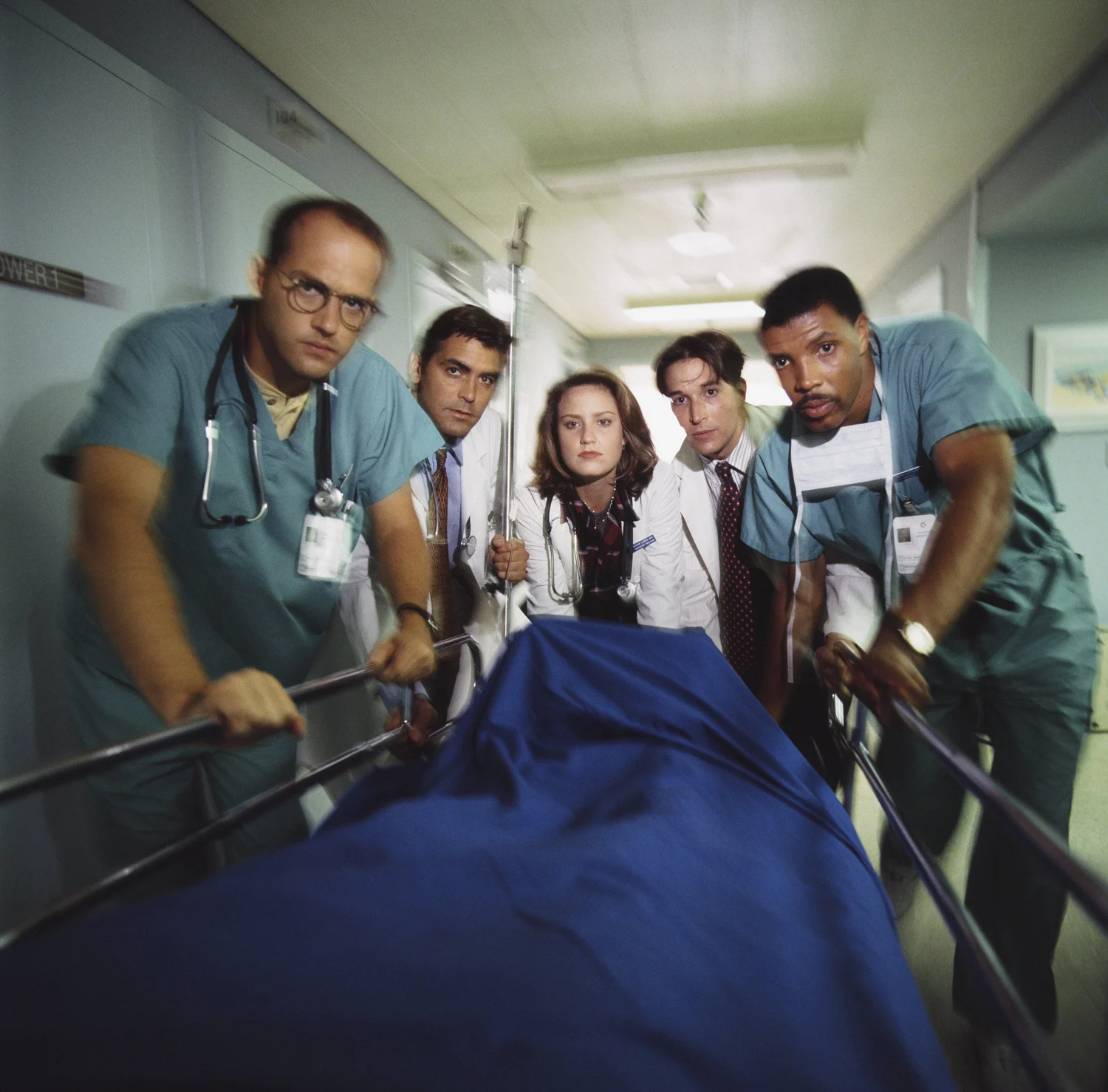
A year later, ER came at the problem from the opposite direction. The pilot premiered in September 1994 from a Michael Crichton script reworked for television under John Wells, with Steven Spielberg involved as an executive producer. The premise sounded almost aggressively familiar: doctors and nurses in a hospital. Then the camera started moving, orders overlapped, patients arrived faster than anyone could comfortably process them, and the whole thing behaved less like a medical soap than a workplace under permanent pressure.
The show’s speed was not just a trick. It changed how exposition worked. Medical jargon could fly by because the emotional meaning of a scene was often clear even when you did not understand every procedure. A character could begin one conversation, get interrupted by a trauma, return to the original problem twenty minutes later and discover that the emotional temperature had changed. The result felt closer to the way a real workday behaves: unfinished, interrupted and full of problems that refuse to wait for a commercial break.
For a deeper look at the series itself, including its characters, production and legacy, see how ER redefined 90s medical drama. In the comparison with NYPD Blue, the key thing is this: both shows stripped away the feeling that a television episode had to stop and politely explain itself. NYPD Blue trusted silence and rough edges. ER trusted momentum.
One Show Raced Through Space. The Other Made Space Feel Uncomfortable
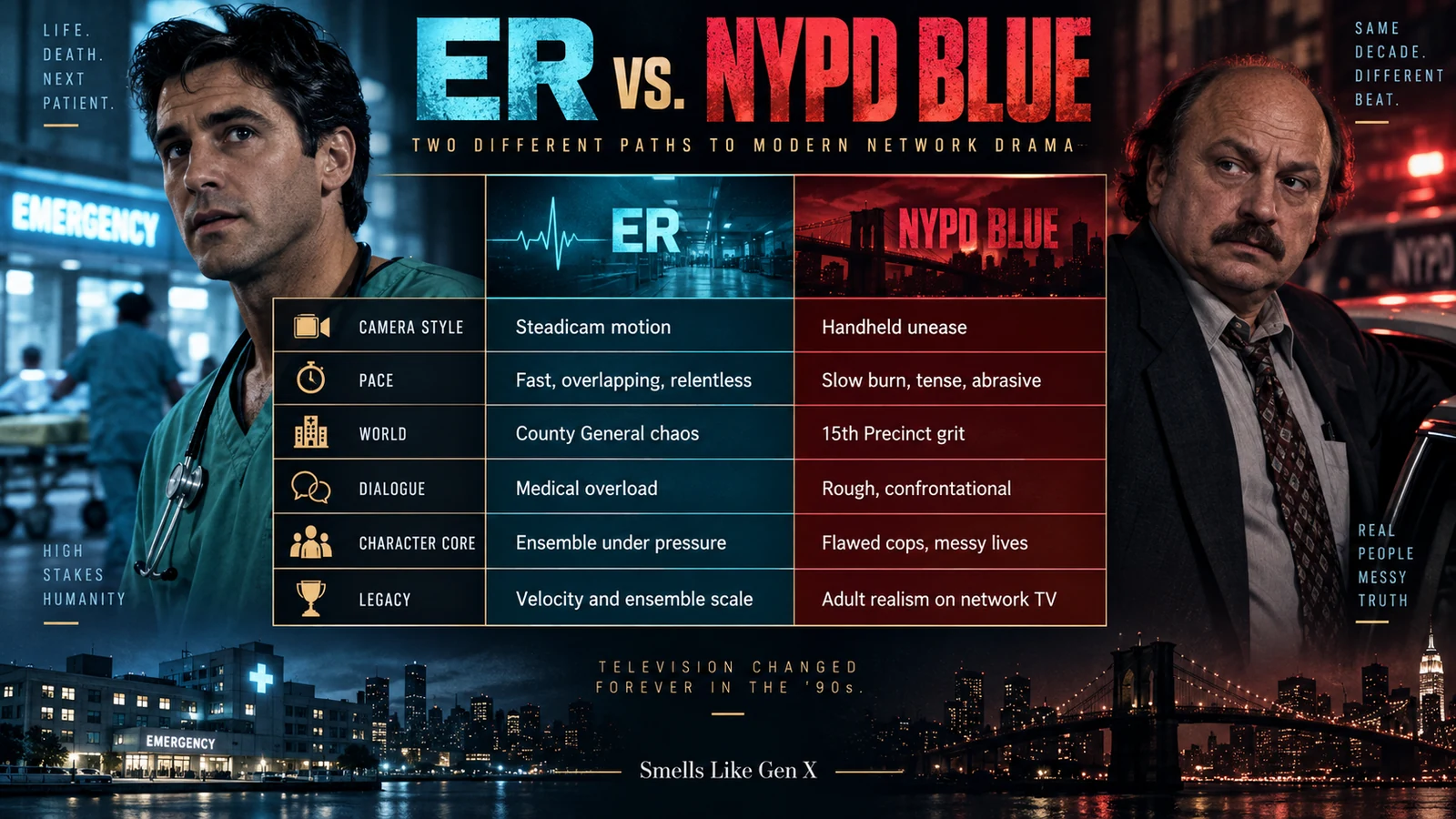
You could probably identify either show with the sound off. ER loved movement through hallways, treatment rooms and crowded workstations. Its Steadicam-driven passages made the emergency department feel interconnected, almost like one enormous organism. Characters entered and left the frame while the story kept moving. The viewer was not placed in the best seat in the room; the viewer was dragged through the room with everybody else.
NYPD Blue often did the opposite. Its camera could feel handheld, searching, slightly late to the action or too close to somebody who clearly wanted more personal space. Quick reframing and nervous zooms gave the precinct a visual instability that matched the characters. It was not documentary realism in any literal sense, but it borrowed enough of that unease to make polished network television feel unexpectedly scuffed up.
That difference is why these shows work so well as a pair. The 90s network-drama revolution was not one aesthetic replacing another. It was permission. A drama could be elegant or jagged, kinetic or claustrophobic, but it no longer had to look like every camera had been bolted to the studio floor and every scene had been designed to make the audience comfortable.
NYPD Blue Made Language, Anger and Moral Failure Part of the Texture
The standards battles around NYPD Blue are easy to reduce to a checklist of words and body parts. That misses the larger change. The show was really arguing for a more adult emotional vocabulary. Its detectives lied, relapsed, humiliated one another, made ugly assumptions and then sometimes surprised you with tenderness. The rough language mattered because it supported a world where people did not become better simply because the hour was ending.
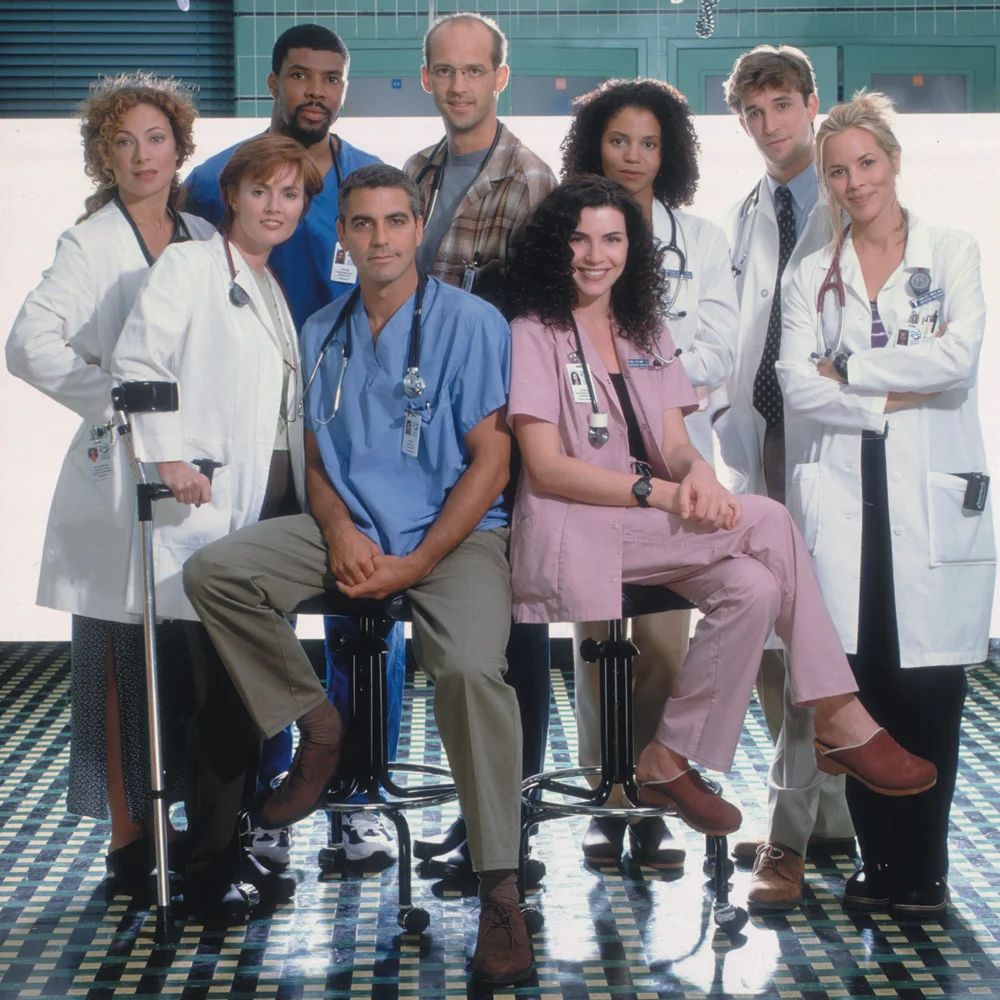
Andy Sipowicz became the clearest example. He could be bigoted, alcoholic, self-destructive and cruel, but the series did not freeze him as a cartoon villain or magically clean him up. It let change happen unevenly. That was a big deal on a mass network because television had long been more comfortable with flawed heroes when the flaws were charming, containable or easily forgiven. Sipowicz’s damage was not decorative. It kept causing problems.
David Milch has described the dialogue as an attempt to capture the metrics of how people actually speak, especially in the street-level world the show inhabited. Whatever you think of every stylistic flourish, the language had weight because it belonged to character. It helped normalize the idea that a network drama could have its own verbal texture instead of sounding like generic television dialogue with the serial numbers filed off.
ER Turned Ensemble Overload Into a Feature
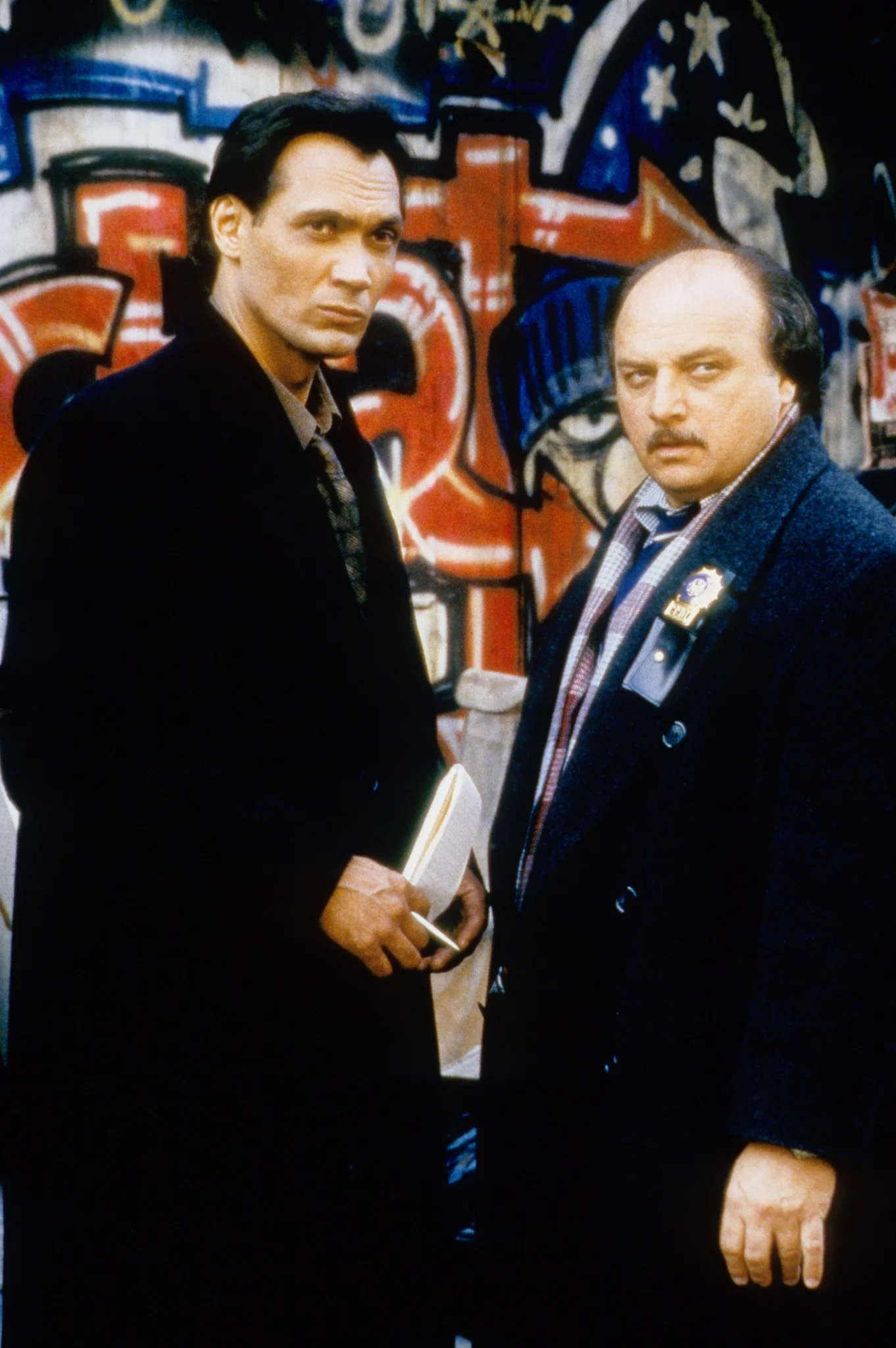
If NYPD Blue deepened the network antihero, ER made the ensemble itself feel like a star. Mark Greene, Doug Ross, Peter Benton, Susan Lewis, Carol Hathaway and John Carter did not simply take turns carrying A-stories. Their problems overlapped inside the same workplace. One character’s emotional crisis could be background noise in another character’s medical emergency, which is exactly how workplaces tend to behave when everyone is living a separate life under one roof.
That structure let the series move between tones without announcing the shift. A brutal trauma could sit beside a joke at the desk, a romantic problem, a teaching moment and a quiet death. Because the hospital never stopped, melodrama could not completely stop it either. The building kept demanding work. That gave ER a kind of narrative discipline even when the personal stories became huge.
The ensemble approach also made cast turnover survivable. Stars mattered, obviously, but County General was bigger than any single doctor. That idea would become increasingly important as long-running dramas learned to refresh themselves without pretending nothing had changed. The show helped prove that viewers could attach to a place, a rhythm and a group dynamic as strongly as they attached to one lead.
The Radical Part Was How Mainstream Both Shows Became
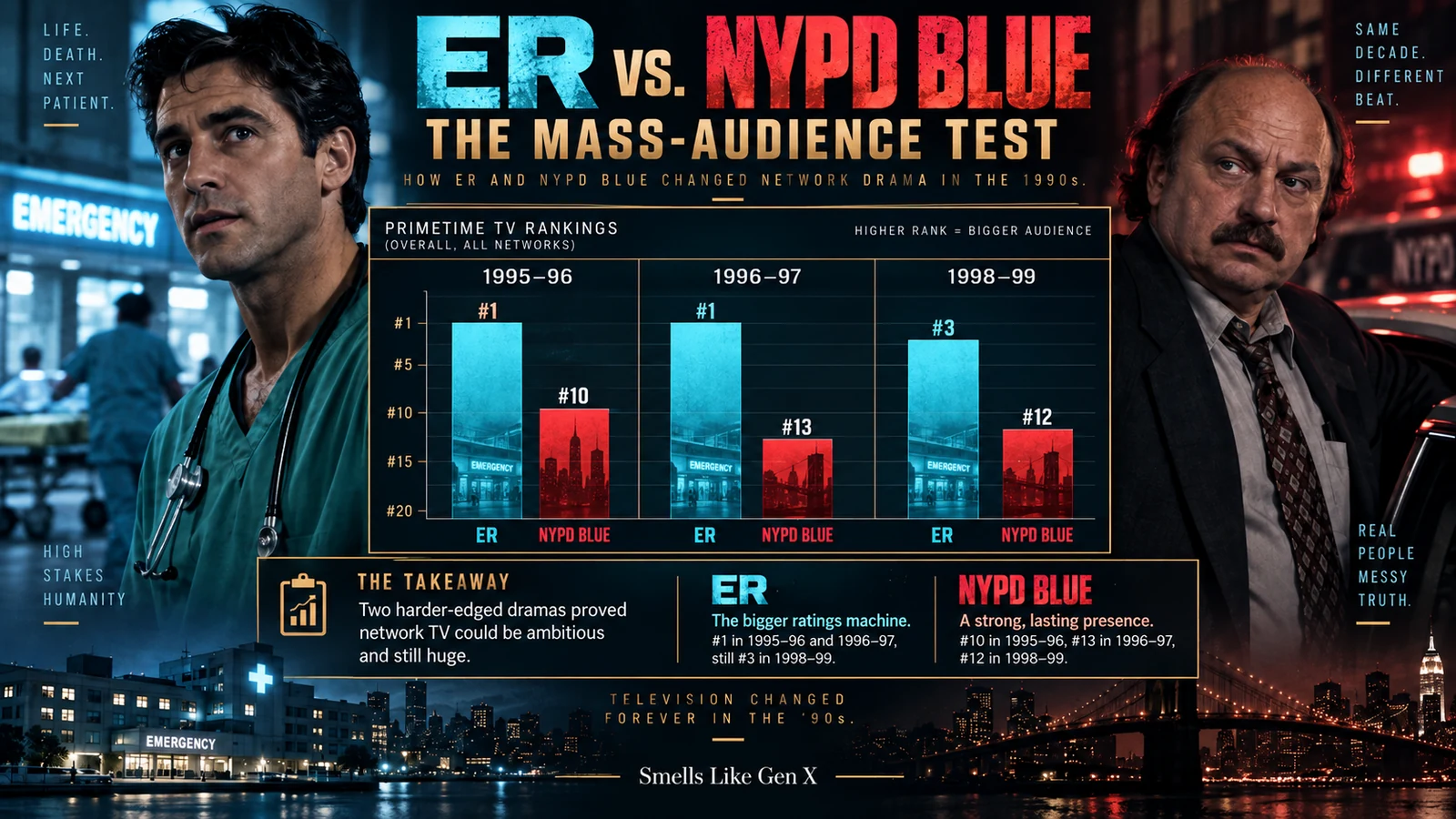
Today we tend to tell the history of ambitious television through cable and streaming, which can make 90s network drama sound like a warm-up act. The ratings tell a different story. These experiments were happening in front of enormous audiences. In the 1995–96 season, ER finished #1 with a 22.0 household rating, while NYPD Blue finished #10 at 14.1. The shows were stylistically adventurous and still sitting in the same rankings as the broadest sitcoms, newsmagazines and football.
That matters because commercial pressure can make networks conservative. A boundary-pushing show that draws a small audience is easy to dismiss as a special case. A boundary-pushing show that lands in the national top ten changes the internal argument. Suddenly executives have evidence that viewers will follow complicated storytelling, morally imperfect characters, fast editing and adult themes if the show gives them enough reason to care.
You can see that 1995–96 snapshot in our ranking of the biggest TV shows of 1996. It catches a moment when ER had become the most-watched series in prime time and NYPD Blue, two seasons after the affiliate revolt, was not some controversial fringe experiment. It was a top-ten network hit.
By 1996, Network Drama Had Two New Definitions of Intensity
The interesting thing about 1996 is that the two shows had already settled into very different kinds of authority. ER was the giant: fast, accessible, emotionally immediate and built to hold a massive Thursday-night audience. NYPD Blue had become the proof that the original controversy was not the whole story. It had survived cast upheaval, turned Jimmy Smits’s Bobby Simone into a central figure and found its long-term emotional center in Sipowicz.
Awards reinforced that status. NYPD Blue won the Emmy for Outstanding Drama Series in 1995. ER won the category in 1996. The handoff is almost too neat, but it captures what network drama looked like in the middle of the decade: the academy and the mass audience were both rewarding shows that asked more from the form than a clean case-of-the-week resolution.
The bigger legacy is not the trophy count. It is the way these shows changed expectations for every drama pitching itself afterward. A new medical show had to explain why it would not feel slow beside ER. A new cop show had to explain why its detectives felt cleaner and less psychologically complicated than NYPD Blue. Once viewers have seen the room with the lights turned up, it is hard to make them pretend they cannot see the old walls.
The 1996–97 Season Shows How Fast the New Normal Arrived
By the season ending in 1997, ER was still #1 by household rating. NYPD Blue had slipped outside the top ten, but the broader drama landscape had already absorbed much of what it helped make possible. The X-Files, Law & Order, Chicago Hope and other series were building their own kinds of tonal specificity. Network drama was becoming less interested in one universal house style.
The ratings page for the 1996–97 television season also shows how fierce the competition for attention had become. NBC’s comedy machine dominated the upper chart, live football remained huge, and CBS was finding a different kind of mass audience with Touched by an Angel. Drama could no longer rely on genre loyalty alone. It needed an identity you could recognize in a few minutes.
That is another place where ER and NYPD Blue had already done the work. Their identities were unmistakable. You did not confuse County General with another hospital, and you did not confuse the 15th Precinct with another police station. In a schedule full of familiar genres, specificity became a competitive advantage.
ER’s Live Episode Worked Because the Show Already Felt Live
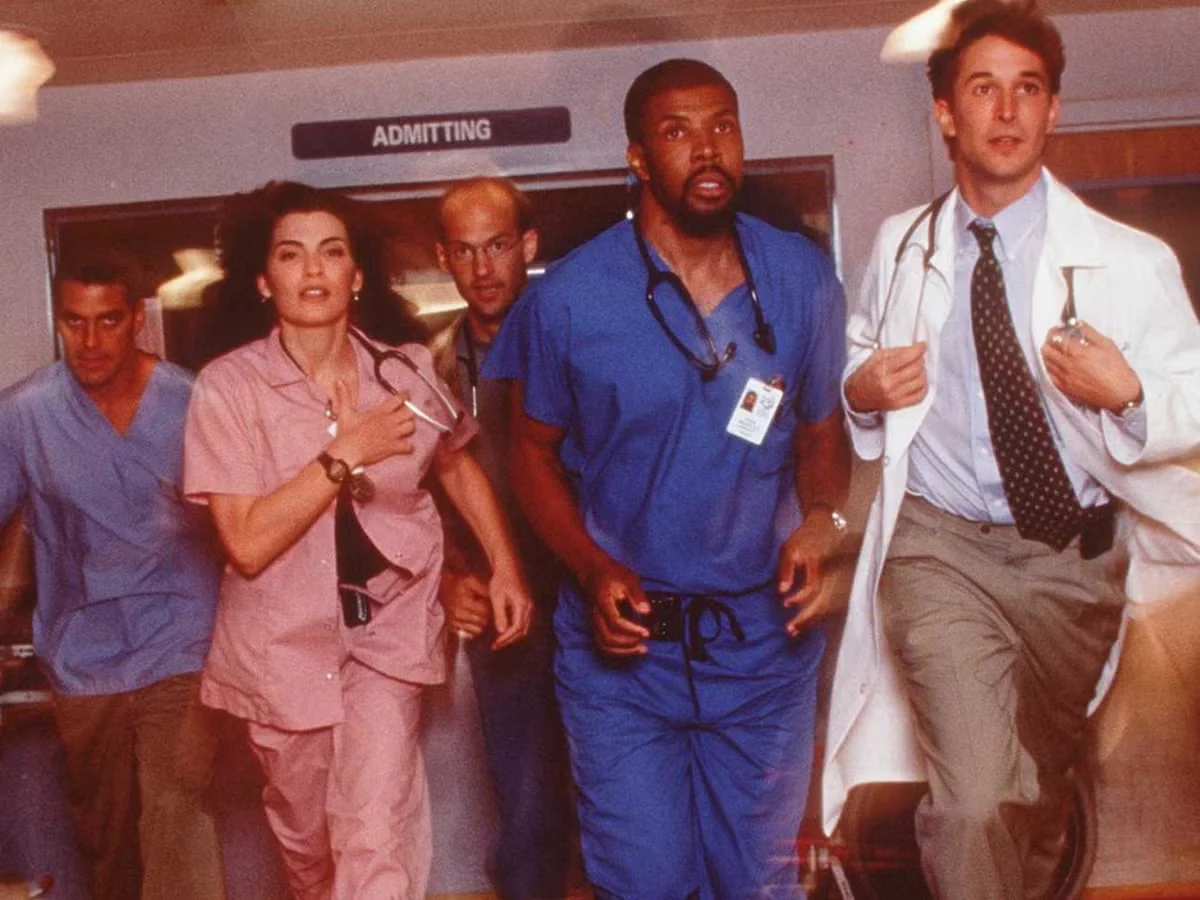
In September 1997, ER opened its fourth season with “Ambush,” performed live twice for the East and West Coasts. On paper, that sounds like exactly the kind of stunt network television loves: big promotion, big risk, big event. What made it more than a stunt was that the series had spent three years teaching viewers to experience the emergency room as continuous motion.
The live format intensified qualities already embedded in the show. Actors had to move through complex medical choreography without the safety net of normal editing. Cameras had to find the action in real time. The audience knew mistakes were possible, which added a layer of tension to a series built around situations where mistakes already mattered. It was a stunt, yes, but it was a stunt that belonged to the show’s grammar.
That is another lesson the decade carried forward. Ambition works best when it grows out of identity. NYPD Blue could push language because its world demanded rougher speech. ER could go live because its world was already organized around pressure and movement. Neither show needed to bolt prestige onto the outside.
Both Shows Let Professional Competence and Personal Failure Coexist
Older television often treated competence as a shortcut to virtue. The doctor who saved the patient was a good person. The detective who caught the killer was on the right side of the moral ledger. The 90s increasingly pulled those ideas apart. A character could be brilliant at the job and disastrous everywhere else, or deeply decent and still make a professional mistake with consequences.
ER used that split to humanize people who worked under impossible pressure. Benton could be a gifted surgeon and a punishing mentor. Doug Ross could be charismatic, compassionate and reckless. Greene could be the emotional center of the department and still carry anger, exhaustion and bad judgment. NYPD Blue went even harder, building whole arcs around officers whose instincts, prejudices and loyalties could not be sorted into a neat hero column.
For Gen X viewers raised on a lot of television where grown-ups were either authority figures or comic disasters, that ambiguity felt recognizably adult. The point was not that everyone was secretly terrible. The point was that a job title did not settle the character question. Modern television takes that for granted now. In the 90s, it was part of the recalibration.
By 1999, the Experiments Had Become Part of Network Television’s Vocabulary
The 1998–99 season is useful because it shows how much had changed without either series needing to stand in exactly the same place. ER finished #1 again by household rating. NYPD Blue ranked #12, still a major network drama six seasons after a premiere that dozens of affiliates refused to carry. The old shock had become part of the furniture.
Look at the biggest television shows of 1999 and the larger shift becomes clearer. Law & Order was entrenched. The X-Files had made genre drama serious appointment viewing. New shows were arriving in a world where serialized character arcs, antiheroes, strong visual signatures and adult subject matter no longer required an apology. Broadcast standards still existed, but the creative perimeter had moved.
That is why the end-of-decade comparison matters more than asking which show was “better.” ER and NYPD Blue solved different problems. One proved density and speed could be mainstream. The other proved discomfort and moral grime could be mainstream. Together they widened the lane for almost everyone behind them.
For Gen X, the Change Was Something You Felt Before You Analyzed It
There is a specific memory attached to both shows: they could make the room feel quieter. Not because they were quiet programs—good luck calling ER quiet—but because you had to pay attention. Miss thirty seconds and somebody had already been intubated, transferred, arrested, insulted or emotionally detonated. These were not great shows for wandering into the kitchen and assuming the laugh track would tell you when to come back.
The network context made that attention feel communal. You watched at the scheduled time, then the next morning the episode was available as conversation, not as a link. An ER cliffhanger or a brutal NYPD Blue turn could become part of school, work or radio chatter because the audience had encountered it together. That shared timing magnified the sense that television itself was changing in public.
And because these were free over-the-air network dramas, the shift was not hidden behind a premium subscription. You did not have to be the person with HBO. You just needed NBC or ABC reception and the willingness to stay up. That mass availability is one reason their influence traveled so quickly.
The Real Legacy Is the Range of Drama We No Longer Find Unusual
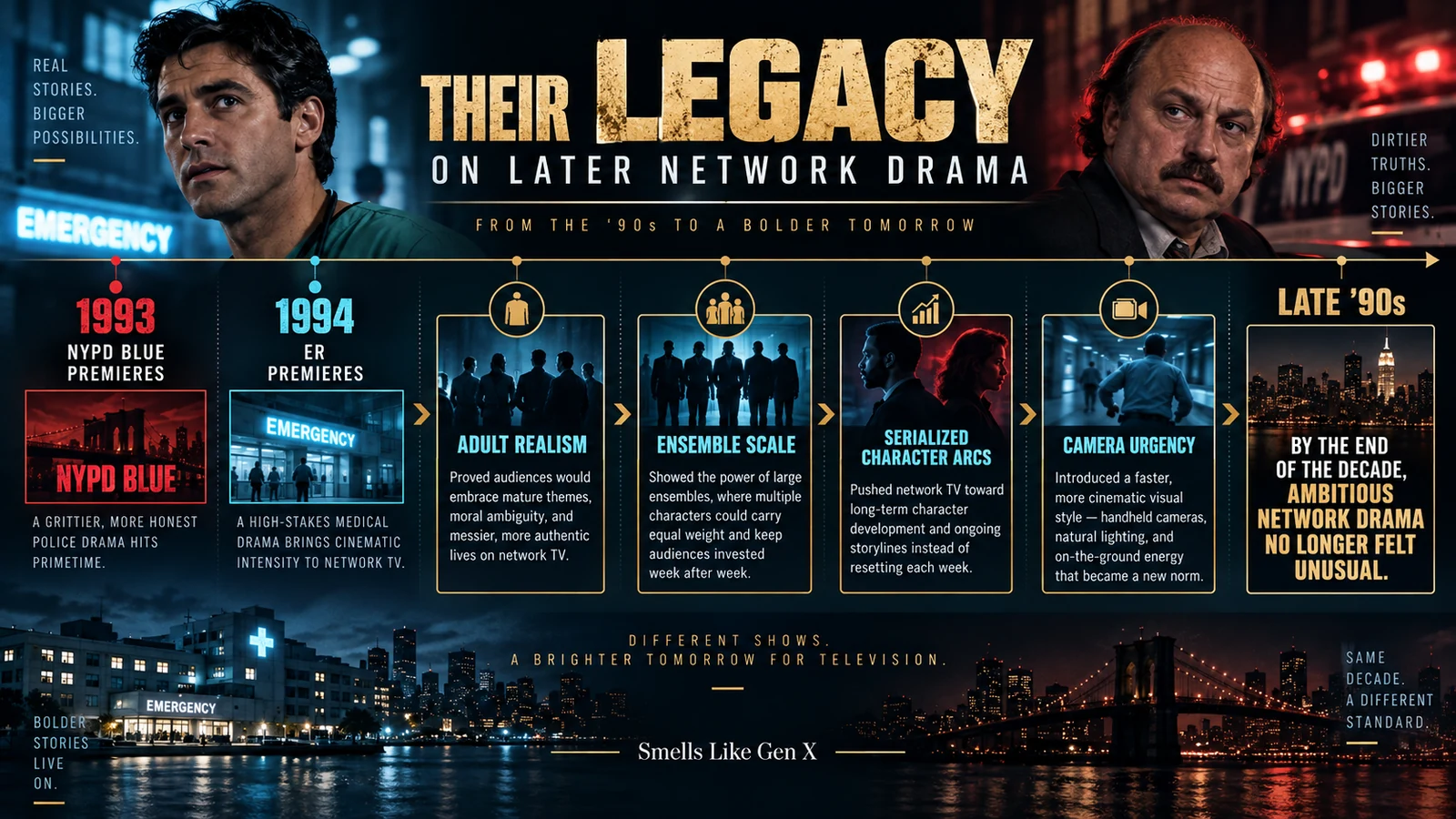
It is tempting to draw a straight line from NYPD Blue to every later antihero drama or from ER to every fast medical series. Television history is messier than that. Creators borrow from dozens of places, technology changes, cable changes economics and audiences change what they will tolerate. The more useful legacy is permission: after these shows, the acceptable range of network drama was visibly broader.
You could build around a deeply compromised lead without promising quick redemption. You could let technical language fly. You could use an ensemble so large that no one character controlled the emotional center. You could make the camera itself feel anxious. You could run stories across episodes without turning the whole series into an impenetrable serial. Most importantly, you could do those things and still chase millions of ordinary viewers rather than a tiny cult audience.
That combination is what makes the pair so important to the history of 90s network dramas. ER gave prime time velocity. NYPD Blue gave it bruises. Between them, network drama learned it did not have to choose between being popular and being specific. Once that lesson took hold, television never really went back.
Frequently asked questions
Which premiered first, ER or NYPD Blue?
NYPD Blue premiered on ABC in September 1993. ER premiered on NBC in September 1994.
Was NYPD Blue really controversial when it premiered?
Yes. ABC confirmed that 57 affiliated stations did not air the first episode, largely because of objections to nudity and coarse language.
How successful was ER in the ratings?
ER became one of the biggest programs of the decade and finished #1 in the 1995–96 and 1996–97 seasons by household rating.
Did ER and NYPD Blue have the same style?
No. ER emphasized speed, movement and ensemble overload. NYPD Blue emphasized rough dialogue, handheld unease, intimacy and morally compromised characters.
Which show won Outstanding Drama Series first?
NYPD Blue won the Emmy for Outstanding Drama Series in 1995. ER won the category in 1996.
Why do these two shows belong in the same story?
Because together they widened the acceptable range of network drama: one showed how kinetic and complex a mass-audience drama could be, while the other showed how adult, abrasive and morally untidy it could become.
Sources behind this story
- Television Academy — ER at 30: The Oral History of Making the Pilot
- Television Academy — ER awards and nominations
- Television Academy Interviews — NYPD Blue
- Television Academy Interviews — David Milch
- Los Angeles Times — NYPD Blue premiere preemptions, Sept. 1993
- Los Angeles Times — 1995–96 Nielsen season Top 10
- Los Angeles Times — 1996–97 season ratings