Top TV Shows of 1986 (According to Nielsen Ratings)
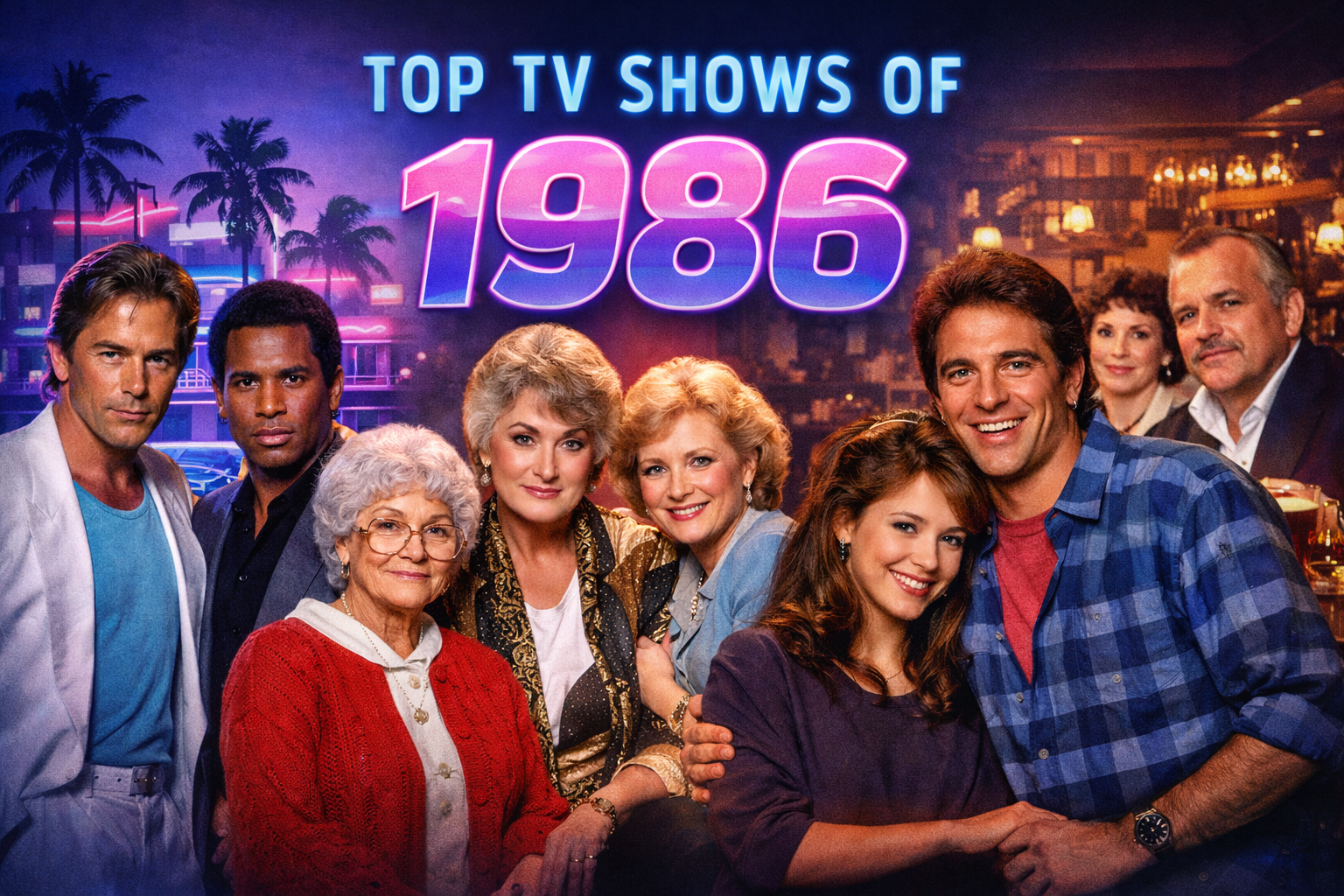
The Top TV Shows of 1986
By 1986, the television center of gravity had clearly moved. The first half of the decade had been ruled by power suits, private jets, boardroom backstabbing, and rich families trying to destroy each other in rooms lit like jewelry ads. That world had not vanished — you can still see it all over this list — but it no longer had the schedule to itself.
What replaced it was not one single thing. It was a mix. Warm family sitcoms got bigger. Ensemble comedy got sharper. Mystery shows became comfort food. Style-heavy crime drama found a cooler, more cinematic lane. And somehow, a serious newsmagazine was still big enough to sit near the top and remind everyone that old network TV could support wildly different kinds of hits at the same time.
This countdown uses the 1985–86 Nielsen season, which is the standard reference point for the top TV shows tied to 1986. One wrinkle: Dynasty and The Golden Girls shared the same official slot, so the snapshot boxes preserve that tie even though this countdown still gives you ten full sections to keep the post readable.
Browse the series: 1980s TV Hub | 1980 | 1981 | 1982 | 1983 | 1984 | 1985 | 1986 | 1987 | 1988 | 1989
Gen X note: 1986 feels like the year the 80s TV personality fully settles in. The shows are warmer, slicker, funnier, and more self-confident. Even the dramas look like they know they’re iconic.
#10 — Who’s the Boss?
Network: ABC
Debut: 1984
Official Nielsen Rank: #10
Who’s the Boss? is one of those sitcoms that looked lighter than it really was. On the surface, it gave viewers an easy hook: Tony Micelli, a former baseball player and single dad, moves into the home of high-powered ad executive Angela Bower to work as a housekeeper and help raise his daughter Samantha. Angela has her own son, Jonathan, and her mother, Mona, circling the situation with a level of meddling that could qualify as a second job. That setup gave the show instant rhythm — class tension, household tension, flirtation, parenting disagreements, and the kind of domestic awkwardness that sitcoms live on.
What made the series especially strong in 1986 was that it could play as both a broad sitcom and a quietly modern one. Tony’s masculinity was never treated as incompatible with caregiving, cooking, or housework. Angela’s career success was not a punchline. The show got a lot of mileage from role inversion without turning the whole thing into a lecture on gender politics. That is harder than it sounds. A lot of sitcoms with “progressive” setups become stiff; this one stayed relaxed and charismatic.
There was also the not-so-small matter of chemistry. The show knew exactly how to milk the will-they-won’t-they tension between Tony and Angela without rushing it to death. Add Mona’s scene-stealing interference and the kid energy from Samantha and Jonathan, and Who’s the Boss? managed to feel both family-friendly and just grown-up enough to keep the adults fully invested.
#9 — Miami Vice
Network: NBC
Debut: 1984
Official Nielsen Rank: #9
Miami Vice in 1986 is not just a crime drama in the top 10. It is a visual thesis statement about mid-80s television. Crockett and Tubbs are technically vice detectives, but the show’s larger impact comes from mood: the night scenes, the pastel jackets, the ocean lights, the synthesizer-heavy soundtrack, the expensive-looking danger, and the sense that every case existed inside a world already humming with heat and corruption. It didn’t simply tell stories. It sold atmosphere.
What made the show especially important here is that it pushed television closer to music-video logic without giving up narrative entirely. Scenes were allowed to breathe on attitude. Music was allowed to carry emotion. Clothing and cars and locations stopped feeling like incidental details and started acting like part of the point. That could have easily turned empty, but Miami Vice had just enough darkness and melancholy under the glossy surface to keep the style from floating away from the stakes.
In the 1986 lineup, the show represents a different path to top-tier success than the comfort comedies around it. It’s cooler, moodier, more image-forward, and more morally unstable. That contrast helps explain why it still stands out. It isn’t just one of the biggest shows of 1986 — it’s one of the shows that taught television how to look a certain way for years afterward.
#8 — The Golden Girls (Official Nielsen Rank: T-7)
Network: NBC
Debut: 1985
Official Nielsen Rank: T-7
The Golden Girls landing in the top 10 this fast is one of the clearest signs that 1986 audiences were willing to reward a sitcom that did not look like the standard network template. Four older women sharing a house in Miami did not sound like the obvious center of a ratings phenomenon — until the writing, the casting, and the timing made it feel inevitable. Dorothy’s sarcasm, Rose’s sweetness, Blanche’s confidence, and Sophia’s acid delivery created one of the cleanest comedic ensembles of the decade.
What made the show more than just a sharp joke machine was the emotional maturity underneath it. It was willing to talk about loneliness, dating, illness, money, family disappointment, sex, death, and reinvention without losing the comic rhythm. That balance gave the series a kind of range few sitcoms manage. It could be warm without getting mushy, topical without feeling performative, and surprisingly bold without ever seeming as though it were trying to make history. It just did.
For a 1986 top-10 post, The Golden Girls is hugely important because it shows that NBC’s rise was not only about families with kids. The network was learning how to make different forms of emotional comfort mainstream. This show offered companionship, verbal speed, and real perspective wrapped in a laugh-friendly package. The result was a series that broadened what a blockbuster sitcom could be.
#7 — Dynasty (Official Nielsen Rank: T-7)
Network: ABC
Debut: 1981
Official Nielsen Rank: T-7
Dynasty still sitting in the top 10 in 1986 tells you that the glam-soap era hadn’t disappeared just because the comedy surge was real. The Carrington world still had everything viewers had come to expect from luxury conflict television: wealth worn like armor, relationships treated like chess moves, and rooms so elegant they made betrayal look like interior design. The show remained a style delivery system as much as a dramatic one.
But the 1986 version of Dynasty feels different from its earlier dominance because now it’s holding ground rather than defining the whole battlefield. That’s what makes this placement interesting. The gowns, power plays, and carefully staged cruelty still worked. Alexis was still an event. The visual language of excess still had enormous pull. Yet the series was now living in a schedule where family sitcoms, cozy mysteries, and ensemble bar comedies were attracting equal or greater loyalty.
In that sense, Dynasty in 1986 becomes a snapshot of a reigning aesthetic under pressure. It is still glamorous, still sharp, still culturally iconic — but no longer the only thing America wants when it turns on the television.
#6 — Dallas
Network: CBS
Debut: 1978
Official Nielsen Rank: #6
Dallas in sixth place is one of the most instructive rankings in the entire 1986 list. This was still one of television’s signature shows, the prime-time soap that had helped revolutionize the form. By 1986 the show was no longer the insurgent that changed the game. It was the established empire figuring out how to remain powerful after the landscape it helped create had diversified around it.
The core engine still worked. J.R. Ewing was still one of television’s greatest manipulative centers of gravity, and the Ewing world still knew how to turn business conflict, family resentment, marital collapse, and strategic betrayal into weekly appointment viewing. One of the great strengths of Dallas was always its sense of narrative momentum. Every deal seemed temporary. Every loyalty felt conditional. Every smile looked like it might conceal a knife. That kind of storytelling doesn’t suddenly stop being effective because sitcoms get better.
What changes in 1986 is the context. Dallas is now competing not just against its soap relatives, but against a television culture increasingly drawn to comfort, rhythm, and comedy that feels livable. That is why the ranking is so interesting. A sixth-place finish doesn’t say decline nearly as much as it says realignment. The show was still enormous. It just no longer defined the whole room by itself.
#5 — Cheers
Network: NBC
Debut: 1982
Official Nielsen Rank: #5
Cheers in the top five is one of the clearest pieces of evidence that NBC’s rise wasn’t just about family comedy. Set in a Boston bar and centered on the staff and patrons who treated it like a second home, the show turned one room into one of the richest ensemble spaces on television. It wasn’t just a premise. It was a social ecosystem.
What made Cheers special was the density of its character dynamics. Sam Malone’s former-athlete swagger, Diane’s intellectual romanticism, Carla’s venom, Norm’s end-of-the-bar consistency, Cliff’s bizarre confidence, and the later presence of Frasier all gave the series a kind of comic layering that most sitcoms can only envy. The bar itself mattered because it created a believable shared space where the same people could plausibly keep colliding, drifting, sniping, flirting, and failing in public. That made the show feel less like a sequence of jokes and more like an environment viewers could inhabit.
For 1986, Cheers is important because it expands the idea of comfort television. This isn’t a family living room. It’s a bar full of adults with baggage. But it still offers the same deep viewer satisfaction: familiarity, routine, and people you want to see again. That’s a huge part of why NBC became so dominant. It wasn’t just making nice sitcoms. It was building places audiences wanted to spend time in.
#4 — 60 Minutes
Network: CBS
Debut: 1968
Official Nielsen Rank: #4
The fact that 60 Minutes was still fourth in the nation in 1986 is one of the strongest pieces of evidence that network television once had a much wider range of mass appeal than people sometimes assume. In a year full of comfort sitcoms, cozy mysteries, style-heavy crime drama, and surviving soap empires, a serious newsmagazine remained one of the country’s biggest draws.
What made the show so durable is that it didn’t treat seriousness like a burden. It treated seriousness like an event. Interviews mattered. Reporting mattered. The correspondents mattered. But the format also mattered. 60 Minutes had enough rhythm, confidence, and editorial force to make information feel urgent rather than dutiful. It wasn’t asking viewers to lower their expectations for entertainment. It was showing that substance itself could be gripping television when it was delivered with enough clarity and authority.
That becomes even more impressive in the context of 1986, when competition for attention was getting more emotionally varied. Viewers now had top-tier family sitcoms, increasingly polished comfort mysteries, and some of the most style-conscious drama the decade had produced. Yet 60 Minutes still held its position. It’s one of the best examples in the whole series of how broad the shared TV culture used to be.
#3 — Murder, She Wrote
Network: CBS
Debut: 1984
Official Nielsen Rank: #3
Murder, She Wrote rising to #3 is one of the smartest outcomes on the 1986 list because it reveals just how strong the appetite for comfort mystery had become. Jessica Fletcher wasn’t flashy. She wasn’t violent. She wasn’t trying to be edgy. She was a mystery writer, a deeply observant amateur sleuth, and one of the calmest centers on all of television.
What made the show a real ratings giant rather than just a respectable one was tonal precision. The stories involved murder, but the series almost never felt grim. Jessica Fletcher’s presence changed the emotional temperature of every episode. She brought intelligence, decency, patience, and enough quiet authority to make the audience feel safe in the hands of the story. That’s a rare thing in television. Viewers weren’t just returning for the case. They were returning for her.
In the 1986 schedule, Murder, She Wrote stands for a huge change in how audiences were rewarding shows. It wasn’t enough to be glamorous or explosive anymore. There was enormous value in being dependable, civilized, and satisfying. That made the series more than a pleasant diversion. It made it a national habit.
#2 — Family Ties
Network: NBC
Debut: 1982
Official Nielsen Rank: #2
Family Ties rising to #2 in 1986 tells you a lot about where network television’s emotional center had moved. The setup was clean and incredibly useful: former 1960s-liberal parents Steven and Elyse Keaton are raising children in a different ideological world, and at the center of that generational shift is Alex P. Keaton, ambitious, conservative, hyper-verbal, self-serious, and impossible to forget.
But the secret of the show wasn’t just Alex. It was the fact that the Keatons still felt like a family first. The ideological conflict gave the writers constant material, but the show never lost the affection underneath it. Parents and children could deeply disagree and still remain emotionally legible to one another. That gave the series a warmth that made its comedy stick. Even when Alex was absurd, the show never made him emotionally disposable. He was ridiculous, not irrelevant.
For a 1986 post, Family Ties matters because it’s one of the clearest examples of a sitcom becoming central, not secondary. This wasn’t a nice comedy that lived off to the side while the real power sat in soaps and dramas. This was one of the biggest shows in America. And that means the values of TV dominance had changed: intimacy, warmth, ideological tension, and high rewatchability now had top-tier commercial force.
#1 — The Cosby Show
Network: NBC
Debut: 1984
Official Nielsen Rank: #1
The Cosby Show taking the top spot in 1986 is the clearest statement in the whole countdown. The shift was complete. Prime time was no longer primarily ruled by oil dynasties, boardroom betrayals, or glossy melodrama. Now the most powerful force on television was the Huxtable household — a family sitcom that made warmth, intelligence, and domestic rhythm feel like the most watchable things in America.
What made the show so strong so quickly wasn’t just Bill Cosby’s comic presence or the elegance of the Huxtables’ Brooklyn life. It was the confidence of the whole world. Cliff and Clair felt like fully formed adults. The kids had distinct personalities. The jokes came out of personality rather than stand-alone setups. That’s a huge reason the show became so comfortable to revisit. It offered viewers not just laughs, but an environment they wanted to return to — a home with order, humor, affection, and just enough chaos to feel real.
The bigger 1986 point is that The Cosby Show didn’t merely win the season. It changed the schedule around it. It helped make NBC dominant, pulled other comedies upward with it, and proved that family-centered television could be sophisticated, aspirational, and massively popular all at once. Whether people came for the laughs, the warmth, or the sense of home, they came in huge numbers.
For this 80s TV series, that makes it one of the most significant #1s of the decade. It doesn’t just tell you what the biggest show was. It tells you what kind of television was now powerful enough to define the culture.
The Rewind Verdict
The top TV shows of 1986 are so satisfying because the list finally feels like the 80s version of balance. The first half of the decade leaned hard on glamour and power. By this point, the chart still has room for those things, but it’s clearly rewarding something broader: comfort, wit, competency, and characters viewers want to revisit every week.
That doesn’t mean the year is soft. It means the center has moved. You still have neon-cool crime drama. You still have soap-era survivors. You still have one of the biggest newsmagazines in TV history. But the strongest energy on the page comes from sitcoms and mysteries that create worlds people genuinely enjoy inhabiting.
For Gen X, these were the shows that made the week feel structured. Thursday-night rituals, Sunday-night routines, mystery comfort, barroom banter, pastel-cop cool, and family comedy all had a seat at the same table — and in 1986, that table looked very, very NBC.
FAQ
What was the most watched TV show of 1986?
According to the 1985–86 Nielsen season, The Cosby Show was the #1 TV show tied to 1986.
Was Family Ties bigger than Dallas in 1986?
Yes. In the 1985–86 season, Family Ties ranked #2 while Dallas ranked #6.
Did The Golden Girls rank in the top 10 in 1986?
Yes. The Golden Girls shared the same official ranking slot as Dynasty.
Was Miami Vice still a top show in 1986?
Yes. Miami Vice ranked #9 in the 1985–86 Nielsen season.
Why does this post use the 1985–86 season for 1986?
Because television popularity was measured by season rather than calendar year. For year-based nostalgia rankings, the season ending in that year is the standard reference point.
What makes 1986 such an important TV year?
It marks the point where NBC’s comedy dominance becomes undeniable while earlier drama giants like Dallas and Dynasty are still hanging in the top tier.
Get the Weekly Gen X Drop
New videos, rewinds, and savage nostalgia — first.
JOIN THE NEWSLETTER WATCH VIDEOS