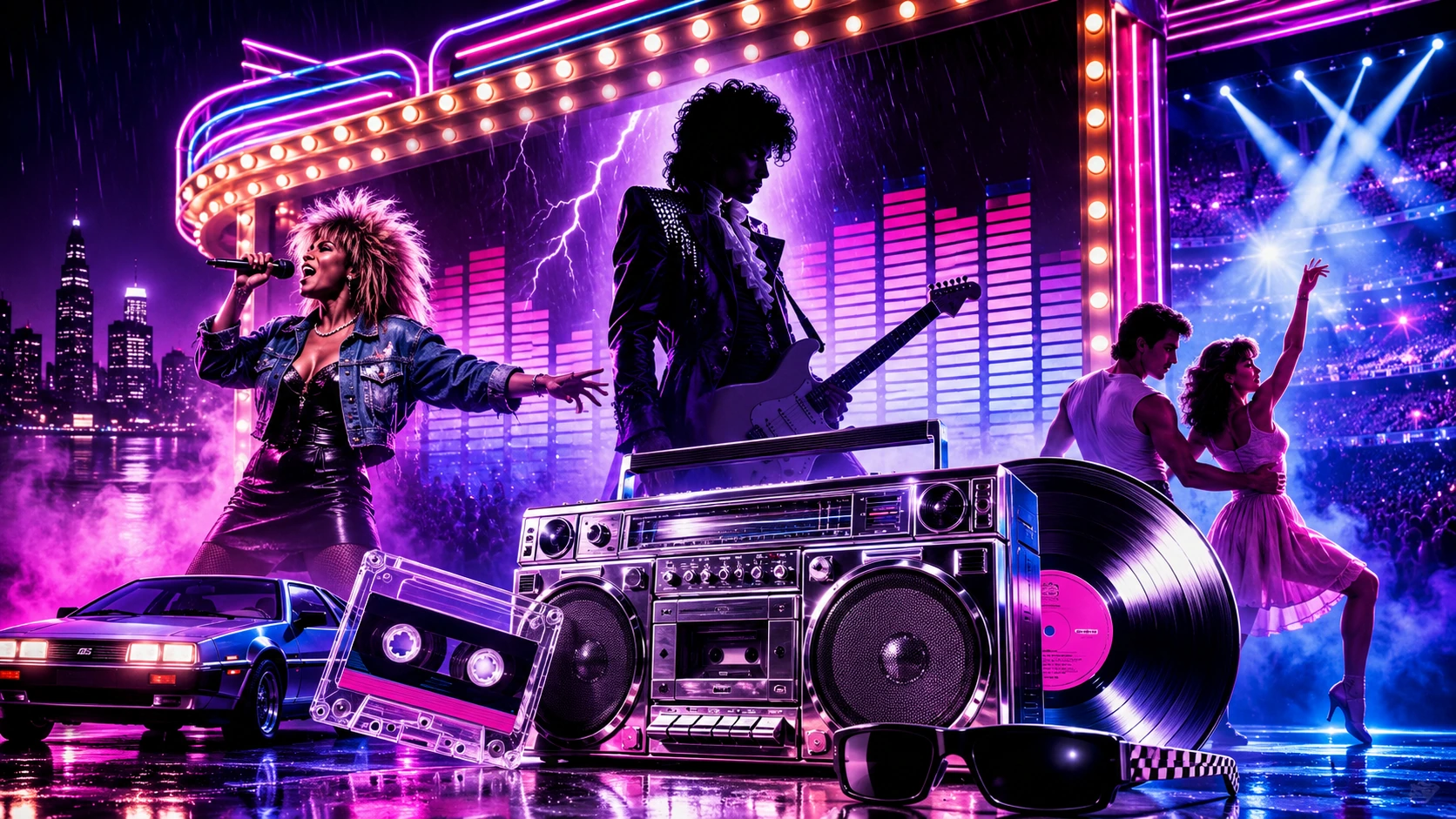
Top 10 Songs of 1984: Billboard Hits from the Peak of the 80s
1984 is the year the 80s stopped knocking and kicked the door clean off the hinges. Pop was brighter, rock was bigger, ballads were more dramatic, movie soundtracks were printing money, and MTV had gone from “new cable curiosity” to the glowing altar in the corner of the living room. This was not a year of subtle cultural influence. This was the decade throwing glitter, leather, hairspray, and synthesizers at the wall and somehow making all of it stick.
What makes 1984 so ridiculous — and so perfect — is how many lanes were firing at once. Prince turned pop into art-school electricity. Tina Turner staged one of the greatest comebacks in music history. Van Halen made synths safe for guitar kids. Kenny Loggins turned movie rebellion into a dance-floor command. Ray Parker Jr. made a ghost-catching phone number into a national chant. Even Lionel Richie’s “Hello” became the kind of ballad that could stop a grocery store aisle in its tracks.
This countdown uses Billboard’s Hot 100 Year-End chart, which means these were not just modern nostalgia favorites. These were the singles that actually dominated the U.S. chart year — the songs pouring out of car radios, malls, skating rinks, school dances, MTV blocks, movie trailers, and every living room where someone was trying to adjust the rabbit ears without losing their temper.
This is 1984 in ten songs: Prince bending pop into something stranger and better, Tina Turner taking the throne back, Michael Jackson teaming with a Beatle, Phil Collins turning heartbreak into a weather system, Van Halen launching a synth-rock missile, and movie soundtracks becoming their own branch of government.
The Answer Before the Movie Trailer Ends
What Were the Top Songs of 1984?
Billboard’s year-end Hot 100 ranked “When Doves Cry” by Prince as the biggest song of 1984. The rest of the top ten included Tina Turner, Paul McCartney and Michael Jackson, Kenny Loggins, Phil Collins, Van Halen, Lionel Richie, Yes, Ray Parker Jr. and Culture Club.
The list captures peak 80s pop culture: MTV superstardom, movie soundtracks, arena-sized hooks, comeback records, synthesizers, adult-contemporary ballads and performers with enough visual identity to own both radio and television.
Billboard Hot 100 Year-End Top 10 for 1984
- #10 “Karma Chameleon” — Culture Club
- #9 “Ghostbusters” — Ray Parker Jr.
- #8 “Owner of a Lonely Heart” — Yes
- #7 “Hello” — Lionel Richie
- #6 “Jump” — Van Halen
- #5 “Against All Odds (Take a Look at Me Now)” — Phil Collins
- #4 “Footloose” — Kenny Loggins
- #3 “Say, Say, Say” — Paul McCartney & Michael Jackson
- #2 “What’s Love Got to Do with It” — Tina Turner
- #1 “When Doves Cry” — Prince
How the Countdown Works
Why These Are the Biggest Songs of 1984
Billboard’s year-end Hot 100 determines the ranking.
The order follows cumulative U.S. chart performance across the full year, not a modern favorites list or a personal ranking.
Peak position is only part of the story.
Every record in this top ten reached number one, but the final order also reflects longevity and how much of 1984 each song controlled.
1984 was a multimedia chart year.
Radio success, MTV visibility, movie placement and performer identity reinforced one another more strongly than ever.
The Decade Reaches Maximum Voltage
Why 1984 Music Feels Like the Absolute Peak of the 80s
Prince made pop stranger and more personal.
“When Doves Cry” proved a number-one record could be tense, unconventional and unmistakably individual without sacrificing mass appeal.
Movie soundtracks became their own chart empire.
“Footloose,” “Ghostbusters” and “Against All Odds” connected the 1984 movie year directly to radio dominance.
Rock embraced synthesizers without surrendering scale.
Van Halen and Yes used electronic production as a source of power, not as a replacement for personality or guitar-driven authority.
Comebacks and superstars owned the center.
Tina Turner, Lionel Richie, Michael Jackson and Prince made the 1984 pop landscape feel driven by singular identities.
The Companion Rewind
Watch and Listen to the Songs of 1984
Watch every 1984 number-one hit, start the Spotify playlist or step into the year where MTV, multiplex soundtracks and arena-sized pop all fought for the same spotlight.
Watch All the #1 Hits of 1984
Want the video version of the 1984 chart rewind? Watch the Smells Like Gen X countdown of every Billboard Hot 100 #1 hit of 1984, featuring Prince, Tina Turner, Van Halen, Kenny Loggins, Cyndi Lauper, Madonna, Culture Club, Ray Parker Jr., Duran Duran, Wham!, and more.
It’s the moving-picture companion to this 1984 songs post — the year MTV, movie soundtracks, arena rock, new wave, and pop royalty all crashed into one glorious neon pileup.
Listen to the 1984 Smells Like Gen X Playlist
Want the 1984 rewind in your ears while you scroll? Hit play on the companion Spotify playlist and let Prince, Tina Turner, Paul McCartney, Michael Jackson, Kenny Loggins, Phil Collins, Van Halen, Lionel Richie, Yes, Ray Parker Jr., and Culture Club drag you straight into peak neon-radio territory.
It’s the soundtrack version of this page — soundtrack hits, comeback anthems, synth-rock, adult-contemporary heartbreak, arena swagger, and enough MTV polish to make your cassette deck feel underdressed.
The Peak-1984 Cultural Pileup
Music no longer arrived by itself. A song could belong to a movie, a video, a fashion identity, an arena show and a school-dance memory at the same time.
That is why “Footloose,” “Ghostbusters,” “Jump,” “When Doves Cry” and “What’s Love Got to Do with It” feel larger than ordinary singles. Each arrived with a complete world attached.
#10 — “Karma Chameleon” — Culture Club
Why it hit
This song is a sugar-coated warning label. It’s bright, catchy, and deceptively sharp — like a smile that means, “I know what you did.” The hook is pure earworm engineering, and the chorus is basically impossible to unlearn once it lands.
Culture Club also understood something 1984 rewarded heavily: color mattered. Image mattered. A song could not just sound memorable; it had to arrive with enough personality to survive in an MTV-saturated world. “Karma Chameleon” had the chorus, the look, and the vibe.
A cheerful arrangement carrying a warning
Why image and personality mattered in 1984
Gen X Rewind
This is the sound of early-80s pop being colorful on purpose. Like the decade put on eyeliner and decided subtlety was canceled.
#9 — “Ghostbusters” — Ray Parker Jr.
Why it hit
A movie theme song did not have to go this hard — but it did. The call-and-response hook is basically a schoolyard chant with a funk certificate. It’s simple, loud, and built for humans of every age to yell at maximum volume.
It also proves how massive the movie-radio pipeline had become. Ghostbusters was not just a box-office smash; it was a full cultural invasion, and the song turned that invasion into a chantable brand signal.
A commercial assignment turned into a real pop record
Why the movie-radio connection became permanent
Gen X Rewind
This is childhood in a trench coat. The moment you realized movies could infect radio — and radio would happily let them.
#8 — “Owner of a Lonely Heart” — Yes
Why it hit
This is progressive rock putting on a leather jacket and walking into mainstream radio like it belonged there. The rhythm is punchy, the production is crisp, and that opening riff hits like a neon punchline.
What makes it so 1984 is the production. It sounds sliced, edited, sharpened, and rebuilt for the decade. Yes did not just write a pop hit; they made a track that felt like older rock DNA being rewired for MTV-era attention spans.
Progressive-rock ambition rebuilt with editing-room precision
Why the opening riff remains so effective
Gen X Rewind
This is the sound of your parents’ serious music colliding with your era’s shiny new production — then somehow becoming a hit anyway.
#7 — “Hello” — Lionel Richie
Why it hit
Because Lionel could turn a simple word into a global event. This ballad is slow, smooth, and emotionally direct — no tricks, no clutter, just melody and sincerity. It’s the kind of song that makes you feel like you’re supposed to be in love with someone immediately.
It also shows how broad 1984 really was. While the year was exploding with neon soundtracks and MTV chaos, adult-contemporary ballads still had serious chart power. “Hello” did not need to run fast. It just stood still and made everyone stare at their feelings.
The ballad succeeds because it refuses to rush
Why the video became inseparable from the song
Gen X Rewind
This is adult-feelings music. It played in the background while kids quietly absorbed the concept that romance is apparently dramatic and time-consuming.
#6 — “Jump” — Van Halen
Why it hit
This is rock deciding synths are not the enemy — they’re a power-up. That keyboard riff is a stadium announcement. The chorus is pure lift-off. And the whole song feels like it’s sprinting with confidence.
The genius is that Van Halen did not soften completely to cross over. They made pop radio come to them by adding a hook so giant it could not be ignored. In a year when everything had to sound big, “Jump” sounded like the scoreboard lighting up.
The synthesizer that divided fans and conquered radio
Why the song feels like instant confidence
Gen X Rewind
This is the sound of turning the volume up in the car and feeling invincible for exactly as long as the song lasts.
#5 — “Against All Odds (Take a Look at Me Now)” — Phil Collins
Why it hit
This is a power ballad built like a confession. It starts controlled, then opens up into full emotional exposure. Phil Collins wasn’t just singing heartbreak — he was documenting it in real time with a microphone that caught everything.
It also fits 1984’s soundtrack machine perfectly. A movie tie-in could become bigger than the film, and “Against All Odds” did exactly what the best 80s ballads did: made private devastation feel public, polished, and weirdly satisfying.
A private plea recorded at blockbuster scale
Why soundtrack ballads became so dominant
Gen X Rewind
This is the song you heard while adults stared into the middle distance like they were about to make a questionable decision.
You May Also Remember
the 1984 #1 hits video, the TV shows still controlling the living room, Ghostbusters, Beverly Hills Cop, Gremlins, Footloose, and the 1984 movie machine, Transformers, Cabbage Patch Kids, He-Man, GoBots, Atari, and toy-aisle escalation, Madonna style, Trapper Keepers, sticker books, Miami Vice fashion, parachute pants, and teen slang, and the full 80s nostalgia hub.
Basically: Prince going god mode, Tina Turner taking the crown back, Van Halen launching synth-rock into the stratosphere, Ghostbusters making movie themes unavoidable, Trapper Keepers guarding homework like classified documents, and 1984 proving subtlety had been officially discontinued.
#4 — “Footloose” — Kenny Loggins
Why it hit
This is an anthem with zero chill. It’s fast, loud, joyful, and built to make you move — even if your dancing looks like a confused giraffe in sneakers.
“Footloose” is also one of the cleanest examples of how 1984 fused movies and radio into one machine. The song did not just promote the movie; it carried the movie’s entire spirit into gyms, cars, malls, and school dances. That is soundtrack dominance at full power.
A rhythm section designed to trigger movement
How the movie and song sold rebellion together
Gen X Rewind
This is school dance energy. Gymnasium lights. Cheap punch. Someone definitely slips. The song still plays.
#3 — “Say, Say, Say” — Paul McCartney & Michael Jackson
Why it hit
This is two giants in the same room energy. Smooth groove, easy melody, and a chorus built for endless replay. The production is glossy without being sterile — radio-friendly but still stylish.
It also feels like a pop-history handoff without needing to announce itself. McCartney brought the classic-melody DNA, Jackson brought the modern superstar voltage, and the song landed right in the middle of a culture where the biggest names still felt like they could pull everyone onto the same channel at once.
A superstar duet that never sounds overcrowded
Why it felt like two generations sharing the same channel
Gen X Rewind
This is the kind of song that made the world feel smaller, like pop culture was one big channel everyone was tuned into at the same time.
#2 — “What’s Love Got to Do with It” — Tina Turner
Why it hit
This is pure cool. Tina’s vocal is confident, lived-in, and sharper than the synth line. The song doesn’t beg for attention — it already has it. And the hook is one of those simple-question, permanent-tattoo-on-your-brain choruses.
What makes it land even harder is the authority in the performance. Tina Turner sounds like someone who has survived, learned, and now gets to decide the terms. In 1984, that was not just a comeback. That was a coronation.
The restraint makes the performance more powerful
Why the comeback became larger than one single
Gen X Rewind
This is the moment you realized a voice can carry history. Even if you didn’t know the story yet, you felt the weight.
#1 — “When Doves Cry” — Prince
Why this was the #1 song of 1984
This record is a flex. The structure is unusual. The vibe is tense. The vocal is iconic. And it doesn’t sound like anything else on the radio — which is exactly why it dominated. Prince didn’t chase trends; he set the room on fire and made everyone else adjust.
It’s also one of those songs that gets darker the more you pay attention. It’s not just a hit. It’s emotional warfare with a hook you can’t escape. No bassline, no easy comfort, no safe landing — just Prince turning pop radio into something stranger, sharper, and more personal.
The missing bass line creates the tension
Why Prince defined the year instead of following it
Gen X Rewind
This is late-night radio perfection. The kind of song that made you feel older than you were, because it sounded like someone was telling the truth without softening it.
Also Huge in 1984
The Billboard #1 hits that ruled 1984 radio, network TV still controlling the living room, Ghostbusters, Beverly Hills Cop, Gremlins, The Karate Kid, and the 1984 movie boom, Transformers, Cabbage Patch Kids, He-Man, GoBots, and toy-aisle escalation, Madonna wannabe style, Trapper Keepers, sticker books, Miami Vice fashion, parachute pants, and teen slang, and the decade becoming fully neon, branded, and impossible to ignore.
1984 Rewind Verdict
1984 is peak “the 80s are officially in control.” Soundtracks dominated, rock went pop without apologizing, synths got sharper, and the year’s biggest hits still feel like cultural landmarks. This is the era where radio didn’t just play songs — it imprinted them.
What makes the 1984 Top 10 so strong is that almost every song feels attached to a larger cultural lane. “When Doves Cry” is Prince turning pop into a personal universe. “What’s Love Got to Do with It” is Tina Turner rewriting the comeback story. “Footloose” and “Ghostbusters” are movies swallowing radio whole. “Jump” is rock discovering the synth hook could be a weapon. “Hello” and “Against All Odds” are adult heartbreak polished until it glows.
For Gen X, these were not just chart hits. They were MTV memories, mall-speaker memories, movie-theater memories, school-dance memories, car-radio memories, and proof that by 1984, pop culture had become a full sensory attack. The decade had finally become exactly what people remember: loud, glossy, ridiculous, brilliant, and allergic to subtlety.
Keep Rewinding 1984
The Billboard year-end songs were only one slice of 1984. This was also the year Ghostbusters, Beverly Hills Cop, Gremlins, The Karate Kid, and Footloose ruled the multiplex, network TV was still appointment viewing, the toy aisle went full franchise battlefield, and fads like Madonna wannabe style, Trapper Keepers, sticker books, Miami Vice fashion, parachute pants, and teen slang made the year feel like one giant mall hallway.
Keep the same-year rabbit hole going with the rest of the 1984 Smells Like Gen X cluster.
Keep the Radio on All Decade
Top 80s Songs by Year: 1980–1989
Move through the decade and hear radio change from disco afterglow and country-pop crossover into MTV pop, power ballads, dance music, new jack swing and the glossy closing credits of 1989.
Frequently Asked Questions About the Top Songs of 1984
What was the #1 song of 1984 on the Billboard Hot 100 year-end chart?
The #1 year-end song of 1984 was “When Doves Cry” by Prince.
What were the top songs of 1984?
Billboard’s year-end Top 10 for 1984 includes Prince, Tina Turner, Paul McCartney & Michael Jackson, Kenny Loggins, Phil Collins, Van Halen, Lionel Richie, Yes, Ray Parker Jr., and Culture Club.
Why does this list use Billboard’s year-end Hot 100?
This series uses Billboard’s year-end Hot 100 because it reflects the biggest U.S. singles of the year based on chart performance, not just personal opinion or modern nostalgia.
How long was “When Doves Cry” #1?
“When Doves Cry” spent five weeks at #1 on the Billboard Hot 100 in 1984.
How long was “Say, Say, Say” #1?
“Say, Say, Say” spent six weeks at #1 on the Billboard Hot 100 and carried over as one of the biggest singles of the 1984 year-end chart.
What was the biggest movie theme song of 1984?
“Ghostbusters” by Ray Parker Jr. was a massive soundtrack hit and ranked #9 on Billboard’s 1984 year-end Hot 100.
Which 1984 songs reached #1 on the Hot 100?
Several songs in this countdown reached #1, including “When Doves Cry,” “What’s Love Got to Do with It,” “Say, Say, Say,” “Footloose,” “Against All Odds,” “Jump,” “Hello,” “Owner of a Lonely Heart,” “Ghostbusters,” and “Karma Chameleon.”
Why does 1984 music feel so peak-80s?
Because 1984 brought together nearly every major 80s music lane at once: MTV image culture, movie soundtrack domination, synth-driven rock, arena-sized hooks, comeback pop, new wave color, adult-contemporary ballads, and superstar-driven chart events.
Why is Prince’s “When Doves Cry” so important?
“When Doves Cry” is important because it sounded unlike almost anything else on mainstream radio. Its unusual structure, tense production, and massive popularity helped make Prince one of the defining artists of the decade.
Is there a playlist for the top songs of 1984?
Yes. This page includes the Smells Like Gen X 1984 Spotify playlist so you can listen while you scroll through the countdown.