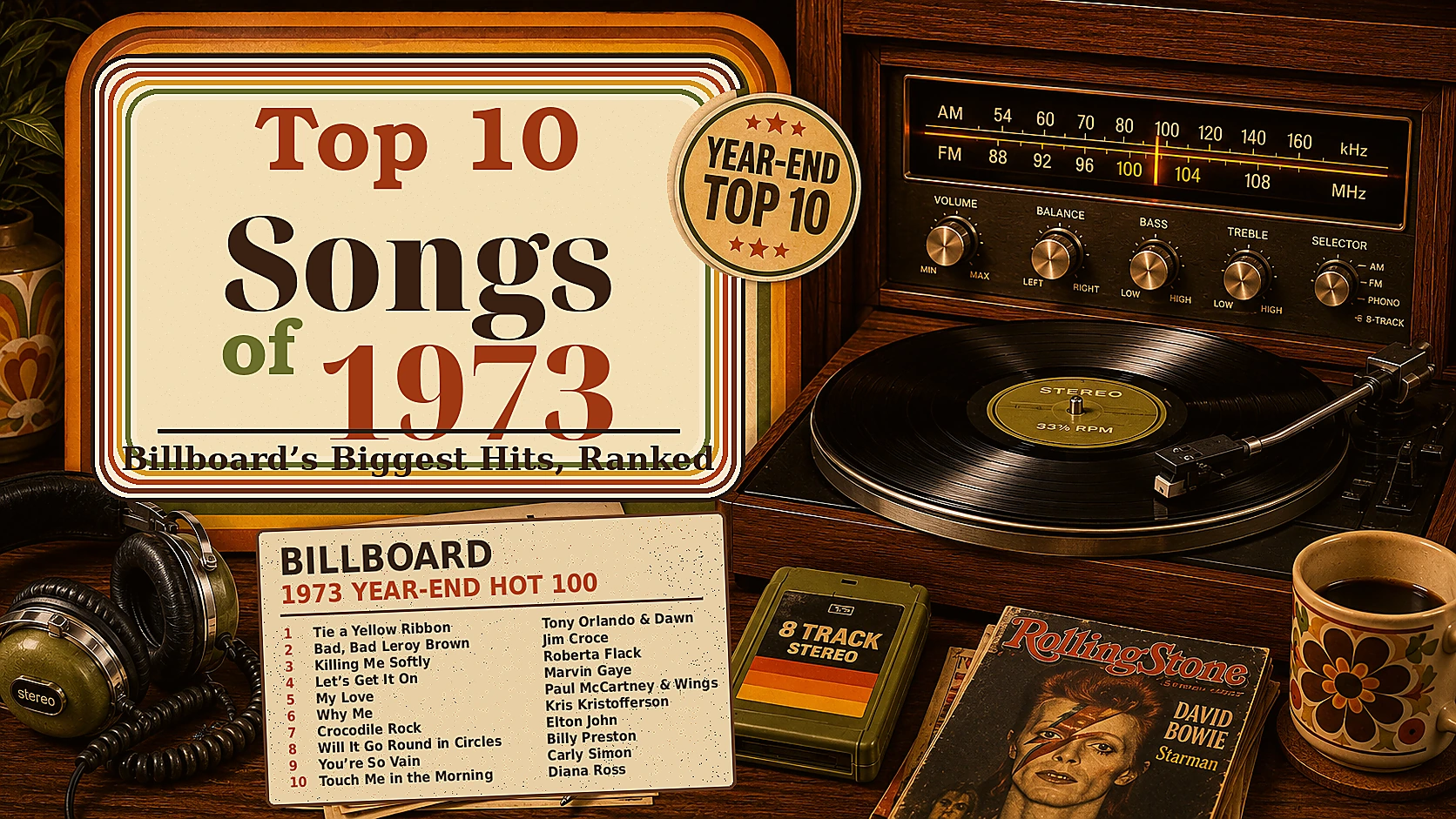
Top 10 Songs of 1973: Billboard’s Biggest Hits, Ranked
The top 10 songs of 1973 sound like mainstream radio discovering it could hold almost anything. Tony Orlando and Dawn turned a homecoming story into the year’s national singalong, Jim Croce built a neighborhood legend, and Roberta Flack made quiet emotional precision feel larger than spectacle.
Marvin Gaye changed the temperature of the room, Paul McCartney & Wings delivered soft-rock luxury, and Kris Kristofferson proved that a song peaking at only number sixteen could outlast nearly everything else on the chart.
Carly Simon turned a private insult into a national guessing game, Billy Preston put pure joy into the rhythm section, and Elton John manufactured instant nostalgia with enough color and bounce to make an imaginary dance craze feel real.
This countdown follows Billboard’s 1973 year-end Hot 100. It ranks the biggest U.S. singles of the chart year by cumulative performance, not the best songs released during the calendar year.
“Tie a Yellow Ribbon Round the Ole Oak Tree” by Tony Orlando and Dawn was Billboard’s number-one year-end song of 1973. “Bad, Bad Leroy Brown,” “Killing Me Softly with His Song,” “Let’s Get It On,” and “My Love” completed the year’s top five.
Billboard Hot 100 Year-End Ranking
Billboard’s annual order rewarded total chart performance. Weekly peak mattered, but sustained record sales and radio activity could carry a song high on the year-end list even when it never came close to number one—exactly what happened with Kris Kristofferson’s “Why Me.”
1973 Radio Had Room for Seduction, Story Songs and Shag-Carpet Pop
The biggest songs of 1973 do not sound as though they came from one unified movement. Soul was sensual, quiet and rhythmically alive. Singer-songwriters brought private resentment and spiritual doubt into the mainstream. Story songs created characters large enough to become household names.
At the same time, pop could be unapologetically bright. “Crocodile Rock” manufactured instant nostalgia, “Tie a Yellow Ribbon” turned sentiment into cultural saturation, and Billy Preston demonstrated that an irresistible groove could compete with every giant ballad around it.
Marvin Gaye and Roberta Flack represented two very different kinds of soul authority. Gaye’s record was warm, physical and direct. Flack created power through control, leaving enough space around her voice that every small change felt enormous.
That range is the defining feature of 1973 music. The dial did not ask these records to share a mood. It only asked them to hold listeners, and each one found a completely different way to do it.
Quick List: Top 10 Songs of 1973
- #1 “Tie a Yellow Ribbon Round the Ole Oak Tree” — Tony Orlando and Dawn
- #2 “Bad, Bad Leroy Brown” — Jim Croce
- #3 “Killing Me Softly with His Song” — Roberta Flack
- #4 “Let’s Get It On” — Marvin Gaye
- #5 “My Love” — Paul McCartney & Wings
- #6 “Why Me” — Kris Kristofferson
- #7 “Crocodile Rock” — Elton John
- #8 “Will It Go Round in Circles” — Billy Preston
- #9 “You’re So Vain” — Carly Simon
- #10 “Touch Me in the Morning” — Diana Ross
1973 Billboard Year-End Top 10 at a Glance
This table shows Billboard’s complete 1973 year-end top 10, each song’s weekly Hot 100 peak and the number of weeks it spent at number one.
| Year-End Rank | Song | Artist | Hot 100 Peak | Weeks at #1 |
|---|---|---|---|---|
| #1 | “Tie a Yellow Ribbon Round the Ole Oak Tree” | Tony Orlando and Dawn | #1 | 4 |
| #2 | “Bad, Bad Leroy Brown” | Jim Croce | #1 | 2 |
| #3 | “Killing Me Softly with His Song” | Roberta Flack | #1 | 5 |
| #4 | “Let’s Get It On” | Marvin Gaye | #1 | 2 |
| #5 | “My Love” | Paul McCartney & Wings | #1 | 4 |
| #6 | “Why Me” | Kris Kristofferson | #16 | 0 |
| #7 | “Crocodile Rock” | Elton John | #1 | 3 |
| #8 | “Will It Go Round in Circles” | Billy Preston | #1 | 2 |
| #9 | “You’re So Vain” | Carly Simon | #1 | 3 |
| #10 | “Touch Me in the Morning” | Diana Ross | #1 | 1 |
Put 1973 Back on the Dial
Radio in 1973 could move from Diana Ross to Billy Preston, from Marvin Gaye to Elton John and from Roberta Flack’s quiet precision to a yellow-ribbon chorus already lodged in the entire country’s head. Nobody expected the songs to belong to one carefully maintained lane.
A station could follow Kris Kristofferson’s spiritual country ballad with Carly Simon’s perfectly aimed insult and then hand the next few minutes to Jim Croce’s toughest imaginary man in Chicago. The format was the variety.
Continue through the complete 70s Music archive for year-by-year countdowns, soul, funk, disco, classic rock, soft rock and the AM-radio soundtrack that followed Gen X through kitchens, station wagons and wood-paneled family rooms.
Countdown: The Top 10 Songs of 1973
The countdown runs from Diana Ross at #10 to Tony Orlando and Dawn at #1, with weekly chart peaks, number-one runs, musical context, 1973 radio history and the memories these records carried into Gen X childhood.
“Touch Me in the Morning”
Diana Ross
Why It Hit
“Touch Me in the Morning” is one of those records that sounds polished enough to belong in a formal living room but vulnerable enough to make the room uncomfortable. Diana Ross begins with poise, almost as if she is determined to keep the breakup under control. The arrangement keeps widening around her until that control becomes the emotional tension of the song.
That balance helped make it one of the biggest songs of 1973. The melody is elegant, the title line arrives with immediate emotional clarity, and Ross never turns the performance into uncontrolled pleading. She sounds like someone asking for one final moment of closeness while already knowing that morning will end the relationship.
Inside the Record
The record is built around gradual escalation. Piano and strings establish a soft, adult-pop setting, while Ross lets small breaks in her phrasing reveal what the lyric is trying to contain. Each return to the chorus feels a little less composed than the one before it.
The orchestration gives the song cinematic scale without burying the vocal. Strings rise, backing voices widen the emotional field, and the rhythm remains restrained enough that Ross stays at the center. The result works equally well as pop, soul and adult contemporary because it never fully belongs to only one of them.
Why It Mattered in 1973
A one-week run at number one and a tenth-place year-end finish show that “Touch Me in the Morning” was more than a brief chart peak. It remained useful to radio throughout the year, crossing formats and reaching listeners who knew Diana Ross from the Supremes as well as those following her solo career.
The song also reinforced Ross’s ability to command large-scale ballads without losing intimacy. She had already proven she could carry dramatic arrangements, but this record made heartbreak feel both expensive and personal—an important sound in early-70s mainstream pop.
Gen X Rewind
This is the sound of the adults having a serious emotional conversation through the stereo instead of with each other.
For Gen X kids, it belonged to quiet kitchens, department-store speakers and family rooms where the mood changed even though nobody explained why.
“You’re So Vain”
Carly Simon
Why It Hit
“You’re So Vain” became a national obsession because Carly Simon delivered a personal takedown with the size and polish of a major pop event. The bass line announces the record before the lyric begins, the chorus is impossible to forget, and Simon’s voice carries the exact mixture of amusement, anger and disbelief required to make every accusation land.
The mystery surrounding the subject helped, but mystery alone does not keep a song at number one for three weeks. The record works because the writing is specific enough to feel lived-in and broad enough for listeners to substitute their own arrogant ex, former friend or self-appointed legend into the role.
Inside the Record
The arrangement is unusually muscular for a confessional singer-songwriter record. The low opening bass, steady drums, piano and guitar create forward motion while the backing vocals make the chorus feel communal. It is one person’s story transformed into a roomful of people agreeing with her.
Simon’s phrasing is the sharpest instrument in the mix. She stretches the title word with theatrical contempt, then pulls back into observational detail. The performance never sounds out of control. That precision is what makes the song feel less like a rant and more like a verdict.
Why It Mattered in 1973
Among the top songs of 1973, “You’re So Vain” captured how thoroughly singer-songwriter writing had moved into mainstream pop. Personal detail, adult resentment and emotional intelligence could now produce one of the largest singles in America.
The song also became an early example of pop culture feeding on the identity behind a lyric. Decades of speculation extended the record’s life, but it survived because the melody, arrangement and attitude remained strong even after the gossip became familiar.
Gen X Rewind
This is the song that taught kids what side-eye sounded like before anybody used the phrase.
It belonged to car radios and kitchen counters where adults suddenly sang along with suspicious enthusiasm and then refused to explain which line they liked best.
“Will It Go Round in Circles”
Billy Preston
Why It Hit
“Will It Go Round in Circles” is groove-first pop at its most welcoming. Billy Preston sounds as though he is having a better time than everyone else on the radio and is generous enough to let the audience join him. The rhythm moves immediately, the vocal feels loose without becoming careless, and the chorus turns a strange little phrase into something everybody can shout.
That combination made the record almost impossible to resist. It was funky enough for soul radio, bright enough for Top 40 and playful enough to feel like a relief between heavier ballads and story songs. Two weeks at number one and an eighth-place year-end finish confirm that listeners kept returning for the energy.
Inside the Record
The track is driven by Preston’s keyboard personality as much as his voice. Piano and organ accents bounce against the rhythm section, creating a conversation that feels spontaneous even when the arrangement is tightly controlled.
The lyric plays with unfinished ideas—a song with no melody, a story with no moral—and then turns those fragments into a complete pop experience. The joke is that the song supposedly lacks the pieces a song should need while demonstrating perfect musical momentum in real time.
Why It Mattered in 1973
The hit placed Billy Preston fully in the center of American pop after years as a respected musician and collaborator. His gospel roots, keyboard skill and natural exuberance translated into a mainstream single without being watered down.
It also reflects how central funk and soul had become to the biggest songs of 1973. Groove was no longer confined to one radio format. A record this rhythmically alive could compete directly with soft rock, country crossover and singer-songwriter pop.
Gen X Rewind
This is cookout, kitchen and station-wagon music—the kind that improved the room before anyone consciously noticed it.
For Gen X kids, it sounded like adults briefly forgetting their serious business and remembering that a record could simply make the day better.
“Crocodile Rock”
Elton John
Why It Hit
“Crocodile Rock” turns nostalgia into a full-color sugar rush. Elton John and Bernie Taupin did not recreate one specific early rock-and-roll record. They created the memory of an entire era—dance halls, young romance, loud records and a time that already seemed simpler than the present.
The song announces itself immediately through bouncing piano, bright rhythm and the famous falsetto refrain. It is deliberately oversized, slightly ridiculous and completely committed. That confidence is why the novelty never feels accidental and why the record stayed at number one for three weeks.
Inside the Record
The arrangement borrows the compact energy of 1950s and early-60s pop but filters it through Elton John’s early-70s studio sound. Piano drives the verses, the chorus lifts into a wordless hook and the band keeps the track moving with almost cartoon-level momentum.
The lyric is nostalgic without pretending to be historical documentation. It remembers a fictional dance craze and a vanished youth, which allows listeners to feel nostalgia even if they never experienced the exact world being described. The emotion is real even when the memory is manufactured.
Why It Mattered in 1973
As one of the biggest 1973 pop songs, “Crocodile Rock” showed Elton John’s extraordinary range. He could move from introspective ballads and ambitious album tracks to a deliberately simple radio smash without losing his identity.
The hit also arrived as rock music began consciously recycling its own past. The first rock-and-roll generation was old enough to miss its youth, and nostalgia itself was becoming a dependable pop language.
Gen X Rewind
This is roller-rink energy before you even reach the roller rink—bright colors, sugar, noise and a chorus designed to follow you home.
Gen X inherited it as one of those records that adults called nostalgic while kids simply recognized that it was fun and very loud.
“Why Me”
Kris Kristofferson
Why It Hit
“Why Me” owns one of the strangest chart stories in the 1973 Billboard year-end top 10. It peaked at only number sixteen, a position that normally would not suggest a sixth-place annual finish. The explanation is endurance. The record stayed on the chart, kept selling and kept finding listeners long after faster-moving hits had come and gone.
The song’s staying power comes from its plainspoken spiritual vulnerability. Kris Kristofferson does not sound like a polished gospel vocalist. His rough voice makes the confession feel more personal, as though the listener has entered a private conversation rather than a formal performance.
Inside the Record
The arrangement remains restrained: acoustic guitar, gentle rhythm, organ and supportive backing voices create a church-adjacent atmosphere without overwhelming the lyric. Kristofferson’s limited vocal polish becomes an advantage because every line sounds earned rather than displayed.
The song asks why the narrator has received grace despite feeling unworthy. That question gives the record broad emotional reach. Listeners did not need to share one exact theology to recognize regret, gratitude and the desire to become better than the person they had been.
Why It Mattered in 1973
Its extraordinary year-end placement demonstrates why chart history cannot be reduced to number-one singles. “Why Me” accumulated points through persistence, crossing country, pop and adult-oriented audiences over a long run.
The hit also shows the mainstream strength of country crossover in 1973. A deeply spiritual, unhurried record with a rough-edged vocal could become one of the year’s largest songs without adopting the surface sound of conventional Top 40.
Gen X Rewind
This is one of those songs that seemed less like a hit than part of the year’s wallpaper. It was simply on—again, still, somewhere in the house.
For Gen X children, it carried the unmistakable weight of adult regret even when the religious and emotional details remained beyond reach.
“My Love”
Paul McCartney & Wings
Why It Hit
“My Love” is Paul McCartney working in the form he understood almost instinctively: a direct romantic melody dressed in an arrangement large enough to feel important but gentle enough to remain personal. The song does not complicate the declaration. Its power comes from how completely McCartney believes in melodic reassurance.
The vocal floats over piano, strings and a restrained rhythm section, while the chorus opens with the smooth confidence of a song built for repeated radio play. Four weeks at number one made it one of the biggest songs of 1973 and confirmed Wings as a major commercial identity beyond the unavoidable shadow of the Beatles.
Inside the Record
The arrangement is carefully spacious. Rather than pushing the ballad toward bombast, the instruments create a soft frame around the vocal. The famous guitar solo adds emotional lift without breaking the song’s calm surface.
McCartney’s writing relies on repetition and clarity. The title phrase returns as both statement and reassurance, while small melodic changes keep it from feeling static. The record demonstrates how sophisticated craft can hide inside a song that appears effortless.
Why It Mattered in 1973
The hit was important for McCartney’s post-Beatles career because it showed that Wings could generate a lasting number-one ballad rather than merely trade on curiosity. Listeners responded to the song on its own terms.
It also helped define the soft-rock and adult-pop center of 1973 radio. Romantic ballads could be polished, orchestral and enormous without adopting the emotional desperation of a traditional torch song.
Gen X Rewind
This is the sound of a household attempting to feel calm, tasteful and more romantic than the actual people inside it.
It belonged to slow dances, living-room stereos and car rides where the adults briefly allowed McCartney to make everything seem settled.
“Let’s Get It On”
Marvin Gaye
Why It Hit
“Let’s Get It On” changes the temperature of a room from its first guitar phrase. Marvin Gaye does not treat desire as a gimmick or a quick seduction. He sings as though physical intimacy, emotional honesty and spiritual release are all part of the same urgent conversation.
The groove is slow but never sleepy. Bass, drums, guitar and strings leave space around Gaye’s voice, allowing every breath, hesitation and lift into falsetto to become part of the performance. Two weeks at number one and a fourth-place year-end finish show how fully the record crossed into mainstream culture.
Inside the Record
The opening guitar figure is one of the most efficient introductions in popular music. Within seconds, the record establishes its mood. The rhythm section settles into a warm pocket while Gaye moves around the beat rather than sitting directly on it.
His vocal contains both confidence and vulnerability. The song is direct about desire, but Gaye repeatedly frames that desire as mutual feeling rather than conquest. That emotional dimension is what gives the recording more life than a simple come-on.
Why It Mattered in 1973
The single marked a major shift in Marvin Gaye’s public sound after the social and political intensity of “What’s Going On.” Rather than abandoning seriousness, he brought the same depth of attention to love, intimacy and the body.
As one of the top soul songs of 1973, it also helped establish a sensual, sophisticated strain of mainstream R&B that would influence quiet storm, slow jams and generations of romantic soul records.
Gen X Rewind
This is the song that made children suddenly aware that the adults had reasons for lowering the lights and asking everyone else to go find something to do.
It belonged to late-night radio, closed doors and the universal household performance in which nobody admitted the song had changed anything.
“Killing Me Softly with His Song”
Roberta Flack
Why It Hit
Roberta Flack followed Billboard’s number-one song of 1972 with another record built on patience, intimacy and extraordinary vocal control. “Killing Me Softly with His Song” describes the unsettling experience of hearing someone else perform your private life back to you.
Flack never rushes the revelation. Her delivery remains calm, but each repetition deepens the sense of exposure. The melody is memorable enough for heavy radio play, while the performance remains subtle enough to reward every return. Five weeks at number one made it one of the year’s dominant records.
Inside the Record
The arrangement gives the vocal enormous space. Piano, bass, light percussion and strings support without interrupting. Flack uses dynamics rather than vocal force, allowing a slight change in tone or timing to carry more emotional weight than a dramatic belt.
The chorus works because it is both beautiful and unsettling. The phrase “killing me softly” combines comfort and pain, while the melody rises gently instead of exploding. The listener is drawn closer to the very feeling the narrator finds difficult to endure.
Why It Mattered in 1973
The success confirmed Flack as one of the central voices of early-70s popular music. She demonstrated that sophisticated, adult soul could dominate the Hot 100 without sacrificing quietness or emotional complexity.
The recording also became part of a larger shift toward intimate storytelling on mainstream radio. The biggest songs of 1973 did not all need spectacle. One of the year’s most powerful performances was built from a woman listening carefully and realizing the song knew too much.
Gen X Rewind
This is the record that could stop an ordinary room without raising its volume. Even children sensed that everyone was listening differently.
For Gen X, it became one of those songs inherited through parents’ records and radio repetition, then rediscovered later when the emotional idea finally made sense.
“Bad, Bad Leroy Brown”
Jim Croce
Why It Hit
“Bad, Bad Leroy Brown” turns a character sketch into a complete neighborhood legend in less than three minutes. Jim Croce introduces Leroy as the toughest man on the South Side of Chicago, piles on colorful details and then gives the character exactly the kind of downfall a great barroom story requires.
The song moves with piano-driven swagger, a bouncing rhythm and a chorus that explains the character before the listener has time to forget his name. Two weeks at number one and a second-place year-end finish show how perfectly Croce balanced storytelling, humor and mass-radio accessibility.
Inside the Record
Croce’s strength is efficiency. A few images—custom car, diamond rings, dangerous reputation—create a vivid figure without slowing the song. The final confrontation gives the narrative shape, while the chorus keeps returning like a group of witnesses repeating the legend.
The arrangement supports that storytelling with honky-tonk piano, acoustic rhythm and a loose, good-time feel. Croce sounds amused rather than intimidated, which lets listeners enjoy the trouble from a safe distance.
Why It Mattered in 1973
Story songs were a major part of 1970s pop, and “Bad, Bad Leroy Brown” became one of the form’s defining hits. It proved that a compact narrative with a memorable character could compete with romantic ballads and soul records at the very top of the chart.
The song’s enormous success also added poignancy after Croce’s death later in 1973. What had been a bright, comic radio smash became part of a suddenly completed catalog, giving the record additional emotional weight in the years that followed.
Gen X Rewind
This is the kind of song that made kids lean toward the speaker because it sounded like trouble presented as entertainment.
Leroy Brown belonged to the safe danger of records—a larger-than-life character who could arrive in the family car, get into a fight and disappear before anyone reached the grocery store.
“Tie a Yellow Ribbon Round the Ole Oak Tree”
Tony Orlando and Dawn
Why It Hit
“Tie a Yellow Ribbon Round the Ole Oak Tree” became Billboard’s biggest song of 1973 because it gives listeners a complete emotional story and then pays it off with an image nobody could forget. A man returning home asks for one yellow ribbon as a sign that he is still wanted. The final reveal gives him far more than one.
The suspense is simple enough to follow on first listen, the chorus is built for immediate participation and Tony Orlando delivers the story with warmth rather than heavy drama. Four weeks at number one and complete cultural saturation turned the song into more than a hit. It became a national symbol almost immediately.
Inside the Record
The arrangement keeps the narrative moving with bright pop rhythm, strings and backing vocals from Dawn. Each verse advances the bus ride and the narrator’s anxiety, while the chorus repeats the central request so the entire audience understands what is at stake.
The final image works because the song delays it. The narrator is afraid to look and asks the bus driver to watch for him. When the tree appears covered in ribbons, the emotional release is both private and communal—the passengers celebrate along with the listener.
Why It Mattered in 1973
The song’s success reflects the enormous power of narrative pop in 1973. Listeners did not need to identify with every detail of the returning man’s story. The larger themes—shame, forgiveness, homecoming and the fear of rejection—were immediately readable.
The yellow ribbon soon expanded beyond the record into a broader symbol of welcome and remembrance. That cultural afterlife helped make the single one of the most recognizable songs of the decade, even for people who later considered it hopelessly sentimental.
Gen X Rewind
This is the sound of mainstream America agreeing on one story and one chorus for a while. The song was not merely on the radio; it seemed built into the walls.
For Gen X kids, it belonged to television variety shows, family singalongs and adults who knew every word whether they admitted liking it or not.
1973 Rewind Verdict
The 1973 Billboard year-end chart feels like a stereo console with every input occupied. Soul brought intimacy and groove. Singer-songwriters supplied wounds, wit and spiritual uncertainty. Soft rock offered reassurance, while narrative pop gave the country characters and symbols large enough to follow it home.
The styles barely resemble one another, but the records share immediate identity. You know “Let’s Get It On” within seconds. You recognize Carly Simon’s target before the chorus ends. You understand the yellow ribbon before the final payoff. That clarity made these the biggest songs of 1973—and made them difficult to erase.
This was also a year when chart position alone could not explain cultural weight. “Why Me” peaked at only number sixteen but accumulated enough long-term performance to finish sixth. “Killing Me Softly” spent more weeks at number one than the annual champion but finished third. The year-end chart captures the full season rather than one brief moment.
FAQ: Top Songs of 1973
What was the number-one song of 1973?
“Tie a Yellow Ribbon Round the Ole Oak Tree” by Tony Orlando and Dawn was Billboard’s number-one year-end song of 1973. It spent four weeks at number one on the weekly Hot 100.
What were the top five songs of 1973?
Billboard’s year-end top five were “Tie a Yellow Ribbon Round the Ole Oak Tree,” “Bad, Bad Leroy Brown,” “Killing Me Softly with His Song,” “Let’s Get It On” and “My Love.”
Why did “Why Me” rank sixth if it peaked at only number sixteen?
Billboard’s year-end ranking reflected total chart performance rather than peak position alone. Kris Kristofferson’s “Why Me” remained on the chart long enough to accumulate more annual points than many songs with much higher weekly peaks.
How long was “Killing Me Softly with His Song” number one?
Roberta Flack’s “Killing Me Softly with His Song” spent five weeks at number one on the Billboard Hot 100.
Was 1973 a strong year for soul music?
Yes. Marvin Gaye, Roberta Flack, Billy Preston and Diana Ross all placed in Billboard’s year-end top 10, making soul one of the defining mainstream sounds of 1973.
What kinds of music were popular in 1973?
The chart mixed soul, singer-songwriter pop, soft rock, country crossover, funk, retro rock and roll and narrative pop. The range is one reason the year remains such a vivid early-70s radio snapshot.
Where can I find more 70s music?
Continue through the Smells Like Gen X 70s Music archive for additional Billboard countdowns, genres, artists and deeper decade rewinds.