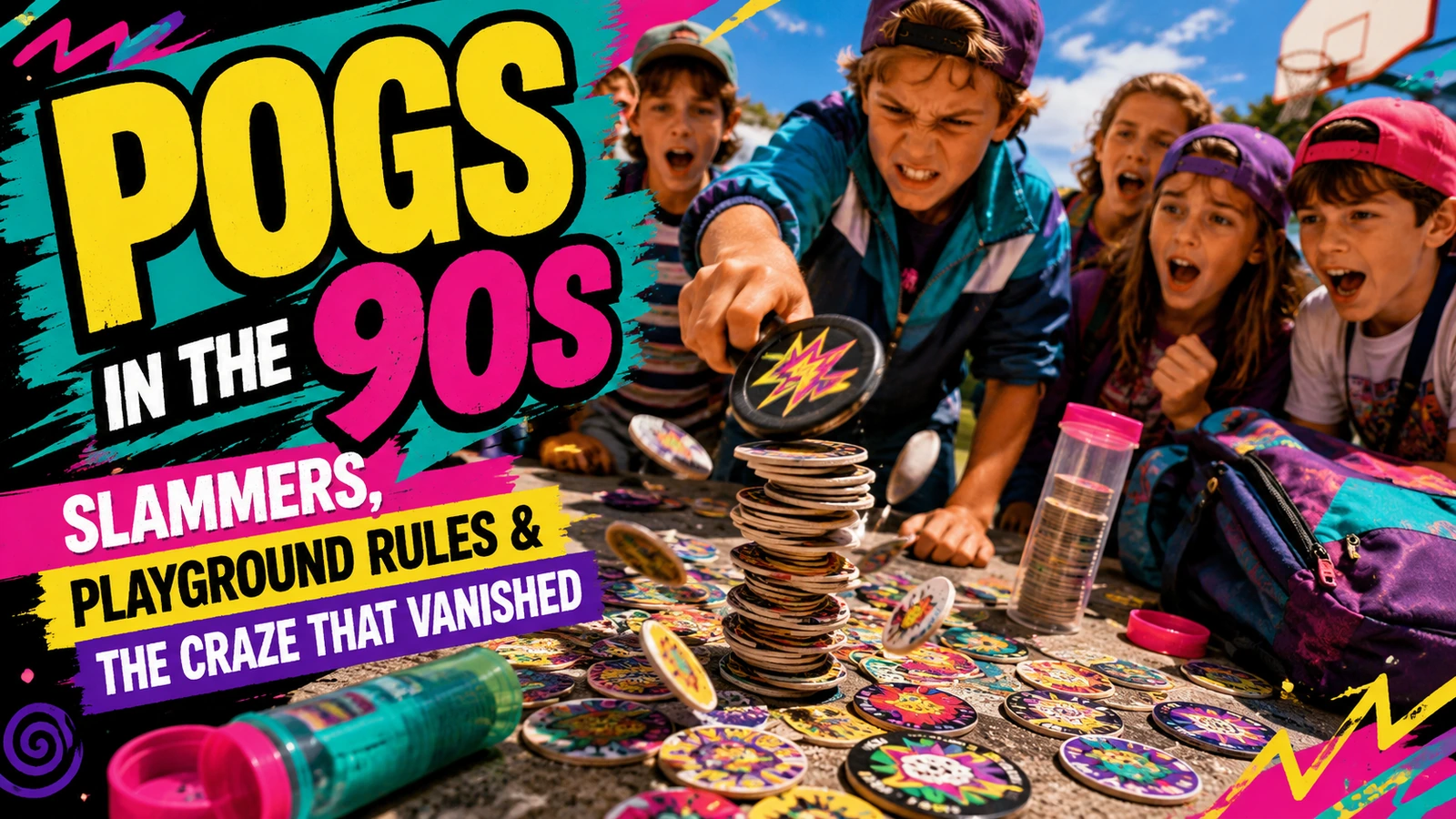
Cardboard Circles, Metal Slammers and the Fastest Playground Economy of the 90s
Pogs in the 90s: Slammers, Playground Rules and the Craze That Vanished
Pogs were collectible cardboard discs used in a simple stack-and-slam game, but that description does not explain what happened to American playgrounds in 1994. Kids carried clear tubes clipped to backpacks, argued over metal slammers, traded licensed designs and risked favorite caps in for-keeps matches that occasionally required adult arbitration.
This is the complete history of the 90s Pog craze—from Japanese Menko and Hawaiian milk caps to Blossom Galbiso, POG juice, the World POG Federation, official rules, school bans, promotional sets, collector value and the remarkably fast moment when the whole thing vanished into desk drawers.
What Were Pogs, and Why Did the 90s Playground Craze Become So Huge?
Pogs were collectible cardboard milk caps used in a simple flipping game. Players stacked an equal number of caps face down, then took turns throwing a heavier disc called a slammer—or kini—onto the stack. Any Pogs that landed face up were collected by the player. Games could be played for points, for fun or “for keeps,” which meant the winner actually walked away with the flipped pieces.
The 90s Pog craze grew because the pieces were inexpensive, portable, endlessly printable and social. They could carry cartoon characters, sports logos, monsters, jokes, holograms, advertisements or whatever image a company could shrink into a circle. Kids could collect them without knowing the rules, trade them without playing and play them without owning anything more complicated than a stack and one heavy slammer.
The modern craze grew out of an older Hawaiian milk-cap game, accelerated after a school counselor reintroduced it to students in the early 1990s and exploded after the World POG Federation commercialized the name and game on the mainland. By 1994 and 1995, Pogs were in toy stores, comic shops, fast-food promotions, backpacks and enough classrooms to convince administrators that cardboard circles had somehow become a disciplinary issue.
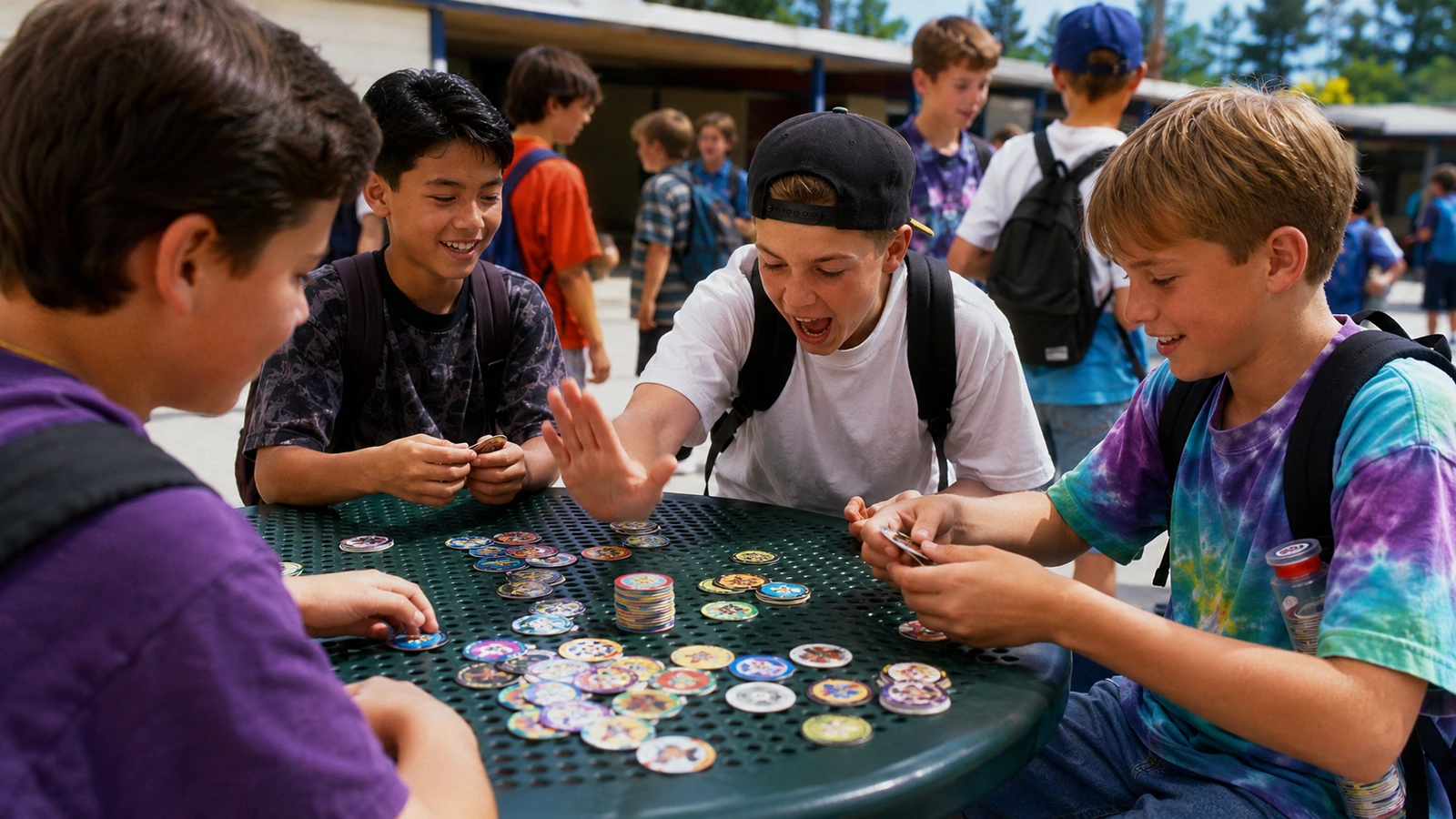
From Japanese Menko to the Plastic Tube in Your Junk Drawer
The Complete History of the 90s Pog Craze
This article follows the game’s deeper roots, Hawaiian revival, World POG Federation rollout, official rules, playground variations, slammer obsession, school bans, licensing explosion, sudden collapse and the collector questions that remain after thirty years.
Cheap, Portable, Collectible and Just Risky Enough
Why Pogs Became the Perfect 90s Playground Craze
Pogs did not require a television series, batteries, a game console or a parent willing to assemble forty-seven pieces. The object, game and social system fit inside one pocket.
Low Cost
A kid could enter the craze with a small pack instead of waiting for a birthday-level purchase.
Endless Artwork
Every new image created another reason to trade, sort or buy one more tube.
Portable Play
Pogs moved between home, school, the bus stop and the pizza place without a carrying case the size of luggage.
Real Stakes
Playing for keeps made each slam matter, especially when somebody had contributed a favorite cap.
Pogs belong near the top of the 50 most iconic toys of the 90s because the craze required almost nothing and still managed to build a complete economy: art, status, equipment, competition, trading, arguments and the occasional administrative ban.
The 90s Did Not Invent Flipping Pictures With Other Pictures
Where Did Pogs Come From? Menko and the Game’s Japanese Roots
The basic idea behind Pogs resembles Menko, a Japanese game played for centuries with illustrated pieces that players tried to flip or displace.
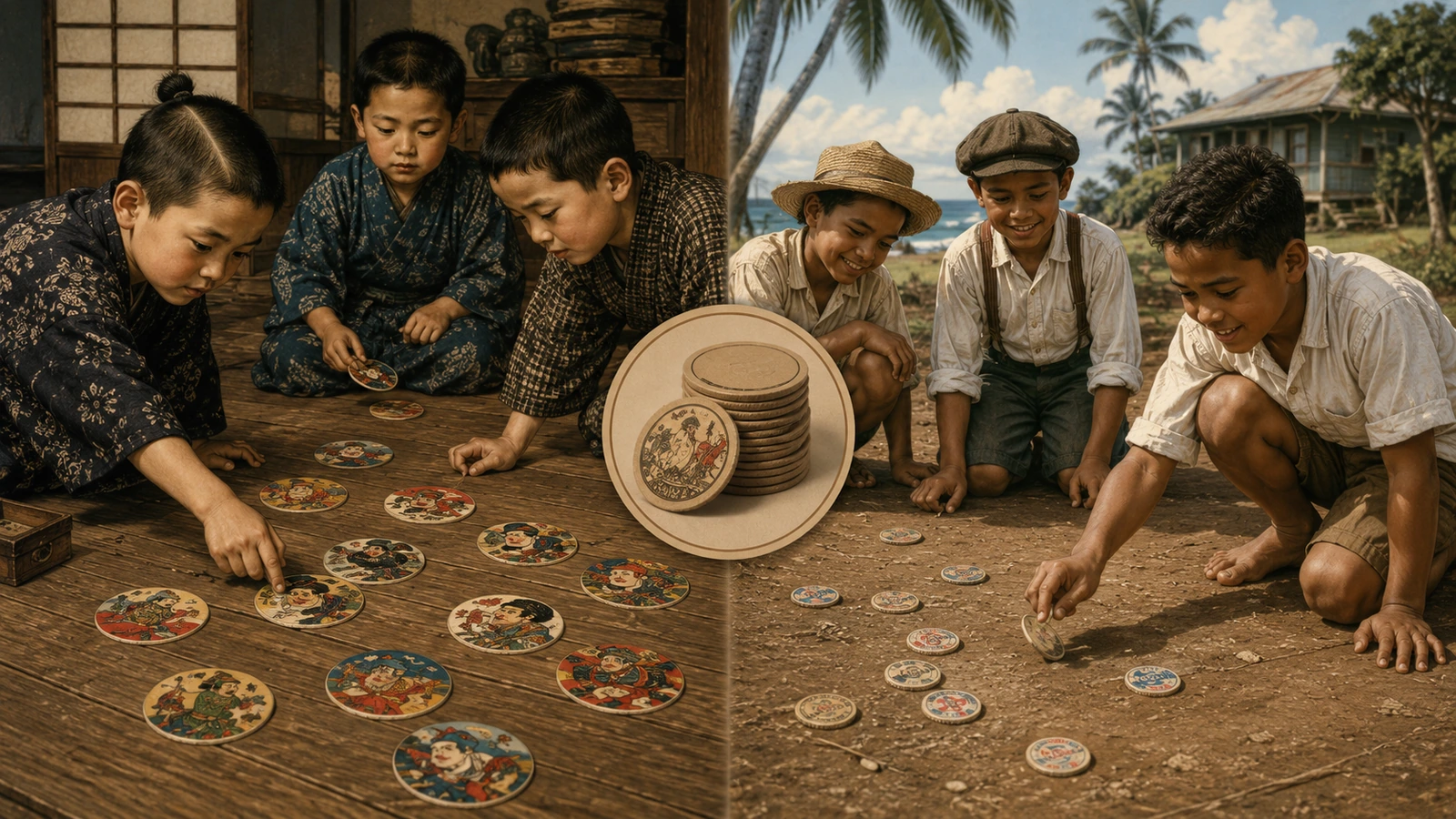
Menko Predates the Pog Craze by Centuries
Versions of Menko existed in Japan long before plastic tubes, holographic foil and the World POG Federation. Early pieces could be made from clay, wood or ceramic, while later cardboard Menko carried images of wrestlers, warriors, actors and popular characters.
The Goal Was Physical and Collectible
Players struck or slapped near an opponent’s piece, trying to flip it, move it or claim it under agreed rules. That combination of image collecting and physical competition is the same basic chemistry that later made Pogs more than decorated cardboard.
Japanese Immigration Brought the Game to Hawaii
As Japanese workers and families settled in Hawaii during the late nineteenth and early twentieth centuries, children adapted familiar play traditions to available materials.
Milk-Bottle Caps Were the Right Shape
Cardboard caps were flat, round, plentiful and expendable. They did not require a toy company to decide they were toys.
The Rules Changed With Place and Generation
Folk games rarely arrive with one permanent instruction booklet. Families, neighborhoods and schools carry their own versions forward.
Pogs Were a Commercial Name for a Much Older Play Pattern
The World POG Federation did not invent the idea of striking a stack of caps. It packaged, branded and distributed one version at global scale.
The Deeper History Explains the Game’s Simplicity
Pogs worked because the play pattern had already survived across materials, communities and decades. The 90s merely added fluorescent skulls and legal departments.
The Gen X correction: we were not practicing an ancient cultural game in the cafeteria. We were dropping a chrome skull slammer onto Batman milk caps. History had taken several detours by then.
Before the Toy Aisle, There Were Bottle Caps and Island Playgrounds
How Milk-Cap Games Developed in Hawaii Before the 90s Pog Craze
By the 1920s, children in Hawaii were playing cap-flipping games with cardboard milk-bottle closures.
The Caps Were Everyday Objects
Milk bottles were sealed with round cardboard discs. Once removed, the caps were sturdy enough to stack and light enough to flip.
Children Reused What Was Available
Like bottle-cap games, stickball and homemade ramps, the activity turned packaging into play before anybody printed “collect all 48” on it.
Different Dairies Created Natural Variety
Brand marks, colors and local designs gave children visual differences long before dedicated collector art arrived.
Families Passed the Game Along
The activity persisted through informal memory. Adults who had played with caps could teach children without needing commercial instructions.
The Hawaiian Story Is Not Just a Marketing Origin
The modern brand name came from a local beverage, but the game itself belonged to community play traditions much older than the product boom.
The Revival Happened in a School Setting
That mattered because the game spread most naturally where groups of children already gathered with pockets, free time and a powerful need to compare belongings.
The Mainland Craze Flattened the Backstory
Once Pogs reached national shelves, many kids heard only that the letters stood for juice flavors. The deeper Menko and Hawaiian milk-cap history vanished behind foil skulls and cartoon licenses.
The corporate transformation: a community game made from reused caps eventually returned in sealed plastic packs with an official mascot. America had entered the conversation.
A School Counselor Helped Restart a Global Fad
Who Revived Pogs? Blossom Galbiso and the Early-90s Schoolyard Return
The widely repeated modern origin story credits Hawaiian educator Blossom Galbiso with reintroducing the milk-cap game to students on Oahu around 1991.

Galbiso Remembered the Game From Childhood
She brought an older local pastime into a modern school setting rather than inventing a brand-new toy.
The Game Offered an Alternative to Rougher Recess Play
Accounts describe the activity as a way to encourage math, turn-taking and social play without the collisions of games like dodgeball.
Students Needed Caps
Children collected available cardboard discs, including caps associated with Haleakala Dairy products.
The School Environment Accelerated Sharing
One child could watch a match, understand the point and join after finding a handful of caps.
The Pieces Became Conversation Objects
Even before large-scale licensed art, caps could be sorted, traded and compared.
Demand for Extra Caps Grew
As the game spread around Hawaii, packaging manufacturers reportedly received requests for additional caps beyond ordinary beverage use.
The Story Demonstrates How Fads Actually Spread
The commercial boom came later. The first network was children watching other children play.
The truly 90s part: a school activity intended to be constructive eventually became a school activity administrators banned. The circle of educational life was complete.
The Name Came From Juice, Not an Ancient Slammer God
What Does POG Stand For? Passion Fruit, Orange and Guava
POG was the name of a Hawaiian fruit drink associated with passion fruit, orange and guava—the three flavors represented by the letters.
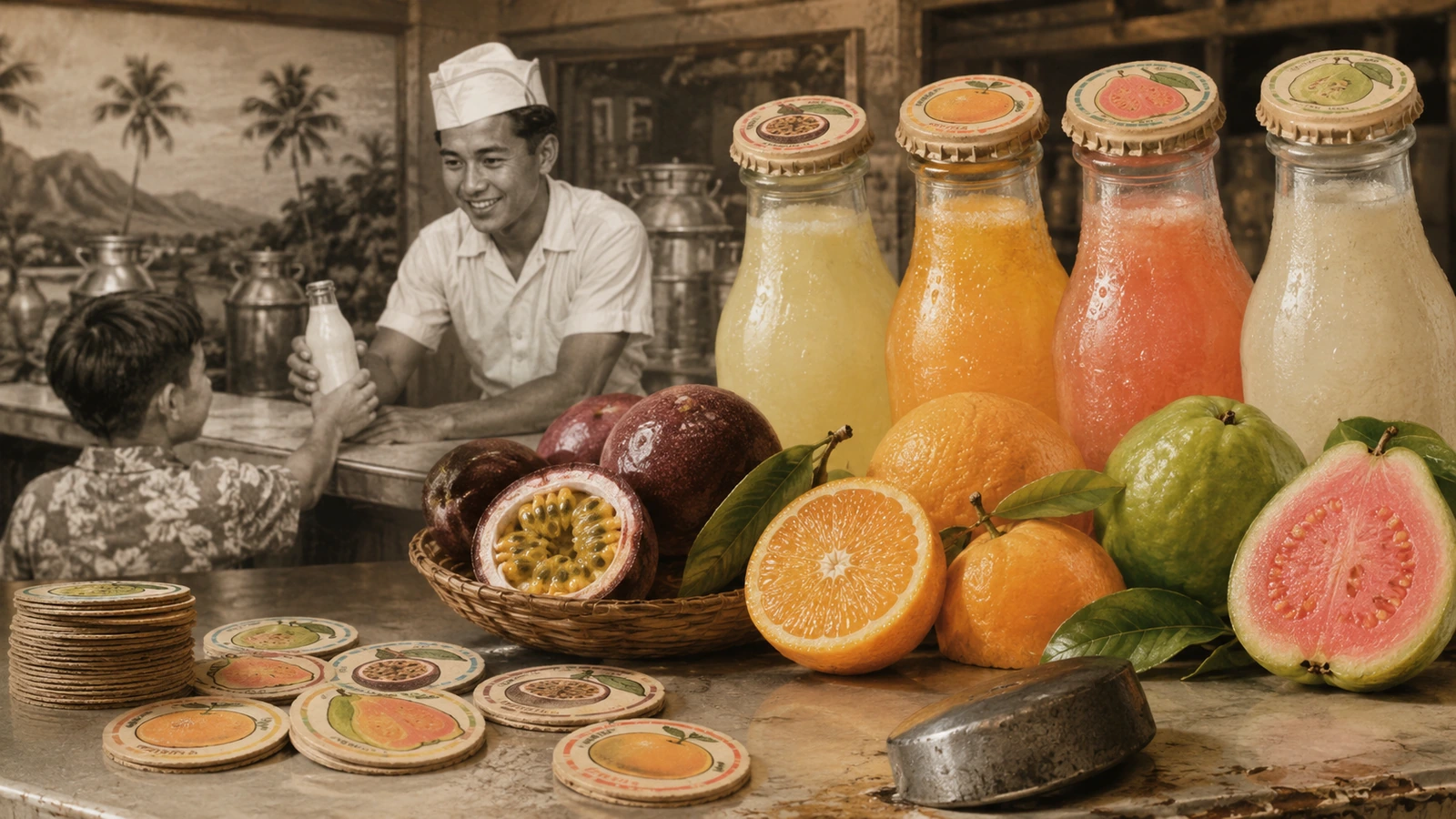
Haleakala Dairy Used POG-Branded Caps
The beverage company’s round cardboard closures became popular pieces in the revived game.
The Letters Described the Juice Blend
Passion fruit, orange and guava gave the drink its compact three-letter name.
The Product Name Became the Game Name
Children increasingly referred to the caps and activity as Pogs, even though many pieces were not made by the beverage company.
The Word Became Nearly Generic
By the mainland boom, kids called almost every milk-cap game piece a Pog regardless of manufacturer.
That Generic Use Created a Legal Problem
The company controlling the trademark wanted POG to mean its official licensed product. Competitors argued the public already used the word for the entire category.
Collectors Still Distinguish Official POG Products
World POG Federation branding, logos and packaging separate official releases from the enormous field of generic milk caps.
The Juice Story Became Playground Trivia
Even kids who did not know the rules often knew somebody willing to announce that POG stood for passion-orange-guava like they had decoded a government file.
The fact every kid repeated: POG meant passion, orange and guava. Nobody could confirm where the juice was sold, but the information was treated as binding.
The Moment Recess Acquired a Governing Body
How the World POG Federation Turned Milk Caps Into a 90s Toy Craze
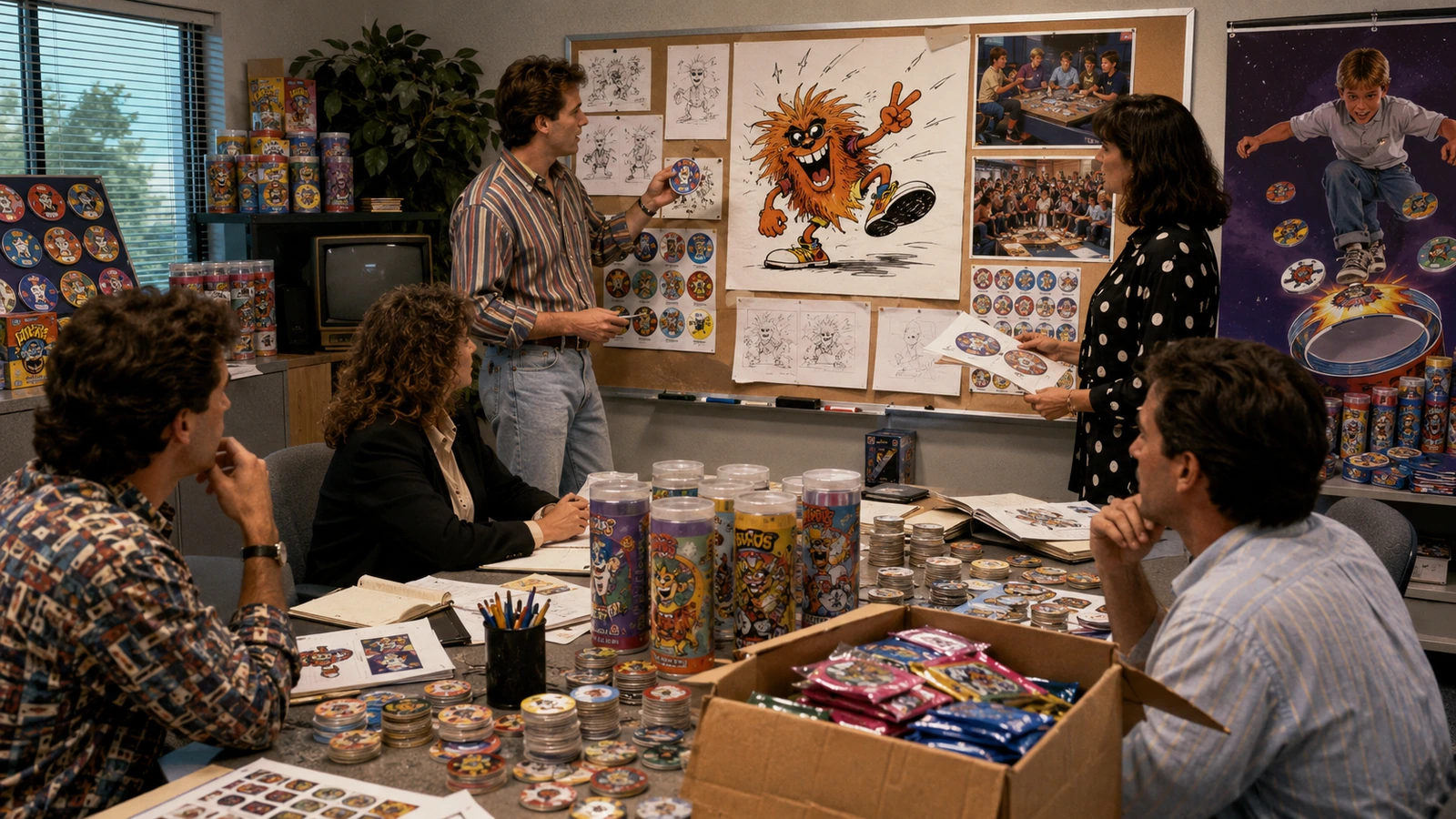
Businessman Alan Rypinski acquired rights connected to the POG name from Haleakala Dairy in 1993 and built the World POG Federation into the commercial face of the craze.
The Company Standardized the Brand
Official packaging, logos, rules and character art turned a flexible folk game into a recognizable retail product.
The Federation Framing Added Authority
Calling it a “World Federation” made cardboard circles sound like an international sport with committees, rankings and perhaps drug testing.
Official Products Used Trademark Marks
Collectors could distinguish branded POG releases from the many competitors selling generic caps.
The Company Promoted Organized Play
Tournaments and official rules gave stores, schools and event organizers a format they could repeat.
Licensing Expanded the Artwork
Characters, sports, entertainment properties and the company’s own mascot transformed the caps into miniature collectible media.
The Commercial Rollout Reached Beyond Hawaii
The game moved through the western United States, then across the country and into international markets.
The Brand Controlled Only Part of the Craze
Competitors, local printers and promotional companies flooded the market with similar discs, proving that a federation can govern only the children willing to read the package.
The official-sports illusion: the World POG Federation made it feel possible that one day an adult might receive a scholarship for dropping a plastic disc onto Garfield.
Kids Were Fighting Over Slammers. Companies Were Fighting Over Three Letters.
The Legal Battle Over the POG Name
As the market exploded, companies disputed whether POG was a protected brand or the generic name everybody already used for milk caps.
The Word Had Escaped Into Everyday Speech
Children, parents and retailers used “Pogs” to describe official products, generic products and sometimes the entire game.
The World POG Federation Claimed Trademark Rights
Its position was that POG identified a protected brand acquired from the Hawaiian beverage company.
Competitors Argued the Word Was Generic
Companies producing similar caps said consumers no longer treated POG as one source.
Retail Recognition Had Real Value
A package labeled “milk caps” did not carry the same immediate meaning as a package labeled “Pogs.”
The Dispute Reached Court in 1994
Contemporary reporting described a fast-growing industry watching an Orange County fight between rival companies.
The Argument Mirrored Other Genericized Brands
Lawyers compared the situation to famous product names the public often uses for whole categories.
Kids Did Not Adjust Their Vocabulary
No recess monitor successfully convinced a playground to say “unofficial circular collectible milk-cap pieces.”
The business lesson: the craze became so large that adults needed attorneys to determine what children meant by the word they were already shouting.
From Oahu Schoolyards to Every Mall Kiosk in America
How Pogs Spread Across America in 1993 and 1994
Pogs reached the mainland in the early 1990s and moved rapidly through toy stores, comic shops, schools, local tournaments and promotions.
The West Coast Was a Natural First Stop
Hawaii’s geographic and cultural connections helped the game travel into western U.S. markets.
Comic and Hobby Shops Understood Collectibility
Stores already selling cards, comics and small collectibles could display inexpensive packs near the register.
Toy Stores Gave the Craze Scale
Once chains devoted racks and endcaps to Pogs, the game looked established rather than local.
Schools Supplied Instant Demonstrations
One child with a tube could teach a crowd during recess, and every spectator became a potential buyer.
Local Media Loved the Visual
Colorful stacks, loud slams and tournament crowds made easy television footage.
Promotions Put Pogs Everywhere
Restaurants, brands and events used the discs as cheap miniature advertisements children willingly collected.
By 1994, the Market Was Exploding
Manufacturers produced millions of caps, competitors entered rapidly and industry observers predicted enormous sales.
The speed of the takeover: one week the kid beside you had a tube. Two weeks later the school had a policy.
Pogs became one of the defining 90s schoolyard toys and recess crazes because every match advertised the game to the crowd standing around it.
A Furry Orange Mascot With the Dental Plan of a Nightmare
Pogman and the Official POG Look
The World POG Federation created a visual identity around Pogman, official logos and a steady stream of themed art.
Pogman Gave the Brand a Character
The orange, wild-looking mascot made official POG products recognizable even when individual cap designs changed.
The Art Fit the Mid-90s
Exaggerated faces, neon colors, extreme poses and comic-book energy matched the same visual world as skate stickers, school folders and arcade cabinets.
The Mascot Could Appear Across Sets
Pogman linked unrelated themes under one official brand.
Official Logos Signaled Authenticity
Packaging and backs could identify World POG Federation products in a market full of generic caps.
The Brand Needed Its Own Lore
Licensed characters were powerful, but an original mascot gave the company something competitors could not simply print.
Kids Ranked Art More Than Provenance
On the playground, a holographic skull could beat an official trademark in the only market research that mattered.
Pogman Survived the Craze
The modern rights holder still treats the mascot as core brand identity, proving that a sufficiently strange 90s creature can outlive the retail system that created it.
The mascot test: if the character looked like it had consumed six bowls of sugary cereal and knew where your slammer was buried, it belonged on a Pog.
The Official Rules Were Simple. The Playground Treaty Negotiations Were Not.
How to Play Pogs: Official Stack-and-Slam Rules
The official game is a turn-based flipping contest. The arguments usually begin when somebody discovers the other player learned a different version.
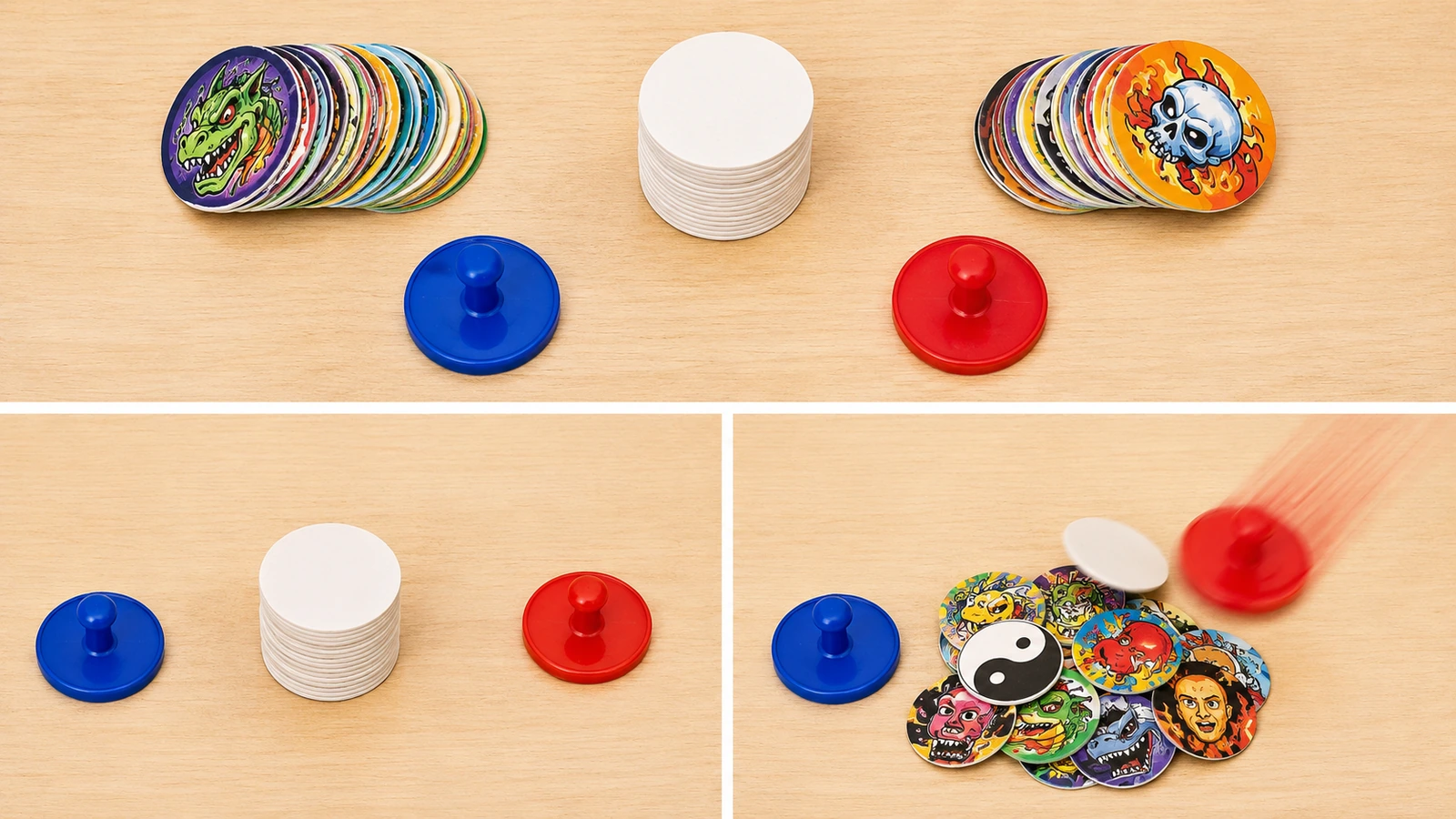
1. Agree on the Stakes
Decide whether the match is for fun, for points or for keeps before anybody contributes a favorite Pog.
2. Contribute Equal Numbers
Each player places the same number of cardboard caps into the common stack.
3. Stack Them Face Down
Official modern rules place the designs down so any cap landing face up counts as flipped.
4. Choose the First Player
Flip a Pog, use rock-paper-scissors or negotiate until somebody claims they already won.
5. Slam the Stack
Drop or throw the heavier slammer onto the pile, trying to separate and flip the caps.
6. Collect Face-Up Pogs
The player takes the pieces that landed face up under the agreed rules.
7. Restack the Rest
Any face-down caps return to the center for the next player.
8. Alternate Turns
Players continue until every cap has been flipped and removed.
9. Count the Results
The player with the most Pogs wins—or owns them, if everybody knowingly agreed to play for keeps.
The full schoolyard setting belongs to 90s schoolyard toys and recess crazes. This page stays with the exact Pog game: the stack, the slammer, the collecting and the rules that somehow changed every fifteen feet.
The Phrase That Turned a Game Into a Contract Dispute
What Did Playing Pogs for Keeps Mean?
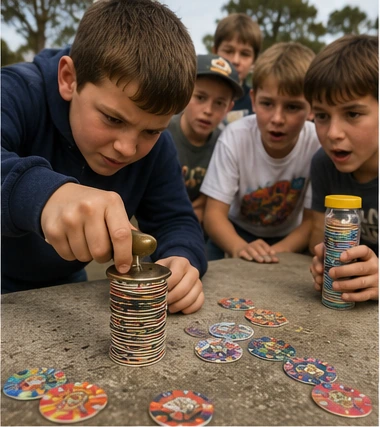
In a for-keeps match, the player who flipped a Pog kept it permanently. That rule created the excitement, resentment and gambling accusations that followed the craze.
For Fun Kept Ownership Separate
Players could count flipped caps, then return every piece to its original owner after the match.
For Keeps Created Real Stakes
Each contributed cap could leave in somebody else’s tube.
Common Pogs Became Game Pieces
Many kids kept a pile of expendable duplicates for matches and protected favorite artwork from actual play.
Favorites Entered Through Bad Judgment
Confidence, peer pressure or one loud child insisting the slammer was fair could put a prized Pog into the stack.
Consent Was Often Questionable
Young players did not always understand whether “for keeps” had been clearly agreed before the first slam.
Winning Could Damage Friendships
A technically valid result did not make losing a favorite character feel acceptable.
Adults Saw a Gambling Structure
Players risked owned property on an uncertain outcome, even if the property was a cardboard circle featuring a cartoon caveman.
The universal lesson: never wager the Pog you would cry about losing. This information usually arrived after the crying.
A good modern match should state the stakes out loud, use equal contributions and keep valuable or sentimental pieces away from the play stack.
The Pogs Were the Collection. The Slammer Was the Personality.
What Is a Pog Slammer, and Why Did the Weight Matter?
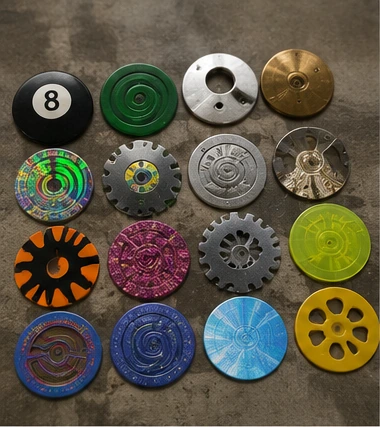
A slammer is the thicker, heavier disc used to strike the stack and flip the cardboard caps.
Official Materials Also Used the Word “Kini”
The World POG Federation used both terms, though most mainland kids simply said slammer.
Slammers Were Built for Impact
They were thicker and denser than ordinary Pogs, allowing force to transfer into the stack.
They Came in Different Materials
Plastic, rubber, metal and composite versions created different weight, grip and bounce.
Artwork Made Them Collectible Too
A favorite slammer could feature skulls, saw blades, eight balls, sports art, holograms or whatever design suggested unnecessary danger.
Weight Became a Status Symbol
Heavy metal slammers felt premium and powerful, especially compared with thin plastic pieces included in starter packs.
Some Slammers Damaged Pogs
Metal edges and hard impacts could dent, crease or scrape the cardboard artwork.
Every Kid Had a Theory
One player wanted maximum weight. Another wanted a wide plastic disc. A third had a chipped slammer they claimed possessed tournament balance.
The Best Slammer Was Often the Familiar One
Consistent grip, release and confidence mattered as much as owning the heaviest object legally allowed near a lunch table.
Peak equipment loyalty: carrying thirty Pogs you barely remembered and one slammer you would identify in a police lineup.
From Starter Plastic to Lunch-Table Ballistics
Pog Slammers Explained: Plastic, Rubber, Brass and Metal
Material changed the feel of the game and provided the first argument before the actual rules argument.
Thin Plastic Slammers
Light, inexpensive and easy to control, but sometimes lacking enough force for tall stacks.
Thick Plastic Slammers
A common balance of weight, durability and affordability.
Rubber Slammers
Grippy and less likely to scrape artwork, though bounce could make results unpredictable.
Metal Slammers
Dense, satisfying and often considered unfair by the child who did not own one.
Brass and Specialty Metals
Premium pieces added shine, weight and collector appeal.
Oversized Slammers
Wider striking surfaces increased contact but could violate local rules.
Notched and Shaped Slammers
Saw-tooth edges, holes and sculpted shapes looked extreme while occasionally making a clean release harder.
Holographic Slammers
Reflective art turned equipment into a display piece even when the actual technique remained average.
Homemade Slammers
Coins, washers and improvised objects appeared anywhere official equipment was unavailable or fairness was no longer a priority.
Every School Had a Constitution Nobody Wrote Down
The Unwritten Playground Rules Every Pog Match Somehow Changed
Official rules provided a foundation, but local variations determined what actually happened beside the cafeteria wall.
Face Up vs. Face Down Stacks
Some groups stacked artwork down to protect it and make flips obvious. Others stacked designs up because that was how somebody’s older brother taught them.
Drop vs. Throw
One rule allowed a controlled vertical drop. Another permitted a wrist-driven slam. A third existed only after somebody threw hard enough to scatter the stack across three tables.
Height Limits
Players argued about how far above the stack the slammer could begin.
One Hand vs. Any Release
Some groups required a flat release from one hand; others tolerated spins, angles and dramatic techniques.
Edge Landings
A Pog balanced on its side could be replayed, counted as face up or become the subject of a hearing.
Slammers Leaving the Area
Rules varied on whether a throw still counted if the slammer bounced off the table.
Stack Reassembly
Some players carefully aligned the remaining caps. Others restacked the pile loosely, changing the next person’s odds.
Material Restrictions
Metal could be banned, weight limits could be invented or the players could agree to use the same slammer.
Winner Keeps Flipped Pogs
In for-keeps games, each successful turn immediately transferred ownership.
The playground legal system: precedent was whatever happened during yesterday’s match unless the kid losing today had developed a new interpretation.
Skill Existed. So Did Luck, Surface Conditions and Loud Confidence.
How to Slam Pogs More Effectively
A clean Pog slam depends on consistent release, contact angle, stack condition and the behavior of the slammer after impact.
Use a Comfortable Grip
Hold the slammer in a way that allows a flat, controlled release without squeezing so hard the disc catches a finger.
Aim Near the Center
Central impact transfers force through the stack, though a slight angle may separate caps more effectively on some surfaces.
Keep the Release Flat
A slammer arriving edge-first can scatter the stack without flipping much.
Add Controlled Spin
Rotation can stabilize the disc and help spread caps, but excessive spin may cause sliding rather than a clean strike.
Match the Slammer to the Surface
A heavy metal disc behaves differently on concrete, carpet, wood and a plastic Pog mat.
Study the Stack
A loose, tall or uneven pile may respond better to a different angle than a compact stack.
Do Not Sacrifice Control for Noise
The loudest slam in the lunchroom is not automatically the most productive, despite what every twelve-year-old believed.
The technique myth: rotating the wrist seventeen degrees while whispering the slammer’s name was not scientifically verified, but the owner reported excellent results.
A Tiny Lesson in Force, Friction and Why the Metal Kid Was Annoying
The Simple Physics Behind a Pog Slam
Pogs were not a laboratory experiment, but weight, speed, angle, friction and surface hardness all changed the result.
Slammer Mass
A heavier disc can carry more momentum at the same speed, increasing the force delivered to the stack.
Release Speed
Faster movement increases impact but can reduce accuracy and create more sideways scatter.
Contact Angle
A flat hit compresses the stack; an angled hit may slide layers apart and encourage flipping.
Surface Friction
Rough surfaces resist sliding, while smooth tables allow the caps and slammer to travel farther.
Stack Height
Taller stacks can separate dramatically but also absorb and redirect force unpredictably.
Cap Condition
Warped, dented or glossy Pogs behave differently from flat matte cardboard.
Slammer Diameter
A wider disc contacts more of the pile; a smaller heavy disc concentrates force.
Spin
Rotation can stabilize release and create sliding action after impact.
Luck
The factor nobody admitted when one weak throw somehow flipped half the stack.
The Same Slammer Could Be a Champion on Wood and a Liability on Carpet
How Playing Surfaces Changed the Pog Game
Official mats offered consistency, but most real matches happened wherever adults had not yet told kids to stop.
Concrete
Hard, rough and loud. It provided strong impact but could destroy edges and artwork quickly.
School Desks
Smooth enough for dramatic scatter, small enough for Pogs to fall into another student’s backpack territory.
Cafeteria Tables
Large surfaces encouraged crowds and gave slammers room to bounce toward somebody’s lunch.
Carpet
Soft fibers absorbed energy and made caps harder to flip, though damage was lower.
Kitchen Floors
Tile or linoleum offered a hard playing area until a parent discovered metal striking the floor repeatedly.
Official Pog Mats
Printed play surfaces defined a target zone and protected tables while giving the hobby another accessory to sell.
Comic-Shop Tournament Tables
Organized events could standardize the surface and remove one source of argument, leaving only the other twelve.
The household rule: if the slammer was metal, the kitchen table suddenly became “good furniture.”
Many Kids Collected Them Without Ever Playing a Correct Match
Why Collecting Pogs Was Bigger Than the Game
The artwork, variety and low price made Pogs function like trading cards for children who preferred circles and less organized statistics.
Every Design Felt Like a Separate Object
Changing one picture transformed a piece of identical cardboard into something new.
Sets Encouraged Completion
Numbered series and matching themes created a clear reason to search for missing pieces.
Duplicates Had Utility
Extra Pogs could be traded, played for keeps or sacrificed to metal slammers.
Art Created Personal Taste
One kid wanted sports logos. Another wanted monsters, eight balls or anything holographic enough to interfere with vision.
Small Size Made Large Collections Possible
A child could carry dozens or hundreds without requiring a shelf system.
Trading Made the Collection Social
A Pog’s value depended on who wanted it, not only on what a company printed on a checklist.
The Game Gave Collections Motion
Unlike display-only items, common Pogs could enter matches and move between owners.
The Market Never Needed One Story
Pogs could carry any character, joke or brand. That flexibility expanded the audience and eventually drowned it in supply.
The honest confession: half the kids with tubes knew the rules. The other half owned shiny circles and refused to let anyone touch them.
The larger 90s collectible-toy craze explains the behavior around Pogs, Beanie Babies, cards and Crazy Bones. Pogs were different because the collectible itself could be risked and won in play.
Unlike the later Beanie Babies collectible bubble, Pogs did not need retirement rumors to move between owners. The game transferred the collectibles directly.
The Art Department Had One Circle and No Fear
Pog Artwork, Foil, Holograms and Mid-90s Design
The tiny format became a concentrated sample of everything visually loud about the decade.
Cartoon Characters
Recognizable faces made individual caps instantly desirable.
Sports Designs
Teams, athletes, balls and mascots connected Pogs to existing fandom.
Skulls and Monsters
A major category for kids seeking the appearance of rebellion in a cardboard circle.
Eight Balls and Billiards Art
Mysterious, slightly adult and therefore essential to the twelve-year-old aesthetic.
Foil Printing
Metallic backgrounds created immediate visual hierarchy inside a tube.
Holographic Images
Movement and changing light made a tiny cap feel technologically advanced.
Die-Cut Shapes
Some caps added holes or shaped edges, sacrificing stack consistency for spectacle.
Black-Light and Neon Art
Fluorescent colors matched school supplies, skate graphics and arcade design.
Anti-Drug and Safety Messages
Public-service groups discovered children would collect almost any message if it appeared in the correct circle.
If It Existed in Pop Culture, Somebody Tried to Put It on a Pog
Licensed Pogs: Cartoons, Movies, Sports and Characters
Licensing converted the format from one brand into a universal delivery system for 90s imagery.
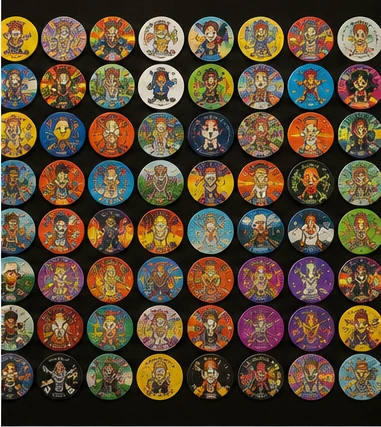
Cartoon Characters Were Natural Fits
Bright faces and simple logos remained readable at milk-cap size.
Comic Heroes Added Collector Appeal
Batman, superheroes and action properties brought existing fan loyalty into the stack.
Power Rangers Fit the Craze Perfectly
Color-coded heroes, symbols and villains created obvious sets. The wider Power Rangers toy craze shows how aggressively the franchise moved from television into every possible object.
Sports Teams Reached a Different Collector
Logos, players and league imagery gave the format crossover with card collecting.
Movie Promotions Used Pogs as Souvenirs
A disc could advertise a release while still functioning as a game piece.
Licensed Sets Encouraged Completion
Children already knew the cast or roster, making missing characters feel obvious.
The Flexibility Fueled Oversaturation
When everything could become a Pog, nothing automatically felt special.
Brand Recognition Often Beat Official POG Status
A favorite character mattered more to many kids than which federation mark appeared on the back.
The licensing strategy: take every thing a child already liked, punch it into a circle and sell the circle beside the register.
The Cheapest Billboard Kids Voluntarily Carried
Fast-Food, Cereal and Promotional Pogs
Companies realized Pogs could function as advertisements, collectibles and playable giveaways at the same time.
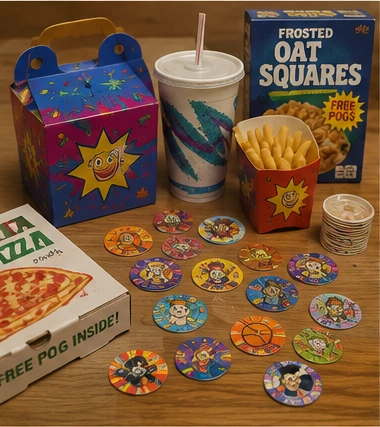
Fast-Food Chains Distributed Themed Sets
Restaurants used licensed characters and limited runs to encourage repeat visits.
McDonald’s Released Branded Promotions
Museum collections document 1994 Power Rangers and VR Troopers-related caps among the period’s restaurant giveaways.
Pizza Hut, Taco Bell and KFC Used Episode I Pogs
By 1999, Star Wars promotional discs connected multiple restaurant chains to one large contest campaign.
Cereal and Packaged Goods Joined In
A lightweight disc fit inside boxes and promotional envelopes more easily than a full toy.
Tourist Attractions Printed Souvenir Pogs
Theme parks and destinations could create collectible reminders smaller than a postcard.
Public-Service Campaigns Used Them
Fire safety and anti-drug messages appeared on items children might actually keep.
Promotional Scarcity Creates Collector Interest
Regional, limited-time or food-linked releases can be harder to reconstruct than standard retail sets.
The marketing miracle: brands convinced us to carry tiny advertisements in protective tubes and become upset when one got scratched.
The broader story of 90s Happy Meal toys and fast-food giveaways shows how restaurants turned licensed plastic, plush and cardboard into repeat-visit strategy.
Every Craze Eventually Requires Storage Sold by the Same Craze
Pog Tubes, Mats, Albums and Accessories
The game began with loose bottle caps. The retail boom supplied an entire equipment system.
Plastic Tubes Became the Standard Carrier
Clear cylinders kept stacks together and allowed kids to display the art through the side.
Tube Caps Held Slammers
Some containers included separate space for thicker pieces or simply forced the slammer on top like a badly packed suitcase.
Clips Attached Collections to Backpacks
Portable display made ownership visible before the first match.
Official Mats Defined Play Areas
Printed targets protected tables and helped standardize tournaments.
Albums Supported Display Collecting
Plastic pages allowed children to organize favorite art without subjecting it to impact.
Carrying Cases Expanded Capacity
Once one tube became five, the hobby required luggage.
Checklist Posters Encouraged Completion
Numbered sets transformed random buying into a mission.
Accessories Signaled Maturity of the Craze
A toy has officially arrived when storage for the toy becomes another toy.
The backpack sound: a plastic tube full of Pogs rattling against a Trapper Keeper like a tiny portable casino.
At Last, Adults Tried to Standardize What the Cafeteria Had Already Ruined
Pog Tournaments and Organized Play
Retailers and the World POG Federation used tournaments to turn playground interest into repeat store traffic and branded competition.
Standardized Stacks
Organizers could set the number and orientation of caps.
Approved Slammers
Material and size restrictions reduced equipment disputes.
Defined Surfaces
Mats or tables made conditions more consistent.
Brackets and Rounds
Structured events transformed quick matches into local championships.
Prizes
Exclusive Pogs, slammers or products gave collectors another reason to enter.
Retail Hosting
Comic shops, hobby stores and malls gained crowds likely to buy more packs.
Official Branding
Federation logos made events look more serious than children throwing discs at cardboard.
Skill Claims
Tournaments supported the idea that technique could be separated from luck.
Community
The events connected collectors beyond one school or neighborhood.
The Craze Reached Its Final Form: A Letter Home
Why Did Schools Ban Pogs in the 90s?
Schools banned or restricted Pogs because the game created gambling concerns, ownership disputes, classroom distraction, trading conflicts and crowds during recess.
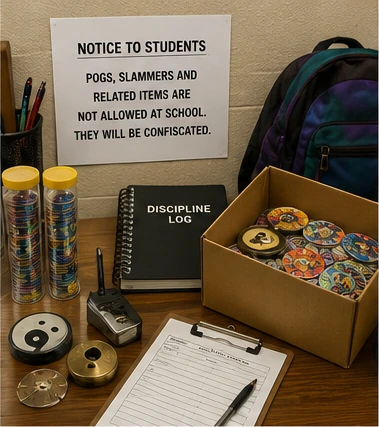
For-Keeps Games Looked Like Gambling
Children risked their property on an uncertain result and could leave with more or less than they brought.
Disputes Required Adult Mediation
Teachers had no practical way to reconstruct whether a favorite Pog had been wagered voluntarily.
Collections Distracted Students
Trading, sorting and comparing continued during class, especially when tubes were visible inside desks.
Metal Slammers Created Safety and Damage Concerns
Heavy discs struck desks, floors and occasionally locations unrelated to the game.
Large Groups Blocked Recess Areas
A small match could attract a crowd, with spectators negotiating side trades and declaring rules.
The Craze Moved Too Fast for Policy
Administrators often discovered the problem only after dozens of students brought collections.
Bans Sometimes Increased the Mystique
Nothing improves a toy’s credibility like an adult memo explaining why it cannot be used during lunch.
The ban cycle: toy appears, toy spreads, somebody cries, principal learns toy’s name, photocopied notice goes home.
Pogs were not banned everywhere, and many schools allowed non-keep play. The restrictions varied because the problems varied by campus.
The same classrooms would soon face the Tamagotchi digital-pet panic, proving that the decade could create a school policy out of cardboard or a keychain.
Kid-Sized Stakes, Real Ownership and One Very Uncomfortable Definition
Was Playing Pogs for Keeps Really Gambling?
The answer depends on the definition, but schools had understandable reasons to see the structure as gambling-like.
Players Risked Something They Owned
Each child contributed caps that could be lost permanently.
The Outcome Was Uncertain
Skill influenced results, but bounce, stack condition and luck mattered.
The Winner Received More Property
That transfer made a for-keeps match different from counting points and returning everything.
The Items Had Social and Sometimes Monetary Value
A favorite licensed Pog could matter deeply even if the retail cost was low.
Children Had Unequal Understanding
Younger players might agree to stakes without appreciating the consequences.
Peer Pressure Complicated Consent
Declining a for-keeps match could be treated as cowardice, especially by the child carrying a suspiciously heavy slammer.
Non-Keeps Play Removed Most of the Concern
Schools and families could allow the game while requiring every piece to return to its owner.
The technical defense: it was a game of skill—right up until the losing player explained that the table was uneven, the stack was loose and the sun was in his eyes indoors.
1994: The Year Every Circle Became Inventory
When Did the Pog Craze Peak? The 1994–1995 Boom
The U.S. craze accelerated in 1993, exploded through 1994 and remained highly visible into 1995 before saturation and fatigue took over.
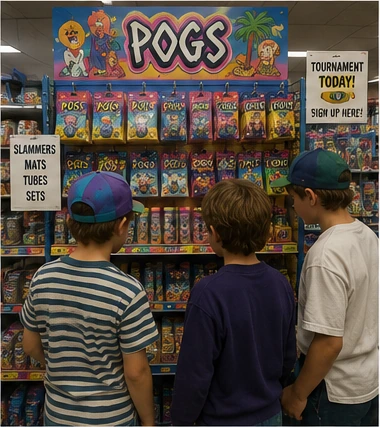
Manufacturers Entered Rapidly
The low-cost format attracted official producers, generic competitors, licensees and promotional printers.
Retailers Added Dedicated Displays
Pogs moved from hobby counters into toy chains, mall kiosks and mass-market stores.
The Trademark Fight Proved the Market’s Size
Companies would not spend money arguing over the name if the name had not become commercially powerful.
Schools Began Restricting Play
Bans are imperfect popularity data, but administrators do not ban hobbies nobody brought to school.
Licensed Sets Multiplied
Characters, teams and brands provided constant new releases.
Fast-Food Promotions Expanded Reach
Kids who never entered a hobby shop could receive Pogs with a meal.
The Craze Became Self-Aware
News stories, tournaments and “official” products taught adults the word while kids were already moving on.
The year-page connection: the top toys of 1994 capture the moment Pogs stopped being one school’s strange recess activity and became everybody’s backpack problem. The top toys of 1995 show the craze at maximum commercial saturation.
The Craze Did Not Fade Gracefully. It Fell Through a Trapdoor.
Why Did Pogs Disappear So Quickly After the Mid-90s Boom?
Pogs vanished because their strengths—cheapness, simplicity and unlimited supply—also made the craze easy to saturate and abandon.
Too Many Manufacturers
The market filled with official Pogs, generic caps, knockoffs and promotional pieces.
Too Much Artwork
When every character and company had a set, new designs stopped feeling scarce.
School Bans
Removing the game from its best social environment weakened both play and trading.
For-Keeps Conflict
Arguments and lost favorites made parents and schools less enthusiastic.
Limited Game Depth
The core action was satisfying but simple. There was no campaign, evolving story or large skill tree.
Collector Fatigue
Completion became impossible once thousands of unrelated designs existed.
Cheapness Reduced Commitment
Kids could abandon Pogs without feeling they had walked away from a major investment.
New Crazes Arrived
Beanie Babies, Tamagotchi, yo-yos, electronic toys and eventually Pokémon competed for the same attention.
The Social Signal Changed
Once the coolest kids stopped carrying tubes, the object went from currency to evidence you had missed the memo.
Pogs were a classic fad because they reached saturation faster than the product could build lasting depth. One year the tube was essential equipment. The next year it remained in a desk drawer beside dried markers and one key nobody could identify.
The Decade Kept Rewriting the Rules of Obsession
Pogs Compared With Other Major 90s Toy Crazes
Each craze used a different combination of scarcity, visibility, character loyalty, technology and social pressure.
Pogs
Main engine: cheap portable collecting plus a for-keeps game.
The craze spread face to face and could be demonstrated on any flat surface.
Beanie Babies
Main engine: retirement rumors and perceived investment value.
The Beanie Babies bubble depended more heavily on adults, scarcity stories and preserved condition.
Tamagotchi
Main engine: portable responsibility and constant attention.
The Tamagotchi school panic created bans because the toy interrupted class from inside a backpack.
Furby
Main engine: electronic personality and Christmas scarcity.
Furby mania required a larger purchase and felt mysterious in ways cardboard could not.
Tickle Me Elmo
Main engine: a beloved character, television exposure and one holiday deadline.
The Tickle Me Elmo frenzy was a shortage crisis; Pogs were a saturation crisis.
Polly Pocket
Main engine: long-running tiny-world variety.
Polly Pocket built durable playsets and characters rather than one brief universal game.
Power Rangers
Main engine: television-driven character demand.
Pogs borrowed the Rangers’ images; the action figures and Megazords delivered the larger fantasy.
Super Soaker
Main engine: visible performance advantage.
The Super Soaker arms race escalated through larger hardware. Pogs escalated through heavier slammers and more art.
Happy Meal Toys
Main engine: limited sets attached to repeat purchases.
Promotional Pogs fit naturally into the same fast-food collection system.
Pogs were not the decade’s biggest Christmas shortage, but they still appear throughout the hottest Christmas toys of the 90s because tubes, licensed packs and slammers made easy stocking gifts during the peak years.
That ability to combine trading, collecting and playground competition is why Pogs remain among the 50 most iconic toys of the 90s even though the peak lasted only a couple of school years.
Your Tube Is Probably Nostalgic. It Is Not Automatically a Retirement Account.
Are Old Pogs Worth Money Today?
Most common 90s Pogs have modest individual value. Collector interest rises for scarce official sets, unusual promotional releases, documented tournament pieces, sealed products, specialty slammers and genuinely hard-to-find licensed variants.
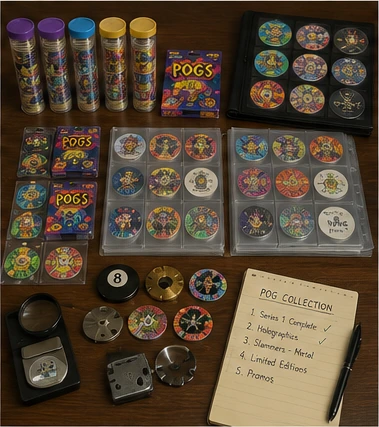
Common Loose Pogs Were Produced in Huge Numbers
Mass supply limits the value of ordinary designs, especially when sold one at a time.
Complete Sets Can Be More Desirable
A documented, numbered series is easier to understand and display than an unrelated pile.
Official POG Branding Matters to Some Collectors
World POG Federation marks can separate branded products from generic milk caps.
Promotional Provenance Can Matter
Regional giveaways, event exclusives and short-lived campaigns may be harder to replace.
Condition Matters
Creases, dents, water damage, writing, edge wear and slammer scars reduce display appeal.
Slammers Have Their Own Market
Metal, branded, unusual-shape and limited pieces can attract interest separate from cardboard caps.
Asking Prices Prove Nothing
A seller may list one Pog for any amount. Recent completed sales for the exact piece and condition provide stronger evidence.
Do Not Clean Away Evidence
Aggressive polishing, chemicals or soaking can damage artwork, metal finishes and packaging.
The realistic answer: the holographic skull may be emotionally priceless. Financially, check sold listings before notifying the family.
Current pricing changes too quickly for a permanent chart. Check date-stamped completed sales for the exact set, manufacturer and condition before deciding that one shiny circle has funded retirement.
Not Every Milk Cap Is an Official POG, Even Though Every Kid Called It One
How to Identify Original and Official 90s Pogs
Identification requires checking the front art, back printing, manufacturer, trademark language, set numbering and packaging.
Inspect the Back
Many caps include company names, licensing information, copyright dates, set numbers or promotional text.
Look for World POG Federation Marks
Official branded products may identify the federation and licensed-product status.
Separate Copyright Date From Production Date
A character copyright may predate the actual Pog release.
Match Numbered Sets
Series numbers, checklists and consistent backs can help reconstruct complete groups.
Identify Promotional Distribution
Restaurant, cereal, event or regional branding may explain why the piece never appeared in a standard retail pack.
Compare Materials
Cardboard thickness, coating, foil and printing quality vary between manufacturers.
Keep Packaging With the Pogs
Wrappers, tubes, checklists and boxes provide provenance that loose pieces cannot.
Do Not Assume “Rare” From Appearance
Holographic, metallic or unusual art can be common if produced in large numbers.
The collector rule: shiny is a finish, not a population report.
The Game Was Designed to Hit the Collectible With a Heavy Object
Pog Condition: Dents, Creases, Edge Wear and Slammer Damage
Mint-condition Pogs are difficult precisely because ordinary play treated the artwork like a target.
Center Dents
Direct slammer impact can compress the cardboard or foil.
Edge Fraying
Repeated handling and tube storage wear the circular edge.
Creases
Bending can permanently distort the piece and change how it plays.
Surface Scratches
Metal slammers and rough floors damage printed or holographic finishes.
Water Damage
Cardboard absorbs moisture, warping the cap and staining the art.
Writing
Names and initials prove schoolyard ownership but reduce collector condition.
Fading
Sunlight can weaken neon colors and promotional printing.
Adhesive Residue
Stickers, tape and old price labels may pull the printed surface.
Warping
Heat, moisture and pressure can make a Pog refuse to sit flat.
The Original Tube Was Convenient, Not Archival
How to Store and Protect a Vintage Pog Collection
Keep the Collection Dry
Cardboard and moisture are natural enemies. Avoid basements, garages and storage areas with condensation.
Use Acid-Free Sleeves or Pages for Better Pieces
Archival materials protect surfaces while keeping art visible.
Do Not Overpack Tubes
Pressure can bend caps, scrape foil and make removal difficult.
Store Slammers Separately
Heavy metal pieces can dent cardboard during movement.
Avoid Direct Sunlight
UV exposure fades ink and can discolor plastic accessories.
Keep Sets Labeled
Document series, numbers, manufacturer and source before memory becomes “I think these came from Pizza Hut.”
Preserve Packaging Flat and Supported
Wrappers, checklists and backing cards may be harder to replace than common caps.
Photograph the Collection
Images help with organization, insurance and recovery if items are lost.
The preservation upgrade: move the good Pogs out of the same tube as the two-pound metal slammer that has been hitting them since 1994.
The Federation Has Returned, Because the 90s Apparently Left Nothing Behind
Are Pogs Coming Back? The Modern POG Revival
The official POG brand returned with nostalgia-focused physical products, digital experiments and an effort to introduce the game to adults who now control household purchasing.
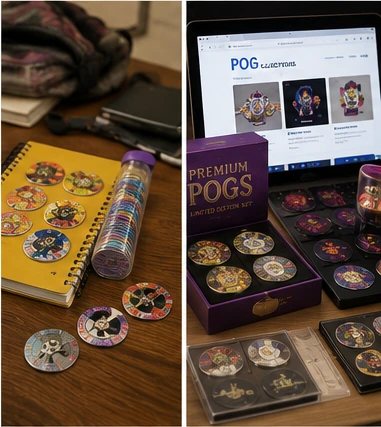
The Brand Rights Changed Hands
Reporting on the revival says the current ownership group acquired the dormant intellectual property in 2019.
The First Audience Was Nostalgic Adults
Collectors who remembered the craze offered a more reliable market than children unfamiliar with milk caps.
New Physical Products Returned
Limited hobby-box releases added numbered pieces, specialty slammers and modern collector features.
The Original Visual Language Remained Important
The revival emphasized preserving Pogman and the mid-90s look rather than redesigning the brand beyond recognition.
Digital Versions Expanded the Game
Online play and digital collectibles attempted to translate the stack-and-slam concept to screens.
Modern Scarcity Is More Deliberate
Numbered runs and limited boxes apply contemporary hobby-market tactics that the mass-produced 90s boom rarely used consistently.
The Core Physical Game Still Works
Two players, equal caps, one slammer and a flat surface remain enough.
The Revival Cannot Recreate the Original Social Network
The 90s craze lived because nearly every school supplied a daily in-person marketplace. Nostalgia products can revive the object, but not the exact recess economy.
The modern difference: adults now buy premium Pogs online and track shipping, which is less chaotic than the cafeteria but also lacks the risk of a vice principal confiscating the whole portfolio.
As of July 2026, the official POG rights holder continues to market new physical products. Availability and product details should be reviewed during future updates.
Centuries of Play, Two Years of Total Mania
Pogs Timeline: Menko to the Modern Revival
The commercial peak was brief, but the game’s roots and afterlife stretch far beyond 1994.
1600s–1800s
Japanese Menko traditions develop around illustrated pieces players try to flip or displace.
Early 1900s
Japanese immigrants bring related play traditions to Hawaii, where children adapt milk-bottle caps.
1920s
Milk-cap flipping games become established in Hawaii.
1991
Blossom Galbiso reintroduces the game to students on Oahu, according to the widely documented revival story.
1993
Alan Rypinski acquires POG brand rights and launches the World POG Federation.
1994
The U.S. craze explodes through schools, stores, licensed sets, promotions and legal fights over the name.
1995
Saturation peaks as tournaments, accessories and thousands of designs crowd the market.
Late 1990s
The core craze fades, though promotional Pogs and licensed releases continue appearing.
2019
A new ownership group acquires the dormant POG intellectual property.
2022
Digital initiatives help finance renewed physical-product plans.
2024
New official hobby products return for nostalgia collectors.
2026
The official brand remains active while original 90s collections continue moving through the vintage market.
The Craze Vanished. The Word “Slammer” Still Reboots the Entire Memory.
Why Pogs Still Matter in 90s Toy History
Pogs captured a moment when a global fad could still spread primarily through schoolyards, mall stores, local promotions and children physically showing one another how to play.
They Turned Packaging Into Play
The game’s roots prove that children can create a toy before the toy industry arrives.
They Combined Collecting and Competition
The art could be admired, traded, played or wagered.
They Created a Portable Economy
Value changed by school, friendship group and current obsession.
They Spread Without a Screen
The best marketing was another child opening a tube.
They Made Licensing Nearly Universal
Any character, company or event could fit on a disc.
They Exposed the Cost of Saturation
Unlimited supply destroyed the sense of discovery that built the craze.
They Showed Why Schools Ban Fads
Trading, wagering and social pressure can turn a cheap toy into an administrative workload.
They Created Equipment Loyalty
A slammer became personal in a way the interchangeable cardboard pieces did not.
They Became the Perfect Forgotten Craze
For a brief period they were unavoidable, and then they became fossils in plastic tubes.
The complete decade lives in the 90s Toys collection, but Pogs deserve their own deep history because no other craze made a cardboard circle feel so much like art, money, equipment and contraband at the same time.
Keep the 90s Rewind Going
More 90s Toy Crazes, Collectibles and Holiday Mayhem
Pogs connected schoolyard competition, collectible fever, fast-food promotions and the same scarcity psychology that drove the decade’s biggest toy crazes.
Because Playground Lore Was 40 Percent Accurate on a Good Day
Pog History, Rules and Revival Sources
The Menko connection, Hawaiian milk-cap history, Blossom Galbiso revival and school-ban context were checked against The Strong National Museum of Play, the Makawao History Museum, and the Kalamazoo Valley Museum. Official stack-and-slam rules were checked against the World POG Federation and the period Pocket Book of POG rules. The 1994 trademark dispute, manufacturing boom and contemporary school restrictions were checked against Los Angeles Times reporting from August 1994. The current brand ownership and physical-product revival were checked against Fast Company’s 2024 report and the current official brand site. Value guidance intentionally avoids fixed price claims because set, condition, provenance and completed-sale date change the market.
Frequently Asked Cardboard-Circle Questions
Pogs in the 90s FAQ
What were Pogs?
Pogs were small collectible cardboard discs used in a stack-flipping game. Players struck the stack with a heavier disc called a slammer.
When were Pogs popular?
The mainland U.S. craze accelerated in 1993, peaked around 1994 and 1995, and declined rapidly afterward.
Where did Pogs come from?
The modern game grew from Hawaiian milk-cap play with deeper connections to the Japanese game Menko.
Who brought Pogs back in the early 90s?
The widely documented revival story credits Oahu educator Blossom Galbiso with reintroducing the milk-cap game to students around 1991.
What does POG stand for?
The beverage name referred to passion fruit, orange and guava.
Was POG originally a juice?
Yes. Haleakala Dairy used the POG name for a Hawaiian fruit drink, and its cardboard caps became associated with the game.
Who created the World POG Federation?
Businessman Alan Rypinski acquired rights connected to the POG name in 1993 and launched the World POG Federation.
Are all milk caps official Pogs?
No. POG is a protected brand name, while many companies produced generic milk-cap game pieces that children also called Pogs.
How do you play Pogs?
Players contribute equal numbers of caps to a face-down stack, take turns slamming it with a heavier disc and collect any Pogs that land face up.
What is a Pog slammer?
A slammer is the thicker, heavier disc used to strike the stack. Official materials also used the term kini.
What were slammers made from?
Common materials included plastic, rubber and metal, with many specialty shapes and finishes.
Were metal slammers better?
They carried more weight and could transfer more force, but they could also damage cardboard Pogs and were sometimes banned by local rules.
What does playing Pogs for keeps mean?
It means the player keeps the Pogs successfully flipped during the match rather than returning them afterward.
Why did schools ban Pogs?
Common concerns included for-keeps gambling, ownership disputes, classroom distraction, trading conflicts, heavy slammers and crowded recess games.
Was playing Pogs gambling?
For-keeps matches had gambling-like elements because players risked owned property on an uncertain outcome. Non-keeps games avoided most of that concern.
Did every school use the same Pog rules?
No. Stack direction, release height, slammer material, drop style and edge-piece rules varied widely.
Should Pogs be stacked face up or face down?
Official modern rules stack them face down, though many playground groups used different conventions.
How many Pogs go in a stack?
The number can vary, but each player should contribute an equal amount under rules agreed before play.
What was Pogman?
Pogman was the orange mascot used by the World POG Federation on official products and promotions.
Why were there so many different Pogs?
The circular format was cheap to print and easy to license, so companies used it for characters, sports, advertising, promotions and public-service messages.
Were Pogs given away with fast food?
Yes. Restaurant chains used Pogs in licensed and movie-related promotions, including Power Rangers-related and Star Wars Episode I campaigns.
Why did the Pog craze disappear?
Oversupply, school bans, collector fatigue, limited game depth, new fads and the loss of social status all contributed.
Are old Pogs worth money?
Most common loose Pogs have modest value, while scarce promotions, complete sets, sealed products and unusual slammers can attract more collector interest.
What makes a Pog rare?
Limited distribution, regional promotion, low production, documented tournament use, unusual licensing and genuine set scarcity matter more than shiny artwork alone.
How can I identify an official 90s Pog?
Check the back, packaging and checklist for World POG Federation marks, manufacturer information, set numbers and licensing details.
Does Pog condition matter?
Yes. Dents, creases, edge wear, water damage, writing and slammer scratches affect collector appeal.
How should vintage Pogs be stored?
Keep them dry, out of sunlight, separated from heavy slammers and protected in archival sleeves or pages when appropriate.
Are Pogs being made again?
Yes. The current rights holder has released new official physical products aimed heavily at nostalgia collectors.
What year page best matches the Pog craze?
The Top 10 Toys of 1994 captures the U.S. explosion, while the 1995 toy page reflects the saturation period.
Where do Pogs fit in the larger 90s toy story?
They connect the schoolyard-toy story, collectible crazes, promotional giveaways and the broader 90s Toys collection.
The Stack Is Gone. The Slammer Is Still in a Drawer Somewhere.
Pogs Were the 90s Playground in One Plastic Tube
They were cheap enough for almost anybody to join, visual enough for everybody to develop favorites and competitive enough to create real stakes. The game could be learned in a minute and argued about for the rest of lunch.
Pogs also burned through every stage of a fad at maximum speed: local game, commercial product, global brand, licensed flood, school problem, collector market and forgotten object. Nothing had to plug in. Nothing needed a screen. All it took was a stack, a slammer and one kid saying, “We’re playing for keeps.”