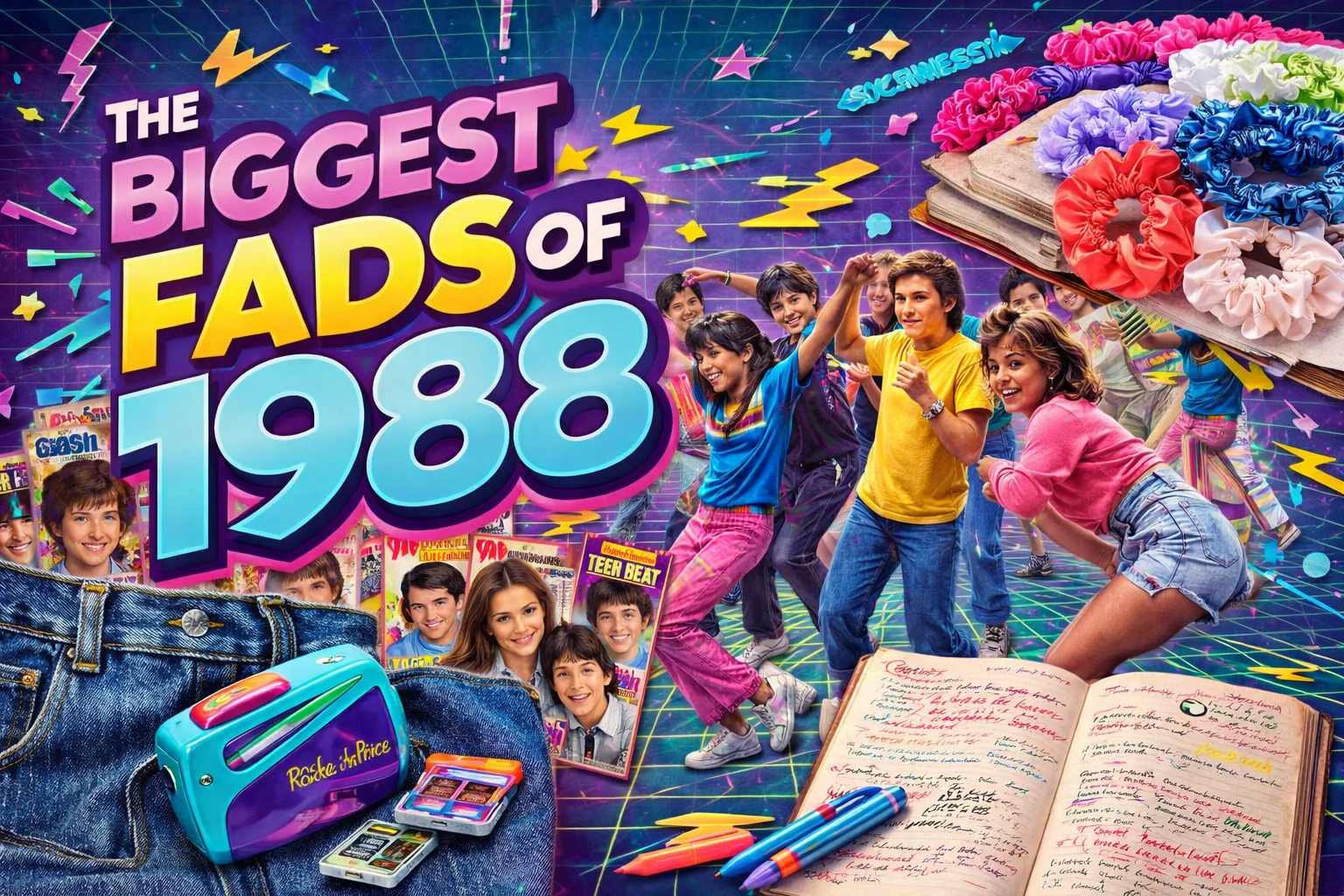
6 Biggest Fads of 1988 The School-Hallway Year of Scrunchies, Slam Books, Dance Moves and Teen-Mag Obsession
1988 felt like the year late-80s culture moved directly into the backpack. Teen magazines covered bedroom floors, slam books passed between desks, scrunchies lived on wrists, Pocket Rockers clipped onto shirts and every school dance became a badly supervised choreography lab.
These six fads capture the year as Gen X actually lived it: not as a museum display, but as a mix of locker decorations, magazine quizzes, dance moves, loud clothes and small objects that somehow became the center of everybody’s attention for three weeks.
1988 Hallway Forecast
Glossy celebrity photos become bedroom wallpaper. Scrunchies multiply. Shoulder pads widen. A notebook quietly destroys three friendships before lunch. Somebody clips a tiny music player to a shirt and acts as though portable audio has reached its final form.
The year’s biggest trends fit inside a locker.
The strongest 1988 fads were portable, social and visible. They traveled through magazines, notebooks, hair accessories, clothing, music gadgets and dance moves copied from television.
What Were the Six Biggest Fads of 1988?
The six biggest fads of 1988 were the teen-mag craze, the Running Man and Cabbage Patch dance craze, colorful clothing and shoulder pads, scrunchies, slam books and Pocket Rockers. Together they show why 1988 felt so school-centered: the trends were worn, clipped on, passed around, danced and read during everyday Gen X life.
Why 1988 Felt More School-Centered Than the Years Around It
The biggest 1988 fads did not need a special destination. They lived in ordinary kid spaces: classrooms, lockers, bedrooms, school dances, salons and the back seats of family cars. The year’s trends were less about owning one giant status object and more about carrying several smaller signals that other kids understood immediately.
A scrunchie could sit on a wrist all day. A teen magazine could be read, traded, cut apart and turned into wall decoration. Slam books moved through friend groups like handwritten explosives. Even Pocket Rockers were designed to clip onto clothing, because apparently the future needed to hang from your shirt.
The hallway was the real showroom
The school hallway gave every trend instant exposure. You could see the hair accessory, the giant shoulders, the magazine tucked under an arm and the kid attempting the Running Man before the bell. No advertising campaign had to explain whether something had caught on. The evidence was walking toward you between classes.
1988 was still loud, but more personal
The late 80s remained bright and oversized, yet the year’s most memorable fads often felt intimate. They lived close to the body or inside the backpack. That made them easier to copy, easier to trade and much harder for adults to control.
How Fads Spread in 1988 Before Feeds and Group Chats
Trends traveled through overlapping physical networks. A dance move appeared in a video, an older kid performed it at school, somebody practiced it in a bedroom mirror and by Friday the gym floor had become an uncontrolled demonstration.
The same process worked for clothing and accessories. Magazines showed the look, malls sold a version, and school decided whether it survived. The system had no algorithm, but it did have immediate feedback delivered by people who had to sit near you every day.
How These 1988 Fads Were Ranked
The countdown weighs visibility, everyday participation, school-life presence, cultural reach and long-term Gen X memory. A fad ranks higher when it influenced more than one part of life and became easy to recognize in photographs, notebooks, bedrooms or school events.
Teen magazines take the top spot because they influenced several other trends at once. Dance crazes rank second because participation spread them through school culture. Shoulder pads and scrunchies made the year visible, while slam books and Pocket Rockers captured the smaller, portable fads that lived inside the kid ecosystem.
The Rest of 1988: Music, Movies, TV, Toys and Nike
The fads were only one part of 1988. This was also the year of George Michael, Whitney Houston, Michael Jackson, Rick Astley, Guns N’ Roses, Def Leppard, Bon Jovi, Poison, and glossy late-80s radio, Nike’s “Just Do It,” huge movies, appointment TV, toy-aisle escalation, and late-80s culture turning brighter, louder, and more branded.
Keep the same-year rabbit hole going with the rest of the 1988 Smells Like Gen X cluster.
Why These Six Belong on the 1988 List
A real fad year is not just about what got advertised or what sold well. It is about what broke out of the store, the TV, or the magazine page and became part of daily life. That is why 1988 works so well. Its biggest fads were not stuck in one lane. They spilled into school culture, after-school culture, bedroom culture, and the strange little status systems kids and teens invent for themselves.
This was also a year that felt a little more social and hands-on than the two years before it. The trends were not all about standing there and looking cool, though that still mattered. They were also about movement, note-passing, reading, styling, carrying around small gadgets, and building identity out of whatever was physically around you. One fad lived in magazines. Another lived in your hair. Another got passed across desks. Another clipped onto your shirt and blasted tiny music into the world like that seemed remotely practical.
That is what gives 1988 its flavor. It had big late-80s visuals, but it also had a more playful, school-centered energy. It felt like the kind of year where style, gossip, dance, and little possessions all mixed together until the whole thing became one giant scrapbook of very specific memories.
What 1988 Looked Like From Inside the Hallway
If you were there, you remember that 1988 could feel like a full sensory experience. Somebody was showing off a magazine, somebody was adjusting a scrunchie, somebody else had shoulder pads making a basic outfit look ten times more dramatic, and somewhere in the room a slam book was quietly ruining somebody’s peace. Then there was always at least one kid trying to dance like they had MTV-level confidence when they absolutely did not.
The 1988 Fad Countdown
- #6 Pocket RockersTiny clip-on music players that felt futuristic, annoying, and extremely elementary-school cool all at once.
- #5 Slam booksNotebook gossip culture at its most chaotic, awkward, and aggressively pre-digital.
- #4 ScrunchiesThe accessory that lived on ponytails, wrists, and half the girls in any hallway worth remembering.
- #3 Colorful clothing and shoulder padsLate-80s fashion stopped asking permission and started taking up space.
- #2 Running Man / Cabbage Patch dance crazeSchool dances, talent shows, and random living rooms suddenly became choreography experiments.
- #1 Teen-mag crazeGlossy magazines turned teen identity into a monthly subscription.
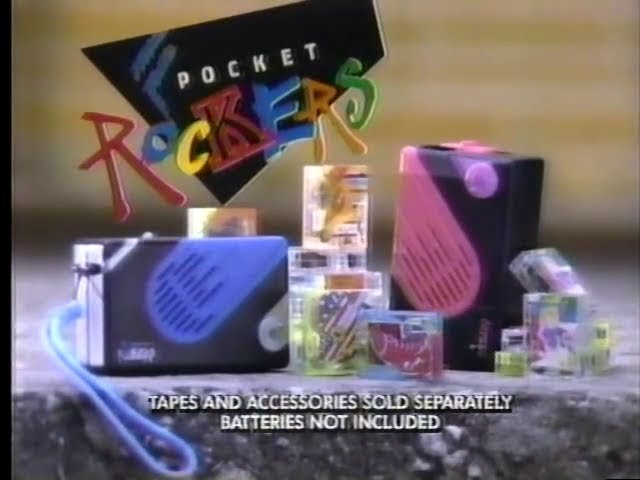
Pocket Rockers
Pocket Rockers are one of those very specific late-80s memories that instantly take you back to a certain kind of kid excitement. They were tiny. They clipped onto clothes. They played little cartridges. And for a brief moment, that was enough to make them seem like the future had arrived in toy form and brought its own soundtrack.
What makes them belong here is that they hit that perfect younger-kid sweet spot: portable, show-off-able, and just annoying enough that adults and schools were not always thrilled. That is usually a good sign. Once something becomes cool enough for kids and irritating enough for authority figures, it starts to behave like a real fad. It becomes part toy, part accessory, part social object.
If you were there, you remember how much the scale of them was part of the magic. They felt personal. They felt like your own little machine. They were not practical in any adult sense, but practicality has never been the point of a good kid fad. The point is that kids suddenly want one, carry one, compare one, and make it part of their personality for a minute, especially in a year where 1988 music was already everywhere. Pocket Rockers absolutely did that.
The clip mattered almost as much as the music
Pocket Rockers were designed to be seen. Clipping one onto clothing made the gadget part accessory, part toy and part announcement that you had portable music technology—even when the available song selection fit inside a very small plastic cartridge.
The sound of younger-kid independence
The appeal was not audio quality. It was ownership. The machine was small enough to feel personal and simple enough to carry without asking an adult to protect it like expensive electronics.
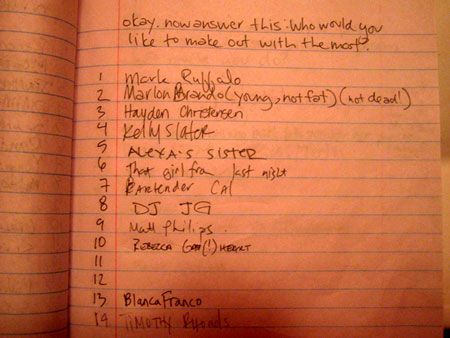
Slam Books
If you want a fad that screams school life before the internet, slam books are hard to beat. They were messy, mean, fascinating, irresistible, and exactly the kind of thing kids and teens would pass around because the combination of gossip and secrecy is basically eternal. You answered questions, rated people, wrote comments, and hoped your own page was not about to become the source of next week’s emotional damage.
That is why slam books belong on a 1988 list. They were not just a trend in theory. They lived physically in schools. They passed from hand to hand. They created minor scandals, major hurt feelings, and the kind of notebook-level drama that adults tended to discover about three beats too late. That is classic fad behavior: social, portable, easy to copy, and just scandalous enough to keep it alive.
If you lived through it, you probably remember that slam books had a very specific tension to them. Everybody knew they were trouble. That never stopped them. In fact, it probably helped. The whole thing was a crude little prototype for future gossip culture, except instead of apps and group chats, you had lined paper, suspicious handwriting, and the constant risk of the wrong person flipping to the wrong page.
Every answer felt permanent
A slam book did not offer editing, disappearing messages or plausible deniability. Once the words were on the page, they stayed there in handwriting somebody would eventually recognize.
Teachers found them one crisis too late
Adults usually discovered the notebook after the social damage had already circulated. Confiscating it stopped the object, but not the conversations it had launched during the previous three class periods.
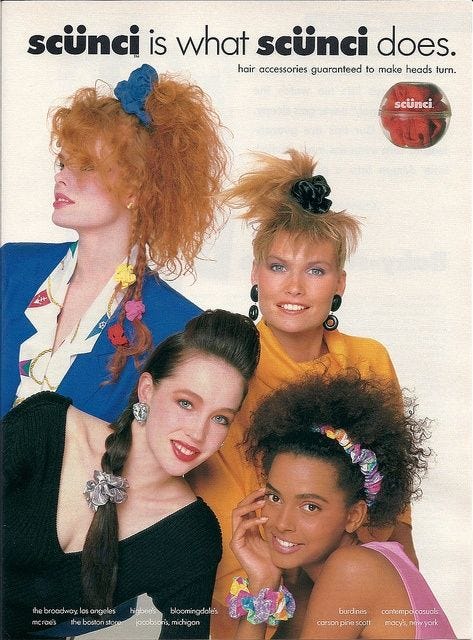
Scrunchies
Scrunchies were one of those perfect late-80s accessories because they were practical enough to use and visible enough to matter. They held hair back, yes, but they also added color, softness, volume, and just enough style to make them feel like more than a basic necessity. By 1988, they were everywhere — on ponytails, around wrists, and attached to entire categories of school-day outfits.
Part of the reason they worked so well is that they were flexible in every possible sense. They could be cute, bright, coordinated, casual, or extra, depending on the rest of the look. That made them ideal for a year when fashion still loved being noticeable but was starting to distribute that energy into smaller, everyday objects. Scrunchies let people participate in the look without needing an entire wardrobe overhaul.
If you were there, you remember how normal it felt to see them constantly. They blended into the visual language of the time so completely that it is easy to forget they were once a fad. But they absolutely were. They took something ordinary, made it bigger and more stylish, and convinced an entire generation that even a ponytail holder should be doing image work.
The wrist became temporary storage
Scrunchies spent almost as much time around wrists as they did in hair. That made them visible even when they were not performing their official job, turning an elastic into a constant style signal.
Cheap enough to multiply
One scrunchie was useful. Several created options. Colors, fabrics and sizes made collecting them feel reasonable, which is how bedroom dressers slowly became soft-fabric ecosystems.
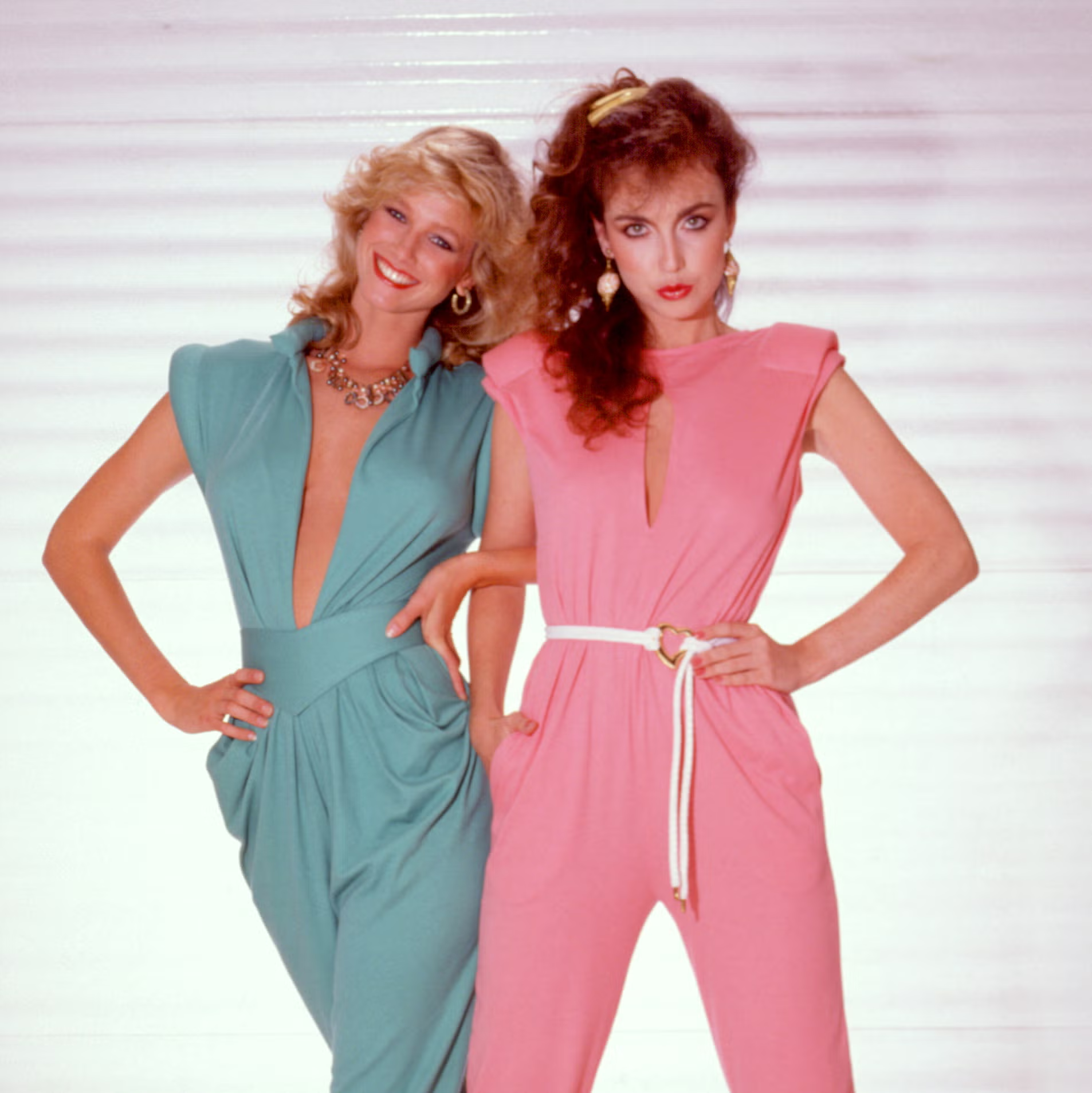
Colorful Clothing and Shoulder Pads
By 1988, late-80s fashion had fully accepted that “a normal amount” was for quitters. Color got brighter. Shapes got stronger. Shoulder pads kept making even basic clothes look like they had opinions. This was the kind of trend that made an ordinary top or dress suddenly feel more theatrical, more grown-up, and more aggressively of-the-moment.
That is why this works as a real fad category rather than just general fashion history. It was visible in everyday life. It showed up at school, in family photos, in malls, at church, at parties, and anywhere people were trying to look current. The look made its presence known immediately. You did not need to ask what year a picture came from once the shoulders came into frame.
If you lived through it, you remember that this style had a kind of late-80s confidence that bordered on absurdity and somehow made that a selling point. The bright colors and bold shapes were not apologizing. They were announcing. That is a big part of what made 1988 feel so distinct. Even the clothes looked like they were trying to win a conversation.
The silhouette entered before the person
Shoulder pads gave ordinary tops, dresses and jackets a built-in announcement. The look borrowed the confidence of television professionals and spread it through malls, offices, churches and family photos.
Color handled the rest
Bright shades and graphic combinations made sure the extra width did not go unnoticed. Late-80s clothing did not merely occupy space. It used color to file a second claim.
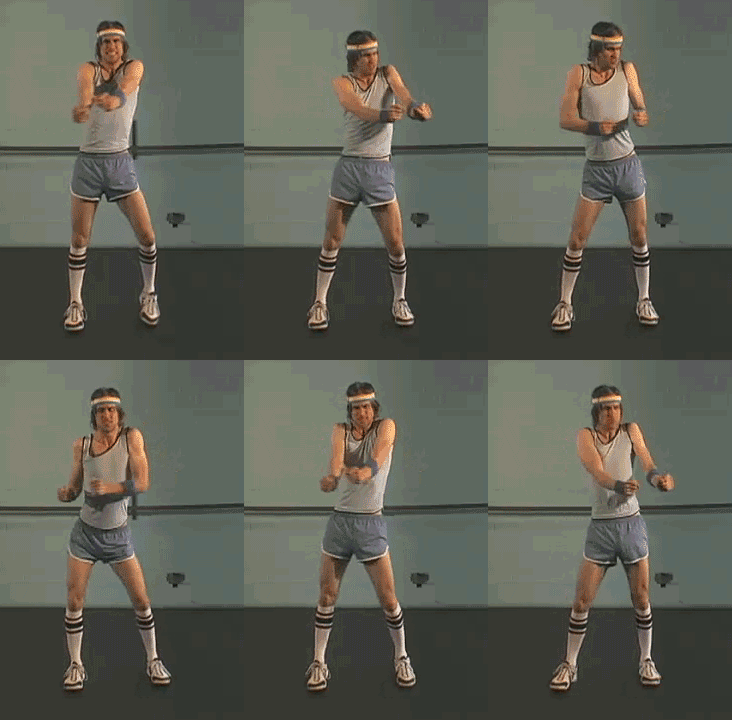
Running Man / Cabbage Patch Dance Craze
Dance crazes are always a great test of whether something has actually entered everyday life, because once people start doing it at school, at parties, in talent shows, in living rooms, and with absolutely no regard for whether they are any good at it, the fad has officially escaped. That is what happened here. The Running Man and Cabbage Patch dance moves became the kind of thing kids and teens tried because they were visible, shareable, and easy enough to imitate badly.
That matters because these were not passive fads. They required participation. You had to move. You had to copy. You had to be willing to make a fool of yourself just enough to try. That is a huge part of why dance crazes tend to hit hard in memory. They are not just something you saw. They are something you did, or at least attempted, and probably not gracefully.
If you were there, you remember how quickly one or two moves could spread through a school or a neighborhood. Somebody learned it from TV, older kids, music videos, or the same 1988 pop culture pipeline that made songs visual, and suddenly every gym, dance floor, and patch of open room turned into a stage. Even people who did not really dance somehow ended up involved. That is genuine fad energy.
The moves were easy enough to begin
Dance crazes spread because the first few seconds looked possible. That confidence often disappeared once arms, feet and rhythm were required to cooperate at the same time.
Every open floor became a test site
School dances, talent shows, parties and living rooms gave the moves room to spread. Watching was not enough. Somebody always decided the group needed a demonstration.
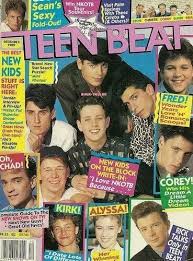
Teen-Mag Craze
If one fad best captures how 1988 fed information and identity into teen life, it is the magazine boom. Teen magazines were not just reading material. They were manuals, wish books, celebrity briefings, fashion guides, beauty suggestions, social reassurance, and mild emotional manipulation, all stapled together with glossy covers and a lot of confidence. For a lot of kids and teens, they helped define what was current long before anything like social media existed.
That is why this takes the top spot. It reached into everything else. The magazines shaped crush culture, style choices, beauty experiments, music awareness, and even the general feeling of what kind of girl or guy you were supposed to want to be. They influenced outfits, bedroom walls, lunch-table conversation, and the general mood of sleepovers. They did not just reflect teen life. They actively helped script it.
If you lived through it, you remember how big that could feel. A magazine was not just something you read once and tossed aside. You flipped through it repeatedly. You dog-eared pages. You studied the quizzes, the advice, the spreads, the celebrity photos, and the little promises that this issue would somehow explain your hair, your face, your crushes, and your social life. In 1988, that kind of glossy influence was hard to beat, especially with music, TV, movies, and celebrity culture all feeding the same machine.
The magazine was meant to be reused
Issues were flipped through repeatedly, shared with friends, cut apart for photos and stacked beside beds. Posters migrated to walls, quizzes circulated and advice columns were studied far beyond their actual usefulness.
Celebrity access before constant access
A magazine felt valuable because photos and interviews were not available every minute. Waiting for the next issue gave celebrity culture a monthly rhythm and made each cover feel like an event.
What Happened to the Biggest Fads of 1988?
Scrunchies had the strongest conventional comeback because they were always useful. Dance moves survived through parties and retro culture. Teen magazines lost the information monopoly they once held, but the emotional memory of waiting for a new issue remains distinct.
Slam books did not disappear so much as change platforms. The need to rate, comment and create social damage migrated online, where handwriting was no longer available to identify the guilty party.
The Final Verdict on the Biggest Fads of 1988
1988 felt like a year where school culture, younger-kid culture, and late-80s style all collided in a really specific way. Teen magazines were shaping what people wanted and how they saw themselves. Dance crazes were turning social spaces into little performance zones. Shoulder pads and bright clothing kept fashion loud. Scrunchies made the simplest accessory feel era-defining. Slam books brought paper-based chaos into the classroom. And Pocket Rockers proved that if you gave kids a tiny portable gadget that clipped to their clothes, they would absolutely make it a moment.
That is why this lineup works. These were not just things people noticed in 1988. They were things people wore, read, passed around, danced, clipped on, and built into everyday life while the year was actually happening. More than anything, 1988 felt like a year of shared rituals — the little school-and-social behaviors that still stick in memory long after the trend itself is gone.
Questions About the Biggest Fads of 1988
What were the biggest fads of 1988?
The biggest fads of 1988 included teen magazines, the Running Man and Cabbage Patch dance craze, colorful clothing and shoulder pads, scrunchies, slam books, and Pocket Rockers.
Why are teen magazines ranked above the fashion and dance fads?
Because they influenced almost everything else. Teen magazines were not just a trend on their own. They shaped what people wore, what celebrities they followed, what beauty ideas they tried, what songs and stars they cared about, and what kinds of social conversations they were having.
Why include slam books as a major 1988 fad?
Because they were incredibly school-specific and social. They lived in classrooms and friend groups, moved physically from person to person, and created exactly the sort of drama that makes a fad feel lived-in rather than abstract.
Why do Pocket Rockers belong on a fad list?
Because they hit the younger-kid lane perfectly. They were portable, visible, shareable, and just disruptive enough to feel special. That is exactly the kind of product that turns into a real school-year craze.
Was 1988 more school-centered than 1987?
In a lot of ways, yes. 1987 felt more image-and-label driven across broader teen culture, while 1988 had more fads that lived directly in schools, on desks, in notebooks, on wrists, and in younger day-to-day routines.
Why were scrunchies such a big late-80s trend?
Scrunchies were cheap, visible, practical, colorful, and easy to match with outfits. They turned a basic hair accessory into a style signal that could live on a ponytail, wrist, backpack, or bedroom dresser.
Was Nike’s “Just Do It” part of 1988 fad culture?
Yes. Nike’s “Just Do It” launched in 1988 and became one of the defining slogans of late-80s motivation and athletic style. It was not part of the school-fad countdown here, but it absolutely belongs in the larger 1988 cultural picture.
Why does 1988 feel so late-80s?
Because the year combined glossy teen media, bold fashion, MTV-influenced dance culture, school gossip rituals, portable kid gadgets, big pop songs, strong TV habits, and heavily branded consumer culture. It feels like the late 80s fully turned up the volume.
How did 1988 fads spread without social media?
They spread through MTV, teen magazines, school hallways, malls, older siblings, sleepovers and word of mouth. A look or dance move could travel from television to a school gym within days.
Which 1988 fad had the biggest long-term influence?
Scrunchies had the clearest everyday comeback, while teen magazines helped establish the celebrity-and-style content model that later moved online.
Why were school fads so important in 1988?
School created daily visibility and constant social feedback. Accessories, notebooks, gadgets and dance moves could be copied, judged and traded immediately.
Were Pocket Rockers toys or music players?
They were both. Pocket Rockers were kid-focused miniature music players that used small cartridges and worked as gadgets, toys and wearable schoolyard status objects.