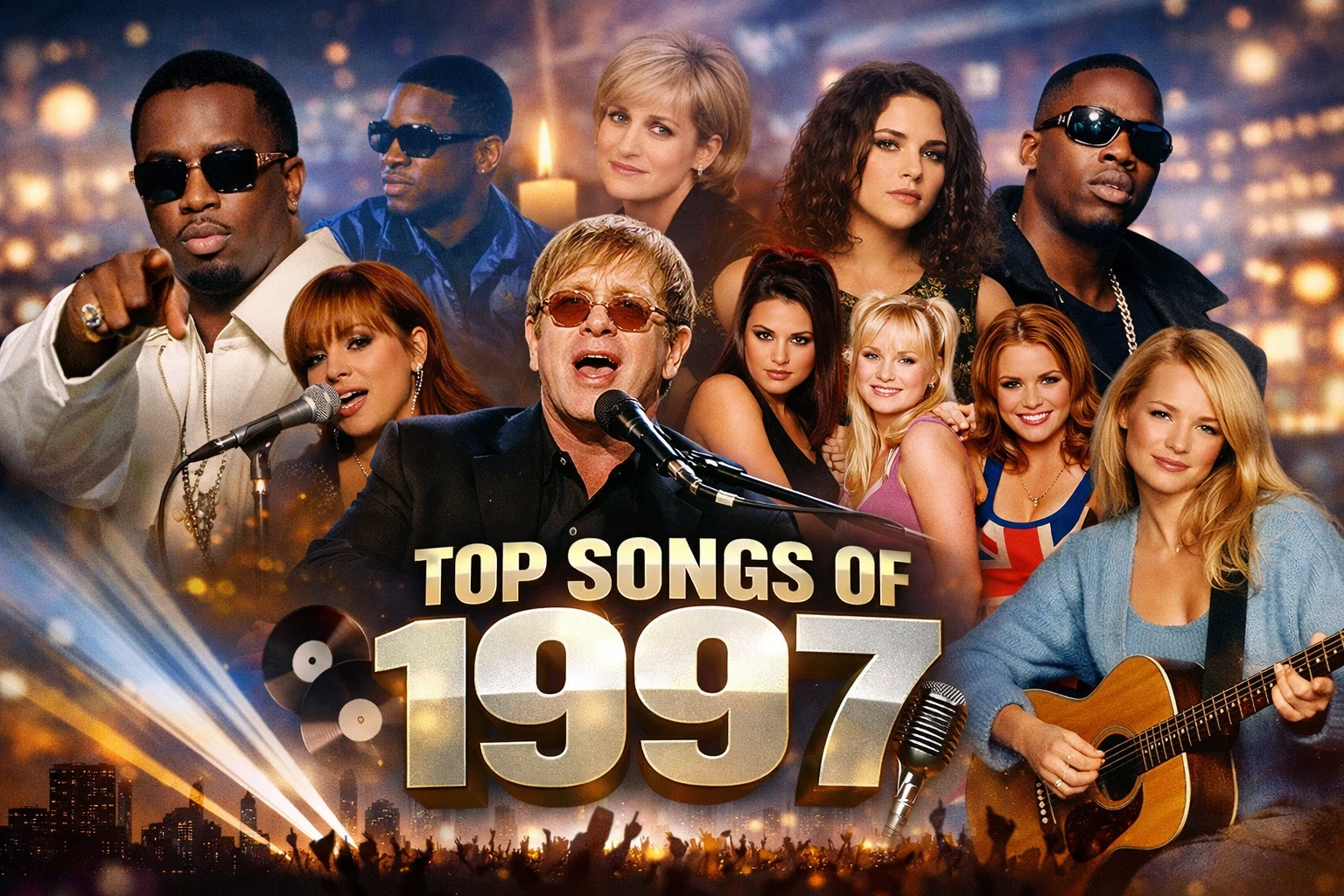
Top 10 Songs of 1997: Billboard’s Biggest Hits, Ranked
The top 10 songs of 1997 capture the moment the decade became glossier, sadder, louder, and much less interested in keeping its feelings private. Billboard’s year-end Hot 100 mixed public mourning, handwritten heartbreak, Bad Boy swagger, towering R&B ballads, country-pop endurance, British comeback confidence, and a five-woman pop explosion that arrived with no indoor voice.
This was the year Elton John turned a moment of worldwide grief into one of the biggest singles in chart history, Jewel made private disappointment feel as though it had been pulled from a notebook, and Puff Daddy occupied two of the year-end top five while the shiny-suit era moved fully into the center of American music.
Toni Braxton delivered heartbreak with full weather effects. En Vogue kept R&B elegant and dangerous. Mark Morrison turned wounded pride into a victory lap, LeAnn Rimes simply refused to leave the chart, and the Spice Girls kicked open the American door like they had already chosen the furniture.
The ranking uses Billboard’s 1997 year-end Hot 100, so these are the biggest U.S. singles of the year based on cumulative chart performance—not a personal ranking of the best songs of 1997 and not a modern nostalgia poll.
“Candle in the Wind 1997” / “Something About the Way You Look Tonight” by Elton John was Billboard’s number-one year-end single of 1997. Jewel, Puff Daddy and Faith Evans, Toni Braxton, and Puff Daddy with Mase completed the year’s top five.
Billboard Hot 100 Year-End Ranking
The year-end order reflects performance across Billboard’s full chart period. A weekly peak matters, but timing and staying power matter too—which is how Jewel finished second for the year without reaching number one, while several shorter-lived chart-toppers landed below her.
1997 Was the Year Private Feelings Became Public Events
The biggest songs of 1997 often sounded as though the entire country had been invited into somebody else’s emotional emergency. Elton John and “I’ll Be Missing You” turned grief into shared national experiences. Toni Braxton made one breakup sound large enough to require federal assistance, while Jewel went the other direction and made heartbreak feel like something overheard through an apartment wall.
Hip-hop was moving through another major change. The Bad Boy sound brought expensive samples, brighter production, designer confidence, and a version of rap that looked perfectly at home inside pop’s largest commercial spaces. Puffy and Mase did not enter quietly. Quiet was not part of the budget.
Pop was changing too. The Spice Girls represented a louder, more personality-driven future, but the older lanes were still working. Adult ballads, R&B vocal groups, country-pop crossover, soundtrack songs, and British soul could all occupy the same dial without agreeing on much of anything.
Quick List: Top 10 Songs of 1997
- #1 “Candle in the Wind 1997” / “Something About the Way You Look Tonight” — Elton John
- #2 “You Were Meant for Me” / “Foolish Games” — Jewel
- #3 “I’ll Be Missing You” — Puff Daddy & Faith Evans featuring 112
- #4 “Un-Break My Heart” — Toni Braxton
- #5 “Can’t Nobody Hold Me Down” — Puff Daddy featuring Mase
- #6 “I Believe I Can Fly” — R. Kelly
- #7 “Don’t Let Go (Love)” — En Vogue
- #8 “Return of the Mack” — Mark Morrison
- #9 “How Do I Live” — LeAnn Rimes
- #10 “Wannabe” — Spice Girls
1997 Billboard Year-End Top 10 at a Glance
This table shows Billboard’s complete 1997 year-end top 10, each single’s weekly Hot 100 peak, and the number of weeks it spent at number one.
| Year-End Rank | Song | Artist | Hot 100 Peak | Weeks at #1 |
|---|---|---|---|---|
| #1 | “Candle in the Wind 1997” / “Something About the Way You Look Tonight” | Elton John | #1 | 14 |
| #2 | “You Were Meant for Me” / “Foolish Games” | Jewel | #2 | 0 |
| #3 | “I’ll Be Missing You” | Puff Daddy & Faith Evans featuring 112 | #1 | 11 |
| #4 | “Un-Break My Heart” | Toni Braxton | #1 | 11 |
| #5 | “Can’t Nobody Hold Me Down” | Puff Daddy featuring Mase | #1 | 6 |
| #6 | “I Believe I Can Fly” | R. Kelly | #2 | 0 |
| #7 | “Don’t Let Go (Love)” | En Vogue | #2 | 0 |
| #8 | “Return of the Mack” | Mark Morrison | #2 | 0 |
| #9 | “How Do I Live” | LeAnn Rimes | #2 | 0 |
| #10 | “Wannabe” | Spice Girls | #1 | 4 |
Listen to the Top Songs of 1997
The companion playlist brings together the biggest songs of 1997 with the wider sound of the year: hip-hop, R&B, country-pop, adult ballads, British pop, alternative music, movie songs, dance records, and the tracks that followed Gen X from car stereos to mall speakers and late-night video countdowns.
Use the playlist while reading the countdown, then continue into the complete 90s Music archive for more Billboard year-end songs, hip-hop, R&B, slow jams, alternative music, grunge, pop hits, and Gen X radio memories.
Countdown: The Top 10 Songs of 1997
The countdown runs from the Spice Girls at #10 to Elton John at #1, with chart peaks, weeks at number one, deeper 1997 music context, and lived-in Gen X memories for every song.
“Wannabe”
Spice Girls
Why It Hit
“Wannabe” did not sound like carefully managed American chart polish. It sounded like five people had charged into the studio at once, talked over one another, found a hook, and refused to leave until the entire building understood what they wanted.
That chaos was carefully built, but it never felt careful. The beat moves quickly, the vocals keep changing hands, and the chorus arrives before the listener has time to organize the personalities involved. The record feels like motion, noise, friendship, and attitude compressed into three minutes.
Its real power was identity. Plenty of catchy records fade because there is nothing behind the hook. “Wannabe” arrived with nicknames, clothes, gestures, group dynamics, and enough personality to make passive listening almost impossible.
Why It Mattered in 1997
Four weeks at number one introduced the Spice Girls to America as far more than another imported pop act. They arrived as a complete cultural package, with “girl power” functioning as both a slogan and a loud invitation to join the group.
The single also signaled the brighter, younger, more personality-driven pop explosion waiting at the end of the decade. The late 90s were about to get shinier. “Wannabe” showed up early and started moving the furniture.
Gen X Rewind
This is the sound of America realizing British pop had arrived wearing platform shoes and absolutely no indoor voice.
The video looked like a party somebody had forgotten to control. The song sounded the same way. Parents were confused, younger listeners immediately chose a favorite, and the rest of us accepted that the personalities had already been assigned.
“How Do I Live”
LeAnn Rimes
Why It Hit
Some records dominate through a giant opening week. “How Do I Live” took the slower route. It simply settled into the chart, radio, stores, offices, cars, and public spaces, then behaved as though leaving had never been discussed.
The melody is broad enough for anyone to pour a personal disaster into it, while LeAnn Rimes delivers the song with enough control to keep the drama from becoming noise. The vocal is powerful, but the record never loses the plain, direct ache at its center.
It also occupied a useful middle ground. The song carried country feeling without asking pop listeners to change stations. It had enough polish for adult contemporary and enough emotional scale for anybody currently staring at a telephone and making poor choices.
Why It Mattered in 1997
The number-two peak never told the whole story. “How Do I Live” became one of the great endurance records of its era, proving that staying power could matter more than securing a single week at the top.
It also helped push country-pop deeper into the mainstream before the genre became even more difficult to separate from ordinary pop radio. The song did not feel like a guest. It sounded completely at home.
Gen X Rewind
This is the song that made a long chart run feel less like a statistic and more like a haunting. It was not always playing loudly. It was simply always playing.
Grocery store, dentist office, car radio, wedding reception, workplace speaker—eventually resistance became less practical than learning the entire chorus.
“Return of the Mack”
Mark Morrison
Why It Hit
Some records survive because they are beautifully delicate. “Return of the Mack” survives because it walks into the room already congratulating itself.
The beat carries swagger before Mark Morrison says a word. Then the vocal arrives, turning betrayal, wounded pride, and a personal comeback into something resembling a victory speech delivered from the back seat of a very expensive car.
That self-mythology is part of the charm. The narrator is not interested in quiet reflection, shared responsibility, or personal growth. He has been wronged. He has returned. Apparently the public needed to be informed immediately.
Why It Mattered in 1997
The record fit perfectly beside the polished R&B and Bad Boy-era confidence shaping late-90s radio, but the vocal tone and British identity gave it enough separation to avoid sounding like anybody else’s production exercise.
Its number-two peak and year-end top-10 finish made it a massive American crossover. More importantly, the song created an identity strong enough to survive long after the original chart run ended.
Gen X Rewind
This is sunglasses-on, collar-up, walking-faster-than-needed music. The confidence is objectively unreasonable. The song somehow earns every bit of it.
Even listeners with nothing to return from could spend four minutes behaving like a highly anticipated comeback had just begun.
“Don’t Let Go (Love)”
En Vogue
Why It Hit
En Vogue had always known how to make emotional tension sound expensive. “Don’t Let Go (Love)” takes longing, frustration, desire, and a relationship stuck between friendship and something more, then places all of it inside a performance that never loses control.
The beat carries urgency without turning frantic. The arrangement leaves room for each singer to bring a different shade of pressure, and the harmonies keep expanding until the song feels larger than the relationship being argued over.
What separates the record from an ordinary love song is the authority. Nobody sounds passive. The singers want an answer, and the song is not going to pretend indefinite uncertainty is a charming personality trait.
Why It Mattered in 1997
“Don’t Let Go” became one of En Vogue’s biggest later hits and showed that a group already associated with the early 90s could still sound completely current as R&B moved toward a darker, more cinematic late-decade finish.
Its success also reinforced how central female R&B voices were to mainstream radio. The group was not occupying a separate format lane. They were competing directly with every pop, rap, country, and adult-contemporary record in the country.
Gen X Rewind
This is one of those songs that instantly makes the room feel better dressed.
The vocals, styling, attitude, and controlled drama all carried the same message: the emotional situation may be uncertain, but the presentation will remain flawless.
“I Believe I Can Fly”
R. Kelly
Why It Hit
“I Believe I Can Fly” was constructed for maximum uplift. The piano begins quietly, the vocal enters with restraint, and every section increases the emotional pressure until the record becomes less like a private thought and more like a public ceremony.
The hook was simple enough to belong to anyone, which made the song unusually useful. It could soundtrack a movie, school assembly, graduation, sports montage, award show, or solitary bedroom moment without changing a word.
That total commitment to inspiration connected with a mainstream audience still willing to accept sincerity at full volume. There was no wink, no defensive irony, and no concern that the emotional message might be considered too much.
Why It Mattered in 1997
The song’s number-two peak and year-end #6 finish made it one of the decade’s largest inspirational records. It also showed how powerfully a major movie song could move beyond its original soundtrack and become a general cultural tool.
Hearing the record now carries a different weight. Its chart importance is part of 1997 history, but the song can no longer be separated from R. Kelly’s federal convictions and the harm documented in those cases.
Gen X Rewind
At the time, this was maximum-volume encouragement. Even an ordinary school event could suddenly feel as though it had secured an Oscar budget.
It was everywhere inspiration was needed—or where an event organizer had run out of ideas and located the most obvious CD available.
“Can’t Nobody Hold Me Down”
Puff Daddy featuring Mase
Why It Hit
“Can’t Nobody Hold Me Down” was the sound of Sean “Puff Daddy” Combs turning executive power into on-mic dominance. This was not a tentative step from behind the scenes. It was a six-week declaration that the person running the operation also intended to stand directly in the spotlight.
The sample-driven production carried instant familiarity, while Puffy’s louder presence and Mase’s relaxed flow created an effective contrast. Puffy sounded like the press conference. Mase sounded like the person who had already received the money and no longer needed to hurry.
The record’s confidence was the point. It celebrated momentum, status, survival, and commercial power without attempting to disguise ambition as humility. It remains one of the clearest opening shots of the shiny suit era of late-90s rap, when the videos got brighter, the samples got more familiar, and success was no longer something anybody planned to hide.
Why It Mattered in 1997
Six weeks at number one made the single one of the opening statements of the Bad Boy takeover. Glossy, sample-heavy rap was not merely crossing into pop. It was beginning to shape what mainstream pop culture looked and sounded like.
The track also introduced Mase’s laid-back style to a national audience. His calm delivery became the ideal counterweight to production and personalities that were otherwise committed to maximum visibility.
Gen X Rewind
This is shiny-suit, tinted-window, champagne-budget music. Nobody involved was trying to look humble, and pretending otherwise would have wasted everybody’s time.
The videos looked expensive, the samples sounded familiar, and the entire operation carried the confidence of a company that had already decided it owned the summer.
“Un-Break My Heart”
Toni Braxton
Why It Hit
“Un-Break My Heart” is not interested in moderation. The title asks for something impossible, the arrangement treats that request as a reasonable starting point, and Toni Braxton delivers every line like the weather has been personally instructed to make the situation worse.
Her voice is what keeps the song from floating away under the production. The low, textured opening gives the pain a physical center. As the arrangement rises, Toni expands with it without losing the control that makes the desperation believable.
The performance is theatrical, but never sloppy. She sounds emotionally destroyed with flawless technique, which was exactly the kind of contradiction mid-90s ballad culture knew how to reward.
Why It Mattered in 1997
Eleven weeks at number one made “Un-Break My Heart” one of the largest ballads of the decade. The record began its reign in late 1996, then carried its emotional weather deep enough into 1997 to finish fourth for the year.
It also established Toni Braxton as something larger than a major R&B singer. She had become a full pop institution, capable of holding adult contemporary, R&B, and Top 40 audiences inside the same song. Its place among the essential R&B songs of the 1990s is not really open for debate unless somebody enjoys being wrong in public.
Gen X Rewind
This is breakup music with full weather effects.
It belongs to bedroom stereos, dramatic drives, late-night radio, and relationships that may not have deserved an eleven-week national mourning period but received one anyway.
“I’ll Be Missing You”
Puff Daddy & Faith Evans featuring 112
Why It Hit
“I’ll Be Missing You” did not feel like an ordinary release. It felt public. The death of the Notorious B.I.G. had created a loss larger than one family, label, city, or fan base, and the record gave that grief a form millions of listeners could immediately understand.
The familiar musical foundation made the emotional entry point instant. Faith Evans gives the track its strongest human center, 112 widens the chorus, and Puffy frames the song as both personal remembrance and public ceremony.
The record’s simplicity was part of its reach. It did not require listeners to know every detail of the East Coast rap world. The central feeling—missing someone who should still be present—needed no explanation.
Why It Mattered in 1997
Eleven weeks at number one made it one of the defining chart events of the year. More importantly, it placed hip-hop grief directly inside America’s largest mainstream spaces without treating the genre as a novelty or outsider culture.
The song also showed the growing commercial force of the Bad Boy family. Its mood was far removed from the luxury and celebration usually associated with the shiny suit era of late-90s rap, but it came from the same machine that was reshaping mainstream music through rap, R&B, major samples, label identity, and videos built to feel like national events.
Gen X Rewind
This is one of those songs that pulls the whole year back into focus before the first verse is finished.
It recalls a time when music television could turn a memorial performance into shared national viewing and a song could become part of how an entire audience processed the same loss.
“You Were Meant for Me” / “Foolish Games”
Jewel
Why It Hit
Jewel’s 1997 dominance came from the opposite end of the spectrum from Puffy, Elton John, or the Spice Girls. She did not make private feelings larger. She made the listener move closer.
“You Were Meant for Me” sounds conversational and lived-in. Small domestic details, unfinished thoughts, and the dull routine after a relationship give the song a reality most giant ballads never approach. The heartbreak is not arriving with an orchestra. It is making breakfast and pretending the day is normal.
“Foolish Games” reaches for more visible drama, but it still feels personal rather than manufactured. Jewel sounds bruised by somebody whose emotional distance has become its own form of performance.
Why It Mattered in 1997
The double-sided single finished second for the year without reaching number one. Its strength came from extraordinary persistence, repeated radio exposure, and two songs capable of reaching slightly different versions of the same wounded audience.
Jewel’s success also proved the singer-songwriter lane had not disappeared beneath hip-hop spectacle, giant ballads, or brighter pop. Intimacy could still compete, provided the songs felt real enough to survive repetition.
Gen X Rewind
This is coffeehouse heartbreak, notebook-margin sadness, and staring through the window like somebody had quietly cast you in an independent movie.
The songs belong to dorm rooms, first apartments, acoustic guitars, radio request lines, and emotional situations that felt private until Jewel described them to the entire country.
“Candle in the Wind 1997” / “Something About the Way You Look Tonight”
Elton John
Why It Hit
There are chart-toppers, and then there are records attached to a moment so large that ordinary chart language feels inadequate. “Candle in the Wind 1997” belonged to the second category from the moment it appeared.
Princess Diana’s death had triggered a level of worldwide public mourning rarely attached to any modern public figure. Elton John’s rewritten performance gave that grief a single musical focal point, and listeners responded on a scale pop records almost never reach.
Elton’s delivery is controlled and solemn. He does not try to compete with the size of the surrounding event. The piano remains familiar, the melody carries years of existing recognition, and the revised words place the song firmly inside the moment without turning it into spectacle.
Why It Mattered in 1997
The double-sided release debuted at number one and spent 14 weeks there, becoming Billboard’s largest song of 1997 despite arriving late in the year.
“Something About the Way You Look Tonight” gave the single a second side rooted in classic Elton John adult pop, but “Candle in the Wind 1997” carried the historic cultural weight. The release became something larger than a hit. It became a physical object tied to public memory.
Plenty of number-one songs define a summer or a radio cycle. This one became part of how an international audience remembers a specific death, funeral, and moment when normal programming seemed to stop.
Gen X Rewind
This is the sound of a year pausing.
Television coverage seemed endless, newspapers changed overnight, and the single appeared almost immediately as though the entire culture had decided it needed the same record at once.
Hearing it now does not merely restore a song. It restores a moment when grief, media, celebrity, and music collapsed into one shared experience.
Keep Rewinding 1997
Continue through the same year with television, movies, toys, videos, and the larger 90s music archive. Together, these pages connect Billboard’s biggest songs of 1997 to the rest of the culture surrounding them.
1997 Rewind Verdict
1997 was one of the strangest top 10s of the decade because it sounded like several different versions of the late 90s arriving at once. Public grief sat beside private heartbreak. Rap became glossier and more commercially powerful. British pop kicked open the door, while R&B ballads and vocal groups continued operating at full strength.
“Candle in the Wind 1997” is public mourning preserved as chart history. Jewel turns ordinary loneliness into something millions of people could recognize. “I’ll Be Missing You” is hip-hop grief at national scale, while “Un-Break My Heart” makes one breakup sound like a natural disaster.
Puffy and Mase bring the shiny-suit future. En Vogue keeps R&B precise and commanding. Mark Morrison turns a personal comeback into mythology, LeAnn Rimes simply refuses to leave, and the Spice Girls provide the sugar-rush warning that late-90s pop is about to get much louder.
For Gen X, these songs are CD singles, school dances, mall stores, movie soundtracks, family cars, bedroom stereos, wedding receptions, late-night countdowns, and the sound of the decade changing shape in real time.
FAQ: Top Songs of 1997
What was the #1 song of 1997?
“Candle in the Wind 1997” / “Something About the Way You Look Tonight” by Elton John was Billboard’s number-one Hot 100 year-end single of 1997.
What were the top five songs of 1997?
The top five were Elton John’s “Candle in the Wind 1997” double-sided single, Jewel’s “You Were Meant for Me” / “Foolish Games,” “I’ll Be Missing You,” “Un-Break My Heart,” and “Can’t Nobody Hold Me Down.”
Why does this countdown use Billboard’s year-end Hot 100?
The year-end chart measures cumulative U.S. chart performance across Billboard’s chart period rather than personal opinion or present-day nostalgia.
How long was “Candle in the Wind 1997” at #1?
Elton John’s double-sided single spent 14 weeks at number one on the Billboard Hot 100.
How long was “I’ll Be Missing You” at #1?
“I’ll Be Missing You” spent 11 weeks at number one on the Billboard Hot 100.
How long was “Un-Break My Heart” at #1?
Toni Braxton’s “Un-Break My Heart” spent 11 weeks at number one, beginning its run in late 1996.
Did Jewel reach #1 with “You Were Meant for Me”?
No. Jewel’s double-sided “You Were Meant for Me” / “Foolish Games” single peaked at number two, but its staying power carried it to second on Billboard’s 1997 year-end chart.
Did “How Do I Live” reach #1?
No. LeAnn Rimes peaked at number two, but “How Do I Live” became one of the era’s longest-lasting Hot 100 hits.
Which songs in the top 10 reached #1?
Elton John’s double-sided single, “I’ll Be Missing You,” “Un-Break My Heart,” “Can’t Nobody Hold Me Down,” and “Wannabe” reached number one.
Why were grief songs so prominent in 1997?
Princess Diana’s death and the murder of the Notorious B.I.G. created two major public losses that produced enormously successful memorial records.
Why was “Wannabe” such a major pop moment?
The single introduced the Spice Girls as a complete cultural event built around a huge hook, five distinct personalities, friendship, fashion, and the group’s “girl power” message.
Is there a playlist for the top songs of 1997?
Yes. The companion Smells Like Gen X Spotify playlist is embedded on this page.
Where can I find more 1997 nostalgia?
The same-year links connect to the top television shows, movies, toys, videos, and the wider 90s Music archive.