Why CBS Sunday Night Was Still a Television Institution in the Late 90s
Why CBS Sunday Night Was Stilla Television Institution in the Late 90s
Late-90s television was getting faster, younger and more fragmented. CBS Sunday mostly answered by being CBS Sunday. 60 Minutes, Touched by an Angel and the Sunday movie turned familiarity into a weekly ritual—and in 1998–99 all three finished inside the household-rating Top 10.
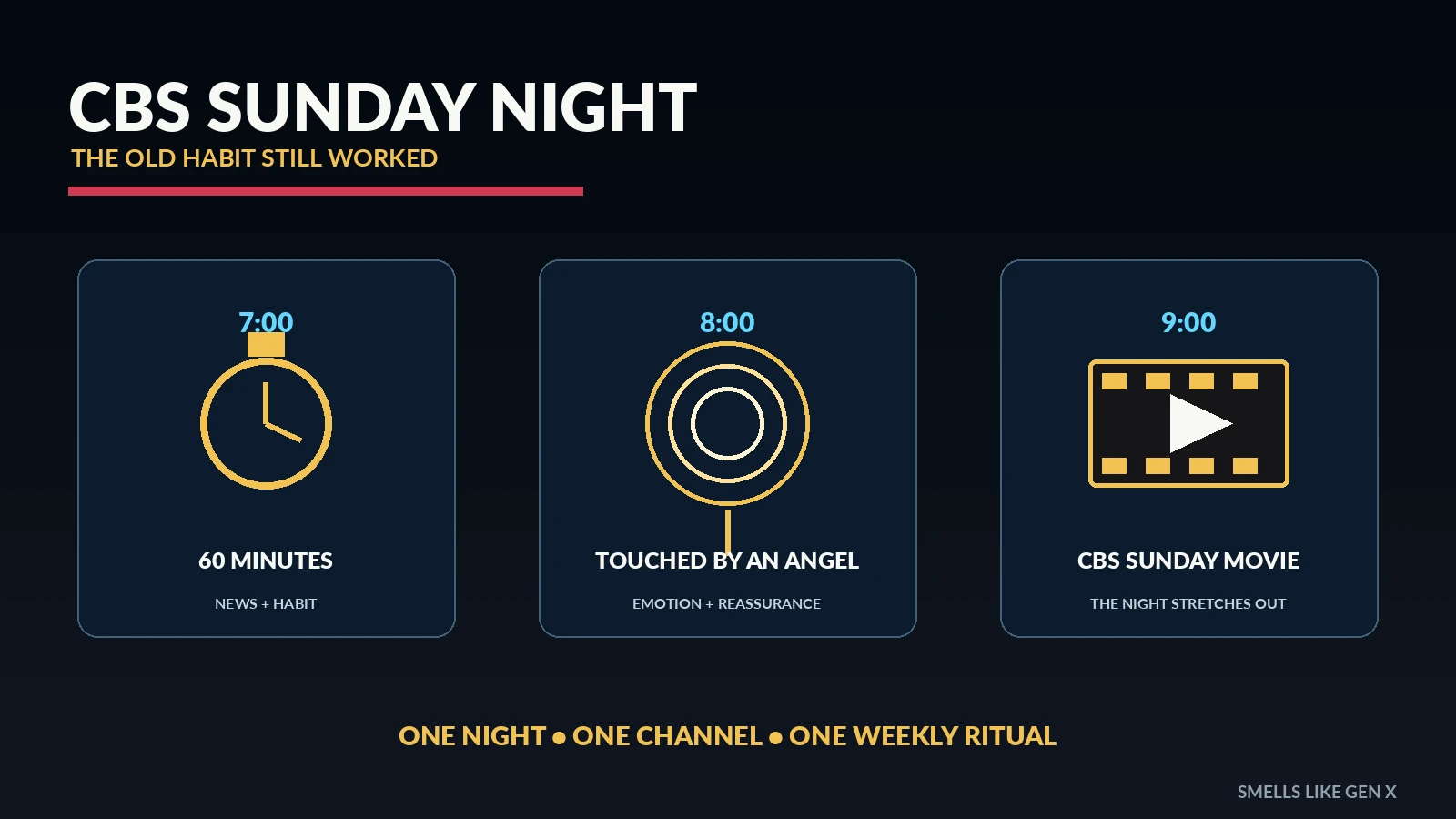
Why was CBS Sunday night still so big in the late 1990s?
Because CBS built a night around habit, trust and compatible audiences. 60 Minutes delivered a huge early-evening base, Touched by an Angel offered emotional family drama, and the Sunday movie extended the night with familiar event programming. In 1998–99 they ranked #7, #8 and #9 by household rating.
CBS Sunday Worked Because It Felt Like a Night, Not Three Random Programs
The easiest way to understand late-90s CBS Sunday is to stop looking at the individual shows for a minute and remember how Sundays felt. Dinner tended to happen earlier. School and work were waiting in the morning. The weekend was effectively over by the time prime time started, even if nobody wanted to say it out loud. Television fit into that emotional clock differently than it did on Thursday or Saturday.
CBS built directly into that mood. 60 Minutes arrived first with a format viewers had known for decades. Touched by an Angel followed with emotional stories built around faith, second chances and human connection. Then a movie could carry the household through the rest of the evening without requiring anyone to learn a new cast or remember last week’s cliffhanger.
That lineup is one reason the broader story of 1990s television cannot be reduced to Friends, Seinfeld and faster youth-oriented programming. One of the decade’s strongest network nights was built around familiarity, older-skewing audiences and a rhythm that would have made sense ten or twenty years earlier. CBS was not winning by pretending to be NBC. It was winning by making Sunday feel like CBS.
Sunday Television Was Part of the Weekly Clock
Weeknight television often competed with homework, late shifts, errands and whatever else people were doing after work. Sunday had a different kind of structure. For many households, the evening was already becoming quieter before 7 p.m. That made a long-running newsmagazine especially powerful because it could sit at the border between the weekend and the workweek.
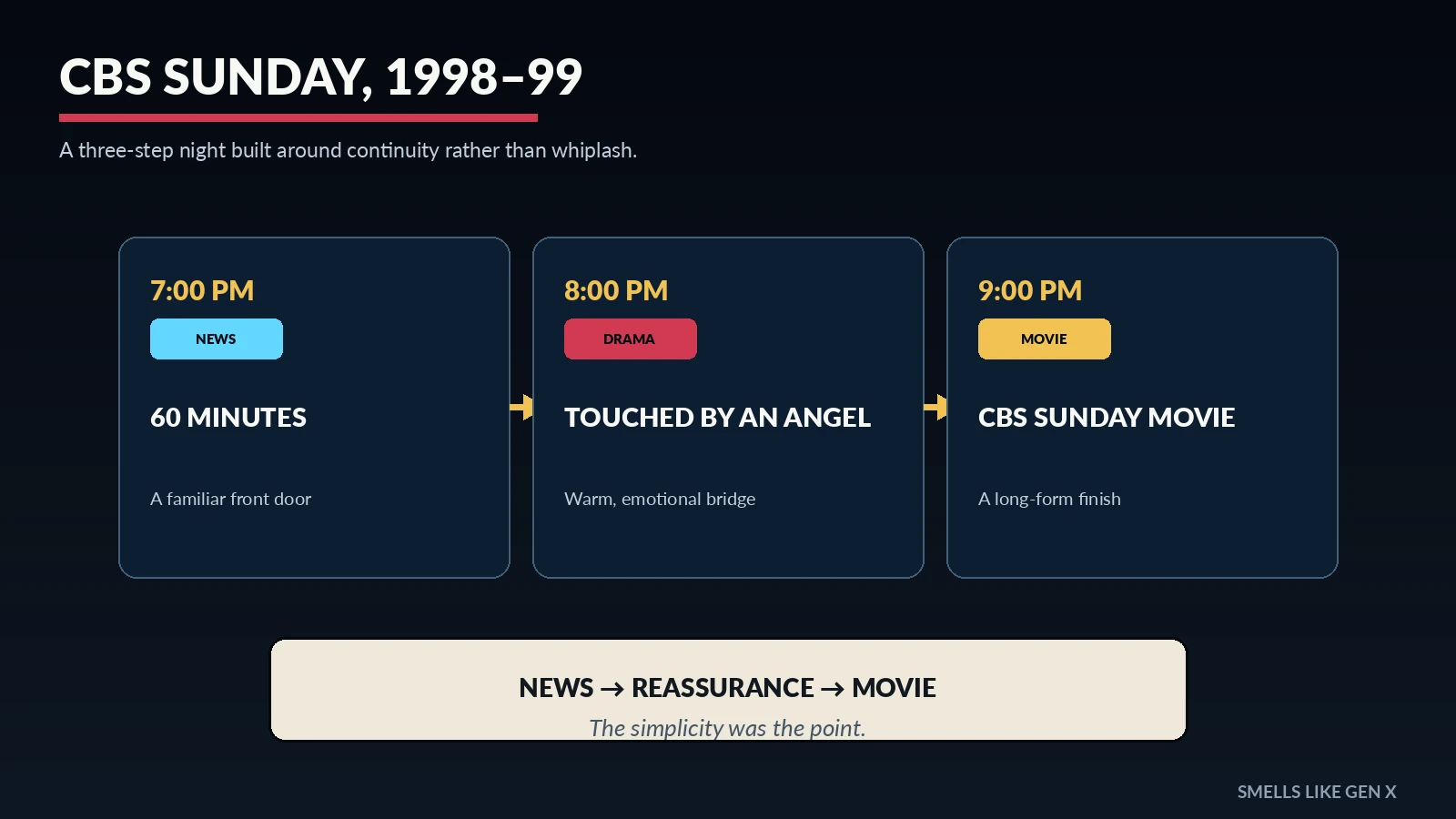
The ritual quality mattered more in the pre-streaming era because the schedule was the interface. You did not browse a home screen. You knew what channel did what at what time. CBS Sunday had the advantage of being easy to remember: news, a warm dramatic hour, then a movie. The simplicity was not a creative weakness. It was a habit architecture.
That is the broader behavior we explore in our companion on 90s appointment television. CBS Sunday is one of the cleanest examples because the night worked even when none of its pieces looked like the buzziest show in the culture. Repetition itself became part of the brand.
60 Minutes Gave CBS an Audience Before the Entertainment Shows Even Began
By the late 90s, 60 Minutes had been on the air so long that its opening stopwatch felt less like branding than a piece of Sunday furniture. The program’s age could have been a liability in a decade obsessed with younger demographics and faster pacing. Instead, it remained a ratings institution. In 1998–99, it finished #7 by household rating.
Part of the strength was format. The show did not need viewers to remember a serialized plot. It offered several self-contained reported stories, familiar correspondents and a visual identity that barely needed explanation. You could miss three weeks and return without being lost. That low barrier to re-entry is one reason long-running news and sports programs can become ritual in a way scripted television often cannot.
We cover the individual ratings history in our article on how 60 Minutes kept beating sitcoms and dramas in the 1990s. Within the Sunday ecosystem, its value was even bigger than its rank. It gathered the audience at the front door and gave CBS a massive platform for everything that followed.

Touched by an Angel Fit the Night Because It Offered Reassurance Instead of Edge
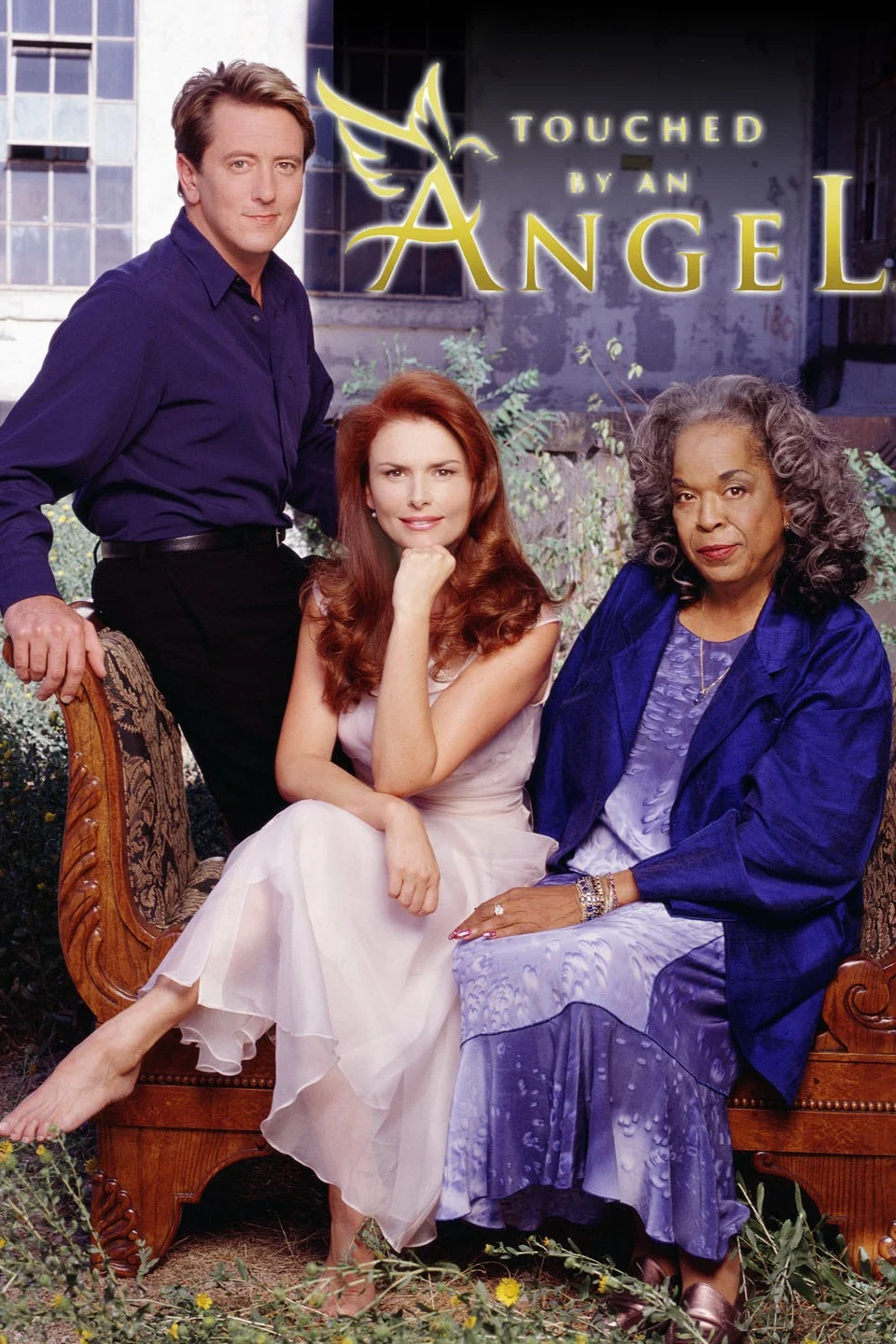
Touched by an Angel was not built to chase the same emotional temperature as ER, NYPD Blue or The X-Files. Its stories were openly spiritual, sentimental and interested in redemption. That made the show easy to dismiss if your memory of 90s television is filtered entirely through irony and “edgy” prestige. The ratings do not allow that dismissal.
After moving into the Sunday lineup, the series became one of CBS’s biggest hits. In 1998–99 it finished #8 by household rating, immediately behind 60 Minutes. The pairing worked because the tonal transition made sense for the audience CBS had assembled. A serious news hour could lead into a drama that treated moral questions directly without forcing viewers into a completely different demographic universe.
The full ratings and show-level story belongs in our Touched by an Angel deep dive. Here, the important thing is its role in the night: it turned the audience gathered by an old news institution into a huge scripted-drama audience without imitating the faster, darker dramas getting more critical attention elsewhere.
The CBS Sunday Movie Let the Night End With Something Familiar but Different Every Week
A weekly network movie sounds almost quaint now because movies are available on demand in quantities no human can reasonably finish. In the 90s, the Sunday movie still mattered. It could be a theatrical film, a made-for-TV event or a star vehicle promoted for days. The title changed, but the programming promise stayed stable: settle in for a feature-length story and call the weekend over.
That consistency helped the format rank #9 in 1998–99 by household rating. Think about that for a second. A rotating movie franchise, not one recurring scripted cast, was one of the ten highest-rated prime-time programs of the season. It worked because the slot itself carried meaning. Viewers trusted that Sunday night on CBS would offer a movie-sized finish.
The movie also gave CBS flexibility. A topical event, a prestige adaptation, a familiar star or an acquired theatrical title could all occupy the same branded space. The network did not have to build twenty-two episodes around one premise. It could sell the night first and the individual movie second.
The Genius Was Not That the Shows Were Similar. It Was That the Hand-Offs Made Sense
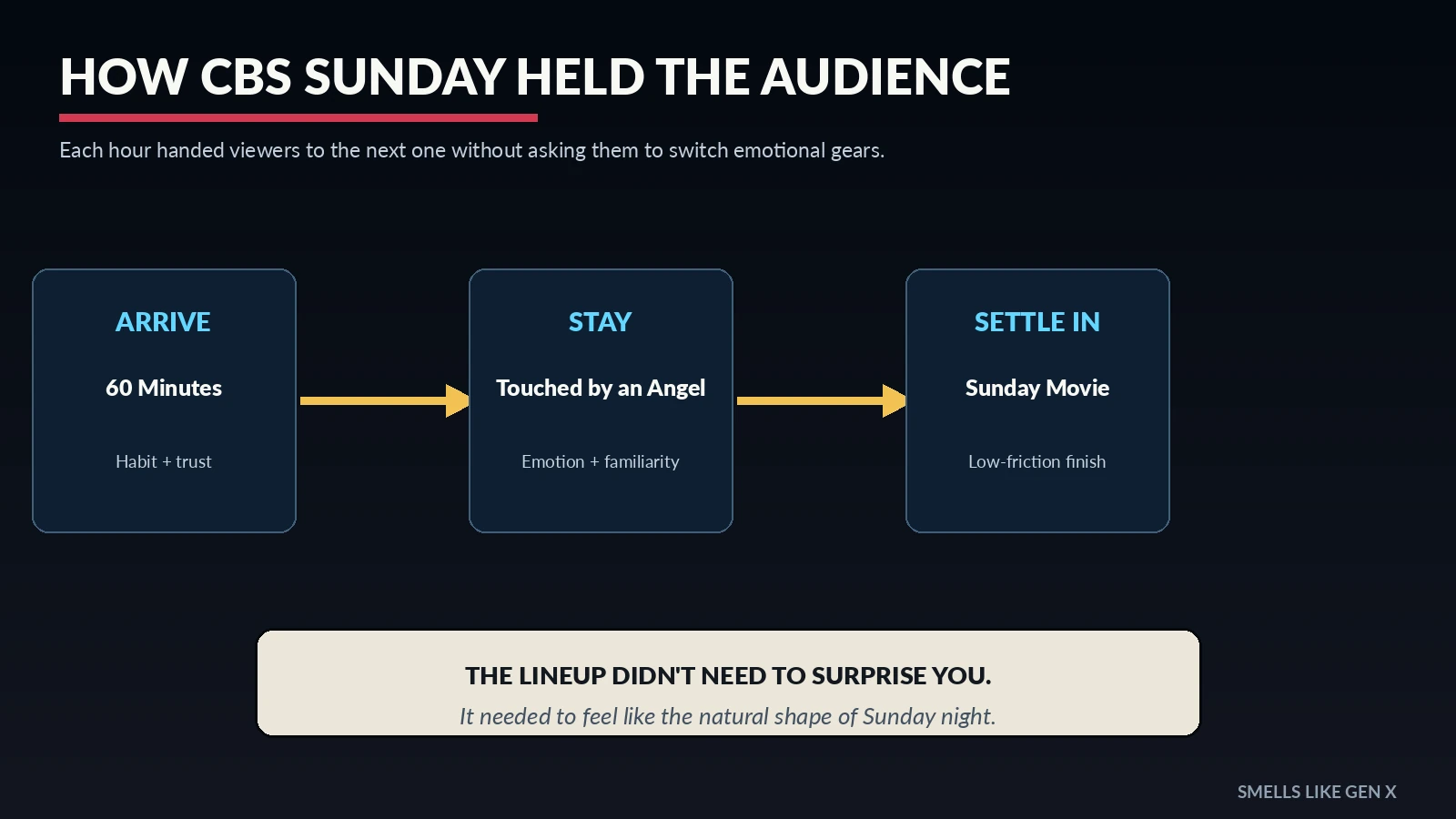
60 Minutes, Touched by an Angel and a Sunday movie were not the same genre. That was fine. Strong network flow is not about cloning the previous show. It is about minimizing the reason to leave. CBS created a sequence where the emotional and demographic jump between programs was manageable enough that viewers could stay without feeling the channel had suddenly changed personalities.
The newsmagazine offered seriousness and familiarity. Touched offered emotional storytelling with a moral center. The movie offered a longer narrative but kept the idea of family-compatible Sunday viewing. Each piece could stand alone, yet together they formed a recognizable evening. That is much more difficult than simply scheduling three hits next to one another.
The arrangement also gave CBS a powerful promotional environment. Viewers of 60 Minutes repeatedly saw promotion for the drama and movie. Viewers of the drama saw the movie teased during commercial breaks. The network could advertise Sunday to people already watching Sunday, which sounds obvious until you remember how valuable that captive attention was.
CBS Sunday Was the Counterweight to NBC’s Faster, Younger Thursday Identity
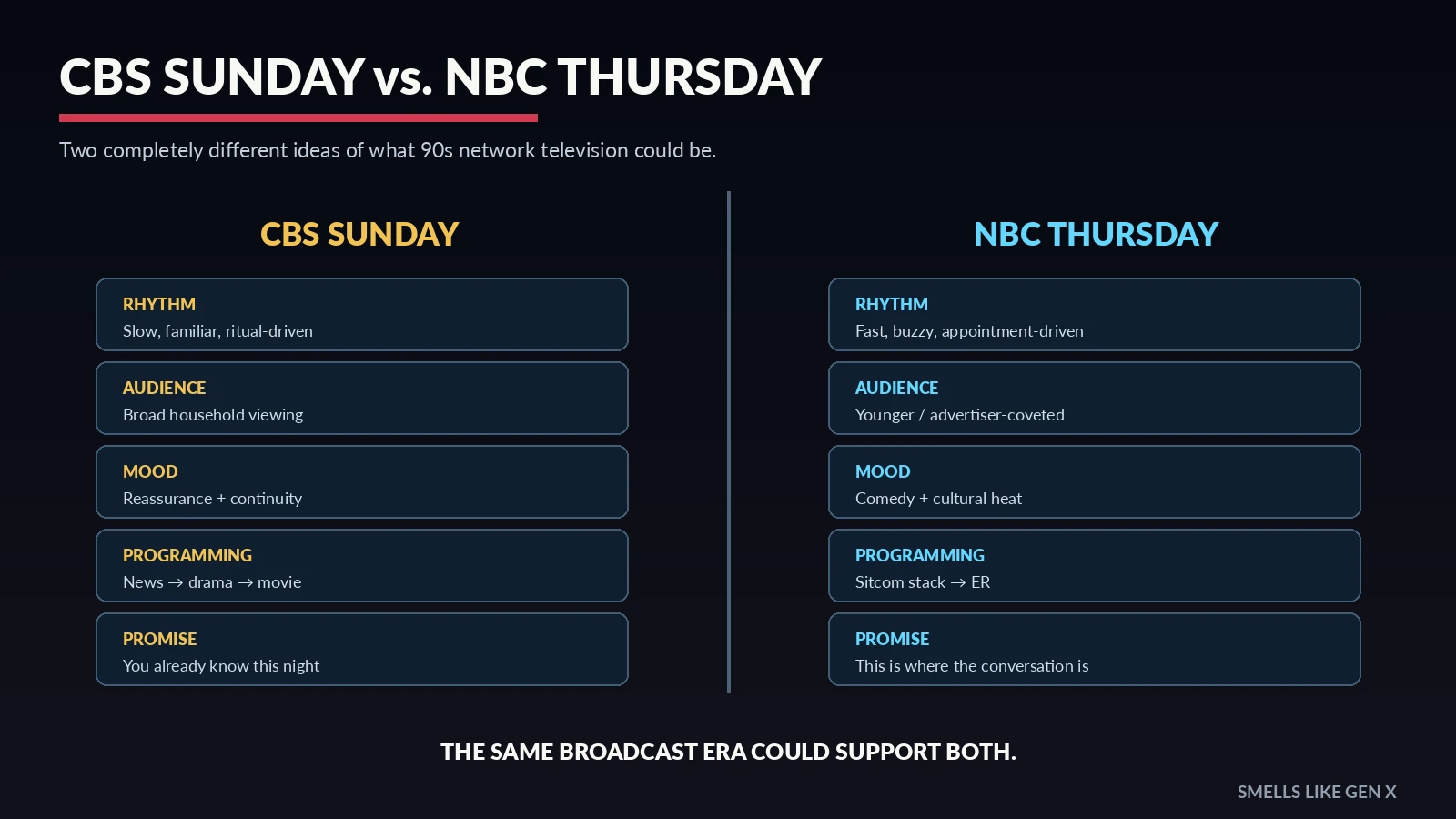
NBC Thursday sold momentum: comedy, more comedy, a giant anchor, another comedy and then ER throwing open the emergency-room doors. CBS Sunday sold continuity and reassurance. One night wanted to feel current, quotable and socially buzzy. The other wanted to feel dependable. Neither approach was inherently superior; they were competing ways to hold a mass audience.
That contrast helps explain why CBS’s older-skewing reputation did not prevent it from winning the 1998–99 broadcast season overall. Contemporary coverage noted that rivals and advertisers sometimes mocked the network for its older audience, but millions of viewers kept showing up. Audience age and audience size were not the same thing, and CBS understood there was still a business in being the network people trusted.
Late-90s television is more interesting when both models stay in the picture. The decade was not one long march toward ironic young adults in apartments. It was also Roma Downey on Sunday night, Mike Wallace interviews, movie events, football overruns and households that preferred a familiar rhythm to whatever was supposedly cooler that week.
In 1998–99, CBS Sunday Ranked #7, #8 and #9 Back-to-Back
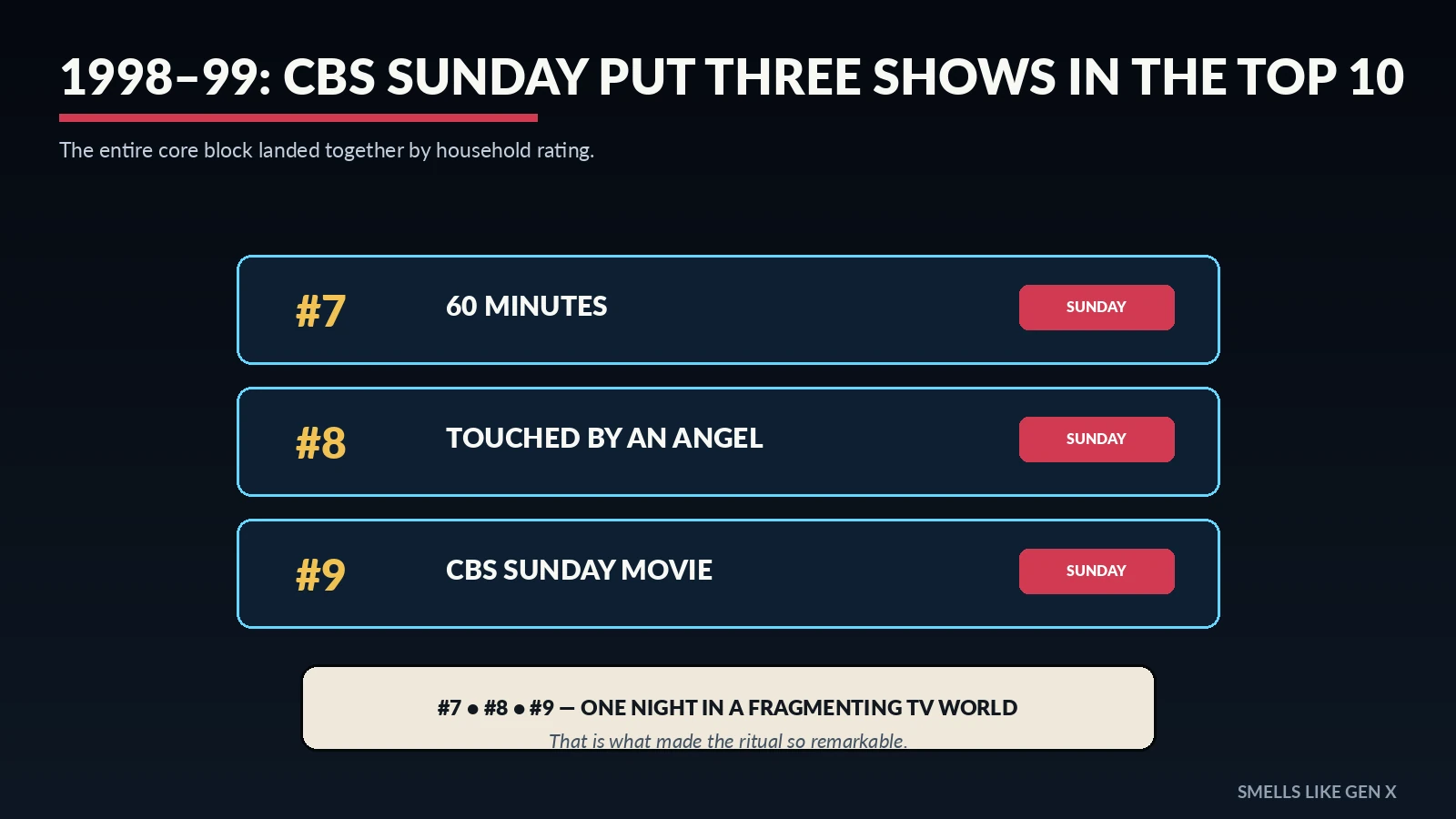
The season-ending household ratings make the strength of the block unusually clear. 60 Minutes was #7 with a 13.2 rating. Touched by an Angel was #8 at 13.1. The CBS Sunday Movie was #9 at 12.0. Three consecutive Sunday franchises, three consecutive Top 10 positions.
You can see the entire season in our ranking of the biggest TV shows of 1999. NBC still controlled the top with ER, Friends and Frasier, while Monday Night Football remained enormous. CBS’s answer was not to duplicate those shows. It built a different island of mass viewing and made that island reliable enough to help the network win the season.
The Washington Post’s viewer-based season summary shuffled some positions—Touched by an Angel ranked especially well by average viewers—but the same basic story held. Sunday was doing heavy lifting for CBS. The block could generate national scale without chasing the exact programming profile that dominated NBC.
NFL Overrun Could Supercharge Sunday, but It Was Not the Whole Story
CBS also benefited from football. Sunday afternoon NFL games could spill into prime time in parts of the country, delivering a large live audience directly into the evening schedule. Contemporary Los Angeles Times ratings coverage explicitly noted the effect during strong Sunday performances. Live sports were already becoming one of television’s most dependable ways to gather people at the same moment.
But it would be a mistake to reduce the entire Sunday lineup to a football lead-in. Season-long Top 10 ranks require more than a few boosted nights, and 60 Minutes had been a ratings institution long before the late-90s CBS NFL arrangement. Touched by an Angel had its own loyal audience. The movie franchise had its own decades-old viewing logic.
Football helped the front door swing wider. The rest of the house still had to be worth entering. CBS’s Sunday success came from combining the occasional rocket boost of live sports with programs whose identities were already compatible with the evening.
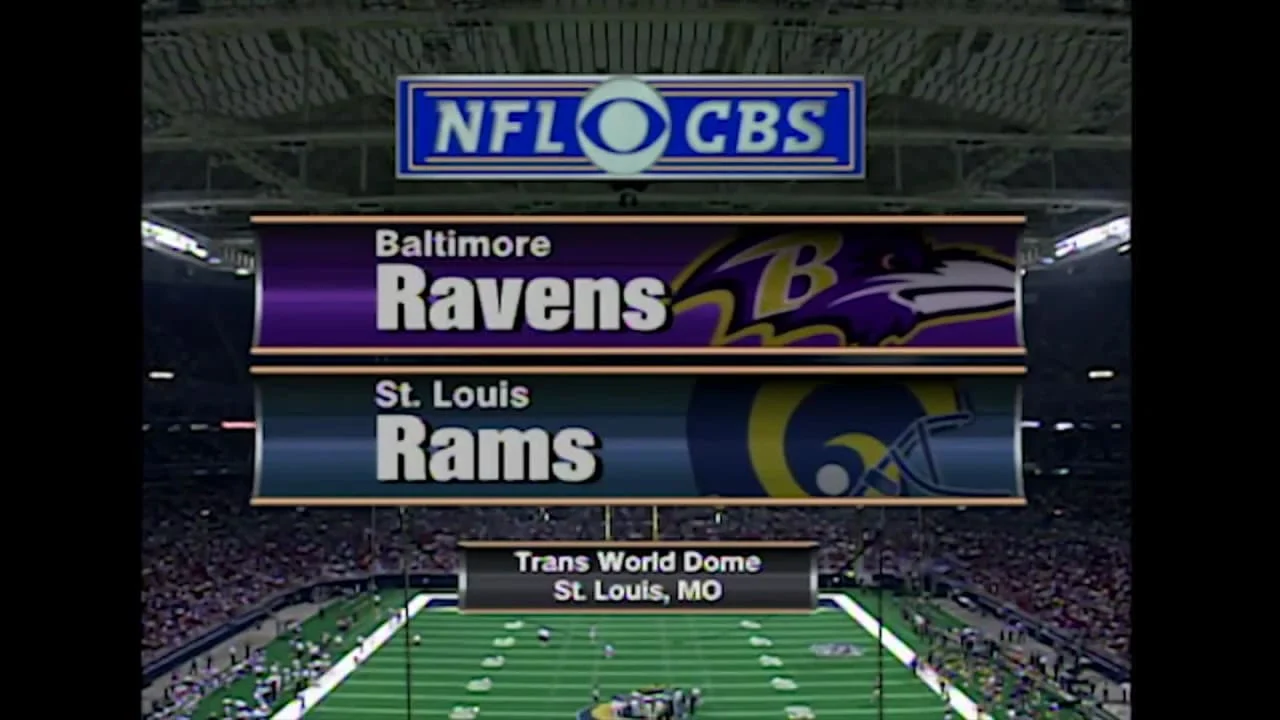
CBS Sunday Was Built for Shared Viewing More Than Personal Branding
A lot of late-90s television increasingly targeted specific age groups and identities. CBS Sunday often felt broader. A teenager might not have chosen 60 Minutes, and a parent might not have chosen the same movie the teenager wanted, but the household could still end up on the same channel because Sunday viewing was negotiated differently from a weekday favorite.
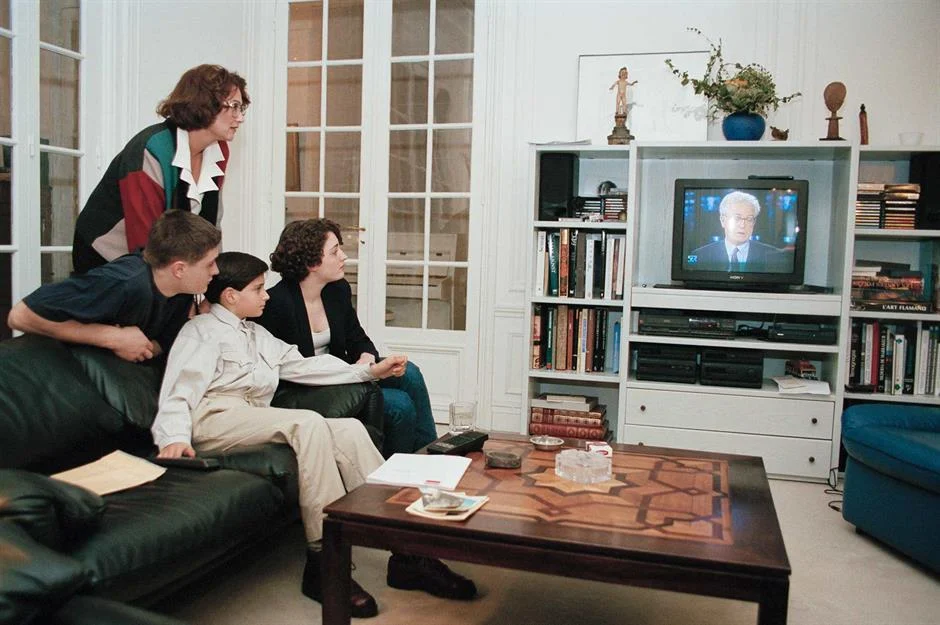
That shared-room quality matters when remembering the era. Many Gen X viewers learned entire programs by proximity. You knew the stopwatch because your parents watched it. You knew Touched by an Angel because somebody in the house did. You saw chunks of Sunday movies while packing a school bag, finishing homework or pretending Monday was not about to happen.
Television memory is full of programs we did not exactly choose. CBS Sunday turned that accidental exposure into a strength. The night could become familiar even to people who would never have described themselves as fans. Familiarity is a powerful thing when the remote is shared.
CBS Sunday Became More Impressive as the Rest of Television Fragmented
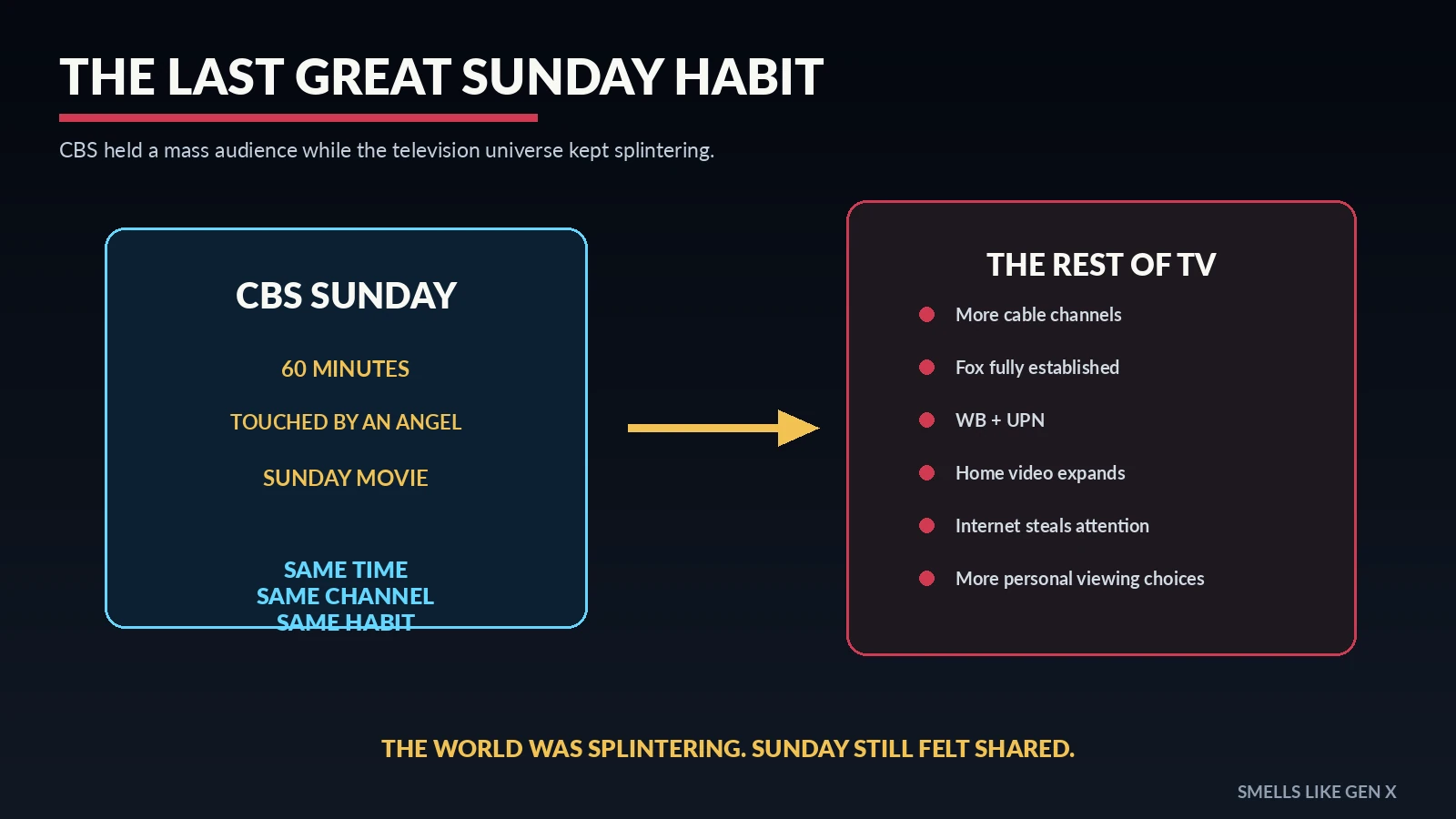
By 1999, cable was no longer a sideshow. Viewers had dozens of specialized choices, Fox was established, WB and UPN had added more broadcast competition, and the internet was beginning to steal attention from the television set. The old three-network world was already gone, even though the biggest broadcast hits still attracted enormous audiences.
That is the tension at the center of our story about 1999 and the end of the great network-TV monoculture. CBS Sunday belongs inside that tension. It was an old-fashioned mass-viewing habit surviving in a world that was becoming less capable of producing shared habits. The night was strong not because fragmentation had stopped, but because CBS had built something durable enough to resist it for a while.
The late-90s ratings therefore feel like a last look at two eras overlapping. One era says viewers can go anywhere. The other says millions of them still know exactly where they will be on Sunday at seven. Both were true at the same time.
For Gen X, CBS Sunday Was Part of the Monday-Morning Countdown
There are television memories that are really schedule memories. Sunday night is one of them. The weekend had a closing sound: the 60 Minutes stopwatch, local news promos, the theme of whatever movie was coming up, somebody asking whether homework was finished. You could feel Monday getting closer one commercial break at a time.
That is why CBS Sunday can trigger nostalgia even for people who would never list every show among their favorites. The night was part of the house. Parents watched. Grandparents watched. Kids drifted through. You absorbed correspondents’ voices and Touched by an Angel promos without making a conscious decision to build a memory.
Modern viewing is better in a hundred practical ways, but it is harder to reproduce that particular shared clock. Everybody can watch exactly what they want now, which also means fewer people accidentally know the same thing. CBS Sunday was built for an era when the entire room often compromised together—and the compromise could still become a Top 10 block.
CBS Sunday Matters Because It Preserved a Different Kind of Mass Television
The lasting lesson of CBS Sunday is not that networks should simply recreate the lineup. The media environment that made it possible has changed too much. The lesson is that programming identity can be built around rhythm as effectively as around buzz. CBS knew what emotional promise Sunday made and gave viewers three programs that could live inside that promise.
It also reminds us to be careful with simplified histories of the 90s. The decade belonged to Friends and ER, yes, but it also belonged to 60 Minutes, Touched by an Angel and a rotating movie franchise. Mass culture was broad enough to support irony, grit, spirituality, news, sports and sentimental drama in the same national Top 10.
By the end of the decade, the monoculture was weakening. CBS Sunday was one of the institutions that showed how strong the old habits could remain even as the cracks widened. For a little longer, millions of people still ended the weekend on the same channel, hearing the same stopwatch and realizing at roughly the same moment that Monday was coming.
Frequently asked questions
What was on CBS Sunday night in the late 1990s?
A core late-90s lineup was 60 Minutes at 7 p.m., Touched by an Angel at 8 p.m. and the CBS Sunday Movie afterward, though exact scheduling could vary by season and special events.
How high did the CBS Sunday shows rank in 1998–99?
By household rating, 60 Minutes ranked #7, Touched by an Angel #8 and the CBS Sunday Movie #9.
Did CBS win the 1998–99 television season?
Yes. CBS finished first among the broadcast networks for the 1998–99 prime-time season, its first season win in five years.
Why did Touched by an Angel work so well on Sunday?
Its emotional, faith-inflected stories fit the audience and tone CBS had already cultivated on Sunday, creating a smoother transition from 60 Minutes than a radically different show might have.
Did NFL football help CBS Sunday ratings?
NFL overruns could provide a strong lead-in in parts of the country, and contemporary ratings reports noted that effect. The prime-time lineup also maintained major season-long audiences on its own.
Why does CBS Sunday matter to 90s TV history?
It shows that late-90s network television was not driven only by younger comedies and faster dramas. Familiarity, family viewing and weekly ritual could still produce Top 10 audiences as the media landscape fragmented.