Why Monday Night Football Was One of the Biggest TV Shows of the 90s
Why Monday Night FootballWas One of the Biggest TV Shows of the 90s
Monday Night Football was not just sports programming. In the 1990s it repeatedly ranked with the biggest sitcoms and dramas in America, making one NFL game every week feel like part of the national television schedule.
How big was Monday Night Football in the 1990s?
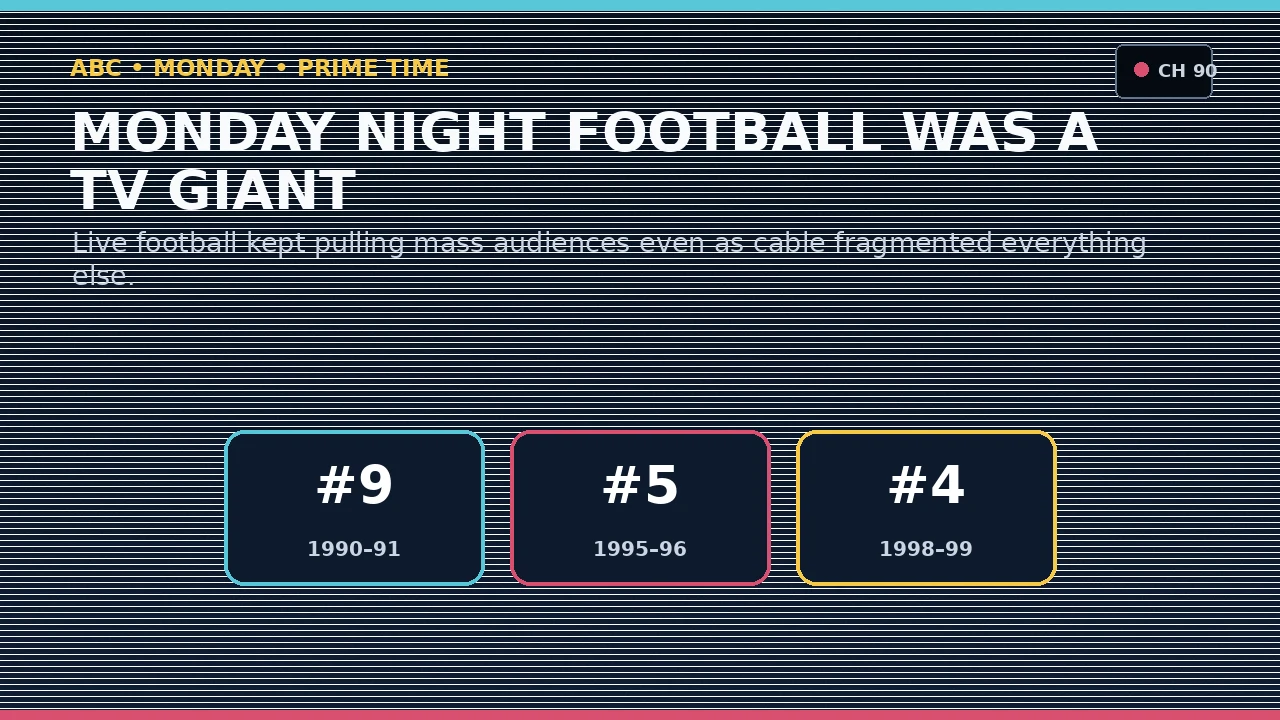
Huge enough to rank in the Nielsen top ten again and again. It finished #9 in 1990–91, #5 in 1995–96, #7 in 1996–97 and #4 in 1998–99, making it one of the decade’s most durable mass-audience television franchises.
Monday Night Football in the 90s Was Bigger Than a Sports Broadcast
For a lot of Gen X households, Monday night had a sound before the game even started: the ABC music, the announcers, the stadium noise and the sense that whatever matchup was on had become the television event of the night.
Monday Night Football had already been part of American television since 1970, but the 1990s proved how durable the idea had become. The NFL was expanding its cultural power, broadcast television still concentrated enormous audiences, and ABC owned a weekly live event that no sitcom rerun or movie could reproduce.
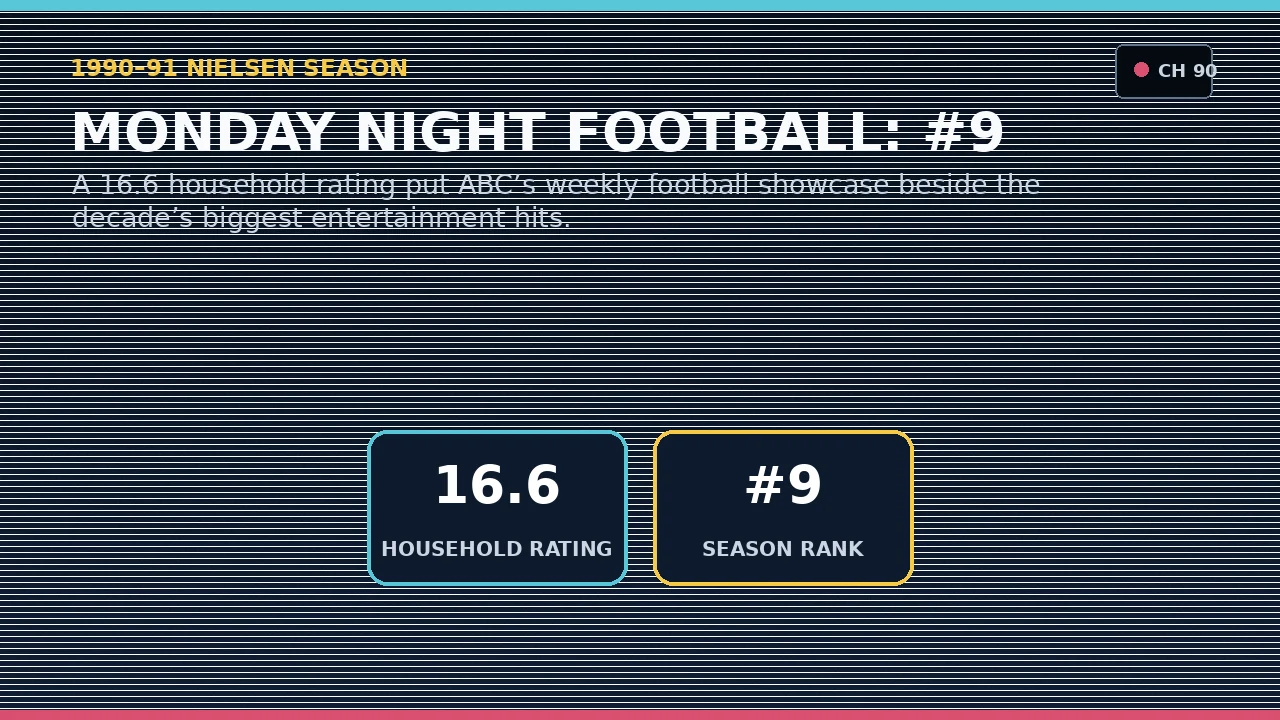
The numbers put it in perspective. In the 1990–91 season, Monday Night Football finished #9 with a 16.6 household rating. Five years later it was #5. In 1996–97 it was #7. By 1998–99, after years of audience fragmentation across cable, it had climbed to #4.
That consistency is the story. Most entertainment series rose, peaked and fell. A sitcom could be #4 one year and vanish from the top 30 after a time-slot move. MNF kept returning because the basic product renewed itself every week: different teams, different stakes, different stars, same Monday ritual.
It belongs inside the broader 1990s TV story because the franchise shows how sports became one of the strongest survivors of the old network monoculture. Even as viewers found more channels, live football still gave millions of people a reason to watch the same thing at the same time.
In 1991, Monday Night Football Ranked With Cheers, Roseanne and 60 Minutes
The 1990–91 season is a useful snapshot because the top ten was packed with the shows we now use as shorthand for early-90s network television.
Cheers was #1. 60 Minutes was #2. Roseanne, A Different World, The Cosby Show and Murphy Brown followed. Then came Empty Nest, America’s Funniest Home Videos, and at #9, Monday Night Football.
That matters because the football broadcast was not sitting in a separate sports universe. Nielsen counted it in the same prime-time ecosystem as the country’s biggest comedies and dramas, and it competed successfully there.
A 16.6 household rating meant a vast share of American television homes were tuned to ABC on Monday nights. The game did not need the same two characters every week or a season-long plot. The consistency came from the league, the night and the expectation that Monday belonged to football.
The broader cultural habit is what the future appointment TV article owns. Here, MNF is the clearest sports example of that habit operating every single week.
Al Michaels, Frank Gifford and Dan Dierdorf Gave the 90s a Familiar Monday-Night Sound
A recurring sports broadcast builds loyalty differently from a scripted series. The players change. The teams change. The booth is what makes the program feel like the same show.
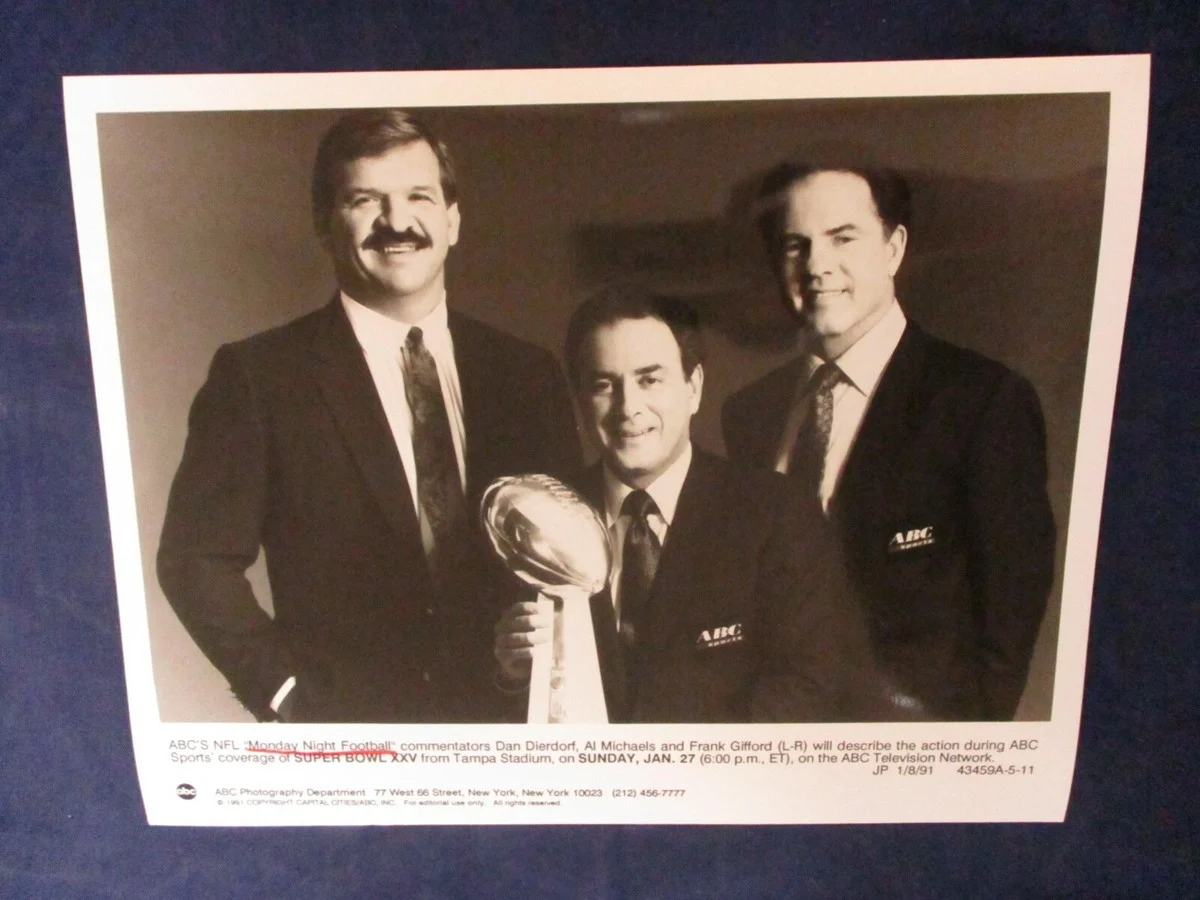
For much of the 1990s, that continuity came from Al Michaels, Frank Gifford and Dan Dierdorf. ESPN’s all-time commentator history lists Michaels, Gifford and Dierdorf together from 1990 through 1993, with Lynn Swann later joining the coverage and Lesley Visser appearing as the decade progressed.
Michaels provided the clean play-by-play spine. Gifford brought decades of association with the franchise. Dierdorf supplied the player’s perspective and the kind of conversational analysis that worked for both committed football fans and casual viewers who had simply landed on ABC because it was Monday.
By 1998, Boomer Esiason joined the booth, and by 1999 Michaels, Esiason and Visser were the core team. The details changed, but the presentation remained recognizably Monday Night Football.
That familiarity was crucial. A regular viewer did not need to know who was playing three weeks in advance to know what the program would feel like. The announcers, graphics, theme, crowd shots and prime-time framing gave the franchise a recurring identity that functioned almost like a television series.
Monday Night Football Finished #5 in the 1995–96 TV Season
The 1995–96 ratings chart is dominated by NBC Thursday—and ABC football still broke through it.
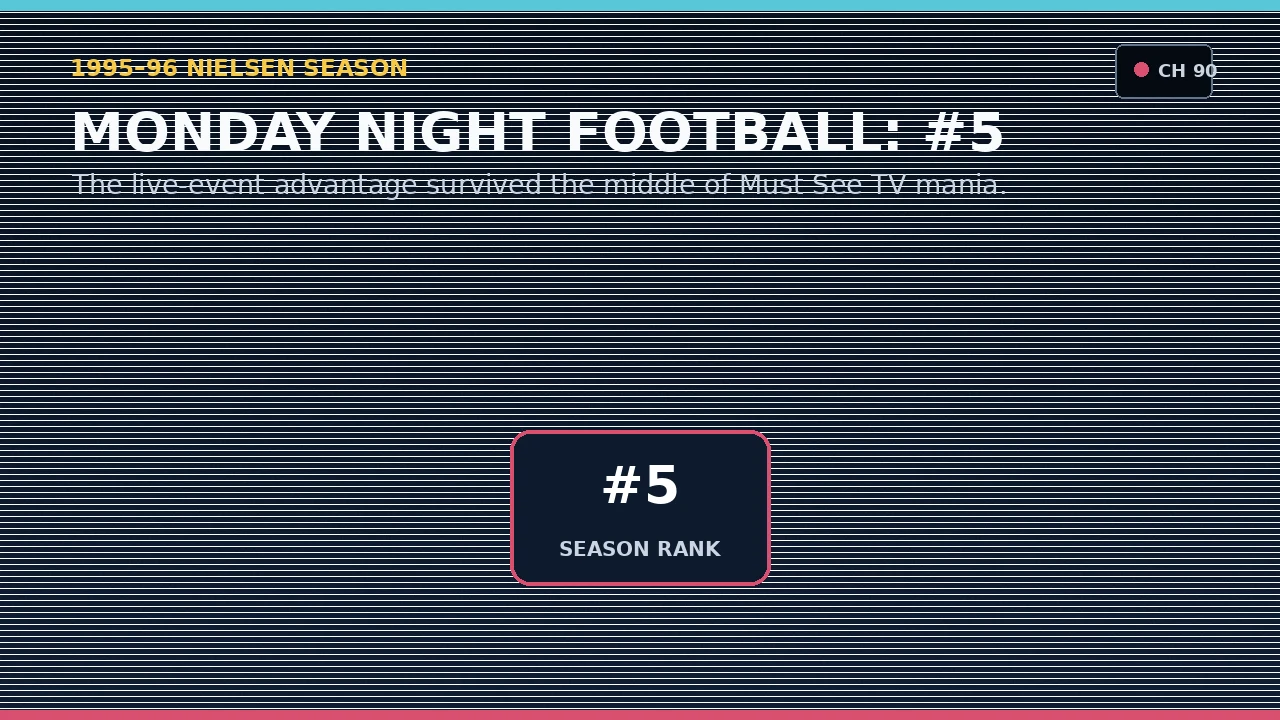
ER, Seinfeld, Friends and Caroline in the City occupied the top four. Then, at #5 with a 17.1 household rating, came Monday Night Football.
The 1996 ranking is full of proof that NBC had built the decade’s most powerful entertainment schedule. MNF did not have a lead-in from Friends or a Thursday-night halo. Its advantage was different: exclusivity, liveness and the NFL.
That combination made football unusually resistant to the forces that weakened ordinary series. You could record a sitcom and watch it later. You could catch a rerun. A live game lost value quickly once the result was known. That time sensitivity created urgency before streaming ever taught us to think about “live” as a separate category.
Pro Football Hall of Fame history notes that the franchise had already become the longest-running prime-time series in ABC history by the 1980s. By the 90s, it was less an experiment than an institution.
In 1996–97, Monday Night Football Ranked #7 While NBC Took Most of the Top Spots
The following season may be the best evidence that the franchise did not depend on the weakness of other programming.
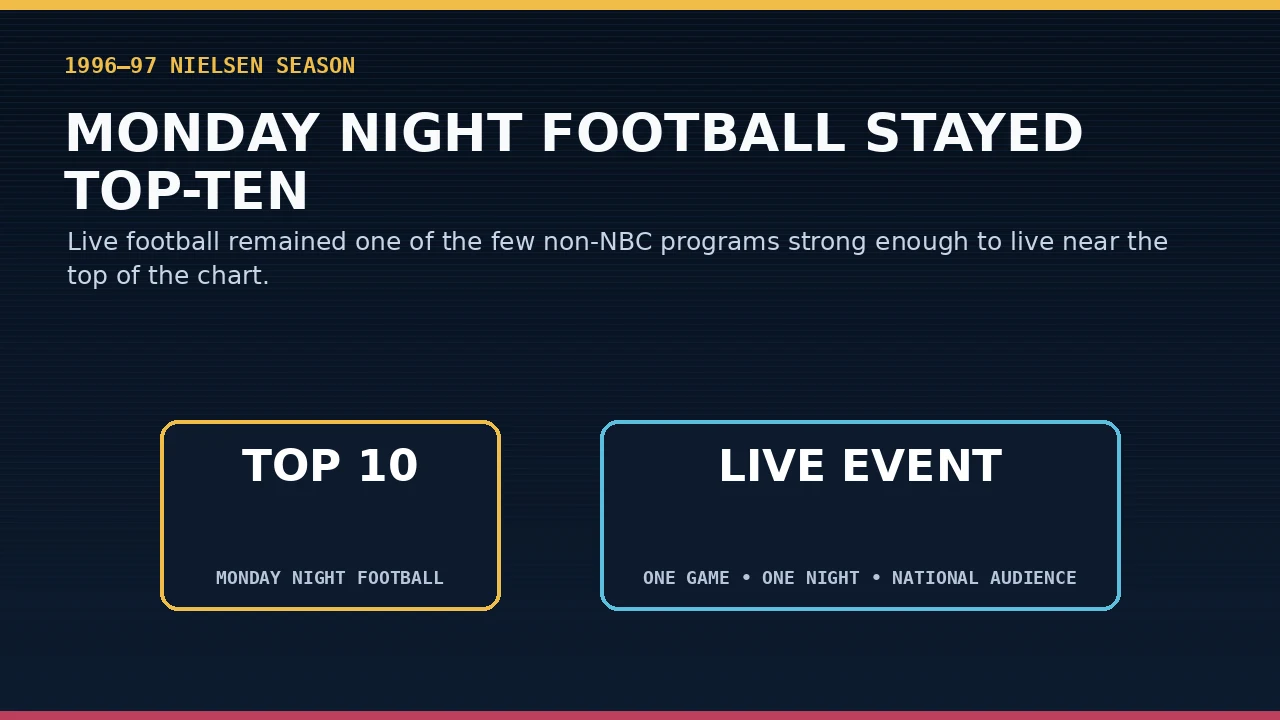
NBC filled the upper chart with ER, Seinfeld, Suddenly Susan, Friends, The Naked Truth and Fired Up. Yet Monday Night Football still finished #7 by household rating.
The 1997 Nielsen list shows how difficult that environment was. NBC had a machine built around lead-ins, promotion and audience flow. ABC’s football package had none of that Thursday structure. It simply had the one television commodity that became more valuable as the schedule fragmented: a major event happening right now.
Contemporary audience totals put the average around the low-20-million range depending on the measurement used. That is a staggering weekly audience for a recurring sports telecast with no guarantee that the matchup itself would be compelling.
Football did not need every game to be a classic. The national ritual was strong enough to make the average Monday one of the largest television audiences of the week.
Monday Night Football Rose to #4 in 1998–99
By the end of the decade, broadcast television was losing audience share to cable—and Monday Night Football was still getting stronger relative to the field.
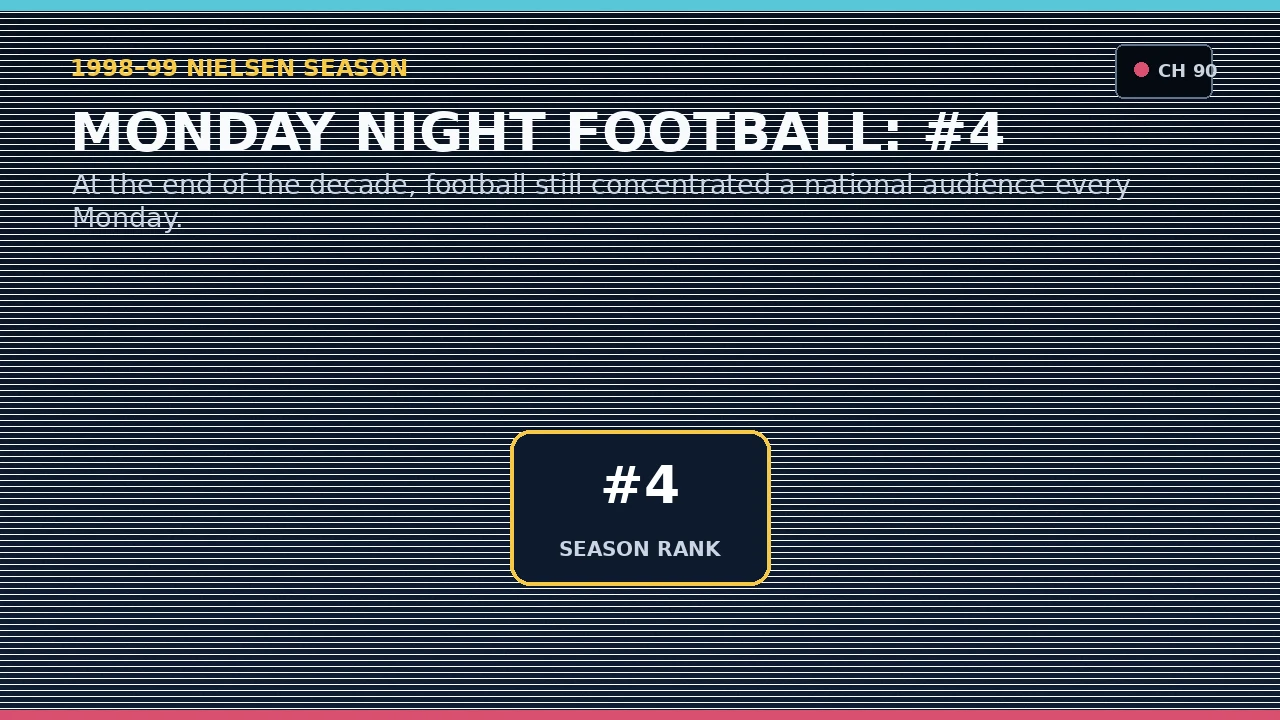
In 1998–99, ER, Friends and Frasier occupied the top three spots. Monday Night Football was #4 with a 14.9 household rating. The 1999 season list makes the shift obvious: entertainment hits remained enormous, but live football was one of the most reliable ways to assemble a giant audience on a predictable night.
The rating itself was lower than the franchise’s mid-decade numbers because the television universe was larger and more fragmented. The rank was better. That is an important distinction when comparing eras and one reason the separate 90s TV ratings explainer is necessary.
A 14.9 in 1999 did not mean football had become smaller in cultural importance. It meant the denominator had changed. Cable networks, specialty channels, home video, video games and the early internet were competing for the same evening hours.
In that environment, a live NFL game became exactly the kind of program broadcasters needed: difficult to time-shift, easy to promote, and capable of creating a national audience all at once.
Monday Night Football Was Event Television Before We Called Everything an Event
A sitcom can be watched late. A drama can be spoiled. A football game has a clock running in the real world.
That difference gave MNF urgency. If you wanted to know what happened without hearing the score from somebody else, you watched the game while it happened. The broadcast was tied to a live result, and that kept the audience synchronized in a way ordinary entertainment programming could not always match.
The NFL also supplied built-in local stakes. Even viewers whose own teams were not playing might care about division races, playoff implications, fantasy football, office pools or simply the chance to see a star player on national television.
ABC packaged all of that as prime-time entertainment. Stadium introductions, celebrity shots, city flyovers, the booth and the music made the game feel bigger than a Sunday regional broadcast. Monday night was not merely another NFL window. It was the showcase.
That distinction explains why the ratings belong in television history, not just sports history. ABC was using football to create one of the most dependable entertainment rituals on the weekly schedule.
Monday Night Football Gave ABC a Weekly Identity No Scripted Show Could Copy
Networks spent decades looking for programs that viewers associated with the channel itself. MNF practically put ABC’s name inside the title of Monday night.
The franchise created a weekly promotional anchor. ABC could use the game to advertise Tuesday sitcoms, Wednesday dramas, news programs and weekend events to an audience that arrived for football rather than for the rest of the schedule.
That audience also skewed differently from the typical sitcom crowd, giving the network a way to reach viewers who might not otherwise spend three hours in ABC prime time. Sports programming has always carried advertising value for that reason, but MNF added the prestige of being a national weekly institution.
When ABC’s run finally ended after the 2005 season and the franchise moved to ESPN, the change felt bigger than a normal rights transfer because Monday night and ABC had been linked for 36 seasons.
In the 1990s, though, that separation was still unimaginable. ABC Monday night meant football.
The Season Average Was the Real Measure of Monday Night Football’s Power
One mediocre matchup could lose to a hot sitcom or a television movie. The franchise’s strength was what happened over the full season.
Every Monday delivered a different local mix of fan interest. A Cowboys game might pull one kind of audience. A 49ers matchup another. A divisional rivalry could spike. A weak late-season game could sag. Averaged together, the package still ranked among the largest programs on television.
That is an important way to understand the numbers. Scripted series generally tried to build consistent loyalty to the same cast and premise. MNF built loyalty to the appointment itself.
The night was the franchise. The teams supplied weekly variation. That made the show unusually durable because a weak episode did not imply the concept was failing. Next Monday was literally a new game.
What Monday Night Football Felt Like in a Gen X House
For kids and teenagers, the biggest problem with Monday Night Football was often that Monday was still Monday.
The game ran late. School started the next morning. Parents had work. Yet plenty of households stretched bedtime because a close fourth quarter felt impossible to abandon. You learned to listen from another room, negotiate for “one more drive,” or fall asleep on the couch while the adults kept watching.
That is the memory the ratings cannot show. The broadcast occupied the house. Even people who were not following every play heard the announcers and crowd noise. The game became background, conversation and event all at once.
Sports bars, dorm rooms, living rooms and break rooms all participated in the same schedule. The result was one of the clearest examples of shared-viewing culture before television stopped requiring everybody to arrive at the same hour.
Monday Night Football’s 90s Ratings Explain Why Live Sports Became So Important to Television
The 1990s were a transition decade: broadcast television was still enormous, but the audience was beginning to scatter across cable and other forms of entertainment.
Monday Night Football moved through that transition almost perfectly. Its household rating gradually changed, but its position near the top of the chart remained remarkably stable. #9. #5. #7. #4. That is not the pattern of a fading franchise.
It is the pattern of a television form becoming more valuable as everything around it fragmented. Live sports could still create simultaneity. It could still make a schedule matter. It could still give advertisers a mass audience that was difficult to skip or postpone.
That is why the 90s ratings are more than trivia. They help explain the future of television. As scripted viewing became more on-demand, the economic and cultural power of live football only became easier to see.
Monday night did not need a cliffhanger. The clock, the score and the fact that everybody else was watching right then were enough.
Monday Night Football Turned Stadiums Into Prime-Time Sets
A Sunday afternoon game could feel local even when it was nationally distributed. Monday night was staged like television understood it was the only NFL game in the room.
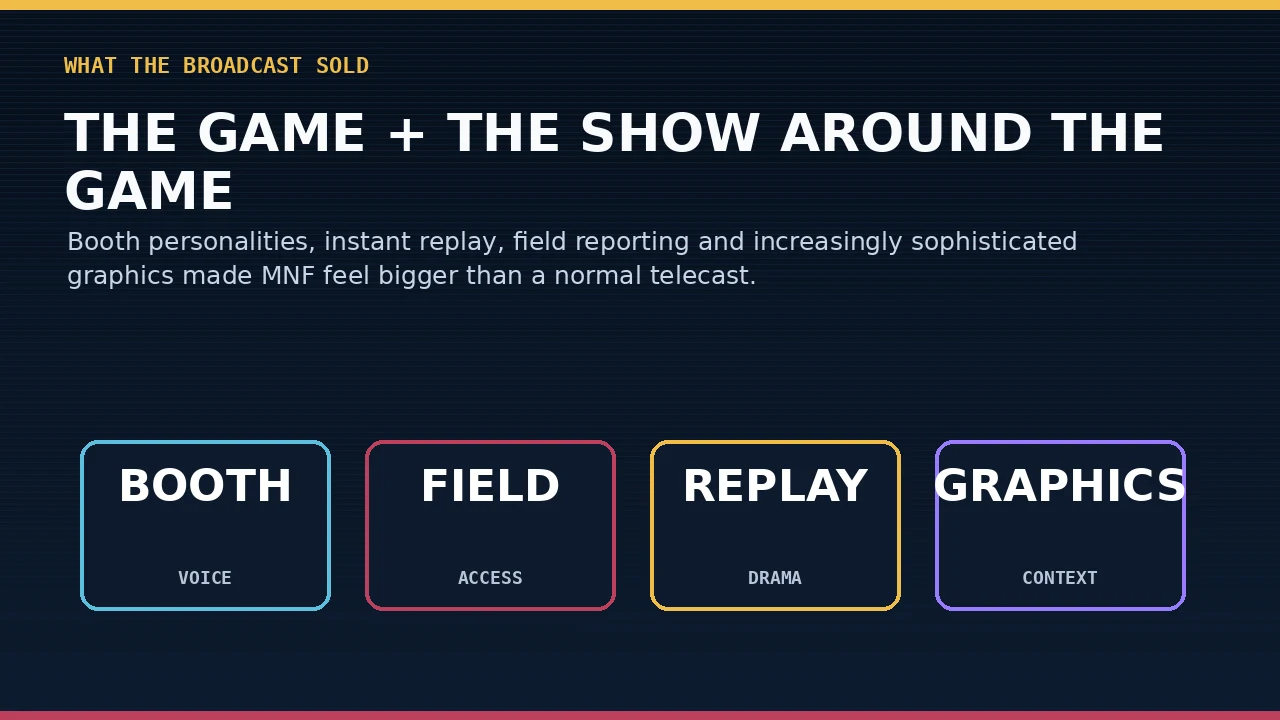
ABC leaned into the city, the crowd and the spectacle around the field. Establishing shots sold the location. Pregame teases made ordinary regular-season stakes sound monumental. The booth was visible enough to become part of the identity. Sideline reporting added personality and access. Graphics and music told viewers they were watching the showcase package.
That production language mattered because many Monday viewers were not die-hard fans of either team. The telecast had to entertain people who arrived for the event as much as for the football. The franchise learned to make the setting itself part of the show.
For the NFL, that national framing turned players into broader television personalities. A star who might otherwise be seen mainly in one regional market could spend three hours in front of the whole country. For ABC, it meant every Monday had a built-in story: this city, this rivalry, this quarterback, this playoff implication.
The scale of the presentation helped ordinary regular-season games feel like something closer to a weekly special. That is one reason the franchise could maintain top-ten season averages even when individual matchups varied wildly in quality.
A Monday Night Audience Was Large, Predictable and Hard to Time-Shift
The same qualities that made Monday Night Football useful to viewers made it unusually valuable to advertisers.
The audience was live. Commercial breaks were built into the event. Viewers could leave the room, but they could not simply skip past the entire ad load with an on-demand interface. The game also delivered a demographic mix that networks could sell differently from a family sitcom or newsmagazine.
Because the franchise returned every week, ABC could package sponsorship and promotion around a reliable national event rather than hope a new scripted series found an audience. The NFL supplied the stars and stakes. ABC supplied the production, marketing and access to prime time.
That relationship foreshadowed where television economics would eventually go. As ordinary entertainment audiences fragmented and time-shifting became easier, live sports became one of the few formats that could still promise a concentrated audience at a known moment.
The 90s ratings show that transition already beginning. MNF’s household rating was not always rising, but its rank remained near the top because other television was fragmenting faster.
The NFL Gave Monday Night Football Something Scripted Shows Could Not Have
A long-running sitcom eventually has to explain why the characters are still in the same situation. Football starts over every fall.
New rookies arrive. Coaches change. Teams rise and fall. Rivalries renew. A franchise quarterback ages. Another becomes a star. The broadcast can keep the same basic structure while the league supplies fresh stories automatically.
That renewal cycle protected Monday Night Football from the kind of creative exhaustion that hits scripted series. ABC did not need to reinvent the premise; it needed to make the next matchup feel important.
The calendar did the rest. September brought optimism. October created separation. November raised playoff stakes. December turned every possession into a possible season-ending mistake. The same Monday slot could feel different because the meaning of the games changed around it.
That is another reason the ratings remained so durable. The show was old, but the content was never a rerun.
Monday Night Football Made a Regular-Season Game Feel Bigger Than Regular Television
The genius of the format was that ABC could repeat the same basic event every week without making it feel repetitive.
The opponent changed, the city changed and the standings changed. The broadcast identity stayed stable enough to make the night familiar. That balance gave MNF the comfort of a recurring series and the unpredictability of live competition.
It also meant viewers did not need to follow every game to understand the appeal. You could miss two Mondays, return on the third and immediately be back inside the same television ritual. That low barrier to re-entry helped keep the franchise enormous over a full season.
In an era when a scripted show could lose viewers permanently after a bad creative turn, football always had next week.
That repeatability also made the franchise unusually resilient to changing entertainment trends. Sitcom styles changed, drama fashions changed and network lineups were rebuilt every fall. The NFL schedule kept returning with the same basic promise: one national game, one night, one result everybody would know by morning.
The consistency of that promise is the reason the franchise belongs beside the decade’s biggest scripted hits rather than in a separate footnote about sports programming.
Monday Night Football Made the Start of the Workweek Feel Like an Event
Part of the program’s power was repetition: same night, same ritual, new matchup.
That predictability mattered in the pre-streaming schedule. Monday could be ordinary all day and still end with a national sports broadcast that millions of households recognized instantly. The matchup changed, but the appointment did not. In a decade packed with sitcom blocks and serialized dramas, Monday Night Football was one of television’s clearest examples of a franchise where the format itself was the habit.
Frequently asked questions
How high did Monday Night Football rank in 1991?
It finished #9 in the 1990–91 prime-time season with a 16.6 household rating.
What was Monday Night Football’s best target-year rank in the 90s?
Among the four Smells Like Gen X target seasons, it ranked highest in 1998–99 at #4.
Who called Monday Night Football in the early 1990s?
Al Michaels, Frank Gifford and Dan Dierdorf formed the core booth through the early 1990s. Lynn Swann and later Lesley Visser also contributed to the broadcasts.
When did Monday Night Football start?
ABC launched Monday Night Football in 1970.
Why were the ratings so strong?
The NFL supplied live stakes, national star power and weekly urgency, while ABC packaged the game as a prime-time event viewers planned around.
Why does Monday Night Football matter to TV history?
Its 90s ratings show how live sports could remain a mass-audience institution even as ordinary network viewing began to fragment.