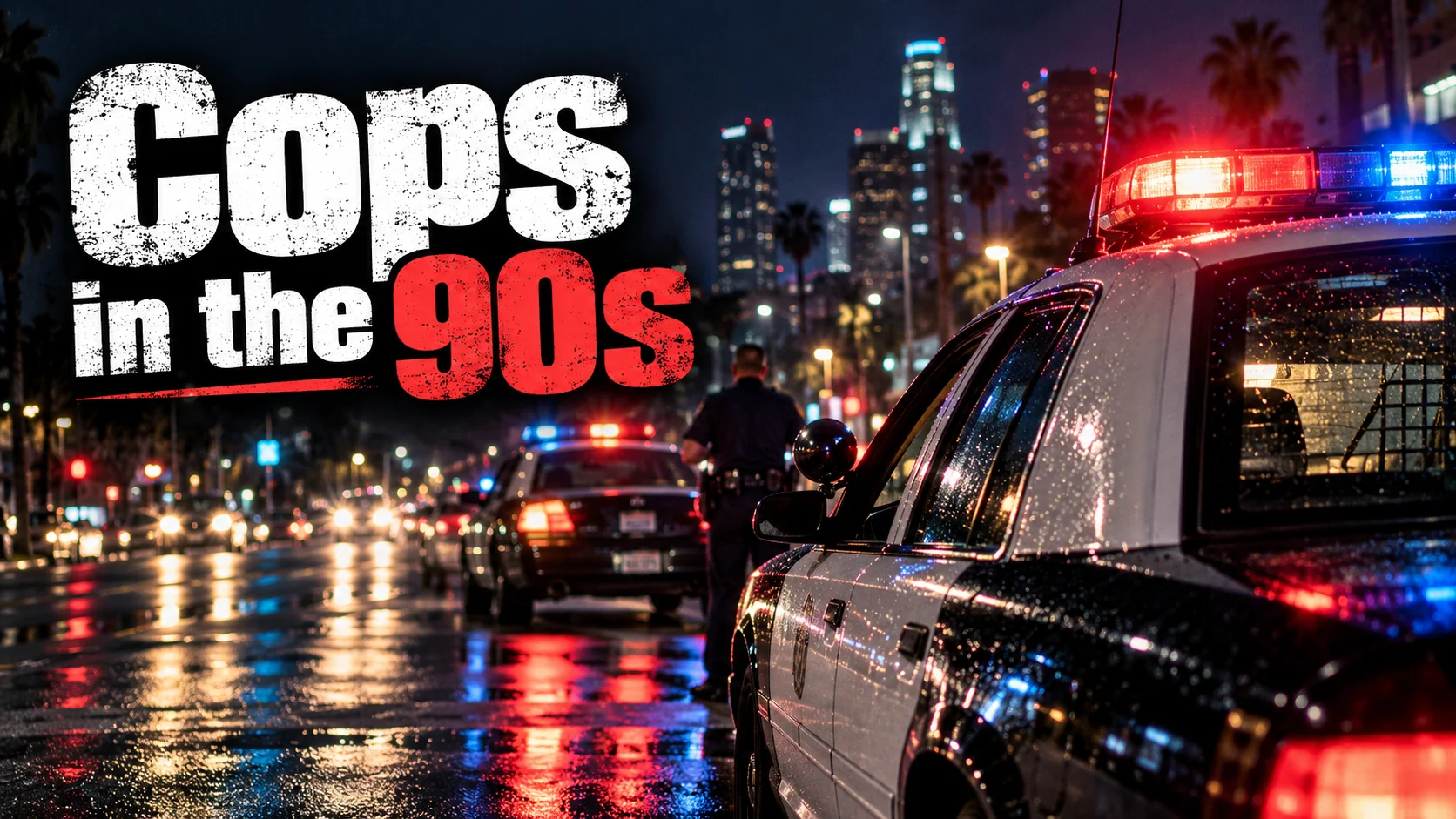
COPSHow Raw Reality TV Changed the Look of Television
No host desk. No laugh track. No polished set. Cops dropped viewers into moving cars, dark streets and real encounters—and television never fully went back.

Quick Answer
Cops changed television by stripping away many conventions of studio-based nonfiction programming and building episodes from location footage of police work. Its handheld style, minimal narration and ride-along structure helped define Fox’s early identity and became an important precursor to the reality-TV boom that followed, while also raising lasting questions about point of view, consent and representation.
The Show Looked Like Television Had Lost Its Tripod
Cops did not look polished, and that was exactly the point.
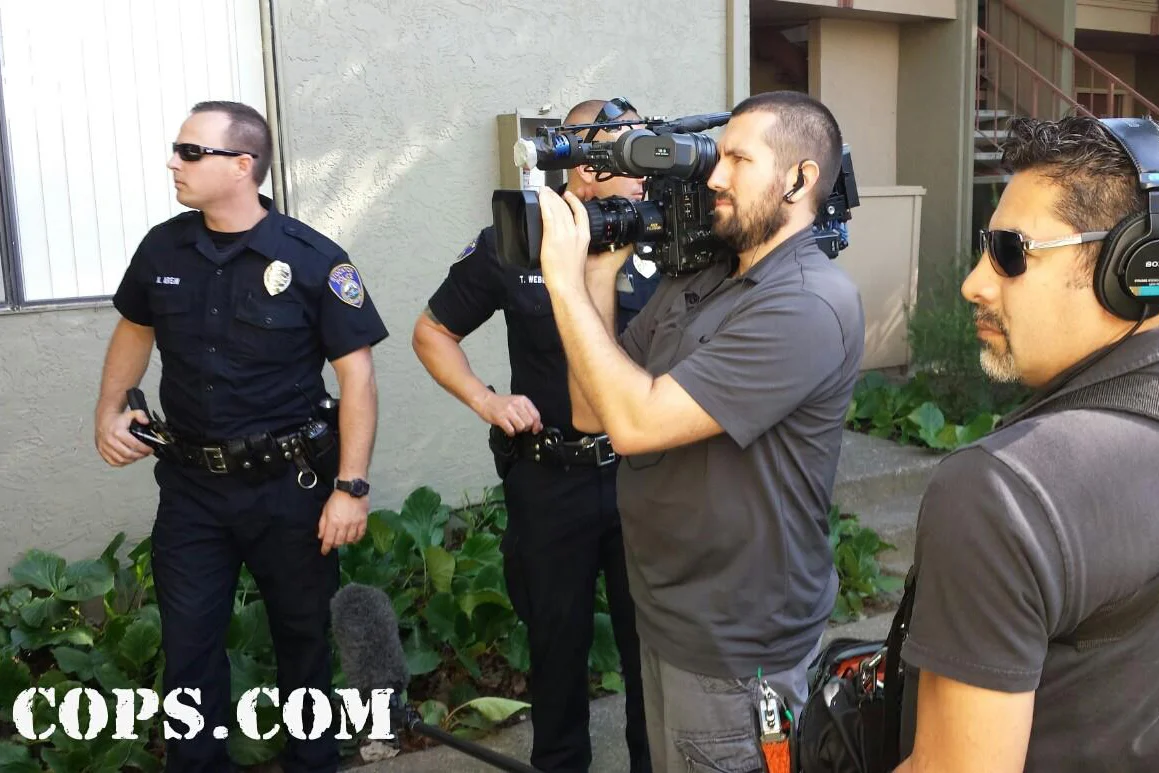
The camera moved because the people moved. Officers jumped out of cars, ran through yards, entered buildings and confronted unpredictable situations while the crew followed behind.
Compared with most network nonfiction television of the late 1980s, the effect was startling.
There was no host standing under clean studio lights. No narrator explained the moral. No actor reenacted what had happened. No dramatic score told you when to feel nervous.
The show wanted the footage itself to carry authority.
That rawness became the brand. A shaky camera could feel more truthful than a polished one. Bad lighting could make the image seem less manipulated. Confusion could look like authenticity.
That visual language would become so common in later reality television that it is easy to forget how unusual it felt when Cops first arrived.
John Langley Came to Cops Through Documentary Television
John Langley’s path to Cops ran through documentary and television specials rather than conventional scripted development.
In his Television Academy interview, Langley described earlier work including Cocaine Blues and American Vice: The Doping of a Nation, a special that included real drug raids.
That experience shaped the premise.
Langley was interested in immediacy: what happens if television follows law enforcement instead of recreating the event later?
The idea was not an obvious sell. A show with no actors, no narrator, no script and no traditional set sounded almost like the absence of television rather than a television format.
That was the breakthrough.
Instead of building the world for viewers, Cops entered a world already in motion.

Fox Was the Network Willing to Buy the Rough Cut
The young Fox network was a natural home for the experiment.
Langley described shopping the concept and eventually reaching Fox executives while the network was still establishing its identity.
He has recalled that the pilot’s rawness was not something Fox demanded he fix. It was part of what made the project interesting.
That fit the network’s larger strategy.
Fox needed programs that could not be mistaken for ABC, CBS or NBC leftovers.
By the late 1980s and early 1990s, the network’s identity was becoming tied to programs that felt younger, rougher or more irreverent.
A 1997 Los Angeles Times history of Fox specifically listed the 1989 arrival of Cops alongside other important steps in the network’s growth.
The show gave Fox something inexpensive, recognizable and structurally different from scripted prime time.
The January 1989 Launch Turned Into a Regular Saturday-Night Slot
Cops first appeared on a limited group of Fox stations in January 1989.
By late February, the Los Angeles Times reported that the series would join Fox’s regular Saturday-night lineup in March.
That is an important detail because the show’s long life can make the original risk feel inevitable.
It was not inevitable.
Fox had to discover whether viewers would stay with footage that did not behave like conventional television.
They did.
The Saturday-night placement became part of the show’s identity.
Cops was easy to enter. You did not need to know a previous episode. You could land on the channel during a traffic stop, domestic call or pursuit and understand the immediate stakes within seconds.
That made it ideal channel-surfing television.
No Host, No Narrator, No Reenactments
Langley later summarized the format by listing what it did not have: no host, no narration, no reenactments, no script and no music inside the body of the program.
Those absences were the design.
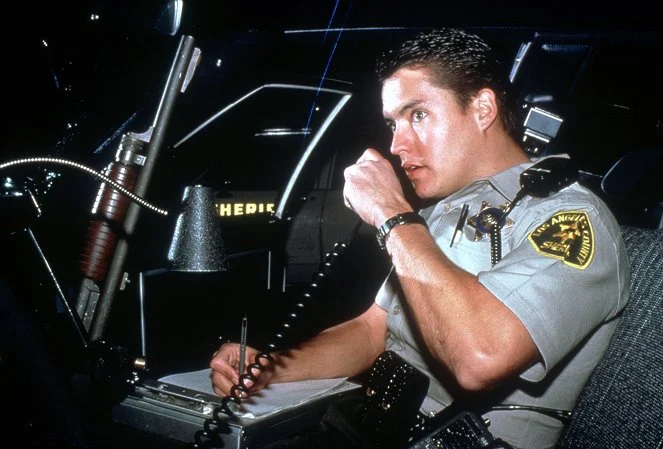
The officers usually explained what viewers needed to know while driving or responding to a call.
The camera provided the rest.
That choice created a feeling of participation. The viewer was not being briefed by a television personality. The viewer appeared to be in the back seat.
Of course, the program was still edited television. Hours of footage had to be selected, arranged and cleared.
But removing the visible machinery made the editing feel invisible.
That is one of the most influential tricks reality television learned: the less production you appear to show, the easier it is for viewers to forget production is there.
The Three-Part Structure Was More Organized Than It Looked
The rough surface did not mean the show lacked structure.
In his Television Academy interview, Langley described a recurring episode design built around three types of material: action, emotion and thought.
That is much more deliberate than simply dumping police footage into a half hour.
An action segment could deliver a pursuit or confrontation.
An emotional piece could focus on a victim, family conflict or aftermath.
A more reflective segment could slow down and let an officer explain the situation.
The formula helped Cops avoid becoming one continuous chase reel.
It also proves an important point about “raw” television: rawness can be carefully arranged.
The program looked spontaneous because the encounters were unpredictable. The episode itself was still shaped.
The Crew Had to Learn Police Work Without Becoming Police
Producing Cops required a strange kind of field competence.
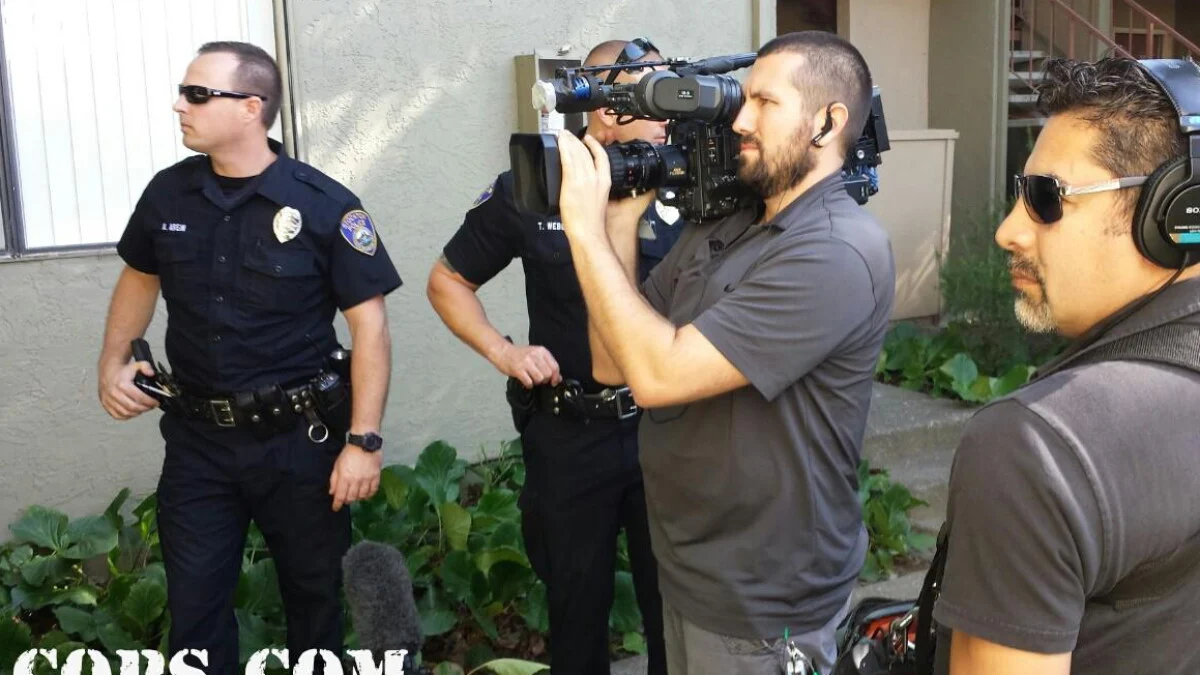
Camera crews had to understand where to stand, how to move and when not to interfere.
Langley described training crews and equipping them for the dangers of following officers into unpredictable situations.
Los Angeles Times reporting on the series also emphasized the low-tech handheld approach and the physical proximity of producers and camera operators to active police work.
That closeness created the show’s visual power.
It also created real risk.
A camera operator could not stop the event and ask for a second take.
The camera had to keep up.
The Officers Became the Narrators—and Sometimes the Stars
Because Cops had no traditional host, officers often became the voices guiding the audience.
They described neighborhoods, explained calls and interpreted behavior.
That made them more than subjects.
In some cases, officers featured repeatedly on the show became recognizable public figures.
The Los Angeles Times reported as early as 1990 that Los Angeles deputies featured on Cops were dealing with the strange consequences of becoming television celebrities.
That is a fascinating collision.
The show claimed documentary immediacy, but the act of broadcasting could change the people being documented.
Once an officer knows the audience may recognize him, “reality” is no longer untouched by television.
Bad Boys Became One of Television's Fastest Audio Shortcuts
The theme song “Bad Boys” by Inner Circle became inseparable from Cops.
You did not need to see the title card.
A few seconds of the song told you exactly what world you were entering.
Langley discussed the theme song’s cultural impact in his Television Academy interview, including the way the series was parodied and referenced elsewhere.
That kind of recognition is powerful because Cops had no recurring cast in the normal sense.
The theme became the recurring character.
Comedy sketches and movies could imitate the show with three ingredients: a shaky camera, somebody running and that musical cue.
The format had become readable at a glance.
Cops Was Reality TV Before 'Reality TV' Became a Giant Category
The reality-TV explosion of the 2000s can make the 1990s look like a warm-up.
Cops proves the format was already developing its grammar much earlier.
The series relied on ordinary people rather than actors, location footage rather than studio sets and conflict that did not begin with a script.
It was not the same as Survivor, The Real World or later dating shows.
There were no confessionals, elimination rules or constructed competitions.
But the underlying proposition was important: real-world footage could become a repeatable entertainment product.
That lesson sits beside the one demonstrated by America’s Funniest Home Videos. The two programs could not feel more different, yet both helped normalize the idea that television did not need professional actors at the center of every successful format.
The Camera's Point of View Was Never Neutral
The most important criticism of Cops is built into the camera position.
The crew usually rides with law enforcement.
That means viewers frequently enter the encounter alongside an officer, hear the officer’s explanation first and see the situation from the same physical side of the confrontation.
Langley himself acknowledged in his Television Academy interview that the footage represented a version of reality rather than reality without mediation.
That distinction matters.
A camera can record real events and still frame them.
Where it stands, when it arrives, what it misses and what gets edited out all shape meaning.
The absence of narration does not create neutrality.
It can simply make perspective harder to notice.
Police Departments Had Their Own Reasons to Participate
Cops depended on cooperation from law-enforcement agencies.
That relationship created another layer of complexity.
The program needed access. Police departments could gain public visibility from participating.
Los Angeles Times reporting on the LAPD’s eventual cooperation with the series in 1994 described the department’s ability to review footage, a practice consistent with the show’s broader production relationships.
Former LAPD Chief Daryl Gates had resisted the show in part because of privacy and safety concerns.
That disagreement highlights the tradeoff.
Ride-along television gains immediacy by embedding with an institution. The institution, in turn, gains influence over access.
That does not automatically make the footage false.
It means the access comes with conditions.
Privacy Was Always Part of the Format's Ethical Problem
Real people on Cops were not actors arriving after an audition.
They were people encountered during police activity.
That made release forms and consent central production issues.
Langley discussed the process of getting releases signed and the way the show’s popularity eventually made that easier.
The ethical question is obvious: how free is a decision to appear on television when the person has just been arrested, questioned or placed in a highly stressful situation?
The series operated within legal and production procedures, but legality and ethics are not the same question.
That tension became increasingly important as reality television expanded.
Cops helped television learn how compelling unscripted access could be. It also helped expose how complicated consent becomes when cameras arrive during crisis.
The Show's Defenders Saw Documentary Honesty
Cops had defenders from the beginning.
A 1992 Los Angeles Times commentary praised the series for avoiding reenactments and elaborate production tricks, calling attention to its cinéma-vérité style.
Co-creator Malcolm Barbour also pushed back against being grouped with more heavily reconstructed “reality” programming.
From that perspective, the virtue of Cops was restraint.
The program did not recreate an arrest with actors.
It did not add a narrator to manufacture suspense.
It showed real officers and real encounters.
That defense is worth taking seriously because it explains why the format felt so different.
The debate is not simply “real or fake.”
It is about whether direct footage can still produce a distorted picture through access, editing and point of view.
The Critics Saw Exploitation and Stereotyping
Criticism followed Cops for reasons just as understandable.
The people most likely to appear on screen were often at vulnerable moments: intoxicated, frightened, angry, poor, injured or under arrest.
Viewers watched those moments as entertainment.
Langley addressed criticism of exploitation and racial stereotyping in his Television Academy interview.
He argued that the producers were conscious of representation and attempted to avoid reproducing actual arrest demographics in a way that would intensify racial stereotypes.
Whether viewers find that answer sufficient is a separate question.
What matters historically is that these concerns were not invented decades later.
The format raised ethical arguments while it was still one of Fox’s signature programs.
The Show Made the Suspect Legible Before the Case Was
Cops usually had only minutes to establish a situation.
That speed encourages instant character judgments.
An officer looks professional because viewers recognize the uniform and procedure.
A person running looks suspicious because the story begins during the chase.
A person yelling looks unstable because the episode may not include the hours of context before the camera arrived.
This is one of the format’s most powerful effects.
Television has always compressed reality.
Cops made the compression feel transparent.
The program could be showing exactly what happened during the recorded minutes while still giving the audience an incomplete moral picture.
Saturday Night Turned Into a Fox Identity
Cops fit Saturday night because the network could build a recognizable block around crime, pursuit and real-world unpredictability.
Fox also used America’s Most Wanted and later other unscripted crime formats.
That scheduling strategy made the night itself a brand.
In the appointment-TV era, networks were not only selling individual shows. They were training viewers to associate certain nights with certain experiences.
Cops needed very little setup.
That made it a durable anchor.
If another show failed, Cops could remain.
The Economics Were Almost as Important as the Style
Unscripted location television offered a different cost structure from scripted drama.
Cops did not need a large recurring cast, elaborate standing sets or a writers’ room producing fictional plots.
That did not make the show cheap in every sense—field production, travel, editing and safety all cost money—but the model was attractive.
The format could generate many episodes from a repeatable production process.
As network competition intensified and audiences fragmented, that reliability became valuable.
Cops helped demonstrate that reality programming could be more than a special-event novelty.
It could be schedule infrastructure.
By the Mid-90s, Cops Had Outlasted the 'Reality TV Fad'
Reality programming went through cycles of hype and backlash in the early 1990s.
Some executives eventually moved away from the genre.
Cops remained.
A 1996 Los Angeles Times report about Fox programming noted that the network’s fall lineup included only one reality-based program: the long-running Cops.
That survival is telling.
The show had become less dependent on the trend that created imitators.
It had its own identity, time slot and audience.
The format was simple enough to remain recognizable and flexible enough to keep producing new material.
The Imitators Proved the Look Had Become a Genre
By the late 1990s, police-reality television had multiplied.
The Los Angeles Times wrote in 1998 about the broader landscape of police video shows, describing Cops as the pioneer whose gritty video-verité style had been followed by numerous programs.
Once imitation begins, a style stops looking experimental.
Handheld footage, dashboard perspectives, pursuits and raw confrontation became a recognizable television category.
Some imitators emphasized shock more aggressively than Cops.
Others slowed the pace and added more explanation.
But the common visual ancestor was obvious.
The camera was no longer observing from across the street.
It was running behind the action.
Cops Changed What Viewers Expected 'Real' Television to Look Like
One of the show’s deepest influences is aesthetic.
Viewers learned to associate imperfect images with authenticity.
A polished image could look staged.
A shaky one could look true.
That association spread far beyond police television.
Later reality shows, documentaries, news packages and even scripted programs borrowed rough camera movement to create immediacy.
The irony is that “raw” became a style sophisticated producers could intentionally reproduce.
Cops did not invent handheld documentary filmmaking.
It imported that visual authority into weekly commercial network television on a massive scale.
The Show Could Be Parodied Because Everyone Knew the Grammar
A format has entered pop culture when a parody requires almost no explanation.
Cops became one of those formats.
Langley discussed movie and television references to the series in his Television Academy interview.
The parody grammar was simple: handheld camera, breathless movement, police lights, a suspect and “Bad Boys.”
The audience filled in the rest.
Specific episodes could be forgotten while the structure remained instantly recognizable.
That is cultural penetration of a different kind.
The format became more famous than most of the people who appeared in it.
The Ratings Need the Same Context as the Rest of 90s Television
Cops occupied a different part of the ratings ecosystem from the giant scripted hits.
Saturday-night audiences were smaller, and Fox’s network reach and demographic strategy differed from the Big Three.
That is why raw ranking alone can be misleading.
Our guide to why 90s television ratings were so much bigger than ratings today explains the larger environment.
Cops mattered not because it was the highest-rated show in America.
It mattered because it was dependable, cheap enough to repeat, recognizable and strategically useful to Fox.
Those qualities can keep a show alive long after flashier programs disappear.
Cops Helped Fox Become Fox
A 1997 Los Angeles Times history of Fox listed Cops as one of the programs that helped the network build its early identity.
That makes sense.
The show was rough, inexpensive-looking and slightly confrontational.
It did not resemble the prestige presentation of the older networks.
Fox was building a brand around difference.
Cops helped make that difference visible.
The young network could turn the lack of polish into an advantage.
What looked underproduced by traditional standards looked immediate to viewers.
The Legacy Requires Holding Two Ideas at Once
Cops is historically important television.
It helped define Fox, popularized a raw nonfiction visual style, proved unscripted location footage could sustain a weekly series and influenced the reality-TV boom that followed.
It is also a format with serious ethical limitations.
The police-centered point of view, access relationships, release process and treatment of vulnerable people all deserve scrutiny.
Those ideas do not cancel each other.
A mature history of television should be able to say a format was influential without pretending influence equals moral approval.
As the industry moved toward the increasingly fragmented world described in our look at the end of the network-TV monoculture, repeatable unscripted formats became even more valuable.
Cops had already shown television how durable that model could be.
On the broader 1990s TV dial, it is impossible to ignore.
It changed what “real” television looked like—and forced viewers to confront how much a camera can reveal while still leaving part of reality outside the frame.
Broward County Gave the Series Its First Visual Vocabulary
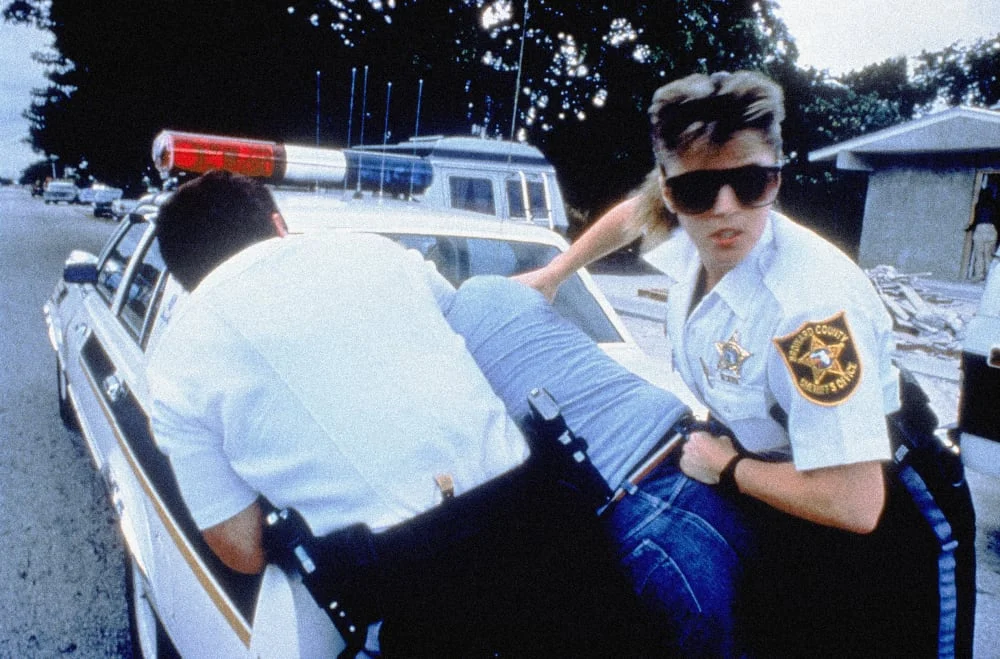
The earliest Cops episodes were closely associated with Broward County, Florida, where viewers saw patrol work, vice enforcement and everyday calls unfold without a fictional setting separating television from place.
That mattered because the series needed a location capable of teaching viewers how to watch it.
The first episodes established the visual grammar: dashboard views, parking lots, apartment complexes, roadside stops, fluorescent booking rooms and officers narrating the neighborhood as they moved through it.
Nothing looked designed.
That sense of geographic specificity helped the show avoid feeling like a generic crime reenactment. Broward County was not “some city.” It was a real jurisdiction with real streets and real weather.
Later seasons traveled widely, but the early Florida footage gave Cops its baseline idea of reality: humid, immediate, ordinary and occasionally chaotic.
The 100th Episode Proved This Was Not a Short-Lived Experiment
By 1992, Cops had reached its 100th program.
That milestone mattered because the format had originally sounded too thin to sustain a series. How many times could viewers watch patrol officers answer calls before the novelty disappeared?
The answer turned out to be: a lot.
The reason was structural variety. Police work naturally produced different tones. One segment could be tense. Another could be sad. Another could be almost mundane.
Langley’s action-emotion-thought structure helped turn that variety into a repeatable half hour.
The 100th episode also marked a larger victory for Fox. The young network had taken a format other executives considered too raw and turned it into one of television’s most durable nonfiction programs.
At that point, Cops no longer needed to prove it could survive. Other shows were already learning from it.

Celebrity Changed the Behavior Around the Camera
Once Cops became popular, participation changed.
Officers recognized the possibility of national exposure. Departments understood the public-relations value. People on the street sometimes recognized the crew or the officers they had seen on television.
That creates a documentary problem without an easy solution.
A camera can influence behavior simply by being present.
An officer may explain more because the audience is listening. A suspect may perform for the camera. A department may prefer the crew to see one kind of operation instead of another.
The Los Angeles Times documented officers becoming recognizable from the series as early as 1990.
That does not mean the events were staged.
It means the success of the program gradually changed the environment it claimed to observe.
The bigger Cops became, the harder it was for the camera to remain invisible.
The Editing Room Was Where 'Reality' Became an Episode
The actual police encounter might last minutes or hours. Cops had less than half an hour to create television.
That meant editors had enormous influence.
They decided which event opened the episode, how long viewers stayed with a person, what officer explanation remained and where the segment ended.
A chaotic event could be compressed into a clean narrative arc.
That is not unique to Cops. Every documentary edits reality.
What made Cops different was how little the finished show called attention to that process.
Without a host or narrator, the episode could feel as if events had simply presented themselves in order.
The invisibility of editorial construction became one of reality television’s most powerful conventions.
Viewers learned to experience edited nonfiction with the speed and clarity of scripted storytelling.
Cops FAQ
When did Cops premiere?
Cops debuted on Fox stations in January 1989 and joined Fox’s regular Saturday-night lineup in March 1989.
Who created Cops?
The series was created by producers John Langley and Malcolm Barbour.
Why did Cops look so different from other television shows?
It relied on handheld location footage and avoided many traditional elements such as a host, narrator, reenactments and scripted scenes.
Was Cops an early reality-TV series?
Yes. It was one of the most influential early unscripted series built around real people and real-world events, although its style differed from later competition and lifestyle reality shows.
How did police departments participate in Cops?
Production depended on access agreements with law-enforcement agencies. Crews rode with officers, filmed calls and worked through release and approval processes.
Why is Cops controversial?
Critics have questioned its law-enforcement-centered point of view, representation of suspects, consent practices and the ethics of turning arrests and crises into entertainment.
What was the Cops theme song?
The series used “Bad Boys” by Inner Circle, which became one of television’s most recognizable theme songs.
Why does Cops matter to 90s TV history?
It helped establish Fox, popularized a raw video-verité look and demonstrated that unscripted location footage could become durable weekly prime-time television.
Sources & Further Reading
- Television Academy Interviews — John Langley
- Television Academy Interviews — Remembering John Langley
- Los Angeles Times — Cops joins Fox's regular Saturday lineup, 1989
- Los Angeles Times — Fox's Cops Has the Right Beat, 1992
- Los Angeles Times — The Force Is With Her, 1992
- Los Angeles Times — Cops Hits Streets of L.A., 1994
- Los Angeles Times — How Fox Outran the Hounds, 1997
- Los Angeles Times — Reality Police Series Leave Mark on the Cultural Blotter, 1998
Keep the dial moving: Explore more 1990s TV shows, sitcoms, dramas, ratings and prime-time classics.