80s Movie Songs: 25 Soundtrack Hits That Made the Movies Bigger Than the Screen

80s Movie Songs: 25 Soundtrack Hits That Made the Movies Bigger Than the Screen
80s Movie Songs

80s Movie Songs: 25 Soundtrack Hits That Made the Movies Bigger Than the Screen

The 80s did not just put songs in movies. It turned soundtracks into marketing weapons, radio events, MTV fuel, school-dance staples, and cassette-deck memories. These are the movie songs that made scenes feel bigger, trailers feel louder, and entire films impossible to remember without hearing the chorus in your head.

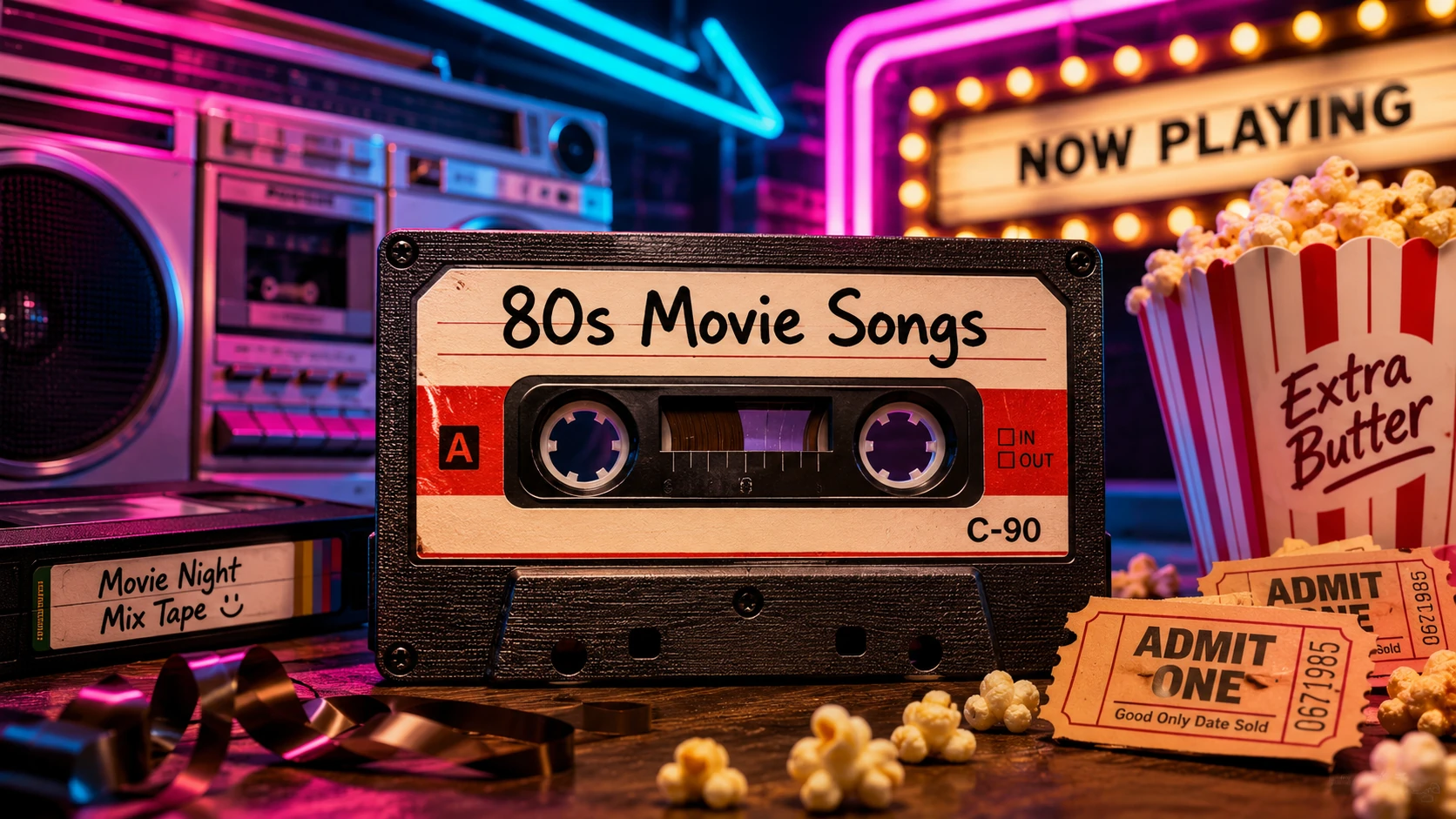
80s movie songs nostalgia collage with VHS tapes, cassette tapes, neon movie marquee, boombox, and soundtrack energy

VHS glow. Radio hooks. Movie scenes that refused to shut up.

Flashdance. Footloose. Ghostbusters. Top Gun. Dirty Dancing. Back to the Future. The soundtrack became part of the movie’s DNA.

When Movies, MTV, and Radio Became One Machine

The 80s movie song was a different beast. It did not simply play over the credits and leave quietly. It showed up on Top 40 radio, got a music video, sold the soundtrack, sold the movie again, and then followed everyone home through VHS rentals, mall speakers, skating rinks, school dances, and cassette tapes with labels written in pen.

A great 80s movie song could make a scene iconic before the movie even hit cable. “Don’t You (Forget About Me)” became the sound of a raised fist. “Danger Zone” turned fighter jets into a music video. “Ghostbusters” made a supernatural comedy feel like a pop event. “Take My Breath Away” made Top Gun romance feel like it had been dipped in neon and slow motion.

Inside the larger 80s Music hub, movie songs deserve their own lane because they connect everything: pop hits, rock, power ballads, dance tracks, synth instrumentals, teen movies, action movies, training montages, and the glorious VHS culture that made every living room feel like a tiny theater with worse tracking.

Listen to the 80s Movie Songs Playlist

Press play and cue the VHS glow: movie themes, soundtrack anthems, training-montage fuel, prom-night slow dances, neon pop, action-movie adrenaline, and the songs that made 80s movies stick in your brain long after the credits rolled.

The 25 Essential 80s Movie Songs

# Song Artist Movie Year Why It Belongs Here
1Flashdance… What a FeelingIrene CaraFlashdance1983The dance-movie anthem that turned sweat, leg warmers, and ambition into pop gold.
2ManiacMichael SembelloFlashdance1983A neon workout panic attack that became one of the decade’s most intense soundtrack hits.
3Eye of the TigerSurvivorRocky III1982The training-montage theme that made everyone briefly believe stairs were a personality.
4FootlooseKenny LogginsFootloose1984The title-track party starter that made dancing sound like civil disobedience.
5Let’s Hear It for the BoyDeniece WilliamsFootloose1984Bright, joyful, and permanently attached to awkward dancing becoming confidence.
6GhostbustersRay Parker Jr.Ghostbusters1984A theme song so sticky it became a call-and-response reflex for an entire generation.
7Axel FHarold FaltermeyerBeverly Hills Cop1985A synth instrumental that somehow became cooler than half the songs with lyrics.
8The Power of LoveHuey Lewis & The NewsBack to the Future1985Pure pop-rock optimism welded forever to a DeLorean and a skateboard.
9St. Elmo’s Fire (Man in Motion)John ParrSt. Elmo’s Fire1985A young-adult anthem for people dramatically entering adulthood near saxophones.
10Don’t You (Forget About Me)Simple MindsThe Breakfast Club1985The teen-movie ending anthem that turned one raised fist into permanent Gen X scripture.
11Weird ScienceOingo BoingoWeird Science1985Jittery new-wave chaos for a movie built from hormones, computers, and bad decisions.
12The Goonies ‘R’ Good EnoughCyndi LauperThe Goonies1985A kids-on-an-adventure anthem with full Cyndi Lauper cartoon-color energy.
13A View to a KillDuran DuranA View to a Kill1985James Bond meets new-wave glamour and somehow the hair is as dangerous as the villain.
14Take My Breath AwayBerlinTop Gun1986The slow-motion love theme that made jet-fighter romance feel like synth-pop destiny.
15Danger ZoneKenny LogginsTop Gun1986The official sound of aviators, engines, volleyball confidence, and reckless 80s velocity.
16If You LeaveOMDPretty in Pink1986Teen romantic melancholy with enough synth glow to light an entire John Hughes hallway.
17Live to TellMadonnaAt Close Range1986Madonna’s darker soundtrack ballad, moody and cinematic without losing pop gravity.
18Into the GrooveMadonnaDesperately Seeking Susan1985The club-pop invitation that made downtown cool feel danceable and dangerous.
19When Doves CryPrincePurple Rain1984A soundtrack hit so strange, spare, and brilliant it rewired what pop drama could sound like.
20Purple RainPrincePurple Rain1984The emotional guitar cathedral that made the movie feel mythic.
21Burning HeartSurvivorRocky IV1986Cold War workout fuel for a movie where geopolitics were apparently settled by abs.
22No Easy Way OutRobert TepperRocky IV1986The moody driving-and-regret song that made grief feel like an FM-radio montage.
23Nothing’s Gonna Stop Us NowStarshipMannequin1987Romantic pop optimism so shiny it could make a department-store mannequin seem reasonable.
24(I’ve Had) The Time of My LifeBill Medley & Jennifer WarnesDirty Dancing1987The end-of-movie lift that turned a dance finale into a generational reflex.
25KokomoThe Beach BoysCocktail1988A tropical radio escape hatch for anyone whose vacation budget was mostly imagination.

The Soundtrack Hits That Would Not Leave the VCR

#1

“Flashdance… What a Feeling” — Irene Cara

1983 Songs Movie: Flashdance Dance-Movie Anthem

“Flashdance… What a Feeling” is one of the purest examples of an 80s movie song becoming bigger than the movie itself. It took the film’s blue-collar dancer fantasy and turned it into a pop anthem about ambition, movement, sweat, and the possibility that your entire life could change if the lighting was dramatic enough.

The song works because it does not simply describe the movie. It sells the emotional promise of the movie. It makes discipline sound glamorous, dancing sound heroic, and leg warmers seem like a reasonable life choice. Irene Cara’s vocal gives it lift, while the production gives it that early-MTV glow: bright, urgent, and just synthetic enough to feel modern.

Lifestyle-wise, this song belonged everywhere: aerobics rooms, school talent shows, radio countdowns, bedroom mirrors, and any moment where someone briefly believed they were one montage away from becoming unstoppable. The 80s loved self-transformation, and this song made transformation sound like it came with a smoke machine.

For Gen X, “What a Feeling” is not just attached to Flashdance. It is attached to the era’s whole dream of reinvention. Work hard, dance harder, wear something off the shoulder, and maybe the final chorus will fix your life. Delusional? Maybe. Effective pop culture? Absolutely.

#2

“Maniac” — Michael Sembello

“Maniac” is the darker, more frantic sibling of the Flashdance soundtrack. Where “What a Feeling” is inspirational, “Maniac” sounds like ambition has been locked in a room with a drum machine and too much caffeine. The song pulses, drives, and refuses to relax, which makes it perfect for a movie obsessed with movement and physical transformation.

The track became inseparable from the image of intense 80s training: sweat, mirrors, sharp cuts, and the belief that effort should look like a music video. It is not a gentle song. It sounds like someone chasing a dream at a pace that may require medical supervision.

Lifestyle-wise, “Maniac” lived in aerobics culture, workout tapes, dance rehearsals, and radio stations that wanted something with more voltage than a standard pop song. It also became one of those songs that made ordinary exercise feel cinematic, even if the actual activity was just stretching on carpet next to a wood-paneled wall.

For Gen X, “Maniac” is one of the definitive songs of the VHS fitness-and-movie era. It captures the 80s belief that intensity was always better, sweat was glamorous, and every dream worth having probably needed a synthesizer chase scene.

#3

“Eye of the Tiger” — Survivor

1982 Songs Movie: Rocky III Training-Montage Royalty

“Eye of the Tiger” is not just a movie song. It is the official audio setting for deciding today is the day you finally get serious, even if you are only walking to the fridge. Survivor’s riff is so instantly recognizable that it practically arrives wearing boxing gloves. It gave Rocky III a sharp, hungry identity and gave the 80s one of its most durable motivational weapons.

The song works because it is simple, direct, and built like a challenge. It does not waste time. The riff stalks forward, the vocal locks in, and suddenly every staircase looks like an opportunity for personal growth. That is the genius: it turns discipline into drama and drama into a hook.

Lifestyle-wise, this song escaped the movie immediately. It became gym-class fuel, sports-team fuel, backyard-wrestling fuel, and the sound of every kid shadowboxing badly in front of a mirror. It also made training montages feel mandatory in real life, which was a problem because real life did not come with editing.

For Gen X, “Eye of the Tiger” is muscle memory. It is Rocky, yes, but it is also PE class, radio countdowns, local commercials, pep rallies, and a thousand low-budget attempts to feel tougher than you were. The song made confidence sound like a guitar riff with a grudge.

#4

“Footloose” — Kenny Loggins

1984 Songs Movie: Footloose Dance-Rebellion Anthem

“Footloose” is Kenny Loggins doing what Kenny Loggins did better than almost anyone in the 80s: turning a movie premise into a radio-ready adrenaline shot. The song is all forward motion — claps, guitar, drums, and a chorus that makes dancing sound like the most important civil right in America.

What makes it work is that it captures the movie’s entire attitude in one blast. Footloose is about repression, rebellion, small-town rules, teenage energy, and the idea that dancing can somehow threaten the social order. The song takes all of that and says, “Great, but can we make it a party?”

Lifestyle-wise, “Footloose” belonged to school dances, wedding receptions, aerobics classes, skating rinks, and every place where people with questionable rhythm decided confidence was more important than accuracy. It made movement feel rebellious, even when the movement was happening under fluorescent gym lights.

For Gen X, “Footloose” is pure 1984 soundtrack culture: the movie sells the song, the song sells the movie, MTV sells both, and suddenly everyone is convinced that one good chorus can defeat authority. Honestly, not the worst philosophy.

#5

“Let’s Hear It for the Boy” — Deniece Williams

1984 Songs Movie: Footloose Feel-Good Soundtrack Pop

“Let’s Hear It for the Boy” brought a completely different kind of energy to Footloose. It is bright, affectionate, playful, and full of the kind of pop sweetness that made the film’s awkward dance-training moments feel charming instead of tragic. Deniece Williams turns encouragement into a hook, and the song becomes pure sunshine with a beat.

The track works because it celebrates imperfection. The boy in question may not be smooth, rich, cool, or especially coordinated, but the song cheers him on anyway. That made it perfect for a movie where confidence mattered more than polish. Very 80s. Very inspirational. Mildly dangerous if applied to actual dancing.

Lifestyle-wise, this was a school-dance and radio staple because it felt happy without being disposable. It belonged to malls, skating rinks, sleepovers, and TV dance clips where everyone looked like they had been dressed by a pastel explosion.

For Gen X, “Let’s Hear It for the Boy” is the lighter side of soundtrack domination. Not every 80s movie song had to be intense. Some just needed a big smile, a bright chorus, and enough charm to make awkwardness feel like a personality.

#6

“Ghostbusters” — Ray Parker Jr.

1984 Songs Movie: Ghostbusters Theme-Song Takeover

“Ghostbusters” is one of the ultimate examples of a movie theme becoming a pop-culture reflex. Ray Parker Jr. delivered a song so simple and sticky that the call-and-response hook became almost impossible not to answer. The movie had ghosts, jokes, proton packs, and Bill Murray. The song had the phrase everyone could shout. That combination was unfair.

The track works because it sounds fun before it sounds spooky. It turns the supernatural into a party, which matches the movie perfectly. The beat is playful, the guitar is funky, and the chorus is basically a marketing department’s dream that somehow still feels like a real song.

Lifestyle-wise, this thing was everywhere: Halloween parties, playgrounds, radio, birthday parties, TV commercials, toy aisles, and kids yelling “Who you gonna call?” until adults considered moving to the woods. It was one of those 80s songs that became part of the culture’s spoken language.

For Gen X, “Ghostbusters” is tied to more than the movie. It is tied to Saturday afternoons, action figures, VHS rentals, Halloween costumes, and the moment a theme song became as famous as the film title. The 80s did branding better than it had any right to.

#7

“Axel F” — Harold Faltermeyer

1985 Songs Movie: Beverly Hills Cop Synth Instrumental Icon

“Axel F” is proof that an 80s movie song did not even need lyrics to become iconic. Harold Faltermeyer’s synth instrumental gave Beverly Hills Cop its cool, mischievous pulse. It sounds like sunglasses, sneakers, palm trees, and Eddie Murphy getting away with something while everyone else tries to keep up.

The melody is simple, but the sound is everything. Those synth tones are pure mid-80s: clean, bright, slightly plastic, and unbelievably memorable. It turned a cop-comedy theme into a radio hit and helped prove that electronic instrumentals could have just as much personality as vocal pop songs.

Lifestyle-wise, “Axel F” belonged to arcades, car stereos, TV promos, and every kid who tried to play the melody on a cheap keyboard at a friend’s house. It sounded futuristic and goofy at the same time, which made it perfect for the decade.

For Gen X, this is one of those songs that instantly triggers the movie’s whole vibe. You hear the first notes and the entire Beverly Hills Cop universe pops back into place: comedy, action, attitude, and synths doing way more work than anyone expected.

#8

“The Power of Love” — Huey Lewis & The News

“The Power of Love” is one of the great feel-good soundtrack hits because it captures Back to the Future’s energy without sounding like a novelty song about time travel. Huey Lewis & The News give the movie a blast of clean, upbeat pop-rock that feels like skateboards, school hallways, and a DeLorean waiting to ruin the space-time continuum.

The song works because it is broad enough to stand alone but specific enough to feel fused to the movie. It does not need lyrics about flux capacitors. It just gives the film a confident, modern pulse. That was the 80s soundtrack sweet spot: a song that could dominate radio and still make the movie feel bigger.

Lifestyle-wise, this is car-radio optimism. It belonged to summer drives, mall parking lots, school mornings, and VHS nights where Back to the Future became one of those movies people watched repeatedly until the tape got tired.

For Gen X, “The Power of Love” is not just a hit song. It is the sound of 1985 feeling fun, fast, and slightly impossible. It made time travel feel like a Top 40 problem, which is exactly why it still works.

#9

“St. Elmo’s Fire (Man in Motion)” — John Parr

“St. Elmo’s Fire (Man in Motion)” is the sound of young adults taking themselves extremely seriously while the saxophone of destiny plays somewhere nearby. John Parr delivers a giant aspirational anthem that matches the movie’s whole vibe: post-college confusion, ambition, friendship, romance, and everyone acting like adulthood is a music video.

The song is built for lift. It is motivational, dramatic, and shamelessly huge. It turns uncertainty into motion and gives the Brat Pack era a full-throttle theme for becoming something, even if nobody is quite sure what that something is.

Lifestyle-wise, it belonged to graduation feelings, first jobs, big dreams, and anyone who looked at a city skyline and briefly believed their life needed a theme song. The 80s loved ambition, and this track made ambition sound like a chorus with a wind machine.

For Gen X, “Man in Motion” is the young-adult version of the training montage. Less boxing, more emotional career confusion. It made growing up sound heroic, which was nice of it, because the actual process was mostly bills and bad apartments.

#10

“Don’t You (Forget About Me)” — Simple Minds

1985 Songs Movie: The Breakfast Club Teen-Movie Immortality

“Don’t You (Forget About Me)” is the 80s teen-movie anthem that became inseparable from one raised fist and an entire generation’s sense of misunderstood cool. Simple Minds gave The Breakfast Club a closing song that did more than wrap up the movie. It turned teenage alienation into something mythic.

The song works because it is both melancholy and triumphant. It sounds like isolation, recognition, rebellion, and victory all at once. That is exactly why it fit a movie about kids realizing they were more than the labels adults and classmates put on them.

Lifestyle-wise, this song belonged to after-school cable, VHS rentals, bedroom walls, hallway drama, and the eternal teenage fantasy of walking away from school while the right song plays. It made detention feel profound. That is not easy. Most detention just smelled like floor wax and regret.

For Gen X, “Don’t You” is practically sacred text. It is the sound of John Hughes turning teen emotion into pop mythology, and it still works because everyone remembers wanting to be seen, even if they were pretending not to care.

#11

“Weird Science” — Oingo Boingo

“Weird Science” sounds exactly like the movie feels: jumpy, strange, hormonal, synthetic, and probably not approved by any responsible adult. Oingo Boingo brought manic new-wave energy to a John Hughes comedy built around teenage fantasy, computers, and deeply questionable decision-making.

The song’s jittery rhythm and oddball hooks made it perfect for the mid-80s moment when computers still felt mysterious and vaguely magical. It is not romantic in the usual soundtrack way. It is twitchy and weird, which makes it much more useful.

Lifestyle-wise, this belongs to basement TV rooms, early computer fascination, cable reruns, and the specific teenage belief that technology might solve everything if used irresponsibly enough. The song sounds like someone fed a lab experiment after midnight.

For Gen X, “Weird Science” is part of the decade’s nerd-chaos soundtrack. It captures the era when computers, hormones, and synth-pop all seemed equally futuristic and equally capable of causing problems.

#12

“The Goonies ‘R’ Good Enough” — Cyndi Lauper

“The Goonies ‘R’ Good Enough” is Cyndi Lauper turning a kids’ adventure movie into a bright, goofy, slightly chaotic pop event. The song has that unmistakable Cyndi energy: colorful, playful, strange, and somehow emotional even when it sounds like it is running through a funhouse.

It fits The Goonies because the movie itself is messy in the best way: treasure maps, booby traps, bikes, caves, criminals, friendship, and kids yelling over each other. The song does not try to make that neat. It leans into the chaos and gives the movie a pop wrapper.

Lifestyle-wise, this is Saturday-afternoon VHS energy. It belongs to sleepovers, bike rides, basement rec rooms, and the era when kids were apparently allowed to roam entire towns with no tracking devices and only mild adult concern.

For Gen X, the song is less about chart perfection and more about memory. It is attached to adventure, friendship, and the childhood fantasy that the weird kids could absolutely save the day if given enough time and a pirate map.

#13

“A View to a Kill” — Duran Duran

1985 Songs Movie: A View to a Kill Bond Goes New Wave

“A View to a Kill” is what happens when James Bond crashes into peak 80s glamour and Duran Duran walks away holding the keys. The song gives the Bond theme tradition a new-wave makeover: dramatic, sleek, stylish, and covered in enough synth-pop polish to make international espionage seem like a nightclub problem.

It works because it still feels like Bond — dangerous, theatrical, and stylish — but it also feels unmistakably 1985. Duran Duran were perfect for the assignment because they already sounded like luxury, danger, fashion, and expensive bad decisions.

Lifestyle-wise, this belonged to MTV cool, magazine covers, sharp suits, and the era when pop stars could make a movie feel younger just by showing up on the soundtrack. It made Bond feel less like your dad’s spy and more like something that might arrive with neon lighting.

For Gen X, “A View to a Kill” is one of the great examples of an old franchise borrowing 80s pop electricity. The movie got the band. The band got the movie. Everyone got hair.

#14

“Take My Breath Away” — Berlin

1986 Songs Movie: Top Gun Synth Love Theme

“Take My Breath Away” is the slow-motion heart of Top Gun. Berlin delivered a synth-pop ballad that made romance feel glossy, dangerous, and slightly aerodynamic. The song does not rush. It glides, which is exactly what the movie needed between all the jets, rivalry, and military swagger.

The track’s power is atmosphere. That pulsing synth motif, the spacious production, and Terri Nunn’s cool vulnerability turn the love scenes into something almost dreamlike. It is not just a ballad. It is mood lighting with a chorus.

Lifestyle-wise, this was slow-dance fuel, radio-dedication fuel, and the sound of 1986 romance as filtered through aviators and sunset lighting. It belonged to couples skates, prom corners, bedroom stereos, and anyone who thought love should look like a motorcycle ride next to an airfield.

For Gen X, “Take My Breath Away” is inseparable from Top Gun’s pop-cultural dominance. It proves that an 80s action movie could sell speed with one song and sell romance with another. Efficient. Excessive. Completely on brand.

#15

“Danger Zone” — Kenny Loggins

1986 Songs Movie: Top Gun Action-Movie Throttle

“Danger Zone” is the sound of Top Gun hitting the afterburners. Kenny Loggins became the unofficial king of 80s movie adrenaline, and this track may be his most aggressively cinematic. It turns engines, ego, competition, and aviator sunglasses into a pop-rock missile.

The song works because it does not pretend to be subtle. It is velocity with lyrics. The drums punch, the guitars push, and Loggins sells the whole thing like danger is not only acceptable but probably required for personal branding.

Lifestyle-wise, this was peak action-movie fantasy. It belonged to kids making jet noises, teens driving too confidently, dads testing stereo speakers, and every montage where speed was mistaken for character development.

For Gen X, “Danger Zone” is pure 1986: military hardware, MTV editing, cocky heroes, and a soundtrack that made everything seem cooler than it had any right to be. You cannot hear it without immediately picturing jets. That is soundtrack dominance.

#16

“If You Leave” — OMD

1986 Songs Movie: Pretty in Pink John Hughes Melancholy

“If You Leave” is John Hughes heartbreak in synth-pop form. OMD gave Pretty in Pink a song that sounds like romantic uncertainty under pastel lighting. It is bittersweet, polished, and emotionally suspended — exactly right for a movie about class tension, crushes, identity, and teenagers trying to make enormous decisions in questionable outfits.

The song works because it captures the feeling of something ending before anyone is ready. It is not a full collapse. It is the ache of a moment slipping away. That made it perfect for the Hughes universe, where hallway glances and prom-night decisions carried the weight of international diplomacy.

Lifestyle-wise, this belonged to mixtapes, bedroom stereos, school dances, and anyone staring at the phone wondering whether calling would make things better or destroy the last remaining dignity in the room. The 80s phone cord was basically an emotional leash.

For Gen X, “If You Leave” is the sound of teen romantic anxiety before texting ruined the mystery. It glows, it aches, and it makes being seventeen seem both beautiful and extremely inconvenient.

#17

“Live to Tell” — Madonna

“Live to Tell” is Madonna in a darker, more cinematic mode. Attached to At Close Range, the song trades dance-floor brightness for secrecy, tension, and emotional weight. It is slow, shadowy, and built around restraint, which makes it stand apart from many of the decade’s louder soundtrack hits.

The song works because Madonna does not oversell it. The vocal is controlled, almost haunted, and the production leaves enough space for the mood to settle. It feels like a confession that may or may not ever be spoken out loud.

Lifestyle-wise, this was late-night radio Madonna — less mall-pop explosion, more bedroom darkness. It belonged to headphones, dim rooms, and the moment when pop stars started proving soundtrack songs could deepen their image instead of simply promote a film.

For Gen X, “Live to Tell” is one of those songs that showed Madonna’s 80s reach. She could own the club, own MTV, own fashion, and then turn around with a movie ballad that sounded like a secret. Annoyingly talented. Very effective.

#18

“Into the Groove” — Madonna

“Into the Groove” is Madonna turning the movie soundtrack into a dance-floor invitation. Connected to Desperately Seeking Susan, the song captures the film’s downtown cool, identity-shifting energy, and sense that New York was one giant club if you knew where to stand.

The song works because it is pure movement. It does not overthink anything. The beat pulls, Madonna commands, and suddenly the groove feels like a place you either enter or spend the rest of your life regretting. That confidence was the point.

Lifestyle-wise, “Into the Groove” belonged to dance floors, bedroom mirrors, mall fashion, and every kid who saw Madonna and realized reinvention could be a full-time hobby. It made style feel like freedom and dancing feel like self-definition.

For Gen X, this is peak Madonna soundtrack crossover. The movie reinforced the image, the song reinforced the movie, and MTV made the whole thing feel like a lifestyle manual for being cooler than your actual town allowed.

#19

“When Doves Cry” — Prince

1984 Songs Movie: Purple Rain Pop Genius Mode

“When Doves Cry” is the moment Purple Rain stops being just a movie soundtrack and becomes its own universe. Prince created a song that was spare, strange, dramatic, and completely magnetic. The lack of a bassline made it feel unsettling, while the vocal and production turned family pain, romantic tension, and identity into pop electricity.

The song works because it refuses to behave like a normal soundtrack hit. It is not a simple theme. It is a psychological room with purple lighting. It captures the movie’s emotional conflict without narrating it directly, which makes it feel bigger and more mysterious.

Lifestyle-wise, this was 1984 cool at maximum voltage. It belonged to MTV, record stores, posters, dance floors, and bedrooms where kids tried to understand how one artist could sound like funk, rock, pop, and something from another planet all at once.

For Gen X, “When Doves Cry” is not just an 80s movie song. It is one of the decade’s defining pop moments, soundtrack or otherwise. Prince did not just add music to a movie. He made the movie, the album, and the image all feed the same myth.

#20

“Purple Rain” — Prince

1984 Songs Movie: Purple Rain Emotional Guitar Cathedral

“Purple Rain” is not just a ballad. It is an emotional monument with a guitar solo. Inside the film, it becomes a moment of release, grief, redemption, and performance all at once. Outside the film, it became one of the decade’s most enduring songs because it sounds like the sky opening over a stage.

The song’s power is scale. It starts like a confession and ends like a ceremony. Prince gives it space, drama, and enough musical gravity to make the movie feel mythic. It is one of those songs where the live-performance feeling matters just as much as the recording.

Lifestyle-wise, “Purple Rain” belonged to bedroom speakers, late-night radio, slow dances, and anyone who wanted their feelings to sound deeper than they were prepared to explain. It was heartbreak, spirituality, rock, soul, and theater all folded into one.

For Gen X, this is one of the great soundtrack-to-life songs. It transcended the film without ever disconnecting from it. You hear it and the whole Purple Rain world comes back: the stage, the smoke, the pain, the genius, and the color.

#21

“Burning Heart” — Survivor

1986 Songs Movie: Rocky IV Cold War Workout Fuel

“Burning Heart” is Rocky IV distilled into one extremely serious rock anthem. Survivor returned to the Rocky universe with a song built around conflict, willpower, and Cold War intensity. It sounds like someone turned geopolitics into a gym playlist.

The track works because Rocky IV is already a montage machine. Training in the snow, chopping wood, running up mountains, fighting for national pride — it all needed a song that could carry absurd emotional stakes without blinking. “Burning Heart” does exactly that.

Lifestyle-wise, this was motivation music for kids who had no reason to be motivated beyond maybe passing gym class. It made push-ups feel political and backyard boxing feel like international diplomacy. Again, the 80s were not subtle.

For Gen X, “Burning Heart” is the sound of action movies, sports fantasy, and Cold War pop culture smashed together. It made training feel heroic and made everyone briefly believe a dramatic workout could solve global tension.

#22

“No Easy Way Out” — Robert Tepper

1986 Songs Movie: Rocky IV Driving Regret Anthem

“No Easy Way Out” is Rocky IV’s moody regret engine. Unlike the pure training anthems, this song is about emotional weight. It is the sound of someone driving at night through grief, guilt, and memory while the movie cuts together pain like a music video.

The song works because it has that perfect 80s combination of rock grit and synth atmosphere. It feels dramatic but not shiny. It has momentum, but the mood is heavy. That makes it one of the most underrated movie-song memories of the decade.

Lifestyle-wise, this is car-stereo cinema. It belongs to night drives, dashboard lights, and the kind of emotional overthinking that happened before phones could distract you every six seconds. You had the road, the radio, and your questionable choices.

For Gen X, “No Easy Way Out” proves that not every soundtrack hit needed to be a party anthem. Some were there to make regret sound enormous. Rocky IV had punches, but this song gave it bruises.

#23

“Nothing’s Gonna Stop Us Now” — Starship

1987 Songs Movie: Mannequin Romantic Pop Gloss

“Nothing’s Gonna Stop Us Now” is so shiny and optimistic that it almost makes Mannequin seem like a normal movie premise. Starship delivered a giant romantic pop anthem that gave the film a much bigger emotional footprint than a department-store mannequin romance probably deserved.

The song works because the chorus is bulletproof. It is pure late-80s uplift: big voices, big production, and a belief in love so confident it can apparently overcome common sense, retail employment, and supernatural mannequin logistics.

Lifestyle-wise, this was wedding-reception fuel, radio-dedication fuel, and soft-rock optimism for people who wanted romance without shadows. It belonged to malls, which is perfect, because the movie also belonged to malls. Synergy, baby.

For Gen X, “Nothing’s Gonna Stop Us Now” is one of those songs that proves the soundtrack could outgrow the movie. You may forget half the plot, but the chorus still knows where you live.

#24

“(I’ve Had) The Time of My Life” — Bill Medley & Jennifer Warnes

“(I’ve Had) The Time of My Life” is one of the ultimate end-of-movie songs because it does exactly what a finale song should do: make the last scene feel like a release, a celebration, and a memory being created in real time. Dirty Dancing builds to it, and the song delivers the lift.

The duet structure gives it drama. The beat grows, the vocals rise, and by the time the famous lift arrives, the song has already done half the emotional work. It makes the movie’s romance, rebellion, and coming-of-age energy feel complete.

Lifestyle-wise, this became wedding-dance fuel, school-dance fuel, talent-show fuel, and living-room recreation fuel. Many people attempted the lift. Many floors filed complaints. The song made everyone believe they could have a cinematic dance moment if given enough courage and poor judgment.

For Gen X, “Time of My Life” is tied to VHS replays, cable airings, and the kind of movie ending that becomes bigger than the plot. Nobody puts Baby in a corner, and apparently nobody retires this song either.

#25

“Kokomo” — The Beach Boys

1988 Songs Movie: Cocktail Tropical Escape Pop

“Kokomo” is the sound of the 80s selling you a tropical vacation through your radio, whether or not you had the money, time, or permission to leave town. Attached to Cocktail, the song gave the film an easy, sun-drenched identity: beaches, drinks, romance, and fantasy escape.

The song works because it is pure postcard pop. It is not cool in the new-wave sense, not intense in the action-movie sense, and not dramatic in the power-ballad sense. It is relaxed, catchy, and designed to make daily life feel temporarily unacceptable.

Lifestyle-wise, “Kokomo” belonged to car radios, beach trips, backyard pools, vacation commercials, and people in landlocked suburbs imagining they were one chorus away from paradise. It was the official soundtrack for pretending your patio was an island.

For Gen X, “Kokomo” is late-80s escapism in a Hawaiian shirt. It may be cheesy, but it is effective cheese. Sometimes a soundtrack song does not need to change your life. Sometimes it just needs to make you want a drink with an umbrella in it.

Why 80s Movie Songs Hit So Hard

80s movie songs worked because they were not trapped inside the movie. They escaped. A song could start in a theater, move to MTV, hit radio, sell the soundtrack cassette, show up at the school dance, then return months later when the movie landed at the video store. That loop made the best soundtrack hits feel unavoidable.

The decade also understood emotional shorthand. A great song could do in four minutes what a movie needed two hours to build: excitement, longing, rebellion, romance, victory, grief, or pure ridiculous confidence. That is why songs like “Danger Zone,” “Don’t You,” “Ghostbusters,” and “Time of My Life” still summon the movie instantly.

Inside the 80s Music cluster, this page is a bridge between music and movies. It should link naturally to your 80s movies content, year-by-year song pages, soundtrack video pages, and related music lanes like Pop & MTV Hits, Power Ballads, and One-Hit Wonders.

The 80s Put the Soundtrack in the Driver’s Seat

These songs made movies bigger, scenes louder, and memories stickier. They were not background music. They were marketing, emotion, identity, and replay value — the sound of VHS culture, MTV, and Top 40 radio all feeding the same neon machine.

Get the Weekly Gen X Drop

New videos, rewinds, and savage nostalgia — first.

JOIN THE NEWSLETTER WATCH VIDEOS

MORE REWINDS