80s Rock & Hair Metal: 25 Songs That Blew Out the Speakers

80s Rock & Hair Metal: 25 Songs That Blew Out the Speakers
80s Rock & Hair Metal

80s Rock & Hair Metal: 25 Songs That Blew Out the Speakers

The 80s did not invent loud rock, but it absolutely gave it bigger hair, brighter lights, louder drums, more leather, more eyeliner, and guitar solos that sounded like someone was trying to communicate with satellites. This was the decade when rock became arena-sized, MTV-ready, cassette-deck essential, and occasionally flammable from the hairspray cloud alone.

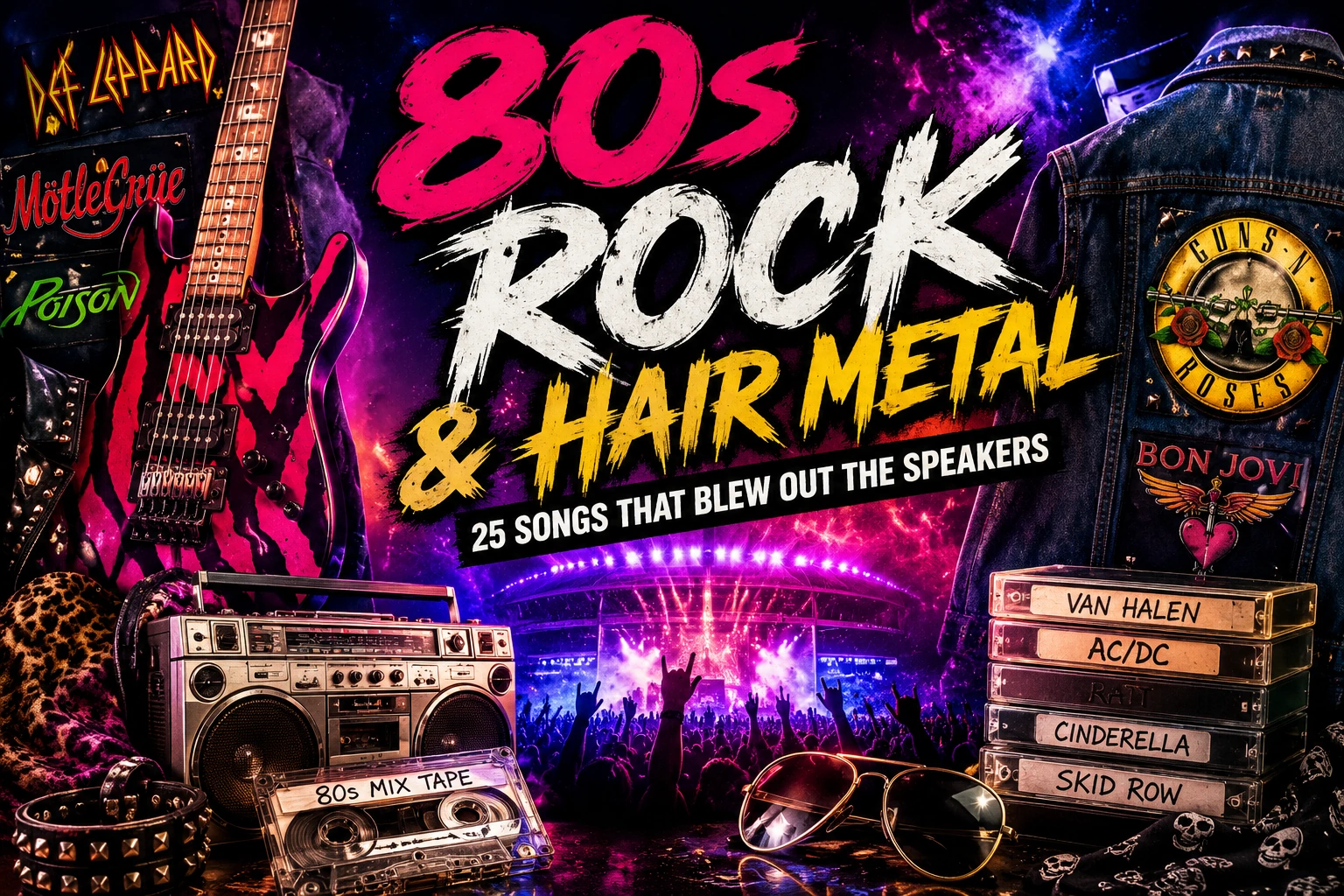
80s rock and hair metal nostalgia collage with guitars, cassette tapes, boombox, neon lights, and arena rock energy

Guitars, leather, smoke machines, and emotional bangs.

AC/DC. Van Halen. Bon Jovi. Def Leppard. Guns N’ Roses. Poison. Ratt. Mötley Crüe. The 80s rock machine was loud, shiny, and absolutely allergic to subtlety.

When Rock Got Bigger Than the Parking Lot

80s rock was not one tidy thing. It was hard rock, arena rock, glam metal, hair metal, pop-metal, bluesy swagger, power ballads, guitar-hero worship, and bands that looked like they had been assembled in a leather factory during a lightning storm. It was AC/DC still punching holes through speakers, Van Halen turning rock into a party sport, Def Leppard polishing guitars into chrome, Bon Jovi making working-class drama sound like a stadium chant, and Guns N’ Roses showing up late in the decade to make everything feel dangerous again.

This was also music built for places. It belonged in parking lots before school, bedroom stereo systems with suspiciously powerful speakers, Camaros, Trans Ams, cassette cases, denim jackets, roller rinks, mall record stores, and arena shows where the lighting rigs looked like NASA had gotten bored. It was music for air guitars, bad decisions, first concerts, older siblings, and that one kid who drew band logos on every notebook like he was being paid.

For the full decade rewind, head back to the 80s Music hub. For the poppier side of the video era, check out 80s Pop & MTV Hits. This page is the louder lane: the songs that made guitar riffs feel like a lifestyle, choruses feel like group therapy, and hair spray feel like a load-bearing structure.

Listen to the 80s Rock & Hair Metal Playlist

Press play and let the guitars, power ballads, parking-lot riffs, arena choruses, and suspiciously aerodynamic hair do what they came here to do. Warning: may cause sudden air guitar, lighter-waving, or the urge to draw band logos on a notebook.

The 25-Song Rock & Hair Metal Hit List

# Song Artist Year Why It Belongs Here
1 You Shook Me All Night Long AC/DC 1980 The decade’s opening riff monster: simple, loud, dirty, and basically impossible to hear quietly.
2 Crazy Train Ozzy Osbourne 1980 Randy Rhoads, Ozzy’s howl, and a riff that made bedroom guitar players dangerous to family peace.
3 Tom Sawyer Rush 1981 Prog rock, synth tension, drum worship, and every serious headphone kid finding a personality.
4 Cum On Feel the Noize Quiet Riot 1983 The moment glam metal kicked down the mainstream door wearing stripes and volume.
5 Photograph Def Leppard 1983 Glossy, hooky, huge, and proof that hard rock could sound built for MTV without losing its guitars.
6 Jump Van Halen 1984 Rock discovered a keyboard hook and somehow got even more ridiculous, in the best possible way.
7 Round and Round Ratt 1984 Pure Sunset Strip sleaze-pop energy, polished just enough for MTV and dangerous enough for parents.
8 We’re Not Gonna Take It Twisted Sister 1984 A rebellion anthem so simple every kid understood it immediately. Especially the ones grounded.
9 Rock You Like a Hurricane Scorpions 1984 Big riff, big chorus, big arena energy, and subtlety thrown directly into a volcano.
10 Home Sweet Home Mötley Crüe 1985 The power ballad blueprint: piano, lighter-waving emotion, and hair metal suddenly developing feelings.
11 Livin’ on a Prayer Bon Jovi 1986 Tommy, Gina, talk box, skyscraper chorus, and every parking lot instantly becoming an arena.
12 The Final Countdown Europe 1986 The synth intro alone could launch a spaceship, a pep rally, or a deeply questionable school assembly.
13 Pour Some Sugar on Me Def Leppard 1987 Glam-metal pop perfection: huge drums, chant chorus, and zero interest in acting respectable.
14 Wanted Dead or Alive Bon Jovi 1987 Cowboy mythology, road-warrior drama, and acoustic intro energy for every bedroom outlaw.
15 Here I Go Again Whitesnake 1987 The song, the video, the hood of the car, the hair. MTV knew exactly what it was doing.
16 Welcome to the Jungle Guns N’ Roses 1987 The late-80s wake-up slap that made rock feel dangerous again.
17 Paradise City Guns N’ Roses 1987 A stadium chant, a street-level sneer, and a chorus that still turns crowds into trouble.
18 Sweet Child o’ Mine Guns N’ Roses 1988 That opening riff, Axl’s voice, Slash’s guitar, and the ballad that did not feel safe.
19 Every Rose Has Its Thorn Poison 1988 The hair-metal heartbreak anthem that made every slow dance smell faintly like Aqua Net.
20 Nothin’ But a Good Time Poison 1988 The mission statement for glam metal: party first, ask accounting questions never.
21 Don’t Know What You Got (Till It’s Gone) Cinderella 1988 A power ballad big enough to require a smoke machine and emotional supervision.
22 18 and Life Skid Row 1988 Late-80s metal drama with grit, melody, and just enough danger to make parents squint.
23 Love Song Tesla 1989 The late-decade power ballad that proved sincerity could still survive the hairspray era.
24 Dr. Feelgood Mötley Crüe 1989 Heavy, slick, sleazy, and the sound of Mötley Crüe hitting their late-80s machine mode.
25 Kickstart My Heart Mötley Crüe 1989 A full-speed adrenaline blast that sounds like a motorcycle crash somehow passed a soundcheck.

The Songs That Made Rock Feel Larger Than Life

#1

“You Shook Me All Night Long” — AC/DC

1980 Songs Hard Rock Staple

AC/DC entered the 80s with a song that did not ask for permission, stretch out dramatically, or pretend to be art-school complicated. “You Shook Me All Night Long” is built like a muscle car: riff, groove, chorus, done. It is rock stripped down to its most durable parts, which is exactly why it still works.

The lifestyle memory is pure early-80s parking lot rock. This was the kind of song that came blasting out of cars before football games, from garage stereos, from older siblings’ rooms, and from cassette decks that had seen things. It did not need MTV gloss to feel huge, though it eventually fit perfectly into the decade’s louder visual language.

For Gen X, AC/DC felt like the older cousin of 80s rock: less makeup, more menace, no patience for nonsense. While hair metal would later arrive with scarves, lipstick, and questionable pants, AC/DC kept the engine running with a riff that could cut through any room.

“You Shook Me All Night Long” belongs at the front because it shows the foundation. Before the decade got shinier, louder, and more theatrical, rock still needed the basics: a killer guitar part, a chorus everybody could yell, and enough attitude to make the neighbors consider moving.

#2

“Crazy Train” — Ozzy Osbourne

1980 Songs Metal Gateway

“Crazy Train” is one of those songs that made kids pick up guitars and made parents immediately regret buying those guitars. Randy Rhoads’ riff had the perfect mix of classical precision and full teenage danger, while Ozzy sounded like he had wandered out of a haunted carnival with very specific opinions.

The song lived in bedrooms, basements, Walkmans, and the private fantasy life of every kid who suddenly believed they could become a guitar hero if they just practiced enough and maybe grew their hair past school policy. It was not as glossy as later MTV metal, but it had something better: danger that felt real.

“Crazy Train” also helped define the idea of heavy music as a personality choice. You did not just like Ozzy. You announced something about yourself by liking Ozzy. Maybe you were the kid with the denim jacket. Maybe you were the kid drawing band logos. Maybe you were the kid who scared substitute teachers by accident.

This is the early-80s metal gateway: theatrical, heavy, melodic, and instantly recognizable. It helped set the table for a decade where rock would become louder, more technical, more visual, and far more likely to involve fire.

#3

“Tom Sawyer” — Rush

1981 Songs Headphone Rock

“Tom Sawyer” is not hair metal, but it absolutely belongs in the 80s rock conversation because it gave the decade one of its most iconic serious-kid rock anthems. Rush made music for people who liked riffs, lyrics, synthesizers, complicated drum parts, and possibly explaining things no one asked about.

The lifestyle memory here is headphones, record collections, older brothers, basement stereos, and that one kid who could air-drum Neil Peart fills on a desk until the teacher considered early retirement. Rush fans did not merely listen. They studied. They analyzed. They made everyone else feel like we were failing a class we did not know existed.

In the early 80s, “Tom Sawyer” bridged old-school album rock and the more synthetic future. It had a muscular riff, but it also had icy keyboard textures and a clean, modern production feel. It sounded like rock had put on a lab coat without giving up the drums.

This song matters because 80s rock was not only party anthems and glam-metal chaos. It also had a brainy, precise, headphone-heavy lane for kids who wanted their rock to feel larger, stranger, and slightly more difficult than whatever was playing at the school dance.

#4

“Cum On Feel the Noize” — Quiet Riot

1983 Songs 1983 #1 Hits Video Glam Metal Breakout

Quiet Riot made hair metal feel like it had officially broken into the mainstream and started rearranging the furniture. “Cum On Feel the Noize” was loud, dumb in the correct way, chant-ready, and perfectly built for a generation discovering that rock could be both heavy and cartoonishly fun.

This song lived in the space between metal and party music. It was not trying to be mysterious. It was not trying to be subtle. It wanted volume, crowd participation, and possibly a striped outfit that would get you questioned at school. The whole thing felt like a dare being yelled from a stage.

The lifestyle around it was early MTV metal: big hair, bright lights, bedroom posters, cassette tapes, and that feeling that rock stars were becoming comic-book characters with better amps. Quiet Riot helped prove there was a mass audience for loud, flashy, hook-filled metal that parents could complain about by name.

“Cum On Feel the Noize” belongs here because it opened a door. After this, labels, video channels, and teenage boys with questionable grooming habits all understood that glam metal could sell. The floodgates were open, and the hairspray was not far behind.

#5

“Photograph” — Def Leppard

1983 Songs 1983 #1 Hits Video MTV Rock Polish

“Photograph” is where hard rock started sounding engineered for the video era without losing its bite. Def Leppard brought guitars, huge hooks, stacked vocals, and a production shine that made the song feel like it had been buffed with chrome.

This was rock for MTV and FM radio at the same time. It had the riffs for the rock crowd, the chorus for pop listeners, and the visual style for kids watching videos after school. Def Leppard understood that the 80s wanted rock to sound massive but also clean enough to survive heavy rotation.

The lifestyle memory is cassette-store browsing, posters, denim jackets, and kids learning that rock could feel sleek instead of grimy. “Photograph” sounded expensive, and that mattered in a decade where production values became part of the fantasy.

This song helped define the glossy hard-rock lane that would dominate the middle of the decade. It was not punk. It was not metal in the scary-basement sense. It was arena-ready, hook-loaded, and built for speakers bigger than your family’s television.

#6

“Jump” — Van Halen

1984 Songs 1984 #1 Hits Video Synth-Rock Crossover

Van Halen adding a huge keyboard hook should have been a disaster, or at least a reason for guitar purists to clutch their denim. Instead, “Jump” became one of the decade’s defining rock-pop explosions. It sounded bright, cocky, ridiculous, and completely unstoppable.

The lifestyle memory is gym class, sports highlights, car stereos, MTV afternoons, and the dangerous belief that you too could jump off furniture if the chorus hit hard enough. David Lee Roth made the song feel like a dare, and Eddie Van Halen made the keyboard feel like a guitar had briefly learned a new language.

“Jump” mattered because it showed how flexible 80s rock could be. A band could bring in synths, go brighter, become poppier, and still feel like a party no responsible adult should supervise. The song did not soften Van Halen. It just made them even more unavoidable.

It belongs on this list because it captures rock at its most athletic and absurdly confident. No brooding, no subtle tension, no tortured poetry. Just a giant hook, a giant grin, and the sense that gravity was optional if your pants were tight enough.

#7

“Round and Round” — Ratt

1984 Songs Sunset Strip Sleaze

“Round and Round” is pure mid-80s glam-metal machinery: a nasty little guitar hook, a polished chorus, a sneering vocal, and enough visual attitude to make MTV viewers understand immediately that this was not their parents’ rock.

The lifestyle memory is Sunset Strip fantasy filtered through suburban bedrooms. Most kids were nowhere near Los Angeles, but videos like this made the whole scene feel accessible: leather, lights, club posters, teasing combs, and guys who looked like they had been professionally assembled out of scarves and bad intentions.

Ratt helped define the exact middle lane of hair metal: catchy enough for radio, edgy enough for rock fans, visual enough for MTV, and suggestive enough for parents to hate without fully understanding the lyrics. That last part was a major 80s marketing advantage.

“Round and Round” belongs here because it is one of the songs that made glam metal feel like a scene, not just a sound. It was loud, stylish, cocky, and committed to making every bedroom air guitarist believe they were one leather jacket away from fame.

#8

“We’re Not Gonna Take It” — Twisted Sister

1984 Songs Teen Rebellion Anthem

Twisted Sister gave the decade one of its easiest, loudest, most universal rebellion chants. “We’re Not Gonna Take It” did not require interpretation. You heard the title, understood the mission, and immediately wanted to yell it at someone with authority, preferably from a safe distance.

This song was practically built for kids who were grounded, bored, over-parented, under-listened-to, or just annoyed that adults kept acting like homework was a personality-building exercise. It turned adolescent frustration into a cartoon riot with guitars.

The video made the whole thing even bigger. Dee Snider became a full MTV character: part rock singer, part comic-book villain, part teenage wish fulfillment. Parents saw chaos. Kids saw justice. The truth was probably somewhere in between, wearing makeup.

“We’re Not Gonna Take It” belongs here because it shows how theatrical 80s rock could get while staying instantly relatable. It was rebellion without a manifesto. Just volume, attitude, and the kind of chorus every kid could understand before being sent to their room.

#9

“Rock You Like a Hurricane” — Scorpions

1984 Songs Arena Metal Energy

Some songs announce themselves. “Rock You Like a Hurricane” kicks the door in, knocks over the furniture, and asks why the speakers are not louder. The riff is enormous, the chorus is ridiculous, and the whole thing sounds designed for dry ice and bad decisions.

The lifestyle memory is arena rock at maximum voltage: concert shirts, guitar posters, cassette decks, car stereos, and that kid in school who treated every Scorpions logo like sacred text. It was the kind of song that made even normal errands feel like you were pulling into a parking lot in slow motion.

Scorpions brought a European hard-rock punch that fit perfectly into the American MTV moment. Big sound, big image, big chorus, zero apologies. It was not subtle because subtle songs did not survive in rooms full of teenagers and cheap speakers.

This song belongs here because it captures the glorious overstatement of 80s rock. Everything is turned up. The vocals, the guitars, the attitude, the metaphor. A hurricane? Sure. Why not. The decade was not exactly known for measured comparisons.

#10

“Home Sweet Home” — Mötley Crüe

1985 Songs Power Ballad Blueprint

“Home Sweet Home” helped teach hair metal that it could put down the party bottle for five minutes, sit at a piano, and still get the crowd to scream. It is one of the songs that made the power ballad a required part of the rock-band survival kit.

The lifestyle memory is lighter-in-the-air emotion before phones ruined everything by replacing fire with rectangles. This was the song that made the toughest-looking bands suddenly seem vulnerable, though usually still wearing leather and enough hair product to waterproof a garage.

For fans, it created a different kind of connection. Not every rock song had to be about partying, danger, or speed. Some could be about loneliness, touring, missing home, and the weird emotional cost of living the fantasy everyone else wanted.

“Home Sweet Home” belongs here because it helped make the power ballad central to hair metal. After this, nearly every band needed its emotional moment. The formula was set: piano intro, vulnerable vocal, giant chorus, guitar solo, crowd sobbing responsibly.

#11

“Livin’ on a Prayer” — Bon Jovi

1986 Songs 1986 #1 Songs Video Pop-Metal Anthem

“Livin’ on a Prayer” is what happened when rock, pop, working-class drama, and skyscraper hair all signed the same record deal. It was huge on radio, huge on MTV, and huge in every car where someone thought they could hit the chorus. They could not.

The lifestyle connection is massive. This was denim jackets, school dances, Camaro dreams, bedroom air-guitar concerts, and kids who had never paid rent screaming about Tommy and Gina like they were personally invested in their financial future.

Bon Jovi made arena rock feel like pop without sanding off all the guitar drama. The talk box, the bassline, the chorus, the video energy — it all worked together to make ordinary struggle sound heroic. Your town might have been boring, but this song made it feel like a movie trailer.

It belongs here because it crossed every boundary. Rock fans claimed it. Pop radio played it. MTV loved it. School dances survived it. Wedding receptions still risk it. “Livin’ on a Prayer” is not just a song; it is a public shouting exercise with emotional backstory.

#12

“The Final Countdown” — Europe

1986 Songs 1986 #1 Songs Video Synth-Arena Drama

“The Final Countdown” begins like a spaceship, a wrestling entrance, a school pep rally, and a budget science-fiction movie all collided in a keyboard store. That intro is so enormous it almost makes the rest of the song feel like paperwork.

The lifestyle memory is pure mid-80s spectacle. This was music for assemblies, sports montages, skating rinks, arena intros, and any moment that needed to feel important even when absolutely nothing important was happening. The song could make walking into a cafeteria feel like a mission launch.

Europe leaned into the theatrical side of 80s rock. Big hair, big keyboard hook, big chorus, big drama. It was not gritty. It was not street-level. It sounded like someone put eyeliner on a rocket.

It belongs here because 80s rock was not only guitars. It was spectacle. “The Final Countdown” is ridiculous, unforgettable, and permanently useful anytime humans want to make an ordinary event sound wildly overproduced.

#13

“Pour Some Sugar on Me” — Def Leppard

1987 Songs 1987 #1 Hits Video Glam-Metal Pop Perfection

“Pour Some Sugar on Me” is one of the most efficient machines 80s rock ever built. The drums are enormous, the chant is immediate, the guitars are glossy, and the whole thing sounds like it was engineered to make arenas clap in unison.

This song lived everywhere: MTV, rock radio, parties, cars, dances, and every place where people wanted to feel rowdy without fully committing to danger. It was sleazy enough for rock fans, pop enough for the charts, and polished enough to sound expensive.

Def Leppard mastered the art of making hard rock feel like a pop event. Nothing sounded accidental. Every hook was stacked, every drum hit sounded like it had been inflated, and every chorus landed like a commercial for trouble.

It belongs here because it is hair metal’s glossy peak: catchy, loud, shameless, and absurdly durable. This is the sound of a decade that looked at restraint, laughed, and asked for more backing vocals.

#14

“Wanted Dead or Alive” — Bon Jovi

1987 Songs 1987 #1 Hits Video Cowboy Rock Myth

Bon Jovi turned touring musicians into modern cowboys, which is objectively ridiculous and somehow completely effective. “Wanted Dead or Alive” gave 80s rock one of its great myth-making songs: acoustic intro, road-weary drama, and a chorus built for thousands of raised fists.

The lifestyle memory is every kid imagining themselves as a lone outlaw while sitting in a bedroom full of school books, laundry, and a clock radio. The song made rock stardom feel cinematic, lonely, rugged, and way cooler than anyone’s actual after-school routine.

It also helped show that Bon Jovi could do more than giant party-rock choruses. They could slow things down, add atmosphere, and still make it feel huge. The band understood that rock fans wanted fantasy, and the cowboy angle gave them a whole new costume rack.

“Wanted Dead or Alive” belongs here because it captures the storytelling side of 80s arena rock. It was not just about volume. It was about building a legend big enough for MTV, radio, tour shirts, and every teenager who thought a leather jacket counted as a life plan.

#15

“Here I Go Again” — Whitesnake

“Here I Go Again” was already a strong rock song, but MTV made it immortal. The video, the car, the hair, the lighting, the drama — it all became part of the song’s identity. You cannot separate the chorus from the visual memory even if you try.

The lifestyle memory is late-80s rock at its glossiest: bedroom posters, video countdowns, radio dedications, and the feeling that every chorus needed to be sung with one hand dramatically reaching toward nothing. It was romantic, lonely, confident, and totally over-the-top.

Whitesnake hit the perfect balance between hard rock and pop accessibility. The guitars had bite, the chorus was huge, and the production was polished enough to glide right into heavy rotation. It sounded like heartbreak wearing leather pants.

It belongs here because it shows MTV’s power at full strength. A song could become bigger because the video gave it a permanent visual hook. In this case, that hook involved a car hood, which somehow became one of the decade’s most famous stages.

#16

“Welcome to the Jungle” — Guns N’ Roses

1987 Songs Danger Returns

By the late 80s, some rock had gotten so polished it practically needed a showroom. Then Guns N’ Roses arrived looking like trouble, sounding like trouble, and making trouble feel interesting again. “Welcome to the Jungle” was not shiny. It was sweaty, hostile, and alive.

The lifestyle memory is older kids, late-night MTV, warning labels, record-store danger, and the feeling that this band was not playing dress-up. They looked like they had actually slept in the bad decisions everyone else was singing about.

The song hit differently because it carried menace. The guitars snarled, Axl sounded unhinged in a way that did not feel focus-grouped, and the whole thing had a street-level energy that cut through the decade’s glossy excess.

“Welcome to the Jungle” belongs here because it signaled a shift. Hair metal was still huge, but Guns N’ Roses made rock feel dirtier, sharper, and less safe. The party was still happening, but now someone had kicked open the back door.

#17

“Paradise City” — Guns N’ Roses

1987 Songs Stadium Chaos

“Paradise City” starts like a singalong and ends like someone cut the brakes. It has one of the most famous choruses in 80s rock, but it also carries the same chaotic edge that made Guns N’ Roses feel different from the cleaner glam-metal machine around them.

The lifestyle memory is pure late-80s teenage electricity: cassette cases, band shirts, crowded bedrooms, school parking lots, and the sense that this band was not trying to be everybody’s favorite. Which, of course, made them everybody’s favorite.

The song works because it blends crowd-chant simplicity with genuine danger. It gives you the big chorus first, then drags you into a sprint. That push-pull is exactly what made Guns N’ Roses so powerful at the end of the decade.

“Paradise City” belongs here because it bridges arena scale and street-level attitude. It could fill a stadium, but it still sounded like something your parents would prefer you not bring into the house.

#18

“Sweet Child o’ Mine” — Guns N’ Roses

1988 Songs 1988 #1 Hits Video Dangerous Ballad

That opening riff is one of the most recognizable guitar lines of the decade. “Sweet Child o’ Mine” gave Guns N’ Roses a massive hit without making them feel safe. It was melodic, emotional, and still rough around the edges.

The lifestyle memory is every aspiring guitarist trying the intro, failing, trying again, and then acting like the amp was the problem. It was also one of those rare rock songs that could cross over into pop spaces without losing the band’s dangerous aura.

The song’s power comes from contrast. It starts almost delicate, turns romantic, then builds toward something heavier and stranger. Axl sounded vulnerable and volatile at the same time, which was basically the band’s entire brand.

It belongs here because it showed that a rock ballad did not have to be polished into sentimental mush. It could still have teeth. “Sweet Child o’ Mine” was emotional, but it did not feel domesticated. Very important distinction when your band looks like it might steal the catering van.

#19

“Every Rose Has Its Thorn” — Poison

1988 Songs 1988 #1 Hits Video Hair-Metal Heartbreak

Poison’s “Every Rose Has Its Thorn” is hair metal sitting alone with an acoustic guitar and pretending it did not just spend the last three years partying in ripped clothing. It became one of the definitive power ballads of the decade because it was simple, emotional, and impossible to avoid.

The lifestyle memory is school dances, radio dedications, heartbreak before texting, and the very specific teenage belief that nobody had ever suffered romantically as deeply as you had after two weeks of dating someone from another homeroom.

Poison understood the emotional economy of hair metal. You needed the party songs, but you also needed the slow one. The one that made fans wave lighters, buy the cassette, and believe the band had layers beneath the glitter and bandanas.

It belongs here because it captures the soft-focus heartbreak side of the scene. Hair metal could be ridiculous, yes. But sometimes ridiculous people have feelings too, and apparently those feelings come with twelve-string guitars.

#20

“Nothin’ But a Good Time” — Poison

1988 Songs Party Metal

If hair metal had a mission statement printed on a sleeveless shirt, it would probably be “Nothin’ But a Good Time.” Poison turned the party anthem into a lifestyle brand: loud guitars, bright colors, huge smiles, and absolutely no interest in long-term planning.

The lifestyle memory is weekend freedom, fast food jobs, school-week survival, and that fantasy of clocking out from ordinary life into something louder. It was music for kids who wanted Friday night to feel like a music video, even if the actual plan was sitting in a friend’s basement eating chips.

Poison’s genius was accessibility. They made glam metal feel fun, colorful, and approachable. Dangerous? Maybe in a cartoon way. But mostly they made rock feel like a party everyone could understand.

It belongs here because not every 80s rock song needed darkness or depth. Some needed a chorus, a grin, and enough energy to make responsibility sound like a scam adults invented to ruin everything.

#21

“Don’t Know What You Got (Till It’s Gone)” — Cinderella

1988 Songs Big Ballad Drama

Cinderella brought a bluesier, rougher edge to the hair-metal world, but “Don’t Know What You Got” gave them a massive emotional spotlight. This is power ballad architecture at full scale: piano, regret, big chorus, guitar solo, and enough fog-machine sadness to fill an arena.

The lifestyle memory is late-80s heartbreak in slow motion. This was the kind of song that made teenagers stare out windows dramatically, even if the view was just a driveway and a trash can. It gave emotional weight to romantic disappointment before everyone had social media to make it worse.

Cinderella made the ballad feel less plastic than some of their peers. Tom Keifer’s raspy voice gave the song grit, which helped keep it from floating away into pure prom-night mist.

It belongs here because the 80s power ballad became a major rock institution, and this is one of the biggest examples. Loud bands needed soft songs. Soft songs needed giant choruses. Giant choruses needed dry ice. The system worked.

#22

“18 and Life” — Skid Row

1988 Songs Late-80s Metal Drama

Skid Row showed up near the end of the decade with more grit than gloss, and “18 and Life” gave them a dramatic hard-rock story song that felt heavier than the average party-metal anthem. It had melody, danger, and a sense of consequence.

The lifestyle memory is late-80s metal shifting toward something rougher. The hair was still there, obviously. Nobody was turning in their teasing combs yet. But the mood was darker, the guitars felt heavier, and the teen rebellion angle felt less cartoonish.

Sebastian Bach’s voice gave the song its punch. It was big enough for MTV but intense enough to feel like the band meant it. That mattered at a time when some of the scene had started to feel a little too polished for its own leather boots.

“18 and Life” belongs here because it captures the end-of-decade transition. Hair metal was still ruling, but heavier, grittier sounds were creeping in. The party was not over yet, but somebody had definitely dimmed the lights.

#23

“Love Song” — Tesla

1989 Songs 1989 #1 Songs Video Earnest Rock Ballad

Tesla’s “Love Song” arrived at the end of the decade with a more grounded feel than some of the era’s glossier power ballads. It still had the big emotional arc, but it felt a little more sincere, a little less dressed for a video shoot in a wind tunnel.

The lifestyle memory is late-80s rock fans aging into slightly more complicated feelings. The party songs were still around, but songs like this gave the scene a reflective side. It was still arena rock, but with fewer cartoon edges.

Tesla always felt a little more denim than spandex, and “Love Song” benefits from that. It has the emotional weight of a power ballad without sounding like it was built entirely from studio gloss and romantic fog.

It belongs here because it shows the softer end of 80s rock maturing right before the decade closed. The hair was still there, but the sincerity was getting harder to dismiss. Annoying, because sincerity always makes jokes less convenient.

#24

“Dr. Feelgood” — Mötley Crüe

“Dr. Feelgood” is Mötley Crüe at their late-80s machine peak: heavy, slick, sleazy, and locked into a groove that sounds like trouble got a studio budget. It is darker and harder than much of the glam-metal party lane, but still completely built for the MTV era.

The lifestyle memory is late-decade rock becoming heavier and more expensive at the same time. The production is massive, the guitars hit harder, and the band’s image feels less like goofy excess and more like polished danger.

Mötley Crüe had always sold chaos, but this song made the chaos sound controlled. That was the trick. The band looked like a warning label, but the record sounded tight enough to survive mainstream radio and heavy rotation.

It belongs here because it represents hair metal’s late peak before the 90s started sharpening knives. “Dr. Feelgood” sounds like the scene at maximum power: louder, darker, richer, and probably still a bad influence.

#25

“Kickstart My Heart” — Mötley Crüe

“Kickstart My Heart” is not subtle, calm, safe, or interested in your indoor voice. It is pure adrenaline, from the revving intro to the full-speed chorus. Mötley Crüe made a song that sounds like a motorcycle, an ambulance, and a bad idea all leaving the driveway at once.

The lifestyle memory is late-80s excess hitting the redline. This was music for driving too fast in your imagination, for workouts nobody completed, for videos full of motion, and for anyone who thought danger sounded better with a guitar solo.

It also works as a closing statement for the decade’s rock explosion. By 1989, everything was bigger: the drums, the videos, the tours, the production, the hair, the scandals, the choruses, and the consequences.

“Kickstart My Heart” belongs here because it sounds like the 80s trying to outrun the 90s. For a few more minutes, the amps are still blazing, the lights are still on, and nobody has heard the word grunge ruin the party yet.

Why 80s Rock & Hair Metal Still Hits

80s rock worked because it understood scale. The songs were not built for quiet rooms. They were built for arenas, cars, school gyms, MTV countdowns, cassette decks, and bedrooms where kids played air guitar with the seriousness of a medical procedure. Even the ballads were huge. Especially the ballads.

Hair metal gets mocked because it was ridiculous, and fair enough, because some of it looked like a pirate ship crashed into a beauty salon. But the reason the music lasted is simple: the hooks were massive. The choruses were built for groups. The videos were unforgettable. The bands knew how to sell fantasy, rebellion, heartbreak, danger, and Friday night freedom in four minutes or less.

This lane is essential inside the 80s Music hub because you cannot tell the story of the decade without the guitars. Pop had MTV. New wave had synths. Hip-hop was breaking through. But rock and hair metal gave the decade its volume knob, its parking lot soundtrack, and its most aggressively teased silhouette.

The 80s Turned Rock Into a Stadium-Sized Lifestyle

These songs were not just background music. They were concert shirts, cassette tapes, school parking lots, bedroom posters, air-guitar injuries, slow-dance heartbreak, MTV countdowns, and proof that a guitar solo could make an entire decade throw up devil horns before dinner.

Get the Weekly Gen X Drop

New videos, rewinds, and savage nostalgia — first.

JOIN THE NEWSLETTER WATCH VIDEOS

MORE REWINDS