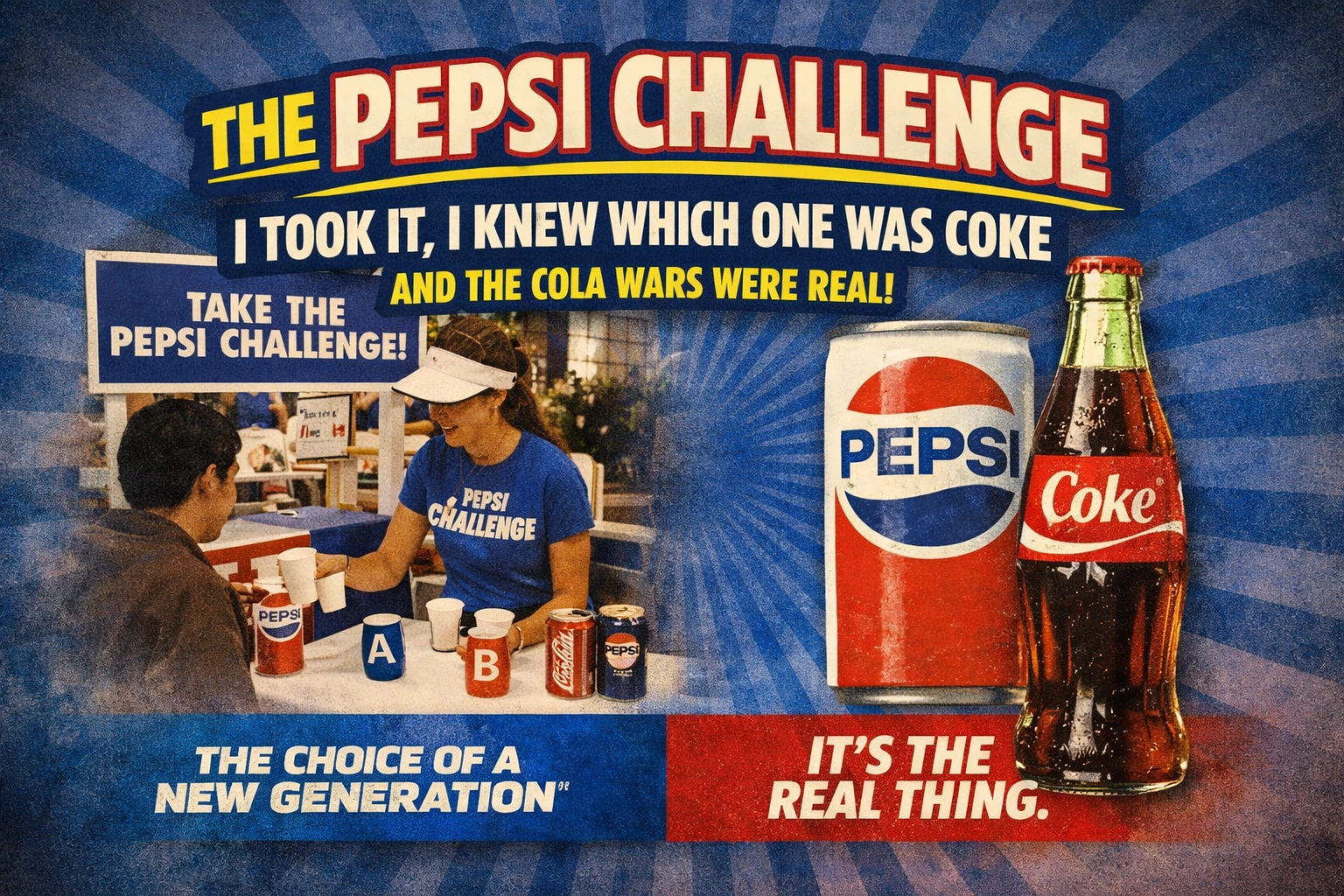
The 1982 Pepsi Challenge Commercial How Blind Taste Tests Fueled the Cola Wars
The 1982 Pepsi Challenge commercial did not merely claim Pepsi tasted better. It showed ordinary people taking a blind Coke-vs.-Pepsi taste test, choosing a cup and discovering whether their taste buds agreed with the brand name they thought they preferred.
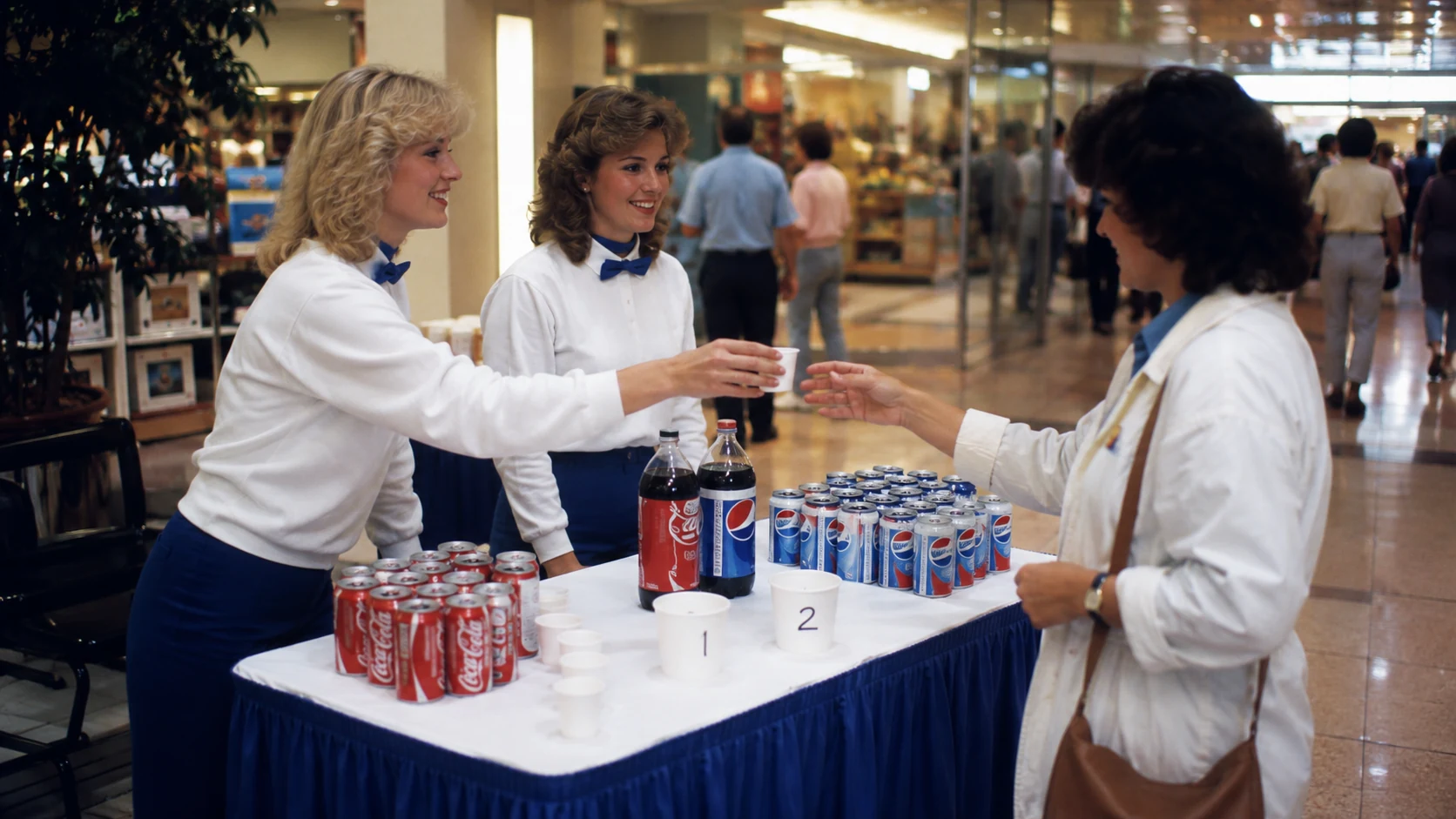
By then, the Pepsi Challenge had already escaped television. Folding tables, anonymous paper cups and public reveals had appeared in malls, stores and shopping centers for years. The campaign made the Cola Wars feel less like corporate advertising and more like a dare anybody could walk up and take.
I took it. I knew which cup was Coke. And the reveal was still fun because the real attraction was never just the soda—it was getting drafted into America’s loudest brand argument.
Let Your Taste Decide
What Was the Pepsi Challenge?
The Pepsi Challenge was a blind taste-test campaign launched in 1975. Participants sampled Pepsi and Coca-Cola from unmarked cups, selected the drink they preferred and then watched the brands be revealed. Television commercials—including the featured 1982 spot—used those reactions to argue that people often preferred Pepsi when the labels were removed.
How the Pepsi Challenge Became Bigger Than One Commercial
Pepsi launched the Pepsi Challenge in 1975, when Coca-Cola was still the unquestioned category leader. The campaign gave the challenger brand a simple way to attack that position without needing a complicated speech: remove the labels, let people taste both drinks and make the result the advertisement.
That format was unusually strong because the demonstration looked fair. Pepsi did not appear to be asking viewers to trust an actor or accept a slogan. It appeared to be handing the decision to regular people. The little paper cups gave the commercial the atmosphere of a public experiment, even though Pepsi controlled the campaign, the editing and the presentation of its results.
By 1982, the idea was already familiar. The Pepsi Challenge commercial no longer had to explain why Coke and Pepsi were being poured into anonymous cups. Viewers understood the ritual: taste, choose, reveal, react. That familiarity made every new participant another episode in the same national argument.
The Challenge belongs to a broader line of advertising built around a public event. The Miller Lite “Tastes Great, Less Filling” campaign gave people an argument to perform; Pepsi gave them a test to take. In both cases, the audience could carry the campaign into real life without needing the television to keep running.
How the Coke-vs.-Pepsi Blind Taste Test Worked
The public version of the Pepsi Challenge was designed to be understood from across a mall corridor. A table, two small cups and a person ready to explain the rules were enough. The setup looked almost aggressively simple, which made the result feel personal: you picked the winner with your own mouth.
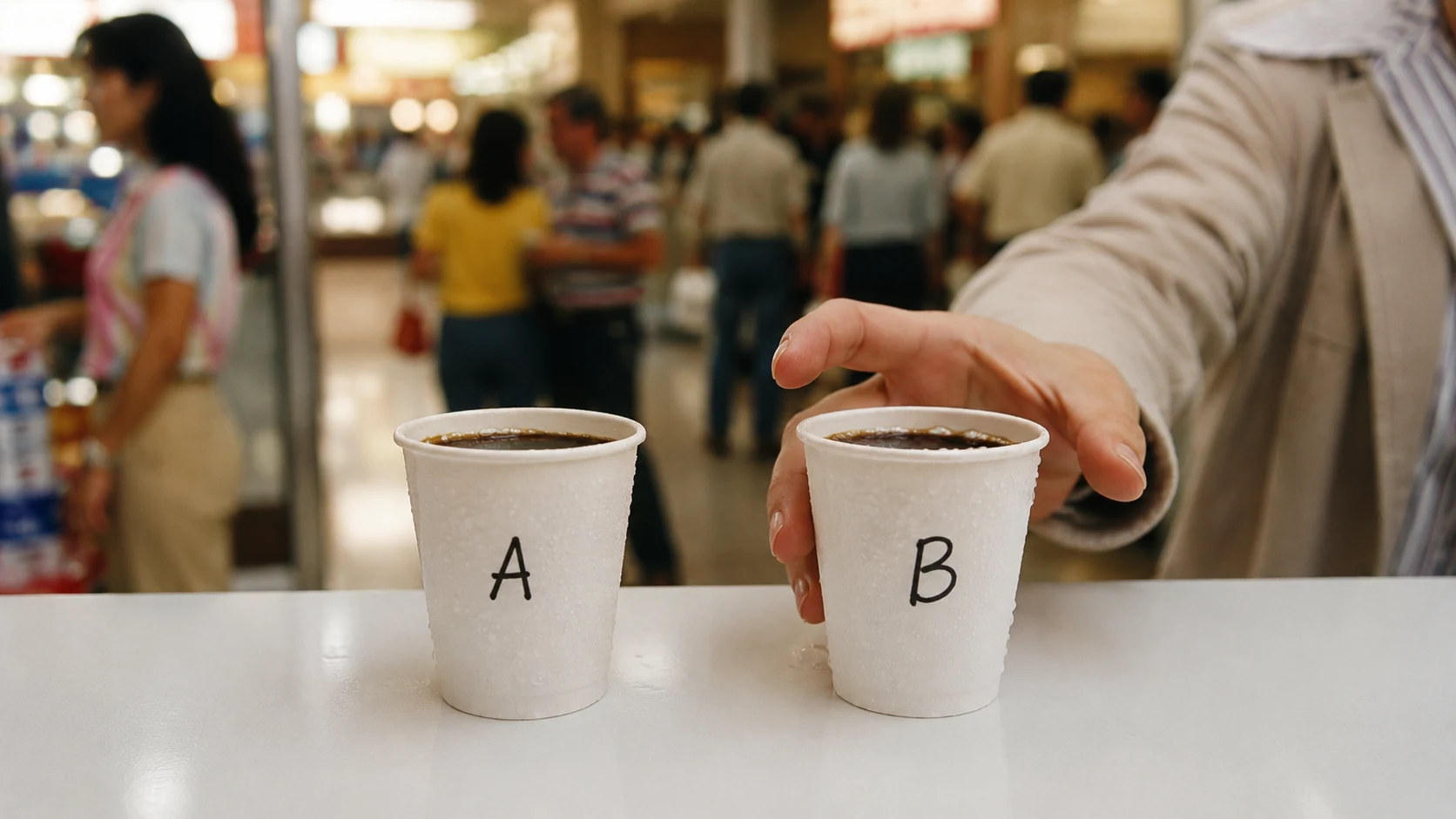
Hide the labels
Pepsi and Coke were poured into plain or coded cups so the participant could not choose by branding.
Take small sips
The participant sampled each cola in quick succession instead of drinking a full can or bottle.
Pick a favorite
The choice was based on immediate taste preference, without packaging or brand identity in view.
Reveal the brands
The covers came off, the reaction became the payoff and Pepsi turned the surprise into advertising.
What the test measured well
It measured immediate preference between two small, unlabeled samples. That made it a powerful demonstration of first-sip taste without brand expectations interfering.
What the test could not measure
It did not capture the experience of finishing a full serving, buying habits, packaging, family tradition or the emotional attachment people carried toward Coca-Cola and Pepsi.
That distinction became enormously important during the New Coke story. Taste tests could show which formula people preferred in a controlled sip, but they could not fully measure what the original Coca-Cola meant to consumers who had lived with the brand for decades.
Why the 1982 Pepsi Challenge Commercial Worked
The 1982 commercial uses a format that already feels proven. It does not need a fantasy world, a mascot or a celebrity performance. The suspense comes from ordinary people making a choice and waiting for the labels to appear.
It made comparison advertising feel like entertainment
Comparative advertising can become dry fast. The Pepsi Challenge avoided that problem by turning comparison into suspense. The brand was not presenting a chart. It was waiting for somebody to point at a cup.
The approach was nearly the opposite of the cinematic mystery used by Apple’s “1984” Macintosh commercial. Apple barely explained the product; Pepsi made the product comparison the entire show. Both became memorable because the format was impossible to confuse with an ordinary commercial.
I Took the Pepsi Challenge—and I Knew Which Cup Was Coke
The campaign’s mythology depends on the reveal being a shock. My memory is less dramatic. I already preferred Coke, and the two drinks did not taste identical to me. In my own experience, Coke came across as sweeter while Pepsi had a sharper bite, so the anonymous cups never felt completely anonymous.
I did not walk away converted. I walked away feeling like I had just taken part in the Cola Wars.
The fun was not discovering an objective winner. It was standing at the table, making the choice and seeing whether your taste matched the brand loyalty you carried into the test.
That experience is one reason the Pepsi Challenge remains unusually vivid. Most advertising memories are secondhand: we remember what appeared on television. This one could become a personal story. People remember where they took it, what they chose and whether the reveal confirmed or embarrassed them.
The campaign was smart enough to benefit from every answer. Picking Pepsi gave the brand a victory story. Picking Coke still meant stopping, tasting Pepsi and participating in a Pepsi-controlled event. Even losing a cup occasionally kept the brand at the center of the conversation.
Did the Pepsi Challenge Help Cause New Coke?
The careful answer is yes—but not by itself. Pepsi’s blind taste tests became one of the clearest public symbols of Coca-Cola’s competitive problem in the late 1970s and early 1980s. Coca-Cola’s own research also found consumers often preferred sweeter formulas in blind tests, adding pressure to rethink the flagship drink.
In April 1985, Coca-Cola replaced its original formula with a sweeter reformulation that became known as New Coke. The company had extensive taste-test data supporting the new drink, but the launch exposed something the sip tests had failed to measure: consumers were emotionally attached to the original Coca-Cola as a symbol, habit and piece of personal history.
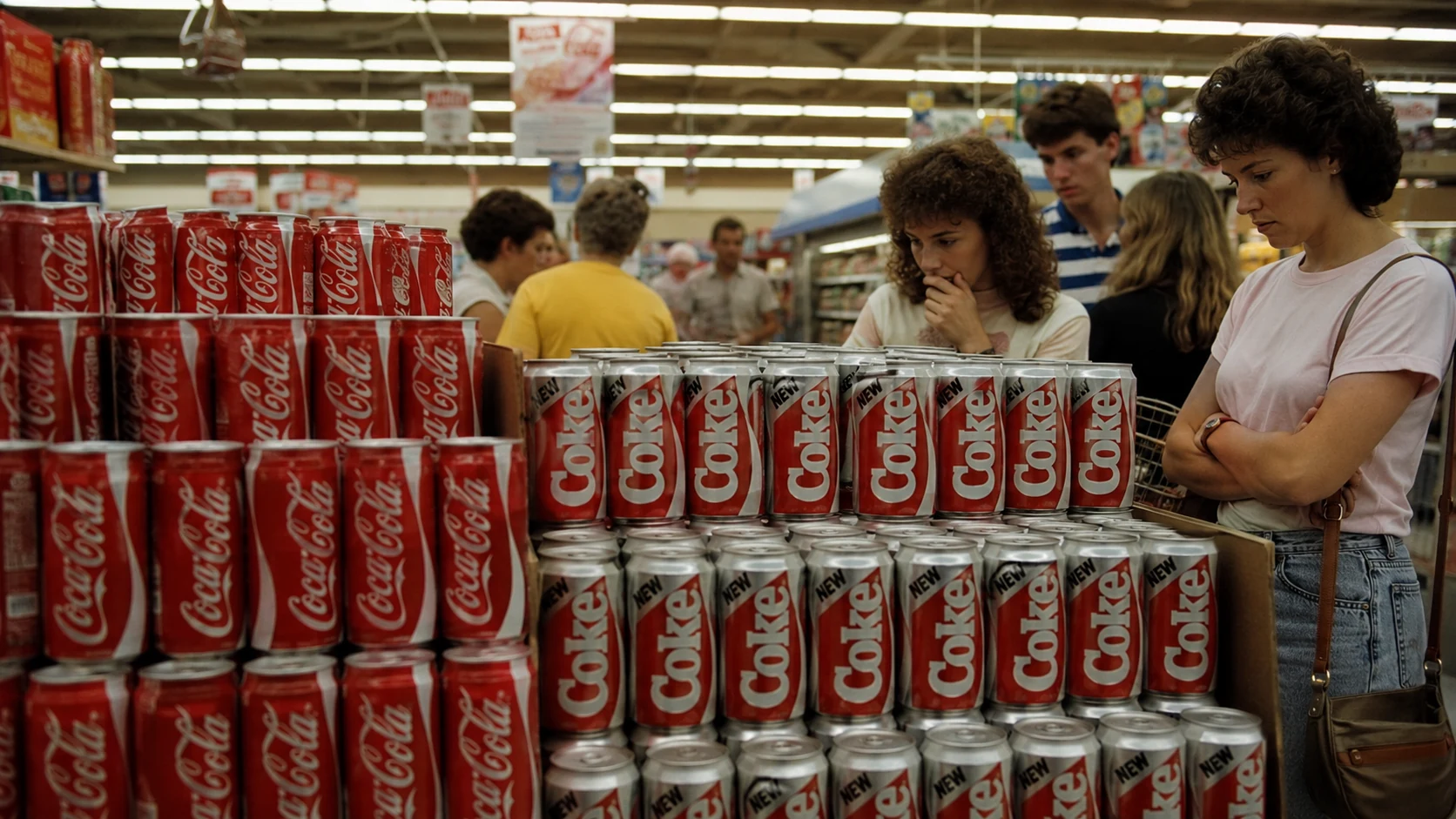
Pepsi framed the problem
Repeated public taste-test wins made Coca-Cola appear vulnerable on the most basic product question: taste.
Coke trusted test data
Coca-Cola developed a sweeter formula that performed strongly in extensive blind consumer testing.
Brand loyalty changed the result
Consumers reacted not only to flavor but to the loss of the original drink and everything it represented.
The original formula returned as Coca-Cola Classic after only 79 days. The full story is explored in the rise, backlash and strange legacy of New Coke in 1985. The episode did not prove taste testing was useless. It proved taste was only one part of why people chose a cola.
Coca-Cola had spent decades building emotional territory, including landmark work such as the 1971 “I’d Like to Buy the World a Coke” commercial. Pepsi’s test could temporarily remove that history from the cup. Coca-Cola could not remove it from the consumer.
Pepsi Was Selling Challenger Energy, Not Just Cola
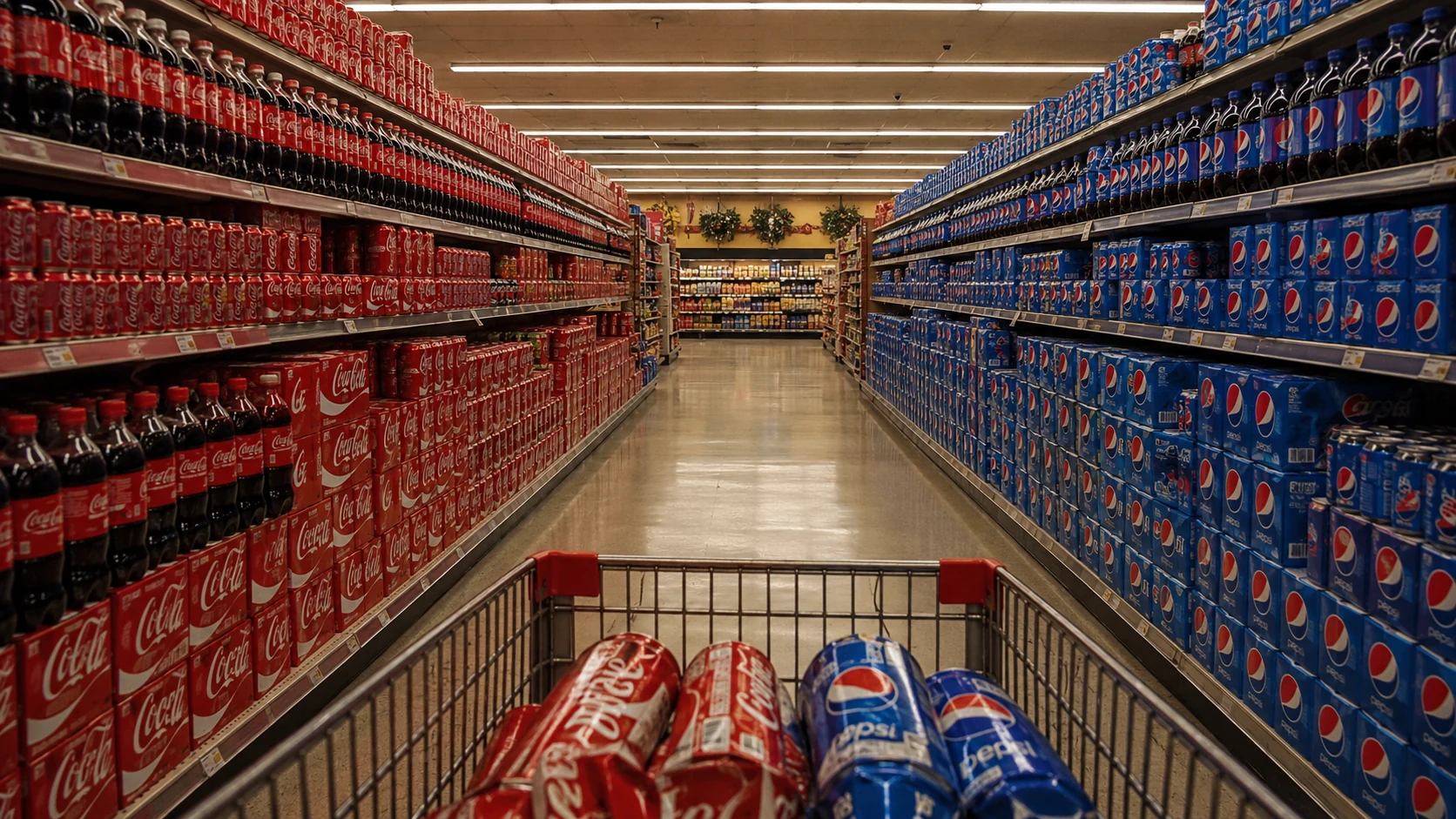
The Pepsi Challenge presented Coke as the established answer and Pepsi as the brand willing to question it. That role was valuable even beyond the individual taste-test result. Pepsi looked younger, less reverent and more comfortable turning the market leader into an opponent.
Coke represented the default
Coca-Cola carried history, familiarity and enormous cultural weight. It did not need to explain why it belonged at the center of American soda culture.
Pepsi represented the challenge
Pepsi benefited from asking consumers to reconsider the default. The test made choosing Pepsi feel like discovering something for yourself rather than following tradition.
That identity became even more visible when Pepsi moved from sampling tables to entertainment spectacle. The Michael Jackson Pepsi campaign in 1984 tied the brand to pop music, youth and MTV-era scale. The Pepsi Challenge had already prepared the ground by teaching consumers to see Pepsi as the energetic rival willing to confront Coke directly.
The campaign also shows why some 80s advertising became permanent cultural shorthand. Wendy’s had “Where’s the Beef?”; Miller Lite had a stadium-ready argument; Pepsi had a public test. Each campaign gave ordinary people something they could repeat or perform after the ad ended.
Why Gen X Remembers the Pepsi Challenge So Clearly
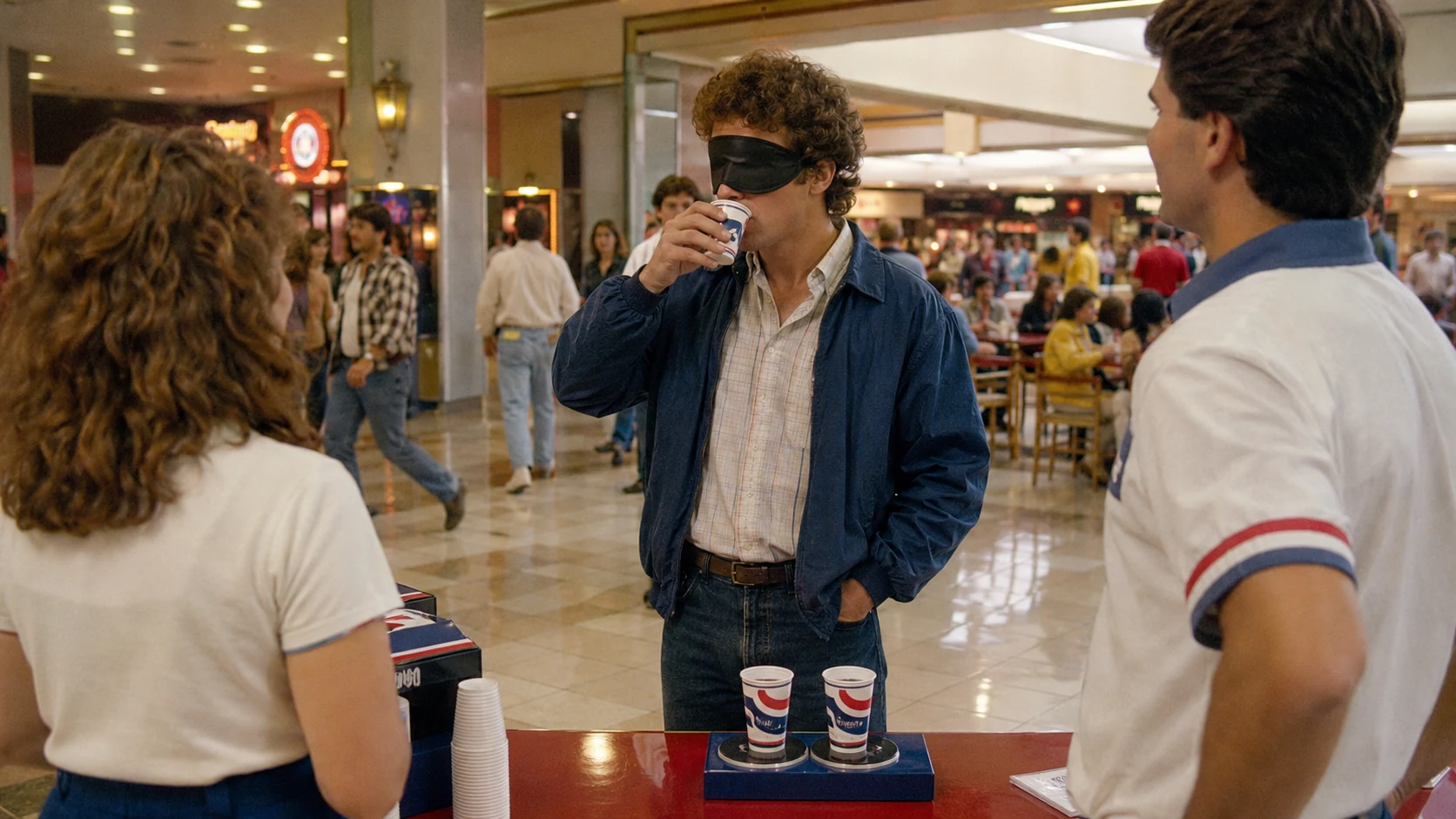
The Pepsi Challenge arrived during a period when national television could make one advertising idea familiar to nearly everybody. Then Pepsi added physical distribution to the memory. The campaign did not stay inside the commercial break; it appeared in the same malls, supermarkets and shopping centers where Gen X spent ordinary weekends.
That combination mattered. The television spots taught people the ritual before they ever reached the sampling table. When a live Pepsi Challenge appeared in public, participants already knew how the scene was supposed to unfold. The brand had turned a commercial format into a real-world attraction.
Television supplied the script
The commercials made the cups, choice and reveal familiar enough that no long explanation was necessary.
The mall supplied the setting
A routine shopping trip could suddenly include a small piece of a national advertising campaign.
People supplied the stories
Every participant left with a personal result they could repeat to friends and family.
Other commercials created characters and fantasies. The California Raisins became full-scale pop-culture celebrities, while the decade’s commercial mascots turned product pitches into recurring cartoons. The Pepsi Challenge did something more stripped down: it made the consumer the character.
The 1982 Pepsi Challenge commercial worked because the campaign made comparison feel personal. Two cups turned the Cola Wars into a decision anybody could make, and the public demonstrations gave millions of people a memory that belonged to them rather than to an actor. I knew which one was Coke. Somebody else picked Pepsi. Either way, Pepsi had already won the moment by getting both of us to take the test.
The Music, Movies, Television, Toys and Fads Around the Commercial
The Pepsi Challenge was only one part of a year filled with blockbuster movies, giant radio hits, network television, toy-aisle competition and early-80s fads. Keep the dial on 1982:
More 80s Commercials and Advertising Legends
Questions About the Pepsi Challenge
When did the Pepsi Challenge begin?
Pepsi launched the blind taste-test campaign in 1975. The commercial featured on this page comes from 1982.
How did the Pepsi Challenge work?
Participants sampled Pepsi and Coca-Cola from unlabeled cups, chose the drink they preferred and then watched the brands be revealed.
Were Pepsi Challenge tests held in real malls and stores?
Yes. Public sampling events in shopping areas helped make the campaign feel larger and more personal than an ordinary television commercial.
Did everyone choose Pepsi?
No. Pepsi highlighted favorable results in its advertising, but individual participants could and did choose Coke.
Why could a small-sip test differ from normal drinking?
A quick blind sample measures immediate taste preference. It does not measure the experience of finishing a full serving, purchasing habits or emotional loyalty to a brand.
Did the Pepsi Challenge lead to New Coke?
It was one important source of competitive pressure, but not the only cause. Coca-Cola’s own research, market-share concerns and broader strategy also shaped the 1985 formula change.
When did Coca-Cola bring the original formula back?
Coca-Cola announced the return of the original formula as Coca-Cola Classic on July 11, 1985, 79 days after New Coke launched.
Why does Gen X remember the campaign so strongly?
Heavy television exposure combined with real public taste tests, giving people both a shared commercial memory and a personal story about which cola they chose.
Historical Sources
Campaign dates and the New Coke history in this feature were checked against brand archives and independent historical reporting.