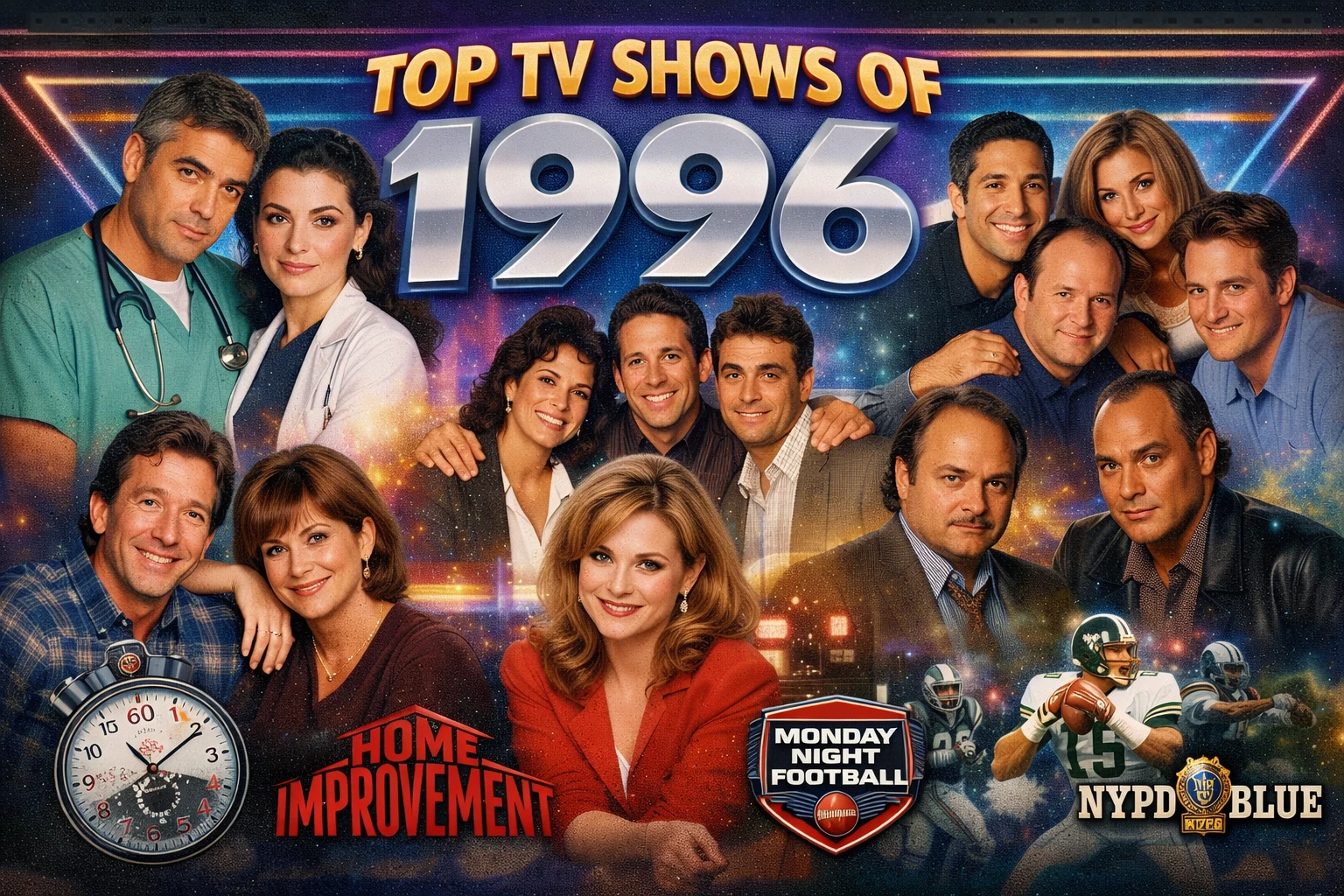
Top TV Shows of 1996: The Biggest Nielsen Hits Ranked
The top TV shows of 1996 feel like the moment mid-90s television fully hits commercial overdrive. By now, the old broadcast system is still strong enough to produce gigantic national hits, but the center of the conversation has shifted decisively toward faster, sharper, more personality-driven programming. The 1995–96 season is led by ER at #1, with Seinfeld right behind it, and that one-two punch tells you almost everything you need to know about where mainstream television was heading: more adrenaline, more confidence, more edge, and a lot less patience for blandness.
For Gen X, the biggest TV shows of 1996 were not just background noise. They were a snapshot of the last great broadcast monoculture: emergency-room chaos, ironic sitcoms, friend-group comedy, live sports, gritty police drama, and family sitcom comfort all competing inside the same national living room.
1996 Means the 1995–96 Nielsen Season
This series assigns each television season to the year in which it ended, so the 1996 list reflects the official 1995–96 network rankings.
Quick List: 1996’s Biggest TV Shows
- #10 NYPD Blue
- #9 60 Minutes
- #8 Boston Common
- #7 Home Improvement
- #6 The Single Guy
- #5 Monday Night Football
- #4 Caroline in the City
- #3 Friends
- #2 Seinfeld
- #1 ER
Keep Rewinding 1996
If 1996 proved anything, it was that the culture could still share one giant room while sounding faster, sharper, and more split by tone inside it. Prime time had sarcasm, high-speed drama, sports ritual, city-life comedy, gritty police work, and broad family appeal all landing at once. But television was only one part of the year. Radio was stacked with crossover hooks and R&B polish, while the movies had enough range to make adult suspense, crowd-pleasing spectacle, and star-driven box office all matter at the same time.
Here’s the rest of the 1996 cluster and the surrounding 90s TV trail — the pages that belong with this countdown if you want the full rewind instead of just the prime-time slice, including the toy aisle that was busy losing its mind over Elmo, Nintendo 64, Beanie Babies, and Bop It.
Countdown: The Top TV Shows of 1996
Every show in this year’s Top 10 now connects to a deeper Smells Like Gen X feature. Look for the Keep Watching link inside each entry to move from the 1996 Nielsen snapshot into the bigger story.
#10 — NYPD Blue
Official Nielsen Rank: #10NYPD Blue rounding out the top 10 in 1996 is a strong reminder that network drama had fully entered a rougher, more adult phase by the middle of the decade. The show was no longer just the edgy exception or the buzzy controversy magnet. By the 1995–96 season, it had become a normalized part of mainstream success. That matters because it shows how much the audience had adapted to a different dramatic texture: less polished, more volatile, more urban, and more openly interested in moral mess.
What made NYPD Blue important in this particular season is that it held its place in a lineup dominated by velocity. ER was running on medical panic and momentum. Seinfeld was refining social irritation into elite comedy. Friends was building chemistry into mass appeal. Against all that, NYPD Blue still mattered because it brought adult dramatic grit into the upper tier. It helped make mainstream television feel less tidy.
For Gen X viewers, NYPD Blue was one of the shows that made 1996 television feel less sanitized and more emotionally jagged. If you are looking back at the top TV shows of 1996, this series matters because it captured a version of network drama that felt restless, urban, adult, and distinctly mid-90s.
#9 — 60 Minutes
Official Nielsen Rank: #960 Minutes at #9 is one of the best reminders that even in a season dominated by quick-hit comedy and high-speed drama, broadcast television still retained a serious public center. By 1996, the program was no longer living at #1 the way it had in some earlier seasons, but staying in the top 10 at all is remarkable when you consider what it was competing against.
Its ranking tells you something important about the shape of the medium. Mid-90s television was getting more restless, more segmented by tone, and more clearly organized around event or buzz, but millions of viewers were still showing up for the sober promise of reporting, interviews, and consequence.
Any honest look at the top TV shows of 1996 has to make room for the fact that Gen X audiences still lived in a television culture where hard journalism could sit beside sitcoms and sports at the top of the ratings. That is what makes 60 Minutes so important in a 1996 TV post.
#8 — Boston Common
Official Nielsen Rank: #8Boston Common at #8 is one of the most revealing rankings in the entire 1996 lineup because it captures how much scheduling power and network momentum still mattered in the Must See TV era. Today it is not one of the first shows people name when they think about 90s television, but that is exactly why its ranking is so interesting.
Part of that story is proximity. NBC in 1995–96 was an absolute machine, and a show could benefit enormously from being placed inside a lineup people already treated like required viewing. But that does not mean Boston Common was accidental. It means it fit the environment well enough to convert exposure into actual audience loyalty.
From a Gen X point of view, Boston Common helps explain how 1996 television felt when Must See TV was running at full power. The era was not built only by the most quoted series. It was also built by the supporting hits that made NBC’s comedy lineup feel unbeatable from top to bottom.
#7 — Home Improvement
Official Nielsen Rank: #7By 1996, Home Improvement dropping to #7 does not mean it had lost importance. It means the field around it had gotten more aggressive. The show was still one of the biggest things on television, and that matters because it confirms how durable its brand of broad suburban family comedy remained even as sharper, more urban, or more youth-oriented programming kept gaining ground.
What made Home Improvement so commercially durable was scale. It did not just tell family stories. It turned family comedy into performance. The tool-show framing, Tim Allen’s oversized persona, and the show’s big, accessible comic beats made ordinary domestic life feel larger than life.
For Gen X audiences in 1996, Home Improvement represented the suburban family-comedy lane at full commercial strength. It belongs in any serious discussion of the top TV shows of 1996 because it proves that even as the culture leaned harder into sarcasm, singles comedies, and faster dramas, there was still enormous mainstream appetite for broad household humor.
#6 — The Single Guy
Official Nielsen Rank: #6The Single Guy at #6 is another excellent example of how strong NBC’s mid-90s comedy machinery really was. Like Boston Common, it is not necessarily the first title people remember when they think back on 1996, but the Nielsen ranking makes clear that it was a very real part of the season’s upper tier.
What the show represents is the increasing commercial strength of single-life sitcom framing in the middle of the decade. The emotional center of television had shifted away from purely family-based formats. Dating, urban adulthood, peer interaction, and lifestyle-based comedy were now major network business.
If you want to understand how Gen X television was changing by 1996, The Single Guy is a useful piece of the puzzle. It reflects the growing commercial power of dating, peer-group, and city-life comedy inside the mainstream network system.
#5 — Monday Night Football
Official Nielsen Rank: #5Monday Night Football at #5 is the season’s giant reminder that live event television still held an extraordinary advantage over everything else on the dial. As scripted television got faster, more stylish, and more competitive, sports still had the one thing no sitcom or drama could fake: real-time urgency.
Its placement in 1996 is especially important because this is a season often remembered for NBC comedy dominance, yet football still cut straight through that conversation and landed in the upper tier anyway. That tells you how much the medium still depended on ritual and simultaneity.
For Gen X viewers, Monday Night Football was not just another program in 1996. It was part of the weekly ritual of American television. In a season full of huge scripted hits, football still had the unmatched advantage of urgency, spectacle, and real-time national attention.
#4 — Caroline in the City
Official Nielsen Rank: #4Caroline in the City finishing #4 is one of the more surprising but revealing facts of the 1995–96 season. In hindsight, it can feel overshadowed by Seinfeld, Friends, and ER, but its official placement proves it was not just along for the ride. It was one of the biggest shows in America.
The show also sits in an interesting place culturally. It reflects the growing commercial value of young-adult and single-life comedy, but in a somewhat brighter, broader, more traditional network form than Seinfeld’s sharper irony. That made it useful to the lineup.
Caroline in the City helps show that Gen X TV in 1996 was not just about the biggest legacy titles. It was also about the expanding power of city-centered, single-adult sitcoms that felt stylish, accessible, and built for NBC’s comedy empire.
#3 — Friends
Official Nielsen Rank: #3By 1996, Friends at #3 means the show is no longer just a breakout. It is an elite mainstream institution. That shift matters because it confirms that the friend-group ensemble had fully broken through as one of the defining storytelling formats of the decade.
What made Friends so powerful in this season was the way it sold youth-adult life as warm, attractive, and emotionally central. The show’s world was built around chosen family rather than traditional family, and that was a major reorientation for network sitcom storytelling.
Few shows say Gen X and 1996 quite like Friends. It is one of the most important entries in the top TV shows of 1996 because it helped redefine what mainstream adulthood looked like on television. Friendship, dating, apartments, work frustration, and chosen-family chemistry became the emotional center of the story.
#2 — Seinfeld
Official Nielsen Rank: #2Seinfeld at #2 in 1996 means it had not slipped from cultural dominance even though ER edged it out in the ratings. In practical terms, the show was still one of the central defining forces of the medium.
The show’s importance in this season is not just that it stayed huge. It is that it solidified a different theory of sitcom success. Seinfeld proved that observational discomfort, petty social friction, and characters who often refused sentimental improvement could not only work, but dominate.
In any discussion of the top TV shows of 1996, Seinfeld has to be treated as one of the essential Gen X texts of the decade. By 1996, it had already proven that mainstream comedy could thrive on irritation, awkwardness, irony, and the petty absurdity of everyday life.
#1 — ER
Official Nielsen Rank: #1ER finishing #1 in 1996 is one of the most important television facts of the decade. In just its second season, it became the top-rated show in America, which tells you how thoroughly it had captured the culture’s appetite for speed, intensity, and ensemble momentum.
What made ER such a powerful #1 is that it combined multiple kinds of appeal at once. It had action. It had youth appeal. It had workplace urgency. It had overlapping emotional arcs. It had a high-pressure environment that made every episode feel kinetic before you even got to the character drama.
If Seinfeld defined one side of the Gen X television sensibility in 1996, ER defined the other: speed, intensity, urgency, and emotional overload. As the #1 entry on a list of the top TV shows of 1996, it matters because it showed how dramatically network storytelling had accelerated by the middle of the decade.
Rewind Verdict
The top TV shows of 1996 reveal a broadcast system operating at peak mid-90s efficiency. ER takes the #1 spot and confirms that urgency, ensemble drama, and momentum have become core mass-audience values. Seinfeld remains a giant and keeps irony at the center of American comedy. Friends becomes elite-tier mainstream TV. NBC’s broader sitcom bench, including Caroline in the City, The Single Guy, and Boston Common, shows just how overwhelming its comedy ecosystem had become.
ABC still holds major territory through Monday Night Football, Home Improvement, and NYPD Blue. CBS keeps its institutional foothold with 60 Minutes. That is what makes 1996 such a strong Gen X TV year. The monoculture is still intact, but it has become faster, sharper, and more stylistically split.
If 1995 felt like mid-90s TV hitting stride, 1996 feels like it hitting top gear.
FAQ: Top TV Shows of 1996
What were the most popular TV shows in 1996?
The most popular TV shows in 1996 included ER, Seinfeld, Friends, Caroline in the City, Monday Night Football, The Single Guy, Home Improvement, Boston Common, 60 Minutes, and NYPD Blue.
Why does this 1996 post use the 1995–96 season?
Because this series uses the Nielsen season ending in that year, so the 1996 post is based on the 1995–96 television season.
What was the #1 TV show of 1996?
For the 1995–96 Nielsen season, ER finished at #1.
Was Seinfeld still huge in 1996?
Yes. Seinfeld finished #2, just behind ER, and remained one of the defining sitcoms of the 1990s.
Did Friends already become one of the biggest shows on TV by 1996?
Yes. Friends finished #3 in the 1995–96 season, confirming it had already become a top-tier mainstream hit.
Which network dominated the 1995–96 season?
NBC had the strongest overall top-tier presence, with ER, Seinfeld, Friends, Caroline in the City, The Single Guy, and Boston Common all inside the top 10.
Why do the top TV shows of 1996 matter so much for Gen X nostalgia?
Because the biggest shows of 1996 capture several major parts of the Gen X TV experience at once: fast network drama, ironic sitcoms, friend-group comedies, sports event viewing, gritty police drama, and the last great era of true broadcast monoculture.