Top TV Shows of 1974: The Biggest Nielsen Hits of Prime Time
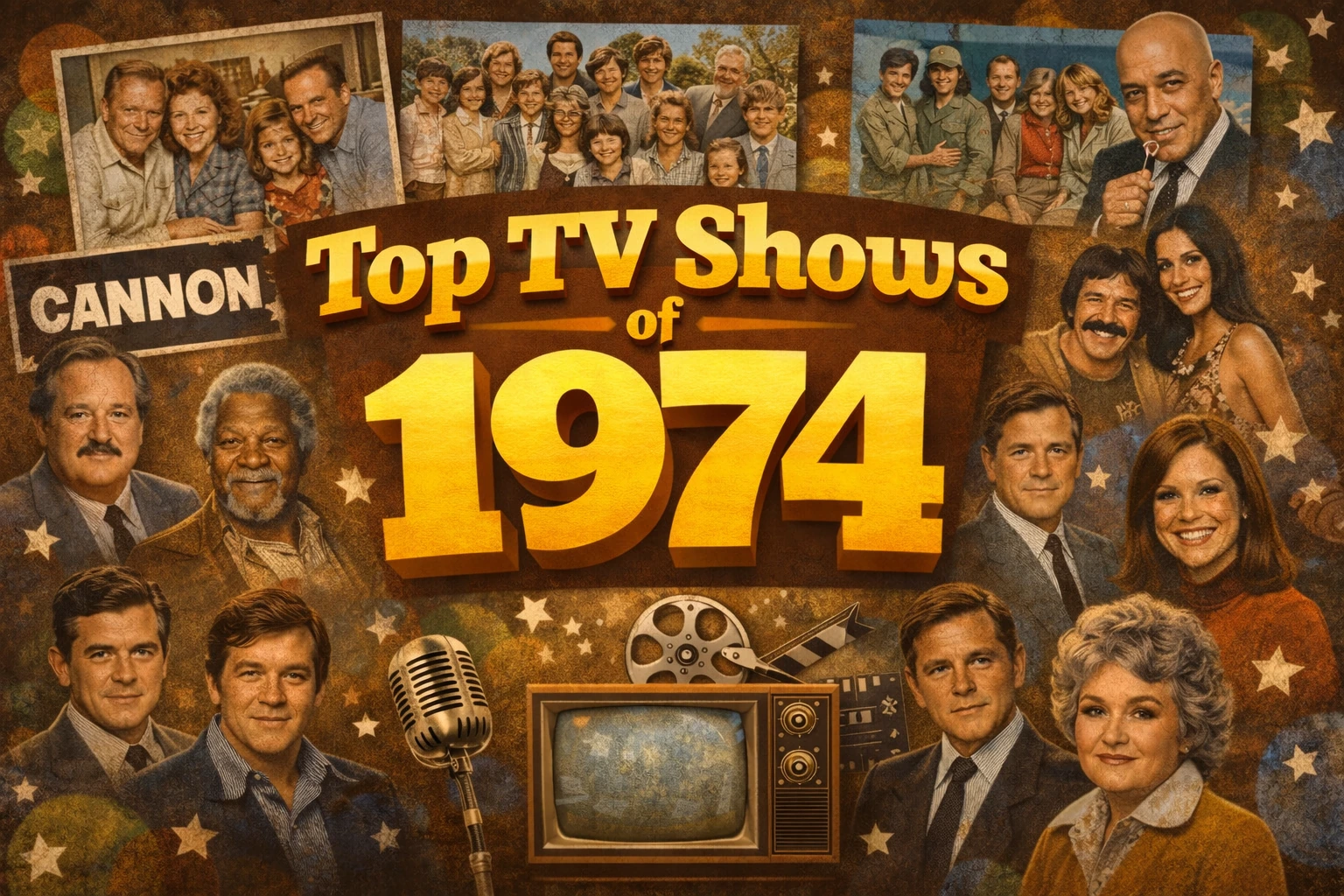
The Top TV Shows of 1974
The top TV shows of 1974 make the early 70s shift feel completely finished. Prime time is no longer cautiously experimenting with sharper comedy, urban drama, or ensemble storytelling. It has fully committed. The biggest hits now include socially combustible sitcoms, emotionally richer family drama, prestige comedy, and sleek crime shows that feel more modern than the television that ruled just a few years earlier.
This countdown uses the 1973–74 Nielsen season, which is the standard reference point for the top TV shows tied to 1974. What makes this year especially fascinating is how thoroughly one network controlled the board. CBS practically turned the top 10 into company property, while NBC managed a single breakout with Sanford and Son. The result is one of the most concentrated and recognizable snapshots of 70s television power.
Browse the series: 1970s TV Hub | 1970 | 1971 | 1972 | 1973 | 1974 | 1975 | 1976 | 1977 | 1978 | 1979
Gen X note: 1974 is the year where 70s prime time feels completely settled into its own skin — sharper sitcoms, richer ensemble shows, family drama with actual weight, and a network chart that looks nothing like the old rural-and-variety order.
#9 (tie) — The Mary Tyler Moore Show
Network: CBS
Format: Workplace sitcom
Official Nielsen Rank: #9 (tie)
The Mary Tyler Moore Show staying in the top tier in 1974 is one of the clearest signs that smart, urban, adult comedy was no longer a novelty. It had become part of the mainstream. This was a sitcom that trusted its audience to enjoy wit, awkwardness, ambition, and emotional realism without flattening everything into a broad family-friendly formula.
What made the series so durable was its tone. It never needed to shout to feel modern. It simply assumed adulthood was interesting. Work mattered. Friendship mattered. Independence mattered. That made the comedy feel contemporary in a way that still reads fresh decades later.
In the broader 1974 picture, The Mary Tyler Moore Show represents the maturing of the sitcom itself. Prime time comedy could now be warm, sharp, and grown-up all at once — and audiences rewarded it.
#9 (tie) — Cannon
Network: CBS
Format: Detective drama
Official Nielsen Rank: #9 (tie)
Cannon tying for #9 shows just how strong the detective-and-crime lane remained in the middle of the decade. This was not background filler. It was part of the core ratings machinery. Viewers clearly still wanted weekly mysteries, adult stakes, and a commanding lead who could hold the whole structure together.
What makes Cannon interesting in this lineup is that it sits alongside much sharper sitcoms and more emotionally layered ensemble shows without feeling out of place. That tells you the genre had become a stable pillar of 70s prime time. Crime drama was no longer the alternative to the mainstream. It was the mainstream.
In the full story of 1974, the show helps explain why CBS dominated so completely. The network was not winning with just one kind of series. It was winning across multiple lanes, and detective drama was one of its strongest weapons.
#7 (tie) — Kojak
Network: CBS
Format: Crime drama
Official Nielsen Rank: #7 (tie)
Kojak tying at #7 is exactly the kind of result that makes 1974 feel locked into the decade’s real personality. Crime drama is no longer just procedural routine. It now has attitude, urban texture, and a lead character strong enough to become part of the cultural atmosphere around the show.
That character force mattered. A show like Kojak did not live on plot mechanics alone. It lived on presence. The tone was tougher, the setting felt more immediate, and the whole series carried a kind of city-energy confidence that earlier television often lacked.
In the larger chart, it helps show why the mid-70s feel so different from the start of the decade. Drama is less frontier, less rural, less abstractly institutional. It is more contemporary, more urban, and more visibly of the moment.
#7 (tie) — The Sonny & Cher Comedy Hour
Network: CBS
Format: Variety / comedy
Official Nielsen Rank: #7 (tie)
The Sonny & Cher Comedy Hour tying for #7 proves that variety television still had real muscle in 1974, but it had to feel stylish and personality-driven to stay competitive. By this point, the old broad-variety template only survived if the people at the center could make it feel alive.
That was the advantage here. The show did not just offer sketches, guests, and music. It sold chemistry, timing, fashion, and a very specific kind of early-70s star appeal. In a season packed with sharper sitcoms and heavy CBS dominance, it still held its ground because it felt like an event.
In the bigger TV story, the show represents the last major wave of variety as a central mainstream force before other formats took even more control of the schedule.
#6 — Maude
Network: CBS
Format: Sitcom / social comedy
Official Nielsen Rank: #6
Maude holding the #6 spot confirms that sharp, outspoken, socially aware comedy was not a passing moment. The audience was clearly still showing up for sitcoms built on strong personalities, tension, and a refusal to pretend that every household in America agreed on how the world worked.
What makes the show so important in 1974 is that it had moved beyond novelty. This kind of comedy was now central to the prime-time ecosystem. Earlier network television often tried to smooth away sharp edges. Maude understood those edges could be the whole point.
In the broader season, its success helps explain why CBS had such a chokehold on the chart. The network was not simply repeating old formulas. It was successfully owning the newer, sharper ones too.
#5 — Hawaii Five-O
Network: CBS
Format: Crime drama
Official Nielsen Rank: #5
Hawaii Five-O at #5 is the sleek side of 70s television at work. It had procedural structure, yes, but it also had style, visual identity, and enough command presence to feel bigger than an ordinary weekly cop show. That combination made it one of the decade’s most durable hits.
Viewers in 1974 clearly wanted television that felt contemporary and distinctive, not just dependable. Hawaii Five-O delivered both. It had authority, momentum, and a setting that immediately made it feel like its own universe.
On this chart, the show helps demonstrate how the CBS lineup could cover so much ground. It had the big family dramas, the sharper sitcoms, and some of the strongest modern crime shows too.
#4 — M*A*S*H
Network: CBS
Format: Ensemble dramedy
Official Nielsen Rank: #4
M*A*S*H at #4 shows how much richer and more flexible television storytelling had become by 1974. This was not a simple sitcom, and it was not a straightforward drama either. It was something more elastic — funny, melancholy, character-driven, and sharp enough to feel emotionally smarter than a lot of earlier prime time.
That tonal flexibility is exactly why it matters so much in the story of the decade. Television was learning that audiences could handle more than one emotional register at a time. M*A*S*H could be witty, weary, human, and chaotic without losing its audience. In fact, that complexity helped make it bigger.
On a chart already filled with socially sharper comedy and prestige family drama, the show marks another major turning point: the rise of the ensemble dramedy as one of television’s most powerful forms.
#3 — Sanford and Son
Network: NBC
Format: Sitcom
Official Nielsen Rank: #3
Sanford and Son taking #3 — and standing as the only non-CBS entry in the top 10 — is a huge statement. The show was not just a hit. It was NBC’s proof that rougher, louder, more character-clash-driven comedy could punch straight through a schedule otherwise controlled by a rival network.
The comedy worked because it never depended on smoothness. It lived on irritation, rhythm, ego, and verbal collisions. That energy felt very different from the cleaner family-sitcom tradition that had dominated earlier TV, and by 1974 that difference was a massive advantage.
In the bigger story of the season, the show also serves as a reminder that even in a year of near-total CBS domination, one truly electric format could still carve out major space.
#2 — The Waltons
Network: CBS
Format: Family drama
Official Nielsen Rank: #2
The Waltons at #2 is one of the most revealing placements on the entire chart because it proves that even in a decade getting sharper and more modern, audiences still made room for emotionally earnest family storytelling. This was not retro comfort as background noise. It was one of the biggest shows in the country.
What made the series so powerful was its sincerity. It offered warmth, family scale, hardship, and moral feeling without becoming flimsy. In a season full of louder and more argumentative hits, The Waltons represented a different kind of emotional pull — one built on closeness, memory, and decency rather than confrontation.
Its position at #2 also helps explain how broad CBS’s control really was. The network was not just winning with one style. It was winning with multiple emotional registers at once.
#1 — All in the Family
Network: CBS
Format: Family sitcom / social comedy
Official Nielsen Rank: #1
All in the Family staying at #1 makes the point better than anything else on the chart: by 1974, the decade’s defining television revolution was not emerging anymore. It had fully taken control. The biggest show in America still ran on conflict, discomfort, class tension, generational collision, and the refusal to pretend families were simple.
What makes the show so potent is that it does not survive on controversy alone. It works because the structure is airtight and the characters are strong enough to make all that friction funny, watchable, and recognizably human. Audiences were not just showing up for provocation. They were showing up because the show felt truer to real life than the older tidy-network formulas.
In the story of 1974 television, All in the Family is still the flag on top of the hill. The 70s are not just here. They are fully in charge.
The Rewind Verdict
The top TV shows of 1974 are a perfect snapshot of mid-70s power television. All in the Family still rules. The Waltons proves emotional family drama can be just as dominant as sharper comedy. Sanford and Son remains a comedy powerhouse. M*A*S*H shows the rise of ensemble dramedy. And CBS, frankly, owns nearly the entire board.
That is what makes this year so useful in the series. It is not just about the rise of new formats. It is about consolidation. The 70s style of television is no longer fighting for room. It already has the room. Now the question is which versions of that style are strongest: social comedy, family drama, crime swagger, or emotionally richer ensemble storytelling.
For Gen X, 1974 is one of those years where the decade’s TV DNA is impossible to miss. It is all here, and most of it is coming from one network.
FAQ
What was the most watched TV show of 1974?
According to the 1973–74 Nielsen season, All in the Family was the #1 TV show tied to 1974.
What was the #2 TV show of 1974?
The Waltons ranked #2.
Were there ties in the top TV shows of 1974?
Yes. There was a tie at #7 between Kojak and The Sonny & Cher Comedy Hour, and another tie at #9 between The Mary Tyler Moore Show and Cannon.
Which network dominated the top TV shows of 1974?
CBS dominated the season, placing 9 of the 10 programs in the top 10.
Why does this post use the 1973–74 season for 1974?
Because television popularity was measured by season rather than calendar year. For year-based nostalgia rankings, the season ending in that year is the standard reference point.
What makes 1974 such a strong TV year?
It is a year of consolidation: socially sharper sitcoms, prestige family drama, ensemble dramedy, and urban crime series all coexist at the top, with CBS dominating across nearly every format.
Get the Weekly Gen X Drop
New videos, rewinds, and savage nostalgia — first.
JOIN THE NEWSLETTER WATCH VIDEOS